image_pdfimage_print

All posts by robert

A Post-card and The Clew

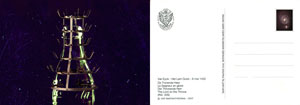
I. Readymade Postcard of Readymade Art

click image to enlarge

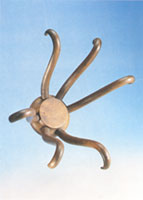
Post-card is the result of joining 3 ‘readymades’ by analogy: Duchamp’s Bottle Dryer, the Coca-Cola bottle, and a postcard of “Christ Enthroned” by Jan Van Eyck (also objects produced in series, although with different aesthetic intentions). In this way, the juxtaposition of 3 powerful icons (one of them invisible, only referred to in the postcard) activates their corresponding connotations: industrial, cultural, and religious. The stamp, another readymade, is a spiraling galaxy that sends the postcard to a more ‘scientific’ dynamic level (optic disks, View, etc).

II. The Clew

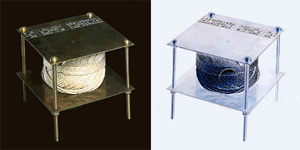
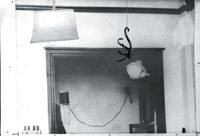
A visual interpretation of Marcel Duchamp, A Bruit Secret [With Hidden Noise] 1916, in a sequence of seven images.

click image to enlarge


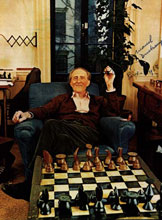
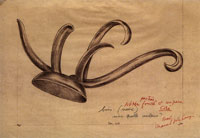
Figs. Bottle Dryer, With Hidden Noise, Chessboard, Note
© 2005 Succession Marcel Duchamp, ARS, N.Y./ADAGP, Paris. All rights
reserved.

BELLE da COSTA GREENE A Biographical Sketch of a Friend & Acquaintance of Aleister Crowley

Response to Bonnie Jean Garner,Duchamp Bottles Belle Greene: Just Desserts For His Canning

Editor’s Note: we found the letter below on the Internet,and asked its author, Steve Jackson, to allow its publication.

Letter on Crowley and Greene,written from Steve Jackson, to Jerry and Marlene

Dear Jerry and Marlene,

My compliments on your excellent web site. I’m researching Crowley’s activities in America from 1914 to 1919, And think that I may be able to add a few names and some additional information for your list of Friends and Acquaintences.


click to enlarge
Belle Green
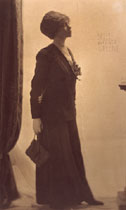
Figure 1

Among the numerous women mentioned by Crowley in his Magical Record of the Beast, May 31, 1920ev, is the name Belle Green. This is almost certainly Belle da Costa Greene (Fig. 1), J.P. Morgan’s librarian.Bonnie Jean Garner describes her thus: “Belle Greene became J.P. Morgan’s librarian in 1905, and following his death she became the director of his library, working there for a total of forty-three years. Empowered by J.P. Morgan, and then by his son Jack, Greene spent millions of dollars buying and selling rare manuscripts, books and art. She travelled frequently and lavishly to Europe, staying at the best hotels — Claridge’s in London and the Ritz in Paris. It was even said that “on trips abroad, made on Morgan’s behalf, she would take along her thoroughbred horse, which she rode in Hyde Park.” Belle Greene was described as beautiful, sensual, smart and outspoken. One author writes that “she daringly posed nude for drawings and enjoyed a Bohemian freedom.” Never married, she favored affairs with rich or influential men, with a focus on art scholars. Another scholar states, “her role at the Morgan Library placed her at the center of the art trade and her friendship was coveted by every dealer.” For many years, Belle Greene wielded an astounding amount of power in the art world and moved comfortably in elite social circles… Belle Greene was a black woman who denied her color to pass herself as white. Evidence indicates that whispers and rumors about her passing circulated around her throughout her life. People like Isabella Gardner, society patron of the arts with close ties to Harvard and a peer of Morgan’s, wrote that Belle Greene was a “half-breed” in a private letter (1909) to Bernard Berenson and his wife, Mary, saying, “But first you must both swear secrecy. If not, please do not read anymore of this.”…. In order to pass, Greene and her mother decided to change their name. (Actually, you could say that they altered their label.) They added “da Costa,” claiming to be part-Portuguese to account for their dusky appearance, a common strategy used for passing. True to the rumors, not only were they black passing for white, but Belle Greene’s father was the distinguished lawyer and public figure, Richard Theodore Greener, the first black undergraduate to receive a degree from Harvard.”

The Morgan Library is located at 29 East 36th Street in New York, just two blocks from Crowley’s residence during most of 1915. Belle Greene (and J.P. Morgan, for that matter) were familiar with lawyer and art patron John Quinn, who had befriended Crowley when Crowley arrived in America, and supported him financially by purchasing copies of Crowley’s books. As Garner shows, Quinn was able to find some sort of employment for the French futurist Marcel Duchamps, when Duchamps arrived in New York in 1915, by using his influence with Greene, who was acting as paymaster for Morgan. This arrangement with Duchamp did not last long, and seems to have inspired one of Duchamps “readymades”, as Garner demonstrates in her essay, “Duchamps Bottles Belle Greene: Just Desserts For His Canning“.

If I am correct, Quinn did a similar favor for Crowley. Both Quinn and J.P. Morgan were pro-British regarding the war. If Crowley had been sent “on a mission” by some branch of British Intelligence, it is not unlikely that he would receive a warm welcome, and some form of financial backing, as he infiltrated the German propaganda machine in America, passing himself off as a traitor to England.

Crowley himself said about this trip, “I had intended, when I left England, to conclude my special business in New York within a fortnight, to make a little splash in any case, and to get home in a month on the outside.” In spy jargon, assassination is sometimes referred to as “wet work”.

That’s all for now. Got more if you want it. I’d be very interested in hearing any comments you may have.

Thanks, and good health.

Steve
http://www.redflame93.com/Greene2.html

Afterword from Steve Jackson
follwing our request for publishing his letter

I have been researching the subject of Aleister Crowley’s activities in America during the years of the “Great War” for some time, and had already suspected that he had received sponsorship and/or employment with J.P. Morgan. And, learning that Duchamp was in New York at the same time, I wondered if the two might have met, since they both were friendly with John Quinn. Bonnie Jean Garner’s revelations about the relationship between Duchamp and Belle Greene seem to parallel Crowley’s experience, though Crowley seems to have lasted somewhat longer on the Morgan payroll.

Crowley was in America acting as an agent of the British Government, as was John Quinn. J.P. Morgan was the chief financial agent for the British Government in the US, and was likely sponsoring Crowley’s Intelligence work. Since Crowley was attempting to infiltrate the Irish revolutionary movement in America, and succeeded in infiltrating the pro-German “Propaganda Cabinet” of George Sylvester Viereck, it was important for Crowley to keep his distance from Morgan. At least publicly. Perhaps the J.P. Morgan Library was being used to quietly channel funds to Crowley.

To speculate further, it is at least possible that Morgan had his own private Intelligence Department, dedicated to helping the Allied cause. Other contemporary plutocrats, such as the rubber baron Thomas Fortune Ryan and arms magnate Sir Basil Zaharoff, employed spies like Claude Dansey and Sidney Riley. With the responsibility of providing the British (and French) with the sinews of war, Morgan could scarcely do less. And who better to run such a private Intelligence Department than the formidable Belle Greene?

And so I wonder about Duchamp’s employment with the Morgan Library. Is it possible that he, like Crowley, was on some secret mission in America? I realize that Duchamp may seem like the most unlikely of spies, but successful agents are usually unlikely suspects.

Once more, my compliments on your fine publication, and to Bonnie Jean Garner for her brilliant detective work.

Excels

I am currently studying for my BFA (Visual Arts) after having a very prestigious previous career as an academic in a very different disciplinary area (I have held three Chairs which I think translate to Full Professor in the USA). My background as a senior researcher has made me extremely skeptical of online journals. What an absolute pleasure to find ‘tout-fait’. It is a rare production of standards that excel. I shall be visiting the journal pages very regularly from now on as I find this one of the best research resources around – online or on newsstands/library shelves/book store shelves.

Thank you for your generosity on making such a high standard resource available so widely and doing this so professionally.


By the way of Herne Bay (a biographical note)

A dada creation of Teste, not the least chimeric, was to want to preserve art – Ars – purely by eradicating illusions about the artist and the creator”
Paul Valéry
(For a portrait of Monsieur Teste)


A Provisional Portrait

He was courteous, articulate, cultivated. At least, one would imagine so. He practiced understatement, liked humor as well as irony. He kept himself at a distance, always in the wings, and would not provide his opinion. On the edge of the circus of the vanities, here was the opposite of a man of letters, of a student of the mind.

The hell raisers of modern art made him the father of the revolution which redefined taste in the 20th century, without really knowing how he was influenced by Alphonse Allais and how similar he was to Ravachol or Kropotkine.

The fact is that this discreet, elegant man, practicing the subtle art of conversation instigated change. He was invited, celebrated in the most elegant circles, and people didn’t pay much attention to the crowd of roustabouts who, following him, invited themselves to the party.

After the patrons, came the institutions. In February 1977, for its opening, the Centre Georges Pompidou chose to celebrate him. This was a watershed event(1).It posed the question of the century: What is art? – And it chose to answer by brushing aside the heroes that one expected to find, Matisse or Picasso(2). With Duchamp, the Minister of Culture had to have faith, with twenty-five

With Duchamp, the Minister of Culture had to have faith, with twenty-five years still to go before the end of the millennium, to favor an art that he believed was liberal, anarchic, democratic, an art for all and made by all, and which answered therefore to the aims of an enlightened State which had known only to suffer an existing elite. Every man is an artist. Every gesture is a work of art. Every work of art can be anything at all.
The fact is that legions of slackers, hearing of artists out there without an oeuvre, without talent or profession, identified themselves with Duchamp, more or less. However, in their actions, their writings, their manifestations, the simplicity turned into misery; the subtlety, a heaviness; intelligence became stupidity; irony, slowness; allusion, crudeness, and finally the meticulous and mercurial method of “le marchand du sel” [Duchamp pseudonym] gave way to a plethora of productions by artists by the grosse, without spirit and without style.
Duchamp remained a silent witness to this phenomenon. He, who had carried on so little, written so little, and who had never taken credit for the result, with an amused smile, allowed the dream world of an avant-garde to become the palladium of fin de siècle societies.
There had been, without a doubt, a mistake about someone.
An Aristocratic Failure*
What was it exactly about the nihilism of Marcel Duchamp? What was the sense in his renouncing painting? By way of what did this transformation of values, this Nietzschian enterprise to which he attached himself, have some of the characteristics of the tabula rasa of the avant-garde at the beginning of the century?
By way of nothing, perhaps. The last of the decadents became, against his will, the first of the moderns.

* * *

Hannah Arendt saw and described that which in the first decade of the century bound modernity with totalitarianism. Contemporary artists during the First World War for the most part shared in “the desire, she said ‘to lose oneself’ and a violent disgust for all existing criterion, for all established powers. […] Hitler and those who were failures in life weren’t the only ones to thank God on their knees when the mobilization swept Europe in 1914.(3)” The elite also dreamed of coming to terms with a world it considered corrupt. The war would be a purification for all, the tabula rasa of values which enabled belief in a whole new humanity. An entry into nihilism, for sure, was this rejection of a society saturated with ideology and bourgeois morality: “Well before a Nazi intellectual announced, ‘When I hear the world culture, I draw my gun,’ the poets had proclaimed their disgust for this ‘cultural filth’ and poetically invited ‘Barbarians, Scythes, Negroes, Indians, Oh! All of you, to the stampede.’(4)

” This rage to destroy what civilization had produced as more refined, more subtle, more intelligent, “The Golden Age of Security” according to Stefan Zweig, but also to destroy this world which celebrated, in 1900, the triumph of scientific progress and humanitarian socialism, was shared by artists and intellectuals as well as terrorists from all sides, from the Nazis to the Bolsheviks. In the cafés of Zurich, Huelsenbeck and Tristan Tzara were mixing with, at neighboring tables, Lenin and the future trigger-happy political commissioners.

* * *

Still more recently, Enzensberger recalled some facts that France, sole remaining nation managing the arts in Europe, continues to ignore. “From Paris to Saint Petersburg, the fin de siècle intelligentsia flirted with terror. The premier expressionists called [it] the war of their wishes, just like the futurists […]. In large countries, the cult of violence and the ‘nostalgia for mud’ in favor of industrializing the culture of the masses, became an integral part of heritage. Because the notion of the avant-garde took an unfortunate turn, its first supporters would never have imagined...(5)

Let’s remember above all from Hannah Arendt the term “failures.” From Hitler, the regrettable candidate at the Academy of Beaux-arts in Vienna, to all those mediocre artists, poets and philosophers cultivating their resentment, failures hastened the twilight of culture.

Duchamp also, in a sense, was a “failure.” The feeling of failure – the idea of being a loser, a pariah, an outcast, a Sonderling or whatever leads a person to finding out at the age of fifteen or sixteen that they’re not in the “in” crowd – was most vivid. There was the social failure of being a notary’s son, an offspring of small-town bourgeoisie in a province that was already looked down upon on the eve of the First World War. There was the professional failure of his entrance examinations to the Ècole des Beaux-arts in 1905, which drove back the spirits of the young artist. There was the failure of the Salon des Indépendants in 1912, when his work was refused. So many wounds to narcissism.
But the most vivid failure remained family-related, when we see his ambition of becoming an artist thwarted by his own brothers, more talented than he. Jacques Villon was a good, sensitive painter and, more than that, an extraordinary engraver. Duchamp-Villon was a wonderful sculptor who, if he hadn’t been killed in the war, would have become one of the greatest artists of the century. Marcel, the youngest, was a menial, underpaid artist. How could he make a name for himself when his name was already taken?
Duchamp would be able in fact to serve as a perfect example to illustrate the argument, all the rage in the United States actually, that the youngest child is born to rebel. Put forth by Frank J. Sulloway, this argument tends to demonstrate on the basis of behaviors that the fate of great creators and reformers of society is dictated within the family dynamic by their birth order. While first borns identify in general with power and authority and have conservative personalities devoted to keeping their prerogative and resisting radical innovations, children born last weave a plan for turning the status quo upside down and often develop revolutionary personalities. “From this rank emerge the great explorers, the iconoclasts, and the heretics...(6)

In open rivalry with his older brothers, Duchamp would have been the prototype of the last born who, in order to dig his ecological niche, had the only alternative of radically upsetting the values advocated by his environment.

* * *

Even so, nothing about him was known to be resentful. Nothing more remote than the idea, common to intellectuals of the time, that individuals had to blend in with the masses to fulfill their destiny. Nothing about him would have been more disagreeable to consider than this comradeship in action of the masses which proposed to fell with violence the society it repulsed.
It was therefore by the love of irony and the daily practice of failing that he responded with his creative powerlessness. The homo ludens against the homo faber.
An accident of life, this feeling of being a failure – and that which was the result of it, his lofty distance from the inner circle – was leading him on the other hand to take note, at the start of the century, of a phenomenon which was elevating the universal. Few onlookers were yet alarmed by the situation, one without precedent in the venerable system of the beaux-arts. And Duchamp was one of the rare to acutely grasp that which others were refusing to admit: art – art such as we knew it, the art of painting, with its rules, techniques, and enslavement to style and schools, art with its status, social recognition, academies, salons, glory – had no reason to exist any longer. Art, an invention of the XVth century, had had its day…
What then had it meant “to succeed”? The previous generation had been able to believe in brilliant careers on the perimeter of respectable society. The studio of the painter who had “arrived” was part of the fashionable scene. But the fin de siècle artist was hardly more well-off than the colorful figure of the previous decades, uneducated, filthy, “stupid like a painter…”
Duchamp’s refusal never to let himself be seduced by the security of normal life and his scorn for the respectability and honors which accompanied this life were therefore sincere and very similar to the anarchic despair experienced by political explorers, by outcasts like Hitler. Without a doubt he didn’t escape, no more than any other, from an infantile proclivity for provocation. From the Indépendants to the Armory Show, he had not a few of these acts which recalled the violence of the time. His actual approach — so profound and so stubborn that it would define itself in the Large Glass, in the ready-mades, and later in Étant donnéswas of a wholly different nature. It was a matter less of shocking the bourgeoisie and destroying their culture than engaging himself in an intellectual adventure without precedent.
Anarchists, Dadaists, Surrealists and other dynamos of society: Duchamp was decidedly not of this group. Rather, his camp was that of the deserters. His departure for New York, at the beginning of the war, resembles Descartes’ departure for Amsterdam. To a cauldron of reflection, of daydreaming, far from the masses. Polite but reserved: he wasn’t there for anyone.
Max Stirner(7) , therefore, rather than Nietzsche or Sorel. The idea of the unique

pupil in advance of the obsession. Nothing owed to anybody and nothing repeating itself. There wasn’t any need of “getting lost” because, in the world which he had entered, there was already nothing else to lose. He was the first to understand that he belonged to a world “without art,” in the same way one speaks of a world “without history.” When he began his work, the death of art had taken place. In this respect, Duchamp is a survivor, not a precursor. He wasn’t preparing for the flood, he was exposing the conditions for survival.

From Decadence to Dandyism

The elegance of a dandy instead of the feigned untidiness of an anarchist. The lack of distinguishing adornments. To pass unnoticed was the distinction. This avoided the worst blows as well as applause. It was an attraction to the strict, the rigorous, the stripped down – “austere” was the key word for Duchamp’s aesthetic, just the right tone in English flannel and tweed, enveloped in the wreath of a good cigar.
The distance he put between himself and his press was always very British. Every one of his talks, interviews, and writings was subject to: “Never explain, never complain.” There was no theory to justify himself, no excuse to excuse himself. Such reserve was immediately sufficient to disconcert a questioner, to discourage the curious, to confuse the scholarly.
The style of this period was also, among the enlightened ones in London, Vienna, and Brussels, about American functionality. Duchamp’s admiration for the quality of plumbing in New York was right up the alley of Adolf Loos; everything, like not tolerating the rancid smells of turpentine trailing about in the studios, was in accord with the architect of theMichaelsplatz, with his disgust for the pastry shops in Ringstraße. (The taste for industrial modernity, for every last technical comfort in improving a home, was already, right away, a trait of the decadent such as des Esseintes.) Nothing “dadaist” in any case, rather an exquisite education, confronting the trivialities of the time.

* * *

No, his admiration had gone instead, one could say, to Mallarmé, Laforgue, Jarry, Alphonse Allais. From his direct elders. From “countries” of Norman descent also, in that this concerned the last two. A nihilism well tempered. The line of the symbolist comet. It would be convenient to add, come to mention it, Huysmans – and Remy of Gourmont, another Norman – whom we think about very little.

From des Esseintes to the “Breather”


click to enlarge
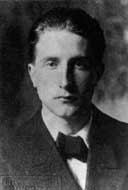

Marcel Duchamp

10. Heinrich Hoffmann,
Marcel Duchamp, 1912

Is it possible that Hitler and Duchamp crossed paths in Munich, in the smoky cabarets of Schwabing or in the Festsaal of the Hofbrauhaus? It’s slightly possible. When Apollinaire wanted a portrait of Duchamp to illustrate Les Peintres cubistes, Duchamp chose Heinrich Hoffmann, the #1 photographer of Munich who had come to immortalize the work of von Stuck and of Hildebrandt, ill.10. This is
the same Hoffman who, eleven years later, would become Hitler’s personal photographer(49).
The photographs that he made of Duchamp, in the pose of a speaker with his mouth shut, were, it’s been said, influenced by Erik Jan Hanussen, the famous European sage, seer, and astrologer, who would have taught Duchamp the art of body language(50).

* * *

This reference takes us back to the ambiguous capital in which avant-garde artists and political adventurers plunged indiscriminately. In 1912, Munich had in effect become the Haupstadt, the European capital of occultism(51). The Gesellschaft für Psychologie, established by the official Baron
von Prell and the doctor von Schrenck-Notzing, was then in full swing and multiplying its exchanges with the spiritual underworlds in England, Italy and France. Nor did the heart of the modernist scene in Munich pass unnoticed by Stefan George’s circle. Moreover, in the plastic domain, along with vson Stuck and Marées, who carried the symbolist generation, one of the most celebrated painters in Munich was Gabriel von Max who painted portraits of sleepwalkers and spirits. His brother, photographer Henrich von Max, took photos of mediums in trance that Gabriel then used in his tableaus. Here, we notice a coincidence with the use of auras and halos which Duchamp tried his hand in with, for example, Portrait de Dumouchel. In 1907, the annual meeting of the Theosophical Society met in Munich and, between 1909 and 1913, the Mysteries of Rudolf Steiner were regularly played there. The great anthropology master(52), who in 1913 broke away to distinguish himself from the theosophy of Blavatsky, also promoted, during these years, conferences which were assiduously
attended by Klee, Kandinsky, Jawlensky, Gabriele Münter and Marianna van Werefkin. Did Duchamp listen in? If this disciple was reading so attentively, to the point where he made particular notes in Du spirituel dans l’art, wouldn’t he have been tempted to listen to the master? Did he go to see the Alchemy museum, in the future Deutsches Museum, with its cornues threaded one into the other like the sieves of the Large Glass? Without a doubt, and much more. It was in Munich in any case that he discovered the theme of his Grand Oeuvre and it was in a frenzy that he multiplied his approaches which would one day turn into the Large Glass : Virgin (No. 1), Virgin (No. 2), Mécanique de la Pudeur, Pudeur mécanique, Passage of the Virgin to the Bride, Bride.
* * *
In search of a non-retinal art, capable of taking into account the invisible and its manifestations, Duchamp very naturally gravitated towards these “seekers” and found photography to be the new
medium which would permit him to materialize these new phenomena. In 1922, on Christmas Day, in the Brevoort hotel in New York, he wrote to his brother Jacques Villon: “I know a photographer here who takes photos of the ectoplasm around a male medium – I had promised to help him in one of
the seances and then got lazy but it would have amused me a lot.”
(53)
“Metarealism” had never really stopped fascinating the man who, in the “Pistons de courant d’Air,” had always meant to photograph ectoplasm.
It was this direction that I undertook to define in Duchamp et la photographie(54).
But the work, which appeared in 1977, had come too early. Enthusiasm for photography had not yet been born. Above all, in the Parisian climate, one wasn’t disposed to admit that occultism, theosophy and spirituality had fed the imaginations of modern painters more than Lenin’s work or the treatises of Rood or Chevreul. It would have to wait twenty-eight years and through a series of exhibitions that would begin in Los Angeles with The Spiritual in Art(55)and culminate in Frankfurt with Okkultismus und Avant Garde(56)in order to see this approach not only validated, but triumphing over others.
Much since then has appeared which reveals the immense influence of the irrational at the turn of the century on the birth of the avant-garde(57).

Two unpublished sources

A little more than twenty years ago, in 1977, I attempted to present the fertile ground of this vein without taking much risk and committing myself to it. To establish the approach of the avant-garde from its curiosity with the occult instead of its solidarity with the proletariat, this would have been too much of a shock for the doxaof modernism.

click to enlarge
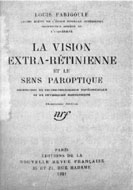
The cover of the book

11. The cover of the book by
Louis Farigoule, La Vision
extra-rétinienne et le sens
paroptique
, 1921

Color-Coded Chromatic Chess


Chess Game

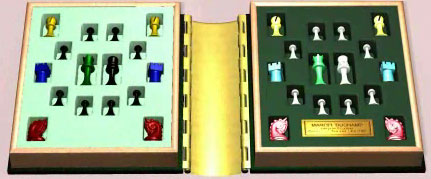
Please click on the still image for animated re-creation of Duchamp’s Color-Coded Chess Pieces;
Please click to start playing chess game immediately against the computer.
The first generation of Duchamp’s Color-Coded Chess Game has been created using computer chess program and 3 dimensional chess pieces that appropriate both Duchamp’s chess piece designs and proposed color system.
Created by Francis Naumann, with animation by Robert Slawinski and chess game appropriation by Sumeet Malik.


click to enlarge
2D and 3D chess pieces
Figure 1
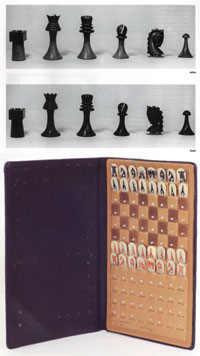
Duchamp created both 2D and 3D chess pieces during his lifetime. Chess Pieces of 1918-19 represents 3D designs (top), while Pocket Chess Set of 1943 illustrates his 2D chess pieces (bottom).


While living in Buenos Aires, Duchamp began to take the game of chess so seriously that he wrote friends to say that he was on the verge of becoming “chess maniac.” He reviewed various published games (especially those of Capablanca, the great Cuban world champion, whose play he idolized) and he relayed various game positions to correspondents by means of a stamp set that he designed and cut from small pieces of rubber. It may have been this process that inspired him to create a new three-dimensional set out of wood, designing the pieces himself. (Fig. 1)

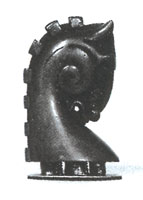
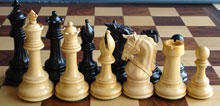
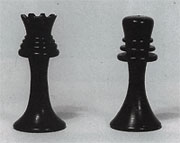
Although Duchamp has been credited in many scholarly publications (including my own) of having carved the pieces himself—except for the Knights, which he said were carved by a local craftsman—it has been recently pointed out that the other pieces are so precisely and mechanically produced that they were likely turned on a lathe by a professional machinist.(1) Larry List—an artist and curator who has studied this set quite carefully—has concluded that what probably actually took place was the reverse: the pieces were likely made by a local craftsman, while Duchamp carved the Knights entirely himself.(2) List also observed that “with their collars of stepped and tiered concentric disk forms,” the pieces bear a resemblance to the style of sets produced in the French Regency/St. George era. Indeed, although united by elegant tapering bases, the individual pieces are actually quite conventional, with the exception of the King and Knight (Fig. 2). The Knight is the piece that varies most greatly even in standard chess set designs, such as the Staunton Chess Set (1849) (Fig. 3), the most popular and widely used set to this day. Duchamp’s Knight creates a horse’s head out of a stylized Art Nouveau violin scroll, its mane punctuated by an even repetition of small squares (lending the overall design a Futurist appearance). His King displays a crown, but the cross that usually hovers above his head is missing, “my declaration,” as Duchamp later explained, “to anticlericalism.”(3) The result is that the Queen and King (Fig. 4) are quite similar in appearance, a characteristic Duchamp may very well have desired (since we know that he would soon go on to invent a female alter-ego), but the results can quickly spell defeat for someone unaccustomed to playing with these pieces (as I can myself attest, having played—and lost—several times on this very set).


click to enlarge


  • Marcel Duchamp, Knight, from the Chess Pieces
    Figure 2


    Marcel Duchamp, Knight, from the Chess Pieces, 1918-19


  • Staunton Chess Set
    Figure 3


    Staunton Chess Set


  • King and Queen, from the Chess Pieces
    Figure 4


    Marcel Duchamp, King and Queen, from the Chess Pieces, 1918-19


In the summer of 1919, Duchamp packed his new chess set into his bags and set sail for Paris, where he spent a few months visiting family and friends. He spent some time with Henri-Pierre Roché, the French diplomat and writer whom he had not seen since in New York. Roché was struck by the beauty of Duchamp’s chess set and, fearing that it could disappear, asked if he could arrange for the set to be cast (into what material is unknown). “The operation is successful and the pieces have reproduced very beautifully,” Roché noted in his diary on December 20, 1919.(4)


In January of 1920, Duchamp returned to New York, where he spent approximately two years engaged in a variety of art-related projects (completing his Large Glass, constructing a new motorized optical device, and helping Man Ray and Katherine Dreier to plan a new museum of modern art). Although these activities must have been demanding, he managed to find the time to engage in his ever-increasing passion. He joined the Marshall Chess Club, and began his first attempts at professional play, entering into various competitions and tournaments. “It was down near Washington Square then,” he told Calvin Tomkins, “and I spent quite a number of nights playing there until three in the morning, then going back uptown on the elevated. That’s probably where I picked up the idea that I could play a serious game of chess.”(5) On October 20, 1920, he wrote to his brother-in-law and former studio-mate Jean Crotti, reporting on his activities, and he seized the opportunity to tell him about a chess set he had designed, which he was planning to produce and sell:


As for chess? Great, Great! I played a lot in simultaneous matches that Marshall held, playing on 12 boards at a time. And I won my match 2 times.
I’ve made enormous progress and I work like a slave. Not that I have any chance of becoming champion of France, but I will have the pleasure of being able to play almost any player, in a year or two.
Naturally this is the part of my life that I enjoy most.
This winter I will be on Marshall’s team (his 8 best players) against the other N.Y. teams. Just as I had already done last winter—but this time I’m hoping to win a few games (which I didn’t then)—I am crazy about it
Something else—I am about to launch on the market a new form of chess sets, the main features of which are as follows:
The Queen is a combination of a Rook and of a Bishop—The Knight is the same as the one I had in South America. So is the Pawn. The king too.
2nd They will be colored like this.
The white Queen will be light green.
” black ” ” ” dark ”
The Rooks will be blue, light and dark.
The Bishops ” ” yellow, ” ” ”
The Knights red, light and dark.
White King and Black King
White and Black Pawns
Please notice that the Queen in her color is a combination of the Bishop and of the Rook (just as she is in her movements)—
3rd I am going to ask Marshall if I can use his name and call them Marshall’s Chessmen. I will give him 10% of the receipts.
4th They will be made out of cast plaster mixed with glue, which will make them as sturdy as wooden pieces. (Perhaps your stone might be useful; I will send you a set as soon as it’s ready and you can experiment with it if you like)—(6)


The design and color-coding of the chess set Duchamp described is ingenious, for the modeling and color of each piece would serve as continuous visual reminders of its movement and strategic power. The Queen, for example, would be a fusion of the design given to the Rook and Bishop, being that—in both power and movement—she combines their characteristics. Since the Rook is Blue, and the Bishop is Yellow, the Queen is naturally green, since she combines their colors (when yellow is mixed with blue it produces green). The Knight—which shares no characteristics with any other pieces on the board (neither in terms of movement or power)—is colored red, and, like the King and Pawn, takes its design from the chess set Duchamp made in Buenos Aires. Opposing Kings and Pawns are black and white, while one side of the board is distinguished from the other by being cast in a darker (black) or lighter (white) tonality.


“Why isn’t my chess playing an art activity?,” Duchamp later rhetorically asked the writer Truman Capote. “A Chess game is very plastic. You construct it. It’s mechanical sculpture, and with chess one creates beautiful problems and that beauty is made with the head and hands.”(7) The game you construct with a chromatic set, therefore, would be very different than the experience of playing with more conventional, black-and-white pieces. Duchamp later compared the game of chess to a “pen and ink drawing, with the difference, however, that the chess players paint with black and white forms already prepared instead of inventing forms as does the artist.”(8) Extending Duchamp’s analogy, we could then say that playing on the chromatic set would be the equivalent of drawing in color.


So far as we know, Duchamp does not seem to have taken his idea to produce this set any further, at least not while he lived in New York. Shortly after returning to Paris in 1922, he again met with Roché, where they reminisced about old days in New York, and Roché admired “the beautiful set of painted chessmen.”(9) This would indicate that at least one example of the painted sets was made, possibly the replica Roché cast two years earlier in Paris and which Duchamp probably painted—in the manner described in his letter to Crotti (cited above)—while living in New York. Unfortunately, to this very day, no trace of this set has been found, but we have here provided a virtual reconstruction, which the reader is invited to play. Good luck: you will be playing the computer.


Notes


1. This observation was made by the artist Richard Pettibone after having read the citation in my book Marcel Duchamp: The Art of Making Art in the Age of Mechanical Reproduction (New York: Harry N. Abrams, 1999) 78-80.


2. Larry List, The Imagery of Chess Revisited (New York: George Braziller, 2005), the catalogue for an exhibition of the same title at the Noguchi Museum, Long Island City, New York, October 20, 2005 – March 5, 2006 (Mr. List kindly provided the author a copy of his manuscript for this publication).


3. As told to Arturo Schwarz and quoted in Schwarz, The Complete Works of Marcel Duchamp (New York: Delano Greenidge, 1997) 667.


4. See Jennifer Gough-Cooper and Jacques Caumont, “Ephemerides on and about Marcel Duchamp and Rrose Sélavy,” in Pontus Hulten, ed., Marcel Duchamp: Life and Art (Cambridge: MIT, 1993), entry for December 20, 1919.


5. Quoted in Calvin Tomkins, Marcel Duchamp: A Biography (New York: Henry Holt and Company, 1996) 210.


6. Marcel Duchamp to Jean Crotti and Suzanne Duchamp, October 20, 1920, ALS, Papers of Jean Crotti and Suzanne Duchamp, Archives of American Art, Smithsonian Institution, Washington, D.C.; see Francis M. Naumann, Affectueusement, Marcel: Ten Letters from Marcel Duchamp to Suzanne Duchamp and Jean Crotti, Archives of American Art Journal 22. 4 (1982): 14, and Naumann, ed, Affectionately, Marcel: The Selected Correspondence of Marcel Duchamp (Ghent: Ludion Press, 2000) 92-94.


7. Quoted in Richard Avadon, ed., Observations (New York: Simon and Schuster, 1959) 55 (cited in Schwarz, Complete Works, 72).


8. Remarks quoted from an address that Duchamp delivered at a banquet for the New York State Chess Association, New York, August, 1952 (quoted in Schwarz, Complete Works, 72).


9. Cooper and Caumont, “Ephemerides,” entry for January 17, 1922 (emphasis added).


Figs. Pocket Chess Set, 1, 2, 4
© 2005 Succession Marcel Duchamp, ARS, N.Y./ADAGP, Paris. All rights reserved.

On Swift Nudes and Flying Friars

In researching the lives of the saints, I recently came across some interesting parallels with Marcel Duchamp’s use of the female nude. The unreachable ‘Brides’ that appear in many of his works are thought to be sources of desire and creativity, which drive the ‘Bachelors’ into a frenzy. But this passion turns out to be one of reason and almost scientifically meticulous attention, and as emotionally detached as a game of chess. What are we to make of this?

During my research I came across a conversation between the Russian monks Gregory Rasputin and Iliodor.(1) Rasputin said he felt great energy and spiritual inspiration from being around women. He said Saints and church Elders would undress prostitutes to gaze at them, but without any physical contact. What occurred was a strange combination of scoptophilia (sexual gazing)and angelophany (meeting angels). Rasputin himself practiced this method, visiting St. Petersburg brothels and women at the royal palace. By managing one’s lust, the soul could become so refined as to rise into the air despite the weight of the body, and Rasputin cited the miracles of Jesus as examples of this soul levitation.


click to enlarge
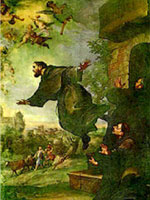
St. Joseph of
Cupertino
Figure 1
St. Joseph of
Cupertino

In the history of the Catholic Church there are 200 noted cases of male and female Saints who had the spectacular ability to fly. The most impressive is St. Joseph of Cupertino, Italy (Fig. 1), a Franciscan friar born on June 17, 1603, whose ecstatic flights earned him the epithet ‘Flying Friar.’(2) As a boy he was sickly, absent-minded, nervous, hot-tempered and unable, because of his states of ecstasy, to stick to a job. Often he would stop in mid-sentence, forgetting the conversation he was engaged in; and suddenly kneel or to stand stock still at awkward moments. Joseph was sent to Grotella in 1628, where for ten years he performed many miracles, to the wonder of the people in the surrounding countryside. Because he drew so many large crowds, his desperate superiors sent him from convent to convent, hidden from the world and basically imprisoned. His life was threatened when he was denounced to the Inquisition at Naples, but after three ‘examinations’ he was freed After that, Joseph was sent to Pope Urban the 8th. When he saw the Holy Father, he flew into the air and remained there until the Pope ordered him down. Hordes of Pilgrims followed Joseph. The Spanish ambassador and his cohorts saw him take off and fly over their heads to the high altar, uttering his usual shrill cry. After twice seeing Joseph in ecstasy, the Duke of Brunswick became a Catholic. The monks tried to distract him with needles and burning embers, but they could not divert him from his trance. He would be caught by a vision that fixed him like a statue. At dinner he was known to fly around holding his plate; or, when working outdoors, suddenly hover in a tree, caught in a state of amazement at the world. When Pope Innocent the 10th ordered him to retire, he spent the rest of his life in seclusion.


click to enlarge
Pieter Bruegel the
Elder
Figure 2
Pieter Bruegel the
Elder, The Temptation
of St. Anthony,
Oil
on wood.The National
Gallery of Art,
Washington,DC, USA.
Fall of
Simon Magus
Figure 3
Benozzo Gozzoli, Fall of
Simon Magus
, 1461-62,
Tempera on panel.
Royal Collection, Hampton Court.

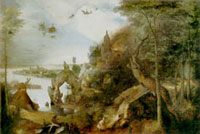
In the life of Joseph, no mention is made of desire as an agent for his gift of flight. But the lives of Saints have been dominated by desire and repentance ever since St. Anthony the hermit, who can be seen flying in a stunning picture by Pieter Bruegel the Elder. (Fig. 2)

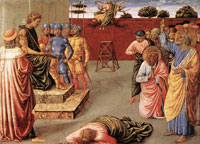
The origins of the sacred ‘muse’ appear from the court magician of Emperor Nero, Simon Magus,(3) who has been erased from Catholic history and is remembered only as ‘the Father of all Heretics.’Born in Gitta in the first century A.D. this man, the founder of Gnosticism, battled mightily with St Peter, we are told, in an attempt to overthrow Christianity. He had the power to heal, to turn stones into bread, travel through the air, stand unharmed in fire, change shape, become invisible, move objects, and open locks without touching them. Simon, a Faustian figure, is thus a scientist turned magician. In trying to imitate Simon’s gift of flight, St. Peter broke his legs. But many accounts, such as this picture by Benozzo Gozzoli (Fig. 3) tell of Simon’s tragic fall.

Nearly all records concerning the Magus have been destroyed. Simon explained the purpose of the Magus (which was misunderstood by the followers of Jesus), as enlightenment. The consciousness of the magician is at one with ‘Nous,’ or Reason. Adam’s knowledge before the Fall is a true and perfect knowledge of nature, a Natural Magic. Such Reason must be combined with ‘Epinoia,’ or Thought. Simon found this aspect of enlightenment in a relationship with a prostitute from Tyre, in whom Simon claimed to see the spirit of God. This is reminiscent of the frenzy of Duchamp’s ‘Bachelor’ as caused by his ‘Bride.’

In early Christianity, as in most religions, there were sacred prostitutes whom the community held in high esteem. These women were manifestations of direct physical interaction with the divine. The Gnostics believed the spirit of God had been trapped in matter, especially in humans, during the creation of the world. Thought can be trapped in form, and the images created can be abused by corrupt men. This abuse must be redeemed by ‘Nous.’

Some Gnostics claim Jesus rescued Mary from a life of prostitution, as Simon did Helena. And that that the Church felt ill at ease with this similarity, so Simon was erased from history.

click to enlarge

  • Bride
Stripped Bare by Her Bachelors
  • 1. The Waterfall
/ 2.The Illuminating Gas
  • Figure 4
  • Figure 5
  • Marcel Duchamp,Bride
    Stripped Bare by Her Bachelors,
    Even
    [a.k.a. The Large Glass],
    1915-23, Philadelphia Museum of Art.
  • Marcel Duchamp,
    Given: 1. The Waterfall
    / 2.The Illuminating Gas
    (interior), 1946-1966.
    Philadelphia Museum of Art.

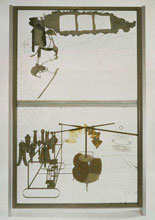
In Duchamp’s Large Glass, (Fig. 4) a nude female levitates. This elevated muse creates a frenzy among the ‘bachelors’ that physically remain below. And as long as their admiration of the nude remains a visual one, they will not rise, just like the church Elders. They can only leave their mundane lives when they can see in her the beauty of Creation.

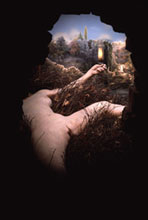
In Duchamp’s last work, Etant donnés (Fig. 5), the bride seems to have fallen, like Simon, and has crashed into a tree.Why this happened is a mystery, but perhaps she fell because her ‘bachelor’ is no longer there.Theun Karelse, 2003, Amsterdam.


Notes

Footnote Return1. Rasputin the Last Word’, Edvard Radzinsky

Footnote Return2. New Catholic Encyclopaedia, various books on Saints and web sources via the Google directory
of Saints

Footnote Return3. New Catholic Encyclopaedia, various books on Saints and web sources via Google

The Artist as a Social Critique

A controversy about Duchamp

The following text is based on an interview with Ms. Rhonda Roland Shearer, the founder of the Art Science Research Laboratory located in Soho, Manhattan, New York and her findings about the art of Marcel Duchamp. Ms. Shearer, an artist herself, has concentrated her work completely on the rewriting and manipulation of art history—“I have learned my lesson from Duchamp,” she says, and consequently has discarded the object from her work. Ms. Shearer is the initiator of the quarterly online-magazine “Tout-Fait” and is in the process of publishing a book revealing a detailed discussion of her research, which ultimately redefines Duchamp’s position in art history. Since Ms. Shearer went public with her ideas, a controversy about the results of her research has broken loose. How can we know what Duchamp’s true intention was when he “created” the ready-mades? Is there much more to them than the collection of art history books has repeatedly told us over the decades? The answer lies in the very objects themselves and now that we are well familiar with his work, it might be time to leave old views behind and take a fresh look at it, which is exactly what Ms. Shearer has done.

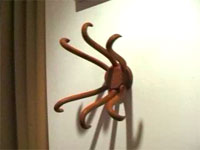
The text will give a detailed discussion of some famous examples such as the urinal, the hat rack and the coat rack to make visible her ideas and then compare them to the harsh criticism she has received from art historians, several critics of major newspapers and art magazines and then evaluate the arguments. To which side more weight is given will be left to the reader. Additional theoretical and visual material as well as some interactive 3-D models of some of the discussed works can be found in the Multimedia section of Tout-Fait (Vol. 2, issue no. 3) in an article by Ms. Rhonda Roland Shearer herself.

“Besides: It is always the others who die.”
The role of Duchamp, the French American Dadaist, as a critic of the art world and of the laxness and inattentiveness of our perceptional conventions is today commonly accepted, as well as his witty and critical spirit as it is expressed in many of his quotes and interviews. But now, since Ms. Rhonda Roland Shearer took a more detailed look at the entirety of his work, profounder issues seem to reveal themselves. We need to ask ourselves, if perhaps there was another surprise hidden behind the one we today have so well integrated into our sense of art history and the foundations Duchamp’s invention of the ready-made has laid for later art forms.
“Besides—it is always the others who die”, reads a quote he had inscribed on his gravestone. Does this suggest that we would die or better: the accuracy of our perception, our curiosity, while he would not? The issues hidden in the ready-mades, objects and studio photography, “once discovered indeed would give him a second revival and guarantee his spirit and influence to live on far beyond the fame of his time”.(1)Once again Duchamp is holding the mirror for us to realize the blind spots and self contentedness of our perception. “And it was all planned out”(2).
Ms. Rhonda Roland Shearer’s findings which seem more and more obvious once the eyes are opened to the deceptions suggest that this indeed is true. Many statements Duchamp made in interviews and his own writings, which are primarily concerned with perceptional research and theories seem to support this theory. Furthermore Duchamp explicitly expresses his interest in a public to come, “you should wait for fifty years or a hundred years for your true public. That is the only public that interests me”, he states.(3)Obviously the inventiveness of Duchamp’s spirit was underestimated for the past decades, but not our capacities as supposed by his mind.
Marcel Duchamp sustained a long lasting interest in mathematics and physics, especially in the theories of Henri Poincaré, the forefather of chaos theory and researcher of geometry. Poincaré “claimed that axioms of geometry are neither a synthetic a priori truth nor an empirical truth and that they are a convention in a disguised form. We choose an appropriate convention in the light of our experience and thus the question is not whether it is true or not but whether it is convenient or simple.”(4)
Likewise the objects of our three dimensional world are neither unchangeable facts nor are they clearly consistent with the data we collect through our perceptual experience especially when it comes to two
dimensional representation of three dimensional objects. They happen in the mind, which means when we perceive with our senses, and this is especially true of our eyes, “we build a mental map of the things, a collection of snapshots gathered through movement in time and space. In our mind they fuse together to one idea of an object”(5)we then call fact, but many times it is not.
The potential “gap between the reality of the object outside of us and the object as it exists in our mind as it happens due to our perceptional blind spots are the zone where Duchamp’s work sets in”.(6)When we perceive we are drawn to the convenient and simple. Duchamp was well aware of all of this, aware of it before anybody else and “his work functions as a set of proof of these findings and the flaws of our visual perception”.(7)

click images to enlarge

  • Duchamp’s studio
  • Marcel Duchamp,Hat Rack
  • Figure 1
  • Figure 2
  • Photograph of Duchamp’s studio in New York,
    1917-18
  • Marcel Duchamp,Hat Rack,
    1917/1964
  • Marcel Duchamp,Tu m’ (detail)
  • Hat Rack Blueprint
  • Figure 3
  • Figure 4
  • Marcel Duchamp,Tu m’ (detail), 1918
  • Marcel Duchamp,Hat Rack Blueprint
    , 1964


click to see video
A study model
of Hat Rack by ASRL
Figure 5
A study model
of Hat Rack by ASRL

How huge the gap between the reality of an object and its representation of it in our mind can become we realize when we follow the research of Ms. Shearer about one of Duchamp’s well known ready-mades, the hat rack. In our mind as well as in art history books it exists as one single object, while in fact it is not. The documentation of the object, a drawing, studio and object photography, a photograph of its shadow and a blue print (Figs. 1-4) reveal that different versions of the object exist and only one of them matches the original Thonet bend wood hat rack as you could buy it in stores of Duchamp’s time. The other versions are alterations and distortions (blue print) and one of them even reveals itself as an unusable object as we can see in the little video animation where a research member places hats on the different works and replicas of Duchamp’s “ready-made”: The lower row of S-shapes is directed downward. (Fig. 5) Accurate scientific research with the aid of computer technology has helped to unveil the true nature of the “ready-made”.

The hat rack is in fact an object that was altered over time, opposed to the one single object that was just purchased in a department store to then be put on a pedestal and named an object of art. Reality is far more complex. The hat rack is a creation and “what Duchamp means by hat rack can be understood only if we put all versions together”(8), in the mind they meld together and become the second shock of the ready-made, the shock about the incapacities of our “reliable” perception as the collector of truth.


click to enlarge
Original studio
photograph
Figure 6
Original studio
photograph showing the
Trébuchet [Trap]
on the floor, 1916-17

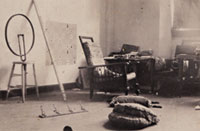
For Duchamp “our blind spots become the very spots where he can fool us”.(9)Another example is the coat rack. A photography of the object looks like the manufactured one. It sits on the floor of Duchamp’s studio and we see it slightly turned, but what seems to be in perspective is, as a closer look reveals—in fact we have to employ the aids of geometer and lines to find out—that what we look at is a distorted version of the piece: the different hooks all are slightly tilted. A frontal view of the object would disclose its unevenness, but of course put in perspective, we miss it. (Fig. 6)

Duchamp hated the retina, for him it was the source of misperception and to rely on it as the only origin for insight in truth and reality finally means to be led astray. Accordingly, as stated in an interview, he expresses his dislike for all art based on the visual alone, e.g. impressionism, and calls it retinal.(10)Already Courbet had introduced the physical emphasis into the painting of the 19th century, while Duchamp approves art that integrates mental images, symbols and allegories, art, that is primarily concerned with ideas.(11)It gives us a broader and more truthful representation of
how reality is present in our minds.

Cabanne: Where does your antiretinal attitude come from?

Duchamp: From too great an importance given to the retinal. Since Courbet , it’s been believed that painting is addressed to the retina. That was everyone’s error. The retinal shudder! Before, painting had other functions: it could be religious, philosophical, moral.(12)

In another interview held 1956 Duchamp states: “Painting should not be exclusively retinal or visual; it should have to do with the grey matter, with our urge for understanding”.(13) Herein we certainly find the root for his extended research (visual experiments, cast shadows, mirror reflections etc.) and interest in the introduction of the fourth dimension into the representation of objects, which then manifest in his long term project the Large Glass. In the Large Glass he no longer uses realistic, but mathematical, scientific
perspective, based on calculations and dimensions. “Everything was becoming conceptional,” Duchamp states.(14)

Already the Egyptian art applied time span principles versus the single moment’s “photographic-like” representations as later made systematic in Renaissance. Egyptian art shows frontal and side views mixed all in order to convey what is meant; it is a series in time and space, not a one single point, central perspective.

Researching Duchamp’s perceptional theories as given in his visual work, two findings seem to become crucial for understanding his point: “Perspective is more than just vision. And: all visual language is based on the mind. The idea of an object is a stack of information and perspective is just one single snapshot taken out of the stack, but incapable of giving us an accurate idea of what the object truly is, in total. Even if we look or meditate on it for a very long time, it keeps its hidden secrets”.(15) We are unchangeably bound to the actual time and space experience, as Kant already stated in his critique of pure reason. “Duchamp through his work gives us the visual version of a truly new mathematical system that describes how eye and mind work together”.(16)

While cubism is working according to similar principles, the time-space process of perception, it emphasizes the fragmentation of perception through splintering the visual information—Duchamp goes one step further. He places all weight on the process beyond the fragmented snapshot collection and concentrates only on the process of the fusion of the different elements into one single idea.

Many works of his show his interest in optical experiments such as stereo vision, a new way to go beyond photography. A card with two different pictures is placed on a device that allows one eye to see one picture each. Duchamp’s system is “working by these very principles, but formally it goes beyond it”(17), since he employs different versions of objects over a longer time period, which leaves us mostly completely unaware of the fact that we are fooled.

Let us for a moment go back to the statement about Poincaré’s research on geometry and the conventions in disguised forms: “We choose an appropriate convention in the light of our experience and thus the question is not whether it is true or not but whether it is convenient or simple.” We see what we know and convenience probably plays a far greater role in our perception than we would like to admit. How much information do we collect to determine that what we see is a tree, a car, a broom, a human being or a person that we know? The idea, once it is formed in our mind is quite durable and the time spent on attentive and close observation is commonly reduced to a very minimum amount, so many details fail to reach the level of consciousness.

click to enlarge
Duchamp’s
Fountain
Figure 7
Photograph of Duchamp’s
Fountain (1917) by
Alfred Stieglitz published
in Blindman No. 2,1917

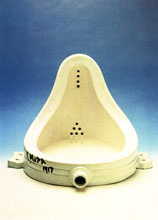
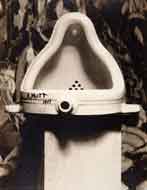
gain we follow Ms. Shearer’s research of another famous “ready-made”, Fountain, the urinal. (Fig. 7) Taking a closer view at its depiction, we find that some manipulation must have taken place either on the object or more likely on the photograph. The upper part of the object shows a frontal view, while the lower part is seen slightly in profile. Once this is discovered it seems quite obvious and we ask ourselves how we could not have noticed a grave “mistake” like this before. Three photographs are the only evidence we have of the urinal’s existence, because the original object has been “lost”. Above that Ms. Shearer’s research into manufactured alike objects of Duchamp’s time resulted in the finding that urinals in this version were never produced, so there is also the option that Duchamp did have produced and/or altered the object for his own purposes, like the coat rack, a comb, a perfume bottle and many others.

We would not go wrong to call “Duchamp the ultimate manipulator even from his grave”.(18) And his witty spirit suggests that “he intended to have art history to be rewritten long after his death. Once again a new belief is forced on us to adopt”(19) and he probably would have a smile of contentment on his face watching us in the very spot we find ourselves today looking at his work with a new mind through the help of Ms. Shearer’s and her
team members’ efforts.

But not everyone is willing to embrace the results of her research. Critics of her work find fault in her usage of 3-d rendering and other scientific methods of research as opposed to traditional art-historical methods. Others want to see more visual evidence or assume that she reads facts to her advantage in anticipation of these facts to conform to her theory.(20)Then others simply do not believe her and decline any comment. Is this perhaps another blind spot, the attempt to dwell on conventional methods of research in art history and ultimately the reluctance to give up well known and comfortable beliefs about what art can be and what our perception is capable of? Indeed, if Ms. Shearer is right, then in fact art history has to be rewritten and with its many hundreds and thousands of artists’ statements as well.

In another quote Henri Poincaré states: “To doubt everything or to believe everything are two equally convenient solutions; both dispense with the necessity of reflection”(21). Well, Ms. Shearer hasn’t. What do we do?

Notes

Footnote Return1. Ms. Shearer, interview

Footnote Return2. Ms. Shearer, interview

Footnote Return3. A conversation with Marcel Duchamp, television interview conducted by James Johnson Sweeney, NBC, 1956

Footnote Return4. Soshichi Uchii, Notes on Henri Poincaré, in Philosophy and History of Science, www.bun.kyoto-u.ac.jp/phisci/gallery/poincare_note.html

Footnote Return5. Ms. Shearer, interview

Footnote Return6. Ms. Shearer, interview

Footnote Return7. Ms. Shearer, interview

Footnote Return8. Ms. Shearer, interview

Footnote Return9. Ms. Shearer, interview

Footnote Return10. Dialogues with Duchamp,
Pierre Cabanne

Footnote Return11. Interview with James Johnson
Sweeney, Bulletin of the Museum of Modern Art, Vol. XIII, 1946

Footnote Return12. Dialogues with Duchamp,
Pierre Cabanne

Footnote Return13. A conversation with Marcel Duchamp, television interview conducted by James Johnson Sweeney, NBC, January 1956

Footnote Return14. Dialogues with Duchamp,
Pierre Cabanne

Footnote Return15. Ms. Shearer, interview,
see also The Writings of Marcel Duchamp, edited by Michel
Sanouillet and Elmer Peterson, The Brides Veil/The Continuum

Footnote Return16. Ms. Shearer, interview

Footnote Return17. Ms. Shearer, interview

Footnote Return18. Ms. Shearer, interview

Footnote Return19. Ms. Shearer, interview

Footnote Return20. Francis Naumann, in “Did Duchamp deceive us, ARTnews, February 1999, by Leslie Camhi

Footnote Return21. www.creativequotations.com/one/733.htm

Figure(s) 1-4, 6-7
© 2004 Succession Marcel Duchamp, ARS, N.Y./ADAGP, Paris. All rights reserved.

Duchamp at the Pompidou by Video Tour

Modernist (Im)mobilities: Marcel Duchamp, Samuel Beckett, and the Avant-Garde Bike

“He rides penny-farthings, tandems, tricycles, racing bikes—
and when he dies at the end, he rides on his bike up a sunbeam straight to heaven, where he’s greeted by a heavenly chorus of bicycle bells.”
Dylan Thomas, Me and My Bike

Hamm: Go and get two bicycle-wheels. Clov: There are no more bicycle-wheels.
Hamm: What have you done with your bicycle? Clov: I never had a bicycle.
Hamm: The thing is impossible.
Samuel Beckett, Endgame

The bicycle offered unsuspected possibilities for the depiction of the raised skirt.
Walter Benjamin, The Arcades Project

Introductory Observations

• The bicycle tends to arouse sexual desire or excitement.
• The bicycle is a traditional narrative usually involving supernatural or imaginary persons and embodying popular ideas on natural or social phenomena.
• The bicycle is commonplace.
• The bicycle is an unmarried man.
• The bicycle is a branch of metaphysics dealing with the nature of being.
• The bicycle gets you nowhere.

click to enlarge
Bicycle
Figure 1
Leonardo da Vinci, Bicycle Drawing,
Codex Atlanticus
(f. 133v)

In 1966 the monks of Grotto Ferrata, near Rome, discovered a sketch-apparently by Leonardo da Vinci, or by one of his pupils-depicting a bicycle-like machine complete with pedals, cogs, and chain mechanisms. (Fig. 1) The sketch was found alongside some caricatures, as well as some pornographic drawings. This scene could also be described as the collected works of Marcel Duchamp and Samuel Beckett.

Beside an Olympic skating oval, a world-class athlete (unable to ride outside because of the ice and snow) trains indoors on a real bicycle. The wheels, however, are set on soundless steel rollers: allowing the tires and rims to spin freely (at significant speeds) while keeping the bike and its rider stationary. We count this powerful, impotent spectacle as technology reversing technology (rollers unroll wheels), caught in a ceaseless loop of motionless motion. The avant-garde, too, can make modernity stand still-by moving it/stopping it yet again. Krzysztof Ziarek contends that “art is avant-garde to the extent to which it keeps unworking the technologization of experience by showing how, in order to reinscribe experience within the order of representation, it effaces historicity” (90).

The bicycle is very simple.

click to enlarge
Henry James
Figure 2
Henry James

Leaving his fine suite in the Osborne Hotel, on Hesketh Crescent, feeling radiant and fresh after his hot morning bath, Henry James (Fig. 2) hopped on his bicycle and toured the sites of Torquay. Imagine it! Modernity takes shape in, and as, The Master’s black and yellow bruises-of which he was so proud.

Consider Renoir’s broken arm and Toulouse-Lautrec’s lonely, longing gaze at the velo-drome. (The pride of a sling; and legs too short to reach pedals?)

It sucks to write about bicycles. In that: it is much better to ride bicycles. Duchamp ride (Fig. 3): I would be doing lascivious things with my sprockets. Beckett ride (Fig. 4): I would be pedalling backwards and shitting on the saddle.

Artistical-historical (bland): the bicycle, the bicycle wheel (Fig. 5), and the objects of the bicycle are powerful symbols in the work of Duchamp and Beckett.

click to enlarge

  •  Marcel Duchamp riding the bike
    Figure 3
    Photo of Marcel Duchamp riding the bike
  • bike Molloy
    Figure 4
    Samuel Beckett, drawing of the bike Molloy
  • Bicycle Wheel
    Figure 5
    Marcel Duchamp, Bicycle Wheel, 1913/1961

The presence of any technology that at once facilitates and complicates mobility is an interesting presence. Second thought: all technology simultaneously facilitates and complicates mobility. If the bicycle falls to this side of the modernist road then it lands in the ditch-water, if it falls to that side of the road it ends up in pasture. The modernist road has space for all mobilities: pedestrians, pedestrians on bicycles, pedestrians in motorcars, and even pedestrians in aeroplanes (emergency landings). But there is nothing more beautiful than a bicycle descending a hill by itself: ghost-rider.

The bike is a gender machine.

The modern is a technology machine?


click to enlarge
F.T. Marinetti
Figure 6
Image of F.T. Marinetti

In the climactic scene of F.T. Marinetti’s original Futurist manifesto-“The Founding and Manifesto of Futurism 1909”-Marinetti (Fig. 6) and his car (the beautiful shark) are famously flipped into the maternal ditch only to be born again in the metallic, celestial muck of industrial modernity. The newly baptised Marinetti, now a begrimed singer-apostle of all things dangerous, violent, machined, and frenetic, is literally tossed into his modern-technological epiphany by an older, slower mode of transportation. He recalls, “¡¦ I spun around with the frenzy of a dog trying to bite its tail, and there, suddenly were two cyclists coming towards me, shaking their fists, wobbling like two equally convincing but nevertheless contradictory arguments. Their stupid dilemma was blocking my way- Damn! Ouch! . . .” (20). The moment is significant, it seems to me, not as some elegiac snap-shot depicting the obsolescence of the bicycle and thus the triumph of the age of the automobile, but rather the exact opposite: Marinetti’s tale constitutes a vision of the stubbornness and presence (the stupid dilemma) of the bicycle itself. Marinetti’s manifesto, caught in a Keystone-cop-like loop, is indirectly documenting the very complexities, ironies, and even impossibilities of mobility in the modern moment. It shows the tragic-comic intermingling of technology with technology, and technologies with the modern subject. For me, the image of these wobbling, contradictory bicycles, despite the fact that they lack the throaty roars of Marinetti’s racing cars, is profoundly moving, because the bikes are curious, hybrid machines: both connotative of the past and yet apparently crucial (if annoying) fixtures on this future, avant-garde road.

Mikael Hard explains that “Facing a world of tanks and assembly lines, and using telephones and automobiles, ‘modern’ men and women were forced to differentiate the uses of technology from the abuses. The proliferation of the machine into ever more areas of social and economic life led to a need to interpret its meanings in a much more comprehensive way than in the past” (2). These transformative technologies of the modern period gave rise to new economies, new cities, new narratives of progress and anxiety and thus, necessarily, new bodies. The modern technologies of the plane, train, and automobile, for example, are not only devices that enhance the mobility of the modern subject, but also contraptions that transform the subject’s relationship to landscape and being itself.


click to enlarge
Alfred Jarry on bike
Figure 7
Alfred Jarry on bike
Wassily Chair
Figure 8
Marcel Breuer,
Wassily Chair
, 1925

Bicycles are a central contraption in the tropics of the avant-garde. From Alfred Jarry’s bicycle obsession (Fig. 7) (he slept with his bike at the foot of his bed), to Picasso’s uncanny handlebar bull-hornism to Marcel Breuer’s Wassily Chair (Fig. 8), inspired by the tubular steel of his brand-new Adler bicycle, the machine haunts avant-garde experimentation. And this is particularly the case in the works of two exemplary avant-gardistes, Marcel Duchamp and Samuel Beckett. While there has been some critical attention paid to the place of bicycles in the texts of Samuel Beckett (notably Hugh Kenner’s work), there has been rather scant focus on the place of the two-wheelers in Duchamp’s corpus and nothing, as yet, that expressly pairs the two artists’ fascination with the bicycle as modern machine. What I argue in this essay is not only that the bike is a crucial facet in the experimental work of both Beckett and Duchamp (allowing one to glimpse significant aesthetic parallels across genres) but specifically that the bike, in their works, comes to represent a crisis of mobility in the modern moment. My contention is that, for both artists, this crisis plays out most tangibly in the fields of language and subjectivity so that the act of “being” in modernity, for Beckett and Duchamp, comes to be playfully linked to the problems of the modern self in interaction with technology. This essay explores the nuances of this interaction by interrogating the place of habit, language, desire, and daily experience in both the avant-garde and modern environments.

The Ride

Any study of the Duchampian/Beckettian bicycle swiftly transports a reader/viewer into the neighbourhoods of ontology, eroticism, bachelorhood, gender, myth and its relationship to the modern everyday. In using the symbol of the bicycle, Duchamp and Beckett illustrate the tragic-comic bind of the modern subject: the body is at once liberated by technology and yet also dangerously dependent on, if not indentured to, its power. (The same scenario exists, generally, for the artist in relation to technology; in relation to the technologization of both the artist and the art in modernity). For the modernist avant-garde then, the question is how to respond to the technological revolution of the everyday environment, which necessitates a grappling with the revelation that technology and reality are mutually constitutive.(1) In other words, something lies beyond the simple bind of liberated/indentured in reference to modern art and the birth of the technological everyday. The avant-gardiste is clearly implicated, perhaps more explicitly than the non-artist, in the invention of the new: in the construction of his or her own unique aesthetic technologies. Therefore, the avant-garde artist becomes and is obsessed with the relationship between making and power; invention and history; progress and immobility. This suggests that the technologization of art and the artist is not just a one-sided narrative about cameras or cinema affecting painting and sculpture and novels. Rather, one sees-in Duchamp and Beckett most powerfully-that a toaster or a bicycle is also an art object, a site of desire, a mechanical conveyance, a glyph.

In this way, the technologization of art and the artist, plus the tragic-comic bind of the modern subject, is one way of discussing a competition of realisms: if there is no set trajectory for any given object then what results is either (or both?) experimental art or something like official status. The goal of the avant-gardiste may be to rethink history, rethink the experience of how one (a culture) gets to a confusion of signifiers, a multiplicity of meanings-and then to rework or restate or re-inscribe that otherwise blanked-out narrative, but to do so always provisionally (this can mean humour). The technologization of anything can therefore be the habitualization of anything, too, and so, in the hands of the experimental artist, the resulting “defamiliarization” is also always a new form of technology. Art restores order through disruption: we see that a bike can also “work” mounted on a stationary stool or that it does not need, as in Beckett’s Mercier and Camier, a chain to actually work. This implies that the avant-garde artist is declaring that no function is absolute and all functions are historically contingent. Perhaps modernity or modernism quite simply means: there is no going back, which then electrifies the present. Modernity (time) captures modernism (“time”) as modernism captures modernity. Modern art is implicated-as the Frankfurt school writers, most notably Max Horkheimer and Theodor Adorno, have already shown-in the workings of industrial culture and this is an aesthetic boon of sorts but also a dilemma.

Krzysztof Ziarek’s recent work The Historicity of Experience: Modernity, the Avant-Garde, and the Event, boldly challenges earlier theories of the avant-garde-including the important work of Peter Burger, Andreas Huyssen, Jurgen Habermas, and Rita Felski-by insisting that discussions of modernist experimentation must move beyond a simple art/life dialectic. Ziarek proposes that the avant-garde be understood not as something outside or “other” to everyday existence (avant-garde art merely transforming the everyday through representation) but rather as something directly temporal. In both Duchamp and Beckett, the bicycle often morphs into a corporeal, body-like presence-one that profoundly questions the stability of definitions of the modern, human subject. Duchamp’s and Beckett’s appropriations of the bicycle are also knowing disruptions of the everyday “sense” or use-value or art-value of the modern technological object and consequently serve to challenge more general, conventional (modern) notions of mobility. These two artists thus lend credence to Ziarek’s, as well as Kornelia von Berswordt-Wallrabe’s, theories of the avant-garde which stress that the classic avant-garde work tends to disrupt an object’s “stream of function” (von Berswordt-Wallrabe) and also then refigure the (ostensibly evacuated of history, transparent) everyday moment as a vital and fluid setting of the “Event.”


click to enlarge
Rover safety bicycle
Figure 9
Rover safety bicycle, 1885
célerièfre,1790s
Figure 10
célerièfre,1790s

The bicycle is a new genre, a radically unique object. It is at once a device that enhances human speed and propels the body through a landscape, and yet it is not so fast that the body is ever removed from the intimate motions of its immediate surroundings. The bicycle, for all its metallic presence, is a comfortable citizen of the back road, the country field, even the mountain pass. It has a relationship to the movement of the wheat as well as to the airy dips of the birds. As a nostalgia-contraption, it is predictably a locus for memories and childhood. As I discuss later on in the essay, the modern bicycle (the “safety” bicycle (Fig. 9), which very closely resembles our contemporary bicycles, was perfected around the late 19th century) has its technological roots in the 1790s’ French children’s hobby-toys called celerifere or velocifere (Fig. 10). From their beginning, then, bicycles have seemed to connote newness but also, perhaps more palpably, nostalgia and the vanished moments of youth.(2) Cranking the pedals, or even just gliding down a hill, powers on the film of the past, a kind of Proustian recreation in which every new ride is always a tour backwards into time-lost. The bicycle is forever patient, too. Its simplicity is magnificent, how it waits against a shed, for example-not as a car sulks in a driveway or lurks beside the curb, but with a kind of Zen-like, friendly abandonment. The bike can look lonely, to be sure, but unlike other technologies of mobility (cars, planes, trains) it seems reconciled to melancholy; without ever being indifferent to, or utterly consumed by, its singularity. The poetics of the bicycle is infinite if only because-along with the complete entity known as “the bicycle”-each part of the machine (pedals, wheels, horn, handlebars, fenders, lugs, hubs, sprockets) resonates with particular, symbolic force.

The bicycle, importantly, is not just a double-sided object. It is multi-dimensional and it is therefore too reductive to state: “the bicycle has another side¡¦.” Yet the bicycle does exist-despite its halcyon glitter-as a protean modern object: it literally comes from (within) modernity. And quite possibly the bicycle can be seen as bringing modernity with it, pulling it out of the Victorian moment toward a late capitalist present. In the conventional cultural-historical narrative of European modernity-a tale that includes the spectacular entrance of planes, trains, and automobiles; the dramatic growth of metropolitan centres (and the elaboration of imperial networks); the birth of photography and cinema; not to mention the inventions of the telephone, typewriter and even tape-machine-the bicycle is a rarely-discussed, almost quaint participant. But for all its romantic-nostalgic energy, moving harmoniously through the ambience of sun-touched, pre-modern country lanes, the bicycle also helped create our modern/urban economies of mass consumption. Avram Davidson, in his short story “Or All the Seas with Oysters,” plots a brilliant, if idiosyncratic, evolution for the bicycle suggesting that safety pins are the larval and coat hangers the pupal stage of the machine’s gestation. What is fascinating about Davidson’s hypothesis is its mingling of the bicycle with other vital, but often overlooked, technologies of the modern. It seems to me it is precisely the apparent insignificance of the everydayness of the safety pin and the coat hanger that also gives the bike its power and poetics-all of these items are the overlooked, invisible dynamos of modernity.

The bike functions as a childhood emblem, then, but is emblematic too of Coca-Cola, Levi’s Jeans, MTV (Figs. 11, 12 and 13). Science historian Sharon Babaian explains that “The bicycle helped to forge the link between advertising and the mass consumption of luxury goods. It was the first expensive, non-essential product to be sold in such numbers-over 1.2 million bicycles per year where produced in the U.S. in the mid-1890s. Also, the bicycle industry was among the first to introduce annual model changes as a way of selling more products” (97). The bicycle, to use Raymond Williams’ term here, is “magical” but only as a revolutionary marketing tool-as a discovery, namely that within modernity a non-essential object could be engineered, mass-produced and sold for significant profit. The bicycle industry prefigured the automobile industry and thus anticipated the latter’s (soon to be more complete) construction and manipulation of appetites of mass consumption. And this was not only the case with the automobile industry but also with the aeronautics business. The Wright brothers, most notably, were originally a cycle firm. Moreover, Wiebe E. Bijker argues that by the turn of the century “Weapon makers, sewing machine manufacturers, and agricultural producers were only too happy to shift their production to bicycles” (32). And so the bicycle is a key protagonist not only in the narrative of mass transportation but also, and more expansively, in the drama of modern marketing, everyday consumption, modern technology, and the diversification of industrial technology.

click to enlarge

  • Coca-Cola logo
    Figure 11
    Coca-Cola logo
  • Levis jeans label
    Figure 12
    Levis jeans label
  • MTV Logo
    Figure 13
    MTV Logo

The bicycle, as both modern symbol and modern technology, is hence deeply embedded in a grander narrative of progress and use-value. To some extent the avant-garde is the manifestation of the retooling of such narratives-a practice of functional dysfunction and, like the everyday itself, much of the avant-garde’s power (force) resides in the play with context and referentiality. Ziarek writes.
Duchamp’s urinal or bicycle wheel ¡¦ stand the ordinary on its head, disconnecting everyday tools from their functional context and, thus, bringing into the open the invisible regulative force with which technicity forms modern being . . . In other words, the concept of the ordinary as immediate, as a place of common knowledge or a sphere of prelinguistic experience, sheltered from the influence of technology and mass culture, has to be called into question. The ordinary is already mediated, it is enframed technologically and functions as a font of availability, as resource or Bestand. (113)

click to enlarge
Duchamps
studio showing the
Fountain
Figure 14
Photograph of Duchamps
studio showing the
Fountain (1917),
1917-18
Duchamps
studio showing the
Bicycle Wheel
Figure 15
Photograph of Duchamps
studio showing the
Bicycle Wheel
(1913-14), 1917-18

The urinal or the bicycle wheel (Figs. 14 and 15) are revealed (as opposed to made) by the avant-gardiste as displaced, even suspended, artefacts of the everyday. They are recontextualized and thus undergo a number of-by now very well documented-changes. First, their use-value is confused as soon as they are “noticed” as art. Part of the enduring aesthetic, even revolutionary, energy of the Duchampian urinal, for example, lies in the crisis it creates for the viewer, forcing one to wonder as if for the first time: “what is a urinal? what is an art object? do I associate art with piss? do I now piss in art?” Perhaps the urinal never asked to be viewed before either. The avant-garde’s use of everyday objects is necessarily a radical play with the technologization of sense, use-value and function. Berswordt-Wallrabe explains that Duchamp’s Bicycle Wheel “had its roots in the artist’s ability to distance himself from the intended utilitarian purpose of the object and thereby to interrupt the existing stream of function, diverting the object or parts of it into an entirely different stream of function” (19).(3) The “other dimensions” of the everyday object are all contained within the art object itself; it is the context-shifting that here brings them into view. (Uselessness, nonsense, suspended function, purposeless play-these are, incidentally, the adjectives also applicable to the characteristic bodies and modes of Beckett’s fiction.) If the everyday object is removed from the everyday (or at least becomes embossed on the template of the everyday), is the same-but in reverse!-true of the art itself? In other words, is part of the crisis that the avant-garde inaugurates that of necessarily returning art to the setting of prosaic, modern being? A curious “cycle”?

Beckett 1

In considering the richness of Samuel Beckett’s numerous bike riders, Hugh Kenner famously surmises in his 1962 monograph, Samuel Beckett: A Critical Study, that Molloy, Moran, Malone, Mercier & Camier et al are representations of “Cartesian Centaurs” (121). Kenner understands this centaur-subject to be guided by rational intelligence yet ever and necessarily obeying the mobile, irrational wonder of the bicycle’s own motion and desire. The Cartesian Centaur is therefore a compliment of mind and body, but also and most importantly of body and machine: “Cartesian man deprived of his bicycle is a mere intelligence fastened to a dying animal” (124). The Beckettian bicyclist, however hopelessly, utilises the bike as a substitute body: one that, if not deathless, at least presents the illusion of delaying or denying mortality.

click to enlarge
French childrens
late 18th
Century hobby horses
Figure 16
French childrens
late 18th
Century hobby horses
cherubim riding on similar contraptions
Figure 17
cherubim riding on similar contraptions

Kenner’s Centaur is also interesting because, as aforementioned, the earliest known bicycles are thought to have derived from French children’s late 18th Century (1790s) hobby horses (Fig. 16). These proto-bikes were unsteerable and pedalless (very Beckettian attributions!), but equipped with two wooden wheels which would allow a rider to propel (push) themselves with their own leg power, or easily coast down a hill. The celeriferes(4) bear an interesting resemblance to certain medieval church iconography in which cherubim and seraphim are shown riding on very similar contraptions.(5) (Fig. 17) These early bicycle images suggest a complicated, if curious, history for a poetics of the modern bicycle. The self-propelled, wheeled vehicle is-from its earliest representations-aligned with the sacred, and specifically with images of ascension and purity. At the same time, these medieval proto-bikes are of course excessively, necessarily earthly machines: the wheels themselves most obviously requiring the stability of the ground, the real. The fundamental tension of the bicycle, perhaps, and one that Beckett exhaustively mines, is that which exists between its angelic and corporeal symbology: it strives dynamically upward and yet is, unfailingly, a mortal vehicle.(6) The discrepancy between virtuous potential and practical, ignominious fact fully articulates the tragic-comic grey space of Beckett’s fiction.

The bicycle first appears in Beckett’s work in his early 1934 collection of short stories, More Pricks Than Kicks. In the “Fingal” tale, the young lovers Belacqua and Winnie head off from Dublin for a romantic afternoon in the country. Their relationship is decidedly cool and characterised by defensive, droll repartee that is further ironized by the arch, omniscient narration. To confirm the subversion of the romance story, Belacqua is inflicted with “impetigo,” the knowledge of which compels Winnie (post-smooch) to thoroughly clean her mouth. And so it is not surprising-in this context of diseased, contaminated “romance”-that the destination of the love-jaunt in the country soon turns out to be the Portrane Lunatic Asylum (“she having a friend, he his heart, [there]”) (26).

On their way, however, Belacqua discovers something in the grass: “They followed the grass margin of a ploughed field till they came to where a bicycle was lying, half hidden in the rank grass. Belacqua, who could on no account resist a bicycle, thought what an extraordinary place to come across one. The owner was out in the field, scarifying the dry furrows with a fork” (27). The context of Belacqua’s discovery-especially in light of this being the first appearance of a bicycle in Beckett’s work-is significant in that the bicycle is riderless. The bicycle, lying abandoned in the rank grass, cannot help but be read as a kind of object counter-part to Belacqua’s own melancholy subjectivity. In particular, Belacqua’s interest in the bicycle is described in relation to his desire: he could, on no account, “resist” a bicycle. In this way, too, the bicycle is the clear, if wry, substitution of or for Winnie and, indeed, the scene mimics the encounter just previously in which the two lovers had been lying on the grass. What is clear here is that the bicycle is Belacqua’s discovery, and so his relationship to the machine is vaguely illicit and, at the very least, works to further his own solitude. Janet Menzies points out in her discussion of the scene that the encounter of the bike is “faintly disturbing” (99). One reason for this uncanny feeling is presumably that the bicycle and Belacqua seem to become indistinguishable. “Fingal”‘s narrative power rests not only in its rather flawless balance of aloof omniscience with caustic dialogue, but also with the mysterious anxiety that the discovery of the bicycle produces. The bicycle takes on a kind of “being” and seems to wordlessly, eerily compete with the superficial intentions of the love story.

This eerie competition is compounded by Belacqua’s developing connection, almost a homosocial alliance, with the bicycle owner and, of course, with the bike itself. The narrative makes it quite clear that Belacqua and the bicycle owner are aligned on the level of their shared masculinity. They both agree, for example, that “it needed a woman to think [the logistics of efficient travel] out” (28). Moreover, as Belacqua and Winnie move away from the man, we read that “Belacqua could see the man scraping away at his furrow and felt a sudden longing to be down there in the clay, lending a hand” (28). This moment happens two short paragraphs after an extended allusion to Hamlet: “The tower began well; that was the funeral meats. But from the door up it was all relief and no honour; that was the marriage tables” (28). If Belacqua is vaguely figured as the dispossessed son here and the bicycle owner as the ghostly father-figure, then Winnie is by default or implication a representation of Gertrude. Regardless, “Fingal” is to some extent a condensed and energetic reworking of the Hamlet themes of madness, diseased desire, and homosocial longing. Indeed, Winnie is evidently also the Ophelia representation here as she and Belacqua seem to be perpetually replaying a modernist version of the get-thee-to-a-nunnery exchange.

As Belacqua and Winnie sit and watch the “lunatics” taking their recreation on the grounds of the asylum, the bicycle owner (apparently an inmate of the asylum himself) comes running towards the lovers. “Belacqua rose feebly to his feet. This maniac, with the strength of ten men at least, who should withstand him? He would beat him into a puddle with his fork and violate Winnie” (30). Beckett’s narration is so comically convincing here because it completely undermines all the “masculine” labour that has previously sought to align Beckett and the bicycle owner. Now Belacqua is positioned less as a modernist Hamlet hero and more as a pathetic-neurotic anti-protagonist. Importantly, the bicycle owner not only runs innocently by the lovers but-crucially-leaves his bicycle behind him, unattended in the grass: “the nickel of the bike sparkled in the sun” (31). The alliterative, consonance clucks of the k’s alone in this sentence work to distinguish the bicycle as a glorious, exquisite signifier (and align it with Belacqua’s own clicky appellation). Thus Belacqua-all things working in his favour-manages to pass Winnie off on her friend Dr. Sholto while he promises to rendez vous with them “at the main entrance of the asylum in, say, an hour” (31). Belacqua, of course, takes a route back to the resplendent machine:

It was a fine light machine, with red tires and wooden rims. He ran down the margin to the road and it bounded alongside under his hand. He mounted and they flew down the hill and round the corner till they came at length to the stile that led into the field where the church was. The machine was a treat to ride, on his right hand the sea was foaming among the rocks, the sands ahead were another yellow again, beyond them in the distance the cottages of Rush were bright white, Belacqua’s sadness fell from him like a shift. (31-2)

Only the interaction with the bicycle seems to allow the narrative to mobilize, so to speak, its most romantic descriptions. Belacqua’s ride literally shakes off his melancholy and it is quite clear that the bike represents both a metaphysical escape from his sadness as well as a physical flight from Winnie. It seems significant, too, that Belacqua’s depression falls from him like a shift, as if the action of the ride is also sexual or (perhaps less carnally) at least cleansing and perhaps feminizing, too-returning him to a first, innocent, and naked moment. Belacqua, of course, never keeps his promise with Winnie and Dr. Sholto and the climax of the story depends on his callous departure. Sholto and Winnie, left waiting, are forced to inquire of another bicyclist entering the asylum if he has seen a person resembling Belacqua: “‘I passed the felly of [that description] on a bike’ said Tom, pleased to be of use, ‘at Ross’s gate, going like flames.’ ‘On a BIKE!’ cried Winnie. ‘But he hadn’t a bike.'” (34). The “going like flames” is a hilarious insertion that contrasts even more comically with Winnie’s slapstick, higher-case exclamation. Her position here, terribly outside the narrative asides, is now confirmed and her innocent “but he hadn’t a bike” comment renders her character charming but slow. Belacqua’s escape is, indeed, complete as the tale closes by revealing that he was “safe in Taylor’s public-house in Swords, drinking” (35). The bicycle, in its first Beckettian mode, is truly a remarkable bachelor’s conveyance: a reliable escape machine, something that can be literally discovered in the grass.(7)

Duchamp 1

“Fingal” can be read as a type of onanistic bachelor’s allegory and, as such, it has (of course!) much in common with Marcel Duchamp’s corpus-especially his celebrated, pioneering ready made Bicycle Wheel. In a 1955 letter to his acquaintance Guy Weelen, Duchamp writes:

My recollections as to the apparition of a bicycle wheel mounted on a kitchen stool in 1913 are too vague and can only be treated as a posteriori reflections. I only remember that the atmosphere created by this intermittent movement was something analogous to the dancing flames of a log fire. It was as if in homage to the useless aspect of something generally used to other ends. In fact, it was a ready made “before the event” as the word only came to me in 1914. I probably accepted the movement of the wheel very gladly as an antidote to the habitual movement of the individual around the contemplated object. (Letters, 346 June 26).

Like Beckett, Duchamp reveals the bicycle (or its components) as a clearly seductive object. If Belacqua’s bicycle scintillates like nickel and allows him to “go like flames,” then Duchamp’s 1913 Bicycle Wheel, too, adopts the erotic, hallucinatory rhythms of a log fire(8) Importantly, Duchamp’s recollection of the creation of this ready made is a characteristically paradoxical mixture of both elucidation and mystification. It is clever as well as strategic that Duchamp refers to the Bicycle Wheel’s construction as an “apparition.” Duchamp casually tinges his entire recollection of the Bicycle Wheel’s construction with the qualities of serendipity, not to mention ethereality. Also, that he offers that the sculpture was “a ready made ‘before the event'” is an audacious and sly manoeuvre in that Duchamp is actually depicting himself as anticipating himself. A fascinating confusion results because the Bicycle Wheel piece, on the one hand, seems to merely “appear” while, on the other, Duchamp’s sole responsibility as the magician behind its fantastic apparition is implied. Regardless of Duchamp’s brilliant, self-mythologizing prose, the letter also reveals that the Bicycle Wheel constitutes a sort of homage to “the useless aspect of something generally used to other ends.” This statement, in miniature, is a provisional definition for all experimental projects in that it indicates the fraught, necessary tension that exists in the avant-garde between function and dysfunction.

Duchamp’s Bicycle Wheel is dependent on its general function, presumably, as a device in a larger piece of machinery that conventionally facilitates human mobility-a bike. It is also dependent, as a seeable piece of art, on highlighting the transparency of that original function while at the same time asserting or proposing an alternative (dis)application (here a wheel mounted upside down in a stool.)(9) What exists between the function and dysfunction are the inter-workings of the everyday (the minutiae of cultural history): the particularly intimate negotiations between objects and subjects. Nothing, it seems, is outside history, nothing is entirely bland, nothing is beyond power. Here modernity is the discovery that the human subject exists no less arbitrarily or perversely than its surrounding objects. Technology-in all its forms-is thus the dynamic crisis of human uselessness. Both Beckett (especially in Molloy as we will see) and Duchamp mobilize the bike to highlight the tragic-comic complications of this critical ontology.

Yet in Duchamp’s brief letter to Guy Weelen it is the last sentence that is arguably the most compelling. Duchamp states that, “I probably accepted the movement of the wheel very gladly as an antidote to the habitual movement of the individual around the contemplated object.” The habitual movement around the contemplated object could refer to the everyday activity in a kitchen. If so, then the wheel is arguably an anti-everyday object (anti-domestic and anti-materiality, on one level). In this way, and despite Duchamp’s characteristically oblique, ingenious phrasing (he “accepted” [“accepte”] the movement of the wheel), he seems to be indicating that the spinning wheel directly disrupts conventional aesthetic viewing patterns. While the bicycle wheel spins on top of a stool it is presumably fixing the viewer in one location. Duchamp implies that the Bicycle Wheel is an alternative sculpture because it is kinetic but also because it seems to invert the object/subject aesthetic relationship. In other words, there is a startling suggestion that the Bicycle Wheel is, in fact, looking back at (contemplating) the viewer. This looking-back-at-ness is not so much a result of a personification of the art-object, but rather more generally of how the Bicycle Wheel (and all ready mades) draw(s) attention to conventional modes of viewership and reception. More importantly perhaps, Duchamp links “contemplation” with mobility and habit.(10)

Beckett, too, in his later Texts for Nothing, finds in the bicycle wheel specifically a metaphor for the repetitive, often futile, work of memory. He writes, “What thronging memories, that’s to make me think I’m dead, I’ve said it a million times. But the same return, like the spokes of a turning wheel, always the same, and all alike, like spokes” (128). Duchamp’s letter to Weelen continues on to detail a kind of collision of movements-a clash of mobilities- within the field of vision. Herbert Molderings contends that, “The bicycle wheel with its fork pointing down and mounted on a stool is fundamentally a chronophotographic sculpture voiced in the language of the Futurists: a sculpture of movement” (150). The Bicycle Wheel, if not entirely “futurist,” is unarguably concerned with the seeing of movement (as opposed to a merely futurist-like glorification of the mobile). Moreover, for Duchamp, viewership and reception are also forms of mobility just as the new, ready made Wheel derives its force from a type of counter-movement. According to Duchamp, then, his ready made sculpture is, at once, an entrancing, lulling spectacle comparable to the dance of flames on a log and yet also an object that resists (is an antidote to) habitual forms of aesthetic contemplation.


click to enlarge
Man Ray, The Gift
Figure 18
Man Ray, The Gift, 1921
Bottle Dryer
Figure 19
Marcel Duchamp,
Bottle Dryer, 1914

But the Bicycle Wheel is only, it seems to me, half of the aesthetic story. The wheeled-sculpture depends crucially on its stool mounting. The Bicycle Wheel is hardly a ready made in the sense that Duchamp’s Bottle Rack or Snow Shovel are: these items qualify as “toute-fait” in that they require no elaborate aesthetic manipulation or intervention. The Bicycle Wheel, unlike its counterparts, does not merely await selection, it also demands assemblage and, to some extent, physical contact (spinning the wheel) from the viewer. The Bicycle Wheel is, above all else, a bizarre object because it defamiliarizes the everyday by blending typically aloof components of the everyday with each other. The avant-garde formula here is to add mundane objects (common technologies but technologies commonly not associated with each other) together in order to equal the experimental aesthetic machine. (Man Ray’s “Gift,” (Fig. 18) for example, a household iron with nails solder on its smoothing surface, would also be apposite here.) If the Bottle Rack (Fig. 19) is avant-garde because it is a prosaic, overlooked object that is then chosen, inscribed, and signed, then the Bicycle Wheel is radical both because it is not fully a stool (and the stool is not fully a bicycle) and because it now demands aesthetic contemplation. The Bicycle Wheel is still highly “artistic,” therefore, in the sense that it spotlights both the artist’s cleverness and his delectation (though Duchamp always and emphatically denied that his “selections” were aesthetically or “retina-lly” motivated). The Bicycle Wheel also introduces (at least) a double crisis: the viewer is incited to wonder not only ‘what is art?’-as is the case with the other ready mades-but also, more simply, ‘what is this?’(11)

Significantly, on the level of practical everyday objects, the Bicycle Wheel is a ridiculous and even useless machine: a subverted stool and a corrupted bike. Like the depictions of bicycles we discover in Beckett’s Molloy and Mercier and Camier, for example, Duchamp’s bicycle is a playful emblem of the comedic failure of (again, at least one kind of) mobility. A viewer, accustomed to that “habitual movement around the contemplated object,” is now fixed with a machine that moves elegantly, entrancingly, yet never, finally, goes anywhere.(12)

The maddeningly enclosed, even intensely self-regarding, circuit of contemplation that Duchamp’s Wheel inaugurates is arguably but another bachelor apparatus, specifically what we might call an onanism process. Calvin Tomkins, Duchamp’s English language biographer, points out that, as a verbal or visual image, the machine-onaniste [Duchamp’s phrase] comes up again and again in Duchamp’s work: . . .Duchamp’s Bicycle Wheel and his obsession with circular forms; his optical machines whose spiral patterns oscillate in a pulsating, back-and-forth rhythm; his invention of Rrose Selavy, a female alter ego; and the very fact that in the Large Glass the unfortunate bachelors never do manage to strip bare the willing but imperious bride-all these can be seen as signposts in the life cycle of the solitary male” (276).


click to enlarge
Note from the
Green Box
Figure 20
Marcel Duchamp,
Note from the
Green Box (1934)

It is not clear whether Tomkins is intentionally punning on the “life cycle” of the male, but the Bicycle Wheel (with its erotic allure and circuit) is certainly symbolic of Duchamp’s dual fascination with the cyclical nature of delay and desire.(13) Indeed, Duchamp’s Green Box catalogue refers enigmatically to the “litanies of the Chariot: slow life, vicious circle, onanism” (Fig. 20) (np). The bio-mechanics or bio-morphism are incorporated by the symbol of the wheel (the vicious circle) and thus also by both the body and desire.

And beyond the particular narrative that highlights the desiring, self-gratifying bachelor, there is also an extra-textual and aesthetic onanism potentially at work. Amelia Jones, in her shrewd study of Duchamp’s relationship to postmodernism, suggests that Duchamp himself has come to stand-in for the ready mades, and vice versa. Postmodernist criticism has thus created a kind of art historical fantasy in which the object replaces the artist-and, in so doing, installs Duchamp as self-generating, ever-fecund patriarch. She writes, Duchamp’s significance as originating father is generally seen to be identical to the significance of the readymades in relation to postmodernism. As mass-produced objects rendered as art only by reference to their authorizing function, Duchamp, the readymades become Duchamp as we know him today. As paternal, theological origin, Duchamp is the readymades and the ‘readymade Duchamp’ comes to signify postmodernism. (8)

Thus Duchamp’s objects are always conflated with Duchamp’s subject-position and presumably every reading of the Bicycle Wheel, for example, is also a reading of a complex metonym for the artist himself. The crisis is most fascinating then in reference to the re-aura-ification of the work of art by way of granting a distinct “author” to an otherwise nameless object. Part of the force of Beckett’s and Duchamp’s mobilization of these everyday technologies lies in the way they draw attention to the radical anonymity of the objects’ function. Thus, if Jones is correct in asserting that the ready made and “the Duchamp” have become interchangeable, it is perhaps a result of a collective refusal (anxiety) to grant objects any serious, non-human identity and presence. Both Duchamp and Beckett illustrate that the everyday object is interesting precisely because there is no certain boundary between it and the human subject.

As Tomkins implies above, the Bicycle Wheel is also connected to Duchamp’s invention of his female alter ego, Rrose Selavy. And indeed, the Bicycle Wheel is a particularly Selavy-esque technology-a kinetic sculpture that can also be seen as an impish reference to women’s knitting wheels of the past. The bicycle is an important technology for modernity not just in the context of its inspiration of advanced capitalist marketing strategies, which were then adopted by numerous other companies, but also in terms of women’s emancipation and the New Woman specifically. As Patricia Marks elaborates, “These New Women, who wanted all the advantages of their brothers, asked for education, suffrage, and careers; they cut their hair, adopted ‘rational dress’, and freewheeled along a path that lead to the twentieth century” (1). Bicycles allowed women to not only escape the home and the obligation of the knitting wheel, they also crucially allowed women to be mobile and to be so without either a male or female chaperone.(14)

The bicycle was such a new technology that its effects on both the male and female body were a source of serious and continual concern. The Penguin Book of the Bicycle reports that, “Up till 1893 doctors had maintained that cycling was a notorious cause of illness. The medical profession worried deeply about ‘bicycle walk,’ ‘bicycle heart,’ or, most dreaded of all, kyhosis bicyclistarum, ‘cyclist’s hump,’ caused by strenuous pulling on the handlebars” (126). For women bicyclists, medical practitioners (including woman doctors) worried that bicycle riding would exhaust female riders’ vital, maternal energy and thus complicate, or even prohibit, child-birth (Marks, 174). The action of pedalling, in this instance, is a kind of anarchist threat to all normative gender and social systems. If the Bicycle Wheel is in fact a Rrose Selavy (might then Rrose’s wheel become “Roue C’est La Vie”?)(15) machine, then it is a bachelor apparatus ironized and nuanced by the contexts of both the gendered history of bicycle riding as well as that of domestic labour and public culture.


click to enlarge
Quelle
Machine Acheter?
Figure 21
A French poster by
Jules-Alexandre Grun for
Whitworth Bicycles, “Quelle
Machine Acheter?”, circa 1897
Cycles
Meteore
Figure 22
A French advertising
poster by Edouard
Corchinoux for Cycles
Meteore, circa 1920

The modernity of the bicycle is inseparable from the advancement of women’s rights, but it is also directly linked to the objectification of the female, particularly as it figures a classical, feminine, mythic beauty as the ample spokes(!)-woman for this new technology. As if an extension of the early church-window cherubim straddling wheels of fire, the representations of women in early (late Victorian) bicycling advertisements are also strikingly iconographic. This lyrical idealization of the woman is an interesting contrast with the practical concerns for women’s safety, health, and sexuality. The woman, refracted through the medium of the bike, is both the angelic metonym for airy travel but also the latent threat of what that freedom might inspire. Consider the numerous advertisements collected in Jack Rennert’s 100 Years of Bicycle Posters in which turn of the century (late 1800s) women are depicted as bewinged, sylvan, naked, sword-wielding, flying, shield-carrying, wind-tussled beauties. (Figs. 21 and 22) One poster in particular, an 1897 Paris ad for Catenol bicycles, reveals a voluptuous, completely naked woman sitting on the edge of a stone well. The bucket mechanism for the well is apparently driven by a bicycle crank and pedal system. The woman is staring out at the viewer giving the “evil eye” hand-signal while her right ankle is chained to the well. The poster reads, “La Verite Assise!!!” or “the Truth is Seated/Established.” This bride stripped bare here reveals the bizarre, ever-erotic connotations of the bicycle. Perhaps because of its own mechanical nakedness, the bicycle is to some extent always obscene and thus connotative of erotic excess. That the woman here, with her simple but queenly(16) tiara showing an impish, cartoony smiling face in its centre, is literally chained to the “well of truth” is a useful reminder that the bike is unavoidably-if comically!-connected to both desire and mobility.
 
Beckett 2

click to enlarge
Cover of Molloy by Samuel Beckett
Figure 23
Cover of Molloy by Samuel Beckett

The Beckett novel in which bicycles (and thus desire at work as mobility) play the most significant role is Molloy (Fig. 23), the first section of Beckett’s celebrated trilogy. Molloy opens in a motherless mother’s room. The eponymous character tells the reader that a man comes every week to “take away the pages” (7). The novel is hard not to read as an allegory for the plight of the neurotic artist: boxed in his mother’s chamber, the writer can’t really be certain of anything. Molloy, however, despite this claustrophobic opening, is a grandiose journey story, or journey stories (Molloy is looking for his mother; Moran & son are looking for Molloy), which document(s) not (by now a Beckett critical cliche) the futility of progress but rather something entirely antithetical: the fact that motion, the need for mobility, is inevitable and intimately connected with both language and being. The Trilogy, and Molloy most abundantly, is a meditation on the inevitability of action, especially as action becomes confused and conflated with both dwindling speech and decaying physical presence. J.D. O’Hara reveals that, “Molloy progresses, so to speak, from one-legged bicycling at the start, and is about to set out on crutches at the end; Malone begins as a bed-ridden octogenarian and ends dead; the Unnamable, a weeping egg, conjures up surrogates who hobble on crutches or exists armless and legless in a jar” (10). For Beckett, it appears that all mobilities (verbal and physical) are complicated by their intimate dependence on each other, which thus serves to produce other competing, interactive binaries: silence and speech, for example, or death-rattles and long novels.

Visual artist Stan Douglas notes this unceasing energy in Beckett’s work and observes that, “Characters and voices in extreme situations of solitude seem to await silence or death but in fact seldom come to rest and even more rarely stop talking; persistent in their desire for something not yet said or not yet done” (11). Beckett’s characters, Molloy as an exemplar, are hardly despairing, existential party-poopers, but rather bizarrely dynamic entities: bodies and languages that utterly refuse to either rest or shut-up. Considering this manic context in Beckett’s work, the bicycle machine is an apposite device that condenses and contains his preoccupation with both mobility and speech.

Molloy appears to be uncertain of almost everything in his world other than his affection for the classic two-wheeler. Like Belacqua in “Fingal,” Molloy comes upon a bicycle as he ventures outside. Ludovic Janvier states that, “The bicycle, then, is an instrument of derisory super-power, of cheap super-lightness, to which the ‘hero’ trusts his destiny” (47). It seems to me that these Beckettian “bike-discovery scenes” (17)are comparable to the thrilling moment in Cervantes’ Don Quixote in which the narrator states that Quixote, “t[ook] whatever road his horse chose, in the belief that in th[at] lay the essence of adventure” (36) The bicycle, like the horse, embodies adventure and whimsy but also, and crucially, the power of both destiny and chance to shape being. Of course Molloy is on crutches, and so his ride is spectacularly distinct (even Quixotic?) from Belacqua’s going-like-flames style. This fact alone suggests the serious chasm separating Beckett’s original bachelor rider from his Trilogy-era one. While Belacqua is literally able to make his fiery escape to the local pub, Molloy is much more entangled with the technology.(18) Molloy explains, “This is how I went about it. I fastened my crutches to the cross-bar, one on either side, I propped the foot of my stiff leg (I forget which, now they’re both stiff) on the projecting front axle, and I pedalled with the other” (17).

To complicate matters further, Molloy’s bicycle happens to be chainless and one with a free-wheel-essentially an impossible machine. As Molloy becomes the bicycle, so to speak, the resulting visual (M. lashed to his self-propelled, chainless vehicle) is like a mirror of Beckett’s own appropriation of (self-fastening to) impossible language. In other words, as Molloy integrates with a superbly faulty machine so too does Beckett-throughout the Trilogy-blend with a severely and increasingly restricted (chainless) language, character and plot. Molloy thus sabotages the familiar technology of the bicycle by making it interchangeable with his own being. Molloy is a cyborg body (propped up with crutches, steel, and rubber) but also, and more simply, just a tangle of prosthetics: an ironic symbol of motion. Molloy’s impossible “mobility” is dependent, therefore, on an array of mobility-technologies and, as he is the symbolic author stand-in, his strange “mobility” is necessarily and always about the (im)mobility of writing and reading, too. So, Molloy’s technological reliance is a self-conscious staging of the avant-garde author-function-wanting and needing to move through an environment that is either hostile or indifferent to action.

After Molloy describes his mounting of the bicycle he becomes hilariously, beautifully absorbed in a description of his machine. He sighs, “Dear bicycle, I shall not call you bike, you were green, like so many of your generation. I don’t know why. It is a pleasure to meet it again. To describe it at length would be a pleasure. It had a little red horn instead of the bell fashionable in your days. To blow this horn was for me a real pleasure, almost a vice” (17). Molloy’s disquisition on the pleasures of bicycles (and horns) is then disturbed by his recollection of his true subject: that of “her who brought [him] into the world, through the hole in her arse if [his] memory is correct. First taste of the shit” (17). Again, as in “Fingal,” it is clear that the bicycle is inseparable from the question of gender-and specifically “woman.” As Molloy arrives in the world through the hole in his mother’s ass, it is a further reversal of traditional (in this case, biological) “technologies.” Molloy is literally a piece of shit, on the one hand, but he is also (though this is no doubt scant consolation) a resplendent symbol of inverted modern “production.” His bicycle exists in some ideal, pluperfect past while Molloy is left to narrate that past with, it seems, the “first taste of the shit” still (always) on his tongue. Thus Molloy’s “productions” are always, like his own birth, scatological “issues.”

Gilles Deleuze and Felix Guattari, in their own machine-obsessed text, Anti-Oedipus, wonder about the function of the bicycle in Beckett’s work, specifically asking what relationship the bicycle-horn machine might have with the so-called mother-anus machine (2). If, as they suggest, that “There is no such thing as either man or nature now, only a process that produces the one within the other and couples the machines together” (2) then the Beckettian avant-garde technology is located in that place in which function becomes actively blurred with form and vice versa. One can ask what things do in this scenario but one cannot ask what processes produce because they are always in flux. The avant-garde’s stake is therefore in the ing of the verb. Jean-Francois Lyotard contends that technology is traditionally founded on principles of optimum performance, and specifically that technology can be understood as a drama of efficiency (Postmodern Condition, 44). Technology is a game of mobility, a contest of speeds, in this reading: power is speed, finally. Powerful technology is anything therefore that does not complicate or obtrude motion. Infinite process (that which is not ever resolved-that which is always in the middle of doing something more) is hedonistic and even paradoxically unproductive as it looks only to be intent on motion, not resolution. The in-flux processes, the body technologies, in this case, consist of Molloy and his mother who, as he describes it, are thoroughly malleable as identities. Molloy is finally unsure, as he says, whether he is the father or the son in the relationship and even whether his mother is “Ma, Mag or the Countess Caca” (18). And when Molloy moves into the terrible but uproarious description of his improvised form of communication with his deaf mother (he has had to, he tells us, resort to knocking on her skull to get a yes or no answer) then the absurd possibilities of bodies is confirmed. Beckett does not, of course, endeavour to detail human potential on a sentimental scale, he instead illustrates the potential for subjectivity to be no different than objects. A mother, to some extent, is discovered as merely a machine you have to knock your knuckles against to “make work”; a son is a ridiculous prosthetic apparatus; while the bicycle itself is the ideal by which human potential is measured. Here the lyrical, human technology trumps the human altogether.

As Molloy sets off on his fantastic but everyday machine he, like Mercier and Camier, is soon stopped by a policeman. The convergence of Molloy and the law is Buster Keaton-like in its potential for slapstick and destruction, but also attains the gravely serious and melancholy. Beckett’s writing is, first of all, remarkably balanced-throughout Molloy-between ironic quips and perceptive, affecting human observation so that a reader must continually weigh Molloy’s digression on toilet paper (the policeman has asked for Molloy’s “papers”), for example, with the vivid lines that immediately follow it: “We took the little side streets, quiet, sunlit, I springing along between my crutches, he pushing my bicycle, with the tips of his white-gloved fingers” (21). The writing effect here is to produce a kind of delirious but always lucid collage-patching together both startlingly beautiful and hilarious elements. Molloy and the policeman are obviously caught in the gagster and the straight-man roles, but they also suggest the father and son team.

The bicycle takes on a charming, limpid modesty as it literally runs along beneath the tips of the gloved-fingers of both the policeman and of Beckett’s prose. As the bicycle, and the journey itself, is stalled by the presence of authority, Molloy slips into an elegiac reverie concerning his profound loneliness: While still putting my best foot foremost I gave myself up to that golden moment, as if I had been someone else. It was the hour of rest, the forenoon’s toil ended, the afternoon’s to come. The wisest perhaps, lying in the squares or sitting on their doorsteps, were savouring its languid ending, forgetful of recent cares, indifferent to those at hand. Others on the contrary were using it to hatch their plans, their heads in their hands. Was there one among them to put himself in my place, to feel how removed I was then from him I seemed to be, and in that remove what strain, as of hawsers about to snap? It’s possible. Yes, I was straining towards those spurious deeps, their lying promise of gravity and peace, from all my old poisons I struggled towards them, safely bound. Under the blue sky, under the watchful gaze. Forgetful of my mother, set free from the act, merged in this alien hour, saying Respite, respite. (21-2).

Molloy’s exquisite meditation on rest and relief, framed by his acute sense of his separation from other human beings, serves to also grant the bicycle the dual purpose of practical machine and metaphysical prism. Janvier states that in Molloy “The body is powerless to continue, but it must continue: the bicycle is this impatience” (47). Molloy’s journey is obviously one of grim longing-his search for his mother is also a more general, sentimental quest for human connection and so his bicycle comes to embody the pathos of his loneliness. When Molloy leaves the police barracks with his bicycle, the quality of fading sunlight affects him once again and he notices the play of shadows on the wall: Let me cry out then, it’s said to be good for you. Yes, let me cry out, this time, then another time perhaps, then perhaps a last time. Cry out that the declining sun fell full on the white wall of the barracks. It was like being in China. A confused shadow was cast. It was I and my bicycle. I began to play, gesticulating, waving my hat, moving my bicycle to and fro before me, blowing the horn, watching the wall. They were watching me through the bars, I felt their eyes upon me. The policeman on guard at the door told me to go away. He needn’t have, I was calm again. (25)

It is fitting that Molloy’s encounter with the law resolves in this moment of play and official supervision. If Molloy is sentimentally searching for some kind of community or companionship, Beckett reveals that it perhaps can only take place-and finitely-in this other-, shadow-dimension. “A confused shadow was cast” articulates the oblique, ontological ambience of the entire Trilogy. Molloy, already excessively distanced from his own surroundings and his own being, now divides himself once more by throwing his lightless reflection against the wall.(19) Molloy is indeed split but also re-unified here as well as the “I and my bicycle” become an “it.” For Molloy, the shadow play is obviously a semi-ecstatic event, as he concludes by grumbling that he “was calm again.” The shadow play also implies (“It was I and my bicycle”) how intimate Molloy is with his bike: the wall ostensibly integrates them both in a kind of ideal, wordless, Beckettian theatre until their independent forms are indistinguishable from each other.

But Molloy’s realism is precisely, if paradoxically, what makes his naivete so convincing. He tells the reader, “The shadow in the end is no better than the substance” (26). Molloy is an apparent amalgam of the hardened knowledge of cold experience and yet also the embodiment of radical optimism and innocence. Molloy follows his grim utterance above with a confession that if he ever thinks consciously about riding his bicycle then he invariably falls off. One of the joys of Beckett’s prose is that every line, so often pared down to its simplest, most honest form, yearns to be read allegorically. Molloy says, “I had forgotten where I was going. I stopped to think. It is difficult to think riding, for me. When I try and think riding I lose my balance and fall. I speak in the present tense, it is so easy to speak in the present tense, when speaking of the past. It is the mythological present, don’t mind it” (26). Molloy’s journey is obviously utterly complicated by memory and habit.

Importantly, Molloy’s speaking in the present tense is also-metaphorically-Beckett’s writing and so Molloy’s anxiety about the difficulty of “think[ing] riding” is also a potential pun on thinking writing. Of course, these lines are mobius strips of self-consciousness: Molloy and Beckett, like Duchamp’s Wheel, are caught in a circuit(20) of hyper-self-awareness so that the journey (the riding and the writing) are apparently compromised by the first-, second-, third-order consciousnesses at play. However, Molloy is also caught in a temporal paradox in which “it is easy to speak in the present tense, when speaking of the past.” This tense is more specifically “the mythological present” which proves Molloy’s ability to make ironic even his own more sage insights. Part of the problem of time that Molloy explores, in its dark Proustian way, is exactly the dilemma of how a subject ever speaks the history of the self. To think too much, in Beckett, is to lose your balance and fall but also-conversely-to give rise to the most telling (moving) diversions. What Molloy calls his “raglimp stasis” (26) begins to look, and read, like whirlwind activity-and vice versa. Whatever “balance” Molloy locates is thus an avant-garde one. Just as the “mythological present” logically cancels out (makes impossible) the very temporal moment it inaugurates by laminating it with the past, so too does Molloy find that not only can he never fully stop or start but rather that he is always doing both simultaneously.

The hilarious pacing of Molloy itself confirms its investment in the blending of the sublime and banal. Shortly after Molloy rides out of town he surmises that “the most you can hope is to be a little less, in the end, the creature you were in the beginning, and the middle” (31). In the next sentence we read, “For I had hardly perfected my plan, in my head, when my bicycle ran over a dog.” The clause, “in my head,” is a strange and even apparently useless qualification which is made, however, immediate and humorous by Molloy’s bicycle then running over a dog. The stunning shift in focuses-from nebulous or abstract in my head to concrete my bicycle ran over a dog-fully situates Molloy as an endearingly powerless entity. For, it is his bike, for example, that appears to be the true perpetrator of the dog murder; and all of the aspects of Molloy’s environment are thus imbued with a vaguely if hilariously “human” quality. It is almost as if Molloy’s own consciousness, his ability to lose himself in making plans in his own head, is what reduces his own human presence. In separating himself from his surroundings (in becoming a virtual, thinking object), his bicycle is forced to stand-in for his physical agency.


click to enlarge
Laurel and Hardy
Figure 24
Laurel and Hardy in
Towed in a Hole,
Hal Roach-MGM, 1933.
Gustave Dore,
Don Quixote,
Figure 25
Gustave Dore,
Don Quixote,
1862

All technologies are both time-machines and space-machines. Lorenzo C. Simpson, in his work Technology, Time, and the Conversations of Modernity, argues that technology “is a response to our finitude, to the realization that we are vulnerable and mortal and that our time is limited” (14). Technology, to some extent, is always anxious and always bodily. This suggests that technology works paradoxically to both counter-act the fact of mortality (to conceal or deny it) but to also function as an anxious, strangely emphatic symbol of our very finitude. It is revealing then that in the second part of Molloy (after Molloy’s reverse-travels have taken him back, so to speak, from where he and the reader started), Moran begins his narrative-not unlike Molloy-by making reference to his immediate surroundings and by then stating that “I shall be forgotten” (84). This line is followed by the mention that Moran’s “report will be long” and so both parts of Molloy quickly figure their protagonists as writers.

If, as Edith Kern argues, “His [Molloy’s] trials served but to lead him to his ‘mother’s room,’ where writing is identical with existence and existence means writing” then Moran’s being, too, is described in direct relation to his obligation to produce a written, literary report. It seems to me significant, also, that Moran, like Molloy, is immediately preoccupied with what vehicle (car, motorcycle, bicycle) to take on his journey. The preoccupation is unnecessary, of course, because Moran and his son soon end up-after much digression-leaving on foot. Indeed, Beckett’s genius “pacing” in these initial scenes of Part Two depend on his idiosyncratic fascination with the minutiae of walking and travel. For Beckett, the spectacle of Moran and Son trying to make progress, trying to proceed, is of course a decidedly complex and seemingly inexhaustible, philosophically rich, affair. Moran recalls, “Get behind me, I said, and keep behind me. This solution had its points, from several points of view. But was he capable of keeping behind me?” (118) Beckett’s discovery here is to hollow out infinite possibilities behind even the most rational and apparently complete utterance. Moran’s prosaic, even boring decision (from a traditional narrative sense) to keep Jacques behind him is not only contingent but also, finally, a source of powerful narrative humour and speculation. The problem and suspense of the journey or the quest, then, is construed-like a Laurel and Hardy film or Don Quixote (Figs. 24 and 25) itself-more around issues of the absurdity of mobility rather than those of conventional heroic trials. Moran himself declares-in lines that Beckett must be said to be at least partly present within, too-that, “I have no intention of relating the various adventures which befell us, me and my son, together and singly, before we came to the Molloy country. It would be tedious” (121).(21)

What resolutely isn’t tedious, for either Beckett or Moran, is the description of bicycles. As Moran and his son wake up outside, and some vague distance from their objective, Moran prepares his son to travel to the next village in order to buy a bicycle. In the context of the Trilogy this is of course a decidedly fraught employment. First of all, the name of the destination-town is-rather unsubtly but still uproariously-Hole and so Jacques is being sent, metaphorically, into an abject absence: the anus. Moran and his son enjoy a long Moe and Curlyesque exchange about what type of bike, what price etc. until Moran accuses his son of stealing ten shillings. The two-page debate is finally resolved and Jacques heads off for Hole-yet before he is out of sight Moran yells one last request, instructing his son to buy a lamp for the bicycle. Beckett’s scenic architecture is comparable here to Molloy’s shadow-wall episode. He follows an extended passage of brilliant farce with a kind of lyrical, melancholy meditation that is always-necessarily-tinged with irony:
Later, when the bicycle had taken its place in my son’s life, in the round of his duties and his innocent games, then a lamp would be indispensable, to light his way in the night. And no doubt it was in anticipation of those happy days that I had thought of the lamp and cried out to my son to buy a good one, that later on his comings and goings should not be hemmed about with darkness and with dangers (133).

The bicycle is a form of elegiac transport, for Beckett, as much as a mechanical proof of the ridiculousness of the human subject. The power of the bicycle machine in Molloy is that it generates, or at least connotes, a sort of silence in the text. How does a reader finally process the weird union of intellectual slapstick and spiritual sadness? Beckett’s language always moves towards silence and death, but it does so with the utmost vocality and verve. To read the Trilogy is to some extent to encounter the sounds of speechlessness, the actions or mobilities of utter exhaustion.

So, as Moran’s lovingly described, imaginative bike lamp sends its glow out backwards over the text it is then compromised-thoroughly de-sentimentalized-by his apparent murder of a man. Moran, who has been waiting uneasily for his son’s return, is approached by a figure who seems to resemble himself and ostensibly kills this stranger by bashing him over the head. The murder scene (which is never explicitly narrated) enacts the very shadow-quality of the novel and also its fascination with identity and anonymity. Moran’s encounter is an encounter with himself and to some extent with his own speech and predicament. In this way Moran implicates the reader in the paradox of his terror: he has killed a man who eerily resembles himself and yet this victim is also radically anonymous-even disposable-in the context of the narrative. Moran’s predicament-who was the stranger? am I guilty?-is thus a mimicking of the reader’s interaction with an often brutally absurdist text. That is to say, Moran’s lostness in his own private narrative comes to ironize the reader’s own experience of deep bewilderment. In this sense then, Beckett’s writing is an explicit ethical challenge because he forces the question-especially in such a stripped-bare, cold, often human-indifferent landscape-how are emotional and physical violence supposed to be received?

When Moran’s son returns with a bicycle from Hole, the father & son team-like the single Molloy before them-become entangled with the machinery. The grim irony here is that the bicycle, like language itself, becomes exposed as merely a diversion-not as some evanescent, pure technology but rather as means to pass the time. All of Moran’s dialogue with his son about the bike is evidently and merely just something “to do”-rhetoric about the curious appetite for rhetoric. Moran and his son make it to Ballyba but it too is a finally unimportant destination. Molloy concludes, tellingly, in the shadow-world of both memory and writing. Molloy recalls his original mission-a voice asking him to complete his report-and then wonders if he is any freer now than before. The point seems radically incongruous, even ridiculously inflated, as the entire text has revealed not only these ideals as chimerical, but the technology and the language by which these ideals are fashioned as wholly contingent and constructed. Molloy ends, famously and literally, with an act of writing. Molloy says, “I went back into the house and wrote, It is midnight. The rain is beating on the windows. It was not midnight. It was not raining” (162). As readers, we are incorporated into this paradoxical final moment until it is unclear whether we are reading Molloy’s text or the narrative’s commentary on, and perhaps extension of, that very writing. That is to say, Molloy’s writing (a text unable to offer the real) suspends our act of reading Molloy-like him, perhaps, we are ultimately unsure of the boundaries and forces of our immediate material environment. Though, concluding in negation is also a strangely affirmative exit-a paradigmatic Beckettian mode-because it simultaneously invokes in the midst of its cancellations. Beckett’s phrasing here, on the minute level of grammar, enacts the text’s more general fascination with the commingling of subjects and mobility/death. The active, nearly suicidal desire, say, to end one’s life (to complete one’s report) is always apparently premised on a real dynamism and indisputable agency.

Duchamp/Beckett: Last Lap


click to enlarge
To Have the Apprentice in the Sun
Figure 26
Marcel Duchamp,
To Have the Apprentice
in the Sun
, in
Box of 1914

For the journey that is not a journey, Duchamp’s drawing-the sole drawing in his first publication of accompanying notes for the Large Glass entitled Box of 1914-To Have the Apprentice in the Sun is apposite as it illustrates a hard-pedalling bicyclist (the “apprentice”) proceeding on a diagonal line that runs up and across the staffs of music paper. The line or hill begins with a small loop underneath the rider and then ends at the right margin. The apprentice is an angelic rider-even a personification of musical perfection, a true note-en route to a kind of ethereal territory in which roads or lines or hills are unnecessary. The apprentice, in his scene of ascension, recalls the medieval church iconography in which cherubim and seraphim are shown riding on (mar)celifere-like winged-machines. Alternatively, the apprentice can be seen here as literally riding towards his own fall or even, quite simply and plainly, not going anywhere at all.

There is a Dedalusian aspect to the rider, too-the title To Have the Apprentice in the Sun (Fig. 26) pointing less at an ideal future location and more at a perverse desire to see the unfortunate apprentice actually in the sun. In a 1949 letter to Jean Suquet, Duchamp referred to the Box of 1914 drawing as a “silhouette” (283). This comment curiously situates the rider in the context of profiles, a kind of one-dimensionality, but then also in the context of shadows-a context of multi-dimensionalities. With his head bent, and body taut with pedalling, the apprentice is unbearably stalled-the bike itself seems full of motion and yet utterly frozen. Like Beckett, Duchamp employs the everyday technology of the bike to both embody and then complicate the “obviousness” of mobility. Marjorie Perloff stresses that this image epitomizes Duchamp’s fascination with concept of “delay.” Duchamp described “delay” as “merely a way of succeeding in no longer thinking that the thing in question [The Large Glass] is a picture” (Green Box). As Perloff writes, “To ‘have’ this particular ‘apprentice’ in the sun, as the title suggests, is thus not to ‘have’ him at all” (Stanford 7.1 1999).

Like so much in Duchamp’s corpus, the rider is also enacting an allegory of desire-in this instance, possibly one of delayed sexual consummation. The climax of the apprentice’s ride of desire, an apparently self-pleasuring kind of ride, is always maddeningly suspended. Onanism, again, is one of the more prominent themes of Duchamp’s Large Glass (Fig. 27). The Apprentice may be linked here with the wheels of the “Chocolate Grinder” (Fig. 28) (“the bachelor,” Duchamp informs us, “grinds his chocolate himself”) as well as the erotic “Water Mill.” (Fig. 29) Furthermore, in the Green Box, Duchamp explicitly links To Have the Apprentice in the Sun with the “slopes” and “illuminating glass” of the Large Glass. Duchamp’s mobile and slopes drawing in the Green Box is showing perhaps the ultimate conclusion of the Apprentice’s line-which is, in fact, a fall into the illuminating gas. We are involved here in what Duchamp calls, perhaps echoing Jarry’s Faustrollian theories, his “playful physics.” The illusion of motion is directly contingent on these planes of possibility and angles of action in delay. Like Beckett’s writing-poised for (in)action and yet always documenting the speech of speechlessness (imagination dead imagine)-Duchamp’s aesthetic is an impossible machine of almost-desire.

click to enlarge

  • Bride Stripped Bare
by Her Bachelors
    Figure 27
    Marcel Duchamp,Bride Stripped Bare
    by Her Bachelors, Even

    [a.k.a.Large Glass],1915-23
  • Chocolate Grinder
    Figure 28
    Marcel Duchamp,Chocolate Grinder, 1913

  • Glider Containing Water
Mill in a Neighboring
Metal
    Figure 29
    Marcel Duchamp,Glider Containing Water
    Mill in a Neighboring

    Metal,1913-15


click to enlarge
Princess Goes To Bed
With A Mountain Bike
Figure 30
Vibeke Tandberg,
Princess Goes To Bed
With A Mountain Bike
, 2001

The reader or viewer of the avant-garde is necessarily involved in a game of identity and complicated progress: the how now/who now of Beckett is often complemented by the what is/when will of Duchamp. In such a subverted art experience, there is necessarily a demand for a new mode of reading and looking. Both Beckett and Duchamp use the technologies of the everyday to confuse its own modes: they effect this by using the habit of modern machinery against itself in order to finally break the pattern (or reveal the workings) of daily experience. In this way, reading and viewing are comparable to riding a bicycle or vacuuming or answering the telephone: everyday reflexes that are merely trained responses to a particular modern environment. The notion of recycling (despite the bad pun) is therefore vitally important here. What Duchamp calls in the Green Box the “junk of life” is thus inverted to read the life of junk: we see into the historicity of the modern object and thus into one component of the circuitry of the modern subject.

Aesthetic beauty for Beckett and Duchamp is less the victory of aesthetic form over mechanised and hackneyed contemporaneity, but rather the revelation of form (form as engineering) within modernity. So Duchamp’s delay, or Beckett’s deliberately counter-Joycean literature of failure, are both eagerly implicated in the inauguration of a grand scientific and artistic tension. In the Duchampian delay, as in the Beckettian grand exhaustion, the act of signification is aligned with the process of subject formation: the workings of modernity and history are exposed as vital, necessary elements in all forms of representation and technology. (There is nothing that does not form being!) So the bicycle, as an emblem of the manufacturing-, engineering-, marketing-genius of modernity is parsed-so to speak-until its powerful, informing tropics of chaos, pain, impossibility are laid bare.

The bicycle is here remoulded. Peter Wagner states that, “The uses and effects of technology have to do with the transformation of the conditions of human action (on whatever terms: toward predictability or creativity, toward autonomy or control) and are not just means to given ends.” (251-2). The revelation of the avant-garde vis a vis modernity here is that the modern gets you nowhere-fast. This revelation-sometimes erotically charged, sometimes banal-is what the post-modern (the legitimately post-aesthetic) inherits from the corpus of both Beckett and Duchamp. (See Josef Beuys’ Bike; Vibeke Tandberg’s Princess Goes to Bed with a Mountain Bike (Fig. 30); Greg Curnoe’s water-colour Duchamp’s Wheel.) Ziarek says that, “Reformulating the valency of experience in modernity from technic to poietic [a term he takes from Heidegger to refer to a rethinking of the commonplace through poetic language], the avant-garde poses the question not only of freedom from aesthetic conventions but of experience as freedom” (299).

If poetic living itself is a kind of liberty then the ethics of the avant-garde are founded not in the utopian, ideal obliteration of the bourgeois field (a nostalgic returning of the work of art and artist to the independent realm) but rather in the implication of all objects and subjects within history. No Beckett genius, no Duchamp genius, steps forward in this particular analysis. We merely end up, at best, riding on our hybrids: a ten-speed becoming a book on wheels, and then a book becoming a bike with pages. Ziarek calls this the “tangled web of relations between experience, technology, and aesthetics.” Tangled, perhaps, because each strand is, finally, connotative of the very same thing-a force shivering (dynamically, resplendently) towards nothingness.


Notes

Footnote Return 1. Gertrude Stein’s comment concerning the new modern artist is apposite: “The painter can no longer say that what he does is as the world looks to him because he cannot look at the world any more, it has been photographed too much and he has to say that he does something else” (357).

Footnote Return 2. Incidentally, Leon Edel points to another possible reason for the bicycle’s nostalgic aura (its horse-like qualities) in his discussion of Henry James’s riding habits (circa 1896): “When he was not walking the hilly streets [of Rye], he took the circling sea roads on his bicycle, going to nearby Winchelsea, where Ellen Terry had her cottage, and to a host of little towns with soft quaint names . . . As the summer deepened, as the shepherds and their dogs passed him in the grassy meadow once marshland, Henry James was reminded of his younger years when he had galloped on horseback past Italian shepherds and their flocks and felt the stir of ancient things in the Roman Campagna” (159).

Footnote Return 3. Astradur Eysteinnson may be said to anticipate, to some extent, both Ziarek and Berswordt-Wallrabe: “I find it more to the point to see modernism as an attempt to interrupt the modernity that we live and understand as social, if not ‘normal,’ way of life” (6).

Footnote Return 4. See The Penguin Book of the Bicycle for more information on the history of this early form of bicycle.

Footnote Return 5. See Bicycling, a History (12). Also, see 100 ans de cyclisme which reproduces a fascinating stained-glass image of an angel riding a bike-like, cloud-riding machine.

Footnote Return 6. Jacques Henri Lartigue, in his brilliant journal and collection of early 20th century European photographs (Diary of a Century), recalls attending the Buffalo racetrack in Paris where he would watch the aviette races. An “aviette” was a bicycle fitted with wings, upon which riders hoped (relying solely on their own leg power) to fly (n.p.).

Footnote Return 7. Jerome McGurn’s text, On your Bicycle, reproduces a 1929 line drawing by Frank Patterson (“the celebrated artist of leisure cycling”) illustrating a pastoral, idyllic scene in which a young couple have clearly bicycled into the country for a weekend of camping. Beckett’s form of “escape” in “Fingal,” of course, contrasts strikingly-and deliberately-with the nostalgic and saccharine fantasy presented in this contemporary advertisement.

Footnote Return 8. Ferdinand Leger is quoted as saying, “The bicycle operates in the realm of light” (quoted in McGurn, 122).

Footnote Return 9. The very nakedness of the bicycle wheel-its built-in honesty-is also relevant. Roderick Watson and Martin Gray discuss the allure of the perfectly balanced cycle wheel: “A well-trued cycle wheel will revolve so smoothly when it is suspended that it should always come to a stop with the tyre valve at the bottom. Even its spokes are thinner in the middle and the thicker at each end (double-butted) to give the best in both lightness and strength. Under tension these spokes are a shimmer of extraordinarily complex forces and to compare a cycle wheel to a car wheel is rather like comparing the airy grace of a suspension bridge to a plank across a ditch” (97).

Footnote Return 10. Leonardo Da Vinci, the Renaissance polymath that Duchamp is frequently compared to, says in his Notebooks, “You will speak of wheels that turn and return” (79).

Footnote Return 11. This crisis may also, more generally, be a result of the bicycle wheel’s own mysterious properties. Lao Tse as quoted in Alan Fletcher: “Thirty spokes meet in the hub, / But the empty space between them / is the essence of the wheel” (n.p.).

Footnote Return 12. Douglas Mao, in Solid Objects, writes that, “Anglo-American modernism is centrally animated by a tension between an urgent validation of production and an admiration for an object world beyond manipulations of consciousness-a tension that lends modernist writing its dominant note of vital hesitation or ironic idealism, and that leads modernists, as thinkers and artists, to that impasse in which all doing seems undoing, all making unmaking in the end” (11). Both Duchamp and Beckett, of course, mine this impasse and both artists thus traffic in what might be called a poetics of effective futility.

Footnote Return 13. Duchamp’s avant-garde colleague, and sometime collaborator, Man Ray was also compelled by the relationship between bicycles and eroticism. See, in particular, his onanistic Monocopter engraving which shows a man on a four-wheeled machine grasping a long pole between his legs that resolves above him into propeller blades. Also, see his cartoony The Bicycle which shows a woman, legs spread and vulva exposed, apparently in a state of ecstasy on her penny farthing.

Footnote Return 14. The bicycles, a dynamic technology of “independence,” thus shaped cultural realities as well as social and gender relations. Bicycling fashion, as well as practical bicycling clothing, was very important to both male and female riders. And because dresses were a definite nuisance/danger-especially while riding on the average late 19th century “safety” bike-many early women riders adopted (bloomer-style) pants. In their rational dress, these pioneering women riders were for the most part shocking spectacles. As the advent of the bicycle helped contribute to the redefinition of traditional boundaries of gender and social propriety, it also metamorphosed women riders into quasi-cosmopolites. Marks stresses that, “The woman who travelled on her own wheels, then, whether she did so for a lark or for serious transportation, expanded her boundaries well beyond the home circle. She became . . . a citizen of the world” (203).

Footnote Return 15. It is interesting to note that Raymond Roussel, a writer Duchamp cites as his key aesthetic influence, in his infamous fantasy novel Impressions of Africa (Impressions d’Afrique)-which is essentially a narrated list of wondrous machines-includes a scene in which a fourteen year-old girl dances on top of a wheel. Roussel’s name seems to be at least one of the phonetic ghosts inside Rrose Selavy’s and it is fun to speculate that the Bicycle Wheel (Roue de bicyclette) may also be an homage to Roussel. Janis Mink further speculates that “The phonetic collage of roue (wheel) and sellette (stool) could make it a ‘little’ portrait of Roussel” (49).

Footnote Return 16. The Penguin Book of the Bicycle states that the French often call bikes “little queens” (np).

Footnote Return 17. Mercier and Camier, eponymous characters of Beckett’s 1970 novel, also discover a bicycle.

Footnote Return 18. This suggests, I think, in microcosm, the more general trajectory of modernist texts as they approach the post-modern moment. I hope to explore this point further in the general “theory” introduction to my dissertation proper.

Footnote Return 19. Duchamp, too, is obsessed with the other-dimensionality of shadows. His final painting, Tu’m, for example, is a catalogue of his ready-mades and their attendant darker selves.

Footnote Return 20. Northrop Frye contends that “The figure of the pure ego in a closed auto-erotic circle meets us many times in Beckett’s masturbating, carrot-chewing, stone-sucking characters” (o’hara 30?).

Footnote Return 2. Moran will also state towards the end of his narrative, “I am sorry I cannot indicate more clearly how this result was obtained, it would have been something worth reading. But it is not at this late stage of my relation that I intend to give way to literature” (139).

Works Cited

Alderson, Frederick. Bicycling-a History. Newton Abbot: David & Charles, 1972.

Babaian, Sharon. The Most Benevolent Machine. Transformation Series 8. Ottawa, Canada:
Museum of Science and Technology, 1998.

Beckett, Samuel. “Fingal.” More Pricks than Kicks. New York: Grove P, 1970.

-. Mercier and Camier. New York: Grove P, 1975.

-. “Texts for Nothing.” Samuel Beckett: The Complete Short Prose (1929-1989). Ed. and
intro. S.E. Gontarksi. New York: Grove P, 1995.

-. The Beckett Trilogy: Molloy, Malone Dies, The Unnamable. Great Britain: Picador, 1976.

Berswordt-Wallrabe, Kornelia von. “Fishing in the Stream of Function.” Marcel Duchamp:
Respirateur. Germany: Cantz Verlag, 1995.

Bijker, Wiebe E. Of Bicycles, Bakelites, and Bulbs. Cambridge, Mass.: MIT P, 1995.

Booker, Keith M. “The Bicycle and Descartes: Epistemology in the Fiction of Beckett and
O’Brien. Eire. 26.1 (1991): 76-94.

Cervantes, Miguel. The Adventures of Don Quixote. Trans. J.M. Cohen. Harmondsworth,
Middlesex, England: Penguin Books, 1972.

Da Vinci, Leonardo. The Notebooks of Leonardo da Vinci. Sel. and ed. Irma A. Richter.
Oxford, England: Oxford UP, 1986.

Davidson, Avram. “Or All the Seas with Oysters.”

Deleuze, Gilles and Felix Guattari. Anti-Oedipus: Capitalism and Schizophrenia. Trans. Robert
Hurley, Mark Seem, and Helen R. Lane. New York: Viking P, 1977.

Douglas, Stan. Preface. Samuel Beckett: Teleplays. By Samuel Beckett. Fwd. Willard Holmes.
Vancouver, B.C.: Vancouver Art Gallery, 1988.

Duchamp, Marcel. “Letter to Guy Weelen.” 26 June 1955. Letter 237 of Affectionately, Marcel:
The Selected Correspondence of Marcel Duchamp. Ed. Francis M. Naumann and Hector Obalk, trans. Jill Taylor. Ghent, Belgium: Ludion P, 2000. 345-6.

-. “Letter to Jean Suquet.” 25 December 1949. Letter 186 of Affectionately, Marcel: The
Selected Correspondence of Marcel Duchamp. Ed. Francis M. Naumann and Hector Obalk, trans. Jill Taylor. Ghent, Belgium: Ludion P, 2000. 282-4..

-. The Bride Stripped Bare by Her Bachelors, Even : a Typographical Version of Marcel
Duchamp’s Green Box. Devised Richard Hamilton, trans. George Heard Hamilton. Stuttgart: H. Mayer, 1976. n.p.

Eysteinsson, Astradur. The Concept of Modernism. England: Oxford UP, 1990.

Fletcher, Alan. The Art of Looking Sideways. London: Phaidon, 2001.
Frye, Northrop. “The Nightmare Life in Death.” Twentieth Century Interpretations of Molloy,
Malone Dies, The Unnamable: a Collection of Critical Essays. Ed. J. D. O’Hara. Englewood Cliffs, N.J.: Prentice-Hall, 1970.

Hard, Mikael. The Intellectual Appropriation of Technology : Discourses On Modernity, 1900-
1939. Boston, Mass. : MIT P, 1998.

Henderson, Linda Dalrymple. Duchamp in Context: Science and Technology in the Large Glass and Related Works. Princeton, New Jersey: Princeton UP, 1998.

Janvier, Ludovic. “Molloy.” Twentieth Century Interpretations of Molloy, Malone Dies, The
Unnamable: a Collection of Critical Essays. Ed. J. D. O’Hara. Englewood Cliffs, N.J.: Prentice-Hall, 1970.

Jones, Amelia. Postmodernism and the Engendering of Marcel Duchamp. Cambridge, England:
Cambridge UP, 1994.

Kenner, Hugh. Samuel Beckett: A Critical Study. London: John Calder, 1962.

Kern, Edith. “Moran-Molloy: The Hero as Author.” Twentieth Century Interpretations of
Molloy, Malone Dies, The Unnamable: a Collection of Critical Essays. Ed. J. D. O’Hara.
Englewood Cliffs, N.J.: Prentice-Hall, 1970.

Lyotard, Jean-Francois. The Postmodern Condition: A Report on Knowledge. Trans. Geoff
Bennington and Brian Massumi, intro. Fredric Jameson. Minneapolis, Minnesota: U of Minnesota P, 1984.

© 2005 Succession Marcel Duchamp, ARS, N.Y./ADAGP, Paris. All rights reserved.

Duchamp’s Gendered Plumbing: A Family Business?


click image to enlarge
Fountain
Figure 1
Marcel Duchamp,
Fountain,
photograph by Alfred
Stieglitz from
The Blind Man
No. 2, 1917

When Duchamp in 1917 labeled a urinal an art work, a sculpture (Fig. 1), he raised questions that have engaged generations of critics, and the work continues to inspire artists.(1) Its designation as a fountain raises other questions; e.g., how could a piece of plumbing, a receptacle for standup male excretion, serve as a fountain that sprinkles water? The association of the “fountain” with the male organ makes some sense; but the recent view of critics that its round compact shape suggests female qualities compounds the paradox of reception/projection of fluid: did Duchamp conceive an incongruous representation in which a female’s anatomy, designed for a vertical drop, serves the function of horizontally directed discharge like the male’s? and was this conception unique, unprecedented?

The answers I propose are yes to his conception and no to its uniqueness.

In an irony that has not escaped his critics, the
Fountain
(or its replicas) and all the other ready-mades of Duchamp, which he considered anaesthetic and antiretinal, remain on public view in museums as centers of attention and discourse, ccupying aesthetic space rather like the unrestored marks of an iconoclast or like the cracks in his definitively unfinished
Large Glass
. (Fig. 2) Their status grows in prominence among some critics even as other contemporary manifestations-for example by the Dadaists-fade into obscurity or a scholarly twilight zone.


click image to enlarge
Large Glass
showing the crack
Figure 2
Marcel Duchamp,
Close-up view of the
Large Glass
showing the crack

No work seems more understated and prosaically obvious than the Fountain, generally presented as a protest against the institution of gallery and museum exhibition. Yet this popular object continues to generate a big literature dedicated to the insatiable interpretation of its hidden implications. A recent theory claims that the work presented by Duchamp as a sample of prosaic American plumbing was not simply ready-made but artfully altered, confected to seem readymade: ars celare artem. This view has inspired erudite research among the manufacturers’s toilets and led some to conclude that Duchamp simulated the standardization.(2) This corroborates the view that at least some of the “mades” were not all “ready-” and merely selected, but evolved over time and with premeditation, a point that emerges also in the following discussion of the Fountain.


click image to enlarge
Bottle Dryer
Figure 3
Marcel Duchamp,
Bottle Dryer,
1914/64

Duchamp’s toilet sculpture makes an exquisitely ironic comment on the view circulating in France since the nineteenth century that advocates of utility-whether in philosophy, art or plumbing-were tasteless. (The epitome of industrial utility were of course the Anglo-Saxons, particularly the Americans.) As the champion of l’art pour l’art Théophile Gautier asserted in 1834, “There is nothing really beautiful save what is of no possible use. Everything useful is ugly, for it expresses a need, and man’s needs are low and disgusting, like his own poor, wretched nature. The most useful place in a house is the water closet. / For my part … I am fond of things and people in inverse ratio to the service they render me. I prefer a Chinese vase with its mandarins and dragons, which is perfectly useless to me, to a utensil which I do use…”(3) It was with this aesthetics of tastelessness in mind that Duchamp the socioaesthetic gadfly wryly remarked (1946), “I threw the bottle rack (Fig. 3) and the urinal into their faces as a challenge, and now they admire them for their aesthetic beauty.”(4)

As noted above, the upright urinals were designed to receive and remove a standing man’s urination, his jet d’eau (“fountain”); in contrast the female’s downward stream favor(ing)s squatting.


click to enlarge
Mannekin-pis fountain, Brussels Hellenistic marble
Fountain
Figure 4
Mannekin-pis fountain, Brussels
Figure 5
Hellenistic marble
Fountain Nymph of
the second century A.D

This property yielded the convenience denied women of the stand-up pissoirs once common on public streets in France.(5) (Fig. 4) A German feminist, concerned about the gendered function of the urinal, argued that the Fountain has an exclusionary significance for Frenchmen: its awkwardness for women embodies in her view an implicit sexism.(6)

Yet the Greeks already conceived of a fountain in which the water gushed from a standing female. The plumbing built into a Hellenistic marble Fountain Nymph of the second century A.D. allowed a strong, horizontally-directed flow of water, projecting a stream identical to that from the male organ. In this rare construction a round vaginal channel passes through the pelvis of the standing figure. The water moved through that passage toward a facing water basin, filling and overflowing it.(7) (Fig. 5) I don’t know whether Duchamp saw a version of this fountain in Paris or Munich, but the idea of adapting replicas of classical statues to contemporary household fixtures was quite common. In this increasingly commercial consumer society even hallowed works like the Venus de Milo could be subjected to caricature: the Vénus de Mille-eaux of 1896 resembles a kiosk plastered with stickers advertising-not fountains, but popular watering places. Thus, engaging the vast upsurge of middle class tourists seeking culture, humorists in anticipation of Duchamp’s Fountain, made sport of bringing dignified classics down to a plebeian level.

click image to enlarge
Portrait of
Tristan Tzara
Figure 6
Jean Arp, Portrait of
Tristan Tzara.1916.
Estate of the
artist: on loan to
the Musee d’Art
et d’Histoire, Geneva.
Portrait of
Princess X
Figure 7
Brancusi,Portrait of
Princess X, 1916

Duchamp generated something more than the ironic display of a provocatively vulgar and sexist object, and his piece bears comparison with some sculptures by his contemporaries. Duchamp in fact emphasized that in choosing an ordinary article of life, and causing its useful significance to disappear under the new title and point of view, he “created a new thought for that object.” The new thought in this protoconceptual piece involved, as we have seen, complicating the gender question by truncating the projecting tubes of the male utensil and rotating its axis. The compact form he devised emphasizes curvilinear lines, like the mechanomorphic female nudes of his friend Picabia; and it also suggests the r(R)eliefs Jean Arp made between 1916 and 1922,(Fig. 6) which Duchamp admired as among the most convincing sculptures of that “antirationalist era,” adding that “his Concretions are like a three-dimensional pun on the female body.”(8) More directly relevant to the Fountain’s implied androgyny is a sculpture exhibited in 1917 in the same Independents exhibition that refused the Fountain-Brancusi’s Portrait of Princess X of 1916, (Fig. 7) notorious for uniting in one piece phallic and female aspects.(9)

A subtle-or controversial-source for the Fountain arguably comes from the collages of Picasso and Braque. When Duchamp rejected Cubist painting-notably the variant practiced by his brothers and their friends at the Section d’Or-he turned to selecting and modifying objects available for purchase. This move to readymades was inspired I believe by the example of Cubist collage, admittedly as an intellectual response to its concept. He made ironic comments or exaggerations of the formal or verbal games of Picasso and Braque, who for example suggested making a “urinal” from a “(jo)ur(i)nal” and-anticipating his play on Q in LHOOQ-insinuated a playful androgyny in the letter Q (a hole with a cedilla) and in the hollow frontal tubes of pipes (derived from the famous Grebo mask’s eyes?).(10) In contrast to the artistic finesse of these androgynous tubes, the frontal hole of Duchamp’s Fountain -at once a truncated penis and a protruding vagina-seems like an artless display of plumbing.

By displaying this utensil upside down-inverting it-Duchamp slyly enhanced the uncertainty of the object’s gender, intimating its androgyny.(11) Aas in note 13 described the Fountain as a receptacle for the male “jet” turned upside-down and made female, a vagina potentially containing its own fluids. This inversion that accentuates the feminine lines of a utensil intended for males, provides one more example of the theme of androgyny so often noted in Duchamp’s work.(12)

The Fountain provided Duchamp with a field suited to his prankish humor about his own gender identity. One of the most important books on the Fountain opens with the remark, “We do not even know with absolute certainty that Duchamp was the artist-he himself once attributed it to a female friend …”(13) The confusion of authorship and gender culminated a few years later in his female persona Rrose Sélavy, a playful transformation of his sex, name and religion; but he may have adumbrated the Fountain’s link of female to male (urinal) earlier in his notes of 1914 for the Large Glass. In one of them he says that “one only has: for female the public urinal and one lives by it.”(14) It seems to me that “one lives” anticipates the name Rrose Sélavy (arrose, c’est la vie).(15) A drawing for the Large Glass traces a parabolic trajectory of water spurting like urinary discharge. The text next to it curiously associates fountain (jet d’eau) or water spray and a subtle confusion of genders: “MOULIN A EAU / Chute d’eau / Une sorte de jet d’eau arrivant de loin en demi-cercle-par-dessus les moules malic.”(16) The word moules embodies androgynous meaning: on the one hand it is defined as male by the adjective malic as the mold for the bachelors; on the other hand a second definition of moule means mussel, which served as a metaphor in Parisian modernist circles to signify the vulve.(17)


click image to enlarge
Family Portrait
Figure 8
Marcel Duchamp,
Family Portrait (1899),1964
Rhonda Roland Shearer COLLECTION

Can Duchamp’s archly subversive efforts to bring together the genders have covered a personal agenda? Perhaps his endless fascination with the coincidentia oppositorum evidenced in the Fountain’s implicit androgyny can provide a brief glimpse beneath his otherwise impersonal facade. I am by no means alone in elevating Duchamp above the impersonal collectivity of the Dadaist movement.(18) In 1964 Duchamp exhibited a photo of his family cut to fit into a replica of the Fountain , a devoutly irreverent monument perhaps prompted by the death of his brother Jacques Villon the year before.(Fig. 8) This is a photomontage composed of photos from 1899 showing the 12 year old Marcel in the center beneath his mother holding a baby and above his father and two sisters. An inked out form between the sisters might have been a photo of his deceased brother Jacques. He had often over the course of his career created figure groups directly or indirectly suggesting family pictures: his brothers playing chess; the King and Queen Surrounded by Swift Nudes ; and the Big Glass with its cloud “parents” above and “bachelors” below.(19)

Family photo in a urinal. Androgyny. Pseudonymous roles-male and female. All this would seem to invite psychological analysis; but the personality of this wily chess master, a connoisseur of stalemates, has discouraged analyses of his motivations. We may note, it is true, that the jarring discord between a family photo and its unseemly location recalls a description of the Freudian family scene in which all differences-gender, age, love and hate, the oedipal triangle-merge in incestuous union;(20) moreover, that as Rrose Sélavy Duchamp once equated incest and a “passion de famille.” However, the approach of Adlerian Individual psychology may offer a more direct access to his intentions. Such an approach would interpret his behavior as largely a reflex of his place in the family constellation-a middle child between siblings of opposite gender.


click to enlarge
Portrait of
the Artist’s FatherThe King and Queen
Surrounded by Swift
Nudes
Figure 9
Marcel Duchamp,Portrait of
the Artist’s Father, 1910
Figure 10
Marcel Duchamp, The King and Queen
Surrounded by Swift Nudes, 1912

Marcel was the youngest of the three artist sons of Eugène Duchamp, a well-to-do notary, and experienced an apparently normal and happy childhood in an affectionate family milieu. His father tolerated and even supported financially the artistic ambitions of his sons. In 1910 Duchamp painted a loving Cézannesque portrait of his seated father with a large urn over his left shoulder.(Fig. 9) Rather than engaging in a simple Oedipal revolt against the father’s prosaic job as notary, he entered into a complex dialectic with him. His older siblings already broke with the bourgeois profession of his father, and Duchamp like them rebelled professionally (a position epitomized, perhaps in The King nd Queen Surrounded by Swift Nudes
of 1913 (Fig. 10)). As the most rebellious sibling and the last-born male Duchamp invites the Adlerian thesis that personality is determined by birth order of children within a family.(21)Duchamp’s case is rather complex since as last of three males in a family of six children he was at once last born and middle child. Adlerian Individual Psychology says of the middle child,(22)especially the male, that he will sometimes become a rebel, either covertly or overtly, but that if not encouraged he could drop out of competition and become an observer. Forced to be self-sufficient he will seek out an independent path. While defying authority figures, he can keep a lower profile or stay out of the limelight.(23)

In seeking out an independent place for himself Duchamp implicitly rebelled against his brothers’ authority, rejecting their use of traditional materials and techniques in favor of technology and commercial materials. He mimicked his brothers’ interest in science especially optics, transmogrified into a mocking pataphysics, an unstable mixture of Jarry and Leonardo.(24) In the end he assimilated the logic and scrupulous attention to detail of his father the notary while rejecting the life style of the staid bourgeois: he carefully filled notebooks (for the Large Glass) with systematic calculations so obscurely self-referential that many are incomprehensible. In doing so he created an onanistic Summa filled with overt and covert sexual annotations: the art of the notary turned into a notarial art.

All this certainly describes the famous anonymous author of R. Mutt’s Fountain, an artist who celebrated and profaned his family by placing their image at the bottom of a urinal (illustrating his famous word play “Ruiner – Uriner”), just as he may have soiled and celebrated the ghosts of millenial sculpture.


Notes

1. To take one example: Mike Bidlo in 1995 titled a version of Fountain Origins of the World (an allusion to the title of Courbet’s painting of female pudenda). Recalling Stieglitz’s famous photo of the Fountain before a painting by Marsden Hartley, he placed behind it a copy of a painting of a flower with vaginal suggestions by Georgia O’Keeffe. Interestingly O’Keeffe’s flower is a rose whose color is visible through the holes of the fountain—doubtless an allusion to Duchamp’s alter ego Rrose! Bidlo produced more than 3,000 variations on the “Fountain” motif. On these and other relevant issues see the valuable article by Michael R. Taylor, “Blind Man’s Buff: Duchamp, Stieglitz, and the Fountain Scandal Revisited,” in the exhibition catalogue Mirrorical Returns. Marcel Duchamp and the [sic] 20th Century Art (Yokohama Museum of Art, 2005) 206-13.Footnote Return

2. Rhonda Roland Shearer has spearheaded this new view of the readmades. Working with her husband the late Stephen Jay Gould, she has investigated Duchamp’s sources for the Fountain and for Apolinère Enameled in “Marcel Duchamp: A readymade case for collecting objects of our cultural heritage along with works of art,” in Tout-Fait: The Marcel Duchamp Studies Online Journal, 1: 3 (Dec. 2000): Collections. William A. Camfield held to the established opinion when he drew attention to Duchamp’s selection of a urinal from the J. L. Mott Iron Works in “Marcel Duchamp’s Fountain: Its History and Aesthetics in the Context of 1917,” in Rudolf E. Kuenzli and Francis M. Naumann, Marcel Duchamp: Artist of the Century (Cambridge, MA: MIT Press, 1989) 64-94. In fact, the first version of the work, refused for the exhibition, has long ceased to exist except as replicas, a photo by Stieglitz, and numerous texts starting with Duchamp’s letters and notes and extending through an interminable series of commentaries and critical footnotes, including this one.Footnote Return

3. See Gautier’s preface to Mlle. de Maupin.Footnote Return

4. The journalist Louise Norton wrote an early critical examination of the Fountain’s aesthetic properties titled “Buddha of the Bathroom” that appeared in the second issue of The Blind Man. (Fig. 11) Duchamp rejoined her piece with a letter to Rongwrong (Fig. 12) on May 5, 1917 calling her sarcastically an “exquise psychologue” who “à propos de pissotières, invoque d’une façon si éclectique Montaigne, Nietzsche et Rémy de Gourmont.”Footnote Return

click images to enlarge  

  • The Blind Man
    Figure 11
    The Blind Man
    , vol. 2, 1917
  • The Blind Man
  • letter to
RongWrong
    Figure 12
    Marcel Duchamp, letter to
    RongWrong
    , 1917

5. The Robert Dictionnaire historique, assuming the pissotière was designed for men, defines it in terms of the membre viril and urine. A French colloquialism describes the urination of boys as occurring while standing. See Michel Maillard, “’Un zizi, ça sert à faire pipi debout! Les références génériques de ça en grammaire francaise,’ in Recherches linguistiques 12: 157-207 (1987). The projective aspect of the standing male urinator is well represented by the penis faucet of the famous Mannekin-pis fountain in Brussels.Footnote Return

6. See Uli Schuster, “Was macht ein Werk zum Kunstwerk? Betrachtungen zu einem Objekt von Marcel Duchamp: Fountain.” It is interesting to note the remarks of the famous Freudian analyst Marie Bonaparte as presented by N. Thompson, “Marie Bonaparte’s Theory of Female Sexuality,” in American Imago 60:3 (Fall 2003): 239, “An additional theme in Bonaparte’s characterization is her grandmother’s alleged virility. Justine Eléonore reinforced the impression that she was a ‘phallic woman’ by boasting that she could urinate while standing up, a claim that astonished her granddaughter.”Footnote Return

7. The statue, recently excavated, is exhibited at the Pergamum Museum under nr.768.Footnote Return

8. Duchamp wrote this retrospectively in 1949.Footnote Return

9. Can an association between Brancusi’s androgynous figure and Duchamp’s androgynous urinal account for one artist’s idea of turning Brancusi’s into toilets? In the 1990’s Tim Thyzel exhibited in the Cynthia Broan Gallery in N.Y.C. an ensemble of “Bathroom Brancusis”; and—echoing Brancusi’s formal vocabulary—starting in 1993 he even fashioned an “Endless Column” of toilet bowls. Doïna Lemny, Edith Balas and William Camfield explore Duchamp’s relation to Brancusi in Marielle Tabart, editor, Brancusi-Duchamp, in the collection “Les Carnets de l’Atelier Brancusi” Paris, 2000. Recent scholarship has explored Brancusi’s androgyny and ambiguity: Bernard Marcadé in Femininmasculin: Le sexe de l’art, exh. cat., Centre G. Pompidou, Paris 1995, p. 31, quoted an interview of Brancusi with Robert Devigne originally published in L’ère nouvelle, ‘Le devenir-femme de l’art,’ Jan. 28, 1920. On Brancusi’s use of ambiguity, see Friedrich Teja Bach, Constantin Brancusi, Metamorphosen plastischer Form (Cologne 1987) 184-7.Footnote Return

10. See also my article “A Symbolist Antecedent of the Androgynous Q in Duchamp’s L.H.O.O.Q.,” in Source XVIII.4 (Summer, 1999): 40-7.Footnote Return

11. In an article in a respected German medical journal, Karl Westphal in 1869 introduced a new mental disorder he called “Contrary Sexual Feeling.” According to Westphal, male inverts exhibit obvious signs of effeminacy and experience sexual desire directed toward their own sex. Similarly, female inverts, including a case he reported on, are tomboys who turn away from “normal” sexual contacts with men, favoring other women instead. Westphal’s successor Richard von Krafft-Ebing viewed sexual inversion as a mental disease, and popularized the notion that male inverts are profoundly feminine and delicate. Havelock Ellis rejected the idea that male inverts are necessarily girlish, but retained the term in his book Sexual Inversion (1896).Footnote Return

12. Lanier Graham, “Duchamp and Androgyny: The Concept and its Context,” Tout-Fait 2:4 (Jan. 2002), Articles. The link between androgyny and the coincidentia oppositorum has led some to speculate about Duchamp’s interest in alchemy. See, for example, Arturo Schwarz, “The Alchemist Stripped Bare in the Bachelor, Even,” in Anne d’Harnoncourt and Kynaston McShine, Marcel Duchamp (New York: Museum of Modern Art, 1973).Footnote Return

13. See William A. Camfield, Marcel Duchamp: Fountain (Houston: The Menil Collection, 1989).Footnote Return .

14. See Duchamp, Box in Sanouillet and Peterson, The Writings of Marcel Duchamp (1973) 23.Footnote Return

15. Perhaps Duchamp had in mind Lumière’s celebrated slapstick film of 1905 L’arroseur arrosé (the sprinkler sprinkled) in which a man watering his lawn lets slip his garden hose which splashes water all over him-“that’s life.” The children’s journal, Musée des enfants in 1897, p.96 contains “sprinkling” cartoons; e.g. one captioned “Il est là, Monsieur” in which a worker hosing the street points the way to a well-dressed gentleman, and inadvertently directs the hose at the shocked, recoiling figure.Footnote Return

16. See Duchamp du Signe, p.89. Duchamp sustained his fascination with fluids over the next decades right to his death; e.g., in the 50 cc. of Paris Air, (Fig. 13) in the Eau de voilette,(Fig. 14) and in the late waterfall of Etant donnés. (Fig. 15) Footnote Return

click images to enlarge
  • 50 cc.
of Paris Air
    Figure 13
    Marcel Duchamp,
    50 cc.
    of Paris Air
    , 1919
  • Belle
Haleine: Eau de Voilette
    Figure 14
    Marcel Duchamp,Belle
    Haleine: Eau de Voilette, 1921
  • 1. The Waterfall / 
2. The Illuminating Gas
    Figure 15
    Marcel Duchamp,
    Etant donnés: 1° la chute d’eau / 2° le gaz d’éclairage
    [Given: 1. The Waterfall /
    2. The Illuminating Gas], 1946-66

17. Mussels first entered French dining in the late 19th century, and Apollinaire already compared it to the vulva in Les Exploits d’un jeune Don Juan (1907) 31): “A la fin je découvris que [la] fente [de Berthe] que l’on pouvait comparer à une moule entr’ouverte …”Footnote Return

18. See Camfield, op.cit., and Marjorie Perloff, Dada without Duchamp / Duchamp without Dada: Avant-garde Tradition and the Individual Talent,1998Footnote Return

19. Duchamp’s efforts to control his siblings and his continual assigning them nicknames suggest a remark made by Robert Smithson in an interview shortly before his death. Smithson observed somewhat caustically the growing influence of Duchamp whom he described as “a kind of priest … who turned a urinal into a baptismal font.” In Moira Roth, “Robert Smithson on Duchamp, an Interview,” Artforum XII.2 (Oct. 1973): 47, reprinted in J. Maschek, ed., Duchamp in Perspective (NJ, 1975) 134-7.Footnote Return

20. See Guy Rosolato, Essais sur le symbolique (1969) 291: “Le mythe serait … dans la nostalgie idéalisée d’une unité originelle qu’entretient le fantasme infantile de la Scène Primitive.”Footnote Return

21. Frank J. Sulloway, Born to Rebel. Birth Order, Family Dynamics and Creative Lives (New York: Random House, 1996) follows Adler in his essential thesis. But he adds a statistical veneer and uses (without citing) Popper’s once fashionable “principle of falsifiability” to refute Adler’s lack of scientific rigor.Footnote Return

22. The complexity of his emotional and artistic relations to his next younger sibling Suzanne have yet to be explored. Replacing him as youngest child she may well have dealt a mildly traumatic blow to his ego. Can his envy of her have contributed to his wish as Rrose to rival females in general, to adopt their look while retaining his male prerogatives?Footnote Return

23. Duchamp advances a concept of “sister squares” in his book on chess theory.Footnote Return

24. Linda Dalrymple Henderson has written extensively on Duchamp’s interest in contemporary science.Footnote Return

Figure(s) 1-3, 10-14 © 2005 Succession Marcel Duchamp, ARS, N.Y./ADAGP, Paris. All rights reserved.