image_pdfimage_print

All posts by robert

On Readymades by/of Marcel Duchamp

It is with great interest that I have been reading Rhonda Shearer’s investigative work on Duchamp’s readymades. Her analysis seems thorough and her approach scientific. But the “revelation” that some of the readymades may not have actually been ready-made, that is, ordinary commercial objects simply selected by the artist, does not seem like such a revelation to me. My background in not in science, rather I am a working artist who has always found Duchamp’s work to be full of humor, conceptual and visual (retinal – I know, I’m sorry Marcel) interest, and intellectual depth. Finding Duchamp’s work to resonate sympathetically within me, and with a small amount of biographical knowledge (I’m getting my chronology from Tomkins biography, with the grain of salt one must take with everything concerning Duchamp), I feel like I might offer some productive speculations on process that might shed some light for the more scientifically-minded in tout-fait’s audience.
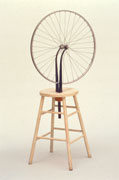
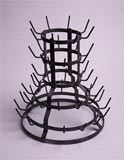
Duchamp never showed much desire to repeat himself. After Nude he painted no more cubist paintings, after the large glass he made no more mechanosexual delays. He had ideas, executed some of them to his satisfaction, and moved on. When, later in life, he did not have ideas (or so he claimed) he spent his time at chess and breathing. If he clarified his thoughts on the idea Readymade around 1915, it stands to reason (mine at least) that he would execute his idea reasonably quickly and then move on. 1915 was the year of In Advance of the Broken Arm. Even before this was the bottle rack, which he never even signed and was not in his possession in New York. (As far as the “forgery” of the shovel goes, with its square handle, which Shearer uses to call it into doubt, I cannot say much — we are in a black swan predicament as far as proving anything goes.)  But between these two early readymades (ignoring the earlier Stoppages and the bicycle wheel, which are commonly called readymades but clearly different in conception), and others we have heard of (Pulled at Four Pins) and can speculate he may have played with, Duchamp may have executed the “pure” (unmodified commercial object) readymade to his satisfaction. After all, once you have the idea, what’s interesting about repeating the simple (boring) act of buying an object and signing it? He had made a readymade (in the bottle rack) perhaps even before the idea was entirely clear to him. Why do any more? Even giving a snow shovel a humorous/poetical title shows a conceptual evolution beyond the simple core concept.

It seems to me that he moved on immediately to the more interesting (to the tinkerer’s mind, and Duchamp was certainly a tinkerer) project of modified readymades, such as With Hidden Noise of the following year. With Hidden Noise included the readymade aspect (buying or finding the components), assemblage, collaboration (he had Walter Arensberg put the mystery noisemaker inside), interactivity (you have to shake the thing to understand the title). Given that he had moved within months from the shovel (fall or winter 1915) to Noise (easter 1916), does it not make sense that by 1917-18 he had moved on to other ideas, which may or may not have included forgery, confusing modifications, and obfuscation of the idea that was initially (in the bottle rack) so simple and straightforward? The essential confusion, I think, is that Duchamp and, taking his lead, all his critics, lumped a bunch of disparate but related concepts under the umbrella term “readymade,” (compare the early readymades to 1921’s Why Not Sneeze Rrose Selavy) and while the shared classification did not bother Duchamp himself, it seems to put the taxonomists among us all in a tizzy.
As far as modification of the hatrack, bicycle wheel, trebuchet, etc. goes, all I can say is if they sat in my studio for years I’d have trouble refraining from playing with them. Duchamp had no qualms about modifying objects or documentation of objects, nor about commissioning others to physically create works for him, nor about giving misleading or false information in interviews, etc. If it gives you joy to sleuth out his “secrets,” good on you. The layers of confusion are one of the gifts he gave us. 
Sincerely,
 
Evan Bender

Re-evaluating the Art & Chess of Marcel Duchamp

Duchamp the Chess “Idiot”
Damisch: You remember Duchamp’s famous print of two chess players . . . [I was furious] that idiot, Duchamp! He just managed to get $2,000 off me for his Chess Association and in exchange he gave me this horrible etching of chess players. . . . [And he] said that Art no longer had any internal necessity; it was now a pure convention!(1)

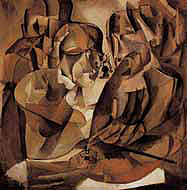
In 1961 Marcel Duchamp organized an auction of artworks to raise funds for the American Chess Foundation and asked many of his contemporaries to contribute works. The ‘horrible etching’ which Damish purchased, a reproduction of his 1911 cubist painting The Portrait of Chess players (Fig.1), is part of a largely incommensurate aspect of Duchamp’s historical and artistic legacy: Chess. Damisch’s response to this work is like that of other art historians to his entire involvement in the game. Most commonly, Duchamp’s involvement in chess is expressed as incomprehensible, or simply ignored.(2)Click to EnlargePortrait of Chess PlayersFigure 1
Marcel Duchamp,
The Portrait of Chess Players, 1911

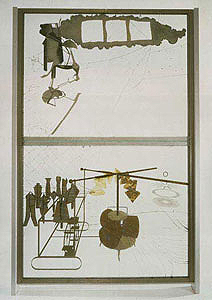
Popular historical representations tell that in 1923, after the completion of The Large Glass (Fig.2), he quit art to play chess.(3)
Nevertheless the connection between chess and Duchamp’s greater artistic agenda is fundamental to understanding him as an historical figure.

Damisch begins a critique on Duchamp as chess player, The Duchamp Defense, with an outline of his chess career, primarily to construct a ‘narrative’ of his achievements in the realm of chess.(4)
The reading of this is impressive. However, Damisch then poses the questions, how does such a narrative serve in attempting to understand Marcel Duchamp? What is the purpose of such a narrative? In developing an understanding of Duchamp, the artist, what is the purpose of understanding Duchamp the chess player? Damisch says that this narrative should not just be told for the love of a story but to establish the value chess was held by Duchamp.Bride Stripped Bare by Her Bachelorsfigure 2
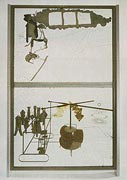
Marcel Duchamp, Bride Stripped Bare by Her Bachelors, Even [a.k.a. The Large Glass], 1915-23, Philadelphia Museum of Art.

Above all is his belief that [Duchamp] was never more interested in chess than after he had ceased being interested in painting.(5)

This narrative shows that Duchamp’s involvement in chess was not a side-line interest but rather Duchamp’s dedication to chess was with “all the ambition and single minded passion of a professional.”(6)
Yet, as Damisch states, this passion that would dominate his time and intellect for over twenty years of his life “was no more than a game.”(7)
Thus if the aim is to understand his art work it has been common practice to dismiss such an investigation in Duchampian chess as an incongruous aspect of his life. Tomkins, who has written extensively on Duchamp, offers that,

Although chess claimed a great deal of the energy that had been formerly devoted to his Large Glass, the usual statement that he abandoned art for chess is misleading. In fact, one of the essential facts about it is that while he has successfully avoided playing the role of artist since 1923, he has never left the art world.(8)

Tomkins points out that the art world has used a blunt instrument to separate aspects of Duchamp’s life. The ‘quitting’ one activity and taking up of another is symptomatic of the way historical figures are commonly represented. Furthermore, historical methodology has placed restrictions upon how Duchamp has been investigated and subsequently represented. It is these assumptions of art historians that have led to the creation of a coherent art narrative of Duchamp’s life and work that has not allowed chess to disrupt or to inform it. Duchamp’s engagement in a variety of intellectual disciplines disrupts such a clear cut understanding of Duchamp as an artist. Such an approach restricts the historical and critical understanding of Duchamp by considering his activities outside the paradigm of art, as peculiar, inconsistent and irrelevant. As ‘an-Artist’ Duchamp allowed diverse and distinctly different institutions to converge, to interrelate, informing a complex philosophical understanding of art and the intellectual milieu in which he was living.


The Histories of Marcel Duchamp as Chess Player

. . . comparatively little has been written about Duchamp’s chess as a form of artistic activity, how it relates to his other artistic interests, and what it reveals about his attitude to art in general. A few writers have commented on these matters, but their views tend to be underdeveloped and are often highly speculative. Roger Cardinal summed it up when he remarked that “nobody has entirely assessed the significance of chess in Duchamp’s career.”(9)

When attempting to address the nature of chess in the life of Marcel Duchamp one is met with many contradictions. Even from within chess there is debate over Duchamp’s approach to the game and has also failed to bridge the theoretical distance in an attempt to reflect upon his art. Theorists have attempted to determine Duchamp’s playing style through a comparison of the complexities in conservative Classical chess play and Avant-garde Hypermodernism. Yet, due to misunderstandings concerning Hypermodernism in chess and of Dada in art, we will see how some, like Keene, Humble & Le Lionnais, have drawn various conclusions about Duchamp the chess player.

It is tempting for the art historians, like Arturo Schwarz, to adopt a systematic approach when writing about Marcel Duchamp and to create a theory through which all of his work can be seen. However one must be wary of theories that claim to unlock the system or pattern behind Duchamp’s work. For such dominant or meta theories have greatly affected how aspects of Duchamp’s life and works are understood. Francis Naumann in his article titled “Marcel Duchamp: A Reconciliation of Opposites,” warns that any attempt to formulate Duchamp “would be – in the humble opinion of the present author – an entirely futile endeavor .“(10)Francis Naumann suggests that Duchamp gave his response to those attempting to unlock the mystery when he said “There is no solution, because there is no problem.” In understanding the nature, role and significance of Duchampian chess, one needs to see beyond the problem / solution dilemma and operate at a different cognitive level involving multiplicity and complexity. This thesis aims to demonstrate a multiplicity of the complex relationships between Duchamp as artist and as chess player. The importance for this approach, as Naumann states, is that Duchamp himself moved through a number of contemporary artistic styles and each time developed a unique approach of self consciously “defying convenient categorization.”(11)To support this claim Naumann offers a collection of quotations by Duchamp from a 1956 interview with James Sweeney emphasizing the importance of change and the defiance in his work to any tradition or “taste.”

‘It was always the idea of changing,’ he later explained, of ‘not repeating myself.’ ‘Repeat the same thing long enough,’ he told an interviewer, ‘and it becomes taste,’ a qualitative judgment he had repeatedly identified as ‘the enemy of Art,’ that is, as he put it, art with a capital A. (12)

Humble asserts that published views on Duchamp’s chess as art are “underdeveloped and often highly speculative is, he suggests, due to the reason that nobody is entirely sure how to understand or to define chess itself. Humble muses that chess players themselves debate whether chess is a game, sport, science, or art.

With this being said, the mystery of chess in the life of Marcel Duchamp is a subject that has often been approached in a formulaic manner. Questions like; “What type of player was Duchamp?,” “What was the role of chess in his life?,” and “What is the relationship between chess and art?” have been presented in a simplistic and minimalistic fashion. One example of this is an article by grand master and chess theoretician Raymond Keene titled Marcel Duchamp: The Chess Mind. In this article Keene discusses Duchamp’s achievements, his associations, his theoretical positions, and attempts to establish a relationship between art and chess. Primarily his analysis focuses upon the nature of Hypermodernist chess praxis and the dada art movement. Keene seeks to show that Duchamp as well as being a Dadaist, was also a hypermodernist chess player and thereby establish that the relationship between chess and art is dada. In this way, Hypermodernism is often equated with dada, yet the similarities have more to do with the look and feel of the game rather than theory. In comparison to Classical or Modern games hypermodernism seems absurd and illogical.(13)

Keene’s theoretical analysis of Duchamp’s chess play dismissed comments made by a chess player and dadaist contemporary of Duchamp’s, Francis Le Lionnais. Le Lionnais defeated Duchamp in 1932 in Paris, and later stated that Duchamp was not a dada chess player, but a player who adopted a conventional, conformist, or classical style of play.(14)
To counter this claim, Keene looks closely at the influence and the similarities between Duchamp and the founder of hypermodernism, Grand master Aaron Nimzowitsch. Keene asserts that Duchamp borrowed a Nimzowitsch opening for the 1927 world Championship. Keene’s theories concerning the relationship between chess and art are convincing. Keene argues that the tactical talent displayed in his love for “paradoxical hidden points” is fundamentally Dada. Keene mirrors Duchamp’s comments that chess was a “violent sport” with that of Nimzowitsch who said “chess was a struggle like that of life.”(15)
Further, Keene shows Duchamp’s continuing dedication to Nimzowitsch. In the course of his research Keene visited Teene Duchamp, Marcel Duchamp’s wife, and found a copy of Nimzowitsch’s Chess Praxis that Duchamp had hand written (over 200 pages).

Keene demonstrates the associations between Duchamp and Nimzowitsch and dispels the comments made by Le Lionnais. Keene establishes a close association between Duchamp and Nimzowitsch, arguing that Nimzowitsch was a hypermodernist and therefore that Marcel Duchamp was one also. Keene’s conclusion is not far off, yet, it maintains an understanding of Hypermodernism that is misleading. Keene adopts a very clear theoretical methodology of forming binary opposites. His use of opposites, or opposition, is essential for the creation of a distinction between classical and hypermodern chess. Yet this position implies a conflict between the two styles of chess play that is not necessarily true. One of the intrinsic characteristics of Hypermodernism is its connectedness with the movement it surpassed.

The relationship does lie in the realms of Hypermodernism and Dada and yet it goes much further, as Duchamp goes further than Dada. Thus, Keene’s whole approach to find the solution to the problem of Duchampian chess is mistaken.

An interview between Ralph Rumney and Francois Le Lionnais was the catalyst for this thesis and investigation. I set out to determine which one of the theorists was correct, and it was not until I reconsidered my methodology that an alternative conclusion could be reached. Ralph Rumney has just asked Le Lionnais to describe Duchamp’s qualities as a player,

FRANCOIS LE LIONNAIS I don’t know how well I can do that . . . in his style of play I saw no trace of . . . a Dada or anarchist style though this is perfectly possible. To bring Dada ideas to chess one would have to be a chess genius rather than a Dada genius. In my opinion Nimzowitsch, a great chess player was a Dadaist before Dada. But he knew nothing of Dada. He introduced an anticonformism of apparently stupid ideas which won. For me that’s real Dada. I don’t see this Dada aspect in Duchamp’s style. . . .

RALPH RUMNEY You say he was not a Dadaist as a chess player. . . but was he an innovator?

FRANCOIS LE LIONNAIS Absolutely not. He applied absolutely classic principles, he was strong on theory – he’d studied chess theory in books. He was very conformist which is an excellent way of playing. In chess conformism is much better than anarchy unless you are Nimzowitsch, a genius.

This exchange ends with Rumney posing a question:

It seems to me that the extremely conformist style of Duchamp’s chess which you describe has parallels in everything he did, and that perhaps instead of looking for evidence of Dada in the way he played chess we should be looking for aspects of this conformism in his most anti-conformist action? (16)

Le Lionnais, it would seem, contradicts Keene’s understanding of Duchamp’s chess. Instead of looking for conformity within Duchamp’s art, Keene refutes the very grounds for such an inquiry by stating that Duchamp was a Dadaist chess player and did not adopt a conformist or classical style. Yet even the investigation suggested by Rumney will bring us to a binary end. Lionnais claims to have seen no evidence of Duchamp’s Dadaist or hypermodernist chess play but instead a classical approach. Duchamp is either a conformist or a non- conformist artist, and Duchamp is either a conformist or non-conformist chess player. In the end this will not bring us to an understanding of Duchampian chess, but a series of binary oppositions. Keene reached this conclusion even though the original question was what sort of player was Duchamp? This investigation into Duchamp’s chess is met with two opposing views; he is either a Hypermodernist or a Classicist. The historian is being asked to determine whether Keene or Lionnais is correct.

The comparison between the chronological order of [my] paintings and a game of chess is absolutely right . . . But when will I administer checkmate – or will I be mated? (17)

Click to EnlargeThe Green Boxfigure 3
Marcel Duchamp, The Green Box, 1934
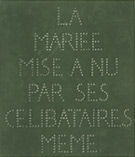
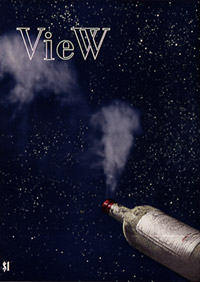
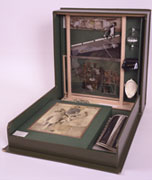
Duchamp dropped clues along his way as to how we are to understand chess. When Duchamp co-wrote a chess book on end-game with chess theorist Vitaly Halberstadt, he collected all of the notes that he made in preparation for the book’s publication and placed them all in a ‘box’. He titled this ‘box’ The box of 1932. What is significant about the act of Duchamp ‘boxing’ his proofs and diagrams, is that it identically reflects his act of ‘boxing’ all of the notes he made in preparation for his Large Glass. Duchamp titled this box The Green Box (Fig. 3), and used it to take the viewer into the world of the ‘bride’ and the ‘bachelors’ the two major aspects of the Large Glass. Thus the Box of 1932 is to L’Opposition et les cases conjuguees sont reconciliees as The Green Box is to the Large Glass. Duchamp did not make any indication that his theoretical work on chess was to be understood through the shattered glass of his Bride. It is through the multiple paradigms in which Duchamp was involved, that we are to understand and represent him as an historical figure. Duchamp as artist sharing the values of other paradigms and bringing what is seen as incommensurate into unity. Duchamp has offered an explanation as to how two apparently incommensurate elements are united through the concept of ‘inframince’ (Fig. 4).front cover for View, vol. 5, no. 1figure 4
Marcel Duchamp, front cover for View, vol. 5, no. 1 (March 1945)

WHEN
THE TABACCO SMOKE
SMELLS ALSO
OF THE MOUTH
THAT EXHALES IT THE TWO ODOURS
ARE MARRIED
INFRAMINCE.(18)

The smell of smoke and the mouth are distinct and separate entities, though through the act of smoking, the two odors are combined forming a ‘new thought.’(19)
Thus through inframince, art and chess are married in the life and work of Marcel Duchamp. The relationship between art and chess is very complex and multi layered, and is not able to be reduced to a meta theory or solved by dismissing Duchamp’s engagement with chess.

The many paradigms in which Duchamp ‘worked’ or ‘played’ need to be understood as blending within art, via this understanding of inframince, like that of the smoke mixing with another odor. This proposed historical methodology is not only relevant to Duchamp but to all historical figures. The various contradictory positions held by historians and theorists concerning Duchamp and his incommensurate activities can be understood by the history of art. Art is what is brought into existence via a series of established conventions and fulfils various criteria. Postmodernism offers a perspective that is able to bring together that which was an anomaly to modernist historical representation of Duchamp. It is through postmodernism that the ‘sub-systems’ that Duchamp was part of can be understood and can become part of his historical representations. Unity can be created through acknowledging the existence of these paradigms and the way in which Duchamp’s activities created ‘inframince’ with each other: art and chess, chess and art, chess and science, science and art. Duchamp is ‘found’ through an historical and theoretical methodology founded upon such postmodern multiplicity.

Chess and Art “reconciled”

It is important to make a connection between many of the theories of Nimzowitsch and that of Duchamp, in particular those of aesthetics and thought. Duchamp made many statements that his art was an intellectual activity and he was critical of what he termed ‘retinal’ art. This is similar to the criticism that the Hypermodern chess players had for the classical school: classical theories were based on (formalistic) aesthetics and not on the intellect or logic. Duchamp’s interest in the intellect went beyond the realms of chess and he wished for a similar intellectual direction to take place in art.

This is the direction in which art should turn: to an intellectual expression.(20)

There is a mental end implied when you look at the formation of the pieces on the board. The transformation of the visual aspect to the gray matter is what always happens in chess and what should happen in art.(21)

The observation that the words of Duchamp mirror those of Nimzowitsch have been made by a number of theorists. Some even go so far as to suggest that Duchamp’s Large Glass mirrors diagrams that Nimzowitsch used in his 1925 publication, which divided the chess board in two.(22)
This is not to suggest that the way to understand Duchamp’s art is through his chess, but it is helpful to break down the intellectual barriers that exist between art and chess thus forming a reconciliation of these two paradigms in the person Duchamp.

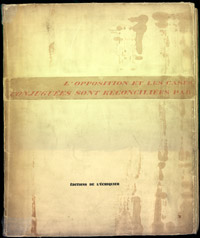
Click to EnlargeOpposition and Sister Squares are Reconciledfigure 5
Marcel Duchmap, Opposition and Sister Squares are Reconciled, 1932
In 1932, Duchamp, in collaboration with Vitaly Halberstadt, wrote a study on a specific end game situation titled L’Opposition et les cases conjuguees sont reconciliees (Opposition and Sister Squares Are Reconciled) (Fig. 5). Duchamp spoke of it as purely an intellectual study with no real practical application, for the situations being presented rarely came about.(23)
He said to Cabanne,

The endgames on which this fact turns are of no interest to any chess player: and that’s the funniest thing about it. Only three or four people in the world are interested in it, and they’re the ones who’ve tried the same lines of research as Halberstadt and myself. Since we wrote the book together, chess champions never read this book, because the problem it poses never really turns up more than once in a lifetime. These are possible endgame problems, but they’re so rare that they’re almost utopian.(24)

Duchamp called his work a “linguistic study,” which Damisch claims the Duchamp / Halberstadt text is built around the notion of ‘opposition.’(25)
Using the language from a number of paradigms, especially from aesthetics and philosophy, to explain scientific and mathematical foundations of his chess theories.

Duchamp’s and Halberstadt’s discussion in L’Opposition et les cases conjuguees sont reconciliees involve end-game problem, and their discussions are very much couched in geometrical language, involving ‘translation,’ ‘displacement,’ and ‘rotation’ around ‘charniere’ or ‘hinges.’ Charniere’ is the term that Duchamp used in his mathematical notes to mean an ‘axis o rotation.’(26)

Saussure directly uses the model of chess to introduce his oppositional theories of language. Damisch quotes from a small section where Saussure explains that it is only through words opposing one another that meaning is created;

a given term having . . . no value except through difference and through its opposition to the other terms in the language.(27)

And furthermore that the relationship between languages and chess is,

Just as the game of chess is entirely in the combination of the different chess pieces, language is characterized as a system based entirely on the opposition of its concrete units.(28)

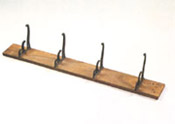
Click to EnlargeTrébuchetFigure 6
Marcel Duchamp, Trébuchet, 1917/1964
The end game is fundamentally a stage of opposition, where the only pieces that remain are the two Kings and some pawns.(29)
Opposition is defined during the end game when symmetry is presented by the position of the Kings and pawns. The aspect of the end game that Duchamp and Halberstadt were concerned about was when a symmetry or a formalist structure arise and each player is struggling to keep equilibrium for survival. For there is security in symmetry during such situations because a player is able to restrict or control the moves available to the opponent. At the same time, due to the symmetry, a player may be forced into making a move that will cause their own defeat, otherwise known as a Trap or Trebuchet (the title of his 1917 Readymade) (Fig. 6).(30) In opposition there is a paradoxical element that interested both Duchamp and Nimzowitsch. Duchamp and Halberstadt’s book attempted to reconcile the two components of symmetrical endgame situations; opposition and sister squares. The squares represent the squares on the chess board that remain relevant to the chess pieces in symmetry. Hence the title of Duchamp’s book Opposition and Sister Squares Are Reconciled. The way that Duchamp explained it is as such,

The “opposition” is a system that allows you to do such – and – such a thing. The “sister squares” are the same thing as opposition, but it’s a more recent invention, which was given a different name. Naturally, the defenders of the old system were always wrangling with the defenders of the new one. I added “reconciled” because I had found a system that did away with antithesis.(31)

It is important to notice that within Duchamp’s study of endgames there is not an attempt to create further opposition by Duchamp positioning himself with one side or the other. Duchamp separates himself from the debates between the Classical school or “old system” and the hypermoderns. He was able to see that with hypermodernism there was an opportunity to create a synthesis between these two opposing understandings of end game theory. In so doing he displays a typically Hypermodern paradoxical attitude to classical theory.

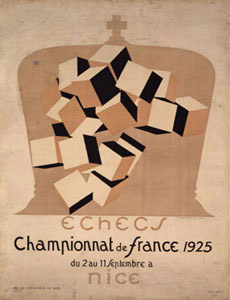
Click to EnlargePoster for the Third French Chess ChampionshipFigure 7
Marcel Duchamp, Poster for the Third French Chess Championship, 1925 Rhonda Roland Shearer Collection
Let us take this one step further towards Duchamp ‘reconciling’ art and chess. Damisch makes the point that Duchamp’s chess poster designed for the 1925 Third French Chess Championship (Fig. 7) mirrored his theory of reconciliation. Duchamp extended the checkers of the chess board until they became cubes with one white, black and a third grey side, grey being the side of reconciliation. In the game of chess it is the opposition between black and white that gives the game its meaning. However, the ‘binary’ opposition of chess is defeated by Duchamp in the presence of the grey surfaces.(32)

Let us return to Naumann’s article and interview contained in De Duve’s The definitively unfinished Marcel Duchamp. Francis Naumann presents Duchamp’s involvement in philosophical ‘reconciliation’ in the context of the German philosopher Stirner and the philosophical beliefs of existentialism and nihilism: That each position or situation exists as a unique entity, thus unable to be located within specific systematic constraints. Naumann points out that reconciliation is not only found in the works of Stirner but has a philosophical tradition that goes back to Plato.(33)
More than that, ‘reconciliation’ is present in contemporary theories of structuralist theory, molecular biology, metaphysical poetry, and French symbolist poets. Thus this theme of ‘reconciliation of opposites’ is present in a number of intellectual domains. The theme is similarly reflected in writings since medieval times up until the time of Carl Jung who specifically wrote on the subject in Mysterium Coniunctionis: An Inquiry into the Separation and Synthesis of Psychic Opposites in Alchemy.(34)
Yet Naumann warns us that one must be careful in the creation of a theory about Duchamp, for he consciously set out never to repeat himself and thus be defined. Naumann says:

No matter what his sources may have been – if any – his exploration of opposites and their reconciliation seems to have been motivated more by his unwillingness to repeat himself than by any possible willingness to conform to the dictates of a previously established system – philosophical, literary – or otherwise. His working method involved a constant search for
alternatives – alternatives not only to accepted artistic practice, but also to his own earlier work.(35)

Naumann states that Duchamp was familiar with many aspects of reconciliation in maths, science, linguistics and philosophy. Therefore the relationship between chess and art in the historical figure Duchamp is contained within a wide intellectual field.

Historian Calvin Tomkins makes the similar observation that Duchamp’s fascination with art and chess seems to be bound up in mathematics.(36)
The importance of logic, rationalism and Cartesian thought are an integral part of Duchamp’s work coupled with an anti-rationalistic interest, as seen in the works of Raymond Roussel and Alfred Jarry. Also Duchamp’s use of the term Cartesian is implicit of Descartes idea of man as a thinking mind, and matter an extension of motion. In terms of chess this duality is clearly seen, the movements of chess pieces upon a board are the physical expression of the chess player’s cognition. In an interview with Tomkins, Duchamp says:

Chess is a marvelous piece of Cartesianism, and so imaginative that it doesn’t even look Cartesian at first. The beautiful combinations that chess players invent – you don’t see them coming, but afterward there is no mystery – it’s a pure logical conclusion.(37)

When the life and actions of Duchamp are placed within the historical context of Postmodernity we find the merger or reconciliation of a variety of intellectual paradigms. Duchamp’s studies into chess drew upon the knowledge and language of science, mathematics, and linguistics. Thus in order to understand the life and actions of Marcel Duchamp we must strive to understand the nature of intellectual reconciliation.


Duchamp as Chess Artist

And why . . . isn’t my chess playing an art activity? A chess game is very plastic. You construct it. It’s mechanical sculpture and with chess one creates beautiful problems and that beauty is made with the head and hands.(38)

“I play chess all the time,” he wrote to Walter Arensberg. “I have joined the club here where there are very strong players classed in categories. I still have not had the honor of being classified, and I play with various players of the second and third categories losing and winning from time to time.” He had a set of rubber stamps made up so that he could play correspondence chess with Walter Arensberg. He even designed a set of wooden chessmen that he carved himself, all except the knight, which he farmed out to a local craftsman. In May he wrote to the Stettheimers that painting interested him less and less: “I play [chess] day and night and nothing interests me more than to find the right move..(39)

It is deep below the layers of chess symbolism that Duchamp is encountered as a chess player and an artist. Art theorist Hubert Damisch raised the question as to why we encounter Duchamp in the world of chess at all. Damisch asks: how could he have spent so much of his life involved in nothing but a game? He makes a point of comparison, that Duchamp spent more of his life within this realm than he spent painting, though Duchamp renounced “neither the notion of “artist” nor that of “art.”(40)
How has Duchamp slipped so easily into the realm of chess and become so difficult to follow? I have suggested that it is the art world’s scorn and misunderstanding for the game. Yet it is not within the “game” that we encounter Duchamp. The artist moved into the world of chess and it is here that the art theorist and historian loses Duchamp. What is significant is that Duchamp was able to enter the world of chess only due to his entering as an artist. Duchamp understood chess via the language, values, history, and culture of art. Thus on entering the world of chess we need to find the artist Duchamp. He was not found in the realm of symbolism, though he has left his footprints there, to perhaps lead us astray. When Duchamp entered the chess world he entered as an artist and he proclaimed that art was to be found here. Damisch summarizes Duchamp’s interest for chess as an artistic activity, and that a game of chess is considered “beautiful” in its own right and is as close as possible to becoming a work of art.(41)

Damisch understands Duchamp’s involvement in chess as deeply connected with his agenda as an artist. Damisch asserts that he was not interested in the symbolism of the chess pieces, the layers of historical meaning, or the psycho-sexual elements, but the way that chess was able to evoke abstract and intellectual movement of objects upon a new space or reality. This point Duchamp directly made when he answered the specific question as to the importance of symbolism in chess. Duchamp said that it holds no importance in the game, although chess acts like a drug of addiction.(42)
Duchamp later said that the “expression” of chess and the “competitive” nature made it too incongruent with art, and thus is no art form at all. However, for Duchamp, it was not important to understand chess as a fight, or “sport” but through artistic qualities. This he explicitly stated during a BBC radio interview, when saying that the “competitive aspect was of no importance.” (43)

Of course, one intriguing aspect of the game that does imply artistic connotations is the actual geometric patterns and variations of the actual set up of the pieces and in the combinative, tactical, strategical, and positional sense. It’s a sad expression though – somewhat like religious art – it is not very gay.(44)

Here Duchamp is presenting three ‘artistic’ or aesthetic levels concerning the game. First, the immediate visual impression of the chess pieces upon the board. This includes the chequered board, the sculptural formation of the pieces, and the variety of visual patterns that they form upon the board. Second, the abstract movement of the pieces through the ‘intellectual’ space. Finally, the emotional expression of chess.

The first level of aesthetics were explored by Duchamp in designing (but never making) a chess set. Writing to his sister Suzanne Duchamp he explained,

I am about to launch on the market a new form of chess sets, the main features of which are as follow: The Queen is a combination of a Rook and of a Bishop – the Knight is the same as the one I had in South America. So is the Pawn. The King Too. 2nd they will be colored like this. The white Queen will be light green. The black Queen will be dark green. The Rooks will be blue, light and dark. The bishops will be yellow, light and dark. The knights, red, light and dark. The white King and Black King. White and Black Pawns. Please notice that the Queens’ colour is a combination of the Bishop and of the Rook (just as she is in her movements).(45)

While the immediate visual impression of the chess set would be striking, its purpose is to direct our attention to the second aesthetic level; the intellectual movement of the pieces. This is directly indicated by the coloring of the Queen – its movement being a combination of a Bishop and a Rook. His engagement in chess is seen as profoundly relating to the intellectualized movement of the pieces, to which he has brought the inventiveness of an artist to the aesthetics of the game. It is the ‘artistic’ intellectual and abstract movement of pieces that Duchamp, the artist, values within chess.

Duchamp spoke most openly and comprehensively to Pierre Cabanne concerning this perspective on the game. This interview sheds light upon a vast array of Duchamp’s chess quotations and references commonly used by historians and theorists when speaking on the subject.

Cabanne: I also noted that this passion [for chess] was especially great when you weren’t painting. So, I wondered whether, during those periods, the gestures directing the movements of pawns in space didn’t give rise to imaginary creations – yes, I know, you don’t like that word – creations which, in your eyes, had as much value as the real creation of your pictures and, further, established a new plastic function in space.

Duchamp: In a certain sense, yes. A game of chess is a visual and plastic thing, and if it isn’t geometric in the static sense of the word, it is mechanical, since it moves; it’s a drawing, it’s a mechanical reality. The pieces aren’t pretty in themselves, any more than is the form of the game, but what is pretty – if the word ‘pretty’ can be used – is the movement. Well, it is mechanical, the way, for example, a Calder is mechanical. In chess there are some extremely beautiful things in the domain of movement, but not in the visual domain. It’s the imagining of the movement or of the gesture that makes the beauty, in this case. It’s completely in one’s grey matter.

Cabanne: In short, there is in chess a gratuitous play of forms, as opposed to the play of functional forms on the canvas.

Duchamp: Yes. Completely. Although chess play is not so gratuitous; there is choice ..

Cabanne: But no intended purpose?

Duchamp: No. There is no special purpose. That above all is important.

Cabanne: Chess is the ideal work of art?

Duchamp: That could be. Also, the milieu of chess players is far more sympathetic than that of artists. These people are completely cloudy, completely blind, wearing blinkers. Madmen of a certain quality, the way the artist is supposed to be, and isn’t, in general. That’s probably what interested me the most.(46)

Cabanne poses a range of questions directly concerning the relationship between art and chess. Cabanne begins by establishing an opposition to, or a clear distinction between, chess and art. The term Cabanne actually uses is “painting” yet in its context the word “art” is clearly implicit. The question posed to Duchamp points directly to the relationship Cabanne saw existing between chess and art. Cabanne asked Duchamp when he was not in the paradigm of art whether the movements of chess pieces gave rise to anything that he would value as art; and whether Duchamp discovered a new realm or space for art within chess. In affirmation of this, Duchamp continues to present an explanation of this artistic encounter within chess. As in his chess set design, Duchamp draws our attention to the multiple levels operating within the aesthetics of chess, and directs us to the aspect which he holds in the highest regard. Duchamp’s interest in the movements of a machine, a mystical machine, as directly and simply illustrated in his 1911 Coffee Grinder, operate also in the realm of chess, where the movements of the grinding mechanism is visible and the process or movement of the coffee through the machine is demonstrated. This is shown most clearly in Duchamp’s body of work that make up the King and Queen. There is a clear focus upon the movement of pieces upon the board in intellectual space.

Developing this further, Duchamp reflects on the close relationship chess has to geometry and mechanical movement. The example he presents is the movement of Calder’s mobiles. But a mobile is aesthetic in the realm of the visual and Duchamp says that the aesthetics of chess are not in this domain. It is not even the physical sculptural pieces that are aesthetic or “pretty” – it is the movement of the pieces in intellectual space. The beauty of chess that Duchamp saw was the movement of the pieces within his mind. This is testament to what Duchamp said to Drot,

And further,

Mechanics in the sense that the pieces move, interact, destroy each other, they’re in constant motion and that’s what attracts me. Chess figures placed in a passive position have no visual or aesthetic appeal. It’s the possible movements that can be played from that position that makes it more or less beautiful.(47)

Actually when you play a game of chess it is like designing something or constructing a mechanism of some kind by which you win or lose. The competitive side of it has no importance, but the thing itself is very, very plastic and it is probably what attracted me to the game.(48)

Cabanne presents Duchamp with a summary of this understanding: The distinction between the aesthetics of chess and art (painting) is that in chess there is a free movement or “play of forms” whereas in art, forms are not considered to be free for they serve a functionally aesthetic purpose. Cabanne has made the battle ground for this debate the issue of values associated with aesthetic functionality. Duchamp corrects Cabanne by saying that the aesthetics of chess are concerned with the “play of forms” in intellectual space, however, the movement is restricted by choice, and each choice brings its own consequences just as the artist also faces the consequences of their actions. Chess is not free or “gratuitous” as crudely expressed by Cabanne.

Duchamp and David Antin wrote an article (in response to an interview they had conducted) in which they illustrate the choice and consequences within the intellectual realm of chess and the weight of meaning and significance placed upon a small sculptural object, the chess piece.

but I don’t want to talk about that now I would rather talk about chess since we’re talking about Duchamp its only right that we should talk about chess chessboards define the action in chess the action is usually on the board similarly if you use the word art you use a board as a perimeter and some where within the perimeter is the site of a action at least it would appear so to someone who knew how to play chess which is an action of a different sort for someone know how to play chess for if two people two chess masters are playing a game and somebody watches that game and he gasps ostensibly this is an act of little significance a man pushes a little piece of wood and moves it over here say and the other man gasps he watches the man next to him doesn’t know why he’s gasping the first man is gasping because the player whose move it was has just moved the bishop to a particular position on the board from which will ensure 15 alternative possibilities all of which are not very good.(49)

This interest in intellectual movement was also Duchamp’s concern within painting, ‘intellectual expression’ was the direction that painting should take. Duchamp said;

I considered painting as . . . a means of expression, instead of a complete aim for life . . . the same as I considered that colour is only a means of expression in painting. It should not be the last aim of painting. In other words, painting should not be only retinal or visual; it should have to do with the gray matter of our understanding, not only the purely visual.(50)

American Chess Master Edward Lasker saw that Duchamp’s interest in the aesthetics of chess had profound effects on Duchamp the chess player. Duchamp’s aesthetic concerns and insights influenced his style of play which had immediate implications on many of his tournament results. Duchamp was ever the artist within the world of chess. Schwarz also acknowledges that Duchamp’s aesthetic interest in chess, coupled with his “unorthodox” style led to many defeats at chess master levels.(51)

Duchamp’s interest in chess also revolves around the contradiction or paradox that exists between freedom and restriction. Within a strict framework of rules, there is great room for creative and imaginative thought. Duchamp’s Cartesian sentiments, also presented insights into the aesthetic realm of chess.

Chess is a marvelous piece of Cartesianism, and so imaginative that it doesn’t even look Cartesian at first. The beautiful combinations that chess players invent – you don’t see them coming, but afterward there is no mystery – it’s a pure logical conclusion.(52)

Duchamp’s Hypermodernist chess praxis questioned all previously established styles and theoretical principals whilst maintaining a rigorous mathematical and scientific methodology. Duchamp as a chess player closely associated himself with Hypermodernism not only for its Dadaist position but also for its rigorous mathematical and logical approach. It was through a Cartesian approach that Duchamp wrote Opposition and Sister Squares Are Reconciled with chess theorist Halberstadt. This text has been observed to involve the “seemingly aimless maneuvers of the kings,” yet it shows his interest in the mathematic logic of chess.(53)
His intellectual interest in both the acceptance and rejection of logical thought, or of freedom and restriction, became an interest in the middle ground. A middle ground of indifference, which he considered the “beauty of indifference,” and “an acceptance of all doubts.”(54)
This “indifference” reflects Duchamp’s adoption of a Hypermodern chess style which is an interplay of romantic and modern forms. He explained his attitude of indifference to Andre Breton:

For me there is something else in addition to yes, no or indifferent – that is, for instance – the absence of investigations of that type. . . . I am against the word ‘anti’ because it’s a bit like atheist, as compared to believer. And the atheist is just as much of a religious man as the believer is, and an anti-artist is just as much of an artist as the other artist. Anartist would be much better, if I could change it, instead of anti-artist. Anartist, meaning no artist at all. That would be my conception. I don’t mind being an anartist . . . What I have in mind is that art may be bad, good or indifferent, but, whatever adjective is used, we must call it art, and bad art is still art in the same way as a bad emotion is still an emotion.(55)

Duchamp was reluctant to draw a distinction between the artist and the anti-artist, which questions whether a theorist should make the distinction between art and chess. An indifference to the division between art and chess creating a free flow of ideas between the two. This free flow or traversal of paradigms existed not only between chess and art. Duchamp’s interest in this intellectual paradox flowed into his involvement in mathematics. Henri Poincare is believed to have presented Duchamp with a position that emphasized the resolution of the paradox. Poincare’s mathematical text Science et method has a chapter concerning mathematical invention, which suggests that by using the laws of mathematics one is able to be as inventive, imaginative and creative as a chess player. Poincare says that all mathematicians have “a very sure memory” or,

a power . . . like that of the chess player who can visualize a great number of combinations and hold them in his memory, . . . every good mathematician ought to be a good chess player, and inversely.(56)

Poincare understood chess to be fundamentally associated with invention. An invention of pure elements of “harmony of number, and forms, of geometrical elegance.”(57)
That strict rules and laws exists both within mathematics and chess. Within this framework, the practitioner is able to move and act freely and inventively. It has been suggested that chess operated for Duchamp as an arena of invention that he occupied after completing his conceptual and mathematical invention, the Large Glass.(58)
Julien Levy said of Duchamp:

Marcel wanted to show that an artist’s mind, if it wasn’t corrupted by money or success, could equal the best in any field. He thought that, with its sensitivity to images and sensations, the artist’s mind could do as well as the scientific mind with its mathematical memory. He came damn close, too. But, of course, the memory boys were tougher, they had trained [for chess] from an early age. Marcel started too late in life.(59)

Duchamp was seen by many of his chess opponents to be highly creative, and his use of inventive or “playful” mathematics within the Large Glass, demonstrates Duchamp’s freedom of movement between these paradigms. And perhaps it is within this context that we are to understand Duchamp’s statement that

From my close contact with artists and chess players, I have come to the personal conclusion that while all artists are not chess players, all chess players are artists.(60)

Duchamp came to conduct chess as an artist and to conduct his art making as the chess player.

The theorist David Joselit also explores the way that chess and art relate in Marcel Duchamp’s life and art. Joselit sees chess as “living art” within Duchamp’s life. In which there is a traversal between art and chess as there is Duchamp’s traversal between art to life.

He took an ordinary article of life, placed it so that its useful significance disappeared under the new title and point of view – created a new thought for that object.(61)

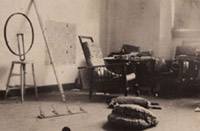
Click to EnlargeOriginal Studio PhotographFigure 8
Original Studio Photograph, 1916-17
The photograph of Duchamp’s studio from 1917 presents the framework for this theory. Hanging vertically upon a wall is chess as a physical object, as opposed to the intellectual realms of chess, and upon the floor, chess as a conceptual reality via the readymade sculpture the Trap (Fig.8). It is well known that Duchamp played correspondence chess and these vertical boards were commonly used to illustrate his games in progress. The depth of logical methodology saw Duchamp thrive in correspondence chess and endgame studies. In these instances, the slow pace of the game creates little scope for oversights and incorrect moves, thus a purer logic is achieved. Joselit views this vertical chessboard through art stating that it has entered the arena of the painting. The chess board has entered or ‘colonized’ the paradigm of art via painting.

The rotated chess board suggests that the relationship between chess and art was not necessarily one of displacement but rather of the transformation or transposition of painterly themes into a realm that obviates “the intervention of the hand.” (62)

The flat vertical image upon a wall, yet the physical transient reality of chess, becomes an “erasable beauty” a painting that can be erased and begun over and over again.(63)
Likewise Duchamp said:

At the end of the game you can cancel the painting you are making.(64)

Duchamp wrote the following note that further expresses this:

Chess = a design on slate / that one erases, / the beauty of which / one can reproduce without the / intervention of the “hand.”(65)

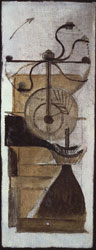
Click to EnlargeCoffee MillFigure 9
Marcel Duchamp, Coffee Mill, 1911
Thus Duchamp saw chess enlightening the paradigm of art. Chess is an “aesthetic idiom” to mathematically represent an “immobilized” movement as is seen in the Large Glass (1923) (Fig. 2) and Coffee Mill (1911) (Fig. 9). The artist chess player is able to “diagram it, to capture it within a grid of measurement.”(66)

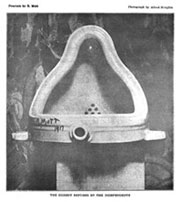
Joselit’s hypothesis is that chess is a projection into Duchamp’s world of the readymade as clearly displayed in the studio photograph. The readymade represents Duchamp’s traversal between art and everyday life and chess. Trebuchet or Trap draws directly from a theoretical movement within chess. This readymade sculpture is created by Duchamp by nailing a coat rack down upon his studio floor. Trebuchet is a tactical chess move that incites a player to make a move that will ultimately cause them to lose a positional advantage, a piece, or the game. The analogy of being tripped by the inverted coat rack is obvious, one Duchamp actually encountered when he brought the object home and never got around to mounting it to the wall. Duchamp becomes the chess piece tripped by the Trebuchet that was set by himself. Joselit sees a direct connection between the chess board tipped upon a wall and the coat rack that has been tipped down upon the floor. Each work has entered a new realm via its displacement. Duchamp the chess player in the realm of art and Duchamp the artist in the realm of chess, both in the realm of the everyday. Joselit understands that within this photograph, chess operates as a pivot for understanding the movement from the realm of painting to the realm of Duchamp’s readymades. Joselit says that these two works demonstrate the “discursive field that we might call ‘Duchampian chess.'”

To understand what is occurring within Duchamp’s art we need to understand the way chess operates as a theoretical and practical model. Within chess Duchamp enters the arena of the painting via the chess board hung upon a wall. The physical chess object can be aestheticised like that of a painting. Duchamp also enters the realm of the readymade object in his studio and the conceptual movement of correspondence chess through intellectual space via an arena of readymade rules and intellectual visualization. Through documentation and notation Duchamp geometrically charted the movement of the readymade upon the painterly plane. Then the entire chess object is placed within the context of the everyday. It is this nature of the everyday that prompted Duchamp in 1917 to publish a game of chess between the artists (both poor chess players) Roche and Picabia, in a regular chess column of a news paper. The readers were outraged! Duchamp wrote in response to this Richard Mutt Case of the chess world that;

It had been a game from everyday life: lyrical, heroic, romantic; with blunders, sudden panic reactions, flights of imagination and here and there even a correct move.(67)

Joselit believes that Duchamp aimed to invent an art form that was equally as elegant and conceptually beautiful as chess and cites chess as being responsible for Duchamp’s low artistic production during the 1920’s. Joselit writes,

The game was no mere idle pastime for the artist, a smoke screen that could block the scrutiny of the art world. Rather, . . . chess, like the machine before it, provided Duchamp with a productive conceptual and aesthetic model that was unquietly capable of synthesizing the “spatial realism” or literalness of the readymade and the systemic complexity of the Large Glass. (68)

The systemic complexity concerning the Large Glass operates in a similar way to the game of chess. In this work, Duchamp established a conceptual mechanism which is understood to operate via the rules and laws referenced in the Green Box. The way to understand the workings of the Large Glass is via the Green Box. For example Duchamp’s use of colour must be understood via the associated notes. Duchamp wrote, “As in geographical maps, as in architects’ drawings; or diagrams with colour wash, need a colour key: substantive meaning of each colour used.”(69)
Likewise, for chess, the conceptual workings and movements of the pieces operate via the established readymade rules of the game.(70)

This comparison between the workings of the Large Glass and chess was also noted by Linda Dalrymple Henderson in her 1983 text entitled The Fourth Dimension and Non-Euclidean Geometry in Modern Art. She claims we see in the works of Duchamp a similarity of approach to chess and art, through the ‘geometrical theorizing’ in chess and in the notes for the Large Glass.(71)
Duchamp believed that language united his life with the Large Glass and with chess. Yet he maintained the belief that language was unable to communicate purely:

I don’t believe in language, which, instead of explaining subconscious thoughts, in reality creates thought by and after the word . . .(72)

Duchamp was able to maintain the purity of the Large Glass by adopting and inventing a language of paradoxical referencing and operation, like the specialized chess.*
Likewise the world of the Large Glass does not operate beyond its glass surface.(73)

Duchamp was able to create a theoretical union whilst acknowledging the incommensurability of chess and art. A methodology that is not associated with hierarchy or dominance or comparison of criteria, but an approach that enters into the distinct paradigms of art and chess themselves. Marcel Duchamp enters chess holding onto the values of art: Not claiming that chess is art but valuing chess as he values art.


Notes

1. Bois, Hollier & Krauss, A conversation with Hubert Damisch, October #85 Summer, 1998, p.10.

2. Damisch, Hubert, The Duchamp Defense, 1979, October # 10, p.8

3. Hughes, Robert, Shock of the New, Thames & Hudson, London, 1991, p.52.

4. Damisch points out that Duchamp was interested in chess as a young man as shown by an etching by Jacques Villon (Marcel’s brother) showing Marcel playing chess with his sister at the age of seventeen. Duchamp played in the 1924 World Amateur Championship, four French championships from 1924 to 1928, and four Olympiads from 1928 to 1933. He tied for first place at Hyeres 1928 and won the Paris championship in 1932. He drew a game with Grand Master Tartakower in 1928. Several times he beat Belgian Champion Koltanowsky in 1929. He was awarded the chess title of Master in 1929. In 1931 Duchamp became a member of the Committee of French Chess Federation and the French delegate to the World Chess Federation. In 1931 Duchamp co-wrote a book on chess with Halberstadt titled L’Opposition et les cases conjures sont reconciliees. In 1935 Duchamp was Captain of the French Correspondence Olympic team.

5. Damisch, Hubert, The Duchamp Defense, 1979, October # 10, p.8. It is important not to read painting to mean art. Although Duchamp ceased painting his career as an artist continued.

6. Damisch, p.8.

7. Ibid, p.5-9.

8. Tomkins, Calvin, Ahead of the Game, Marmondsworth, Middlesex, Penguin, 1965, p.52-3.

9. Humble, Marcel Duchamp: Chess Aesthete and Anartist Unreconciled, Journal of Aesthetic Education, Vol.32 no.2, 1998, p.41.

10. Naumann, Francis, “Marcel Duchamp: A Reconciliation of Opposites,” de Duve, Thierry, ed., The Definitively Unfinished Marcel Duchamp. Cambridge, MIT Press (co-published with Nova Scotia School of art and Design). 1993, p.41.

11. Ibid, p.41.

12. ‘A Conversation with Marcel Duchamp’. A 30 minute film directed by Robert Graff incorporating an interview by James Sweeney, made at the Philadelphia Museum of Art in 1955 and broadcast by NBC in January 1956 in the program Elderly Wise Men.

13. Raymond Keene, Marcel Duchamp: The Chess Mind, Modern Painters, vol.2, no. 4, winter 1989, p.121

14. Rumney, R. “Marcel Duchamp as a Chess Player and One or Two Related Matters: Francois le Lionnais Interviewed by Ralph Rumney” Studio International 189 no.972 (January-February), 1975, p.127

15. Keene, p.123

16. Rumney 1975, p.128

17. Jones, A. Postmodernism and the Engendering of Marcel Duchamp. Cambridge, Cambridge University Press, 1994, p. 120.

18. View, ser. no.1, March 1945.

19. Duchamp (R.Mutt), The Blind Man, New York, 1917, found in Harrison/Wood, Art in Theory 1900 – 1990, Blackwell, 1992, p.248.

20. Sweeney, J. A Conversation with Marcel Duchamp, Wisdom: Conversation with the Elder Wise Men of Our Day, New York, W.W. Norton & Co., 1958, p.94-5.

21. Quoted in Damisch, Hubert, The Duchamp Defense, 1979, October # 10, p.10

22. Masheck, J., Marcel Duchamp in Perspective, New Jersey, Prentice-Hall, 1975, p.19.

23. Damisch, p.19-21.

24. Cabanne, Pierre, P. Dialogues with Marcel Duchamp. New York, Viking Press, 1971, p.77-8.

25. Damisch, p.22.

26. Adcock, Craig, Marcel Duchamp’s Notes for the Large Glass: An N-Dimensional Analysis, Ann Arbor, p.63.

27. Damisch, p.14. Quoting Ferdinand de Saussure, Course in General Linguistics, eds. Charles Bally and Albert Sechechaye, trans. Wade Baskin, New York McGraw-Hill, p.107.

28. Ibid, p.14

29. This work is concerned with that very special point of the endgame in chess when all the pieces have been lost, only the Kings and a few pawns remain on the board. And this special ‘lone-pawns’ situation is treated only from the even more particular situation in which the pawns have been blocked and only the Kings can play. This situation is called zugzwang, a German term of international use that indicates this blocked position in which only certain moves, and in a limited number, are possible. In this case (pawns blocked and only the Kings being able to move), even though they make use of conclusions already established by Abbe Durand, Drtina, Bianchette, etc., Duchamp and Halberstadt are the first to have noticed the synchronisation of the moves of the black King and the white King. This synchronisation is analysed at length and forms the basis of their system. In order to win, a white King cannot move indiscriminately without regard for the colour of the square on which he finds himself. Using the terminology of the authors of the book, he must choose a ‘heterodox opposition’ with respect to the colour of the square occupied by the black King. This ‘heterodox opposition,’ which represents the real contribution of Duchamp and Halberstadt to the theory of chess, would demand a technical explanation too lengthy to be given here. At any rate, for clarity I would add that the game of chess does contain the idea of ‘opposition,’ and that Duchamp and Halberstadt have renamed it ‘orthodox opposition’ in order to distinguish it form the ‘heterodox opposition’ that they have discovered. This ‘orthodox opposition’ is something that all chess players know about, and it is far form being a mystery. It is a sure means of winning in certain situations. In fact, ‘heterodox opposition’ is no more than an amplification of opposition. It is simply applied to a longer number of squares, and it adopts various forms that are missing in the rigid ‘orthodox opposition.

30. Trap or Le Trebuchet is a technical chess term, and is also the subject of a readymade by Duchamp.

31. Damisch, p.24.

32. Ibid, p.25-6.

33. de Duve, p.55.

34. Ibid, p.53-7.

35. Ibid, p.57.

36. Tomkins, Calvin, Duchamp: A Biography. London, Random House, 1998, p.211.

37. Ibid, p.211.

38. Marcel Duchamp, interview by Truman Capote in Richard Avedon, Observation, NY: Simon and Schuster, 1959, p.55.

39. Tomkins 1998, p.210-11.

40. Damisch 1979, p.8.

41. Ibid, p.9.

42. Documentary film by Drot, J. M. A game of chess with Marcel Duchamp, L’institut National de’Audiovisuael Direction des Archives: RM Associates/Public Media, 1987.

43. Kremer, M. The Chess Career of Marcel Duchamp. New in Chess, Alkmaar, Holland, 1989, p.34

44. Duchamp quoted by Brandy, Schwarz, Marcel Duchamp. New York, Harry N. Abrams, Incorporated, 1975, p.70.

45. Duchamp quoted by Naumann, Affectueusement, Marcel: ten Letters from Marcel Duchamp to Suzanne Duchamp and Jean Crotti. Archives of American Art Journal, 22, No. 4 1982, p.14.

46. Cabanne, 1971, p.18-19.

47. Drot, J. M., 1987.

48. Duchamp, Salt Seller: the Writings of Marcel Duchamp, New York, Oxford University Press, 1973, p.136

49. D’Harnoncourt & McShine ed. Marcel Duchamp, MoMA, Prestel, 1989 p.100 (original published format has been maintained)

50. Schwarz, Arturo, The Complete Works of Marcel Duchamp. London, Thames and Hudson, 1969, p.20.

51. Ibid, p.66.

52. Marcel Duchamp interview with Calvin Tomkins, undated, Tomkins, 1998, p.211.

53. Kremer, p.50.

54. Hamilton and Hamilton, BBC interview, London, 1959.

55. Duchamp quoted by Schwarz 1969, p.33.

56. Poincare, Science et methode, cited in Henderson, Duchamp in Context, Princeton, New Jersey, Princton University Press, 1998, p.186.

57. Ibid

58. Ibid

59. Schwarz 1969,p.70.

60. Archives of American Art, Smithsonian Institution, Washington, D.C. papers, August 30, 1952.

61. Duchamp, 1917, p.248.

62. Joselit, D., Infinite Regress: Marcel Duchamp 1910-1941. Cambridge, Massachusetts London, England, October, 1998, p.158

63. Joselit, D., Infinite Regress: Marcel Duchamp 1910-1941. Cambridge, Massachusetts London, England, October, 1998, p.160.

64. J. J. Tharrats, “Marcel Duchamp,” Art Actuel (Lausanne) 6 (1958): p.1

65. Marcel Duchamp, Notes, ed Paul Matisse, Boston: G.K.Hall, 1983, note 273, unpaginated.

66. Joselit, 1998, p.163.

67. Kremer, 1989, p.47.

68. Joselit, 1998, p.164.

69. Schwarz, 1969, p.27.

70. Joselit, 1998, p.173-4.

71. Henderson, Linda D., The Fourth Dimension and Non-Euclidian Geometry in Modern Art. Princeton, N.J., Princeton University Press, 1983, p.124.

72. Jones, p.133.

* The language of chess must be understood to go beyond the cliche of chess that are used in everyday speak like “checkmate” to the abstract world of piece movement, engagement, exchange, and combination.

73. M.D to Jehan Mayoux, March 8, 1956, Archives of Alexina Duchamp, Tomkins, 1998, p.394.

Fig.1-6, 8-9 © 2007 Succession Marcel Duchamp, ARS, N.Y./ADAGP,
Paris.

Cinq petites choses à propos de L.H.O.O.Q.

1


click to enlarge

Figure 1
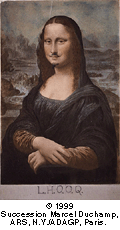
Marcel Duchamp, L.H.O.O.Q.

Tentant tardivement de préciser quand, en 1919, a été “fait” L.H.O.O.Q., Marcel Duchamp fournira deux dates: au début 1953, dans ses entretiens avec Sidney, Harriet et Carroll Janis, il dira décembre(1) ; en juin 1966, dans ses entretiens avec Pierre Cabanne, octobre(2) .

Ceci, autant en regard des faits rapportés que de la lecture qu’on peut en faire, n’est pas sans conséquence.

Du début août au 27 décembre 1919, en effet, Duchamp habite, avenue Charles-Floquet (Paris 7e), chez Francis Picabia et Gabrielle Buffet (cette dernière enceinte d’un quatrième enfant de lui, qui naît le 15 septembre). Picabia, lui, a emménagé depuis quelques jours ou semaines déjà rue Émile-Augier (Paris 16e), chez Germaine Everling, sa maîtresse (également enceinte de lui, et dont l’enfant naîtra le 5 janvier 1920(3)). Il faut déduire de cette situation particulière que, durant ce séjour de presque cinq mois, les contacts Duchamp-Picabia n’ont été que très épisodiques, sinon inexistants (sauf, selon toute vraisemblance, vers la fin du séjour), cela permettant d’ “expliquer” pourquoi L.H.O.O.Q. n’est pas publié dans les n 9 (novembre 1919), 10 (décembre 1919) ou 11 (février 1920) de 391, la revue de Picabia, mais bien, dans une version Picabia intitulée Tableau dada par Marcel Duchamp(4) , dans le n 12 (mars 1920). Michel Sanouillet ajoute sur ce point une précision: “Picabia lui demanda par lettre l’autorisation de “refaire” une Joconde pour 391, autorisation qui fut naturellement accordée. Mais Picabia, qui n’avait conservé de l’oeuvre de Duchamp qu’un souvenir imprécis, se borna à dessiner la moustache(5).” Picabia, en effet, ne reprend sur le coup que “L.H.O.O.Q.”, l’inscription qui deviendra le titre du readymade(6), l’inscrivant à son tour, verticalement et sans les points, sur l’une de ses toiles, Le double monde(7), datée de [décembre] 1919 et exhibée sur scène par André Breton lors du Premier vendredi de (la revue) Littérature, le 23 janvier 1920, première manifestation de Dada à Paris.

À cause de son titre (Tableau dada par Marcel Duchamp), la version Picabia passera pour l’original pendant plusieurs années, cet original n’étant montré pour la première fois qu’en mars 1930 à Paris, en même temps qu’une réplique agrandie (faite fin janvier ou début février 1930(8)), lors de l’exposition intitulée La peinture au défi et préfacée par Aragon.

Pour un poète, romancier et critique comme Aragon, un readymade n’est pas, dès cette époque, qu’un objet industriel, déplacé de son contexte et détourné de sa fonction utilitaire.

3

Il faut préciser que la reproduction en couleur qui en est la base n’est pas une carte postale, malgré que tant de gens l’aient dit ou écrit(9). Il n’y a qu’à regarder le verso, publié par Arturo Schwarz dès 1969 dans la 1re édition de son catalogue, pour constater qu’il n’y a pas le dispositif habituel de la carte postale avec la place pour l’adresse et le timbre (à droite), pour le “message” et la légende de l’illustration (à gauche), mais plutôt, par Duchamp, telle indication technique (au crayon) sur comment photographier le recto, et, plus tard, par dessus la précédente, telle déclaration officielle devant notaire (à l’encre) comme quoi il s’agit bien de l’original(10). Ce petit palimpseste, au verso, n’ayant d’égal, au recto, que cette mine (de crayon ajoutant les moustaches et la barbiche(11)) sur la mine (de la Joconde).

Mais où Duchamp s’est-il procuré cette reproduction en couleur? Le plus vraisemblable, comme il le raconte aux Janis en 1953, est qu’il l’a achetée dans quelque boutique installée près du Louvre, rue de Rivoli, afin de vendre à bon marché telle ou telles reproductions des grandes oeuvres de ce musée, façon de faire bien connue dans toutes les grandes villes où il y a d’importants musées. Faut-il rappeler qu’en avril 1911 le déjà très célèbre tableau de Léonard, peint au début du XVIe siècle, a été volé au Louvre et que, parce qu’on pouvait le croire disparu ou détruit (il ne sera retrouvé qu’en décembre 1913), on en a massivement diffusé, durant ces années ou immédiatement après, diverses reproductions couleur, photos retouchées ou non, dont certaines au format d’une carte postale(12). Sans doute sait-on également qu’en 1919 c’est le 400e anniversaire de la mort du peintre. Il est fait allusion à ces deux événements (telle perte peut-être irrémédiable et tel anniversaire) dans le choix de Duchamp.

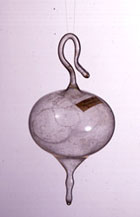
Quand Duchamp demande par lettre (New York, 9 mai 1949) à son ami Henri-Pierre Roché d’aller acheter une ampoule de sérum – devenue ampoule d’Air de Paris – pour remplacer celle, actuellement cassée, qu’il a rapportée de Paris, fin décembre 1919, à ses amis Louise et Walter Arensberg, il écrit:

Pourrais[-]tu aller dans la pharmacie qui est au coin de la rue Blomet et la rue de Vaugirard (si elle existe encore, c’est là que j’avais acheté la première ampoule) et acheter une ampoule comme celle-ci: 125c.c. et de la même dimension que le dessin […]
— Si pas rue Blomet ailleurs, mais autant que possible la même forme, merci.(13)

La simple consultation d’un plan de Paris nous indique tout de suite qu’il n’y a pas de coin Blomet-Vaugirard, ces deux rues (15e) étant parallèles! Je rappelle cet exemple pour indiquer qu’une indication précise, même venant de l’auteur, peut être tout simplement inexacte, voire erronée. Ainsi en est-il de L.H.O.O.Q., carte postale.

Et quand Duchamp, dans “Apropos of Myself” (1962-1964), décrit cette reproduction en couleur comme étant “a cheap chromo”, il faut préciser qu’en français comme en anglais chromo est l’abréviation de chromolithographie “image lithographique en couleur” (Petit Robert I), chromolithograph “a color print produced by chromolithography”(The American Heritage of the English Language). En français, cependant, chromo, maintenant au masculin (et non plus au féminin), a un sens péjoratif: “toute image en couleur de mauvais goût”. Ce sens supplémentaire, qui met en scène le goût, fait intervenir la question esthétique, voire artistique, ce qui n’est pas le cas en anglais, cheap signifiant dans cet exemple “of poor quality” (dont la reproduction est de mauvaise qualité), mais surtout “inexpensive” (qui est bon marché(14)).

4

Quand Duchamp, dans ses entretiens de 1966 avec Cabanne, parle de Picabia et de L.H.O.O.Q., il en profite, si je puis dire, pour ajouter:

Une autre fois Picabia a fait une couverture de 391 avec le portrait de [Georges] Carpentier; il me ressemblait comme deux gouttes d’eau, c’est pour cela que c’était amusant. C’était un portrait composite de Carpentier et de moi.(15)

Cette autre fois, c’est l’été 1923, quand Georges Carpentier, le boxeur, est venu chez Picabia, au Tremblay-sur-Mauldre, le petit village où il habite depuis 1922, et que ce dernier a fait son portrait de profil; le boxeur, alors, a même signé le portrait. Quand Picabia, plus d’un an plus tard, a décidé de mettre ce portrait en première page du dernier numéro de 391 (n 19, octobre 1924), il a barré incomplètement cette signature (qu’on peut lire sous la rature) et a ajouté “Rrose Sélavy / par Picabia”, frappé après coup par la ressemblance entre Carpentier et Duchamp (dont Sélavy est le pseudonyme depuis 1920)(16). Duchamp ne faisant qu’entériner, en 1966, cette “interprétation” de Picabia.

De la même façon, si, par contiguïté, ce “portrait composite” désigne aussi L.H.O.O.Q., il faut en déduire que Duchamp rappelle, en 1966, sa déclaration de 1961 à propos de ce readymade:

La chose curieuse à propos de cette moustache et de ce bouc est que, lorsque vous regardez le sourire, Mona Lisa devient un homme. Ce n’est pas une femme déguisée en homme, c’est un vrai homme; voilà ma découverte, sans qu’à l’époque je le réalise.(17)

En 1919, une femme (La Joconde dans L.H.O.O.Q.) est aussi un homme comme, en 1920-1921, un homme (Marcel Duchamp en Rose, puis Rrose, Sélavy) est aussi une femme.

5

Sans vraiment entrer dans l’interprétation du célèbre readymade, il peut néanmoins être remarqué que ce 400e anniversaire a pu être non seulement un déclencheur (en tant qu’anniversaire), mais aussi une contrainte (en tant que chiffraison), le 4 disant qu’il ne faut utiliser que quatre lettres, les 00 suggérant que l’une d’elles, qui doit être un O, soit redoublée(18). Ces quatre lettres, comme Duchamp le dit dans “Apropos of Myself”, étant, comme on peut ici aussi le constater après-coup, dans l’ordre alphabétique – H, L, O, Q – dans le nom de la rue (cHarLes-flOQuet) où il habite alors. Mais aussi dans le nom du procédé à la base de cette reproduction: elle est cHromoLithOgraphiQue.

Et il me plaît de constater qu’à New York la notaire choisie par Duchamp et qui, signant, certifie, le 22 décembre 1944, qu’il s’agit de l’original (“This is to certify that this is the original “ready made” L H O O Q Paris 1919”(19) ), se nomme Elsie Jenriche(20): comment ne pas voir qu’elle est là aussi parce qu’elle a ce nom (qui, de ce fait, revient métatextuellement sur l’un des enjeux de l’oeuvre), mixte de “je” (I en anglais ou Ich en allemand) et d’”autre” (else), et qu’il y est question de “genre” (jenre), else rimant avec le féminin (elle: La Joconde, La Gioconda) qui rime avec le masculin (L: Léonard, Louvre), elle étant devenu il!

Enfin, si l’on trace une ligne verticale à angle droit avec le haut de l’oeuvre et qu’on passe par le centre des moustaches, on voit bien que, à cause de l’angle du visage, on longe le nez, à gauche, du personnage femelle et désormais aussi mâle et qu’on arrive, “down below” (comme dira Duchamp en 1961), exactement entre “L.H.” et “O.O.Q.”. Ce redoublement du O est alors, une fois de plus, désigné.


Notes

Footnote Return1. Toujours inédits, les entretiens avec la famille Janis (Sidney, le père, Harriet, la mère, et Carroll, le fils) ont été faits à l’occasion de la préparation, par Duchamp, du catalogue et de l’accrochage de l’exposition Dada 1916-1923 à la Sidney Janis Gallery, New York, 15 avril-9 mai 1953. Dans la chronologie intégrée du catalogue Joseph Cornell / Marcel Duchamp… in resonance Joseph Cornell / Marcel Duchamp… in resonance, Philadelphia Museum of Art, 8 octobre 1998-3 janvier 1999, et The Menil Collection, Houston, 22 janvier-16 mai 1999, Ostfildern-Ruit, Cantz Verlag, 1998, p. 277, Susan Davidson, sans dire d’où elle tire cette précision, retient également le mois de décembre.

Footnote Return2. Pierre Cabanne, Entretiens avec Marcel Duchamp, Paris, Belfond, 1967, p. 114.

Footnote Return3. C’est un jour après la rencontre d’André Breton, invité là, et douze jours avant que, le 17 janvier, Tristan Tzara n’arrive là pour y habiter, ce séjour coïncidant avec le début de ce que Michel Sanouillet a appelé “Dada à Paris”: voir sa somme, Dada à Paris, Paris, Pauvert, 1965. Le siège du “MoUvEmEnT DADA, Berlin, Genève, Madrid, New York, Zurich”, dit le papier à lettre qui arbore cet en-tête, est maintenant à Paris. Par ailleurs, je note la coïncidence (qui n’en était peut-être pas une en 1919, étant donné l’état des connaissances sur l’oeuvre de Léonard): lorsque Duchamp est à Paris cette année-là, les deux femmes (l’épouse et la maîtresse) de Picabia sont enceintes de garçons; lorsque Francesco del Giocondo, au printemps 1503, passe une commande à Léonard pour qu’il fasse un portrait de son épouse, celle-ci lui a déjà donné deux garçons (en mai 1496 et en décembre 1502). Voir, autre somme, Daniel Arasse, Léonard de Vinci. Le rythme du monde [1997], Paris, Hazan, 2003, p. 388-389. La rime, ici, dans les deux cas: Joconde / féconde.

Footnote Return4. À Cabanne, Duchamp dit Tableau dada de [sic] Marcel Duchamp.

Footnote Return5. Michel Sanouillet, Francis Picabia et “391”, tome II, Paris, Losfeld, 1966, p. 113. (Le tome I est, en fac-similé, la réédition de 391 [1917-1924] augmentée de divers documents inédits, Paris, Losfeld, 1960.) Duchamp étant à New York depuis le 6 janvier et le no 12 de 391 ne paraissant (précise Sanouillet) qu’à la fin mars, on peut penser que Duchamp, interviewé par Schwarz (The Complete Works of Marcel Duchamp, New York, Abrams, 2e édition, 1970, p. 476), se souvient erronément de ce qui s’est passé à l’époque (je retraduis): “Mon original n’est pas arrivé à temps et, afin de ne pas retarder indûment l’impression de 391, Picabia a dessiné lui-même la moustache sur la Mona Lisa mais a oublié la barbiche.”

Footnote Return6. Je dis “l’inscription qui deviendra le titre du readymade” car, dans le catalogue-affiche de l’exposition chez Sidney Janis, Duchamp écrit: “La Joconde, postcard with pencil”. Ce n’est qu’à partir du premier catalogue de l’oeuvre duchampienne, celui de Robert Lebel (Sur Marcel Duchamp, Paris, Trianon Press, 1959), que ce readymade a L.H.O.O.Q. comme titre. Et ce n’est qu’à partir du catalogue Schwarz (Arturo Schwarz, The Complete Works of Marcel Duchamp, New York, Abrams, 1re édition, 1969) qu’on a les dimensions exactes dudit readymade: 19.7 x 12.4 cm ou 7¾ x 4⅞ pouces.

Footnote Return7. Les deux O de “L H O O Q”, eux-mêmes au centre de deux autres O qui ont la forme de ficelles formant des 8 ou encore la forme des pales d’une hélice, mais d’une hélice sans axe et molle, courbée par le vent, sont également – et doublement – les O de “double” et de “monde”. Le petit manque, en haut à gauche, dans l’un de ces autres O n’a d’égal, en bas à droite, que le petit manque dans le À de “À DOMICILE”, une autre inscription, et que le petit supplément – la queue – du Q de “L H O O Q”. Façon de faire coïncider ironiquement spéculations mathématiques (topologie) et spéculations marchandes (livraison “à domicile”, c’est-à-dire au logis).

Footnote Return8. “J’ai fait juste avant de quitter Paris une Joconde pour Aragon […] / Man Ray a la 1ère Joconde” (lettre de Duchamp à Jean Crotti, Villefranche-sur-mer, 6 février 1930, dans Affectionately, Marcel. The Selected Correspondance of Marcel Duchamp, édition de Francis Naumann et Hector Obalk, traduction de Jill Taylor, Gand et Amsterdam, Ludion Press, 2000, p. 171).

Footnote Return9. Trois exemples: Duchamp lui-même en 1953 (voir note 6); Ecke Bonk, Marcel Duchamp, The Box in a Valise. Inventory of an Edition, New York, Rizzoli, 1989, p. 241; Calvin Tomkins, Duchamp. A Biography, New York, Henry Holt and Company, 1996, p. 221.

Footnote Return10. Faut-il ajouter que Duchamp, dans les répliques ultérieures, n’a jamais utilisé une carte postale.

Footnote Return11. J’utilise ici le pluriel, comme Duchamp en avril 1942 lorsqu’il indique à l’encre, au bas de la maquette de l’une des deux versions Picabia (celle qui est reproduite dans 391), “Moustaches par Picabia / barbiche par Marcel Duchamp”. En français, on dit indifféremment, par exemple, ciseau et ciseaux (car il y a deux lames), pantalon et pantalons (deux jambes), moustache et moustaches (deux joues ou, simplement, deux côtés au visage). Je note par ailleurs que l’indication technique, inscrite par Picabia sur deux lignes au crayon verticalement à droite de la reproduction, commence par deux liaisons – celle qui amorce le 1 de “1 cliché” sur la première ligne et celle qui amorce le s de “sans” sur la deuxième ligne – qui n’ont d’égal que l’extrémité des moustaches! Pour une reproduction et des commentaires, voir Francis Naumann, The Art of Making Art in the Age of Mechanical Reproduction, catalogue de l’exposition chez Achim Moeller Fine Art, New York, 2 octobre 1999-15 janvier 2000. Si le voyage à Paris fait par Arp en avril 1942 est bien celui durant lequel il entre en possession de ces deux versions, la rencontre Arp-Duchamp (qui se connaissent depuis 1926) ne peut avoir lieu qu’en zone inoccupée (à Grasse où habite Arp, à Sanary où habite Duchamp, avant le départ de ce dernier pour les États-Unis le 14 mai).

Footnote Return12. Voir les deux cartes postales, datées 1914, reproduites dans Roy McMullen, Les grands mystères de la Joconde [1975], traduction d’Antoine Berman, Paris, Éd. de Trévise, 1981, p. 223.

Footnote Return13. Affectionately, Marcel, ouvr. cité, p. 272.

Footnote Return14. C’est d’ailleurs la traduction, par Michel Sanouillet, de ce passage: “un chromo […] bon marché” (“À propos de moi-même”, dans Duchamp du signe, Paris, Flammarion, 1975, p. 227). Naumann emprunte exactement la même voie: “an inexpensive chromo-lithographic color reproduction” (The Art of Making Art in the Age of Mechanical Reproduction, ouvr. cité, p. 10).

Footnote Return15. Pierre Cabanne, Entretiens avec Marcel Duchamp, ouvr. cité, p. 115.

Footnote Return16. Voir Michel Sanouillet, Francis Picabia et “391”, ouvr. cité, p. 166. On peut voir (391, ouvr. cité, p. 127) la signature de Carpentier et l’ajout de Picabia sous quelques-unes des lignes imprimées en caractères typographiques au bas de la page.

Footnote Return17. Herbert Crehan, “Dada”, Evidence, Toronto, n 3, automne 1961. Je traduis.

Footnote Return18. Ces deux “O.” ne sont pas sans évoquer aussi, par la rime “O.” / eau, le lac de montagne et le lac de plaine dans le célèbre tableau, respectivement en haut à droite et un peu plus bas à gauche dans le paysage dominé par la loggia où est le modèle, Lisa. Et que dire du chemin sinueux venant du lac de plaine, répercuté dans la queue du “Q.” (calligraphié par Duchamp)?

Footnote Return19. Une phrase présentative dans une autre, le référent de “This” (Ceci, comme dans “Ceci est mon corps” ou dans “Ceci est une oeuvre d’art”) étant cataphorique (c’est-à-dire qu’il suit le pronom): dans le premier cas, c’est “the original “ready made””; dans le second cas, c’est l’ensemble de la proposition formant le premier cas.

Footnote Return20. Dans son bref article, ““Desperately Seeking Elsie”. Authenticating the Authenticity of L.H.O.O.Q.’s Back” (Tout-Fait, New York, vol. I, n 1, décembre 1999), Thomas Girst nous apprend que cette dame, installée à l’Hotel St. Regis, New York, de 1943 à 1945, est une sténographe publique.

The Bachelor Stripped Bare by Cabri Geometre, Even

1.1. The Bride stripped bare by her Bachelors, even

The Bride stripped bare by her Bachelors, even commonly known as The Large Glass (or simply The Glass) is the masterwork of Marcel Duchamp, and it is also one of the most representative and influential works of art of the 20th century. Duchamp spent several years completing his project, but the work was left unfinished in 1923. The actual execution of the work starts in 1915, but the first ideas date back to the Summer of 1912.

Duchamp planned each detail of this complex work, and left a huge corpus of notes, sketches, and blueprints, documenting not only his intentions and the desired final outcome, but also the different executive techniques for each single part of the Glass. These notes were published by Duchamp himself in three main collections.
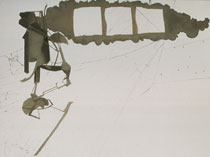
The first one, edited in 1914, commonly known as The 1914 Box (Fig. 1) (because of the Kodak box containing the reproductions of the originals) contains sixteen notes and drawings; the second collection, dated 1934, is known as The Green Box (Fig. 2) (because of the green color of its binding) and contains a larger group of notes and sketches; finally, the third collection, named A l’infinitif but commonly known as The White Box, (Fig. 3) edited in 1966, contains for the most part a quantity of notes regarding mathematical
speculations on the fourth dimension, directly related to the Glass and other works. Duchamp asserted that this huge apparatus of notes must be considered an integral part of the Glass.
click to enlarge


  • The
    Figure 1
    Marcel Duchamp, The Box of 1914,
    1913-14

  • The Green Box
    Figure 2
    Marcel Duchamp, The Green Box,
    1934

  • The White Box
    Figure 3
    Marcel Duchamp, The White Box,
    1964


Bride’s Domain, in the Large Glass
Figure 4
Marcel Duchamp, Bride’s Domain, in the
Large Glass(detail), 1915-23
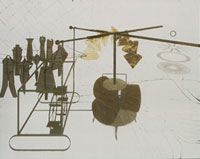
Bachelors Apparatus
Figure 5
Marcel Duchamp,Bachelors Apparatus, in the
Large Glass (detail), 1915-23
    

Two main parts constitute the Glass: the higher and the lower ones. The higher part is the realm of the Bride, (Fig. 4) and according to Duchamp’s intention, it depicts the 2D
projection of a 3D shadow of a 4D Bride. Thus, the realm of the Bride is intended to be a true 4D realm, which however cannot really be seen, since it is as depicted on a 2D support (the sheet of glass). The lower part is the realm of the Bachelors (Fig. 5) or the Bachelor apparatus (or utensil). In contrast with the Bride’s realm, the Bachelor’s realm is a 3D world. Thus it is imperfect in comparison with the 4D higher realm. In a note belonging to the White Box (but already issued with some minor variants in the Green Box), Duchamp wrote:

Principal forms, imperfect and freed
The principal forms
of the bachelor apparatus or
utensil are imperfect:
Rectangle, circle, square, parallelepiped, symmetrical handle; demisphere.-i.e. these forms are mensurated (interrelation of their actual dimensions and relation of these dimensions to the destination of the forms in the bachelor utensil.)
In the Bride – the principal forms will be more or less large or small, no longer have mensurability in relation to their destination: a sphere in the Bride will have any radius (the radius given to represent it is “fictitious and dotted.”)

Likewise, or better still, in the Pendu Femelle parabolas, hyperbolas (or volumes deriving from them) will lose all connotation of men-surated position. (1)

Thus, the two parts of the Glass represent two distinct realities. The lower realm is imperfect and only tries to emulate the higher dimensionality of the Bride’s realm by means of expedients and tricks (very effective, as we shall see).

These tricks are largely based on perspective representations and on elementary geometric transformations. These transformations will gradually become more and more general, and, as we pass through the threshold of the horizon (the area which divides the two parts of the Glass) from the lower half into the 4D realm of the Bride (following the pathway described by Duchamp), we finally reach a world where, abandoning any metrical trait of the objects, only more general geometrical transformations take place: the topological ones. The subject is already thoroughly discussed by scholars (2).

Perspective is not only the drawing system used by Duchamp to compose the lower part of the work, but also (and better) perspective in itself is one of the most important themes of the Glass. Indeed, we have quite explicit statements by Duchamp, such as the following,
given during a famous interview with Pierre Cabanne, that supports this contention:

Duchamp: […] In addition, perspective was very important. The “Large Glass” constitutes a rehabilitation of perspective, which had then been completely ignored and disparaged. For me, perspective became absolutely scientific.

Cabanne: It was no longer realistic perspective.

Duchamp: No. It’s a mathematical, scientific perspective.

Cabanne: Was it based on calculations?

Duchamp: Yes, and on dimensions. These were the important elements. […] (3)

Scholars largely speculated (and still speculate) on the meaning of such a rehabilitated perspective, no longer having a realistic purpose, being instead a mathematical and
scientific procedure.

Duchamp’s authoritative biographer Calvin Tomkins wrote for instance:

Vanishing-point perspective, which gave the illusion of three dimensions on a two dimensional surface, had been abandoned by modern artists who wanted their art to be a real thing rather than an imitation of reality. Why, then, did Duchamp, who certainly shared that ambition, choose to master such a discredited device? Was he looking for a mathematical formula through which he could actually evoke the presence of a fourth dimension? Whatever serious ambition he may have had along these lines he abandoned soon enough.(4)

Rhonda Roland Shearer suggests that Duchamp could have used a complex technique based on the overlapping of several different perspectives at once. According to her, such
a technique could explain both some strange features in the historical photos of the readymade and the difficulties one encounters as he or she tries to recreate the perspective of the lower half of the Glass, starting from its original blueprint (plan and elevation)(5). She says for instance:

Most Duchamp scholars have either accepted or praised Duchamp’s perspective skills. The problem remains, however, that I and a few other scholars have actually made 3-D models from Duchamp’s plans
— and none of us can find any one perspective projection view that matches Duchamp’s perspective drawings! Moreover, the process of trying to recreate the Large Glass perspective drawing from what a viewer would see of the 3-D model via perspective (equivalent to what one eye or camera lens sees) quickly becomes maddening. When you fit one part of the Large Glass model to its projection in Duchamp’s perspective drawing (say; part A, the ellipse in one wheel of the Chocolate Grinder, for example — see illustration 49A), the rest (parts B through Z) immediately fall out of place. We lose the fit of part A, and all the other parts C through Z, once part B is matched — etc.(6)

A few lines above, we also read:

My discovery that the strangely distorted Chocolate Grinder uses the same systematic characteristic approach also found in the hatrack, coatrack and urinal (and a large set of other examples not discussed in this essay) returns us to Duchamp’s words that I used at the beginning of this essay — a quotation that now bears repeating. (7)

Shearer shows a complete map of “at least” 43 different viewpoints which could have been used by Duchamp for the perspective of the Glass. Unfortunately, Shearer’s article is mainly focused on Duchamp’s readymades. The procedure used to inspect the Glass’s perspective is only briefly described, and only supported by means of 3D animations.

In the present paper, I will describe with some details the procedures I used to check the perspective of the Bachelor apparatus and will present and briefly discuss the outcomes reached.

In addition, considering some serendipitous discoveries I made by moving the elements of the Bachelor, as a further thesis, I would like to point out that the internal motions of the Bachelor apparatus (carefully planned and described in the Notes by Duchamp himself)
could be considered ways that permit the Bachelors to emulate the higher dimensionality of the Bride.


1.2. General procedures and remarks

Cabrì Géomètre II(8) is the software I
used to reconstruct the perspective of the Glass. It is a world wide known pedagogical software, commonly used to teach geometry in high schools, thus it is not specifically oriented to graphic applications or to professional 3D rendering, but instead it is aimed at building geometric objects (even very complex) which can be dynamically transformed according to well defined geometric constructions and rules.

The basic objects that Cabri furnishes are the basic geometric elements of Euclidean geometry, as usually taught at school, such as points, straight lines, segments, angles, polygons, conics, and so on.

Cabri works essentially on the plane, but following the rules of projective geometry, it makes it possible to represent 3D objects in perspective (or even higher dimensional objects, such as a hypercube, for instance).

Just such a feature interested me, as I intended to verify Duchamp’s statement about his mathematical, scientific use of perspective. Indeed my concern was to reconstruct the correct perspective of the Glass, starting from the detailed and precise metric information we read in the autograph sketches of the elevation and plan of the Bachelor apparatus (Duchamp carefully gave us even the exact position of the vanishing point).

As a second step, I intended to compare the aseptic geometric drawings obtained with Cabri, with the reproductions of the actual Glass and of its parts. To do that, I used a second tool developed for using Cabri in Internet-like environments: CabriJava(9).

This program allowed me to superimpose Cabri figures on the corresponding reproductions by Duchamp and to adjust them in a continuous way until the figures and the reproductions matched (or did not).

Here is the key question: Which kind of adjustment is allowed in order to state that Duchamp’s perspective matches the mathematical construction?

To answer that question, let us consider the perspective construction of a simple parallelepiped. Once we have the metric values for both the plan and the elevation of the parallelepiped (refer to Applet 1)and once we choose the vanishing point VP and the ground line (i.e. the elements given by Duchamp with the sketches of the plan and the elevation of the Bachelor apparatus), a degree of freedom still remains: following the standard perspective rules, we have to choose a couple of corresponding straight lines r and r’, for example the diagonal AC and the corresponding diagonal A’C’ (10).

Applet
1
depicts the situation. You can drag the straight line r’ to modify the figure, but always obtaining a perspective consistent with the given data, i.e., the metric of the parallelepiped, its position in the space, and the position of the vanishing point and the ground-line.

Perspective constructions and adaptations of Duchamp’s originals have been made for the overall view of the Bachelor apparatus and for each of its main elements. We shall discuss them later with some details.Fig. 6 shows how Duchamp’s elevation and plan sketches were inserted in Cabri.(11).

Fig. 7 and Fig. 8 illustrate the two basic steps followed to construct the perspective rendering of an A point in the plan sketch, passing through the A’ image of A on the ground-plane, and then elevating it at the A’’ position, according to the position of A in
the elevation sketch.

click to enlarge
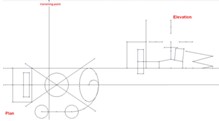

  • Duchamp’s elevation and plan sketches
inserted in Cabri
    Figure 6
    Duchamp’s elevation and plan sketches
    inserted in Cabri

  • construction of the perspective rendering of a single point
    Figure 7
    Two basic steps illustrating the construction of the perspective rendering
    of a single point, given its position in plan and elevation sketches
  • construction of the perspective rendering of a single point
    Figure 8


2.1. The overall view

Let us start with the perspective of the overall view.

To make pictures more suitable for the internet (therefore with not too heavy files) the elements of the Bachelor apparatus are inserted schematically, just to check the correctness of their mutual positions according to the rules of perspective. The corresponding details for each inserted element are checked in separate figures.

click to enlarge
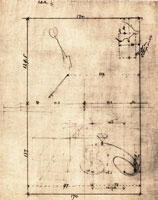
 The Bride stripped bare by her Bachelors
Figure 9
Marcel Duchamp, The Bride stripped
bare by her Bachelors, Even
, 1913
The straight line r’
Figure 10
The straight line r’

The overall perspective is compared with both the Glass and the preparatory sketch of 1913 named The Bride Stripped Bare by Her Bachelors, Even, like the Glass itself. We shall refer to it simply as the 1913 Sketch (Fig. 9).For the lower part of the actual Glass, see below Applet 2 and Applet 3). This double superimposition is necessary because the important element called the Toboggan, one of the most difficult pieces to render in perspective, is actually absent in the Glass (remember that it was left unfinished by Duchamp) while it is present in the 1913 Sketch.

In both Applet 2 and Applet 3, CabriJava has some problems in displaying the ellipses of the Water Mill, which indeed are incomplete, and in addition an unexpected straight line is drawn starting from them. The same problems still remain for some curves of the Toboggan. However, despite these problems, I think that Applet 2 and Applet
3
will help understand the overall perspective.

Why? Look at the straight line r’ in Fig. 10

r’ is the perspective correspondent of the straight line r in the plan, which passes through the bottom-left point of the so called Chariot (the parallelepiped containing the Water Mill) and through the centre of the circle representing the Chassis of the Chocolate Grinder. The choice of line r’ is free, but according to that choice we obtain different perspectives. Thus, by dragging the blue line in Applet 2 and Applet 3, you will see how the perspective could change accordingly, always remaining consistent with Duchamp’s data (12).

Anyway, the problems of the applets are definitely overcome with Fig. 11 and Fig. 12 (which are static), where the geometrical perspective of Cabri is correctly displayed on the background of Duchamp’s originals.
click to enlarge
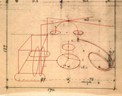
 

  • The geometrical perspective of Cabri
    Figure 11
    The geometrical perspective of
    Cabri correctly displayed on
    top of Duchamp’s original
    1913 sketch and the lower half of the Large Glass
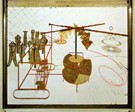
  • The geometrical perspective of Cabri
    Figure 12
    The geometrical perspective
    of Cabri correctly displayed
    on top of Duchamp’s original
    1913 sketch and the lower half of the Large Glass

Look at Fig. 11. The major discrepancies between 1913 Sketch and the Cabri figure are on
the right side of the picture:

one of the blades of the Scissor (the lower on the right) doesn’t match perfectly with its counterpart(13);

The right Sieve (the Sieves are the conical shapes just under the Scissor) is slightly in a lower position relative to the Cabri figure;

the Toboggan (the spiralling line on the right) is slightly shifted down.

In contrast, the left part of the 1913 Sketch matches quite well the remaining elements of the Cabri figure particularly the ellipses of the Chocolate Grinder. The left Sieve also matches perfectly the one in the Cabri figure.

In my opinion, some trivial explanations can be considered for the mismatches: maybe the reproduction of the 1913 Sketch used here is slightly rotated in the clockwise sense, around a centre located somewhere near the centre of the Chariot; this could explain why the
most evident discrepancies are on the right half of the picture, whereas the better matching is on the left. A second explanation could be that the sheet used by Duchamp for the 1913 Sketch could be somehow deformed. Indeed the squaring of the drawing (as I saw in all the photos I could examine, including the one used here) is not perfect.

Consider now the singular shape of the Toboggan. It is a strange mix of semicircles and semiellipses disposed on oblique planes: its correspondence with the Cabri figure, even though imperfect, is quite shocking; remember, indeed, that Duchamp drew it by hand;
it means that the drawing was made point per point. The exact placement of even just one of those points (starting from its position in plan and elevation) can be considered a very difficult task for anyone having only an intuitive knowledge of projective geometry.


click to enlarge
Possible construction lines of the Toboggan
Figure 13
Possible construction lines of the Toboggan

To have the right idea of such difficulties look at Fig. 13 which displays the construction lines necessary for just one point for each of the four arcs forming the Toboggan (thus multiply these construction lines al least 4-5 times).

Consider now Applet 3 and the corresponding static Fig. 12, which superimposes the Cabri
figure on the lower part of the actual Glass.

Look at Fig. 12. The reproduction of the Bachelor apparatus matches quite well the Cabri
figure: look especially at the Scissor and the Sieve on the right, which fit a lot better with Cabri figure than the ones of 1913 Sketch. Also, the ellipses circumscribing the Water Mill seem to match it perfectly.

Consider finally the supports of the Chariot named the Runners with their four semicircular shapes. They scarcely match the Cabri figure. Note however that the Runners were not
yet present in the sketches of plan and elevation, thus we have no measures for them. I simply used four semi-circumferences without making any attempt to recreate the correct image.

In conclusion, the inspection of the overall perspective seems to suggest that the reciprocal positions of the main elements of the Glass are consistent with the hypothesis that Duchamp correctly used the rules of perspective. It is worth noting in particular his skill in managing very complex constructions such as the one for the Toboggan, especially considering that he was self-trained in perspective.


2.2. The Chariot with the Water Mill, the Capillary Tubes and the Cemetery of Uniforms and Liveries

The simplest solid to render with perspective is the parallelepiped with edges parallel and perpendicular to the horizon: it is the case of the Chariot. Not equally trivial is to draw the wheels of the Water Mill contained in the Chariot. Nonetheless the perspective rendering of this elements is almost perfect.

Applet 4 shows how the geometric construction fits the corresponding detail of the Glass. Because of some possible problems with CabriJava in displaying objects, we shall refer to Fig. 14, which is static, but displays the picture correctly.Here is a problem: the overall framework of the Chariot is made by rods which actually have thickness and width, whilst in Duchamp’s preparatory sketches of plan and elevation they are considered as pure linear elements without thickness and width. This implies a quite arbitrary superimposition of Cabri figure on the Glass picture (unless one considers a number of different possible assumptions regarding the passage from the sketches to the actual Glass, which I didn’t).

Apart from this problem, the perspective created with Cabri matches quite well the parallelepiped of the Chariot.

Observe now the wheels of the Water Mill.


click to enlarge
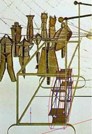
Detail of the Glass
Figure 14
Static image
showing how the
geometric
construction fits
the
corresponding detail of the Glass

First, let us consider the ellipses circumscribing the Water Mill (in red in Fig. 14): they touch exactly the peripheral points of each paddle (as we already noticed in the overall perspective of the Bachelor apparatus), except for the paddle in the foreground. But there is no error here: indeed, Duchamp preferred to clip the parts of the paddles which fall beyond the limits of theChariot.

Look now at the ellipses (in blue) touching the internal points of each paddle. Duchamp didn’t insert them in the sketches of plan and elevation. Therefore, we don’t know the actual radius of such circles. Just for this reason, I inserted in Applet 4 the red large point. As the user drags it vertically, the radius of the internal Water Mill wheels varies accordingly. The match with the Glass is satisfactory.

Consider now the eight spokes of the Water Mill wheels. I drew them under the assumption that they formed a regular octagon, and placing two of them along a vertical line. They also perfectly match the originals.

Some minor mismatching are there with the paddles of the Water Mill, but they are not severe, in any case.
Let us finally consider the perspective of the nodes of the so called Capillary Tubes, from which the 9 Malic Moulds hang, forming the so called Cemetery of Uniforms and Liveries.

In the sketches of the elevation and plan, the positions of the 9 numbered nodes are present, but, unfortunately, some measures are missing, namely those necessary in the plan sketch. Therefore I deduced them by measuring and scaling the distances directly on the sketch. The outcome displayed in Applet 5 is quite unsatisfactory. In particular, the nodes (and accordingly the Uniforms) nos. 2, 3, and 7 are clearly misplaced, whereas the remaining ones are only approximately right. Even by dragging the red diagonal (which modifies the perspective viewpoint), the drawing remains wrong (at least with respect to the preparatory sketches).

In conclusion: the perspective of the Water Mill shows some minor mismatches with the Cabrifigure; namely: some paddles seem to be not properly drawn. For the rest, the geometric construction easily fits the corresponding parts of the Glass.

In contrast, the nodes of the Capillary Tubes are misplaced. We must consider however, that the sketches are quite reticent regarding this detail, and we cannot rule out the possibility that the Capillary Tubes were more carefully planned before the execution of the actual perspective of the Glass.


2.3. The Chocolate Grinder

The Chocolate Grinder is often said to have the most problematic perspective. Indeed, it seems “strangely distorted” according to Shearer(14).In a second, stimulating essay, written in collaboration with Stephen Jay Gould, it is argued that:

Scholars have simply and uncritically accepted Duchamp’s claim that he rigorously used these principles in his major works. Ironically, however, no one who actually attempted the experiment has ever been able to render the bachelor machinery of the Large Glass under classical perspective, unless they alter Duchamp’s own drawings and therefore conclude that he was not, after all, a very accurate geometer. The Chocolate Grinder, especially, does not seem properly drawn, and no one has been able to show how the device might turn without the wheels interpenetrating and thus, to make the metaphor literal, grinding to a halt.(15)


click to enlarge
 Chocolate Grinder
Figure 15
Marcel Duchamp, Chocolate Grinder, No. 2 ,
1914
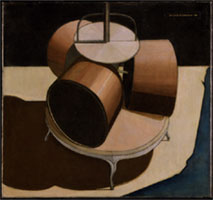
Chocolate Grinder, No. 1
Figure 16
Marcel Duchamp, Chocolate Grinder, No. 1 ,
1913
Chassis and the 
Rollers
Figure 17
Geometric features of the Chassis and the
Rollers

The second and definitive painting of the Grinder (namedChocolate Grinder, No. 2 (Fig. 15), dated 1914) is quite different relative to the first one (dated 1913) (Fig. 16), not only because it openly shows its second important identity (connected with electromagnetism and wireless telegraphy), discussed by Linda Henderson(16), but also because (as we shall see further on in this section) it acquires well-defined perspective construction, unlike the first version, whose perspective is quite problematic.

The first problem to solve in order to check the perspective of the Grinder, is to understand its geometry. Indeed, the sketches of plan and elevation are quite incomplete.

Essentially the Grinder is formed by three rollers (which seem to be frusta of a cone) placed on a Chassis (a cone with altitude much smaller than the radius of its base).

Duchamp’s sketches give us the complete measures necessary to reconstruct the Chassis, but for the roller, only two measures are given: the diameter of the circle of the major base and the length of the generatrix. No measures of angles are given. Reconstructing the rollers without additional assumptions is thus impossible.

At first I thought that the roller had to roll without sliding on the Chassis, and (of course) always rotating on theChassis itself, without leaving it. Geometrically speaking, this implies that the vertexes of the cones of each roller must coincide with the vertex of the cone of the Chassis; but looking at the actual Grinder we immediately understand that it is not the case: their vertexes clearly lay far beyond the vertex of the Chassis(Fig. 17). Thus the rollers grind the chocolate by sliding on the Chassis. Thus the assumption about the kind of friction of the rollers on the Chassis was wrong (17).

If we start from the measures of the roller given by Duchamp (radius of the major base and length of the generatrix), accepting their conical shape, and giving the angle the major base forms with a horizontal line, then the frustum of the cone is completely assigned (see Fig. 17).

In order to find the exact value for the measure of the unknown angle, I inserted in the Cabrifigure a corresponding further degree of freedom, allowing the user to drag the line corresponding to the major base of the roller in the elevation.


click to enlarge
Contact lines of the rollers with
the Chassis
Figure 18
Contact lines of the rollers with
the Chassis

Duchamp’s sketch of the plan doesn’t contain information about the mutual positions of the rollers and the exact positions of the contact points of the rollers with the Chassis. Thus, further assumptions must be made. Fig. 18 shows the simplest assumption (plan view of theChassis): the axes of the rollers form 120° angles, and one of them is parallel to the ground-line of the perspective. This hypothesis will prove exact (except for minor mismatches indicated below).

Finally let us examine Applet 6, which superimposes Cabri figure of the Grinder onto the 1914 picture Chocolate Grinder (No.2). I used the 1914 picture instead of the actual Grinder of the Glass, because we know that the latter was obtained by simply transferring on glass the former; thus using the 1914 picture I avoided considering those mismatches possibly derived from the transfer on glass, maintaining instead the focus on possible true perspective mismatches.

The outcome is once again unexpected, because the matching is almost perfect.

Applet 6 allows the user to see that:

The two ellipses corresponding to the Chassis and to the Necktie match well the Cabri figure (the ellipses of the Chassis are slightly smaller than the corresponding ones in the Cabri figure). The blue point on the top of the Grinder axis (or Bayonet) over the Necktie also matches well the point where the handle of the Necktie intersects the axis of the Grinder.

So good is the matching of the fixed parts of the Grinder with the Cabri figure that we see even the same very small portion of the Chassis visible in its higher part between the rollers!

Let us consider now the rollers. The grey line in the elevation, running along the major base of the roller allows the user, by dragging it, to choose the better unknown angle we talked about above (my best estimate is 81,9°).

The vertexes of the equilateral triangle (in the little circle under the Grinder) indicate the positions of the rollers (namely their contacts with the Chassis). The green point can be dragged in order to rotate the roller, and to test its matching with the original picture for each of the three positions.

In two cases (the two rollers in the background), the matching is almost perfect, whereas the roller in the foreground shows a minor mismatch, because the ellipse corresponding to its major base is slightly larger than in the Cabri figure.

In particular, note the blue points that indicate the center of the bases of the frustum of the cone. In the case of the roller to the right, the blue point coincides exactly with the insertion point of the roller on its axis. In the case of the roller in the foreground, one of the blue points matches perfectly the center of the major base of the roller.


click to enlarge
Louis XV legs
Figure 19
Tentative position
of the Louis XV legs
as vertex of an
equilateral triangle
One only visible leg
Figure 20
One only visible leg
under the
assumption of
Fig. 19

Let us now consider the Louis XV legs of the Chassis. At first I thought that, because of the equilibrium of the whole device, the three legs had to be placed at the vertices of an equilateral triangle. Accordingly, the vertex corresponding to the leg in foreground is such that the exact position of the equilateral triangle must be as in Fig. 19.
Look now again at Applet 6. The three grey vertical segments and the corresponding cyan extremities indicate the position of the legs of the Chassisin case the legs were planned to be positioned as in Fig. 19. The background legs are clearly misplaced, whatever was their planned shape. The only visible leg in the perspective drawing would be that in foreground, whereas the others would be covered by the Chassis, as in Fig. 20.

Fig. 20 shows the Grinder with one only leg: even though appropriate for both the equilibrium and the perspective, it makes the whole Grinder seem to be supported by one only leg, which, of course, would be impossible.

The addition of the background legs makes the drawing acceptable for the eyes, but wrong for perspective. Indeed, in order to make the perspective we see in Chocolate Grinder (No.2), the background legs wouldn’t be placed according to Fig. 19 (the only disposition ensuring the equilibrium of the device): they have to be slightly shifted forward, which however makes the equilibrium impossible.

So far we have faced something paradoxical: if you pay the tribute required by the retina, you will obtain a thing which cannot stand up (a quite Duchampian statement, we have to acknowledge). Here I emphasize the Duchampian key concept of instability. Interestingly, a similar kind of paradox between retinal and mental data, with similar conflict between equilibrium and instability concepts, has been already discussed in terms of the Bicycle Wheelby Shearer(18).


click to enlarge
Perspective project in the 1913 Sketch
Figure 21
A further investigation of the perspective project
in the 1913 Sketch

A further investigation of the sketches makes things clear. In both the 1913 Sketch and the elevation, we can see the legs actually drawn (see Fig. 21). In fact nothing tells us that they are disposed as an equilateral triangle; this misleading assumption was made because the visible legs are three, but very probably they actually are four, disposed as a square, like in Fig. 21. Indeed three of them are clearly visible in both of Duchamp’s sketches, whereas the fourth would-be leg (the posterior one) couldn’t be seen in neither of them: in the elevation because it is exactly behind that one in the foreground, and in 1913 Sketch because it is hidden by the Chassis. But this fourth leg is necessary for the equilibrium. According to this new assumption Duchamp’s perspective would turn out to be correct, and the equilibrium of the device would be safe. On the other hand, no actual datum contradicts this hypothesis of four legs, which in my opinion is thus confirmed. In conclusion: the perspective rendering of the legs is correct.

Consider now the threads sewn through canvas in the Chocolate Grinder, (No. 2) then carefully reproduced in the Glass.

Applet 7 shows the roller completed with similar threads, and helps check the correctness of their orientation. It proved to be consistent with the adopted perspective in two cases (the right and the foreground rollers) but also revealed some minor mismatching in the third case (the roller in background). In my opinion just the wrong perspective of the threads of the background roller makes the overall perspective of the Grinder difficult to be accepted for the eye.

To convince that what we said about the perspective of the Grinder No. 2 holds its validity in the passage to the Glass, look at Applet 8, which displays the Cabri figure superimposed on the actual Grinder of the Glass. Once again the matching is almost perfect.

Before concluding this section, I want to say a few words comparing the perspective rendering of both the first and the second version of the Grinder.

Applet 9 clearly shows that the perspective of the first Grinder is definitely wrong (at least accepting the measures of Duchamp’s sketches and the assumptions I declared above). The user can try to adapt the Cabri figure to the picture of the first Grinder, by dragging either the red diagonal or the green point (which have the same meaning as in Applet 6), but the outcome will be in any case unsatisfactory. Particularly the Necktie and the rollers seem to be totally wrong.Thus we can say that the passage from the first to the second version of the Grinder shows an extraordinary leap in Duchamp’s perspective skill.

In conclusion we can say that despite its strangely distorted view, and in spite of its intrinsic difficulty, the Grinder is one of the best executed elements in the perspective of the Glass. In any case the mismatches revealed above are consistent with the hypothesis that Duchamp drew the Glass according to the ordinary rules of perspective.

Recall Gould’s and Shearer’s statement that : «…no one has been able to show how the device might turn without the wheels interpenetrating…». Look now at Animation 1(19). It shows theGrinder in action. Definitely, the rollers do not interpenetrate as the device is grinding.


Please refresh the page, if the animation stops
The Sieves or Parasols
Animation 1
2.4. The Sieves or Parasols


click to enlarge
The Yport sketch
Figure 22
The Yport sketch, 1914

The Sieves (or Parasols) are the conical shapes that are disposed in semicircle behind the Scissor.

Unlike other elements of the Glass, we have detailed sketches which describe not only the measurements and the position of the cones, but also the detailed perspective procedures followed by Duchamp. We can see such perspective sketches and projects in the Green Box. (20) But the most important sketch, drawn at Yport during the summer of 1914, is not published in any of the cited collection of notes. We shall refer to it as the Yport sketch. (Fig. 22)

Particularly, we note the following shortcut Duchamp used to speed his work.

Once the drawing of the base-circle of the first cone was executed by interpolating 8 reference points (clearly visible in the sketch), Duchamp exploited the semi-circumferences where the corresponding points of the other cones lay, and divided them with the vertices of the inscribed dodecagons (which is a quite simple and speedy procedure). As I worked with Cabri, I used the same procedure.


click to enlarge
Geometry of the Sieves
Figure 23
The actual geometry of the Sieves

The Yport sketch also clearly shows a further detail: the declared altitude of each single cone (we read twelve cm in the elevation sketch) was probably modified by Duchamp on the basis of the geometry displayed in Fig. 23, in turn based on Yport sketch.

The shared altitude CH of the cones is such that the perpendicular to the base AB of the first cone intersects the base of the second one exactly at point C (and similarly for the others as well). Thus, the involved angle being of amplitude 30°, and being OH=23 cm, the measure actually used for the Sieves is CH=13.28 cm.For construction of the Sieves, I followed the geometry of Fig. 23, instead of using the measurements given in the elevation sketch.

Look finally at Applet 10. It shows that, once the best inclination of the diagonal (the red one) is chosen, the matching is perfect.

2.5. Some conclusion about the perspective of the Glass: the static viewpoint

Duchamp composed the Glass by hand and, above all, used absolutely unconventional media, which required him to invent ex novo appropriate techniques of execution. In general, we must suppose that drawing on glass is not as easy as drawing on paper or on canvas, especially if one of the main goals was precision, as in the case of the Glass.Just to have a correct idea of what this could mean, read the following description, regarding the execution of a preparatory study for the Chariot:

His first idea was to etch the design on the glass with fluoridic acid, a powerful corrosive used by commercial glass workers. “I bought paraffin to keep the acid from attacking the glass except where I wanted,” he said, “and for two or three months I struggled with that, but I made such a mess, plus the danger of breathing those fumes, that I gave it up. It was really dangerous. But I kept the glass. Then came the idea of making the drawing with the lead wire – very fine lead wire that you can stretch to make a perfect straight line, and you put a drop of varnish on it and it holds. It was very malleable material, lovely to work with.” (Duchamp used fuse wire, a coil of which was a staple in Paris apartments then.) (21).
We also already reminded that Duchamp was substantially self trained in perspective. In a note of the White Box we read:

Perspective.
See Catalogue of Bibliotèque St. Geneviève
The whole section on Perspective :
Niceron, (Father Fr., S.J.)
Thaumaturgus opticus (22)

The note suggests that while Duchamp was working at the library of Sainte Geneviève (1913-14) he read the whole section on perspective, and particularly (at least so we may assume from the note) the treatise on perspective and optics by mathematician Jean-François Niceron (1613-1646), titled Thaumaturgus opticus (23).

Thus, in the years Duchamp was composing the first elements of the Glass, he also was concluding his education in perspective.

We can obtain the exact measure of his progress in perspective skill in those years by comparing the two versions of the Grinder (dated 1913 and 1914), as we did in section 2.3.

On the other hand, regarding now my reconstruction of the perspective, remember that procedures and tools I used are quite non-professional:

– the used software is perfect to study and teach geometry, but in general not for 3D rendering;

– the reproduction used are photos whose reliability is not certified (think for instance about possible parallax errors or perspective deformations);

– the photos were in addition reduced or enlarged to match the scaled measures I used withCabri, and such adaptations could be imperfect…

These considerations surely reduce each pretension of precision, but at the same time they also reduce the relevance of the minor mismatches revealed above.

Let us finally reconsider the perspective elements of the Glass that we have examined, in order to answer to the question: is the perspective of the Glass canonical (and/or correct)? Are there elements which permit us to hypothesize a non-canonical (and/or incorrect) use of perspective?In my opinion, the only mismatch one can consider a true error, or possibly as a non-canonical use of perspective, is the one regarding the nodes of the Capillary Tubes. For the rest the execution of perspective is quite stunning, especially for some elements such as the Grinderand the Toboggan.I believe that the matching between the geometrically reconstructed perspective and the actual perspective of the Glass is in general good or even perfect in some cases.Let us then reconsider Shearer’s argument. She describes the minor mismatches between computer aided designs and Duchamp’s originals

When you fit one part of the Large Glass model to its projection in Duchamp’s perspective drawing (say; part A, the ellipse in one wheel of the Chocolate Grinder, for example — see illustration 49A), the rest (parts B through Z) immediately fall out of place. We lose the fit of part A, and all the other parts C through Z, once part B is matched — etc.

Her statements can be discussed at two different levels.

At the level of single parts of the Glass, such as the Grinder, the Chariot, and so on (the micro level), I think that her statement is substantially wrong. With the exceptions of the nodes of theCapillary Tubes, the mismatches revealed by the inspection above are completely acceptable and consistent with the hypothesis that the Glass was drawn according to the usual rules of perspective, and must be considered as absolutely minor imprecisions due to Duchamp’s free-hand execution. I believe this conclusion holds unless a unitary theory can be formulated that explains all the mismatches at once.

Shearer proposes a unitary theory of this kind about the perspective of the historical photos of the readymade, but there are no explanations about the way that theory could be extended to theGlass.

Let us pass now to the higher level (the macro level), that of the overall view. Some further preliminary considerations are needed.

I executed Cabri figures in different sessions by separating the principal elements of the Glass.

This procedure risks creating a trivial error: choosing different and mutually inconsistent diagonals (possible diagonals are, for instance, the straight lines r and r’ in Fig. 10) for different figures can generate mistakes (remember that Duchamp’s measures allows such a degree of freedom). This implies the possibility of an overall perspective inconsistency, even if each individual element was rendered in correct perspective. In other words, choosing inconsistent diagonals would be equivalent to choosing different viewpoints. (This possibility agrees to some extent with Shearer’s proposal concerning the presence of several, different viewpoints in the perspective of the Glass).

The same considerations I did for the computer aided reconstruction of the perspective, could be applied to the execution of the actual Glass by Duchamp: remember indeed that the elements of the Glass were added by him one by one (even because each piece had to be executed with an appropriate technique) through successive and separate steps, which could expose Duchamp himself to the same risk of error I was exposed to.

Thus, it was very important to verify the mutual consistence of the details. In the contrary case, it would have been an important evidence for applying Shearer’s theory of multiple viewpoints to the perspective of the Glass (but, in such a case, there would be no evidences for an intentional choice by Duchamp, and consequently we couldn’t rule out the possibility of a simple mistake).

Now, in order to verify the perspective consistence of the single details with the overall view there were two possible ways:

either choosing every time the same couple of diagonal lines (which sometimes was very inconvenient), or choosing different couples of corresponding line, but verifying that they were consistent to each other.

I chose the second way. The check for consistency was done by comparing in each figure the position of the same straight line, namely r’ (refer to Fig. 10).

The check returned a positive response: each diagonal r passing trough the left lower point of the Chariot and the centre of the Chassis in the plan, corresponds to a straight line r’ in the ground plane of perspective, forming the same angle (16.3°) with the ground line. Hence, the details are perspectively consistent with each other and with the overall view.

Definitively, Duchamp used the canonical perspective rules, and mastered them at the highest level.

What is then the meaning of his mathematical, scientific perspective?

Often people think of mathematics as something which deals essentially with numbers. If there are no numbers there is no mathematics.

Remember for instance that after Duchamp’s claim about the mathematical use of perspective, Cabanne asked: «Was it based on calculations?» (we shall consider Duchamp’s interesting reply below), or even recall what Tomkins told about a possible formula.

Now, geometry is mathematics, and I think that Duchamp meant (among other things) that he used thoroughly projective geometry. Try to execute the perspective of the Toboggan to understand how much projective geometry he used.

Let us return to Cabanne and Duchamp dialogue.

Cabanne: Was it based on calculations?
Duchamp: Yes, and on dimensions. These were the important elements.

A few lines below we also read:

I almost never put any calculations into the “Large Glass” (24)

but again, a few lines below:

At the same time I was doing my calculations for the “Large Glass” (25)

I think that Duchamp used here the word calculations in the more general meaning of mathematical (namely geometrical) operation, construction, deduction: the only true calculations actually necessary for the drawing were the proportions possibly necessary for scaling the measures and a few minor operations (26); for the rest there are only geometrical constructions.

Here, I want to emphasize the second element of Duchamp’s answer: that of dimensions, which of course refers to the fourth dimension.
Remember the already-cited Tomkins’ statement:

Was he looking for a mathematical formula through which he could actually evoke the presence of a fourth dimension? Whatever serious ambition he may have had along these lines he abandoned soon enough.

In other words Tomkins says that, even admitting the attempt to find the mathematical key which could open the door of the fourth dimension, Duchamp soon abandoned it, possibly (I’m hypothesizing) in favor of speculation on non-Euclidean geometry. I don’t agree with Tomkins. Not to diminish the importance of non-Euclidean geometry, but to emphasize the importance of the concept of higher dimensions in relation to perspective.

So far, we regarded Duchamp’s perspective from an eminently static viewpoint, and (consequently, I say) no reference to higher dimensions were highlighted.
The main goal of the remaining part of this article is just to establish a connection between the perspective of the Bachelor apparatus and the emancipated spatiality of the Bride realm, by introducing a new important element: that of motion.

3.1. The Chariot in the fourth dimension

In the introduction I argued that the Bachelor apparatus emulates the higher dimensionality and the topological properties of the Bride realm by coupling perspective with motion.


click to enlarge
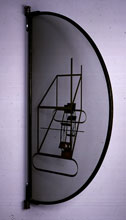
Glider Containing a Water Mill
Figure 24
Marcel Duchamp, Glider
Containing a Water Mill (in
Neighboring Metals), 1913-15

Let us start our course along this strand with the demonstration of a subject already widely discussed by scholars, regarding the Chariot (27). In the years 1913-15 Duchamp worked at a preparatory study of the Chariot, named Glider Containing a Water Mill (in Neighboring Metals). (Fig. 24)It is the same element of the Glass, executed on a semicircular hinged panel of glass, which can rotate.

Applet 11 shows the situation. The red point on the bottom can be dragged to rotate about its hinge the plane where the Chariot is drawn. To simplify the drawing, the Water Mill is missing, to better focus the attention on the essential details.

The actual Chariot is drawn on a 2D support (the sheet of glass), and emulates its own status of 3D object by means of perspective. Accordingly, the 2D sheet of the glass emulates the ordinary 3D space. Hence the rotation of the Glider around its hinges suggests the rotation of a 3D object in a 4D hyperspace. Notice that just the sheet of glass used as support of the drawing allows to complete correctly the metaphoric turn in the fourth dimension: indeed just the transparency of the glass allows us to see the Chariot specularly reversed, as it reaches its final position. In fact we face an inverse congruence between two figures; just the exit from the 3D space and the rotation into the hyperspace allows two 3D figures inversely congruent to overlap on one another.

This idea is clearly presented by Duchamp in a note of the White Box and is widely discussed by Adcock (28).Returning now to the applet, we can see a strong optical effect (also known as the Necker cube inversion), which can be described as if the Chariot would turn inside out as if it were a glove. Just this effect can be considered as a mental turn into the fourth dimension(29).

We can understand the variety and the subtlety of the game that Duchamp plays here, by comparing the rotation of the Glider with many other rotations of planes, everywhere present in the Bachelor apparatus. Consider for instance the rotation of the plane which ideally sustains the first Sieve (which we can actually see in the Yport sketch). Applet 12 allows the user to see this rotation by dragging the red point. Here we face a plane which rotates in a 3D space, giving rise to cones (which are 3D shapes) directly congruent with the starting one; on the contrary the glass plane of the Glider, which is 2D but perspectively simulates a 3D space, rotates in a true 3D space which accordingly simulates a 4D hyperspace, and gives rise to a second Chariot, inversely congruent to the starting one.

Now we can understand why Duchamp chose just the reproduction of the Glider as the cover of the White Box: remember indeed that the notes of this collection are mainly focused on the fourth dimension and its properties.

In short, with the Glider Duchamp suggests a rotary motion which allows the observer to look at two different Chariots, the one being the specular reversed image of the other, with the involvement of the fourth dimension concept we presented above.

Now, consider that the same thing can actually be done with the whole Glass, by simply walking around it. Once again the transparency of the glass permits the observer to look at two different Bachelor apparatuses, specular one to another, with analogous involvement of the fourth dimension concept. The motion of the observer around the Glass corresponds to the rotary motion of the Glider about its hinge as the observer stands still.

We shall exploit similar relative exchanges in motion (observed object rotating about its hinge and fixed observer vs. fixed object and observer moving around it) especially with the Sieves(in section 3.3.) and we shall consider the notes which carefully describe this inversion.

3.2. A new possible identity of the Grinder

One of the most important innovations of the 1914 painting Chocolate Grinder (No.2) are the threads directly sewn on the canvas; they obviously recall the coil-winding of an electromagnet.

Consider now a new possibility. The threads could also be related to the geometric concept ofruled surface.

A ruled surface is one which can be obtained by a straight line moving in the ordinary 3D space and leaving wherever it passes its trail: the ruled surface.

A note of the Green box, usually considered as the only one of this collection directly related to the theme of the fourth dimension (30), also describes rotational motions of lines considered as generatrix; in addition the note contains ubiquitous suggestions of moving lines which leave a sort of trail forming surfaces; also, the note connects such a practice with the idea of circularity:

The right and the left are obtained by letting trail behind you a tinge of persistence in the situation. […]
And on the other hand: the vertical axis considered separately turning on itself, a generating line at a right angle e.g., will always determine a circle in the 2 cases 1stturning in the direction A, 2nd direction B. –
[…]
As there is gradually less differentiation from axis to axis., i.e. as all the axes gradually disappear in a fading verticality the front and the back, the reverse and the obverse acquire a circular significance […] (31)

Further examples possibly related to the idea of ruled surface can also be found in the White Box, such as the following:

On an infinite line let us take two points, A and B. Let us rotate AB about A as hinge. AB will generate some sort of surface, i.e. either curved, broken or plane (32)

or even this one:

Elemental parallelism: repetition of a line equivalent to an elemental line (in the sense of similar at any point) in order to generate the surface. (33)


click to enlarge
Sad Young Man on a
Train
Figure 25
Marcel Duchamp, Sad Young Man on a
Train
, 1911
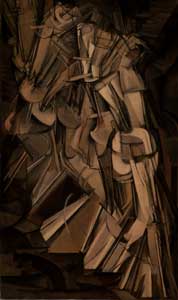
Nude descending
Figure 26
Marcel Duchamp, Nude descending a Staircase no. 2, 1912

The formula of Elemental parallelism was not a sterile speculation, but one of the most important conceptual foundations of a whole creative period: we know that Duchamp used it for capital painting, such as Sad Young Man on a Train(1911) (Fig. 25) or Nude descending a Staircase (no. 2) (1912).(Fig. 26) He carefully explained it in the dialogue with Pierre Cabanne (34).
As an example of how a ruled surface can be generated, imagine a luminescent straight thread moving about in the darkness; also imagine a camera with the shutter opened, to capture the luminous trail left on the film by the moving thread. This trail could be an example of ruled surface. The example is not chosen by chance: this explicative metaphor is used by E.J. Marey in one of his photography books (35). Duchamp was interested in similar photographic experiments (chronophotography), and scholars already related the painting of 1912 Nude Descending a Staircase (No. 2) to chronophotography(36).
Thus, for a moment let us think of the threads of the Grinder as a suggestion of straight lines moving about, while the rollers are grinding, generating trails corresponding to several kind of ruled surfaces.

The connection between the glued threads of the Grinder and the duchampian concept of elemental parallelism has been already stressed by Craig Adcock, who also recalled that Duchamp spoke of the threads as generatrices(37)

Let us start with the simpler example: what is the geometric locus of the diametric threads of the circular bases of the rollers, as they rotate around the axis of the Grinder, without rotating around their own axis? Animation 2(38) shows a rotating roller. The surfaces described by the diametric blue lines are one-sheeted hyperboloids.

Animation 3 : shows that as the diametric lines vary their inclination, the hyperboloids gradually change their shape, giving rise to the degenerate case.
  • Animation 2
    Animation 2
  • Animation 3
    Animation 3

The genesis of a single-sheeted hyperboloid by means of a rotating straight line is also displayed by Marey in his already cited photography book which Duchamp surely knew (Fig. 27).


click to enlarge
The genesis of a
single-sheeted hyperboloid
Figure 27
The genesis of a
single-sheeted
hyperboloid displayed
in Marey’s book
Two single-sheeted hyperboloids
Figure 28
Two single-sheeted
hyperboloids forming a
special type of gearing
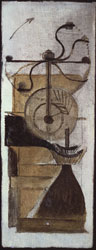
Coffee Mill
Figure 29
Marcel Duchamp,
Coffee Mill ,
1911

Look now at Fig. 28: being the single-sheeted hyperboloids (doubly) ruled surfaces, it is possible to use them to create a special type of gearing. The interest of Duchamp in similar devices is documented by a painting which can be considered as the most direct antecedent of the Grinder: the Coffee Mill (1911),(Fig. 29) which clearly displays the gearing machinery allowing the device to work.

We already recalled that Linda Henderson thoroughly documented that theChocolate Grinder is strongly related to electromagnetism and wireless telegraphy: it is its second identity, after the first one as both a true and metaphoric grinder (connected with the autoerotic activity of the Bachelor, resumed with the slogan: The bachelor grinds his chocolate himself(39)). Now, I like the possibility of a third identity of the Grinder, as a geometric device to generate ruled surfaces.

Maybe it can be seen as a flight of fancy, but not so much, after all; read indeed once again the Green box note about the geometric properties of theBachelor apparatus:

Principal forms, imperfect and freed
The principal forms
of the bachelor apparatus or utensil are imperfect:
Rectangle, circle, square, parallelepiped, symmetrical handle; demisphere.-i.e. these forms are mensurated (interrelation of their actual dimensions and relation of these dimensions to the destination of the forms in the bachelor utensil.)
In the Bride – the principal forms will be more or less large or small, no longer have mensurability in relation to their destination: a sphere in the Bride will have any radius (the radius given to represent it is “fictious and dotted.”)
Likewise, or better still, in the Pendu Femelle parabolas, hyperbolas (or volumes deriving from them) [emphasis mine] will lose all connotation of men-surated position.

The question is: where are those hyperbolas and volumes deriving from them (and the corresponding surfaces, we could add) which, once passed into theBride realm will lose their connotation? Are they maybe the ones generated by the Grinder? It is possible.

Accepting this hypothesis, let us take some further step.

What happens if, while rotating around the Grinder axis, the roller also rotates around its own axis? Applet 13 will help visualize the possible resulting surfaces for such a composition of motions.

The different possible outcomes depends on the different sliding component in the motion of the rollers (remember indeed that in their motion rollers also slide on the Chassis). It means that, once a complete turn around the Grinder axis is completed, the rollers also turn around their own axis by a certain variable angle ω, whose amplitude depends on the sliding component.

Look finally at Applet 13(40): at its opening, the parameters are fixed in order to have the roller making a half turn around its own axis, while making a complete turn around the axis of theGrinder.

The surface described by the diametric line of the major base of the roller is a Moebius band.
At the bottom of the figure you find two green points which can be dragged.

By dragging the upper one the roller will rotate and make a complete turn around the Grinderaxis: you can see that the diametric line actually rules the band. As you drag the lower green point you simply modify the ω parameter and accordingly the locus surface will gradually change its shape, giving rise to more complex bands.

A further step could be taken by observing the surfaces obtained by the longitudinal lines of the rollers as generatrices. Applet 14 visualizes them. Once again the two green points can be dragged, with the same meaning as before.

Now the question is: accepting the present hypothesis about the Grinder, what could be the meaning of the surfaces generated by it, in the general project of the Glass? In my opinion surfaces such as the Moebius band, with their topological properties, could be a means for theBachelor to emulate the higher and more complex space of the Bride; it could be a sort of bridge, between the Bachelor and the Bride realms: remember indeed that the Bride is characterized by topological properties where the metrical traits governing the lower half of theGlass lose their meaning. The same holds (all the more reason) for the more complex bands obtainable with the Grinder.
To be precise, I don’t mean that Duchamp thought exactly of the Moebius band (or of similar and possibly more complex surfaces), but it is possible that he could imagine similar figures, maybe knowing neither their name nor their status of well-defined and studied geometrical objects. Possibly he guessed some of their strange properties; after all we have a number of evidences of its astonishing geometric imagination. Jean Clair already discussed some works of Duchamp referring them to well defined topological objects (such as the Kleinian bottle). Also Clair informs us that in the 60’s Duchamp discussed the properties of such topological objects with the French mathematician Le Lionnais. Following this suggestion I discussed other possible examples, referable to the properties of both the Kleinian bottle and the Moebius band(41).

In conclusion we could think of the Grinder as a ruled surfaces generator, or better, as a true surfaces grinder. The complex surfaces generated by Grinder’s motion could emulate the topological essence of the hyperspace of the Bride realm in the higher part of the Glass. The thesis is supported by some facts:

1. Notes from both the Green Box and the White Box (cited above) prove that Duchamp knew and used the concepts of ruled surface and quadric surfaces (at least on a qualitative level);
2. The idea of ruled surface is strictly connected with the practice of chronophotography which Duchamp praised and in a way used;
3. The surface of the rollers is carefully ruled by the threads sewn on the canvas, and as theGrinder is supposed to work, they rotate moving about in several complex ways; and, above all, the Grinder actually works as a surfaces generator;
4. It is proved that (at least) in the 60’s Duchamp knew at some qualitative level both the Moebius band and the Kleinian Bottle;

3.3. The Sieves’ perspective: a possible antecedent of Duchamp’s optical devices
Let us now consider the Sieves (or Parasols) and their function in the Bachelor apparatus. TheGreen Box notes describe the process which produces the so called Illuminating gas; as it leaves the Capillary tubes, it is then cut into bits, called spangles, which must run through the circular pathway of the Sieves:

As in a Derby, the spangles pass through the parasols A,C D.EF…B. and as they gradually arrive at D, E, F, … etc. they are straightened out, i.e. they lose their sense of up and down ([more precise term]). – The group of these parasols forms a sort of labyrinth of the three directions. –
The spangles dazed by this progressive turning. Imperceptibly lose [provisionallythey will find it again later] their designation of left, right, up, down, etc, lose their awareness of position.(42)

By this way, the spangles, straighten out

[…] like a sheet of paper rolled up too much which one unrolls several times in the opposite direction (43)

lose their sense of space. The way it happens is described as a loss of distinction between left, right, up, down, etc. as they pass through a labyrinth of three directions.
The following note from the Green Box makes clear that in Duchamp’s thought the identifications left-right, front-back, hi-low and so on are connected with the suggestion of a higher dimension::

[…] the front and the back, the reverse and the obverse acquire a circular significance: the right and the left which are the four arms of the front and back. melt. along the verticals.
the interior and exterior (in a fourth dimension) can receive a similar identification.(44)

Hence we can think that the circular pathway through the Sieves and the consequent loss of distinction between opposite orientations could be somehow connected with the suggestion of a higher dimension.
The pathway followed by the Spangles is strictly circular, because the seven Sieves (originally they were six and semi spherical) have nine holes (originally eight) which repeat exactly the shape of the polygon connecting the nine (originally eight) Malic moulds, where they come from.

The sieves (6 probably) are semispherical parasols, with holes. [The holes of the sieves parasols should give in the shape of a globe the figure of the 8 malic moulds, given schematic. by the summits (polygon concave plane). by subsidized symmetry](45)

Thus the Sieves convey the Spangles according to well defined circular trajectories.
Applet 15 shows the pathway of 5 possible Spangles, assuming for simplicity five arbitrary convenient positions of the holes. The blue point can be dragged to move the Spangles through the Sieves. The actual course of the Spangles is semicircular, but Applet 15 displays a complete turn, in order to emphasize some aspects we will discuss as we shall go along.
Applet 15 helps understand why the dazed spangles lose the sense of up-down and left-right (follow for instance the course of the blue one); in addition it displays a strong depth effect due to perspective rendering of the Spangles in motion.


click to enlarge
Five semcircumferences
Figure 30
Five semcircumferences used by
Duchamp to perform the
perspective drawing of the cones
Points A, B, C
Figure 31
Because of the perspective,
the arcs are not concentric:
their centers are the points A, B, C.

Let us now return to the perspective of the Sieves. Particularly let us consider the Yport sketch of 1914. The following Fig. 30 summarizes those, among its features, relevant in this context.

We clearly see five semcircumferences used to perform the perspective drawing of the cones. Four of them were used to rotate four diametric points of the first ellipse, in order to easily obtain the corresponding transformed points of the remaining ellipses; the fifth arc was used to obtain the centers of each ellipse, starting from the first. Maybe other circumferences were used, also considering how perfectly the ellipses are drawn; however the sketch doesn’t show any trace of possible further arcs. Note that, because of the perspective, the arcs are not concentric: their centers are the points A, B, C, visible in Fig. 31, which also displays the complete circumferences.
I used for convenience just these circumferences as circular pathways of the spangles in Applet 15; according to the original project by Duchamp, nine similar circumferences must be used (one for each of the nine holes).
The White Box contains notes which specifically connect linear perspective with circular shapes, by means of the concept of gravity:

Gravity and center of gravity make for horizontal and vertical in space3
In a plane2 – the vanishing point correspond to the center of gravity, all these parallel lines meeting at the vanishing point just as the verticals all run toward the center of gravity.(46)

This association between perspective and gravity (which interestingly and meaningfully was made in the same way by Klee(47)) leads Duchamp to the following conclusion:

Resemblance –
Between a perspective view and a circle –
The vanishing point and the center –
To what in a perspective view would the
Circle itself correspond?

Horizon(48)
Elsewhere in the White Box we also read:

Difference between “tactile exploration” or the wandering in a plane by a 2-dim’l eye around a circle, and of this very circle by the same 2-dim’l eye fixing itself at a point. Also: difference between “tactile exploration,” 3-dim’l wandering by an ordinary eye around a sphere and the vision of that sphere by the same eye fixing itself at a point (linear perspective).(49)

Here Duchamp adds the motion as a further key ingredient in the perception of higher dimensions of space. Perspective representation and vision must be integrated by the motion of the eye in order to reach a better representation and understanding of higher dimensional objects:

A 3-dim’l tactile exploration, a wandering around, will perhaps permit an imaginative reconstruction of the numerous 4-dim’l bodies, allowing this perspective to be understood in a 3-dim’l medium.(50)

Perhaps, the rotational motion of the Spangles through the Sieves may be intended as a suggestion of a wandering or tactile exploration of the space surrounding the Sieves, or, in general of the medium which the Glass is immersed in.
Following this course, the next step seems to be quite obvious: maybe the same effect could be reached if, instead of the wandering around an object, this very object could turn in front of the observer which remains in a fixed position.
In our case, what happens if the circumferences conveying the Spangles rotate around a fixed center (not necessarily one among points A, B, C in Fig. 31 in front of us?
Applet 16 illustrates the outcome: a set of seven eccentric circles (which I used before for the perspective construction) rotate around a center near to their own centers, which however doesn’t coincide with any of them. Use the blue point to fix the center of rotation into the desired position; drag the red point to shift the set of circumferences backward or forward; finally drag the green point to rotate the set of circles.
The depth effect is quite remarkable, and is further reinforced if the circles are colored, like in the following Animation 4.

Please refresh the page, if the animation stops    

  • Animation 4
    Animation 4


Thus we passed from a true 2D plane to the illusion of a 3D space. Hence, once again we have the emulation of the higher dimensionality of the Bride realm.
Only speculations? Possible, but it is exactly what Duchamp did a few years later with the filmAnemic Cinema (1925) (Fig. 32) and especially with the optical devices such as the Rotary demisphere (1925) (Fig. 33) and the Rotorelief (1935). (Fig. 34)

click to enlarge
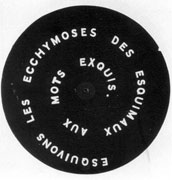
 

  • Anemic Cinema
    Figure 32
    Marcel Duchamp, Anemic Cinema, 1925
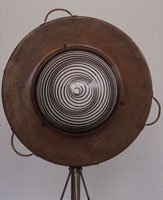
  • Rotary demisphere
    Figure 33
    Marcel Duchamp, Rotary demisphere, 1925
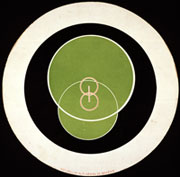
  •  Rotorelief
    Figure 34
    Marcel Duchamp, Rotorelief, 1935


There Duchamp used once again sets of eccentric circumferences, which while rotating produce remarkable effects of depth (see for instance Animation 5, where a facsimile of the optical disc named Verre de Boheme, 1935 produces the effect of a three dimensional stemmed glass). The effect of depth produced by the Rotorelief has no relation with the stereoscopic vision; on the contrary it is even more surprising if seen with a single eye.

Please refresh the page, if the animation stops
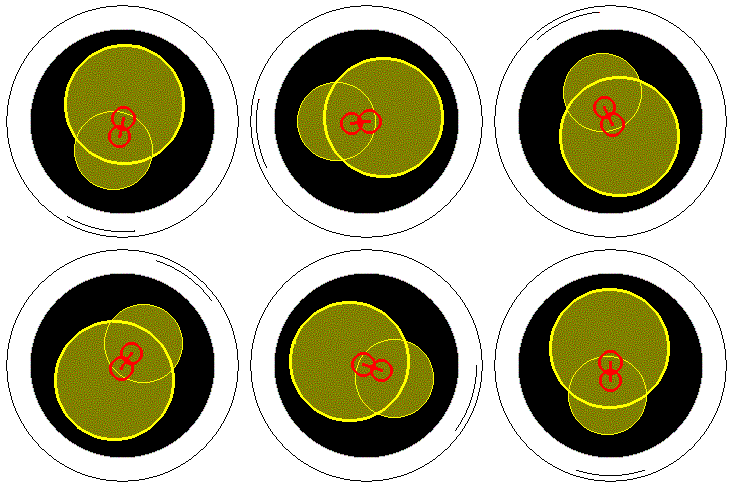


  • Animation 5Animation 5

Interestingly scholars generally don’t consider the connection of the Rotorelief with the previous efforts of Duchamp in perspective, but I think it is an important element to consider, as Adcock already carefully stressed(51). Let us look once again at Animation 5. We see a 3D stemmed glass rotating in front of us, and it happens also because our mind perceives the set of circles as a Gestalt, and this can be possible all the more reason if the circles have some perspective consistence. Duchamp himself makes clear this point talking about his Rotorelief :

Thanks to an offhand perspective, that is, as seen from below or from the ceiling, you got a thing which, in concentric circles, forms the image of a real object(52)

Thus, once again we have a strict correspondence between rotary motion, perspective, and suggestion of higher dimensions, with the optical illusion of depth, known as stereokineticeffect.
Indeed the rotating circles were drawn on the same sheet of paper (the Yport Sketch) and implicitly are present on the same sheet of glass; thus they actually belong to a plane; however in the perspective fiction they belong to different planes (parallel to each other) which determine a 3D space. Now, if the stereokinetic effect allows us to pass from the 2D plane to a 3D space, then according to the perspective fiction in the meantime we also pass from the ordinary space to a hyperspace.
Concluding this section, we shall consider an additional interesting feature of the Sieves which is to be stressed.
With their semicircular course, the circular bases of the conical Sieves ideally generate an half torus.


click to enlarge
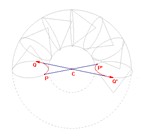
Kleinian bottle
Figure 35
If we identify the
diametrical points of a torus,
the surface we obtain
is a Kleinian
bottle.

With reference to Fig. 35, consider for a moment the whole torus, and its centre of symmetry C; also consider the couples of symmetric points of the torus, such as P and P’, or Q and Q’ and so on; call the points of such couples diametrical points. The loss of distinction (described above) between left-right, up down and so on, can be expressed in terms of identification of diametric points of our torus. Now, it is known that if one identifies the diametrical points of a torus for each possible couple, the outcome is a surface topologically equivalent to the Kleinian bottle. For those interested in the subject, it is clearly and simply presented in a classic text of David Hilbert (53).
Thus let us reconsider the notes dealing with the Spangles and their run through the Sieves, which I reported at the beginning of this section. The loss of distinction (or identification) between left and right, up and down, interior and exterior already interpreted in terms of reference to higher dimensions, can also be interpreted in terms of possible reference to the topological properties of a Kleinian bottle.
The different possible interpretations are not in conflict; on the contrary, they are somehow related, if we think that only in the fourth dimension the Kleinian bottle could be properly built.
Hence we can think of the Sieves machinery of the Bachelor apparatus as a further emulation of the topological properties of the Bride realm.
In conclusion I suggest three things:
first, we have some further evidences that coupling perspective and rotary motion allows theBachelor apparatus to emulate the higher dimensionality of the Bride realm;
second, the perspective construction of the Sieves could be seen as the most direct and relevant antecedent of the successive optical devices;
third, the Sieves could be thought of as a sort of topological apparatus which returns objects with non ordinary properties (such as the Kleinian bottle); thus the Sieves could also be considered as an apparatus emulating the topological properties of the Bride realm.

3.4. Rotating the Water Mill: an unexpected further bridge toward the fourth dimension
The Water Mill perspective offers a further unexpected surprise.
Let me start with the description of the course which led me to the serendipitous discovery about the Water Mill that I will describe in this section; indeed I think this very course contains in itself some insight about the way one could possibly approach the Glass in particular and Duchamp in general.
Once the perspective of the Water Mill was obtained with Cabri, it was only a question of few additional contrivances, to allow the wheels to rotate, thus I did it.
In order to better appreciate the rotary motion of the Water Mill wheels, I filled the polygons corresponding to the eight paddles (which originally were transparent) with a solid grey color.
The unexpected outcome is displayed in Applet 17. What kind of motion was there? What happened to the Water Mill? Was it turning forward or backward?
Along with the widely explored category of the 3D impossible objects, do we deal here with a new category, that of the impossible motions?
After a few moments I realized what the problem was:
The grey filling color is opaque, and if there is overlapping of paddles, each new filling operation causes the covering of the previously filled paddle. As the animation is running, for each frame Cabri repaints the screen, and the paddles are repainted accordingly, following the same order used to fill them the first time. So, it happens that from time to time, the order followed by Cabri for filling the paddles can be the right or the wrong one. If it is right, the paddles are drawn consistently with their position and with the forward motion (the foreground upon the background ones). In the contrary case the filling order is wrong, so that paddles which actually must be in background, are filled as they were in foreground and vice versa, and the global outcome is the perception of a backward motion. In addition, consider that originally the paddles were filled by chance, without a precise order, so that the animation actually shows a continuing and unpredictable change of direction.

click to enlarge
Impossible Water Mill wheel
Figure 36
Impossible Water
Mill
wheel

Now look at the static picture of the Water Mill in Fig. 36 (it is a single frame captured from Applet 17). In spite of its correct perspective, we face an impossible 3D object, similar to that of Escher’s print Belvedere, based on the Necker cube. Indeed Fig. 36 shows a similar situation, namely the simultaneous presence of two different and inconsistent versions of the same object.
The first version is based on the perspective shortening of the background paddles compared with the major ones in foreground.
The second version of the Water Mill wheels is based on the reciprocal coverage of the elements: in our mind the element which covers another isover, and the covered element is under.
Thus our perception continuously oscillates between two different possible choices, each one corresponding to a different orientation of the Water Mill.
These two possible simultaneous orientations of the same object are specular: it means that no rigid motion inside the ordinary 3D space allows us to overlap these figures, which are inversely congruent. To physically obtain this result, we would have to rotate the figure in the forth dimension. Thus, once again the mental effort we make to invert the figure corresponds to a rotation in the fourth dimension.(54)
The interesting thing is that the key element to achieve such a result is just the rotary motion, coupled with the perspective rendering of the wheels with their paddles, and not the coverage order of the paddles (which however propitiated the discovery) as we shall see.
Indeed, if you look at the static Fig. 20 and try to do the mental inversion of the object, is a lot harder than do that by observing the animated Applet 17.
The following applets are intended to enable the reader, step by step, to progressively lay aside the coverage order of the paddles, but always maintaining the optical effect of inversion.
Using Applet 18, you will learn to follow a single paddle (the red one, in this case) and to perform a stable mental inversion each time the paddle reaches its higher and lower positions.
Applet 19 will help you fix a single paddle (the one with the red border) but laying aside the coverage order, because the paddles are drawn transparent.
Finally Applet 20 shows a transparent Water Mill which you can invert without any help.
Use it to convince yourself that just the rotary motion of the paddles allows you to easily invert the object: stop it by passing with the mouse over its area and then leave it. Try now to invert the static frame. Once again it is a lot harder than with the moving picture.
With patience you will obtain a surprising result (even though only for a few instants at once):at the same time the wheels will rotate forward and backward, the paddles will be over and under, in front and back, the view point being both from the left and the right of the wheels.
This meaningfully agrees with some details of Duchamp’s speculations about the fourth dimension. Remember the already-cited note from the Green Box:

[…] the front and the back, the reverse and the obverse acquire a circular significance: the right and the left which are the four arms of the front and back. melt. along the verticals.
the interior and exterior (in a fourth dimension) can receive a similar identification.(55)

As a further detail consider the Green Box describing how the Water Mill works(56): one of its interesting features is that the rotation of the water wheels determines the onanistic left-right motion of the whole Chariot (which sustains the water wheels): this motion in fact could propitiate the left-right shifting of the viewpoint from where the wheels are viewed.
As a matter of fact, if you look at Applet 20 by shifting to the left and the right your head according to the rotation, it is a lot easier to make the required mental inversions than holding the same fixed position.
Now the question is: did Duchamp think of the Water Mill as a machinery allowing the observer to make possible these inversions, thus to make possible a turn into the fourth dimension? To be honest I don’t believe it, at least specifically for the Water Mill: we have no evidences that he thought of or planned what I said above.
However some objective data remain:
– the Water Mill wheels were planned to rotate;
– among other results, the infinite rotary motion of the water wheels was intended to enable the onanistic left-right motion of the Chariot (which sustains the wheels); the left-right motion of the Chariot with the Water Mill could be somehow connected with the specular inversions of the wheels, which accordingly seem to be viewed from the left or from the right;
– by means of the Glider (discussed in section 3.1.) Duchamp suggested us to specularly reverse just the Chariot and the Water Mill as a trick to make somehow visible the fourth dimension;
– and, especially, just a rotary motion (of either the observed object or the observer) makes possible such an inversion.
As a final objective datum to be added, consider now that using the water wheels and that mix of further ingredients, one obtains the outcome described by the applets above, which perfectly agrees with Duchamp’s speculation on fourth dimension.
By this way I don’t mean that Duchamp exactly thought about what the applets showed above, but simply that Duchamp’s recipe (that of mixing perspective and rotation in order to emancipate the spatiality of the Bachelor realm) does work effectively!

3.5. Further conclusion about the perspective of the Glass: the dynamic viewpoint
Let us return to Tomkins’ statement already cited:

Was he looking for a mathematical formula through which he could actually evoke the presence of a fourth dimension? Whatever serious ambition he may have had along these lines he abandoned soon enough.

We already said that Duchamp’s execution of the perspective drawing is absolutely canonical. As Tomkins suggests, no special mathematical formulas were used to carry out neither calculations nor geometrical constructions, but simply Duchamp carefully and thoroughly applied the rules of projective geometry.
However I think Duchamp didn’t abandon his ambition about evoking the presence of higher dimensions. Higher dimensionality being one of the declared (and most important) subjects of the Glass, he couldn’t abandon, because it meant to abandon the very project of the Glass, which he actually didn’t; the Glass was left unfinished, but after a period which covers more than ten years, not to consider Duchamp’s activity around the Glass in the years after his decision to leave it unfinished (thus he didn’t abandon soon enough).
I think that he behaved according to his claims: perspective effectively was one of the main ingredients in order to reach the illusion of the fourth dimension.
But, on the other hand we demonstrated that no special perspective tricks were used to modify what the canonical rules prescribe. And, of course, no special or magic effects are there inlooking at the Glass. The key is in thinking of the Glass, as Duchamp recommended, by stating the primacy of the grey matter over the retina.

Duchamp: I was mixing story, anecdote (in the good sense of the word), with visual representation, while giving less importance to visuality, to the visual element, that one generally gives in painting. Already I didn’t want to be preoccupied with visual language…
Cabanne: Retinal.
Duchamp: Consequently, retinal. Everything was becoming conceptual, that is, it depended on things other than the retina(57)

In fact we have to consider the Glass as a continue and stimulating invitation to use the grey matter; this is one of the reasons for conceiving the notes as integral part of the Glass: they often are the starting point for successive mental activity, or even they are further integrations or suggestions to complete ideas born somewhere else.

I wanted that album [the Boxes] to go with the “Glass,” because, as I see it, it must not be “looked at” in the aesthetic sense of the word. One must consult the book, and see the two together. The conjunction of the two things entirely removes the retinal aspect that I don’t like. It was very logical.(58)

We know that the range of speculations underlying Duchamp’s notes (and works) is wide enough to cover a plenty of different disciplinary fields. As an evidence of that, look at the monumental volume of Henderson(59) which however deals only with the scientific and technological humus from where the Glass took origin.
Why this digression on the disregard of Duchamp for the retinal, and consequently the accentuation of the importance of the notes? It is to stress that we have not to limit ourselves to the visual data we are facing. The Glass is not only the sheet of glass we can see at Philadelphia Museum but also that multilayered stratification of meanings that Duchamp himself suggested by means of the notes.
Thus, no surprise if I talk about a perspective which has to be moved to be fully understood, whereas the actual Glass is definitely static.
Indeed we already saw that the Glass was conceived in perpetual ubiquitous motion, with a particular inclination for circuital courses. We also have a number of claims about Duchamp’s attraction for circular motions:

Always there has been a necessity for circles in my life, for rotations. It is a kind of narcissism, this self-sufficiency, a kind of onanism. The machine goes around and by some miraculous process that I have always found fascinating, produces chocolate.(60)

As a further reinforcement of the importance of rotary motions in Duchamp, I like also to remember here the extraordinary analysis which Stephen Jay Gould did of an historical photo representing (probably) Duchamp as a sort of ghost, surrounded by a myriad of suggestions of circular motions and shapes (61).

click to enlarge
Rotary Glass Plates
Figure 37
Marcel Duchamp, Rotary Glass Plates (Precision
Optics)
, 1925

If the Glass contains only suggested virtual motions, Duchamp also inserted actual rotary motions in the optical devices, starting from theRotary Glass Plates (Precision Optics) (1920, thus the execution of theGlass was still ongoing). (Fig. 37)
Thus I think that it is absolutely acceptable to consider the importance of mobile perspective in the Glass even though its exterior appearance is static.
After these necessary preliminary remarks, the thesis I presented in the third part of the present article can be resumed as it follows:
It is well known that the Bride belongs to an actual 4D realm (which we can see only by means of a 2D rendering of her 3D projected shadow). Also, her realm is characterized by the absence (or by the loss of meaning, which is the same) of the metric traits: the spatiality of the Bride realm is governed by more general topological (or even non-Euclidean) laws, where things no longer have mensurability (to use Duchamp’s word).
Also, it is known that the Bachelor realm is a true 3D domain, and its forms are imperfectobjects belonging to the standard Euclidean geometry (such as rectangles, parallelepipeds, circles…): the Bachelor can only try to emulate the higher dimensionality and the topological and non-Euclidean properties of the Bride realm(62), to make possible his (impossible) conjunction with the Bride.
Here the examples I presented in the third part of the article come into play. To emulate the emancipated spatiality of the Bride, the Bachelor can only use tricks and contrivances.
The key elements allowing such an emulation of higher dimensionality are:
perspective,
transparency,
and (rotary) motion.
Indeed just moving (rotating) the perspective elements of the apparatus, drawn on a transparent medium, we can reach the illusion (pay attention: just only the illusion) of a higher and emancipate spatiality.
Basically, the examples regarding the Chariot (see 3.1. and 3.4.) rise from a simple reasoning led by analogy: if two figures laying on the same plane (2D) are inversely congruent to one another (the one is specular to the other), no rigid plane motion allows to overlap them: to reach the result, a rotation into space (3D) is necessary to invert the congruence and allow the overlapping. By analogy, two spatial figures (3D) inversely congruent have to rotate in a 4D medium in order to overlap.
In the first example, the rotation of the Glider about its hinges allows the Chariot to turn inside out as if it were a glove (allowing, in fact, the identification left = right).
In the second example the rotation of the Water Mill wheels help us conceive (at least for a moment) the identification of both the specular version of the same 3D object and the contrary motions back and forth of the wheels.
Similarly, in the most part of the notes about the fourth dimension Duchamp led the reasoning by analogy: he observed what happens in the passage from 1D to 2D, or from 2D to 3D, and then extended the reasoning to the next passage from 3D to 4D.
But he clearly understood the limitations of such contrivances:

Will the passage from volume to 4-dim’l figure be produced through parallelism? Yes. But this elemental parallelism being a geometric process requires an intuitive knowledge of the 4-dim’l continuum [emphasis mine]. One can give the following definition for a 4-dim’l continuum. (By analogical reasoning, it is an enumeration of a few characteristic common to all the n-dimensional continuums rather than a definition): A representation of the 4-dim’l continuum will be realized by a multiplication of closed volumes evolving by elemental parallelism along the 4th dimension. Of course one has still to define by intuitive knowledge the “direction” of this 4th dimension [emphasis mine].(63)

This note stresses Duchamp’s discontent, because, apart from giving a first possible key in guessing about higher dimensionality, it is sterile unless one has an intuitive knowledge of the“direction” of the fourth dimension.
Possibly Duchamp looked for other solutions.
The example regarding the Grinder (3.2.) could be seen as a possible alternative to analogical reasoning. The Grinder is based on a double rotary motion (around its own axis and around the axes of the rollers). On the one hand, the resulting ruled surfaces are connected with previous experiments concerning so-called elemental parallelism (thus, the Grinder looks backward). On the other hand those surfaces show interesting and unexpected topological properties, allowing the space of the Bachelor apparatus to expand (thus, at the same time, the Grinder looks forward).
The example regarding the stereokinetic effect applied to the Sieves (3.3) could be seen as a further different solution, involving perspective and rotary motion.
Also, the motion of the Spangles through the Sieves establishes a direct connection with the topological properties of a Kleinian bottle, which, in turn, is another way for the Bachelors to emulate the higher spatiality of the Bride.
In conclusion, we can say that the emancipation of the freed forms of the Bachelor apparatuspass through a dynamic perspective.
Duchamp did not abandon his ambition to make visible the presence of higher dimensions.


Acknowledgements

I want to express my thanks to Prof. Silvia Pianta, for some clarifications about the hyperboloids, and to my friend Paolo Mazzoldi, who checked the article for the linguistic correctness.



Notes


Footnote Return 1. Michel Sanouillet and Elmer Peterson (eds), The Writings of Marcel Duchamp (New York: Da Capo Press, 1989), 83.
For the corresponding note issued in the Green Box see also pp. 44-45.    

Footnote Return 2. See for instance:
Craig Adcock, Marcel Duchamp’s Notes from the « Large Glass » : An N-Dimensional Analysis, (Ann Arbour: UMI Research Press, 1983).
Jean Clair, Marcel Duchamp et la fin de l’art (Paris: Gallimard, 2000).
For some further details see also:
Roberto Giunti (a), “R. oS. E. Sel. A. Vy” in Tout-Fait, Vol. 2, Issue 4 (January 2002): Articles.
Roberto Giunti (b), “Complexity Art” in Tout-Fait, Vol. 2, Issue 5 (April 2003): Articles.

Footnote Return 3. Pierre Cabanne, Dialogues with Marcel Duchamp, trans. Ron Padget, (New York: Viking Press, 1971), 38.

Footnote Return 4. Calvin Tomkins, Duchamp, A Biography, (New York, Henry Holt and Company, 1996), 128.

Footnote Return 5. Sanouillet and Peterson [1], 40, 41.

Footnote Return 6. Rhonda Roland Shearer, et al., “Why the Hatrack is and/or is not Readymade: with Interactive Software, Animations, and Videos for Readers to Explore” in Tout-Fait, Vol. 1, Issue 3 (December 2000): 9.

Footnote Return 7. Roland Shearer, [6], 9.

Footnote Return 8. Cabrì Géomètre II, The Interactive Geometry Notebook, by Jean Marie Laborde and Franck Bellemain. Cabrì Géomètre II is a trademark of Université Joseph Fourier.

Footnote Return 9. Information on CabriJava and free download of the software at this site:
http://www-cabri.imag.fr/cabrijava/

Footnote Return 10. Of course the choice of such couple of corresponding lines determines the position of the viewpoint, or, equivalently, the distance of the observer from the picture. The matter was already known in the Renaissance. See for instance Tony Phillips, who carefully and simply explains it at

http://www.math.sunysb.edu/~tony/whatsnew/column/alberti-0102/alberti1.html

Footnote Return 11. Note that the plan sketch is symmetrically reversed upside-down with respect to Duchamp’s original orientation. This was done to allow simpler prospective procedures with Cabri
Footnote Return 12. Be patient with dragging, because the applet must recalculate the entire perspective; it requires up to tens of seconds, according to the speed of the used processor. Also, drag only by a little step at a time.

Footnote Return 13. In addition, the blades of the Scissor in Cabri figure are shorter than the original; but in this case we cannot speak of mismatch, simply because Duchamp’s sketches don’t include the exact measure of the length of the blades.

Footnote Return 14. Roland Shearer [6], 9.

Footnote Return 15. Gould, Stephen Jay and Rhonda Roland Shearer “Drawing the Maxim from the Minim: The Unrecognized Source of Niceron’s Influence Upon Duchamp” in Tout-Fait, Vol. 1, Issue 3 (December 2000): News.

Footnote Return 16. Linda Henderson, Duchamp in Context: Science and Technology in the Large Glass and Related Works(Princeton, Princeton University Press, 1998).
Footnote Return 17. Anyway this wrong assumption could perhaps be useful, at least to clarify a minor detail about the Grinder. We know that Duchamp saw such a machine in the window of a confectionary shop in Rouen. See for instance the entry for March 8, 1915 in:
Jennifer Gough-Cooper and Jacques Caumont, and Pontus Hulten, ed. ‘Ephemerides on or about Marcel Duchamp and Rrose Sélavy, 1887-1968’, in P. Hulten, ed., Marcel Duchamp: Work and Life (Cambridge, Mass.: MIT Press, 1993).
We still have a hatching of that window, showing the very machine seen by Duchamp; we can clearly see the three rollers which are very elongated, and this shape could indicate that their vertexes coincided with that of the basement; thus maybe they rolled without sliding. However Henderson (in [16], 59) points out that similar grinders standardly have only two rollers, and shows a hatching of such a grinder (fig. 67 of her book): here the rollers slide on their basement, because their vertexes lay far beyond the centre of it. I’m not an expert in grinding chocolate, but maybe we could have an explanation for everything: if there is no sliding (as we could suppose for the Rouen grinder) a minor power is required to rotate; on the contrary, if there is sliding (which gives a better grinding) higher power is required to rotate, and in addition there is the risk to break the machine for the higher friction; the solution could be to remove one roller, to diminish both required power and risks of breaking.

Footnote Return 18. Roland Shearer, Rhonda: “Why is Marcel Duchamp’s Bicycle wheel shaking on its stool” <http://asrlab.org/articles/why_bicycle_wheel.htm>

Footnote Return 19. In general I inserted Animations instead of the usual Applets if (as in the present case) the visualization is too complex to be rendered correctly with CabiJava.

Footnote Return 20. Sanouillet and Peterson [1], 55.

Footnote Return 21. Tomkins [4], 137.

Footnote Return 22. Sanouillet and Peterson [1], 86.

Footnote Return 23. In the stimulating article cited in [15] Stephen Jay Gould and Rhonda Roland Shearer doubt that theTaumaturgus could have influenced Duchamp, and as a further support of their hypothesis they stated:
At least three scholars well versed in the science of Duchamp’s interests in optics and perspective (Jean Clair, Linda Henderson and Craig Adcock) have followed Duchamp’s literal instruction, and searched Thaumaturgus opticus to locate the influence of classical works upon Duchamp’s understanding of perspective. But they found nothing beyond the undoubted status of Thaumaturgus as a good and standard text for its time.
In short, Gould and Roland Shearer argue that the Thaumaturgus is a quite conventional book, which academically resumes the standard knowledge then available on geometric optics and perspective; it was written in highly formal Latin and with academic purpose. His spirit is quite far from Duchamp’s personal style. Thus the Authors suggest a possible different influence of Niceron upon Duchamp: La perspective curieuse, ou magie artificielle des effects merveilleux, published in 1638; it is a shorter and amusing handbook, written in French, in a very different style (“chatty and irreverent”, say Gould and Roland Shearer) than the opus maior. A number of tricks (based on optics and perspective) are presented, which undoubtedly could better match Duchamp’s interests. Particularly, some of them were in fact used (or projected to be used) by Duchamp, for instance the now called Wilson-Lincoln effect, present in the project of the Glass (see Sanouillet and Peterson [1], 65).

Footnote Return 24. Cabanne [3], 40.

Footnote Return 25. Cabanne [3], 41.

Footnote Return 26. To have an example of similar necessary and very trivial calculations, consider the project of the Tobogganin the elevation sketch. Starting from the overall altitude of the Toboggan (26 cm), Duchamp divided it into four parts, three of them measuring 7,73 cm, and one of 2.78 cm. Notice however that 7,73X3+2.78 gives 25,97 instead of 26. Other similar minor mistakes in calculations can be found elsewhere in the project.
Footnote Return 27. See for instance Henderson [16], 82-83; and Adcock [2], 176-77.

Footnote Return 28. See Sanouillet and Peterson [1], 97 and Adcock [2], 164-65, 177.

Footnote Return 29. On the Necker cube inversion, and its meaning with reference to the fourth dimension, see particularly:
Rudy Rucker, The Fourth Dimension. A Guided Tour of the Higher Universes, (Houghton Mifflin Company, Boston Massachusetts, 1984).
Footnote Return 30. Henderson [16], 82.

Footnote Return 31. Sanouillet and Peterson [1], 29.

Footnote Return 32. Sanouillet and Peterson [1], 96.

Footnote Return 33. Sanouillet and Peterson [1], 92.

Footnote Return 34. Cabanne [3], 29, 34-35.

Footnote Return 35. E. J. Marey, Le Mouvement (Paris: G.Masson, Editeur, 1894)

Footnote Return 36. See Henderson [16], 9; See also Cabanne [3], 34:
Cabanne: Didn’t films influence the “Nude Descending a Staircase?”
Duchamp: Yes, of course. That thing of Marey…
Cabanne: Chronophotography.
Duchamp: Yes. In one of Marey’s books, I saw an illustration of how he indicated people who fence, or horses galloping, with a system of dots delineating the different mouvements. That’s how he explained the idea of elementary parallelism. As a formula it seems very pretentious but it’s amusing.
Footnote Return 37. Adcock [2], 188-189.

Footnote Return 38. The same remark of note [19] holds.

Footnote Return 39. Sanouillet and Peterson [1], 68.

Footnote Return 40. In general the red surfaces are displayed only for the first turn of the roller around the Grinder axis. The geometric loci displayed in Applet 11 are quite complex, and the same applet could work not perfectly and too slowly.

Footnote Return 41. Clair [2]; Giunti [2a]

Footnote Return 42. Sanouillet and Peterson [1], p. 49

Footnote Return 43. Ibid., 50.

Footnote Return 44. Ibid., 29.

Footnote Return 45. Ibid., 49.

Footnote Return 46. Ibid., 87.

Footnote Return 47. Roberto Giunti, “Analysing Chess. Some deepening on the chaos concept by Klee”, VisMath, Vol. 4, No. 3 (2002), http://www.mi.sanu.ac.rs/vismath/pap.htm

Footnote Return 48. Sanouillet and Peterson [1], 87.

Footnote Return 49. Ibid., 88.

Footnote Return 50. Ibid., 88.

Footnote Return 51. Adcock [2], 183.

Footnote Return 52. Cabanne [3], 72.

Footnote Return 53. David Hilbert and S. Cohn-Vossen, Geometry and the Imagination (New York: Chelsea, 1999).

Footnote Return 54. See once again Rucker [29]

Footnote Return 55. Sanouillet and Peterson [1], 29.

Footnote Return 56. Ibid., 57-59.

Footnote Return 57. Cabanne [3], 38-39.

Footnote Return 58. Cabanne [3], 42-43.

Footnote Return 59. Henderson [16].

Footnote Return 60. Tomkins [4], 125.

Footnote Return 61. Gould’s analysis is contained as a separate box inside the already cited article of Roland Shearer [6]

Footnote Return 62. It is well known that the Capillary Tubes (alias the Standard Stoppages, the starting point of the whole machinery of the Bachelor apparatus), sound like a non-Euclidean axiom, but they seem to be unable to generate something emancipated, maybe because of the mechanic gearing of the parts of the apparatus, which in turn recalls a too rigid (non-emancipated) logic.

Footnote Return 63. Sanouillet and Peterson [1], 92.
Fig. 1-5, 9, 11-12, 14-16, 20-22, 24-29, 32-34, 37 © 2007 Succession Marcel Duchamp, ARS, N.Y./ADAGP, Paris.

Attracting Dust in New Zealand Lost And Found: Betty’s Waistcoat and Other Duchampian Traces

In 1983, three works by Marcel Duchamp found their way into the collection of the Museum of New Zealand Te Papa Tongarewa (Te Papa, Wellington, New Zealand). The following account demonstrates how two New York-based friends of Duchamp, Judge Julius Isaacs, and Betty Isaacs (Fig. 1) are tied to this course of events.


click to enlarge
Betty Isaacs and Julius
Isaacs
Figure 1
Betty Isaacs and Julius
Isaacs, Wellington New Zealand,
1966. Copyright Fairfax NZ
Ltd. Courtesy Dominion
Post and Te Papa Museum

Moreover this essay exposes how this process, despite the diligence of Duchamp scholarship, led to the virtual disappearance of these works from the record. This essay will also draw (preliminary) conclusions about the significance of this process, both in terms of the new light shed on the fate of Duchamp’s work, and of the reception of this work outside the centers of art practice.(1) These works are the BETTY waistcoat (1961, New York), The Box in a Valise, (Edition D. 1961, Paris) and The Chess Players (copperplate etching, artist’s proof, 1965, New York). In addition, five 1st edition publications on Marcel Duchamp signed with personal dedications accompany the works.(2) All these form part of the bequest of Judge Julius Isaacs to the National Art Gallery of New Zealand (NAG) in 1983.

The Duchamp works are the most important items in a gift of over 200 artworks, publications, and articles donated to the museum by the estate of Mrs. Betty and Judge Julius Isaacs, who were New York-based friends of Marcel Duchamp. The bequest of Judge Julius Isaacs, as characterized by Betty Isaacs, born in Tasmania, Australia and a one-time New Zealand resident between 1886 and 1913, is an eclectic range of over 80 sculptures, of both carved and cast forms. These were made during Isaacs’ career as a sculptor after graduating from the Cooper Union Art School in 1928. The bequest also contains 45 amateur paintings by Julius Isaacs, a small grouping of artworks by the American artist Larry Rivers, and works by two important New Zealand expatriates Frances Hodgkins (NZ/London) and Billy Apple (NZ/London/New York). The bequest also originally contained a large number of books which found their way into the NAG or other Wellington libraries, or, deemed to be of little value, were otherwise thrown into the rubbish bin.

Duchamp’s works stand out in relation to the rest, as the entire Bequest was accepted on the basis of the Duchamp articles, as well as the biographical association Betty Isaacs has with New Zealand. This was a clear sign of the museum’s recognition of Marcel Duchamp’s significance and their desire to acquire such works for their collection. History would demonstrate that this was an astute and canny move, as unique works by Duchamp were rarely available or in art market circles.(3) Such rarity has caused consternation for those wishing to collect works by the artist who has eclipsed other 20th Century figures as holding the central importance to the history of contemporary art.


click to enlarge
Marcel Duchamp,
Boîte-en-valise
series G
Figure 2
Marcel Duchamp,
Boîte-en-valise
series G, 1968

Of the various artworks by Duchamp in the bequest, the following can be recorded. The Box in a Valise (Fig. 2) contains 68 unnumbered items enclosed in a light-green cloth and signed by Marcel Duchamp in blue ball-point pen, characteristic of the edition of 30 boxes assembled by Jacqueline Matisse Monnier in Paris, 1961.(4) While this may have been a gift directly from Duchamp, no dedication appears within it. However, the Chess Players (Fig. 3) is indeed a gift from Duchamp to the Isaacs. It is an unnumbered artist’s proof, inscribed on the lower left in pencil ‘epreuve d’artiste,’ dedicated ‘pour Betty and Jules Isaacs’ in pencil on the lower centre, and signed and dated in pencil on the lower right ‘Marcel Duchamp/1965.’ This print belongs to a series of etchings engraved after Duchamp’s charcoal drawing, Study for Portrait of Chess Players (1911) (Fig. 4). The first series of etchings were a limited edition of 50 proofs, printed in black on handmade paper and hand numbered 1/50-50/50; plus ten artist’s proofs (one of which was a gift to the Isaacs).(5) A single print from this edition was given to each of the artists who had contributed to the group exhibition A Homage a Caïssa. This exhibition was arranged by Duchamp in which works by selected artists were sold for the benefit of the Marcel Duchamp Fund of American Chess.

click images to enlarge

  • Marcel Duchamp, The
Chess Players
  • Study
for Portrait of Chess
Players
  • Figure 3
  • Figure 4
  • Marcel Duchamp, The
    Chess Players
    , 1965
  • Marcel Duchamp, Study
    for Portrait of Chess
    Players
    , 1911


click to enlarge
Marcel Duchamp, Betty
Waistcoat
Figure 5
Marcel Duchamp, Betty
Waistcoat
, 1961. Bequest
of Judge Julius Isaacs,
New York (1983). Collection
of the Museum of New
Zealand Te Papa Tongarewa

The BETTY waistcoat (Fig. 5) is signed ‘Marcel Duchamp/1961’ in blue ball-point pen on the inside lining. Belonging to the series “Made to Measure” (1957-1961), this modified readymade is catalogued by Arturo Schwarz in The Complete Works of Marcel Duchamp as ‘present location unknown’. Schwarz writes, “Duchamp designed this waistcoat for Isaacs, a New York jurist and close friend (The occasion of the gift is unknown)”.(6) The BETTY waistcoat is another instance of Duchamp’s habit to sign works and then to send these works to his peers, friends, or family. Three out of the four waistcoats from the series, “Made to Measure,” were gifts: the TEENY waistcoat (Fig. 6) was a gift from Duchamp to his wife in 1957, and the SALLY waistcoat (Fig. 7) was a gift to his son-in-law Paul Matisse on the occasion of his marriage to Sarah “Sally” Barrett on December 27, 1958. The fourth, the PERET waistcoat (Fig. 8), was named after Duchamp’s friend Benjamin Péret.(7) The BETTY waistcoat was in all likelihood presented as a gift to the Isaacs for their 40th wedding anniversary (celebrated on September 11 1961). In a 1st edition copy of Richard Hamilton’s typographic translation The Bride Stripped Bare and Her Bachelors, Even (1960), gifted to the Isaacs, Duchamp pens: “dear Betty, dear Jules en attendant le gilet, affectueusement Marcel et Teeny” (Fig. 9) – here is a short correspondence setting up an exchange in the production of the work of art, one that demonstrates the awareness Marcel and Teeny would have had of the Isaacs’ forthcoming wedding anniversary. This is backed in 1967 when Duchamp penned a dedication to the long union of the judge and the sculptress: theirs was “an amicable institution.” (Fig. 10)

click images to enlarge

  • Teeny Waistcoat
    Figure 6
  • Sally Waistcoat
    Figure 7
  • Peret
Waistcoat
    Figure 8
  • Marcel Duchamp,
    Teeny Waistcoat
    , 1957
  • Marcel Duchamp,
    Sally Waistcoat
    , 1958
  • Marcel Duchamp, Peret
    Waistcoat
    , 1958

click images to enlarge

  • Page from The Bride Stripped Bare
by Her Bachelors
    Figure 9
  • Page from The World of Marcel Duchamp,
187
    Figure 10


  • Page from The Bride Stripped Bare
    by Her Bachelors, Even (1960),
    Richard Hamilton. Collection of the
    Museum of New Zealand Te Papa Tongawera
  • Page from The World of Marcel Duchamp,
    187-
    , Calvin Tomkins inscribed by Marcel
    Duchamp: “pour Betty et Judge Isaacs/an amicable
    Institution/et affectueusement/Marcel Duchamp/1967.”
    Collection of the Museum of New Zealand Te Papa Tongarewa.


click to enlarge
Couple
of Laundress’s
Aprons
Figure 11
Marcel Duchamp, Couple
of Laundress’s
Aprons
, 1959

A waistcoat, ‘made to measure’ through tailoring, recalls Duchamp’s earliest thought for the term ‘readymade’ as an article of clothing available and ready to wear. A waistcoat, when worn, constitutes a union of sorts to the body. Through linguistic ploy, the letters B. E. T. T. Y (spelled in a 24-point lead font) are individually affixed to the waistcoat as buttons, and spell the name of Julius Isaacs’ wife in mirror reverse. By threading buttons Isaacs joins with his wife, a union that evokes an erotic connotation – “considering the fact that Duchamp’s most celebrated work is based on the theme of a bride being stripped bare, any piece of wearing apparel used in his art could carry the potential for a more erotic meaning”.(8) Waistcoats were not the only garments used by Duchamp at this time; during the same period that the waistcoats were made for the series “Made to Measure” (1957-61), Duchamp also made the Couple of Laundress’s Aprons (1959, Paris) (Fig. 11), which are erotic garments of clothing of another (gendered) sort: domestic, not suited attire.


* * *


Betty Isaacs, forming the first-hand link to New Zealand, is the principal connection behind the bequest of Judge Julius Isaacs and New Zealand’s National Art Gallery. Betty Isaacs was born Ettie Lewis on September 2, 1894 in Hobart, Tasmania, and died aged 76 on February 4, 1971 in New York. She was one of four children to Annie Lewis (nee Cohen) a New Zealander, and Henry Lewis an Australian, who were married in Hobart in 1882. Upon the death of Henry Lewis in 1886, the Lewis family (Annie and children Gabriel, Rachel, Ettie and Rosalie) were brought by Betty’s grandparents, Mr. and Mrs. Benjamin Cohen, to Wellington, New Zealand where Betty was educated. Betty’s mother married a second time to Maurice Ziman on January 27, 1896 and together began a new family, eventually producing three children. In 1902, the family traveled to London and New York, returned to Wellington in 1903, and soon thereafter suffered a tragic setback: the death of Betty’s youngest sister Rosalie in 1905, and Betty’s 49 year old mother Annie Lewis in 1906. Betty remained in New Zealand for seven years, completed her education, and then, at age 19, departed for New York in 1913.(9)

Upon arriving in New York, Betty Isaacs changed her name and reverted back to her original family name Lewis. She trained and then served as a librarian between the years of 1915 and 1918. She then, for a period, worked at the New York City Public library where she met Julius Isaacs. They married on September 11, 1921. Between the years of 1925 and 1928 Betty Isaacs trained at the Cooper Union Art School and emerged as a sculptor in the late 1930’s after working as a designer in the textiles industry. Betty Isaacs’ debut exhibition was in 1953 at the Hacker Gallery, New York, and included 38 items of sculpture, 5 ceramic pictures and 2 mosaic panel drawings. The exhibition drew varied reviews from the New York Times staff critics: “Betty Lewis Isaacs . . . devotes herself to portraying animals from fish to polar bears, and she has evolved a manner of representing them that is naturalistic without being photographic”.(10) But one critic found that “her animals tend to be petty,” instead favoring: “an inscrutable, poetic “Girl’s Head” just a little in the Zorach vein”.(11) Isaacs worked with a range of materials including wood, stone, alabaster and bronze. She was an enthusiast of wood in particular, and on a 1966 return trip to New Zealand hoped to find examples of carvings in the native Totara and Kauri.(12)

It was Betty Isaacs’ fond remembrance of her time spent in New Zealand that drew her and Julius Isaacs back to visit between August 25 and September 15, 1966. These memories are evident in the poem written by John Cage that recalls Isaacs’ early pastimes living in the suburbs of Wellington. In Number 66 of his many one minute read aloud stories published in Silence (1961) and A Year to Remember (1968), Cage writes:

Betty Isaacs told me that when she was in New Zealand she was informed that none of the mushrooms growing wild there were poisonous.So one day when she noticed a hillside covered with fungi,she gathered a lot and made catsup.When she finished the catsup, she tasted it and it was awful.Nevertheless she bottled it and put it up on a high shelf.A year later she was housecleaning and discovered the catsup,which she had forgotten about.She was on the point of throwing it away.But before doing this she tasted it.It had changed color.Originally a dirty gray, it had become black, and, as she told me, it was divine, improving the flavor of whatever it touched.(13)

John Cage was a friend of Betty Isaacs who he would have met sometime after 1941 in the close neighborhood of Greenwich Village. Cage wrote about Betty Isaacs as a subject for the above story and one other, and forms the connection to the Duchamps during the period he built a closer friendship with Marcel and Teeny Duchamp in the early 1960s in Greenwich Village. He would have introduced the Isaacs who lived at 21 East 10th Street in the years between 1941 and Julius Isaacs’ death in 1979, near the Duchamp’s 28 West 10th Street apartment. Prior to Marcel and Teeny’s departure from New York in 1964, Cage often visited the Duchamps at their apartment. In an interview with Calvin Tomkins, John Cage commented, “I was living in the country then, and I would bring wild mushrooms I had gathered and a bottle of wine, and Teeny would cook dinner.”(14) It is highly probable that Betty Isaacs would share stories of New Zealand over a dinner of mushrooms, in the company of her husband Julius, John Cage and Marcel and Teeny Duchamp. The relationship Marcel and Teeny Duchamp had with the Isaacs does not feature significantly in published literature. Judge Julius Isaacs was a patron of the arts, particularly of music and writing, and according to Arturo Schwarz, a “close friend” of Marcel Duchamp.(15) Julius Isaacs was born in 1896 and died in New York on his 83rd birthday on December 31, 1979. After studying at the City College, City University of New York where he was valedictorian and class president in 1917, he trained in law and his public service began in 1934. During the 1940’s he became Acting Corporation Counsel of the City of New York and was appointed as a New York City Magistrate by Mayor Fiorello H. LaGuardia. Julius Isaacs may well have been acquainted to Duchamp through legal practice or through social circles of New York arts patrons. Little extant correspondence (if any) between the Isaacs and Duchamp’s still remains.(16) Betty Isaacs and Judge Julius Isaacs did not have any children, and Betty’s surviving family members in New Zealand are found on Betty’s stepfather’s side, Maurice Ziman, who, while remembering meeting the Isaacs on their 1966 New Zealand visit, have no knowledge of the extent of their New York based lifestyle or their friendships that developed in the 1960s.


click to enlarge
Page from Marcel Duchamp
(1959), Robert Lebel
Figure 12
Page from Marcel Duchamp
(1959), Robert Lebel
(translated by George Heard
Hamilton). Collection of
the Museum of New Zealand
Te Papa Tongarewa.

The nature of the Duchamp/Isaacs friendship is verified by four short personal inscriptions written by Duchamp in publications gifted to the Isaacs, now in Te Papa’s works on paper collection. Dating from 1959 with the publication of Robert Lebel’s Sur Marcel Duchamp in English (translated by George Heard Hamilton) these read: “pour Betty, pour Jules Isaacs le magician des portes qui, pour lui, ne sout jamais ni ourestes . . . en grande affection, Marcel Duchamp N.Y. Oct. 1959.”(Fig. 12) Secondly, the aforementioned dedication in Richard Hamilton’s The Bride Stripped Bare by Her Bachelors, Even (1960): “dear Betty, dear Jules en attendant le gilet, affectueusement Marcel et Teeny”. On the inside cover to the catalogue NOT SEEN and/or LESS SEEN of/by MARCEL DUCHAMP/RROSE SELAVY 1904-64 (Cordier & Ekstrom Gallery, N.Y., 1965) Duchamp scribed: “To the judge of all things, dear Jules and Betty. Marcel.” And, as also previously noted, in Calvin Tomkins’ The World of Marcel Duchamp 1887 – (1966): “pour Betty et Judge Isaacs, an amicable Institution, et affectueusement. Marcel Duchamp, 1967.” One can conclude that their friendship was based through contact in Greenwich Village after 1941, and that these were also strengthened by John Cage’s friendship with Betty Isaacs. The ‘BETTY’ waistcoat and the personal dedications stand as proof, and from these are gleaned certain insight into the nature of their friendship.

Fondness for New Zealand was shared by both Betty and Julius Isaacs. On occasion, they dined and entertained the Minister of New Zealand’s foreign affairs, and over the years entertained other notable New Zealanders at their New York home: including Paul Gabites and Richard Taylor (New Zealand Consular-Generals), Sir Thaddeus McCarthy (Judge and president of the New Zealand Court of Appeal), John Hopkins (symphony conductor and co-founder of the New Zealand National Youth Choir) and the New Zealand expatriate artist Douglas MacDiarmid.(17) Their bequest contains works by two of New Zealand’s most significant expatriate artists, Frances Hodgkins (NZ/London) and Billy Apple (NZ/London/New York). In addition, on June 1966, Julius Isaacs managed an exhibition of an important New Zealand expatriate, the writer and novelist Katherine Mansfield, for the 34th annual International Congress of the P.E.N. Club entitled “The Writer as Independent Spirit”.(18) Shortly after this congress, the Isaacs embarked on their New Zealand visit.

The Isaacs’ relationships with the New Zealand Consulate in New York underpin connections established for Betty Isaacs’ work in the NAG in New Zealand. Paul Gabites’ efforts (through photographs) to bring her work to the attention of the Selection Committee of the NAG in 1964, was met with “great interest.” However, the Selection Committee’s reply to Paul Gabites in 1964 also informed him that two purchases, a Barbara Hepworth and a Derain oil painting, had “more than absorbed our import collection for the next two years!” They added that “the members, however, have been made aware of the work of Betty Isaacs and we are that much ahead”.(19) It was after Betty Isaacs’ death in 1971 that Julius Isaacs, with increased energies, offered her works to the NAG, which ultimately formed further origin for the later bequest. In 1972, nearly one year after Betty Isaacs’ death, Julius Isaacs wrote to Melvin Day, the director of the NAG, outlining brief biographical details of his wife Betty Isaacs. Two years later, the Selection Committee agreed to accept one work by Betty Isaacs, a gift sent from Julius Isaacs. In 1974, New Zealand’s Minister of Overseas Trade, Mr. Walding, accepted as ‘a gift to the Government and people of New Zealand’ the abstract sculpture “Torso in Bronze” (1962, New York). This transaction forms a definite trace to the bequest later confirmed in 1981 to the NAG by the executors of Judge Julius Isaacs’ estate.

Instruction left in Julius Isaac’s will asked the executors of his estate (representatives of the Chemical Bank Corporation, New York) to determine a suitable repository for the collection of his art works and related items either in the United States or abroad.(20) Isaacs’ will, dated August 29 1979, reads under paragraph (U) of Article Second: “I give and bequeath all my books and art objects, including paintings, sculpture and drawings to such museums and libraries in this country, Israel and New Zealand, as my executor shall select, to be kept as intact as possible or distributed separately to various such institutions, to be known as the BETTY LEWIS ISAACS and JULIUS ISAACS COLLECTION or COLLECTIONS . . . . I urge my executor to follow the advice of MEYER SHAPIRO and DOROTHY MILLAR as to the proper allocation of these works of art, especially of the sculpture of BETTY LEWIS ISAACS so that her reputation as an artist may best be preserved.”(21)

The initial offer of the estate’s collection was sent by L. David Clark (representative executor) to the Secretary of the Art Galleries and Museums Association of New Zealand (AGMANZ) on 13 November 1980. Luit Bieringa, who was the vice-president of AGMANZ and director of the NAG, does not recollect the broad possible scope of benefactors for the bequest. Bieringa’s opportunity to view objects, works and books in the estate became the opportunity “to not miss out on something unique” making sure that “the sequence from Betty Isaacs and the Judge Julius Isaacs bequest to the National Gallery was a natural one”.(22) Furthermore, the trace of origins outlined in this article certainly support Bieringa’s claim and would have determined the executor’s decision.


click to enlarge
Telegram from Chemical Bank
Corporation
Figure 13
Telegram from Chemical Bank
Corporation (N.Y) to the NAG.
Postmarked 06 June 1981,
Wellington, New Zealand.
Archives of the Museum of New
Zealand Te Papa Tongarewa.

It was Bieringa who secured the bequest for New Zealand. With AGMANZ support, Bieringa entered into a protracted process of disposition and scheduled a meeting with Paul F. Feilzer, the Senior Trust Officer of Chemical Bank Corporation, for February 8 and 9 1981 in New York, when he viewed selected works in the bequest. The collection of artworks and other related items in the Isaacs estate had been appraised by William Doyle Galleries, Inc., New York, who appraised (in U.S. dollars) the Betty Waistcoat at $20,000.00; the Chess Players at $2,000.00 and the Box in a Valise at $3,000.00. The bequest of Judge Julius Isaacs was confirmed via telegram to Luit Bieringa on June 6, 1981 from the Chemical Bank Corporation (Fig. 13), and the Board of Trustees of the National Art Gallery voted unanimously to approve acquisition on June 11, 1981. Although this approval was passed in June 1981, and Bieringa personally signed the receipt and release of the bequest in New York on November 9, 1981, it took until February 1983 before the works were formally accessioned into the national collection.


click to enlarge
Inventory of the Bequest
of Judge Julius Isaacs
Figure 14
Inventory of the Bequest
of Judge Julius Isaacs,
shipped by Day & Meyer,
Murray & Young Corp. –
Packers, Shippers and Movers of
High Grade Household Effects and
Art Objects (N.Y.) (23 November 1981).
Archives of the Museum of New
Zealand Te Papa Tongarewa.

Delays are not an uncommon occurrence a propos a peripheral location. The news of obtaining the bequest originally in June 1981 was in fact new news again by the time of its actual arrival in Wellington and its formal acquisition in 1983. The delay was due to the distance the freighted works had to travel across the Pacific Ocean (and also due in part to the large size of the entire bequest). The total freight was comparatively expensive (estimated at $5,700.00 US dollars), yet approval of the bequest was conditional on NAG’s meeting associated costs for its climate-controlled freight to New Zealand. The full inventory of the bequest of Judge Julius Isaacs was shipped by Day & Meyer, Murray & Young Corp. — Packers, Shippers and Movers of High Grade Household Effects and Art Objects (Fig. 14), and departed New York on the Malmros Monsoon on November 23, 1981, arriving in New Zealand on December 18, 1981 through Auckland. The shipment reached its final destination at the National Art Gallery in Wellington in February 1982. It took another full year for formal acquisition processes to be completed, but, finally, ‘Duchamp’ had arrived in New Zealand.(23)

Bieringa, delighted by the acquisition of Duchamp’s works, writes: “As a young country New Zealand cannot, apart from its superb indigenous cultural assets, boast of rich assets reflecting the art historical developments of the Western world. As such several of the works contained in the Isaacs Estate, in particular the Duchamp items, will have a significant impact with the art museum collections in New Zealand, whereas their retention in Europe and America will only marginally affect the stature of any significant collection. Given the limited financial resources of our museums the impact of the Isaacs collection will be substantial.”(24)

While the bequest was somewhat serendipitous, Bieringa exhibited a presence of mind in securing a small but significant collection of Duchampian works and articles for the NAG, especially at a time contemporaneous to a wider desire in collecting works by Duchamp. The bequest belongs to a limited transfer of his works to international museum collections after the artist’s death. Museums and curators arrived at the significance of Duchamp’s work much later than that of other 1960’s New York based artists, and so a period of institutional interest in Duchamp’s work grew belatedly.(25) Within a period in which very few Duchamp works might have actually been purchased or exchanged, the National Art Gallery of New Zealand succeeded in obtaining a small but unique collection.

Bieringa’s enthusiasm for the transaction made in 1983 has not been sustained by the institution that had facilitated the bequest. Indeed, The Box in a Valise, documented on its acquisition, has been shown on two occasions: at the Auckland Art Gallery, for the exhibition ‘Chance and Change’ in 1985, and more recently in 2003 at the Te Papa Museum, in ‘Past Presents’ an exhibition of works focusing on gifts to the collection. The BETTY waistcoat and The Chess Players were also documented upon their acquisition, but Te Papa museum art catalogue files have not recorded any further movement of these items for exhibition, either within the institution or beyond. In addition, the 80 sculptural works by Betty Isaacs have never had any comprehensive exhibition, and remain in their brown cardboard boxes in storage. Duchamp’s works have never formed a collective basis for any exhibition in New Zealand, though such an exhibition is long overdue. Therefore, akin to one of Duchamp’s time based pleasures (from his delayed work on the Large Glass) these three Duchamp works have, as in that figure of speech, attracted dust.


* * *


So what can be made of the fate of these Duchampian artworks? Firstly, their disappearance into a Museum Collection in a small city in an isolated country at the “bottom” of the South Pacific has effectively meant they were lost (until now) to Duchamp scholars. This fact starkly reminds us of New Zealand’s peripheral situation vis-à-vis the centres of culture and for which delays are a particular and peculiar circumstance. Yet, delay is also a favored operation and strategy of Marcel Duchamp and the sequential ‘delays’ to the uptake of Duchamp’s work in the 20th Century suggests that the marginal geographical location where these three Duchamp works are located is an affirmation of the ubiquity of their maker. These facts only impresses a stronger urge to make some sense out of these works within the cultural context in which they reside, in relation to the wider operations and strategies of Marcel Duchamp’s work. Rather than simply celebrate their re-discovery, I would argue the fate of these works actually tallies with aspects of Duchamp’s practice and this approach would stitch the works back into the picture.


click to enlarge
Marcel Duchamp as
Rrose Sélavy
Figure 15
Marcel Duchamp as
Rrose Sélavy,
1921, photographed by Man
Ray, retouched by Duchamp

In attributing ubiquity one might think of Duchamp’s demeanor, his trans-gendered performance as Rrose Sélavy (Fig. 15), his employed translation and turns in meaning between French and English, his personal history and status as an expatriate between Paris and New York, travelling and slipping between varying reputations on both sides of the Atlantic. It is Duchamp’s ability to resist classification, at variance to other 20th century artists, that spawned a highly mobile legacy across historical periods and across generations of art makers. It is here that register is found with the Isaacs’ bequest: not for the first time material and visual artifacts by Duchamp’s hand slipped across national borders, arriving in a new context. The Isaacs’ bequest is part of a navigation of ‘Duchamp’ beyond the cultural centers within which he had historically operated. Marcel Duchamp’s legacy functions in the New Zealand context, as elsewhere, as an inescapable and indispensable example for local artists, but who have developed their distinctive practices not only as faint echoes of mainstream models but as canny adaptations within the limits of a local situation.

Returning to the dedications by Duchamp to the Isaacs, the earliest of which was signed by Duchamp in 1959, and the last in 1967, it is within this period that Duchamp was somewhat of a traveling inscriber: a (supposedly) retired artist, pen in hand, authorizing and laying claim to various reproductions of his work. “The sixties are notably the replica years – replicas of his own work, made by others and signed by Duchamp”.(26) Here the works in the bequest of Judge Julius Isaacs (1983) offer a vital model to a culture that has historically relied on the reproducibility of art and the beneficiates of “friends” to participate in wider culture. New Zealand’s position in the history of art is necessarily replete with (international) comings and goings: replete with networks formed overseas, of generating acquaintances, friendships and unions to serve as contacts and to sustain lines of communication upon returning. It is befitting that gifts from Duchamp are, in turn, gifts to New Zealand’s National Museum, made under the auspices of friends of this country.


Notes


Footnote Return1. This research is ongoing. I would like to acknowledge Christina Barton (Art History, Victoria University of Wellington, New Zealand) for considerable support in writing this article and her teachings.

Footnote Return2. A complete list and the Written dedications appear later in this article.

Footnote Return3. Francis M. Naumann discusses Duchamp’s relation to the art market at length in “Duchampiana II: Money Is No Object,” Art in America (March 2003): 67-73, and in “Marcel Duchamp: Money Is No Object. The Art of Defying the Art Market,Tout-Fait: The Marcel Duchamp Studies Online Journal 2.5 (2003): News.

Footnote Return4. Arturo Schwarz, The Complete Works of Marcel Duchamp (New York: Delano Greenidge Editions, 2000) 764.

Footnote Return5. Ibid. 853.

Footnote Return6. Ibid. 808-9.

Footnote Return7. Ibid.

Footnote Return8. Francis M. Naumann and Hector Obalk, eds., Affectionately Marcel – The Selected Correspondence of Marcel Duchamp. (London: Thames and Hudson, 2000) 187.

Footnote Return9. Biographical details have been established through Julius Isaacs’ Letter to Melvin Day (10 Oct. 1972) and with descendents of Betty Isaacs: in email correspondence with Rob Golblatt “Betty Isaacs,” E-mail to the author (17 April 2005), and in personal interview with David Heinemann (30 May 2005).

Footnote Return10. “Isaacs Debut Show,” New York Times (12 Dec. 1953): 23.

Footnote Return11. “Women Sculptors at Galleries Here,” New York Times (12 Dec. 1953): 23.

Footnote Return12. “Sculptress Spent Childhood in New Zealand,” The Evening Star [Dunedin] (9 September 1966): page number unknown.

Footnote Return13. John Cage. “Untitled” poem, cited at http://www.lcdf.org/indeterminacy/s.cgi?66 (20 April 2005). Thanks to Rob Goldblatt who in an idle moment stumbled upon this poem whilst searching the web for Betty Lewis.

Footnote Return14. Calvin Tomkins, Duchamp – a Biography. (London: Pimlico, 1998) 411.

Footnote Return15. Julius Isaacs, Letter to Melvin Day (10 October 1972).

Footnote Return16. See “Historical Sketch,” P.E.N American Center Archives. Princeton University Library, http://libweb.princeton.edu/libraries/firestone/rbsc/aids/pen.html (04 June 2005).

Footnote Return17. Stuart MacClennan, Letter to Paul Gabites (24 September 1964).

Footnote Return18. Schwarz, op. cit. 809.

Footnote Return19. Francis M. Naumann, one authority on Duchamp’s personal correspondences, writes “I have never come across any references to Judge Julius Isaacs or to Betty Isaacs in my research through the extant Duchamp correspondence.” “Re: Duchamp correspondences- Betty and Judge Julius Isaacs/ New Zealand connections,” E-mail to the author (4 April 2005).

Footnote Return20. L. David Clark Jr., Letter to Cpt. J. Malcolm (13 November 1980).

Footnote Return21. Julius Isaacs, “Receipt and release of the bequest of Judge Julius Isaacs to the National Art Gallery of New Zealand” (November 9 1981).

Footnote Return22. Luit Bieringa, Personal interview with the author (17 May 2005).

Footnote Return23. However, this was not the first time works by Marcel Duchamp had arrived to New Zealand. 78 works from The Mary Sisler Collection toured the country in 1967.

Footnote Return24. Luit Bieringa, Letter to David Cark Jr (20 May 1981).

Footnote Return25. See Dieter Daniels, “Marcel Duchamp: The Most Influential Artist of the 20th Century?,” Museum Jean Tinguely Basel. Ed. Marcel Duchamp. (Ostfildern: Hatje Cantz, 2002) 25-28.

Footnote Return26. Naumann and Obalk, op. cit. 15. For a history of signed replicas and editions in this period see Naumann’s “Proliferation of the Already Made: Copies, Replicas, and Works in Edition, 1960-64,” Marcel Duchamp: The Art of Making Art in the Age of Mechanical Reproduction (Amsterdam: Ludion Press, 1999) 208-254.

Bibliography


Bieringa, Luit. Personal Interview. 17 May. 2005

_____. Letter to L David Clark Jr. 20 May 1981. Archive file MU00000-4-23-2. Museum of New Zealand Te Papa Tongarewa. Wellington, New Zealand.

Cage, John. “Untitled” poem. 20 April 2005. http://www.lcdf.org/indeterminacy/s.cgi?66.

Clark Jr., L. David. Letter to the Art Galleries and Museums Association of New Zealand Inc. 13 November 1980. Archive file MU00000-4-23-2. Museum of New Zealand Te Papa Tongarewa. Wellington, New Zealand.

_____. Letter to Cpt. J. Malcolm. 13 November 1980. Archive file MU00000-4-23-2. Museum of New Zealand Te Papa Tongarewa. Wellington, New Zealand.

Daniels, Dieter. “Marcel Duchamp: The Most Influential Artist of the 20th Century?” Marcel Duchamp. Ed. Museum Jean Tinguely Basel. Ostfildern: Hatje Cantz, 2002.

Goldblatt, Rob. “Re: Betty Isaacs”. E-mail to the author. 17 April. 2005.

Heinemann, David. Personal Interview. 30 May. 2005.

“Historical Sketch.” P.E.N American Center Archives. Princeton University Library. 04 June 2005. http://libweb.princeton.edu/libraries/firestone/rbsc/aids/pen.html

“Isaacs Debut Show”. New York Times 12 Dec. 1953: 23.

Isaacs, Julius. Letter to Melvin Day. 10 Oct. 1972. Archive file MU00000-4-23-2. Museum of New Zealand Te Papa Tongarewa. Wellington, New Zealand.

_____. Estate of Julius Isaacs. “Receipt and release of the Bequest of Judge Julius Isaacs to the National Art Gallery of New Zealand.” November 9 1981. Archive file MU00000-4-23-2. Museum of New Zealand Te Papa Tongarewa. Wellington, New Zealand.

Lensing, Mildred. “With Chisel or Spoon Mrs. Isaacs Creates.” Courier Journal

[Louisville] 8 Oct. 1955.

MacClennan, Stuart. Letter to Paul Gabites. 24 September 1964. Archive file MU00000-4-23-2. Museum of New Zealand Te Papa Tongarewa. Wellington, New Zealand.

Naumann, Francis M. “Proliferation of the Already Made: Copies, Replicas, and Works in Edition, 1960-64)”. Marcel Duchamp: The Art of Making Art in the Age of Mechanical Reproduction. Amsterdam: Ludion Press, 1999. 208-254.

_____. “Re: Duchamp correspondences- Betty and Judge Julius Isaacs/ New Zealand connections.” E-mail to the author. 4 April 2005.

_____. “Duchampiana II: Money Is No Object”. Art in America Mar. 2003: 67-73.

_____. “Marcel Duchamp: Money Is No Object. The Art of Defying the Art Market”. Tout-Fait: The Marcel Duchamp Studies Online Journal 2.5 (2003): News.

Naumann, Francis M and Obalk, Hector. Ed. Affect Marcel – The Selected Correspondence of

Marcel Duchamp. London: Thames and Hudson, 2000.

Schwarz, Arturo. The Complete Works of Marcel Duchamp. New York: Delano Greenidge Editions, 2000.

Taylor, Richard. Letter to Julius Isaacs. 21 July 1966. Archive file MU00000-4-23-2. Museum of New Zealand Te Papa Tongarewa. Wellington, New Zealand.

Te Papa Museum of New Zealand Te Papa Tongarewa Museum art catalogue references: Betty Waistcoat, Item No: 2810, Accession No: 1983-0032-229; The Chess Players Item No: 2330, Accession No: 1983-0032-179. Te Papa Museum of New Zealand Te Papa Tongarewa. Wellington, New Zealand.

Tomkins, Calvin. The World of Marcel Duchamp, 1887-. New York: Time Incorporated, 1966.

_____. Duchamp – a Biography. London: Pimlico, 1998.

William Doyle Galleries Inc. “Summary and appraisal of the Judge Julius Isaacs Bequest to the National Art Gallery of New Zealand.” 16 June 1980. Archive file MU00000-4-23-2. Museum of New Zealand Te Papa Tongarewa. Wellington, New Zealand.

“Women Sculptors at Galleries Here”. New York Times 12 Dec. 1953: 23.

Ziman, Vera. Letter to Luit Bieringa. 2 November 1981. Archive file MU00000-4-23-2. Museum of New Zealand Te Papa Tongarewa. Wellington, New Zealand.

Fig. 2-4, 6-8, 11, 15 © 2007 Succession Marcel Duchamp, ARS, N.Y./ADAGP, Paris.


Remembering Marcel and Duchamp

READYMADE/UNMADE,
Laurent Sauerwein 2007

He was a face from my childhood before I realized he was an art history icon.

My father had bought a small house in the Catalan village of Cadaqués, on the Mediterranean coast of Spain. We would go there in the summer, and I would often see an elderly gentleman slowly walking through the village. My father would say hello and exchange a few pleasantries. I would shake the smiling gentleman’s hand, and we would all continue our summer business. Then I would hear about various dinners to which my father and his wife were invited along with the elderly Marcel – that was his name – and his wife Teeny. And at those dinners, there were another dozen people, the usual international lot, some permanently settled in Cadaqués, others just passing through.
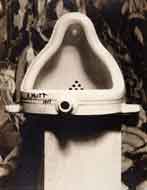
Marcel was the discreet center of a small world of familiar faces you would run into, toward the cooler part of the afternoon, after having spent the day out in the boat, along the rocky shores of the Costa Brava.

I’d been told that Marcel Duchamp was an artist, but there was nothing extraordinary about that, as a lot of artists of all kinds lived or spent the summer in Cadaqués, some famous, others obscure, some remarkable, some very bad. Most of the art that was shown in the local galleries was mediocre, except for the Galeria Cadaqués, run by the architect Franco Bombelli. The gallery was a vaulted white-washed space where contemporary art was shown and where, on opening nights, you just might catch a glimpse of Marcel.

Every summer day


click to enlarge
Marcel Duchamp’s daily
trip to play chess at Café Meliton
Figure 1
Marcel Duchamp’s daily
trip to play chess at Café Meliton

There was another place where you were absolutely sure to see Duchamp: at exactly 5:00 p.m. and at precisely the same spot, in the same chair, at the same table, every summer day.

The place was the café Meliton, at the northern end of the Paseo, the village’s main meeting place. The tiny café has a handful of tables inside and, across the road, a few more, practically on the beach. You would never catch Marcel sitting outside, however, at least I never did. At 5:00 p.m. sharp, every day, he would go inside, just to the right, and sit down on the wicker chair, his back to the wall, covered, salon-style, with framed pictures, autographed photographs, small oil canvases and watercolor landscapes, faded surrealist sketches and other souvenirs. Marcel would sit there, watching the waiter and waitress go about their business, going to the counter at the rear to fill their round trays with drinks ordered by people sitting outside. Somewhere in the back, a very striking gentleman was discreetly supervising the operation. His last name was Meliton, which had a proud ring to it. He had a very distinguished tanned face, the hands of a fisherman and elegant, totally white hair. He was younger than Marcel but had been around. He had been an anti-Franco, Republican hero in the Spanish Civil War. The waiter was his son, the waitress his daughter. Marcel wanted to be at that particular table, so Meliton kept it for him. It went without saying. With Marcel, everything went smoothly.

Then Marcel would order a drink and gracefully proceed to light a cigar. It was a ritual of sorts, with inframince differences from day to day.


click to enlarge
Marcel and Teeny
Duchamp’s apartment

Figure 2
Marcel and Teeny
Duchamp’s apartment on
the top floor of a house on
Port d’Alguer, in Cadaqués

In the summer of 1965, I took advantage of Duchamp’s daily habit. By then, I had just turned 21 and was living in Cambridge, Mass., discovering contemporary art among other things. And so, in my youthful mind, he was no longer Marcel, the elderly friend of my parents, but Marcel Duchamp, discreetly carrying about him the aura of a century of art. So one day, I went to Meliton’s a bit ahead of time, and sat at the table next to the one which I knew he would soon occupy. When he appeared, I greeted him, and he kindly invited me to pull up a chair. I was full of questions, all of which he answered with patience and courtesy. I didn’t ask him about his work really, probably because I felt comfortable with its enigmatic nature. But what I longed to hear about in my youthful enthusiasm, were details about people I’d been reading about so recently: Picabia, Tzara, Eluard, Max Ernst, Breton, Varèse, Masson… They were all in the Pantheon, names I had only encountered in books or museums, and Marcel had known them all. Marcel who was a familiar face, a warm and witty presence, a part of my childhood before he became, for me, a figure, no longer Marcel but Marcel Duchamp. Of course, in Cadaqués, you’d see Dali’s name everywhere, on postcards, mugs and tacky souvenirs. And you would occasionally run into him, with his funny moustache and walking cane, followed by the ever-present, ghostly Gala, his wife. They were unavoidable, but they were not in my Pantheon, whereas Marcel had become something of a spiritual father, someone paradoxically brought closer by his mystery, and the fact that everyone thought (wrongly, as it turned out) that he had ceased all artistic activity.

Meanwhile, back at the Café Meliton, at 5:30 sharp, a fellow walked in and sat across from Marcel. It was often a tall Swede. A wooden chess board was immediately brought to them. Glasses and cups were removed. At that point, I knew I had to shut up. The serious business was about to begin. I didn’t know much about chess at the time, so I don’t remember what openings Duchamp favored, or anything about his style of play. All I can say is, however dramatic the confrontation might have been, Marcel kept focused, samurai-like, periodically puffing on his cigar. I don’t remember whether he usually won, but it felt like he did, regardless of the outcome. My feeling was that he was less an aggressive player than one who knew how to exploit his opponent’s moves. I didn’t stay until the very end actually, because I thought that would have been indiscreet. What was at stake on the chess board seemed too intimate to watch. 

Animated Reconstruction of Rotoreliefs

My relation to Marcel Duchamp is that of a chess player trying to win a game against someone who is dead but is determined to win in any case-no matter what I do. It is a hopeless game to get involved with the father of conceptual art who may laugh at art theory like Nam June Paik may laugh at a television screen. Duchamp beats the linguist into the critic and spits out absurd connections. He is someone who is specialized in breaking the rules. Maybe that’s why I like him.

The Flash piece is a reconstruction of Duchamp’s Rotoreliefs using text. They are meant as an homage to Duchamp. A linguistic analysis of any of the spirals will show various ambiguities in terms of meaning or phonetics. These sentences may really wring a scientific brain. There is no end.

My own work revolves around photography and short videos and animations. I am interested in feedback regarding problems and patterns and use the internet as a personal publishing space.

For more works, please visit:
www.lu-x.de

The Late Show Line Up: BBC UK Interview with Marcel Duchamp, June 5, 1968

Duchamp’s Gendered Plumbing: A Family Business?


click image to enlarge
Fountain
Figure 1
Marcel Duchamp,
Fountain,
photograph by Alfred
Stieglitz from
The Blind Man
No. 2, 1917

When Duchamp in 1917 labeled a urinal an art work, a sculpture (Fig. 1), he raised questions that have engaged generations of critics, and the work continues to inspire artists.(1) Its designation as a fountain raises other questions; e.g., how could a piece of plumbing, a receptacle for standup male excretion, serve as a fountain that sprinkles water? The association of the “fountain” with the male organ makes some sense; but the recent view of critics that its round compact shape suggests female qualities compounds the paradox of reception/projection of fluid: did Duchamp conceive an incongruous representation in which a female’s anatomy, designed for a vertical drop, serves the function of horizontally directed discharge like the male’s? and was this conception unique, unprecedented?

The answers I propose are yes to his conception and no to its uniqueness.
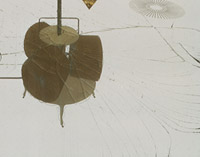
In an irony that has not escaped his critics, the
Fountain
(or its replicas) and all the other ready-mades of Duchamp, which he considered anaesthetic and antiretinal, remain on public view in museums as centers of attention and discourse, ccupying aesthetic space rather like the unrestored marks of an iconoclast or like the cracks in his definitively unfinished
Large Glass
. (Fig. 2) Their status grows in prominence among some critics even as other contemporary manifestations-for example by the Dadaists-fade into obscurity or a scholarly twilight zone.


click image to enlarge
Large Glass
showing the crack
Figure 2
Marcel Duchamp,
Close-up view of the
Large Glass
showing the crack

No work seems more understated and prosaically obvious than the Fountain, generally presented as a protest against the institution of gallery and museum exhibition. Yet this popular object continues to generate a big literature dedicated to the insatiable interpretation of its hidden implications. A recent theory claims that the work presented by Duchamp as a sample of prosaic American plumbing was not simply ready-made but artfully altered, confected to seem readymade: ars celare artem. This view has inspired erudite research among the manufacturers’s toilets and led some to conclude that Duchamp simulated the standardization.(2) This corroborates the view that at least some of the “mades” were not all “ready-” and merely selected, but evolved over time and with premeditation, a point that emerges also in the following discussion of the Fountain.


click image to enlarge
Bottle Dryer
Figure 3
Marcel Duchamp,
Bottle Dryer,
1914/64

Duchamp’s toilet sculpture makes an exquisitely ironic comment on the view circulating in France since the nineteenth century that advocates of utility-whether in philosophy, art or plumbing-were tasteless. (The epitome of industrial utility were of course the Anglo-Saxons, particularly the Americans.) As the champion of l’art pour l’art Théophile Gautier asserted in 1834, “There is nothing really beautiful save what is of no possible use. Everything useful is ugly, for it expresses a need, and man’s needs are low and disgusting, like his own poor, wretched nature. The most useful place in a house is the water closet. / For my part … I am fond of things and people in inverse ratio to the service they render me. I prefer a Chinese vase with its mandarins and dragons, which is perfectly useless to me, to a utensil which I do use…”(3) It was with this aesthetics of tastelessness in mind that Duchamp the socioaesthetic gadfly wryly remarked (1946), “I threw the bottle rack (Fig. 3) and the urinal into their faces as a challenge, and now they admire them for their aesthetic beauty.”(4)
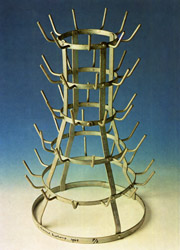
As noted above, the upright urinals were designed to receive and remove a standing man’s urination, his jet d’eau (“fountain”); in contrast the female’s downward stream favor(ing)s squatting.


click to enlarge
Mannekin-pis fountain, Brussels Hellenistic marble
Fountain
Figure 4
Mannekin-pis fountain, Brussels
Figure 5
Hellenistic marble
Fountain Nymph of
the second century A.D

This property yielded the convenience denied women of the stand-up pissoirs once common on public streets in France.(5) (Fig. 4) A German feminist, concerned about the gendered function of the urinal, argued that the Fountain has an exclusionary significance for Frenchmen: its awkwardness for women embodies in her view an implicit sexism.(6)

Yet the Greeks already conceived of a fountain in which the water gushed from a standing female. The plumbing built into a Hellenistic marble Fountain Nymph of the second century A.D. allowed a strong, horizontally-directed flow of water, projecting a stream identical to that from the male organ. In this rare construction a round vaginal channel passes through the pelvis of the standing figure. The water moved through that passage toward a facing water basin, filling and overflowing it.(7) (Fig. 5) I don’t know whether Duchamp saw a version of this fountain in Paris or Munich, but the idea of adapting replicas of classical statues to contemporary household fixtures was quite common. In this increasingly commercial consumer society even hallowed works like the Venus de Milo could be subjected to caricature: the Vénus de Mille-eaux of 1896 resembles a kiosk plastered with stickers advertising-not fountains, but popular watering places. Thus, engaging the vast upsurge of middle class tourists seeking culture, humorists in anticipation of Duchamp’s Fountain, made sport of bringing dignified classics down to a plebeian level.
click image to enlarge
Portrait of
Tristan Tzara
Figure 6
Jean Arp, Portrait of
Tristan Tzara.1916.
Estate of the
artist: on loan to
the Musee d’Art
et d’Histoire, Geneva.
Portrait of
Princess X
Figure 7
Brancusi,Portrait of
Princess X, 1916

Duchamp generated something more than the ironic display of a provocatively vulgar and sexist object, and his piece bears comparison with some sculptures by his contemporaries. Duchamp in fact emphasized that in choosing an ordinary article of life, and causing its useful significance to disappear under the new title and point of view, he “created a new thought for that object.” The new thought in this protoconceptual piece involved, as we have seen, complicating the gender question by truncating the projecting tubes of the male utensil and rotating its axis. The compact form he devised emphasizes curvilinear lines, like the mechanomorphic female nudes of his friend Picabia; and it also suggests the r(R)eliefs Jean Arp made between 1916 and 1922,(Fig. 6) which Duchamp admired as among the most convincing sculptures of that “antirationalist era,” adding that “his Concretions are like a three-dimensional pun on the female body.”(8) More directly relevant to the Fountain’s implied androgyny is a sculpture exhibited in 1917 in the same Independents exhibition that refused the Fountain-Brancusi’s Portrait of Princess X of 1916, (Fig. 7) notorious for uniting in one piece phallic and female aspects.(9)

A subtle-or controversial-source for the Fountain arguably comes from the collages of Picasso and Braque. When Duchamp rejected Cubist painting-notably the variant practiced by his brothers and their friends at the Section d’Or-he turned to selecting and modifying objects available for purchase. This move to readymades was inspired I believe by the example of Cubist collage, admittedly as an intellectual response to its concept. He made ironic comments or exaggerations of the formal or verbal games of Picasso and Braque, who for example suggested making a “urinal” from a “(jo)ur(i)nal” and-anticipating his play on Q in LHOOQ-insinuated a playful androgyny in the letter Q (a hole with a cedilla) and in the hollow frontal tubes of pipes (derived from the famous Grebo mask’s eyes?).(10) In contrast to the artistic finesse of these androgynous tubes, the frontal hole of Duchamp’s Fountain -at once a truncated penis and a protruding vagina-seems like an artless display of plumbing.

By displaying this utensil upside down-inverting it-Duchamp slyly enhanced the uncertainty of the object’s gender, intimating its androgyny.(11) Aas in note 13 described the Fountain as a receptacle for the male “jet” turned upside-down and made female, a vagina potentially containing its own fluids. This inversion that accentuates the feminine lines of a utensil intended for males, provides one more example of the theme of androgyny so often noted in Duchamp’s work.(12)

The Fountain provided Duchamp with a field suited to his prankish humor about his own gender identity. One of the most important books on the Fountain opens with the remark, “We do not even know with absolute certainty that Duchamp was the artist-he himself once attributed it to a female friend …”(13) The confusion of authorship and gender culminated a few years later in his female persona Rrose Sélavy, a playful transformation of his sex, name and religion; but he may have adumbrated the Fountain’s link of female to male (urinal) earlier in his notes of 1914 for the Large Glass. In one of them he says that “one only has: for female the public urinal and one lives by it.”(14) It seems to me that “one lives” anticipates the name Rrose Sélavy (arrose, c’est la vie).(15) A drawing for the Large Glass traces a parabolic trajectory of water spurting like urinary discharge. The text next to it curiously associates fountain (jet d’eau) or water spray and a subtle confusion of genders: “MOULIN A EAU / Chute d’eau / Une sorte de jet d’eau arrivant de loin en demi-cercle-par-dessus les moules malic.”(16) The word moules embodies androgynous meaning: on the one hand it is defined as male by the adjective malic as the mold for the bachelors; on the other hand a second definition of moule means mussel, which served as a metaphor in Parisian modernist circles to signify the vulve.(17)


click image to enlarge
Family Portrait
Figure 8
Marcel Duchamp,
Family Portrait (1899),1964
Rhonda Roland Shearer COLLECTION

Can Duchamp’s archly subversive efforts to bring together the genders have covered a personal agenda? Perhaps his endless fascination with the coincidentia oppositorum evidenced in the Fountain’s implicit androgyny can provide a brief glimpse beneath his otherwise impersonal facade. I am by no means alone in elevating Duchamp above the impersonal collectivity of the Dadaist movement.(18) In 1964 Duchamp exhibited a photo of his family cut to fit into a replica of the Fountain , a devoutly irreverent monument perhaps prompted by the death of his brother Jacques Villon the year before.(Fig. 8) This is a photomontage composed of photos from 1899 showing the 12 year old Marcel in the center beneath his mother holding a baby and above his father and two sisters. An inked out form between the sisters might have been a photo of his deceased brother Jacques. He had often over the course of his career created figure groups directly or indirectly suggesting family pictures: his brothers playing chess; the King and Queen Surrounded by Swift Nudes ; and the Big Glass with its cloud “parents” above and “bachelors” below.(19)

Family photo in a urinal. Androgyny. Pseudonymous roles-male and female. All this would seem to invite psychological analysis; but the personality of this wily chess master, a connoisseur of stalemates, has discouraged analyses of his motivations. We may note, it is true, that the jarring discord between a family photo and its unseemly location recalls a description of the Freudian family scene in which all differences-gender, age, love and hate, the oedipal triangle-merge in incestuous union;(20) moreover, that as Rrose Sélavy Duchamp once equated incest and a “passion de famille.” However, the approach of Adlerian Individual psychology may offer a more direct access to his intentions. Such an approach would interpret his behavior as largely a reflex of his place in the family constellation-a middle child between siblings of opposite gender.


click to enlarge
Portrait of
the Artist’s FatherThe King and Queen
Surrounded by Swift
Nudes
Figure 9
Marcel Duchamp,Portrait of
the Artist’s Father, 1910
Figure 10
Marcel Duchamp, The King and Queen
Surrounded by Swift Nudes, 1912

Marcel was the youngest of the three artist sons of Eugène Duchamp, a well-to-do notary, and experienced an apparently normal and happy childhood in an affectionate family milieu. His father tolerated and even supported financially the artistic ambitions of his sons. In 1910 Duchamp painted a loving Cézannesque portrait of his seated father with a large urn over his left shoulder.(Fig. 9) Rather than engaging in a simple Oedipal revolt against the father’s prosaic job as notary, he entered into a complex dialectic with him. His older siblings already broke with the bourgeois profession of his father, and Duchamp like them rebelled professionally (a position epitomized, perhaps in The King nd Queen Surrounded by Swift Nudes
of 1913 (Fig. 10)). As the most rebellious sibling and the last-born male Duchamp invites the Adlerian thesis that personality is determined by birth order of children within a family.(21)Duchamp’s case is rather complex since as last of three males in a family of six children he was at once last born and middle child. Adlerian Individual Psychology says of the middle child,(22)especially the male, that he will sometimes become a rebel, either covertly or overtly, but that if not encouraged he could drop out of competition and become an observer. Forced to be self-sufficient he will seek out an independent path. While defying authority figures, he can keep a lower profile or stay out of the limelight.(23)

In seeking out an independent place for himself Duchamp implicitly rebelled against his brothers’ authority, rejecting their use of traditional materials and techniques in favor of technology and commercial materials. He mimicked his brothers’ interest in science especially optics, transmogrified into a mocking pataphysics, an unstable mixture of Jarry and Leonardo.(24) In the end he assimilated the logic and scrupulous attention to detail of his father the notary while rejecting the life style of the staid bourgeois: he carefully filled notebooks (for the Large Glass) with systematic calculations so obscurely self-referential that many are incomprehensible. In doing so he created an onanistic Summa filled with overt and covert sexual annotations: the art of the notary turned into a notarial art.

All this certainly describes the famous anonymous author of R. Mutt’s Fountain, an artist who celebrated and profaned his family by placing their image at the bottom of a urinal (illustrating his famous word play “Ruiner – Uriner”), just as he may have soiled and celebrated the ghosts of millenial sculpture.


Notes

1. To take one example: Mike Bidlo in 1995 titled a version of Fountain Origins of the World (an allusion to the title of Courbet’s painting of female pudenda). Recalling Stieglitz’s famous photo of the Fountain before a painting by Marsden Hartley, he placed behind it a copy of a painting of a flower with vaginal suggestions by Georgia O’Keeffe. Interestingly O’Keeffe’s flower is a rose whose color is visible through the holes of the fountain—doubtless an allusion to Duchamp’s alter ego Rrose! Bidlo produced more than 3,000 variations on the “Fountain” motif. On these and other relevant issues see the valuable article by Michael R. Taylor, “Blind Man’s Buff: Duchamp, Stieglitz, and the Fountain Scandal Revisited,” in the exhibition catalogue Mirrorical Returns. Marcel Duchamp and the [sic] 20th Century Art (Yokohama Museum of Art, 2005) 206-13.Footnote Return

2. Rhonda Roland Shearer has spearheaded this new view of the readmades. Working with her husband the late Stephen Jay Gould, she has investigated Duchamp’s sources for the Fountain and for Apolinère Enameled in “Marcel Duchamp: A readymade case for collecting objects of our cultural heritage along with works of art,” in Tout-Fait: The Marcel Duchamp Studies Online Journal, 1: 3 (Dec. 2000): Collections. William A. Camfield held to the established opinion when he drew attention to Duchamp’s selection of a urinal from the J. L. Mott Iron Works in “Marcel Duchamp’s Fountain: Its History and Aesthetics in the Context of 1917,” in Rudolf E. Kuenzli and Francis M. Naumann, Marcel Duchamp: Artist of the Century (Cambridge, MA: MIT Press, 1989) 64-94. In fact, the first version of the work, refused for the exhibition, has long ceased to exist except as replicas, a photo by Stieglitz, and numerous texts starting with Duchamp’s letters and notes and extending through an interminable series of commentaries and critical footnotes, including this one.Footnote Return

3. See Gautier’s preface to Mlle. de Maupin.Footnote Return

4. The journalist Louise Norton wrote an early critical examination of the Fountain’s aesthetic properties titled “Buddha of the Bathroom” that appeared in the second issue of The Blind Man. (Fig. 11) Duchamp rejoined her piece with a letter to Rongwrong (Fig. 12) on May 5, 1917 calling her sarcastically an “exquise psychologue” who “à propos de pissotières, invoque d’une façon si éclectique Montaigne, Nietzsche et Rémy de Gourmont.”Footnote Return

click images to enlarge  


  • The Blind Man
    Figure 11
    The Blind Man
    , vol. 2, 1917
  • The Blind Man
  • letter to
RongWrong
    Figure 12
    Marcel Duchamp, letter to
    RongWrong
    , 1917

5. The Robert Dictionnaire historique, assuming the pissotière was designed for men, defines it in terms of the membre viril and urine. A French colloquialism describes the urination of boys as occurring while standing. See Michel Maillard, “’Un zizi, ça sert à faire pipi debout! Les références génériques de ça en grammaire francaise,’ in Recherches linguistiques 12: 157-207 (1987). The projective aspect of the standing male urinator is well represented by the penis faucet of the famous Mannekin-pis fountain in Brussels.Footnote Return

6. See Uli Schuster, “Was macht ein Werk zum Kunstwerk? Betrachtungen zu einem Objekt von Marcel Duchamp: Fountain.” It is interesting to note the remarks of the famous Freudian analyst Marie Bonaparte as presented by N. Thompson, “Marie Bonaparte’s Theory of Female Sexuality,” in American Imago 60:3 (Fall 2003): 239, “An additional theme in Bonaparte’s characterization is her grandmother’s alleged virility. Justine Eléonore reinforced the impression that she was a ‘phallic woman’ by boasting that she could urinate while standing up, a claim that astonished her granddaughter.”Footnote Return

7. The statue, recently excavated, is exhibited at the Pergamum Museum under nr.768.Footnote Return

8. Duchamp wrote this retrospectively in 1949.Footnote Return

9. Can an association between Brancusi’s androgynous figure and Duchamp’s androgynous urinal account for one artist’s idea of turning Brancusi’s into toilets? In the 1990’s Tim Thyzel exhibited in the Cynthia Broan Gallery in N.Y.C. an ensemble of “Bathroom Brancusis”; and—echoing Brancusi’s formal vocabulary—starting in 1993 he even fashioned an “Endless Column” of toilet bowls. Doïna Lemny, Edith Balas and William Camfield explore Duchamp’s relation to Brancusi in Marielle Tabart, editor, Brancusi-Duchamp, in the collection “Les Carnets de l’Atelier Brancusi” Paris, 2000. Recent scholarship has explored Brancusi’s androgyny and ambiguity: Bernard Marcadé in Femininmasculin: Le sexe de l’art, exh. cat., Centre G. Pompidou, Paris 1995, p. 31, quoted an interview of Brancusi with Robert Devigne originally published in L’ère nouvelle, ‘Le devenir-femme de l’art,’ Jan. 28, 1920. On Brancusi’s use of ambiguity, see Friedrich Teja Bach, Constantin Brancusi, Metamorphosen plastischer Form (Cologne 1987) 184-7.Footnote Return

10. See also my article “A Symbolist Antecedent of the Androgynous Q in Duchamp’s L.H.O.O.Q.,” in Source XVIII.4 (Summer, 1999): 40-7.Footnote Return

11. In an article in a respected German medical journal, Karl Westphal in 1869 introduced a new mental disorder he called “Contrary Sexual Feeling.” According to Westphal, male inverts exhibit obvious signs of effeminacy and experience sexual desire directed toward their own sex. Similarly, female inverts, including a case he reported on, are tomboys who turn away from “normal” sexual contacts with men, favoring other women instead. Westphal’s successor Richard von Krafft-Ebing viewed sexual inversion as a mental disease, and popularized the notion that male inverts are profoundly feminine and delicate. Havelock Ellis rejected the idea that male inverts are necessarily girlish, but retained the term in his book Sexual Inversion (1896).Footnote Return

12. Lanier Graham, “Duchamp and Androgyny: The Concept and its Context,” Tout-Fait 2:4 (Jan. 2002), Articles. The link between androgyny and the coincidentia oppositorum has led some to speculate about Duchamp’s interest in alchemy. See, for example, Arturo Schwarz, “The Alchemist Stripped Bare in the Bachelor, Even,” in Anne d’Harnoncourt and Kynaston McShine, Marcel Duchamp (New York: Museum of Modern Art, 1973).Footnote Return

13. See William A. Camfield, Marcel Duchamp: Fountain (Houston: The Menil Collection, 1989).Footnote Return .

14. See Duchamp, Box in Sanouillet and Peterson, The Writings of Marcel Duchamp (1973) 23.Footnote Return

15. Perhaps Duchamp had in mind Lumière’s celebrated slapstick film of 1905 L’arroseur arrosé (the sprinkler sprinkled) in which a man watering his lawn lets slip his garden hose which splashes water all over him-“that’s life.” The children’s journal, Musée des enfants in 1897, p.96 contains “sprinkling” cartoons; e.g. one captioned “Il est là, Monsieur” in which a worker hosing the street points the way to a well-dressed gentleman, and inadvertently directs the hose at the shocked, recoiling figure.Footnote Return

16. See Duchamp du Signe, p.89. Duchamp sustained his fascination with fluids over the next decades right to his death; e.g., in the 50 cc. of Paris Air, (Fig. 13) in the Eau de voilette,(Fig. 14) and in the late waterfall of Etant donnés. (Fig. 15) Footnote Return

click images to enlarge
  • 50 cc.
of Paris Air
    Figure 13
    Marcel Duchamp,
    50 cc.
    of Paris Air
    , 1919
  • Belle
Haleine: Eau de Voilette
    Figure 14
    Marcel Duchamp,Belle
    Haleine: Eau de Voilette, 1921
  • 1. The Waterfall / 
2. The Illuminating Gas
    Figure 15
    Marcel Duchamp,
    Etant donnés: 1° la chute d’eau / 2° le gaz d’éclairage
    [Given: 1. The Waterfall /
    2. The Illuminating Gas], 1946-66
  •  

17. Mussels first entered French dining in the late 19th century, and Apollinaire already compared it to the vulva in Les Exploits d’un jeune Don Juan (1907) 31): “A la fin je découvris que [la] fente [de Berthe] que l’on pouvait comparer à une moule entr’ouverte …”Footnote Return

18. See Camfield, op.cit., and Marjorie Perloff, Dada without Duchamp / Duchamp without Dada: Avant-garde Tradition and the Individual Talent,1998Footnote Return

19. Duchamp’s efforts to control his siblings and his continual assigning them nicknames suggest a remark made by Robert Smithson in an interview shortly before his death. Smithson observed somewhat caustically the growing influence of Duchamp whom he described as “a kind of priest … who turned a urinal into a baptismal font.” In Moira Roth, “Robert Smithson on Duchamp, an Interview,” Artforum XII.2 (Oct. 1973): 47, reprinted in J. Maschek, ed., Duchamp in Perspective (NJ, 1975) 134-7.Footnote Return

20. See Guy Rosolato, Essais sur le symbolique (1969) 291: “Le mythe serait … dans la nostalgie idéalisée d’une unité originelle qu’entretient le fantasme infantile de la Scène Primitive.”Footnote Return

21. Frank J. Sulloway, Born to Rebel. Birth Order, Family Dynamics and Creative Lives (New York: Random House, 1996) follows Adler in his essential thesis. But he adds a statistical veneer and uses (without citing) Popper’s once fashionable “principle of falsifiability” to refute Adler’s lack of scientific rigor.Footnote Return

22. The complexity of his emotional and artistic relations to his next younger sibling Suzanne have yet to be explored. Replacing him as youngest child she may well have dealt a mildly traumatic blow to his ego. Can his envy of her have contributed to his wish as Rrose to rival females in general, to adopt their look while retaining his male prerogatives?Footnote Return

23. Duchamp advances a concept of “sister squares” in his book on chess theory.Footnote Return

24. Linda Dalrymple Henderson has written extensively on Duchamp’s interest in contemporary science.Footnote Return

Figure(s) 1-3, 10-14 © 2005 Succession Marcel Duchamp, ARS, N.Y./ADAGP, Paris. All rights reserved.

Modernist (Im)mobilities: Marcel Duchamp, Samuel Beckett, and the Avant-Garde Bike

“He rides penny-farthings, tandems, tricycles, racing bikes—
and when he dies at the end, he rides on his bike up a sunbeam straight to heaven, where he’s greeted by a heavenly chorus of bicycle bells.”
Dylan Thomas, Me and My Bike

Hamm: Go and get two bicycle-wheels. Clov: There are no more bicycle-wheels.
Hamm: What have you done with your bicycle? Clov: I never had a bicycle.
Hamm: The thing is impossible.
Samuel Beckett, Endgame

The bicycle offered unsuspected possibilities for the depiction of the raised skirt.
Walter Benjamin, The Arcades Project

Introductory Observations

• The bicycle tends to arouse sexual desire or excitement.
• The bicycle is a traditional narrative usually involving supernatural or imaginary persons and embodying popular ideas on natural or social phenomena.
• The bicycle is commonplace.
• The bicycle is an unmarried man.
• The bicycle is a branch of metaphysics dealing with the nature of being.
• The bicycle gets you nowhere.

click to enlarge
Bicycle
Figure 1
Leonardo da Vinci, Bicycle Drawing,
Codex Atlanticus
(f. 133v)

In 1966 the monks of Grotto Ferrata, near Rome, discovered a sketch-apparently by Leonardo da Vinci, or by one of his pupils-depicting a bicycle-like machine complete with pedals, cogs, and chain mechanisms. (Fig. 1) The sketch was found alongside some caricatures, as well as some pornographic drawings. This scene could also be described as the collected works of Marcel Duchamp and Samuel Beckett.

Beside an Olympic skating oval, a world-class athlete (unable to ride outside because of the ice and snow) trains indoors on a real bicycle. The wheels, however, are set on soundless steel rollers: allowing the tires and rims to spin freely (at significant speeds) while keeping the bike and its rider stationary. We count this powerful, impotent spectacle as technology reversing technology (rollers unroll wheels), caught in a ceaseless loop of motionless motion. The avant-garde, too, can make modernity stand still-by moving it/stopping it yet again. Krzysztof Ziarek contends that “art is avant-garde to the extent to which it keeps unworking the technologization of experience by showing how, in order to reinscribe experience within the order of representation, it effaces historicity” (90).

The bicycle is very simple.

click to enlarge
Henry James
Figure 2
Henry James

Leaving his fine suite in the Osborne Hotel, on Hesketh Crescent, feeling radiant and fresh after his hot morning bath, Henry James (Fig. 2) hopped on his bicycle and toured the sites of Torquay. Imagine it! Modernity takes shape in, and as, The Master’s black and yellow bruises-of which he was so proud.

Consider Renoir’s broken arm and Toulouse-Lautrec’s lonely, longing gaze at the velo-drome. (The pride of a sling; and legs too short to reach pedals?)

It sucks to write about bicycles. In that: it is much better to ride bicycles. Duchamp ride (Fig. 3): I would be doing lascivious things with my sprockets. Beckett ride (Fig. 4): I would be pedalling backwards and shitting on the saddle.

Artistical-historical (bland): the bicycle, the bicycle wheel (Fig. 5), and the objects of the bicycle are powerful symbols in the work of Duchamp and Beckett.

click to enlarge


    •  Marcel Duchamp riding the bike
      Figure 3
      Photo of Marcel Duchamp riding the bike
    • bike Molloy
      Figure 4
      Samuel Beckett, drawing of the bike Molloy
    • Bicycle Wheel
      Figure 5
      Marcel Duchamp, Bicycle Wheel, 1913/1961


The presence of any technology that at once facilitates and complicates mobility is an interesting presence. Second thought: all technology simultaneously facilitates and complicates mobility. If the bicycle falls to this side of the modernist road then it lands in the ditch-water, if it falls to that side of the road it ends up in pasture. The modernist road has space for all mobilities: pedestrians, pedestrians on bicycles, pedestrians in motorcars, and even pedestrians in aeroplanes (emergency landings). But there is nothing more beautiful than a bicycle descending a hill by itself: ghost-rider.

The bike is a gender machine.

The modern is a technology machine?


click to enlarge
F.T. Marinetti
Figure 6
Image of F.T. Marinetti

In the climactic scene of F.T. Marinetti’s original Futurist manifesto-“The Founding and Manifesto of Futurism 1909”-Marinetti (Fig. 6) and his car (the beautiful shark) are famously flipped into the maternal ditch only to be born again in the metallic, celestial muck of industrial modernity. The newly baptised Marinetti, now a begrimed singer-apostle of all things dangerous, violent, machined, and frenetic, is literally tossed into his modern-technological epiphany by an older, slower mode of transportation. He recalls, “¡¦ I spun around with the frenzy of a dog trying to bite its tail, and there, suddenly were two cyclists coming towards me, shaking their fists, wobbling like two equally convincing but nevertheless contradictory arguments. Their stupid dilemma was blocking my way- Damn! Ouch! . . .” (20). The moment is significant, it seems to me, not as some elegiac snap-shot depicting the obsolescence of the bicycle and thus the triumph of the age of the automobile, but rather the exact opposite: Marinetti’s tale constitutes a vision of the stubbornness and presence (the stupid dilemma) of the bicycle itself. Marinetti’s manifesto, caught in a Keystone-cop-like loop, is indirectly documenting the very complexities, ironies, and even impossibilities of mobility in the modern moment. It shows the tragic-comic intermingling of technology with technology, and technologies with the modern subject. For me, the image of these wobbling, contradictory bicycles, despite the fact that they lack the throaty roars of Marinetti’s racing cars, is profoundly moving, because the bikes are curious, hybrid machines: both connotative of the past and yet apparently crucial (if annoying) fixtures on this future, avant-garde road.

Mikael Hard explains that “Facing a world of tanks and assembly lines, and using telephones and automobiles, ‘modern’ men and women were forced to differentiate the uses of technology from the abuses. The proliferation of the machine into ever more areas of social and economic life led to a need to interpret its meanings in a much more comprehensive way than in the past” (2). These transformative technologies of the modern period gave rise to new economies, new cities, new narratives of progress and anxiety and thus, necessarily, new bodies. The modern technologies of the plane, train, and automobile, for example, are not only devices that enhance the mobility of the modern subject, but also contraptions that transform the subject’s relationship to landscape and being itself.


click to enlarge
Alfred Jarry on bike
Figure 7
Alfred Jarry on bike
Wassily Chair
Figure 8
Marcel Breuer,
Wassily Chair
, 1925

Bicycles are a central contraption in the tropics of the avant-garde. From Alfred Jarry’s bicycle obsession (Fig. 7) (he slept with his bike at the foot of his bed), to Picasso’s uncanny handlebar bull-hornism to Marcel Breuer’s Wassily Chair (Fig. 8), inspired by the tubular steel of his brand-new Adler bicycle, the machine haunts avant-garde experimentation. And this is particularly the case in the works of two exemplary avant-gardistes, Marcel Duchamp and Samuel Beckett. While there has been some critical attention paid to the place of bicycles in the texts of Samuel Beckett (notably Hugh Kenner’s work), there has been rather scant focus on the place of the two-wheelers in Duchamp’s corpus and nothing, as yet, that expressly pairs the two artists’ fascination with the bicycle as modern machine. What I argue in this essay is not only that the bike is a crucial facet in the experimental work of both Beckett and Duchamp (allowing one to glimpse significant aesthetic parallels across genres) but specifically that the bike, in their works, comes to represent a crisis of mobility in the modern moment. My contention is that, for both artists, this crisis plays out most tangibly in the fields of language and subjectivity so that the act of “being” in modernity, for Beckett and Duchamp, comes to be playfully linked to the problems of the modern self in interaction with technology. This essay explores the nuances of this interaction by interrogating the place of habit, language, desire, and daily experience in both the avant-garde and modern environments.

The Ride

Any study of the Duchampian/Beckettian bicycle swiftly transports a reader/viewer into the neighbourhoods of ontology, eroticism, bachelorhood, gender, myth and its relationship to the modern everyday. In using the symbol of the bicycle, Duchamp and Beckett illustrate the tragic-comic bind of the modern subject: the body is at once liberated by technology and yet also dangerously dependent on, if not indentured to, its power. (The same scenario exists, generally, for the artist in relation to technology; in relation to the technologization of both the artist and the art in modernity). For the modernist avant-garde then, the question is how to respond to the technological revolution of the everyday environment, which necessitates a grappling with the revelation that technology and reality are mutually constitutive.(1) In other words, something lies beyond the simple bind of liberated/indentured in reference to modern art and the birth of the technological everyday. The avant-gardiste is clearly implicated, perhaps more explicitly than the non-artist, in the invention of the new: in the construction of his or her own unique aesthetic technologies. Therefore, the avant-garde artist becomes and is obsessed with the relationship between making and power; invention and history; progress and immobility. This suggests that the technologization of art and the artist is not just a one-sided narrative about cameras or cinema affecting painting and sculpture and novels. Rather, one sees-in Duchamp and Beckett most powerfully-that a toaster or a bicycle is also an art object, a site of desire, a mechanical conveyance, a glyph.

In this way, the technologization of art and the artist, plus the tragic-comic bind of the modern subject, is one way of discussing a competition of realisms: if there is no set trajectory for any given object then what results is either (or both?) experimental art or something like official status. The goal of the avant-gardiste may be to rethink history, rethink the experience of how one (a culture) gets to a confusion of signifiers, a multiplicity of meanings-and then to rework or restate or re-inscribe that otherwise blanked-out narrative, but to do so always provisionally (this can mean humour). The technologization of anything can therefore be the habitualization of anything, too, and so, in the hands of the experimental artist, the resulting “defamiliarization” is also always a new form of technology. Art restores order through disruption: we see that a bike can also “work” mounted on a stationary stool or that it does not need, as in Beckett’s Mercier and Camier, a chain to actually work. This implies that the avant-garde artist is declaring that no function is absolute and all functions are historically contingent. Perhaps modernity or modernism quite simply means: there is no going back, which then electrifies the present. Modernity (time) captures modernism (“time”) as modernism captures modernity. Modern art is implicated-as the Frankfurt school writers, most notably Max Horkheimer and Theodor Adorno, have already shown-in the workings of industrial culture and this is an aesthetic boon of sorts but also a dilemma.

Krzysztof Ziarek’s recent work The Historicity of Experience: Modernity, the Avant-Garde, and the Event, boldly challenges earlier theories of the avant-garde-including the important work of Peter Burger, Andreas Huyssen, Jurgen Habermas, and Rita Felski-by insisting that discussions of modernist experimentation must move beyond a simple art/life dialectic. Ziarek proposes that the avant-garde be understood not as something outside or “other” to everyday existence (avant-garde art merely transforming the everyday through representation) but rather as something directly temporal. In both Duchamp and Beckett, the bicycle often morphs into a corporeal, body-like presence-one that profoundly questions the stability of definitions of the modern, human subject. Duchamp’s and Beckett’s appropriations of the bicycle are also knowing disruptions of the everyday “sense” or use-value or art-value of the modern technological object and consequently serve to challenge more general, conventional (modern) notions of mobility. These two artists thus lend credence to Ziarek’s, as well as Kornelia von Berswordt-Wallrabe’s, theories of the avant-garde which stress that the classic avant-garde work tends to disrupt an object’s “stream of function” (von Berswordt-Wallrabe) and also then refigure the (ostensibly evacuated of history, transparent) everyday moment as a vital and fluid setting of the “Event.”


click to enlarge
Rover safety bicycle
Figure 9
Rover safety bicycle, 1885
célerièfre,1790s
Figure 10
célerièfre,1790s

The bicycle is a new genre, a radically unique object. It is at once a device that enhances human speed and propels the body through a landscape, and yet it is not so fast that the body is ever removed from the intimate motions of its immediate surroundings. The bicycle, for all its metallic presence, is a comfortable citizen of the back road, the country field, even the mountain pass. It has a relationship to the movement of the wheat as well as to the airy dips of the birds. As a nostalgia-contraption, it is predictably a locus for memories and childhood. As I discuss later on in the essay, the modern bicycle (the “safety” bicycle (Fig. 9), which very closely resembles our contemporary bicycles, was perfected around the late 19th century) has its technological roots in the 1790s’ French children’s hobby-toys called celerifere or velocifere (Fig. 10). From their beginning, then, bicycles have seemed to connote newness but also, perhaps more palpably, nostalgia and the vanished moments of youth.(2) Cranking the pedals, or even just gliding down a hill, powers on the film of the past, a kind of Proustian recreation in which every new ride is always a tour backwards into time-lost. The bicycle is forever patient, too. Its simplicity is magnificent, how it waits against a shed, for example-not as a car sulks in a driveway or lurks beside the curb, but with a kind of Zen-like, friendly abandonment. The bike can look lonely, to be sure, but unlike other technologies of mobility (cars, planes, trains) it seems reconciled to melancholy; without ever being indifferent to, or utterly consumed by, its singularity. The poetics of the bicycle is infinite if only because-along with the complete entity known as “the bicycle”-each part of the machine (pedals, wheels, horn, handlebars, fenders, lugs, hubs, sprockets) resonates with particular, symbolic force.

The bicycle, importantly, is not just a double-sided object. It is multi-dimensional and it is therefore too reductive to state: “the bicycle has another side¡¦.” Yet the bicycle does exist-despite its halcyon glitter-as a protean modern object: it literally comes from (within) modernity. And quite possibly the bicycle can be seen as bringing modernity with it, pulling it out of the Victorian moment toward a late capitalist present. In the conventional cultural-historical narrative of European modernity-a tale that includes the spectacular entrance of planes, trains, and automobiles; the dramatic growth of metropolitan centres (and the elaboration of imperial networks); the birth of photography and cinema; not to mention the inventions of the telephone, typewriter and even tape-machine-the bicycle is a rarely-discussed, almost quaint participant. But for all its romantic-nostalgic energy, moving harmoniously through the ambience of sun-touched, pre-modern country lanes, the bicycle also helped create our modern/urban economies of mass consumption. Avram Davidson, in his short story “Or All the Seas with Oysters,” plots a brilliant, if idiosyncratic, evolution for the bicycle suggesting that safety pins are the larval and coat hangers the pupal stage of the machine’s gestation. What is fascinating about Davidson’s hypothesis is its mingling of the bicycle with other vital, but often overlooked, technologies of the modern. It seems to me it is precisely the apparent insignificance of the everydayness of the safety pin and the coat hanger that also gives the bike its power and poetics-all of these items are the overlooked, invisible dynamos of modernity.

The bike functions as a childhood emblem, then, but is emblematic too of Coca-Cola, Levi’s Jeans, MTV (Figs. 11, 12 and 13). Science historian Sharon Babaian explains that “The bicycle helped to forge the link between advertising and the mass consumption of luxury goods. It was the first expensive, non-essential product to be sold in such numbers-over 1.2 million bicycles per year where produced in the U.S. in the mid-1890s. Also, the bicycle industry was among the first to introduce annual model changes as a way of selling more products” (97). The bicycle, to use Raymond Williams’ term here, is “magical” but only as a revolutionary marketing tool-as a discovery, namely that within modernity a non-essential object could be engineered, mass-produced and sold for significant profit. The bicycle industry prefigured the automobile industry and thus anticipated the latter’s (soon to be more complete) construction and manipulation of appetites of mass consumption. And this was not only the case with the automobile industry but also with the aeronautics business. The Wright brothers, most notably, were originally a cycle firm. Moreover, Wiebe E. Bijker argues that by the turn of the century “Weapon makers, sewing machine manufacturers, and agricultural producers were only too happy to shift their production to bicycles” (32). And so the bicycle is a key protagonist not only in the narrative of mass transportation but also, and more expansively, in the drama of modern marketing, everyday consumption, modern technology, and the diversification of industrial technology.

click to enlarge


    • Coca-Cola logo
      Figure 11
      Coca-Cola logo
    • Levis jeans label
      Figure 12
      Levis jeans label
    • MTV Logo
      Figure 13
      MTV Logo


The bicycle, as both modern symbol and modern technology, is hence deeply embedded in a grander narrative of progress and use-value. To some extent the avant-garde is the manifestation of the retooling of such narratives-a practice of functional dysfunction and, like the everyday itself, much of the avant-garde’s power (force) resides in the play with context and referentiality. Ziarek writes.
Duchamp’s urinal or bicycle wheel ¡¦ stand the ordinary on its head, disconnecting everyday tools from their functional context and, thus, bringing into the open the invisible regulative force with which technicity forms modern being . . . In other words, the concept of the ordinary as immediate, as a place of common knowledge or a sphere of prelinguistic experience, sheltered from the influence of technology and mass culture, has to be called into question. The ordinary is already mediated, it is enframed technologically and functions as a font of availability, as resource or Bestand. (113)

click to enlarge
Duchamps
studio showing the
Fountain
Figure 14
Photograph of Duchamps
studio showing the
Fountain (1917),
1917-18
Duchamps
studio showing the
Bicycle Wheel
Figure 15
Photograph of Duchamps
studio showing the
Bicycle Wheel
(1913-14), 1917-18

The urinal or the bicycle wheel (Figs. 14 and 15) are revealed (as opposed to made) by the avant-gardiste as displaced, even suspended, artefacts of the everyday. They are recontextualized and thus undergo a number of-by now very well documented-changes. First, their use-value is confused as soon as they are “noticed” as art. Part of the enduring aesthetic, even revolutionary, energy of the Duchampian urinal, for example, lies in the crisis it creates for the viewer, forcing one to wonder as if for the first time: “what is a urinal? what is an art object? do I associate art with piss? do I now piss in art?” Perhaps the urinal never asked to be viewed before either. The avant-garde’s use of everyday objects is necessarily a radical play with the technologization of sense, use-value and function. Berswordt-Wallrabe explains that Duchamp’s Bicycle Wheel “had its roots in the artist’s ability to distance himself from the intended utilitarian purpose of the object and thereby to interrupt the existing stream of function, diverting the object or parts of it into an entirely different stream of function” (19).(3) The “other dimensions” of the everyday object are all contained within the art object itself; it is the context-shifting that here brings them into view. (Uselessness, nonsense, suspended function, purposeless play-these are, incidentally, the adjectives also applicable to the characteristic bodies and modes of Beckett’s fiction.) If the everyday object is removed from the everyday (or at least becomes embossed on the template of the everyday), is the same-but in reverse!-true of the art itself? In other words, is part of the crisis that the avant-garde inaugurates that of necessarily returning art to the setting of prosaic, modern being? A curious “cycle”?

Beckett 1

In considering the richness of Samuel Beckett’s numerous bike riders, Hugh Kenner famously surmises in his 1962 monograph, Samuel Beckett: A Critical Study, that Molloy, Moran, Malone, Mercier & Camier et al are representations of “Cartesian Centaurs” (121). Kenner understands this centaur-subject to be guided by rational intelligence yet ever and necessarily obeying the mobile, irrational wonder of the bicycle’s own motion and desire. The Cartesian Centaur is therefore a compliment of mind and body, but also and most importantly of body and machine: “Cartesian man deprived of his bicycle is a mere intelligence fastened to a dying animal” (124). The Beckettian bicyclist, however hopelessly, utilises the bike as a substitute body: one that, if not deathless, at least presents the illusion of delaying or denying mortality.

click to enlarge
French childrens
late 18th
Century hobby horses
Figure 16
French childrens
late 18th
Century hobby horses
cherubim riding on similar contraptions
Figure 17
cherubim riding on similar contraptions

Kenner’s Centaur is also interesting because, as aforementioned, the earliest known bicycles are thought to have derived from French children’s late 18th Century (1790s) hobby horses (Fig. 16). These proto-bikes were unsteerable and pedalless (very Beckettian attributions!), but equipped with two wooden wheels which would allow a rider to propel (push) themselves with their own leg power, or easily coast down a hill. The celeriferes(4) bear an interesting resemblance to certain medieval church iconography in which cherubim and seraphim are shown riding on very similar contraptions.(5) (Fig. 17) These early bicycle images suggest a complicated, if curious, history for a poetics of the modern bicycle. The self-propelled, wheeled vehicle is-from its earliest representations-aligned with the sacred, and specifically with images of ascension and purity. At the same time, these medieval proto-bikes are of course excessively, necessarily earthly machines: the wheels themselves most obviously requiring the stability of the ground, the real. The fundamental tension of the bicycle, perhaps, and one that Beckett exhaustively mines, is that which exists between its angelic and corporeal symbology: it strives dynamically upward and yet is, unfailingly, a mortal vehicle.(6) The discrepancy between virtuous potential and practical, ignominious fact fully articulates the tragic-comic grey space of Beckett’s fiction.

The bicycle first appears in Beckett’s work in his early 1934 collection of short stories, More Pricks Than Kicks. In the “Fingal” tale, the young lovers Belacqua and Winnie head off from Dublin for a romantic afternoon in the country. Their relationship is decidedly cool and characterised by defensive, droll repartee that is further ironized by the arch, omniscient narration. To confirm the subversion of the romance story, Belacqua is inflicted with “impetigo,” the knowledge of which compels Winnie (post-smooch) to thoroughly clean her mouth. And so it is not surprising-in this context of diseased, contaminated “romance”-that the destination of the love-jaunt in the country soon turns out to be the Portrane Lunatic Asylum (“she having a friend, he his heart, [there]”) (26).

On their way, however, Belacqua discovers something in the grass: “They followed the grass margin of a ploughed field till they came to where a bicycle was lying, half hidden in the rank grass. Belacqua, who could on no account resist a bicycle, thought what an extraordinary place to come across one. The owner was out in the field, scarifying the dry furrows with a fork” (27). The context of Belacqua’s discovery-especially in light of this being the first appearance of a bicycle in Beckett’s work-is significant in that the bicycle is riderless. The bicycle, lying abandoned in the rank grass, cannot help but be read as a kind of object counter-part to Belacqua’s own melancholy subjectivity. In particular, Belacqua’s interest in the bicycle is described in relation to his desire: he could, on no account, “resist” a bicycle. In this way, too, the bicycle is the clear, if wry, substitution of or for Winnie and, indeed, the scene mimics the encounter just previously in which the two lovers had been lying on the grass. What is clear here is that the bicycle is Belacqua’s discovery, and so his relationship to the machine is vaguely illicit and, at the very least, works to further his own solitude. Janet Menzies points out in her discussion of the scene that the encounter of the bike is “faintly disturbing” (99). One reason for this uncanny feeling is presumably that the bicycle and Belacqua seem to become indistinguishable. “Fingal”‘s narrative power rests not only in its rather flawless balance of aloof omniscience with caustic dialogue, but also with the mysterious anxiety that the discovery of the bicycle produces. The bicycle takes on a kind of “being” and seems to wordlessly, eerily compete with the superficial intentions of the love story.

This eerie competition is compounded by Belacqua’s developing connection, almost a homosocial alliance, with the bicycle owner and, of course, with the bike itself. The narrative makes it quite clear that Belacqua and the bicycle owner are aligned on the level of their shared masculinity. They both agree, for example, that “it needed a woman to think [the logistics of efficient travel] out” (28). Moreover, as Belacqua and Winnie move away from the man, we read that “Belacqua could see the man scraping away at his furrow and felt a sudden longing to be down there in the clay, lending a hand” (28). This moment happens two short paragraphs after an extended allusion to Hamlet: “The tower began well; that was the funeral meats. But from the door up it was all relief and no honour; that was the marriage tables” (28). If Belacqua is vaguely figured as the dispossessed son here and the bicycle owner as the ghostly father-figure, then Winnie is by default or implication a representation of Gertrude. Regardless, “Fingal” is to some extent a condensed and energetic reworking of the Hamlet themes of madness, diseased desire, and homosocial longing. Indeed, Winnie is evidently also the Ophelia representation here as she and Belacqua seem to be perpetually replaying a modernist version of the get-thee-to-a-nunnery exchange.

As Belacqua and Winnie sit and watch the “lunatics” taking their recreation on the grounds of the asylum, the bicycle owner (apparently an inmate of the asylum himself) comes running towards the lovers. “Belacqua rose feebly to his feet. This maniac, with the strength of ten men at least, who should withstand him? He would beat him into a puddle with his fork and violate Winnie” (30). Beckett’s narration is so comically convincing here because it completely undermines all the “masculine” labour that has previously sought to align Beckett and the bicycle owner. Now Belacqua is positioned less as a modernist Hamlet hero and more as a pathetic-neurotic anti-protagonist. Importantly, the bicycle owner not only runs innocently by the lovers but-crucially-leaves his bicycle behind him, unattended in the grass: “the nickel of the bike sparkled in the sun” (31). The alliterative, consonance clucks of the k’s alone in this sentence work to distinguish the bicycle as a glorious, exquisite signifier (and align it with Belacqua’s own clicky appellation). Thus Belacqua-all things working in his favour-manages to pass Winnie off on her friend Dr. Sholto while he promises to rendez vous with them “at the main entrance of the asylum in, say, an hour” (31). Belacqua, of course, takes a route back to the resplendent machine:

It was a fine light machine, with red tires and wooden rims. He ran down the margin to the road and it bounded alongside under his hand. He mounted and they flew down the hill and round the corner till they came at length to the stile that led into the field where the church was. The machine was a treat to ride, on his right hand the sea was foaming among the rocks, the sands ahead were another yellow again, beyond them in the distance the cottages of Rush were bright white, Belacqua’s sadness fell from him like a shift. (31-2)

Only the interaction with the bicycle seems to allow the narrative to mobilize, so to speak, its most romantic descriptions. Belacqua’s ride literally shakes off his melancholy and it is quite clear that the bike represents both a metaphysical escape from his sadness as well as a physical flight from Winnie. It seems significant, too, that Belacqua’s depression falls from him like a shift, as if the action of the ride is also sexual or (perhaps less carnally) at least cleansing and perhaps feminizing, too-returning him to a first, innocent, and naked moment. Belacqua, of course, never keeps his promise with Winnie and Dr. Sholto and the climax of the story depends on his callous departure. Sholto and Winnie, left waiting, are forced to inquire of another bicyclist entering the asylum if he has seen a person resembling Belacqua: “‘I passed the felly of [that description] on a bike’ said Tom, pleased to be of use, ‘at Ross’s gate, going like flames.’ ‘On a BIKE!’ cried Winnie. ‘But he hadn’t a bike.'” (34). The “going like flames” is a hilarious insertion that contrasts even more comically with Winnie’s slapstick, higher-case exclamation. Her position here, terribly outside the narrative asides, is now confirmed and her innocent “but he hadn’t a bike” comment renders her character charming but slow. Belacqua’s escape is, indeed, complete as the tale closes by revealing that he was “safe in Taylor’s public-house in Swords, drinking” (35). The bicycle, in its first Beckettian mode, is truly a remarkable bachelor’s conveyance: a reliable escape machine, something that can be literally discovered in the grass.(7)

Duchamp 1

“Fingal” can be read as a type of onanistic bachelor’s allegory and, as such, it has (of course!) much in common with Marcel Duchamp’s corpus-especially his celebrated, pioneering ready made Bicycle Wheel. In a 1955 letter to his acquaintance Guy Weelen, Duchamp writes:

My recollections as to the apparition of a bicycle wheel mounted on a kitchen stool in 1913 are too vague and can only be treated as a posteriori reflections. I only remember that the atmosphere created by this intermittent movement was something analogous to the dancing flames of a log fire. It was as if in homage to the useless aspect of something generally used to other ends. In fact, it was a ready made “before the event” as the word only came to me in 1914. I probably accepted the movement of the wheel very gladly as an antidote to the habitual movement of the individual around the contemplated object. (Letters, 346 June 26).

Like Beckett, Duchamp reveals the bicycle (or its components) as a clearly seductive object. If Belacqua’s bicycle scintillates like nickel and allows him to “go like flames,” then Duchamp’s 1913 Bicycle Wheel, too, adopts the erotic, hallucinatory rhythms of a log fire(8) Importantly, Duchamp’s recollection of the creation of this ready made is a characteristically paradoxical mixture of both elucidation and mystification. It is clever as well as strategic that Duchamp refers to the Bicycle Wheel’s construction as an “apparition.” Duchamp casually tinges his entire recollection of the Bicycle Wheel’s construction with the qualities of serendipity, not to mention ethereality. Also, that he offers that the sculpture was “a ready made ‘before the event'” is an audacious and sly manoeuvre in that Duchamp is actually depicting himself as anticipating himself. A fascinating confusion results because the Bicycle Wheel piece, on the one hand, seems to merely “appear” while, on the other, Duchamp’s sole responsibility as the magician behind its fantastic apparition is implied. Regardless of Duchamp’s brilliant, self-mythologizing prose, the letter also reveals that the Bicycle Wheel constitutes a sort of homage to “the useless aspect of something generally used to other ends.” This statement, in miniature, is a provisional definition for all experimental projects in that it indicates the fraught, necessary tension that exists in the avant-garde between function and dysfunction.

Duchamp’s Bicycle Wheel is dependent on its general function, presumably, as a device in a larger piece of machinery that conventionally facilitates human mobility-a bike. It is also dependent, as a seeable piece of art, on highlighting the transparency of that original function while at the same time asserting or proposing an alternative (dis)application (here a wheel mounted upside down in a stool.)(9) What exists between the function and dysfunction are the inter-workings of the everyday (the minutiae of cultural history): the particularly intimate negotiations between objects and subjects. Nothing, it seems, is outside history, nothing is entirely bland, nothing is beyond power. Here modernity is the discovery that the human subject exists no less arbitrarily or perversely than its surrounding objects. Technology-in all its forms-is thus the dynamic crisis of human uselessness. Both Beckett (especially in Molloy as we will see) and Duchamp mobilize the bike to highlight the tragic-comic complications of this critical ontology.

Yet in Duchamp’s brief letter to Guy Weelen it is the last sentence that is arguably the most compelling. Duchamp states that, “I probably accepted the movement of the wheel very gladly as an antidote to the habitual movement of the individual around the contemplated object.” The habitual movement around the contemplated object could refer to the everyday activity in a kitchen. If so, then the wheel is arguably an anti-everyday object (anti-domestic and anti-materiality, on one level). In this way, and despite Duchamp’s characteristically oblique, ingenious phrasing (he “accepted” [“accepte”] the movement of the wheel), he seems to be indicating that the spinning wheel directly disrupts conventional aesthetic viewing patterns. While the bicycle wheel spins on top of a stool it is presumably fixing the viewer in one location. Duchamp implies that the Bicycle Wheel is an alternative sculpture because it is kinetic but also because it seems to invert the object/subject aesthetic relationship. In other words, there is a startling suggestion that the Bicycle Wheel is, in fact, looking back at (contemplating) the viewer. This looking-back-at-ness is not so much a result of a personification of the art-object, but rather more generally of how the Bicycle Wheel (and all ready mades) draw(s) attention to conventional modes of viewership and reception. More importantly perhaps, Duchamp links “contemplation” with mobility and habit.(10)

Beckett, too, in his later Texts for Nothing, finds in the bicycle wheel specifically a metaphor for the repetitive, often futile, work of memory. He writes, “What thronging memories, that’s to make me think I’m dead, I’ve said it a million times. But the same return, like the spokes of a turning wheel, always the same, and all alike, like spokes” (128). Duchamp’s letter to Weelen continues on to detail a kind of collision of movements-a clash of mobilities- within the field of vision. Herbert Molderings contends that, “The bicycle wheel with its fork pointing down and mounted on a stool is fundamentally a chronophotographic sculpture voiced in the language of the Futurists: a sculpture of movement” (150). The Bicycle Wheel, if not entirely “futurist,” is unarguably concerned with the seeing of movement (as opposed to a merely futurist-like glorification of the mobile). Moreover, for Duchamp, viewership and reception are also forms of mobility just as the new, ready made Wheel derives its force from a type of counter-movement. According to Duchamp, then, his ready made sculpture is, at once, an entrancing, lulling spectacle comparable to the dance of flames on a log and yet also an object that resists (is an antidote to) habitual forms of aesthetic contemplation.


click to enlarge
Man Ray, The Gift
Figure 18
Man Ray, The Gift, 1921
Bottle Dryer
Figure 19
Marcel Duchamp,
Bottle Dryer, 1914

But the Bicycle Wheel is only, it seems to me, half of the aesthetic story. The wheeled-sculpture depends crucially on its stool mounting. The Bicycle Wheel is hardly a ready made in the sense that Duchamp’s Bottle Rack or Snow Shovel are: these items qualify as “toute-fait” in that they require no elaborate aesthetic manipulation or intervention. The Bicycle Wheel, unlike its counterparts, does not merely await selection, it also demands assemblage and, to some extent, physical contact (spinning the wheel) from the viewer. The Bicycle Wheel is, above all else, a bizarre object because it defamiliarizes the everyday by blending typically aloof components of the everyday with each other. The avant-garde formula here is to add mundane objects (common technologies but technologies commonly not associated with each other) together in order to equal the experimental aesthetic machine. (Man Ray’s “Gift,” (Fig. 18) for example, a household iron with nails solder on its smoothing surface, would also be apposite here.) If the Bottle Rack (Fig. 19) is avant-garde because it is a prosaic, overlooked object that is then chosen, inscribed, and signed, then the Bicycle Wheel is radical both because it is not fully a stool (and the stool is not fully a bicycle) and because it now demands aesthetic contemplation. The Bicycle Wheel is still highly “artistic,” therefore, in the sense that it spotlights both the artist’s cleverness and his delectation (though Duchamp always and emphatically denied that his “selections” were aesthetically or “retina-lly” motivated). The Bicycle Wheel also introduces (at least) a double crisis: the viewer is incited to wonder not only ‘what is art?’-as is the case with the other ready mades-but also, more simply, ‘what is this?’(11)

Significantly, on the level of practical everyday objects, the Bicycle Wheel is a ridiculous and even useless machine: a subverted stool and a corrupted bike. Like the depictions of bicycles we discover in Beckett’s Molloy and Mercier and Camier, for example, Duchamp’s bicycle is a playful emblem of the comedic failure of (again, at least one kind of) mobility. A viewer, accustomed to that “habitual movement around the contemplated object,” is now fixed with a machine that moves elegantly, entrancingly, yet never, finally, goes anywhere.(12)

The maddeningly enclosed, even intensely self-regarding, circuit of contemplation that Duchamp’s Wheel inaugurates is arguably but another bachelor apparatus, specifically what we might call an onanism process. Calvin Tomkins, Duchamp’s English language biographer, points out that, as a verbal or visual image, the machine-onaniste [Duchamp’s phrase] comes up again and again in Duchamp’s work: . . .Duchamp’s Bicycle Wheel and his obsession with circular forms; his optical machines whose spiral patterns oscillate in a pulsating, back-and-forth rhythm; his invention of Rrose Selavy, a female alter ego; and the very fact that in the Large Glass the unfortunate bachelors never do manage to strip bare the willing but imperious bride-all these can be seen as signposts in the life cycle of the solitary male” (276).


click to enlarge
Note from the
Green Box
Figure 20
Marcel Duchamp,
Note from the
Green Box (1934)

It is not clear whether Tomkins is intentionally punning on the “life cycle” of the male, but the Bicycle Wheel (with its erotic allure and circuit) is certainly symbolic of Duchamp’s dual fascination with the cyclical nature of delay and desire.(13) Indeed, Duchamp’s Green Box catalogue refers enigmatically to the “litanies of the Chariot: slow life, vicious circle, onanism” (Fig. 20) (np). The bio-mechanics or bio-morphism are incorporated by the symbol of the wheel (the vicious circle) and thus also by both the body and desire.

And beyond the particular narrative that highlights the desiring, self-gratifying bachelor, there is also an extra-textual and aesthetic onanism potentially at work. Amelia Jones, in her shrewd study of Duchamp’s relationship to postmodernism, suggests that Duchamp himself has come to stand-in for the ready mades, and vice versa. Postmodernist criticism has thus created a kind of art historical fantasy in which the object replaces the artist-and, in so doing, installs Duchamp as self-generating, ever-fecund patriarch. She writes, Duchamp’s significance as originating father is generally seen to be identical to the significance of the readymades in relation to postmodernism. As mass-produced objects rendered as art only by reference to their authorizing function, Duchamp, the readymades become Duchamp as we know him today. As paternal, theological origin, Duchamp is the readymades and the ‘readymade Duchamp’ comes to signify postmodernism. (8)

Thus Duchamp’s objects are always conflated with Duchamp’s subject-position and presumably every reading of the Bicycle Wheel, for example, is also a reading of a complex metonym for the artist himself. The crisis is most fascinating then in reference to the re-aura-ification of the work of art by way of granting a distinct “author” to an otherwise nameless object. Part of the force of Beckett’s and Duchamp’s mobilization of these everyday technologies lies in the way they draw attention to the radical anonymity of the objects’ function. Thus, if Jones is correct in asserting that the ready made and “the Duchamp” have become interchangeable, it is perhaps a result of a collective refusal (anxiety) to grant objects any serious, non-human identity and presence. Both Duchamp and Beckett illustrate that the everyday object is interesting precisely because there is no certain boundary between it and the human subject.

As Tomkins implies above, the Bicycle Wheel is also connected to Duchamp’s invention of his female alter ego, Rrose Selavy. And indeed, the Bicycle Wheel is a particularly Selavy-esque technology-a kinetic sculpture that can also be seen as an impish reference to women’s knitting wheels of the past. The bicycle is an important technology for modernity not just in the context of its inspiration of advanced capitalist marketing strategies, which were then adopted by numerous other companies, but also in terms of women’s emancipation and the New Woman specifically. As Patricia Marks elaborates, “These New Women, who wanted all the advantages of their brothers, asked for education, suffrage, and careers; they cut their hair, adopted ‘rational dress’, and freewheeled along a path that lead to the twentieth century” (1). Bicycles allowed women to not only escape the home and the obligation of the knitting wheel, they also crucially allowed women to be mobile and to be so without either a male or female chaperone.(14)

The bicycle was such a new technology that its effects on both the male and female body were a source of serious and continual concern. The Penguin Book of the Bicycle reports that, “Up till 1893 doctors had maintained that cycling was a notorious cause of illness. The medical profession worried deeply about ‘bicycle walk,’ ‘bicycle heart,’ or, most dreaded of all, kyhosis bicyclistarum, ‘cyclist’s hump,’ caused by strenuous pulling on the handlebars” (126). For women bicyclists, medical practitioners (including woman doctors) worried that bicycle riding would exhaust female riders’ vital, maternal energy and thus complicate, or even prohibit, child-birth (Marks, 174). The action of pedalling, in this instance, is a kind of anarchist threat to all normative gender and social systems. If the Bicycle Wheel is in fact a Rrose Selavy (might then Rrose’s wheel become “Roue C’est La Vie”?)(15) machine, then it is a bachelor apparatus ironized and nuanced by the contexts of both the gendered history of bicycle riding as well as that of domestic labour and public culture.


click to enlarge
Quelle
Machine Acheter?
Figure 21
A French poster by
Jules-Alexandre Grun for
Whitworth Bicycles, “Quelle
Machine Acheter?”, circa 1897
Cycles
Meteore
Figure 22
A French advertising
poster by Edouard
Corchinoux for Cycles
Meteore, circa 1920

The modernity of the bicycle is inseparable from the advancement of women’s rights, but it is also directly linked to the objectification of the female, particularly as it figures a classical, feminine, mythic beauty as the ample spokes(!)-woman for this new technology. As if an extension of the early church-window cherubim straddling wheels of fire, the representations of women in early (late Victorian) bicycling advertisements are also strikingly iconographic. This lyrical idealization of the woman is an interesting contrast with the practical concerns for women’s safety, health, and sexuality. The woman, refracted through the medium of the bike, is both the angelic metonym for airy travel but also the latent threat of what that freedom might inspire. Consider the numerous advertisements collected in Jack Rennert’s 100 Years of Bicycle Posters in which turn of the century (late 1800s) women are depicted as bewinged, sylvan, naked, sword-wielding, flying, shield-carrying, wind-tussled beauties. (Figs. 21 and 22) One poster in particular, an 1897 Paris ad for Catenol bicycles, reveals a voluptuous, completely naked woman sitting on the edge of a stone well. The bucket mechanism for the well is apparently driven by a bicycle crank and pedal system. The woman is staring out at the viewer giving the “evil eye” hand-signal while her right ankle is chained to the well. The poster reads, “La Verite Assise!!!” or “the Truth is Seated/Established.” This bride stripped bare here reveals the bizarre, ever-erotic connotations of the bicycle. Perhaps because of its own mechanical nakedness, the bicycle is to some extent always obscene and thus connotative of erotic excess. That the woman here, with her simple but queenly(16) tiara showing an impish, cartoony smiling face in its centre, is literally chained to the “well of truth” is a useful reminder that the bike is unavoidably-if comically!-connected to both desire and mobility.
 
Beckett 2

click to enlarge
Cover of Molloy by Samuel Beckett
Figure 23
Cover of Molloy by Samuel Beckett

The Beckett novel in which bicycles (and thus desire at work as mobility) play the most significant role is Molloy (Fig. 23), the first section of Beckett’s celebrated trilogy. Molloy opens in a motherless mother’s room. The eponymous character tells the reader that a man comes every week to “take away the pages” (7). The novel is hard not to read as an allegory for the plight of the neurotic artist: boxed in his mother’s chamber, the writer can’t really be certain of anything. Molloy, however, despite this claustrophobic opening, is a grandiose journey story, or journey stories (Molloy is looking for his mother; Moran & son are looking for Molloy), which document(s) not (by now a Beckett critical cliche) the futility of progress but rather something entirely antithetical: the fact that motion, the need for mobility, is inevitable and intimately connected with both language and being. The Trilogy, and Molloy most abundantly, is a meditation on the inevitability of action, especially as action becomes confused and conflated with both dwindling speech and decaying physical presence. J.D. O’Hara reveals that, “Molloy progresses, so to speak, from one-legged bicycling at the start, and is about to set out on crutches at the end; Malone begins as a bed-ridden octogenarian and ends dead; the Unnamable, a weeping egg, conjures up surrogates who hobble on crutches or exists armless and legless in a jar” (10). For Beckett, it appears that all mobilities (verbal and physical) are complicated by their intimate dependence on each other, which thus serves to produce other competing, interactive binaries: silence and speech, for example, or death-rattles and long novels.

Visual artist Stan Douglas notes this unceasing energy in Beckett’s work and observes that, “Characters and voices in extreme situations of solitude seem to await silence or death but in fact seldom come to rest and even more rarely stop talking; persistent in their desire for something not yet said or not yet done” (11). Beckett’s characters, Molloy as an exemplar, are hardly despairing, existential party-poopers, but rather bizarrely dynamic entities: bodies and languages that utterly refuse to either rest or shut-up. Considering this manic context in Beckett’s work, the bicycle machine is an apposite device that condenses and contains his preoccupation with both mobility and speech.

Molloy appears to be uncertain of almost everything in his world other than his affection for the classic two-wheeler. Like Belacqua in “Fingal,” Molloy comes upon a bicycle as he ventures outside. Ludovic Janvier states that, “The bicycle, then, is an instrument of derisory super-power, of cheap super-lightness, to which the ‘hero’ trusts his destiny” (47). It seems to me that these Beckettian “bike-discovery scenes” (17)are comparable to the thrilling moment in Cervantes’ Don Quixote in which the narrator states that Quixote, “t[ook] whatever road his horse chose, in the belief that in th[at] lay the essence of adventure” (36) The bicycle, like the horse, embodies adventure and whimsy but also, and crucially, the power of both destiny and chance to shape being. Of course Molloy is on crutches, and so his ride is spectacularly distinct (even Quixotic?) from Belacqua’s going-like-flames style. This fact alone suggests the serious chasm separating Beckett’s original bachelor rider from his Trilogy-era one. While Belacqua is literally able to make his fiery escape to the local pub, Molloy is much more entangled with the technology.(18) Molloy explains, “This is how I went about it. I fastened my crutches to the cross-bar, one on either side, I propped the foot of my stiff leg (I forget which, now they’re both stiff) on the projecting front axle, and I pedalled with the other” (17).

To complicate matters further, Molloy’s bicycle happens to be chainless and one with a free-wheel-essentially an impossible machine. As Molloy becomes the bicycle, so to speak, the resulting visual (M. lashed to his self-propelled, chainless vehicle) is like a mirror of Beckett’s own appropriation of (self-fastening to) impossible language. In other words, as Molloy integrates with a superbly faulty machine so too does Beckett-throughout the Trilogy-blend with a severely and increasingly restricted (chainless) language, character and plot. Molloy thus sabotages the familiar technology of the bicycle by making it interchangeable with his own being. Molloy is a cyborg body (propped up with crutches, steel, and rubber) but also, and more simply, just a tangle of prosthetics: an ironic symbol of motion. Molloy’s impossible “mobility” is dependent, therefore, on an array of mobility-technologies and, as he is the symbolic author stand-in, his strange “mobility” is necessarily and always about the (im)mobility of writing and reading, too. So, Molloy’s technological reliance is a self-conscious staging of the avant-garde author-function-wanting and needing to move through an environment that is either hostile or indifferent to action.

After Molloy describes his mounting of the bicycle he becomes hilariously, beautifully absorbed in a description of his machine. He sighs, “Dear bicycle, I shall not call you bike, you were green, like so many of your generation. I don’t know why. It is a pleasure to meet it again. To describe it at length would be a pleasure. It had a little red horn instead of the bell fashionable in your days. To blow this horn was for me a real pleasure, almost a vice” (17). Molloy’s disquisition on the pleasures of bicycles (and horns) is then disturbed by his recollection of his true subject: that of “her who brought [him] into the world, through the hole in her arse if [his] memory is correct. First taste of the shit” (17). Again, as in “Fingal,” it is clear that the bicycle is inseparable from the question of gender-and specifically “woman.” As Molloy arrives in the world through the hole in his mother’s ass, it is a further reversal of traditional (in this case, biological) “technologies.” Molloy is literally a piece of shit, on the one hand, but he is also (though this is no doubt scant consolation) a resplendent symbol of inverted modern “production.” His bicycle exists in some ideal, pluperfect past while Molloy is left to narrate that past with, it seems, the “first taste of the shit” still (always) on his tongue. Thus Molloy’s “productions” are always, like his own birth, scatological “issues.”

Gilles Deleuze and Felix Guattari, in their own machine-obsessed text, Anti-Oedipus, wonder about the function of the bicycle in Beckett’s work, specifically asking what relationship the bicycle-horn machine might have with the so-called mother-anus machine (2). If, as they suggest, that “There is no such thing as either man or nature now, only a process that produces the one within the other and couples the machines together” (2) then the Beckettian avant-garde technology is located in that place in which function becomes actively blurred with form and vice versa. One can ask what things do in this scenario but one cannot ask what processes produce because they are always in flux. The avant-garde’s stake is therefore in the ing of the verb. Jean-Francois Lyotard contends that technology is traditionally founded on principles of optimum performance, and specifically that technology can be understood as a drama of efficiency (Postmodern Condition, 44). Technology is a game of mobility, a contest of speeds, in this reading: power is speed, finally. Powerful technology is anything therefore that does not complicate or obtrude motion. Infinite process (that which is not ever resolved-that which is always in the middle of doing something more) is hedonistic and even paradoxically unproductive as it looks only to be intent on motion, not resolution. The in-flux processes, the body technologies, in this case, consist of Molloy and his mother who, as he describes it, are thoroughly malleable as identities. Molloy is finally unsure, as he says, whether he is the father or the son in the relationship and even whether his mother is “Ma, Mag or the Countess Caca” (18). And when Molloy moves into the terrible but uproarious description of his improvised form of communication with his deaf mother (he has had to, he tells us, resort to knocking on her skull to get a yes or no answer) then the absurd possibilities of bodies is confirmed. Beckett does not, of course, endeavour to detail human potential on a sentimental scale, he instead illustrates the potential for subjectivity to be no different than objects. A mother, to some extent, is discovered as merely a machine you have to knock your knuckles against to “make work”; a son is a ridiculous prosthetic apparatus; while the bicycle itself is the ideal by which human potential is measured. Here the lyrical, human technology trumps the human altogether.

As Molloy sets off on his fantastic but everyday machine he, like Mercier and Camier, is soon stopped by a policeman. The convergence of Molloy and the law is Buster Keaton-like in its potential for slapstick and destruction, but also attains the gravely serious and melancholy. Beckett’s writing is, first of all, remarkably balanced-throughout Molloy-between ironic quips and perceptive, affecting human observation so that a reader must continually weigh Molloy’s digression on toilet paper (the policeman has asked for Molloy’s “papers”), for example, with the vivid lines that immediately follow it: “We took the little side streets, quiet, sunlit, I springing along between my crutches, he pushing my bicycle, with the tips of his white-gloved fingers” (21). The writing effect here is to produce a kind of delirious but always lucid collage-patching together both startlingly beautiful and hilarious elements. Molloy and the policeman are obviously caught in the gagster and the straight-man roles, but they also suggest the father and son team.

The bicycle takes on a charming, limpid modesty as it literally runs along beneath the tips of the gloved-fingers of both the policeman and of Beckett’s prose. As the bicycle, and the journey itself, is stalled by the presence of authority, Molloy slips into an elegiac reverie concerning his profound loneliness: While still putting my best foot foremost I gave myself up to that golden moment, as if I had been someone else. It was the hour of rest, the forenoon’s toil ended, the afternoon’s to come. The wisest perhaps, lying in the squares or sitting on their doorsteps, were savouring its languid ending, forgetful of recent cares, indifferent to those at hand. Others on the contrary were using it to hatch their plans, their heads in their hands. Was there one among them to put himself in my place, to feel how removed I was then from him I seemed to be, and in that remove what strain, as of hawsers about to snap? It’s possible. Yes, I was straining towards those spurious deeps, their lying promise of gravity and peace, from all my old poisons I struggled towards them, safely bound. Under the blue sky, under the watchful gaze. Forgetful of my mother, set free from the act, merged in this alien hour, saying Respite, respite. (21-2).

Molloy’s exquisite meditation on rest and relief, framed by his acute sense of his separation from other human beings, serves to also grant the bicycle the dual purpose of practical machine and metaphysical prism. Janvier states that in Molloy “The body is powerless to continue, but it must continue: the bicycle is this impatience” (47). Molloy’s journey is obviously one of grim longing-his search for his mother is also a more general, sentimental quest for human connection and so his bicycle comes to embody the pathos of his loneliness. When Molloy leaves the police barracks with his bicycle, the quality of fading sunlight affects him once again and he notices the play of shadows on the wall: Let me cry out then, it’s said to be good for you. Yes, let me cry out, this time, then another time perhaps, then perhaps a last time. Cry out that the declining sun fell full on the white wall of the barracks. It was like being in China. A confused shadow was cast. It was I and my bicycle. I began to play, gesticulating, waving my hat, moving my bicycle to and fro before me, blowing the horn, watching the wall. They were watching me through the bars, I felt their eyes upon me. The policeman on guard at the door told me to go away. He needn’t have, I was calm again. (25)

It is fitting that Molloy’s encounter with the law resolves in this moment of play and official supervision. If Molloy is sentimentally searching for some kind of community or companionship, Beckett reveals that it perhaps can only take place-and finitely-in this other-, shadow-dimension. “A confused shadow was cast” articulates the oblique, ontological ambience of the entire Trilogy. Molloy, already excessively distanced from his own surroundings and his own being, now divides himself once more by throwing his lightless reflection against the wall.(19) Molloy is indeed split but also re-unified here as well as the “I and my bicycle” become an “it.” For Molloy, the shadow play is obviously a semi-ecstatic event, as he concludes by grumbling that he “was calm again.” The shadow play also implies (“It was I and my bicycle”) how intimate Molloy is with his bike: the wall ostensibly integrates them both in a kind of ideal, wordless, Beckettian theatre until their independent forms are indistinguishable from each other.

But Molloy’s realism is precisely, if paradoxically, what makes his naivete so convincing. He tells the reader, “The shadow in the end is no better than the substance” (26). Molloy is an apparent amalgam of the hardened knowledge of cold experience and yet also the embodiment of radical optimism and innocence. Molloy follows his grim utterance above with a confession that if he ever thinks consciously about riding his bicycle then he invariably falls off. One of the joys of Beckett’s prose is that every line, so often pared down to its simplest, most honest form, yearns to be read allegorically. Molloy says, “I had forgotten where I was going. I stopped to think. It is difficult to think riding, for me. When I try and think riding I lose my balance and fall. I speak in the present tense, it is so easy to speak in the present tense, when speaking of the past. It is the mythological present, don’t mind it” (26). Molloy’s journey is obviously utterly complicated by memory and habit.

Importantly, Molloy’s speaking in the present tense is also-metaphorically-Beckett’s writing and so Molloy’s anxiety about the difficulty of “think[ing] riding” is also a potential pun on thinking writing. Of course, these lines are mobius strips of self-consciousness: Molloy and Beckett, like Duchamp’s Wheel, are caught in a circuit(20) of hyper-self-awareness so that the journey (the riding and the writing) are apparently compromised by the first-, second-, third-order consciousnesses at play. However, Molloy is also caught in a temporal paradox in which “it is easy to speak in the present tense, when speaking of the past.” This tense is more specifically “the mythological present” which proves Molloy’s ability to make ironic even his own more sage insights. Part of the problem of time that Molloy explores, in its dark Proustian way, is exactly the dilemma of how a subject ever speaks the history of the self. To think too much, in Beckett, is to lose your balance and fall but also-conversely-to give rise to the most telling (moving) diversions. What Molloy calls his “raglimp stasis” (26) begins to look, and read, like whirlwind activity-and vice versa. Whatever “balance” Molloy locates is thus an avant-garde one. Just as the “mythological present” logically cancels out (makes impossible) the very temporal moment it inaugurates by laminating it with the past, so too does Molloy find that not only can he never fully stop or start but rather that he is always doing both simultaneously.

The hilarious pacing of Molloy itself confirms its investment in the blending of the sublime and banal. Shortly after Molloy rides out of town he surmises that “the most you can hope is to be a little less, in the end, the creature you were in the beginning, and the middle” (31). In the next sentence we read, “For I had hardly perfected my plan, in my head, when my bicycle ran over a dog.” The clause, “in my head,” is a strange and even apparently useless qualification which is made, however, immediate and humorous by Molloy’s bicycle then running over a dog. The stunning shift in focuses-from nebulous or abstract in my head to concrete my bicycle ran over a dog-fully situates Molloy as an endearingly powerless entity. For, it is his bike, for example, that appears to be the true perpetrator of the dog murder; and all of the aspects of Molloy’s environment are thus imbued with a vaguely if hilariously “human” quality. It is almost as if Molloy’s own consciousness, his ability to lose himself in making plans in his own head, is what reduces his own human presence. In separating himself from his surroundings (in becoming a virtual, thinking object), his bicycle is forced to stand-in for his physical agency.


click to enlarge
Laurel and Hardy
Figure 24
Laurel and Hardy in
Towed in a Hole,
Hal Roach-MGM, 1933.
Gustave Dore,
Don Quixote,
Figure 25
Gustave Dore,
Don Quixote,
1862

All technologies are both time-machines and space-machines. Lorenzo C. Simpson, in his work Technology, Time, and the Conversations of Modernity, argues that technology “is a response to our finitude, to the realization that we are vulnerable and mortal and that our time is limited” (14). Technology, to some extent, is always anxious and always bodily. This suggests that technology works paradoxically to both counter-act the fact of mortality (to conceal or deny it) but to also function as an anxious, strangely emphatic symbol of our very finitude. It is revealing then that in the second part of Molloy (after Molloy’s reverse-travels have taken him back, so to speak, from where he and the reader started), Moran begins his narrative-not unlike Molloy-by making reference to his immediate surroundings and by then stating that “I shall be forgotten” (84). This line is followed by the mention that Moran’s “report will be long” and so both parts of Molloy quickly figure their protagonists as writers.

If, as Edith Kern argues, “His [Molloy’s] trials served but to lead him to his ‘mother’s room,’ where writing is identical with existence and existence means writing” then Moran’s being, too, is described in direct relation to his obligation to produce a written, literary report. It seems to me significant, also, that Moran, like Molloy, is immediately preoccupied with what vehicle (car, motorcycle, bicycle) to take on his journey. The preoccupation is unnecessary, of course, because Moran and his son soon end up-after much digression-leaving on foot. Indeed, Beckett’s genius “pacing” in these initial scenes of Part Two depend on his idiosyncratic fascination with the minutiae of walking and travel. For Beckett, the spectacle of Moran and Son trying to make progress, trying to proceed, is of course a decidedly complex and seemingly inexhaustible, philosophically rich, affair. Moran recalls, “Get behind me, I said, and keep behind me. This solution had its points, from several points of view. But was he capable of keeping behind me?” (118) Beckett’s discovery here is to hollow out infinite possibilities behind even the most rational and apparently complete utterance. Moran’s prosaic, even boring decision (from a traditional narrative sense) to keep Jacques behind him is not only contingent but also, finally, a source of powerful narrative humour and speculation. The problem and suspense of the journey or the quest, then, is construed-like a Laurel and Hardy film or Don Quixote (Figs. 24 and 25) itself-more around issues of the absurdity of mobility rather than those of conventional heroic trials. Moran himself declares-in lines that Beckett must be said to be at least partly present within, too-that, “I have no intention of relating the various adventures which befell us, me and my son, together and singly, before we came to the Molloy country. It would be tedious” (121).(21)

What resolutely isn’t tedious, for either Beckett or Moran, is the description of bicycles. As Moran and his son wake up outside, and some vague distance from their objective, Moran prepares his son to travel to the next village in order to buy a bicycle. In the context of the Trilogy this is of course a decidedly fraught employment. First of all, the name of the destination-town is-rather unsubtly but still uproariously-Hole and so Jacques is being sent, metaphorically, into an abject absence: the anus. Moran and his son enjoy a long Moe and Curlyesque exchange about what type of bike, what price etc. until Moran accuses his son of stealing ten shillings. The two-page debate is finally resolved and Jacques heads off for Hole-yet before he is out of sight Moran yells one last request, instructing his son to buy a lamp for the bicycle. Beckett’s scenic architecture is comparable here to Molloy’s shadow-wall episode. He follows an extended passage of brilliant farce with a kind of lyrical, melancholy meditation that is always-necessarily-tinged with irony:
Later, when the bicycle had taken its place in my son’s life, in the round of his duties and his innocent games, then a lamp would be indispensable, to light his way in the night. And no doubt it was in anticipation of those happy days that I had thought of the lamp and cried out to my son to buy a good one, that later on his comings and goings should not be hemmed about with darkness and with dangers (133).

The bicycle is a form of elegiac transport, for Beckett, as much as a mechanical proof of the ridiculousness of the human subject. The power of the bicycle machine in Molloy is that it generates, or at least connotes, a sort of silence in the text. How does a reader finally process the weird union of intellectual slapstick and spiritual sadness? Beckett’s language always moves towards silence and death, but it does so with the utmost vocality and verve. To read the Trilogy is to some extent to encounter the sounds of speechlessness, the actions or mobilities of utter exhaustion.

So, as Moran’s lovingly described, imaginative bike lamp sends its glow out backwards over the text it is then compromised-thoroughly de-sentimentalized-by his apparent murder of a man. Moran, who has been waiting uneasily for his son’s return, is approached by a figure who seems to resemble himself and ostensibly kills this stranger by bashing him over the head. The murder scene (which is never explicitly narrated) enacts the very shadow-quality of the novel and also its fascination with identity and anonymity. Moran’s encounter is an encounter with himself and to some extent with his own speech and predicament. In this way Moran implicates the reader in the paradox of his terror: he has killed a man who eerily resembles himself and yet this victim is also radically anonymous-even disposable-in the context of the narrative. Moran’s predicament-who was the stranger? am I guilty?-is thus a mimicking of the reader’s interaction with an often brutally absurdist text. That is to say, Moran’s lostness in his own private narrative comes to ironize the reader’s own experience of deep bewilderment. In this sense then, Beckett’s writing is an explicit ethical challenge because he forces the question-especially in such a stripped-bare, cold, often human-indifferent landscape-how are emotional and physical violence supposed to be received?

When Moran’s son returns with a bicycle from Hole, the father & son team-like the single Molloy before them-become entangled with the machinery. The grim irony here is that the bicycle, like language itself, becomes exposed as merely a diversion-not as some evanescent, pure technology but rather as means to pass the time. All of Moran’s dialogue with his son about the bike is evidently and merely just something “to do”-rhetoric about the curious appetite for rhetoric. Moran and his son make it to Ballyba but it too is a finally unimportant destination. Molloy concludes, tellingly, in the shadow-world of both memory and writing. Molloy recalls his original mission-a voice asking him to complete his report-and then wonders if he is any freer now than before. The point seems radically incongruous, even ridiculously inflated, as the entire text has revealed not only these ideals as chimerical, but the technology and the language by which these ideals are fashioned as wholly contingent and constructed. Molloy ends, famously and literally, with an act of writing. Molloy says, “I went back into the house and wrote, It is midnight. The rain is beating on the windows. It was not midnight. It was not raining” (162). As readers, we are incorporated into this paradoxical final moment until it is unclear whether we are reading Molloy’s text or the narrative’s commentary on, and perhaps extension of, that very writing. That is to say, Molloy’s writing (a text unable to offer the real) suspends our act of reading Molloy-like him, perhaps, we are ultimately unsure of the boundaries and forces of our immediate material environment. Though, concluding in negation is also a strangely affirmative exit-a paradigmatic Beckettian mode-because it simultaneously invokes in the midst of its cancellations. Beckett’s phrasing here, on the minute level of grammar, enacts the text’s more general fascination with the commingling of subjects and mobility/death. The active, nearly suicidal desire, say, to end one’s life (to complete one’s report) is always apparently premised on a real dynamism and indisputable agency.

Duchamp/Beckett: Last Lap


click to enlarge
To Have the Apprentice in the Sun
Figure 26
Marcel Duchamp,
To Have the Apprentice
in the Sun
, in
Box of 1914

For the journey that is not a journey, Duchamp’s drawing-the sole drawing in his first publication of accompanying notes for the Large Glass entitled Box of 1914-To Have the Apprentice in the Sun is apposite as it illustrates a hard-pedalling bicyclist (the “apprentice”) proceeding on a diagonal line that runs up and across the staffs of music paper. The line or hill begins with a small loop underneath the rider and then ends at the right margin. The apprentice is an angelic rider-even a personification of musical perfection, a true note-en route to a kind of ethereal territory in which roads or lines or hills are unnecessary. The apprentice, in his scene of ascension, recalls the medieval church iconography in which cherubim and seraphim are shown riding on (mar)celifere-like winged-machines. Alternatively, the apprentice can be seen here as literally riding towards his own fall or even, quite simply and plainly, not going anywhere at all.

There is a Dedalusian aspect to the rider, too-the title To Have the Apprentice in the Sun (Fig. 26) pointing less at an ideal future location and more at a perverse desire to see the unfortunate apprentice actually in the sun. In a 1949 letter to Jean Suquet, Duchamp referred to the Box of 1914 drawing as a “silhouette” (283). This comment curiously situates the rider in the context of profiles, a kind of one-dimensionality, but then also in the context of shadows-a context of multi-dimensionalities. With his head bent, and body taut with pedalling, the apprentice is unbearably stalled-the bike itself seems full of motion and yet utterly frozen. Like Beckett, Duchamp employs the everyday technology of the bike to both embody and then complicate the “obviousness” of mobility. Marjorie Perloff stresses that this image epitomizes Duchamp’s fascination with concept of “delay.” Duchamp described “delay” as “merely a way of succeeding in no longer thinking that the thing in question [The Large Glass] is a picture” (Green Box). As Perloff writes, “To ‘have’ this particular ‘apprentice’ in the sun, as the title suggests, is thus not to ‘have’ him at all” (Stanford 7.1 1999).

Like so much in Duchamp’s corpus, the rider is also enacting an allegory of desire-in this instance, possibly one of delayed sexual consummation. The climax of the apprentice’s ride of desire, an apparently self-pleasuring kind of ride, is always maddeningly suspended. Onanism, again, is one of the more prominent themes of Duchamp’s Large Glass (Fig. 27). The Apprentice may be linked here with the wheels of the “Chocolate Grinder” (Fig. 28) (“the bachelor,” Duchamp informs us, “grinds his chocolate himself”) as well as the erotic “Water Mill.” (Fig. 29) Furthermore, in the Green Box, Duchamp explicitly links To Have the Apprentice in the Sun with the “slopes” and “illuminating glass” of the Large Glass. Duchamp’s mobile and slopes drawing in the Green Box is showing perhaps the ultimate conclusion of the Apprentice’s line-which is, in fact, a fall into the illuminating gas. We are involved here in what Duchamp calls, perhaps echoing Jarry’s Faustrollian theories, his “playful physics.” The illusion of motion is directly contingent on these planes of possibility and angles of action in delay. Like Beckett’s writing-poised for (in)action and yet always documenting the speech of speechlessness (imagination dead imagine)-Duchamp’s aesthetic is an impossible machine of almost-desire.

click to enlarge


    • Bride Stripped Bare
by Her Bachelors
      Figure 27
      Marcel Duchamp,Bride Stripped Bare
      by Her Bachelors, Even

      [a.k.a.Large Glass],1915-23
    • Chocolate Grinder
      Figure 28
      Marcel Duchamp,Chocolate Grinder, 1913


    • Glider Containing Water
Mill in a Neighboring
Metal
      Figure 29
      Marcel Duchamp,Glider Containing Water
      Mill in a Neighboring

      Metal,1913-15


click to enlarge
Princess Goes To Bed
With A Mountain Bike
Figure 30
Vibeke Tandberg,
Princess Goes To Bed
With A Mountain Bike
, 2001

The reader or viewer of the avant-garde is necessarily involved in a game of identity and complicated progress: the how now/who now of Beckett is often complemented by the what is/when will of Duchamp. In such a subverted art experience, there is necessarily a demand for a new mode of reading and looking. Both Beckett and Duchamp use the technologies of the everyday to confuse its own modes: they effect this by using the habit of modern machinery against itself in order to finally break the pattern (or reveal the workings) of daily experience. In this way, reading and viewing are comparable to riding a bicycle or vacuuming or answering the telephone: everyday reflexes that are merely trained responses to a particular modern environment. The notion of recycling (despite the bad pun) is therefore vitally important here. What Duchamp calls in the Green Box the “junk of life” is thus inverted to read the life of junk: we see into the historicity of the modern object and thus into one component of the circuitry of the modern subject.

Aesthetic beauty for Beckett and Duchamp is less the victory of aesthetic form over mechanised and hackneyed contemporaneity, but rather the revelation of form (form as engineering) within modernity. So Duchamp’s delay, or Beckett’s deliberately counter-Joycean literature of failure, are both eagerly implicated in the inauguration of a grand scientific and artistic tension. In the Duchampian delay, as in the Beckettian grand exhaustion, the act of signification is aligned with the process of subject formation: the workings of modernity and history are exposed as vital, necessary elements in all forms of representation and technology. (There is nothing that does not form being!) So the bicycle, as an emblem of the manufacturing-, engineering-, marketing-genius of modernity is parsed-so to speak-until its powerful, informing tropics of chaos, pain, impossibility are laid bare.

The bicycle is here remoulded. Peter Wagner states that, “The uses and effects of technology have to do with the transformation of the conditions of human action (on whatever terms: toward predictability or creativity, toward autonomy or control) and are not just means to given ends.” (251-2). The revelation of the avant-garde vis a vis modernity here is that the modern gets you nowhere-fast. This revelation-sometimes erotically charged, sometimes banal-is what the post-modern (the legitimately post-aesthetic) inherits from the corpus of both Beckett and Duchamp. (See Josef Beuys’ Bike; Vibeke Tandberg’s Princess Goes to Bed with a Mountain Bike (Fig. 30); Greg Curnoe’s water-colour Duchamp’s Wheel.) Ziarek says that, “Reformulating the valency of experience in modernity from technic to poietic [a term he takes from Heidegger to refer to a rethinking of the commonplace through poetic language], the avant-garde poses the question not only of freedom from aesthetic conventions but of experience as freedom” (299).

If poetic living itself is a kind of liberty then the ethics of the avant-garde are founded not in the utopian, ideal obliteration of the bourgeois field (a nostalgic returning of the work of art and artist to the independent realm) but rather in the implication of all objects and subjects within history. No Beckett genius, no Duchamp genius, steps forward in this particular analysis. We merely end up, at best, riding on our hybrids: a ten-speed becoming a book on wheels, and then a book becoming a bike with pages. Ziarek calls this the “tangled web of relations between experience, technology, and aesthetics.” Tangled, perhaps, because each strand is, finally, connotative of the very same thing-a force shivering (dynamically, resplendently) towards nothingness.


Notes

Footnote Return 1. Gertrude Stein’s comment concerning the new modern artist is apposite: “The painter can no longer say that what he does is as the world looks to him because he cannot look at the world any more, it has been photographed too much and he has to say that he does something else” (357).

Footnote Return 2. Incidentally, Leon Edel points to another possible reason for the bicycle’s nostalgic aura (its horse-like qualities) in his discussion of Henry James’s riding habits (circa 1896): “When he was not walking the hilly streets [of Rye], he took the circling sea roads on his bicycle, going to nearby Winchelsea, where Ellen Terry had her cottage, and to a host of little towns with soft quaint names . . . As the summer deepened, as the shepherds and their dogs passed him in the grassy meadow once marshland, Henry James was reminded of his younger years when he had galloped on horseback past Italian shepherds and their flocks and felt the stir of ancient things in the Roman Campagna” (159).

Footnote Return 3. Astradur Eysteinnson may be said to anticipate, to some extent, both Ziarek and Berswordt-Wallrabe: “I find it more to the point to see modernism as an attempt to interrupt the modernity that we live and understand as social, if not ‘normal,’ way of life” (6).

Footnote Return 4. See The Penguin Book of the Bicycle for more information on the history of this early form of bicycle.

Footnote Return 5. See Bicycling, a History (12). Also, see 100 ans de cyclisme which reproduces a fascinating stained-glass image of an angel riding a bike-like, cloud-riding machine.

Footnote Return 6. Jacques Henri Lartigue, in his brilliant journal and collection of early 20th century European photographs (Diary of a Century), recalls attending the Buffalo racetrack in Paris where he would watch the aviette races. An “aviette” was a bicycle fitted with wings, upon which riders hoped (relying solely on their own leg power) to fly (n.p.).

Footnote Return 7. Jerome McGurn’s text, On your Bicycle, reproduces a 1929 line drawing by Frank Patterson (“the celebrated artist of leisure cycling”) illustrating a pastoral, idyllic scene in which a young couple have clearly bicycled into the country for a weekend of camping. Beckett’s form of “escape” in “Fingal,” of course, contrasts strikingly-and deliberately-with the nostalgic and saccharine fantasy presented in this contemporary advertisement.

Footnote Return 8. Ferdinand Leger is quoted as saying, “The bicycle operates in the realm of light” (quoted in McGurn, 122).

Footnote Return 9. The very nakedness of the bicycle wheel-its built-in honesty-is also relevant. Roderick Watson and Martin Gray discuss the allure of the perfectly balanced cycle wheel: “A well-trued cycle wheel will revolve so smoothly when it is suspended that it should always come to a stop with the tyre valve at the bottom. Even its spokes are thinner in the middle and the thicker at each end (double-butted) to give the best in both lightness and strength. Under tension these spokes are a shimmer of extraordinarily complex forces and to compare a cycle wheel to a car wheel is rather like comparing the airy grace of a suspension bridge to a plank across a ditch” (97).

Footnote Return 10. Leonardo Da Vinci, the Renaissance polymath that Duchamp is frequently compared to, says in his Notebooks, “You will speak of wheels that turn and return” (79).

Footnote Return 11. This crisis may also, more generally, be a result of the bicycle wheel’s own mysterious properties. Lao Tse as quoted in Alan Fletcher: “Thirty spokes meet in the hub, / But the empty space between them / is the essence of the wheel” (n.p.).

Footnote Return 12. Douglas Mao, in Solid Objects, writes that, “Anglo-American modernism is centrally animated by a tension between an urgent validation of production and an admiration for an object world beyond manipulations of consciousness-a tension that lends modernist writing its dominant note of vital hesitation or ironic idealism, and that leads modernists, as thinkers and artists, to that impasse in which all doing seems undoing, all making unmaking in the end” (11). Both Duchamp and Beckett, of course, mine this impasse and both artists thus traffic in what might be called a poetics of effective futility.

Footnote Return 13. Duchamp’s avant-garde colleague, and sometime collaborator, Man Ray was also compelled by the relationship between bicycles and eroticism. See, in particular, his onanistic Monocopter engraving which shows a man on a four-wheeled machine grasping a long pole between his legs that resolves above him into propeller blades. Also, see his cartoony The Bicycle which shows a woman, legs spread and vulva exposed, apparently in a state of ecstasy on her penny farthing.

Footnote Return 14. The bicycles, a dynamic technology of “independence,” thus shaped cultural realities as well as social and gender relations. Bicycling fashion, as well as practical bicycling clothing, was very important to both male and female riders. And because dresses were a definite nuisance/danger-especially while riding on the average late 19th century “safety” bike-many early women riders adopted (bloomer-style) pants. In their rational dress, these pioneering women riders were for the most part shocking spectacles. As the advent of the bicycle helped contribute to the redefinition of traditional boundaries of gender and social propriety, it also metamorphosed women riders into quasi-cosmopolites. Marks stresses that, “The woman who travelled on her own wheels, then, whether she did so for a lark or for serious transportation, expanded her boundaries well beyond the home circle. She became . . . a citizen of the world” (203).

Footnote Return 15. It is interesting to note that Raymond Roussel, a writer Duchamp cites as his key aesthetic influence, in his infamous fantasy novel Impressions of Africa (Impressions d’Afrique)-which is essentially a narrated list of wondrous machines-includes a scene in which a fourteen year-old girl dances on top of a wheel. Roussel’s name seems to be at least one of the phonetic ghosts inside Rrose Selavy’s and it is fun to speculate that the Bicycle Wheel (Roue de bicyclette) may also be an homage to Roussel. Janis Mink further speculates that “The phonetic collage of roue (wheel) and sellette (stool) could make it a ‘little’ portrait of Roussel” (49).

Footnote Return 16. The Penguin Book of the Bicycle states that the French often call bikes “little queens” (np).

Footnote Return 17. Mercier and Camier, eponymous characters of Beckett’s 1970 novel, also discover a bicycle.

Footnote Return 18. This suggests, I think, in microcosm, the more general trajectory of modernist texts as they approach the post-modern moment. I hope to explore this point further in the general “theory” introduction to my dissertation proper.

Footnote Return 19. Duchamp, too, is obsessed with the other-dimensionality of shadows. His final painting, Tu’m, for example, is a catalogue of his ready-mades and their attendant darker selves.

Footnote Return 20. Northrop Frye contends that “The figure of the pure ego in a closed auto-erotic circle meets us many times in Beckett’s masturbating, carrot-chewing, stone-sucking characters” (o’hara 30?).

Footnote Return 2. Moran will also state towards the end of his narrative, “I am sorry I cannot indicate more clearly how this result was obtained, it would have been something worth reading. But it is not at this late stage of my relation that I intend to give way to literature” (139).

Works Cited

Alderson, Frederick. Bicycling-a History. Newton Abbot: David & Charles, 1972.

Babaian, Sharon. The Most Benevolent Machine. Transformation Series 8. Ottawa, Canada:
Museum of Science and Technology, 1998.

Beckett, Samuel. “Fingal.” More Pricks than Kicks. New York: Grove P, 1970.

-. Mercier and Camier. New York: Grove P, 1975.

-. “Texts for Nothing.” Samuel Beckett: The Complete Short Prose (1929-1989). Ed. and
intro. S.E. Gontarksi. New York: Grove P, 1995.

-. The Beckett Trilogy: Molloy, Malone Dies, The Unnamable. Great Britain: Picador, 1976.

Berswordt-Wallrabe, Kornelia von. “Fishing in the Stream of Function.” Marcel Duchamp:
Respirateur. Germany: Cantz Verlag, 1995.

Bijker, Wiebe E. Of Bicycles, Bakelites, and Bulbs. Cambridge, Mass.: MIT P, 1995.

Booker, Keith M. “The Bicycle and Descartes: Epistemology in the Fiction of Beckett and
O’Brien. Eire. 26.1 (1991): 76-94.

Cervantes, Miguel. The Adventures of Don Quixote. Trans. J.M. Cohen. Harmondsworth,
Middlesex, England: Penguin Books, 1972.

Da Vinci, Leonardo. The Notebooks of Leonardo da Vinci. Sel. and ed. Irma A. Richter.
Oxford, England: Oxford UP, 1986.

Davidson, Avram. “Or All the Seas with Oysters.”

Deleuze, Gilles and Felix Guattari. Anti-Oedipus: Capitalism and Schizophrenia. Trans. Robert
Hurley, Mark Seem, and Helen R. Lane. New York: Viking P, 1977.

Douglas, Stan. Preface. Samuel Beckett: Teleplays. By Samuel Beckett. Fwd. Willard Holmes.
Vancouver, B.C.: Vancouver Art Gallery, 1988.

Duchamp, Marcel. “Letter to Guy Weelen.” 26 June 1955. Letter 237 of Affectionately, Marcel:
The Selected Correspondence of Marcel Duchamp. Ed. Francis M. Naumann and Hector Obalk, trans. Jill Taylor. Ghent, Belgium: Ludion P, 2000. 345-6.

-. “Letter to Jean Suquet.” 25 December 1949. Letter 186 of Affectionately, Marcel: The
Selected Correspondence of Marcel Duchamp. Ed. Francis M. Naumann and Hector Obalk, trans. Jill Taylor. Ghent, Belgium: Ludion P, 2000. 282-4..

-. The Bride Stripped Bare by Her Bachelors, Even : a Typographical Version of Marcel
Duchamp’s Green Box. Devised Richard Hamilton, trans. George Heard Hamilton. Stuttgart: H. Mayer, 1976. n.p.

Eysteinsson, Astradur. The Concept of Modernism. England: Oxford UP, 1990.

Fletcher, Alan. The Art of Looking Sideways. London: Phaidon, 2001.
Frye, Northrop. “The Nightmare Life in Death.” Twentieth Century Interpretations of Molloy,
Malone Dies, The Unnamable: a Collection of Critical Essays. Ed. J. D. O’Hara. Englewood Cliffs, N.J.: Prentice-Hall, 1970.

Hard, Mikael. The Intellectual Appropriation of Technology : Discourses On Modernity, 1900-
1939. Boston, Mass. : MIT P, 1998.

Henderson, Linda Dalrymple. Duchamp in Context: Science and Technology in the Large Glass and Related Works. Princeton, New Jersey: Princeton UP, 1998.

Janvier, Ludovic. “Molloy.” Twentieth Century Interpretations of Molloy, Malone Dies, The
Unnamable: a Collection of Critical Essays. Ed. J. D. O’Hara. Englewood Cliffs, N.J.: Prentice-Hall, 1970.

Jones, Amelia. Postmodernism and the Engendering of Marcel Duchamp. Cambridge, England:
Cambridge UP, 1994.

Kenner, Hugh. Samuel Beckett: A Critical Study. London: John Calder, 1962.

Kern, Edith. “Moran-Molloy: The Hero as Author.” Twentieth Century Interpretations of
Molloy, Malone Dies, The Unnamable: a Collection of Critical Essays. Ed. J. D. O’Hara.
Englewood Cliffs, N.J.: Prentice-Hall, 1970.

Lyotard, Jean-Francois. The Postmodern Condition: A Report on Knowledge. Trans. Geoff
Bennington and Brian Massumi, intro. Fredric Jameson. Minneapolis, Minnesota: U of Minnesota P, 1984.

© 2005 Succession Marcel Duchamp, ARS, N.Y./ADAGP, Paris. All rights reserved.