click to enlarge
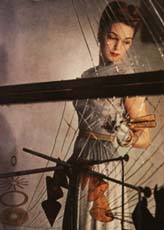
Illustration 1.
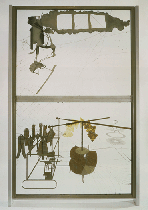
Detail of the cover of
Vogue magazine (July 1945),
showing parts of Duchamp’s
Large Glass in the foreground
I. CRACKS
Cracks travel, but never in a straight line. They are always slightly deflected, but a crack that starts at one edge of a sheet of glass will hardly ever stop until it reaches another edge. Cracks in glass have virtually no physical dimension. They are breaks in the molecular structure made visible. Marcel Duchamp loved cracks (figure 1). For several years Duchamp was a glass painter, and three of his four works in this medium are shattered. He would say that these transparent paintings were not broken but merely “wrinkled,” and even enhanced, or “brought back into the world,” by the new linear designs that accidental falls or jolts had imposed upon them.Duchamp never acknowledged that this breakage was a part of his intention. Instead he gave two different explanations for his decision to work on such a fragile ground.
Firstly, when Cabanne asked “How did the idea of using glass come to you?” Duchamp replied, “Through color. When I painted, I used a big thick glass as a palette and, seeing the colors from the other side, I understood there was something interesting from the point of view of pictorial technique. After a short while, paintings always get dirty, yellow or old because of oxidation. Now, my own colors were completely protected, the glass being a means for keeping them both sufficiently pure and unchanged for rather a long time.”
Even as he was turning his back on the medium, Duchamp remained surprisingly curious about oil paint. It would be a messy and disruptive maneuver to invert a palette, because a sheet of glass on a painter’s table is the field of action, encumbered with his tools. It supports his brushes and palette knives, jars of medium and turpentine, and mounds of wet or drying colors. Most artists have never thought of turning over their palettes to consider fresh paint from behind. But Duchamp investigated paint, wet paint, and went to great lengths to study and preserve it. He tried to trap ponds of fresh oil color against the glass within boundaries of lead wire. He sealed these from behind with lead foil. But his experiments failed. The paint did not stay fresh, but, in many places, reacted with the foil, turned into a powdery cake, and discolored badly.
Duchamp’s second stated reason for working on glass was very different. He was concerned, not with color, or the technical properties of oil paint, but with space. When pressed by Cabanne, “The glass has no other significance?” Duchamp replied, “No, no, none at all.” Then, without skipping a beat, he offered another significance: “The glass, being transparent, was able to give its maximum effectiveness to the rigidity of perspective.” The transparency of glass offered a means of interjecting a painted image into the space of a room. But, for many reasons related to the rules of single-point perspective, The Large Glass can never work this way. Anyone who has seen it, or any of its full-scale reproductions, knows that the Bachelor Machine always looks flat, distorted and out of place in any gallery configuration. It hangs there, an artifice in space.
click to enlarge
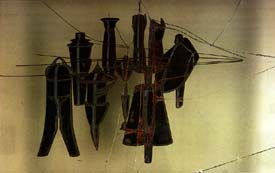
Illustration 2.
© 1999 Succession Marcel
Duchamp, ARS, N.Y./ADAGP, Paris.
Nine Malic Moulds, 1914-15
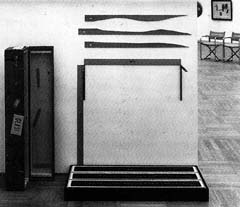
Duchamp’s ideas about color and space in his works on glass remained unrealized. He could have pursued them, but chose not to. What interested him most was not the material’s transparency, or its ability to seal and preserve, but its fragility. Nine Malic Molds (figure 2), was the first glass to be broken. Someone propped it up against an easy chair in Arensberg’s apartment to study it, not noticing the castors on the chair’s feet. Someone else approached from the opposite side and rolled the chair away. The glass fell and shattered. Although the carpet on the floor could not cushion the blow, its pile did keep the splinters from scattering. Duchamp was present. He must have kept everyone calm. The breakage of his glasses had begun, and would continue for a decade.
Duchamp derived great pleasure from repairing these glasses, or “bringing them back into the world,” each in its turn completed with a web of cracks. He expressed these feelings emphatically to James Johnson Sweeney, standing before the The Large Glass in the Philadelphia Museum of Art: “The more I look at it the more I like the cracks: they are not like shattered glass. They have a shape. There is a symmetry in the cracking, the two crackings are symmetrically arranged and there is more, almost an intention there, an extra- a curious intention that I am not responsible for, a ready-made intention, in other words, that I respect and love.”
II. SCRATCHES
click to enlarge
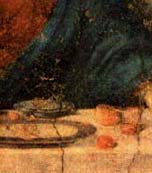
Illustration 3.
detail of Leonardo da
Vinci’s The Last Supper, 1498
In 1910 Marcel Duchamp and his brother Jacques Villon studied the Treatise on Painting
by Leonardo da Vinci in its new French translation.
They noted passages on perspective in which da Vinci advises young painters to make studies on sheets of glass set up before a landscape. By looking through the glass like a window, for example, and tracing a row of trees regularly spaced at the edge of a field, a novice could investigate the rate at which objects appear to diminish in size as they recede into the distance. But da Vinci never recommended using glass as a ground for a finished painting. It would never last. When da Vinci, elsewhere in the book, addressed the question of permanence, he gives the following prescription: “A painting made on thick copper, covered with white enamel, then painted upon with colors of enamel, returned to the fire, and fused, is more durable than sculpture.”
click to enlarge
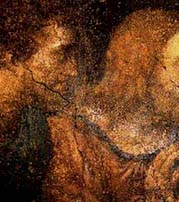
Illustration 4.
Detail of Leonardo da
Vinci’s The Last Supper, 1498
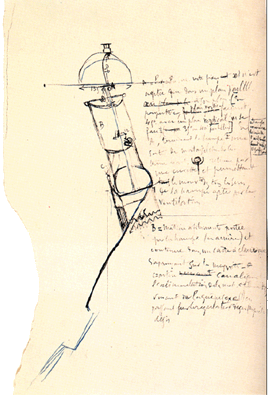
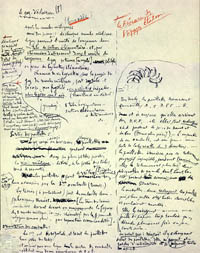
A picture made this way would be impervious to cracks, scratches or virtually any kind of wear and tear. But da Vinci himself never used a fired enamel technique, or if he did, his works in the medium have been lost and forgotten. His largest and most influential painting, by contrast, is so fragile that, even as it was being created, it started to disintegrate. The Last Supper, executed in a mysterious tempera technique on a layer of pitch mixed with gesso, immediately began to separate from the wall and fall away (figure 3 and 4). Soon after da Vinci’s death, patches of mold appeared, and the surface was attacked from behind by salts and moisture, which seemed to ooze out of the mortar in the wall. Seen at close range, all that was left was a field of blots. Restoration efforts were initiated at once and continued, with limited success, to the present day. But as the physical painting faded away, the image of The Last Supper gathered force and grew more complex in the minds of those who traveled to Milan to see it. In 1850 Theophile Gautier wrote: “The first impression made by the marvelous fresco is in the nature of a dream. All trace of art has disappeared; it seems to float on the surface of the wall, which absorbs it as a light vapor. It is the ghost of a painting, the specter of a masterpiece returned to earth.”
The wreck of an artwork can take on a dramatic life of its own, like a play with many acts over time as accidents accumulate and deterioration continues. Marcel Duchamp noticed this process, became its student and critic, and learned to make use of it for his own purposes. He saw America as a wide-open landscape, free from the obstacles of battered relics. Europe, however, was crowded with churches and museums stuffed to their roof-lines with old war-horses. He told Calvin Tomkins that the European terrain made life difficult for its young, independent-minded artists: “When they come to produce something of their own the tradition is indestructible. They’re up against all those centuries and all those miserable frescoes which no one can even see any more – we love them for their cracks.”
click to enlarge
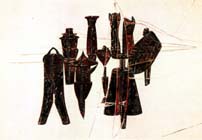
Illustration 5.
© 1999 Succession Marcel
Duchamp, ARS, N.Y./ADAGP, Paris. Nine
Malic Moulds, reproduction
for the ‘Boîte,’ 1938
click to enlarge
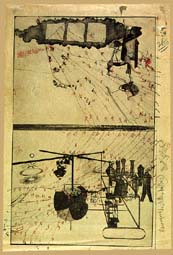
Illustration 6.
© 1999 Succession Marcel Duchamp,
ARS, N.Y./ADAGP, Paris. Reversed
print of The Large Glass
with cracks numbered to make the
stencils which transferred them to
the celluloid prints for the ‘Boîte,’ 1939
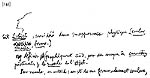
So Duchamp took a lesson from history. He set up in the New World, in Philadelphia, his own bettered relic, the masterwork of a tradition with no past that leads nowhere. It is indestructible precisely because it is so fragile. In the late 1930s, Duchamp’s glass paintings took on another life as miniatures in his portable museum, the Boîte-en-Valise. He had three of them printed on sheets of celluloid, the clear plastic that, when coated with light sensitive silver salts, becomes photographic film. Celluloid serves as a good stand-in for glass in miniature, except for one property – it is very flexible, and cannot be cracked. In his reproductions of the glasses the component that Duchamp fretted over longest was the network of cracks. He wanted it reproduced as accurately as possible. Photographic cracks, printed in black ink as part of the image, would not suffice. Fortunately celluloid scratches easily. Duchamp made from acetate two miniature scratching stencils, with cuts that follow the breaks in Nine Malic Moulds and The Large Glass (figures 5 and 6). Each of the 300 reproductions was scratched by hand with an etching needle. The surfaces of the miniature glasses were interrupted. They were as good as broken.
Notes :
1. Lawrence Steefel writes “As Duchamp remarked to me in 1965 the cracks brought the glass back into the world. When asked where it had been before this he threw up his hands and laughed.” Lawrence Steefel,The Position of La Mariée Mise à Nu Par Ses Célibataires Même (Anne Arbor: Xerox University Microfilms, 1975 [1960]), 22.
2. ierre Cabanne, Dialogues with Marcel Duchamp (New York: Viking Press, 1977), 41.
3. Ibid., 41.
4. Michel Sanouillet and Elmer Peterson, The Writing of Marcel Duchmap (New York: Da Capo Press, 1989 [1973]), 127.
5. Mention of the Duchamp brothers’ encounter with Josephin Peladan’s version of Leonardo’s Treatise on Painting (see footnote 6) occurs in many places. Among them are: William Agee, Raymond Duchamp-Villon (New York: Walker, 1967), 50; Pierre Cabanne, The Brothers Duchamp (Boston: New York Graphic Society, 1976), 8, 74, 86; William Camfield, Francis Picabia (Princeton: Princeton University Press, 1979), 24, 36; Alice Goldfarb Marquis, Marcel Duchamp: Eros, c’est la vie (Troy: Whitston Publishing, 1981), 132; Linda Henderson, The Fourth Dimension and Non-Euclidean Geometry in Modern Art (Princeton: Princeton University Press, 1983) 66n; Linda Henderson, Duchamp in Context (Princeton: Princeton University Press, 1998), 72, 188; Daniel Robbins ed., Jacques Villon (Cambridge: Harvard University Press, 1976), 49; Calvin Tomkins, Duchamp (New York: Henry Holt, 1996), 457.
6. Josephin Peladan, translator and editor, Leonard de Vinci, Traite de from A. Philip McMahon, Treatise on Painting by Leonardo da Vinci (Princeton: Princeton University Press, 1956), 33.
7. Quoted in A. Richard Turner, Inventing Leonardo (Berkeley: University of California Press, 1992), 101.
8. Calvin Tomkins, The Bride and the Bachelors (New York: Viking Press, 1965), 66.



 1. Marcel Duchamp, Pontus Hulten, ed., 1993. Why is Marcel Duchamp´s Bicycle Wheel Shaking on Its Stool?