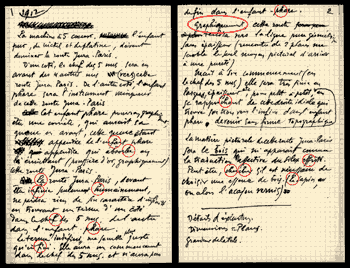
” Mlle de l’escalier ” [novelette, dictée le 17 novembre 1916], dans Frederick P. Gay, The Open Mind. Elmer Ernest Southard 1876-1920, Chicago, Normandie House, 1938.
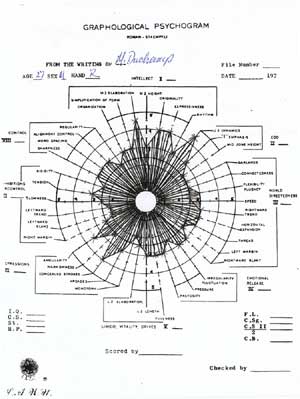
Elsa von Freytag-Loringhoven, dite The Baroness, née Elsa Hildegard Ploetz (1874-1927)
Henrie Waste, pseud. d’Henrietta, dite Ettie, Stettheimer (1874-1955)
” Mlle de l’escalier ” [novelette, dictée le 17 novembre 1916], dans Frederick P. Gay, The Open Mind. Elmer Ernest Southard 1876-1920, Chicago, Normandie House, 1938.
Elsa von Freytag-Loringhoven, dite The Baroness, née Elsa Hildegard Ploetz (1874-1927)
Henrie Waste, pseud. d’Henrietta, dite Ettie, Stettheimer (1874-1955)
- Les armes parlantes. Pratique de la poésie, Paris, Belfond, 1976.
- Idylles précédé de Féminaire, dessins de Corneille, Paris, Galilée, coll. ” Écritures, figures “, 1985.
- Poésie en jeu 1953-1973, Paris, Galilée, coll. ” Écritures, figures “, 1986.
- Le jardin le labyrinthe 1953-1989, poèmes, prologue d’Octavio Paz, Paris, Éd. de la Différence, coll. ” Littérature “, 1991.[1974, article] Gilbert Lascault (1934-)
- Enfances choisies, Paris, Bourgois, 1976.
- Encyclopédie abrégée de l’Empire vert, Paris, Maurice Nadeau: Papyrus, coll. ” Lettres nouvelles “, 1983.
- Éloges à Geneviève, Paris, Balland, 1985.
- Les amours d’Arthur-Toujours-Là et de Monika-Belle-de-Givre, mies de pain de Pétra Werlé, Strasbourg, Baby Lone, coll. ” L’île sonnante “, 1986.
*******************
2. Ceux qui ont publié une oeuvre littéraire (roman, nouvelle, pièce, etc.) qui est ” inspirée ” ou partiellement ” inspirée ” par l’oeuvre ou la personne de Marcel Duchamp
N.B. Les noms précédés d’un astérisque sont déjà dans la section 1
Elmer Ernest Southard (1876-1920)
” Mlle de l’escalier ” [novelette, dictée le 17 novembre 1916], dans Frederick P. Gay, The Open Mind. Elmer Ernest Southard 1876-1920, Chicago, Normandie House, 1938.
Elsa von Freytag-Loringhoven, dite The Baroness, née Elsa Hildegard Ploetz (1874-1927)
” Portrait de Marcel Duchamp “, The Little Review, New York, vol. 9, n° 2, hiver 1922.
Henrie Waste, pseud. d’Henrietta, dite Ettie, Stettheimer (1874-1955)
Love Days [Susanna Moore’s], novel [écrit de 1919 (?) à 1922], New York, Alfred A. Knopf, [août] 1923.
” Pensée-Cadeau: vers à un ami ” [poème, été 1922], dans View, New York, série 5, n° 1, mars 1945.
[1975, article] Michel Butor (1926-)
- La modification, roman, Paris, Minuit, 1957; coll. ” 10 / 18 “.
- Mobile, étude pour une représentation des États-Unis, Paris, Gallimard, 1962; Mobile, study for a representation of the United States, translated by Richard Howard, New York, Simon and Schuster, 1963.
- Matière de rêves, Matière de rêves II. Second sous-sol, Matière de rêves III. Troisième dessous et Matière de rêves IV. Quadruple fond, Paris, Gallimard, coll. ” Le chemin “, respectivement 1975, 1976, 1977, 1981.
- Envois et Exprès. (Envois 2), poèmes, Paris, Gallimard, coll. ” Le chemin “, 1980 et 1983.
*******************
2. Ceux qui ont publié une oeuvre littéraire (roman, nouvelle, pièce, etc.) qui est ” inspirée ” ou partiellement ” inspirée ” par l’oeuvre ou la personne de Marcel Duchamp
N.B. Les noms précédés d’un astérisque sont déjà dans la section 1
Elmer Ernest Southard (1876-1920)
” Mlle de l’escalier ” [novelette, dictée le 17 novembre 1916], dans Frederick P. Gay, The Open Mind. Elmer Ernest Southard 1876-1920, Chicago, Normandie House, 1938.
Elsa von Freytag-Loringhoven, dite The Baroness, née Elsa Hildegard Ploetz (1874-1927)
” Portrait de Marcel Duchamp “, The Little Review, New York, vol. 9, n° 2, hiver 1922.
Henrie Waste, pseud. d’Henrietta, dite Ettie, Stettheimer (1874-1955)
Love Days [Susanna Moore’s], novel [écrit de 1919 (?) à 1922], New York, Alfred A. Knopf, [août] 1923.
” Pensée-Cadeau: vers à un ami ” [poème, été 1922], dans View, New York, série 5, n° 1, mars 1945.
[1975, livre] Jean Clair, pseud. de Gérard Régnier (1940-)
- Gérard Régnier, Les chemins détournés, roman, Paris, Gallimard, 1962.
- Le voyageur égoïste, carnets de voyage 1978-1988, Paris, Plon, coll. ” Carnets “, 1989.
- Onze chansons puériles, numérotées par Pierre Alechinsky (1927-), Caen, l’Échoppe, 1990.
*******************
2. Ceux qui ont publié une oeuvre littéraire (roman, nouvelle, pièce, etc.) qui est ” inspirée ” ou partiellement ” inspirée ” par l’oeuvre ou la personne de Marcel Duchamp
N.B. Les noms précédés d’un astérisque sont déjà dans la section 1
Elmer Ernest Southard (1876-1920)
” Mlle de l’escalier ” [novelette, dictée le 17 novembre 1916], dans Frederick P. Gay, The Open Mind. Elmer Ernest Southard 1876-1920, Chicago, Normandie House, 1938.
Elsa von Freytag-Loringhoven, dite The Baroness, née Elsa Hildegard Ploetz (1874-1927)
” Portrait de Marcel Duchamp “, The Little Review, New York, vol. 9, n° 2, hiver 1922.
Henrie Waste, pseud. d’Henrietta, dite Ettie, Stettheimer (1874-1955)
Love Days [Susanna Moore’s], novel [écrit de 1919 (?) à 1922], New York, Alfred A. Knopf, [août] 1923.
” Pensée-Cadeau: vers à un ami ” [poème, été 1922], dans View, New York, série 5, n° 1, mars 1945.
[1976, livre] Sarane Alexandrian (1927-)
- Le déconcerto, contes, Paris, Galilée, coll. ” Ligne fictive “, 1980.
- L’aventure en soi, autobiographie, Paris, Mercure de France, 1990.
- Le grand astrosophe, roman, Paris, Losfeld, 1994.
*******************
2. Ceux qui ont publié une oeuvre littéraire (roman, nouvelle, pièce, etc.) qui est ” inspirée ” ou partiellement ” inspirée ” par l’oeuvre ou la personne de Marcel Duchamp
N.B. Les noms précédés d’un astérisque sont déjà dans la section 1
Elmer Ernest Southard (1876-1920)
” Mlle de l’escalier ” [novelette, dictée le 17 novembre 1916], dans Frederick P. Gay, The Open Mind. Elmer Ernest Southard 1876-1920, Chicago, Normandie House, 1938.
Elsa von Freytag-Loringhoven, dite The Baroness, née Elsa Hildegard Ploetz (1874-1927)
” Portrait de Marcel Duchamp “, The Little Review, New York, vol. 9, n° 2, hiver 1922.
Henrie Waste, pseud. d’Henrietta, dite Ettie, Stettheimer (1874-1955)
Love Days [Susanna Moore’s], novel [écrit de 1919 (?) à 1922], New York, Alfred A. Knopf, [août] 1923.
” Pensée-Cadeau: vers à un ami ” [poème, été 1922], dans View, New York, série 5, n° 1, mars 1945.
[1977, livre] Jean-François Lyotard (1924-1998)
- Récits tremblants, avec Jacques Monory (1934-), Paris, Galilée, 1977.
- Le mur du Pacifique, récit, Paris, Galilée, coll. ” Ligne fictive “, 1979.
- L’histoire de Ruth, avec Ruth Francken (1924-), Talence, le Castor astral, coll. ” Le mot et la forme “, 1983.
*******************
2. Ceux qui ont publié une oeuvre littéraire (roman, nouvelle, pièce, etc.) qui est ” inspirée ” ou partiellement ” inspirée ” par l’oeuvre ou la personne de Marcel Duchamp
N.B. Les noms précédés d’un astérisque sont déjà dans la section 1
Elmer Ernest Southard (1876-1920)
” Mlle de l’escalier ” [novelette, dictée le 17 novembre 1916], dans Frederick P. Gay, The Open Mind. Elmer Ernest Southard 1876-1920, Chicago, Normandie House, 1938.
Elsa von Freytag-Loringhoven, dite The Baroness, née Elsa Hildegard Ploetz (1874-1927)
” Portrait de Marcel Duchamp “, The Little Review, New York, vol. 9, n° 2, hiver 1922.
Henrie Waste, pseud. d’Henrietta, dite Ettie, Stettheimer (1874-1955)
Love Days [Susanna Moore’s], novel [écrit de 1919 (?) à 1922], New York, Alfred A. Knopf, [août] 1923.
” Pensée-Cadeau: vers à un ami ” [poème, été 1922], dans View, New York, série 5, n° 1, mars 1945.
[1977, article; 1984, livre] André Gervais (1947-)
- Trop plein pollen, poèmes, revue Les Herbes rouges, Montréal, n° 23, 1974.
- Hom storm grom suivi de Pré prisme aire urgence, poèmes, Montréal, Éd. de l’Aurore, coll. ” Lecture en vélocipède “, 1975.
- Du muscle astérisque, proses, revue La Nouvelle Barre du jour, Montréal, série ” Auteur / e “, n° 180, 1986.
- La nuit se lève, poèmes et proses, avec un tableau de Bruno Santerre. Saint-Lambert, Éd. du Noroît, 1990.
*******************
2. Ceux qui ont publié une oeuvre littéraire (roman, nouvelle, pièce, etc.) qui est ” inspirée ” ou partiellement ” inspirée ” par l’oeuvre ou la personne de Marcel Duchamp
N.B. Les noms précédés d’un astérisque sont déjà dans la section 1
Elmer Ernest Southard (1876-1920)
” Mlle de l’escalier ” [novelette, dictée le 17 novembre 1916], dans Frederick P. Gay, The Open Mind. Elmer Ernest Southard 1876-1920, Chicago, Normandie House, 1938.
Elsa von Freytag-Loringhoven, dite The Baroness, née Elsa Hildegard Ploetz (1874-1927)
” Portrait de Marcel Duchamp “, The Little Review, New York, vol. 9, n° 2, hiver 1922.
Henrie Waste, pseud. d’Henrietta, dite Ettie, Stettheimer (1874-1955)
Love Days [Susanna Moore’s], novel [écrit de 1919 (?) à 1922], New York, Alfred A. Knopf, [août] 1923.
” Pensée-Cadeau: vers à un ami ” [poème, été 1922], dans View, New York, série 5, n° 1, mars 1945.
[1984, article] Philippe Muray (1945-)
- Chant pluriel, Paris, Gallimard, 1973.
- Jubila, roman, Paris, Seuil, coll. ” Fiction et Cie “, 1976.
- Postérité, roman, Paris, Grasset, 1988.
- On ferme, roman, Paris, les Belles lettres, 1997.
*******************
2. Ceux qui ont publié une oeuvre littéraire (roman, nouvelle, pièce, etc.) qui est ” inspirée ” ou partiellement ” inspirée ” par l’oeuvre ou la personne de Marcel Duchamp
N.B. Les noms précédés d’un astérisque sont déjà dans la section 1
Elmer Ernest Southard (1876-1920)
- ” Mlle de l’escalier ” [novelette, dictée le 17 novembre 1916], dans Frederick P. Gay, The Open Mind. Elmer Ernest Southard 1876-1920, Chicago, Normandie House, 1938.
Elsa von Freytag-Loringhoven, dite The Baroness, née Elsa Hildegard Ploetz (1874-1927)
- ” Portrait de Marcel Duchamp “, The Little Review, New York, vol. 9, n° 2, hiver 1922.
Henrie Waste, pseud. d’Henrietta, dite Ettie, Stettheimer (1874-1955)
-
Love Days [Susanna Moore’s], novel [écrit de 1919 (?) à 1922], New York, Alfred A. Knopf, [août] 1923.
- ” Pensée-Cadeau: vers à un ami ” [poème, été 1922], dans View, New York, série 5, n° 1, mars 1945.
click to enlarge
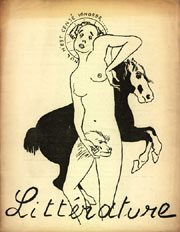
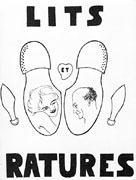
Cover of Littérature,
André Breton (ed.), N° 5, 1er October, 1922
Robert Desnos (1900-1945)
- Rrose Sélavy, [aphorismes, octobre 1922-1923], partiellement dans Littérature, Paris, nouvelle série: n° 7, 1er décembre 1922; toujours partiellement (mais avec variantes) dans Corps et biens, Paris, Gallimard, 1930; coll. ” Poésie / Gallimard “.
- L’aumonyme [novembre 1922-décembre 1923], dansCorps et biens, Paris, Gallimard, 1930; coll. ” Poésie / Gallimard “.
- Francis Picabia (1879-1953)
- Caravansérail, [roman écrit de juin 1923 à janvier 1924], Paris, Belfond, 1974.
Robert Lebel
- [La double vue suivi de] L’inventeur du temps gratuit [conte écrit en 1943-1944, publié en revue en 1957], illustré par [Alberto Giacometti et] Marcel Duchamp, Paris, le Soleil noir, 1964; The inventor of gratuitous time, in The custom-house of desire : A half-century of surrealist stories, translated with an introduction by J. H. Matthews, Berkeley and Los Angeles, University of California Press, 1975; The inventor of gratuitous time, translated by Sarah Skinner Kilborne (with Julia Koteliansky), with a preface by André Gervais, Tout-Fait. The Marcel Duchamp studies online journal, New York, n° 2, juin 2000.
click to enlarge

Robert Lebel, La Double
Vue, Paris: Le Soleil noir, 1964
* Michel Butor
* Henri Pierre Roché
- Victor, roman [écrit en 1957, inachevé], texte établi par Danielle Régnier-Bohler, préface et notes par Jean Clair, Paris, Centre Georges Pompidou, 1977.
* Jean Suquet
- ” Discours de Marcel Duchamp ivre sur la condition des filles du boulevard Saint-Laurent “, [extrait d’un roman en préparation, toujours inédit], Liberté, Montréal, n° 76-77, septembre-octobre 1971.
Tom Stoppard, pseud. de Thomas Straussler (1937-)
- Artist Descending a Staircase [and Where Are They Now?], 2 plays for radio, Londres, Faber and Faber, 1973. [Artist Descending a Staircase a été jouée pour la première fois sur les ondes de la BBC le 14 novembre 1972.]
click to enlarge
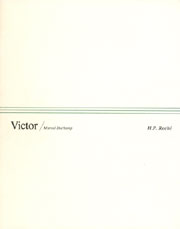
Henri Pierre Roché, Victor,
vol. 4 of the four-volume publication issued for the exhibition
“L’Oeuvre de Marcel Duchamp,” 31 January – 2 May, 1977, Paris: Centre
Georges Pompidoue
Claude Simon (1913-)
- Triptyque, roman, Paris, Minuit, 1973
Alain Robbe-Grillet (1922-)
- Topologie d’une cité fantôme
- Souvenirs du triangle d’or, roman, Paris, Minuit, 1978;Recollections of the golden triangle, translated by J. A. Underwood, London, J. Calder, 1984.
- Le miroir qui revient
Jacques Charlier (…-)
- Rrose Melody, Liège, Association Art Promotion, 1977.
Bryan Ferry (…-)
- The Bride Stripped Bare, 33 tours, EMI, 1978; CD, Virgin 47606-2 (distribué par EMI)
* Michel Leiris
- Le ruban au cou d’Olympia, Paris, Gallimard, 1981.
Jean-François Vilar (1948-)
- Le ruban au cou d’Olympia, Paris, Gallimard, 1981.
[1977, livre] Jennifer Gough-Cooper (…-) & Jacques Caumont (…-)
- Rrose, sa vie sans cachotteries dépeinte […], épopée [en 1150 vers], Hautot-le-Vatois (Normandie), Académie de Muséologie Évocatoire, 1985.
Michel Waldberg (1940-)
- La boîte verte, Paris, Éd. de la Différence, 1995.
Walter Henry, pseud. de Paul Braffort (…-)
- Chu dans mer sale ou La rumination polymorphe, Paris, la Bibliothèque oulipienne, n° 86, 1997.
***********************
3. Ceux qui ont publié une oeuvre littéraire (roman, nouvelle, poème, etc.) ” en hommage ” ou partiellement ” en hommage ” à la personne ou à l’oeuvre de Marcel Duchamp
N.B. Les noms précédés d’un astérisque sont déjà dans la section 1
Elsa von Freytag-Loringhoven
- ” Love – Chemical Relationship ” [poème dédié à Marcel Duchamp], The Little Review, New York, vol. 5, n° 2, juin 1918.
- ” Mefk Maru Mustir Daas ” [poème dédié à Marcel Duchamp], The Little Review, New York, vol. 5, n° 8, décembre 1918.
Francis Picabia
- Pensées sans langage, poème [livre écrit d’octobre (?) 1918 à mars 1919, ainsi dédié: ” Chers amis Gabrielle Buffet, Ribemont-Dessaignes, Marcel Duchamp, Tristan Tzara, je vous dédie ce poème en raison de notre sympathie élective. “], Paris, Eugène Figuière, 1919; Écrits, Tome I: 1913-1920, Paris, Belfond, coll. ” Les bâtisseurs du XXe siècle “, 1975.
* André Breton
- ” À Rrose Sélavy “, poème [1923], dans Clair de terre, Paris, coll. ” Littérature “, 1923;Earthlight, translated by Bill Zavatsky and Zack Rogow, Los Angeles, Sun & Moon Press, 1993.
click to enlarge
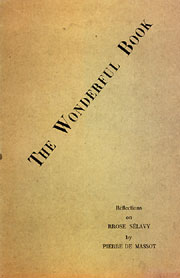
Pierre de Massot, The Wonderful Book,
Reflections on Rrosé Selavy
(1924), in Étant donné Marcel
Duchamp, n° 2, February 2000,
pp. 97~120
* Pierre de Massot
- ” Mode d’emploi ” [poème écrit le 8 juin 1923, ainsi dédié: ” pour Rrose Sélavy “] et ” Jeu du ‘dans’ ” [poème écrit au début des années 1950 (?), ainsi dédié: ” pour Marcel Duchamp “], dans Poésie 1, Paris, n° 23 (Jacques Baron, Pierre de Massot, Philippe Soupault: trois poètes surréalistes), mars 1972; Étant donné Marcel Duchamp, Baby, n° 2, février 2000.
- The Wonderful Book. Reflections on Rrose Sélavy, Paris, hors commerce [Imprimerie Ravilly], s.d. [1924]; Étant donné Marcel Duchamp, Baby, n° 2, février 2000.
- 5 poëmes, [recueil écrit de 1931 à 1946], dédié “À Marcel Duchamp”, avec un portrait de l’auteur par Francis Picabia, Paris, hors commerce [Imprimerie Gaschet et Cie], 1946.
Louis Aragon (1897-1985)
- ” La force ” [poème dédié ” à Marcel Duchamp “], dans Le mouvement perpétuel, poèmes 1921-1924, Paris, Gallimard, 1926.
Georges Hugnet (1906-1974)
- Marcel Duchamp [poème écrit le 8 novembre 1939], avec un frontispice par Marcel Duchamp, Paris, hors commerce, 1941.
Kay Boyle (1902-1992)
- Avalanche, novel [dédié ” To Monsieur and Madame Rrose Sélavy “], New York, Simon and Schuster, 1944.
- ” A Complaint for Mary and Marcel “, dans Collected Poems, Port Townsend (Wa), Copper Canyon Press, 1970.
Henri-François Rey (1919-1987)
- Les pianos mécaniques, roman [écrit à Cadaquès de mars 1961 à février 1962]
David Young (1946-)
- Agent provocateur, novel, dédié ” For Marcel Duchamp “, Toronto, Coach House Press, 1976.
***********************
click to enlarge
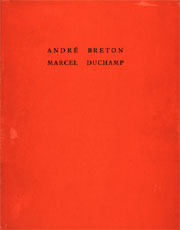
André Breton, Au Lavoir
noir, Paris: Éditions G.L.M, 1936
4. Oeuvres littéraires ” illustrées ” par Marcel Duchamp, seul ou en collaboration, ou par Marcel Duchamp et un autre artiste
N.B. Les noms précédés d’un astérisque sont déjà dans la section 1
Alfred Jarry (1873-1907)
- Ubu roi [1896], Paris, Fasquelle, 1921; Reliure pour ” Ubu roi ” d’Alfred Jarry (1935), dessinée par Marcel Duchamp et exécutée par Mary Reynolds. Ubu roi, drama in 5 acts, translated by Barbara Wright, London, Gaberbocchus P., 1966; Ubu rex, translated by David Copelin, Vancouver, Pulp Press, 1977; in Three pre-surrealist plays, translated with an introduction and notes by Maya Slater, Oxford and New York, Oxford University Press, 1997.
* André Breton
- Au lavoir noir, poème, avec une fenêtre de Marcel Duchamp, Paris, GLM, coll. ” Repères “, [janvier] 1936; Illustration pour ” Au lavoir noir ” d’André Breton (1935).
Young cherry trees secured against hares / Jeunes cerisiers garantis contre les lièvres, choix de poèmes traduit par Édouard Roditi, avec des dessins d’Arshile Gorky, New York, View Editions, [mars ou avril] 1946; Couverture pour ” Young cherry trees secured against hares ” d’André Breton (1945).
click to enlarge

André Breton, Young Cherry
Trees Secured against Hares, Edward Roditi (trans.), New York:
View Editions, 1946
Georges Hugnet
- La septième face du dé, poèmes découpages, couvertures cigarettes par Marcel Duchamp, Paris, Éd. Jeanne Bucher, [mai] 1936; Couverture pour ” La septième face du dé ” de Georges Hugnet (1936).
- Marcel Duchamp [poème écrit le 8 novembre 1939], avec un frontispice par Marcel Duchamp, Paris, hors commerce, 1941; Moustache et barbe de L.H.O.O.Q. (1941).
Giorgio de Chirico (1888-1978)
- Hebdomeros, Paris, Éd. du Carrefour, 1929; Reliure pour ” Hebdomeros ” de Giorgio de Chirico (1936-1939), dessinée par Marcel Duchamp et exécutée par Mary Reynolds.
Francis Picabia
- L’équilibre, [poème écrit en 1917], avec une gravure de Marcel Duchamp, Alès, PAB, [août] 1958.
Pierre-André Benoit (1921-1993)
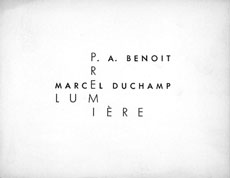
- Première lumière, poème, avec une gravure de Marcel Duchamp, Alès, PAB, [août] 1959.
click images to enlarge
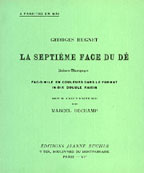
Georges Hugnet, La septiéme
face du dé, Paris: Éditions Jeanne Bucher, 1936
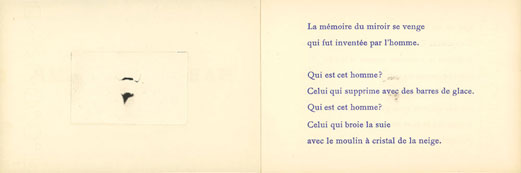
Georges Hugnet, Marcel Duchamp,
a poem and front piece with
Moustache et barbe de L.H.O.O.Q.
(1941) by Duchamp, Paris:
Hors Commerce, 1941
*Pierre de Massot
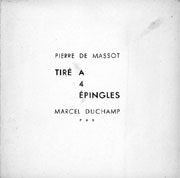
- Tiré à quatre épingles, poèmes, avec une gravure de Marcel Duchamp, Alès, PAB, [été] 1959.
- Marcel Duchamp. Propos et souvenirs, avec un readymade rectifié et en couleurs de Marcel Duchamp, Milan, chez Arturo Schwarz, 1965; L.H.O.O.Q. (réplique, septembre 1964); Étant donné Marcel Duchamp, Baby, n° 2, février 2000.
* Arturo Schwarz
- Il Reale Assoluto, poèmes [en italien], avec onze lithographies de Marcel Duchamp et de Man Ray, Milan, Galleria Schwarz, 1964; Certificat de lecture (février-mars 1964).
click images to enlarge
-
Pierre-André Benoit, Première
lumière, Alès: PAB, 1959
-
Pierre de Massot, Tiré
à quatre épingles, Alès: PAB, 1959
* Robert Lebel
- La double vue suivi de L’inventeur du temps gratuit, avec un diptyque gravé à l’eau-forte par Alberto Giacometti et un pliage de Marcel Duchamp (pour les 111 premiers exemplaires), avec une eau-forte de Ferró (pour les 150 exemplaires suivants), Paris, le Soleil noir, 1964; La pendule de profil (1964).
Envoyer vos remarques: André_Gervais@uqar.uquebec.ca
Notes
1. Cette rétrospective contient Mont de piété [1919, avec 2 dessins d’André Derain], Clair de terre [1923, avec un portrait par Pablo Picasso], L’union libre [1931], Le revolver à cheveux blancs [1932, avec une eau-forte par Salvador Dali], Violette Nozières [1933], L’air de l’eau [1934, avec 4 gravures par Alberto Giacometti] et Au lavoir noir [1936, avec une fenêtre de Marcel Duchamp].
2. Cette rétrospective contient [Poèmes 1935-1940], Pleine marge [1943, avec une eau-forte de Kurt Seligmann], Fata morgana [1941, avec 4 dessins de Wilfredo Lam], [Poèmes 1940-1943], Les états généraux[1944], Des épingles tremblantes [1948], Xénophiles [1948], Ode à Charles Fourier [1947], Oubliés [1948],Constellations [1959, avec 22 gouaches de Juan Miró] et Le la [1961, avec une lithographie de Jean Benoît].
3. Cette rétrospective contient, en totalité ou en partie, les brefs petits livres suivants: Soliloque de Nausicaa [1928, avec cinq dessins de Jean Cocteau], 5 poëmes [1946, avec un portrait de l’auteur par Francis Picabia], Orestie [1949], Mot clé des mensonges [1954], Galets abandonnés sur la page [1958, avec une eau-forte de Jacques Villon] et Tiré à quatre épingles [1959, avec une gravure de Marcel Duchamp], auxquels elle ajoutePrison de neige, poèmes écrits en 1960-1961.
4. Cette rétrospective récente ajoute à la précédente plusieurs autres poèmes ainsi qu’une étude et une biographie.
5. Cette rétrospective contient les livres suivants: Simulacre [1925], Le point cardinal [1927], Glossaire: j’y serre mes gloses [commencé en 1925; 1939, avec des lithographies d’André Masson], Bagatelles végétales [1956, avec 6 gravures de Juan Miró] et Marrons sculptés pour Miró [1961, avec une lithographie en couleurs de Juan Miró]. Le Glossaire… a une suite: Langage tangage ou Ce que les mots me disent, Paris, Gallimard, 1985.
6. Sur le rabat de la jaquette: ” Manuscrits choisis à coups de ciseaux, photographies le plus souvent en noir et blanc, articles perdus parmi les feuilles mortes, entretiens de vive voix, clins d’oeil à des amis, retracent sans horloge ni boussole le voyage. ”
7. Michel Butor, lors de la discussion suivant la communication de Patrice Quéréel sur ce roman dans le cadre d’un colloque sur son oeuvre (qui a eu lieu du 24 juin au 1er juillet 1973), précise ceci: ” En ce qui concerne les appareils idéologiques d’État, j’ai constamment pensé, en vous écoutant, à Marcel Duchamp: il y avait dans cette façon de voir ces institutions le modèle du grand verre de Marcel Duchamp qui est évoqué de toutes sortes de manières dans ce livre. ” Ceci dans Georges Raillard (sous la dir. de), Butor. Colloque de Cerisy, Paris, UGÉ, coll. ” 10 / 18 “, n° 902, 1974, p. 84.
8. Georges Raillard, dans ” Mots de passe. Quelques notes prises au cours d’une traversée difficile: La belle captive [1976] “, Obliques, Les Pilles, n° 16-17 (Robbe-Grillet), 4e trimestre 1978, cite la dédicace de l’auteur sur un exemplaire de Topologie…: ” quelque chose comme mon Grand Verre “.
9. Georges Raillard intitule ” Le Grand Verre de Robbe-Grillet ” (La Quinzaine littéraire, Paris, n° 432, 16-31 janvier 1985) sa critique de ce premier tome de l'” autobiographie ” robbegrillettienne, dont le titre général estRomanesques.
10. Ce roman ne contient qu’une brève allusion à Duchamp qui, de 1958 à 1968, passera un ou quelques mois du printemps ou de l’été dans ce village catalan.