image_pdfimage_print

All posts by robert

Duchamp Bottles Belle Greene: Just Desserts For His Canning

“There are many people who may have contemplated the treasures of the Morgan Library without ever meeting personally its erstwhile director, Belle da Costa Greene. But no one there could have been unaware of her taste, her intelligence, her dynamism. For it was Miss Greene who transformed a rich man’s casually built collection into one that ranks with the greatest in the world.”
Aline B. Louchheim
New York Times,
April 17, 1949

“Duchamp was apparently paid by the Morgan Library through Belle Greene, and this somewhat unusual arrangement took care of his financial needs for the next two years.”
Calvin Tomkins
Marcel Duchamp, A Biography, p. 155


click to enlarge
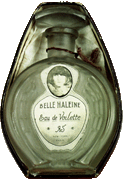
Belle Haleine: Eau de voiletteBelle Haleine: Eau de voilette
Illustration 1
Marcel Duchamp,Belle Haleine: Eau de voilette, 1921
© 2000 Succession Marcel Duchamp ARS, N.Y./ADAGP, Paris

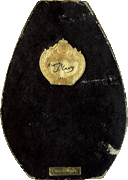
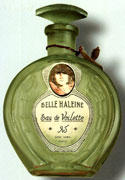
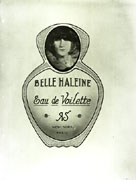
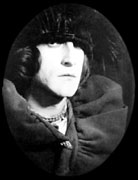
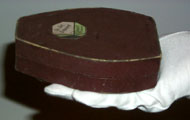
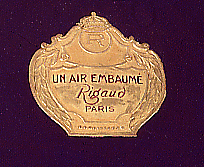
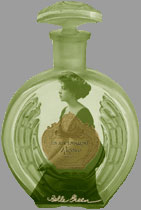
The sound of Belle Greene’s name brings to mind a recent unpublished fact about Duchamp’s Belle Haleine: Eau de Voilette(1921), an assisted readymade using a Rigaud perfume bottle with an altered label. The label features a Man Ray photograph of Duchamp dressed as a woman. It reads “Belle Haleine: Eau de Voilette” [Beautiful Breath, Veil Water], and Duchamp signed the accompanying perfume box “Rrose Sélavy.”(See Illustration 1)

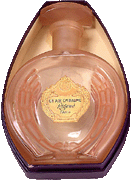
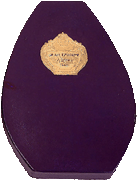
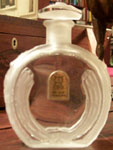
Recently, Rhonda Roland Shearer discovered that Duchamp altered the perfume bottle,(1)by changing the bottle’s original peach color to green — and it is important to note that peach was the only color ever used for Un Air Embaumé, the particular Rigaud perfume that Duchamp appropriated. (See Illustrations 2A of the standard Rigaud bottle color with box. In illustration 2B, the tint has been washed off a Rigaud bottle with water, leaving clear glass.
click images to enlarge

  • Rigaud perfume bottle
    Illustration 2
    Rigaud perfume bottle
    (before wash off)
  • Box for Rigaud perfume bottle
    Illustration 2A
    Box for Rigaud perfume bottle
  • Clear glass Rigaud bottle after washing with water
    Illustration 2B
    Clear glass Rigaud bottle after washing
    with water (Note: Rigaud changed the box and bottle label in later
    designs but still kept the peach tinted bottle.)

Shearer notes, “By looking carefully at Duchamp’s green bottle, one will see peach color remaining in the cracks at the bottle’s bottom.”) Furthermore, Shearer noticed that Duchamp depicted the color of his green bottle as red in New York Dada (1921) and that the bottle later appears in the original peach color in The Box in a Valise (1941). (See Illustrations 3A, B, and C)

Duchamp changed the color of the perfume bottle, a fact that no one noticed even after it was first exhibited in 1965. (2) In addition, any degree of underlying meaning or ironic suggestion intended
by passing a common readymade peach-colored bottle for green likewise remained unknown. What new relationships could emerge when considering this new information of Duchamp’s green colored bottle actually having a peach past?

click images to enlarge

  • Belle Haleine: Eau de voilette
    Illustration 3A
    Marcel Duchamp,Belle
    Haleine: Eau de voilette
    , 1921
    © 2000 Succession Marcel Duchamp
    ARS, N.Y./ADAGP, Paris
  • Cover for “New York Dada”
    Illustration 3B
    Marcel Duchamp, Cover for
    “New York Dada”
    , 1921
    © 2000 Succession Marcel Duchamp
    ARS, N.Y./ADAGP, Paris
  •  The Box in a Valise
    Illustration 3C
    Marcel Duchamp, Original peach from
    The Box in a Valise, 1941
    © 2000 Succession Marcel Duchamp
    ARS, N.Y./ADAGP, Paris

While reading a short passage about Belle da Costa Greene and Duchamp, I began combining this new information with Duchamp’s propensity to play with sounds and meaning. (3) The action of dying the bottle and the resulting color was, for me, a path to Belle Greene: Bottle Dye Color
Green, Belle Da Costa Greene. My curiosity was piqued. I wondered if Belle da Costa Greene was Duchamp’s inspiration for the mysterious artwork Belle Haleine.


click to enlarge
Marcel duchamp as Belle HaleineMarcel duchamp as Rrose Sèlavy
Illustration 4A
Marcel Duchamp,Marcel duchamp
as Belle Haleine
, 1921
© 2000 Succession Marcel Duchamp
ARS, N.Y./ADAGP, Paris
Illustration 4B
Marcel Duchamp,Marcel duchamp
as Rrose Sèlavy
, 1921
© 2000 Succession Marcel Duchamp
ARS, N.Y./ADAGP, Paris

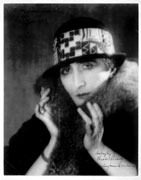
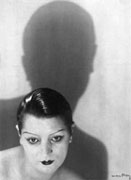
Duchamp signs this work “Rrose Sélavy.” Yet the picture of Duchamp dressed as a woman on the perfume bottle label that he designed and printed is distinctly different from later photographs of Duchamp passing as Rrose. (See Illustrations 4A and B depicting the two Rrose Sélavy versions.) Perhaps Duchamp was passing as Rrose passing as Belle Haleine passing as Belle Greene. That is, did the photograph on the label contain clues that pertained to Belle Greene? Duchamp draws our focus to the letter ‘r’ as it is the only letter he draws in mirror reverse. (See Illustration 5).
Moreover,

click to enlarge
Label forBelle Haleine: Eau de voilette
Illustration 5
Marcel Duchamp,Label forBelle
Haleine: Eau de voilette
,1921
©2000 Succession Marcel Duchamp
ARS, N.Y./ADAGP, Paris

Moreover,our attention is further directed to the letter ‘r’ because it is one of the first times, here on this Belle Haleine work, that Duchamp signs Rose as Rrose, adding a second ‘r’.
(4) Would this change in spelling, and the addition of a second ‘r’, also relate to Belle Greene?

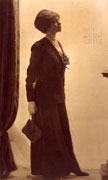
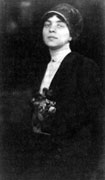
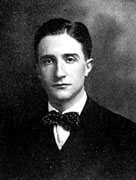
First, who was Belle da Costa Greene? (see Illustration 6) Belle Greene became J.P. Morgan’s librarian in 1905, and following his death she became the director of his library, working there for a total of forty-three years. Empowered by J.P. Morgan, and then by his son Jack, Greene spent millions of dollars buying and selling rare manuscripts, books and art.


click to enlarge
 Belle de Costa Greene
Illustration 6
Photograph of Belle de Costa Greene
by Clarence White, 1911 © Archives of
the Pierpont Morgan Library,New York.

She traveled frequently and lavishly to Europe, staying at the best hotels — Claridge’s in London and the Ritz in Paris. It was even said that “on trips abroad, made on Morgan’s behalf, she would take along her thoroughbred horse, which she rode in Hyde Park.” (5) Belle Greene was described as beautiful, sensual, smart and outspoken. (Illustration 6) One author writes that “she daringly posed nude for drawings and enjoyed a Bohemian freedom.” (6) Never married, she favored affairs with rich or influential men, with a focus on art scholars. Another scholar states, “her role at the Morgan Library placed her at the center of the art trade and her friendship was coveted by every dealer.” (7)For many years, Belle Greene wielded an astounding amount of power in the art world and moved comfortably in elite social circles.

One piece of information draws an amazing parallel between Belle Greene and the color change of Duchamp’s Belle Haleine bottle. Belle Greene was a black woman who denied her color to pass herself as white. (8) Evidence indicates that whispers and rumors about her passing circulated around her throughout her life. People like Isabella Gardner, society patron of the arts with close ties to Harvard and a peer of Morgan’s, wrote that Belle Greene was a “half-breed” in a private letter (1909) to Bernard Berenson and his wife, Mary, saying, “But first you must both swear secrecy. If not, please do not read anymore of this.” (9)

Bernard Berenson, a Harvard-trained art historian, also Belle Greene’s lover and later a friend for many years, reportedly said to his next paramour that Greene was “handicapped only by her part-Negro inheritance.” (10) (As so often happens, sworn secrecy is no match for the seduction of perpetuating rumor.) Cleve Gray, translator for Duchamp’s mathematical notes and close friend of Duchamp’s brother Villon, reports that when he was a student at Princeton he visited the Morgan Library, met Belle Greene, and was aware of the rumors.(11)(Cleve Gray, being a Princeton man, was an exception, as everyone in Belle Greene’s circle seemed to be Harvard men, including Morgan himself.) Apparently, these rumors persisted even after Greene’s death. Jean Strouse’s richly-detailed, well-researched biography of Morgan is the first published account of Belle Greene that throughly investigates her background. These rumors eventually served as successful guides for Ms. Strouse’s research.(12)

click to enlarge
Richard Theodore Greener
Illustration 7
Richard Theodore Greener

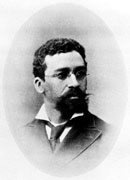
In order to pass, Greene and her mother decided to change their name. (Actually, you could say that they altered their label.) They added “da Costa,” claiming to be part-Portuguese to account for their dusky appearance, a common strategy used for passing. True to the rumors, not only were they black passing for white, but Belle Greene’s father was the distinguished lawyer and public figure, Richard Theodore Greener, the first black undergraduate to receive a degree from Harvard.(13) (See Illustration 7) Jean Strouse writes that in an issue of the Harvard alumni news, Greener and his daughter, Belle Marion, are both mentioned. Obviously, being the first black graduate of Harvard would draw a lot of attention, especially since he worked in politics and wrote on controversial issues such as Irish rights. After he retired and settled in Chicago in 1908, he continued to write on these topics and was a member of the Harvard Club. (The Harvard connection for Duchamp began with Walter Arensberg, a Harvard graduate who was Duchamp’s host when he first arrived in New York in 1915. Arensburg immediately included Duchamp in a group of Harvard alumni chess players and soon became his great patron.) (14)

In order to further distance themselves from the famous African American Richard Greener, Belle and her mother dropped the ‘r’ from their last name. (15) When passing for a woman, Duchamp absurdly adds an ‘r’ to become Rrose Sélavy, whereas for Belle Greener, to pass as a white, she drops the ‘r’from Greener. Is there a connection?

In 1921, Duchamp chose to change the spelling of Rose Sélavy to Rrose Sélavy, resulting in our attention being drawn not only to the added ‘r’ but also to the act and idea of an absurd change in spelling itself. (16)
Fundamentally, the choice of adding or subtracting the ‘r’ of her last name was the critical move that determined whether or not Greene lived in a white (Belle Greene) or a black (Belle Greener) world.

A summary of the factual analogies and reversals connecting Duchamp’s Belle Haleine to Belle Greene are as follows:
· Duchamp is a man passing as a woman.
· Belle Greene is a black woman passing as white.
· The commonly-sold Rigaud peach-colored bottle is passing as green-colored.
· Belle’s lover, Bernard Berenson, was (famously) a Jew passing as a Christian(17)
· Belle Greener dropped the last letter — an ‘r’ — of her name (a label), whereas, Duchamp, as Rose Sélavy, absurdly adds a first letter — an ‘r’– to her label.


click to enlarge
PearBelle-Hélène
Illustration 8
PearBelle-Hélène

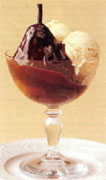
Looking at the full title of this work, Belle Haleine: Eau de Voilette, more connections emerge. If we combine literal translations and the sound of the title, we get Eau de Voilette, which means “veiled waters.” “Da Costa” also means “the coast” (along the water). In effect, Belle used da Costa, the coast along the water, to veil, mask or conceal her identity. Belle Haleine also sounds like Belle Hélène, the classic French dessert whose basic ingredient is a chocolate-covered pear..(18) (See Illustration 8) A chocolate-covered, shapely pear reflects an image of “the beautiful slim-waisted sensual figure”(19)of Belle Greene. To our list of analogies and reversals, we can add a peeled, white pear (previously green-skinned) passing as chocolate. Belle Hélène, the dessert, works now in reverse, a white (pear) passing for black (chocolate), or if you prefer, a pair (Belle Greene and a pear) both dipped in chocolate.

As previously mentioned, we see an image of Duchamp dressed as Rrose Sélavy on the label of the perfume bottle. The box for the perfume carries her signature. The difference between the Belle Haleine version of Rrose Sélavy and later ones is striking (for comparison, see the Man Ray photographs previously illustrated). Rrose Sélavy (on Belle Haleine) wears what looks like pearls, a fancy hat, a grand collar on her dress, lots of make-up and a haunting, stern look. Pearls, in 1921,were a very expensive status symbol. Beautiful pearls were five to ten times more expensive than they are today. The pearls, the hat, the look of this Rrose on the label of Belle Haleine reflect wealth. The second version of Rrose, depicted in the Man Ray portraits, has a contemporary, youthful hat, no pearls, a coat with a coquettish fur collar and similarly coquettish facial expression. (Duchamp inscribed a note on one of the photographs of this second version of Rrose, “Hat and hands [belong to], Germaine Everling.” (20) See again previous illustrations). The second Rrose is much younger and more casual than the first society lady Rrose Sélavy.


click to enlarge
Belle Greene with Pearls
Illustration 9
Belle Greene with Pearls

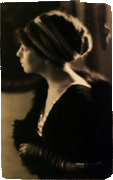
The Rrose in Belle Haleine certainly seems to approximate the style and look of Belle Greene. The report of her stating, “just because I am a librarian doesn’t mean I have to dress like one,”(21)
did not prepare me for the descriptions of Greene at work. One scholar writes, “glamorous and heavily-perfumed, and dressed in Renaissance gowns adorned with matching jewels.”(22)Another writer states, “she always carried a large green silk handkerchief that she used for dramatic effect.”(23) Apparently Greene liked pearls, too. The author of The Book of the Pearl (1908) inscribed a copy to Belle Greene. (See Illustration 9) (24) More importantly, she was photographed wearing her long pearl necklace.(25)


click to enlarge
Marcel duchamp as Belle HaleineBelle de Costa Greene
Illustration 10
Marcel Duchamp,Marcel duchamp
as Belle Haleine
, 1921
© 2000 Succession Marcel Duchamp ARS,
N.Y./ADAGP, Paris
Illustration 11
Photograph of Belle de Costa
Greene,1911

She obviously dressed to accentuate her power, glamour and access to wealth through her femininity. At other times it is reported that Belle dressed to express her power and access to wealth in a surprisingly opposite masculine style. “She would stride about in a tweed suit, throwing colorful remarks offhand over her shoulder. Or, with her jacket removed she would stand belligerently while she talked with you…” (26) (Imagine what ‘standing belligerently’ might look like and consider the severe facial expression of Rrose on the label of Belle Haleine.)(See Illustrations 10 and 11)

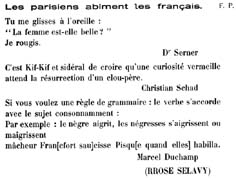
There is some uncertainty over which art object Duchamp first signed with the double ‘r’ (Rrose). It may have been on the perfume bottle box or on a painting Picabia invited many artists to sign, L’oeil cacodylate (1921), a Dada collaboration. However, scholars agree that the Rrose Sélavy with the extra ‘r’ was first published in Le Pilhaou-Thibaou (July 10th, 1921), the illustrated supplement of Francis Picabia’s Dada magazine 391. (See Illustration 12, Duchamp’s pun as it appeared in Le Pilhaou-Thibaou) Rrose’s signature appeared under a pun that Duchamp had originally sent to Picabia from New York, in an undated letter of January, 1921.(27)

click to enlarge
 Pun from Le Pilhaou-Thibaou
Illustration 12
Marcel Duchamp, Pun from Le Pilhaou-Thibaou
(illustrated supplement of 391), 1921

Rrose writes:
Si vous voulez une règle de grammaire: le verbe s’accorde avec le sujet consonnament: Par exemple: le nègre aigrit, les négresses s’aigrissent ou maigrissent.(28)

[“If you want a rule of grammar: The verb agrees with the subject consonantly: For Example: the Negro embitters, the Negresses become embittered and thin.”]

Significantly, we can interpret this pun as describing Belle Greene’s and her mother’s relationship to Richard Greener. The black man (Greener) has caused the black women (Belle and her mother, the former Mrs. Greener) to become hostile (bitter) and their name without the ‘r’ (thinner). See Stephen Jay Gould’s informative discussion about the relationship of this pun to Belle Greene in the text box below.

Linking Belle Greene to Duchamp’s Rule of Grammar
Stephen Jay Gould

My analysis may be judged largely conjectural here, but if the 1921 Negro pun also refers to Belle Greene’s passing, and to the dropping of the final “r” from her name, then the conjunction in meaning between this verbal play and the visual creation of Belle Haleinebecomes truly striking — and (presumably) expresses Duchamp’s anger and bitterness arising from the shame of his rejection (at least as a patron, and perhaps as more than just a friend) by this fascinating woman. Duchamp wrote to Picabia at the most relevant time of January, 1921 (and later published the statement in July of 1921), virtually contemporaneously with the Belle Haleine bottle:

Si vous voulez une règle de grammaire: le verbe s’accorde avec le sujet consonnament: Par exemple: le nègre aigrit, les négresses s’aigrissent ou maigrissent.

This pun has puzzled many people, for the point seems so lame (see André Gervais’s La raie alitée d’effets, p. 41 et seq.) In translation, the statement says “If you want a rule of grammar: the verb accords with the subject consonantly: for example, the Negro embitters, the Negresses become embittered and get thin.” So what’s the big deal about consonance? Yes, when you feminize and pluralize the word for a single black male (nègre), obtaining négresses, then the near rhyme with the appended verb is preserved: nègre and aigritchanges to négresses and s’aigrissent or maigrissent. But so what? Pluralizations of nouns and verbs often yield such consonance in both grammar and sound in French. Duchamp must have had more in mind.

But now suppose that Duchamp knows the rumors of Belle Greene’s passing –that to do so, she changed her father’s name Greener by dropping an “r” and becoming Greene, thus hoping to break the familial tie and be able to pass as a white woman. Now the pun achieves a complex and truly pungent meaning (if not downright nasty for anyone who knew the full context). Take out the comma and read “les négresses” as both the object of “le nègre” and as the subject for the next part. We now get for the first part: “The black male embitters the black women” — as Richard Greener did for Belle and her mother, both of whom wished to pass for white, but could not do so if the tie to Greener were known, therefore poisoning their plan. The second part then reads: “The black women become embittered and get thinner.” Even more incisive. Belle and her mother become bitter about the limitations imposed by their racial affiliation (and what a comment on the evils of the far more racist American society of the 1920’s), and they get thinner — wasting away from the bitterness perhaps, but probably also a wry comment on their strategy of distancing themselves from Greener by dropping the final “r” from their name to achieve a new, and literally thinner, identity.

So far so good. This part seems sound to me. Let me now be a bit more conjectural about the first line. (If even some of this speculation holds, then Duchamp’s pun becomes truly deep and almost diabolical). “Une règle de grammaire.” Yes, a grammatical rule but also, with almost the same pronunciation, “une règle de grandmère” — or “grandmother’s rule,” perhaps a statement on the ineluctability of racial heritage. We then continue: “le verbe s’accorde…” “Verbe” is a near homonym of “vert,” meaning “green” in French. Even more incisively, “verbe” could be a contraction for “verte Belle” or “green Belle.” “Verte Belle is a near homonym of “verbal” — so Duchamp might be indicating a “verbal accord” with the subject. The subject of the pun sentence is “Le nègre.” So green Belle, trying to pass for white, cannot escape the accord with her black father, the subject of the pun. Moreover, “nègre” just happens to be an anagram of “green”!

Now consider “s’accorde”: Inoffensively, in French, the word just means “agrees” (third person singular of the reflexive verb s’accorder, to agree or harmonize with). But, as a pun, “s’accorde” could also be “sa corde” — that is “her rope,” or metaphorically her burden. (“Corde” is masculine, so proper grammar would read “son corde,” but sexual gendering of inanimate objects should not be allowed to destroy a pun). So we now have “le verbe s’accorde,” or “green Belle, her rope.” But we can also glimpse the solution actually taken by Ms. Greene. Drop the “r” from s’accorde (as Belle dropped the “r” from her name to distance herself from her black father), — and we get “s’accode” or, punningly, “sa code.” In French, code is also masculine and should be “son code” — but the meaning could not be more incisive: her code! (Perhaps Duchamp even valued the grammatically false gendering, for the rope and the code, while grammatically masculine, apply here to a woman — so why not make them feminine)?


click to enlarge
Coffin-like Rigaud box
Illustration 13
Coffin-like Rigaud box for Un Air Embaumé
perfume (Note: Rigaud changed the box
and bottle label in later designs but
still kept the original shape of the box.)

The Un Air Embaumé Rigaud label text and box reminded Shearer of Duchamp’s emphasis on the death and mausoleum storage of art in museums, with its coffin-like box shape and the alternative reading of Embaumé as “embalmed.” (See illustration 14 the Rigaud box coffin-like appearance) Shearer offers that perhaps Duchamp wanted to preserve (as Egyptions use perfumes to embalm) Belle Greene’s lie for posterity. (29)

Gould writes more on Un Air Embaumé Rigaud punning. See text box below.

From the Bitter Negro Pun to the Beautiful Breath Bottle
Stephen Jay Gould

The case for viewing Duchamp’s Belle Haleine bottle as an ironic commentary upon his feelings for Belle Greene and her efforts, as a light-skinned African American, to pass for white gains great strength, as Bonnie Garner has shown, by linking the otherwise lame 1921 “Negro pun” to Belle Haleine. Even though uncertainty surrounds the timing of Duchamp’s signature for Rrose (with the double R) Sélavy on the box of Belle Haleine, scholars agree that Duchamp used the double R for the first time when he wrote the Negro pun. (The double R represents an important argument in Garner’s case because, in her effort to pass, Belle Greene dropped the final “r” of her famous father’s name, Richard Greener, the first African American graduate from Harvard. Note also that scholars have, for years, debated the origin and meaning of the double R, and have compiled a long list of disparate theories. Ms. Garner may now have found a much simpler and more satisfactory basic explanation).

The full case would become even stronger if we could link the 1921 pun to the 1921 bottle by more than the common subject of their final outcome. I believe that a persuasive, albeit unproven, argument can be made for such a connection.

How did Duchamp get his idea to alter a perfume bottle, and why did he choose his particular substrate for Belle Haleine? The answer may lie in Duchamp’s affinity for punning. We know that the original bottle held a brand of perfume manufactured by the Rigaud company and called Un air embaumé (literally, perfumed air). But the verb embaumer means either to perfume or to embalm (an obvious commonality of process despite the different purposes). Moreover, in French, the word air and the name of the letter “r” have exactly the same pronunciation — and we know that Duchamp loved, and frequently created, puns based on different meanings for the names and sound values of letters (with LHOOQ as a primary example, but see my general discussion in my article, in this issue on “Duchamp’s Substantial Ghost“).

Thus, “un air embaumé” becomes a perfect homonymic pun meaning either “perfumed air” (as Rigaud intended) or “an embalmed r” as I suspect Duchamp recognized.


click to enlarge
Rigaud

Could Duchamp have resisted such a temptation to alter the bottle for a second statement (following the Negro pun written a few months earlier) to “out” Belle Green by showing the world in concrete fashion — that is, by embalming so that it could not decay away, as Ms. Greene wished — the telltale missing r of her original name?

Moreover, and making the pun even more delicious, the verb rigolermeans “to laugh, have fun, or be joking,” and the derived adjective and noun rigo (masculine, rigote feminine) means “funny” or “odd” as an adjective, and (even more strikingly) a “wag” or a “phoney” as a noun. Rigo and the name of the perfume maker Rigaud have exactly the same pronunciation in French. So we have “an embalmed r” manufactured by a jokester or phoney. How could Duchamp not have used such a bottle to house his evil genie, a being cryptic enough not to blow Belle’s cover (for I doubt that Duchamp wished to destroy Belle, as the exposure of passing would certainly accomplish in the racist America of the time), but more than sufficient to make her squirm (though I doubt that she ever knew or suspected — or that the supremely arrogant Duchamp gave a damn whether she did or didn’t. He had made his point and achieved his personal revenge!)

In a purely technical sense, Bonnie Garner’s case remains circumstantial. But one reaches a point — achieved, I think, with the linkage of the Negro pun and the Belle Haleine bottle, and with the plethora of independent affirmations for each piece taken separately — when the cascade of independent items of confirmation, all pointing in the same direction, becomes so overwhelming that no other single explanation could possibly coordinate all the data. At this stage, we reach the style of confirmation — different from the usual mode of proof in science, but no less powerful — that William Whewell, the great 19th century British philosopher of science, called “consilience,” literally the “jumping together” of so many otherwise unconnected facts that the sole coordinating explanation becomes unavoidable. I believe that Ms. Garner has made her case by consilience, and that the burden of disproof must now lie with scholars who wish to deny the link of Belle Greene and her missing r both to the addition of the extra and initial r to Rrose Sélavy, and to the creation of Belle Haleine.

In addition, Duchamp would know Belle Greene to be caustic and hostile (“bitter” as in the pun) from both her reputation and from direct experience. Duchamp worked for Greene, although not for long. Her reputation then was for being mercurial in temper, demanding and, at times, ruthless. One man, who worked as an assistant director at the Morgan Library under Greene, said, “She (Belle) was a real tartar. You’d have to work under her to know it. (30)

click to enlarge
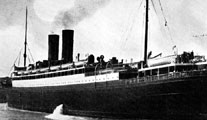
The ship Duchamp would sail on to New York in 1915
Illustration 14
The ship Duchamp would sail on to New
York in 1915

Before Duchamp sailed for America in 1915, on April 2, he wrote to his friend, Walter Pach, “I would willingly live in New York. But only on the condition that I could earn my living there. 1st. Do you think that I could easily find a job as a librarian or something analogous that would leave me great freedom to work (Some information about me: I do not speak English […] I worked for two years at the Bibliothèque Sainte-Geneviève as an intern)” (31)

click to enlarge
Marcel Duchamp
Illustration 15
Photograph of Marcel Duchamp, 1915
© 2000 Succession Marcel Duchamp ARS,
N.Y./ADAGP, Paris

After receiving this letter, Pach arranged for his father to provide a letter of introduction to Belle Greene so that Pach could see if Greene knew of any work for Duchamp. During the spring, she reported to Pach that she was unable to find any work anywhere for Duchamp. After Duchamp arrived, in the summer of 1915, Pach brought Duchamp to the French Institute. (Illustration 14 and 15 depicting the ship Duchamp sailed on and Duchamp’s appearence in 1915)Duchamp made friends with one of the workers who told Duchamp that they thought a position might open up and that Belle Greene would be in charge. Pach had just written to Quinn (another member of the Harvard (Law) circle) to ask his advice about his (Pach) approaching Greene again, or to see if it would be better if Quinn contact her himself. Duchamp next told Pach about the news that he had just learned about a possible job opening at the French Institute. The next day, Pach wrote to Quinn with the new information and made a direct request for Quinn to appeal to Greene on behalf of Duchamp.

Quinn then wrote to Greene, who agreed to meet with Duchamp at the Morgan Library. After the first meeting, Duchamp wrote Quinn that his hopes were surpassed as Greene said she would ask the president of the French Institute for part-time work at $100 per month (the equivalent today of about $1,600). The night of their first meeting, Greene wrote to Duchamp, who later shared this letter with Quinn and was in a happy mood. The following week Greene introduced Duchamp to Hawkes, president of the French Institute. All seemed to go well. Duchamp met with Greene the next day and together they went to the French Institute where she gave him provisional work. He was told that the position was temporary, pending the decision of a committee that was scheduled to meet in one month. Duchamp started work on the 14th of November, 1915. On the 18th Hawkes wrote to Greene. On the 26th Greene wrote a short, two-paragraph letter to Hawkes with an apology for her delay in answering him. Both paragraphs are about Duchamp, stating that he was not progressing as fast or as well as she hoped or desired and she very much feared that he would not suit their purpose. She ended the letter indicating that on the following day she would definitely determine whether or not to keep Duchamp. She concluded with a statement to the effect that she would bear the expense of the ‘try-out’ with Duchamp. (32)

Six weeks later, on January 12, 1916, Duchamp was let go by Greene. She paid him $60 for each month (not the hoped-for $100). Duchamp wrote to Quinn that Greene would write to him, as she instructed him to wait until he hears from her. After two weeks passed, Duchamp wrote Quinn to say that he had “not yet heard from Belle Greene.”(33) Greene had apparently handed Duchamp a “don’t call us, we’ll call you” firing and good-bye message.

click to enlarge
Marcel Duchamp
Illustration 16
Photograph of Marcel Duchamp,
© 2000 Succession Marcel Duchamp ARS,
N.Y./ADAGP, Paris

I suspect that this abrupt firing and brush-off was a humiliating experience for Duchamp. Both of his socially powerful friends, Pach and Quinn, had put great effort into securing this opportunity. Duchamp even wrote Quinn, on January 1st, that he liked the work and would write his intentions to Ms. Greene as suggested by his friend who worked there. Obviously Duchamp had a different view of himself and his work than the negative one painted by Greene in her letter to Hawkes.

Given the tone of Greene’s letter to Hawkes, it is probable that she and possibly Hawkes had the power to make the decision to hire or fire Duchamp, and it is likely that there never was a committee’s decision to wait upon, a fact that could be established by Duchamp’s contacts at the French Institute. Greene was known for her outspoken behavior and her indiscretion. Resulting rumors could only have embarrassed Duchamp further.

It is more than likely that Greene was aware of the fame around this young artist. Before beginning his work for her, Duchamp had appeared in five newspaper interviews. Since he had experienced notoriety in New York, he likely would have found Greene’s ill treatment beneath his status. After all, even his arrival in 1915 attracted the press — they were waiting for him at the dock! Young, handsome and charming, Duchamp clearly rode the wave of being the French artist of the Armory Show fame, but even so, Greene would have recognized, and been sensitive to, his lack of financial or academic substance. (34)
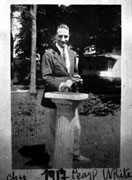
(See Illustration 16 of a nattily attired Duchamp in the country sometime during 1917) Greene, in her early 30s, was a liberated, independent, intelligent and beautiful woman with a focus and discrimination tuned to success. Although their art interests ran in different circles, there was overlap.Greene was a friend of Alfred Stieglitz and was invited to contribute an article to his famed magazine.
(35)
(See text box “What does 291 mean to me?” by Belle da Costa Greene, Camera Works, January 1915).

291

What does “291” mean to me? – The thrills received from Matisse, from Picasso, from Brancusi? The Rabelaisian delights of Walkowitz, the glorious topsy-turvydom of Marin or the glowing sincerity of Steichen? In vain do I try to convince myself that all of this is “291” – quite in vain – “291” is Stieglitz. I can see you rage as you read this, dear Stieglitz.

I can see that wonderful hirsute adornment of yours rise as if under the machiavellian hand of De Zayas – but you are quite helpless, you cannot apply the blue pencil – the Censor has never yet ben admitted to “291.”

Yes, Stieglitz, in spite of your “art stuff” you are It. In spite of your endless drool you are the magnet of Life.

I wish that I were able to repay you for the countless times you have so lavishly poured courage into my soul, enthusiasm into my living, and clarity into my thinking; – for the countless times I have come to you a hopeless incoherent mass, my courage like so much wet tissue paper, my mind fringed by the seeming uselessness of things, and left you an optimistic, determined and directed Endeavor.

I owe you much, Stieglitz, perhaps more than do your Satellites, for they, at least have seen the Light – they know that Rembrandt, Leonardo, Raphael, Velasquez and the other old fogies are weak, flabby and hopelessly defunct; they know that the Metropolitan Museum is but a morgue and as such should be relegated to its proper place under ground – but I, oh Stieglitz, am still groping in darkness – my eyes are still unopened – and when you are not looking, I creep back to that same Morgue, and find there, as I have at “291”, the glory you radiate.

Stieglitz – I salute you.

BELLE GREENE


click to enlarge
Belle Greene Bottled Green
Illustration 17
Belle Greene Bottled Green,
digital collage by Rhonda Roland
Shearer, 2000

Like Greene, Duchamp courted and was courted by the wealthy and powerful in art circles. So, each had his/her own sense of entitlement and perhaps confronting it in the other may have proved too much for both of them, or at least for Duchamp. If their personalities clashed, her criticism of his work at the Institute would be beside the point. However, what we do know is directly from letters by Greene, Quinn, Pach, and Duchamp. The bottom line resulting from the circumstances of Duchamp’s employment, strange as they may be (for example, why was Duchamp paid for his ‘trying-out period’ by Greene and not the French Institute? Moreover, why was Greene firing him at the Institute? How did she know, as soon as Duchamp began, that he would not ‘suit our purpose’? And why didn’t she want him there?), is that Duchamp was canned by Belle Greene. Perhaps my case now reveals that Duchamp, though he used restraint by not exhibiting the Belle Haleine bottle while Belle Greene was alive, had his private revenge for Belle da Costa Greene through his Belle bottle dyed green. (See Illustration 17)


Notes

Footnote Return 1.In November 1999, Shearer privately informed me of her unpublished discovery. See Rhonda Roland Shearer’s “Marcel Duchamp’s Impossible Bed,” part I and Part II for her general arguments about how the readymades are not readymade as Duchamp presents them or as scholars have believed. A letter that Duchamp wrote to his good friend and New York socialite Ettie Stettheimer, August 10, 1922, suggests that, on more than one occasion, he used green dye and hinted at Belle Green being connected to his Belle Haleine dye job. Duchamp writes: “a marvelous, raincoat-like, dark bottle green” . . . “I am waiting with impatience that you come to NY to show off Rrose Selavy in bottle green.” (From Ephemerides On or About Marcel Duchamp and Rrose Sélavy 1887-1968 by Jennifer Gough-Cooper and Jacques Caumont. Cambridge: MIT Press, 1993.)

Footnote Return 2. Duchamp waited to exhibit the green bottle of Belle Haleine until the 1965 exhibition, Not seen &/or Less Seen of/by Marcel Duchamp/Rrose Sélavy 1904-1964 at the Cordier & Ekstrom Gallery, New York (January 14-Febuary 13, 1965). Before 1965, only the New York Dada (1921) image of Belle Haleine in red, the Boîte-en-Valise version (1941) in peach, and the Man Ray photograph of the label were exhibited.

Footnote Return 3. Tomkins, Calvin. Duchamp, A Biography. (New York: Henry Holt and Company, 1996), 154-155.

Footnote Return 4. In his Marcel Duchamp: The Art of Making Art in the Age of Mechanical Reproduction (Ghent, Amsterdam: Ludion Press, 1999), Francis M. Naumann questions the time of the work’s signature (p. 94, note 49). In an e-mail to Thomas Girst of 2 April 2000 Naumann writes that he is now inclined to accept Duchamp’s stated version of when the work was signed. Arturo Schwarz reports in a fax to Rhonda Roland Shearer (4 April 2000) that Duchamp told him that he signed the label on the box of Belle Haleine after 1945.

Footnote Return 5. Casfield, Cass. The Incredible Pierpont Morgan, Financier & Art Collector. (New York: Harper & Row, 1974), 152. Although this statement is published, this may be part of the myth surrounding Belle Greene. In a conversation with Jean Strouse, she said she found nothing in her research to support this statement. In keeping with both Greene’s ability to develop and live with a myth (and her sense of humor), I suspect that if this “horse story” is not true, Greene might have enjoyed perpetuating or possibly originating such a prestige-evoking story of wealth.

Footnote Return 6. Chernow, Ron. The House of Morgan. (New York: Simon & Schuster, 1990),117.

Footnote Return 7. Samuels, Earnest. Bernard Berenson, The Making of a Legend. (Cambridge: Harvard University Press, 1987), 286.

Footnote Return 8. Strouse, Jean. Morgan, American Financier. (New York: Random House, 1999). This book contains a detailed and fascinating account of Belle Greene.

Footnote Return 9. Letter dated December 18, 1909. Strachey, Barbara and Jayne Samuels, eds. The Letters of Bernard Berenson and Isabella Stewart Gardner, 1887-1924. (New York: Harper & Row, 1974), 462.

Footnote Return 10. Secrest, Meryle. Being Bernard Berenson, A Biography. (New York: Holt, Rinehart and Winston, 1979), 249.

Footnote Return 11. As per private conversation, January, 2000, Ms. Shearer relayed to me what Cleve Grey told her in a personal conversation.

Belle Greene herself was well aware of the rumors, excerpts from a letter written by Belle Greene to Bernard Berenson in 1912: “I really had to laugh at your last letter complaining of all the scandal you were hearing about me—I suppose they say everything…but what difference does it make?….I’ve come to the conclusion that I really must be grudgingly admitted the most interesting person in New York, for it is all they seem to talk about—C’est a rire—You know perfectly well BB…that I get “hipped” on some man, regularly every six months and I suppose it will be so until I die—but I get over it all so very quickly that it does not really disturb the actual current of my life at all—and BB….these men and this talk and all is so stupidly unimportant and irreverent—the only time I was really ‘scandalous’ was in your own dear company so if I guarantee that I will be really wicked only with you isn’t it alright?…” (Morgan, American Financier, Jean Strouse. page 520.)

Footnote Return 12. Strouse, Jean “The Unknown JP Morgan” in The New Yorker (March 29, 1999).

Footnote Return 13. Strouse, Jean. Morgan, American Financier, 512.

Greener wrote a series called “The White Problem” and it was published in “The Cleveland Gazette” from the “St. Joseph’s Advocate” in 1894. The title ‘The White Problem’ is magnificently provocative. In 1906, in Washington, DC, Greener spoke before the literary society of the Metropolitan AME church. An article appeared in the Cleveland Journal, subtitled ‘Former Consul Greener speaks in Washington-Russian Jew can enjoy citizenship’. It may have appeared elsewhere. In November, 1920, an article titled ‘GREENER!’ appeared in the Union Newspaper. It discusses Greener’s education (1st from Harvard) and his career. It mentions that as a “bibliophile, he stands without a peer.”

Footnote Return 14. It is interesting to note that Duchamp was a frequent guest of the Stettheimer sisters. (It is to Floriene Stettheimer that Duchamp wrote his hint of ‘Rrose in bottle green’ mentioned in note 1) along with Carl Van Vechten, and his wife, actress Fania Marinoff. The Van Vechten’s promoted black performers and writers and knew the obstacles prejudice placed before them. (In fact, he was friend as well a literary sponsors of Nella Larsen and she dedicated her acclaimed novel Passing to the Van Vechtens.) Emily Farnham. Charles Demuth, Behind a Laughing Mask University of Oklahoma Press: Norman, Oklahoma. 1971.

Footnote Return 15. Strouse, Jean. Morgan, American Financier, 512.

Footnote Return 16. To explain the why, where and when of the added ‘r’, Duchamp offers us the same explanation in Dialogues with Duchamp (New York: Da Capo Press, 1971), an interview by Pierre Cabanne, that he states in another interview with Katherine Kuh in 1949 (Katharine Kuh. The Artist’s Voice: Talks with Seventeen Artists. New York: Harper & Row, 1962). In essence, Duchamp explains that when he was about to sign Picabia’s L’Oeil Cacadylate (1921) he was inspired by the double ‘r’ in the word arrose. In addition, he said to Katharine Kuh that he, “thought it clever to begin a word, a name with two ‘r’s like two ‘ll’s in Lloyd.” To Cabanne, Duchamp ends the same story with, “All of this was word play.”

Footnote Return 17. I include Berenson in this list for a few reasons. Berenson would hold a place of special interest for Duchamp. It was through connections provided by Berenson that Duchamp’s brother, Jacques Villon got caught making forged Constables (and narrowly escaped big trouble). From 1899 to 1902, Villon was known as a “speed Constable painter.” He apparently provided forgeries for a friend, an art dealer and a man named Van Kopp. (See Simpson, Colon. Artful Partners. New York: Macmillan Publishing Co., 1986.) Art authenticator and art historian Bernard Berenson would likely have remained a dubious character for Duchamp due to his connection to Van Kopp and his brother. (More on this subject by me in a forthcoming article.)

Berensons’s affair with Belle Greene (and their subsequent lifelong friendship) also stirred the rumor mill about Belle Greene. Berenson’s own public “act of passing” and its meaning in the context of his life and times is explored in an article by Meyer Schapiro, “Mr. Berenson’s Values,” in Encounter Magazine (January 16, 1961), which I recommend.

Footnote Return 18. Esscoffier, A. The Escoffier Cook Book. English translation by Guide Culinaire. Originally published in 1903. New York: Crown Publishers, 1973.

Footnote Return 19. Secrest, Meryle. Being Bernard Berenson, A Biography. (New York: Random House, 1979), 290.

Footnote Return 20. Schwarz, Arturo. The Complete Works of Marcel Duchamp, Volume Two. (New York: Delano Greenidge, 1997), 693.

Footnote Return 21. Strouse, Jean. Morgan, American Financier, 510.

Footnote Return 22. Casfield, Cass. The Incredible Pierpont Morgan, Financier & Art Collector, 152.

Footnote Return 23. Secrest, Meryle. Being Bernard Berenson, 290.

Footnote Return 24. Kunz, George Frederick & Charles Hugh Stevenson. The Book of the Pearl: The History, Art, Science, and Industry of the Queen of Gems. New York: Century,1908.

Footnote Return 25. A beautiful picture of Belle Greene with her pearls is featured in Jean Strouse’s article “The Unknown JP Morgan.”

Footnote Return 26. Auchincloss, Louis. J.P. Morgan. The Financier as Collector. (New York: Harry H. Arbam,1990), 19.

Footnote Return 27. Jennifer Gough-Cooper and Jacques Caumont, “Ephemerides on and about Marcel Duchamp and Rrose Sélavy,” (July 10, 1921,) in: Pontus Hulten (ed.), Marcel Duchamp: Work and Life, Cambridge: MIT, 1993.

Footnote Return 28. in: Le Philaou-Thibaou: Supplément Illustré de 391 (July 1921), n.p.

Footnote Return 29. It is interesting to note that Greene uses the phrase “the Metropolitan Museum is but a morgue” – a remark similar in nature to Duchamp’s philosophy – in a statement for Stieglitz’ Camera Works, January 1915.

Footnote Return 30. Secrest, Meryle. Being Bernard Berenson, 291.

Footnote Return 31. Naumann, Francis M. “amicalement, Marcel: Fourteen Letters from Marcel Duchamp to Walter Pach,” in: Archives of American Art Journal (vol. 29, no. 3-4, 1989, pp.36-50) p. 39.

Footnote Return 32. From the Pierpont Morgan Library Archives.

Footnote Return 33. New York Public Library, Manuscript and Archives Division: Quinn Letters. All dates and information are from letters in this archive. (Other sources for the Greene letter and Duchamp’s letter to Pach have been previously cited.)

Footnote Return 34. Senda reported to her brother Berenson that Belle said her that she did not wish to marry but if she did it would be for “money—much money.” (Bernard Berenson, The Making of a Legend, Ernest Samuels. page 119.) Apparently, Berenson was not rich enough for Belle Greene.

Footnote Return 35. Strouse, Jean. Morgan, American Financier. (New York: Random House, 1999)

Announcing the “International Online Bibliography of Dada”

The International Dada Archive at the University of Iowa Libraries is pleased to announce the availability of its online catalog, the International Online Bibliography of Dada.

With some 19,000 titles (including nearly 2,000 related to Duchamp), the online catalog currently includes about thirty percent of the titles in our card catalog. Grant funding will permit us to continue conversion of the card catalog to electronic format at a good pace through the end of June 2000.

This is the culmination of twenty years of bibliographic work at the International Dada Archive. The Archive was established in 1979 with support from the National Endowment for the Humanities and the Jerome Foundation. Creation of the International Online Bibliography of Dada has been made possible by a University of Iowa Arts and Humanities Initiative Grant, and has been a collaborative project of Donna Hirst and Timothy Shipe of the University Libraries and Professor Rudolf E. Kuenzli of the Program in Comparative Literature.

The bibliography is currently a database within the University of Iowa Libraries’ online system, OASIS. The University Libraries will be migrating to a web-based catalog late this summer, at which point the IOBD will become considerably more web-friendly. In the meantime, you can access the IOBD via a telnet connection at the following url:

http://www.lib.uiowa.edu/cgi/oasis.cgi

Enter your terminal type (usually V1), hit “return” to bypass the log-on screen, enter “1” to get into OASIS, then enter “cho dada” to get into the IOBD.

For more information, see the web site of the International Dada Archive athttp://www.lib.uiowa.edu/dada/index.html.

Timothy Shipe, Curator, International Dada Archive The University of Iowa Librariestimothy-shipe@uiowa.edu


Delay in Delivery: A postcard sent by Duchamp in 1933


click to enlarge
Man Ray,Kiki, 1924arcel Duchamp à Paris,
1931
1.Man Ray,Kiki, 1924
2.Marcel Duchamp à Paris,
1931

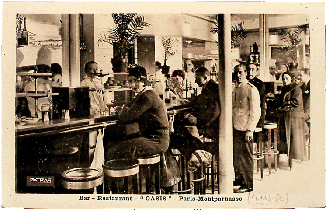
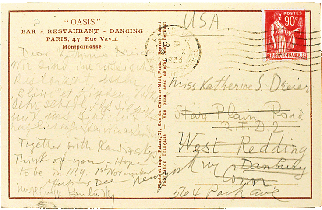
In October 1933 Duchamp met with Nina and Wassily Kandinsky in Paris. They knew each other through Katherine Dreier who was close to both artists. Duchamp and the Kandinskys decided to send her a postcard. Dreier received the message in New York and the postcard eventually ended up in her archives which, after her death, became part of the Beinecke Rare Book and Manuscript Library at Yale University.

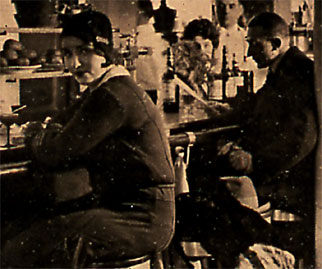
Almost sixty-five years later, in the summer of 1998, I came across the postcard among the hundreds of pages of correspondence between Dreier and Duchamp. In retrospect it’s hard to say if I found out immediately what the problem was in the image of the postcard (showing a bar-restaurant in Paris). Probably I didn’t. I made a copy that accompanied me back to Europe. Only weeks later, while concentrating on the image, it became clear to me that one of the figures in the postcard could well be Marcel Duchamp himself.

click to enlarge

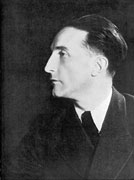
As a matter of fact, this discovery opened a whole new perspective. There is a strong similarity between the profile of the man in the postcard and some Duchamp photographs we know from 1919-1920, showing him with a short haircut. I found out that the bar-restaurant Oasis really existed, but the problem is that the place was only founded in the late twenties. There are only two ways of dealing with this contradiction in time: whether all this is based on a remarkable coincidence or whether the postcard is the product of an extremely precise collage.


click to enlarge

Close-up View of the Postcard, 1933

Close-up View of the Postcard, 1933

In support for the last thesis, one could consider that the postcard must have been produced between 1928 and 1933. During this period Duchamp worked on the Green Box. This project included on the one hand the fact that he had to dig in his old boxes and on the other hand that he got involved with printing and photography.
Another consideration makes it hard to believe that we deal with a coincidence.
At one point, the bar-restaurant Oasis was owned by nobody else than Man Ray’s favorite model Kiki de Montparnasse. Billy Klüver, who wrote an extensive study on Kiki, believes that the woman in the main focus of the postcard is Kiki herself. During the Harvard symposium “Methods of Understanding in Art and Science: The Case of Duchamp and Poincaré” (November 5-7, 1999) Arturo Schwarz confirmed that, in his opinion, the two people sitting on the stools at the bar of Oasis are indeed Marcel Duchamp and Kiki de Montparnasse.

Berlin, April 2000.

click to enlarge

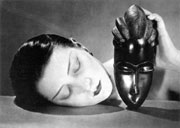
  • Man Ray, Noire
et Blanche, 1926
    Man Ray, Noire
    et Blanche
    , 1926
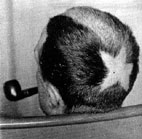
  • Marcel Duchamp,Tonsure, 1919
© 2000 Succession Marcel Duchamp, ARS, N.Y./ADAGP,
Paris.Marcel Duchamp,Tonsure, 1919
    © 2000 Succession Marcel Duchamp, ARS, N.Y./ADAGP,
    Paris.
  • Man Ray, Kiki
de Montparnasse, 1922Man Ray, Kiki
    de Montparnasse
    , 1922


Marcel Duchamp’s Three Threads


click to enlarge

Duchamp

1999 Succession Marcel
Duchamp, ARS, N.Y./ADAGP, Paris.

In 1963 the Pasadena Art Museum in California presented Marcel Duchamp’s first retrospective exhibition. Organized by the young curator Walter Hopps, this exhibition introduced, for the fist time, Duchamp’s works to the West Coast’s spectators and artists. The exhibition space was designed according to themes based on Duchamp’s works. His early Cubist-influenced paintings(including two versions of Nude Descending A Staircase, 1911-12) were shown in one room, and a replica of The Bride Stripped Bare by Her Bachelors, Even, 1915-23, was shown in another room with some of Duchamp’s ready-mades (such as Fountain, Paris Air,and Traveler’s Folding Item). The exhibition’s announcement implicitly mentioned an ongoing Duchamp project (which was, in fact, Étant Donnés, Duchamp’s famous posthumous work,revealed to the public after his death) but no evidence of this project was displayed at the exhibition.
(1)

Juan Antonio Ramírez,Professor of Art History at the Universidad Autónoma de Madrid and author of several books on art, architecture and film, has written Duchamp: love and death, even along the same themes as the Pasadena Art Museum’s retrospective, with an interesting and telling twist of perspective. The book focuses on three topics: Duchamp’s readymades, The Bride Stripped Bare by Her Bachelors, Even,and Étant Donnés. In the last chapter, the book provides an appendix addressing Duchamp’s early paintings. A shift has been made from the importance of his early work (so carefully spotlighted in the retrospective exhibition) to the profound importance of Duchamp’s final piece.


click to enlarge

Fountain, 1917

©1999 Succession Marcel
Duchamp, ARS, N.Y./ADAGP, Paris.

First, Ramírez addresses the readymades and describes a “readymade” as a work of art that has been, prior to the artist’s handling, “‘already-made,’ or previously produced. The artist does not create, in the traditional sense of the word, but chooses from among the objects of the industrial world or (to a lesser degree) the world of nature.” Ramírez then summarizes Duchamp’s readymades according to their “degree of rectification,” the “complexity of the assemblage” and the “degree of necessity for manipulation […] and structure.”(2)Here, Ramírez tries to link the concept of the readymade to industrial production by highlighting the technical and material aspects of the readymade. On the other hand, he also suggests there is a sensual quality to the readymade. The form of the readymade renders its industrial counterpart an aesthetic sense, even an erotic one. Therefore, the readymade, for the author, presents us with a double character, showing us both industrial significance and erotic pleasure.

click to enlarge

Large Glass, 1915-23

©1999 Succession Marcel
Duchamp, ARS, N.Y./ADAGP, Paris.

Following this,Ramírez spends two chapters discussing Duchamp’s The Bride Stripped Bare by Her Bachelors, Even. Chapter Two begins the topic from the bachelor section of The Bride Stripped Bare by Her Bachelors,Even and Chapter Three moves to the section of the bride. By referring to notes in the Green Box, the author explicates the functions of the mechanical apparatuses in the bachelor section. For example, he gives a detailed chart showing the elements and significance of the malic moulds. The author compares Duchamp’s apparatuses with those of the industrial culture of that time, and he indicates that these industrial designs inspired Duchamp.


click to enlarge

Note from Green Box, 1934

©1999 Succession Marcel Duchamp,
ARS, N.Y./ADAGP, Paris.

The bachelor section illuminates a precise and solid blue print of a mechanical device which reveals a masculine sense. In opposition to this masculine sense,the bride section conveys a feminine sense. The left side of Female Pendant (“Bride Hanging” or, the top portion of The Bride Stripped Bare by Her Bachelors, Even) in 1913 shows a female figure, and the composition of this female figure echoes the optical concern in Oculist Witness of the bachelor section.(3) Ramírez further suggests that a transparent body is contained in the area known as the Milky Way of the bride’s section. “The human being with his halo can be contained within the cinematic expansion [otherwise known as the Milky Way] of the bride.” Finally, an electronic circulation between the bride and the bachelor functions according to the devices of Tender of Gravity, Tripod, Rod,and Black Ball. This circulation implies, perhaps, the sexual relationship between woman and man (the bride and the bachelor).


click to enlarge
Note from Green Box, 1934
©1999 Succession Marcel
Duchamp, ARS, N.Y./ADAGP, Paris.

In chapters four and five, the author undertakes the shift from The Bride Stripped Bare by Her Bachelors, Even to Duchamp’s most secretive work, ÉtantDonnés. According to a Green Box note, Ramírezdraws a possible link between these major pieces.(4)He believes that Étant Donnés continues what Duchamp didn’t finish in The Bride Stripped Bare by Her Bachelors, Even.Also, Ramírez shows how several of Duchamp’s early works relate to Étant Donnés. La Bagarre d’Austerlitz (1921), for instance, corresponds to the Spanish wooden door of Étant Donnés. He surveys Duchamp’s oeuvre and finds direct inspiration for the design of not only the door, but also the brick wall, landscape, table, electrical installation, and female torso in Étant Donnés. Ramírez elaborates upon the construction of Étant Donnés in detail.


click to enlarge

Etant donnés,  1946-1966

©1999 Succession Marcel
Duchamp, ARS, N.Y./ADAGP, Paris.

Both Maria Martins and Teeny Duchamp served as models for the piece and Ramírez asserts that Étant Donnés was begun as a result of the erotic influence of Martins upon Duchamp.(She was later “displaced”by Teeny Duchamp.) The author places the composition of the female torso of Étant Donnés into the context of some nineteenth-century figurative paintings and twentieth-century surrealist works. The works of Jean Léon Gerôme, Courbet, and Cézanne, for example, directly or indirectly influenced Duchamp’s design of the female figure. Also, the photos of Man Ray and Hans Bellmer and the paintings of Magritte, Max Ernst and Paul Delvaux evoke a female figure, similar to the one in Étant Donnés, which epitomizes surrealist fascination with the erotic and the sexual.

In the last chapter,Ramírez introduces Duchamp’s earliest eight paintings: Landscape
in Blainville
(1902), Nude in Black Stockings (1910), Portrait of Dr. Dumouchel (1910), Paradise (1910-11), Spring(1911), Dulcinea (1911), Coffee Mill (1911), Nude
Descending a Staircase No. 2
(1912), and The King and Queen Surrounded by Swift Nudes (1912). These paintings, created during Duchamp’s Paris period before 1912, show the influence of late-Impressionism, Symbolism, Fauvism, and Cubism on his early career. Ramírezdescribes and captures Duchamp’s growth as an artist during this time,noting that, finally in 1912, with Queen Surrounded by Swift Nudes, “Duchamp had exhausted the possibilities of this thousand-year-old art form at the same rapid pace as his nudes – that is to say, vertiginously.”


click to enlarge

Three Standard Stoppages, 1913-14

©1999 Succession Marcel
Duchamp, ARS, N.Y./ADAGP, Paris.


click to enlarge
Note for The Large Glass
©1999 Succession Marcel
Duchamp, ARS, N.Y./ADAGP, Paris.

In Duchamp: love and death, even, Ramírez fails to deal with several key points. He classifies Trois stoppages (“Three Standard Stoppages”) of 1913-14 as a readymade while most Duchamp scholars don’t attribute the work as a readymade. Duchamp explained the process of this work to Richard Hamilton: “Three canvases were put on long stretchers and painted Prussian blue. Each thread was dropped on a canvas and varnish was dropped on the thread to bond it on a canvas. The canvases were later cut from the stretchers and glued down onto strips of plate glass.”(5) Trois stoppages, in this sense, is Duchamp’s experimentof chance, not a readymade. Second, Ramírez draws a direct link between the female figure (called the “Sacrificial Dummy” in his book) and Duchamp’s intimate relationship with Maria Martins. In fact, Duchamp already had a similar idea in mind, and it appears in note 142 of the Green Box.In the note, there is a figure’s head and the inscription: Give The  Object., considered in its physical appearance. (color, mass, form.)/define (graphically i.e. by means of pictorial conventions). the mould of the object./By mould is meant: from the pt. Of view of form and color.(6) So perhaps Martins is not the key to Duchamp’s ideas about designing a female figure.


click to enlarge

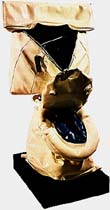
Soft Toilet, 1966

Claes Oldenburg, Soft Toilet, 1966

On the other hand,Ramírez offers some convincing and intriguing interpretations of Duchamp’s art. He shows that Duchamp’s experience of life does not tie in with his final creation and that love, intellectual rigor and sense of humor play out as the three threads that shape the core of Duchamp’s works. Furthermore, because Duchamp’s art reflects his particular interest in industrial culture and society, Duchamp challenges the orthodox discourse of traditional art and builds a provocative route for the modern art that later prompts the emerging of contemporary art in the 1960’s and 70’s. Duchamp’s oeuvre maps the avant-garde art and establishes him as one of the most important figures of twentieth-century art and culture.


Notes :

Footnote Return 1. The whole announcement is folded in half. The front view shows Duchamp looking at the viewer and standing close to a door as if he is entering a room from outside. The door is reminiscent of Duchamp’s Door: 11, rue Larrey, 1927. The design of the back view, showing a hole, foreshadows Duchamp’s two peep holes on the door of Étant Donnés.

When Hopps was working on the exhibition, he had an interview with Duchmap. He asked Duchamp: “If there were something you had been working on privately,would this have been the show that you would have wanted it to be seen in?” And then Hopps noted: “After this exchange, I was quite convinced in my own mind that time would turn up something important,as indeed it did.” (Bonnie Clearwater ed., West Coast Duchamp,Florida: Grassfield Press, 1991, p. 121.)

Later, Hopps realized nof course that Duchamp had been secretly working on Étant Donnés.

Footnote Return 2. The readymadesare examined under “technical aspects and materials,” “geometrical and/or speculative aspects,” “erotic significance,” “relations with the large glass,” “other aspects.”

Footnote Return 3. According to the note in the Green Box, it says that “this angle will express the necessary and sufficient twinkle of the eye.” (Author’s italics.)

Footnote Return 4. Étant Donnés: 1. La chute d’eau, 2. Le gaz d’éclairage.

Footnote Return 5. Richard Hamilton, The Almost Complete Works of Marcel Duchamp(London: the Arts Council of Great Britain, 1966), 48.

Footnote Return 6. Arturo Schwarz ed., Marcel Duchamp: Notes and Projects for The Large Glass (New York: Harry Abrams Inc., 1969), 210.

Marcel Duchamp and Glass


click to enlarge

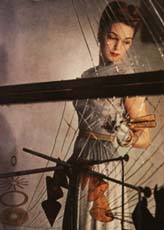
Vogue, July 1945

Illustration 1.
Detail of the cover of
Vogue magazine (July 1945),
showing parts of Duchamp’s
Large Glass
in the foreground

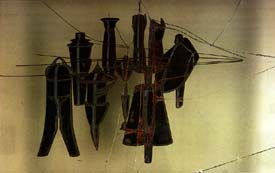
I. CRACKS
Cracks travel, but never in a straight line. They are always slightly deflected, but a crack that starts at one edge of a sheet of glass will hardly ever stop until it reaches another edge. Cracks in glass have virtually no physical dimension. They are breaks in the molecular structure made visible. Marcel Duchamp loved cracks (figure 1). For several years Duchamp was a glass painter, and three of his four works in this medium are shattered. He would say that these transparent paintings were not broken but merely “wrinkled,” and even enhanced, or “brought back into the world,” by the new linear designs that accidental falls or jolts had imposed upon them.(1)Duchamp never acknowledged that this breakage was a part of his intention. Instead he gave two different explanations for his decision to work on such a fragile ground.

Firstly, when Cabanne asked “How did the idea of using glass come to you?” Duchamp replied, “Through color. When I painted, I used a big thick glass as a palette and, seeing the colors from the other side, I understood there was something interesting from the point of view of pictorial technique. After a short while, paintings always get dirty, yellow or old because of oxidation. Now, my own colors were completely protected, the glass being a means for keeping them both sufficiently pure and unchanged for rather a long time.”(2)

Even as he was turning his back on the medium, Duchamp remained surprisingly curious about oil paint. It would be a messy and disruptive maneuver to invert a palette, because a sheet of glass on a painter’s table is the field of action, encumbered with his tools. It supports his brushes and palette knives, jars of medium and turpentine, and mounds of wet or drying colors. Most artists have never thought of turning over their palettes to consider fresh paint from behind. But Duchamp investigated paint, wet paint, and went to great lengths to study and preserve it. He tried to trap ponds of fresh oil color against the glass within boundaries of lead wire. He sealed these from behind with lead foil. But his experiments failed. The paint did not stay fresh, but, in many places, reacted with the foil, turned into a powdery cake, and discolored badly.

Duchamp’s second stated reason for working on glass was very different. He was concerned, not with color, or the technical properties of oil paint, but with space. When pressed by Cabanne, “The glass has no other significance?” Duchamp replied, “No, no, none at all.” Then, without skipping a beat, he offered another significance: “The glass, being transparent, was able to give its maximum effectiveness to the rigidity of perspective.”(3) The transparency of glass offered a means of interjecting a painted image into the space of a room. But, for many reasons related to the rules of single-point perspective, The Large Glass can never work this way. Anyone who has seen it, or any of its full-scale reproductions, knows that the Bachelor Machine always looks flat, distorted and out of place in any gallery configuration. It hangs there, an artifice in space.


click to enlarge
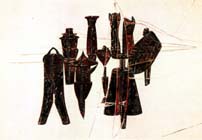
Nine Malic Moulds, 1914-15

Illustration 2.
© 1999 Succession Marcel
Duchamp, ARS, N.Y./ADAGP, Paris.
Nine Malic Moulds
, 1914-15

Duchamp’s ideas about color and space in his works on glass remained unrealized. He could have pursued them, but chose not to. What interested him most was not the material’s transparency, or its ability to seal and preserve, but its fragility. Nine Malic Molds (figure 2), was the first glass to be broken. Someone propped it up against an easy chair in Arensberg’s apartment to study it, not noticing the castors on the chair’s feet. Someone else approached from the opposite side and rolled the chair away. The glass fell and shattered. Although the carpet on the floor could not cushion the blow, its pile did keep the splinters from scattering. Duchamp was present. He must have kept everyone calm. The breakage of his glasses had begun, and would continue for a decade.

Duchamp derived great pleasure from repairing these glasses, or “bringing them back into the world,” each in its turn completed with a web of cracks. He expressed these feelings emphatically to James Johnson Sweeney, standing before the The Large Glass in the Philadelphia Museum of Art: “The more I look at it the more I like the cracks: they are not like shattered glass. They have a shape. There is a symmetry in the cracking, the two crackings are symmetrically arranged and there is more, almost an intention there, an extra- a curious intention that I am not responsible for, a ready-made intention, in other words, that I respect and love.”(4)

II. SCRATCHES


click to enlarge
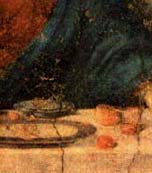
The Last Supper, 1498
Illustration 3.
detail of Leonardo da
Vinci’s The Last Supper, 1498

In 1910 Marcel Duchamp and his brother Jacques Villon studied the Treatise on Painting
by Leonardo da Vinci in its new French translation.(5)
They noted passages on perspective in which da Vinci advises young painters to make studies on sheets of glass set up before a landscape. By looking through the glass like a window, for example, and tracing a row of trees regularly spaced at the edge of a field, a novice could investigate the rate at which objects appear to diminish in size as they recede into the distance. But da Vinci never recommended using glass as a ground for a finished painting. It would never last. When da Vinci, elsewhere in the book, addressed the question of permanence, he gives the following prescription: “A painting made on thick copper, covered with white enamel, then painted upon with colors of enamel, returned to the fire, and fused, is more durable than sculpture.”(6)


click to enlarge

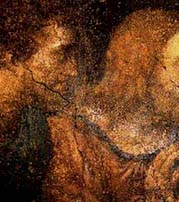
The Last Supper, 1498

Illustration 4.
Detail of Leonardo da
Vinci’s The Last Supper, 1498

A picture made this way would be impervious to cracks, scratches or virtually any kind of wear and tear. But da Vinci himself never used a fired enamel technique, or if he did, his works in the medium have been lost and forgotten. His largest and most influential painting, by contrast, is so fragile that, even as it was being created, it started to disintegrate. The Last Supper, executed in a mysterious tempera technique on a layer of pitch mixed with gesso, immediately began to separate from the wall and fall away (figure 3 and 4). Soon after da Vinci’s death, patches of mold appeared, and the surface was attacked from behind by salts and moisture, which seemed to ooze out of the mortar in the wall. Seen at close range, all that was left was a field of blots. Restoration efforts were initiated at once and continued, with limited success, to the present day. But as the physical painting faded away, the image of The Last Supper gathered force and grew more complex in the minds of those who traveled to Milan to see it. In 1850 Theophile Gautier wrote: “The first impression made by the marvelous fresco is in the nature of a dream. All trace of art has disappeared; it seems to float on the surface of the wall, which absorbs it as a light vapor. It is the ghost of a painting, the specter of a masterpiece returned to earth.”
(7)
The wreck of an artwork can take on a dramatic life of its own, like a play with many acts over time as accidents accumulate and deterioration continues. Marcel Duchamp noticed this process, became its student and critic, and learned to make use of it for his own purposes. He saw America as a wide-open landscape, free from the obstacles of battered relics. Europe, however, was crowded with churches and museums stuffed to their roof-lines with old war-horses. He told Calvin Tomkins that the European terrain made life difficult for its young, independent-minded artists: “When they come to produce something of their own the tradition is indestructible. They’re up against all those centuries and all those miserable frescoes which no one can even see any more – we love them for their cracks.”(8)


click to enlarge

Nine Malic Moulds, reproduction, 1938

Illustration 5.
© 1999 Succession Marcel
Duchamp, ARS, N.Y./ADAGP, Paris. Nine
Malic
Moulds, reproduction
for the ‘Boîte,’ 1938


click to enlarge
Large Glass print, 1929
Illustration 6.
© 1999 Succession Marcel Duchamp,
ARS, N.Y./ADAGP, Paris. Reversed
print of The Large Glass
with cracks numbered to make the
stencils which transferred them to
the celluloid prints for the ‘Boîte,’ 1939

So Duchamp took a lesson from history. He set up in the New World, in Philadelphia, his own bettered relic, the masterwork of a tradition with no past that leads nowhere. It is indestructible precisely because it is so fragile. In the late 1930s, Duchamp’s glass paintings took on another life as miniatures in his portable museum, the Boîte-en-Valise. He had three of them printed on sheets of celluloid, the clear plastic that, when coated with light sensitive silver salts, becomes photographic film. Celluloid serves as a good stand-in for glass in miniature, except for one property – it is very flexible, and cannot be cracked. In his reproductions of the glasses the component that Duchamp fretted over longest was the network of cracks. He wanted it reproduced as accurately as possible. Photographic cracks, printed in black ink as part of the image, would not suffice. Fortunately celluloid scratches easily. Duchamp made from acetate two miniature scratching stencils, with cuts that follow the breaks in Nine Malic Moulds and The Large Glass (figures 5 and 6). Each of the 300 reproductions was scratched by hand with an etching needle. The surfaces of the miniature glasses were interrupted. They were as good as broken.


Notes :

Footnote Return 1. Lawrence Steefel writes “As Duchamp remarked to me in 1965 the cracks brought the glass back into the world. When asked where it had been before this he threw up his hands and laughed.” Lawrence Steefel,The Position of La Mariée Mise à Nu Par Ses Célibataires Même (Anne Arbor: Xerox University Microfilms, 1975 [1960]), 22.

Footnote Return 2. ierre Cabanne, Dialogues with Marcel Duchamp (New York: Viking Press, 1977), 41.

Footnote Return 3. Ibid., 41.

Footnote Return 4. Michel Sanouillet and Elmer Peterson, The Writing of Marcel Duchmap (New York: Da Capo Press, 1989 [1973]), 127.

Footnote Return 5. Mention of the Duchamp brothers’ encounter with Josephin Peladan’s version of Leonardo’s Treatise on Painting (see footnote 6) occurs in many places. Among them are: William Agee, Raymond Duchamp-Villon (New York: Walker, 1967), 50; Pierre Cabanne, The Brothers Duchamp (Boston: New York Graphic Society, 1976), 8, 74, 86; William Camfield, Francis Picabia (Princeton: Princeton University Press, 1979), 24, 36; Alice Goldfarb Marquis, Marcel Duchamp: Eros, c’est la vie (Troy: Whitston Publishing, 1981), 132; Linda Henderson, The Fourth Dimension and Non-Euclidean Geometry in Modern Art (Princeton: Princeton University Press, 1983) 66n; Linda Henderson, Duchamp in Context (Princeton: Princeton University Press, 1998), 72, 188; Daniel Robbins ed., Jacques Villon (Cambridge: Harvard University Press, 1976), 49; Calvin Tomkins, Duchamp (New York: Henry Holt, 1996), 457.

Footnote Return 6. Josephin Peladan, translator and editor, Leonard de Vinci, Traite de from A. Philip McMahon, Treatise on Painting by Leonardo da Vinci (Princeton: Princeton University Press, 1956), 33.

Footnote Return 7. Quoted in A. Richard Turner, Inventing Leonardo (Berkeley: University of California Press, 1992), 101.

Footnote Return 8. Calvin Tomkins, The Bride and the Bachelors (New York: Viking Press, 1965), 66.

“Fountain” avant la Lettre


click to enlarge

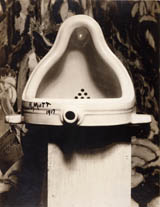
Fountain, 1917

© 1999 Succession Marcel Duchamp,
ARS, N.Y./ADAGP, Paris.
Marcel Duchamp, Fountain,
1917 (Photograph by Alfred Stieglitz).

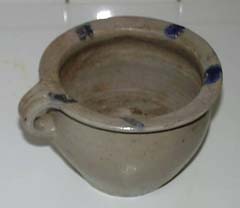
In his as yet unpublished article “Duchamp’s New Leap,” on Duchamp’s Given, the infrathin and the readymades, Juan José Gurrola draws our attention to the following quotation in Norbert Elias’ The Civilizing Process of 1939 which we thought too amusing not to share with our readers. The quote is taken from a letter written by Madame du Deffand to Madame de Choiseul in 1768:

“I should like to tell you, Dear grandmother, as I told the Grand Abbé, howgreat was my surprise when a large bag from you was brought to meat my bed yesterday morning. I hasten to open it, put in my hand and find some green peas…and then a vase…that I quickly pull out: it is a chamber pot. But of such beauty and magnificence, that my people say in unison that it ought to be used as a sauce boat.The chamber pot was on display the whole of yesterday evening and was admired by everyone. The peas…till not one was left.”


click to enlarge

Chamber Pot, ca. 1750

Chamber Pot, ca. 1750

(“Je voudrais, chère grand’mamam, venir peindre, ainsi qu’au grand qu’au grand-abbé, qu’elle fut ma surprise, quand hier matin on m’apporte, sur mon lit, un grand sac de votre part. Je me hâte de l’ouvrir, j’y fourre la main, j’y trouve des petits pois…et puis un vase…je le tire bien vite: c’est un pot de chambre. Mais d’une beauté, d’une magnificence telles, que mes gens tout d’une voix disent qu’il en fallait faire un saucière. Le pot de chambre a été en représentation hier toute la soirée et fit l’admiration de tout le monde. Les pois…furent mangés sans qu’il en restât un seul.”)

See Norbert Elias’sThe Civilizing Process (Urizen: New York, 1978), pages 133-134,279. The letter serves as an example for ‘changes in attitude towardthe natural functions.’

“Faucon” or “Perroquet”? A Note on Duchamp’s Morceaux choisis d’après Courbet


click to enlarge
Morceaux choisis d'après Courbet, 1968
Illustration 1.
© 1999 Succession Marcel
Duchamp, ARS, N.Y./ADAGP, Paris.
Morceaux choisis d’après Courbet, 1968


click to enlarge
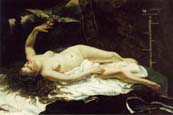
Woman with White Stockings
Illustration 2.
Gustave Courbet, Woman with
White Stockings,
1861
Woman Holding a Parrot
Illustration 3.
Gustave Courbet, Woman
Holding a Parrot,
1866

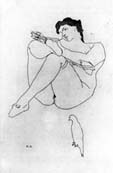
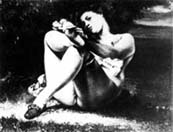
I have always thought that the bird in Duchamp’s 1968 etching, Morceaux Choisis d’Après Courbet,looks odd (Illustration 1). To me, the bird more resembles a parrot, or perhaps a pigeon,than a falcon (faucon in French). The bird is taken to be a faucon because Duchamp explained to Arturo Schwarz that “he’s curious, and furthermore he’s a falcon, which in French yields an easy play on words; so that here you can see a faux con and a real one.”(1) I have tried to confirm my suspicions by looking at stuffed birds in science museums, at real birds in zoos, and at drawings and photographs of birds in guide books. To me, Duchamp’s bird just doesn’t look like a falcon or any other bird of prey. The beak is too small, the sitting position is too upright, the body is too slender, the eye is too small and vacuous, the feet are too unlike talons, etc. To be sure, it is not impossible to see a falcon in Duchamp’s etching, but I think there is room for doubt about the bird’s identity.(2) As an alternative, we can read a dual-language pun in addition to the faucon/faux con suggestion made by Duchamp himself. Namely, we can interpret the image in terms of its being a “false” image, a “con” in the sense of a confidence game. The faux/con in this latter connotation would “parrot” a falcon.


click to enlarge
Pollyperruque
Illustration 4.
© 1999 Succession Marcel
Duchamp, ARS, N.Y./ADAGP, Paris.
Pollyperruque, 1967

In addition to Woman with White Stockings (Illustration 2), the painting that Duchamp reworks in the print, there is another of Courbet’s paintings, Woman Holding a Parrot (Illustration 3), that is often compared with the nude in Duchamp’s last piece, Given: 1st, the Waterfall; 2nd, the Illuminating Gas. (3)(It was the then still secret last piece that Duchamp apparently intended to index with the print, where the bird takes the place of the viewer at the peepholes in the assemblage.) The various connections in the complex, voyeuristic matrix of possible meanings involving parrots and nude women in these works indicate that Duchamp was concerned with “looking” and “interpreting.”(4) He manipulates the viewer’s gaze.


click to enlarge
Bird Illustrations
Illustration 5.
Bird Illustrations

Notice also that the nude in Duchamp’s etching looks at her stockings rather than directly at the viewer as she does in Courbet’s original painting. Given Duchamp’s changes, the viewer of the etching can be taken as a kind of dupe, a pigeon, who can be made to misconstrue a falcon. Considering Duchamp’s interest in perceptual matters, it is possible that he was familiar with, or interested in, psychology experiments involving perceptual set.(5)Expectation can lead to very different perceptions, especially when the stimulus is labile. As has been pointed out by a number of scholars,including Stephen Jay Gould and Rhonda Roland Shearer in a recent essay (6), Duchamp was clearly up to something in the domain of “looking” and “not looking.” There is still a great deal of material in Duchamp’s oeuvre that deserves to be looked at again, and again, from various points of view.


Notes :


Footnote Return 1. Arturo Schwarz, The Complete Works of Marcel Duchamp 3rd ed.(New York: Delano, 1997), 2:885.

Footnote Return 2.Thomas Girst has pointed out to me that, in the page of bird illustrations that Duchamp used as a source for his 1967 collage Pollyperruque(see Schwarz, 2: 871, for a discussion of this work) (figure 4), there is a “faucon,” mirror-reversed from Duchamp’s, that is not wholly unlike the image in the etching. To my eye, however, the differences are greater than the similarities. Girst also reminds me that the source for Pollyperruque was identified by Thomas Zaunschirm in his Marcel Duchamps Unbekanntes Meisterwerk (Klagenfurt, Austria: Ritter, 1986), 101 (figure 5). Zaunschirm also discusses Duchamp’s etching (pp.92-93), but he does not connect it with Pollyperruque. Carol James has discussed both Pollyperruque and Morceaux choisis d’après Courbet in her essay “An Original Revolutionary MessagerieRrose, or What Became of Readymades,” in The Definitively Unfinished Marcel Duchamp, ed. Thierry de Duve (Cambridge: MIT Press, 1991),277-96. James does not compare the two works in her text, but images of them are reproduced on facing pages. I am also indebted to Girst for pointing out that Juan Antonio Ramírez has discussed Duchamp’s collage and etching in his recent book, Duchamp: Love and Death, Even,trans. Alexander R. Tulloch (London: Reaktion Books, 1998), 214-16.Ramírez, apparently following Carol James’s implicit comparison, argues that “the supposed falcon (faucon) in the foreground was taken from the parrot of Pollyperruque, a 1967 readymade.” Here too,even though I’m arguing that Duchamp’s bird resembles a parrot, I think the differences between the bird in the etching and the parrots in Pollyperruque are greater than the similarities.

Footnote Return 3.See, for example, Hellmut Wohl, “Duchamp’s Etchings of Large Glass and The Lovers,” in Marcel Duchamp: Artist of the Century, ed. Rudolf Kuenzli and Francis M. Naumann (Cambridge: MIT Press: 1989),175-76.

Footnote Return 4.In this context, the general surrealist strategy of juxtaposing unlikely items comes to mind. For example, Joan Miró’s Object, 1936, has a stuffed parrot and woman’s leg with white stocking suspended in a keyhole-like opening.

Footnote Return 5.See, for representative examples, see E. G. Boring, “A New Ambiguous Figure,” American Journal of Psychology 42 (1930): 444-45; J.S. Bruner and A. L. Minturn, “Perceptual Identification and Perceptual Organization,” Journal of General Psychology 53 (1955): 21-28.

Footnote Return 6. Stephen Jay Gould and Rhonda Roland Shearer “Boats and Deckchairs” ToutFait 1, no. 1 (December 1999), www.toutfait.com/duchamp.jsp?postid=757&keyword=.

“Desperately Seeking Elsie” Authenticating the Authenticity of L.H.O.O.Q.‘s Back


click to enlarge
L.H.O.O.Q.
Figure 1
LHOOQ  (verso)
Figure 2

Duchamp’s most fervent biographers, Jacques Caumont and Jennifer Gough-Cooper, tell us that Duchamp was in New York City on 22 December 1944 and that, on this day, he met up with Frederick Kiesler in the afternoon for a discussion about a forthcoming issue of View magazine. This issue was going to be dedicated exclusively to Duchamp. After meeting with Kiesler, Duchamp cabled Walter Arensberg in Hollywood to inquire about the address of a photographer who had taken some pictures of Duchamp’s work before World War II. Duchamp wanted to contact him again in connection with View.(1) The cable said, “PLEASE WIRE ADDRESS OF MR LITTLE WHO PHOTOGRAPHED MY PICTURES SOME YEARS AGO STOP VIEW MAGAZINE PREPARDING [sic] DUCHAMP NUMBER WRITING= MARCEL DUCHAMP.”

Not noted by his biographers but also on that same day, Duchamp ran a very important errand. (2)He asked Ms. Elsie Jenriche to confirm the authenticity of his rectified readymade L.H.O.O.Q.(Figure 1), made twenty-five years earlier in 1919. We know this from an inscription on the reverse side of the readymade. It reads, in ink: This is to certify / that this is the original / “ready made” LHOOQ / (Figure 2) Paris 1919 / Marcel Duchamp. Beneath this, also in ink,is a testimony: Witnesseth: / This 22nd day of / December, 1944 / Elsie Jenriche.

A rubber stamp to the right of Ms. Jenriche’s name declares that she was a notary public (Figure 3): NOTARY PUBLIC, New York Co. / N. Y. Co. Clk. No. 63, Reg. No.
82J-3 / Commission expires March 30, 1945.
But can we be sure of this?

The 1943 A to L volume of Notaries Public N.Y. County Term Expires 1943 (archive #0394442), begins to eliminate doubt. Ms. Jenriche is listed, along with her profession (public stenographer) and signature. Then, in the 1945 A to K volume of the Notaries Public N.Y. County Term Expires 1945 (archive #0394442), Elsie Jenriche is listed again, this time as a public stenographer at the Hotel St. Regis (Figure 4,5). The entry is dated 17 March 1943 with an expiration of 30 March 1945 (Figure 6). This is precisely in accordance with the stamp on the back of L.H.O.O.Q.

Fast forward some fifty years. On Thursday, 29 April 1999, Mr. Jonathan van Nostren, archivist of the Division of Old Records at New York County’s Surrogate Court Hall of Records, declared that Elsie Jenriche’s signature on verso L.H.O.O.Q. is “authentic,” adding that “there’s no doubt that the work was properly notarized.”

click images to enlarge

  • detail LHOOQ (verso)
  • detail Notary, 1945
  • detail Notary, 1945

  • Figure 3
  • Figure 4,5
  • Figure 6

Notes:

Footnote Return1. Marcel Duchamp, Pontus Hulten, ed., 1993. Why is Marcel Duchamp´s Bicycle Wheel Shaking on Its Stool?

Footnote Return2. I am grateful to Francis M. Naumann for pointing out that fours years prior to this ‘errand,’ Duchamp intended to sell L.H.O.O.Q. to Louise and Walter Arensberg. In a letter dated 16 July 1940, Duchamp writes from Arcachon, France: Une autre chose dans la même genre est l’original de la Joconde aux moustaches (1919) / Pensez-vous que $100 soit trop pour la dite Joconde (Something else in the same category is the original of the Mona Lisa with a mustache (1919) / Do you think that $100 would be too much for the so-called Mona Lisa ). The Arensbergs are not known to have acquired the work. Arturo Schwarz in his The Complete Works of Marcel Duchamp, vol. 2 (New York: Delano, 1997) lists the Cordier & Ekstrom Gallery in New York and the collector Mary Sisler as previous owners of L.H.O.O.Q. As for its current status, it is now in a private collection in Paris. As yet unaccounted for is the Pierre Matisse Gallery, New York, which on a label on the work’s verso is credited (as Matisse Gal.) for loaning the work to the Museum of Modern Art’s traveling exhibition The Art of Assemblage which was on display in New York from 10 October – 12 November 1961.

‘Paris Air’ or ‘Holy Ampule’?


click to enlarge
Duchamp as the Black King
Duchamp,wearing a crown
left:Duchamp as the Black
King in Hans Richter’s 8×8, 1957
right: Duchamp in 1957, wearing
a crown made for his 70th
birthday (photographyby Denise Hare)


click to enlarge
Salvador Dalí, Apotheosis of the Dollar
Clovis I and the miracle of the 'Holy Ampule'
left:Figure 1.
Salvador Dalí, Apotheosis
of the Dollar, 1965
right: Figure 2.
First known image
of Clovis I and the miracle of
the ‘Holy Ampule,’ ca. 9th Century

In January 1968, Salvador Dalí wrote the preface for the English translation of Pierre Cabanne’s Dialogues with Marcel Duchamp, stating that “Marcel Duchamp could have been a king if, instead of making the Chocolate Grinder, he made the Holy Ampulla, the unique, divine readymade, to anoint himself as king. Duchamp then could have been crowned at Rheims.” (1) Duchamp and Dalí, “treat[ing] each other with great respect,” (2)had spent several summers together since the late 1950s, in the small fishing village and surrealist haven of Cadaqués, on the northern tip of Spain’s Mediterranean coast.

Dalí had likened Duchamp to a king once before, in a painting of 1965 with the rather gargantuan title Salvador Dalí in the Act of Painting Gala in the Apotheosis of the Dollar, in which One may also Perceive to the Left Marcel Duchamp Disguised as Louis XIV, behind a Curtain in the Style of Vermeer, which is but the Invisible Monument Face of the Hermes of Praxiteles. (3)(Figure 1).

While the painting establishes Duchamp as France’s sun king and grand monarch, Dalí, with his introductory remarks for the publication of Dialogues, had yet another ruler in mind: Clovis I, pagan founder of the Frankish kingdom in the early Middle Ages who converted to Christianity only after the combined efforts of his wife and the bishop inspired him to do so. He was finally baptized at Rheims around 500 A.D. with ‘le Sainte Ampoule’ or ‘Holy Ampule’ (4) (Figure 2).

Ever since Clovis, a ‘holy ampulla’ has been used to consecrate the kings of France. Usually in the shape of a small vial with a large paunch and an elongated neck, its form became diversified in the 16th century. (5) The Museum of Antiquities in Rouen, Duchamp’s birthplace, holds two such ampules designated for holy water, possibly from the middle of the 18th century (Figure 3). (6) It should not come as a surprise that these bulging flasks more closely resemble Duchamp’s Air de Paris of 1919 (Figure 4) than any pharmaceutical instruments of the early 20th century (Figure 5). In fact, experts testify that the shape presented by Duchamp as a readymade ampule looks nothing like a standard medical ampule of his time. (Listen to a message left on ASRL‘s answering machine by Professor Gregory Higby, School of Pharmacy, University of Wisconsin, Summer 1998.) The apparent oddity of a medical ampule containing a hook within its design adds to the argument that Duchamp’s ampule stems from an earlier period. (7)

click images to enlarge

  • Figure 3.
    Two Holy Ampules, ca. 1750s,
    height: 35 mm (photograph by Yohann
    Deslandes, Musees Departementaux
    de la Seine-Maritime
  • Figure 4.
    Marcel Duchamp, Air de Paris,
    1919 (Philadelphia Museum of Art)
  • Figure 5.
    Late 19th and 20th century
    pharmaceutical glass ampules
    (Collection Rhonda Roland Shearer,
    New York)


click to enlarge

Comb

Figure 6.
Marcel Duchamp, Comb,
1916 (Philadelphia Museum of Art)
Set of Surrealist Postcards
Figure 7.
Set of Surrealist
Postcards, Paris, 1937
Letter to Henri Pierre Roché
Figure 8.
Marcel Duchamp, Letter to Henri
Pierre Roché, 9 May 1949
(Carlton Lake Collection,
The University of Texas at Austin)

The ampule is not his only readymade linked to coronation ceremonies. In Duchamp’s inscribed Comb of 1916 (Figure 6), we note another object commonly used for this grand occasion. Those combs were often made of “precious metals, carved and adorned with Scriptural and other subjects.” (8)

Paris Air was brought to New York by Duchamp as a present from Paris for Louise and Walter Arensberg. (9) Duchamp claimed that he bought the ampule from a Parisian pharmacist. Presumably containing “Sérum Physiologique,” the pharmacist was asked to empty the glass bottle, let it fill up with air and then reseal it. Paris Air, first published as a postcard in 1937, was titled ampoule contenant 50 cc d’air de Paris (Ampule Containing 50 cc air of Paris) (Figure 7). (10) While visiting the Arensbergs in Hollywood during the spring of 1949, he discovered that his present to them had beeen broken. (It was later restored).

He immediately wrote to his close friend Henri Pierre Roché, asking him to find a similar one in Paris. In a letter dated 9 May 1949, Duchamp explained: May I ask you for the following service: / Walter Arensberg broke his ampule / ‘Air de Paris’ – I’ve promised him to / replace it – / Could you go to that pharmacy on the corner of rue Blomet and rue / de Vaugirard (if it’s still there) and buy / [this is where I have bought the first ampule /] an ampule like this: 125 cc and of the same / dimensions as the drawing; ask the pharmacist / to empty it and reseal the / glass with a lamp – wrap it and / send it to me here – if not on rue Blomet / than elsewhere / but as much as possible the same form thank you (Figure 8). (11)


click to enlarge

50 cc Air de Paris

Figure 9.
Marcel Duchamp, 50 cc Air
de Paris
, 1949 (Philadelphia Museum
of Art)

About three weeks later, in a letter written 29 May 1949, Duchamp tells his friend (Roché seems to have suggested to present the Arensbergs with a miniature version of the ampule from the Boîte instead) “that the ampule must be the size I gave you, because that’s the size of the (broken) original.Those in the valises are scaled down, like all reproductions (generally speaking). (12)This second version for the ‘life-size’ ampule (titled and signed on a label: 50cc air de Paris réplique type / 1949 R.S.), now in the collection of the Philadelphia Museum of Art, is generally assumed to be a selected readymade by Henri-Pierre Roché. It seems odd that after an apparently unsuccessful search for the “real thing,” Duchamp’s friend “found” – almost twenty years after Duchamp’s initial Paris Air – an object closely resembling but strangely different from the version of 1919. (Figure 9)

Most likely, Roché was aware that the small-scale replicas of the ampule which had been made in the 1940’s (for Duchamp’s Boîte) had been created by the firm of Obled, laboratory glass blowers, located close to Duchamp’s studio in Paris at that time. (13) Furthermore, glass experts tell us that pharmacists would have easily had the ability to alter or make glass objects. (14) We suggest that the probable scenario was that Roché eventually asked a pharmacist to duplicate the odd shape of Paris Air – just as Duchamp had done when he conceived of the work in 1919.


click to enlarge

50 cc Air de Paris

Figure 10.
Marcel Duchamp, 50 cc Air
de Paris
(small-scale version for
the Boíte-en-Valise), 1940
Measuring Duchamp's Ampules at the Art Science Research Laboratory
Measuring the Schwarz-version of
Air de Paris, 1964, at the
Art Science Research Laboratory,
Inc., New York

In an interview of 1959, Duchamp confirms George Heard Hamilton’s suggestion that the 1919 version of Paris Air was the last of his actual readymades. (15) Let us consider four versions of Duchamp’s ampule, including the 1964 Schwarz edition. All of these versions are obviously four different sizes. Puzzled by Duchamp’s consistent ’50 cc’ title, we measured the volumes of the 1964 Schwarz edition and the Boîte miniature version. The Schwarz version measures approximately 123 cc; the original and the Roché versions appear to be slightly larger in volume and would therefore measure more. Even the 300 miniatures of the Boîte failed to match their shared name of 50 cc of Paris Air, for their volume measures approx. 35 cc

But why then do we trust the original ampule to be a readymade when it holds more than double the amount stated by Duchamp, when its second full-size version is signed on a label with the initials of Duchamp’s pseudonym Rrose Sélavy (resembling the lettering of the Rouen ampules)? Moreover, the ‘Sérum Physiologique’ on the label of the first version of Air de Paris is preceded by a small star (*), an asterisk, commonly used to distinguish words of obscure character or wrong usage. (16) Where is the 50 cc of Paris Air?


Notes

Footnote Return1. “L’Échecs, C’est Moi,” in Pierre Cabanne, Dialogues with Marcel Duchamp, (New York: Da Capo, 1967)13-14. Dalí had published two articles on Duchamp before — “The King and Queen Surrounded by Swift Nudes,” Art News 58 (April 1959): 22-25 and “Why They Attack the ‘Mona Lisa,'” Art News 62 (March 1963): 36, 63-64.

Footnote Return2. Calvin Tomkins, Duchamp. A Biography (New York: Henry Holt, 1996), 402.

Footnote Return3. For further information on Duchamp’s and Dalí’s years in Cadaqués and a brief discussion of the painting, see Tout-Fait‘s interview with Timothy Phillips.

Footnote Return4. The first recorded mention of an ampule with holy attributes was in connection to Clovis I. In 869, the archbishop of Reims held up a small bottle of holy water at the coronation of Charles le Chauve and declared that “Glorious Clovis, King of France, was consecrated with a holy water which came down from the sky and which we still possess.” According to legend, le Saint Ampoule or “Holy Ampule” which was filled with this holy water had been brought to the sanctuary of Saint Remi by a dove and then used in the sacred ceremony which crowned Clovis as King. The story follows the story of Christ: the spirit of God descended from the sky in the form of a dove. As a result, beginning with Clovis, the kings of France were crowned in a fashion which implied that they had been “chosen” and that God’s will would be done. (The Holy Ampule can still be found in Saint Remi, at Reims.) See Patrick Demouy, “Du Baptême du Sacre,” Connaissance des Arts 92 (1996): 7-9.

Footnote Return5. See Jacqueline Bellanger, Verre. D’Usage et de Prestige. France 1500-1800, (Paris: Éditions de l’Amateur, 1988); Etienne Michon, “La Collection d’Ampoules à Eulogies du Musée du Louvre,” Mélang. Archeol. Hist. 12 (Rome, 1892): 183-201. We are grateful to Virginia Wright and Rosalind S. Young of the Corning Museum of Glass, New York, for drawing these sources to our attention.

Footnote Return6. Laurence Flavigny, conservator of the Musée des Antiquités, Rouen, could not confirm how long the ampules have been in the museum’s collection.

Footnote Return7. For the first discussion and questioning of the status of Duchamp’s glass ampule (with a hook) as a readymade, see Rhonda Roland Shearer’s “Marcel Duchamp’s Impossible Bed and Other ‘Not’ Readymade Objects: A Possible Route of Influence From Art to Science”, Part 1, Art & Academe 10, no. 1 (Fall 1997): 26-62. Shearer argues that historical evidence and analysis of their forms reveal the readymades were not unaltered, mass-produced objects as Duchamp claimed. Monika Wagner, professor of Art History at the University of Hamburg, Germany, also discusses the impossibility of Duchamp’s ampule in her forthcoming book “Das Material der Kunst” (Munich: Beck, 2000).

Footnote Return8. Henry John Frasey, “The Use of the Comb in Church Ceremonies,” The Antiquary XXXII (January/December 1896): 312-316.

Footnote Return9. “I thought of it as a present for Arensberg, who had everything money could buy. So I brought him an ampule of Paris Air.” –Marcel Duchamp in Arturo Schwarz, The Complete Works of Marcel Duchamp, vol. II, (New York: Delano, 1997), 676. The quote in Schwarz’ book is taken from Hans Richter, Dada: Art and Anti-Art (London: Thames & Hudson, 1965), 99.

Footnote Return10. See Ecke Bonk, The Box in a Valise (New York: Rizzoli, 1989) 201-202.

Footnote Return11. Translation by Julia Koteliansky; letter reproduced in William Camfield, Marcel Duchamp: Fountain(Houston: Houston Fine Arts Press, 1989) 76.

Footnote Return

12. Bonk, The Box in a Valise, 202.

Footnote Return13. Ibid., 202.

Footnote Return14. In a fax of 27 April 1998, Virginia Wright of the Corning Museum of Glass, New York, writes:


“Pharmacists in the early 20th century had training in chemistry, and one of the first things taught in chemistry classes is lamp working (a.k.a. glass-blowing)”; also see: W.A. Shenstone, The Methods of Glass Blowing and of Working Silica in the Oxy-Gas Flame, London: Longman’s, 1916; p. 7 describes a burner useful in small laboratories (similar books were widely available in France at the time).

Footnote Return15. The interview was conducted by Richard Hamilton and George Heard Hamilton for BBC around October 1959. It was published as an audiocassette by Audio Arts Magazine 2, no. 4 (1976). According to Dieter Daniels this “last, actual readymade” was actually the first one to be commented upon in print. See Daniels, Duchamp und die Anderen, (Köln: DuMont, 1992), 188-189, 330. See also Henry McBride, “The Walter Arensbergs,” The Dial (July 1920).

Footnote Return16. In his postumously published notes (Paul Matisse, ed., Marcel Duchamp Notes, Paris: Centre Georges Pompidou, 1980), Duchamp twice refers to ‘asstricks’ (notes 217 and 235), a possible play on the word “asterisk.” [In this context it is worth mentioning that the verso of note 32 – an important note on the infrathin – reads 50 cent. cubes d’air de Paris (not reproduced).] In an e-mail of 6 December 1999, André Gervais wrote:

Yes, of course, “asstricks” and “asterisks” is a play on words, almost
a pun (because they do not sound exactly alike). You will find in my book
(La Raie Alitée d’Effects. Apropos of Marcel Duchamp, Québec: Hurtubise, 1984, p. 242) the following: “asstricks: tours du cul, arse et attrapes, trucs cul(s) lent(s), etc.”

I translate to help you:
* “tours du cul” = asstricks, and “tours” is the anagram of “trous” = holes (so “trou du cul” = asshole);
* “arse et attrapes”, almost a pun (with French and English words): arse = cul, and “farces et attrapes” = tricks and jokes;
* “trucs” = tricks or contraptions, “cul(s) lent(s)” = slow ass(es), a pun on “truculent” = realistic, tough.

For the asterisks, also see his manuscript page The of 1915 [Schwarz, 1997, cat. no. 334, p. 638]. And do not forget that “asstricks” is a word (probably invented by MD) with a “tr” in it: as you probably know, Duchamp said to Cabanne that in the title Jeune homme triste dans un train [Sad Young Man on a Train, (1911), see: Schwarz, 1997, cat. no. 238, p. 559], the young man is “triste” (a word with a “tr”) because – ! – he is in a train (another word with a “tr”): the “tr”, here, he said too, is very (“tr”ès, in French) impo”rt”ant.

Fig. 4, 6, 9, 10 © 1999 Succession Marcel Duchamp, ARS, NY/ADAGP, Paris.

Alfred Jarry and l’Accident of Duchamp


click to enlarge
Large Glass
Figure 1.

Marcel Duchamp’s masterpiece is The Bride Stripped Bare By Her Bachelors, Even (The Large Glass), 1915-1923 (Figure 1). With his notes, which the artist stated were part of the piece, it stands as the most influential artwork of our century. Duchamp said that the two plate-glass panels which hold the work were accidentally broken, then carefully repaired.

The greater our familiarity with the sources for this work, the stronger the sense that this must have been the most fortuitous accident in the history of art; or not an accident at all. In any case, The Large Glass, visualized in its unbroken state, does not make nearly the poetic sense that it does in its broken state. Duchamp’s own response to interviewers is not at odds with this evaluation. This article will talk generally of the Jarry/Duchamp connection and present evidence suggesting a conscious breaking of the glass.

* * *

Marcel Duchamp once said, “Rabelais and Jarry are my gods, evidently”.(1)Barely any of Rabelais’ imagery can be found with any specificity or consistency in Duchamp’s work and notes, but ideas and imagery adapted from Alfred Jarry’s writings crop up regularly in many of his most characteristic concoctions. Sometimes we see the material straight up, thinly disguised, sometimes in the form of either ingenious or obvious inversions. An example of inversion occurs in a Duchamp note treating an image from a pivotal scene in Jarry’s science fiction novel, The Supermale. A five-man bicycle team of inconceivable potency is engaged in a cosmic race, sometimes exceeding the speed of light, with a train on a ten-thousand-mile elliptical course. When they reach the apogee, which represents the fourth dimension, Jarry describes a tower, “shaped like a truncated cone.” In Duchamp’s writings for the large glass, with their “heaps of notes on the fourth dimension,”(2)he makes reference instead to a “conical trunk.” Vis à vis breakage, the Jarry scene ends with the symbolic penetration of the fourth dimension’s barrier, pictured as the shattering of a large barrel which has magically appeared as the racers complete their turn. “The cowcatcher of the locomotive hit [the barrel] like a football, spattering the rails and the track with a little water and sheaves of roses.” Roses owe their presence to the Supermale’s virgin inamorata Ellen Elson, the sole female passenger on the train. Her entire car had earlier been mysteriously covered by “red roses; enormous, full-blown, and as fresh as if they had just been picked. Their perfume spread through the stillness of the air…”(3)

The English title for The Large Glass is The Bride Stripped Bare By Her Bachelors, Even. In Jarry’s first novel, the autobiographical Days and Nights, a licentious young artist’s model named Huppe is itching to entertain five lovers in the studio where she poses. One of the chosen, introduced as “the Jewish eunuch Severus Altmensch,” is understandably hesitant. Sengle, the Jarryesque hero of the novel, dreams up a ruse to permit all present to see the naked body of Severus. His objective is to discover “whether he lacked so much as to be a eunuch or merely enough to prove him a Jew.” He proposes a game “to decide who would pose nude on the dais.” Then, “without cheating, although Sengle might have predicted the result, the lot fell upon Severus Altmensch. Who refused to comply. Sengle held him by the shoulders — with his fingertips –and Huppe stripped (him)…”(4) The inversion here is that a male (“bachelor”) is being stripped by a female (“bride”). In a number of Jarry’s novels hyper-sexual females who are not brides are referred to as such. Another figurative foretaste of Duchamp, here sans inversion, is the central presence of one “bride” and multiple “bachelors,” with copulation their sole raison d’être. And we meet in the person of the Jewish eunuch — the stripping reveals as much — a viable forerunner to Duchamp’s alter ego Rrose Sélavy, who was born when the artist had himself photographed as a female. Castration is naturally implied when a male becomes female. Recall, too, that Duchamp’s first idea for Rrose involved turning himself into a Jew.

This orgy scene takes place in a “studio below the oasis of a great lamp.”(5)The short chapter ends with the naked troupers scampering: “And the six disappeared in the smoke of the great lamp, whose glass was cracked … they rushed to their clothes, barefoot across the cracks.” Appearing in 1897, this is the first of three crucial scenes in separate Jarry novels describing “stripped” participants in a whirl of sexual jouncing, accompanied by images of cracked or shattered glass. The second occurs in Messalina, 1900, the third in The Supermale, 1902.

In Chapter One of Messalina, the heroine, wife of Emperor Claudius Caesar, takes on all comers in a lowly brothel from nightfall to sun-up, then “[closes] her cell-door last of all, later even than her servant, still consumed with desire.”(6)Duchamp’s “Bride”, according to his notes, is “basically a motor” and “in perpetual motion.”

Chapter Two begins with Claudius rising at dawn, “when Messalina slept at last,” then entering “the quadrangular, glass-paned study which rose above the roofs of the palace…” On the next page we learn that most of the Emperor’s courtiers are also his wife’s lovers. In the same chapter, Jarry describes a cameo of the Empress “that was copied and preserved by Rubens.” We read that “according to this cameo … [she is] not beautiful, in fact; but then the fire in her eyes has been put out in the unliving stone! And surely beauty is only a convention.(7) Or perhaps a form that is called beautiful is but a vase for passion, and one preferably unblemished, uncracked even, as it is itself of the purest transparency.” Though Jarry here equates beauty with an uncracked and transparent vase, in the next scene his promiscuous heroine, soon to be a “bride,” is associated with an image of shattering glass. She contemplates the magnificent landscape outside her window “as though admiring herself in a mirror…Suddenly she burst into sobs, and in her room it was as though the great mirror of Sidon glass had shattered across the mosaic floor –a sparkling arena of powdered specular stone! –or as though the pearls of the portrait were unstrung and the beauty of Messalina flooded over the ground in a thousand fragments.”

Chapter Three, Book II, of Messalina is titled THE ADULTEROUS NUPTIALS. It describes a “marriage” in which the Empress (who, of course, is already married) is to be the “bride.” This chapter, with its central figure the unquenchable Messalina, certainly relates to the drama Duchamp described in his notes to the glass, with an axial bride surrounded by her bachelors.

Relevant to Duchamp’s “Stripped Bare,” Jarry’s heroine, “altogether naked” for most of her appearances, declares at one critical point, “But I have given you my whole life! I love you, Silius! My body, which you do not reject. . . will you also peel off my skin…?” The bride of the adulterous nuptials is offering herself to be stripped bare indeed by one of her “bachelors.”

In The Supermale, the American Ellen Elson, as eager in her clean-cut way as the notorious Roman Empress, says towards the end of a non-stop around the clock sexual marathon, “I’m not naked enough. Couldn’t I take this thing off my face?” She makes reference to her sole bit of apparel, a pink plush driver’s mask meant to hide her identity from the peeping scientist busy keeping score for the bettors. In the chapter titled AND MORE, she has just helped Marcueil, the Supermale, achieve an imposing record of eighty-two consummations in twenty-four hours. Marcueil leaves the room briefly, pleased with having accomplished his goal.(8)But the instant he returns,

“a supple body, still warm from his embrace, wrapped itself about him and pushed him onto the bed of fur. And the young woman’s breath murmured, in a kiss that made his ears buzz: ‘At last we’re through with the betting to please… Now let’s think of ourselves. We haven’t yet made love. . . for pleasure.’(9) She had double-bolted the door. Suddenly, near the ceiling, a windowpane shattered, and the glass showered down on the rug.”

Thus ends the chapter.


click to enlarge

Belle Haleine: Eau de Voilette, 1921

Figure 2.

Before delving further into broken glass, we’ll detour to a glass-free passage from Jarry which depicts a sexually amenable machine-bride.(10)In 1902, the same year as The Supermale, Jarry’s article for La Revue Blanche titled Wife-beaters tells of a “matrimonial agent who was at the same time a large rubber manufacturer” who made “spouses of elastic rubber available for two-thousand francs per specimen, three thousand with made-to-order head.”(11)We learn that “honeymooning in their company is incomparable” and that “one enters into communication with them by means of a valve.” Duchamp’s bride seems to share this handy feature with Jarry’s honeymooning spouse. Under the heading Compression in Duchamp’s posthumously published notes for the glass we find, with the artist’s idiosyncratic punctuation: “cones in elastic metal (resembling udders) passing drop by drop the erotic liquid which descends toward the hot chamber, onto the planes of slow flow. to impregnate it with oxygen required for the explosion. the dew of Eros.”(12) An additional possible connection suggests itself here. Duchamp’s perfume bottle festooned with Rrose Sélavy’s face is titled BELLE HALEINE, EAU DE VOILETTE 1921. (Figure 2) One of the English translations for belle is ‘rubber’ as in “rubber game” or “winning game.” French/English puns were a specialty with the artist, as were games. Jarry’s honeymooning bride is made of rubber, and his Supermale’s sexual marathon was a winning game.

Jarry and Duchamp circle around the same exotic terrain obsessively. They share a marvelously specific stereotype of woman as sexually insatiable. In Jarry’s case she is sometimes flesh and blood, sometimes a machine; in Duchamp’s case, always a machine.

* * *

The Large Glass, with its notes, features a distinctive pattern of sexual motifs combining the ideas of virginity, sexuality and machinery. There are machines that resemble the living, a bride who “reveals herself as nude,” who, although he calls her “basically a motor,” “becomes a sort of apotheosis of virginity,” or “must appear” as same. A little later she is simply “this virgin” with an “intense desire for the orgasm,” whose “reservoir will end at the bottom with a liquid layer.” His bachelor machine section includes a description of “the bottles: Great density and in perpetual movement…(oscillating density). It is by this oscillating density that the choice is made between the three crashes. It is truly this oscillating density that expresses the liberty of indifference”(13)“…after the 3 crashes = Splash.”

Jarry, in a passage from Days and Nights (1897), shows a similar collision of motifs. These include the idea of “virgins,” nakedness, love-making, “glass wall,” a “liquid sea,” “machines [which] resemble the living” and “which move, oscillating in the waves…” Two pages earlier, Jarry introduced the subject of “a glass shopfront.” Here are two passages without the intervening text:

Sengle,…thought first of looking for a ditch or a glass shopfront for the temporarily blind men to topple into…

I have been unable to bring Micromegas back to life or join the quotinoctial circling of virgins around the enclosure.

There is an inscription upon the wall stating that whoever passionately kisses his Double through the glass, for them the glass comes to life at one point and becomes a sex, and person and image make love through the wall, whether by the will of the immortal gods or the artifice of some skillful man who has constructed machines to resemble the living, and which move, oscillating in the waves and to the island’s libation, on the other side of the glass.

Compare this with Duchamp’s ‘shop window’ soliloquy dated 1913, published in A l’Infinitif:

The question of shop windows

To undergo the interrogation of shop windows.

The exigency of the shop window

The shop window proof of the existence of the outside world

When one undergoes the examination of the shop window, one also pronounces one’s own sentence. In fact, one’s choice is “round trip.” From the demands of the shop windows, from the inevitable response to shop windows, my choice is determined. No obstinacy, ad absurdum, of hiding the coition through the glass pane with one or many objects of the shop window. The penalty consists in cutting through the glass pane and in feeling regret as soon as possession is consumated. Q.E.D.

Of all the images common to both passages, the critical parallel is between the idea of “coition through the glass pane,” as Duchamp puts it, and Jarry’s “person and image make love through the [glass] wall.”

There are, as well, numerous subsidiary affinities: Jarry has, “a glass shopfront for the temporarily blind men to topple into…” Duchamp has, “The shop window proof of the existence of the outside world.” And the title of his 1917 magazine was The Blind Man,(14)with its celebratory Blindman’s Ball. Jarry pictures for us “the…circling of virgins,” Duchamp’s notes describe the Bride as “a sort of apotheosis of virginity,” and her “Sex Cylinder” features “Heat produced by rotation.” Jarry: “I stand naked against the glass wall…standing in the liquid sea.” Duchamp: “The Bride reveals herself as naked,” and “The reservoir will end at the bottom with a liquid layer… This liquid layer will be contained in the oscillating bathtub (hygiene of the Bride.)” Jarry’s “…by the will of the immortal gods or the artifice of some skillful man who has constructed machines to resemble the living…” sounds like a precise prediction, twenty years before the fact, of the notes for The Large Glass and the skillful man who wrote them.(15)Jarry tells us that the machines made by this man “move, oscillating in the waves … on the other side of the glass,” a harbinger of Duchamp’s Bride in her “oscillating bathtub” and his bachelor machine, with its “oscillating density.”


click to enlarge
L.H.O.O.Q.
Figure 3.

From Duchamp’s ‘shop window’ soliloquy we learn that “one’s choice is “round trip.” This almost certainly relates to his known interest in the androgyne, a male-female creature.(16) His L.H.O.O.Q., from 1919, (Figure 3), is a reproduction of the Mona Lisa to which he has added a mustache and beard. The title, when the letters are pronounced in French, becomes “She has a hot ass,” which readily reminds us of Jarry’s famous homosexual bravado and occasional cross-dressing. Two years later, in harmony with Jarry’s line, “I…gaze at my image glued close to me…” Duchamp himself cross-dressed and began his habit of hiding behind his female double, Rrose Sélavy, signing many of his important works with her name.(17) It is quite easy to view The Large Glass, in addition to its other significations, as a picture of Duchamp “kissing” his Double through the glass.

To the cast of characters cited thus far as likely models for Duchamp’s bride and bachelors, add Adele from The Supermale. She is first among “the seven prettiest harlots in Paris” who have been hired by Marcueil to assist him in attaining a new record for virility. Prior to being locked out and preempted by the amateur Miss Elson, we find the prostitutes arguing among themselves over who would “go” first. Virginie informs the others that she was told “we’ll be ‘put through’ in alphabetical order.” A few lines later we read, “Let’s congratulate the first ‘bride,’ said all six, making deep curtsies to Adele.” As in Messalina, a lady with an accommodating sexuality is referred to as a bride. Unlike the scene in the earlier novel, this arrangement is the reverse of the configuration in The Large Glass. The prostitutes were hired to be many “brides” for one bachelor.

In the same novel, the five-man bicycle team racing the speeding locomotive enlightens us regarding “the machine with 5 hearts” in Duchamp’s notes for The Large Glass.

“Perpetual Motion Food” energizes Jarry’s cyclists, whose interminable race symbolizes and prefigures the sexual marathon to follow; “Love Gasoline” energizes Duchamp’s bride and he describes the Bachelor Machine’s “bottles” as “in perpetual movement.”

Jarry speaks of the gears of the cycle, Duchamp of the “desire gears” and “lubricious gearing.”

Early in the novel, we read of Marcueil’s physical attack on an imposing “female” machine, literally shattering it to pieces as he utters, “Come, Madame.” Duchamp’s 1912 machine-like painting Bride is called to mind, as well as a Green Box note from that period describing “this nude bride before the orgasm which may (might) bring about her fall.” Also, this orgasm/fall idea can be tied to Marcueil’s firm belief, later in the story, that he has killed Ellen with his frenzied lovemaking, as well as to Messalina’s execution for indiscriminate bed-hopping. The Love Machine, title of the final chapter of The Supermale, again calls to mind Duchamp’s concept of a mechanical bride and bachelors and their “love gasoline.” Messalina and Ellen could be called, in common parlance, sex-machines; Duchamp’s Bride is literally that. Yet notwithstanding unremitting desire and sexual athleticism, his Bride, like Jarry’s heroines, is described a virgin.

* * *

Jarry’s biographers are in agreement that each of his heroines can be easily identified as symbolizing his mother, with whom he was obsessed. Jarry’s ultimate “dramatic situation” is “to perceive that one’s mother is a virgin.” The reason for his repeated association of sexual intercourse with the breaking of glass is plainly related to a fantasy he shared with his readers in which his mother is a virgin whom he would break in. In his novel L’Amour Absolu (Absolute Love) written in 1899, a young man resembling the author makes love to his “virgin” mother, then kills her. Duchamp’s alter ego, Rrose Sélavy, gives us that basic plot in a few words: “…an incesticide must sleep with his mother before killing her…” (…un incesticide doit coucher avec sa mère avant de la tuer…) . Both the Jarry story and Duchamp’s encapsulation remind us of Duchamp’s “virgin” bride, whose orgasm might bring about her fall. Any doubt that Jarry means his “bride” vanishes when we read in this novel, “I am the Son, I am your Son, I am the spirit, I am your husband, in all eternity, your husband and your son, oh pure Jocasta,” connecting his mother to Oedipus’ mother/wife. Oedipus was blinded as punishment for making his mother his bride; Jarry describes “a glass shopfront for the temporarily blind men to topple into…” His imagery of making love through a glass wall may well signify the breaking of his mother’s hymen. Duchamp’s soliloquy ends, “The penalty consists in cutting the pane and in feeling regret as soon as possession is consummated. Q.E.D.” The “regret” and the “penalty” seem to both connect with Rrose’s mention of “an incesticide.” The pun possibilities, which include ‘incest’, ‘insect’, ‘insecticide’ and ‘suicide’, work equally well in French and English. Q.E.D., abbreviation for which was to be demonstrated, in all likelihood points to the immanent construction of The Large Glass.

* * *

Considering Jarry’s persistent association of frenetic coupling with cracked or shattering glass, and Duchamp’s words from 1913, “The penalty consists in cutting the pane…,” the suspicion arises, though obviously only a theory, that the two thick glass plates of The Bride Stripped Bare By Her Bachelors, Even were not broken accidentally, as advertised.


click to enlarge
Tu m', 1918
Figure 4.

Remember that Tu m’, 1918, (Figure 4), Duchamp’s last painting as such, features a zigzagging trompe l’oeil rent cutting the plane of the picture, as well as a brush handle, a bolt, and three safety pins physically puncturing the canvas surface — an unprecidented violation of the heretofore sacred face of a painting. This could be an indication that Duchamp’s intentions, conscious, or half-conscious, were already preparing for a later, more ambitious breaking of a two-dimensional work’s plane. By 1918, the year of the painting, he was well into work on The Large Glass.

The story given to the world regarding this famous breakage is devoid of details and has sufficient time and space for the act to have been done surreptitiously. We’re told that more than four years passed before the breakage was discovered by the Glass’s owner, another two months before the artist was let in on the secret. A 1956 television interview of Duchamp has the interviewer, J.J. Sweeney, opening with : “So here you are, Marcel, looking at your Large Glass.” Duchamp responds, “Yes, and the more I look at it the more I like it. I like the cracks, the way they fall. You remember how it happened, in 1926, in Brooklyn?”

Duchamp errs slightly here regarding the year. The Glass was not packed up until January of 1927 after its premiere showing at The Brooklyn Museum. Also, since by all accounts it wasn’t discovered broken until 1931 in Connecticut, “it happened…in Brooklyn” can be an assumption at best. If it occurred in transit between Brooklyn and Connecticut, with the truckers unaware, or at the least uncommunicative, why assume Brooklyn? Possibly to divert attention from Connecticut. To further muddy things, Duchamp’s handwritten caption on the back of the Glass states that it was broken in 1931, even though he repeatedly told interviewers that it broke on its way to Connecticut years before. Is it possible that his caption on the artwork is more reliable than his words? If so, then Connecticut would have been the scene of the breakage.

Continuing Duchamp’s reply: “They put the two panes on top of one another on a flat truck, not knowing what they were carrying, and bounced for sixty miles into Connecticut, and that’s the result! But the more I look at it the more I like the cracks: they are not like shattered glass. They have a shape. There is a symmetry in the cracking, the two crackings are symmetrically arranged and there is more, almost an intention there, an extra — a curious intention that I am not responsible for, a ready-made intention, in other words, that I respect and love.”

On the same subject, Duchamp gave this account to Pierre Cabanne in 1966: “While I was gone, it was shown in an international exhibition at the Brooklyn Museum. The people who sent it back to Katherine Dreier weren’t professionals; they were careless. They put the two glasses one on top of the other, in a truck, flat in a box, but more or less well packed, without knowing if there was glass or marmalade inside. And after forty miles, it was marmalade. The only curious thing was that the two pieces were one on top of the other, and the cracks on each were in the same places.’

Cabanne: The cracks follow the direction of The Network of Stoppages, it’s astonishing all the same.

Duchamp: Exactly, and in the same sense. It constitutes a symmetry which seems voluntary, but that wasn’t the case at all.

Cabanne: When one sees The Large Glass one doesn’t imagine it intact at all.

Duchamp: No. It’s a lot better with the breaks, a hundred times better. It’s the destiny of things.

Cabanne: The intervention of chance that you count on so often.

Duchamp: I respect it; I have ended up loving it.

Jarry, no less than Duchamp, seemed to love Chance, l’accident. He had invented a new physics, for which he coined the word ‘Pataphysics,’ containing nothing less than an alternate hypothesis for the workings of the universe. These workings depended ultimately on “purely accidental phenomena.” Duchamp identified to a startling degree with this concept and coinage in his notes and attitudes. For example, he describes his 3 Standard Stoppages, of 1913, as “casting a pataphysical doubt on the concept of a straight line as being the shortest route from one point to another.”(18) And once, for a friend, he signed a photograph of himself, “Yours Pataphysically (Bien pataphysic a vous), Marcel Duchamp.”


click to enlarge
To Be Looked At with One Eye, Close to, for Almost an Hour
Figure 5.

The fervor of Duchamp’s remarks about the breakage is unprecedented. We never hear him raving about any piece or aspect of his work the way he does about this. One explanation might be that he felt free to be so openly enthusiastic about this because it was not his doing. But it may be instead that given what the world was told, he felt free to rave about the one part of the idea that he personally liked most. When we consider that earlier, two other important pieces on thick plate glass were also reported to have been accidentally shattered (The 9 Malic Moulds, 1914-1915, and To Be Looked At With One Eye, Close To, For Almost An hour, 1918 — Figure 5) — both, according to my thesis, influenced to a substantial degree by Jarry — the case for a discreet intentional breaking becomes stronger. Duchamp’s account of how The 9 Malic Moulds was broken may shed light on the “astonishing” symmetry that Cabanne and others have commented upon: “[The glass] was cracked when I brought it here to America in 1915. I showed it to somebody(19) and it was leaning against a rocking chair which rolled back, so the splinters were not scattered at all, the floor was carpeted, it stayed in shape, as it is today. All I had to do was to pick it up very carefully between two other glasses, so that it would not change shape, and would keep like that, which it has for the last forty years.”

A chess master, and self-described “very meticulous man,” would seem an unlikely victim of such an accident, let alone three of them. His description of this accident raises questions. To break a thick plate glass panel on a carpeted floor, one would have to be particularly unlucky or clumsy. Yes, if you were careless enough to leave the piece under the runner of a rocking chair, a person sitting and inattentively rocking backward or forward over it might break it, carpeted floor notwithstanding. But what Duchamp describes is different. Rolling an empty chair back, causing the glass to fall from its leaning position to a flat position on a carpeted surface, would seem insufficient to cause such thick glass to shatter.(20) A look at the configuration of cracks on the piece only reinforces this skepticism.


click to enlarge
With My Tongue in My Cheek
Figure 6.


click to enlarge
Wanted
Figure 7
Wanted, 1923.

The stories offered are of accidents. My questioning Duchamp’s veracity will be seen as decidedly late-in-the-day when we consider his own famous all-purpose disclaimers, such as, “Every word I tell you is stupid and false,” and “All in all I’m a pseudo, that’s my characteristic.” We also have the famous self-portrait titled With My Tongue In My Cheek, 1959, (Figure 6), a second self-portrait as a “Wanted” felon, 1923,(Figure 7), and a third as the very devil.(21)In the Cabanne interview, given two years before Duchamp’s death, we find him blatantly ignoring the truth. When the interviewer, harking back to the twenties, brings up his decision to stop painting, Duchamp reminds him that the Glass “was far from the traditional idea of the painter, with his brush, his palette, his turpentine, an idea which had already disappeared from my life.”

Cabanne: Did this break ever bother you?

Duchamp: No, never.

Cabanne: And you never had a longing to paint since then?

Duchamp: No,… Never… All that disgusted me.

Cabanne: You never touched a brush or pencil?

Duchamp: No. It had no interest for me. It was a lack of attraction, a lack of interest.

Duchamp is leaving out the palette and all the brushes and turpentine that he used in executing the meticulously painted backdrop for the Etant Donnés, knowledge of which was kept from the world while he lived. Later in the interview, Duchamp goes out of his way to close any conceivable loophole to the truth.

Cabanne: You’re the first in art history to have rejected the idea of painting…

Duchamp: Yes. Not only easel painting, but any kind of painting.


click to enlarge
Boîte-en-valise
Figure 8.

It is noteworthy that the cracks in The Large Glass are the part that Duchamp seems to be most proud of. When having it photographed for reproduction in The Box in a Valise, 1935-41, (Figure 8), Duchamp tells Dreier to make sure that the photographer shoots the piece so that every crack in the glass is visible. He wrote, “I hope you won’t have too much trouble with Mr. Coates about photographing the glass. It seems important to me to have the black background as well as the white one… The black is to help outlining the cracks in the glass, the white outline is to help outline each group painted on the glass (chocolate grinder etc…….) …Each item (including cracks) on the glass shall be printed from half-tone cuts cut out and leaving the cellophane perfectly transparent.”(22) This means that in the concise 16″ x 10″ reproduction in the Box, Duchamp, with the help of hundreds of tiny stencils, will reproduce every tiny shard of broken glass that state-of-the-art photography could reveal. If the cracks were not part of the original thinking, he has certainly welcomed them into the family with all the rights and privileges accorded the children of his own brain. And it may be significant that he treated the cracks on the other two broken works in similar ways reproducing them for the Box. For The 9 Malic Moulds: “A labor-intensive detail that is almost invisible…is the pattern of “original” cracks in the glass, reproduced by scratching with an etching needle.”(23) For To Be Looked at With One Eye…..: “…the lines of the cracks in the glass have been strengthened in ink.”(24)

Duchamp to Arturo Schwarz: “I never finished The Large Glass, because after working on it for eight years I probably got interested in something else; also I was tired.”(25) To Cabanne on this subject: “…it became monotonous, it was a transcription, and toward the end there was no invention. So it just fizzled out.”(26)But though he may have stopped the work in 1923 because he was bored by it, he seems, in 1965, only a few years before the end, to have been still very enthusiastic about its cracks. In fact, nothing in the hundred page Cabanne interview elicits equal exuberance. Furthermore, his fondness for broken glass can be traced back to the era of the Arensberg salon when he was still at work on the piece. It was there that he declared that “a stained glass window that has fallen out and lay more or less together on the ground is of far greater interest than the thing conventionally composed in situ.”(27)

One last sign that may point away from l’accident is that in his early notes, composed either before or roughly concurrent with the three shatterings, Duchamp makes reference to “the 3 falls,” and repeatedly to “the 3 crashes.” Coincidentally, of the seven pieces which he made with or on panes of glass, three were “accidentally broken.” Coincidentally, in three Jarry novels, highly sexual activity is accompanied by cracking or shattering glass. Eventually the sheer number of coincidents seems to make a statement.

Duchamp never names a second person witness to any of the accidents. In the case of The 9 Malic Moulds, as mentioned, he was showing it to “somebody.” Regarding To Be Looked At With One Eye…, I have come across no description of the circumstances surrounding its breaking. And The Large Glass itself, we’re told, was discovered broken years after it was delivered to Katherine Dreier. Neither she nor anyone else is named as having been aware of the breakage when it occurred. Was the shattered glass of the two large panels mute as the heavy packing crate was carried from the truck and set down in Dreier’s storage space? Was she in attendance for the event? Was anyone there besides the truckers? Was an insurance company of the truckers or of Dreier or of the Museum ever notified?

Dreier is the one person identified by Duchamp in connection with any of the breaks. She was a “formidable woman who considered herself an artist,” and who was known for her “organizational skills.” She was to all appearances obsessed with Duchamp. She followed him to Buenos Aires in 1918 even though it is clear that they were never romantically involved.(28)Duchamp made the laborious repairs over a period of two months in her home in West Redding, Connecticut. Dreier has been described as a “demanding presence” for Duchamp during the entire thirty years of their acquaintance.(29) Nor was the connection left to die with her — she had named him executor to her will.

Perhaps Duchamp looked to Jarry’s works for ‘instructions,’ even to the point of breaking three thick plate glass pieces. Telling the world that The Large Glass and the others were broken accidentally would then be just another of his famous hoaxes. True, in all of art history we have never heard of an artist who secretly destroys major works, telling the public a story of accidents, all with the intention of laboriously repairing them. But then, we have never before had an artist who works on a major work for twenty years in total secrecy — the intricate Etant Donnés, with its moving parts, its artificial lighting, and its fifty page construction manual — while claiming publicly that he had completely stopped making art, leaving his survivors to deal with the complications of its posthumous debut. This was a man who thrived on secrets and who was obviously more interested in posterity’s decision than in the instant gratification most artists hunger for. “Wait for posterity,” was one of his mantras. Another was, “I found it amusing.” Conceivably the artist capable of the drawn out ruse of the Etant Donnés, with its awesome logistics, might have been just the artist capable of three sudden gestures — three falls — kept equally secret.(30)In the one case, it takes twenty years to construct one hidden piece; in the other, it takes seconds to destroy three public ones. It would be a neat inversion indeed.

* * *

AFTERWORD

In 1959 Duchamp agreed to be “a satrap” in the College of Pataphysics, the “Parisian band of zealots devoted to perpetuating (and often distorting) Jarry’s philosophical pranks.”(31)But, in spite of his having identified Jarry as one of his two “Gods,” by 1965 he had been fairly quiet about a Jarry connection for about forty-five years. In 1965, possibly inspired by mixed signals which the artist himself had periodically put on the record about Jarry, the Swiss art historian Serge Stauffer sent the question, “Was Alfred Jarry an influence?” Duchamp answered, “Not directly, only in an encouragement found in Jarry’s general attitude toward what passed for Literature in 1911.” Actually, Jarry had already been in his grave four years by 1911. That year may have come to Duchamp’s mind because it was the year in which Jarry’s influential Exploits and Opinions of Doctor Faustroll, Pataphysician was published posthumously. This was hailed by Apollinaire as “the publishing event of the year.” It is clear that back in 1914 Duchamp did not mind confiding to his notes, and to whomever might read them, his intense interest in Jarry. In his art-defining formula of that year, consisting of just four words, the most revealing word is Jarry’s coinage merdre, by then famous in the art world and beyond as marking the end of one era in the arts, and the beginning of another. It is the only one of the four words not found in the French dictionary, or in any other. The equation reads,

arrhe
art

=

merdre
merde

Arrhe est à art que merdre est à merde. In English it would be something like ‘Deposit is to art as shitte is to shit.’(32)

Even by 1918, he is still relaxed about the possibility of someone connecting the writer to himself. Tu m’ of that year is essentially an abstracted illustration of the pivotal scene in The Supermale where the racing five-man bicycle team reaches the fourth dimension, the turning point of the race. There is a Jarry sentence there that would work well as a caption for Tu m’, Duchamp’s last painting for a wall: “It was revolving on its own axis, corkscrewing through the air just above the ground in front of us, while a furious wind was sucking us toward its funnel.”(33)

Duchamp obviously came to reverse this openhandedness about Jarry. He may have decided that the connection was too good to broadcast. Or it may have been that admitting as an influence the same writer who was being increasingly lionized by the likes of Picasso, Dali, Ernst, Miró, Magritte (as well as by virtually all of the Futurists, Surrealists and Dadaists) would have been out of character for the secretive and independent person he was becoming. This reading is consistent with Robert Lebel’s recollection of a remark made by his friend, Marcel Duchamp: “In a shipwreck, it’s every man for himself.”

* * *

HE HAS NICE TEETH, HE PROBABLY ONLY CHEWS BROKEN GLASS AS A RULE…

…THE CHANDELIER SWAYED, THE PICTURE FRAMES TREMBLED, AND NEAR THE CEILING, A PANE OF GLASS VIBRATED.

…A FIST, CUIRASSED WITH RINGS BUT WHICH BLED NEVERTHELESS, SMASHED IN THE PANE.

SUDDENLY, NEAR THE CEILING, A WINDOW-PANE SHATTERED, AND THE GLASS SHOWERED DOWN ON THE RUG.

The Supermale

…THE GREAT MIRROR OF SIDON GLASS HAS SHATTERED ACROSS THE MOSAIC FLOOR…

Messalina

…THE SIX DISAPPEARED IN THE SMOKE OF THE GREAT LAMP, WHOSE GLASS WAS CRACKED. AND SCANDALIZED…THEY RUSHED TO THEIR CLOTHES, BAREFOOT ACROSS THE CRACKS.

Days and Nights


Notes

Footnote Return1. Calvin Tomkins, Duchamp (New York: Henry Holt and Co.), 73.

Footnote Return2. Duchamp in 1966 to Pierre Cabanne: Pierre Cabanne, Dialogues with Marcel Duchamp (New York: Viking Press, 1971).

Footnote Return3. Jarry’s “…a little water and sheaves of roses,” whose “perfume spreadthrough the stillness of the air,” would seem to connect with Duchamp’sperfume bottle labeled with a photograph of the artist as Rrose Sélavy[BELLE HALEINE, EAU DE VOILETTE — Beautiful Breath, Veil Water]of 1921. The title’s second word could remind us that the Supermaledreams of Ellen transformed into Helen of Troy (Hellene is French forGreek) during a post coitum animal triste. (P. 72). Haleine canalso be used in the phrase “Tenir en Haleine” (“to keepin working order” or in a working mood”). Ellenneeded to stay in the mood and in super working order for 82 consummationsin 24 hours. Rrose, who Duchamp once described as an old whore, withher calling card advertising herself as a specialist in “precision assand glass work” fits well with this good “working order” sense and alsowith the Greek part of the thesis, since anal intercourse is known as”the Greek way” in both English and French slang. A second meaning forvoilette is fall, so that EAU DE VOILETTE ties to water-fall,as in Duchamp’s title Given: 1. The Waterfall; 2. The IlluminatingGas, which in turn ties to the falling water on the Supermale’sestate. It is the power generated by this water, at the novel’s end,that supplies the voltage that electrocutes him as punishment for having”loved” Ellen.

Footnote Return4. Chapter Three, Book I.

Footnote Return5. Coincidentally, in Duchamp’s posthumously unveiled Etant Donnés,a nude woman, with her legs spread, holds high, almost dead center,a glass lamp. The lush painted backdrop could be either a paradise oran overly idyllic oasis.

Footnote Return6. Jarry introduces the novel with a quote from Juvenile’s Satires,writing of the historical Messalina, which may point to Jarry’s knowninterest in androgeny: “…she stayed till the end, always the lastto go, then trailed away sadly, still with a burning hard-on, retiringexhausted, yet still far from satisfied.”

Footnote Return7. Duchamp: “Taste is habit.” Cabanne, Dialogues With Marcel Duchamp.

Footnote Return8. His intent was to prove the viablity of his opening line, also the first words of the novel: “The Act of love is of no importance, since it can be performed indefinitely.” Again we think of Duchamp’s bride, “basically a motor,” “in perpetual motion.”

Footnote Return9. Duchamp’s notes tell of the Bride’s “intense desire for the orgasm.”

Footnote Return10. A more comprehensive account of this connection was published in an earlier essay. See William Anastasi, “Jarry in Duchamp,” New Art Examiner (October 1997).

Footnote Return11. Note that by implication the cheaper model is a ready-made item as well as a machine-wife.

Footnote Return12.Paul Matisse, Marcel Duchamp, Notes (Paris: Centre Georges Pompidou, 1980).

Footnote Return13. Jarry too seems to have had a soft spot for indifference. Here is an exchange between his characters Fear and Love:

Fear: Your clock has three hands. Why is that?

Love: Nothing could be more natural, nothing simpler. The first marks the hour, the second urges on the minutes, and the third, forever motionless, points to the eternity of my indifference.

From “Visits of Love,” Chapter VIII, Fear Visits Love (London: Atlas Press, 1993).

Footnote Return14. Published with Henri-Pierre Roche and Beatrice Wood.

Footnote Return15. Nobel laureate Octavio Paz connected Jarry’s later posthumously published novel to Duchamp with these remarks: “The best commentary on the Large Glass is Ethernites, the last book of the Gestes et opinions du Docteur Faustoll. A doubly penetrating commentatery because it was written before the work was even conceived.”

Footnote Return16. Duchamp’s relief Etant Donnés: la Chute d’Eau et le Gaz d’Eclairage , 1948-49, shows a nude figure with one leg lifted. The opening between the legs resembles a notch made by an axe rather more than it does an anatomically faithful vagina. The upper torso has an unquestionably female left breast, but a right one more to a male’s proportions.

Footnote Return17. Jarry’s sparse ouevre of paintings includes at least one that he signed “Ubu,” the name he gave to his best known invented character who served also as his notorious alter ego.

Footnote Return18. Anne d’Harnoncourt and Kynaston McShine, eds., Marcel Duchamp(Philadelphia: TheMuseum of Modern Art and Philadelphia Museum of Art, 1973).

Footnote Return19. As with the other famous breakages, we are given no named witness.

Footnote Return20. Consciously or otherwise, imagery from Jarry may have contributed to Duchamp’s story. At the climax of The Supermale, following the moment when Ellen asks for MORE after having withstood 82 rapid-fire consummations, the chapter ends with: “Suddenly, near the ceiling, a windowpane shattered, and the glass showered down on the rug.”

Footnote Return21.Corroboration can be found as well in the remarks of his friends. H.P. Roche: “I watch Normans like Duchamp carefully … I know that I can be had by him.” John Cage: “…he was a wonderful man, and I was very fond of him. But he did love secrets.” William Anastasi, Jarry, Joyce, Duchamp and Cage (Catalogue to the Vienna Biennale, 1973).

Footnote Return22. Ecke Bonk, Marcel Duchamp, The Box in the Valise (New York: Rizzoli Press, 1989), 200.

Footnote Return23. Ibid., 206.

Footnote Return24. Ibid., 247.

Footnote Return25. Schwarz, The Complete Works of Marcel Duchamp (London: Thames & Hudson, 1997), 146.

Footnote Return26. Cabanne, Dialogues With Marcel Duchamp, 65.

Footnote Return27. Dickran Tashjian, Henry Adams and Marcel Duchamp: Liminal Views of the Dynamo and the Virgin (speech at The Whitney Museum of American Art, 26 April 1976), 22.

Footnote Return28. Tomkins, Duchamp, 209.

Footnote Return29. Tomkins, Duchamp, 180.

Footnote Return30. In Duchamp’s notes for The Large Glass, there are mysterious allusions to an “instantaneous state of rest,” an “extra-rapid State
of Rest” and a “twinkle of the eye.”

Footnote Return31. Michel Sanouillet, “Marcel Duchamp and the French Intellectual Tradition,” in Marcel Duchamp (Philadelphia: The Museum of Modern Art and Philadelphia Museum of Art, 1973).

Footnote Return32. At the age of 72, looking back on his long career, Duchamp said, “Eroticism is a subject very dear to me…in fact, I thought the only excuse for doing anything was to introduce eroticism into life. Eroticism is close to life, closer to life than philosophy or anything like it; it’s an animal thing that has many facets and is pleasing to use, as you would use a tube of paint.” Given this outlook one can easily guess that his use of the word “arrhe” points more to the sexual than to any other place on the compass. From a primitive male point of view, a deposit of semen is the goal of each act of sexual intercourse. This could not have been overlooked by Duchamp, the punster responsible for “Have you already put the hilt of the foil in the quilt of the goil?” Therefore, one interpretation of his formula must be: “my way of saying fucking corresponds to everyone else’s way of saying art as Jarry’s way of saying shit corresponds to everyone else’s way of saying shit.” – or more succinctly: “My fucking is to your art as Jarry’s shit is to your shit.” See William Anastasi, “Jarry in Duchamp,” New Art Examiner (October 1997).

Footnote Return33.The Supermale, p 32. An analysis of this connection appears in William Anastasi, “Duchamp on the Jarry Road,” Artforum (September, 1991).

Fig.1~8 © 1999 Succession Marcel Duchamp, ARS, N.Y./ADAGP, Paris.