A dada creation of Teste, not the least chimeric, was to want to preserve art – Ars – purely by eradicating illusions about the artist and the creator”
Paul Valéry
(For a portrait of Monsieur Teste)
A Provisional Portrait
He was courteous, articulate, cultivated. At least, one would imagine so. He practiced understatement, liked humor as well as irony. He kept himself at a distance, always in the wings, and would not provide his opinion. On the edge of the circus of the vanities, here was the opposite of a man of letters, of a student of the mind.
The hell raisers of modern art made him the father of the revolution which redefined taste in the 20th century, without really knowing how he was influenced by Alphonse Allais and how similar he was to Ravachol or Kropotkine.
The fact is that this discreet, elegant man, practicing the subtle art of conversation instigated change. He was invited, celebrated in the most elegant circles, and people didn’t pay much attention to the crowd of roustabouts who, following him, invited themselves to the party.
After the patrons, came the institutions. In February 1977, for its opening, the Centre Georges Pompidou chose to celebrate him. This was a watershed event.It posed the question of the century: What is art? – And it chose to answer by brushing aside the heroes that one expected to find, Matisse or Picasso. With Duchamp, the Minister of Culture had to have faith, with twenty-five
With Duchamp, the Minister of Culture had to have faith, with twenty-five years still to go before the end of the millennium, to favor an art that he believed was liberal, anarchic, democratic, an art for all and made by all, and which answered therefore to the aims of an enlightened State which had known only to suffer an existing elite. Every man is an artist. Every gesture is a work of art. Every work of art can be anything at all.
The fact is that legions of slackers, hearing of artists out there without an oeuvre, without talent or profession, identified themselves with Duchamp, more or less. However, in their actions, their writings, their manifestations, the simplicity turned into misery; the subtlety, a heaviness; intelligence became stupidity; irony, slowness; allusion, crudeness, and finally the meticulous and mercurial method of “le marchand du sel” [Duchamp pseudonym] gave way to a plethora of productions by artists by the grosse, without spirit and without style.
Duchamp remained a silent witness to this phenomenon. He, who had carried on so little, written so little, and who had never taken credit for the result, with an amused smile, allowed the dream world of an avant-garde to become the palladium of fin de siècle societies.
There had been, without a doubt, a mistake about someone.
An Aristocratic Failure
*
What was it exactly about the nihilism of Marcel Duchamp? What was the sense in his renouncing painting? By way of what did this transformation of values, this Nietzschian enterprise to which he attached himself, have some of the characteristics of the tabula rasa of the avant-garde at the beginning of the century?
By way of nothing, perhaps. The last of the decadents became, against his will, the first of the moderns.
* * *
Hannah Arendt saw and described that which in the first decade of the century bound modernity with totalitarianism. Contemporary artists during the First World War for the most part shared in “the desire, she said ‘to lose oneself’ and a violent disgust for all existing criterion, for all established powers. […] Hitler and those who were failures in life weren’t the only ones to thank God on their knees when the mobilization swept Europe in 1914.” The elite also dreamed of coming to terms with a world it considered corrupt. The war would be a purification for all, the tabula rasa of values which enabled belief in a whole new humanity. An entry into nihilism, for sure, was this rejection of a society saturated with ideology and bourgeois morality: “Well before a Nazi intellectual announced, ‘When I hear the world culture, I draw my gun,’ the poets had proclaimed their disgust for this ‘cultural filth’ and poetically invited ‘Barbarians, Scythes, Negroes, Indians, Oh! All of you, to the stampede.’
” This rage to destroy what civilization had produced as more refined, more subtle, more intelligent, “The Golden Age of Security” according to Stefan Zweig, but also to destroy this world which celebrated, in 1900, the triumph of scientific progress and humanitarian socialism, was shared by artists and intellectuals as well as terrorists from all sides, from the Nazis to the Bolsheviks. In the cafés of Zurich, Huelsenbeck and Tristan Tzara were mixing with, at neighboring tables, Lenin and the future trigger-happy political commissioners.
* * *
Still more recently, Enzensberger recalled some facts that France, sole remaining nation managing the arts in Europe, continues to ignore. “From Paris to Saint Petersburg, the fin de siècle intelligentsia flirted with terror. The premier expressionists called [it] the war of their wishes, just like the futurists […]. In large countries, the cult of violence and the ‘nostalgia for mud’ in favor of industrializing the culture of the masses, became an integral part of heritage. Because the notion of the avant-garde took an unfortunate turn, its first supporters would never have imagined...”
Let’s remember above all from Hannah Arendt the term “failures.” From Hitler, the regrettable candidate at the Academy of Beaux-arts in Vienna, to all those mediocre artists, poets and philosophers cultivating their resentment, failures hastened the twilight of culture.
Duchamp also, in a sense, was a “failure.” The feeling of failure – the idea of being a loser, a pariah, an outcast, a Sonderling or whatever leads a person to finding out at the age of fifteen or sixteen that they’re not in the “in” crowd – was most vivid. There was the social failure of being a notary’s son, an offspring of small-town bourgeoisie in a province that was already looked down upon on the eve of the First World War. There was the professional failure of his entrance examinations to the Ècole des Beaux-arts in 1905, which drove back the spirits of the young artist. There was the failure of the Salon des Indépendants in 1912, when his work was refused. So many wounds to narcissism.
But the most vivid failure remained family-related, when we see his ambition of becoming an artist thwarted by his own brothers, more talented than he. Jacques Villon was a good, sensitive painter and, more than that, an extraordinary engraver. Duchamp-Villon was a wonderful sculptor who, if he hadn’t been killed in the war, would have become one of the greatest artists of the century. Marcel, the youngest, was a menial, underpaid artist. How could he make a name for himself when his name was already taken?
Duchamp would be able in fact to serve as a perfect example to illustrate the argument, all the rage in the United States actually, that the youngest child is born to rebel. Put forth by Frank J. Sulloway, this argument tends to demonstrate on the basis of behaviors that the fate of great creators and reformers of society is dictated within the family dynamic by their birth order. While first borns identify in general with power and authority and have conservative personalities devoted to keeping their prerogative and resisting radical innovations, children born last weave a plan for turning the status quo upside down and often develop revolutionary personalities. “From this rank emerge the great explorers, the iconoclasts, and the heretics...”
In open rivalry with his older brothers, Duchamp would have been the prototype of the last born who, in order to dig his ecological niche, had the only alternative of radically upsetting the values advocated by his environment.
* * *
Even so, nothing about him was known to be resentful. Nothing more remote than the idea, common to intellectuals of the time, that individuals had to blend in with the masses to fulfill their destiny. Nothing about him would have been more disagreeable to consider than this comradeship in action of the masses which proposed to fell with violence the society it repulsed.
It was therefore by the love of irony and the daily practice of failing that he responded with his creative powerlessness. The homo ludens against the homo faber.
An accident of life, this feeling of being a failure – and that which was the result of it, his lofty distance from the inner circle – was leading him on the other hand to take note, at the start of the century, of a phenomenon which was elevating the universal. Few onlookers were yet alarmed by the situation, one without precedent in the venerable system of the beaux-arts. And Duchamp was one of the rare to acutely grasp that which others were refusing to admit: art – art such as we knew it, the art of painting, with its rules, techniques, and enslavement to style and schools, art with its status, social recognition, academies, salons, glory – had no reason to exist any longer. Art, an invention of the XVth century, had had its day…
What then had it meant “to succeed”? The previous generation had been able to believe in brilliant careers on the perimeter of respectable society. The studio of the painter who had “arrived” was part of the fashionable scene. But the fin de siècle artist was hardly more well-off than the colorful figure of the previous decades, uneducated, filthy, “stupid like a painter…”
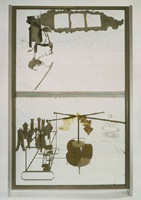
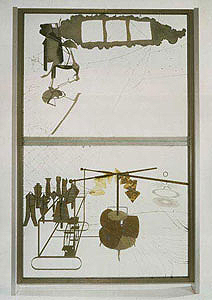
Duchamp’s refusal never to let himself be seduced by the security of normal life and his scorn for the respectability and honors which accompanied this life were therefore sincere and very similar to the anarchic despair experienced by political explorers, by outcasts like Hitler. Without a doubt he didn’t escape, no more than any other, from an infantile proclivity for provocation. From the Indépendants to the Armory Show, he had not a few of these acts which recalled the violence of the time. His actual approach — so profound and so stubborn that it would define itself in the Large Glass, in the ready-mades, and later in Étant donnéswas of a wholly different nature. It was a matter less of shocking the bourgeoisie and destroying their culture than engaging himself in an intellectual adventure without precedent.
Anarchists, Dadaists, Surrealists and other dynamos of society: Duchamp was decidedly not of this group. Rather, his camp was that of the deserters. His departure for New York, at the beginning of the war, resembles Descartes’ departure for Amsterdam. To a cauldron of reflection, of daydreaming, far from the masses. Polite but reserved: he wasn’t there for anyone.
Max Stirner , therefore, rather than Nietzsche or Sorel. The idea of the unique
pupil in advance of the obsession. Nothing owed to anybody and nothing repeating itself. There wasn’t any need of “getting lost” because, in the world which he had entered, there was already nothing else to lose. He was the first to understand that he belonged to a world “without art,” in the same way one speaks of a world “without history.” When he began his work, the death of art had taken place. In this respect, Duchamp is a survivor, not a precursor. He wasn’t preparing for the flood, he was exposing the conditions for survival.
From Decadence to Dandyism
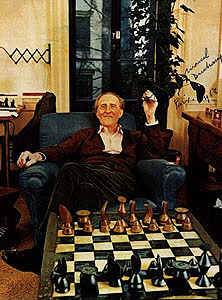
The elegance of a dandy instead of the feigned untidiness of an anarchist. The lack of distinguishing adornments. To pass unnoticed was the distinction. This avoided the worst blows as well as applause. It was an attraction to the strict, the rigorous, the stripped down – “austere” was the key word for Duchamp’s aesthetic, just the right tone in English flannel and tweed, enveloped in the wreath of a good cigar.
The distance he put between himself and his press was always very British. Every one of his talks, interviews, and writings was subject to: “Never explain, never complain.” There was no theory to justify himself, no excuse to excuse himself. Such reserve was immediately sufficient to disconcert a questioner, to discourage the curious, to confuse the scholarly.
The style of this period was also, among the enlightened ones in London, Vienna, and Brussels, about American functionality. Duchamp’s admiration for the quality of plumbing in New York was right up the alley of Adolf Loos; everything, like not tolerating the rancid smells of turpentine trailing about in the studios, was in accord with the architect of theMichaelsplatz, with his disgust for the pastry shops in Ringstraße. (The taste for industrial modernity, for every last technical comfort in improving a home, was already, right away, a trait of the decadent such as des Esseintes.) Nothing “dadaist” in any case, rather an exquisite education, confronting the trivialities of the time.
* * *
No, his admiration had gone instead, one could say, to Mallarmé, Laforgue, Jarry, Alphonse Allais. From his direct elders. From “countries” of Norman descent also, in that this concerned the last two. A nihilism well tempered. The line of the symbolist comet. It would be convenient to add, come to mention it, Huysmans – and Remy of Gourmont, another Norman – whom we think about very little.
From des Esseintes to the “Breather”
Huysmans first. Did he ever read him? Well, we couldn’t leaf through Against the Grainwithout thinking at every turn of Marcel Duchamp. Plus, among the three paintings that Suzanne Duchamp submitted to the Salon des Indépendants in 1912 (thanks to the care of her brother) there was an homage, À des Esseintes. This seems to indicate some close reading of the author of Down There in their family’s Blainville household.
click to enlarge
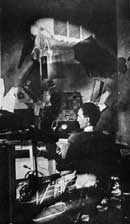
1. Duchamp in his
studio on 14th Street, New York
(detail from a photomontage by
Kiesler, Poème d’espace
dédié à H (ieronymus)
Duc’hamp, published in View
, Series V, n° 1, March 1945)
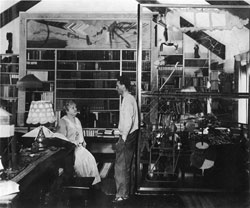
Some features clarify this elective affinity. For example, in the solitude of his studio, on 14th street, the image of Duchamp seated in his armchair, his expression fixed, his hand “à la maisselle” as we see him in some photographs, among so many things scattered in an “amusing physique,” piled up to the sky, overcome by the “dust breeding,” the Rotoreliefs, the sketches of mysterious machines, unique optical devices, a movie projector and bits of film, stereoscopes, and the chessboard hanging from the wall, similar to the magic square of Dürer. ill. 1. This instantaneous office of the idle and curious, marked by fatal signs of melancholia, this eternal “sad young man on a train,
” transported to New York, in the beginning of the century, a new version of the insomniac of Fontenay-aux-Roses, a “des Esseintes” “seated pensively among all the wise toys that civilization offers to its sick for their procuring disappointing respites.“Henri-Pierre Roché would not be mistaken; he suspected the accediosa nature of his new friend, such a hermit and yet the prophet of a religion. Entering Duchamp’s New York studio for the first time, “Pierre realized that he was in a monastery.”
When we asked him if he believed himself an artist, Duchamp responded that he was only a “breather”whose masterpiece, he would say again to his friend Roché, had been the use of his time.
The idea was to elude the taedium vitae which fills up a tired civilization, a Spätkultur, a civilization after the death of art, overloaded with memories and overcome with masterpieces, both authentic and inauthentic, a civilization where the signs of a new empire which is the world of science multiply and disturb the outlook by their unusual configurations, a world where the artist retires, becomes an amateur, critic, collector. Duchamp, like the Arensbergs and Katherine Dreier, his first patrons, would initially be a collector, and an expert; then he would become the first curator of the Société Anonyme, choosing its art, writing notices, advising buyers. In many of these areas, he resembles Huysman’s hero who, in order to escape his condition of failure, turns into a dilettante, collector, book lover, decorator, and consumer of rare and original sensations.
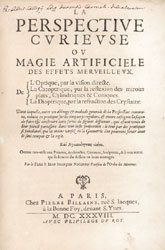
“He had searched the libraries, exhausted the boxes, encumbered his intellect to skim the surface of this mess, and all for idleness, for momentary appeal, without a desirable conclusion, without a useful goal.” The portrait of this researcher worn down by the acedia of the end of the century could have been that of Duchamp in the library of Sainte-Geneviève, leafing through old treatises on the perspective of Nicéron, Abraham Bosse or the celebrated Kircher, or the new treatises on mathematics by Jouffret and Henri Poincaré, in search of an impossible synthesis. It’s that of des Eissentes, prey to his fin de siècle neurosis and subjugating himself to what ultimately resembles, now as well as then, with Duchamp or the hero of Huysman’s, some very modern spiritual practices, the ersatz of a world that’s become decidedly impossible.
The esthetic dilettantism of a collector and the idle curiosity of the curious. But also the erotic dilettantism of he who searches for adventure. The dilettantism, therefore, of Duchamp-Don Juan. Just as des Esseintes collects sexual adventures, here was the novice rogue, after young women at New York’s high society balls. Henri-Pierre Roché, in Victor, would create a portrait of this.
Both in effect are bachelors, and both are misogynists. Both are heirs of Beaudelaire: “Woman is natural, that is to say, appalling.” The same man who affirms that “Nature made time and the moment has come for it to be replaced with artifice” is he who wrote “One has only: for femail the urinal and one lives by it.” Better yet, he mocks the “abominable abdominal skin.” All are evidence of the same root.
Artifice must be substituted for art because art is already dead. Similarly, cynicism in sexual matters must replace love because the time has come to subjugate Nature, and therefore its accomplice, woman, to the artificial genius of man. Forays by Duchamp into transgendering and cross-dressing through his alter ego Rrose Sélavy echo the singular curiosities of des Esseintes and his fascination for both the athletic, monstrous Miss Urania and the “sashaying” Adonis.
Confronting a love as broken down as art remains the challenge, even if it will be one of infinite despair. Artifice will always be superior to Nature. And the machine, for the bachelor, has charms that a woman doesn’t.
* * *
Of all the connections that Michel Carrouges made in his essay, he overlooked that the steam engine, which fascinates des Esseintes,
appears even as a prototype of the “accouplements de visceres et de machines” [the coupling of innards and machinery] that Duchamp will combine in his Bride. Because she is artificial like the would-be Eve (only two years later) she is superior in natural beauty. The unsurpassable perfection of airplane propellers that Duchamp remarks upon during a visit to the aeronautical museum in the Grand Palais in 1912, crosses the mind of the hero of Huysmans. “The beauty of woman is, in everyone’s opinion, the most original and the most perfect.” In revenge man makes “an animated and artificial being who is amply worthwhile from the point of view of fabricated beauty.”
These new beings, they are, in relation to blasé des Esseintes, two adopted engines on the lines of the Northern railroad. “One, the Crampton, is an adorable blonde, with a high-pitched voice, a very tiny waist, imprisoned in a sparkling corset of brass […] whose extraordinarily horrifying grace when, tensing her muscles of steel […], sets in motion an immense rosette of its wheel […] The other, the Engerth, a monumental and somber brunette with muffled, husky noises, with solid organs, chokes in a cast-iron armor…
* * *
The anthropomorphism of the machine dates from its appearance, from the first loom, “Jenny,” named after the daughter of its inventor, up until La Bête humaine of Zola. But Huysmans is the first to give it this erotic appeal which makes the metaphor of the male/female anticipate by thirty years the description that Duchamp will make, piece by piece, organ by organ, the driving force of the Bride in 1912.
Another “bachelor machine” of des Esseintes is a liquor organ. It contains an element that all experts of the Large Glass will recognize, a bottle of Benedictine which Huysmans described in his leisure as the bulging form “solid, of somber green.” The hero’s attention dwells amorously on it, dreaming
of “cornues” and “alambics” prepared for “incontestable authority” and fascinated by “the extraordinary disaccord established between the containing and the contained, between the liturgical outline of the bottle and its soul, every ounce feminine, every ounce modern…
An idealistic thinker
“Liturgy” and “soul” – these terms seem a long way now from Duchamp. The “black” mass of des Esseintes, viewed as a sacrifice where one celebrates in reverse, “à rebours,” comes under a decadent religiosity from which the work of Duchamp seems to remain foreign.
It is ironic that, behind the scenes, he showed a taste for the marvelous that certain surrealists exhibited. Especially when we consider that André Breton, Desnos, Crevel, Brauner, accorded so much credit to hypnosis, telepathy, and the interpretation of dreams that they left him cold. As they left their friends Man Ray and Soupault. We know also with what an amused distance he welcomed the gloss that certain of these commentators made of his work from the approach of an alchemist or an agnostic.
But to see him as a true believer opposed to the supernatural is to forget that Duchamp had not ceased to interest himself, between the ages of ten and twenty, and perhaps beyond, in paranormal phenomena. Without a doubt one must be prudent. Duchamp was too ironic. He cultivated too much skepticism not to be watchful of the reality of these clairvoyant phenomena. He observed them, considered them, believed in them without a doubt always, entirely. However, each time he was interested in them they seemed to be based on a scientific approach that pulled him instantly from his ennui.
In this way, he responded to Arensberg, from whom we know of Duchamp’s taste for spirituality and theosophy; in fact, he had once been unconsciously preoccupied by “a metarealism…a need for the ‘miraculous.“
Similarly, after the war he spoke of the artist as a “medium” in a famous declaration, often cited,and of art as a means of accessing “non-retinal” reality. Idealism? The romanticism of Novalis? The temptation of a young man for a spiritualism à la Kandinsky, whose writings he conscientiously annotated, even though they are written in a language he little understands? Yes. It was very much this, all of this, that he had gone looking for in Munich in 1912, and it merits our attention. His exemplary copy of Concerning the Spiritual in Art was covered in pencil marks. At the turn of the century, every possible occultist was putting in their two cents about this feeling of intuition that guides the artist blind through “the forest of symbols” of our three-dimensional universe toward a superior reality.
click to enlarge
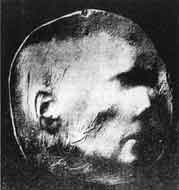
2.Mold of an imprint produced by Eusapia
before the editorial committee of the
journal Lux, plate made of Albert de
Rochas,L’Extériorisation de la
mortricité, Paris, 1906
3.Marcel Duchamp, With my
Tongue in my Cheek,
1959, Paris,Collection of
Centre Georges Pompidou.
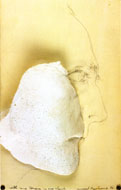
However, it was no longer the occultism of Peladan, Gaïta or Papus which gripped him ten years, twenty years later, and which gripped him perhaps throughout his life, until his last works of art. In 1959, for example, With my Tongue in my Cheek, curiously recalls the three-dimensional impressions, in plaster molds, that mediums in their seances were claiming to receive from the spirits. ill.2,3. The mold of Duchamp’s jaw, akin to a spiritual manifestation, became then a sarcastic commentary, twelve years before his death, of a Duchamp pre-posthumous – of this comic held in the making of the allusion of its English title, “tongue in cheek” – quand on ne rit pas à se décrocher la mâchoire – this discreet turn at mortification was already present in 1954 in another anatomical fragment, the Coin de chasteté, executed with dentistry material and which evokes in effect a filling. The fin de siècle ennui was turning into a morose wallowing: acedia diaboli balneum est.
It was therefore an occultism more refined, more demanding of its material, more subtle. It remained very much also Luciferian: the progress of mathematics and of science were extensively absorbed, and they seemed to bring to him, from now on, a semblance of validity.
From Flatland to the Fourth Dimension
Two domains of science have in effect kept this revival going. They are the discovery of invisible radiation and the development of multidimensional geometries.
click to enlarge
4.Sacha Guitry, Gaston de
Pawlowski
click to enlarge
5.Léonard Sarluis, cover
illustration for Voyage
au pays de la quatrième
dimension by Gaston de
Pawlowski
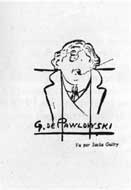
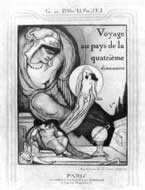
I was certainly one of the first, in 1975, to draw attention to the major influence that the speculations on the fourth dimension had on Duchamp and which he had learned about first in the serial of Gaston de Pawlowski ill. 4, 5, seen in 1911 in Comoediawhich, more than speculation or science-fiction, rose instead from the genre of mathematical entertainment created by Edwin Abott in Flatland, then in the library Sainte-Geneviève, in the Trait de géometrie by Élie Jouffret. Later, when Paul Matisse published with my help Duchamp’s unpublished notes, the multiplication of references to the fourth dimension brought proof of the validity of this approach. It was with Jouffret in particular that he found the concepts of “blossomings” and of “infra-mince.” It was in the writings of Henri Poincaré, Science and Hypothesis, published in 1902, in particular in chapter IV, “Space and Geometry” but above all in The Value of Science, published in 1905, in particular in chapter IV, there again, “Space and its Three Dimensions,” that he found the notion of “cutting” and the essence of his “non-retinal” approach.
* * *
In France, apart from the subtle Jean Suquet, few preoccupied themselves with the necessity of the epistemological overthrow that this approach had provoked. The fourth dimension had never been taken into account by art historians among mathematical novelties which, born of the analysis situs, had turned the esthetic reign of the 20th century upside down, in the same way Pacioli on perspective was upset during the Renaissance. We had seen, for want of knowing exactly what it was, only barely a literary fantasy.We preferred therefore to continue lazily considering Duchamp a Dadaist, a provocateur, an ancestor of New Realism, of kinetics, of the conceptual, of action, or more generally of the nihilism of art. That he managed, contrary to this caricature, a strong, thoughtful method, reasoned, and founded upon mathematical speculations, nobody, in a French tradition foreign to the scientific culture, even ignorant of the history of the sciences and reticent, powerless in any case to cross the frontiers of its narrow disciplines, above all, in a historically lazy tradition which believes in economizing the research of source-material, nobody, historian, university lecturer or simple critic was willing to admit Duchamp had done this. Protected by ignorance, we continued to foolishly surrender to the myth of a Duchamp, originator of acts and absurd objects and, for need of a title, prophet to the avant-garde.There are English historians who interested themselves in this approach: first Susan Compton and John Dee in England.
The first important work, which synthesized everything preceding it, was that of Linda Henderson, The Fourth Dimension and Non Euclidean Geometry in Modern Art published by Princeton University Press in 1983. The same year there appeared a study by Craig E. Adcock, Marcel Duchamp’s Notes from the Large Glass: an N-dimensional analysis (University of Michigan Press) which, for a good part,relied on my research. The many studies which have followed, in the last twenty years, are too numerous to cite here, and only serve to repeat old material, without adding new elements. One will cite, for a recent example, the latest work by Linda Henderson.
More original and more adventurous is the approach of newcomer Rhonda Roland Shearer who is determined to demonstrate the total artificiality and rigorous fabrication of the so-called “readymades,” which far from being found objects have been supposedly modified and manipulated in every aspect of their proportions. According to her, no readymade exists which wasn’t carefully prepared and calculated. Apolinère Emameled, for example, which seems to offer at first glance the parallelpiped construction of a metal bed for an advertisement of paint enamel, reveals, upon examination, an impossible figure which defies the laws of classical perspective. Relying on a very detailed reading of Poincaré and his theory of probability, Rhonda Shearer is, in this way, putting forth that the three-dimensional readymades by Duchamp are, in reality, significant shadows of a four-dimensional entity .
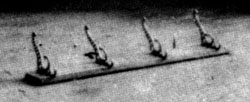
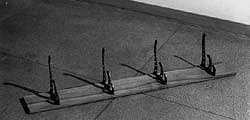
We could support this demonstration with the following remark: exhibited during Duchamp’s lifetime, the ready-mades have always been accompanied by their cast shadow. Bottle Dryer, Hat Rack, Trébuchet [a coat rack] weren’t even presented: a projector, judiciously placed, projected their outline onto a wall or on the floor. They are therefore objects of n dimensions which, because of the trick of their projected shadow, are reduced to three-dimensional objects belonging to our space. The procedure had been used by prospectors in the 17th century to grasp the passage of the geometrical to the perspective, just like mathematicians did later to grasp the passage from a world of n dimensions to a world of n + 1 dimensions. The tableau Tu m‘, in 1918, inventory of varying procedures for “transcrbing” codes of representation of varying dimensions, represents the cast shadow of a ready-made, Bicycle Wheel.
If this tableau were the occasion for Duchamp to quit painting, the apparent promise of its title shuts the door once more on a long history. Remember that the myth of the original painters was formed around the idea of cast shadows. As Pliny the Elder tells it, there was the fable of Butadès de Sicyone, the lover of a potter, who outlined the enchanting shadow of her face as it was projected onto a wall. All things considered, the myth is ambiguous: does it suggest the art of the drawer, therefore an art of two-dimensions, created by the hand of the young woman, or does it suggest instead a three-dimensional work, the clay relief that the father of the young woman derived from the drawn silhouette? The fable of Butadès would have designated then the origin of casting – of “molding” – and not of painting. In both cases, the myth of the shadow of the loved object throws back to the “cutting” of a dimensional universe by another. Remember again that Duchamp, in one of his notes, proposed to create a “Société anonyme des porteurs d’ombres” represented by every source of light – sun, moon, star, candle, fire…It would be, again, a link to the ancient tradition of Ars magna lucis et umbrae.
* * *
So does the ready-made, object of subtle demonstration, through the projection of its shadows, lead into multidimensional universes? This is what Ulf Linde, the best critic of Duchamp and the least well-known since much of his work is in Swedish,had already advanced, as of 1977, in the catalogue for the Centre Georges Pompidou. The Bicycle Wheel, far from being a banal object found in a bicycle shop and mounted on a stool, is in reality an ingenious optical machine which allows the principle of “demultiplication” to be realized by “elementary parallelism” which, from the painting of Moulin à café, in 1911, occupied the mind of Duchamp: “It schematically gives shape to the principle of cubism: if one turns the wheel, one creates a multiplicity of n dimensions – the spokes become innumerable – a unit of n + 1 dimensions.” Likewise was he going to prove the astonishing complexity of Why not Sneeze, Rrose Sélavy? with the presence, under the marble cubes, of porcelain cups.
click to enlarge
6.Window display from l’Exposition
surréaliste des objets,Paris,
Galerie Charles Ratton, 1936
click to enlarge
7.
Projection of a three dimensional
regular body into four dimensions,
brass and string, Paris, Institute
Henri Poincaré
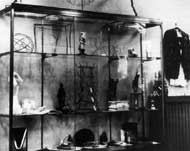
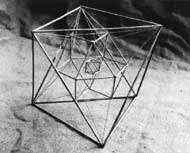
Let’s consider, finally, that in the surrealist exposition of objects at the Charles Ratton gallery in 1936, the ready-made by Duchamp, the Bottle Dryer and the birdcage of Why not Sneeze, for example, were enthroned under the same light and to the side of some mathematical objects in string and brass from the Poincaré Institute which served to visualize the fourth dimension. ill. 6,7. Such near posturing, yet again, in favor of a complex ready-made conceptual machine destined to make visible the multidimensional continuum, rather than an ordinary object supposedly “elevated to the dignity of a work of art by the simple choice of the artist.”
* * *
Another newcomer, Hector Obalk, in recalling judiciously that this blindly accepted definition of the ready-made had appeared only belatedly, twenty years after its creation, and under the pen of André Breton, lends itself to a rigorous test of the topology of these singular objects and to an ontology of their mode of existence. Combining art history with analytical philosophy, Obalk looks to demonstrate that, on those very rare ready-mades more or less “nus” (neither touched nor assisted) by Marcel Duchamp, none is truly a “ready-made” – if one considers the addition of an engraved title on the object and the very significant extravagance of their installation in his studio.
He equally recalls that in spite of these secondary properties, none of these pure ready-mades has been assumed to be a “work of art” by the artist of the era – not only because they have all been lost but above all because of the absence of public exhibition in their time. He finally affirms that “if there’s a work of art, the art by no means resides in the chosen object but, to a much greater degree, in the fanciful scenario which exists within the choice,” or in other words, “in the fiction, most often literature, according to which a ready-made is a work of art.” For Hector Obalk, it’s in spirit that the ready-mades, on the historical plane, are nowhere to be found – and that the ready-made is, by all logic, impossible…
“L’iconographie de l’invisible fluidique”
The other infatuation at the fin de siècle which fed, one could say, the curiosity of Duchamp was the revival of occultism prodded by technical advances, in particular new methods of electricity and photographic recording.
* * *
The “sparks” of The Bride, the “Draft Pistons,” the “Milky Way,” the “cinematic blossoming”: each a word borrowed from chemistry, physics, astronomy, strewn about his notebook.
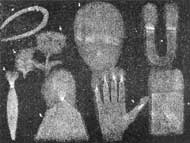
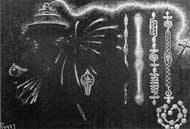
In 1900, electricity, magnetism, and electromagnetism had long since substantiated the idea of obscure energy, of radiation all the more powerful since it was invisible. How could one forget that one of the most ardent supporters of spirituality was none other than Sir William Crookes, the inventor of the cathode ray tube? Or that Camille Flammarion, an astronomer as celebrated in his time as Hubert Reeves is today, believed in the transmigration of souls on far away planets and very seriously featured in The Unknown,phenomena like apparitions of the dead, telepathy, seeing into the future? He wasn’t the only one. Charles Richet, illustrious physicist and inventor of anaphyloxie founded the French Society of Metaphysics and went around the tables and interrogated spirits. The administrator of the Polytechnic School, lieutenant-colonel de Rochas d’Aiglun, took up where des Mesmer and des Puységur left off in studying the phenomena of “odiques” radiation of Baron de Reichenbach. Duchamp would remember, same as his brother, the sculptor Duchamp-Villon, to get an internship in the radiology department of the Sâlpêtrère, and probably brushed shoulders there with Albert Londe and Jean-Martin Charcot.
click to enlarge
8.Drawing of light “odiques,” taken
from Le Fluide des magnétiseurs
by Albert de Rochas, Paris, 1891.
9.Luminous
effects of high frequency,
engraving by Poyet taken from Claude’s
L’Électricité à la portée de tout le
monde, Paris, 1905.
When radio waves were discovered by Hertz in 1888, when the X-ray was discovered by Röntgen in 1895, and when, thanks to Becquerel in the following year, radioactivity brought proof of the mysterious power of the breath, current beliefs in the corporeal body, the astral body, in two halves to one person, in aura, in telekinetics, in ectoplasm were suddenly strengthened. In the hospital of Charity, Luys, neurologist, went so far as to photograph the dreams of his patients by applying sensory detectors to their foreheads. The photograph, which “reveals” and “develops ” from “ultrasensitive” devices invisible phenomena for the naked eye, was in this way far ahead in the quest for the supernatural. ill 8,9. If “retinal” art was displaying its inadequacy through impressionism, the photographic negative, already defined by Jules Janssen in 1875 as “the retina of the wise” would have well been the way. At least it would have been this technique which would have allowed art to regain the “science” that it appropriated during the time of its glory, opening it up now to the world of the never-before-been-seen. In 1904, in his book, Dans l’invisible, Léon Denis compares spirit photographs to X-rays and defines the negative as “this look onto the invisible.”
* * *
Des Esseintes, again, in his singular mixture of optimism and credulity, reveals the spirit of time. Did he not believe that “the eyes of certain animals will retain, up until decomposition, just like photographic negatives, the image of life and of things, from the time that they died, from their last glimpse.” In 1870, in fact, a certain doctor named Vernois, member of the Legal Medical Society, had published an article on the “optogramme” in the Revue photographique des hôpitaux de Paris, entitled “Étude photographique sur la rétine des sujets assassinés,” in the aim of discovering the identity of murderers.
The examples of scientific discoveries that serve to bolster the devotees of Allan Kardec are, between 1890 and 1910, innumerable. Every nebulous group was a mixture of the most renowned intellectuals and the most dubious magicians. And art, after having exhausted the resources of the visible world in naturalism and impressionism, put itself from this point forward in quest of the invisible, which Hyppolyte Baraduc, one of the most ardent proselytizers of the Beyond, was rightly going to name, “l’iconographie de l’invisible fluidique.”
Munich, Capital of Occultism
We are far from having discerned all there is of Duchamp’s trip to Munich, which I mentioned above. Why did Duchamp go there? Above all, why did he stay there so long, for four months? What could he have found in this town of six hundred thousand inhabitants, rustic and provincial under pretentions of grandeur? What was the charm in these Propylées put together in the Königsplatz, in these alignments of the fake Pitti Palace along the Maximilianstrasse, in the caprice of the Feldherrnhalle, clumsy copy of the Loggia dei Lanzi, in this secondhand architecture drawn from a Wagnerian opera? Instead of being the Athens of the North which she pretended to be, wasn’t the city of Wittelsbach the biggest kitsch town in Europe? Would Duchamp, born into a cultured and satisfied bourgeoisie, have taken interest in the great masters which made huge and heavy paintings Munich’s glory, like Hans von Marées, von Stuck?
Let’s remember some coincidences. The town was, at the start of the century, a place to meet immigrants of every background, the marginal, as it were, who hadn’t found a place for themselves in their own country. Munich was the rendez-vous of refugees from the East like Jawlensky, the brothers Burliuk, Kandinsky, and some Italians like de Chirico, ill at ease at home and who, nourished with Greek culture and German philosophy, were more arrested with the spirit of Sezession than with a Parisian modernism. The French, they were hardly headed for Munich.
The bohemian spirit, which welcomed all, also drew a certain number of anti-conformists of another nature. Twelve years before Duchamp, Munich had welcomed, under the name of Herr Meyer, a certain Vladimir Ilitch Oulianov who, in the tranquility of the students’ and “artists'” quarter of Schwabing, would write under the alias Lenin manifestos destined to change the world. And, in May 1912, if one believes Mein Kampf and the account of the life therein, Hitler also landed in Munich and went to live a few steps from the domicile which accepted Lenin, on the Schleissheimerstrasse, in the north of town, at the edge of Schwabing. Hitler wrote that he was “full of enthusiasm,” with the intention of putting to work his training as an Architekturzeichner, as a draftsman. However, Hitler never succeeded in getting accepted to the city’s Academie des Beaux-Arts; it was more difficult in Munich to live as an artist than in Vienna.
click to enlarge
10. Heinrich Hoffmann,
Marcel Duchamp, 1912
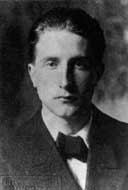
Is it possible that Hitler and Duchamp crossed paths in Munich, in the smoky cabarets of Schwabing or in the Festsaal of the Hofbrauhaus? It’s slightly possible. When Apollinaire wanted a portrait of Duchamp to illustrate Les Peintres cubistes, Duchamp chose Heinrich Hoffmann, the #1 photographer of Munich who had come to immortalize the work of von Stuck and of Hildebrandt, ill.10. This is the same Hoffman who, eleven years later, would become Hitler’s personal photographer.
The photographs that he made of Duchamp, in the pose of a speaker with his mouth shut, were, it’s been said, influenced by Erik Jan Hanussen, the famous European sage, seer, and astrologer, who would have taught Duchamp the art of body language.
* * *
This reference takes us back to the ambiguous capital in which avant-garde artists and political adventurers plunged indiscriminately. In 1912, Munich had in effect become the Haupstadt, the European capital of occultism. The Gesellschaft für Psychologie, established by the official Baron
von Prell and the doctor von Schrenck-Notzing, was then in full swing and multiplying its exchanges with the spiritual underworlds in England, Italy and France. Nor did the heart of the modernist scene in Munich pass unnoticed by Stefan George’s circle. Moreover, in the plastic domain, along with vson Stuck and Marées, who carried the symbolist generation, one of the most celebrated painters in Munich was Gabriel von Max who painted portraits of sleepwalkers and spirits. His brother, photographer Henrich von Max, took photos of mediums in trance that Gabriel then used in his tableaus. Here, we notice a coincidence with the use of auras and halos which Duchamp tried his hand in with, for example, Portrait de Dumouchel. In 1907, the annual meeting of the Theosophical Society met in Munich and, between 1909 and 1913, the Mysteries of Rudolf Steiner were regularly played there. The great anthropology master, who in 1913 broke away to distinguish himself from the theosophy of Blavatsky, also promoted, during these years, conferences which were assiduously attended by Klee, Kandinsky, Jawlensky, Gabriele Münter and Marianna van Werefkin. Did Duchamp listen in? If this disciple was reading so attentively, to the point where he made particular notes in Du spirituel dans l’art, wouldn’t he have been tempted to listen to the master? Did he go to see the Alchemy museum, in the future Deutsches Museum, with its cornues threaded one into the other like the sieves of the Large Glass? Without a doubt, and much more. It was in Munich in any case that he discovered the theme of his Grand Oeuvre and it was in a frenzy that he multiplied his approaches which would one day turn into the Large Glass : Virgin (No. 1), Virgin (No. 2), Mécanique de la Pudeur, Pudeur mécanique, Passage of the Virgin to the Bride, Bride.
* * *
In search of a non-retinal art, capable of taking into account the invisible and its manifestations, Duchamp very naturally gravitated towards these “seekers” and found photography to be the new medium which would permit him to materialize these new phenomena. In 1922, on Christmas Day, in the Brevoort hotel in New York, he wrote to his brother Jacques Villon: “I know a photographer here who takes photos of the ectoplasm around a male medium – I had promised to help him in one of the seances and then got lazy but it would have amused me a lot.””
“Metarealism” had never really stopped fascinating the man who, in the “Pistons de courant d’Air,” had always meant to photograph ectoplasm.
It was this direction that I undertook to define in Duchamp et la photographie.
But the work, which appeared in 1977, had come too early. Enthusiasm for photography had not yet been born. Above all, in the Parisian climate, one wasn’t disposed to admit that occultism, theosophy and spirituality had fed the imaginations of modern painters more than Lenin’s work or the treatises of Rood or Chevreul. It would have to wait twenty-eight years and through a series of exhibitions that would begin in Los Angeles with The Spiritual in Artand culminate in Frankfurt with Okkultismus und Avant Gardein order to see this approach not only validated, but triumphing over others.
Much since then has appeared which reveals the immense influence of the irrational at the turn of the century on the birth of the avant-garde.
Two unpublished sources
A little more than twenty years ago, in 1977, I attempted to present the fertile ground of this vein without taking much risk and committing myself to it. To establish the approach of the avant-garde from its curiosity with the occult instead of its solidarity with the proletariat, this would have been too much of a shock for the doxaof modernism.
click to enlarge
11. The cover of the book by
Louis Farigoule, La Vision
extra-rétinienne et le sens
paroptique, 1921
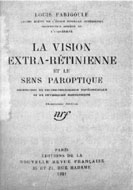
Even so, the indications poured in. While disappointing others, I discovered that in February 1919 – when Duchamp had moved towards the invisible, bought a small glass, To Be Looked at (from the Other Side of the Glass)…, and worked on the stereoscopic point of view of the anaglyphes – a certain Louis Farigoule, an old student of the École normale supérieure, destined to be celebrated under the name Jules Romains, had published in the NRF an essay entitled La Vision extra-rétinienne et le sens paroptique
[Extra-Retinal Vision and the Paroptical Sense], ill. 11. Featuring sightless vision, the young doctor closely approximated some of Duchamp’s ideas on the art of the non-retinal and Henri Poincaré’s take on tactile space. With “paroptical” perception, hadn’t he come across “a certain perception about optical conditions of the exterior environment apart from or in comparison to the mechanism of normal perception.”?
The paroptical sense, according to the doctor, who conducted his experiences as if he were in a laboratory, had accorded him “tell-tale markings, microscopic organisms situated on the epidermis.” Or, in other words, it’s the entire body which, according to this theory of an extra-retinal vision, has the capacity of perceiving colors and shapes without using the ordinary mechanics of ordinary vision.
Did Duchamp know of Louis Farigoule’s fantastic theory? The book was distributed among doctors but Duchamp neither shared in this, nor cited the book. The fact remains, however, that Jules Romain, later,in Les Hommes de bonne volunté, was going to create along the lines of Valéry/ Strigelius, a portrait in which Marcel Duchamp would have recognized himself: “These men never left the zone of general sublimation. Space,the dimension of space, the fourth dimension, pure form, absolute form,objectivity, creation, analysis and synthesis, total perspective, absolute plans. Here was what never ceased to burden my eyes. When they cited a particular name, it wasn’t that of an artist. It was that of Henri Poincaré, Duhem, Gustave Le Bon, Riemann, Lobatchewsky….”
* * *
click to enlarge
12. The cover of thebook by
Camille Revel, Le Hasard,
sa loi et ses conséquence dans
les sciences et en philosophie
, Paris, 1909 (with the annotation
by David Gascoyne)
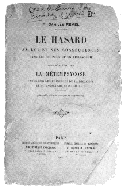
Yet again, in 1977, had I known that Duchamp, in the ten years it took him to construct the Large Glass, was attentively reading another forgotten author today, Camille Revel, who in 1909 had published with the Chacornac press, a.k.a. “Librairie générale des Sciences occultes,” and with the Durville press, a.k.a. “Librairie générale du magnétisme,” a very large book called Le Hasard, sa loi et ses conséquences dans les sciences et en philosophie, suivi d’un essai sur la métempsycose basé sur les principes de la biologie et du magnétisme physiologiqueThe Law of Chance and Its Consequences in Science and Philosophy, followed with an essay on metempsychosis based on the principles of biology and physiological magnetism] ill. 12.
Evidence of Duchamp’s fascination for the occult is on the exemplary copy that he owned and which was entrusted to me by Jacqueline Matisse-Monnier. On the cover there is a handwritten inscription in ink:”One of the sources of the originality of Marcel Duchamp.” It is written in the hand of the English poet David Gascoyne to whom Duchamp had previously entrusted the book.
I leave this unpublished source – decisive in so many ways- to the examination of future scholars.
A modern theophany
What does this continuous association with the unseen worlds mean? That, absolutely, there was never with Duchamp the will, despite the last go-round with Breton, to elevate found objects to the rank of art under the name “ready-made.”
This definition, it’s almost with regret that Duchamp accepted it and it was just barely at the end of the fifties that he consented to comment on who seemed to get the credit.
Therefore, more than thirty years after having conceived and made them, he resigned himself, under the pressure of the neo-dadaists desiring to recruit him to their brotherhood, to side with the legions of the current avant-garde.
Ready-made? It underestimates the complexity, the finesse, and the material perfection of these enigmatic objects, so difficult to reproduce,and which seem to me rather like subtle traps with which to harness Chance,similar to the small curios of the American Indians, objects made of nets,shells and beads that they call dream-catchers.
However, what artist or critic in the fifties, in the middle of l’informel and existentialism, a fortiori in the sixties, in the age of spontaneity and provocation, would have been able to accept the spiritual and occultist arrière-fonds, the idealist philosophy and the quasi-religious (in the proper sense of the term) from which these objects, which were going to do so much to clarify matters, had been chosen and defined? It was necessary to find in their existence an explanation in accordance with the spirit of the time – something that Duchamp only barely supplied at last, a posteriori. The theories of Jouffret and Poincaré, which concern themathematical representation of the world, and invisible radiation – which by means of the negative brings proof of a reality other than that perceived by our senses – as a technique of representing the world, are the same expression, yet again, of a non-retinal vision. If we go along with this perspective, we must understand then that the fourth dimension which renders itself visible in the third dimension is for us the geometric metaphor of that which was in ancient times the metaphor of God, hidden, rendered visible in the carnal image of Christ. And, suggesting the mystery of the creation of the image, which has preoccupied every artist, the ready-made, an object of encounter, of the “rendez-vous,” is measured in varying degrees. Like Duchamp said, “this snapshot effect” of “on such a day, such a date such a minute” where the hand of the artist does not interfere would be the equivalent in our time of that which was the image achéiropoiète of the Byzantines in which Chance, to use the capitalization of Camille Revel, would play the role of God.
Far from the tabula rasa of the avant-garde which supposes a creation ex nihilo, it goes against a strange dream of logical relationships and of the necessary continuity of a creation – “that rules from age to age,” which Duchamp abandoned when he said:
“So a man can never expect to start from scratch; he must start from ready-made things like even his own mother and father.”
The ready-made isn’t therefore a manifestation of a new absolute, it is the re-emerging effect of an obscure area which reappears at a given moment according to a “clockwork” firmly fixed. It is that which manifests itself in the line between the present and the past immemorial, the hic et nunc that reflects upon the whole history of the species, along with its eternal riddle. It would be a modern véronique, an apparition in our space of appearance – to use the same words as Duchamp – similar to the apparition of the face of Edess on the wo-dimensional canvas that is an appearance of the divine, passage then from a universe of n + 1 dimensions to a universe of n dimensions, vera icona, in three dimensions. It is the indication of the hidden face of an invisible multidimensionality which, under certain conditions, is revealed in the “infra-mince” of the cut between the two worlds. This is to say also that, with such an esthetic, the act replaces the work. The ready-made is the effect of a blind date, just as good Fortune hangs in the balance of its counter, and, in effect, veils the eyes: taste has nothing to see. The eye, which makes an artist, serves nothing. Neither discernment nor judgement. A method of feeling one’s way, “like a medium,” “towards a clearing…beyond space and time.”
The blind abandon of Chance. The “rendez-vous” isn’t dictated by sight of another, by attraction to another: it is decided according to calculations where the esthetic judgement doesn’t enter in at the beginning. In reviving the traditional iconography of Occasio calva that we rip our hair out for only as long as she is bald and her eyes blindfolded. Chance according
to Duchamp is a game of metaphysics below nothingness.
An encounter with the ready-made, the clockwork of the “rendez-vous” creates
a vertigo that simple attraction, taste for a thing or a being, wouldn’t know how to produce. Games of Love and Chance, the roll of the die and the eroticism of the libertine: Eros and Tyché would be the directors of the Duchamp pantheon.
It dawned on me to compare Leonardo da Vinci with the author of the Large Glass at a conference held in Cerisy in 1978.
In relation to succeeding generations of love and the chance of ossicles running into one another (which already speaks of the beyond), Leonardo remarked, “We’ll see the bones of the dead, in rapid movements, deciding the fate of those who killed them.”a succession of generations of love and chance, noted “On verra les ossements des morts, par leurs mouvements rapides, décider de la fortune de ceux qui les meuvent.”
This is as far from the marvelous encounters of the surrealists as it is from the scraps of the hand-me-down dadaists. No hermeneutic of the Freudian type in this business of randomness and shadows. To Alfred Barr who asked him why he made use of chance, Duchamp responded that with chance there were two means of eluding “the human element unconscious in art” (the other being, in technique, the use of a purely mechanical drawing).
As a result, no way out of the unconscious dear to surrealism. But worse still, none of the clinical. No willingness to wait for charity. There was nothing to cure. “Given that…; if I suppose I’m suffering a lot” :the “Tender of gravity” would not soothe the lead soles of the saturnine being which Duchamp was…It was better to choose anesthesia, in order not to suffer. The absence of all sensation. An ataraxie esthetic. A suspension of judgement and taste.
From “elementary parallelism” to sexual duality
Eros, then, but a restless eros. The myth of the androgynous haunts Duchamp’s creative process. There’s no point though in looking back like we did with alchemy. The androgynous figure was familiar to the decadents of the turn of the century, even central with Péladan, the biographer of Leonardo, and Duchamp, yet again, behaves like his heir. When in 1919, on a return to France, he adds a moustacheand beard à la Napoleon III to the Mona Lisa on a postcard to make it appear more masculine, he accomplished, just like he said, “un geste de provocation,” destined to show sympathy with the Dada movement that Tzara had just created in Zurich in 1916 and which had begun to spread in Paris. Perhaps what he said was true. Dadaist or not, the provocation would inscribe itself in a strongly established tradition of caricature and pleasantry in the spirit of turning things upside down which had been flourishing in December 1913, when the Mona Lisa was returned to the Louvre, after having been stolen two years before. André Chastel has brilliantly recreated the story of these derivations and vulgarities, to which Duchamp’s farce appears, all in all, rather modest in comparison.
However, curiously, while his book contains reproductions of Italian newspapers where the name of the Mona Lisa is correctly spelled, Chastel pays no attention to the Italian spelling and doesn’t comment on the name being misspelled by the French: “Mona Lisa” when it should have been written “Monna Lisa” (Monna being the Italian diminutive of Madonna). Or that the expression “mona lisa” could have only made our Italian neighbors laugh .
The word mona, in a popular dialect from the north of Italy, means vagina. The poems of Baffo are an interminable ode to the mona. “Cara mona, che in mezzo a do colone” ; “Gran beni che la mona al mondo fa!” As for the adjective lisa, which is the feminine of liso, it means threadbare. A mona lisa, then, to speak rigorous French, is a vagina that’s losing its hair.
The Mona Lisa as Duchamp presented her, with a moustache and beard has been given back some luster and some hair. Against better judgement: the “L.H.O.O.Q. rasée,” that he signed in 1965, is the Mona Lisa as Leonardo had painted her, without this hair.But the word liso, wasn’t it also, in a strict parallel,the plucked penello that was Duchamp himself when, in renouncing art, he went without this “little brush” crowned with a tuft of hair that is the sign of the painter and the symbol of his power?
Duchamp’s so-called Leonardo “ready-made” shows only a little Dada provocation. It introduces a return to a sarcastic reflection, not without finesse, on the precariousness, the possibilty and finally on the reversibility of a secondary sexual characteristic and, as a result, on the dividing “infra-mince” between the two genders which make up the species.
* * *
click to enlarge
13.Montage by Jean Toche
according to La grande Fortune
by Albrecht Dürer and Moulin à Eau
by Marcel Duchamp, for
the cover of the third volume
of Marcel Duchamp, edited
by Jean Clair,Paris, 1977
14.Klein bottle, Paris, Palais
de la Découverte
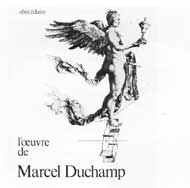
When I wrote, in the article “Éroticism” in the Abécedaire
for Duchamp ill.
13, an essay on the complimentary anatomical shapes of Female Fig Leaf and Objet-Dard [Dart-Object], it was the strangeness of
a topology which they represented which caught my attention. The two figures,
in their necessary male/female reversibility, were also two possible projections,
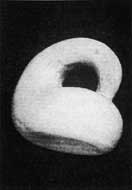
in a three-dimensional world, of a four-dimensional entity, and Klein’s bottle, well known to mathematicians, could offer a sensible approximation of this.
Without a doubt, Duchamp knew of this bizarre object, a one-surface, unilateral volume which represented, along with Möbius’ ribbon, a number of objects which were kept at the Henri Poincaré Institute (which surrealists assiduously frequented) and which Breton collected on occasion, ill. 14. At the start of the sixties, when Duchamp met up with François Le Lionnais, mathematician and member of the Pataphysics College, there were again the topological mysteries of the Möbius ribbon and the Klein bottle that, one would think, intrigued them.This Klein bottle, born from the twisting of a spout turning in on itself, a spout reminiscent of a gloved finger, which so to speak invades itself,this strange cornue whose mouth plunges into its belly, with neither an inside nor an outside, was in effect a perfect illustration of the following note from the Green Box – the only time where it appears beside the mention of a learned four-dimensionality:
“The interior and exterior (in a fourth dimension) can receive a similar identification.” If this series of imprints of the female sex, molds of a vulva and a vagina, gave birth to some of the “dards” and “d’art” objects, such an enterprise responded well to the curiosity about genitalia, a mystery as old as time. In my article, I reproduced for the first time,a tableau which, twenty years later, would set a lot of pens in motion -Courbet’s L’Origine du monde – and I cited the analyses of Sandor Ferenczi who, in returning to Haeckel,established an ontogeny and phylogeny parallel in noting the perfect relationship between the phallus and the vagina, organe-fée,organe-Mélusine, sometimes developed in depth and sometimes on thesurface according to the needs of space.
click to enlarge
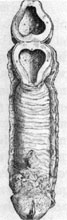
15.The vagina represented like a penis,
engraving taken from the work of Vésale,
De humnai corporis fabrica, Bâle,
1543
The studies of Thomas Laqueur on the representations of the different sexes didn’t appear in the United States until 1990. Dwelling on the representation that Vésale made of the vagina in Fabrica,imagined like a penis fitted back inside its glove, Laqueur analyzed the chance that such a “phallic” representation would have in successive images of the female genitals throughout the Renaissance and even, in the imagination of our minds, up to our timeill.
.
* * *
It was hardly necessary, however, at the time I did so,to trace back to the analyses of Lacan and Laqueur in order to talk about Duchamp’s sexual molds. I needed to go back only so far to get what Duchamp in his youth would have been able to read, during the first years of the century, in the way of Remy de Gourmont.A Norman like Duchamp (originally from Orne), a man of taste, a curious mind, passionate about the erotic, anarchistic, and admirably individual, Remy de Gourmont would hardly have gone unobserved in the eyes of his neighbor in Blainville.
* * *
In 1903, his Physiology of Love was published. Chapter VIII, dedicated to the “organs of love” spoke of “sexual duality and sexual parallelism” as the title of the chapter implied. Gourmont, giving in to the Age of Industrialism, remarked that the male and female genitals were very much “like gears which must hook together with exactitude.”
But even more, citing Galien, it was the similarity in the difference that got his attention: “Every part of man is found in woman; there is only a difference in point of view, it’s only that parts of the woman are internal and those of the man are external, from the region of the perineum. Take into account whichever first gets your attention, either one, and then think of the outside of woman, and think of the inside of man, and you will find everything the same…”
click to enlarge
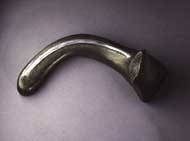
16. Marcel Duchamp, Dart-Object,
1951, galvanized plaster
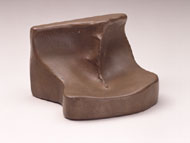
17. Marcel Duchamp, Female Fig Leaf,
1950, galvanized plaster
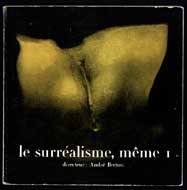
18. Marcel Duchamp, Female Fig Leaf,
Cover for the review, Le Surréalisme,
même
This turning about – inversely – of the male and female was carried out initially with molds of the female sex , first of the external part in the object Not a Shoe, then of the hollow of the vagina in Objet-Dard. Then it was carried out with a photographic inversion, negative/positive, of an imprint that Duchamp made of the female sex with Female Fig Leaf for the cover of issue no. 1 of Surréalisme, même that Duchamp was going to carry out according to a “cut” which, following the teaching of Poincaré, passes through a superior dimension to the three-dimensional one of an anatomical organ. We could then be able to say that, as always, it passed systematically from the flat, two-dimensional representation of the genitals to a three-dimensional representation and, in the declination of the four works that we’ve cited, it passes to apprehending a four-dimensional sexuality. This sublimates the very blow that comes with the notion of a cut or “section” that the term sex implies – ill. 15 – 18 – by demonstrating that the “gender,” the male or the female, was never, as with perspective, only a question of a point of view, given [étant donné ], from a certain distance, from a fixed eye-level, etc.
It was Gourmont again, who, citing Diderot in D’Alembert’s Dream, fournished a description that underlines what the masculine sex possesses, a particular shaft within that resembles, said he, “a tacked on vulva”: “There is in man, from the anus to the scrotum, an interval that we call the perineum, and from the scrotum to the tip of the penis, a vestige that seems to be leftover from a vulva, tacked on…”
If we keep in mind that the singular technique of
the Objet-Dard with its curious hard metal shaft running the length
of it, we can’t miss the parallel. The sewing, the network of “stoppages,” the m of metal are familiar terms in the Duchamp vocabulary.
* * *
click to enlarge
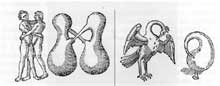
19. The “androgynat alchimique”
and copulation of the two “alambics,
” engraving drawn from a work
of Giambattista della Porte, De
Distillationibus, Strasbourg,
1609
The topological particularities of the Klein bottle could also lead to other reflections. I have even compared this last with the figures of the androgynat alchimique such as the ones represented by Giambattista della Porta, ill. 19. The figure of the Klein bottle devouring itself in a continuous movement which develops on the outside its internal surface and, conversely, which folds back in on the interior surface that which outlines it on the exterior, this movement of inversion would find itself very much in the figure of the two alambics maintaining between them a continuous motion of supply and demand. Della Porta, inventor of the camera oscura, invokes a telling premonition of modern analysis situs. Hadn’t he made it in light of the image of a pelican devouring itself, of which the torsion of its beak plunging into its stomach in order to nourish itself is the same as the Klein bottle, a kind of esophagus continuum inverting its contained with its containing?
click to enlarge
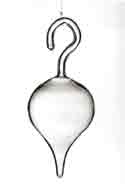
20.Marcel Duchamp, Paris Air,
1919, Philadelphia Museum of Art,
The Louise and Walter Arensberg
Collection.
Now, the movement articulating the interior and exterior of the same volume around a unilateral surface is also found in another Duchamp object, Paris Air, ill. 20. The small glass vial, sealed and terminating in a slender neck, sketches the movement of the Klein bottle and poses in a certain way the same problem. What is “outside” in Paris, the air one breathes, becomes, when transported to New York,”inside,” contained in a small bottle, a pocket of 50cc. The so-called readymade is now a strangely poetic object, largely meditative, a trap for dreaming, banal in appearance, that opens up one’s mind to the reversibility of phenomena according to the point of view of the observer.
To be a man or a woman is a question of point of view, which expands or envelopes the surface of one and the same Objet-Dard.
To breathe is also a question of point of view, whether it’s about inhaling the air around us or considering the air just captured from where we were. This infinitesimal difference, that the transparent wall of a capsule of air creates, is what will resume for us the notion of “infra-mince.”
Duchamp had said, “When the tobacco smoke smells also of the mouth which exhales it, the odors marry by infra-thin.“ And when he calls himself a “breather” and lets go of his last breath, again, the question of “infra-mince” comes into play. The inscription on his tomb reads: “Besides, it’s always the others who die.
“Besides, which is to say seen from another side, considered from another place, an unreal death. Death is only an “appearance.” It is seen from the eyes of those who are on this side of the world, but it isn’t a matter of ours. We will never be the eye-witnesses of our own death.
As we approach it, the last breath separates us from it. We believe we can grasp it, from the other side of the glass, but it escapes us, belonging in the very act to another dimension that is where we will remain. It is not hidden from life but follows along the same unilateral surface and continues, like the Bride’s love, and recovers from the act of enveloping and expanding one and the same reality. It is also in a dimension other than the continued three-dimensional, the continued succession of appearances that alone the infirmity of our experiences prevents us from entirely grasping just as it keeps us from understanding the end. From this side of things, we will never be the observers of our death. This “Besides” that separates us from the “infra-mince” frontier, from an invisible window, isn’t it also the glass through which Alice, in a mathematician’s fantasy,stepped into another world?
One last thing, in this moment when Thanatos rejects Eros, Duchamp, the great melancholic, noticed that our judgements and our affections always depend on the angle from which we absorb space and time in the world here below. And this world will forever be just a simple reflection taken from a superior reality that always remains inaccessible to us…
The Soirée with Mr. Duchamp
With Remy de Gourmont, we return to the place where we started. Duchamp, decadent?
Remember, one more time, the portrait that Jules Romains drew of Strigelius for which the model was Paul Valéry. A Strigelius “satisfied, not with production, whose faults didn’t escape him at all, but with mannerism, by which things happened. He wasn’t tormented one moment, wasn’t afraid of sterility, neither of failure […] Everything was given to the encounters between matter and mental instinct. Strigelius himself – such a responsible man, a director of “signature” – was restricted to being attentive and speaking his mind. He showed little pain. The game amused him.“Leonardo’s method, which would have fascinated Paul Valéry, and the Strigelius method that Jules Romains described are in effect one and the same method – the method of Duchamp, “le directeur qui a la ‘signature'”.
The way to escape sterility and to ignore the angst of being a creator is to leave oneself to Chance, not to the game of the surrealists in which, in the shadow of the unconscious, there sparkles the meeting of words and graffiti, the promise of the sense and the accomplishment of desire. Nor is the way to escape by taking on “the automation of the sibyl” but, says Jules Romains very smartly, “a kind of automation of instinct” which permits him to “stay in agreement with his vision of the world, having crowned old dreams that it turns into a physical-mathematical culture .”
Within [the French] “insecte” there’s the word “sec” [“dry”] and this key word to Duchamp’s esthetic is the confession of a moral: beneath the sparkling of words there is nothing, nothing profound, nothing interior, nothing trembling, but a roll of the die forever tossed away. Perhaps there was only the fascination of the skeleton, “la mariée squelette” for Duchamp, in its geometrical purity and in its honest whiteness,
a corpse which would always be refused the exquisite charm of existence… The real work, like with Leonardo – like with Raymond Roussel whose approach to writing also gave rise to the Strigelius method – was always sacrificed to a program of possible works. In default of mastering a creation, we see a dissemination of immense criticism. A poïétique, in the absence of a work.
Let’s stick, however, to the ambition of creating art. Even a masterpiece. This ambition was that of Leonardo. Nothing less preoccupied Duchamp, nothing more concerted. Lazy but stubborn. He was, in this way, a classical mind: none of the mall-mindedness or shortness of breath of the moderns who identified with him. Thirteen years to work on the Large Glass. Twenty years on Étant donnés. And the first notes for this enigmatic work, which was revealed in 1969, date back to…1915. Similarly, 1915 is the date of his notes about The Clock in Profile which wasn’t seen until 1960. An astonishing perseverance, an astonishing production, focused, while everything around him fell to pieces. But a masterpiece, in the second half of this century, was it even possible?
* * *
In essence, more like Monsieur Teste than any other. “I was badly, sharply affected with perfection. I held onto an extreme desire incapable to comprehend, and I was searching inside myself for those areas critical to my ability to perceive.”
With a similar feeling of distance, we aren’t any further from the “Painting of precision” or the “Beauty of indifference” which would define the esthetic of Marcel Duchamp.
And still, he who welcomed beginnings, ignored ends, who considered himself superb, as a “définitif inachèvement,” how could he not have recognized himself as being in the faith profession like Teste: “The general results – and by consequence the work – interested me a lot less than the energy of the worker – the substance he trusts.”
The treatise on chess that he wrote in 1932 with Halberstadt, Opposition and Sister Squares Are Reconciled, brings this interest to mind. From the author’s own confession, the book was unusable. It features a problem which almost never happens in chess matches and would only serve a handful of persons. “These are possible situations at the of a match, but so rare that they are nearly utopian. Chess champions don’t even read the book since the problem it raises only happens maybe once in a lifetime.”
It was Henri-Pierre Roché who would guess the profoundly hopeless horizon
of such an enterprise. “A game,” certainly, but an extreme one, which people no longer fancied. Would this have amused him too? A Monsieur Teste of the domain of art – “It isn’t a matter of demand for the same possibility. The worry can be about control. He observes himself, he maneuvers, he doesn’t want to leave himself to maneuver.He only knows two values, two categories, those which are the underlying consciousness of his acts: the possible and the impossible….”
The Taboo of Modern Art
Having arrived at this point, I was seized with doubt. Monsieur Teste? But Monsieur Teste had nothing of the sarcastic about him. Nothing of this mordant irony, nor even the cynicism that we encounter in Duchamp. Moreover, wasn’t it a matter of conserving art – Ars– by killing the artist himself, as if cutting the strings of a marionette? Or, on the contrary, since art was already dead in 1912 when Duchamp came upon the scene, was it about preserving the illusion of being an artist, sparing oneself the labor of having to do the work?”Since 1923 I consider myself as an artist ‘défroqué’ [unfrocked],” he wrote in his own hand in the sixties. What religion of art did he serve as preacher? What liturgy did he celebrate? And in 1923, the unfinished state of the Large Glass – his failure? – what lay people did he show this to? The expression of “unsatisfied relations” came to my quill when I attempted, simultaneously, to trace the process of exclusion which made Duchamp “a failure” and to deconstruct the genealogy of the readymade. “Il faut partire de ce qui a déjà été fait…comme l’ont fait son propre père et sa propre mère.” An unexpected confession from the mouth of an iconoclast and an avant-gardist who had found himself also the youngest in a line of artists.
click to enlarge
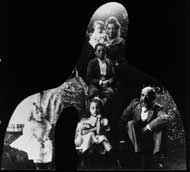
21. Marcel Duchamp,
Ready-made, 1964
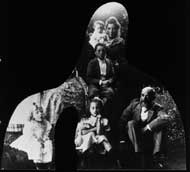
In 1964, Duchamp produced a twilight readymade from a photo of his family, ill. 21. Taken in 1899, it is found to have been cut – like the outline of Marcel Duchamp in M.D. dechiravit – along a certain curve. We see the father, Eugene Duchamp, seated on the right, and next to him the two sisters, Suzanne and Yvonne, while in the top half, the mother holds in her arms the newborn baby Magdeleine. Young Marcel is in the center. The two brothers, however, aren’t visible in this cut-out of the photograph. Intentional? To avenge the insult from them at the Indépendants? “Incest, or the passion of the family.”
The last settling of an account of the child “born to rebel”?
click to enlarge
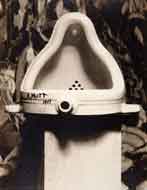
22. Marcel Duchamp, Fountain,
1917, photo by Alfred Stieglitz
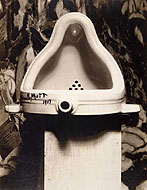
The way the photo has been cut is unique, just like the hat of a doge is unique, with still another cut within, like the shadow of a needle. But the helix which opens a window within the photo shows also, precisely, another cut and another shadow: that of Fountain,in its canonic photo that was made by Stieglitz in 1917, ill. 22,to illustrate The Richard Mutt Case. The family portrait becomes,in a certain sense, a retouched photo, framed by the readymade Fountain.
In carefully choosing the angle from which it would be taken, and in designing the shadow in the urinal’s cavity – the same as the outline of the photo – Stieglitz gave the sanitary apparition the appearance of a mandorle or a Buddha, as some people have said.
The sanitary object thus disposed – turned to a 90 degree angle, photographed,of trivial use now as a public object – took on the allure of a porcelaintalisman, pious, for private worship. The title even underlines the ambiguity:Fountain, with its connotation of lustrous water, of natural origins,of a clear rejuvenating spring.
It was Louise Norton, wife of the composer Edgar Varèse, who dubbed Duchamp’s urinal “the Buddha of the Bathroom.” Relying on a passage from the authority, Remy de Gourmont – rightly, in his Essay on the Dissociation of Ideas – yet again doesn’t hesitate to see, if one succeeds in breaking away from conventional bonds with which we link objects with functions and words, the “pure” example of an art of the future. A fountain to cleanse the face of prejudice. Should we ask ourselves now about the significance of the signature: R. MUTT? We will here advance a hypothesis: “Mutt” in English is a pejorative word that means “imbecile, twit.” Modern-day French would say “sale con.” As for the letter R, rather than being the initial of a surname, doesn’t it go back to an episode during preparations for the exhibition of the Society of Independent Artists where the urinal was going to be shown? Duchamp had been charged by the committee’s director to preside over the hanging of the art. In order to decide how to choose the alphabetical order of the artists, he decided to do a drawing of lots. It was by chance that the letter R was drawn first and would determine the place of 2,125 works at the exhibition. As a result, R appears like the rank of the work and “mutt,” its adjective. Notice too, that to the eye of any student of German, like Duchamp, R. Mutt can be read as “Armut,” German for “poor”, “indigent,” “destitute,” “penurious,” “incapable.” Geistige Armut is poverty of the spirit.In English, like in German, the word rings with lowlife, humiliation – confirming the use of the object which in modern society serves to evacuate urine.
An esthetic of the stercoraire
To inscribe the effigies of his own family in the inside of a urinal is to recall Inter urinas et faeces nascimur. To make it in the spirit of a readymade that more than any other was put at stake along with his relationship and his reputation, his “fame” as an artist. To compisser his family in the same action and to enthrone a urinal – this was to pursue a scatalogical and embarrassing eloquence that he often manifested. Recall, of the twenty examples of puns and Morceaux moisis [Moldy pieces] gathered by Michel Sanouillet, the “Fossettes d’aisances,” the “Oh! do shit again…” “Oh! douche it again,” the “de MA Pissotière j’aperçois Pierre de Massot” and, above all, the anagram so revelatory: “Ruiner, uriner” [Ruined, Urined].
The useless public urinal, Fountain, appears at first glance like a perverse parody on the shell in which Aphrodite was born from the foam of the sea and the sperm of a god. The ejaculation stream and the urine stream are the insult made to the vénusté. Of the Beauty remains only “ruins.” But for the semen to substitute waste is to advance that reproduction is no longer from Eros but has returned to its primitive cloak. “One has only: for female urinal and one lives by it…
The urinal also establishes, in contemporary history, that the museum, a closed and sacred place where the object of ancient ritual turns into the object of modern culture, is in shocking proximity to the pit of release, the public bathroom, the prostitute or the brothel.
At the opposite end of the spectrum of the positivistic thesis of Malraux on the metamorphosis of Gods in the imaginary muséal, Duchamp’s museum is a place of cleaning out, of reducing, of desecrating art in “in every respect.” A general draining of values.
* * *
Since the time of the ancients, the experience of the stercus
has been linked to the birth of culture .
Our ontological position faced with the concept of Beauty is first a scatological position. What, asked Goethe, do we make of this Erdenrest, of this inopportune “pit stop” by which man, like animal, marks out his territory?
Civilization, if one believes Freud, is subjected to a double unrest: when shed of an impulse to subjugate such dregs of the earth, it creates objects and values socially useful but it is constantly motivated by the need for “more juice” [tr. a play on the word for “orgasm”] which is never reducible to the dimension of the useful. Civilization is trapped between the reality of excreta and the necessity of waste which comes from the production of abundance, itself born of the triad – order, cleanliness, beauty – fruit of our education, which is to say the repression of instinct. In this way, waste is found to be sublimated to a gain in pleasure, an enrichment, of which a work of art would be the most noble image. The high degree of civilization of the Roman culture is measured as much for the construction of a Cloaca maxima as for the beauty of proportion in an aqueduct bringing water for bathing. From the mud of the stercoraire
is born the treasure of our culture.
The arrival of Fountain does away with the fabric of society, or rather transforms its gold back into mud. The immense effort of transformation of the impulsive energy that establishes a culture is reduced by Duchamp to an action so lazy that it becomes an “infra-mince.” In his sketch of the economy of minimal impulses, he draws up a list of “…slight, wasted energies such as…the growth of a head of hair, of other body hair and of the nails…the fall of urine and excrement…stretching, yawning, sneezingl…ordinary spitting and of blood…vomiting, ejaculation,[…] etc.”
It’s to draw an esthetic of the stercoraire and this perhaps is his last word.
Let’s recall that Freud, in Civilisation and Its Discontents,was exposing a curious theory, à propos of an interesting game of figures of “ambition, (of) fire, and (of) urethra erotica,” in recalling the accomplished “exploits” of Gargantua and Gulliver, giants who, in extinguishing fire by urinating, affirm their virile power. In the destiny of unfulfilled ambition, worse still, falling short in a duel with his own brothers, one could say in this respect that the urinal was playing its symbolic role.
But Freud above all was testifying in his essay which extended the introductory remarks in Totem and Taboo, his anxiousness in distinguishing, in the society of his time, the symptoms of the eclipse of the social Super Ego, of this Kultur Über-Ich, this idealization
of Me that cultivated society impresses upon us and art would be its highestrepresentation. He alone allowed, in channeling and domesticating ones impulses, in particular in mastering ones erotic instincts, anal and urethral, to establish a civilization.
The collapse of the collective Super Ego, such that we, stupefied and alarmed at this end of the century can record it, would verify even the pessimism of Freud, one of the last sages that the philosophy of the Enlightenment fathered. And Duchamp would be one of the most resounding symptoms of it.
An archaic sacer
In such a turnaround of values, such a transmutation à rebours, of gold into bones, because the work is defiled, because it can no longer be consecrated in the liturgy of a clergy elevated in the religion of art (thus was it still for the symbolists and the decadents) and because the artist is today necessarily, a “défroqueé of art”, art can suddenly get strength and be reborn, by and in the waste, even. It is the same filth, the same stercus taken as it is of the impure and untouchable, that revived a sense of the sacred, a sacred other, at the opposite end of the spectrum from the delicate fin de siècle mysticism.
To be taken in such ambivalence was to rediscover the sense of an essential and enigmatic figure that was the origin of a sense of the divine: the sacratio of the sacer.
It was discovered that at the same time of Duchamp’s youth, the sacratio was defined, studied and discussed by the growing science of anthropology .
The sacratio is the archetypal figure of the sacred as much as it is of the consecration of the infernal gods, analogous in its ambiguity to the ethnological notion of taboo, august and damned, both worthy of inspiring veneration and creating horror. The sacer manifests the impossibility of separating the sacred, the saint, and the sacrosanct as we know them from the impure, the damned, the abominable. Is sacer that which, with a being or an object, simultaneously raises the sacred and the profane, the taboo and the untouchable, the consecration and the outlawed, the secret to guard and the order to reject? In him veneration and horror get mixed up, same as disgust and sanctification, the holy and the unclean.
One could say it was discovered that between the end of the 19th century and during the first two decades of the 20thcentury that this theory of the ambiguous sacred, a sacred “faste” [“splendorous”] and a sacred “nefaste” [“harmful”], would meet its greatest fortune. Freud himself in Totem et Tabou, in 1912, referred to it. It coincided, as Giorgio Agamben rightly noted, with this moment where the western religious tradition, at the end of the Victorian era, began to betray its own malaise, such that theology admitted its confusion before the riddle of the revealed word, such that religious sentiment had descended into the banal, a shudder, before the obscure and the impenetrable. Duchamp participated very much in the “malaise with religion” when he admitted to being “a défroqué of art.”
The Extinction of the Christian Body
Such ambivalence touches the heart of the problem with art, work and creativity in the 20th century as they became the approximate substitutes for what was sacred in religious times. Art, in modern society, is the means of religion. It’s the thing people listen to, but did we account for what this was signifying, if art was itself taking part in the failure of the sacer? It’s become common with young artists to use in their work blood, saliva, hair, and what Plato designated the most vile in man, also nasal secretions, excrement, sanie, pus. The use of the wound (Gina Pane), the manipulation of blood (Journiac, Hermann Nitsch), the experience of pain and self-mutilation (Schwarzkogler, Orlan), experimentation with risk (Chris Burden), and in more recent work, a return to the urolagnie, to the coprophilie (Andrès Serrano). In the beginning, never would artwork have been so derisive, never would it have linked itself with the scatological, the soiled and malodorous .
But never – and this fact is extremely significant – would it have been set apart by the powers of the people from timid attempts at resistance, so much applauded, celebrated, encouraged .
Everything has happened as if the public exhibition of excremental works will, from now on, outlive the social body .
Everything has happened as if the cohesion of the socius, now impossible to maintain either in religion or in traditional art, is from this point forward, in the public manifestation of an accepted and celebrated scatology under the name of art, in fact, in the name of an archaic and violent sacer, the display of life stripped of its organs, a pure state of physiology, a sort of generalized affirmation of biological waste.
We seem to live at a time when the Christian body is becoming extinct and while this body, in the domain of science, becomes the terrain of all experience, of all plasticity, of all hybridization, and of all disintegration. We no longer know if we’re dealing with the living dead (in the case of the embryo) or the dead-living (in the case of the comatose, artificially kept alive). Contemporary art affirms the extinction and, in experimentation in this manner with such and such fragments of the new body which science proposes, reinvents a bloody and horrible ritual, approximating primitive sacrifices on which religion was established. In the general collapse of canons and normalcy, it seems that the body has become the immediate reference to creation. It’s also the ultimate form of infantile regression, when all social taboos, little by little forged by the repression of instincts, which is to say by culture, have been lifted. The contemporary artist refers to his own body and in particular to the productions of his body that are exrecta, as if they were immediate proof of his existence, following the example of the infant who finds in his own body the first frontiers of his identity. An esthetic of the stigmatized stercoraire like art at the turn of this century, in the same way that an esthetic of the quintessential marked the end of the last century. As its heir, Duchamp would have been responsible for it.
The phantasmagoria that he engraved in the Bride of the Large Glass, a new and incredible organism, with her organs stripped bare, skinned, turned inside out and like bursts in four-dimensional space, thus anticipate very well the affect of the new post-Christian body which is now affirmed at the end of the century. The urinal will have confirmed, as its symbolic role, not in accelerating the manufactured object to the rank of art, or in consecrating, according to Benjamin, the loss of the aura of the work, but even more radical, in bringing about a return to the archaic sacrifice of waste and the childish veneration of stercus. As for the motive behind The Bride Stripped Bare, did not Duchamp attempt to throw the spectator towards a religious interpretation, in recalling that the stripped was first associated with Christ, whose clothes were stripped before his crucifixion? To Alfred Barr who asked him, after the war in 1945, if by chance the Bride of the Large Glass had something to say about the assumption of the Virgin, Duchamp responded no, but advanced on the other hand that the expression “stripped bare” could have well referred to the station of the cross where the clothes of Christ were torn off. Fourteen years later, in an interview with the BBC, on September 14, 1959, he would return to this theme ne varietur.
“The stripped bare,” he would say, “probably had even a naughty connotation with Christ. You know that Christ was stripped bare, and it was a naughty form of introducing eroticism and religion…” The Bride Stripped Bare,sarcastic parody of the Christian ritual, was directly establishing the ritual which we now face.
We will be able to say that there where neither religion nor traditional art can any longer guarantee the “cultural” existence of the body (the social body as much as civil society), the fin de siècle state has manifested into an absolute bipartisan power that needs contemporary scatological art in order to find esthetic and moral legitimization in the sacrificial practice as we know it. We’re no longer dealing with a Christian redemption founded on the primitive death of the Father but a sacer per nefas that is exercised upon the naked body of every citizen.
Wasn’t such ambiguity already at the heart, divinely demonic, of Marcel Duchamp’s method? The urinal, in his time, was never exhibited. And there were Duchamp’s own colleagues, artists, who opposed its participation in an exhibition. It’s in revenge then, that the state of today, with its ministers, representatives, deputies, and officers who test the obscure need, no more violent than horrible, the sordid, the excremental, like extreme incarnations of a necessary sacer to hold society together,must be ritually presented.
Contemporary art, as exultation of waste and horror, became thus the post-modern liturgy of a society in quest of a new bond with the sacratio, a re-ligio in the proper sense. The acedia of the young idle dandy that Duchamp was at the beginning of the century is then shed, like in the melancholy ceremony, in the “black” mass, the religiosity “à rebours” of a des Esseintes who pretended to change the lead, of the saturnine individual that he was, into gold, into a sordid operation where the alchemist’s kiln, in the form of a urinal, became emblematic of today’s art, and transformed the gold of the spirit evermore into lead.
Duchamp the Apostle
To review the analyses of Marcel Gauchet, we see that a double standard seems to stand out during the course of the century in that he calls Duchamp’s process a way out of religion. And Duchamp was present at the beginning of both of these restructurings. The first time, around 1900, between the last decade of the last century and the first decade of ours, a premiere displacement began rebuilding religion outside of religion. Estheticism as the ersatz of religion and the will of the avant-garde to rebel as a messianic project then played this role of transfer. The second time – which we carry on today – would be the installation of a religious without religion .
The turn of the century, we’ve seen, participated in a grand moment of occultism and “physical research.” This, which was formally regarded as the supernatural, phantom-like apparitions, miracles, revelations, was from then on indebted to the pursuit of science in piercing “the invisible.”If the ancient religious bond with the world had expired, the belief in the powers of the beyond didn’t just go out the door, since artists and intellectuals, physicians and poets, every explorer of the psychic realm grew to celebrate these powers. And every member of the avant-garde of the time, from Kandinsky and the those in Munich to Mondrian, from Malevitch to Kupka – this avant-garde that Duchamp, with his associations, his friendships, his readings and his trips confirm – participated in this religious science, fearful of optimism and the lay ideal for a better society, but no less swept over with the belief in the dimension of revelation. This dimension – for the ease, let’s say, in occurrence, “symbolism” and “decadence,” in their two contradictory but indissolubly bonded facets that are a modernizing or socializing symbolism that dreams of a better society, and a satanic symbolism, or “diabolic nature,” like the opposite of symbolism, that wants an apocalypse and is fascinated by the fall of man – this in any case is the belief that art possess in itself a dimension of “unveiling” (to use the term of Schuré, Péladan and Blavatsky for the many “initiates”) that compels its supporters to become the magi or, as Duchamp would say, the “mediums.”
Thus, after 1923, came a time of disillusion and apathy. Duchamp défroqué. Duchamp idle. Duchamp the chess player. Duchamp the prophet of contemporary art. Duchamp the genius of American art. This other Duchamp, who spent his life commentating on his first gestures and giving them an often confusing meaning, at the last minute announced, in the 1960s, a second construction that had been underway beneath our very eyes during his last years: the installation of a religious without religion. The secular religion of art emptied of substance, extinguishing the faith in its transcendental powers of knowledge, abolishing in consequence the ideology of the avant-garde, is replaced with a religiosity without religion, which no more tests the need for an objectification of its belief but is contented with individual manifestations, idiotic configurations, self-celebrations, micro-experiences without validation, without sanction, without a church – other than the benediction of a State which, we’ve seen, was finally taken into account.
But had Duchamp wished for such evolution? Would he have accepted it? He had painted, in Munich, a tableau, Bride, which is in every respect his masterpiece. The chromatic finesse of the grays and the ochre, the declination of the reds and the greens, a lesson in anatomy without precedent, without posterity, makes this icon of cubism, irreducible to the things common to cubists, a work of infinite charm which placed Duchamp right away in the ranks of the great masters. He had established his supremacy.
Now, when he abandoned painting and decided to plunge himself into the sterility of the window of the Large Glass, was it a rebellion of dés mallarméen, the dizziness of a virgin in the Hérodiade? Abandoning the toil, its warmth, suppleness, and its organic life, abandoning the pigments and their bond with the earth, he chose the materials of a laboratory, the glass of test-tubes and vials. For a long time, crazy with powerlessness, he said he only bread dust, like others, and in the base of petri dishes, grew colonies of protozoa. The culture of melancholia. And it was lead, the metal of Saturn, that he chose for creating shapes and it was minium that he chose for covering surfaces, an oxide of lead, a preservative but also a preparation for color to come and which wouldn’t come, an under-layer for a coat never to be found. Could one, more lucidly, more painfully, more cynically, choose the power of gray against the green of the tree of life and, in accordance with this theoria, with this intellectual view, this morose speculation, the preeminence of the practical and experience over the senses, sign a pact with the devil that thousands of lost children would sign after?
Notes
* Tr. The French word for failure is “échec” and the expression “jouer aux échecs” means “to play chess.” Considering that Duchamp gave up art for chess, he must have appreciated the lexical link. My thanks to Lyn Merrington for pointing this out.
1.It produced a publication in four volumes, under a green, lightweight felt cover: L’Œuvre de Marcel Duchamp, vol. 1 – Catalogue Raisonné, vol. 2 – Chronologie, vol. 3 –Abécédaire, Approches critiques, vol. 4 –Victor, a novel by H-P Roché. Paris: Centre National d’art et culture Georges-Pompidou, 1977.
2.See the account by André Chastel, “L’au-delà de la peinture de Marcel Duchamp” in L’Image dans le miroir. Paris: Éditions Gallimard, 1980. p. 377.
3.Hannah Arendt. Les Origines du totalinarianisme – Le Système totalitaire. Paris. Éditions du Seuil, 1972. p. 53.
4.Ibid.
5.Hans Magnus Enzensberger. “Culture de haine, médias en transes” in Vues sur la guerre civile. Paris: Éditions Gallimard, 1995. p. 123-135.
6.Frank J. Sulloway. Born to Rebel. Birth Order, Family Dynamics and Creative Lives. New York: Random House, 1996. Introduction, p. XIV.
7.It was between 1910 and 1925 that the Stirner doctrine spread, mainly in the lower classes, in Germany and Italy. Ardently individualistic and egotistical, it clashed with the collective anarchism of Bakounine, at the same time that it shared in a hatred for the State.
8.See the letter from Marcel Duchamp to his sister Suzanne, March 15, 1912. Letter graciously supplied by Hector Obalk.
9.One evening that Duchamp put on a happy front, reported Robert Lebel, Man Ray addressed him with this remark: “Mais non, tu es triste, tu l’es depuis toujours…” [But no, you’re sad, you’ve always been sad…“]Robert Lebel. “Dernière soirée avec Marcel Duchamp” in L’Œil. November 1968, no. 167. P. 19.
10.Marc Fumaroli. Introduction to Huysman’s À rebours. Paris: Gallimard, 1977. p. 27.
11.Henri-Pierre Roché. Victor, in L’Œuvre de Marcel Duchamp, catalog for the exhibition, volume IV, produced by Danielle Régnier-Bohler. Paris: Centre Georges Pompidou, 1977. Chapter XVIII, “Le Travail de Victor.”
12.To Brian O’Doherty, at the time of a visit to the University Medical Center in New York. April 4, 1966.
13.Henri-Pierre Roché, op. Cit.
14.Note, from the Boîte de 1914.
15.In Littérature, no. 5, V.
16.Certain erotic episodes of Marcel Duchamp in New York, as a young man, as they were recorded by Roché in his Carnets, reveal a feminine nature, very pronounced. Even from the final party between Duchamp, Roché and Louise Norton on April 18, 1917.
17.Michel Carrouges. Les Machines célibataires. Paris: Éditions Arcanes, 1954.
18.Joris-Karl Huysmans. À rebours [Tr. Against the Grain], op. cit., p. 104.
19.See Günter Metken. “De l’homme-Machine à la Machine-Homme. Anthropomorphie de la machine au XIX siècle” in Jean Clair and Harald Szeeman’s Les Machines célibataires, exhibition catalog. Venice: Alfieri, 1975. p. 50.
20.See p. 169, the chapter “Métaphores automobiles.”
21.Joris-Karl Huysmans, op. cit., pp. 279-280.
22.Unpublished letter (in English) to the Arensbergs, dated July 25, 1951, cited in the L’Œuvre de Marcel Duchamp, exhibition catalog, op.cit., vol 1, p. 34.
23.”Selon toutes apparences, l’artiste agit comme un être médiumnique qui, du labyrinthe par-delà le temps et l’espace, cherche son chemin vers une clairière.”
24.Gason de Pawlowski. Voyage au pays de la quatrième dimension. Paris, 1912. Republished in 1924.
25.Jean Clair. Marcel Duchamp ou le Grand Fictif. Paris: Éditions Galilée, 1975.
26.Paul Matisse. Marcel Duchamp, Notes. With a preface by Pontus Hulten. Paris: Centre Georges Pompidou, 1980.
27.Henri Poincaré contrasted simple visual space of two dimensions with tactile space, similar to what a finger can trace in different positions and which would have three dimensions.
28.Jean Suquet. Le Grand Verre rêve. Paris: Éditions Aubier, 1991.
29.Multidimensional mathematics have engendered a specific literary vein, to be sure. Besides Pawlowski, there’s H. G. Wells in The Time Machine, Apollinaire in Le Roi Lune, or still later, Maeterlinck, who, in La Vie de l’espace, in 1928, devoted an entire chapter to the fourth dimension.
30.John Dee. Four Space a Forgotten Dimension of the Mind. Cumbria: LYC Museum, 1977.
31.Linda D. Henderson. Duchamp in Context, Science and Technology in the Large Glass and Related Works. Princeton: Princeton University Press, 1998.
32.Rhonda Roland Shearer. “Marcel Duchamp’s Impossible Bed and Other “Not” Ready-made Objects: A possible route of influence from art to science” in Art &
Academe – A Journal for the Humanities and Sciences in the Education of Artists, vol. X, nos. 1, 2. Autumn 1997 and 1998.
33.Ulf Linde. Marcel Duchamp. Stockholm: Rabén & Sjögren, 1986.
34.Ulf Linde. “La roue de bicyclette” in Abécédaire, L’Œuvre de Marcel Duchamp, exhibition catalog. Paris: Centre Georges Pompidou, 1977. Vol. 3, p. 37.
35.See note 65.
36.The Bottle Dryer, at first glance the most “found” and the most trivial of the ready-mades, is in fact, for someone who would ignore the use of it, an object with a very intriguing aspect. Far from satisfying the principal of indifference dear to Duchamp, it forces one’s attention and isn’t short of reminding us, through a succession of circles, one after the other, fraught with stings, of some objects used in religious rituals. Furthermore, it bore an inscription erased and forgottenss that “had colored” it.
37.Hector Obalk. The Unfindable Ready-Made. Boston: College of Art Association, February 1996. It appears in French in the Cahiers du musée national d’Art moderne.
38.Camille Flammarion. L’Inconnu et les problèmes psychiques. [Tr. The Unknown.] Paris: Éditions Flammarion, n.d.
39.De Rochas. Le Fluide des magnétiseurs. Précis des expéeriences du baron de Reichenbach sur ses proprétés physiques et physiologiques. Paris: Éditions Georges Carré, 1891.
40.It was between 1888 and 1914 that Albert Londe undertook to write the Nouvelle Iconogarphie de la Salpêtrière.
41.Röntgen. Eine neue Art von Strahlen. Würzburg, 1895.
42.Léon Denis. Dans L’invisible: spiritisme et médiumnité. Paris, 1904.
43.Joris-Karl Huysmans. À rebours, op. cit., p. 312.
44.One recalls that the most ferocious critic of this phenomenon who, born in the quietest Anglo-Saxon age of empiricism, had acquired the most dubious mysticism, was none other than Friedrich Engels. In the Dialectique de la Nature, he talks of the same spiritual plan as William Crookes who improved the laboratory’s experimentation with phantasmagoria, and the approach of Zöllner, mathematician who “discovered that a lot of things that are impossible in a space of three dimensions come suddenly into being in a space of four dimensions […]. The spirits prove the existence of the four dimension, at the same time the fourth dimension guarantees the existence of the spirits.” An interesting point of the criticism of Engels, which concerns Duchamp and his desirable four-dimensional Bride, brings about the inevitable material quality of these spirits “who breathe, are fertile, have lungs, a heart, and an apparent circulatory system and body […] and, like the most of these spirits are young women of a marvelous beauty who are neither distinguishable nor from nothing, all these maidens of the earth, according to their supernatural beauty, how could they miss being ‘for men who resent love’ […] In the same way the fourth dimension opens itself up to natural selection, a dimension where it will never have to fear being confused with the cruel social democrat.” (Friedrich Engels. “La science de la nature dans le monde des esprits” in Dialectique de la nature. Paris: Éditions Sociales, 1975, p. 57sq.)
45.Hippolyte Baraduc. L’Âme humaine, ses mouvements, ses lumières, et l’iconographie de l’invisible fluidique. Paris: Éditions Ollendorf, 1896.
46.A sizable exception, however: Henri-Pierre Roché, in 1907, in the company of Franz Hessel, sojourned in the Bavarian capital. He would visit la bohème of Schwabing, the capricious comtesse Franziska von Reventlow.
47.The registry of police says, though, that he wouldn’t have left Vienna before May 1913.
48.See Ian Kershaw. Hitler 1889 – 1936. Paris: Éditions Flammarion, p. 141.
49.See Rudolf Herz. Hoffmann und Hitler. Fotografie als Medium des Führer-Mythos. Munich: Klinkhardt & Biermann, 1994.
50.John Toland. Hitler. Paris: Laffont, 1983. p. 211.
51.See V. Loers and P. Witsmann. Okkultismus und Avant-Garde – Von Munch bis Mondrian, 1900-1915. Frankfort: Schirn Kunsthalle, 1995. p. 238 – 241.
52.Joseph Beuys posseded the whole of his writings, must be a hundred volumes.
53.Unpublished document, graciously supplied by Hector Obalk.
54.Taken from the last chapter in this book, under the title, “La boîte magique.”
55.Maurice Tuchman (under direction of). The Spiritual in Art: Abstract Painting 1890 – 1985I. New York: Abbeville Press, 1987.
56.Okkultismus und Avant-Garde, op. cit.
57.Among the most recent works, one will notice: Rolf H. Krauss, Jenseits von Licht und Schatten. Die Rolle der Photographie bei bestimmten paranormalen Phänomenen. Ein historischer Abriss. Marbourg: Jonas Verlag, n.d.; Andreas Fischer and Veit Loers, Im Reich der Phantome – Fotografie des Unsichtbaren, exhibition catalog, Cantz, 1997; Angela Schneider and Joachim Jäger, Geist und Materie – Das XX. Jarhrhundert, ein Jarhundert Kunst in Deutschland exhibition catalog, Berlin, 1999: And last, appropriate to the influence from the science-related photographs and spirit photos of Edvard Munch, Arne Eggum, Munch and Photography,Yale University Press, 1989. Etc.
58.Louis Farigoule (alias Jules Romains). La Vision extra-rétinienne et le sens paroptique. Recherches de psychophysiologie expérimentale et de physiologie histologique. Paris: Éditions Gallimard, 1919.
59.Ibid.,p. 39.
60.Ibid.,p. 140.
61.Jules Romains. Les Hommes de bonne volonté, chapter XVI. “Les créateurs.” Paris: Éditions Robert Laffont, “Bouquins” collection, 1985. p. 848.
62.[Translation of title: “Chance, its laws and its consequences in the sciences and in philosophy, followed by an essay on the metempsychosis based on the principles of biology and physiological magnetism.”]A first edition of the book appeared in 1890 under the title of Esquisse d’un système de la nature fondé sur la loi du hasard. A revised edition, published in 1909, was owned by Duchamp.
63. David Gascoyne, born in London in 1916, was the introducer of surrealism in Great Britain and himself a great surrealist poet. Established in Paris in 1932, he translated Péret, Unik, Tzara, Dali, Qu’est-ce que le Surréalisme? by André Breton, and wrote his own Premier Manifest anglais du surréalisme that was published in 1935 by Les Cahiers d’art. The following year, he organized in June, in London, the international exhibition on surrealism. He was all these years a close friend with Duchamp before turning his back on surrealism and engaging himself in a spirituality spurred by the readings of Kierkegaard, Chestov, and Benjamin Fondane.
64.Dominique Chateau.Duchamp et Duchamp. Paris: L’Harmattan, 1999.
65. We know, for example, that the bird cage of Why not Sneeze? contains, in its original version, hidden under the blocks of marble, two cups of porcelain in the shape of a cone (the moules mâlics having themselves been designed from cone-like shapes, as Linde would show), a reservoir of grain and a reservoir of water, that was strictly the same theme as the two grindstones of the Broyeuse de chocolat. In the replicas made by Schwarz, this particular volumetric was evidently not respected.
66. Interview with Katharine Kuh, “MD,” March 29, 1961, in K. Kuh’s The Artist’s Voice with seventeen artists. New York and Evanston: Harper & Row, 1962. p. 81-93.
67. Linde, with his intuition, made it happen such that La Grande Fortune by Dürer was on the cover of one of the volumes of the Duchamp catalog for the exhibition of 1977 at the Centre Georges Pompidou.
68.Remember that [the French word for Chance], “Hasard,” written “hasart,” only first appeared in the 17th century, taken from an arabic word that meant the game of dice. The sliding of its sense towards “le coup heureux dans un jeu de dés” [the happy roll in a game of dice], the happy chance, is going to replace its current sense of risk, chance, luck. (See Émile Littré. Pathologie verbale ou lésion de certains mots dans le course de l’usage, Paris, 1986, p. 53).
69.Jean Clair. “Duchamp, Léonard et la tradition maniériste” in Colloque Duchamp. Paris: U..G.E., 1979, p. 117. Taken from chapter IV in this book, entitled “Spectacula paradoxa rerum.”
70. Cited by André Chastel, “Léonard et la pensée artistique du XX siècle” in Fables, formes, figures. Paris: Éditions Flammarion, 1978. Vol. 11, p. 267.
71. Discussion with Alfred Barr on December 21, 1945. Cited by J. Gough-Cooper and Jacques Caumont. Marcel Duchamp, exhibition catalog. Milan: Bompiani, 1993.
72.LaBoîte de 1914.
73.André Chastel. L’Illustre incomprise. Paris: Éditions Gallimard, 1988, p. 51.
74.Pierre Lartique was the first, to my knowledge, to raise this anomaly. He must be thankful.
75.Pierre Guiraud, in his Dictionnaire érotique, gives the word moniche [vagina] the etymology of moune, female monkey. Let’s add to this the old existing French term of mine in order to explain the mop of hair (of a cat, a mine [pussycat]), which was substituted in the popular expression “faire minette” which is to say, cunnilingus.
76.Today, “le barbu” [“bearded man”], dear to Annette Messager, is the feminine sex.
77.Abécédaire,op. cit., p. 52 sq. Taken from chapter V in this book, entitled “Moules femâlics.”
78.It was the same action of modification that began L’Objet-Dard, otherwise incomprehensible.
79.Hector Obalk is the only one, to my knowledge, to have remarked upon this exception.
80.With the ancient legend of the Hatvany collection, in the museum of Beaux-Arts in Budapest.
81.Ferenczi. Thalassa, psychanalyse des origines de la vie sexuelle, 1928.
82.Thomas Laqueur. Making Sex. Body and Gender from the Greeks to Freud. Harvard, 1990. French translation: La Fabrique du sexe. Essai sur le corps et le genre en Occident. Paris: Éditions Gallimard, 1992.
83.Ulf Linde was the first, as of 1977, to draw attention to Gourmont.
84.Cited by Remy de Gourmont. La Physique de l’amour. Paris: Éditions Georges Crès, 1917. p. 77-78.
85.It remains well known, the entire problem of material realization of such a molding. We would be able instead to speak of a “collapsible approximation,” to the same degree that we can of the Objet-Dard, in fact, having served the function of supporting the arms of the Étant donnés.
86.Remy de Gourmont, op. cit., p. 79.
87.Published in View, special number on Marcel Duchamp, V, no. 1.
88.Jules Romains. “Strigelius applique sa méthode,” Les Hommes de bonne volonté, op. cit., p. 835.
89.Ibid.,p.827.
90.See Raymond Roussel. Comment j’ai écrit certains de mes livres. Paris: Lemerre, 1935.
91.Paul Valéry. Preface to “La soirée avec Monsieur Teste,” Monsieur Teste. Paris: Éditions Gallimard, 1946. p. 7.
92.Ibid.,p. 8
93.Ibid.,p. 11-12.
94.Cited by J. Gough-Cooper and Jacques Caumont, Marcel Duchamp, op. Cit., p. 108. In two reappraisals, at least, other than this manuscript, Duchamp would explain his state of being “défroqué.” The first time, in 1959, to G. H. Hamilton, he confided, “It’s true that I really was very much of a Cartesian défroqué – because I was very pleased by the so-called pleasure of using Cartesianism as a form of thinking, logic and very close mathematical thinking.” (Interview with the BBC, in London, September 14-22, 1959.) Such confidence confirms our analyzed notion of a Duchamp as prospector, spiritual son of the Minimes and of the father Athanasius Kircher (see the chapter “Thaumaturgus opticus”). A second time, in 1966, he confided in the critic Pierre Cabanne that, “Depuis quarante ans que je n’ai pas touchéun pinceau ou un crayon, j’ai été vraiment défroqué au sens religieux du mot…” (Entretiens avec P. Cabanne, “Je suis un défroqué” in Arts-Loisirs, Paris, no. 35, May 25 – 31, 1966, p. 16-17.)
95.Cited by Pierre de Massot, The Wonderful Book, 1924.
96.From a seeming sarcasm, under the same influence as a sacer that Caillois was going to define in 1939 (see note 106), Georges Bataille, in Le Bleu du ciel, établira l’équation: “Uriner: buriner.”
97.Op.cit., note 14.
98.The surrealist tradition, Michel Leiris for example, in L’Âge d’homme, found pleasure in treating a museum like a brothel.
99.We certainly hear “culture” in a traditional sense of “the particular form of a civilization owing to its people.” (Littré.) The pulverization of the concept in expressions like “consumer culture,” “rap culture,” or “media culture” make it lose all of its meaning.
100.”Und bleibt ein Erdenrest zu tragen peinlch…” (Goethe, The Second Faust.)
101.Freud. Le Malaise dans la culture (1930)[Tr. Civilisation and Its Discontents], Œuvres complètes, XVIII. Paris: Presses Universitaires de France, 1994.
102.Cited in André Breton’s, Anthologie de l’humour noir. Paris: Éditions du Sagittaire, 1940. p. 225.
103.Freud., op. cit., p. 37, note 3.
104.Ibid., p. 103.
105.Ibid., p. 25 sq.
106.For example, in these three fundamental works from the turn of the century: Hubert et Mauss, Essai sur le sacrifice, 1899; Émile Durkheim, Les Formes élémentaires de la vie religieuse, 1912; Rudolf Otto, Das Heilige. Ueber das Irrationale in der Idee des Göttlichen und sien Verhältnis zum Rationalen, 1917; Le Dictionnaire étymologique de la langue latine of Ernout and Meillet, in 1932, again, established that the notion of sacer “designates this or what can’t be touched without being soiled or without soiling; from there the double sense of ‘holy’ or ‘damned'” (p. 586). Roger Caillois, in L’homme et le sacré, in 1939, belatedly therefore will take into account this definition.
107.Girogio Agamben. Homo sacer. Le pouvoir souverain et la vie nue. Paris: Éditions du Seuil, 1977, p. 85 sq.
108.If Duchamp used his stubble in the plaster mold With my Tongue in my Cheek, or even his own sperm for an homage to the Brazilian sculptor Maria Martins, he wasn’t going to go as far as using what came out of his nose like the French Pierrick Sorin, celebrated in every manifestation of contemporary art in his country and beyond, neither would he use his excrement like the artist Chris Ofili (Turner Prize 1998).
109.For example, one will cite the enormous success brought in by the exhibition Sensations, put up at the Royal Academy of London in 1998, or its equivalent, put up at the Brooklyn Museum of New York in 1999, announced by a spread of advertisements from the department of health, where one could have read: “The contents of this exhibition may cause shock, vomiting, confusion, panic, euphoria, and anxiety. If you suffer from high blood pressure, a nervous disorder, or palpitations, you should consult your doctor before viewing this exhibition.”
110.The Turner Prize of 1999, a prize of two hundred thousand francs, was given to the artist Tracy Ermin for her own bed, stained in urine, covered in used condoms, pregnancy tests, dirty underwear, and bottles of vodka, the bed where she would have spent a week in a state of depression leading to a breakdown.
111.In the sense that Jean-Louis Schefer gave to this expression in his Invention du corps chrétien (Paris, Éditions Galileé, 1975)
112.Marcel Gauchet. “L’inconscient en redéfinition,” Essai de psychologie contemporaine, in Le Débat, no. 100, May-June 1998, p. 200 sq.