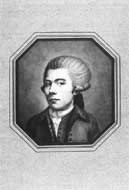
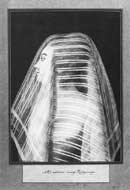
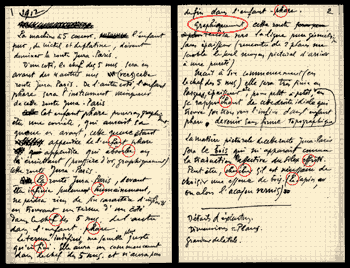
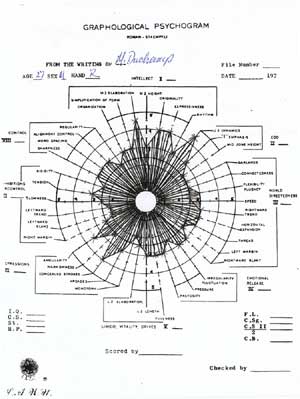
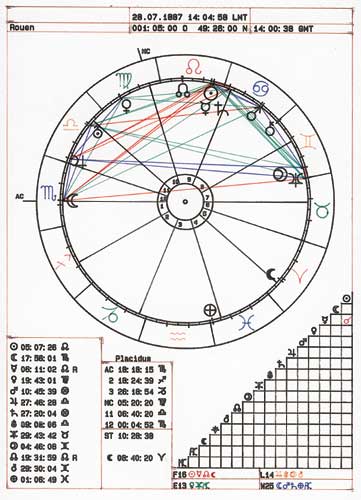
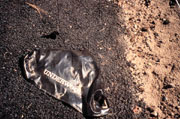
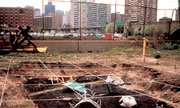
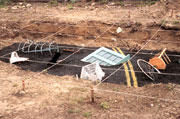
From a modern point of view, astrology and alchemy are early forms of our scientific thinking that are limited by superstition. To the historian they appear as partial spheres of a uniform or holistic take on the world. In recent times, it is surprising to note an aestheticizing return to the era of “Kunst – und Wunderkammern” [editor’s note: a curious way in which art – often displayed from floor to ceiling – was exhibited alongside odd objects, scientific instruments, archeological findings and anatomical models] of early modern times. The exhibition, which was staged at great cost (around $15 million) and labor under the mystical title “7 Hills” at Berlin’s Gropiusbau-Museum, entertains the thought of an encyclopedic sum within which the knowledge of our times is contained. It is true that while doing so, one risks losing one’s level-headedness, but via a more artistic approach one might also gain a better understanding of the cosmos on a micro- as well as a macro-level. In view of the euphoria of natural scientists to simultaneously have deciphered the genome and the elementary particle, even winners of the Nobel prize talk about a new mysticism. The four letters of the DNA are supposedly nothing less than a re-formulation of the old four elements-fire, water, earth, air. Furthermore, it is no coincidence that 12 fermions exist in the standard model of the elementary particles. It might well be that man, always striving for more knowledge, can only project new versions of old prejudices, whose common structure lie in particular numbers. The horoscope is the portrait of the planets in the ecliptic. It is a clock that, unlike ordinary time, is not restricted by the position of the Sun alone, but also takes into account other celestial bodies-from Mercury, located close to the Sun, to far away Pluto. These are astronomical facts; only with our belief in a possible interpretation of this constellation, ever-changes according to time and place, do we leave safe terrain and enter the realm of superstition of historical traditions. The 12 signs of the zodiac are the projected combinations from the three areas (body, soul, spirit) and the four elements, which since C.G. Jung can also be understood as four functions (sense, feeling, thinking, will). Since the notions are not unequivocal and diverge in different languages, various possibilities of interpretation are always possible. One can thus designate the signs according to the system of the religious philosopher from Vienna, Arnold Keyserling, as follows: Aries: soul-will, Taurus: body-sense, Gemini: spirit-thinking, Cancer: soul-feeling, Leo: body-will, Virgo: spirit-sense, Libra: soul-thinking, Scorpio: body-feeling, Sagittarius: spirit-will, Capricorn: soul-sense, Aquarius: body-thinking, Pisces: spirit-feeling. Within this cosmic human being, the planets create a structure that can be looked at as a sort of grammar. Jupiter would be the “and” of the language, which connects everything, Venus the noun, which is fixated upon the world of the object, etc. Each human being has all the components of such a systematic structure, a sort of ontology, different with each individual. But here, we shall not pursue further any ethical inclinations. In this sense, a horoscope can be anything-ranging from the “characteriologic” analysis to the representation of a course of life. With all of our knowledge about Duchamp today, it does not make much sense to read Duchamp’s horoscope retro-prophetically as a potential life. The record would constantly be set straight by biographical data. This a posteriori view would not be very interesting. What one could try to accomplish however, is to redraw the easily available course of his life by taking into account the most important data. What was really important to him? And how can one explain his ability to let the world in the dark about his work? Every “house” (indicated by Roman numericals), beginning with the ascendant to the left, lasts for seven years. That is, one moves first through one’s own horoscope under the horizon, until, at the beginning of the 7th house (at the descendant right), one rises from the “night,” and, with 42 years (6×7), one appears before the public. In their meaning, the individual houses adhere to the respective state of development; they are, however, present throughout the entire life (similar to the genetic code, which is nowadays given more credence to. It is true that it has been deciphered, but we are far from understanding it.) A horoscope discloses that missed opportunities can hardly be taken up again. Life goes on. One should not, for example, raise small children (5th house) when one is in the 9th house (older than 63 years). One is not always equally young or old; but everybody has the focal points of his or her development at another place, so that not even these statements should be generalized. In the following, we will restrict ourselves to the indicated data. Such a reading will certainly be a very general one. Everybody who is interested in astrology can further spin it out. Accordingly, planet Venus in the 10th house in Virgo has manifold meanings within the frame of a certain spectrum. Here though, this will be reduced to one location, namely 19.43 degrees, that for MD is the year 1953. We will proceed in this manner with every planet, and we will also consider the place directly opposite, that is displaced by 180 degrees, in this case 1911. The point situated directly opposite to one’s own location represents the complementary goal in one’s horoscope. The individual astrological traditions differ considerably with regards to the tolerance of the Aspects. These are the relations between the planets themselves. One can compare them with the relation between notes that blend together to more or less harmonious music. Generally, one assumes a tolerance of 10 degrees between the planets, between a planet and the Sun or the Moon respectively 12.30 degrees and between the Sun and the Moon 15 degrees. This may seem arbitrary, and it differs from other systems. Opposition and conjunction (0 or 180 degrees respectively + tolerance, yellow) are impulses that have to be controlled through Will; Square (90 degrees, red) is feeling; Sextile (60, 120 degrees, green) = Sense; semi-sextile and trigon (30, 150 degrees, blue) = Thought. Traditionally, green is considered to be positive, red to be negative. It can also be characteristic when two planets are not related through any Aspects. Below, an abbreviated interpretive overview will be given, together with a record of the planets throughout MD’s life. All the planets are located above the horizon. It is true that this is characteristic of a public life, yet it is also characteristic of a late fame. Usually, it is said that a horoscope, which does not enclose the center, is eccentric. Focal points are the 7th house (community, society), with Neptune in Taurus and Pluto in Gemini, as well as the 9th house (journey, ideas) with Saturn in Cancer, the Sun in Leo and Mercury in Leo, as well as the 11th house (friendships with the rich and famous, works) with Uranus and Jupiter in Libra. From the viewpoint of the Aspects, most of it is concentrated in the 9th house. This is why we are dealing with a person destined for (journeys and) ideas, and less with an artist in the traditional sense-the 2nd house (art, possession) is empty and in Taurus, we find only Neptune, that is acquaintances. Venus in the 10th house in Virgo is only connected through Aspects with 4 other planets. Venus occupies a prominent spot in the house of the public and has no negative Aspect. Since Venus is the creative force (and, from a mythological stance, the goddess of love), we could start analyzing her first, asking for the two corresponding moments. Venus in Virgo in the 10th house: 1911 and 1953/4 Moon in Scorpio in the 12th house: 1929 Neptune in Taurus in the 7th house: end of 1931 / beginning of 32 Mars in Cancer in the 8th house: 1940 Uranus in Libra in the 11th house: 1915/16 and 1957/58 Jupiter in Libra in the 11th house: 1921 and 1963 Saturn, Sun, Mercury in the 9th house in Cancer and Leo: 1943-1946 Another chapter could be written on the allocation of cities. This differs, however, according to the various schools of astrology. We will restrict ourselves to note that New York as city of Neptune and Paris as city of Venus agree with the corresponding meanings in the 7th and 10th house. |
All posts by robert
Duchamp’s Horoscope
Between Gadget and Re-made: The Revolving History of the Bicycle Wheel
The history of Duchamp’s Bicycle Wheel has been frequently recounted and is sufficiently known. One aspect, however, has often been considered too little: the usability of this peculiar apparatus.

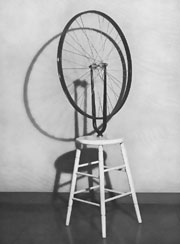
Marcel Duchamp, Bicycle Wheel, 1913 © 2000 Succession Marcel Duchamp, ARS, N.Y./ADAGP, Paris
Rhonda Roland Shearer has recently pointed out that at least the second version of the Roue de Bicyclette, created in 1916 in New York, is statically an extremely fragile object. Could, Roland Shearer ponders, the combination of front-wheel fork, rim and a stool be “an experiment and schematic diagram of chance”. (1)
Duchamp himself, during his lifetime, never ceased to stress, with ostentatious calm and persistence, the incidentalness and the insignificance of his invention trouvé. Even though today the Bicycle Wheel is regarded as one of the central incunabula of the ready-made-idea, we now know that originally it had little in common with the future ready-made (2).According to Duchamp, the 1913 original as well as the 1916 version of it were rather intended to please him personally, to be “the ‘gadget’ for an artist in his studio(3).”One of the statements used by Duchamp in several interviews is to be remembered in this connection – in the version that was handed down to us by Arturo Schwarz: “To set the wheel turning was very soothing, very comforting, a sort of opening of avenues on other things than material life of every day. I liked the idea of having a bicycle wheel in my studio. I enjoyed looking at it, just as I enjoyed looking at the flames dancing in a fireplace. It was like having a fireplace in my studio, the movement of the wheel reminded me of the movement of the flames (4).”Clearly, the analogy to an open fire was not chosen arbitrarily. Duchamp, with the flames dancing in the fireplace, found an easily intelligible analogon for the ‘contemplative’ effect that the spinning spoke wheel was supposed to have on him, at the time the first and only beholder and user – regardless of whether he had taken delight in the spokes’ ‘optical flicker’ or in the object’s supposed instability, provoked by the centrifugal forces acting upon it. Whether the spinning of the rim was “very soothing, very comforting(5)” or rather, as Roland Shearer assumes, “hardly relaxing(6)” it was originally part of the idea of the Bicycle Wheel.
Should it not then be allowed, one may well ask now, to set the wheel turning even today, following Duchamp’s instruction and thus to a large extent keeping the original idea alive? This, of course, strikes one as being quite a theoretical question, given the museum reality. Whoever encounters one of the Bicycle Wheel‘s replicas in a public collection today, be it in Cologne, Paris, Philadelphia, New York, Stockholm or elsewhere, is confronted with tabooing prohibition signs, exposing plinths and reprimanding museum attendants. This confirms not only the museum’s inherent paradoxical logic of making history an actual experience by means of preserving it, but also the shift of meaning the idea of the Bicycle Wheel has been through in the course of the decades.
Sidney Janis has the dubious honour of having introduced a first replica, namely the third version of the Roue de Bicyclette, into the context of an exhibition for the first time. He did so on the occasion of the “Climax in XXth Century Art”-exhibition early in 1951, thereby changing the object’s intellectual status as well as the meaning and the function ascribed to it. The former “gadget” was de facto declared a designated ready-made within the canon of Duchamp’s works. The artist himself had carried out the arrangement of the exhibits and had dated as well as signed and thus authenticated and authorized the replica of the Bicycle Wheel in the beginning of 1951.
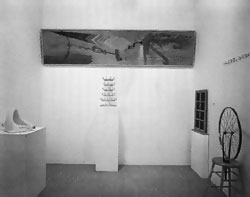
View of the Duchamp gallery,”The Art of Assemblage” (October 2 – November 12, 1961), The Museum of Modern Art, New York
Some years later, in the autumn of 1961, the same Janis-replica was displayed in the legendary
exhibition “The Art of Assemblage” in the Museum of Modern Art, once more and unquestionably so within the context of the ready-made. The Bicycle Wheel, having been given the status of a museum piece, was transformed into a state of visually documenting the concept of the ready-made, which was regarded as being historical (8).It was no longer necessary to set the wheel turning in order to be delighted by it; on the contrary, this was prohibited, as the American photographer Marvin Lazarus reported on the occasion of a photo shooting with Duchampn in the exhibition on 10 November 1961: “I wanted to move the Roue de Bicyclette so that I could shoot through it. Duchamp moved it.[…] the guard […] ran over to me and asked if I had moved the object. Before I could answer, with a little smile, Duchamp said quietly, ‘No, I did it.’ The guard then turned on him and said, ‘Don’t you know you’re not supposed to move things in a museum?’ Duchamp smiled again and speaking very softly said ‘Well, I made the object – don’t you think it’s all right for me to move it a little?'”(9)“An interesting question, now, that the artist addressed to a presumably puzzled museum attendant. Had Duchamp been allowed to refer to his nominal and intellectual authorship in order to obtain the privilege of usage? This question seems too good to spoil with an answer. It raises, however, another, more general question that shall not remain unanswered.
What would be gained by the average visitor to an exhibition and his aesthetic experience, if he too was allowed to set the wheel turning in an exhibition? As far as I know, this was the case only once in the history of exhibiting the various replicas. The touring exhibition “Art in Motion”(Dutch: “Bewogen Beweging”, Danish and Swedish: “Rörlse i konsten”), stopping over in the Stedlijk Museum, Amsterdam, the Moderna Museet, Stockholm, and the Louisiana Museum of Modern Art, Humblebaek, from the spring of 1961 onwards, among other optical and kinetical works of art put on display a replica of the Roue de Bicyclette, which, based on the 1916 version, had been built by Ulf Linde and Per Olof Ultvedt in May 1960. Pontus Hulten, at the time the Moderna’s director, assured me that the visitors to the exhibition had been allowed to turn the wheel (10).The spirit in those days, Hulten said, had simply been a different one (11). A different spirit? Surely, rather, it was due to the fact that the replica, which had been built despite the lack of initial authorization, was of a low financial value. In consequence the curators Hulten and Sandberg could risk public use without having to fear too much damage (12).
In order to return to the question I raised earlier: little would be achieved if the visitor was allowed to set the wheel turning. I will confine myself to giving two reasons, one of them concerning the curational problem: the history of the 20th century’s participatory art shows that tactily involved viewers were always either overstrained with the offer of participation or unable to utilize the potential of the experience proposed to them. Allan Kaprow reported, for instance, that the visitors to his situational environment Push and Pull – A Furniture Commedy for Hans Hofmann from 1963 did not react the way he had hoped they would to his proposal to alter the furnishing. Robert Rauschenberg’s Black Market, in which the visitors were supposed to exchange objects and document this exchange with a drawing, was ransacked in 1961 while on display in the exhibition “Art in Motion” (13).
George Brecht had a similar experience when presenting his Cabinet made in 1959 – a cabinet containing several everyday objects. The intended epistemological experience, linked to the viewers’ tactile participation, was thwarted by overzealous customers looting the Cabinet(14).

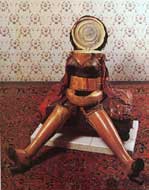
Edward Kienholz, Cockeyed Jenny, 1961/62
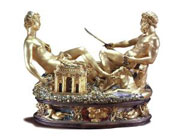
Benvenuto Cellini, Saliera, 1540-43, Collection Kunsthistorisches Museum, Wien
At the opening of Roxys, Edward Kienholz’ legendary brothel environment, in the Alexander Iolas Gallery in 1963, one of the visitors of the vernissage urinated into the ash can of Cockeyed Jenny, one of the whore figure (15).The second reason concerns the origin of the Bicycle Wheel itself: it would be practically impossible for visitors to a spacious exhibition to recreate the intimate atmosphere of the studio where Duchamp had once been able to contemplate the movement of the wheel. It would be as if one allowed the visitors of the Kunsthistorisches Museum in Vienna to use, in an allegedly authentic manner, Benvenuto Cellini’s Saliera in order to emulate François Primeur, long since covered with dust, at his sumptuous dining table. Historical events and situations may be portrayed vividly in a museum, but it is impossible to recreate them.
Duchamp himself, however, was once more given the opportunity to set the wheel turning, for in
1964 the Roue de Bicyclette‘s shift or rather the establishment of its meaning entered its – for the time being – last stage. Duchamp had authorized Arturo Schwarz to produce, amongst accurate replicas of thirteen other works of art, an edition of the Bicycle Wheel, the number of copies being eight plus two. The production of replicas of the Roue which, in the fifties, amounted to only a few copies, thereby gained a new quality and quantity. The strategy of creating almost identical remades for the sake of representing the idea of the ready-made inevitably had to result in authenticity, originality, in the establishment of an aura and, finally, in artificiality. Every single piece of the Schwarz-edition, just as before with the replicas produced by Janis and Linde, had been affixed by Duchamp with the admonition of metaphysics, the personal signature. Signatures commonly authenticate the will of their absent author – unless they are forced from him, which is hardly to be assumed in the case of Duchamp/Schwarz. Duchamp had readily given his nominal placet to a definite authorization by signing the ‘documents’ presented by Schwarz. And soon the Bicycle Wheels, representing Duchamp’s imagination, advanced triumphantly through the international museums, thereby strengthening their museumesque status as well.
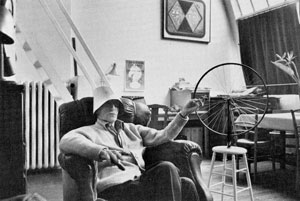
Photograph of Duchamp wearing a lampshade with Bicycle Wheel, 1951 © 2000 Succession Marcel Duchamp, ARS, N.Y./ADAGP, Paris
Duchamp, in the sixties, may have sat in New York and Neuilly, puffing away at his cigar and turning the wheel that had been given to him as an artist’s copy from the Schwarz-edition. If so, then probably not without being amused by the course of things. The way the multiple Bicycle Wheels are displayed in the museums, however, was and still is traced out differently. The visitor of a museum or a gallery is no longer confronted with a “gadget” but with a remade representing the idea of the ready-made. The ease with which it had once been possible for Duchamp to set the wheel turning has been superseded by the complexity, the import, and the historicization of the ready-made-concept. Had Marcel Duchamp originally intended to create works that were not art, as he wrote in 1913 (16)
then the remades, on the other hand, bear witness to the affirmative force of an institutionalized operating system of art. The turning wheel of history has made the Bicycle Wheel an artefact. Reciprocally, the latter has lost its drive.
notes
1. Roland Shearer, Rhonda: Why is Marcel Duchamp’s Bicycle Wheel Shaking on Its Stool?, in: www.artscienceresearchlab.org, December 1999; see also her reply to What makes the Bicycle Wheel a Readymade by Yassine Ghalem, in: www.toutfait.com, vol. 1, no. 2, May 2000; and “Marcel Duchamp’s Impossible Bed and other ‘Not’ Readymade Objects: A Possible Route of Influence from Art to Science, Part I,” in: Art & Academe 10, no. 1 (Fall 1997), pp. 26-62; Part II in: Art & Academe 10, no. 2 (Fall 1998), pp.76-95.
2. See Duchamp in Cabanne, Pierre: Dialogues with Marcel Duchamp. New York: Wiking, 1971, p. 74 and Schwarz, Arturo: The Complete Works of Marcel Duchamp. 3., revised and expanded ed. New York: Delano Greenidge Editions,1997, p. 588.
3. Marcel Duchamp, quoted from Siegel, Jeanne: Some late Thoughts of Marcel Duchamp. In: Arts Magazine, Vol. 43, New York, December 1968/ January 1969, p. 21, here quoted from Daniels, Dieter: Duchamp und die anderen: Der Modellfall einer künstlerischen Wirkungsgeschichte der Moderne. Cologne: DuMont, 1992, p. 208.
4. Duchamp, quoted from Schwarz [1997], ibid., p. 588.
5. Duchamp, quoted from Schwarz [1997], ibid, p. 588.
6. Roland Shearer, Rhonda: Why is Marcel Duchamp’s Bicycle Wheel Shaking on Its Stool? In: tout-fait, Vol. 1, Nr. 1, December 1999.
7. Following Buettner, Stewart: American Art Theory 1945-1970. Michigan
Ann Arbor: UMI Research Press, 1981, p. 109.
8. This is not only confirmed by the photographs documenting the mode of presentation but also by an entry in the catalogue accompanying the exhibition, where it says: “The ‘readymades’ are among the most influential of Duchamp’s works. They are ordinary objects that anyone could have purchased at a hardware store […]. The first readymade, however, done in 1913 by fastening a bicycle wheel to a stool, was “assisted” by Duchamp, and hence is an assemblage on the part of the discoverer as well as the original manufacturer.” (Catalogue The Museum of Modern Art, New York: The Art of Assemblage. 2 October – 12 November 1961 (ed. by William C. Seitz) New York: The Museum of Modern Art and Doubleday, 1961, p. 46.
9. Marvin Lazarus, quoted from Gough-Cooper, Jennifer; Caumont, Jacques: Ephemerides on and about Marcel Duchamp and Rrose Sélavy 1887-1968.London: Thames and Hudson, 1993, no page number (entry for 11 November 1961).
10. Pontus Hulten in a letter to the author, 26 July 2000. A contemporary review in a newspaper from 17 March 1961 gives another hint. There it says: “Nu geef je tegen het wiel een zetje. Wat gebeurt? Ja, precies – het wiel gaat draanien.”(English translation: “Now one touches the wheel. What happens? Yes, precisely – the wheel starts turning.”,quoted from anon.: In A’dams museum beleeft men: De nachtmerrie van een fietsenmaker. In: Overijsselse en zwolsche Courant, 17 March 1961,no page number, with regards to Dr. Maurice Rummens, Stedelijk Museum, Amsterdam).
11. Pontus Hulten in a letter to the author, 26 July 2000.
12. This replica was signed by the artist when Duchamp visited Stockholm in late August, early September 1961. Today it belongs to the Moderna Museet, Stockholm.
13. see i.a. catalogue Museum Ludwig, Cologne: Robert Rauschenberg – Retrospektive. 27 June – 11 October 1998 [ed. by Walter Hopps and Susan Davidson]. Ostfildern-Ruit: Cantz, 1998, p. 560.
14. see George Brecht in catalogue Kunsthalle Bern: Jenseits von Ereignissen: Texte zu einer Heterospektive von George Brecht. 19 August – 24 September [ed. Marianne Schmidt-Miescher; Johannes Gachnang]. Bern: Kunsthalle, 1978, p. 94.
15. see Virginia Dwan in Stuckey, Charles F.: Interview with Virginia Dwan conducted by Charles F. Stuckey, 21 March 1984, The Oral History Collections of the Archives of American Art, New York Study Center, p. 8.
16. “Peut-on faire des oeuvres qui ne soient pas d’art?” says the 1913 facsimile note in the box à l’infintif, 1967.
Duchamps Horoscope
From a modern point of view, astrology and alchemy are early forms of our scientific thinking that are limited by superstition. To the historian they appear as partial spheres of a uniform or holistic take on the world. In recent times, it is surprising to note an aestheticizing return to the era of “Kunst – und Wunderkammern” [editor’s note: a curious way in which art – often displayed from floor to ceiling – was exhibited alongside odd objects, scientific instruments, archeological findings and anatomical models] of early modern times. The exhibition, which was staged at great cost (around $15 million) and labor under the mystical title “7 Hills” at Berlin’s Gropiusbau-Museum, entertains the thought of an encyclopedic sum within which the knowledge of our times is contained. It is true that while doing so, one risks losing one’s level-headedness, but via a more artistic approach one might also gain a better understanding of the cosmos on a micro- as well as a macro-level. In view of the euphoria of natural scientists to simultaneously have deciphered the genome and the elementary particle, even winners of the Nobel prize talk about a new mysticism. The four letters of the DNA are supposedly nothing less than a re-formulation of the old four elements-fire, water, earth, air. Furthermore, it is no coincidence that 12 fermions exist in the standard model of the elementary particles. It might well be that man, always striving for more knowledge, can only project new versions of old prejudices, whose common structure lie in particular numbers.
The horoscope is the portrait of the planets in the ecliptic. It is a clock that, unlike ordinary time, is not restricted by the position of the Sun alone, but also takes into account other celestial bodies-from Mercury, located close to the Sun, to far away Pluto. These are astronomical facts; only with our belief in a possible interpretation of this constellation, ever-changes according to time and place, do we leave safe terrain and enter the realm of superstition of historical traditions.
The 12 signs of the zodiac are the projected combinations from the three areas (body, soul, spirit) and the four elements, which since C.G. Jung can also be understood as four functions (sense, feeling, thinking, will). Since the notions are not unequivocal and diverge in different languages, various possibilities of interpretation are always possible. One can thus designate the signs according to the system of the religious philosopher from Vienna, Arnold Keyserling, as follows: Aries: soul-will, Taurus: body-sense, Gemini: spirit-thinking, Cancer: soul-feeling, Leo: body-will, Virgo: spirit-sense, Libra: soul-thinking, Scorpio: body-feeling, Sagittarius: spirit-will, Capricorn: soul-sense, Aquarius: body-thinking, Pisces: spirit-feeling.
Within this cosmic human being, the planets create a structure that can be looked at as a sort of grammar. Jupiter would be the “and” of the language, which connects everything, Venus the noun, which is fixated upon the world of the object, etc. Each human being has all the components of such a systematic structure, a sort of ontology, different with each individual. But here, we shall not pursue further any ethical inclinations. In this sense, a horoscope can be anything-ranging from the “characteriologic” analysis to the representation of a course of life.
With all of our knowledge about Duchamp today, it does not make much sense to read Duchamp’s horoscope retro-prophetically as a potential life. The record would constantly be set straight by biographical data. This a posteriori view would not be very interesting. What one could try to accomplish however, is to redraw the easily available course of his life by taking into account the most important data. What was really important to him? And how can one explain his ability to let the world in the dark about his work? Every “house” (indicated by Roman numericals), beginning with the ascendant to the left, lasts for seven years. That is, one moves first through one’s own horoscope under the horizon, until, at the beginning of the 7th house (at the descendant right), one rises from the “night,” and, with 42 years (6×7), one appears before the public. In their meaning, the individual houses adhere to the respective state of development; they are, however, present throughout the entire life (similar to the genetic code, which is nowadays given more credence to. It is true that it has been deciphered, but we are far from understanding it.) A horoscope discloses that missed opportunities can hardly be taken up again. Life goes on. One should not, for example, raise small children (5th house) when one is in the 9th house (older than 63 years). One is not always equally young or old; but everybody has the focal points of his or her development at another place, so that not even these statements should be generalized.
In the following, we will restrict ourselves to the indicated data. Such a reading will certainly be a very general one. Everybody who is interested in astrology can further spin it out. Accordingly, planet Venus in the 10th house in Virgo has manifold meanings within the frame of a certain spectrum. Here though, this will be reduced to one location, namely 19.43 degrees, that for MD is the year 1953. We will proceed in this manner with every planet, and we will also consider the place directly opposite, that is displaced by 180 degrees, in this case 1911. The point situated directly opposite to one’s own location represents the complementary goal in one’s horoscope.
The individual astrological traditions differ considerably with regards to the tolerance of the Aspects. These are the relations between the planets themselves. One can compare them with the relation between notes that blend together to more or less harmonious music. Generally, one assumes a tolerance of 10 degrees between the planets, between a planet and the Sun or the Moon respectively 12.30 degrees and between the Sun and the Moon 15 degrees. This may seem arbitrary, and it differs from other systems. Opposition and conjunction (0 or 180 degrees respectively + tolerance, yellow) are impulses that have to be controlled through Will; Square (90 degrees, red) is feeling; Sextile (60, 120 degrees, green) = Sense; semi-sextile and trigon (30, 150 degrees, blue) = Thought. Traditionally, green is considered to be positive, red to be negative. It can also be characteristic when two planets are not related through any Aspects.
Below, an abbreviated interpretive overview will be given, together with a record of the planets throughout MD’s life. All the planets are located above the horizon. It is true that this is characteristic of a public life, yet it is also characteristic of a late fame. Usually, it is said that a horoscope, which does not enclose the center, is eccentric. Focal points are the 7th house (community, society), with Neptune in Taurus and Pluto in Gemini, as well as the 9th house (journey, ideas) with Saturn in Cancer, the Sun in Leo and Mercury in Leo, as well as the 11th house (friendships with the rich and famous, works) with Uranus and Jupiter in Libra. From the viewpoint of the Aspects, most of it is concentrated in the 9th house. This is why we are dealing with a person destined for (journeys and) ideas, and less with an artist in the traditional sense-the 2nd house (art, possession) is empty and in Taurus, we find only Neptune, that is acquaintances. Venus in the 10th house in Virgo is only connected through Aspects with 4 other planets. Venus occupies a prominent spot in the house of the public and has no negative Aspect. Since Venus is the creative force (and, from a mythological stance, the goddess of love), we could start analyzing her first, asking for the two corresponding moments.
Venus in Virgo in the 10th house: 1911 and 1953/4
During this year, Duchamp paints his most important paintings (family, nudes, chess) in Blainville. The long-term project refers to the passage from the “virgin” to the “Bride.” The background or frame to these years (opposite the goal) is the sign of Virgo. As the one formative incident that enters with Venus one has to assume the wedding of his favorite sister Suzanne in August. The inaccessibility of the “bride” will later become a subject of the Large Glass. Almost exactly opposite, that is 42 years later, in the 10th house, the 66 year-old MD marries Alexina “Teeny” Matisse-Sattler in January of 1954. From the viewpoint of the Aspects, it was a harmonious event. MD nevertheless manages to portray himself publicly (10th house) as (male) virgin, as bachelor (Venus). Only years later MD found out by chance that he had become the father of a girl in 1911.
Moon in Scorpio in the 12th house: 1929
The female (the mother) is generally represented by the Moon. The Moon also stands for the changeable and for (in the 12th house) regenerating in seclusion. As one can see from the two squares in the 9th house to Mercury and the Sun, this iridescent seclusion clashed with the self-confident talk and his judgment of himself. Externally this became evident in the 41st year (1929) of his life. This does not concern his short marriage to Lydie Sarazin-Levassor since it was divorced just a year before. Henry McBride asked the question why, in view of the “fat” bride and her father’s rather inadequate endowment, MD did not marry Kathy Dreier. At the crucial moment (1929), MD met up with her and her friend Mrs. Thayer to travel around Spain and Germany. Dreier saw in MD “another side of me.” She was probably the most important woman in his life, gravely underestimated by his biographers, even though she did not understand all the ideas (squares in the 9th house) of her “adopted son.” The opposition to Neptune in the 7th house brings forth the speculation that this friendship would not have faired too well with his other public acquaintances.
Neptune in Taurus in the 7th house: end of 1931 / beginning of 32
Except the already mentioned inclination to leave people in the dark about his relationships to women, MD obviously had many acquaintances (Neptune), which were not least (favorable Aspects in the 9th house) conducive to his journeys and ideas. In his vitae this talent manifested itself officially when he wrote a chess book together with Vitaly Halberstadt that was published in three languages during June of 1932 in Brussels. This cooperation must have been important for him since it is also the first planet he reaches in the horoscope (because so far the houses were empty and the other mentioned planets stood opposite).
Mars in Cancer in the 8th house: 1940
The ruler of nativity (the regent of the ascendant Scorpio) is on good terms with Venus and the Moon, but not so with Neptune. Next to the Sun, the ruler of nativity is often seen as the most important planet in a horoscope. Initiative as sublimated aggressiveness, the tendency to keep searching for the roots (Cancer), has to be accepted here as a principle. The square that points toward Uranus in the 11th house indicates the longing for the intellectual dealing with the work for which the foundation stone only is laid. In 1940, MD decides to start working on his private museum-on his Boîte-en-Valise. From 1941 on, MD will, little by little, put the samples of the edition together in seven series and publish them.
As mythological figure, Mars is naturally the god of war. Yet the German occupation of Arcachon, to where MD had retreated together with Mary Reynolds, his sister Suzanne and her second husband Jean Crotti, Salvador Dalí and his wife Gala, scarcely seemed to have bothered him.
Uranus in Libra in the 11th house: 1915/16 and 1957/58
MD has a balanced (Libra) intellectual-dialectic relationship (Uranus) to his friends (11th house) in society. The time during which his personality (Aries) is emphasized-from 1913 to 1922-is determined by the Ready-mades. When he arrives in New York as a twenty-seven-year-old, he becomes friends with the Arensbergs. Directly opposite, 42 years later, the occupation with his work takes place through dealings with the publishers of his writings, George Heard Hamilton and Michel Sanouillet. He also meets with his important biographer and interpreter, Robert Lebel.
Jupiter in Libra in the 11th house: 1921 and 1963
The second planet in this house of the lifework is Jupiter. Jupiter stands for the capability of synthesis. What is better to announce an oeuvre than bringing works together in a big personal exhibit? MD is already 76 years old and only now is he offered this exhibit in Pasadena. 42 years earlier, in the house of mastery (5th) of his personality (Aries), MD brings about this synthesis in a completely different way than in an accumulation of his works. Through his alter ego Rose Selavy he explores the female side of his personality. The integrative force of Jupiter can be rendered in many different ways. Particularly noteworthy is the big tension to the conjunction of the three planets gathered in the 9th house, that is, to his ideas.
Saturn, Sun, Mercury in the 9th house in Cancer and Leo: 1943-1946
This is a big emotional conflict. Saturn as Authority, the Sun as Being, and Mercury as rhetoric economy not only set up priorities of the entire horoscope-so to speak the culmination of all his efforts-but they also create a symbiosis of apparent crisis. MD is now generally perceived as authority (Saturn) or in his mastery (Mercury and the Sun in Leo). He is almost popular, in any case a legend. Not only does the magazine “VIEW” dedicate an issue to him, but the Large Glass also appears as prop for a fashion shoot on the cover of “VOGUE.” There is an exhibit of the three Duchamp-brothers, etc. The squares from here to Jupiter and to the Moon display his yearning in two ways. On the one hand a longing for a synthesis of his oeuvre, which he realizes through the work on individual examples of the Boîte-en-Valise. On the other hand, it is evident through the fulfillment of his female side, namely in a sexual way (Moon in Scorpio) and through loneliness (Moon in 12th house). Of utter importance here is his liaison with a Brazilian artist and wife of an ambassador, Maria Martins, to whom he dedicates a personal “valise.” The “faulty landscape” within is painted with ejaculate. Through this, one can grasp the ironic message of the proverbial bachelor, who “grinds his own chocolate.” The speculation is permitted that similar things have happened 42 years before, directly opposite in the horoscope. His work will from now on be restructured. He moves into a new studio that he will use for the next 22 years, until the end of the sign of Libra. From now on, he will come up ,in this modest studio with the idea and realization of a sexualized, lonely woman (Moon in Scorpio in the 12th house), that is Etant donnés. The model for her body was Maria Martins, who soon was to disappear to Paris and Brazil, her native country. She became for MD the bedded Maria, in memory of the far-away Mariée.
Another chapter could be written on the allocation of cities. This differs, however, according to the various schools of astrology. We will restrict ourselves to note that New York as city of Neptune and Paris as city of Venus agree with the corresponding meanings in the 7th and 10th house.
Marcel Duchamp et la littérature
Nullement complète et, sur plus d’un plan, éminemment perfectible, cette bibliographie vise néanmoins à offrir un premier rassemblement de noms d’écrivains et de titres d’oeuvres littéraires qui sont en rapport direct ou indirect, les uns et les autres, avec l’oeuvre ou la personne de Marcel Duchamp (1887-1968).
Afin de bien voir arriver les choses, dans chacune des quatre sections, les entrées sont classées chronologiquement. Si le livre est repris ou directement publié en édition de poche (coll. ” Le livre de poche “, coll. ” 10 / 18 “, coll. ” J’ai lu “, coll. ” Poésie / Gallimard “, coll. ” Folio “, coll. ” L’imaginaire “, coll. ” Babel “), cela est indiqué. Si le livre est traduit en totalité ou en partie en anglais ou en français, cela est également indiqué.
Les quatre sections sont les suivantes:
1. Ceux qui ont publié
a. au moins un livre, un chapitre de livre ou un article sur Marcel Duchamp ou une entrevue de lui (dans tous les cas, la date de publication est entre [ ] avant le nom);
b. au moins une oeuvre littéraire (roman, recueil de nouvelles, recueil de poèmes, pièce);
2. Those who have published a literary work (novel, short story, play, etc.) which was “inspired” or “partially inspired” by the work of Marcel Duchamp or Duchamp himself.
3. Ceux qui ont publié une oeuvre littéraire (roman, nouvelle, poème, etc.) ” en hommage ” ou partiellement ” en hommage ” à la personne ou à l’oeuvre de Marcel Duchamp;
4. Oeuvres littéraires ” illustrées ” par Marcel Duchamp, seul ou en collaboration, ou par Marcel Duchamp et un autre artiste.
La reconnaissance d’une oeuvre, puis de quelques oeuvres, puis de ce qu’il est convenu d’appeler l’oeuvre de Marcel Duchamp commençant vraiment en 1913 – reconnaissance américaine côté public (Armory Show, 1913), reconnaissance française côté critique (Apollinaire, 1913) -, il semble bien qu’elle se soit plus développée du côté anglophone, même si les rapports entre l’art et la littérature, comme on le constatera, auront été nettement plus constants, voire consistants, du côté francophone. Nulle relation de cause à effet, ici, mais un simple constat: bien des gens qui ont écrit ou écriront sur Marcel Duchamp ont écrit ou écriront aussi (en français le plus souvent) des textes littéraires.
André Gervais Janvier 2000
*******************
1. Ceux qui ont publié
a. aau moins un livre, un chapitre de livre ou un article sur Marcel Duchamp ou une entrevue de lui (dans tous les cas, la date de publication est entre [ ] avant le nom);
b. au moins une oeuvre littéraire (roman, recueil de nouvelles, recueil de poèmes, pièce)
N.B. Pour les écrivains qui ont publié un grand nombre d’oeuvres littéraires, nous ne donnons qu’un choix volontairement limité à 4 titres.
[1913, Chapter] Guillaume Apollinaire, pseud. de Wilhem Apollinaire de Kostrowitzky (1880-1918)
- L’enchanteur pourrissant [récit en prose entrecoupé de poèmes]. avec 10 bois d’André Derain, Paris, Henry Kahnweiler éditeur, 1909.
- Alcools, poèmes 1898-1913, avec un portrait par Pablo Picasso, Paris, Mercure de France, 1913; Paris, Gallimard, coll. ” Poésie / Gallimard “; Alcools. translated by Anne Hyde Greet, with a foreword by Warren Ramsey, Berkeley, University of California Press, 1965; Alcools, translated by Donald Revell, Hanover, University Press of New England for Wesleyan University Press, 1995.
- Le poète assassiné, contes, avec un portrait par André Rouveyre, Paris, Bibliothèque des curieux, 1916; Paris, Gallimard, coll. “Poésie / Gallimard”; The Poet Assassinated, translated with a biographical notice and notes by Matthew Josephson, New York, The Broom Pub. Co., 1923; The Poet Assassinated, translated by Ron Padgett, illustrated by Jim Dine, New York, Holt, Rinehart and Winston, 1968.
- Calligrammes, poèmes de la paix et de la guerre 1913-1916, avec un portrait par Pablo Picasso, Paris, Mercure de France, 1918; Paris, Gallimard, coll. “Poésie / Gallimard “;Calligrammes, poems of peace and war (1913-1916), translated by Anne Hyde Greet, with an introduction by S. I. Lockerbie and commentary by Anne Hyde Greet and S. I. Lockerbie, Berkeley, University of California Press, 1980.
[1917, Article-entrevue] Mina Loy, pseud. de Mina Lowy (1882-1966)
- Lunar Baedecker [sic], Paris, Contact Publishing Company, 1923; Lunar Baedeker & Time-tables. Highlands, NC: Jonathan Williams, 1958; The Last Lunar Baedeker, edited and introduced by Roger L. Conover, Highlands, The Jargon Society, 1982; The Lost Lunar Baedeker, definitive edition, edited and introduced by Roger L. Conover, New York, Farrar, Straus & Giroux, 1996.
[1917, Article]Louise Varèse, née Louise McCutcheon (1890-1988)
- St.-John Perse. Éloges, and other poems, French text with English translation by Louise Varèse and introduction by Archibald MacLeish, New York, W.W. Norton & Co, 1944.
- Charles Baudelaire. Paris Spleen, translated by Louise Varèse, New York, New Directions, 1947.
- Marcel Proust. Pleasures and Regrets, translated by Louise Varèse, with a preface by Anatole France, New York, Crown Publishers, 1948.
- Varèse: A Looking-Glass Diary, Volume 1, 1883-1928; New York, W.W. Norton & Co, 1972.
[1922, Article] André Breton (1896-1966)
- Nadja [1928], [récit], édition entièrement revue par l’auteur, Paris, Gallimard, 1963; coll. “Folio”; Nadja, translated by Richard Howard, New York, Grove Press, and London, Evergreen Books, Ltd., 1960.
- Arcane 17 [1944, avec 4 lames de tarot en couleurs par Matta] enté d’Ajours, avec 3 eaux-fortes par Baskine, Paris, Éd. du Sagittaire, 1947; coll. “10 / 18 “; Arcanum 17 : With Apertures : Grafted to the End,tTranslated by Zack Rogow and with an introduction by Anna Balakian, Toronto: Coach House Press, 1994.
- Clair de terre(1) , poèmes, préface d’Alain Jouffroy, Paris, Gallimard, coll. ” Poésie / Gallimard “, 1966.
- Signe ascendant(2) , poèmes, Paris, Gallimard, coll. ” Poésie / Gallimard “, 1966.
[1924, Preface] Gertrude Stein (1874-1946)
- Geography and Plays, Boston, The Four Seas Company, 1922.
- The Making of Americans, Being a History of a Family’s Progress , novel, Paris, Contact Editions, 1925; Américains d’Amérique, histoire d’une famille américaine, traduction de la baronne J. Seillère et de Bernard Faÿ, Paris, Stock, Delamain et Boutelleau, 1933.
- The Autobiography of Alice B. Toklas, London, John Lane, The Bodley Head, 1933;Autobiographie d’Alice Toklas, traduction de Bernard Faÿ, Paris, Gallimard, 1934.
- Everybody’s Autobiography, New York, Random House, 1937; Autobiographies, traduction de la baronne d’Aiguy [May Tagnard], Paris, Éd. Confluences, 1945.
[1924, Book]
- Pierre de Massot (1900-1969)
- Prolégomènes à une éthique sans métaphysique ou Billy, bull-dog et philosophe [essay]. Paris: Éditions de la Montagne, 1930.
- Mon corps, ce doux démon [written 1932] [autobiography]. Letter-preface by André Gide, with an engraved portrait by Jacques Villon, s.l.n.d. [Alès: PAB, 1959].
- Le mystère des maux [poems]. With a drawing by Francis Picabia. Paris: hors commerce [Imprimerie René Martinet et Cie], 1961.(3)
- Le déserteur. Oeuvre poétique 1923-1969, texts collected and presented by Gérard Pfister, Paris, Arfuyen, 1992.(4)
[1936, article] Michel Leiris
- L’âge d’homme [écrit en 1930-1935, publié en 1939], précédé de De la littérature considérée comme une tauromachie [1946], [première autobiographie], Paris, Gallimard, 1946; Paris, Gallimard, coll. “Folio”; Manhood : a journey from childhood into the fierce order of virility, preceded by The autobiographer as torero, translated by Richard Howard, New York, Grossman Publishers, 1963.
- La règle du jeu. Tome I: Biffures, Tome II: Fourbis, Tome III: Fibrilles et Tome IV: Frêle bruit, [seconde autobiographie], Paris, Gallimard, respectivement 1948, 1955, 1966 et 1976: les 4 tomes, coll. “L’imaginaire”; Rules of the game : Scratches [Biffures], translated by Lydia Davis, New York, Paragon House, 1991 [Baltimore, Johns Hopkins University, 1997]; Scraps [Fourbis], translated by Lydia Davis, Baltimore, Johns Hopkins University, 1997.
- Mots sans mémoire (5), [poésie], Paris, Gallimard, 1969.
- Journal 1922-1989, édition établie, présentée et annotée par Jean Jamin, Paris, Gallimard, 1992.
[1937, article] Roger Caillois (1913-1978)
- Art poétique, Paris, Gallimard, 1958.
- Esthétique généralisée, Paris, Gallimard, 1962.
- Pierres, Paris, Gallimard, 1966.
- Obliques [1967] précédé de Images, images… [1966], Paris, Gallimard, coll. ” Le monde ouvert “, 1974.
[1938, article-entrevue; 1959, livre] Robert Lebel (1901-1986)
- Masque à lame, illustré par Isabelle Waldberg, New York, Éd. Hémisphères, 1943.
- L’oiseau caramel,, illustré par Max Ernst, Paris, le Soleil noir, 1969.
- Traité des passions par personne interposée, Paris, Losfeld, 1972.
- La Saint-Charlemagne, illustré par Max Ernst, Paris, le Soleil noir, 1976.
[1945, article] Man Ray, pseud. d’Emmanuel Radnitsky (1890-1976)
- Self portrait [commencé en 1951, publié en 1963], [autobiographie], foreword by Merry A. Foresta, afterword by Juliet Man Ray, Boston, Little, Brown & Co. and the New York Graphic Society, 1988; trad. fr. d’Anne Guérin, Paris, Laffont, 1964; Arles, Actes Sud, coll. ” Babel “.
- Ce que je suis et autres textes, présentation de Vincent Lavoie, Paris, Hoëbeke, coll. “Arts & esthétique”, 1998.
[1945, article] Nicolas Calas (ou Nikolas Kalas), pseud. de Nikos Kalamares (1907-…)
- Odos Niketa Randou [Rue Nikita Randou], poèmes, Athènes, Ikaros, 1977.
[1949, article] Gaston Puel (1924-)
- Paysage nuptial, frontispice de Hans Bellmer, Paris, GLM, 1947.
- La jamais rencontrée, frontispice de Max Ernst, Paris, Seghers, 1950.
- Ce chant entre deux astres, collage de Jean Arp en double frontispice, Lyon, Henneuse éd., 1956.
- Le cinquième château, avec deux bois originaux de Raoul Ubac, Veilhes, la Fenêtre ardente, 1965.
[1950, article; 1974, livre] Jean Suquet (1928-)
- Jamais rien ni personne, roman, augmenté d’une gravure effacée par le temps, Paris, le Parler de la lune aphasique, 1958.
- Une chimie greffée de chimères, Paris, le Parler de la lune aphasique, 1972.
- Oubli sablier intarissable(6), n° spécial de la revue Liard, Bordeaux, 1996.
[1952, article; 1954, chapitre] Michel Carrouges, pseud. de Louis Couturier (1910-1988)
- Les portes dauphines, roman, Paris, Gallimard, 1954.
- Les grands-pères prodiges, roman, Paris, Plon, 1957.
[1953, article] Henri Pierre Roché (1879-1959)
- Jean Roc, pseud. d’Henri Pierre Roché, Don Juan et…, [récit], Paris, Éd. de la Sirène, 1921; Marseille, André Dimanche Éditeur, 1993.
- Jules et Jim, roman, Paris, Gallimard, 1953; coll. ” Folio “; Jules and Jim, translated by Patrick Evans, London and Boston, M. Boyars, 1963.
- Deux Anglaises et le continent, roman, Paris, Gallimard, 1956.
- Carnets. Les années Jules et Jim, première partie 1920-1921, avant-propos de François Truffaut, Marseille, André Dimanche Éditeur, 1990.
[1954, article-entrevue] Alain Jouffroy (1928-)
- Un rêve plus long que la nuit, roman, Paris, Gallimard, 1964; coll. ” Folio “.
- Trajectoire, récit-récitatif, Paris, Gallimard, 1968.
- Liberté des libertés, illustré par Joan Miró et Valerio Adami, Paris, le Soleil noir, 1971.
- L’ouverture de l’être 1947-1962, poèmes, préface par Sarane Alexandrian, Paris, Éd. de la Différence, coll. ” Littérature “, 1983.
[1957, article-entrevue] Jean Schuster (1929-1995)
- Les moutons, Paris, Éd. le Récipiendaire, 1978.
- Les fruits de la passion, Paris, l’Instant, coll. “Griffures “, 1988.
- T’as vu ça d’ta f’nêtre suivi d’une Lettre à André Liberati contre les acolytes de Dieu et les Judas de l’athéisme, Levallois-Perret, Manya, 1990.
- Le ramasse-miettes suivi d’une Lettre différée à Philippe Soupault, Saucats, Opales, 1991.
[1959, article] Salvador Dali (1904-1989)
- La vie secrète de Salvador Dali, adaptation française de Michel Déon, Paris, Éd. de la Table ronde, coll. ” Les vies perpendiculaires “, 1952; Paris, Gallimard, coll. ” Idées “.
[1963, article] John Cage (1912-1992)
- Silence, lectures and writings; A year from Monday, new lectures and writings; M, writings, ’67-’72; Empty Words, writings, ’73-’78; X, writings, ’79-’82; Middletown (Conn.), Wesleyan University Press, respectivement 1961, 1967, 1973, 1979 et 1983; Silence, discours et écrits, traduction de Monique Fong, Paris, Denoël, 1970.
- Pour les oiseaux, entretiens avec Daniel Charles, Paris, Belfond, 1976; For the birds, Boston, M. Boyards, 1981.
[1964, chapitre; 1967, livre] Arturo Schwarz (1924-)
- Choix de poèmes [en français], Paris, Seghers, 1956.
- Il Reale Assoluto, poèmes [en italien], avec onze lithographies de Marcel Duchamp et de Man Ray, Milan, Galleria Schwarz, 1964.
- Per Vera, poèmes [en italien], avec un portrait de Vera par Franco Francese, Milan, Penna di Pollo Editore, 1984.
- A coat made of wind, poèmes [en anglais], illustré par Ofer Lellouche avec une gravure, Tel-Aviv, The Genia Shreiber University Art Gallery, Tel Aviv University, 1994.
[1968, article] Denis de Rougemont (1906-1985)
- L’amour et l’occident, essai [1939], édition remaniée, Paris, Plon, 1956; Paris, UGÉ, coll. ” 10 / 18 “; Love in the western world, revised and augmented edition, translated by Montgomery Belgion, New York, Pantheon, 1956 [the other title of this translation isPassion and society, London, Faber and Faber, 1956].
- La part du diable [fin 1942], nouvelle version, Neuchâtel, la Baconnière, 1945; The devil’s share, an essay on the diabolic in modern society, translated by Haakon M. Chevalier, New York, Meridian Books, 1956.
- Lettres sur la bombe atomique, Paris, Gallimard, 1946.
- Journal d’une époque 1926-1946, Paris, Gallimard, 1968 [édition révisée de Journal des deux mondes, 1947].
[1968, livre] Octavio Paz (1914-1998)
- Liberté sur parole [Libertad bajo palabra, 1949; traduction publiée en 1966] suivi deCondition de nuage, Aigle ou soleil [Aguila o sol?, 1951], À la limite du monde [A la orilla del mundo, 1942] et Pierre de soleil [Piedra de sol, 1957; traduction publiée en 1962], poèmes traduits de l’espagnol par Jean-Clarence Lambert (et revus par l’auteur) et Benjamin Péret, Paris, Gallimard, coll. ” Poésie / Gallimard “, 1971.
- Versant Est [Ladera Este (1962-1968), 1970] et autres poèmes 1960-1968, poèmes traduits de l’espagnol par Yesé Amory, Claude Esteban, Carmen Figueroa, Roger Munier et Jacques Roubaud, Paris, Gallimard, 1970; coll. ” Poésie / Gallimard “.
- The collected poems of Octavio Paz, 1957-1987, edited and translated by Eliot Weinberger, with additional translations by Elizabeth Bishop et al., New York, New Directions, 1987.
- Le singe grammairien, traduit de l’espagnol par Claude Esteban, Genève, Skira, coll. ” Les sentiers de la création “, 1972; The monkey grammarian, translated by Helen R. Lane, New York, Seaver Books, 1981.
[1969, article] Bernard Teyssèdre (1930-)
- Romans-éclairs, Paris, Grasset, 1961.
- Foi de fol, récit drôlatique enchevêtré de plagiats et d’exemples, Paris, Gallimard, coll. ” Le chemin “, 1968.
- Le roman de l’Origine, Paris, Gallimard, coll. ” L’Infini “, 1996.
[1971, article] José Pierre (1927-1998 ?)
- Qu’est-ce que Thérèse? C’est les marronniers en fleurs, roman, Paris, le Soleil noir, 1974; coll. ” J’ai lu. Pour lecteurs avertis “.
- La charité commence par un baiser, Paris, Galilée, coll. ” Ligne fictive “, 1980.
- Les barreaux du coeur, roman, Paris, Mercure de France, coll. ” Le Mercure galant “, 1986.
- La fontaine close. Les livres secrets d’une secte gnostique inconnue, Paris, l’Instant, coll. ” Griffures “, 1988.
[1972, article] Marcelin Pleynet (1933-)
- Stanze. Incantation dite au bandeau d’or, Paris, Seuil, coll. ” Tel quel “, 1973.
- Rime, Paris, Seuil, coll. ” Tel quel “, 1981.
- Le jour et l’heure, journal, Paris, Plon, coll. ” Carnets “, 1988.
- La vie à deux ou trois, roman, Paris, Gallimard, 1992.
[1973, article] David Antin (1932-)
- Selected Poems 1963-1973, Los Angeles, Sun & Moon Press, coll. ” Sun & Moon classics “, 1991; Poèmes parlés, traduction de Jacques Darras et al., préface de Jacques Darras, Saint-Pierre-du-Mont, les Cahiers des brisants, coll. ” les Cahiers de Royaumont “, 1984.
- Meditations, Los Angeles, Black Sparrow Press, 1971.
- After the War, a long novel with few words, Los Angeles, Black Sparrow Press, 1973.
- Talking at the boundaries, New York, New Directions, 1976.
- La voix de son maître, Paris, Gallimard, 1973.
- La scène primitive, Paris, Gallimard, 1984; coll. ” L’imaginaire “.
- Adieu Kafka, roman, Paris, Gallimard, 1989.
- Bartoldi le comédien, roman, Paris, Seuil, 1996.
- Les armes parlantes. Pratique de la poésie, Paris, Belfond, 1976.
- Idylles précédé de Féminaire, dessins de Corneille, Paris, Galilée, coll. ” Écritures, figures “, 1985.
- Poésie en jeu 1953-1973, Paris, Galilée, coll. ” Écritures, figures “, 1986.
- Le jardin le labyrinthe 1953-1989, poèmes, prologue d’Octavio Paz, Paris, Éd. de la Différence, coll. ” Littérature “, 1991.[1974, article] Gilbert Lascault (1934-)
- Enfances choisies, Paris, Bourgois, 1976.
- Encyclopédie abrégée de l’Empire vert, Paris, Maurice Nadeau: Papyrus, coll. ” Lettres nouvelles “, 1983.
- Éloges à Geneviève, Paris, Balland, 1985.
- Les amours d’Arthur-Toujours-Là et de Monika-Belle-de-Givre, mies de pain de Pétra Werlé, Strasbourg, Baby Lone, coll. ” L’île sonnante “, 1986.
- La modification, roman, Paris, Minuit, 1957; coll. ” 10 / 18 “.
- Mobile, étude pour une représentation des États-Unis, Paris, Gallimard, 1962; Mobile, study for a representation of the United States, translated by Richard Howard, New York, Simon and Schuster, 1963.
- Matière de rêves, Matière de rêves II. Second sous-sol, Matière de rêves III. Troisième dessous et Matière de rêves IV. Quadruple fond, Paris, Gallimard, coll. ” Le chemin “, respectivement 1975, 1976, 1977, 1981.
- Envois et Exprès. (Envois 2), poèmes, Paris, Gallimard, coll. ” Le chemin “, 1980 et 1983.
- Gérard Régnier, Les chemins détournés, roman, Paris, Gallimard, 1962.
- Le voyageur égoïste, carnets de voyage 1978-1988, Paris, Plon, coll. ” Carnets “, 1989.
- Onze chansons puériles, numérotées par Pierre Alechinsky (1927-), Caen, l’Échoppe, 1990.
- Le déconcerto, contes, Paris, Galilée, coll. ” Ligne fictive “, 1980.
- L’aventure en soi, autobiographie, Paris, Mercure de France, 1990.
- Le grand astrosophe, roman, Paris, Losfeld, 1994.
- Récits tremblants, avec Jacques Monory (1934-), Paris, Galilée, 1977.
- Le mur du Pacifique, récit, Paris, Galilée, coll. ” Ligne fictive “, 1979.
- L’histoire de Ruth, avec Ruth Francken (1924-), Talence, le Castor astral, coll. ” Le mot et la forme “, 1983.
- Trop plein pollen, poèmes, revue Les Herbes rouges, Montréal, n° 23, 1974.
- Hom storm grom suivi de Pré prisme aire urgence, poèmes, Montréal, Éd. de l’Aurore, coll. ” Lecture en vélocipède “, 1975.
- Du muscle astérisque, proses, revue La Nouvelle Barre du jour, Montréal, série ” Auteur / e “, n° 180, 1986.
- La nuit se lève, poèmes et proses, avec un tableau de Bruno Santerre. Saint-Lambert, Éd. du Noroît, 1990.
- Chant pluriel, Paris, Gallimard, 1973.
- Jubila, roman, Paris, Seuil, coll. ” Fiction et Cie “, 1976.
- Postérité, roman, Paris, Grasset, 1988.
- On ferme, roman, Paris, les Belles lettres, 1997.
- ” Mlle de l’escalier ” [novelette, dictée le 17 novembre 1916], dans Frederick P. Gay, The Open Mind. Elmer Ernest Southard 1876-1920, Chicago, Normandie House, 1938.
- ” Portrait de Marcel Duchamp “, The Little Review, New York, vol. 9, n° 2, hiver 1922.
- Love Days [Susanna Moore’s], novel [écrit de 1919 (?) à 1922], New York, Alfred A. Knopf, [août] 1923.
- ” Pensée-Cadeau: vers à un ami ” [poème, été 1922], dans View, New York, série 5, n° 1, mars 1945.
- Rrose Sélavy, [aphorismes, octobre 1922-1923], partiellement dans Littérature, Paris, nouvelle série: n° 7, 1er décembre 1922; toujours partiellement (mais avec variantes) dans Corps et biens, Paris, Gallimard, 1930; coll. ” Poésie / Gallimard “.
- L’aumonyme [novembre 1922-décembre 1923], dansCorps et biens, Paris, Gallimard, 1930; coll. ” Poésie / Gallimard “.
- Francis Picabia (1879-1953)
- Caravansérail, [roman écrit de juin 1923 à janvier 1924], Paris, Belfond, 1974.
- [La double vue suivi de] L’inventeur du temps gratuit [conte écrit en 1943-1944, publié en revue en 1957], illustré par [Alberto Giacometti et] Marcel Duchamp, Paris, le Soleil noir, 1964; The inventor of gratuitous time, in The custom-house of desire : A half-century of surrealist stories, translated with an introduction by J. H. Matthews, Berkeley and Los Angeles, University of California Press, 1975; The inventor of gratuitous time, translated by Sarah Skinner Kilborne (with Julia Koteliansky), with a preface by André Gervais, Tout-Fait. The Marcel Duchamp studies online journal, New York, n° 2, juin 2000.
- Passage de Milan (7), roman [écrit en 1950-1951], Paris, Minuit, 1954; coll. ” 10 / 18 “.
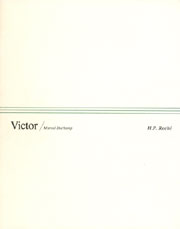
- Victor, roman [écrit en 1957, inachevé], texte établi par Danielle Régnier-Bohler, préface et notes par Jean Clair, Paris, Centre Georges Pompidou, 1977.
- ” Discours de Marcel Duchamp ivre sur la condition des filles du boulevard Saint-Laurent “, [extrait d’un roman en préparation, toujours inédit], Liberté, Montréal, n° 76-77, septembre-octobre 1971.
- Artist Descending a Staircase [and Where Are They Now?], 2 plays for radio, Londres, Faber and Faber, 1973. [Artist Descending a Staircase a été jouée pour la première fois sur les ondes de la BBC le 14 novembre 1972.]
- Triptyque, roman, Paris, Minuit, 1973
- Topologie d’une cité fantôme (8), roman, Paris, Minuit, 1976; Topology of a phantom city, translated by J. A. Underwood, New York, Grove Press, 1977.
- Souvenirs du triangle d’or, roman, Paris, Minuit, 1978;Recollections of the golden triangle, translated by J. A. Underwood, London, J. Calder, 1984.
- Le miroir qui revient (9), roman, Paris, Minuit, 1984;Ghosts in the mirror, translated by Jo Levy, London, J. Calder, 1988.
- Rrose Melody, Liège, Association Art Promotion, 1977.
- The Bride Stripped Bare, 33 tours, EMI, 1978; CD, Virgin 47606-2 (distribué par EMI)
- Le ruban au cou d’Olympia, Paris, Gallimard, 1981.
- Rrose, sa vie sans cachotteries dépeinte […], épopée [en 1150 vers], Hautot-le-Vatois (Normandie), Académie de Muséologie Évocatoire, 1985.
- La boîte verte, Paris, Éd. de la Différence, 1995.
- Chu dans mer sale ou La rumination polymorphe, Paris, la Bibliothèque oulipienne, n° 86, 1997.
- ” Love – Chemical Relationship ” [poème dédié à Marcel Duchamp], The Little Review, New York, vol. 5, n° 2, juin 1918.
- ” Mefk Maru Mustir Daas ” [poème dédié à Marcel Duchamp], The Little Review, New York, vol. 5, n° 8, décembre 1918.
- Pensées sans langage, poème [livre écrit d’octobre (?) 1918 à mars 1919, ainsi dédié: ” Chers amis Gabrielle Buffet, Ribemont-Dessaignes, Marcel Duchamp, Tristan Tzara, je vous dédie ce poème en raison de notre sympathie élective. “], Paris, Eugène Figuière, 1919; Écrits, Tome I: 1913-1920, Paris, Belfond, coll. ” Les bâtisseurs du XXe siècle “, 1975.
- ” À Rrose Sélavy “, poème [1923], dans Clair de terre, Paris, coll. ” Littérature “, 1923;Earthlight, translated by Bill Zavatsky and Zack Rogow, Los Angeles, Sun & Moon Press, 1993.
- ” Mode d’emploi ” [poème écrit le 8 juin 1923, ainsi dédié: ” pour Rrose Sélavy “] et ” Jeu du ‘dans’ ” [poème écrit au début des années 1950 (?), ainsi dédié: ” pour Marcel Duchamp “], dans Poésie 1, Paris, n° 23 (Jacques Baron, Pierre de Massot, Philippe Soupault: trois poètes surréalistes), mars 1972; Étant donné Marcel Duchamp, Baby, n° 2, février 2000.
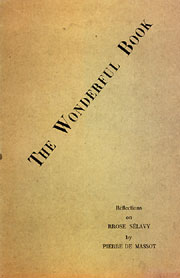
- The Wonderful Book. Reflections on Rrose Sélavy, Paris, hors commerce [Imprimerie Ravilly], s.d. [1924]; Étant donné Marcel Duchamp, Baby, n° 2, février 2000.
- 5 poëmes, [recueil écrit de 1931 à 1946], dédié “À Marcel Duchamp”, avec un portrait de l’auteur par Francis Picabia, Paris, hors commerce [Imprimerie Gaschet et Cie], 1946.
- ” La force ” [poème dédié ” à Marcel Duchamp “], dans Le mouvement perpétuel, poèmes 1921-1924, Paris, Gallimard, 1926.
- Marcel Duchamp [poème écrit le 8 novembre 1939], avec un frontispice par Marcel Duchamp, Paris, hors commerce, 1941.
- Avalanche, novel [dédié ” To Monsieur and Madame Rrose Sélavy “], New York, Simon and Schuster, 1944.
- ” A Complaint for Mary and Marcel “, dans Collected Poems, Port Townsend (Wa), Copper Canyon Press, 1970.
- Les pianos mécaniques, roman [écrit à Cadaquès de mars 1961 à février 1962] (10),, Paris, Laffont, 1962; coll. ” Le livre de poche “; The mechanical pianos, translated by Peter Wiles, New York, Farrar, Straus and Giroux, 1965.
- Agent provocateur, novel, dédié ” For Marcel Duchamp “, Toronto, Coach House Press, 1976.
- Ubu roi [1896], Paris, Fasquelle, 1921; Reliure pour ” Ubu roi ” d’Alfred Jarry (1935), dessinée par Marcel Duchamp et exécutée par Mary Reynolds. Ubu roi, drama in 5 acts, translated by Barbara Wright, London, Gaberbocchus P., 1966; Ubu rex, translated by David Copelin, Vancouver, Pulp Press, 1977; in Three pre-surrealist plays, translated with an introduction and notes by Maya Slater, Oxford and New York, Oxford University Press, 1997.
- Au lavoir noir, poème, avec une fenêtre de Marcel Duchamp, Paris, GLM, coll. ” Repères “, [janvier] 1936; Illustration pour ” Au lavoir noir ” d’André Breton (1935).
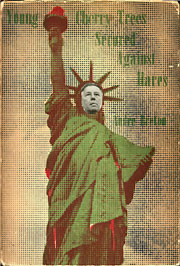
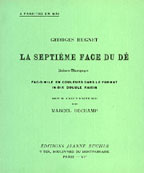
Young cherry trees secured against hares / Jeunes cerisiers garantis contre les lièvres, choix de poèmes traduit par Édouard Roditi, avec des dessins d’Arshile Gorky, New York, View Editions, [mars ou avril] 1946; Couverture pour ” Young cherry trees secured against hares ” d’André Breton (1945). - La septième face du dé, poèmes découpages, couvertures cigarettes par Marcel Duchamp, Paris, Éd. Jeanne Bucher, [mai] 1936; Couverture pour ” La septième face du dé ” de Georges Hugnet (1936).
- Marcel Duchamp [poème écrit le 8 novembre 1939], avec un frontispice par Marcel Duchamp, Paris, hors commerce, 1941; Moustache et barbe de L.H.O.O.Q. (1941).
Giorgio de Chirico (1888-1978) - Hebdomeros, Paris, Éd. du Carrefour, 1929; Reliure pour ” Hebdomeros ” de Giorgio de Chirico (1936-1939), dessinée par Marcel Duchamp et exécutée par Mary Reynolds.
- L’équilibre, [poème écrit en 1917], avec une gravure de Marcel Duchamp, Alès, PAB, [août] 1958.
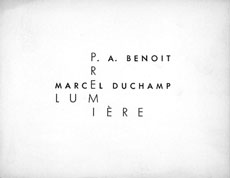
- Première lumière, poème, avec une gravure de Marcel Duchamp, Alès, PAB, [août] 1959.
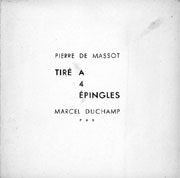
- Tiré à quatre épingles, poèmes, avec une gravure de Marcel Duchamp, Alès, PAB, [été] 1959.
- Marcel Duchamp. Propos et souvenirs, avec un readymade rectifié et en couleurs de Marcel Duchamp, Milan, chez Arturo Schwarz, 1965; L.H.O.O.Q. (réplique, septembre 1964); Étant donné Marcel Duchamp, Baby, n° 2, février 2000.
- Il Reale Assoluto, poèmes [en italien], avec onze lithographies de Marcel Duchamp et de Man Ray, Milan, Galleria Schwarz, 1964; Certificat de lecture (février-mars 1964).
-
Pierre-André Benoit, Première
lumière, Alès: PAB, 1959 -
Pierre de Massot, Tiré
à quatre épingles, Alès: PAB, 1959 - La double vue suivi de L’inventeur du temps gratuit, avec un diptyque gravé à l’eau-forte par Alberto Giacometti et un pliage de Marcel Duchamp (pour les 111 premiers exemplaires), avec une eau-forte de Ferró (pour les 150 exemplaires suivants), Paris, le Soleil noir, 1964; La pendule de profil (1964).
*******************
2. Ceux qui ont publié une oeuvre littéraire (roman, nouvelle, pièce, etc.) qui est ” inspirée ” ou partiellement ” inspirée ” par l’oeuvre ou la personne de Marcel Duchamp
N.B. Les noms précédés d’un astérisque sont déjà dans la section 1
Elmer Ernest Southard (1876-1920)
” Mlle de l’escalier ” [novelette, dictée le 17 novembre 1916], dans Frederick P. Gay, The Open Mind. Elmer Ernest Southard 1876-1920, Chicago, Normandie House, 1938.
Elsa von Freytag-Loringhoven, dite The Baroness, née Elsa Hildegard Ploetz (1874-1927)
” Portrait de Marcel Duchamp “, The Little Review, New York, vol. 9, n° 2, hiver 1922.
Henrie Waste, pseud. d’Henrietta, dite Ettie, Stettheimer (1874-1955)
Love Days [Susanna Moore’s], novel [écrit de 1919 (?) à 1922], New York, Alfred A. Knopf, [août] 1923.
” Pensée-Cadeau: vers à un ami ” [poème, été 1922], dans View, New York, série 5, n° 1, mars 1945.
[1974, article] Bernard Pingaud (1923-)
*******************
2. Ceux qui ont publié une oeuvre littéraire (roman, nouvelle, pièce, etc.) qui est ” inspirée ” ou partiellement ” inspirée ” par l’oeuvre ou la personne de Marcel Duchamp
N.B. Les noms précédés d’un astérisque sont déjà dans la section 1
Elmer Ernest Southard (1876-1920)
” Mlle de l’escalier ” [novelette, dictée le 17 novembre 1916], dans Frederick P. Gay, The Open Mind. Elmer Ernest Southard 1876-1920, Chicago, Normandie House, 1938.
Elsa von Freytag-Loringhoven, dite The Baroness, née Elsa Hildegard Ploetz (1874-1927)
” Portrait de Marcel Duchamp “, The Little Review, New York, vol. 9, n° 2, hiver 1922.
Henrie Waste, pseud. d’Henrietta, dite Ettie, Stettheimer (1874-1955)
Love Days [Susanna Moore’s], novel [écrit de 1919 (?) à 1922], New York, Alfred A. Knopf, [août] 1923.
” Pensée-Cadeau: vers à un ami ” [poème, été 1922], dans View, New York, série 5, n° 1, mars 1945.
[1974, article] Jean-Clarence Lambert (1930-)
*******************
2. Ceux qui ont publié une oeuvre littéraire (roman, nouvelle, pièce, etc.) qui est ” inspirée ” ou partiellement ” inspirée ” par l’oeuvre ou la personne de Marcel Duchamp
N.B. Les noms précédés d’un astérisque sont déjà dans la section 1
Elmer Ernest Southard (1876-1920)
” Mlle de l’escalier ” [novelette, dictée le 17 novembre 1916], dans Frederick P. Gay, The Open Mind. Elmer Ernest Southard 1876-1920, Chicago, Normandie House, 1938.
Elsa von Freytag-Loringhoven, dite The Baroness, née Elsa Hildegard Ploetz (1874-1927)
” Portrait de Marcel Duchamp “, The Little Review, New York, vol. 9, n° 2, hiver 1922.
Henrie Waste, pseud. d’Henrietta, dite Ettie, Stettheimer (1874-1955)
Love Days [Susanna Moore’s], novel [écrit de 1919 (?) à 1922], New York, Alfred A. Knopf, [août] 1923.
” Pensée-Cadeau: vers à un ami ” [poème, été 1922], dans View, New York, série 5, n° 1, mars 1945.
[1975, article] Michel Butor (1926-)
*******************
2. Ceux qui ont publié une oeuvre littéraire (roman, nouvelle, pièce, etc.) qui est ” inspirée ” ou partiellement ” inspirée ” par l’oeuvre ou la personne de Marcel Duchamp
N.B. Les noms précédés d’un astérisque sont déjà dans la section 1
Elmer Ernest Southard (1876-1920)
” Mlle de l’escalier ” [novelette, dictée le 17 novembre 1916], dans Frederick P. Gay, The Open Mind. Elmer Ernest Southard 1876-1920, Chicago, Normandie House, 1938.
Elsa von Freytag-Loringhoven, dite The Baroness, née Elsa Hildegard Ploetz (1874-1927)
” Portrait de Marcel Duchamp “, The Little Review, New York, vol. 9, n° 2, hiver 1922.
Henrie Waste, pseud. d’Henrietta, dite Ettie, Stettheimer (1874-1955)
Love Days [Susanna Moore’s], novel [écrit de 1919 (?) à 1922], New York, Alfred A. Knopf, [août] 1923.
” Pensée-Cadeau: vers à un ami ” [poème, été 1922], dans View, New York, série 5, n° 1, mars 1945.
[1975, livre] Jean Clair, pseud. de Gérard Régnier (1940-)
*******************
2. Ceux qui ont publié une oeuvre littéraire (roman, nouvelle, pièce, etc.) qui est ” inspirée ” ou partiellement ” inspirée ” par l’oeuvre ou la personne de Marcel Duchamp
N.B. Les noms précédés d’un astérisque sont déjà dans la section 1
Elmer Ernest Southard (1876-1920)
” Mlle de l’escalier ” [novelette, dictée le 17 novembre 1916], dans Frederick P. Gay, The Open Mind. Elmer Ernest Southard 1876-1920, Chicago, Normandie House, 1938.
Elsa von Freytag-Loringhoven, dite The Baroness, née Elsa Hildegard Ploetz (1874-1927)
” Portrait de Marcel Duchamp “, The Little Review, New York, vol. 9, n° 2, hiver 1922.
Henrie Waste, pseud. d’Henrietta, dite Ettie, Stettheimer (1874-1955)
Love Days [Susanna Moore’s], novel [écrit de 1919 (?) à 1922], New York, Alfred A. Knopf, [août] 1923.
” Pensée-Cadeau: vers à un ami ” [poème, été 1922], dans View, New York, série 5, n° 1, mars 1945.
[1976, livre] Sarane Alexandrian (1927-)
*******************
2. Ceux qui ont publié une oeuvre littéraire (roman, nouvelle, pièce, etc.) qui est ” inspirée ” ou partiellement ” inspirée ” par l’oeuvre ou la personne de Marcel Duchamp
N.B. Les noms précédés d’un astérisque sont déjà dans la section 1
Elmer Ernest Southard (1876-1920)
” Mlle de l’escalier ” [novelette, dictée le 17 novembre 1916], dans Frederick P. Gay, The Open Mind. Elmer Ernest Southard 1876-1920, Chicago, Normandie House, 1938.
Elsa von Freytag-Loringhoven, dite The Baroness, née Elsa Hildegard Ploetz (1874-1927)
” Portrait de Marcel Duchamp “, The Little Review, New York, vol. 9, n° 2, hiver 1922.
Henrie Waste, pseud. d’Henrietta, dite Ettie, Stettheimer (1874-1955)
Love Days [Susanna Moore’s], novel [écrit de 1919 (?) à 1922], New York, Alfred A. Knopf, [août] 1923.
” Pensée-Cadeau: vers à un ami ” [poème, été 1922], dans View, New York, série 5, n° 1, mars 1945.
[1977, livre] Jean-François Lyotard (1924-1998)
*******************
2. Ceux qui ont publié une oeuvre littéraire (roman, nouvelle, pièce, etc.) qui est ” inspirée ” ou partiellement ” inspirée ” par l’oeuvre ou la personne de Marcel Duchamp
N.B. Les noms précédés d’un astérisque sont déjà dans la section 1
Elmer Ernest Southard (1876-1920)
” Mlle de l’escalier ” [novelette, dictée le 17 novembre 1916], dans Frederick P. Gay, The Open Mind. Elmer Ernest Southard 1876-1920, Chicago, Normandie House, 1938.
Elsa von Freytag-Loringhoven, dite The Baroness, née Elsa Hildegard Ploetz (1874-1927)
” Portrait de Marcel Duchamp “, The Little Review, New York, vol. 9, n° 2, hiver 1922.
Henrie Waste, pseud. d’Henrietta, dite Ettie, Stettheimer (1874-1955)
Love Days [Susanna Moore’s], novel [écrit de 1919 (?) à 1922], New York, Alfred A. Knopf, [août] 1923.
” Pensée-Cadeau: vers à un ami ” [poème, été 1922], dans View, New York, série 5, n° 1, mars 1945.
[1977, article; 1984, livre] André Gervais (1947-)
*******************
2. Ceux qui ont publié une oeuvre littéraire (roman, nouvelle, pièce, etc.) qui est ” inspirée ” ou partiellement ” inspirée ” par l’oeuvre ou la personne de Marcel Duchamp
N.B. Les noms précédés d’un astérisque sont déjà dans la section 1
Elmer Ernest Southard (1876-1920)
” Mlle de l’escalier ” [novelette, dictée le 17 novembre 1916], dans Frederick P. Gay, The Open Mind. Elmer Ernest Southard 1876-1920, Chicago, Normandie House, 1938.
Elsa von Freytag-Loringhoven, dite The Baroness, née Elsa Hildegard Ploetz (1874-1927)
” Portrait de Marcel Duchamp “, The Little Review, New York, vol. 9, n° 2, hiver 1922.
Henrie Waste, pseud. d’Henrietta, dite Ettie, Stettheimer (1874-1955)
Love Days [Susanna Moore’s], novel [écrit de 1919 (?) à 1922], New York, Alfred A. Knopf, [août] 1923.
” Pensée-Cadeau: vers à un ami ” [poème, été 1922], dans View, New York, série 5, n° 1, mars 1945.
[1984, article] Philippe Muray (1945-)
*******************
2. Ceux qui ont publié une oeuvre littéraire (roman, nouvelle, pièce, etc.) qui est ” inspirée ” ou partiellement ” inspirée ” par l’oeuvre ou la personne de Marcel Duchamp
N.B. Les noms précédés d’un astérisque sont déjà dans la section 1
Elmer Ernest Southard (1876-1920)
Elsa von Freytag-Loringhoven, dite The Baroness, née Elsa Hildegard Ploetz (1874-1927)
Henrie Waste, pseud. d’Henrietta, dite Ettie, Stettheimer (1874-1955)
click to enlarge

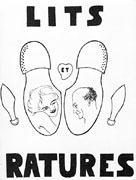
Cover of Littérature,
André Breton (ed.), N° 5, 1er October, 1922
Robert Desnos (1900-1945)
Robert Lebel
click to enlarge

Robert Lebel, La Double
Vue, Paris: Le Soleil noir, 1964
* Michel Butor
* Henri Pierre Roché
* Jean Suquet
Tom Stoppard, pseud. de Thomas Straussler (1937-)
click to enlarge

Henri Pierre Roché, Victor,
vol. 4 of the four-volume publication issued for the exhibition
“L’Oeuvre de Marcel Duchamp,” 31 January – 2 May, 1977, Paris: Centre
Georges Pompidoue
Claude Simon (1913-)
Alain Robbe-Grillet (1922-)
Jacques Charlier (…-)
Bryan Ferry (…-)
* Michel Leiris
Jean-François Vilar (1948-)
[1977, livre] Jennifer Gough-Cooper (…-) & Jacques Caumont (…-)
Michel Waldberg (1940-)
Walter Henry, pseud. de Paul Braffort (…-)
***********************
3. Ceux qui ont publié une oeuvre littéraire (roman, nouvelle, poème, etc.) ” en hommage ” ou partiellement ” en hommage ” à la personne ou à l’oeuvre de Marcel Duchamp
N.B. Les noms précédés d’un astérisque sont déjà dans la section 1
Elsa von Freytag-Loringhoven
Francis Picabia
* André Breton
click to enlarge

Pierre de Massot, The Wonderful Book,
Reflections on Rrosé Selavy
(1924), in Étant donné Marcel
Duchamp, n° 2, February 2000,
pp. 97~120
* Pierre de Massot
Louis Aragon (1897-1985)
Georges Hugnet (1906-1974)
Kay Boyle (1902-1992)
Henri-François Rey (1919-1987)
David Young (1946-)
***********************
click to enlarge

André Breton, Au Lavoir
noir, Paris: Éditions G.L.M, 1936
4. Oeuvres littéraires ” illustrées ” par Marcel Duchamp, seul ou en collaboration, ou par Marcel Duchamp et un autre artiste
N.B. Les noms précédés d’un astérisque sont déjà dans la section 1
Alfred Jarry (1873-1907)
* André Breton
click to enlarge

André Breton, Young Cherry
Trees Secured against Hares, Edward Roditi (trans.), New York:
View Editions, 1946
Georges Hugnet
Francis Picabia
Pierre-André Benoit (1921-1993)
click images to enlarge

Georges Hugnet, La septiéme
face du dé, Paris: Éditions Jeanne Bucher, 1936

Georges Hugnet, Marcel Duchamp,
a poem and front piece with
Moustache et barbe de L.H.O.O.Q.
(1941) by Duchamp, Paris:
Hors Commerce, 1941
*Pierre de Massot
* Arturo Schwarz
click images to enlarge
* Robert Lebel
Envoyer vos remarques: André_Gervais@uqar.uquebec.ca
Notes
1. Cette rétrospective contient Mont de piété [1919, avec 2 dessins d’André Derain], Clair de terre [1923, avec un portrait par Pablo Picasso], L’union libre [1931], Le revolver à cheveux blancs [1932, avec une eau-forte par Salvador Dali], Violette Nozières [1933], L’air de l’eau [1934, avec 4 gravures par Alberto Giacometti] et Au lavoir noir [1936, avec une fenêtre de Marcel Duchamp].
2. Cette rétrospective contient [Poèmes 1935-1940], Pleine marge [1943, avec une eau-forte de Kurt Seligmann], Fata morgana [1941, avec 4 dessins de Wilfredo Lam], [Poèmes 1940-1943], Les états généraux[1944], Des épingles tremblantes [1948], Xénophiles [1948], Ode à Charles Fourier [1947], Oubliés [1948],Constellations [1959, avec 22 gouaches de Juan Miró] et Le la [1961, avec une lithographie de Jean Benoît].
3. Cette rétrospective contient, en totalité ou en partie, les brefs petits livres suivants: Soliloque de Nausicaa [1928, avec cinq dessins de Jean Cocteau], 5 poëmes [1946, avec un portrait de l’auteur par Francis Picabia], Orestie [1949], Mot clé des mensonges [1954], Galets abandonnés sur la page [1958, avec une eau-forte de Jacques Villon] et Tiré à quatre épingles [1959, avec une gravure de Marcel Duchamp], auxquels elle ajoutePrison de neige, poèmes écrits en 1960-1961.
4. Cette rétrospective récente ajoute à la précédente plusieurs autres poèmes ainsi qu’une étude et une biographie.
5. Cette rétrospective contient les livres suivants: Simulacre [1925], Le point cardinal [1927], Glossaire: j’y serre mes gloses [commencé en 1925; 1939, avec des lithographies d’André Masson], Bagatelles végétales [1956, avec 6 gravures de Juan Miró] et Marrons sculptés pour Miró [1961, avec une lithographie en couleurs de Juan Miró]. Le Glossaire… a une suite: Langage tangage ou Ce que les mots me disent, Paris, Gallimard, 1985.
6. Sur le rabat de la jaquette: ” Manuscrits choisis à coups de ciseaux, photographies le plus souvent en noir et blanc, articles perdus parmi les feuilles mortes, entretiens de vive voix, clins d’oeil à des amis, retracent sans horloge ni boussole le voyage. ”
7. Michel Butor, lors de la discussion suivant la communication de Patrice Quéréel sur ce roman dans le cadre d’un colloque sur son oeuvre (qui a eu lieu du 24 juin au 1er juillet 1973), précise ceci: ” En ce qui concerne les appareils idéologiques d’État, j’ai constamment pensé, en vous écoutant, à Marcel Duchamp: il y avait dans cette façon de voir ces institutions le modèle du grand verre de Marcel Duchamp qui est évoqué de toutes sortes de manières dans ce livre. ” Ceci dans Georges Raillard (sous la dir. de), Butor. Colloque de Cerisy, Paris, UGÉ, coll. ” 10 / 18 “, n° 902, 1974, p. 84.
8. Georges Raillard, dans ” Mots de passe. Quelques notes prises au cours d’une traversée difficile: La belle captive [1976] “, Obliques, Les Pilles, n° 16-17 (Robbe-Grillet), 4e trimestre 1978, cite la dédicace de l’auteur sur un exemplaire de Topologie…: ” quelque chose comme mon Grand Verre “.
9. Georges Raillard intitule ” Le Grand Verre de Robbe-Grillet ” (La Quinzaine littéraire, Paris, n° 432, 16-31 janvier 1985) sa critique de ce premier tome de l'” autobiographie ” robbegrillettienne, dont le titre général estRomanesques.
10. Ce roman ne contient qu’une brève allusion à Duchamp qui, de 1958 à 1968, passera un ou quelques mois du printemps ou de l’été dans ce village catalan.
Painting the Large Glass
click to enlarge

Octavian Balea,
the “Large Glass”
[Some time ago, Octavio Balea contacted us from Romania. We learned about his enthusiasm for Duchamp and the horrible state his country is in. It was all the more surprising to see him put with what he called the ignorance of his people and express himself through art. He is angry at the legacy Ceaucescu’s dictatorship has left behind. As a caring and and enthusiastic young man, he is often laughed at, trying to open the eyes of his fellow students to modern art. Octavian draws, paints and takes photographs. A recent series of his work was inspired by Duchamp.]
“Here is why I painted that painting, on my parent’s glass: One night, at 2 A.M., staring at the ceiling, and at the walls, and I thought that the world was getting back at me for a mistake I had never made! I remember that I took the brush in my hand, and I started to paint on what was closest to me! The window was the first thing that I noticed. I was inspired by the genial masterpiece of Marcel Duchamp, called “The Large Glass.” I think that Duchamp wanted to tell more, more than the human mind is able to understand. More than the words can say. I am trying to find a better way to express what it is to express and it is not expressed yet.”
We Deserve Scheme Z and Excavation or the Law of Diminishing Returns
Click here for Video (83.5 KB)

click to enlarge

We Deserve Scheme Z.
This is a Reclamation Artists Project in 1990 at the height of public outcry against “the Big Dig” in Charlestown-a five tiered eight-lane expressway interchange, part of the Central Artery/Third Harbor Tunnel Project for Greater Boston. A gas pump contains a video monitor showing Boston rush-hour traffic with the audio track overdubbed several times until it sounds like babble. A dead bird covered in oil lays where the price per gallon is usually displayed. The word “Mobiline” is taken from Duchamp’s “love gasoline” the substance activating the Bride’s motor in his work “The Bridge Stripped Bare by her Bachelors, Even” in the Phildelphia Museum of Art.
Excavation or the Law of Diminishing Returns.
l994 Reclamation Artists project about the same highway system. North Point, Cambridge. Replicas of Duchamp’s Readymades appear to be strewn along an excavated highway. This installation is on the site of the (now under construction) Central Artery. The installation was intended to “disturb the peace” of Modernism as Duchamp had done and as the highway construction is presently doing.
click images to enlarge
Into the Vitrine
click images to enlarge

Marcel Duchamp,
Interior view of Etant donnés: 1º la chute d’eau / 2º le gas
d’éclairage (Given: 1. The Waterfall /2. The Illuminating Gas),
1946-66
Into the Vitrine
The hand melted down in carbon
like ash
but veined
palpably
Fingers in a throttle
and over all
of course
wax
Into the vitrine
it all went
Visibility held its charms
but oh so old
And so closeted in glass
no stench arose.
Rrose Sélavy,
she said.
Harriet Zinnes, 1999
Fig. 1 © 2000 Succession Marcel Duchamp, ARS, N.Y./ADAGP, Paris. All rights reserved.
Memoirs: Art & Art History
These six paintings linking Marcel Duchamp and Man Ray are part of a long-term project on art, artists and art movements. The Duchamp/Man Ray paintings are pairs or companion pieces. The paintings, in gouache, are not absolutely faithful to detail or color and are painted with flat surfaces and thin paint so as not to reproduce the texture of the originals. The series began late in 1995. It was completed in early 2000 with nineteen paintings.
The work is in various paint media-gouache, acrylic, oil-acrylic gel transfer photocopies and computer-generated type. While each pair of paintings carries intellectual and personal content, their primary impact is visual.
The block letter texts framing the images are gleaned from various sources; they are pertinent to the images and are combinations of artist’s titles and descriptions as well as observations from critics, historians and curators, and others.
Some of the artists have influenced me or been a source of inspiration. Others’ work uses motifs and backdrops for intertextual discourse. Each pair has a Jewish context or presence. The Jewishness is represented by my selection of artists, critics, and historians. The paintings are personal responses to specific aesthetics, works of art, artists, art movements, art personalities, and my own social, aesthetic, or political engagement with them.
In this century, copying, can be found in the work of Pablo Picasso, Roy Lichtenstein and Sherrie Levine. Picasso abducted other sources because he needed icons as sources of inspiration; Lichtenstein carried away various modernist pictures to praise and subvert them for his popular comic book style and Levine deconstructed modernist paradigms in her “stainless steals.” Unlike Picasso, I am not pilfering images; unlike Lichtenstein, I am not re-designing paintings to convey a post-modern aura; and unlike Levine, I am not re-writing history. But more like the poster paintings of Charles Demuth, on the other hand, which were tributes to his friends and associates, this work is largely about late modernism, artists and critics and their complicated inter-personal associations.
The written material, aside the paintings, augments the narrative I tell in pictures and words:
Paintings 1 & 2, 1997-1998 (44″x34″)
Left Panel: ADOPTED BY THE FRENCH/PAINTING WITH LIGHT/OUR OWN MAN RAY/BROKEN WITH SIGHT
The background image is a painted copy of Man Ray’s The Rope Dancer Accompanies herself with her Shadows, 1916. This painting was completed while Marcel Duchamp was working on his Large Glass; it is in homage to or, at least, is an allusion to Duchamp’s work. The central photocopy is a Man Ray self-portrait photograph with a camera. His quote reads: “I tell them that the tricks of today are the truths of tomorrow.” The photocopy in the lower center is a photograph of the lower portion of The Bride Stripped Bare by Her Bachelors, Even by Man Ray and Marcel Duchamp’s Dust Breeding, 1920.
Right panel: WELCOME TO NEW YORK/BROKEN WITH SIGHT/ENIGMATIC DUCHAMP/ANTI RETINAL ART
The background image is a painted copy of Duchamp’s drawing for the Large Glass. The central photocopy is a photograph of Duchamp by Man Ray. His quote reads: “It is idle to explain it, I do not explain it. It is, after all, the fourth dimension.” The photocopy in the lower center is the lower portion of the Large Glass photographed by Charles Scheeler, c. 1921.
Text around these paintings was gleaned from what the artists said and what others said about them. “WELCOME TO NEW YORK,” is from a Francis Picabia painting completed shortly after he made his first visit to the city and encouraged Duchamp to follow.
Duchamp, a son of a French notary, and Man Ray, born of immigrant Jews in Philadelphia, were friends and partners in art and chess since they met in New Jersey in 1915 where they feigned an imaginary game of tennis. Perhaps this was the first work of Performance Art. They shared interests in Dada, machine-like contrivances, cross-dressing, women, sex and readymades, as well as chess, for over fifty years.
Paintings 3 & 4, 1998 (44″x34″)
Left Panel: …ROSE SEL A VIE/EROSE C’EST LA VIE/EM(MAN)UEL (RA)DNITSK(Y)/C’EST DE LA BELLE HÆLEINE
The background images are painted copies of Man Ray drawings: the left side drawing was done from a photograph of Man Ray’s wife, Julie in 1942; the right side is a surrealist drawing, Sablier-compte fils [(the) Hourglass Counts (the) Threads, (probably another reference to the bride stripping bare)], 1938. The central photocopy is a self-portrait photograph in which Man Ray depicts himself about to indulge in multiple suicides. His quote reads: “To Be-continued unnoticed.” The photocopy lower center is a magazine reproduction of a solarized print with color: Beauty in Ultra Violet, 1940.
Right Panel: …ROSE SEL A VIE/EROS C’EST LA VIE/RROSE SELAVY/C’EST LA BELLE HELENE
The background images are painted copies of Duchamp’s etchings. The left side is from Lucas Cranach’s Adam and Eve from a presentation, years before, with Duchamp on stage as Adam and Bronia Perlmutter as Eve in a Ciné Sketch produced by Francis Picabia and René Clair at the Théâtre des Champs-Elysées. The right side is from a painting by Gustav Courbét-this is the bride stripping bare; the falcon represents a “peeping Tom” bachelor and “a false cunt and a real one,” according to Duchamp. The central photocopy is a photograph of Duchamp as Rrose Selavy-his alter ego Jewish woman persona. His quote reads: “…I consider myself…’an unfrocked artist.'” The photocopy lower center is Duchamp’s relief maquette, painted leather over a plaster mounted on velvet, for Etant donné: Given the Illuminating Gas and the Waterfall, 1948-’49.
Multiple puns abound in the text: Man Ray’s, “…ROSE SEL A VIE (originally a Rayograph Dadist object portrait of Duchamp published in The little Review, 1922) translates to “ROSE THE SALT OF LIFE,” Duchamp’s French enunciation, EROS C’EST LA VIE, is “EROTICISM THAT’S LIFE,” and his English transliteration of RROSE SELAVY is “ROSE LEVY.” Other puns revolve around the perfume bottle readymade with a photograph portrait of Duchamp as a woman wearing a hat (not shown) called “C”EST DE LA BELLE HÆLEINE-BEAUTIFUL BREATH.” (I superimposed the “A” over the “E” to make the pun on “HALEINE” more closely resemble “HELENE.” “C’EST DE LA BELLE HELENE-BEAUTIFUL HELEN,” which is my addition to the punster game.
Paintings 5 & 6, 1998 (44″x34″)
Left Panel: I AND MARCEL A DUEL/THE KING IS MINE/PORTRAIT OF THIRTY YEARS/THE QUEEN IS YOURS (This is to be read horizontally top and bottom and vertically right and left.)
The background image is a painted copy of Man Ray’s Night Sun–Abandoned Playground, 1943. The central photocopy is a photograph of Man Ray and Duchamp, as old men, playing chess. His quote reads: “The Cosmic Urge-with ape-ologies to PicASSo, 1915.” The photocopy lower center is Man Ray’s whimsical construction of a chess board with three giant chess pieces, Permanent Attraction, 1948
Right Panel: A YOUNG MAN OF GOOD/ELEMENTARY TREATICE/ PROVINCIAL/FAMILY/ON FOUR-DIMENSIONS (This is to be read horizontally top and bottom and vertically right and left.)
The background image is a painted copy of Duchamp’s The Chess Game, 1910, which includes his two artist brothers playing chess and his sisters sitting around. The central photocopy is of a photograph of Man Ray and Duchamp, as young men, playing chess. His quote reads: “A piece of canned chance. It’s amusing to put chance in a can,” 1913-1914. The photocopy lower center is of Duchamp’s construction, “Pocket Chess set with Rubber Glove,” 1966, upside down.
The mysteries of chess, plays on words, games, chance, physics and mathematics were mutual interests of these perplexing artists.
Marcel Duchamp and Literature
By no means complete and, on more than one occasion, eminently perfectible, this bibliography aspires nevertheless to offer the first gathering of the names of writers and the titles of literary works that are related, either directly or indirectly, to Marcel Duchamp or to the work of Marcel Duchamp.
For matters of clarification, entries have been arranged chronologically in each of the four sections. If a book is reprinted or initially published in a paperback edition, this is indicated. If a book is translated, in full or in part, in English or in French, this is also indicated.
The four sections are the following:
I. Those who have published
a. at least one book, chapter, or article on the work of Marcel Duchamp, or an interview with him, as well as
b. a literary work (novel, collection of short stories, poetry, play).
II. Those who have published a literary work (novel, short story, play, etc.) which was “inspired” or “partially inspired” by the work of Marcel Duchamp or Duchamp himself.
III. Those who have published a literary work (novel, short story, poem, etc.) “in honor of” or “in partial honor of” Marcel Duchamp or his work.
IV. Literary works “illustrated” by Marcel Duchamp (alone or in collaboration) or by Marcel Duchamp and another artist.
Recognition of the first important work by Duchamp, of several works by Duchamp, and of what we’ve agreed to collectively call “the art of Marcel Duchamp” truly began in 1913 – with public recognition from the Americans (at the Armory Show, 1913) and critical recognition from the French (Apollinaire, 1913). Although more developed on the English-speaking side, the connections between art and literature, if one were to consider them, seem clearly more constant, even more consistent, on the French-speaking side. No relation of cause and effect here, but a simple observation: quite a lot of those who have written or will write about Marcel Duchamp have written or will also write (most often in French) literary texts.
André Gervais Janvier 2000
*******************
Those who have published a. at least one book, chapter, or article on the work of Marcel Duchamp, or an interview with him, as well as b. a literary work (novel, collection of short stories, poetry, play).
Note : In each case, the publication date of (a) is provided first, in brackets, before the author’s name. Following the author’s name is a list of his/her literary texts. Where an author has published a number of literary texts, the choice has been limited to four.
[1913, Chapter] Guillaume Apollinaire, pseud. de Wilhem Apollinaire de Kostrowitzky (1880-1918)
- L’enchanteur pourrissant With a portrait by Pablo Picasso. Paris : Mercure de France, 1913; Paris: Gallimard, coll. “Poésie/Gallimard”; Alcools. Translated by Anne Hyde Greet, with a foreword by Warren Ramsey. Berkeley: University of California Press, 1965; Alcools. Translated by Donald Revell. Hanover: University Press of New England for Wesleyan University Press, 1995.
- Le poète assassiné, With a portrait by André Rouveyre. Paris: Bibliothèque des curieux, 1916; Paris: Gallimard, coll. “Poésie / Gallimard”; The Poet Assassinated. Translated with a bibliographical notice and notes by Matthew Josephson. New York: The Broom Pub. Co., 1923; The Poet Assassinated. Translated by Ron Padgett, illustrated by Jim Dine. New York: Holt, Rinehart and Winston, 1968.
- Calligrammes, [Poems of peace and war 1913-1916]. With a portrait by Pablo Picasso. Paris : Mercure de France, 1918; Paris: Gallimard, coll. “Poésie / Gallimard “; Calligrammes. Translated by Anne Hyde Greet, with an introduction by S. I. Lockerbie and commentary by Anne Hyde Greet and S. I. Lockerbie. Berkeley: University of California Press, 1980.
[1917, Article-entrevue] Mina Loy, pseud. de Mina Lowy (1882-1966)
- Lunar Baedecker [sic], Paris: Contact Publishing Company, 1923; Lunar Baedeker & Time-tables. Highlands, NC: Jonathan Williams, 1958; The Last Lunar Baedeker. Edited and introduced by Roger L. Conover. Highlands, NC: The Jargon Society, 1982; The Lost Lunar Baedeker. Definitive edition, edited and introduced by Roger L. Conover. New York: Farrar, Straus & Giroux, 1996
[1917, Article]Louise Varèse, née Louise McCutcheon (1890-1988)
- St.-John Perse. Éloges, and other poems, French text with English translation by Louise Varèse and introduction by Archibald MacLeish, New York, W.W. Norton & Co, 1944.
- Charles Baudelaire. Paris Spleen, translated by Louise Varèse, New York, New Directions, 1947.
- Marcel Proust. Pleasures and Regrets, translated by Louise Varèse, with a preface by Anatole France, New York, Crown Publishers, 1948.
- Varèse: A Looking-Glass Diary, Volume 1, 1883-1928; New York, W.W. Norton & Co, 1972.
[1922, Article] André Breton (1896-1966)
- Nadja [1928], [story] Completely revised edition, by the author. Paris: Gallimard, 1963; coll. “Folio”; Nadja. Translated by Richard Howard. New York: Grove Press, 1960 and London: Evergreen Books, Ltd., 1960.
- Arcane 17 [1944, with four colored tarot strips by Matta] enté d’Ajours. With three etchings by Baskine. Paris: Éd. du Sagittaire, 1947; coll. “10 / 18 “; Arcanum 17 : With Apertures : Grafted to the End. Translated by Zack Rogow, with an introduction by Anna Balakian. Toronto: Coach House Press, 1994.
- Clair de terre(1) , [poems]. Preface by Alain Jouffroy. Paris: Gallimard, coll. “Poésie / Gallimard,” 1966.
- Signe ascendant(2) , Paris: Gallimard, coll. “Poésie / Gallimard,” 1966
[1924, Preface] Gertrude Stein (1874-1946)
- Geography and Plays, Boston, The Four Seas Company, 1922.
- The Making of Americans, Being a History of a Family’s Progress , novel, Paris, Contact Editions, 1925; Américains d’Amérique, histoire d’une famille américaine, traduction de la baronne J. Seillère et de Bernard Faÿ, Paris, Stock, Delamain et Boutelleau, 1933.
- The Autobiography of Alice B. Toklas, London, John Lane, The Bodley Head, 1933;Autobiographie d’Alice Toklas, traduction de Bernard Faÿ, Paris, Gallimard, 1934.
- Everybody’s Autobiography, New York, Random House, 1937; Autobiographies, traduction de la baronne d’Aiguy [May Tagnard], Paris, Éd. Confluences, 1945.
[1924, Book]
- Pierre de Massot (1900-1969)
- Prolégomènes à une éthique sans métaphysique ou Billy, bull-dog et philosophe [essay]. Paris: Éditions de la Montagne, 1930.
- Mon corps, ce doux démon [written 1932] [autobiography]. Letter-preface by André Gide, with an engraved portrait by Jacques Villon, s.l.n.d. [Alès: PAB, 1959].
- Le mystère des maux [poems]. With a drawing by Francis Picabia. Paris: hors commerce [Imprimerie René Martinet et Cie], 1961.(3)
- Le déserteur. Oeuvre poétique 1923-1969, texts collected and presented by Gérard Pfister, Paris, Arfuyen, 1992.(4)
[1936, article] Michel Leiris
- L’âge d’homme published 1939]. Preceded by: De la littérature considérée comme une tauromachie [1946] [first autobiography]. Paris: Gallimard, 1946; Paris: Gallimard, coll. “Folio”; Manhood : A Journey from Childhood into the Fierce Order of Virility. Preceded by: The Autobiographer as Torero. Translated by Richard Howard. New York: Grossman Publishers, 1963.
- La règle du jeu. Tome I: Biffures,Tome II: Fourbis, Tome III: Fibrilles [and] Tome IV: Frêle bruit [second autobiography]. Paris: Gallimard, respectively 1948, 1955, 1966 and 1976: the four volumes, coll. “L’imaginaire”; Rules of the Game: Scratches [Biffures]. Translated by Lydia Davis. New York: Paragon House, 1991 [Baltimore, MD: Johns Hopkins University, 1997]; Scraps [Fourbis]. Translated by Lydia Davis. Baltimore, MD: Johns Hopkins University, 1997.
- Mots sans mémoire (5), Paris, Gallimard, 1969.
- Journal 1922-1989,Critical edition presented and annotated by Jean Jamin. Paris: Gallimard, 1992.
[1937, article] Roger Caillois (1913-1978)
- Art poétique, Paris, Gallimard, 1958.
- Esthétique généralisée, Paris, Gallimard, 1962.
- Pierres, Paris, Gallimard, 1966.
- Obliques [1967] précédé de Images, images… [1966], Paris, Gallimard, coll. ” Le monde ouvert “, 1974.
[1938, article-entrevue; 1959, livre] Robert Lebel (1901-1986)
- Masque à lame, Illustrated by Isabelle Waldberg. New York: Éd. Hémisphères, 1943.
- L’oiseau caramel,, Illustrated by Max Ernst. Paris: le Soleil noir, 1969.
- La Saint-Charlemagne, illustré par Max Ernst, Paris, le Soleil noir, 1976.
[1945, article] Man Ray, pseud. d’Emmanuel Radnitsky (1890-1976)
- Self portrait [begun 1951, published 1963] [autobiography]. Foreword by Merry A. Foresta. Afterword by Juliet Man Ray. Boston: Little, Brown & Co., and the New York Graphic Society, 1988; Autoportrait. Translated into French by Anne Guérin. Paris: Laffont, 1964; Arles: Actes Sud, coll. “Babel.”
- Ce que je suis et autres textes, Presented by Vincent Lavoie. Paris: Hoëbeke, coll. “Arts & esthétique,” 1998.
[1945, article] Nicolas Calas [pseud.], [also known as Nikolas Kalas], Nikos Kalamares (1907- )
- Odos Niketa Randou [Rue Nikita Randou], poèmes, Athènes, Ikaros, 1977.
[1949, article] Gaston Puel (1924-)
- Paysage nuptial, frontispice de Hans Bellmer, Paris, GLM, 1947.
- La jamais rencontrée, frontispice de Max Ernst, Paris, Seghers, 1950.
- Ce chant entre deux astres, collage de Jean Arp en double frontispice, Lyon, Henneuse éd., 1956.
- Le cinquième château, avec deux bois originaux de Raoul Ubac, Veilhes, la Fenêtre ardente, 1965.
[1950, article; 1974, livre] Jean Suquet (1928-)
- Jamais rien ni personne, Enhanced with an engraving faded by time. Paris: le Parler de la lune aphasique, 1958.
- Une chimie greffée de chimères,Paris: le Parler de la lune aphasique, 1972.
- Oubli sablier intarissable(6), n° spécial de la revue Liard, Bordeaux, 1996.
[1952, article; 1954, chapitre] Michel Carrouges, pseud. de Louis Couturier (1910-1988)
- Les portes dauphines, roman, Paris, Gallimard, 1954.
- Les grands-pères prodiges, roman, Paris, Plon, 1957.
[1953, article] Henri Pierre Roché (1879-1959)
- Jean Roc [pseud.]. Don Juan et… [story]. Paris: Éd. de la Sirène, 1921; Marseille: André Dimanche Éditeur, 1993.
- Jules et Jim [novel]. Paris: Gallimard, 1953; coll. “Folio”; Jules and Jim, translated by Patrick Evans. London and Boston: M. Boyars, 1963.
- Deux Anglaises et le continent, roman, Paris, Gallimard, 1956.
- Carnets. Les années Jules et Jim. Part one, 1920-1921. Foreword by François Truffaut. Marseille: André Dimanche Éditeur, 1990.
[1954, article-entrevue] Alain Jouffroy (1928-)
- Un rêve plus long que la nuit, roman, Paris, Gallimard, 1964; coll. ” Folio “.
- Trajectoire, récit-récitatif, Paris: Gallimard, 1968.
- Liberté des libertés, Illustrated by Joan Miró and Valerio Adami. Paris: le Soleil noir, 1971.
- L’ouverture de l’être 1947-1962, poèmes,Preface by Sarane Alexandrian. Paris: Éd. de la Différence, coll. “Littérature,” 1983.
[1957, article-entrevue] Jean Schuster (1929-1995)
- Les moutons, Paris, Éd. le Récipiendaire, 1978.
- Introduction and notes by Michel Déon. Paris: Éd. de la Table ronde, 1964; Paris: Gallimard, coll. “Idées”; Diary of a Genius. Foreword and notes by Michel Déon. Translated by Richard Howard. New York: Doubleday, 1965.
[1959, article] Salvador Dali (1904-1989)
- La vie secrète de Salvador Dali, Translated by Haakon M. Chevalier. New York: Dial Press, 1942; La vie secrète de Salvador Dali. Adapted by Michel Déon. Paris: Éd. de la Table ronde, coll. “Les vies perpendiculaires,” 1952; Paris: Gallimard, coll. “Idées.”.
[1963, article] John Cage (1912-1992)
- Silence, lectures and writings; A Year from Monday [new lectures and writings]; M [writings, ’67-’72]; Empty Words [writings, ’73-’78]; X [writings, ’79-’82]; Middletown (CT): Wesleyan University Press, respectively 1961, 1967, 1973, 1979 and 1983; Silence. Translated into the French by Monique Fong. Paris: Denoël, 1970.
- Pour les oiseaux, Dialogues with Daniel Charles. Paris: Belfond, 1976; For the Birds, Boston: M. Boyards, 1981.
[1964, chapitre; 1967, livre] Arturo Schwarz (1924-)
- Choix de poèmes [en français], Paris, Seghers, 1956.
- Il Reale Assoluto, With eleven lithographs by Marcel Duchamp and Man Ray. Milan: Galleria Schwarz, 1964..
- Per Vera, poems In Italian. With a portrait of Vera by Franco Francese. Milan: Penna di Pollo Editore, 1984.
- A coat made of wind, n English. With an engraving by Ofer Lellouche. Tel-Aviv: The Genia Shreiber University Art Gallery, Tel Aviv University, 1994.
[1968, article] Denis de Rougemont (1906-1985)
- L’amour et l’occident, essay [1939], Revised edition. Paris: Plon, 1956; Paris: UGÉ, coll. “10 / 18”; Love in the Western World. Revised and augmented edition. Translated by Montgomery Belgion. New York: Pantheon, 1956. [The other title of this translation is Passion and Society, London: Faber and Faber, 1956].
- La part du diable [fin 1942],New version. Neuchâtel: la Baconnière, 1945; The Devil’s Share [essay]. On the diabolic in modern society. Translated by Haakon M. Chevalier. New York: Meridian Books, 1956.
- Lettres sur la bombe atomique, Paris, Gallimard, 1946.
- Journal d’une époque 1926-1946, Paris: Gallimard, 1968. [Revised edition of Journal des deux mondes, 1947.].
[1968, livre] Octavio Paz (1914-1998)
- Liberté sur parole [translated into French, 1966], followed by: Condition de nuage, Aigle ou soleil [1951], À la limite du monde [1942], and Pierre de soleil [1957, translated into French, 1962] [poems]; Translated from the Spanish by Jean-Clarence Lambert (reviewd by the author) and Benjamin Péret. Paris: Gallimard, coll. “Poésie / Gallimard,” 1971.
- Versant Est [Ladera Este (1962-1968), Translated from the Spanish into French by Yesé Amory et al. Paris: Gallimard, 1970; coll. “Poésie / Gallimard.”
- The collected poems of Octavio Paz, 1957-1987, Edited and translated into English by Eliot Weinberger, with additional translations by Elizabeth Bishop et al. New York: New Directions, 1987.
- Le singe grammairien, Translated into the French by Claude Esteban. Geneva: Skira, coll. “Les sentiers de la création,” 1972; The Monkey Grammarian. Translated into the English by Helen R. Lane. New York: Seaver Books, 1981.
[1969, article] Bernard Teyssèdre (1930-)
- Romans-éclairs, Paris, Grasset, 1961.
- Foi de fol, [comical story entangled with plagiarism and examples]. Paris: Gallimard, coll. “Le chemin,”1968.
- Le roman de l’Origine, Paris: Gallimard, coll. “L’Infini,” 1996.
[1971, article] José Pierre (1927-1998 ?)
- Qu’est-ce que Thérèse? C’est les marronniers en fleurs, roman, Paris, le Soleil noir, 1974; coll. ” J’ai lu. Pour lecteurs avertis “.
- La charité commence par un baiser, Paris: Galilée, coll. “Ligne fictive,” 1980.
- Les barreaux du coeur, roman, Paris, Mercure de France, coll. ” Le Mercure galant “, 1986.
- La fontaine close. Mercure de France, coll. “Le Mercure galant,” 1986.
La fontaine close. Les livres secrets d’une secte gnostique inconnue. Paris: l’Instant, coll. “Griffures,” 1988.
[1972, article] Marcelin Pleynet (1933-)
- Stanze. Incantation dite au bandeau d’or, Paris, Seuil, coll. ” Tel quel “, 1973.
- Rime, Paris, Seuil, coll. ” Tel quel “, 1981.
- Le jour et l’heure, journal, Paris, Plon, coll. ” Carnets “, 1988.
- La vie à deux ou trois, roman, Paris, Gallimard, 1992.
[1973, article] David Antin (1932-)
- Selected Poems 1963-1973, Los Angeles: Sun & Moon Press, coll. “Sun & Moon classics,” 1991; Poèmes parlés. Translated into the French by Jacques Darras et al., preface by Jacques Darras. Saint-Pierre-du-Mont: les Cahiers des brisants, coll. “les Cahiers de Royaumont,” 1984.
- La voix de son maître, Paris, Gallimard, 1973.
- La scène primitive, Paris, Gallimard, 1984; coll. ” L’imaginaire “.
- Adieu Kafka, roman, Paris, Gallimard, 1989.
- Bartoldi le comédien, roman, Paris, Seuil, 1996.
- Les armes parlantes. Pratique de la poésie, Paris, Belfond, 1976.
- Idylles précédé de Féminaire, dessins de Corneille, Paris, Galilée, coll. ” Écritures, figures “, 1985.
- Poésie en jeu 1953-1973, Paris, Galilée, coll. ” Écritures, figures “, 1986.
- Le jardin le labyrinthe 1953-1989, poèmes, prologue d’Octavio Paz, Paris, Éd. de la Différence, coll. ” Littérature “, 1991.[1974, article] Gilbert Lascault (1934-)
- Enfances choisies, Paris, Bourgois, 1976.
- Encyclopédie abrégée de l’Empire vert, Paris, Maurice Nadeau: Papyrus, coll. ” Lettres nouvelles “, 1983.
- Éloges à Geneviève, Paris, Balland, 1985.
- Les amours d’Arthur-Toujours-Là et de Monika-Belle-de-Givre, mies de pain de Pétra Werlé, Strasbourg, Baby Lone, coll. ” L’île sonnante “, 1986.
- La modification, roman, Paris, Minuit, 1957; coll. ” 10 / 18 “.
- Mobile, étude pour une représentation des États-Unis, Paris, Gallimard, 1962; Mobile, study for a representation of the United States, translated by Richard Howard, New York, Simon and Schuster, 1963.
- Matière de rêves, Matière de rêves II. Second sous-sol, Matière de rêves III. Troisième dessous et Matière de rêves IV. Quadruple fond, Paris, Gallimard, coll. ” Le chemin “, respectivement 1975, 1976, 1977, 1981.
- Envois et Exprès. (Envois 2), poèmes, Paris, Gallimard, coll. ” Le chemin “, 1980 et 1983.
- Gérard Régnier, Les chemins détournés, roman, Paris, Gallimard, 1962.
- Le voyageur égoïste, carnets de voyage 1978-1988, Paris, Plon, coll. ” Carnets “, 1989.
- Onze chansons puériles, numérotées par Pierre Alechinsky (1927-), Caen, l’Échoppe, 1990.
- Le déconcerto, contes, Paris, Galilée, coll. ” Ligne fictive “, 1980.
- L’aventure en soi, autobiographie, Paris, Mercure de France, 1990.
- Le grand astrosophe, roman, Paris, Losfeld, 1994.
- Récits tremblants, avec Jacques Monory (1934-), Paris, Galilée, 1977.
- Le mur du Pacifique, récit, Paris, Galilée, coll. ” Ligne fictive “, 1979.
- L’histoire de Ruth, avec Ruth Francken (1924-), Talence, le Castor astral, coll. ” Le mot et la forme “, 1983.
- Trop plein pollen, poèmes, revue Les Herbes rouges, Montréal, n° 23, 1974.
- Hom storm grom suivi de Pré prisme aire urgence, poèmes, Montréal, Éd. de l’Aurore, coll. ” Lecture en vélocipède “, 1975.
- Du muscle astérisque, proses, revue La Nouvelle Barre du jour, Montréal, série ” Auteur / e “, n° 180, 1986.
- La nuit se lève, poèmes et proses, avec un tableau de Bruno Santerre. Saint-Lambert, Éd. du Noroît, 1990.
- Rrose Sélavy, [written October 1922-1923] [aphorisms]. Published in part in Littérature, new series: no. 7 (Paris, December 1, 1922); published in part (but with variation) in Corps et biens. Paris: Gallimard, 1930; coll. “Poésie / Gallimard.”
- [La double vue [written from November 1922 to December 1923]. In Corps et biens. Paris: Gallimard, 1930; coll. “Poésie / Gallimard.”
- Passage de Milan (7), [written 1950-1951] [novel]. Paris: Minuit, 1954; coll. “10 / 18.”
- Victor, [written 1957] [novel, left unfinished]. Critical edition by Danielle Régnier-Bohler, preface and notes by Jean Clair. Paris: Centre Georges Pompidou, 1977.
- ” Le scorpion et la rose. Paris: Bourgois, 1970.
- Artist Descending A Staircase [play]. Performed for the first time on the airwaves of the BBC, November 14, 1972; in Artist Descending A Staircase and Where Are They Now?, two plays for radio. London: Faber and Faber, 1973; Artiste descendant un escalier, adaptation in French by Élisabeth Janvier. Martel: Éd. du Laquet, coll. “Théâtre en poche,” 1998.
- Triptyque, Paris: Minuit, 1973; Triptych. Translated by Helen R. Lane. New York: Viking Press, 1976.
- Topologie d’une cité fantôme (8), [novel]. Paris: Minuit, 1976; Topology of a Phantom City. Translated by J. A. Underwood. New York: Grove Press, 1977.
- Le miroir qui revient (9), Paris: Minuit, 1984; Ghosts in the Mirror. Translated by Jo Levy. London: J. Calder, 1988.
- Rrose Melody, Liège: Association Art Promotion, 1977..
- The Bride Stripped Bare, [record]. EMI, 1978; [compact disc]. Virgin 47606-2 (distributed by EMI).
- Le ruban au cou d’Olympia, Paris: Gallimard, 1981.
- Le ruban au cou d’Olympia, Paris: Fayard, 1982; Paris: Éd. J’ai lu, coll. “Policier.”
- Rrose, sa vie sans cachotteries dépeinte […], [epic poem]. 1150 verses. Hautot-le-Vatois (Normandy, France): Académie de Muséologie Évocatoire, 1985.
- La boîte verte, Éd. de la Différence, 1995.
- Chu dans mer sale ou La rumination polymorphe. Paris: la Bibliothèque oulipienne, no. 86, 1997.
- ” Love – chemical relationship” [poem]. Dedicated to Marcel Duchamp. In The Little Review, vol. 5, no. 2 (New York, June 1918).
- ” Mefk Maru Mustir Daas ” [poem]. Dedicated to Marcel Duchamp. In The Little Review, vol. 5, no. 8 (New York, December 1918).
- Pensées sans langage, [written from October (?) 1918 to March 1919] [poem in book form]. Dedicated thus: “Chers amis Gabrielle Buffet, Ribemont-Dessaignes, Marcel Duchamp, Tristan Tzara, je vous dédie ce poème en raison de notre sympathie élective.” (“My dear friends Gabrielle Buffet, Ribemont-Dessaignes, Marcel Duchamp, Tristan Tzara, I dedicate this poem to you because of our elective sympathy.”). Paris: Eugène Figuière, 1919; Écrits, Volume I: 1913-1920. Paris: Belfond, coll. “Les bâtisseurs du XXe siècle,” 1975.
- ” À Rrose Sélavy “, [poem]. In Clair de terre. Paris: coll. “Littérature,” 1923; Earthlight, translated by Bill Zavatsky and Zack Rogow. Los Angeles: Sun & Moon Press, 1993.
- ” Mode d’emploi ” [written June 8, 1923] [poem]. Dedicated to Rrose Sélavy: “pour Rrose Sélavy”]. In Poésie 1, no. 23: Jacques Baron, Pierre de Massot, Philippe Soupault: trois poètes surréalistes (Paris, March 1972); Étant donné Marcel Duchamp, no. 2, (Baby [France], February 2000).”Jeu du ‘dans’ ” [written in early 1950’s (?)] [poem]. Dedicated to Marcel Duchamp: “pour Marcel Duchamp “. In Poésie 1, no. 23: Jacques Baron, Pierre de Massot, Philippe Soupault: trois poètes surréalistes, (Paris, March 1972); Étant donné Marcel Duchamp, no. 2, (Baby [France], February 2000).
- The Wonderful Book. Reflections on Rrose Sélavy, Paris: hors commerce [Imprimerie Ravilly], s.d. [1924]; Étant donné Marcel Duchamp, no. 2, (Baby [France], February 2000).
5 poëmes [written from 1931 to 1946] [poems]. Dedicated to Marcel Duchamp : “À Marcel Duchamp.” With a portrait of the author by Francis Picabia. Paris: hors commerce [Imprimerie Gaschet et Cie], 1946. - ” La force ” [poem]. Dedicated to Marcel Duchamp: “à Marcel Duchamp.” In Le mouvement perpétuel (poems 1921-1924). Paris: Gallimard, 1926.
- Marcel Duchamp [written November 8, 1939] [poem]. With a frontispiece by Marcel Duchamp. Paris: hors commerce, 1941.
- Avalanche, [novel]. Dedicated in English and in French: “To Monsieur and Madame Rrose Sélavy .” New York: Simon and Schuster, 1944.
- ” A complaint for Mary and Marcel.” In Collected poems. Port Townsend (Wa): Copper Canyon Press, 1970..
- Les pianos mécaniques, [written (in Cadaquès) from March 1961 to February 1962](10)[novel]. Paris: Laffont, 1962; coll. “Le livre de poche”; The Mechanical Pianos. Translated by Peter Wiles. New York: Farrar, Straus and Giroux, 1965.
- Agent provocateur, n[novel]. Dedicated in English: “For Marcel Duchamp.” Toronto: Coach House Press, 1976.
- Ubu roi [1896], Paris: Fasquelle, 1921; Reliure pour “Ubu roi” d’Alfred Jarry [1935]. Designed by Marcel Duchamp and created by Mary Reynolds. Ubu roi [drama in five acts]. Translated by Barbara Wright. London: Gaberbocchus P., 1966; Ubu Rex. Translated by David Copelin. Vancouver: Pulp Press, 1977; in Three Pre-Surrealist Plays. Translated with an introduction and notes by Maya Slater. Oxford and New York: Oxford University Press, 1997.
- Au lavoir noir, [poem]. With a window by Marcel Duchamp. Paris: GLM, coll. “Repères,” [January] 1936; Illustration pour “Au lavoir noir” d’André Breton (1935).
Young Cherry Trees Secured Against Hares / Jeunes cerisiers garantis contre les lièvres [selection of poems]. Translated by Édouard Roditi, with drawings by Arshile Gorky. New York: View Editions, [March or April] 1946; Couverture pour “Young Cherry Trees Secured Against Hares” d’André Breton (1945-1946). - La septième face du dé,[poems, paper cutouts]. Cover cigarettes by Marcel Duchamp. Paris: Éd. Jeanne Bucher, [May] 1936; Couverture pour “La septième face du dé” de Georges Hugnet (1936).
- Marcel Duchamp [written November 8, 1939] [poem]. With a frontispiece by Marcel Duchamp. Paris: hors commerce, 1941; Moustache et barbe de L.H.O.O.Q. (1941).
- Hebdomeros, Paris: Éd. du Carrefour, 1929; Reliure pour “Hebdomeros” de Giorgio de Chirico (1936-1939). Designed by Marcel Duchamp and created by Mary Reynolds.
- L’équilibre, [written in 1917] [poem]. With an engraving by Marcel Duchamp. Alès: PAB, [August] 1958.
- Première lumière, [poem]. With an engraving by Marcel Duchamp. Alès: PAB, [August] 1959.
- Tiré à quatre épingles, [poems]. With an engraving by Marcel Duchamp. Alès: PAB, [Summer] 1959.
- Marcel Duchamp. Propos et souvenirs, With a rectified readymade, in color, by Marcel Duchamp. Milan: chez Arturo Schwarz, 1965; L.H.O.O.Q. (replica, September 1964); Étant donné Marcel Duchamp, no. 2 (Baby [France] February 2000).
- Il Reale Assoluto, [poems]. In Italian. With eleven lithographies by Marcel Duchamp and Man Ray. Milan: Galleria Schwarz, 1964; Certificat de lecture (February-March 1964).
-
Pierre-André Benoit, Première
lumière, Alès: PAB, 1959 -
Pierre de Massot, Tiré
à quatre épingles, Alès: PAB, 1959 - La double vue suivi de L’inventeur du temps gratuit, With an etched diptych by Alberto Giacometti and a folding by Marcel Duchamp (in the first 111 exemplary copies), with an etching by Ferró (in the next 150 exemplary copies). Paris: le Soleil noir, 1964; La pendule de profil (1964).
*******************
2. Those who have published a literary work (novel, short story, play, etc.) which was “inspired” or “partially inspired” by the work of Marcel Duchamp or Duchamp himself;
Note: Names preceded by an asterisk have already been listed in Section I.
Elmer Ernest Southard (1876-1920)
” Mlle de l’escalier ” [novella, dictated into English, November 17, 1916]. In The Open Mind. Elmer Ernest Southard 1876-1920 by Frederick P. Gay. Chicago: Normandie House, 1938.
Elsa von Freytag-Loringhoven, (“The Baroness”), born Elsa Hildegard Ploetz (1874-1927)
“Portrait de Marcel Duchamp” [poem]. In English. The Little Review, vol. 9, no. 2 (New York, Winter 1922).
Henrie Waste, Henrietta (“Ettie”) Stettheimer (1874-1955)
Love Days [Susanna Moore’s], [written from 1919 (?) to 1922] [novel]. New York: Alfred A. Knopf, [August] 1923.
” Pensée-Cadeau: vers à un ami ” [Summer 1922] [poem]. In French. View, series 5, no. 1 (New York, March 1945)
Robert Desnos (1900-1945)
Rrose Sélavy [written October 1922-1923] [aphorisms]. Published in part in Littérature, new series: no. 7 (Paris, December 1, 1922); published in part (but with variation) in Corps et biens. Paris: Gallimard, 1930; coll. “Poésie / Gallimard.”
L’aumonyme [written from November 1922 to December 1923]. In Corps et biens. Paris: Gallimard, 1930; coll. “Poésie / Gallimard.”
Francis Picabia (1879-1953)
Caravansérail [written from June 1923 to January 1924] [novel]. Paris: Belfond, 1974.
[1974, article] Bernard Pingaud (1923-)
*******************
2. Ceux qui ont publié une oeuvre littéraire (roman, nouvelle, pièce, etc.) qui est ” inspirée ” ou partiellement ” inspirée ” par l’oeuvre ou la personne de Marcel Duchamp
N.B. Les noms précédés d’un astérisque sont déjà dans la section 1
Elmer Ernest Southard (1876-1920)
” Mlle de l’escalier ” [novelette, dictée le 17 novembre 1916], dans Frederick P. Gay, The Open Mind. Elmer Ernest Southard 1876-1920, Chicago, Normandie House, 1938.
Elsa von Freytag-Loringhoven, dite The Baroness, née Elsa Hildegard Ploetz (1874-1927)
” Portrait de Marcel Duchamp “, The Little Review, New York, vol. 9, n° 2, hiver 1922.
Henrie Waste, pseud. d’Henrietta, dite Ettie, Stettheimer (1874-1955)
Love Days [Susanna Moore’s], novel [écrit de 1919 (?) à 1922], New York, Alfred A. Knopf, [août] 1923.
” Pensée-Cadeau: vers à un ami ” [poème, été 1922], dans View, New York, série 5, n° 1, mars 1945.
[1974, article] Jean-Clarence Lambert (1930-)
*******************
2. Ceux qui ont publié une oeuvre littéraire (roman, nouvelle, pièce, etc.) qui est ” inspirée ” ou partiellement ” inspirée ” par l’oeuvre ou la personne de Marcel Duchamp
N.B. Les noms précédés d’un astérisque sont déjà dans la section 1
Elmer Ernest Southard (1876-1920)
” Mlle de l’escalier ” [novelette, dictée le 17 novembre 1916], dans Frederick P. Gay, The Open Mind. Elmer Ernest Southard 1876-1920, Chicago, Normandie House, 1938.
Elsa von Freytag-Loringhoven, dite The Baroness, née Elsa Hildegard Ploetz (1874-1927)
” Portrait de Marcel Duchamp “, The Little Review, New York, vol. 9, n° 2, hiver 1922.
Henrie Waste, pseud. d’Henrietta, dite Ettie, Stettheimer (1874-1955)
Love Days [Susanna Moore’s], novel [écrit de 1919 (?) à 1922], New York, Alfred A. Knopf, [août] 1923.
” Pensée-Cadeau: vers à un ami ” [poème, été 1922], dans View, New York, série 5, n° 1, mars 1945.
[1975, article] Michel Butor (1926-)
*******************
2. Ceux qui ont publié une oeuvre littéraire (roman, nouvelle, pièce, etc.) qui est ” inspirée ” ou partiellement ” inspirée ” par l’oeuvre ou la personne de Marcel Duchamp
N.B. Les noms précédés d’un astérisque sont déjà dans la section 1
Elmer Ernest Southard (1876-1920)
” Mlle de l’escalier ” [novelette, dictée le 17 novembre 1916], dans Frederick P. Gay, The Open Mind. Elmer Ernest Southard 1876-1920, Chicago, Normandie House, 1938.
Elsa von Freytag-Loringhoven, dite The Baroness, née Elsa Hildegard Ploetz (1874-1927)
” Portrait de Marcel Duchamp “, The Little Review, New York, vol. 9, n° 2, hiver 1922.
Henrie Waste, pseud. d’Henrietta, dite Ettie, Stettheimer (1874-1955)
Love Days [Susanna Moore’s], novel [écrit de 1919 (?) à 1922], New York, Alfred A. Knopf, [août] 1923.
” Pensée-Cadeau: vers à un ami ” [poème, été 1922], dans View, New York, série 5, n° 1, mars 1945.
[1975, livre] Jean Clair, pseud. de Gérard Régnier (1940-)
*******************
2. Ceux qui ont publié une oeuvre littéraire (roman, nouvelle, pièce, etc.) qui est ” inspirée ” ou partiellement ” inspirée ” par l’oeuvre ou la personne de Marcel Duchamp
N.B. Les noms précédés d’un astérisque sont déjà dans la section 1
Elmer Ernest Southard (1876-1920)
” Mlle de l’escalier ” [novelette, dictée le 17 novembre 1916], dans Frederick P. Gay, The Open Mind. Elmer Ernest Southard 1876-1920, Chicago, Normandie House, 1938.
Elsa von Freytag-Loringhoven, dite The Baroness, née Elsa Hildegard Ploetz (1874-1927)
” Portrait de Marcel Duchamp “, The Little Review, New York, vol. 9, n° 2, hiver 1922.
Henrie Waste, pseud. d’Henrietta, dite Ettie, Stettheimer (1874-1955)
Love Days [Susanna Moore’s], novel [écrit de 1919 (?) à 1922], New York, Alfred A. Knopf, [août] 1923.
” Pensée-Cadeau: vers à un ami ” [poème, été 1922], dans View, New York, série 5, n° 1, mars 1945.
[1976, livre] Sarane Alexandrian (1927-)
*******************
2. Ceux qui ont publié une oeuvre littéraire (roman, nouvelle, pièce, etc.) qui est ” inspirée ” ou partiellement ” inspirée ” par l’oeuvre ou la personne de Marcel Duchamp
N.B. Les noms précédés d’un astérisque sont déjà dans la section 1
Elmer Ernest Southard (1876-1920)
” Mlle de l’escalier ” [novelette, dictée le 17 novembre 1916], dans Frederick P. Gay, The Open Mind. Elmer Ernest Southard 1876-1920, Chicago, Normandie House, 1938.
Elsa von Freytag-Loringhoven, dite The Baroness, née Elsa Hildegard Ploetz (1874-1927)
” Portrait de Marcel Duchamp “, The Little Review, New York, vol. 9, n° 2, hiver 1922.
Henrie Waste, pseud. d’Henrietta, dite Ettie, Stettheimer (1874-1955)
Love Days [Susanna Moore’s], novel [écrit de 1919 (?) à 1922], New York, Alfred A. Knopf, [août] 1923.
” Pensée-Cadeau: vers à un ami ” [poème, été 1922], dans View, New York, série 5, n° 1, mars 1945.
[1977, livre] Jean-François Lyotard (1924-1998)
*******************
2. Ceux qui ont publié une oeuvre littéraire (roman, nouvelle, pièce, etc.) qui est ” inspirée ” ou partiellement ” inspirée ” par l’oeuvre ou la personne de Marcel Duchamp
N.B. Les noms précédés d’un astérisque sont déjà dans la section 1
Elmer Ernest Southard (1876-1920)
” Mlle de l’escalier ” [novelette, dictée le 17 novembre 1916], dans Frederick P. Gay, The Open Mind. Elmer Ernest Southard 1876-1920, Chicago, Normandie House, 1938.
Elsa von Freytag-Loringhoven, dite The Baroness, née Elsa Hildegard Ploetz (1874-1927)
” Portrait de Marcel Duchamp “, The Little Review, New York, vol. 9, n° 2, hiver 1922.
Henrie Waste, pseud. d’Henrietta, dite Ettie, Stettheimer (1874-1955)
Love Days [Susanna Moore’s], novel [écrit de 1919 (?) à 1922], New York, Alfred A. Knopf, [août] 1923.
” Pensée-Cadeau: vers à un ami ” [poème, été 1922], dans View, New York, série 5, n° 1, mars 1945.
[1977, article; 1984, livre] André Gervais (1947-)
*******************
2. Ceux qui ont publié une oeuvre littéraire (roman, nouvelle, pièce, etc.) qui est ” inspirée ” ou partiellement ” inspirée ” par l’oeuvre ou la personne de Marcel Duchamp
N.B. Les noms précédés d’un astérisque sont déjà dans la section 1
Elmer Ernest Southard (1876-1920)
” Mlle de l’escalier ” [novelette, dictée le 17 novembre 1916], dans Frederick P. Gay, The Open Mind. Elmer Ernest Southard 1876-1920, Chicago, Normandie House, 1938.
Elsa von Freytag-Loringhoven, dite The Baroness, née Elsa Hildegard Ploetz (1874-1927)
” Portrait de Marcel Duchamp “, The Little Review, New York, vol. 9, n° 2, hiver 1922.
Henrie Waste, pseud. d’Henrietta, dite Ettie, Stettheimer (1874-1955)
Love Days [Susanna Moore’s], novel [écrit de 1919 (?) à 1922], New York, Alfred A. Knopf, [août] 1923.
” Pensée-Cadeau: vers à un ami ” [poème, été 1922], dans View, New York, série 5, n° 1, mars 1945.
click to enlarge
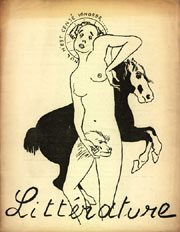
Cover of Littérature,
André Breton (ed.), N° 5, 1er October, 1922
Robert Desnos (1900-1945)
Robert Lebel
click to enlarge

Robert Lebel, La Double
Vue, Paris: Le Soleil noir, 1964
* Michel Butor
* Henri Pierre Roché
* Jean Suquet
Tom Stoppard, pseud. de Thomas Straussler (1937-)
click to enlarge

Henri Pierre Roché. Victor, vol. 4
of the four-volume publication
issued for the exhibition “L’Oeuvre de Marcel Duchamp,”
31 January – 2 May, 1977.
Paris: Centre Georges Pompidou
Claude Simon (1913-)
Alain Robbe-Grillet (1922-)
Jacques Charlier (…-)
Bryan Ferry (…-)
* Michel Leiris
Jean-François Vilar (1948-)
[1977, livre] Jennifer Gough-Cooper (…-) & Jacques Caumont (…-)
Michel Waldberg (1940-)
Walter Henry, pseud. de Paul Braffort (…-)
***********************
3.Those who have published a literary work (novel, short story, poem, etc.) “in honor of” or “in partial honor of” Marcel Duchamp or his work;
Note: Names preceded by an asterisk have already been listed in Section I.
Elsa von Freytag-Loringhoven
Francis Picabia
* André Breton
click to enlarge

Pierre de Massot.
The Wonderful Book. Reflections on
Rrose Sélavy (1924), in Étant donné
Marcel Duchamp, n° 2, (Baby [France] February 2000),
pp. 97~120
* Pierre de Massot
Louis Aragon (1897-1985)
Georges Hugnet (1906-1974)
Kay Boyle (1902-1992)
Henri-François Rey (1919-1987)
David Young (1946-)
***********************
click to enlarge
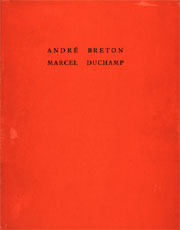
André Breton, Au Lavoir
noir, Paris: Éditions G.L.M, 1936
4. Literary works “illustrated” by Marcel Duchamp (alone or in collaboration) or by Marcel Duchamp and another artist.
Note: Names preceded by an asterisk have already been listed in Section I.
Alfred Jarry (1873-1907)
* André Breton
click to enlarge

André Breton, Young Cherry
Trees Secured against Hares, Edward Roditi (trans.), New York:
View Editions, 1946
Georges Hugnet
Francis Picabia
Pierre-André Benoit (1921-1993)
click images to enlarge

Georges Hugnet, La septiéme
face du dé, Paris: Éditions Jeanne Bucher, 1936
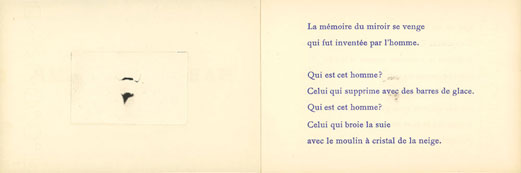
Georges Hugnet, Marcel Duchamp,
a poem and front piece with
Moustache et barbe de L.H.O.O.Q.
(1941) by Duchamp, Paris:
Hors Commerce, 1941
*Pierre de Massot
* Arturo Schwarz
click images to enlarge
* Robert Lebel
E-mail André Gervais with suggestions and comments: Andre_Gervais@uqar.uquebec.ca
Notes
1. This retrospective contains Mont de piété [1919, with two drawings by André Derain], Clair de terre [1923, with a portrait by Pablo Picasso], L’union libre [1931], Le revolver à cheveux blancs [1932, with an etching by Salvador Dali], Violette Nozières [1933], L’air de l’eau [1934, with four engravings by Alberto Giacometti] and Au lavoir noir [1936, with a window by Marcel Duchamp].
2. This retrospective contains [Poèmes 1935-1940], Pleine marge [1943, with an etching by Kurt Seligmann], Fata morgana [1941, with four drawings by Wilfredo Lam], [Poèmes 1940-1943], Les états généraux [1944], Des épingles tremblantes [1948], Xénophiles [1948], Ode à Charles Fourier [1947], Oubliés [1948], Constellations [1959, with 22 gouaches by Juan Miró] and Le la [1961, with a lithograph by Jean Benoît].
3. This retrospective contains, in whole or in part, the following brief, small books: Soliloque de Nausicaa [1928, with five drawings by Jean Cocteau], 5 poëmes [1946, with a portrait of the author by Francis Picabia], Orestie [1949], Mot clé des mensonges [1954], Galets abandonnés sur la page [1958, with an etching by Jacques Villon] and Tiré à quatre épingles [1959, with an engraving by Marcel Duchamp], to which is added Prison de neige, poems written from 1960 to 1961.
4. This recent retrospective adds to the preceding several other poems as well as a study and a biography.
5. This retrospective contains the following books: Simulacre [1925], Le point cardinal [1927], Glossaire: j’y serre mes gloses [1939 (begun in 1925), with some lithographies by André Masson], Bagatelles végétales [1956, with six engravings by Juan Miró] and Marrons sculptés pour Miró [1961, with a color lithograph by Juan Miró]. The Glossaire… has a continuation: Langage tangage ou Ce que les mots me disent [Paris: Gallimard, 1985].
6. On the jacket flap: “Manuscripts chosen by scissor cuts, photographs most often in black and white, articles lost among dead papers, dialogues in person, winking at some friends, retracing the voyage without a clock or a compass.”
7. Michel Butor, during the discussion following the paper of Patrice Quéréel on this book, as part of a colloquium on Butor’s work (June 24 – July 1, 1973), made this clear: “In regard to that which concerns the ideological machinery of State, I have been constantly reminded, while listening to you, of Marcel Duchamp: there was in the way you see these institutions the model of the Large Glass by Marcel Duchamp who is evoked in various manners in this book.” This in Butor. Colloque de Cerisy, under the direction of Georges Raillard, (Paris: UGÉ [coll. “10 / 18,” no. 902] 1974), p. 84.
8. Georges Raillard, in “Mots de passe. Quelques notes prises au cours d’une traversée difficile: La belle captive [1976],” (Obliques, Les Pilles, no. 16-17, Robbe-Grillet, 4th Quarter 1978), quotes the dedication from the author on an exemplary copy of Topologie…: ” quelque chose comme mon Grand Verre .” [“Something like my Large Glass. “]
9. Georges Raillard calls “Le Grand Verre de Robbe-Grillet ” [La Quinzaine littéraire, no. 432, (Paris, January 16-31, 1985)] his critique of the first volume of this “robbegrilletian autobiography,” of which the general title is Romanesques.
10. This novel contains only a brief allusion to Duchamp who, from 1958 to 1968, spent one or more months in the spring or summer in this catalan village.
Bicycles With Elephant Memories Stolen From Our Oasis When We Were The Most Thirsty
click to enlarge

Video1(1.4mb)Video2(1.4mb)Video3(1.4mb)
Video4(1.8mb)Video5(1.7mb)Video6(1.3mb)
A PERFORMANCE FOR NEW YORK CITY
(Sunday April 30th, 2000)
In the April of this year artist, Patrick Grenier performed a new work on the streets of New York City which converged several ideas about memory, loss, vulnerability and reconciliation. The concept was inspired by Duchamp’s sculpture,Large Glass; a poem by Alfred Jarry titled, The Passion Considered as a Bicycle Race; Grenier’s observation of a thief carrying Duchamp’s modified readymadeBicycle Wheel just stolen from the Museum of Modern Art in 1995, over the Brooklyn Bridge; conversations he had with Duchamp’s last assistant, Robert Barnes; the theft of three of his own bicycles; and his interest in the ability of elephants to remember things over a long period of time. The idea of bicycles possessing elephant memories alludes to the idea that possessions are imbibed with the owner’s energies and when that item is taken, its spirit stays with you, as he believes your own spirit leaves with the object stolen.
Grenier along with two other performers rode on vintage bicycles, similar in design to the one drawn on the page of sheet music in Duchamp’s 1914 drawing To Have the Apprentice in the Sun, from the front square of the Brooklyn Museum to the Museum of Modern Art making a total of twelve stops at locations related to the artist for on-site short action performances. The cyclists wore stylized costumes inspired by the work of Duchamp, Jarry and the physiognomy of elephants. Some of the props for the on-site actions included, a bicycle made of thorn branches, a unique chess board with pieces derived from peanut forms and bicycle parts, shadows of bicycles cut out of black velvet, melted chocolate and raw peanuts.
Bicycles are powered by human engines. Muscles and bones work with rubber and metal to become one machine.
CREDITS:
- Cyclists:
Patrick Grenier as “Peanut”
Mary Noll as “Padlock”
Claire Pertalion as “Bicycle Wheel”
Video:
Drew Cerria
8mm FILM:
Michael DeRoker - 35mm Stills:
Laura Moss
Driver:
Julio Lopez
Production Assistant:
Tia Shin
Photographs:
Laura Moss
© 2005 Succession Marcel Duchamp, ARS, N.Y./ADAGP, Paris. All rights reserved.