image_pdfimage_print

All posts by robert

Duchamp Past and Present

Dear Reader,


click to enlarge
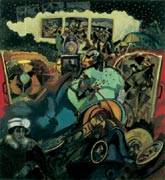
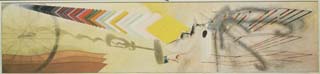
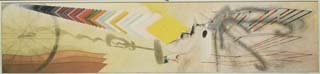
Marcel Duchamp, Tu m’
Figure 1
Marcel Duchamp, Tu m’, 1918
(The overall design of Tout-Fait is
based on the above, Duchamp’s last painting.)

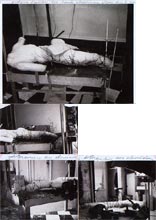
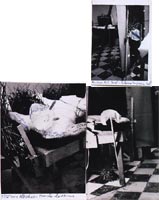
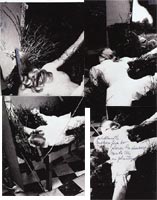
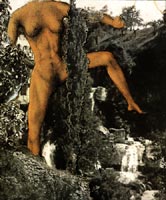
For some reason, this issue is big on interviews. In our News-section, Robert Barnes, an acquaintance of Duchamp’s from the 1950s, talks about him for the first time, describing his own involvement with the production of Duchamp’s major work, Étant Donnés (1946-1966). In our Interviews-section, André Gervais unearths “Two Nuggets from the Spanish Days” while Thomas Hirschhorn, winner of the Prix Marcel Duchamp 2000, refers to Duchamp as the “most intelligent artist of his century.” Sarah Skinner Kilborne translated two recently published French interviews (from 1960 and 1965) into English and Columbia undergrad Lauren Wilcox spoke to Sanford Biggers – a participant in the upcoming Whitney Biennial – about his 1999 performance “Duchamp in the Congo (Suburban Invasion).”


click to enlarge
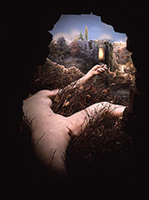
1 The Waterfall / 2.
The Illuminating Gas(outside view)1 The Waterfall / 2.
The Illuminating Gas(Inside view)
Figure 2 / Figure 3
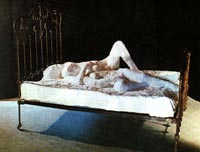
Marcel Duchamp, Given: 1 The Waterfall / 2.
The Illuminating Gas
, 1946-1966 (outside view)
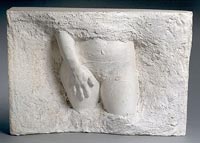
Marcel Duchamp, Given: 1 The Waterfall /
2. The Illuminating Gas
, 1946-1966
(inside view)

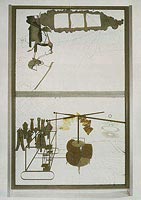
This, of course, is just the beginning. All in all, our readers may find about three dozen contributions of interest, including Bradley Bailey’s close look at Duchamp’s early drawing Encore à cet Astre; Stephen Jay Gould’s Duchamp and September 11th; a facsimile edition of Matta’s and Katherine Dreier’s brief study of Duchamp’s Glass (1944); Glenn Harvey’s take on Duchamp and Saussure; and Rhonda Roland Shearer’s latest observations on the an-artist’s chess poster design of 1925.

During a discussion at a recent Duchamp symposium at the Hessisches Landesmuseum in Darmstadt, Germany, the question was raised whether Duchamp still mattered today and why it was that one should even bother to study both him and his works. Apart, of course, from Duchamp being crucial to Tout-Fait’s raison d’être, one cannot help but notice that the overall recognition and appreciation of him seems to be doing very well – and is, in fact thriving among young artists, art historians, critics and pop stars alike. Just a few examples:

In the Winter issue of Bookforum, Barry Schwabsky, reviewing the paperback edition of Arturo Schwarz’s Complete Works catalogue (New York: Delano Greenidge, 1999) is of the opinion that “Duchamp’s work is so deeply encoded in the fabric of contemporary art that I’m tempted to keep this book not with other art monographs, but on the ready-reference shelf next to Roget, Bartlett, and Merriam-Webster: Duchamp is to a great extent, our vocabulary.” (“Coffee Table: Barry Schwabsky and Andy Grundberg on Art and Photography,” Bookforum 8. 2 (Winter 2001), 42)

Bjork, the Icelandic Queen of Pop (and Matthew Barney’s new lover), did not fail to mention Duchamp in a recent interview evolving around Vespertine, her new album. Proclaiming him a genius, she is mostly in awe of Étant Donnés: “And then he created an artwork, when he was already very old, when everyone thought he’d already be over with, and this artwork changed completely the 20th century.” (Thomas Venter, “Der Look Passiert Nicht,” Süddeutsche Zeitung, 27 August 2001 [my translation])

Reviewing last year’s Turner Prize – which, expectedly, went to a horrendously lame installation by Martin Creed Work No. 227: the light going on and off – Anna Somers Cocks, editor of the London-based The Art Newspaper, refers to Marcel Duchamp as “the patron saint” of most of the Young British Artists, scolding them, however, for not really heeding his advice. (“The Turner Prize: As Exciting as hearing old jokes retold,” in: The Art Newspaper, January 2002, 21)

Back in the States, the promising young video-artist Paul Pfeiffer – recent recipient of the prestigious Buxbaum award – described his appreciation of Duchamp thus: “Somewhere I read a statement by Duchamp to the effect that his art was intended as a destroyer, specifically of identity. I find that really inspiring. Putting a mustache on Mona Lisa makes a pretty basic point about the fluidity of identity and the depths to which gender, race and nationality are encoded into vision. I’m interested in multiple meanings and a kind of ambiguity that frustrates any attempt to pin it down.” (Linda Yablonsky, “Making Microart that can Suggest Macrotruths,” in: The New York Times, 9 December 2001, 39)

And here’s what’s new on the exhibition front: Beginning in March 2002, the Museum Tinguely in Basel will open its doors to the biggest Duchamp retrospective (curator: Harald Szeemann) since the 1993 Palazzo Grassi show in Venice, including a symposium organized by Basel University. And starting on February 6th, the Metropolitan Museum will be hosting Surrealism:Desire Unbound, a major show coming straight from London’s Tate Modern, while another exhaustive exhibition on the same movement is scheduled by the Centre George Pompidou, Paris, for later this year. Coinciding with the publication of this issue of Tout-Fait, the Williams College Museum of Art is launching But is it Real? – a show running from January 26 through September 22, 2002 – exploring notions of authenticity in modern art.

Finally, the upcoming 90th Annual Conference of the College Art Association in Philadelphia (February 20-23, 2002) will devote two sessions to Duchamp: The Studio Art Open Session (“Fluxus and Duchamp”) as well as the Art
History Open Session (“Ready-Mades: From Duchamp to Consumer Culture”).

Tout-Fait is a free and not-for-profit website and has been newly redesigned for our reader’s convenience by ASRL’s programming advisor Soojin Kim. With more than 100,000 visitors and a readership spanning the globe, with daily inquiries and questions coming in from university professors in Serbia, artists in Australia or public school teachers in South Africa, we’re happy to be of help wherever we can.

Enjoy browsing, stay a while and spread the word.

Thomas Girst
Editor-in-Chief

PS: Since September 11th, the Art Science Research Laboratory has been active working closely with WTC recovery workers at Ground Zero and Fresh Kills, establishing a warehouse and coordinating the shipment of much needed items on a daily basis. If you are in New York and would like to volunteer or otherwise support the cause, please visit our website at www.wtcgroundzerorelief.org.

Tout-Fait is published by the CyberArtSciencePress,
the publishing branch of the not-for-profit
Art Science Research Laboratory, Inc.,
62 Greene Street, Third Floor, New York, New York 10012

Tout-Fait welcomes any type of critical thinking. Multiple authorship is encouraged. All articles are first publications. All accepted foreign submissions will be published in both English and their original language. Tout-Fait (ISSN 1530-0323) is published by CyberArtSciencePress, the publishing house of the not-for-profit Art Science Research Laboratory.
We welcome donations!

©2002 Art Science Research Laboratory, Inc.


Figs. 1-3
©2002 Succession Marcel Duchamp, ARS, N.Y./ADAGP, Paris. All rights reserved.

Two Nuggets From The Spanish Days


click to enlarge
Duchamp
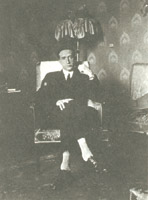
Figure 1
Photograph of Duchamp
taken by
Katherine
Dreier, Buenos Aires, 1918
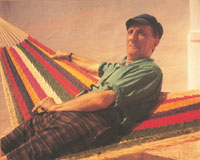
Duchamp in
his hammock
Figure 2
Man Ray, Photograph
of Duchamp in
his
hammock, date unknown

For Marcel Duchamp the Spanish way of life passed by his door first in Buenos Aires, Argentina, during a long sojourn there in 1918 -1919 (with his companion Yvonne Chastel)(Fig. 1) and then in Cadaqués, Spain, during a vacation in 1933 (with his companion Mary Reynolds) and during annual visits from 1958 to 1968 (with his wife Alexina, known as “Teeny”).(Fig. 2)

Although there hasn’t been the equivalent for these years of what there is for Duchamp’s travels to the American West in 1936, 1949 and 1963,(1) or for the long time spent in Argentina by Polish writer Witold Gombrowicz,(2) several analyses of Duchamp’s finished and continued work during his Spanish days as well as several documents (correspondence, photographs, etc.) and relative accounts have been published.(3) A bibliography assembling these elements, however, has gone unaddressed.

But here, upfront, are two brief unpublished accounts of the 1960s from some lesser known (or even unknown) individuals to Duchampians.

I. Conversation without quotation marks with Grati Baroni.(4)

Grati Baroni and Jorge Piqueras, both born in 1925, had four young children when they met Teeny and Marcel Duchamp in 1960.

It was on account of Emilio Rodríguez-Larraín, a Peruvian painter, who was spending the summer in Llançà, near Cadaqués, with his friend Piqueras, a Peruvian painter of Spanish origin.

It was in August. Francesca, our last child (born June 10th), was a little
less than three months old.(5)

For eight years, until Marcel’s death, the Piqueras and the Duchamps saw one another in Cadaqués, in Paris, and in Wissous, near Orly, (Wissous being where they lived from 1961 to 1966). They saw each other nearly every day in Cadaqués (except July-August 1968, when Grati was in Rome on a family matter) and frequently when the Duchamps were in France, at their (the Duchamps’) house or sometimes at the Lebels’.

We kept an eye on the Duchamps’ car while they were in the United States and we were the ones who, with or without Jacqueline Matisse, Teeny’s daughter, would many times go and pick up the Duchamps in Orly when they arrived from New York.


click to enlarge
Faux-Vagin [false
Vagina]
Figure 3
Marcel Duchamp,
Faux-Vagin
[false
Vagina
], 1962-63
Faux-Vagin [false
Vagina]
Figure 4
Marcel Duchamp,
Faux-Vagin [
false Vagina
], 1962-63,
detail

And so it was that one day in 1962 or 1963–more probably 1963 than 1962 when I think back on it–the Faux-Vagin (Fig.3) was “made” on the way back from Cadaqués,(6) around mealtime in Wissous, as a “joke,” without documentation or any title inscribed on the work.(7) Just a dedication and a signature: “pour Grati / affectueusement / Marcel” [for Grati / affectionately / Marcel]. (Fig. 4) And Teeny was saying, “Tiens, as un readymade!” [There, you have a readymade!]

You can’t imagine the “tricks,” the word plays that Marcel was already making with the Volkswagen. For example, “Teeny est partie avec sa Faux-Vagin.” [Teeny’s left with her False-Vagina.](8)

We accompanied him in the small villages around Cadaqués where he would play in important chess tournaments and where he would very often win.

This friendship was a comfortable friendship, nothing self-interested. In 1961, we were already on familiar terms with each other. In the following years, the friendship grew deeper still.

*****

Baroni is an Italian name. I was born in Florence: a Florentine can’t be naive, she can decide to be good, but she can never be naive! Grati is a name probably invented by my godfather, a nickname which was always used to address me and which became my real first name. And Grati Baroni de Piqueras (with a de), this was my married name. Since our separation, I’ve gone back to Grati Baroni, very simple.

I lived in Italy, in Peru (1952-1956), and then in France. I had a knowledge of art history but not a degree. I started painting when I was very young, fourteen years old, and painted until the 1950s and 60s. Then after a break I began to paint again.

Marcel, though terribly concerned with contemporary art, would speak with me about paintings from the Renaissance. Everything, in this sense, interested him. And he was very aroused by physical beauty. He loved us, I think, for the couple that we were, that we created: a symbiotic couple, “mythical.” We were very beautiful.

And I remember that he told me that one day when he was forty or forty-one, when he was in New York and very much in love, he was in front of a profound hole in the street that was being repaired; he was drunk and, upon seeing this hole, in one fell swoop he sobered up, for good!(9)

Marcel was tremendously helped by Arensberg, Dreier, etc.; did he want to help others in turn? He was very generous with Piqueras, for example, in introducing him to the Staempfli Gallery. George and Emily Staempfli had a house in Cadaqués. I remember one evening in particular where the Dalis, the Duchamps and us, we were at the Staempfli’s house. Dali, that very same day if I’m not mistaken, had painted a small picture entitled Le twist, an allusion to a dance that was all the rage those months.(10)

On the other hand, I was never informed about Marcel’s plan for Piqueras regarding Noma and Bill Copley, a plan set for the first days of June 1964 and which never resulted in anything.


click to enlarge
Check
Figure 5
Check from Marcel
Duchamp to Grati
Piqueras,December 20,
1967, collection G.
Baroni, Paris

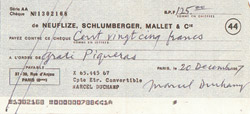
Marcel was very generous with his knowledge and his advice. Each Christmas, he sent a check to the children and he did this till he died. The last check, or what would become the last check, dated December 20, 1967, we have never touched. (Fig. 5)

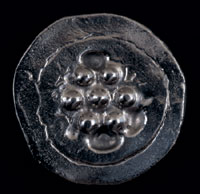
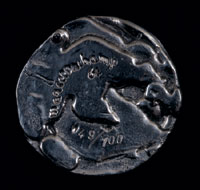
I was in Cadaqués the day when Marcel made what he would entitle Medallic Sculpture. This happened, if my memory serves me correctly, the same year that Man Ray came to Cadaqués to see Marcel. In his Autoportrait, he speaks of this 1961 visit. The problem for Marcel was finding a way to “fill up” the bath [le bain-douche] in his small apartment: more of a “bath stopper” [Bouche-douche], in effect, than a “sink stopper” [Bouche-évier]. (Fig. 6) He first made a plaster model, then a metal one, and this remained a utilitarian object for several years, in fact, until he agreed to permit the International Collectors Society of New York to make it into an art object in 1967.

click images to enlarge

  • Recto
  • Verso
  • Figure 6 (recto)
    Marcel Duchamp, Bouche-évier
    [ Sink Stopper],
    1964, Collection Rhonda Roland Shearer
  • Figure 6 (verso)
    Marcel Duchamp, Bouche-évier
    [ Sink Stopper],
    1964, Collction Rhonda Roland Shearer

That year [1961], Man Ray and Marcel were making a telephone with empty tin cans and a cord, in order to speak to one another–like children–from their rented castles!

If I remember this right, it was in Paris in 1962 that we introduced Marcel to Gianfranco Baruchello, the Italian painter, who would later invite him to Italy several times.(11)Plus, Baruchello had known Arturo Schwarz who was already working on Duchamp.(12)
In Europe, the artistic activity of Duchamp, during this period in any case, was not so well-known.

And we introduced Baruchello to the art critic Alain Jouffroy, who had already been to our house in Wissous for a dinner with Marcel; Jouffroy wrote pieces on Baruchello and Piqueras.(13)


click to enlarge
Aimer
tes héros
Figure 7
Marcel Duchamp, Aimer
tes héros
[Love Your
Heros
], 1963

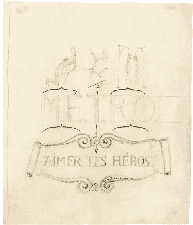
It was also in Paris, in 1962 I think, that we introduced Marcel to Bruno Alfieri, director of the review mETRO and godfather to our daughter Francesca. You know what happens next: the small drawing entitled M.É.T.R.O. (1963). (Fig. 7)

It was in Cadaqués in August 1962, through Marcel, that I met his sister Suzanne. I sympathized greatly with her. She told me a lot of stories about him, such as when they were children and adolescents, there was a complicity between them, an incredible communion: she would think of something and he would come up with it, and vice-versa. They were as one.

September 30, 1968, two days before his death: “You, I want to see you alone.” A message of enormous affection. We went to his apartment, in Neuilly, for dinner.

After his death, our closeness gradually blurred. The rupture between Jorge and me took place in 1969 and our separation, in 1973. It wasn’t until much later, through our son Lorenzo, that we replanted the seeds of our friendship with Teeny and Jacqueline who very much appreciated the exhibition, L’époque, la mode, la morale, la passion, on which Lorenzo worked as an architect.(14)

After the exhibition Paris-New York,(15)to which I lent a work by Suzanne Duchamp that I liked a lot, Étienne-Alain Hubert came to my house and “discovered” the targa (Faux-Vagin), a private, intimate “thing.” One never discovers a work of art in my house. It was exhibited for the first time in a museum in Japan, during August and September 1981, and reproduced for the first time, although in black and white, in the catalogue for this exhibition.

When I had to sell this readymade, and it distressed me to sell it to someone who didn’t love Marcel as we did, I contacted Bill Copley first, but he wasn’t interested. I also tried Jasper Johns, but he wasn’t interested either. And so it disappeared into the art market. Shame… I would give anything today to have it again.

*****

I knew a lot of artists (Fernand Léger, Constantin Brancusi, Henri Cartier-Bresson, etc.) but stayed voluntarily on the sidelines.

I have a total respect for the other: who he is (as a person), what he does (in his work).

I have nothing left–nothing kept, nothing hoarded–and I want nothing. I didn’t want to take what my Italian friends–Giacometti, Magnelli, Fontana–suggested I take… What then remains of our time together? Of my time with the Duchamps? Perhaps Rodríguez-Larraín saved some documents like some letters or photos of our vacations.(16)

However, I regret not having kept a journal, even minimally, during that period.
True friends don’t make plans!

I have lived intensely in all of my relationships which were exceptional, meaningful and fulfilling. With my family, it’s the same thing: I have very few photos.

*****

Appendix

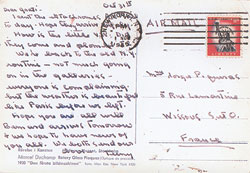
Postcard from Teeny (New York, October 31, 1965) to Grati: (Fig. 8)

click images to enlarge

  • Recto
  • Verso
  • Figure 8 (recto)
  • Figure 8 (verso)

Mme Jorge Piqueras
5 Rue Lamartine
Wissous S. et. O. [Seine-et-Oise]
France

Oct. 31st

Dear Grati –

I sent the ektachromes Air Mail today – Hope they arrive safely –

How is the little V.W.? Did they come and plombé it?(17)

We’re back to the old N.Y. routine – not much going on in the galleries – everyone is complaining, but the weather is beautiful like Paris before we left.

Hope you are all well. Bernard(18)
arrives tomorrow & we hope to have news of you all. We both send our love –

Teeny

II.

•Five Qestions for Emilio Rodríguez-Larraín (19)

What is the broad outline of your C.V.?

I was born in Lima in 1928. My first solo exhibition went up in 1950, my first group exhibition in 1951.

From the time I met Marcel Duchamp, I had (and would have) solo exhibitions in Milan (1959, 1960, 1961, and 1963), Cologne (1960), Frankfort (1960), Berlin (1960), New York (1962 and 1965, at the Staempfli Gallery; 1967, at the Rose Fried Gallery), Washington (1963), Brussels (1965), etc.

I received an award from the William and Noma Copley Foundation in 1965; Marcel Duchamp, Man Ray, Max Ernst, Roberto Matta and Walter Hopps, among others, were the judges.

How did you come to meet Marcel Duchamp? Where, when and how did that happen?

I knew Marcel Duchamp through Gordon Washburn, director of the Carnegie Institute of New York. He had come to Milan to invite me to an exhibition at the Carnegie Institute.(20)
We had become very close with him and his family. He asked me where we were going to spend our vacation, and they came to join us at Llançà, on the Costa Brava. There he realized we were close to Cadaqués, where Marcel Duchamp often went, as did Salvador Dali, Man Ray, and others.

We went there and he introduced me to all these great artists.

Where did you get in the habit of seeing each other?

With Marcel Duchamp, it was an instant friendship. He came to Llançà, we would go to Cadaqués, we would find ourselves in Paris, in Neuilly, in New York.

What was your rapport like with him and with Teeny?

Quotidian life with Marcel Duchamp and Teeny, which meant art, chess, language, walks, bulls, as much in Paris as in New York or on the Costa Brava.

What was Duchamp for you, ultimately?

A great friend, as much him as his wife, and an artist that I respected and continue to respect very much, finding him the most lucid man I’ve ever known, generous and courageous.


Adjoining Documents:

click to enlarge
Self-
Portrait
Figure 9
Marcel Duchamp, Self-
Portrait in Profile
, 1958


click to enlarge
Emilio Rodríguez-Larraín
Figure 10
Emilio Rodríguez-Larraín, 1965
Figure 11
Emilio Rodríguez-Larraín, 1965

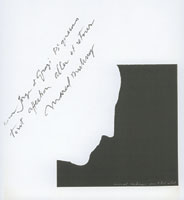
• A dedication of Robert Lebel’s book Sur Marcel Duchamp (1959), to M. and Mme Piqueras, most likely from 1960. (Coll. G. Baroni, Paris.)(Fig. 9)

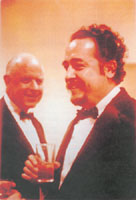
• Two photos of Emilio Rodríguez-Larraín at the opening of Not Seen and/or Less Seen of/by Marcel Duchamp/Rrose Sélavy, 1904-1964, New York, Cordier & Ekstrom, January 13, 1965. To his right in one of the photos: George Staempfli; behind his right elbow in the other photo: Marcel Duchamp! (Coll. E. Rodríguez-Larraín, Lima.)(Figs. 10 & 11)

Postcard from Teeny Duchamp to Mme Jorge Piqueras, October 31, 1965. (Coll.G. Baroni, Paris.)

Check from Marcel Duchamp to Grati Piqueras, December 20, 1967. (Coll.G. Baroni, Paris.)

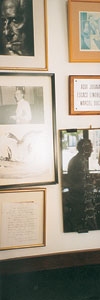
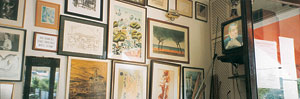
• Two photos of a wall at the bar Meliton, Cadaqués. (Coll. André Valois, Montréal, 1994.) Around a plaque which reads “AQUI JUGAVA ALS / ESCACS L’INOBLIDABLE / MARCEL DUCHAMP” [“Here used to play / chess the unforgettable / Marcel Duchamp”], some artifacts recall the presence of the man: two photographs, a letter (regarding a meeting at the café), the reproduction of a picture by Jacques Villon representing Duchamp in about 1951, and a mirror on which the name of the bar has been broken down (“me / mel / elit / lito / liton,” etc.) between the words “ciel” [sky] and “champ” [field].(21) (Figs.12 & 13)

click images to enlarge

  • The wall at the
bar Meliton
  • The wall at the
bar Meliton
  • Figure 12
    The wall at the
    bar Meliton, Cadaqués
  • Figure 13
    The wall at the
    bar Meliton, Cadaqués

Notes


Footnote Return 1. Bonnie Clearwater, ed. West Coast Duchamp (Miami Beach: Grassfield Press, 1991).

Footnote Return 2. See Rita Gombrowicz’s Gombrowicz en Argentine. Témoignages et documents, 1939-1963 (Paris:
Denoël, 1984).

Footnote Return 3. Examples of work made during these sojourns: To Be Looked at (from the Other Side of the Glass) with one Eye, Close to, for Almost an Hour (1918), Unhappy Readymade (1919), With My Tongue in My Cheek (1959), Still Torture (1959), Still Sculpture (1959).

Footnote Return 4. Compiled from notes taken while on the telephone with Grati Baroni (July 19, 1998), and then during a long conversation with her at her home (June 4, 1999). She afterward reviewed the notes (June 29, 1999) and they were consequently lightly expanded (July 20, 1999).

Footnote Return 5. In 1960, the Duchamps were in Cadaqués from July 1st to September 1st.

Footnote Return 6. Between September 19 and October 1, 1963, and, therefore, some days before Signed Sign(Pasadena, October 7, 1963).

Footnote Return 7. The spelling of the title comes from a letter Duchamp wrote (in French) to Arne Ekstrom (Cadaqués, September 3, 1966), even though he was talking about his car. “We will return to Neu-Neu September 21st by Volkswagen (Faux-Vagin), and to New York October 15th by plane.” Neu-Neu, short forNeuilly, is a suburb west of Paris.

Footnote Return 8. Regarding the VW, see also the 1965 postcard from Teeny to Grati, reproduced here in the appendix.

Footnote Return 9. This actually took place when he was thirty-nine: from October 20, 1926 to February 26, 1927 he was in the United States to put together two Brancusi exhibitions, one at the Joseph Brummer Gallery in New York November 17 – December 15, 1926) and the other at the Arts Club of Chicago (January 4 – 22, 1927). The woman could well be Alice Roullier of the Arts Club.


click to enlarge

Figure 9
Salvardo Dali, Twist
dans l’atelier de
Vélasquez
, 1962

Footnote Return 10. In all likelihood, it was 1962 when the first version appeared of Twist dans l’atelier de Vélasquez, oil on canvas (but was it that very work?). As for the hit songs, they were essentially from 1961 and 1962: The Twist and Let’s Twist Again (sung by Chubby Checker), Twist and Shout (by the Isley Brothers), and Twistin’ the Night Away(by Sam Cooke).

Footnote Return 11. See Marcel Duchamp in 20 Photographs by Gianfranco Baruchello, foreword by Piero Berengo Gardin (Rome: Edizioni Gregory Fotografia, 1978); photos taken between 1962 and 1966 in Italy (in Rome, Bomarzo,
Cerveteri and Umbria), in Spain (in Cadaqués) and in the United States (in the Philadelphia Museum of Art).

Footnote Return 12. Arturo Schwarz began to work on Duchamp’s œuvre in 1957.

Footnote Return 13. Alain Jouffroy: “Piqueras chez Eiffel,” in XXe siècle, the new series, no. 48 (Paris, June 1977) and “Baruchello, navigateur en solitaire,” no. 50 (June 1978).

Footnote Return 14. Bernard Blistène with Catherine David and Alfred Pacquement, eds. L’époque, la mode, la morale,la passion. Aspects de l’art aujourd’hui, 1977-1987 (Centre d’art et de culture Georges Pompidou,
Musée national d’art moderne, May 21 – August 17, 1987). Katia Lafitte and Lorenzo Piqueras, assisted by Diane Chollet, did the scenography for this exhibition. See, moreover, “Qualifier l’espace. Entretien avec Lorenzo Piqueras,” by Roselyne Marsaud Perrodin, in Pratiques, no. 2 (Rennes, Autumn 1986): 117-139.

Footnote Return 15. Centre Georges Pompidou, June 1 – September 19, 1977. This exhibition took place immediately after the Duchamp exhibition (Marcel Duchamp, January 31 – May 2, 1977), which was the Pompidou’s inaugural exhibition.

Footnote Return 16. The latter wrote me from Lima (August 24, 2000): “All of the photos and all of the documents that I had concerning my relationship with Marcel Duchamp (which included a L.H.O.O.Q. Shaved, an invitation to a private preview at Cordier & Ekstrom) were stolen in Miami when I was living there some years ago.”

Footnote Return 17. Jacqueline Matisse, in two faxes (April 27, 2001), puts it into context: “Marcel and Teeny’s VW bug was parked unused at the Piqueras’ in Wissous over the winter. In order to pay less tax on the car, the customs authorities required a lead seal on the vehicle when not in use. That is what Teeny is inquiring about in her card. […] Teeny used her best “franglais”…when talking about this car […].”

Footnote Return 18. Bernard Monnier, husband of Jacqueline Matisse.

Footnote Return 19. Lima, August 24, 2000, in response to written questions sent by André
Gervais July 21st.

Footnote Return 20. The Pittsburgh Triennial would be held at the Carnegie Institute in
1961.

Footnote Return 21. Regarding this Mecca of Cadaqués, see Henri-François Rey’s Le café Meliton (Paris: Balland, 1987).

Figs. 3, 4, 6-8
©2002 Succession Marcel Duchamp, ARS, N.Y./ADAGP, Paris.
All rights reserved.

Duchamp is Global: From Philadelphia to Jerusalem

Dear Reader,


click to enlarge
Marcel Duchamp, Tu m’
Marcel Duchamp, Tu m’, 1918 / ©
2000 Succession Marcel Duchamp,
ARS, N.Y./ADAGP, Paris.
(The overall design of
Tout-Fait
Volume 1 is based
on the above, Duchamp’s last painting.)

We are happy to present to you Tout-Fait #3, concluding the first volume of this journal. With more than forty contributors and an enthused team of roughly a dozen in-house devotees, this is the fattest issue ever.

And this is what Tout-Fait is all about:

Eighteen-year old Kim Whinna interviews surrealist artist Enrico Donati while Arthur C. Danto’s “Marcel Duchamp and the End of Taste: A Defense of Contemporary Art” responds to a recent lecture on the topic by Jean Clair, whose first chapter of his recent book on Duchamp we can offer you exclusively in its premier English translation. Tout-Fait strives to be a journal accessible to both younger people and students as well as important scholars and art historians.

Once again, we have added a few new squares: Since the Philadelphia Museum of Modern Art, the Tate Modern, the Israel Museum and the Centre Georges Pompidou have all recently (re)arranged their Duchamp collections, we thought it time to create our own “Collection”-section. In this issue we start off with Tamar Minor-Friedman, the exhibition curator of the Israel Museum’s collection of Dada and Surrealist Art, guiding us through Jerusalem’s Duchamp rooms. Here, we also present online facsimile editions of three early and very rare Dada journals. The “Bookstore”-square links to recent publications of our contributors and our “Giftshop” encourages you to purchase items benefiting our not-for-profit journal. For your convenience, we have also added a contents-link on the homepage so you may see at a glance what to expect inside.

As always, all contributions are first publications. Articles have been translated from Danish, French and German and may also be read in their original language. So please indulge when Stephen Jay Gould and Rhonda Roland Shearer examine Niceron’s influence upon Duchamp and Leif Erikkson presents a comprehensive view of Duchamp’s impact on Sweden between 1933 and 1970. And there’s more: Mark Pohlad looks at Duchamp as conservator while Bailey Bradley wonders about the similarities of pawns and bachelors. Listen to a composition inspired by Duchamp’s Nude Descending and find out whether he chose Emmentaler cheese or Gruyère for the design of a Surrealist exhibition cover in 1942. To top things off, there’s plenty within the squares of “Multimedia,” “Letters,” and “Art & Literature,” more research on the Ready-mades and manifold “Notes” by the likes of Thomas Zaunschirm and André Gervais.

Starting next year, Tout-Fait is also headed for a bit of good old-fashioned print media. A monthly page in NYArts Magazine will provide this journal’s readers with a Duchamp “news ticker,” and the Art Science Research Laboratory will work on a “Best of Tout-Fait Volume One” publication, comprising the most interesting and debate-stirring contributions of our first three issues.

It’ll all keep going: over 30,000 hits for Tout-Fait this year and counting. Needless to say, our gratitude continues to go out to Jacqueline Matisse-Monnier for her support of this not-for-profit endeavor.

Enjoy browsing, stay a while and spread the word.

Thomas Girst
Editor-in-Chief

Tout-Fait is published by the CyberArtSciencePress,
the publishing branch of the not-for-profit
Art Science Research Laboratory, Inc.,
62 Greene Street, Third Floor, New York, New York 10012

Tout-Fait welcomes any type
of critical thinking. Multiple authorship is encouraged. All articles
are first publications. All accepted foreign submissions will
be published in both English and their original language. Tout-Fait (ISSN 1530-0323) is
published by CyberArtSciencePress
, the publishing house of the not-for-profit
Art Science Research Laboratory
.
We welcome donations!


©2000 Art Science Research Laboratory, Inc.

Orchestrating the Nude Descending

Henri René
(29 December 1906, New York City – 25 April 1993, Houston, Texas)

Born in New York City and growing up in Germany, conductor and arranger Henri René received a thorough education in classical music at the Royal Academy of Music in Berlin. He moved to the U.S. during the mid-1920s, appearing with a variety of orchestras before returning to Berlin, he is appointed musical director of Electrola, a recording company, and UFA, the German movie studio at Babelsberg.

In 1936, he emigrates to the U.S. and is appointed musical director for RCA International; in 1941, he establishes a Continental-style orchestra. After serving with the allied forces in World War II, he returns to RCA as a musical director to arrange and conduct a variety of classical recordings. René retired from RCA in 1959 and worked as an independent for the remainder of his career.

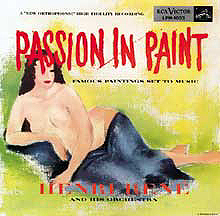
Passion in Paint
(Famous Paintings Set to Music)
Henri René and His Orchestra


click to enlarge
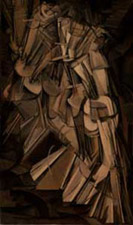
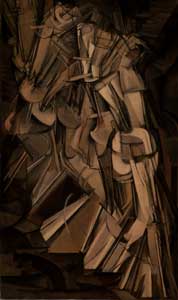
Nude Descending
a Staircase
Marcel Duchamp,
Nude Descending
a Staircase, No. 2
, January 1912
© 2000 Succession Marcel
Duchamp, ARS, N.Y./ADAGP, Paris

“Passion in paint, passion in music…how differently they are expressed, and yet how closely akin are they! Music has color and paintings have rhythm, and both convey to us beauty and emotion.

Here, as far as I know, is the first attempt to link popular paintings with what is usually called “popular” music. I am not sure I know precisely what popular music is: I am certain that these original rhapsodies by Henri René are music which everybody can enjoy, which everybody can understand and from which everybody can experience an emotional lift.

Henri René has, of course, not attempted any literal description of the paintings. That would be impossible in music. Ha has given us impressions. These very sensuous mood of Botticelli’s The Birth of Venus to the famous and still controversial Duchamp Nude Descending the Stairs, a painting which no longer “describes” or”tells a story” but is all impression and emotion. What you have here, therefore, is a mood music album with many moods.

Many of the paintings treated musically by René are familiar favorites. Several of them can be seen in our country. To see others you will have to travel as far as Florence, Madrid and Paris. To enjoy René’s music you don’t have to travel at all: you can “see” the paintings from your armchair.

This latest work of Henri René follows a series of highly successful albums composed, arranged and conducted by him in his own individual style. That style is Continental, which is quite natural considering that René has spent much of his life abroad. Among the albums which have become best sellers are Listen to Henri René and Music for Romance

Here, then, is passion in paint translated into passion in music. Whatever you play the album one “painting” at a time or whatever you play the whole album together I think you are in for a new kind of enjoyment.”


George R. Marek
Director of Artists and Repertoire
Copyright 1955, Radio Corporation of America

Click for the Music

“Nude
Descending [the] Stairs” from the suite “Passion in Paint” by Henri
René

Henri René and His Orchestra
“Passion in Paint: Famous Paintings Set to Music” (1955)
Recorded by RCA Victor LPM-1033
Music inspired by famous paintings throughout the centuries include:


click to enlarge

Album Cover, RCA Victor

Album Cover, RCA Victor, 1955

Side 1
Marcel Duchamp-Nude Descending the Stairs
Pierre Auguste Renoir-Gabrielle in an Open Blouse Sandro Botticelli-The Birth of Venus
Francisco Goya-The Nude Maya
Pablo Picasso-Girl Before Mirror
Henri Toulouse-Lautrec-At the Moulin Rouge

Side 2
Leonardo da Vinci-Mona Lisa
Edgar Degas-L’Absinthe
Amedeo Modigliani-Nude on Cushion
John Singer Sargent-Madame X
Edouard Manet-Olympia
Salvador Dalí-The Persistence of Time

(We are grateful to Veit Schuetz of Cosmic Art Enterprises for transferring the music from record to tape)

Watching the Detectives


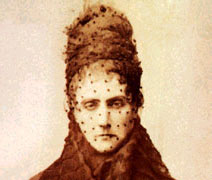
  • Illustration 4
    Photograph showing a
    lady veiled in the antique lace
    span>

  • Photograph of Marcel
    Duchamp by Hans
    Hoffmann, Munich, 1912

“L’oeuvre d’art est toujours basée sur ces deux poteaux du générateur et du spectateur, et
l’étincelle qui vient de cette action bipolaire donne naissance à quelque chose comme l’électricité.”

Bill Tanch

Rolling the “RRRR”

Stephen Jay Gould’s text is very interesting and full of pleasant “interactive consonants.” Though it seems important to add Frantz Fanon’s “R- assimilationist” so to speak, to the discussion. Fanon actually devoted part of his book “Black Skin, White Mask” (1952) to the importance of language and pronunciation. A doctor and trained psychoanalyst, Fanon discovered an obsession of pronouncing the letter “R” by the people from the French speaking Antilles (Martinique and Guadeloupe). To differentiate themselves from other black people in Paris during the 1950’s and 60’s, these so-called “assimiléé,” went out of their way to pronounce the rolled “R,” producing an exaggerated sound effect. The general French black population had a tendency to skip and not pronounce the consonant.

Fanon cites an example where a costumer in a Parisian coffee-shop asked loudly for a beer, consciously rolling each “R” at the appropriate moment. The result was much more than he had hoped for, and sounded like, “GARRRRÇON ! UN VÈ DE BIÈ.” The proper phrase should have been, “GARÇON ! UN VERRE DE BIÈRE.” By putting too much pressure on the first “R” in Garçon (Waiter), the man was unable to keep the two other ones, in Verre (Glass) and Bière (Beer).

This example can be reinterpreted through S.J. Gould’s approach. Here one might say that “Verre = Vert” (the color Green) and Bière = Bierre (in this case coffin, like the shape of the Rigaud perfume bottle). Finally, “Eau de Voilette,” the piece of cloth used by widows to cover their face can be read also as “Eau de Violette” (color for the funeral).

As an additional grammatical point, the gender for the word CORDE is feminine, not masculine. In French we say “une corde,” and in accordance with S’ ACCORDE (liaison) it becomes SA CORDE (Her Rope).

I loved the whole text. Best regards,

Marc Latamie


3-D goes 4-D

This letter was received by Natural History and forwarded to Tout-Fait, as the original article appeared simultaneously in both Tout-Fait and the millennial issue of Natural History, December 1999- January 2000, volume 108, no. 10, pp. 32-44

Zirahuén Lake
July 27, 2000

Dear Stephen J. Gould,

For quite a few months I had been trying to write to you about my thoughts after reading your and Rhonda Roland Shearer’s essay “Boats & Deckchairs”. I have greatly enjoyed your column since the early 90’s but this essay was especially meaningful for two reasons. First because on this occasion I thought of something you apparently did not. I was initially reluctant to accept that I might have realized something you (or Duchamp!) had not, but the more I thought about it the less reluctant I became. Now I dare to share it with you and ask for your opinion. The second reason is because on announcing your retirement from the column, I realized with a mix of joy and sadness that I would barely catch the immense pleasure and honor of sharing an issue of the magazine [Natural History] with you. As my article, “Touchy Harvestmen,” will be featured next October. I will begin with my reflections on your 4-D essay, and this will bring me back to my harvestmen’s [daddy-long-legs] 4-D perspective.

I haven’t read Abbott’s Flatland (I certainly will) but from your digested excerpts I can conclude that A Square didn’t have to fly too high above Flatland to see the shocking and never before imagined perspective being offered from a 3-D world. Of course the higher the better, but just standing a bit above the plane and stretching the neck and peeping would be enough to see Mr. Circle all at once, though somewhat deformed as an ellipse. (Similarly to when we are lost in the woods and need to climb a tree or a hill to have a map view of where the heck we are and where we are trying to go.) The perfect view of Mr. Circle is at a right angle from above, but any angle larger than zero allows for seeing him all at once, even though the shape distortion increases as the angle diminishes. I would put my money down and say that A Squares’ big “WOW!” was just after taking-off and long before reaching a straight angle above Mr. Circle. An experience much like the very first time we fly as children and realize that we can see a whole block or field all at once just after taking-off, long before reaching a complete view.

If I got that right and I properly understood that the analogy should work when going from 3-D to 4-D as well, then I think we (especially us primates) do have a chance to have that 4-D perspective of a 3-D land. In fact, the great majority of us have it all the time, literally in front of our noses. The genesis of my argument goes back to my childhood when staying late in bed. Laying on my side, I would amuse myself by switching between the two different perspectives of the landscape of blankets in front of my face, shifting as I closed each eye. Then, I would force both eyes to focus and converge on something just a few inches from my nose, and close one, and then the other (you see where I’m going?). Then I remembered a zoology teacher of mine in college saying what a “convenient idea” it was in primate evolution to have two frontal eyes, enabling us to judge distances when jumping from branch to branch. And the last relevant revelation along this line, before your essay, came when I took the instructions leaflet of my binoculars and read it (one wanders who on earth would read the directions for a pair of binoculars!). This only occurred as I was trying to kill time while waiting in the rain forest for the end of a butterfly copula that had lasted several hours already. It said that when you see through your binoculars (if they are the kind that includes mirrors), the objects not only look closer, but the 3-D view is “deeper.” This was because the two sources of the image coming from the objects to each tube are wider apart than your eyes; I thought that was pretty cool too and kept on peeping at “deeper” butterfly sex.

So when I read your article, I first thought it would be possible to do something like using two periscopes (the kind people use to see parades above the crowd) oriented sideways (and maybe slightly forward) to look at an object in front with one eye on each periscope. I wondered if the brain could still handle and integrate that (as it can when the two sources of image are slightly separated when looking at binoculars), and this would look even “deeper”, more in 4-D! However, that would be like A Square trying to see Mr. Circle from almost directly above, closer to a straight angle, with less shape distortion. But we are always looking at things from two different points anyway: from each eye. This difference is negligible with a distant object, but less and less when the object gets closer to the point where we could see it from opposite ends: between our eyes. We know since we were kids we can only focus so close, even crossing our eyes, but I think that is enough to stretch our necks out of 3-D land. A practical object to do this with is for instance is a 3.5″ floppy disk (which in fact is a solid “square” case with a real floppy disk inside, but that doesn’t matter now). It is an object with true volume, although conveniently flattened for our purposes to a couple of mm, a flattened “cube”. If you place it vertical and perpendicular to your face, just between your eyes at the minimum distance at which you can focus and converge your eyes on a single image of the edge facing you (10-20 cm), you are looking at the two full sides of the disk at once. If you close one eye, you only see the opposite side and nothing of the other.

In other words, my argument is that if we only had one eye, or if we had them on opposite sides of our head as many birds and mammals, we would be true prisoners of the 3-D prison. In that case, we would be unable to see objects from two points at the same time. As long as we have two (eyes) views of the same object (depth vision), and if I understood your essay correctly, we are having a 4-D view of the world, or at least somewhere between 3-D and 4-D. This is as if A Square stood on a chair, on its toes, stretched its neck and could see a deformed Mr. Circle. Leaving primates and owls aside, I was trying to think of animals that had shape-perception with eyes that could really look at an object from different sides at straight angles, maybe some mollusk? But even if there is such we would still need to ask it what that’s like. We would be back to where A Square was trying to explain to their friends what it’s like up there, so let’s better try it ourselves (September 16 is independence day in Mexico and they sell those periscopes in the street to see the parade, I’m getting myself two of them!).

However, visual animals are probably not the most interesting to consider for the cum-hyperhypho-embraced perspective, but those whose main perception of the world come through tactile stimuli, and which can wrap objects to perceive them. It is true that us primates, especially as kids, handle a lot of objects and get the “4-D perception” of them through our hands or mouth. This reminds me of a TV program showing how they allowed this blind-since-birth sculptor to climb on a specially made structure around Michelangelo’s David to touch and embrace (“observe”) it… he was delighted.

But the true masters of cum-hyperhypho-embracing must be something like flatworms, snakes, octopuses (in spite their good view), and one of my favorite creatures: harvestmen, or daddy longlegs. Many species, including the one I have studied, see nothing but changes in light intensity above them, and their hearing and smelling are hopeless. But they sure have legs, and they do much more than walking with them. As they progress, they are constantly assessing their very complex 3-D environment through their 8 “channels”, with an accuracy that must exceed our poor tactile perception, and that depends clearly on touching objects on several sides at the time. In short, they might not have the resolution primates or owls have, but their depth perception is clearly better, and it’s the only one they got!

During the the many field hours I was working with harvestmen for my dissertation, on top of the great fun they provided me, I frequently read your column lying in my field hammock. It was then that I shared that View of Life, never imaging that I would someday have an excuse to share details of mine with you, which is to a great extent yours anyway. Regardless of your thoughts on my 4-D speculations, I deeply thank you for all this time.

Truly yours,

Rogelio Macías-Ordóñez
Departamento de Ecología y Comportamiento Animal
Instituto de Ecología, A.C.
México

The Stereochemistry of Boats and Chairs

I would like to add some observation to the intriguing notion of cyclohexane mentioned in Robert Ausubel’s response to “Boats and Deckchairs”. One might add that the terms “boat” and “chair” are international standard in teaching the peculiarities of cyclohexane in stereochemistry. We find the terms “Boot” (boat) or “Wanne” (tub) and “Sessel” (chair) in German, “bateau” and “chaise” in French study books, to mention just those I cared to check. According to the dictionary the terminology developed between 1890 and 1918 (when it was firmly established), hence well into the time when Duchamp put together the majority of his notes for the “White Box.” I find it hard to believe that he was not somehow aware of the origin of this specific pair of terms. Maybe he learned of the bateau-chaise conformations of cyclohexane through some popularisation in a book or an article for non-scholarly readership. It would be helpful to track down possible source material. It is, however, easy to understand why he should find it intriguing. It was probably sufficient to him that the interconversion of the conformations of cyclohexane, metaphorically termed “boat” and “chair,” is indeed a fold-back operation, hence a member of the family of rotations. For that alone it remains another fascinating clue to how Duchamp’s perceptive mode was conditioned.

Stephan E. Hauser
University of Basel (art historian)


Why the Hatrack is and/or is not Readymade: With Interactive Software, Animations, and Videos for Readers to Explore

* Please note this essay contains 8 videos, 10 animations and
3 interactive presentations.


click to enlarge
Note from
the Green Box
Illustration 1
Marcel Duchamp, Note from
the Green Box, 1934
(typographic version by Richard
Hamilton, translated by George
Heard Hamilton, 1960)

Duchamp states innotes written between 1911-15 (see illustration 1, showing Duchamp’sGreen Box Note published in 1934) that the time and date of hisreadymades is important “information” in addition to the “serialcharacteristic of the readymade.”(1)

The “snapshoteffect”(2)of this timing of the readymade, to which Duchamp refers in this note,makes sense when we examine Duchamp’s readymades with his mathematicalnotes (written 1911-15 but held back for publication by Duchamp until1967, a year before his death.)(3)

First, let us begin by “looking” at Duchamp’s readymades through time. Since Duchamp claims that he “lost” most of his original readymade objects, Duchamp’s 1915 hatrack, as well as his urinal, snow shovel, coatrack, bottlerack and bicycle wheel and stool, exist only in a series of varied representations given to us by Duchamp over an extended period of time.

As an example, the following time-line illustrates the sequence of appearances of Duchamp’s “lost” hatrack. We see “the serial characteristic of the Readymade” just as Duchamp described in a presentation of his “Readymade” (the title he used for his hatrack in the 1941 representation, see illustrations 2A, B, C, D, E, and F below).


Time Line of Readymade Series of Hatracks – As Seen by Spectators
2A 2B 2C 2D 2E 2F
Click each image to enlarge
2D Shadow in Oil Paint
Tu m’
2D Print made with Photo
2D Photo
Studio Photo
2D Shadow in Photo
Cast Shadows
3D Wood Model
Hatrack
2D Blueprint
Hatrack
1918
1941
1960s
(made 1916-17
found 1960s)
1960s
(made 1918
found 1960s)
1964

1991
(made 1964
seen 1991)
2D Shadow in Oil Paint
Tu m’
(detail)
2D Print made with Photo
Boite-en-Valise
2D Photo
Studio Photo
2D Shadow in Photo
Cast Shadows (detail)
3D Wood Model
Hatrack (limited edition of 8)
2D Blueprint
Hatrack

Thus the tally of Duchamp’s hatrack representations is as follows:

2 2D shadows
(one painted [1918, Tu m’]; one photographed [1918, Cast Shadows])

2 2D photographic images
(one made into a print [1941, Boite-en-valise]; and one altered studio photograph [1916-17, found in 1960s]. Note both photographs are altered — to be discussed later in this essay.

1 2D blueprint (1964)
that, one assumes, generated
1 3D wood model (1964)
(in an edition of 8)

In effect, Duchamp gives us only 6 “snapshots” in time of his Hatrack Readymade (with “all kinds of delays”)(4).The limited total of information that we have, obviously, does not equal the quantity of data that we would have if we had access to the lost 3D original or if we suddenly possessed many more 2D photographs that carefully depicted the original 3D hatrack “in the round.”

Indeed, with the paltry set of data that Duchamp provides, the only physical or mental construction we can make, based upon the hatrack’s original form, is by fusing or averaging and filling in among the 6 representations previously listed — 5 images in 2D and 1 model in 3D. This procedure can be done mentally via visualization, or physically via model-making, with conscious effort on the part of spectators. However, interpreting 2D depictions, mentally translating them into 3D, and then rotating and joining them (with visual filling in), is not a skill equally possessed by everyone and has, in fact, been frequently used as one measure of intelligence.(5)

Alternatively, if we do not help ourselves by consciously combining the 6 hatrack depictions, the result is an ad hoc, automatic conclusion or assumption-generated “readymade” from the unconscious mind. A single depiction — such as the first Duchamp hatrack that we see in a photograph or a print, or the 3D Schwarz model, or any one of a combination of Duchamp’s 6 particular depictions — has served to evoke in our minds a “general idea of a Duchamp hatrack” that is surely derived from an uncertainmixture taken from among Duchamp’s 6 hatrack representations and our prior experience with hatracks.

But does our present “generalization” or “knowledge” of Duchamp’s hatrack hold up to testing? In other words, will the generality that we have made about Duchamp’s readymades, and have long held inour minds and in our written art history — that such readymades as the hatrack are simply store bought, unaltered, mass produced objects — be maintained after more snapshots are added to the 6 that we havealready tallied. Yet, you may challenge: how can we add more snapshots to our generality when Duchamp gives us only 6 representations and the original is lost?

Herein lies the key to Duchamp’s insight, conveyed within his In the Infinitive [a.k.a. the White Box](1967) mathematical notes (1911-15). After identifyingthe 6 representations that Duchamp has given us as 6 distinct and separate snapshot views of his original hatrack, we have, essentially, a set of 6 “cuts” or 2D parts taken from a larger set of information,or the hatrack as a 3D whole. These 6 “cuts” are, in essence, 6 perspective views or observations. Each cut is also, itself, an “aggregate” (made of parts) of additional “cuts” or observations — ad infinitum. In other words, to add more cuts to our set of 6 hatrack representations, we must simply repeat our previous operation. Just as we took 6 cuts (parts), beginning from our generality of Duchamp’s hatrack, we must now take these 6 cuts (now themselves a set or whole) and cut each of these cuts into more cuts.


click to enlarge
 Note from
In the Infinitive
Illustration 3A, 3B
Marcel Duchamp, Note from
In the Infinitive
[a.k.a. the White Box], 1967
Note: labels 3A and 3B
are for clarity added by author

Duchamp clearly indicates his grasp of this recursive nature of our mental operations in the White Box Notes. Several drawings illustrate two perspectives that behave as one process split into two alternating mental states. Our perspectives mechanically move back and forth between the general (a single perspective of the AGFC figure, see illustration 3A) to the particular (multiple snapshots [cuts] or perspectives of A,G,F,C in a series over time, see illustration 3B). Immediately after perspectives A,G,F and C are cut as in figure 3B, we have created a new set that functions as a generality, as in figure 3A.We then begin the cycle all over again, with more cuts of this generality,then another generality, then cuts in a series, again at finer and finer scales. Essentially, we are mentally and observationally moving back and forth between states 3A and 3B — wholes and parts at different levels of details.

Illustrations 4A and 4B show how the schematic diagram of Duchamp’s two mental operations contained in illustration 3A and 3B apply to his hatrack. Illustration 4A matches the relation of the single perspective in 3A (Here Duchamp’s hatrack in particular, and prior experience of hatracks in general, are fused together), whereas illustration 4B matches the relation of a series of perspectives taken over time as in 3B (Where Duchamp’s hatracks are reduced to multiple but discrete snapshots in a time-series). Illustration 4C depicts a possible series of mental steps that could occur immediately after 4B. This series illustrates how we now cut each of the 6 cuts from step 4B into more cuts, at an even finer scale of observation, ad infinitum.

click images to enlarge


Illustration 4A
Illustration 4A.
Illustration 4B
Illustration 4B
Illustration 4B.


Illustration 4C.
Illustration 4C

As in 3A and 4A above
Step 1whole generalization
Single perspective of set 6 Duchamp Hatracks fused with observer’s prior experience.

As in 3B and 4B above
Step 2whole cut into parts
Multiple perspectives (cuts) of 6 Duchamp Hatracks fused with observer’s prior experience.

As in 3A and 4A
Step 3-Hatrack parts (cuts) now are their own whole.

As in 3B and 4B
Step 4
This new Hatrack whole is also cut into parts(finer scale observation)

As in 3A and 4D
Step 5
This Hatrack part is now seen as one whole
As in 3B and 4B
Step 6
This whole hatrack part is also cut into more parts–ad infinitum

Step 4 of illustration 4C above answers the challenge previously mentioned: how do we add more cuts to our limited set of 6 representations of Duchamp’s hatrack?


click to enlarge
Cube seen in 2D parts
Illustration 5
Cube seen in 2D parts
as eye moves around it
Perspective distortions of cube
in relation to fixed eye
Illustration 6
Perspective distortions of cube
in relation to fixed eye

When we actually take Duchamp’s hatracks representations and add the cuts (beyond merely identifyingthe 6 snapshots as in step 2 in illustration 4C), we discover that everyone of the 6 representations (5 in 2D and 1 in 3D) is not, as we mighthave expected, a single cut from the same 3D hatrack object. By wayof example, see illustration #5, if we reassemble all observations (cuts)resulting from the set of all eye positions looking at this particularcube, we would be able to predict, and easily to build, a symmetricalcube object from the resulting limited set of cuts. Each cut, upon examination,fulfills our expectation of a cube’s form with its 6 faces, 12 edges8 vertices — all we have to do is just count them to confirm. Illustration#6 depicts how the perspective distortions change according to the angleof eye’s observation of the cube.

Our expectations arenot fulfilled upon examining the 6 hatrack snapshots. Not only are thecurvatures of the hooks different in all 6 representations, but we mustconclude that even the number of hooks varies after we count them. Forexample, the Schwarz 3D model, (the “corrected” second version)has 6 equal length hooks, symmetrically placed as 3 on one side and3 on the other side of the base’s circular form. In contrast, the blueprint(approved and signed “okay, Marcel Duchamp”) has a weird tangleof 2 long and 3 short hooks.

click images to enlarge

Click here for Interactive Presentation
(Shown below at only 60% of actual size)

To download the plug-in, click here

Interactive Software Instructions:

Please test out the interactive hatrack software thatwe have installed(6).To select a hatrack click on one of the 5 icons shown on the upper left.Hold the left side of the mouse down. Making sure the cursor’s handicon switches on (while the arrow is moving) roll the mouse on the hatrack’sround base and “pull” the 3D model off its fixed position in the 2Drepresentation. Interactive challenges include; the 1941 print of astudio photo (and an early stage of our hatrack 3D computer model),the 1917-18 studio photo (and an early stage of our hatrack 3D computermodel), the 1964 Schwarz blueprint (with a computer model of the Schwarz3D version), the 1964 Schwarz blueprint (with an early stage of ourhatrack 3D computer model) and, a 1904 Thonet hatrack catalogue diagram(and equivalent 3D computer model)(7).To explore these 5 models, keep the left side of the mouse down, (alwaysbeginning with the hatrack’s base) and roll the mouse in various directions,and compare the 3D shape of the hatrack to the 2D representation. Rotateeach of the 5 hatrack 3D models in all x, y and z directions that arepossible in 3D space (north, south, east, west, up and down). Try tovisualize the 2D representation that you choose as a 2D slice (cut),or only one fixed perspective view of the 3D hatrack form. Also, practiceplacing the 3D models back into the best possible position matchingthe 2D depiction you have chosen.

The 5 computer modelsshown in the hatrack interactive design result from early stages ofour geometric analysis of the 6 hatrack representations in combinationwith our research of available mass-produced hatrack models in the historicalrecord (found in period catalogues, patents, museum collections anddesign books).

The 5 interactive hatracks are meant to offer spectators a shortcutand assistance in their efforts, not only to review my arguments butto allow them to experience, and to explore and build upon their ownanalysis to process, and later to generalize from the facts before us.

The order of occurrencesand the quantity and choice of 5 interactive models above differs fromthe earlier illustrations #2A, B, C, D, E, and F that I originally sitedas Duchamp’s 6 hatracks cuts. For clarity, I will discuss each of the5 interactive models separately starting with the 1904 Thonet catalogueimage and 3D model.

What To Look For:

1. 1904 Thonet Hatrack – Interactive Model

After examining Duchamp’s 6 hatrack representations, and after canvasingthe historical record, I concluded that; A. Six different 3D hatrackswere described by Duchamp’s 6 representations (five 2D, one 3D); B.No duplicate, mass produced, readymade store-bought hatrack matchedany of the five 2D representations or the one 3D Schwarz model. C. Theclosest possible mass-produced hatrack circa 1915 or before that I couldfind (after considering the varied deviations within the five 2D depictionsand the one 3D model), was the common Thonet bentwood hatrack (a designstill commonly found today in both metal and wood).

4 Hatracks from the Art Science Research Laboratory (ASRL) Collection
click each image to see video

  • Thonet Hatrack
  • Metal Hatrack, circa late 19th, early 20th
  • Illustration 7A
  • Illustration 7B
  • Thonet Hatrack, circa 1904
  • Metal Hatrack, circa late 19th, early 20th
  • Bentwood Hatrack, circa late 19th, early 20th century
  • Thonet Bentwood Hatrack, circa late 19th century
  • Illustration 7C
  • Illustration 7D
  • Bentwood Hatrack, circa late 19th, early 20th century
  • Thonet Bentwood Hatrack, circa late 19th century

See illustrationsand videos 7A, B, C, and D showing lab members hanging hats on fourhatracks from the Art Science Research Lab collection. The first woodmodel below is the closest one that we have found that has characteristicscommon to all six of Duchamp’s hatrack representations, and appearssimilar to Thonet bentwood style #11022. Thonet Brothers mass-manufacturedand shipped their original Bentwood designs throughout the world. Seeillustration #8A, B showing the title page for the 1904 catalogue andthe page for hatrack #11022. Trythe Thonet 1904 interactive 3D model. Note how symmetrical thehatrack appears and how it matches the catalogue drawing.

The patented technologythat allowed Thonet to permanently shape wood for furniture withoutcarving (hence bentwood), became immediately recognizable by the “S”curve module units. Note too, that the illustration 7A Thonet hatrackhas three “S” curves on a round base. The 7B and 7C Thonet-stylehatracks, one in metal and the other in wood, also have 3 “S”hooks. Click to see videos of each hatrack in the ASRL collection. Theillustration 7D video shows the official Thonet paper label on the back.As you can see from all 4 videos, each of the hatracks are wall units,and each can easily hang hats. BothThonet catalogue pages illustrations #9 and 8B show examples of thecommon bentwood hatrack/coatrack free-standing models still in use today.

click images to enlarge

  • Thonet Bentwood
& Other Furniture
  • Thonet Bentwood &
Other Furniture
  • Thonet Bentwood &
Other Furniture
  • Illustration 8A
  • Illustration 8A
  • Illustration 9
  • Frontispiece of “Thonet Bentwood
    & Other Furniture,”
    illustrated catalogue, 1904 New
    York: Dover Publication, 1980
  • “Thonet Bentwood &
    Other Furniture,” illustrated
    catalogue, 1904, p. 80
    New York: Dover Publication, 1980
  • “Thonet Bentwood &
    Other Furniture,” illustrated
    catalogue,” 1904, p. 81
    New York: Dover Publication, 1980


click to enlarge
Wireframe of a computer
generated Hatrack
Illustration 10
Wireframe of a computer
generated Hatrack based
upon 1917 studio photo

This studio photograph was reproduced as a retouched print in the 1941 Boîte en Valise. Count the hooks. There are 2 long hooks and 3 short hooks. We took the 3D model of the Thonet hatrack with the 3 “S” hooks, compared it to this studio photograph print and noted the differences. If the first long hook and short hook are, together, one “S” hook of the Thonet model (with a total of three “S”s), then the second long curve and short curve could together be the second “S”. But the second long hook (having a much more open and soft curved shape when compared with the first long hook’s curve) cannot be the same shape as the first long hook.

Rotate the 1917 (above the Thonet 1904) interactive hatrack 3D model away from the 2D photo underneath and compare the differences. Note that the 3D model’s second “S”‘s long curve is not open and soft like the second “S”‘s long curve in the photograph(8). Yet, the second “S”‘s long curve in the 3D model approximately matches the first “S”s long curve in the photograph.

Moreover, the 2nd”S”‘s bottom, small hook is a wider shape and less curvedwhen compared with the first “S”‘s bottom small hook. Finally,the third small hook is missing the top, long hook part of the “S”.In order to represent Duchamp 1917 2D depiction in 3D, we had to cutoff the long curve from the “S” hook and leave the bottomsmall hook curve in yet a different angle from the first and second”S”‘s two bottom small hooks. See illustration #10 that showsa front view of this hatrack with its cut off long hook. Rotatethe interactive 1917 3D model into the face forward position (like theThonet 1904’s position) and then go back to compare the Thonet 19043D model. Importantly, try to place this Thonet 1904 into similar positionsas the first or second “S” hooks in the 1917 Duchamp 2D depiction.(The 3D Thonet model here is slightly squatter than Duchamp’s 1917 hatrack.)

3. 1917 Hatrack (3rd Interactive hatrack model from the bottom)

This studio photograph immediately appeared to be a more promising matchfor both the Thonet 1904 model and the 1918 shadow in the Tu m’ painting(see illustration 2A). However, all attempts to match a 3D model withthree identical and symmetrical “S” curves to the depictionthat Duchamp provides failed, asone can see by examining this 1917 Interactive 3D model. Again,return to the 1904 Thonet 3D model and try to place each of the model’sthree “S” hooks into similar positions as the 1917 hatrack”S” hooks found here. As observed in the previous 1917 photo(2nd hatrack from bottom), the Thonet 3D computer model has tightercurves and shorter hooks then in our actual wooden Thonet 3D model fromthe ASRL collection shown in #7A.

4. 1964 Blueprint with Interactive 3D model of lost version, Schwarz 3D Hatrack model

This blueprint turns out to be a poor interpretation made by an anonymousdraftsman while tracing the 1917 Boîte en Valise (see illustration11A, showing overlay of 1941 Boîte hatrack [placed on its side]with the blueprint. See the circled section on #11B and compare thisto the circled part of #11C, instead of interpreting the first smallhook (from the right) making a continuous “S” shapemoving from the first long hook on the right, the blueprint indicatesthat the 1st short hook is a separate piece awkwardly sticking out fromwithin the side of the first long hook. It is interesting to note thatthere is no indication of the draftsman having had a conception thatthe hatrack was made of “S” shapes anywhere in this muddleof 3 small and 2 long hooks, (with each hook having its own size andunrelated curved shape).

click images to enlarge

Overlay of the 1964 Hatrack blueprint
Illustration 11A
Overlay of the 1964 Hatrack blueprint with the 1941
Box in a Valise
photograph (detail); individual images
shown on the right Note: circles are for clarity added by author

  • Illustration
  • Illustration
  • Illustration 11C
  • Illustration 11B

My examination ofother 1964 blueprints for other Schwarz readymades might be helpfulto mention here. Also signed “Marcel Duchamp, okay,” the bicyclestool blueprint is similarly ambiguously and inaccurately drawn (mostlikely because Schwartz’s draftsman did not know how to interpret thebroken legs and rails as depicted in the 1941 Boite-en-valiseprint of the bicycle wheel (also showing the coatrack). See illustration#12A, B and C, notice that the two most right horizontal rails in theblueprint go in two different directions and are cut off oddly, as depictedin the original studio photograph (12C). In addition, the 3 legs arenot evenly spaced as one would expect in a blueprint (and the fourthleg is missing completely) and yet in the final Schwarz edition (12D),all legs are completely symmetrical. Note that illustration 12B alsocontains the within 3D model we made using the information containedin the 1964 stool Blueprint (also 12B).

click images to enlarge

  • Print made from of the
original studio photo
  • Bicycle Wheel (Stool) with the
ASRL 3D model
  • Illustration 12A
  • Illustration 12B
  • Print made from of the
    original studio photo (1916-17)
    for the Box in
    a Valise
    , 1941
  • Comparison of 1964 Blueprint
    of the Bicycle Wheel (Stool)
    with the
    ASRL 3D model made from its information
  • Original Studio Photograph
  • Bicycle Wheel, 1913/64
  • Illustration 12C
  • Illustration 12D
  • Original Studio Photograph, 1916-17
  • Bicycle Wheel, 1913/64,
    Schwarz edition of 8

The shovel blueprintindicates that the handle was literally traced from a well known ManRay photograph that captured the shovel hanging high above eye level,(see illustration 13A and B). At this height, as the eye looks up theshovel’s wooden shaft’s outside edges appear to converge (and get narrowerwith more distance.) To create a blueprint, perspective distortion mustbe accounted for (and discarded) if you use a photograph as a sourceto recreate an accurate 3D model. See the shovel blueprint illustration13B, the front and side elevation views both depict the converging linesthat were later, amusingly translated in the construction of Schwarz’s3D model. The shovel’s wood shaft, literally gets progressively morenarrow from metal blade to the handle. See illustration 13C showingthe final Schwarz 3D model built from the blueprint as a much smaller3D model on the left than the shovel on the right that was built frommeasurements of actual example of the Schwarz edition of 8 snow shovels)(9).

click images to enlarge

  • Photograph of Duchamp’s Studio by Man Ray
  • Blueprint for In Advance of the Broken Arm
  • Front and side views of the ASRL 3D models shovel made from the blueprint
  • Illustration 13A
  • Illustration 13B
  • Illustration 13C
  • Photograph of Duchamp’s Studio by Man Ray, 1920
  • Marcel Duchamp, Blueprint for In Advance of the Broken Arm, 1964
  • Front and side views of the ASRL 3D models of actual Schwarz shovel (left and longer) and a shovel made from the blueprint (the smaller one on the right)

Let us return to the hatrack blueprint 1964 and the 3D model. IfSchwarz’s 1st version of the hatrack 3D model, indeed, looked like thegeometry in this blueprint, it’s no wonder why Duchamp insisted uponthrowing it out and felt he had to redesign it.. . and yet his 2nd andfinal version of the Schwarz hatrack looks even less like the photographsof the “original” 1916-17 hatrack in his studio! (I will laterdiscuss the likely reason why Duchamp approached his hatrack in thistechnique of “information” that decays in a series of snapshotsover time).

5. 1964 Blueprint with Interactive version of 3D Schwarz model


click to enlarge
Marcel Duchamp, Hatrack
Illustration 14A
Marcel Duchamp, Hatrack, 1917/64

Before considering the interactive 3D model, one can see that the blueprint has nothing to do with what ends up as the 2nd and final version of the Schwarz 3D hatrack model. See video and illustration 14A of the Schwarz 3D model, in addition to the interactive model, how do we install this hatrack? Does it go on a wall? If so, how? If you place the 3 hooks up, the other 3 hooks go down, and half are therefore useless. Placing 3 on the left side and 3 on the right side is not much better. Sitting on a table does not make sense; neither does somehow hanging it upside down from the ceiling. The radial, symmetrically distributed series of curves definitely reminds one of the top the free standing-type Thonet coatrack/hatrack shown in illustration 14B and video 14E. However, as much as we are vaguely reminded of such a hatrack, a critical comparison quickly reveals that the tops of these Thonet free standing structures are a circular series of “S” curves. Moreover, Schwarz’s hatracks (edition of 8) are not even bentwood but have been carved as shown earlier in illustration 14C and D (our study model of the Schwarz editions). Moreover, note that the 6 equal length hooks curve out whereas the real free standing Thonet “S” hooks at the top curve in(10), see illustrations 14 C and D. 14C reminds us of the top part of the “S‘s” in the standing Thonet (14B); whereas, 14D reminds us of the S‘s lower set of curves that turn up.

click images to enlarge

  • Thonet standing hatrack
  • ASRL wood model of Schwarz
  • 1999 version of ‘Alice in Wonderland
  • Illustration 14B
  • Illustration 14C, 14D
  • Illustration 14E
  • Thonet standing hatrack, “
    Thonet Bentwood & Other Furniture,”
    illustrated catalogue, 1904, p. 80
  • ASRL wood model of Schwarz 1964
    Hatrack wood 3D model in two positions
  • 1999 version of ‘Alice in Wonderland’
    uses Thonet hatrack as prop ©
    1999 Babelsberg International Film
    produktion GmbH & Co. Betriebs
    KG and Hallmark Entertainment Distribution Company

Compare5 Interactive Models with Tu m’ and Cast Shadows Depictions


click to enlarge
Marcel Duchamp, Tu m
Illustration 15A
Marcel Duchamp, Tu m’
(detail; rotated by 180º), 1918
Historical Thonet hatrack
Illustration 15B
Historical Thonet hatrack, 1904

The final 2 representations from Duchamp’s 6 depictions thatwe will discuss are Tu m’s 1918 hatrack and Cast Shadows‘hatrack, 1918. These are both shadow projections that can also be comparedto five interactive 3D models (1904, 1917, 1917, 1964, 1964)

The Tu m’ shadow’s2 long hooks and 3 short hooks, in particular, (see illustration 15A,B) if viewed upside down and then compared to the 1904 Thonet modelwhen rotated into similar position, can readily be seen as fragmentsof 3 “S” shape hooks (albeit, that the 3 “S”‘s inTu m’ are incorrectly and asymmetrically angled in relation toeach other and the top of one is cut off when compared to the Thonet1904 3D model below).

The 1918 Tu m’ painting brings us back to the issue, previouslymentioned, of the difference in making objects in 3D, versus interpretingwhat these same objects look like, due to distortions, in a photograph,or in perspective drawings. Just as a bicycle wheel can objectivelybe perfectly round in shape and yet appear in a photograph as an ellipse,the same is true of any object’s representation. Representations mustbe interpreted. We, in fact, because of a prior experience, can safelyguess that the bicycle wheel is round but only appears to be an ellipsedue to perspective distortions. However, an alternative hypothesis couldbe true, though not as likely — that the bicycle wheel is not roundbut shaped like an oval. How can we know? The answer is two-fold. Ifwe have access to the original wheel, we can test it (roll it and seeif it smoothly and evenly rolls) and measure it (and see if the axisis in the middle of the circumference of a circle).

In the case of Duchamp’shatracks and other readymade objects, we are in the same position ofdiscovering that a bicycle wheel that we assumed was round in a photographwas, in fact, oval. Since we only had a set of photographs of the secondversion of the Bicycle Wheel, and not the actual object, theonly thing we could do was to take measurements from the 2D representations,fuse and build 3D models (both physically and in computers) based uponthe group of photographs, and then test and measure again.


Click for video
Assembled 3D model of Bicycle
Wheel
Illustration 16B
Assembled 3D model of Bicycle
Wheel by Rhonda Roland Shearer

Ironically, my bicycle wheel example turns out not to be hypothetical. Seeillustration 16A, B. From the set of bicycle wheel photographs, afterwe made measurements and models, and tested them, Robert Slawinksi, inour ASRL group, concluded that the axis of the Duchamp bicycle wheel was,in fact, not in the center of the wheel! Duchamp had lengthened some spokesand shortened others to create a large and surprising effect that is basedupon only a very small difference in the decentered positioning of theaxis. Click on #16B to see the video of what happens when our 3D modelof one of Duchamp’s bicycle wheels turns(11).

click images to enlarge

2nd version of the Bicycle Wheel
Illustration 16A
Setof photographs showing the 2nd version of the Bicycle Wheel,1916-17
(Both the original and this 2nd version are lost.There are no representations knownof the 1913 original Bicycle Wheel and Stool.)


click to enlarge
Marcel Duchamp,Ombres Portées
Illustration 17
Marcel Duchamp,Ombres Portées
(Cast Shadows), 1918
Note: arrow is for clarity
added by author

The Cast Shadows 1918 photograph shouldalso be examined by spectators in comparison with the 5 interactive hatrackmodels, see illustration 17. This representation of the hatrackindicates 3 long hooks and two short hooks. The first long hook on theleft, hanging by a string, ambiguously appears as if it could be attachedin a whole “S” shape with the first small hook on the left. A more likelyinterpretation is that the middle long hook is one “S” curve with thefirst (left) small hook and that the long hook at the most right is connectedto the right most small hook. Yet this is unclear for the right most longhook could share an “S” shape with the left most small hook. In additionto the hatrack shadow ambiguities, other ambiguities reign in this photograph.For example, Duchamp’s work Hidden Noise (see illustration 18A,a closeup of the Cast Shadows, 1918) oddly appears twice(he supposedly only had one original in 1918 — the multiple edition of8 was made much later in 1964, see #18B that shows the original HiddenNoise.) One has to conclude that Duchamp either somehow used mirrorsto multiply the Hidden Noise shadow, or he created a photographiccomposite where he layered different photographs together into one image(12).Duchamp used both techniques in his photographs, a topic we will explorein the next section.

click images to enlarge

  • Ombres portées
  • Marcel Duchamp, With
Hidden Noise with
mirror
  • Illustration 18A
  • Illustration 18B
  • Ombres portées
    (Cast Shadows), detail
    showing two shadows projecting from
    With Hidden Noise (1916),
    1918 Note: circles are for clarity added by author
  • Marcel Duchamp, With
    Hidden Noise
    with
    mirror, 1916

Duchamp’s readymade hatrack only
exists in the mind not in factual nature.

Afterduly noting the geometric distortions in Duchamp’s six hatrack representations,we must conclude that the simple history and definition of the hatrackthat everyone believed — that a readymade is an unaltered, mass-producedobject — must be completely reassessed and rewritten.

We can return to the six representations of the hatrack and explore some of the issues now raised such as to how Duchamp generated the six depictions? Did he alter hatrack objects or doctor photographs or both? We are presently working with forensic scientists to help us determine more about the exact nature and type of photographic or physical manipulations that Duchamp may have used. Duchamp, obviously, put us all on notice that he was doing the photographic tricks well known in the late 19th and early 20th century by both amateur and professional photographers, see illustrations #19A, B. In both photographs 19A and B, Duchamp himself appears to be a ghostly apparition, a typical photo trick of the time.(13)

click images to enlarge

  • Duchamp’s ghost image
  • Duchamp
as ghost image
  • Illustration 19A
  • Illustration 19B
  • Studio photograph(1916-17) with
    Duchamp’s ghost image found in 1960’s
  • Photographof Duchamp’s studio
    by Man Ray with Duchamp
    as ghost image, 1920


Original Studio Photograph
Illustration 20A
Original Studio Photograph, 1916-17

Forensic experts thatI have consulted also noted that the scale, shadows and light directionsin many of Duchamp’s photographs are inconsistent throughout the wholeimage.(14)As an example, strong shadows will, inconsistently, be cast from oneobject but not from the other object directly next to it. (Closely examineillustration 20A, Note that the stick leaning against the wall casta shadow and yet the Bicycle Wheel does not! Moreover, the pillowsin the foreground cast strong shadows and yet the Coatrack doesnot!)

For another example, look at illustration20A, B and C. A full size snow shovel could not possibly be hanging physicallyfrom a height indicated in these studio photographs. We discover thatthe wood shaft would have to be too short when we compare the shovel’ssize to the ceiling.

click images to enlarge

  • Duchamp’s studio used
for making print for the Box in a
Valise
  • Duchamp’s ghost image
  • Illustration 20B
  • Illustration 20C
  • Photograph of Duchamp’s studio used
    for making print for the Box in a
    Valise
    , 1941Note: circle is for
    clarity added by author
  • Notethat shovel could not be hanging
    at its full length from the ceiling.
    Photograph of Duchamp’s studio with
    Duchamp’s ghost image, 1916-1917
    Note: circle is for clarity added by author


click to see video
n
the Manner of Delvaux
Illustration 21A.
Marcel Duchamp, In
the Manner of Delvaux
, 1942
Note: arrows are for clarity
added by author
Techniques
of Photographic Deception and
Manipulation
Illustration 21B
Mathew Brady used composite
techniques in the earlist
days of photography.
From Dino A. Brugioni, Photo Fakery:
The History and Techniques
of Photographic Deception and
Manipulation
, Virginia: Brassey’s,
1999, p. 34
Note: circles are for clarity
added by author

Our resulting hypothesismust be that the shovel’s wood shaft and handle have been somehow cutoff. Duchamp (or someone in his behalf) shortened the wood shaft eitherphysically or photographically. In the later case of trick photography,instead of hanging a short snow shovel in his studio, Duchamp, or someoneat his behest, could have; 1); taken a photograph of a snow shovel andcarefully trimmed away the background; 2), Next, this snow shovel shapedphotograph part (with short wood shaft) would then be inset into a preciselysized and shaped cut out receptacle in the studio photo’s emulsion (similar to putting acut out cookie back into its negative space within the rolled out dough);3), the studio background and shovel fragment now appear as one photographthat is rephotographed and printed for the final resulting composite thatwe see. Examinehere the video of the work, In the Manner of Delvaux (1942) whichdocuments only one example among many of the expert skill Duchamp (orsomeone at his request) demonstrated in creating photographic composites.(See Illustration 21A) Adding or subtracking subjects from photos wasdone with numerous techniques from the earliest days of photography. MathewBrady seamlessly added an eighth Civil War general in illustration 21B.

The aforementionedstudio photographs (19A, B and 20A, B) present many other instancesof photographic manipulations that I will leave for future discussions.However, please see Stephen Jay Gould’s text box here to read his observationsand discovery regarding Duchamp’s studio photograph, illustration 19B.For now, I will limit myself to analysis of two studio photographs ofreadymades to continue my argument (see illustrations 22A and 22B thatshow Duchamp’s “original” 1916 coatrack and “original” 1917urinal.)

click images to enlarge

  • Marcel Duchamp,
Trébuchet
  • Fountain,
photograph by Alfred stieglitz
  • Illustration 22A
  • Illustration 22B
  • Marcel Duchamp,
    Trébuchet, 1917
  • Marcel Duchamp,Fountain,
    photograph by Alfred stieglitz
    from BlindmanNo. 2, 1917

Did Duchamp Give Us a Ghostly and
Partial Seventh Cut of His Hatrack?

Stephen Jay Gould


click to enlarge
Photograph of Duchamp’s
studio by Man Ray
Photograph of Duchamp’s
studio by Man Ray, 1920

Man Ray’s 1920photograph of Duchamp’s Rotative plaque de verre (withone plate broken and scattered on the floor) raises many questionsthat have never been addressed by art historians. In particular,although the photo, at first glance, might seem to be a casualsnapshot of a messy studio, even a cursory examination revealscomplex changes, careful placements, and interpolations – particularlyto imbue the entire composition with a “circle” theme (understandablesince the centerpiece Rotatitive plaque is a device madeof glass rectangles that, when spun, produces the appearance ofa set of rotating circles.)

But note all the other circles, not so casually placed or imported into the composition: the “target” beneath the chess pieces on the wainscotting, the circle cut out of glass in front of the frame on the floor next to the crate, the bicycle wheel to the left (but not resting on the stool that should be visible if the famous readymade roue de bicyclette just happened to be present in its reality and entirety, and, especially, the blurred circular forms that look like cooking pots with handles at the upper and lower right, and that create such an interesting triangular composition with the bicycle wheel at center left. (Thomas Girst suggests that these large circles may be parts of the lighting equipment that Man Ray set up to take the photo). One can go on ad infinitum: why, in an otherwise complete chess set of white pieces on the wainscotting, is a single pawn missing? Why is the Russian eye chart hanging upside down?

Click to see video

  • Animation of the Rotary Glass Discs
  • Animation of the Rotary Glass Discs in motion

Animation of the Rotary Glass Discs in stationary position (left),
and in motion (right), 1920


click to enlarge
Carpet Beater
Carpet Beater like the one
in Duchamp’s studio photo
from the ASRL Collection.
carpet
beater
On left, second example from
the bottom matches carpet
beater Duchamp displayed.
Logan-Gregg Hardware
Company, Pittsburg
, 1912, p. 631

But moving to the main point of this note, look just tothe left of the large wheel at the left end of the rotative plaque. Herewe see a ghost figure of the top half of a man’s body, perhaps Duchamp’s.We can hardly make out the head, but we see the right arm fairly clearly,even including the creases of the shirt. The figure then cuts off abruptlyat the waist, but we can easily be fooled into missing the cutoff becausethe photo includes what seems to be an old-style carpet beater, businessend pointing down and handle pointing up, extending just where the man’sright leg would be. (Why?)

Now, look abovethe right forearm just behind the shirt cuff. The image is blurry,but I’m fairly sure that I see a single full hook of a Thonethatrack (the presumed original for Duchamp’s series of manipulationsand redoings). I originally thought that the ghost man was cradlingthe hook in the crook of his arm. But I now think that the hookjust lies in front of the arm. The hook seems to be tied to astring extending rigidly upwards and affixing nowhere. The hookthen curves around to the right, passing over the figure’s arm,and then completing its curve just under the arm and towards thewaist. A second string seems to emerge from the top, under thefirst, and to run downwards and slightly to the left, finallypassing over the figure’s arm just to the left of the hook itself.

click images to enlarge

  •  Coatrack hook
  • Outline surrounds ghostly hook
  • See Coatrack hook in photograph of Duchamp’s
    studio by Man Ray (detail),1920
    Note: circle added by author
  • Outline surrounds ghostly hook.
    Wooden base added to illustrate the position of
    this hook in an unaltered Thonet hatrack model
    with three “S“shaped curves.
    Note that string is tied to the top hook as
    in the two studio photos below.

Now, both Duchamp’s 1941 Boite print of a 1916-17 studio photo and a second studio photograph of the hatrack show the entire device hanging from the ceiling, affixed by a similar string tied near the upper end of a hook in positions comparable to the tie of the single hook in the ghost photo. (Duchamp, by the way, produced several photos with ghost images of himself emplaced into an interior scene). However,one of the two studio photos of the “full” hatrack in the 1941 Boite print seems to be missing one of the three large hooks. Did Duchamp remove the hook from this photo and then give it back to us as a single ghostly item in this later photo? Hooking and roping us in yet again; pulling our leg with his legless ghost; kicking us in the pants with a rug beater acting as a surrogate for a leg?

  • Duchamp’s
studio
    Photograph of Duchamp’s
    studio by Man Ray
    (detail), 1920
    1916-1917(found in 1960s)
    Studio Photo (detail)
    Note: String tied to the top hook
  • Photo to make print for
Boite-en-valise
    1941 Photo to make print for
    Boite-en-valise (detail)
    Note: String tied on the top hook
  •  

One, might think at this point, “So what. I can alreadysee that Duchamp probably altered, physically or photographically, hisreadymade objects — what difference does this make?” Let’s set asidethe fact that all books of art history or cultural criticism (and evencookbooks! See illustration 22C) state, as their premise, that Duchamp’sreadymades are unaltered, store bought mass-produced objects – and thatthis claim can now be dismissed as factually incorrect.(15)I will use illustrations 22A and 22B to show that Duchamp’s original coatrackand urinal help explain why I believe Duchamp altered readymade objectsin his photographs in the first place. Since the quality and approachthat Duchamp used for his numerous distorted “readymade” representationsare similar, such a frequency of occurrence suggests that Duchamp wasapplying a single geometric system. Perhaps this system that I have beenobserving throughout Duchamp’s readymade works is the new and mathematicallyrigerous “rehabilitated perspective” geometry Duchamp spoke about in interviews.Moreover, I also found evidence that Duchamp used this new geometry inthe Large Glass, just as he had claimed.


click images to enlarge

  • Marcel Duchamp, Trébuche
  • Marcel Duchamp, Fountain
  • cookbook
  • Illustration 22A
  • Illustration 22B
  • Illustration 22C
  • Marcel Duchamp, Trébuchet, 1917
  • Marcel Duchamp, Fountain, photograph by Alfred stieglitz fromBlindman No. 2, 1917
  • Even a cookbook refers to Duchamp’s readymades as only humble, store-boughtobjects.
    David Rosengarten with Joel Dean and Giorgio DeLuca, THE DEAN & DELUCA COOKBOOK, New York: Random House, 1996, P. 206

In a 1966 interview with Pierre Cabanne, Duchamp states:(16)
Perspective was very important. The “Large Glass” constitutes a rehabilitation of perspective, which had then been completely ignored and disparaged. For me, perspective became absolutely scientific.

Cabanne:  It was no longer realistic perspective.
Duchamp:   No. It’s a mathematical, scientific perspective.
Cabanne:  Was it based on calculations?
Duchamp:  Yes, and on dimensions. These were the important elements. What I put inside was what, will you tell me? I was mixing story, anecdote (in the good sense of the word)(17)with visual representation, while giving less importance to visuality, to the visual element, than one generally gives in painting. Already I didn’t want to be preoccupied with visual language. . . .
Cabanne:   Retinal.
Duchamp:   Consequently, retinal. Everything was becoming conceptual, that is, it depended on things other than the retina.

Time Line of Readymade Series of “Trébuchet” Coatracks —
as Seen by Spectators

click each image to enlarge

23A
23B
23C
23D
23E
Click
Click
Click
Click
Click

2D print in Boite-en-valise

2D photo original Coatrack

3D iron and wood model

2D print found by Ecke Bonk

2D Blueprint
1941


1960s
(made 1916-17
found in 1960s)
1964
1983
(made in 1940
found in 1983)
1991
(made 1964
seen 1991)
Arrow
Retouched 2D print in Boite-en-valise
2D photo original Coatrack
3D iron and wood model
2D print found by Ecke Bonk
(made in 1940 by Duchamp for Boite)
2D Blueprint

Let’s look at the Coatrack (see illustration 23A, B, C, D, and E) as a series of snapshots in time, just as we did to examine Duchamp’s hatracks, as he instructed us to do in his notes (refer again to illustration #1).

Note that the geometriesof the coatrack series (as we also found in the hatrack series), isdifferent in every 2D and 3D representation. (For example, the ironhooks are straight in the 1964 Schwarz 3D model and 2D blueprint, whereasthey lean backwards in the original 1916-17 studio photograph and inthe 1941 Boîte print. And as in our treatment of the hatrackseries, we must mentally visualize or, alternatively, make literal 3Dmodels of the coatrack 2D representations, in order to observe the differencesamong all of the 5 coatrack representations (four 2D and one 3D).

The particular distortionscontained within the original studio photograph provide the greatestinterest for our immeditate discussion. Again, as we found in the hatrack,the coatrack hooks bend and turn in unanticipated ways. (We expect mass-producedobjects to have characteristics of the factory-made, traits that includestandardization and regularity of form — the very opposite of custom-madevariations). Look at the last hook of the 4 (moving from left most hookto right), the top small sub-hook (the middle of the three sub-hooks)bends so far up and in that it reaches the top largest sub-hook. Duchamptold us that he nailed the coatrack to the floor after having “kickedit around” his studio. However, this trauma to the coatrack (that heaptly titled “trap” or Trébuchet — a term from a move in chesswhere a player sacrifices one of his own pieces to trap an opponent’spiece) the physical properties of cast iron determine that such a hookwould crack and break before bending. This rigidity of material provesuseful for withstanding the stress of hanging heavy coats. Duchamp,on the 1964 blueprint, even specifies that his 3D 1964 Schwarz hooksmust be made of iron — not soft copper.

Testingand Comparison of Perspective Geometry: A Technique Applied fromCIA Expert Dino A. Brugioni in Photo Fakery
Click each image to enlarge
  • 23FDuchamp’s distorted Coatrack
    in original studio
    photo, 1916-17
  • 23FDuchamp’s distorted Coatrack
in original studio
photo
  • 23FDuchamp’s distorted Coatrack
in original studio
photo
  • 23G
    Actual historical coatrack
    in ASRL Collection with
    correct perspective
  • 23G
Actual historical coatrack
in ASRL Collection with
correct perspective
  • 23G
Actual historical coatrack
in ASRL Collection with
correct perspective


Illustration 23 F and G
Analysis done by Yong Duk Jhun and Rhonda Roland Shearer

click images to enlarge

  • demonstrating evidence of
photo manipulation
  • Cover of Photo Fakery
  • Illustration 23H
  • Illustration 23I
  • Method of identifying perspective
    distortion in a photograph —
    thus demonstrating evidence of
    photo manipulation — from Brugioni’s
    Photo Fakery
  • Cover of Photo Fakery:
    The History and Techniques of
    Photographic Deception and Manipulation
    ,
    by Dino A. Brugioni, Virginia:
    Brassey’s, 1999, p. 90

Note the shapes and count the holes in hook 24A and 24B and contrast these to the general form and number of holes found in Duchamp’s original Coatrack hooks in the studio photo and in the Schwarz model in 24C

In fact, when Robert Slawinski and I began working on creating a coatrack 3D computer model (equivalent to the information contained in the 1915-16 2D studio photograph) we quickly recognized that the hooks used by Duchamp were; a) a common type readily found in the historical record (see illustrations 24 A and B); b.) that his 3D Schwarz model of the coatrack looked nothing like the “original coatrack” found in the studio photograph of 1915-16 (for example, note that the hooks are straighter in the 3D model and that the wood board bottom extends too far past the hooks on each end in comparison to what we find in the original 1915-16 2D studio photograph, see illustration 24; c) not only is the last hook (moving from right to left) distorted in the original studio photo above (in 24C) (its top small sub-hook with an impossible upward curve), but the other 3 main hooks of the four, and the wood board itself, are also distorted. In other words, we cannot take the matching historical hooks (as in illustration 24B), place them evenly on a symmetrically rectangular wood board and then find one single perspective viewpoint to make a projection that matches all the shapes of the coatrack, as Duchamp has depicted them in the original studio photograph (see illustration 23A).

click images to enlarge

  • Historical coathook in the
ASRL Collection
  • Historical coatrack in the ASRL Collection
  • Comparison of Schwarz 3D model’s wood base and wood base as depictedin
  • Illustration 24A
  • Illustration 24B
  • Illustration 24C
  • Historical coathook in the
    ASRL Collection that matches
    the one Duchamp used in original
    1916-17 studio photo
  • Historical coatrack in the ASRL Collection
  • Comparison of Schwarz 3D model’s
    wood base (bottom) and wood base
    as depictedin 1916-1917 original
    studio photograph (top)
    Note: circles are for clarity added by author


click to enlarge
pochoir print
Illustration 23E
2D working print
found by Ecke Bonk
that Duchamp made
in 1940 in the process of creating
a pochoir print for his1941
Boite-en-valise


See illustration 25 showing how the cube’s shape changes according to the position of theviewer’s eye position. When we know the original shape — such as acube or a series of identical coat hooks in a row — we can then accuratelypredict what the shape of the cube or coat hooks will be from variousobserver’s eye positions. In other words, if the resulting cube or coatrackshapes follow our predictions (based upon both our prior experienceand perspective rules), then we say that the representation is “correct”(in perspective geometry); if the cube and coathook shapes are not inaccordance with our predictions, then we say that the representationis distorted. As in our previous hatrack series, our two hypotheses are possible: first, that Duchamp altered the coatrack physically; or second, that he altered it photographically. The last image in the coatrack series of snapshots reveals, I believe, the photo composite technique that Duchamp used to make his coatrack and other “readymades” as well as disclosing the underpinnings and general methodology of his new form of perspective geometry. (see illustration 23E)

Illustration 25A depictsthe perspective found in photography — one fixed eye sees a continuousand related set of distortions from the perspective of this one eye.(The four different cube descriptions in 25A are what the eye sees from4 different fixed positions). Illustration 25B, however, more accuratelydepicts how we actually see objects, as our two eyes, head and bodiesmust continually move around 3D objects to fully see their forms, asshown with this cube. And yet, despite what must be the truly fragmentednature of the visual input, the mind and eyes work seamlessly togetherto create the appearance of discrete and fixed objects.

The two cube examples(25A and B) directly relate to the earlier discussion of Duchamp’s WhiteBox note, which, as I argued, describes 2 mental operations (seeillustration 26A and B). The single fixed eye perspective of 26A islike the fixed eye looking at the cube in 25A; whereas the moving eyeof 26B operates like the multiple perspectives described in 25B.

The notable difference between illustrations 25A,B and 26 A,B is the dimension. Using Duchamp’s terminology, 25A,B describes an eye in 3D space (“eye3“) looking at a 3D cube; whereas, 26A,B represents an eye in 3D space making observations of a 2D plane. Both 25B and 26B require time and movement in 3D space of the 3D eye ; whereas, 25A and 26A illustrate what Duchamp describes as the “vision” of the “same eye from a fixed point of view (linear perspective).”1

click images to enlarge

  • 3D cube distortions
  • 3D cube seen as 3D eye moves around it
  • Illustration 25A
  • Illustration 25B
  • A set of continuous and related
    3D cube distortions as seen
    from four fixed eye positions
  • 3D cube is only seen as a
    3D eye moves around it
  •  what is seen
from a single fixed eye
  • how an eye moves
in time and space to collect
information
  • Illustration 26A
  • Illustration 26B
  • Duchamp’s diagram 26A
    illustrates what is seen
    from a single fixed eye
    as in 25A above
  • Duchamp’s diagram 26B illustrates
    more accurately how an eye moves
    in time and space to collect
    information as also shown in 25B above


click to view
Coatrack
animation analysis
Illustration 27
Video of Coatrack
animation analysis

In order to actuallysee all of the coatrack information seen in Duchamp’s original studiophotograph in real 3D space, our eye would need to be moving in time– see Illustration 27 showing a video of Robert Slawinski and my animation.Our analysis of the original coatrack depiction reveals that Duchampused a common composite photo trick to “cut and paste” togetherhis “whole” coatrack. Using 6 different photographs from 6different fixed eye viewpoints, we believe that Duchamp cut out onesection of the coatrack from each photo and then carefully fused theseparts together for the final appearance of only one readymade coatrack.The spectator would only “see” this actuality of multiplepoints of sight “non-retinally,” with conscious effort viamental visualization or actual model-making.

We made both physicaland computer models here in the lab. Our computer animation diagramsthe 6 cuts we believe that Duchamp made from 6 separate photographstaken in 6 different perspective positions. Robert Slawinski and myanalysis concludes that Duchamp used 3 whole hooks, 1 hook split into2 parts and 1 whole wood board as the 6 parts (from 6 different photos)as he assembled into what appears to be the single, whole and readymadecoatrack in his studio photograph. See Illustrations 28A, B, C, D, E,F, the 6 coatrack parts that Duchamp cut out and later assembled togetherare color coded (in these still images taken from the computer animation)to emphasize the separation of the part selected by Duchamp from therest of the coatrack (that he then discards, and that follows the sameperspective geometry of the targeted part.)

click images to enlarge

  • coatrack positions
  • coatrack positions
  • coatrack positions
  • 28A
  • 28B
  • 28C
  • coatrack positions
  • coatrack positions
  • coatrack positions
  • 28D
  • 28E
  • 28F

This series of stills shows each of the 6 coatrack positions
from which Duchamp selected parts to composite
(Note: The selected parts are color-coded)

Illustration 29A and B show a comparison of the parts that Duchamp selected (in color coding) with an image that assembles the 6 whole coatracks, in their 6 different perspectives, together into one event simultaneously seen (using the same color coding).

click images to enlarge

  • A color-coded diagram
  • coatracks
from which Duchamp selected
parts to composite
  • Illustration 29A
  • Illustration 29B
  • A color-coded diagram
    showing the 6 parts Duchamp
    composited together taken from 6 photos.
  • This still from our coatracks
    from which Duchamp selected
    parts to composite (as in 29A).


click to enlarge
fluffy contours
Illustration 30
A photo trick book points to
the problem of “fluffy contours”
created by the unintentionally
cut and paste method, revealing
that photo compositing has been made.
cut and
paste
Illustration 31A
cut and
paste
Illustration 31B
Here are two pages from a
photo trick book discussion
about the “cut and
paste” method used for
creating photo composites.

In addition to the evidence resulting from our analysis of the perspective geometries,2 other examples of internal evidence indicate that Duchamp used both”masking” and “cut and paste” techniques from thephoto alterations used in hobby and trade.

Examine illustration30, a close up view of Duchamp’s original coatrack photo, revealingwhat a photo trick book calls the “fluffy edges” that caneasily appear as a soft whitish outline around a photo cut-out afterbeing pasted, if special measures are not taken. Forensic experts lookfor tell-tale signs — such as fuzzy contours– as indicators that photo prints have been combined. See illustration31A and B,two pages from “The Secrets of Trick Photography”by O.R. Croy discussing this particular problem within the cut and pastemethod.

Our second exampleof internal evidence for our hypothesis that Duchamp altered his originalcoatrack photograph by combining parts returns us to illustration 23E.Only after making our animation analysis of the geometries in the coatrackdid I notice the potential importance of Duchamp’s “working”prints of the coatrack first published in 1983 by Ecke Bonk. These printswere described by Bonk as preliminary stages of Duchamp’s 1940 processin preparing pochoir prints for his publication of 300 copies of theBoîte-en-valise, (see illustration 32A and B). Bonk doesnot explain what the method was, or why Duchamp was cutting and pastinga separate paper cutout of the coatrack onto the background studio photo(where 3 hooks are masked out of the scene with white). Illustration32B indicates an attempt to position only the first hook of the cutoutonto the coatrack underneath. This “working print” also suggests(as judged by their two positions) that the paper cut-out coatrack isin one perspective view and the coatrack underneath, imbedded into thestudio photo background, is in another perspective.

Compare this working print (32B) to our still from the video animation, where we concluded that Duchamp used 6 different viewpoints (cutouts of hooks and a wood board from 6 photographs), see illustration 32C. The similarity between 32B and C is striking. Was Duchamp using the same method of compositing multiple viewpoints into one coatrack for his pochoir print that he had used earlier to create his original coatrack in the studio photograph?

click images to enlarge

  • Boite-Series F
  • Working print used by
Duchamp
  • coatrack
analysis that appears strikingly
  • Illustration 32A
  • Illustration 32B
  • Illustration 32C
  • Marcel Duchamp, Boite-Series F, 1966
  • Working print used by
    Duchamp to create his 1941
    pochoir print for the Boite-en-valise
  • A still from our coatrack
    analysis that appears strikingly
    similar to Duchamp’s working print above

I believe that this working print serves as a “smoking gun” in our case. Not only is the cut and paste method and the geometries of the forms similar between the alterations in the studio photograph and in Duchamp’s Boîte pochoir print, but his separate white-out and maskings of the wood board and the hooks now makes sense. For what purpose would the separate masking and treatment of the 4 hooks and the wood base serve (as is clearly indicated in his “working print”) other than as a matrix for creating a composite image?


click to enlarge
Known stieglitz version of
Duchamp’s Fountain
Illustration 33A
Known stieglitz version of
Duchamp’s Fountain
urinal publishedin
Blindman N. 2,1917
Second version of stieglitz’s
Fountain
Illustration 33B
Second version of stieglitz’s
Fountain photo (1917)
not publiclyknown until 1989

Related to evidence of photo compositing, as found within Duchamp’s “working print”of the coatrack, is a curious 2nd version of a photograph of Duchamp’sFountain urinal taken by stieglitz in 1917, and shown in illustration33A and B. William Camfield’s 1989 book, a chronicle of the odd historyof Duchamp’s Fountain urinal, presented this second stieglitzphoto for the first time after it quietly appeared within the archiveof Duchamp’s main patrons, the Arensberg’s, in the 1950’s.

Before discussing the potential importance of this particular photograph, and its delayedappearance for spectators, let us again examine, as we did with thehatrack and coatrack, the consistent approach that Duchamp uses to presenthis readymades — as a series of snapshots over time — now appliedto Duchamp’s urinal.
As we discovered with his snow shovel, hatrack, coatrack, bicycle wheeland stool, Duchamp’s original 1917 urinal does not exist today. Historianssuch as William Camfield and Michael Betancourt have documented thecontradictions and conflicting stories that leave us with effectivelyno definitive evidence about the urinal’s existence — including anypotential witnesses of the object (the few testimonies that exist conflict);who photographed it (stieglitz himself, who supposedly photographedthe urinal for the 1917 Blindman publication, only briefly mentionsthe urinal in writing, and no negative or print was ever found in hisarchive); or how it quickly the urinal vanished into thin air in 1917.I will not go into the details here, for they are so well pursued anddocumented by Camfield and Betancourt. All that we do have, as for Duchamp’shatrack, coatrack, and other readymades, is a series of urinal representationsin 2D and 3D that we can put together in a set (as in step A of Duchamp’smental operation). We can then examine each depiction as its own snapshotor cut (as in Duchamp’s step B, where we take separate observationsover time). Since the original 3D urinal is “lost” as a sourcefor collecting more information, we must depend upon our ability toaverage among, and compare differences between, each urinal representation,see illustrations 34A, B , C, D, E, F, G and H. The tally of our representations,encompassing what we know of Duchamp’s urinal, follows:

3   2D photographs of 1917 original
(two by stieglitz and one by unknown photographer)
2   3D models
(one miniature and one full size)
2   2D prints
(one in 1941 Boîte, one 1964 etching)
3   2D Blueprints
(two side views, one plan view)

Total cuts

    10 snapshots of the urinal
(eight 2D, two 3D)

Time Line of Readymade Series of Urinals — As Seen by Spectators

(click each image to enlarge)
34A
34B
34C
34D
34E
34F
34G
34H
2D photo by stieglitz from Blindman #2 journal 3D miniature model in Boite-en
-valise 2D print made from studio photo in Boite-en valise 2D photo, studio photo 2D etching,
edition of 100 3D pottery model Schwarz edition of 8 2D set of blueprints 2D photo fragment published by William Camfield
1917
1941
1941
1960s
(made 1916-17
found in 1960s)
1964
1964
1964
1989
(found 1950s
published 1989)
2D photo by stieglitz from Blindman #2 journal, 1917 3D
miniature
model in
Boite-en
-valise
2D print
made from
studio
photo in
Boite-en
valise
2D photo, studio photo 2D etching,
edition of 100
3D pottery model Schwarz edition of 8,
second corrected version by Duchamp
2D set of blueprints
(first 3D model,
based upon blueprints, lost)
2D photo fragment published by William Camfield
(original dating not known)

Note: This time line excludes urinal versions that Duchamp did not originate.

As we discovered when examining Duchamp’s hatrack and coatrack, the above set of urinal depictionsin 2D and 3D do not describe one consistent 3D urinal. For example,our analysis of the studio photo 1916-17 (illustration 34D found inthe 1960’s), the 1941 print (illustration 34C created from a 1916-17photograph) and the 1st version of the stieglitz photograph(illustration 34A published in the Blindman #2) reveals an inescapableconclusion — namely, that two different urinals were represented in1917. Again, our key question involves casualty — did Duchamp change urinals literally or photographically? Evidence for both hypothesesexists. Duchamp did make his original 3D miniature urinal model in 1940,and he did commission others to manufacture the full edition of 300.Surprisingly, after Duchamp authorized Schwarz to make editions of 14of his “readymades,” Schwarz failed, despite intensive search,to find even one of the 14 mass produced objects close enoughto Duchamp’s originals in 2D or 3D to serve as prototypes for the editions.Therefore, Schwarz had to organize the manufacture of all 14 editions himself. Stranger still, no duplicate urinal has even been found inany catalogue, including the literature from the very company that Duchampspecifically named his source for his urinal — the Mott company.

One of the nice twists of history’s perversity is that, while theDuchamp Fountain exists in numerous replica versions, asurviving example of the original type of urinal has proven impossibleto locate. If it exists at all, it is now an item of exquisiterarity.
Kirk Varnedoe, Adam Gopnik,
High and Low: Modern Art and Popular Culture, MOMA Catalogue,1990


click to enlarge
Trenton Potterie
Illustration 35A
Urinals were purchased by Mott,
Crane and other plumbing companies
from Trenton Potteries in Trenton, NJ.
The Bedfordshire urinals in the ASRL
collection are all stamped Trenton potteries.

Art historians WilliamCamfield and Kirk Varnedoe report that they strenuously searched thehistorical record for urinal models that matched the geometry of Duchamp’surinal. My own research agrees with their conclusion — that the closesturinal to Duchamp’s is a model called the “Panama” or “Bedfordshirewith Lip.” In the early 20th century, Mott, Crane andother distributers purchased urinals from Trenton Potteries, Trenton,NJ (a.k.a. “the sanitary pottery capital of the U.S.”). Modelsof urinals and other pottery products, such as toilets, were so basicand so infrequently changed that only freelance workers were neededto serve as modelers for the entire sanitary pottery industry. ASRLowns three of the Bedfordshire urinals, and all are stamped, “TrentonPotteries,” NJ; see illustration 35A. The duplication of shapeamong these urinals speaks both to the minimal variation that occursamong urinals, and to the easy standardization of form resulting fromtheir mold making process.

Just as one hatrackstudio photo, found in the 1960’s, provided a closer match (but no cigar)to the Thonet historical model than any of Duchamp’s other 2D or 3Dhatrack depictions, his urinal in two studio representations (34C and34D) provide a close, but not exact, match to the Mott historical model(see illustration 35B,C and D,E). Duchamp’s two studio photo urinalsare here compared to the Bedfordshire urinal with lip from the ASRLcollection, placed in a similar position. The general appearance issimilar among 35B,C and D,E. However, the “side ear-like”brackets are larger and different, both from each other and from theMott model, as are the pipe connections at the urinals’ top and bottom.Moreover, we have concluded from our analysis that one should be ableto see Duchamp’s “R. Mutt 1917” signature and date (and one cannot)on a urinal when placed in both positions 35B and 35C, if the inscriptionwere indeed there.

click images to enlarge

  • studio photos
  • studio photos
  • 35B
  • 35C


2 studio photos (35B, C) look similar
to the Mott/Crane Bedfordshire
with lip in 35D,E below;
Compare with detail images below

click images to enlarge

  • Detail of Duchamp's studio photo
  • Detail of Duchamp's studio photo
  • ASRL Bedfordshire urinal
  • 35B detail
  • 35C detail
  • 35D
  • Signature of
  • Signature of
  • 
ASRL Bedfordshire urinal
  • The 35B position would show
    the signature “R. Mutt
    1917″if it were there
    in the above studio photo
    — as indicated byour 3D
    computer model when placed
    in a similar angle.
  • The 35C position would show
    the “R. Mutt 1917”
    inscriptionif it were there
    in the above studio photograph
    — as indicatedby our 3D
    computer model placed in a similar angle.
  • 35E
    ASRLBedfordshire urinals placed
    in similar positions to urinals
    inDuchamp’s studio photos look
    easily similar, see 35B, 35C

However, when we examine35B,C,D,E various attempts to place the Bedfordshire model in a positionto match the stieglitz photo 36A completely fail. Only when we compositetogether the top part of the urinal from one photograph, the bottompart from another and the drain holes and pipe hole from yet othersin different perspectives, does the urinal begin to look vaguelylike the stieglitz urinal 36A. Note that the bottom and top of the urinalsin 35B,C and 35D,E easily appear similar in size, scale and perspectiveview, whereas, in 36A, the stieglitz original photograph appears tobe in one perspective view in the top half and in yet another cameraviewpoint in the bottom half where the pipe connection rests. Moreover,when you look at our actual Urinal, 36D for example, the upper halfwith the drain holes looks further away from us in the photo; whereas,the bottom pipe hole part appears closer to us, in the foreground. Curiously,no similar “near and far” positions are transmitted by theforms in 36A, Duchamp’s 1917 stieglitz photograph. In fact,in our Bedfordshireurinal photos, 36B,C,D,E, the drain holes appear smaller, and thereforefurther away, and the pipe hole reads larger and therefore closer tous than in the 36A stieglitz photograph — giving credence to my observationthat the stieglitz photograph, strangely, does not depict the significantdistance between the back of the urinal and the front (as clearly indicatedin 36B).

Click each image to enlarge  
Duchamp's urinal
ASRL Bedfordshire model
 
36A
36B
Theoriginal stieglitz 1917 photo of Duchamp’s urinal, unlikeDuchamp’s two other studio photos, could not be easily approximatedwhen we photographed our Bedfordshire urinals. The Bedfordshireis the only urinal model, circa 1917, that appears closeto, but not identical to, the original urinal depicted inthe stieglitz photo.

36 B,C,D,E are a series of photographs of our ASRL Bedfordshire models that show our attempts
to reproduce a shape
similar to the urinal
in the original
1917 stieglitz photo.

ASRL Bedfordshire model
36C
ASRL Bedfordshire model
36D
ASRL Bedfordshire model
36E
Click to enlarge
Combined four photographs
Illustration 37A,B,C,D
We combined four different photographs to create 37A,B,C,D — asour Bedfordshire urinal’s drain holes, pipe hole, urinal top andbottom parts could not be captured in one photograph with positionsthat match the drain holes, pipe hole, and top and bottom parts
in the stieglitz photo (36A).

We provide the 2D Interactive Presentation below to allow the spectator to experimentwith the cutting up and pasting together of different urinal photo parts.There are 9 possible combinations. One combination matches the stieglitzphoto. Also, try placing the pipe in the middle as we suggest. One canbegin to see how pieces that do not originally go together can be movedand will there appear to be better, or at least, equally correct intheir form, when in a new position — especially if you had the abilityto fill in gaps with even more cut-out parts then we provide in thispresentation.

  click here for
2D Interactive Presentation
Partial Steiglitz
To download Flash Player plug-in, click here
Partialstieglitz photo found in 1980s is combined with part cut fromstieglitz 1917 photo (see part below)  
bottom part cut from the original
Steiglitz photo
This bottom part is cut from the original
stieglitz photo, 1917


click to enlarge
The Blind Man
Illustration 38A
In 1917, Duchamp places,
what I believe to be,
a composited photograph,
in a journal titled
The Blind Man
The Blind Man No. 2
Illustration 38B
The Blind Man No. 2: P.B.T., May 1917

More specifically, this Interactive Presentation places together the bottom part, cut fromthe entire Stieglitz original photograph (36A), with the mysteriouspartial version (also printed from an original negative) as the top.Perhaps, as in our coatrack example, where the working print probablyrevealed Duchamp’s methodology for compositing his coatrack togetherfrom a series of photos in different perspectives, perhaps this partialphoto of the urinal, printed and left as a complete image, representsthe smoking gun, also found to reveal similar evidence of being a photocomposite. For if we can, (1), easily create a likeness of the two 1917photos of Duchamp urinals using the Bedfordshire 3D models and yet,(2), run into difficulty when doing the same experiment by trying torecreate the 1917 Stieglitz original urinal photo with the same Bedfordshire3D model (the main difference being that the top part of the urinal,as in the partial Stieglitz photo, lies in one perspective and the bottompart in another), then perhaps the partial photo discloses itself asa step that Duchamp used in a process of creating his final photo composite,then aptly published in The Blind Man as he realized that wewould not readily see his alterations. (see illustrations 38A and B.)


click to enlarge
Partial Stieglitz
Illustration 39A
Is the Partial Stieglitz
photo itself a photo
composite?

Is this partial Stieglitz photo itself, that we see in illustration 39A, also made of parts? Andis the complete version of the Stieglitz photo (38A) essentially a fusionof yet more parts added to parts already composited in the top photoof the partial version (39A)? Moreover, is the fusing of different perspectivespassing as one perspective in Duchamp’s urinal, hatrack and coatrack,the same “rehabilitated perspective” geometry that he claimsto have been using in his Large Glass?

Beyond “cut and paste” — what other photo tricks did Duchamp use?

As previously described,I had suspected that the Stieglitz partial urinal photo representeda step in Duchamp’s photo compositing process, and that this photographicpart, was itself, perhaps, made of photo parts. Illustration 40B suggeststhat, indeed, the drain holes were added within the Stieglitz partialphoto, which, as a subtle but visible vestige, remains in the originalStieglitz photo, see illustration 40A.

Note that in illustration 40B, when the contrast of light and shadow are amplified, the drainholes reveal a distinct boundary that is, unexpectedly, and withoutapparent reason, lighter in value, thus giving the literal appearanceof having been added as a patch.

click images to enlarge

  • Known Stieglitz version
of Duchamp’s Fountain
  • Drain holes
  • photographic compositing and retouching
  • Illustration 40A
  • Illustration 40B
  • Illustration 40C
  • Known Stieglitz version
    of Duchamp’s Fountain
    urinal published in
    Blindman No. 2,1917
  • When the contrast of light and
    shadow are amplified, the drain
    holes reveal a distinct boundary
    that is, unexpectedly, and without
    apparent reason, lighter in
    value and gives the literal
    appearance of having been
    added as a patch.
  • Examine the circled area in
    illustration 40C. The indefinite
    shadows and discontinuous lines
    and edges indicate this lower
    left corner as a likely site of
    photographic compositing and retouching.

The urinal in the Stieglitz photo, shown close up and large, created a greater technicalchallenge for hiding alterations than in our previous examples of thehatrack or coatrack, that are depicted as farther away and small, andtherefore creating less expectation of perceiving visible detail. Sincehatracks and coatracks are, literally, made of parts (the hooks andwood base are all physical parts put together), photographic cuttingand pasting of parts can naturally exploit these predetermined and expectedjoinings, whereas, the urinal’s smooth and continuous, singular formdoes not offer such easy opportunities.

Illustration 40C depicts yet another important piece among numerous pieces of evidence (pun intended).Porcelain urinals are molded forms that produce clean, clearly unambiguouslines and edges as shown in illustration 40D, E, F, (depictions of Bedfordshiretype urinals taken from Mott, Crane and Trenton Potteries cataloguesof the period [circa 1917]). Examine the circled area in illustration40C. The indefinite shadows and discontinuous lines and edges suggestthis lower left corner as a likely site of photographic compositingand retouching.

click images to enlarge

  • Trenton Potteries
  • Mott
  • Crane
  • Illustration 40D
  • Illustration 40E
  • Illustration 40F
  • Trenton Potteries
  • Mott
  • Crane


Three different company catalogue entries (circa 1917) featuring the same urinal type that looks most like Duchamp’s urinal

We are presently working, along with forensic experts, on a substantial list of other odditiesfound within the Stieglitz photo (40A) including: (1), more precisedetermination of the nature of the distortions, first noted by WilliamCamfield, between the urinal in the foreground as depicted in relationto the painting in the background. We will also analyze and try to relatethe seemingly strange scale differences among objects in the Stieglitzphoto; such as the size of the urinal itself in comparison to the gaugeof the string tied to the left “ear-bracket”; or the relativelytoo large appearance of the rough hewn texture of the wood pedestal;(2), testing the feasibility of placing the urinal (whose actual form,not shown, is hollowed out underneath) so off center on the pedestal,as depicted on the photo; and (3), studying the strange shadows, lighting,as well as the peculiar reflections (reminiscent of pooling urine),in the top upper lip of the urinal — a pooling that appears to be defyinggravity. (If these reflections were actually urine, we would have tobe standing above, strattling a normally installed urinal in a novelorientation — with our backs against the wall looking down into thepool of urine and facing out to whoever would be peeing.)

A second compositingmethod, beyond cut and paste, is suggested within the two studio photodepictions of Duchamp’s urinal, see illustrations 41A, B, C, D. A commonbut more difficult method of combining photo parts uses a dark or blackbackground (cardboard or cloth) placed into a scene with a correspondingspace left blank on the photographic plate in the camera. In this blankspace, a second image (not in the immediate scene) can then be seamlesslyadded into both the plate, and also into the (formerly) plain blackbackground.

click images to enlarge

  • Duchamp’s studio
  • Duchamp’s studio
  • Illustration 41A
  • Illustration 41B

Two Photographs of Duchamp’s studio taken in 1916-17
A common but more difficult method of combining photo parts depends upon the use of a dark or black background (cardboard or cloth) placed into a scene and a corresponding space left blank on the photographic plate in the camera

click images to enlarge

  • Dark cloth hanging
  • Dark cloth hanging
  • Illustration 41C
  • Illustration 41D

Close-upviews of the Duchamp’s studio photographs (41A and 41B) Carefullynote the general blackened area behind the urinal in illustration41B and 41D and the dark cloth hanging directly behind the urinalin illustration 41A and 41C.

Illustrations 42A, B, C, D show a few early examples from a 1898 book written for the general public, and titled, Magic; Stage Illusions, Special Effects and Trick Photography. Compare these four illustrations to illustrations 41 A, B, C, D, Duchamp’s two studio photos that depict his urinal. Carefully note the general blackened area behind the urinal in illustration 41B and 41D and the dark cloth hanging directly behind the urinal in illustration 41A and 41C. Not only do the other photo alterations, as previously discussed, exist in these two studio depictions (remember, the ghost figure in 41A and the likely cutting and pasting of the hatracks and shovels in 41A and B) but the urinal appears to be “applied” to the scene using the classic black background composite technique as the device. Look at our animation analysis in illustration 43A and 43B.

  • black ground method
  • black ground method
  • black ground method
  • black ground method
  • Illustration 42A
  • Illustration 42B
  • Illustration 42c
  • Illustration 42d

Four 19th century examples of the “black ground method” ofcompositing
multiple photographic images taken at differnet distances

The irregular shadowing, unsure line and edges of the urinal’s silhouette(especially prominent in 43A) indicate a careful but, imperfect, maskingand transfer of the urinal onto the blackground placed in the scene.Note, in the animation, that the studio depictions of the urinal’s interiorlip shape, when outlined, comes very close to matching the form of ourstandard Crane/Mott/Trenton Potteries Bedfordshire model; whereas formof the interior lip on the ideal Stieglitz urinal (that is, when thedrain and pipe holes are corrected to be centered) is very different,see animation 43C. Of course, these data conform with my prediction(derived from my hypothesis) that the two studio photos are slightlyaltered representations of an actual Bedfordshire urinal (and, therefore,that a Bedfordshire model would predictably almost match.) However,a 3D model — even a corrected one — based upon the geometry in Stieglitzphoto would not match either the two studio photo urinals or the Bedfordshiremodel. As I have argued, the Stieglitz image is not representing, factualurinal different from either the 2 studio urinals or Bedfordshire model.I believe that the Stieglitz urinal is a photo composite madeof varied parts taken from photographs of an actual Bedfordshire3D urinal from different perspectives and at different scales).

click images to enlarge
Animations by Gregory Alvarez and Rhonda Roland Shearer

  • Urinal animation analysis
  • Urinal animation analysis
  • Urinal animation analysis
  • Illustration 43A
  • Illustration 43b
  • Illustration 43c
  • Video of Urinal animation analysis
    that compares the 3D Crane
    modelto the Stieglitz model
    and this studio photo
  • Video of Urinal animation
    analysis that compares the 3D
    Crane modelto the Stieglitz
    model and this studio photo
  • Video ofUrinal animation analysis
    that compares the Stieglitz
    photograph,the corrected ideal
    shape and a 3D model (made
    with depicted distortions)are compared.

Looking back at the historical examples of the black background method of photo compositing,in 42C and D (now circled and labeled as illustrations 44A and 44B),we see how the compositing of separate images can play havoc with scale(when we see multiple images of the same figure taken at two differentdistances, we interpret these figures in the final photograph as smalland large sizes.) Other cues reinforce our interpretation of small andlarge figures standing side by side (as opposed to the small figuresuggesting greater distance, and the larger figure as the same sizestanding in the foreground). In illustration 44B, for example, the table’sposition in space (directly opposite to the larger standing figure),along with the feet of the small figure physically happening to meetthe table’s horizontal plane, immediately evokes our most absurd andimpossible interpretation — a real Tom Thumb!

According to forensic experts, the only way to get a better grasp on why and how the scalesof urinal parts, and other objects in the Stieglitz photo look out ofwhack, is to determine as much as possible about actual sizes. For example,how large are the tags used at the 1917 Exhibition? (see illustration45A, of the Stieglitz photo with its tag circled.) The urinal looksdisturbingly small in comparison to the string, hang tag, and wood pedestaltexture. We have already determined, by our prior analysis, that the”ear-brackets” as depicted in the Stieglitz photo appear toolarge when compared to the actual Bedfordshire models of the period.Perhaps the ear-bracket [with the string and tag] are from a singlephoto taken at a different distance, a photo that was then fused withthe rest of the urinal parts?)

Moreover, our forensic expert’s initial analysis echos my suspicion that the urinals in thetwo studio photos (45B, 45C) are, in addition to our sense that thescale of the urinals’ size is off, in comparison to the rest of theroom, most likely composited in, and also do not seem to hang accordingto gravity, (We need to try to measure Duchamp’s old studio room. Ifany original woodwork exists, we can learn a lot more about Duchamp’sphotos.)

click images to enlarge

  • Ear-bracket [with the string and tag]
  • Urinal appear applied upon
black backgrounds
  • Urinal appear applied upon
black backgrounds
  • Illustration 45A.
  • Illustration 45b.
  • Illustration 45c.
  • Perhaps the ear-bracket
    [with the string and tag] are
    from a single phototaken at a
    different distance which was
    then fused along with the
    rest of the urinal parts.
  • The two urinals appear applied upon
    black backgrounds and seem to not
    hang according to gravity.

A closer examination of Duchamp’s 1964 urinal etching shows that, although Duchampdid base his tracings on the Stieglitz photograph to create this etchedimage, he, also and importantly, added a separate and specific extrapart — in a yet another perspective view, more radically differentfrom the rest. Note, when comparing illustration 46A, B and C with 47Aand 47B, the extreme leftward position that the whole urinal would haveto occupy (47B) for us to see this one urinal part in the upper rightside (47A). Why else would Duchamp move so far away from traditionalperspective in one exaggerated and isolated part of this drawing, ifnot from a desire to push his point further, probably because we arelikely not yet again to notice his new rehabilitated perspective systembased upon fusions of multiple points of view in his drawings, modelsor photographs. Remember this etching was done at the end of his life,in 1964. Duchamp had already exposed his new perspective system to theworld since his 1912 Chocolate Grinder painting and no one noticed.Moreover we continue to not notice because the mind creates and dependson such composites of information that Duchamp was presenting as perspectiveall the time.

click images to enlarge

  • Stieglitz version of
Duchamp’s Fountain urinal
  • An Original Revolutionary Faucet
  • An overlay of Duchamp’s
etching
  • Illustration 46A
  • Illustration 46b
  • Illustration 46c
  • Stieglitz version of
    Duchamp’s Fountain urinal
  • Etching, Marcel Duchamp,
    An Original Revolutionary
    Faucet: Mirrorical Return
    , 1964
  • An overlay of Duchamp’s
    etching (1964) when flopped
    , and placedonto the Stieglitz’s
    photograph of Duchamp’s
    Fountain (1917)
    indicates that used a tracing method.

click each image to enlarge
     
  click left image to enlarge; click right image for animations
Click to see a video of our animation analysis, comparing the 3D modelmade from the idealized Stieglitz urinal (withoutthe distortions in the original photo) that Duchamp draws with the varied positions that it would have to occupy tomatch the multiple perspective descriptions contained within theetching.  Urinal animation analysis  Urinal animation analysis
Illustration 47A Illustration 47B
Videoof Urinal animation analysis based on the 1964 etching.
Note: Extra perspective part Duchamp added to Stieglitz urinalimage for his Etching, as well as how far turned to the left,the urinal would have to be turned to see the perspective viewof this added part.
(Animation created by Gregory Alvarez and Rhonda Roland Shearer.)

Given Duchamp’s claimthat he studied the entire section on perspective at the Paris’s mainlibrary, and that, it is a “no-brainer” to trace the basicshape of the Stieglitz urinal without mistakes, it would be difficultto believe that this extra and distinct perspective part added by Duchampto his urinal etching, would have occurred through accident or incompetence.We are especially encouraged to conceive of Duchamp’s extra perspectivepiece as intentional, since the rest of the etching captures the spatialrelations of the Stieglitz photo so well, including the pipe hole offsetto the left, and so forth.

I must add one finalpoint to buttress my case about the urinal. In the quotation on perspectivethat I cited at the beginning of this essay, Duchamp claimed that headded language, in addition to anecdote, in his rehabilitated form ofperspective. Bonnie Garner suggested that when Duchamp signed his urinalMutt, he, in effect, communicated linguistically the same structurethat he used geometrically (with his fusing of multiple perspectiveparts into one whole). For what else is a “mutt” than an entiremongrel dog composited of many dog breeds (or parts) put together intime — an entity that only appears to be, in a traditional perspective,a low quality whole.


click to enlarge
Cover of The Blind Man
Illustration 48
Cover of The Blind Man, No. 2: P.B.T., 1917.
Just as Duchamp did with the Urinal, Duchamp combined the ChocolateGrinder with the title of the journal, The Blind Man.

The other colloquialdefinition of mutt as “a stupid person” brings me backto thoughts about the first appearance of Duchamp’s urinal in TheBlind Man (1917). Not only was the Mutt urinal essay and image placedunder The Blind Man heading, but Duchamp and his close friendsalso(and, I believe, not coincidentally) used Duchamp’s ChocolateGrinder painting on the front cover, under The Blind Manbanner, as well — see illustration 48.

I argue that thisplacement of the Chocolate Grinder painting with the BlindMan heading relates directly, in meaning, to Duchamp’s similar positioningof his urinal. For as spectators in 1917, we would have been specificallyblind to Duchamp’s new rehabilitated perspective used in bothhis Fountain urinal and Chocolate Grinder forms,as well as generally blind, as a consequence our foolish dependence(as Duchamp believed) on conventional perspective and “retinalvision” for determining factual reality.

My discovery that the strangely distorted Chocolate Grinder uses the same systematic characteristic approach also found in the hatrack, coatrack and urinal (and a large set of other examples not discussed in this essay) returns us to Duchamp’s words that I used at the beginning of this essay — a quotation that now bears repeating.

Duchamp:  Perspective was very important. The “Large Glass” constitutes a rehabilitation of perspective, which had then been completely ignored and disparaged.
For me, perspective became absolutely scientific.
Cabanne:  It was no longer realistic perspective.
Duchamp:  No. It’s a mathematical, scientific perspective.
Cabanne:  Was it based on calculations?
Duchamp:  Yes, and on dimensions. These were the important elements. What I put inside was what, will you tell me? I was mixing story, anecdote (in the good sense of the word, with visual representation, while giving less importance to visuality, to the visual element, than one generally gives in painting. Already I didn’t want to be preoccupied with visual language. . . .
Cabanne:  Retinal.
Duchamp:  Consequently, retinal. Everything was becoming conceptual, that is, it depended on things other than the retina.

Duchamp’s claims inthis interview (albeit cryptically) that he has done something rigorousand different to rehabilitate perspective, and that he has embodiedthis novelty in his new geometry in the Large Glass — with theChocolate Grinder as one part!

In 1956 Duchamp stated”I was already beginning to make a definite plan, a blueprint forthe Large Glass. All of this was conceived, drawn, and on paperin 1913-14. It was based on a perspective view, meaning a complete knowledgeof the arrangement of the parts. It couldn’t be haphazardly done orchanged afterwards. It had to go through according to plan, so to speak.”In the Cabanne interview Duchamp further claims that “I had workedeight years on this thing, (the Large Glass) which was willed,voluntarily established according to exact plan. . .”

Duchamp carefully provided us with his “Sears Roebuck-like” catalogue of notesand drawings describing his Large Glass project. Mostly writtenbetween 1911-15, these notes include a separate plan view and a sideelevation of the lower “bachelor half” of the Large Glass,(but no 3-D model) and a perspective drawing illustrating measurementsat 1/10 scale of the final Large Glass work, see illustration 49 A, B, C, D.

click images to enlarge

  • The Bride Stripped Bare by Her Bachelors
  • Facsimiles of Plan and Elevation
  • Facsimiles of Plan and Elevation
  • The Bride Stripped Bare by Her Bachelors
  • Illustration 49A
  • Illustration 49b
  • Illustration 49c
  • Illustration 49d
  • Perspective view, The Bride Stripped Bare by Her Bachelors, Even, 1915-23
  • Plan section of Bachelor Apparatus: Facsimiles of Plan and Elevation, 1913/1934
  • Elevation section of Bachelor Apparatus: Facsimiles of Plan and Elevation,1913/193
  • Perspective drawing, The Bride Stripped Bare by Her Bachelors, Even, 1913

Architects or engineersdepend upon similar plan views and side elevations as Duchamp’s Bachelorhalf to manufacture 3-D projects and small scale 3-D models. As discussedearlier, perspective drawings, in contrast, indicate the relative positionof a particular observer in visual relation to the object or building.A “precise and exact aspect” in the science of perspective(an “aspect” that Duchamp said he was interested in following),dictates that the perspective in the lower half of the Large Glassdrawing should relate to the geometry of the “blueprint” planand elevation. In other words, if you make a 3-D model following Duchamp’splan view and side elevation blueprints, you should readily be ableto find and replicate the perspective view that Duchamp depicts in hisperspective drawing by using this very same 3-D model.

Most Duchamp scholarshave either accepted or praised Duchamp’s perspective skills. The problemremains, however, that I and a few other scholars have actually made3-D models from Duchamp’s plans — and none of us can find any oneperspective projection view that matches Duchamp’s perspective drawings!Moreover, the process of trying to recreate the Large Glass perspectivedrawing from what a viewer would see of the 3-D model via perspective(equivalent to what one eye or camera lens sees) quickly becomes maddening.When you fit one part of the Large Glass model to its projectionin Duchamp’s perspective drawing (say; part A, the ellipse in one wheelof the Chocolate Grinder, for example — see illustration 49A),the rest (parts B through Z) immediately fall out of place. We losethe fit of part A, and all the other parts C through Z, once part Bis matched — etc.

We may then be temptedto somehow change the plans so that the perspective projection, as laidout in Duchamp’s actual Large Glass, can be generated from the3-D model (built from the plan and elevation view) — which is, in fact,what some scholars have done. But that’s cheating, and such a providencealso assumes that Duchamp was incompetent, or did not care about accuracyof perspective, although he claimed otherwise in earlier interviews,as well as to Cabanne.

If both the plan viewand side elevation construct a consistent 3-D model of the ChocolateGrinder and the overall Large Glass itself, how and why haveI and other scholars failed to generate a similar, if not exact, perspectivedrawing from this 3-D Large Glass model? I will argue that thereason why we cannot generate a single perspective view (in duplicating,what should has been the process that Duchamp followed to create hisperspective drawing) must be Duchamp himself did not used perspectivegeometry, but, rather his new rehabilitated perspective — the methodthat created his perspective drawing and the Large Glass (a.k.a.The Bride Stripped Bare by Her Bachelors, Even 1915-23.)


click to enlarge
Cube seen in 2D parts
as eye moves around it
Illustration 50A
Cube seen in 2D parts
as eye moves around it
Perspective distortions
of cube in relation
to fixed eye
Illustration 50B
Perspective distortions
of cube in relation
to fixed eye

If we analyze theparts of the Large Glass (a 2D perspective view), using a 3Dmodel constructed from Duchamp’s plans, we can only duplicate the depictionsin what is rendered in Duchamp’s Large Glass 2D perspective drawingwhen we move our eye in time around the Large Glass 3D modelto collect snapshots (cuts), and then fuse these separate perspectiveparts together into one depiction — the very same method that Duchampuses in his coatrack, hatrack and urinal 2D representations. Recallthe illustrations (now #50A,B) showing the different perspective depictionsresulting from 4 different fixed eye positions, in contrast to an eyethat moves around a cube.

Illustration 51A,B, C present three animations from our analysis of Duchamp’s ChocolateGrinder and Large Glass in 2D and 3D. The first animation(51A) shows the camera’s perspective while moving around a 3D modelof the Chocolate Grinder in 3D space. Colors highlight the partthat corresponds to the equivalent section of the 2D Chocolate Grinderin the Large Glass perspective drawing. In other words, the animationshows a position that both the camera and 3D Chocolate Grinderwould have to occupy to create the particular 2D Chocolate Grinderpart shown in color code.

click each image and see animations
Chocolate Grinderand Large Glass Chocolate Grinderand Large Glass Chocolate Grinderand Large Glass
Illustration 51A Illustration 51B Illustration 51C
Threeanimations from our analysis of Duchamp’s Chocolate Grinderand Large Glass in 2D and 3D
(created by Gregory Alvarez and Rhonda Roland Shearer)


click to enlarge
3D model 2D composite  
Illustration 51D
3D model
Illustration51E
2D composite
 
Dueto perspective constraints, we would have to move one eye or lensin 3D space and time approximated 43 times around the 3D modelto actually see the same information as Duchamp shows us in hisLarge Glass work in only one instant.(Created by GregoryAlvarez and Rhonda Roland Shearer  

The next animation,51B, shows our 3D computer model of the Chocolate Grinder asfundamentally based upon Duchamp’s 1913/1934 plan view and side elevationplans. The animation further depicts how the position of the cameradetermines the particular set of distortions seen by the lens in anyone 2D snapshot of the 3D Chocolate Grinder. Moreover, this animationdepicts that once one camera position allows a match in one part ofthe Chocolate Grinder, the other parts of the Chocolate Grinderand the Large Glass depart from this single perspective position.When other Chocolate Grinder parts are matched, each exists inits own perspective framework. Our efforts to tame all ChocolateGrinder parts into one perspective view, slips hopelessly away witheach successful match of a single part, and the consequent completerejection of the rest in lock step.

The next animationsequence, 51C, illustrates the cut and paste method that Duchamp probablyused to create not only his Chocolate Grinder (and also his coatrack,urinal, hatrack, etc.), but the entire bottom half of the Large Glassitself. As any one photograph yields a single perspective view (withits own particular distortions), Duchamp’s selection of one part fromeach snapshot, after he pastes them together, creates a multiple fusionof varying perspectives. The last frame, showing the Large Glassin color coding, indicates each of the (approximately) 43 parts thatlive in their own perspective world, see Illustrations 51D and 51E.Due to perspectiveconstraints, we would have to move one eye or lens 43 times in 3D spaceto actually see the same information that Duchamp shows us in his singleLarge Glass work! Illustrations51F and 51G map the 43 camera positions in relation to the LargeGlass 3D model that produced the 2D color coded projections in 51Dand 51E.

click to enlarge
set of 43 possible camera positions set of 43 possible camera positions
Illustration 51F Illustration 51G
Sideview of set of 43 possible camera positions Duchamp used to createhis Large Glass fusing approx 43 photo parts cut from photographsin 43 different perspectives. Topdown view of set of 43 possible camera positions Duchamp usedto create his Large Glass fusing approx 43 photo partscut from photographs in 43 different perspectives.

Duchamp’s Revolutionary Alternative
in the context of competing optical experiments

Within the larger Victorian framework of technological mania, the human desire to developa better system of representation for expressing how we see the worldevolved into a frenzy of public interest and private invention. Theadvent of stereoscopic drawings quickly led to a whirl of experimentsamong the expanding developments in stereo photography and moving pictureimages. Stereoscopic devices depend upon the mind’s ability to fusetogether two 2D images that, when seen side by side at the same time,create an impressive 3D effect. (One 2D image is drawn and seen in theperspective of the left eye, and the second 2D image rendered and thenseen when displayed in the position of the right eye). Seemingly endlessvariants and extensions of stereoscopic concepts and equipment weredeveloped and patented into the early 20th century. The useof various prisms, or mirror systems, in numerous combinations, ledto even more unusual attempts to create stereo fusion with, for example,the use of three images, instead of two, for two eyes. (See illustrations52A,B,C,D,E and F.)

Stereoviewers were all the rage in the late 19th, early 20th century
Click each image to enlarge
Stereo viewers Stereo-Viewer and
book with cards in one gadget Stereoviewers
Illustration 52A Illustration 52B Illustration 52A
Stereo viewers were used for entertainment and education around the world. Saugrin Album Magique
French made Stereo-Viewer and
book with cards in one gadget.
Hundreds of different Stereoviewers
were patented throughout the world; many types are here on this book cover. Paul Wing, Stereoscopes, The First One HundredYears, 1996
Stereo effect created with Prisms 90º Mirror system stereovision
Illustration 52D
Stereo effect created with Prisms
Illustration 52E
90º Mirror system creates stereo effect
Illustration 52F
Various prism and mirror systems were tried to stretch and test the limitsof what was possibile in creating stereovision. This unusual optical devise uses three images instead of two!

The limitations ofhuman perception and cognition lie at the center of our illusionaryexperiences evoked by 3D stereo vision or even by “moving pictures,”where projections of film, when speeding by fast enough, appear continuousbecause our eyes and minds are, literally, too weak to detect separationsbetween the 2D images. Moreover, it requires no great leap, for someoneas intelligent as Duchamp, to understand that these 19thcentury optical experiments expose not only this retinal weakness, but(and more importantly) also suggest, in general, how perception andcognition work. We learn that our eyes and minds take bits of information(from the past and present) and seamlessly fuse them together. However,what we actually think we see, unless we become directlyanalytical and override this automaticity,is much more dominated by a mental construction than we consciouslyrealize.

For example, when we view a depiction of a cube, we are essentially guessing that this object is a cube, basedupon both the direct information that we have in illustration 53 andupon prior experience. The idealized construction of”cubeness” in our minds completely erases the additional informationof the cube thatour two eyes literally see. In illustrations 54A,B, and C, twoviews of the same cube are separately represented as seen by the leftand right eyes (54A,B), whereas 54C is the amount of information thatboth eyes actually see. Illustration 54D shows a schematic plan (inbird’s eye view) of two eyes’ field of vision and fusion when lookingat a cube.

click to enlarge
cube Both eyes see A and B as C when fusion occurs Bird's eye view of two eyes looking at cube
Illustration 53 Illustration 54 A,B,C
Illustration 54D
We are guessing that this is a cube based upon direct perceptionand prior experience. Both eyes see A and B as C when fusion occurs. Bird’s eye view of two eyes looking at cube, two eyes see more informationin sterevision, than in one eye perspective.

We obviously see moreinformation with stereovision’s two eyes than in photography and perspective’s”one-eyed vision.” The mind’s action of fusing two 2D imagesinto a single 3D experience has also raised the dimension of our perceptionand, therefore, also increases the information available to our senses,as shown in illustration 54C. Not everyone possesses the ability tosee representations in stereo. Severe astigmatism, or blindness in oneeye makes the 3D fusion of two 2D images impossible. In early bookson stereo vision, 19th century experiments that tested thepossibility of an optical device that would allow a single 2D imageto be seen as 3D with only one eye were cited and ridiculed as obviouslyfated to fail. The research of Stephen Jay Gould and me reveals thatDuchamp himself was the first person, even before any scientist succeeded,to develop a system and a device (1923) that produced a 3D stereo fusionin the mind with a single 2D image seen by a single eye. Try the InteractivePresentation in illustration 55. Duchamp’s Rotorelief Discs (1935)surprisingly produce an even greater 3D effect when seen by one eyethan by two. Click on any disc to select. Control speed by clickingon bar and dragging bar up and down (with depressed clicks) betweenfast and slow. Duchamp first made his Rotorelief Discsfor phonographic record playing speeds, 78 or 33 3/1.

Click here for Interactive Presentation
Rotorelief Discs
Illustration 55.
Duchamp’s Rotorelief Discs (1935)
(machine modeled after 1964 version
created by Vittorio Marchi and Robert Slawinski)

Duchamp created many other experiments using stereoscopicpairs. He included two examples in his Boîte-en-Valiseminiature museum (Figs. 56A and 56B). These two stereoimages weremade by Duchamp in 1918 and 1920 but not published until 1941.As I discussed at the Harvard symposium Methods of Understandingin Art and Science: The Case of Duchamp and Poincaré, Duchamp’spreviously unrecognized stereo experiments, as detectedby my studies, include one work, the Wanted Poster (1921),that was (since 1941) viewed as a “readymade” object thatDuchamp only altered by personalizing the object with photos andtext referring to himself. (See illustration 57A and 57B, theWanted Poster print, first seen by spectators in the Boite-en-Valise(1941), as the original Wanted Poster (1921) work is “lost.”

Click each image to enlarge
Stereo pair Stereo pair
Illustration 56A Illustration 56B
Stereo pair (1920) included as print in 1941 Duchap’s Boite-en-valise Stereo pair made in 1918, also included as print in Duchamp’s Boite-en-valise, 1941


click to enlarge
Duchamp Wanted Poster
Illustration 57A
Duchamp Wanted Poster (1921) printed in 1941 Boite-en-valise
Wanted Poster detail
Illustration 57B
Wanted
Poster detail,
Duchamp’s underground
stereo experiment can be
seen when this detail is placed
into a stereo viewer.
The Hyper-Cube represented stereoscopically
Illustration 57C
The Hyper-Cube represented stereoscopically (Benham)

I noted that the redand blue colored boxes and the two portrait photos (of what may be,even in Duchamp’s original photo source used to recreate his work, aretouched composite of Duchamp and someone else — a criminal perhaps?)are asymmetrically placed and shaped. In other words, the left Duchampimage is higher than the right image, and the lines of the boxes themselvesare strangely designed to be uneven. I noticed one day that both thesize and the separation between the 2 boxes seemed similar to a commonstereo card. I scanned, printed and then cut off the top of the WantedPoster at a duplicate size in the Boîte-en-Valise folder(56B) and then placed it in to a stereo viewer. When seen in stereo,the two asymmetrically shaped boxes in the Wanted Poster unexpectedlyfuse into one symmetrical box. I now could see a single Wanted Posterimage of Duchamp’s head that allowed me to see the front and side ofhis head all at once — a single viewpoint that would not be possiblefor 3D eyes in 3D space. This visual result, I believe, expresses Duchamp’sverbally stated interest in extending a continuum to include transformationsamong 2, 3 and 4 dimensions. (See illustration 58, showing atraditional stereo card that reflects the popular and technical interestin 4D space and objects in the early 20th century. This 2Dstereopair, as seen here, depicts a 4D figure in two different perspectiveviews. When seen in a stereo viewer, the dimension will then be increasedinto a single 3D view of this same 4D object, also shown in 2D.

Using what Duchamp called a 4D eye [eye4], only 4D space allows us to see 3D objects 360° in the round in one instant; whereas, in 3D space a 3D eye (eye3) must move in time around a 3D object to collect 2D observations (thus reducing an object from 3D to a series if 2D shapshots). Only after these cuts are fused together, can we recreate in our minds a sense or approximation of any actual 3D object in the round (thus increasing the dimension when transforming a series of 2D cuts into a 3D object). Duchamp’s note, illustration 59, uses the fist’s ability to hold and experience the form of a 3D object, all at once, as analogous to what would occur in 4D vision. Illustration 60, a portrait photograph of Duchamp, also mimics what could only be simultaneously seen in 4D space. This portrait is also similar to the experience evoked when seeing the two Wanted Poster heads and lined boxes in a stereo viewer. Significantly, Duchamp selected this very photo (60) as the cover for his own catalogue raisonné design in 1958.

click images to enlarge

  • The View3 of a plane P
  • Cover design
  • Illustration 59
  • Illustration 60
  • English translation of the Note: “The View3 of a plane P.
    corresponds in the hyperspace to a grasp4 of which one can get an idea by gripping a penknife in the hand, for example”
    Marcel Duchamp, mathematical note from In the Infinitive [a.k.a. the White Box], written in 1910s published in 1967
  • Cover design done by Duchamp for his Catalogue Raisonné (1953) includes this portrait photograph that illustrates the similar “4D” effect (seeing front and side view at once) found when placing the Wanted Poster (57B) into a stereo viewer

With Duchamp’s undergroundexperiment in the Wanted Poster, we may have increased our informationwith a 4D experience, but the data provided by Duchamp’s head are stillincomplete. Panoramic painting and photography represented yet another19th and 20th century experiment and approachto packing even more 3D information into 2D images. Illustration 61shows a “panoramic” view of a woman’s head. The photo uncomfortablyreads as if a 360° view of the woman’s head were rolled out, like cookiedough, onto a 2D plane. Such a panoramic photograph, by allowing usto see a 3D object (such as a head) on all sides at once, certainlyyields more 3D information in


click to enlarge
Apanoramic photo of a
woman’s head
Illustration 61
Apanoramic photo of a
woman’s head captures a
whole 3D object in 2D space,
allowing it to be seen all at once.

2D than stereo experimentscan provide, and also offers a perspective of something not possiblein our normal 3D vision in 3D space. Yet, because the distortions producedby the panoramic technique, as seen in illustration 60, are so viscerallyrepulsive (probably because they evoke a sense of seeing flayed skin– the only way to make such a flat geometric view literally possible),and so foreign to our actual experience, we are unable to disregardthe panoramic distortions, whereas we routinely, and without effort,ignore or seamlessly filter out perspective distortions. Therefore,we can conclude that the panorama presents an interesting representationaleffect that would not challenge perspective photography as a dominantor popular convention.


click to enlarge
Pablo Picasso, Violin
and Grapes, spring
and autumn
Illustration 62
Pablo Picasso, Violin
and Grapes
, spring
and autumn, 1912

Cubism, in addition to its status as the beginning of one of the two biggest revolutionary departures in art (the other being the advent of perspective itself in the Renaissance), emerged, for Duchamp and others, as yet another experiment and alternative to static perspective representation in the larger cultural context of the early 20th century (see illustration 61, a cubist painting by Picasso).

* Part IV through VI will be published in Tout-Fait, Perpetual 2005.

Illustrations 2A-2F, 12A-D, 13B, 14A, 15A, 16A, 17, 18A-B, 19A, 20A-C, 21A, 22A-B, 23A-E, 32A, 34A-H, 41A-D, 46B, 49A-D ©2005 Succession Marcel Duchamp, ARS, N.Y./ADAGP, Paris. All rights reserved.

Through the Large Glass (1994)


click to enlarge

Richard Kegler, 1994,
after Marcel Duchamp,
The Large Glass
(Bachelor Domain), 1915-1923
© 2000 Succession Marcel
Duchamp, ARS, N.Y./ADAGP, Paris

The basic premise of this project is to use the work of Marcel Duchamp as a framework from which to base a series of computer generated works. The significance of this project is to continue his intentions (or collaborate) in ways that would not have been possible before the introduction of high-end computer image manipulation.

Click here to leave Tout-Fait and see Through the Large Glass on its own website.