image_pdfimage_print

All posts by robert

Die Bedeutung des Ready-mades für die Kunst der Gegenwart


click to enlarge

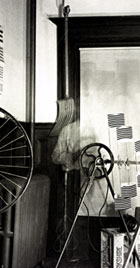
Figure 1
Marcel Duchamp, In
Advance of the Broken Arm
,
1915(studio photograph by Man Ray)

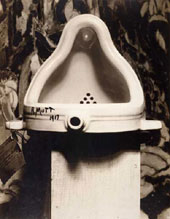
Figure 2
Marcel Duchamp,
Fountain, 1917
(photograph: Alfred Stieglitz)

Es sieht so aus, als enthielte das Œuvre Duchamps kein einziges Ready-made im buch­stäb­lichen Sinne. Wie in den verschiedenen Artikeln dieses Magazins nachzulesen ist, hat Rhonda Shearer starke Indizien dafür vorgelegt, daß Duchamp keine ‘echten’ Ready-mades präsentiert hat. Vielmehr handelt es sich bei den‘Ready-mades’ offenbar sozusagen um Fälschungen, also um von Hand hergestellte Imitate der Produkte, die sie zu sein vorgeben, oder um All­tagsgegenstände, die Duchamp gezielt manipuliert hat. (2) Das Fahrradrad eiert, die Schnee­schaufel mit dem Titel „In Erwartung eines gebrochenen Arms“ ist für den Gebrauch unge­eignet und selbst die Fontäne ist allem Anschein nach von allen Urinalen verschieden, die Duchamp in einschlägigen Geschäften hätte kaufen können. Hektor Obalk macht da­rauf aufmerksam, daß die Existenz Duchampscher ‘Ready-mades’ schon ohne dies fraglich ist. Nach der Definition von Duchamp, der zufolge ein Ready-made etwas ist, das durch die bloße Auswahl des Künstlers zu einem Kunstwerk wird, fallen von vornherein eine ganze Reihe Werke heraus, namentlich die, die Duchamp „korrigierte“ oder „assistierte“ Ready-mades etc. nannte. Diese Ready-mades waren von Duchamp sichtbar verändert. Ferner hätte es doch wenigstens einen Fall geben müssen, an denen Duchamp eines seiner Ready-mades einem Kunstwelt-Publi­kum zugänglich gemacht hätte. Tatsächlich sind zwar durchaus in der Phase seines Schaffens, in der Duchamp sich dem Ready-made gewidmet hat, ‘Ready-mades’ in einer Galerie zu sehen gewesen, allerdings nur in einem einzigen Fall und nicht in den Aus­stellungsräumen der Galerie. Die Unter­suchungen von Shearer und des ASRL legen damit natürlich um so mehr nahe, die Echtheit der Ready-mades an­zuzweifeln.

Diese Entdeckung ist deshalb so verblüffend, weil das Konzept des Ready-mades für die Kunst vor allem der zweiten Hälfte des zwanzigsten Jahrhunderts so wichtig geworden ist. Der Begriff ist aus der Kunst der letzten Jahrzehnte nicht mehr wegzudenken. Entsprechend muß man sich fragen, ob nicht ngesichts der Ergebnisse Shearers diese Kunst ganz neu bewertet werden muß. Im folgenden möchte ich indessen zeigen,
daß die ästhetische useinan­dersetzung mit dem Ready-made unbeschadet der Tatsache, daß sie auf einem ‘Irrtum’ beruht, weiterhin aktuell bleibt.

Für die Theorie ist die Frage, ob die Ready-mades von Duchamp ‘echt’ sind, natürlich ent­scheidend. Vor allem für Ansätze, die auf der Ununterscheidbarkeitsthese beruhen, wird die Datenbasis deutlich schmaler, wenn die Werke von Duchamp als Beleg wegfallen: Die Unun­ter­­scheid­bar­keitsthese besagt nach Danto, daß es Paare von perzeptiv ununterscheidbaren Gegenständen gibt bzw. geben kann, von denen einer ein Kunstwerk ist und der andere nicht; als Bestätigung dieser These kann Duchamp somit, wie es aussieht,
nicht mehr herhalten.

Im Bereich der Kunst sind die Verhältnisse dagegen verwickelter. Kunst bezieht sich auf ihr Material als auf eine gesellschaftliche Realität. Entsprechend ist ihre Selbstthematisierung in der Regel nicht abhängig davon, inwieweit sich aus dieser Reflexion wahre oder falsche Aussagen extrahieren lassen. Kritisch mögen die neuen Erkenntnisse über Duchamp le­diglich für solche Projekte sein, deren Pointe Duchamp verschwiegen


click to enlarge

Figure 3
Sherrie Levine,
After Walker Evans, 1979

vorweggenommen hat. Die Originalität verschiedener Strategien des Fake (3) bspw. steht in Frage. Aber selbst in diesem Feld sind die künstlerischen Arbeiten der letzten Jahrzehnte durchaus nicht überholt. After Walker Evans von Sherrie
Levine bleibt interessant, auch wenn die künstlerische Strategie der kalkulierten Fälschung und Entdeckung bereits bei Duchamp zu finden ist. Für das Werk hat Levine Reproduktionen von Fotos von Walker Evans abfotografiert und so Fotos hergestellt, die nicht von Gegenständen sind, sondern von Fotos. Damit erhalten die Fotos eine geistige Dimension, die ihrem Objekt abgehen, obwohl sie diesem –: Fotos von Ge­genständen – bis auf die Schärfe genau gleichen: Die Fotos von Evans sind gerade auf Objektivität, auf ihren dokumentarischen Wert berechnet, während die Fotos von Levine ihren Ausdruck durch geringfügigste Differenzen erhalten, die das ansonsten fast unsichtbare Objekt verraten.

Interessanter noch sind aber gerade die Fälle, in denen Kunst sich auf Begriffe bezieht, die unmittelbar mit dem Ready-made zusammenhängen. Als Beispiel mag hier der Zyklus Landschaft von Alexander Ginter dienen. Mit dem Begriff der Landschaft geht Ginter dabei von einem Sujet aus, das dem Ready-made geradezu entgegengesetzt zu sein scheint.

II.


click to enlarge

Figure 4
Alexander Ginter, Landschaft
(Provence), 1999 (installation view)

Bäume, Wiesen und Hirsche haben ihre Zeit gehabt, sollte man meinen. Soweit sie heute noch dazu die­nen, unsere Häuser wohnlicher zu machen, hat das weniger mit Kunst zu tun, als mit De­koration. Wenn sich dennoch ein Künstler der Gegenwart mit der Landschaft aus­einan­dersetzt, kann der Fall entsprechend kaum sonderliches Interesse provozieren. Und doch empfiehlt sich der Zyklus Landschaft unserer Aufmerksamkeit, zumal
insofern er zeigt, wie durch subtile An­spielungen auf innerästhetische Begriffe eine Position gewonnen werden kann, die auch durch eine veränderte kunsthistorische Forschungslage nicht unterminiert werden kann.


click to enlarge

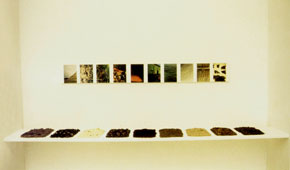
Figure 5
Alexander Ginter, Landschaft
(Yucatan), 1999(installaton view)

Der Zyklus besteht aus zwei Teilen. Der erste mit dem Titel Provence ist eine Reihe von Leinwänden, hochformatige ‘Bilder’, die allerdings auf dem ersten Blick eher trist wirken. Der zweite mit dem Titel Yucatan ist eine Installation bestehend aus Fotos und einer linearen Anordnung von Haufen unter­schiedlicher Erde. Die Bilder – man ist geneigt Landschaften in Ihnen zu sehen – zeigen im oberen Drittel Silhouetten, Berge vielleicht, in einem Fall eine Art Torbogen oder eine Brücke; die Formen sind schwarz und reduziert auf wenig Charakte­ristisches, Piktogramme von Landschaften, wenn man so will. Auf dem unteren Teil sehen wir je ein Feld in erdigen Tönen, in braun, gelb oder beige. Tritt man näher an die Bilder heran, so erkennt man, daß es sich bei den bis auf einen Rand von einigen Zentimetern die ganzen unteren zwei Drittel der Leinwände ausfüllenden Flächen nicht um Farbe handelt, sondern um Erde, die auf die weiße Leinwand aufgetragen ist. Unterhalb jedes Bildes findet sich jeweils ein Name: Orte in der Provence. Die Erde, die da aufgetragen wurde, soll man denken, kommt von diesen Orten. Die Bilder beziehen sich also offenbar über das Material auf ihren Ge­genstand.

Es bleiben jedoch Zweifel an der Echtheit des Materials. Die Installation, das Arrangement neben der kleinen Galerie von ‘Landschaften’, scheint indessen dieser Skepsis Rechnung zu tragen. Über einem Sims mit neun Häufchen Erde mit rechteckiger Grundfläche hängt eine Reihe Fotos.Diese Fotos bieten sich sozusagen als Beglaubigung für die Echtheit der Erde an. Jedes Foto, so scheint es, zeigt einen Ort, von dem jeweils die Erde von einem der Häufchen stammt.

Das ganze Ensemble wirkt eher schlicht, fast harmlos. Hinter dieser Fassade verbirgt sich indes ein raffiniertes Spiel mit Kategorien und Erwartungen, das uns bei der Betrachtung nach und nach in seinen Bann zieht. Um einen Begriff davon zu geben, seien hier nur einige der Zusam­menhänge analysiert.

Das übergreifende Thema des Zyklus ist ‹Landschaft›. Womit wir es aber zu tun haben, sind keineswegs Landschaften im herkömmlichen Sinn, also Landschaften, die sich mimetisch auf ihren Gegenstand beziehen. Das Konzept der malerischen Darstellung selbst wird vielmehr hintersinnig ‘analysiert’, in die begrifflichen Bestandteile zerlegt, und es sind diese Bestandteile, die dargestellt werden: Oben sehen wir die, wenn auch stark reduzierte, ‘Form’ und unten das ‘Material’. Das Verhältnis dieser Ginterschen Bilder zu ihrem Sujet ist dabei durch ihre Materialität wesentlich eines der Methexis an dem, worauf sie sich beziehen. Die Wahrheiten dieser Landschaften ist die Wahrheit
der sinnlichen Gewißheit, von der Hegel sagt, wir „haben uns […] aufnehmend zu verhalten, also nichts an ihm [dem Gegenstand, dem Ding], wie es sich darbietet, zu verändern“. Sie ist „unmittelbar […] die reichste“ und zugleich die „abstrakteste und ärmste“(4) . Jede der Mikrolandschaften, die sich in den Erdflächen verbirgt, ist hoch strukturiert und zugleich fast eintönig, so daß sich aus der Entfernung die Bilder nahezu gleichen. In einer ironischen Wendung gegen das Genre der Landschaft wird hier aus der ‘konkreten’ Landschaft das Konkreteste genommen und nicht abgemalt,
sondern eingeklebt.

Was wir damit vor uns haben, ist die Landschaft als Ready-made, als fertig Vorgefundenes. Das Verfahren erinnert an Picasso, der das Etikett einer Suze-Flasche in ein Bild klebte, um gegen den Realismus in der Malerei zu polemisieren, es wird aber noch dadurch radikalisiert, daß die ‘eingeklebte’ Erde anders als das

Etikett sich nicht einmal für ihre eigene Authentizität verbürgen kann. Für die Serie Provence wird diese Funktion, wenn überhaupt, schlecht und recht von den schwarzen Silhouetten übernommen, an deren Stelle bei der Installation Yucatan scheinbar die Fotos treten. Daß die Fotos die Erdhaufen supplementieren und


click to enlarge

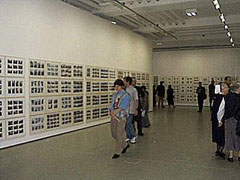
Figure 6
Gerhard Richter, Atlas,
1962-1996(installaton view,
detail of a total of 633 panels)

nicht umgekehrt die Erde die Fotos, wird dabei vor allem durch den Zusammenhang mit den Provence-’Landschaften’ sichtbar. Das Foto als eines der genuinen Medien der Landschaft tritt, weil sich die Erde als ‘eigentlicher’ Stoff des Zyklus darstellt, in den Hintergrund und fungiert als Kommentar. Der Eindruck wird dadurch verstärkt, daß die Bildausschnitte wie zufällig wirken und die Folge der Fotos eher darauf angelegt ist, einander zu einem bestimmten ‘Farb­rhythmus’ zu ergänzen, als sich beschreibend oder gar erzählend auf die Motive zu beziehen. Der Umgang mit Fotografie erinnert so an die große Fotoinstallation Atlas von Gerhard Richter, die auf der dokumenta X in Kassel zu sehen war.

Die Pointe der durch die Fotos repräsentierten Authentisierungsstrategie ist indessen, daß sie durch das Arrangement selbst unterlaufen wird. Die Erwartung, daß je einem Erdhaufen ein Foto entspricht, wird enttäuscht, denn tatsächlich haben wir neun Erdhaufen, aber zehn Fotos. Dadurch wird der Verdacht genährt, die Erde stamme vielleicht gar nicht von den angegebenen Plätzen. Allerdings ist unklar, was im Falle der Gleichzahligkeit von Erdhaufen und Fotos durch die Fotos überhaupt bewiesen würde.

Wir werden hinsichtlich der Herkunft des Materials verunsichert. Nicht nur der Begriff der Landschaft wird hier also reflektiert und in Frage gestellt, auch das Konzept des natürlichen Materials und insbesondere das der Authentizität werden thematisiert und kritisch durch­leuchtet.

III.

Die Interpretation macht deutlich, daß der Begriff des Ready-mades, des schon fertig Ge­machten, Vorgefundenen, außerordentlich wichtig für die Landschaft ist, ohne daß die In­stallation in diesem Begriff aufgeht. Vielmehr wird das ‹Ready-made› für eine Auseinander­setzung mit dem Thema ‹Authentizität› und dem Genre der Landschaft in Anspruch genom­men und weiterentwickelt. Das gilt unbeschadet der Tatsache, daß eine unmittelbare Aus­einandersetzung mit Duchamp hier nicht intendiert ist. Die durch den Duchampschen Begriff vermittelte Auseinander­setzung, und nicht dessen Applikation ist das, was den Zyklus so interessant macht.

Solche Arten der Aneignung werden durch die neuere Forschung zu Duchamp in der Tat nicht widerlegt: Auch andere Begriffe, denen in der Realität nichts entspricht oder die in sich wider­sprüchlich sind, wie die des Äthers oder der Dreieinigkeit, haben ein außerordentliches kreatives Potential freigesetzt; wo sich die Kunst mit solchen Konzepten ausein­andergesetzt hat oder wo diese wie auch immer implizit in sie eingegangen sind, ist die Kunst nicht dadurch entwertet worden, daß die Begriffe für uns ihre Relevanz eingebüßt haben. Es sind die Theo­rien, die bei einer Revision unserer Begriffe ihre Gültigkeit verlieren, nicht die Kunst.

Das gilt übrigens auch da, wo die Kunst selbst theoretisch wird. Entsprechend geben die Untersuchungen des ASRL eher Anlaß zu der Erwartung, daß der Einfluß Duchamps auf die ge­genwärtige Kunst fortbestehen wird, als daß die Kunst der letzten Jahrzehnte entwertet würde. Die Theorie der Kunst kann sich dagegen nicht damit begnügen, die neuerliche Finte Duchamps achselzuckend zur Kenntnis zu nehmen, auch wenn gegenwärtig die Neigung dazu groß ist.


Notes :

1. Wichtige Ideen des zweiten Teils verdanke ich Constanze Berwarth und Elsbeth Kneuper (vgl. Michael Enßlen: Kunst als Kultur der Präsenz, Heidelberg 2000). Die Verantwortung für den Text trage ich.

2. Hektor Obalk, The Unfindable Readymade, Tout-Fait: The Marcel Duchamp Studies Online Journal 1.2 Articles (May 2000)

3. Eine umfassende Studie hat jüngst Stefan Römer vorgelegt: Künstlerische Strategien des Fake. Kritik von Original und Fälschung. Köln 2001. Vgl. Auch Hillel Schwartz: The Cultur of the Copy. Striking Likenesses, Unreasonable Facsimiles.
New York 1996.

4. G.W.F. Hegel: Phänomenologie des Geistes, Hrsg. Hans Jürgen Gawoll, Hamburg 1986, S.69.

Figs. 1, 2
©2002 Succession Marcel Duchamp, ARS, N.Y./ADAGP, Paris. All rights reserved.

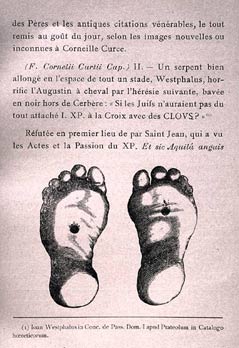
Jarry = Duchamp


click to enlarge
Anonymous
Woodcut of Jesus’ feet
Figure 1. Anonymous
Woodcut of Jesus’ feet

1. Jarry
“La Passion: Les Clous du Seigneur”.

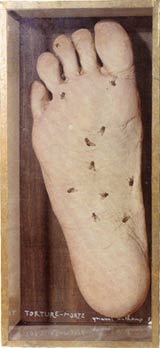
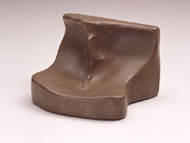
2. Duchamp “Sculpture-morte”


click to enlarge
Painted plaster and
flies, on paper mounted
on wood
Figure 2. Marcel Duchamp
Torture-Morte
1959
Painted plaster and
flies, on paper mounted
on wood, 11 5/8 x 5
5/16 x2 3/16 inches
(29.5 x 13.4 x10.3 cm)

Illustration to Alfred Jarry’s article,
“La Passion: Les Clous du Seigneur”
L’Ymagier IV
(July 1895)
Page 221
Spencer Museum of Art
Museum Purchase: R. Charles and Mary Margaret Clevenger Fund, 94.32
    

Fig. 2
©2002 Succession Marcel Duchamp, ARS, N.Y./ADAGP, Paris.
All rights reserved.

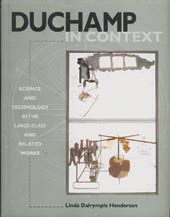
A Note on Linda Dalrymple Henderson’s “Duchamp in Context” (Niceron, Leonardo, Poincaré & Marcel Duchamp)

Click to enlarge

  • Science and Technology in the Large Glass and Related Works
    Figure 1
    Linda Dalrymple Henderson, Duchamp in Context: Science and Technology in the Large Glass and Related Works, (Princeton: Princeton University Press, 1998)
  • Portrait of Jean Francois Niceron
    Figure 2
    Portrait of Jean Francois Niceron (1613-46), 1646
  • Cover for A l’infinitif
    Figure 3
    Marcel Duchamp, Cover for A l’infinitif [a.k.a. The White Box],
    1967

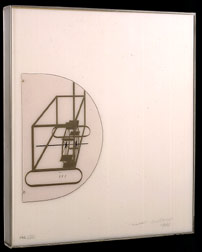
The recent discovery by Rhonda Shearer of the influence of the Renaissance geometer Niceron on Marcel Duchamp’s Large Glass (note from White Box) is confirmation of both his debt to Poincaré and his status as a sophisticated geometer in his own right.

The formidable academic scholarship of Professor Henderson may tend to limit the overall influence of Poincaré in favor of a “smorgasbord mix”
of contemporary science on Duchamp’s formulation of the Large Glass. In another context, the brief introduction by Prof. Henderson of Niceron missed an important contribution to the understanding of M.D.’s approach to Optics and Perspective.

Similar to his friend Apollinaire, Duchamp, in lieu of academic training, immersed himself in intensive studies of Optics and Perspective (as opposed to the generality of Apollinaire’s varied studies) in the St. Genevieve Library becoming, also a savant of the history of ideas. More information about Duchamp makes it untenable to deny the focus of Duchamp on Poincaré’s ideas, as proposed in “Science and Method” and “Science and Hypothesis.”

A concern with Optics and Perspective is common to Duchamp, Poincaré and Leonardo (in his Notebook). This focus on the geometry of vision is inseparable from the physiology of vision and the mechanics governing perception. Such a density of material, presented to even the most sophisticated public, might require a “light touch” (not of the hand, so despised by Duchamp) in presentation. Comic relief is afforded by such notions as “hilarious invention.” Niceron himself, in “La Perspective Curieuse,” is at no loss for subtle jokes at the expense of the Pope’s Turkish foes!

Click to enlarge

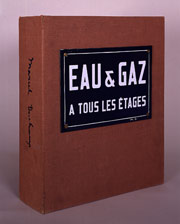
Eau & Gaz à tous les étages
Figure 4
Marcel Duchamp, Plate of Eau & Gaz à tous les étagesaffixed to the box for the limited edition of Robert Lebel’s Sur Marcel Duchamp, 1958

Blake wrote, “energy is eternal delight.” This sums up the pervasive erotic element which everywhere humanizes Duchamp’s exploration of the theme of a universal energy which ascends from the prosaic “Bachelor Realm” to the higher dimension proper to the “Bride.” This vary complex being, the Bride, seems to embody a gradient of stages (gas on all floors) from the strictly mechanical, to the electromagnetic, to the Wasp of Fabre, the etymologist, to Rrose Sélavy and — perhaps — in some empyrean splendor, the Virgin Mary herself.
The concept of a continuum of progressive states from the micro to the macro-scotic realms is essential to both Poincaré and Duchamp. Such a progression implies, at some point, a separation in dimensions which nonetheless still communicate. Thus, the Bachelor Realm is redeemed from isolation and yet supplied the gross fuel, which undergoes transformations as a distilled essence, at last arrives to nourish the Bride and to enable her, in turn, to provide for the limited world of the Bachelors a way of transcending their prescribed orbits, clothed in liveries and uniforms of stultifying conformity.

Everywhere this continuum appears buffeted by chance or, more accurately, refined by chance, so that an alternative to the dead stasis of thermodynamic equilibrium is revealed in the universal play of energy states–as well as in the mind as in Nature. As chance has its play in the mind, Poincaré brings forward a theory of human creativity and genius, in the chapter formulation, following an intensive but more or less random input of study, ideas appear to sort themselves out in what he calls the unconscious mind. There follows “tout fait,” the illuminating flash of insight. This vividly recalls Kekules’s epochal discovery of the benzine ring. Poincaré elaborates on this process from his own experience; service in the army only served to grant him a time for unconscious reflection on a problem. Freed of military obligations, he was struck all of a sudden with a path to a solution to his problem. Of course this epiphany had to be paid for in the laborious working out of the happy inspiration!
Click to enlarge

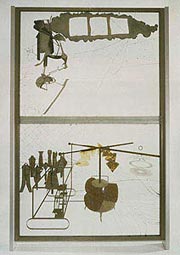
The Bride Stripped Bare by Her Bachelors, Even
Figure 5
Marcel Duchamp, The Bride Stripped Bare by Her Bachelors, Even [a.k.a. The Large Glass], 1915-23

In accordance with his universal postulate of collisions producing phenomena–from random collections of dust mites (an important Duchampian motif) to the vast interstellar space of the Milky Way where flaming gases mingled following principles laid down by Clerk Maxwell–all nature, including Mind, was subject to a process in which destined outcomes proceeded in an orderly fashion from inputs randomly fed into closed systems. Similarly in the mind of genius, ideas, like molecules, collided and bumped against each other. At length, the closed system of the unconscious mind sorted out the most fruitful outcome, giving rise to a new paradigm.
This is the central theme of the Large Glass. Through an almost the “illuminating gas” arises and, becoming increasingly refined, passes from the three dimensional realm of the Bachelors into the higher fourth dimensional realm of the Bride. This process mirrors in contemporary form the transmutations that the alchemists made with the array of crucibles, furnaces, alembecs, etc.

Click to enlarge

Dust Breeding
Figure 6
Marcel Duchamp, Dust Breeding, 1920(Photograph by Man Ray)

When confronted with the suggestion he was an alchemist, Duchamp replied, “If I have practiced alchemy it has been in the only possible way that it can be practiced today, namely unknowingly.”

The thesis, shared by Duchamp and Poincaré, infers that any effort to place Duchamp in any other orbit (*pun intended) than that of Poincaré is to deny M.D.’s consistency and his basic seriousness, however concealed by the rubric of “playful physics” or “hilarious picture.” A very serious mind has addressed the basic problem of human creativity. In so doing, he has adopted as a model the thoughts of a leading mathematician and physicist of his day. Without Poincaré, the Great Glass would lack cohesion and relevance to seminal modern thought. Duchamp would have spent so many years of thoughtful labour in vain (neglecting the dreary months of repairing his masterwork in Katherine Dreier’s garage after it was shattered by careless handling); producing only a witty commentary on contemporary science.

*Poincaré was a foremost astronomer interested in the three-dimensional problem.

Without wishing to in the least diminish Linda Henderson’s monumental work, Duchamp in Context, the writer seeks to put Duchamp in a leading place in the history and development of science–not as an original theoretician or as an experimentaist in any but a “thought experimentalist mode.” (Remember that Einstein’s great discoveries came from the use of imaginative “thought experiment.”) The notes for the Great Glass, in themselves, furnish an extraordinary essay in thought experimentation. Without intensive academic training, without a well-furnished laboratory, without consistently available help from hired co-workers or staff, Duchamp’s commentary on science has much to do with Jarry’s pataphysics.

Pataphysics, as Jarry himself defines it, consists of, “the science of imaginary explain the universe supplementary to this one.” The writer believes that the universe supplementary to this one could only be apprehended from a higher dimensional standpoint, attainable solely through mathematical insight. This would confirm that Duchamp had recourse to the brilliant insights of Poincaré, who above all others at the time understood the inter-dimensional tensions between the familiar third-dimensional world and the so-called fourth, where the fourth is a spatial dimension (five dimensions would include time). Such tensions, according to Duchamp and Poincaré, could be resolved in the subconscious mind following an intensive period of effort or study. (The phrase “tout faite,” in fact, originated with Poincaré.)

Jarry’s pataphysics were propounded (posthumously) by his character Dr Faustroll. The so-called laws of science were, according to the doctor, merely exceptions occurring more frequently than others. This skeptical iconoclasm gave rise to Duchamp’s notion of “playful physics.” Perhaps the concept of “meta-irony” would better serve than any other to characterize Duchamp’s approach to “exact science.” His mentor Poincaré was applying a statistical, probabilistic model to descriptions of that range of phenomena, dust mites to galactic gaseous formations, already referred to.

The intrusion of probabilistic consideration into exact science displaced an earlier confidence in Determinism–followers of Newton and Laplace Physicists, e.g. Einstein, were uncomfortable with a world in which “God played dice.” Although a fervent amateur of advanced science, Duchamp was nevertheless capable of a gentle (and very intelligent) mockery of that which so fascinated him.

Click to enlarge

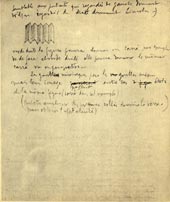
Note from the Green Box
Figure 7
Marcel Duchamp, Note from the Green Box, 1934

In Niceron, Duchamp may have seen a quality of “hiddenness.”
By this the writer refers to the use of “folded prisms and multiple viewpoints to convey unsuspected images, lurking,” as it were, awaiting detection–as with Duchamp’s ‘Wilson-Lincoln effect,’ Rhonda Shearer has consistently drawn attention to the quality of ‘hiddenness’ in the oeuvre of Duchamp. This is not obscurantism; although there is a traditional linkage to the obscure language of the classical alchemists.

The reference to the “language” of the alchemists brings up Duchamp’s fascination with language and the subtle level of meaning. Word puns, anagrams — the whole elusive verbal trickery of Cabalism–is common both to Duchamp and Jarry. In a period where ciphers and codes are looked for everywhere (affording a wealth of humorous material to comedians and cartoonists), why waste intellectual effort on “schoolboyish” pursuits? The answer lies in the deconstruction of language itself. Consider the contribution of so many and so diverse intellects to this endeavor of our time: Levi Strauss; Noam Chomsky; Moore; Ayer; Wittgenstein, Charles Dodgson (e.g. ‘Alice’ — a word means what I choose it to mean); Roussel; Jarry; Apollinaire; etc, etc. the critical analysis of language is a major preoccupation of our time.

If Duchamp is much more than a very clever master of word play, it is essential to look at the entirety of his life’s work–even his period of just “breathing!” The readymades, for example, form a continuous commentary on the Large Glass. In fact, every note and every artifact or “precision painting” or “tout fait” forms part and parcel of a big “closed system.” Such smaller closed systems–mechanics; entymology (the Wasp); electo-magnetism; eroticism; non-Euclidian geometry; chess; verbal manipulation; symbolism; alchemy–all figure in the “compendium” / encyclopedia, as it were, of the Large Glass and the Bride. Duchamp, from this viewpoint, is a major philosopher of our time, on a level with Popper Jasper, Wittgenstein, or whomever one chooses to nominate. Only his medium is different from the strictly verbal-literary works of the forgoing. Also, it might be added, he conveyed in an urbane and witty manner insights made ponderous and hard to follow by the savants. Then, it might be asked, who are the real obscurists? The writer much prefers to be amusingly enlightened by the Large Glass than to pour over wordy and weighty tomes, the output of scholars caring little but for the approbation of academic peers.

Figs. 3-7 ©2002 Succession Marcel Duchamp, ARS, N.Y./ADAGP, Paris.
All rights reserved.

Ready-Mades and Contemporary Art


click to enlarge

Figure 1
Marcel Duchamp, In
Advance of the Broken
Arm
, 1915 (studio
photograph by Man Ray)

Figure 2
Marcel Duchamp,Fountain,
1917 (photograph:
Alfred Stieglitz)

It could very well turn out that there is not a single ready-made in the narrow sense among the works of Duchamp. As is reported by several articles of this magazine, Rhonda Shearer submitted strong evidence that Duchamp did not present any “real” ready-mades. According to Shearer the “ready-mades” are fakes, handmade imitations of the ready-made objects they pretend to be, or ordinary objects that were purposefully changed by Duchamp. The bicycle wheel wobbles, the snow-shovel with the title In Advance of the Broken Arm does not work and even the Fountain to all appearance is different from all urinals that Duchamp could have bought anywhere. Hector Obalk draws our attention to the fact that the existence of Duchampian ready-mades is questionable enough as it is (2) . Given Duchamp’s definition of the ready-made, according to which a ready-made is something that becomes a work of art by the mere choice of the artist, many of the works of Duchamp are ruled out already. This holds namely for those which he called “corrected” or “assisted” ready-mades, et cetera. These “ready-mades” were visibly changed by Duchamp. Furthermore there should have been at least one case where Duchamp presented his ready-mades to an art-world public. Actually ready-mades were shown to the public. This is true even for the period when Duchamp dedicated himself to the ready-made. Only once, however, could two of them be found in a gallery, and they were still not placed in the showrooms. This underlines the relevance of the research of Shearer and the ASRL, and the authenticity of the ready-mades becomes questionable all the more.

The importance of this discovery is due to the fact that the concept of the ready-made became so eminent to art, in particular to art of the second half of the twentieth century. We cannot imagine the art of the last decades without this notion of the ready-made. This brings us to the question of whether we have to revise our valuation of the art of the past 50 years in light of the findings of Shearer. I would like to show that the artistic treatment of the ready-made is still valid, regardless of it resting on error.

With respect to theory, it is crucial to know if there are “real” Duchampian ready-mades or not. If the works of Duchamp fail to be positive evidence for “real” ready-mades, this puts a serious question mark to approaches that rest on the indiscernible-thesis. According to Danto the indiscernible-thesis says that there are or could be two objects indiscernible by perception and yet one of them is a work of art and the other is not. Duchamp apparently cannot serve as confirmation of this thesis any longer.

In the realm of art, on the other hand, things are more complicated. Art refers to its material as much as to social facts. Accordingly the way it refers to itself usually does not depend on whether there can be drawn true or false propositions from this reflection. It may be conceded, though, that the new insights into Duchamp could depreciate such projects which Duchamp anticipated unrecognised. The originality of any


click to enlarge

Figure 3
Sherrie Levine, After
Walker Evans
, 1979

strategy towards the fake
(3)
is called into question. But even in this field recent aesthetic experiments are not yet obsolete. After Walker Evans by Sherrie Levine remains interesting, even though the artistic strategy of calculated faking and the discovery of the fake as fake was used by Duchamp long before. For her project Levine took photographs from reproductions of photos from Walker Evans, and thus produced photos that were not pictures from physical objects, but from photos. By way of this procedure the photos achieve a geistige (4) dimension that lacks the objects but the photos still look like the ones taken of physical objects by Evans – apart from some details such as sharpness. The photographs from Evans aim at objectivity and at documentary evidence, whereas the photos of Levine receive their expressiveness through the slightest differences which reveal their nearly invisible subject.

Even more interesting, however, are just those cases where art refers to concepts that are more immediately related to the ready-made. The cycle landscape by Alexander Ginter may serve as illustration for that.

II.

click to enlarge

Figure 4
Alexander Ginter,
Landschaft
(Provence),
1999 (installation view)

Ginter’s starting point, the notion of “landscape,” is so to speak the opposite of “ready-made.” Trees, meadows and deer seem to be somewhat out-dated. In so far as they continue to make our houses pleasing, they become more a matter of decoration than a matter of art. Thus, if a contemporary artist nevertheless dedicates himself to landscapes, it does not provoke particular interest. Yet Landscape still deserves our attention inasmuch as it shows, through subtle allusions to aesthetical concepts, how art gains a vantage point which cannot be undermined by new art historical evidence.


click to enlarge

Figure 5
Alexander Ginter, Landschaft
(Yucatan), 1999(installaton view)

The cycle Landscape consists of two parts. The first one, the title of which is Provence, is a series of canvasses which for the time being do not look particularly interesting. The second one, Yucatan, is an installation consisting of photography plus a linear arrangement of mounds of earth. The paintings – probably landscapes – show in the upper thirds black silhouettes (possibly hills or mountains or in one case an arch or a bridge). The silhouettes are reduced forms which exhibit only a few characteristics, pictograms of landscapes, as it were. On the lower part of each painting there is an area of earthy colours, of brown, yellow, and beige. Closer examination reveals that these fields, that, except for a margin of some centimetres, take up the lower two thirds of the canvasses, don’t consist of ordinary colours but of soil and sand applied to the white canvasses. Below each painting can be found a name: places in Provence in France. Apparently the paintings refer to their subject through their respective material. Yet one may reasonably doubt the authenticity of the material.

The installation, however, the arrangement beneath the small gallery of “landscapes,” seems to take into account those doubts. Above a still of nine mounds of earth with rectangular base hangs a row of photographic prints. These photos offer themselves as authenticating the respective mounds. Seemingly each photo shows a spot where the material of one of the mounds was taken from.

The ensemble gives the impression of being simple, even naïve. That is but a façade that conceals a cunning play with categories and expectations. Little by little we are drawn into this game. I will confine myself to an analysis of just some of the interesting points to show the subtlety of the work.

The overall theme of the cycle is “landscape.” What the cycle consists of, though, by no means are landscapes in a narrow sense, which is to say landscapes that refer mimetically to their subject. It’s rather the concept of pictorial reference that is analysed and cut up into its conceptual components, and it’s these components that are shown. At the top there is the reduced “form” and at the bottom there is the “material.” The relation of these paintings to their subject is a relation by way of methexis, of participation in the object to which they refer. The “truth” of these landscapes is the truth of “sense-certainty” about which Hegel says “we have to conduct […] receptive, that is we are to alter nothing in it [the object, the thing], as it presents itself.” Sense-certainty “immediately appears to be the richest kind of knowledge” and at the same time “the most abstract and poorest” (5) . Each of the micro-landscapes that is hidden in the earthen areas has a complex structure, and at the same time is almost monotonous, so that from a distance the pictures look alike. These “landscapes” deal with the genre “landscape” in that they take from the “concrete” landscape the most concrete but do not paint it but stick it on.

The concept which is hypostatized here is the landscape as ready-made, as ready-found soil. The procedure reminds us of Picasso who stuck the label of a Suzet bottle on a canvas as polemic against the realism of the


click to enlarge

Figure 6
Gerhard Richter, Atlas
, 1962-1996 tallaton
view,detail of a total
of 633 panels)

Academy. The landscape as ready-made is then made radical through the fact that the “stuck on” stuff, unlike the Suzet label, cannot even guarantee its own authenticity. For the series Provence the black silhouettes take over this function in a way, and the photos appear to have the same function for the installation. That the photos supplement the mounds of earth and not vice-versa is made clear through the relation to the Provence “landscapes.” Although photo­graphy is the genuine medium of landscape, it is replaced here by earth, the actual matter of the cycle, and serves as mere commentary. This impression is reinforced by the fact that the ensemble of photos aims more at constituting to an object. This handling of photography thus resembles the photo-installation Atlas of Gerhard Richter that was seen at the documenta X.

In spite of the impression we have for the moment, the key to the interpretation of land­scape must surely be that the arrangement undermines the strategy of authentication. The expectation that each photo corresponds to one mound of earth is wrong, because there really are nine mounds but ten photos. This raises the question whether we still have any reason to think that the mounds stem from the places that are revealed by the photos. On the other hand one might reasonably suppose that, even if there was the same number of photos and mounds, this does not prove anything.

As for the origin of the material, we are put into a state of uncertainty. So it’s not only the concept of landscape material and particularly the concept of authenticity.

III.

According to the above interpretation there can be no doubt that the concept of ready-made, an object that does not undergo any change for its use is essential for the Landscape, although Landscape cannot be reducedto this concept. Rather “ready-made” is used for an analysis of the notion of authenticity and the genre “landscape.” This holds regardless of the fact that Ginter apparently did not intend to deal with Duchamp. What is particular with the cycle landscape is not the application of the Duchampian concept but the expression of Landscape that is mediated through this concept.

The conclusion which emerges from what is shown above is, indeed, that such ways of appropriation are not proven wrong or out-dated by the recent research in Duchamp. We have some concepts with respect to which there is nothing they refer or even contradict, such as the concepts of ether or trinity, but which nonetheless gave rise to interesting artistic and even scientific discoveries. Insofar as art has, however implicit, referred to such concepts, it is not depreciated by the fact that those concepts became irrelevant to us. It’s the theories, not art, that have to be reconsidered if our concepts cease to be valid.

This still holds when art itself is engaged in theory. It would appear, then, that the research of the ASRL gives more reason to expect that the influence of Duchamp will continue rather than that the art of the art, however, must not be contented with carrying on as usual, even though the aestheticians are inclined just to do so.

Notes

1. Some important ideas of the second part of this article I owe to Constanze Berwarth and Elsbeth Kneuper(see Michael Ensslen: Kunst als Kultur der Gegenwart, Heidelberg 2000). Of course I take responsibility for the text. For correcting the English text I want to thank Sarah Skinner Kilborne.


2. Hektor Obalk, “The Unfindable Readymade“, Tout-Fait: The Marcel Duchamp Studies Online Journal 1, no. 2 Articles (May 2000).

3. Stefan Römer recently published a comprehensive essay on the fake, Künstlerische Strategien des Fake.Kritik von Original und Fälschung, Köln 2001; See also Hillel Schwartz, The Culture of the Copy. Striking Likenesses, unreasonable Facsimiles, New York 1996.

4. I must apologise for leaving the German expression without translation. I feel somewhat uneasy about the translation of “geistige dimension” with “spiritual dimension,” though this may probably be the best one.

5. G.W.F. Hegel, Phänomenologie des Geistes (Hamburg: Hrsg. Hans Jürgen Gawoll, 1986) 69, my translation.

Figs. 1, 2
©2002 Succession Marcel Duchamp, ARS, N.Y./ADAGP, Paris. All rights reserved.

A Note on Duchamp/Saussure and the Mysterious Sign of Accordance

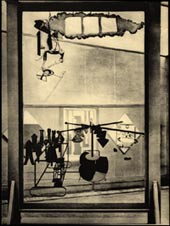
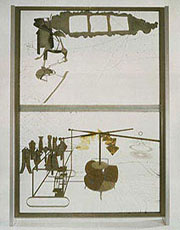
The Large Glass, on the evidence of Marcel Duchamp’s own notes from The Green Box, is the result of an attempt at a kind of pataphysical proof.Duchamp is looking to demonstrate that it is possible to isolate what he calls in his notes–“the sign of accordance”(1)(quite specifically). This is ultimately Duchamp’s aim and the test of whether his scientific experiment has been successful. What are the factors at work in this attempt? What are the conceptual tools at his disposal? The sign of accordance between what elements?
In Duchamp’s notes from the Green Box he makes reference to one element, namely, a succession “[of a group] of various facts” that seem to depend on each other under “certain laws.” He wants to determine the conditions which bring about the instantaneous State of Rest (extra-rapid; perhaps a photographic exposure; an indexical mark or trace) – that which brings a sudden halt to this succession of interdependent various facts. This accord (agreement/conformity) is between then, this State of Rest (a particular) and a choice of possibilities (authorised and determined by these certain laws). Here, as elsewhere,the thinly veiled language of photography and other physical-indexical processes is apparent in Duchamps notes. This much has already been noted by Duchamp scholars.
In another note from The Green Box Duchamp re-frames the problem in a slightly different way. Here, what was also previously an allegorical appearance has also become an allegorical “reproduction.”What remains unchanged in this other note is that the required proof is still the isolation of “the sign of accordance.”
A third re-framing of the problem by Duchamp – again from The Green Box – takes an algebraic turn: he writes a sort of ur-formula:
a

b

Here “a” is the instantaneous State of Rest or extra-rapid exposition (or exposure), whilst “b” is the (or a) choice of possibilities. Duchamp makes a point in his notes here to the effect that this ratio of “a” over “b” is not given by a resultant (say) “c,” but by the sign (the horizontal bar) that separates “a” and “b.” This is effectively
the sign of his pursuit…”look for it.”


click to enlarge
 Green Box
Figure 1
Marcel Duchamp,Deluxe
edition of the Green Box, 1934

And here also he writes a curious thing: as soon as “a” and “b” are known they become new units and lose their relative value. In other words, as soon as a and b become – somehow – concrete or qualitative, they lose their previously held abstract quantative character. Here again Duchamp rehearses the refrain of looking for the sign of accordance or rather of something else related to the concept of accordance (perhaps parallelism or something else?). Where else might we find a similar search?

Some speculations – hopefully not too idle. Duchamp seems to be searching for some process, some abstract relation, not dissimilar from the concerns of classical semiotics(2) – a theoretical discipline struggling to be born in the years prior to the First World War via the nineteenth century research and writings of, for example, William Dwight Whitney in America and Hippolyte Taine in France. For where can we find a similar set of problems articulated (almost during the same time)? Look at Ferdinand de Saussure’s Course in General Linguistics(3).Some of the parallels, at the level of ideas, with Duchamp’s writings from The Green Box, are quite uncanny (as in a kind of unfamiliarity within familiarity…). The interesting thing here is that, despite being at the beginning of a new Science of Signs, Saussure’s researches into the workings of language were tinged with a kind of madness and, in that sense, it makes a comparative study all the more compelling.
At the time Duchamp was formulating his ideas for The Large Glass, it appears untenable that he knew anything of Ferdinand de Saussure’s research. (Saussure wrote very little and published less.) Saussure’s Course, based on the notes of his students, was published posthumously by Payot in Paris in 1916, but there appears to be no biographical or documentary evidence that Duchamp ever read the book. However the “correspondences” were in the air at the time, and it should be of little surprise that these two thinkers where approaching similar intellectual projects – albeit from radically different directions.
So Saussure’s “sign of accordance”–how did he “look for it?”
What follows is a rather sketchy and caricatured version of (a small part of) Saussure’s Course but it will, possibily, go some way to illustrating some of the similarities in the thinking of these two very different “researchers.”
Because of his dissatisfaction with previous attempts to map out the specific and detailed contours of a study of language, Saussure set about the task himself and in doing so focused on what he saw as the most elemental characteristics. For example, Saussure had to first establish the building block of his discipline. How did he do this? He started from an act of speech from a specific spoken sound and as he saw it its accompanying idea. From this simple coupling, he articulates the beginning of a new social science.
A language…is a social institution. But it is in various respects distinct from political, juridical and other institutions. Its special nature emerges when we bring into consideration a different order of facts. A language is a system of signs expressing ideas, and hence comparable military signals and so on. It is simply the most important of such systems. It is therefore possible to conceive of a science which studies the role of signs as part of social life. It would form part of social psychology, and hence general psychology. We shall call it semiology…(4)


click to enlarge
Two-sided
psychological entity
Figure 2
Ferdinand de Saussure,
diagram for two-sided
psychological entity

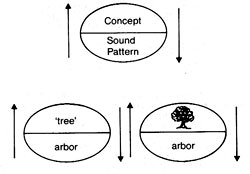
So here we have Saussure’s momentous founding of a new social science. Its most elemental structure, according to Saussure, is “The Sign” which he illustrates thus(5)
: (Fig. 2)

What we have here is three ways of picturing what Saussure called a “two-sided psychological entity.” (6) In this diagram he is using (appropriately enough for a comparison with Duchamp and The Large Glass) an example of the word “arbor” where the concept or idea of “tree” sits above what Saussure calls the “sound pattern.” This “concept” has a relation with its “sound pattern” which involves a kind of two-way communication across the line that “divides” the two psychological entities. At one point in his notes Saussure also compares this relation to the two sides of a sheet of paper. Recto (say) is the idea or thought and verso being the sound pattern. “Just as it is impossible to take a pair of scissors and cut one side of paper without at the same time cutting the other, so it is impossible in a language to isolate sound from thought or thought from sound…Linguistics, then, operates along this margin, where sound and thought meet.”(7)

It is important to remember that what we have here is effectively a structural relationship between an idea and the mental imprint, if you like, of that idea’s articulation. Although Saussure called the sign “concrete,” in many ways it is actually an abstract construction, more or less. It, the Saussarian sign, is neither a relation between a spoken word and its concept nor a thing entirely in the world. As Saussure says, “A linguistic sign is not a link between a thing and a name, but between a concept and a sound pattern” and “…[a] sound pattern is the hearer’s psychological impression of a sound…”(8) Today, these structural features of the sign are known more familiarly. However, often they are misunderstood as “signifier” (the Saussurian “concept”) and “signified” (the “sound pattern”).
In the Saussurian view, moreover, the relation between the signifier and the signified is to a greater or lesser extent unmotivated, conventional relation here but ask for this to be taken–for the purposes of this short essay–as “given.” What this amounts to though is that signs (or potential signs) it can only be isolated by what it is not. Saussure says that. “…language itself is nothing other than a system of pure values…”(9) and that, the ultimate law of language is, therefore, dare we say, that nothing can ever reside in a single term. This is a direct consequence of the fact that linguistic signs are unrelated to what they designate, and that therefore “a” cannot designate anything without the aid of “b” and vice versa. In other words, both have value only by the differences between them, or neither has value, in any of its constituents, except through this same network of forever negative differences.(10)

So we have at this point a sign constructed of two conventionally related components (both psychological) which as a combination have value only in relation to what the combination is not. It is at this point that Saussure’s Course takes what I would call, an even more Duchampian turn. Look at this diagram(11) :


click to enlarge
Sign of accordance
Figure 3
Ferdinand de Saussure,
sign of accordance

Here we have, effectively, Saussure’s illustration of his sign of accordance.(Fig. 3) For in this diagram what haunts his ideas on the sign is the nature of the relation between the signifier (A) and the signified (B). However, look at that gap! A shifting nothingness sliced by the temporal relation with other signs. Moreover these “other signs” are never really present as such. What is more, a substitution of a form of ideogramme for a phonetic text derived from the Greek alphabet brings more clearly into focus the “vulgar” comparison with not only The Large Glass, but also, perhaps, begins to show the limitation of the Saussurian sign–one which (albeit unwittingly) I believe Duchamp was questioning.

Like the cleavage between The Bride and Her Batchelors, the relationship between the signifier and the signified is, coincidentally, a separation and a pulling together. Saussure indicates that the two elements of the linguistic sign are intimately linked.(12)Elsewhere in the Course, however, Saussure describes the relation between signifier and signified as mysterious. When it comes to establishing the nature of the “bar,” or the entity, that both separates and links the two entities of the sign together, Saussure starts to struggle (we might even say teeter) on the edge of Reason. Prior to this point in his Course his articulations have largely followed a form of logic.(13) But then…
Psychologically, setting aside its expression in words, our thought is simply a vague, shapeless mass. Philosophers and linguists have always agreed that were it not for signs, we should be incapable of differentiating any two ideas in a clear and constant way. In itself, thought is like a swirling cloud where no shape is intrinsically determinate. No ideas are established in advance, and nothing is distinct, before the introduction of linguistic structure.

But do sounds, which lie outside this nebulous world of thought, in themselves constitute entities established in advance? No more than ideas do. The substance of sound is no more fixed or rigid than that of thought. It does not offer a ready-made mould, with shapes that thought must inevitably conform to. It is a malleable material which can be fashioned in to several parts in order to supply the signals that thought has need of. So we can envisage the linguistic phenomenon in its entirety the language, that is as a series of adjoining subdivisions simultaneously imprinted both on the plane of vague, amorphous thought (A), and on the equally featureless plane of sound (B)…. Thought, chaotic by nature, is made precise by this process of segmentation. But what happens is neither a transformation of thoughts into matter, nor a transformation of sounds into ideas. What takes place is a somewhat mysterious process by which “thought-sound” evolves into divisions, and a language takes shape with its linguistic units in between those two amorphous masses. One might think of it as being like air in contact with water:changes in atmospheric pressure break up the surface of the water into a series of divisions, i.e. waves. The correlation between thought and sound, and the union of the two, is like that.(14)
Saussure is trying to grapple with the problem he has, himself, set up. For he is struggling, metaphorically, with a strange and mysterious confluence which, earlier in his notes, was a single fixed line (albeit one which entertained contrary vectors). We could perhaps go further and say that Saussure’s construction of the sign held within itself its own critique, and, further, it could be argued that Duchamp was more aware of this than Saussure. Within The Large Glass the relationship between the The Bride and Her Bachelors is represented by three (not one) glass bars which are subject to feeble and faltering breaches – both electrical and mechanical. In contra-distinction to Saussure’s amorphous “middle term,” even Duchamp’s middle has a middle.


click to enlarge

  • Large Glass
    Figure 4
    Photograph of the
    Large Glass
    at the
    Brooklyn Museum of Art,
    New York, in 1926
  • The 
Large Glass repaired
    Figure 5
    Marcel Duchamp, The
    Large Glass
    repaired, 1915-23

Before Duchamp’s Large Glass was broken and repaired the few photographs of it show that the division between The Bride and Her Bachelors was not as distinct as it is now. The repair of the two sections and the subsequent reframing have given The Large Glass a visual heaviness that it did not have when it was shown at the Brooklyn Museum in 1926. (Figs. 4 & 5) Then, although the heavy wooden frame almost semed to threaten to crush the work it seemed to maintain its visual lightness and physical integrity. Now of course, the heavy framework more brutally (but only visually) separates The Bride and, her fantasies, Her Bachelors. By 1936 Duchamp’s interests had moved on although to developments of very much related matters.


Notes :

Footnote Return 1. Marcel Duchamp, The Bride Stripped Bare by Her Bachelors, Even: a typgraphic version by Richard Hamilton of Marcel Duchamp’s Green Box, trans. George Heard Hamilton (Stuttgart: Edition Hansjorg Mayer, 1976) unpaginated. All quotes are from this publication unless stated otherwise.

Footnote Return 2. In an unpublished Master of Arts dissertation, Richard Blakey, taking a “deconstructivist approach,” relates the machinations of Duchamp’s Large Glass via Saussure to Derrida – in his Of Grammatology – and Derrida’s critique of Saussure’s concept of the sign in Chapter 2 of that book. Here I am just trying to draw out a few (perhaps “naïve”) associations from a perspective of Art History/Theory. See: R.Blakey, “Duchamp andThe Sign,” diss., University of Sussex, U.K, 1991.

Footnote Return 3. Ferdinand de Saussure, Course in General Linguistics, trans. Roy Harris (London: Duckworth, 1983).

Footnote Return 4.Ibid., p.15.

Footnote Return 5. Ibid., p.67.

Footnote Return 6. Ibid., p.66.

Footnote Return 7. Ibid., p.111.

Footnote Return 8. Ibid., p.66.

Footnote Return 9. Ibid., p.110.

Footnote Return 10. Jonathan Culler,
Saussure (London: Fontana Press, 1986), de Saussure quoted, p.52.

Footnote Return 11. Ferdinand de Saussure, Course in General Linguistics, 111.

Footnote Return 12. Ibid., p.15.

Footnote Return 13.What contradictions exist within the text of the Course, and there are a few (whether due to the inconsistencies in Saussure’s exposition, interpretation by Saussure’s students, or his translator), they are not the subject here.

Footnote Return

14. Ibid., pp. 110-111.

Figs. 1, 4, 5
©2002 Succession Marcel Duchamp, ARS, N.Y./ADAGP, Paris. All rights reserved.

Rrose Selections

ORIENTATION
OF THE
PARASOLS

Picture A: half-moon of parasols, moving
like a caterpillar on a branch, arc of S.
shoes emerge from underneath
they are the chain which connects the pearls…
the necklace wraps around, gracefully,
but when the woman bends over the pearls come undone.

Picture B: parallel lines of color
on a beach in the South of Portugal.
Drinks are served. Glances are cast.
Eyes close with the image before them in mind.
Eyes close but the parasols, those parasols,
blooms of summer, narrowed to darts
thorns in a hand that pulls down the night,
are still on the beach when she asks,
knowing what she’s seen, “Can we go?”
to which he replies, having only watched her,
“My love, whatever you wish.”

ART


click to enlarge

Figure 1
Marcel Duchamp,
Female Fig Leaf, 1950

Figure 2
Marcel Duchamp, Given:
1. The Waterfall, 2. The Illuminating
Gas
, 1946-66

Figure 3
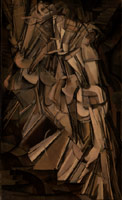
Marcel Duchamp, Nude
Descending a Staircase
, No. 2, 1912

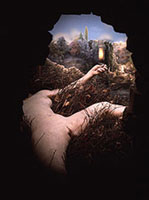
Female fig leaf Reveals a landscape, reclined Leaves and twigs about her legs A lantern in the distance Water running softly, continually.
I peer through the peep hole. It is dark where I am and bright where she is, Hundreds of miles from home. I forget where I am from, taken in by the slit which is open and which is the only face that is exposed. Like the mouth of an adult who is towering, talking her clitoris is all I want to look at.Hot breath on my shoulder reminds, It is time for another’s turn.

1913
The blood of the city lights explodes onto a corner and covers a group of nine in uniforms they never imagined.Chatter ensues but the lady in stride crosses over[a line, infrathin]and is gone,leaving them exposed, barren in the corner of a city at night.On the building to one side,their shadows form spires but these men and one woman in front of the armory are bystanders only [in red]To them, the lady is naked. She is shame.She is the replaceable stair.


Figs. 1-3 ©2002 Succession Marcel Duchamp, ARS, N.Y./ADAGP, Paris. All rights reserved.

Elena del Rivero and Marcel Duchamp: Les Amoureuses


click to enlarge
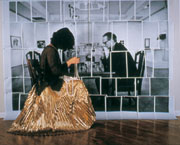
Elena & Rrrose
Figure 1
Elena del Rivero,
Les Amoureuses: Elena & Rrrose
2001 (Photo: Kyle Brooks;
© Photo 1963:
Julian Wasser. All rights reserved)

In the end, West Coast photographer Julian Wasser gave in to her gentle pleading and allowed New York-based artist Elena del Rivero to use his famous photograph of Marcel Duchamp, depicting the artist at the opening of his first major solo-show at the Pasadena Museum of Art in 1963, playing chess with a nude Eve Babitz . The result of del Rivero’s appropriation is a Duraflex C-type print of 30 x 36 inches titled “Les Amoureuses, Elena & Rrrose” (2001) (Fig. 1). The artist, seated in front of a collage of a photocopied and enlarged version of Wasser’s original, seems to be seated opposite Duchamp, almost entirely covering the body of the nude appearing behind her on the picture. The artist, wearing a long, pleated dress of golden color (Elena del Rivero: “I wanted to be a princess!”) is stringing up pearls of which a rather arge amount is gathered in her lap. Concentrated as she is in her work, the artist
takes on the pose of a seamstress passing time through monotonous, almost meditative work – a theme often explored throughout del Rivero’s oeuvre.


click to enlarge
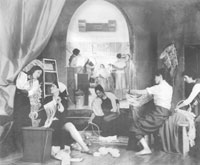
Elena del Rivero, Las Hilanderas
Figure 2
Elena del Rivero,
Las Hilanderas
(The Spinners)
, 2001
(Photo: Kyle Brooks;
© Photo 1963: Julian Wasser.
All rights reserved)
The Spinners
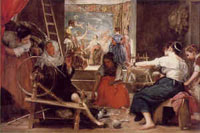
Figure 3
Diego Velázquez,
The Spinners, c. 1657

Between July 11–28, 2001, del Rivero concurrently presented the installation [Swi:t] Home at The Drawing Center’s Drawing Room in New York, and Las Hilanderas (The Spinners) (Fig. 2) at the Dieu Donné Papermill (DDP) just around the corner. As Mina Takahashi, the executive director of DDP wrote in an accompanying foldout, [Swi:t] Home tracked the daily life in del Rivero’s home/studio (1)
“by registering movement and activities on large sheets of paper which she placed on the floor throughout her space […] The 60 x 40-inch handmade abaca sheets were fabricated at Dieu Donné with a watermark bearing Elena’s full name in a circular logo.” For Las Hilanderas (The Spinners), del Rivero, employing the age-old technique of paper-thread making, explores through a tableaux vivant of Velázquez’ well-known painting of the same name (ca. 1657) (Fig.3) Ovid’s myth of Arachne and the goddess Athenae. The young Lydian girl Arachne dared to challenge Pallas Athenae to a contest to see who could weave the most brilliant tapestry. After several days, Athena finished first. Hers was a brilliant tapestry depicting the gods and goddesses of Olympus. At each corner of Athena’s design she illustrated the punishments given to mortals who attempted to defy the Olympians. Arachne, however, rafted her tapestry as a retort to Athena’s. It was a magnificent portrayal of of the higher reality as well. But on her tapestry Arachne wove into the design a scandalous story of the love affairs between the gods and mortal women, revealing the gods’ more human-like faults. This insult angered Athena and she lashed out at the girl in rage. Arachne, hurt and broken, opted for suicide over the torments of Athena and desperately tried to hang herself. But feeling guilty at the suffering she caused the poor girl, Athena changed Arachne into a spider, just moments before her suicide was accomplished. Arachne,transfigured as a spider, never moved, but forever dangled on one thin string from her web.

In her artist’s statement for [Swi:t] Home and Las Hilanderas (The Spinners) Elena del Rivero describes her work thus:


click to enlarge
Titian
Figure 4
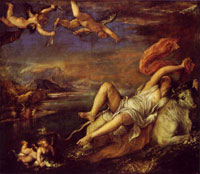
Titian, The Rape
of Europa
,1562

“Like all the best discoveries, transforming the leftover paper from [Swi:t] Home was a chance event. The ‘spinning’ of thread has allowed me to establish relationships with other female artists who have collaborated with me on this project. From the moment that I called my first collaborator a spinner, the die was cast: Las Hilanderas (The Spinners) by Velázquez started to wriggle in my head. I remembered my visits to the Museo del Prado to investigate all the meanings attached to the master’s brushstrokes. I know that my interpretation differs from that of the great scholars: to
me, the oldest woman in the group is Arachne. It may also be unorthodox to refer to Duchamp in relation to the tapestry representing Titian’s Rape of Europa (Fig. 4) in Velázquez’s painting. I am not measuring myself against Duchamp; I am simply outlining a possible dialogue through difference, one that, I think, Luce Irigaray might approve of. More important is the fact that I have been able to invite my mother to ‘spin.’ The thread has been an excuse to engage in talking again about how time goes by.”

And finally, the following is an excerpt of Rita Gonzales’ essay “How to Feed and Sustain a Fragment,” published in the 64pp. catalogue At the Curve of the World (Santa Monica: Smart Art Press, 1999) that accompanied the group show of the same name which took place at Track 16 Gallery, Santa Monica, September 11–November 6, 1999.


click to enlarge
Elena del Rivero
Elena del Rivero

Elena del Rivero
Elena del Rivero
© Elena del Rivero
&video artist Nacho Pereez.
All rights reserved.
Figures 5-9
Elena del Rivero,
still images from A Reading, 1998
Elena del Rivero
Figure 10
Elena del Rivero, Opening Tom
Patchett
, 1999
(Photo:Kyle Brooks)

To the show featuring works by woman artists Mariana Botey, E.V. Day and Diana Lopez, among others, Elena del Rivero contributed Echo of an Unfinished Letter, an intricate and layered record of the passage of time that takes the form of six hundred pages of musical notation paper imprinted with sound waves (the “echo”) produced by passing a needle and thread through paper. Visually stunning, Echo speaks – through its formal, emotional and performative power – of the hidden, devotional aspect of longing and creation.

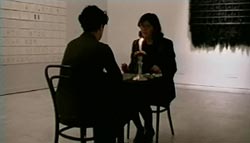
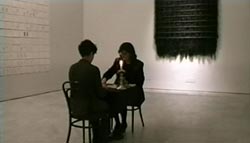
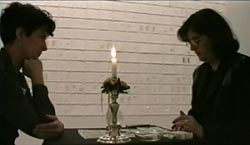
The accompanying pictures (Figs. 5-9) are film stills from A Reading, showing Elena del Rivero with her Tarot teacher, a performance that took place during her Unfinished Letter exhibition at the Reina Sofia Museum in Madrid, 1998. The last photo showing del Rivero with Man Ray’s chess board is called “Opening Tom Patchett” (Fig. 10). She explains [in an e-mail to Tout-Fait of 13 August 2001: “He is a collector from LA and I was having a show at his space Track 16 [see above] and stayed at his place. Going into his bedroom I saw the chessboard by Man Ray in the edition of 1943.

Rita Gonzales writes:

“Elena del Rivero’s work seeks correspondence with an invisible audience sometimes figured as an absent mother, lover, or friend, and in the case of her recent video installation A Reading with the infamous image of Marcel Duchamp playing chess with a young nude woman. According to accounts in Bonnie Clearwater’s West Coast Duchamp (2) , no individual party (including Duchamp himself) took credit for the staging of this event at his Pasadena Art Museum retrospective exhibition in 1963. Dickran Tashjian has revealed that the woman in question, Eve Babitz, was in fact the grandaughter of modernist composer Igor Stravinsky. Tashjian intuits that her naked presence may have brought to Duchamp’s mind (among other things) a historical moment of rupture at which he was present–the first performance of Stravinsky’s Rite of Spring before a decidedly disturbed audience. Unlike del Rivero, critics of Duchamp have tended to shy away from this image, perhaps imagining that the event was a cheap publicity ploy (even though Duchamp himself held a strong fondness for it).

In her discussion of the ‘en-gendering’ of Duchamp’s work, art historian Amelia Jones represents the Pasadena chess game as a moment of frustration for those who believe they know everything about Duchamp. In this closed circuit of frustrated narrative and through other moments in his public address and writings, Jones finds her Duchamp articulated through his contradictions and discursive elisions.

He is not ‘simply’ modern or postmodern, authoritative or anti-authoritative, regressive or progressive, masculine (virile, original subject) or feminine (seductive object), heterosexual (paternal and generative) or homosexual (coquettish camp idol), but particularly llustrates the contingency of each of these terms on its supposed opposite. (3)

“These contingencies are perhaps what drew del Rivero to the infamous image of seduction and sublimation. She, like Jones, searches for a throughway to access the document and to play out her own critique of the en-gendering of art production. While in Spain for art exhibition of her massive series Unfinished Letter (1998), del Rivero staged a private performance, the end result of which was A reading (1998):

‘I asked the museum director [at the Reina Sofia in Madrid] if I could have the rooms closed for two hours. I had previously asked my tarot reader, whom I had not seen for seven years, if she could come to the Reina, read the tarot for me there, and be recorded. She accepted. I had two camera-people ready on that day, a candle, and a glass ball. The cameramen thought it looked OK. I had fetched a small table and two simple chairs. They were placed in the middle of the room, very much after the Duchamp photo. The séance started. It was recorded in actual time. It lasted thirty-four minutes….’(4)

“The final edited version of the video intermixes elements from an audio art piece entitled String Quartet (1998-99), the sound of which was captured during the embroidery of the six hundred sheets that make up del Rivero’s series Unfinished Letter. As String Quartet blurs and obscures the revelations of that tarot reader, the enigmas of the artist are preserved, echoing with humor the staging of the Duchamp photograph. It is the very difference between tarot and the chess game that del Rivero uses to address the contradictions in the philosophies and oeuvre of Duchamp and their subsequent effect on the readings and inscriptions of his work. A Reading draws on the ambiguity of Duchamp’s notions of art production as they shifted between ‘mysticism and the games,’ a phrase drawn from Duchamp’s own contradictory statements about art production as being pure sensation to associating art with pure concept. ‘I do believe in the mediumistic role of the artist,” said Duchamp at a Philadelphia Museum College of Art panel in 1961. A Reading allows del Rivero to inhabit the photograph and disturb the sense of disclosure and culpability felt by those who approach both the historical document and her own serial work looking for confessions. As Maria-Josep Balsach has so eloquently said of del Rivero’s work: “Perhaps it is an inverted movement–or a projection–of what has been the innate objective of twentieth-century art: To dislodge utopia and ostentatiously occupy the essence of the confronting and self-confronting ego, arising from the most intimate, dark, abominable recesses.’(5)


Notes

Footnote Return 1.Through the attacks of September 11, 2001, the home/studio of Elena del Rivero and her partner Kyle Brooks was destroyed. Luckily, both were unharmed. With the apartment located on Cedar Street, in the immediate vicinity of what came to be known as Ground Zero, they lost most of their work and documents.

Footnote Return 2.Dickran Tashjian, “Nothing Left to Chance: Duchamp’s First Retrospective,” in West Coast Duchamp, ed. Bonnie Clearwater (Miami Beach: Grassfield Press, 1993) 61-83.

Footnote Return 3. Amelia Jones, Postmodernism and the En-Gendering of Marcel Duchamp (Cambridge:Cambridge University Press, 1994) 106.

Footnote Return 4.”Echo of an Unfinished Letter through a Reading of Tarot,” unpublished artist statement.

Footnote Return 5.Elena del Rivero: Cortas (Burgos, Spain: Espacio Caja de Burgos, 1997)7.

The Wicked and Unfaithful Song Of Marcel Duchamp To His Queen


click to enlarge

Figure 1
Marcel Duchamp, The Bride
Stripped Bare by Her
Bachelors, Even
, 1915-23

A weighted soul who believed in the purity and vitality of poetry,the poet Paul Carroll inherited from Dada and Surrealisman undisguised passion and iconoclasm.”The Wicked and Unfaithful Song of Marcel Duchamp to His Queen”of 1961 seems to resonate with a consequential reading of postmodern thought–“meaning” is literally a mere perception residing in the human mind … perhaps nothing more, and the presence of Duchamp’s posthumously revealed
Given: 1. The Waterfall, 2. The Illuminating Gas (1946-66),by musing on “Death” as “the only good joke.” In 1979, composer John Austin conducted a vocal piece based on the very same poem. Tout-Fait is delighted to present the juxtaposition of text, sound, and visual images
in order to induce an enchanted experience of various dimensions in simultaneity.

– Compiled by Ya Ling Chen


click to enlarge

Figure 2
Marcel Duchamp,Dust Breeding,1920,
from the Green Boxof 1934

Figure 3
Marcel Duchamp,Cemetery of Uniforms
and Liveries, No. 2
, 1914

Figure 4
Photograph of Duchamp’s studio,
1916-17

Figure 5
Photograph of
Duchamp’sUnhappy Readymade (1919) taken
by Jean Grotti or Suzanne Duchamp Grotti, 1920

A trifle pompously, your move, my love, among the mass of nerve- tissues in my cranium;and as you move you have become the last of my inconsequential ironies. At best,chess too just a question of pure chance.Films of dust girdle your body: for once

I shift you on the chess board, sweet, you will become a solution for which there never was a problem:that old itch for order which we like to hint exists in what we do. And yet, that blueprint I fashioned once for the motions of the body ended nice-ly in a cemetery

of empty uniforms: priest and bus-boy, butler, gendarme,undertaker, horseman—jointless.Art? A form of intimate hygiene for the ghosts we really are. More work, those wolftraps for the intellect (one must always work, sweet, to contradict one’s taste)— the hanger tack-

ed upright to the floor; that urinal I signed: R. Mutt; and that geometry textbook I tied to dangle in diagonal at a corner of my porch until, buffeted by raw winds, bleach—
ed by sun & sleets, it got the facts of life; or those glass discs twirling on the phonograph

to tease the ear and eye. How predictable poor Picabia became! And such a fool to bitch all day and thrash about and sob how slovenly God goes about his job. I’ll let you sit,
sweet, and move the Rook instead. Why not? Death is the only good joke.


A drawing by John Austin (1979)

The Wicked and Unfaithful Song Of Marcel Duchamp To His Queen(1979)


Composer:
John Austin
Performers:
Diane Ragains, Soprano
Robert Morgan, Oboe/English
Horn Michael Gamburg, Bassoon

NOTE: THE TEXT AND MUSIC OF “THE WICKED AND UNFAITHFUL SONG OF MARCEL DUCHAMP TO HIS QUEEN” ARE UNDER COPYRIGHT; DOWNLOADING OF THIS PERFORMANCE IS STRICTLY PROHIBITED.


* Special
thanks to Maryrose Carroll and Luke Carroll for authorizing Tout-Fait to publish this poem.

Figs.1-5
©2002 Succession Marcel Duchamp, ARS, N.Y./ADAGP, Paris.All rights reserved.

Nude Descending Again


click to enlarge
Rrose Sélavy
Figure 1
Marcel Duchamp, Rrose Sélavy,
photograph by Man Ray, 1921

Duchamp, the anti-artist, has always fascinated me to the point of envy. His irreverent behavior and ground-breaking ideas were so engaging that they force me to rethink my work and its purpose. His work is humorous to the passerby yet far more intelligent than any work of its time. The idea, rather than the product, was his focus. He was the greatest, laziest person ever.

Instead of creating a sculpture of a woman he became one (Rrose Sélavy). Instead of creating something that looked like a urinal he used an actual one. Instead of cleaning the dust off the glass he and Man Ray just took a photo of it.

I am a painter by training but I feel it takes too long to paint a good painting. So I began to experiment with my work by turning photography into painting. I feel as though I have found a new window of photography that has not been explored and treated as I have been doing. I have never seen results like that which I have been producing. I shoot in complete darkness with an open shutter and compose these paintings with light.

With this photograph, in particular, I wanted to recreate Duchamp’s famous yet “absurd” take off on Futurism and Cubism. This photograph and my work in general have received much of the same criticism that his painting did.

click images to enlarge

  • Nude Descending
  • Nude Descending Again
  • Figure 2
  • Figure 3
  • Marcel Duchamp,
    Nude Descending a Staircase,
    No. 2
    , 1912
  • William Richard Hundley,
    Nude Descending Again, 2001

This shot is one of 20 negatives attempting the Nude. I have plans to use all the images in one frame in the form of a lenticular (3-D) print. As the viewer walks across the frame the images shift from one to another.

I currently reside in Austin, TX and collaborate with a friend on more painting-based photographic work. Our recent body of work has taken influence from the paintings of Francis Bacon. We call ourselves the Industry of Light and our new body of work is titled “Innocent X.”

Please view it online at www.williamhundley.com

William Richard Hundley Industry of Light

Figs. 1, 2
©2002 Succession Marcel Duchamp, ARS, N.Y./ADAGP, Paris. All rights reserved.

Transformation and Tradition: Interview with Sanford Biggers

click images to enlarge

Four images from: Sanford Biggers, Duchamp in the Congo (Suburban Invasion), Performance 1999 Photo: Art Meyers

Dressed in a suit and tie, Sanford Biggers entered a Chicago diner teeming with businesspeople. Briefcases in hand, they exchanged small talk and serious nods. Biggers clung to his own briefcase while slowly taking a seat, alone, at the counter to order breakfast. At their tables, diners drank coffee and held open newspapers. But between crisp folds and shuffles of the news in front of them, they noticed a very different text at Biggers’ side. Biggers, perhaps unbeknownst to his audience, was performing Duchamp in the Congo (Suburban Invasion) , his latest performance. His “newspaper” was Hangman’s House , the first of two artworks created for the performance. Hangman’s House is an old, fraying hardcover book entitled Hangman’s House , through which Biggers drove nails and sharp objects to puncture the cover and pages inside.

Biggers, 31, is an artist who now resides in New York City after living in other American and international cities. In a rare confluence, he applies Dadaist techniques to reconsider objects of power, cultural signatures, and African traditions. To objects of contemporary familiarity, Biggers adds symbolic and traditional elements, some mundane and others seemingly misplaced, to forge postmodern tributes to the African roots of modernism.

As Biggers carried Hangman’s House while performing Duchamp in the Congo (Suburban Invasion), the only words legible were those of the book title. When he exhibits the book outside the context of his performance, he uses a bookstand which spreads the covers open to reveal the entire piece. The piece rests on a transparent surface and a mirror underneath the book reveals some cover text on the underside.

The second piece Biggers created for the performance shares the title of the performance, Duchamp in the Congo. A wheel sits on the inside of a block of wood, pushing through its surface. Leather straps, twine, rope, and various fibers tightly tie the wheel to the block of wood. This construction is Biggers’ briefcase– the wheel extends from the block to form a handle.


click to enlarge

Figure 1
Hangman’s HouseUnited States: New York:
Century, 1926 and United Kingdom: London:
Sampson Low, Marston, 1926)
The book, now out of print, is a story by
Donn Byrne about an Irish judge who sentences
several people to a hanging death and urges his
daughter against her will to marry a man who
becomes the target of an avenger. The story
was made into a movie directed by John Ford in 1928.

The form of Duchamp in the Congo draws on traditional African rituals, specifically those involving the captivity of spirits and their power ( minkisi ) into objects. Nail figures (or nkisi n’kondi), were traditionally carved by indigenous people within the Congo in the late 19th and early 20th centuries and symbolize a ritual of collective oath-taking in which participants drive nails or sharp iron pegs into an object of power to symbolize their agreement and compliance with community codes, customs, and mores. Each stake remains where driven, and each individual’s penetration into the object qualifies their commitment while further activating the power of the figure to guard and secure the community.

To frame his performance, Biggers imagined what Marcel Duchamp would have created having traveled to the Democratic Republic of the Congo. He depicts a fictitious trip that Duchamp took to study African works of art and then create an nkisi-influenced or nail-inundated wheel.

Biggers explained that after he created the two pieces for Duchamp in the Congo (Suburban Invasion) , the next step was his execution of a ritual. He chose to perform a present-day activity to echo traditional rituals of collective oath-taking: dressed as a businessman he enacted a typical commute to work, and displayed Duchamp in the Congo and Hangman’s House by carrying the two through the streets of Chicago during rush hour.

For a commuting suburban audience, Biggers clings to his own spiky “briefcase” while reading Hangman’s House, with its sprouting nails, as his newspaper. Carrying his artworks as he would everyday objects in familiar ways down busy streets, he reads his paper as if curious to learn something new. By imitating the form of a daily trip to work while contradicting it with the content of the objects he holds, he draws his audience directly to his art. Biggers challenges commuters to glance beyond their everyday concerns and the certainty of their paths to examine the symbols of the collective oath they take to perceive, inquire, and behave as they do everyday.

Beyond a Dadaist appeal to more closely examine commonly perceived truths, Duchamp in the Congo (Suburban Invasion) revives other salient themes introduced by modernists in the early and mid nineteenth century. By performing during rush hour, Biggers blurs the boundaries between art and everyday life and engages the public in a live dialogue. By adopting African rituals, he makes the inspiration of non-industrialized, non-Western cultures and values on modernism explicit. He revisits a time when artists typically looked at traditions from Africa, Asia, and the pre-Columbian Americas to define modernism and he continues in the current era where they left off. Each piece made for the performance is a retrospective of modern art from the post-modern perspective. The wheel included in Duchamp in the Congo serves as a reference to Duchamp’s Bicycle Wheel (Fig. 2).

click images to enlarge

  • Figure 2
    The Bicycle Wheel, 1913, is Duchamp’s first “Readymade”
    While it has been “lost,” scholars have found at least 5
    photos of it in his New York studio. The irregular leg
    positions of the stools and the tilt of the wheel and
    fork were never (one could argue) in equilibrium. In fact,
    Duchamp would have had to glue the stools into their
    irregular shapes, and tie string to support the five
    bicycle wheels and stools, in order to permit
    them even to stand, let alone spin.
  • Figure 3
    Nkisi n’kondi, 19th century

As Biggers explained it to me, “before a ceremony, ritual or some celebratory act that the whole community is involved in, people walk by the sculpture or image and pound nails, shards of glass, and sharp or reflective objects into the piece. The piece becomes a power object not only by the veneration that this group of people put on the piece, but the physical activity of pounding and hammering into the piece. Later, the piece itself acts almost as a type of scarecrow to ward off enemies, evil spirits and others who may harm the group. So in the case of the Hangman’s House, I used that as an aesthetic metaphor for banishing the history of America, being the Hangman’s House, the house of so much lynching. In terms of Duchamp in the Congo , I was using the nails to go against the notion of modernism and primitivism, so in this case instead of warding off physical spirits or enemies, there is a warding off in the psychological or philosophical sense of erroneous notions and traces of modernism, primitivism, and post-modernism.”

In the photographs of Biggers on a train during the performance, people look at him inquisitively. He recalls standing on a corner in downtown Chicago where another man behind him, briefcase and newspaper in hand, gives him incredulous looks as if to confront him. But this type of response reveals the larger confrontation at work by Biggers. As he elaborated, “I follow the idea of keeping the form as one of the most important elements but also feel strongly about challenging prescribed notions in art theory. The fact that I am the creator or author of these pieces also adds to how these pieces are interpreted by art theory. In that respect, I think it follows that Duchamp’s Dada approach is to juxtapose objects and concepts with the norm.”


click to enlarge

Figure 4
Mandala of the B-Bodhisattva II
Sanford Biggers and David Ellis, 2000

Figure 5
Mandala of the B-Bodhisattva I
Sanford Biggers, 1999

Figure 6
Disks Bearing Spirals
Marcel Duchamp, 1923

Biggers collaborated with another artist, David Ellis, for a break dancing mat project, Mandala of the B-Bodhisattva II , 2000. Ellis focused on preserving the idea of Duchamp’s Rotoreliefs of 1935, six double-sided optical disks made after prior experiments with optics such as Disks Bearing Spirals of 1923 or Rotary Demisphere (Precision Optics) of 1925. Each one of the Rotoreliefs bears a spiral, eccentric-circle, or similar design. When placed on a record player or other spinning circle, the Rotoreliefs create an optical illusion of depth, intensified when looking with one eye rather than two. I asked Biggers about connections between the mats and the Dadaist celebration of mechanical methods apparent in the Rotoreliefs.

Biggers replied, “my approach had to do more with the Mandala, so there was an overlap there in terms of the circle-based art form, but for me the Rotorelief was not used as literally as in Ellis’ work. However, the motive was to use the concept on a more geometrical level with the juxtaposition of circles as well as other geometries to create the illusion of movement. To enhance this effect, the dancers create the movement as opposed to a turntable’s rotation.”

He continues, “One reason we worked on this project was my fascination with the Mandala and Ellis’ fascination with the Rotorelief for shared conceptual and aesthetic reasons. We have both been DJs and are deeply into preserving hip hop culture. For us it was the idea of spinning and turning more importantly than the Mandala or the Rotorelief, but these were ways for us to deal with the idea of the spin–the backspin, the spin of a skateboard wheel, or the spin of the turntable–and finding a graphic representation of that idea. The spin is also important in that it goes back to several traditions–whirling dervishes and other dancers going into trance, in Yoruba and Vodoun ceremonies. This reminds me of an interesting fact about the Mandala–sometimes monks don’t actually draw or depict the Mandala, but they remember the patterns and then dance and jump in circles to form it with their own motions. We know the trace and graphic depiction of the Mandala and the Rotorelief, but I thought it was interesting to explore how to experience or create the sense of movement as the actual depiction.”

click images to enlarge

Rotary Demisphere (Precision Optics)
Marcel Duchamp, 1925

Biggers recommends They Came Before Columbus for this issue’s Bookstore section. Upon hearing this suggestion, I mention a review of the PS1 show at New York City’s Clocktower Gallery last year. One of the artists, David Godbold, did a cynical piece about the Mayflower, using a comic-like motif against a traditional piece. His installation, entitled America[s] Disclosed 2000 , is a wall painting that presents the initial discovery of America by the Europeans as erroneous. Biggers comments that Godbold’s piece “looks at colonialism, dispelling the belief of Manifest destiny, the grand romanticism of colonialism and the current reality of post-colonialism both here in America and Cuba as well as the relationships between sovereign and colonial nations and the people that they colonize. My work touches on the colonial and post-colonial history of the African Diaspora, however, I use Africa more as a metaphor for African America, and not the other way around. It also relates to what we mentioned of art theory and that being a type of colonial mentality.”

For my last question, I inquire about any connections between Duchamp’s concept of a ready-made item and items found in Biggers’ work. I wondered specifically about Biggers’ appropriation of objects to explore issues of class and race. Biggers replies that although he was trained as a painter, he began to take more interest in making three-dimensional objects. He describes that one of the things drawing him to this decision was the realization that objects found on the street, often marked by a particular type of use and treatment and grouped with other objects, often already said what he intended to create. “It isn’t about depicting–it’s about seeing authenticity right in front of you.” Biggers elaborates,”‘Use patina,’ the way the paint falls off, the way a chair is rubbed on the arms because someone kept sitting in the chair in the same way over time, molding the chair itself– it serves as a quiet tribute to history. Different areas where I would find materials, like a poor neighborhood in Baltimore versus an upper class neighborhood in Japan, said different things. I started to find out what areas had different items to collect. I could find a piano for example, in one part of town, where somebody might just throw that kind of thing out. A physical mapping of various cities began to emerge based on the artifacts I found in certain neighborhoods. I have used this approach in several countries and it gave me an “in” to the social geography of any given region. I was originally drawn to objects that were used by individuals and later become interested in mass produced materials that were used by many people. For example, the color tiles that are used in the Mandalas are the same tiles used on the subway and bus floor of Brooklyn, Harlem, and most of Inner-City U.S.A.”

In his work, Biggers provides us with the synthesis of the mundane and the extraordinary, historical testimony and present-day realism, tradition and transformation.

click images to enlarge


Sanford Biggers, Hangman’s
House
, 1999

Fig(s). 2, 6, 7
©2005 Succession Marcel Duchamp, ARS, N.Y./ADAGP, Paris. All rights reserved.