image_pdfimage_print

All posts by robert

Femalic Molds

“I believe very much in eroticism (…) It replaces, if you will, what other schools of literature call Symbolism, Romanticism…”
Marcel Duchamp

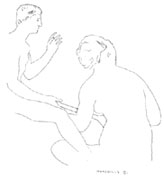
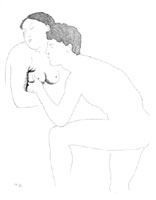
SSome months before his death, Duchamp produced a series of nine etchings dedicated to the theme of Lovers (Figs. 1 and 2) Aside from their erotic content, these nine etchings are alike in that they mark a return to “figurative” art, they are directly linked to Étant Donnés(through at least one among them, Le Bec Auer), and finally, they are copies in the style of older masters.

click on images to enlarge

  • Marcel Duchamp
Selected Details after Courbet
    Figure 1
    Marcel Duchamp
    Selected Details after Courbet, 1968.
  • Marcel Duchamp
Selected Details after Ingres I,
    Figure 2
    Marcel Duchamp
    Selected Details after Ingres I, 1968.


click to enlarge

The Torture Garden
Figure 3
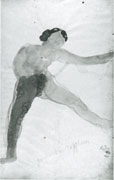
Auguste RodinDrawing for
The Torture Garden
, 1899.

The chosen models, Cranach, Ingres, Courbet, Rodin, are clearly artists to whom women and eroticism, as with Duchamp, played an crucial, if not determinant, role. A singular, intoxicating, cerebral eroticism, at times obsessive. To treat only the example of Rodin, it could be said that many of his sculptures–particularly Iris, Messenger of the Gods–are built around female genitals, or are sculptures of female genitals, just as ÉtantDonnés, with its perspectivist game and its illumination, is organized entirely around the genitals of a supine woman. What is more, in consulting certain Rodin drawings, one cannot help but notice their direct resemblance to the preparatory drawing of the Étant Donnés nude. Another pertinent example is drawing MR 5714 from the illustrations for Pierre Louÿs’ Bilitis or, more precisely still, drawing MR 4967 from the illustrations for Octave Mirbeau’s The Torture Garden (Fig. 3). Of the same illustrations, the drawings of these various titles merit further mention: “Buisson ardent,” “Flamme,” “Feu follet” (MR 4034)…
tranger still is the case of Courbet. The engraving is a “selected detail,” done in the style ofWoman with White Stockings, which now belongs to the Barnes Foundation in Merion/Pennsylvania. Duchamp, playing on words, adds a faucon (1)to it to trick us, his frustrated viewers, in keeping with Apollinaire’s address to the absent Lou:
Il me faudrait un petit noc
Car j’ai faim d’amour comme un ogre
Et je ne trouve qu’un faucon.
(2)

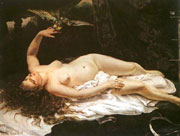
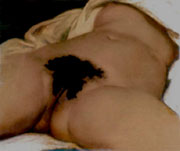
Arturo Schwartz is equally justified in directly relating this engraving to the highly provocative pose of the Étant Donnés nude. Guided by this interpretation, we should not hesitate to see in Étant Donnés a “collage” of two references drawn from two of Courbet’s works (Fig. 4) – just as the etching Selected Details after Ingres, # 1, is a combination of references drawn from two Ingres paintings. For one thing, the raised pose of the left arm recalls that of Woman Holding a Parrot (Fig. 5), a painting Duchamp could not have missed seeing in New York at the Metropolitan Museum. In addition and more importantly, the overall position of the body, the spread legs, cropped and separated from the head-the sort we tend to see, like pornographic graffiti, as sexual symbols, merely genitals and breasts, all the more provocative because they are anonymous-recall very distinctly the Courbet painting entitled The Origin of the World (Fig. 6).

click on images to enlarge

  • Marcel Duchamp
Selected Details after Ingres, II
  • Woman Holding a Parrot
  • The Origin of the World
  • Figure 4
  • Figure 5
  • Figure 6
  • Marcel Duchamp
    Selected Details after Ingres, II, 1968.
  • Gustave Courbet
    Woman Holding a Parrot, 1866.
  • Gustave Courbet
    The Origin of the World, 1866.

It is possible here that Duchamp mocks Courbet’s penchant for painting feathers, hair, and fleece, both by the wig that he had wanted “from a dirty blond” (3) and by the hairless genitals. One may wonder why Duchamp, at the end of his life, felt the need to pay this sort of homage, albeit ironically,
to the “retinal” painter par excellance, and who, it is said, was no great intellect, and could be included in the category of painters who were paragons of the stupidity that Duchamp shunned.

Courbet gave many definitions to realism in art, such as “What my eyes see.” Particularly relevant here is this declaration that confines painting to the domain of visible things: “Anabstract, invisible object is not painting’s domain.” (from an 1861 letter) As it happens, precisely what Duchamp, from his youth, had endeavored to do was to turn away from such naturalism, leading the way toward what he once called “metarealism.(4)

The Large Glass, which for many years had been his attempt to attain this “metarealism,” to portray this “abstract, invisible object,” is the appearance in a three-dimensional world of a nude young woman belonging to the four-dimensional realm…


Étant Donnés, with the weighty signification of a geometry problem, seems ironically to lead us to the solid ground of visible reality.


It unfolds before the eye-or rather before both eyes – in the depth of the three-dimensional space that the realist Courbet was satisfied to offer on the two-dimensional surface of a canvas. Realism pushed to the limit? Realism pushed to the absurd? And does the assemblage in Philadelphia herald, finally, as other aspects of the work heralded Pop Art or conceptual Art, the hyperrealist sculpture of a De Andrea or a Duane Hanson? It is something else altogether. These visible things (resorting to the Courbetian designation of “What my eyes see”) are affected by an additional, heightened visibility. The light is bit too intense, the flesh a bit too grainy.(5)

And this hint of abberation calls the “réalisme” of the entire scene into question.


The Bride is certainly there, surrounded by mechanisms now made visible. Finally, the appearance of what, in the Glass, remained hidden: the waterfall and the illuminating gas. She, herself, remains, with a sudden and strange reversal in appearance, something like the finger of a glove turned inside-out. In the Glass, she appears disembowelled, a mass of indistinct organs, an inside without an outside, entrails without skin-she conforms in this way to what theoreticians of the fourth dimension-Poincaré and Pawlowski-imagine in terms of the way our bodies would be seen by four-dimensional observers. On the other hand, in Étant Donnés, she appears as an exterior without an interior, an empty carcass, a hollow mold, a shell, an illusion.
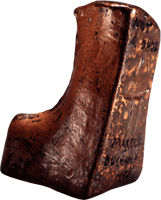
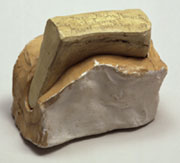
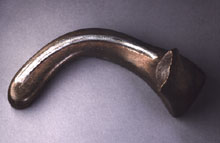
Is this to say that she lacks insides? No, they exist. She has organs, organs that mark her as a sexual being: these are the four erotic sculptures, from Not a Shoe (Fig. 7) to Wedge of Chastity, which preceded her development, and which are, literally, the contents that correspond to her void (Fig. 8).
click on images to enlarge

  • 
Not a Shoe
    Figure 7
    Marcel Duchamp
    Not a Shoe, 1950.
  • 
Wedge of Chastity
    Figure 8
    MarcelDuchamp
    Wedge of Chastity, 1954.

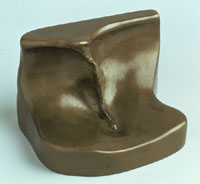
If the Female Fig Leaf (Fig. 9) is, as the evidence indicates, the imprint of a female groin, it is easy enough to imagine that Not a Shoe is a more limited but deeper imprint, literally stated, the impression of a vulva. And Dart-Object (Fig. 10), far from being a phallic extravagance, as Arturo Schwarz suggests, is an impression still more limited, intimate, and profound, of a decidedly feminine organ. (6)

click on images to enlarge

  • 
Female Fig Leaf
    Figure 9
    Marcel Duchamp
    Female Fig Leaf, 1950.
  • 
Dart-Object
    Figure 10
    Marcel Duchamp
    Dart-Object, 1951.

There is a play here on the masculinity and the femininity of the mold: if the Malic Molds contained in their void the full form of the Bachelors, these molds that could be called “femalic,” embody in full the hollowed out forms of the Bride’s organs (7)


But still further: what is suggested is the reversibility of these organs. Dart-Object has an effectively phallic appearance, and its title adds to this evidence the aggressive behavior attributed to the male. Inversely, Female Fig Leaf, a blunt and massive object, photographed under a sort of illuminating gas that reverses values, turns the concave into the convex, becomes, like on the cover of Surréalisme, meme #1, a female figure imprinted with a strong, unusual “sex appeal.”

The psychoanalyst, of course, has not failed to take an interest in this reversability of organs, the structure of a glove finger turned inside-out, that connotes sexuality. Sandor Ferenczi, in particular, in establishing his famous onto-and-phylogenetic parallel, had long meditated on the fact that the penis and vagina are a single organ, one and the same – a fanciful organ, a Mélusinian organ, developed here on the inside and there on the exterior, according to the needs of the species. (8)We will come back to this.

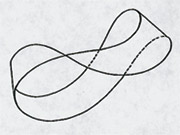
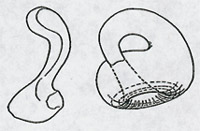
But let us go on further or rather elsewhere: into geometry. At the turn of the century, the principal studies on topology (analysis situs) began. Mathematicians then concentrated on such strange objects as the Mobius Strip and the Klein Bottle (Fig. 11). Let’s also examine them. The strange particularities of the first are well-known. Take a strip of paper. It has two dimensions. Connect it by its shorter ends: you will get a ring with two surfaces, one internal and one external, and two sides. But if, instead of directly linking these two sides, you twist the strip before connecting it, you obtain a strange object that has no more than one surface and one side: paradoxical volume, unisurficial and unilateral (Fig. 12). Imagine, in a sort of Flatland à la Abott, a flat, two-dimensional being walking along this Mobius Strip: at no time would he be conscious of the third dimension that the torsion of the strip allowed him to cross (Fig. 13). Consequently, his consciousness could never grasp the exact form of this mathematical object.

click on images to enlarge

  • Mobius Strip
    Figure 11
    Mobius Strip
  •  Klein Bottle
    Figure 12-13
    Drawings of a Klein Bottle

Let us move on to the Klein Bottle. Broadly stated, it can be said that it is to the three dimensional world what the Mobius Strip is to the flat realm. Take up the same piece of paper, connecting it this time by its longer ends, as if you were rolling cigarette paper. You get a tube. Connect the two ends of this tube: you get a torus. Just as in the preceding example, it has two surfaces, one internal surface and one external surface, one outside and one within. But if, once again, before making the connection, you twist the tube, in an analogous twist to the one that brought the strip into the third dimension, this time crossing the fourth dimension, you get a paradoxical, unisurficial, and unilateral volume, possessing neither an inside nor an outside. As three-dimensional individuals, we are incapable of precisely conceiving the reality of such a volume. Only one “indigenous to the fourth dimension,” to borrow the words of Duchamp himself in À l’infinitif, could grasp the torsion that creates such a volume that no longer has an outside nor an inside, and that makes of a solid mass a curious entity in which the notions of interior and exterior, of surface and depth, are annulled or exchanged.


Let us look at Dart-Object: this pseudo-phallic tube curves and bends in a curious way; if you mentally extend its inflection up to the point of the root or stalk it issues from, you get a volume strangely similar to a Klein Bottle.
 (9)

Can we be accused of over-interpretation? Recall these facts: on the Glass, the Bride, a three-dimensional projection of a four-dimensional entity, presents herself as a mass of organs without a surface, a sort of inside without an outside. In Étant Donnés, by contrast, she is a shell without an interior, an outside without an inside. Recall also this note from theGreen Box: “The interior and exterior (in a fourth dimension) can receive a similar identification.(10)” Recall finally that topology was developing at the beginning of the century, at the very time that Duchamp read Henri Poincaré
and became interested in Riemannian geometry… There is further evidence of his ceaseless fascination with topology: when he met François Le Lionnais in the early 1960s, the first questions he asked of him concerned the Mobius Strip and the Klein Bottle.
(11)

What is more, Dart-Object suggests something else: the genitals, seen as truncated, like the division of the being from itself-like something is missing-is not merely the effect of three-dimensional space. That we are sometimes allocated a vagina-and that designates a “woman”-virgin, bride, etc.-and sometimes a penis-and that indicates a “man”-bachelor, groom, etc.-this chance physiological event was never anything more than the effect of an assuredly ironic causality: the laws of Euclidian geometry. In a four-dimensional study-the place of erotic fulfillment, according to Duchamp-in keeping with an anamorphic illusion, vagina and penis would lose all distinctive character. It is the same object that we would sometimes see as “male” and sometimes as “female,” in this perfect mirrorical return of the body that presupposes, because it takes place, the existence of a fourth dimension.


click to enlarge
Aprons
Figure 14
Marcel Duchamp Couple of Laundress’
Aprons,
1959.

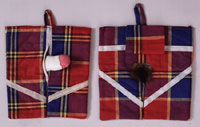
Schwarz is therefore right, in a sense, to insist on hermaphroditism as an essential theme in Duchamp’s oeuvre. But he is wrong to look for an explanation in Jungian archetypes and primitive religions. The model comes from Non-Euclidean geometry and the issues raised around 1900 by analysis situs. Transexuality, with Duchamp-his play on the transvestite, which goes from Rrose Sélavy to (in a more minor but also significant way)Couple of Laundress’s Aprons of 1959 (Fig. 14) (mittens that can reverse gender like the finger of a glove)-is a kind of naïve ontological experience of a mathematical ideal that abolishes sexual differentiation.
To those who wish to pursue this further, one will recall the analyses marked out by Jacques Lacan in his Séminaire concerning “la schize du sujet,” “l’optique des aveugles,” and “phallus dans le tableau (12)

Going back to the phenomenological studies of Merleau-Ponty in Le Visible et l’Invisible, he recalls that “ce qui nous fait conscience nous institue du meme coup comme Speculum mundi” and he develops these lines, in which one cannot help but see the emerging shadow of Étant Donnés: “Le spectacle du monde, en ce sens, nous apparaît comme omnivoyeur. C’est bien là le fantasme que nous trouvons dans la perspective platonicienne, d’une être absolu à qui est transférée la qualité de l’omnivoyant. Au niveau même de l’expérience phénoménale de la contemplation, ce côté omnivoyeur se pointe dans la satisfaction d’une femme à se savoir regardée, à condition qu’on ne le lui montre pas.” (13)

Such is this perfect circularity of glance that transforms the voyeur into the seen object and makes the voyeur of the seen object, that makes prey of the hunter and catches the hunter in a snare, traps
him in the spokes of an open eye. (14) A reversal like the glove of a finger in which the consciousness, Lacan says once more, this time citing a poet more than a bit close to Duchamp, “dans son illusion de se voir se voir (15), trouve son fondement dans la structure retournee du regard.(16)


Notes

Footnote Return1. Translator’s Note: this is an untranslatable play on words that hinges on the homophonic double meaning of “faucon” (falcon) and “faux con” (false cunt). For further discussion of this pun, see Craig Adcock’s “Falcon” or “Perroquet”? in http://www.toutfait.com/duchamp.jsp?postid=773&keyword=

Footnote Return2.Poèmes à Lou, “A mon tiercelet,” LXI.

Footnote Return3.Unpublished note from the assembly notebook for Étant donnés,
“Approximation démontable…”

Footnote Return4.In a letter to Louise and Walter Arensburg dated July 22, 1951 Naumann, Francis M. and Hector Obalk Ludion, eds. Affectionately,Marcel (Ghent-Amsterdam: Ludion Press, 2000) 302-303..

Footnote Return5.It is known that she is made from a pig skin.

Footnote Return6.My gratitude goes to Pontus Hulten for having led me toward this interpretation.

Footnote Return7. Let us remember here this note from À l’infinitif: “By mold is meant: from the point of view of form and color, the negative (photographic); from the point of view of mass, a plane (generating the object’s form by means of elementary parallelism).”Sanouillet, Michel and Elmer Peterson, eds. The Writings of MarcelDuchamp (New York: Da Capo Press, 1973) 85.

Footnote Return8. In Thalassa, Psychanalyse des origines de
la vie sexuelle
, 1928.

Footnote Return9. My gratitude, here, to Jacqueline Pierre, biologist,
and to Alain Montesse, mathematician, for providing this interpretation.

Footnote Return10. Sanouillet, Michel and Elmer Peterson, eds. The Writings of Marcel Duchamp (New York: Da Capo Press, 1973) 29.

Footnote Return11.Account given by François Le Lionnais, October 1976.

Footnote Return12.In Les Quatre Concepts fondamenteux de la psychanalyse (Paris,1973) 65-84.

Footnote Return13.Op. cit., “La schize de l’œil et du regard,” p.71.

Footnote Return14. Connecting Étant donnés to the myth of Artemis
and Actaeon, Octavio Paz is close to this interpretation.

Footnote Return15. Paul Valéry, La Jeune Parque.

Footnote Return16.Lacan, op. cit., “L’anamorphose,” p. 78.


Figs. 1, 2, 4, 7-10, 14 ©2003 Succession Marcel Duchamp, ARS, N.Y./ADAGP, Paris. All rights reserved.


Rotorelief Interactief

A Laboratory for Exploring Marcel Duchamp’s Optical Works
Created by Stephen Lewis, Architectronics, Inc.
Java coding by Carl Muckenhoupt.


click to enlarge
Rotoreliefs
Figure 1
Marcel Duchamp, Rotoreliefs
(1 of 12), 1935
Rotoreliefs
Figure
Marcel Duchamp, Rotoreliefs
(1 of 12), 1935

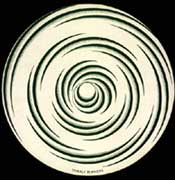
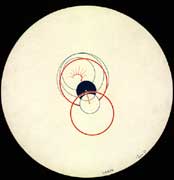
This project provides an active virtual laboratory for the exploration of the optical ideas and works of Marcel Duchamp. Duchamp’s Rotoreliefs (Fig. 1 and 2) are painted disks which were meant to be displayed while rotating, generating the illusion of three-dimensional dynamic objects. Art is exhaustively described, critiqued and reproduced, but rarely is a viewer given the chance to “become” the artist. The Rotorelief Interactief project attempts to provide viewers with the tools to experiment with the same ideas which Duchamp worked with in the Rotoreliefs.

In Rotorelief Interactief, viewers can design, place and modify objects on a rotating turntable. Two versions have been created in Java, best viewed using Internet Explorer on a PC. Click on these links to run the programs:

http://www.elasticmind.com/arch/roto/

This version provides tools which constrain the activities only to those which Duchamp had the ability to control–colored objects drawn upon a colored circular field whose speed of revolution can be adjusted.

http://www.elasticmind.com/ElasticMind/Roto/rotorelief.php

This second version implements an extension of the original idea where objects “painted” on the turntable can be given individual movements and characteristics which physical painted disks could not permit. This second version envisions a laboratory for the development of Duchamp’s ideas making use of the virtual digital medium. In this version, it’s possible to create and email a Rotorelief Interactief composition. The www.elasticmind.com website, created by Architectronics, Inc., hosts a number of customizable and emailable activities.

This is a work in progress. The interface is experimental; the code may be a bit buggy, and the documentation is not adequate. Architectronics, Inc. invites collaborators who might want to work to develop this into a robust online activity, CD or kiosk project. In addition to the Rotorelief Interactief software laboratory for viewer experimentation, the project might include onscreen replicas of Duchamp’s Rotoreliefs so that viewers could see these objects as they might appear spinning on a turntable. These artworks are rarely seen in this fashion, as they were meant to be viewed. A CD version might also include physical replicas of the artworks and a spinning mechanism to view them in motion. An accompanying text from a Duchamp scholar might be appropriate. The project can be hosted from an Internet location, a CD, or a site installation

Figs. 1,2
©2003 Succession Marcel Duchamp, ARS, N.Y./ADAGP, Paris. All rights reserved.

Flag of Ecstasy


click to enlarge
Charles Henry
Ford
Photograph
of Charles Henry
Ford by Penny Arcade,
early 1990s

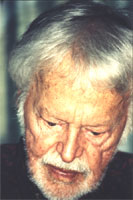
Charles Henri Ford (1913-2002) was a 20th century Renaissance man, admired for his literary criticism, editing and publishing, poetry, photography, film making, and visual art. “Flag of Ecstasy”, written for Duchamp, was the title poem of his 1972 poetry collection for Black Sparrow Press.

Ford was at the epicenter of the art world co-authored and influenced by Duchamp. Nurtured and encouraged from a young age by the likes of Ezra Pound, Gertrude Stein and William Carlos Williams, Charles’s contemporaries and collaborators later included Djuna Barnes, Parker Tyler, Pavel Tchelitchew, Man Ray, Peggy Guggenheim, Andre Breton, Cecil Beaton, Salvadore Dali, Jean Cocteau, William Burroughs, Ned Rorem, Joseph Cornell… the list goes on.

Charles did not consent to recite his poetry often. This recording (2000) is one of the few that exist. When Charles agreed to record, I asked him to include “Flag of Ecstasy” because of my personal interest in Duchamp. I was fascinated by Charles’s words written specifically for the amusement of Duchamp, whom Charles greatly admired. At 92, his speech in the recording is slightly slurred, but his voice carries the dignity and depth that characterize all of his work, regardless of medium.

The music behind Charles’s recitation is an atonal soundscape, my impressionistic reaction to the poem. There is nothing “Duchampian” in the logic or construction of this piece; it is simply a contemporary reaction to Duchamp as an individual (Charles’s poem) accompanied by my abstract composition, which is designed to provoke but not distract the listener from the poem. To collaborate with Charles, a genuine living Surrealist, was an honor and a thrill indeed.


click to enlarge
Flag of Ecstasy
Charles Henri Ford,
“Flag of Ecstasy,”
published in View, vol.
5, no. 1 (March
1945), p. 4

FLAG OF ECSTASY
(For Marcel Duchamp)
by Charles Henri Ford

Over the towers of autoerotic honey
Over the dungeons of homicidal drives

Over the pleasures of invading sleep
Over the sorrows of invading a woman

Over the voix celeste
Over vomito negro

Over the unendurable sensation of madness
Over the insatiable sense of sin

Over the spirit of uprisings
Over the bodies of tragediennes

Over tarantism: “melancholy stupor and an uncontrollable desire to dance”
Over all

Over ambivalent virginity
Over unfathomable succubi

Over the tormentors of Negresses
Over openhearted sans-culottes

Over a stactometer for the tears of France
Over unmanageable hermaphrodites

Over the rattlesnake sexlessness of art lovers
Over the shithouse enigmas of art haters

Over the sun’s lascivious serum
Over the sewage of the moon

Over the saints of debauchery
Over criminals made of gold

Over the princes of delirium
Over the paupers of peace

Over signs foretelling the end of the world
Over signs foretelling the beginning of a world

Like one of those tender strips of flesh
On either side of the vertebral column

Marcel, wave!

download QuickTime Player

“Flag of Ecstasy”
Poem written and read by Charles Henri Ford; music by Chris Rael,
2000

Postcard and Duchamp

I.


click to enlarge
Duchamp’s postcard
to Katherine Dreier
Figure 1
Front view of
Duchamp’s postcard
to Katherine Dreier, 1933

There is a Tout-Fait article, dated May 2000 by Hans de Wolf. He thinks Duchamp appears in a postcard sent from Duchamp to Katherine Dreier (Fig. 1). There are 2 men behind the Duchamp figure that look an awful lot like Man Ray and Andre Breton. At least in my opinion. Could this be possible?

II.

I was deeply saddened by the news of Prof. Goulds death. I consider him one of my favorite authors. I didn’t always completely understand him, but I always enjoyed his sense of humor and his constant quest to understand the universe.

I was pleasantly surprised to see that he and Dr. Shearer have been analyzing my favorite artist, Marcel Duchamp. His “Readymades” finally made sense. I had previously thought of these items as his most boring work, but now they are my favorite.

Incidentally, Austrian violinist Fritz Kriesler deceived his fans by performing “Recently Found” compositions of famous 17th and 18th century composers, which he had in fact wrote himself, but in their style. He admitted his deception and probably did it out of a sense of modesty, rather than trying to change the ideas of what is and is not music.

c’est la vie,
Keith Sacra

Minerva, Arachne and Marcel

Historians of art like to believe that they can solve the riddles of interpretation posed by masterpieces of old painting. Firm in the conviction that a great painting is endowed by its creator with a unique, unambiguous message, we struggle to recover that meaning through the use of textual and visual evidence. And, up to a point, the historical method can recover the forgotten aspects of works of art created centuries ago.

Las Hilanderas is proof of this assertion; for over two centuries, the subject was mistakenly identified as a view of women at work in a tapestry factory. Velazquez had painted the picture around 1658, for a friend named Pedro de Arce, a funcionario in the royal palace. By the early eighteenth century, the picture was believed to represent a scene from everyday life, “mugeres que trabajan en tapizeria.” With this description it is listed in the inventory of Luis de la Cerda, IX Duke of Medinaceli, who in 1711 surrendered it to the royal collection. By the end of the century, this interpretation of the subject had metamorphosed into an incontrovertible fact, as demonstrated by entries in the royal inventories, where it is called by the enduringly popular title, “Las Hilanderas“.

It was only in the twentieth century that the original and accurate identification of the subject began to be recovered, a process that required forty-five years to unfold. In 1903, the English critic C.R. Ricketts observed that the composition depicted on the tapestry hung on the rear wall was a partial copy of Titian’s Rape of Europa, now in the Isabella Stewart Gardner Museum, Boston, but formerly owned by Velazquez’ patron, Philip IV. (It had been acquired for the Spanish royal collection by Philip II.) Some years later, in 1940, Enriqueta Harris, the great English velazquista, identified the helmeted figure in the background as Minerva, who was gesturing toward Arachne. However, Harris believed that these two mythological figures were woven into the tapestry, a misapprehension corrected in 1948 by the American scholar Elizabeth DuGue Trapier, who pointed out that all the figures in the small background space were standing in front of the wall hanging. As it happened, 1948 was the culminating year in the recovery of the original subject. Maria Luisa Caturla, the renowned archival researcher, published an inventory of the original owner, Pedro de Arce, which was dated 1664. In this inventory, the title of the painting is listed as the “fabula de aragne.” Articles by Diego Angulo Iniguez (1948) and Charles de Tolnay (1949) definitively confirmed the identification of the subject as an illustration (a highly-original illustration) of a passage from Book VI of Ovid’s Metamorphoses. According to this venerable literary source, Arachne was a Lydian weaver who claimed that her skill exceeded that of Minerva. She was punished for her pride by being converted by Minerva into a spider, the scene that is about to occur in the background of Velazquez’ painting.

Far from ending discussion of the painting, the retrieval of the subject opened a new chapter in the historiography of Las Hilanderas. Velazquez’ composition is highly allusive and ambiguous. By virtue of his original conception of the antique text, the artist raises questions which both demand and frustrate attempts to answer them. Who are the women in the foreground? Who are the elegantly-dressed females who accompany Minerva and Arachne? Why did Velazquez reverse the logic of the composition, placing the climactic moment of the story in the distance instead of in the foreground? And what is the purpose of the quotation from Titian’s Rape of Europa? By a cruel paradox, the correct identification of the subject only obfuscated the significance of this masterpiece.

It would be tedious to review and analyze in detail the myriad of intepretations that have been inflicted on Las Hilanderas over the last six decades. One proposes that the painting is a political allegory, another that it symbolizes the virtue of prudence, another that it is Velazquez’ claim that painting is a liberal art not a manual craft and that he, therefore, is entitled to noble status. Although they differ one from another, these interpretations do share a common trait. Their authors assert with the absolute conviction, on the basis of the assembled evidence, that they have unlocked the “secret” of this masterpiece. Unconsciously, however, they make the opposite point–that no single interpretation can possibly be sufficient. Although ambiguity is the sworn enemy of the historical sciences, it is a precious resource of artistic creation. Las Hilanderas is the validation of reception theory, which holds that the meaning of art works is altered as the expectations and presuppositions of viewers change over time and through circumstance. It also proves that multiple meanings need not be self-contradictory. Indeed, I would argue that a great work of art demands a multiplicity of responses if it is not to become mere illustration.

Elena del Rivero clearly has arrived at the same conclusion. Her appropriation of Las Hilanderas is incredibly witty and perverse. Interpretations of her deconstruction of the painting could go in many directions, for it is a richly evocative work. Allow me to speak of Elena’s work in purely personal terms. I confess that when I first saw it, I nearly fell off my chair. My intense reaction exemplifies how meaning escapes the control of the artist, at least when the artist has not attempted to reduce significance to boring certainty. As my eyes scanned the image, I saw that Elena had invited an improbable intruder into the magical world of Las Hilanderas, none other than the most engimatic, elusive artist of the twentieth century, Marcel Duchamp. Velazquez and Duchamp in the same imaginary space! They had, in fact, inhabited the space between my ears for decades.

I encountered Velazquez and Duchamp at approximately the same time, in the late 1950s, a formative moment in my life. I had the good fortune of belonging to a family in which art was an obsession. My parents, Jean and Leonard Brown, were pioneering collectors of Dada and Surrealism, and Marcel Duchamp was a household god. My parents talked about him incessantly and in reverential tones. They regarded Duchamp as the most original artist of the twentieth century, and this at a time before his all-pervasive influence had become an acknowledged fact. My mother baptized him as “Leonardo Duchamp,” which was her way of expressing the belief that Duchamp and Leonardo da Vinci were extraordinary polymaths endowed with an ability to look into the future. Furthermore, each had essentially abandoned the practice of painting to pursue interests which can only be called extra-artistic. My mother also discovered a parallel between Duchamp’s Green Box, a strange assortment of sketches and writings related to his greatest work, the Bride Stripped Bare by Her Bachelors, Even, and the notebooks of Leonardo da Vinci. In both cases, the workings of the artist’s mind were presented as pieces of something larger that was never fully revealed. Duchamp was very pleased with the compliment and signed his print, the Chessplayers, with a dedication to my father: “From Leonardo Duchamp to Leonardo Brown.” Chess was the obsession of Duchamp’s later life, and he appears in Elena’s version of Las Hilanderas in the midst of his most notorious game of chess, the one that took place in Pasadena on 18 October 1963, against his naked opponent, Eva Babitz. Marcel enters the world of Minerva and Arachne as a de-stabilizing presence. It is a move that Velazquez, the master of ambiguity, would have certainly approved.

Duchamp, of course, was still alive when his spirit possessed our household and my parents eventually came to know him in person. They would travel to New York from our home in the provincial city of Springfield, Massachusetts, and meet Duchamp at his gallery or in a restaurant. On one occasion sometime in the late fifites, I accompanied them and had the opportunity to shake his hand. I hardly knew what to say and therefore said nothing. This was a very impoverished response from someone who aspired to be a historian of art, and I have tried to do better in my innumerable encounters with Velazquez. The first of these occurred in 1958, when, as a young student in Madrid, that I started my regular visits to the Museo del Prado, that shrine to the art of Velazquez, which would soon lead me to a career as a student of the master and of the Spanish Golden Age.

As I have mentioned, Duchamp and Velazquez are a most unlikely couple but they have been beloved inhabitants of my mental world. I see them as reticent artists, as brilliant critics of accepted modes of art-making, as cryptic analysts of accepted systems of beliefs and as masters of ambiguity, too respectful of art to bind it with the shackles of certainty. With brilliant insight, Elena del Rivero has brought them together in a way that seems completely natural, although it is obviously highly artificial. By collapsing the twentieth century into the seventeenth or, if you like, propelling the seventeenth into the twentieth, Elena’s interpretation of Las Hilanderas invites us to ruminate on the art of two of the most subversive masters in the history of western art. As such, it claims a place of honor in the historiography of this masterpiece and the never-ending history of its reception.


Marcel Duchamp: Money Is No Object The Art of Defying the Art Market

* This essay was originally intended to serve as the second half of an article dealing with the general topic of Duchamp and money. The first part—which deals with the subject of how Duchamp used money in both his art and life—appeared in the April 2003 issue of Art in America.

In the nearly thirty-five years that have passed since Duchamp’s death, there has been a steady increase in the attention devoted to his work, not only by art historians, but also within the world of contemporary art. Certainly the retrospective exhibitions that were held in Philadelphia and New York (1973), Paris (1977), and Venice (1993), contributed to the appreciation of his work, as did the numerous articles and books on the artist that have appeared with consistency over the years. But exactly how much this kind of attention affects the financial evaluation of his work is difficult to determine with any degree of accuracy. Historical importance and contemporary relevance are certainly factors that should be taken into consideration when one attempts to evaluate a given work of art, but, as we shall see, taste (a factor Duchamp’s work confronts by its very nature) and quantity (which he attempted to control) are even more relevant concerns in a fickle and continuously changing art market.

In the late 1960s and early 1970s, Arturo Schwarz, Duchamp’s dealer in Milan, continued to sell examples of the artist’s work, as did a number of galleries in other parts of Europe and the United States. Schwarz still had nearly all of the readymades that were produced in the 1964 edition. At the time they were issued, the complete set was priced at $25,000. So far as is known, there were only two takers: the National Gallery of Canada, and the Cordier & Ekstrom Gallery in New York. The Canadian purchase took place through the efforts of Brydon Smith, Curator of Contemporary Art at the museum. In 1970, Smith approached Schwarz with an interest in purchasing the entire set of readymades, but discovered that there was not enough money left in the museum’s purchase account for that particular year. The following year the museum experienced a surplus in their operating budget, and through a skillful reappropriation of these funds, they were able to make the acquisition. “It was rather in the spirit of Duchamp,” Smith later mused, for the readymades were purchased “from an account usually reserved for office supplies and other such useful materials.”(1)

The second set of readymades ended up in an even more unlikely institution: the Art Museum of Indiana University in Bloomington, Indiana. In 1971, Thomas T. Solley, director of the museum, was approached by Arne Ekstrom, owner of the Cordier & Ekstrom Gallery, through which Solley had made various purchases over the years. Ekstrom wanted to know if he would be interested in acquiring the complete set of readymades (which Ekstrom had purchased from Schwarz in the mid-1960s for a Duchamp exhibition at his gallery, and which were then languishing in his storage facility). Through the museum, Solley contacted a donor who agreed to facilitate the purchase, and the readymades were shipped out to Bloomington, where, to this very day, they remain on public display in the University Art Museum. Even though the purchase price had risen to $35,000 (a considerable sum in those years), the expenditure was not challenged by members of the art faculty, but was, surprisingly, applauded.(2)In the end, it would prove to be a very wise investment, for, as we
shall see, within thirty years the entire set of Duchamp readymades would escalate in value to well over one hundred times that amount.

click images to enlarge

  • Collection of Dada Art
  •  Bicycle Wheel
  • Figure 1
  • Figure 2
  • A Collection of Dada Art, Sotheby’s London,
    December 4, 1985, catalogue (cover).
  • Marcel Duchamp, Bicycle Wheel, 1916/68,
    lot no. 251 in A Collection of Dada Art.

In contrast to the success of these private sales, the first attempt to sell the readymades at public auction proved a surprising and unexpected disappointment. In 1985, Sotheby’s in London offered “A Collection of Dada Art,” which was identified in the catalogue as “property of a Swiss collection, formerly the collection of Arturo Schwarz, Milan” (Fig. 1). Schwarz had closed his gallery ten years earlier, and the 261 separate lots in this auction represented the remaining inventory from his commercial activities (he had kept the most important pieces for his own private collection). Included was work by some of the most notable of Dada artists: Hans Richter, Hanna Hoch, Max Ernst, George Grosz, Marcel Janco, Kurt Schwitters, Francis Picabia, Man Ray, and a selection of works by Duchamp. The sale concluded with the complete set of readymades issued by the Galleria Schwarz in 1964 (Fig. 2), offered, however, as separate lots. Bidding for these items was anything but brisk. In the end, six of the smaller readymades sold, but at prices that were only about half their pre-sale estimates. This would indicate that the auction house set the reserve (the lowest price at which a work can be sold) unusually low, far lower than the low of the estimate. Despite this strategy, seven of the more important readymades — Bicycle Wheel, Bottle Rack, In Advance of the Broken Arm, Fountain, among others — failed to sell. Nevertheless, within a few weeks after the sale, Sotheby’s managed to find buyers for all the readymades that still remained in their possession, but at prices that were a fraction of the pre-sale estimates.(3)


click to enlarge
The National Enquirer,
London edition
Figure 3
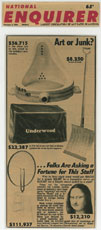
“Art or Junk?,” The National Enquirer,
London edition, February 4, 1986.

The lack of success in selling these works did not prevent at least one newspaper— the anything-but-respected National Enquirer — from asking its readers if the readymades were “Art or Junk?” (Fig. 3). The tabloid reproduced a selection of the objects with their prices, alerting their readers to the fact that “folks are asking a fortune for this stuff.” When an expert at Sotheby’s was asked to explain the “outrageous amounts… these wacky ‘artworks’ are worth,” she wisely replied: “It requires a great deal of knowledge of twentieth-century art to understand these pieces.” Few would argue with that explanation; to understand the prices would have required a great deal of knowledge of twentieth-century art, but also a thorough knowledge of the market in twentieth-century art.

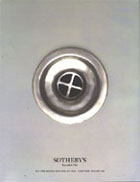
The ideas Duchamp introduced continue to represent an influential force in the world of contemporary art, a factor that — one would assume — affects the financial evaluation assigned his work. This point was dramatically demonstrated in 1997 when one of the examples of Fountain from the Schwarz edition was offer by Sotheby’s in New York as part of their autumn sale of Contemporary Art (Fig. 4). Fourteen years had passed since the Schwarz sale in London when this same work failed to sell, but times had changed. The work was considered so important that the auction house decided to reproduce it on the front cover of its catalogue, and, in a clever decision (since the two works seem to share a common theme), Robert Gober’s Drain was chosen to appear on the back cover. I was asked by the auction house to write an entry on


click to enlarge
catalogue(front cover)
Contemporary Art, Sotheby’s
New York, November 17, 1999,
catalogue(front cover).
catalogue (back cover)
Contemporary Art, Sotheby’s
New York, November 17, 1999,
catalogue (back cover: reproduced:
Robert Gober, Drain,
edition no. 2/8, cast pewter,
4 ¼ in. x 4 ¼ in. x 3 in., 1989).
Figure 4

Fountain, which turned out to be an essay of six pages that provided not only a history of the original urinal, but the making of subsequent replicas, including the Schwarz edition. The organizers of the auction decided upon a pre-auction estimate of $1,000,000 — 1,500,000, an unprecedented amount for a work like this at auction, but perfectly in keeping with their knowledge of private sales. A year earlier, it was generally known within the art world that under the directorship of David Ross, the San Francisco Museum of Modern Art purchased an example of Fountain from the collection of Charles Saatchi for $1,000,000. This information may very well have contributed to the success of the Sotheby’s sale, for in the end, Fountain was purchased by Dimitri Daskalopoulos, a Greek collector, for $1,762,500, a new record for a work by Duchamp at auction. When questioned after the sale, Daskalopoulos said that he had purchased the piece because “for me, it represents the origins of contemporary art.”(4)

A knowledge of prior sales may have contributed to the exceptionally high price paid for this work, but there were other factors as well. In the days immediately preceding the sale, Daskalopoulos’s advisor in art purchases called me several times from Athens to inquire exactly how this particular
example of Fountain differed from one owned by Dakis Joannou, another Greek collector of modern art. Dakis’s Fountain, I explained, came from the collection of Andy Warhol, but it did not bear the important brass plaque that identified the work as part of the edition of eight signed and numbered examples.(5) So far as I could determine, the work being sold by Sotheby’s was the very last example of Fountain from the Schwarz edition that was ever likely going to be made available for sale (the location of the seven other examples of this work from the complete edition of eight accompanied my essay in the catalogue).(6)

It should also be noted that as a collector of contemporary art, Daskalopoulos was certainly familiar with the high prices that were usually paid to secure important work. In fact, the two lots that directly preceded the sale of Fountain in the Sotheby’s auction sold for prices that either equaled or exceeded the amount paid for this particular readymade: a Jasper Johns drawing of a Flag sold for $1,762,500, and one of Andy Warhol’s paintings of wanted men (which was compared in the catalogue to Duchamp’s Wanted Poster of 1923/63) sold for $1,982,500. Even these prices were not exceptional when compared with the record-breaking $11 million dollars that was paid for a painting by Mark Rothko that followed a few lots later in the same sale. When it came to assessing the success of this sale, however, few neglected to mention the record-breaking price for a work by Duchamp.

####PAGES####


click to enlarge
Nine Works,
Sotheby’s London
Figure 5
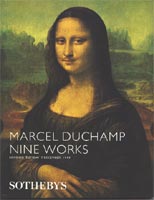
Marcel Duchamp: Nine Works,
Sotheby’s London, December 7, 1999,catalogue (cover).
Study for
a Portrait of Chess Players
Figure 6
Marcel Duchamp, Study for
a Portrait of Chess Players
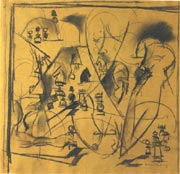
,
1911, charcoal on paper, 19 ½ x 19 7/8 in.
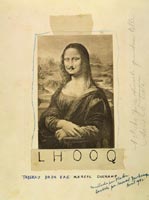
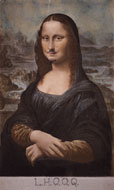
 L.H.O.O.Q.
Figure 7
Marcel Duchamp, L.H.O.O.Q.,
1920/42, rectified readymade
(made by Francis Picabia),
9 ¼ x 7 inches (23.8 x 18.8 cm).
Francis M. Naumann Fine Art, New York.

Three weeks after the sale took place in New York, an auction of Impressionist and Modern Art was held at Sotheby’s in London that included nine works by Duchamp ( Fig. 5). It was generally known that all nine of these works were owned by Georges Marci, a Swiss collector who had assembled the works over the course of the prior decade. These works were featured in a separate catalogue, for which I was again asked to write the introduction. Like the readymades, most of the items offered were produced in editions: the three erotic objects made in an edition of 8 to 10 examples, a reproduction of the L.H.O.O.Q.issued in an edition of 35, and a valise, produced in an edition of 150 examples. The only unique work was Study for a Portrait of Chess Players ( Fig. 6), a magnificent large Cubist drawing that Duchamp had made in 1911, but which he had given to Louise Varèse during his early years in New York (and which remained in her possession until her death in 1988). This drawing was given an estimate of 350,000-450,000 BP, and sold for an impressive 529,500 BP. It may have been the attraction of this single work that caused most of the other works by Duchamp to sell within or in excess of their pre-sale estimates. Only the valise — which was accompanied by five original letters from Duchamp to Poupard-Lieussou (the original owner of this item)—failed to sell. The pre-auction estimate was $165,000 – $206,000, far in excess of the amount that had ever been paid for a comparable work at auction, which was, apparently, the main factor that inhibited bidding.

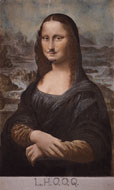
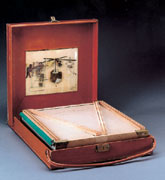
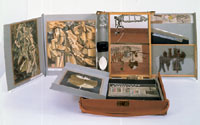
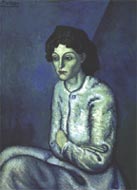
The exceptionally high price paid for a work by Duchamp may have impressed many, but it is not a great deal of money when compared with the amount that would have been paid, for example, for an important drawing by Picasso from the height of his Cubist period. Indeed, when the prices of Duchamp’s work are compared with those paid for anything even remotely similar by Picasso, the differences can be astronomical. In a sale of Impressionist and Modern Art held at Christie’s New York in the fall of 2000, I wrote entries for two works by Duchamp: a replica by Francis Picabia of his famous L.H.O.O.Q. ( Fig. 7)(with an estimated value of $700,000-900,000), and a deluxe edition of the valise ( Fig. 8) (estimated at $800,000-1,200,000).The auction would also include a rare Blue Period painting by PicassoFemme aux bras croisés ( Fig. 9), a woman with arms crossed that—as a friend of mine recently observed—resembled (coincidentally) the positioning of La Jocconde in Duchamp’sL.H.O.O.Q..(7)When I found out about the Picasso, I requested that I be allowed to write entries on Duchamp that were at least as long as the one that was being written for this painting, though I was well that the Picasso would have a higher estimate (the catalogue stated “estimate upon request,” but the experts felt that the painting was worth between 30 to 40 million dollars). To my surprise, the auction house complied. Of course, I knew that the length of my entry would not affect the outcome of the sale, but I wanted Duchamp to be accorded the same historical respect as Picasso. On the night of the auction, the Picasso sold for over 55 million dollars, and, so far as I could tell, the two works by Duchamp did not receive even a single bid.

click images to enlarge

  • The Box in a Valise
  • The Box in a Valise
  • oil
on canvas
  • Figure 8
  • Figure 9
  • Marcel Duchamp, The Box in a Valise, 1943, deluxe edition made
    for Kay Boyle (containing original Bachelor’s Domain,
    a hand-colored pochoir reproduction on celluloid of the lower
    section of the Large Glass).
  • Pablo Picasso, Femme aux
    bras croisés
    , 1901-02, oil
    on canvas,32 x 23 in. (81.3 x 58.4 cm).
    Private Collection.

here are several explanations that could account for this failure. First, the works by Duchamp had been recently on the market: the L.H.O.O.Q. had come from a Duchamp exhibition at a commercial gallery in New York (a show that I had organized), where the asking price for this work had been set at $1,300,000 (considerably more than the auction estimate), and the valise had been offered privately by several dealers in Europe and in the United States at prices that ranged from $650,000 to $750,000 (still lower than the auction estimate).(8)But even more importantly, the works by Duchamp were placed in the wrong context. The sale included paintings by some of the most renowned Impressionist and Post-Impressionist artists— Monet, Renoir, Gauguin, Cézanne — as well as some of Duchamp’s most notable contemporaries: Picasso, Kandinsky, Léger, Miro, Magritte, Ernst, and Giacometti, the majority of which fared well in an evening of heavy bidding (the Giacometti sculpture, for example, sold for over 14 million dollars).

For Duchamp, context is everything. A shovel in a hardware store is, after all, only a shovel; place it into a museum, and it is magically transformed into art. This is a concept that most collectors of classic European modernism would either fail to understand or flatly reject. Most collectors of contemporary art, on the other hand, accept the philosophical and aesthetic implications of the readymade as an important if not critical precedent to the underlying conceptual strategies of modernism (which, in part, explains Sotheby’s success in sellingFountain for a record-breaking price).

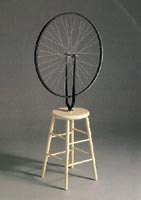
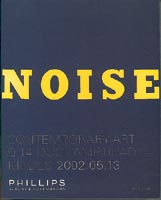
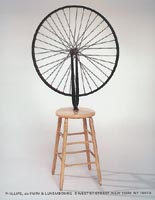
The lesson of placing Duchamp’s work within the context of vanguard art is one that was well understood by the organizers of a sale on May 13, 2002, of Contemporary Art at Phillips de Pury & Luxembourg in New York. The auction featured all fourteen of the readymades that had been issued by the Galleria Schwarz in 1964, these examples from the collection of Arturo Schwarz himself. The sale also included sculpture by Dan Flavin, Donald Judd, Carl Andre, Joseph Beuys, Jeff Koons, Rachel Whiteread, and Maurizio Catelan; photographs by Cindy Sherman, Andreas Gursky, Thomas Struth and Thomas Ruff; paintings by Francis Bacon, Joan Mitchell, Agnes Martin, Gerhard Richter, Andy Warhol, Jean-Michel Basquiat, Damien Hirst, Neo Rauch, and Ed Ruscha, whose untitled 1963 painting of the word “NOISE” in yellow against a dark blue ground graced the cover of the lavish, oversized catalogue (Duchamp’s Bicycle Wheel appeared on the back cover: Figs. 10.1 and 10.2).

click images to enlarge

  • Contemporary Art &
14 Duchamp Readymades
  • Bicycle Wheel
  • Figure 10-1
  • Figure 10-2
  • Contemporary Art &
    14 Duchamp Readymades
    ,
    Phillips de Pury &
    Luxembourg,New York, May 13,
    2002, catalogue (cover).
  • Contemporary Art & 14
    Duchamp Readymades
    ,
    Phillips de Pury &
    Luxembourg, New York, May 13,
    2002, catalogue (back cover:
    reproduced: Marcel Duchamp,
    Bicycle Wheel,
    assisted readymade: bicycle
    wheel and fork mounted upside
    down on a kitchen stool painted
    white, 49 13/16 x 24 13/16
    x 10 ¾ in.(126.5 x 63 x 27.3 cm).

The sale was accompanied by as much advance publicity as the auction house could muster, including a regular run of advertisements in the New York Times reproducing the various readymades. The only newspaper to run a feature article about the sale, however, was the London Daily Telegraph. The Bicycle Wheel was reproduced, and the article was given the amusing title “Wheel of Fortune,” for as its author Colin Gleadell remarked, it was “estimated to sell for up to $3 million.” Gleadell also informed his readers that in contrast to the issuing of readymades in 1964, which were designed to be sold intact (as complete sets), these fourteen examples were being offered individually, so that collectors were at liberty to chose whichever one they wanted and could afford. He reminded readers that Fountain had sold a few years earlier for $1.7 million, and that, although this information could not be confirmed, an example of the Bicycle Wheel had “sold for more than $2 million on the private market.” Moreover, when the evaluation assigned to all fourteen readymades is tallied, “the overall pre-sale estimate for the set is $8.5 million to $12.6 million,” which, we are told, falls short of the $15 million guarantee Schwarz was given. “Clearly Phillips has taken a gamble,” Gleadell concluded, “one that Duchamp, who had a weakness for risk-taking when playing chess, might have enjoyed.”(9)

In fact, Duchamp took few risks when playing chess, and, as I demonstrate in the first part of this article (Art in America, April 2003), even fewer when it came to his art dealings, whether pertaining to the sale of his own work, or to the investments he had made in the work of others. In the case of the Phillips auction, however, the owners and administrators did undertake a fairly serious financial risk, for it was later revealed that they issued Schwarz a guarantee of $10 million, an amount that fell in the middle of the low and high estimates. If the readymades sold for the low estimate of $8.5 million, the auction house stood to lose $1.5 million; if they sold for their high estimate, they would have made $2.5 million. Apparently, this was a risk the auction house was willing to take, drawing a certain degree of confidence, perhaps, in their recollection of the successful sale of Fountain two years earlier in a sale of Contemporary Art at Sotheby’s.

On the evening of the sale at Phillips, it was raining steadily in New York, which, we can only imagine, must have filled the auctioneers with trepidation, for they knew that if they were to meet their guarantee, they would need as many potential bidders to compete against one another as possible. The eighty-one year old Schwarz, however, who came from his home in Milan to attend the sale, appeared confident and relaxed. Just before the bidding began, a collector asked him if he was nervous. “Why should I be nervous?” Schwarz responded. “As far as I am concerned, they have already been sold.(10)

The sale began with Duchamp’s Paris Air, one of the smallest and least known of the readymades, which was given an estimate of $200,000 – $300,000. Bidding was slow and halting. It eventually stopped at a hammer price of $150,000, short of the low estimate but still higher than the reserve, for, to everyone’s surprise (probably even the successful bidders), the auctioneer announced that the work had been sold. A similar pattern continued for the remaining thirteen readymades, where, in most cases, prices only reached approximately half the low estimates, yet were repeatedly announced as having been sold. Only the Bottle Rack (estimated at $800,000-$1.2 million) and snow shovel (estimated at $700,000-$900,000) failed to meet their reserves. Fountain, which was given a conservative estimate of $1.5 – $2 million (a range that reflected the price it had attained two years earlier at Sotheby’s), sold for a hammer price of just over $1 million, still nearly one-half million dollars short of its low estimate. When the bidding stopped, a quick tally showed that the entire set of readymades sold for $5,370,000, exactly $4,630,000 short of the amount Schwarz was guaranteed, a substantial loss for the auction house, but a huge gain for Schwarz, who, in all likelihood, with a fat check in his pocket, scurried back to Milan the next morning.

By contrast, the rest of the auction went rather well: eight artists had achieved record prices for their work, including the Ruscha cover-lot painting, which sold for over $2.5 million, and a Judd sculpture, which sold for over $1.3 million. The entire auction fetched $29,686,350, with 91% of the offerings sold by value. In a report issued by the auction house after the sale, these facts were of course emphasized, and in an effort to put a positive spin on the sale of readymades, it was even announced that Duchamp’s “iconic Bicycle Wheel tied the record for any Readymade,” which it did, since it sold for the same price as Fountain two years earlier at Sotheby’s. Of course, there was no mention of the fact that Phillips lost over $4.5 million on its guarantee to Schwarz, which was perceived by many to have been a total disaster for the Duchamp market(11)

Perception is, of course, only a reflection of the person doing the perceiving. In describing the sale of the readymades in her regular column for the New York Times, Carol Vogel reported that “collectors sniffed at what some consider icons of modern art,” and Christopher Michaud, writing for the Reuters News Agency, reported that the prices of the readymades “fell far short of expectations, eclipsed by works of more current artists.” Josh Baer summarized the evening best when he wrote in his newsletter that “people will look back on [the sale] and wish they had bought.(12)

So far as the sale of Duchamp’s work is concerned, the failure of the readymades to attain their estimates may inhibit sales in the short term, but in the future, there will be little — if any — harm done to the general Duchamp market. To my way of seeing things, there are two reasons why Duchamp’s work continues to be assigned comparatively low evaluations: rarity, and, perhaps even more importantly, an unrelenting cerebral content.

Rarity is a factor that in most commercial markets causes an item gradually to escalate in value over time. Precisely the opposite occurs in Duchamp’s work, for its rarity creates a situation in which reliable evaluations of comparable prior sales cannot be established. The best way to demonstrate this point is by citing a hypothetical example: Say that you own a work of art by a notable artist that you are interested in selling. When an attempt is made to evaluate the work, comparables are cited, earlier examples by the same artist from the same period that have sold — either at auction or privately — within the recent past (in the art market, up to five years is usually considered a fair indicator). If you should manage to find a comparable work that sold for X-number of dollars, naturally you want the work of art that you own to be evaluated at a somewhat higher figure, an amount that reflects the time passed since the comparable work was sold. When it comes to unique works by Duchamp, however, there are preciously few comparables. During his lifetime, he saw to it that his most important work was placed into important private collections (such as with Arensberg or Dreier), which he knew would one day be donated to museums.(13)In the Duchamp market, then, the “snowball effect” that causes works of art to escalate in value over time is virtually nonexistent. As a result, one can ask whatever one wants for a unique work by Duchamp, but even here, the price must remain within reason, that is to say, controlled by some knowledge of prices that were paid for other works by artist in the comparatively recent past.


click to enlarge
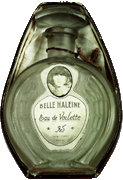
Perfume bottle
Perfume bottleFigure 11
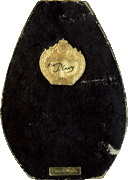
Marcel Duchamp, Belle Haleine:
Eau de Voilette (Beautiful
Breath: Veil Water)
,
1921, assisted Readymade,
perfume bottle (6 in.) in cadrdboard
box, 6 7/16 x 4 7/16 in..
L.H.O.O.Q.
Figure 12
Marcel Duchamp, L.H.O.O.Q.
, 1919,7 ¾ x 4 7/8 in.

Today, the most common way to the check prices paid for an individual artist’s work is on the Internet. A variety of sites offer postings of recent auction records, but it is virtually impossible to find any verifiable information pertaining to private sales. Of course, when a collector of means is matched with a work of art that he or she absolutely cannot live without, the question of comparable evaluations is of no relevance. In the André Breton sale that took place recently in Paris, for example, the Monte Carlo Bondsold to the Principality of Monaco for 240,000 euros (well above its pre-auction estimate of 50,000 to 60,000 euros). A similar situation occurred in the mid-1990s, when a collector and former art dealer living in Paris sold Duchamp’s Belle Haleine (Fig. 11) perfume bottle to Yves Saint-Laurent and Pierre Bergé for five million dollars. The collector originally purchased the work some twenty-five years earlier from the Forcade-Droll Gallery in New York, and, at the same time, he also purchased the original L.H.O.O.Q. (Fig. 12), which is still in his collection. Some years ago I was approached by a curator at the Museum of Modern Art in New York, asking whether I knew if this work could be acquired. I called the collector in Paris and asked if he would consider selling it. He responded to my inquiry by asking if I knew the highest price ever paid for a work of art. Recalling Renoir’s Moulin de la Galette, I said that I thought it was around 65 million dollars (having forgotten that a van Gogh sold a few years later for some 20 million more). He said: “Bring me a collector willing to pay 66 million dollars, and we’ll talk.(14)

Even if the information pertaining to private sales were made public, I doubt that it would affect the comparatively depressed financial evaluation given to works by Duchamp. This, I believe, can be traced to a single overriding factor: the importance of vision over thought. Unlike more traditional works of art, which rely primarily upon visual comprehension for understanding their importance — and, thus, financial value — a work by Duchamp (particularly the readymades) relies upon more complicated processes of thought. We can look at a painting by Matisse, for example, and appreciate it on a purely visual level. Indeed, Matisse himself encouraged precisely this method of viewing when he stated that “an art of balance, of purity and serenity” is “something like a good armchair that provides relaxation from fatigue.”(15)By contrast, any viewer who looked at Duchamp’s readymades in this same fashion would derive little or no aesthetic pleasure; no matter how long you look at a shovel — whether hanging in a museum or in a hardware store — it remains a shovel. In this case, viewers are forced to echo a strategy employed by the artist himself when selecting these objects, for he wanted the readymades to exhibit no exceptional visual interest, or, as he said, they are objects possessed of “visual indifference… a total absence of good or bad taste… a complete anesthesia.”(16)

If we apply this reasoning to the marketplace, then an art dealer or seller is placed in a somewhat unusual position. He or she can no longer present a work of art to his or her client and allow a purely visual response to convey its content. I have come to refer to this predicament as the triangle theory, where, under normal circumstances, three specific points must be identified and understood before a sale can take place: (1) the client’s eyes; (2) the work of art; (3) the client’s pocketbook. In trying to sell a work by Duchamp, one point in this triangle must be adjusted slightly, for in considering a readymade, one cannot rely solely upon a client’s vision. Instead, the seller is obligated to move that point one or two inches back, to a position well with the client’s gray matter. Only then can he hope to come anywhere near the client’s pocketbook. If the person’s intellect is not stimulated, then, as in the case of looking at a readymade like Duchamp’s In Advance of a Broken Arm, a shovel remains a shovel, which in most hardware stores sells for about fifty dollars (not $600,000, which is the amount for which this item reportedly sold in a private sale to a European client a few days after the Phillips sale).

It is my belief that, in the future, works of art will be increasingly appreciated for their cerebral content, although for the present moment, at least, vision is still required to comprehend the existence of the object. At this point in time, we can only imagine a work of art that would stimulate our minds before reaching our eyes (of course, the same could be said for all kinds of social situations, from race relations to geographic borders, as in John Lennon’s use of the word “Imagine”). Meanwhile, as was his habit, Duchamp seems to have timed things perfectly: if there is any correlation between the aesthetic value of a work of art and the amount of money that someone is willing to pay for it, at the very moment in our history when intellect and vision strive to achieve union, there are virtually no important works by Duchamp available to test the market. He was not only successful in thwarting attempts to commercialize his work in his lifetime. In having kept his production of unique works of art to a minimum, only replicas and works in edition remain within the marketplace today, and even these items come up only rarely. Some thirty-five years after his death — in both aesthetic and monetary terms — Duchamp remains securely one step ahead of the game.


Notes

Footnote Return1. Quoted in a letter to the author from Diana Nemiroff, Curator of Modern Art, National Gallery of Canada, 25 September 2002.

Footnote Return2. Information provided in an email message to the author dated October 14, 2002, from Nan Esseck Brewer, Curator of Works on Paper at the Art Museum of the University of Indiana at Bloomington. Additional details concerning the purchase was relayed to the author in a telephone conversation with Thomas T. Solley from his home in England on October 15, 2002.

Footnote Return3.It should be acknowledged that I was among those who negotiated to acquire these works, eventually acquiring the Network of Stoppages (now collection of the Yale University Art Gallery, New Haven),Bottle Rack, In Advance of a Broken Arm, Fountain,
and Fresh Widow (the latter four now in the collection of the Maillol Foundation, Paris).

Footnote Return4.Quoted in Carol Vogel, “More Records for Contemporary Art,” The New York Times, November 18, 1999.

Footnote Return5. See Jeffrey Deitch, ed., The Dakis Joannou Collection (Ostfildern: Cantz, 1996), p. 93.

Footnote Return6.At the time when this essay was written, I had mistakenly concluded that no. 4/8 of the edition was in the collection of the Toyama Museum of Art in Japan.That information proved incorrect, for no. 4 of the edition appeared on the market in 2002 at the Gagosian Gallery in New York (with a provenance that can be traced to Sarenco & Sarenco of Milan, Italy).

Footnote Return7.The friend, Nura Petrov, is an artist who lives in Riegelsville, Pennsylvania.

Footnote Return8.The Duchamp show was entitled “Marcel Duchamp: The Art of Making Art in the Age of Mechanical Reproduction,” and was held at Achim Moeller Fine Art, New York, 2 October 1999 — 15 January 2000.

Footnote Return9.Colin Gleadell, “Wheel of Fortune,” The Daily Telegraph [London], April 22, 2002. I am grateful to the author, who kindly provided me with a photocopy of his article.

Footnote Return10.The collector wishes to remain anonymous.

Footnote Return11.“Phillips, de Pury & Luxembourg Set 8 Artist Records in $29 Million Sale of Contemporary Art on May 13, 2002,” Click here to view the link.

Footnote Return12.Josh Baer, The Baer Faxt # 318, May 13, 2002; Christopher Michaud, “Rare Duchamps Collection Sold at N.Y. Auction,” Reuters Press, May 21, 2002; Carol Vogel, “An Uneven Night at Auction for Phillips,” New York Times, May 14, 2002. See also Brooks
Barnes, “Phillips Contemporary Art Auction Brings in a Healthy $30 Million,” The Wall Street Journal, May 14, 2002.

Footnote Return13.When he served as executor of Dreier’s estate, he arranged for several of his most important works to be placed into the permanent collection of the Museum of Modern Art, which demonstrates that, in some measure, he wanted his work to be seen and understood
within the context of a larger, more international audience.

Footnote Return14.The collector wishes to remain anonymous, and even though he has refused to confirm the sale price of the Belle Haleine,its current owners requested an insurance evaluation of five million dollars when they lent the work to a show I organized for the Whitney Museum in 1996 (see the catalogue, Making Mischief: Dada Invades New York, Whitney Museum of American Art, distributed by Harry N. Abrams, New York, 1996, pp. 146 and 292).

Footnote Return15.Henri Matisse, “Notes of a Painter,” 1908; quoted in Alfred H. Barr, Jr., Matisse: His Art and His Public (New York: Museum of Modern Art, 1951), p. 122.

Footnote Return16.“Apropos of ‘Readymades’,” a talk delivered by Duchamp at the Museum of Modern Art, New York, 19 October 1961; published in Art and Artists,vol. I, no. 4 (July 1966), p. 47.

Figs. 6-8, 11-12 ©2003 Succession Marcel Duchamp, ARS, N.Y./ADAGP, Paris. All rights reserved.

Desnuda-vestido, vestida-desnudo: Les amoureuses (Elena & Rrrose), con Duchamp al fondo

Marcel Duchamp está frente al tablero de ajedrez, muy concentrado en una partida contra (o con) una joven completamente desvestida, sentada en el lado opuesto. La escena captada en esta fotografía se desarrolla en una sala del Pasadena Art Museum (California) el 18 octubre de 1963, con ocasión de la primera exposición retrospectiva que se le dedicó al artista, apenas cinco años antes de su muerte. Todos los testimonios de la época coinciden al describir a aquel Duchamp como un hombre saludable y jovial, aunque su edad, 76 años, no pareciera ya la más adecuada para jugar con chicas desnudas. La foto, en efecto, tiene obvias implicaciones eróticas, situados como están los jugadores delante de una réplica deLa mariée mise à nu par ses célibataires, même, que había elaborado Ulf Linde ante la imposibilidad de que el vidrio original pudiera trasladarse desde el Museo de Filadelfia hasta Pasadena.

Sabemos en realidad que la foto forma parte de una inocente performance preparada por el fotógrafo Julian Wasser con la complicidad de Walter Hopps, comisario de la exposición de Pasadena, y de una amiga de éste, Eve Babitz, que accedió a posar para ésa y para algunas otras tomas (como la que muestra a Duchamp fumando un puro junto a su Fuente con la muchacha al fondo). No consta quién ganó aquella partida o si llegó a terminarse siquiera, pero sí nos han contado que casi todos parecían estar algo nerviosos. Eve se mostró aliviada cuando supo que en la fotografía seleccionada por Wasser para la publicación, el pelo caía sobre el lado derecho de su rostro, tapándolo por completo(1) . Las contraposiciones de la obra eran, así, completas: un hombre mayor, vestido de negro, con la cara descubierta, juega al ajedrez con una mujer joven y desnuda, de piel muy blanca, y en cuya cabeza sólo se percibe una lisa melena negra. Distanciamiento y “belleza de indiferencia”, por utilizar la propia formulación duchampiana. El artista mira las piezas del ajedrez cuyos ecos formales evidentes se hallan en los moldes málicos y en el molino de chocolate de la maquinaria soltera, muy visibles al fondo; el cuerpo de Eve Babitz, por su parte, remite a la “vía láctea carne”, colgada en la parte más elevada del Gran vidrio, en el vértice superior de un triángulo perfecto cuyas esquinas inferiores están constituidas por los asientos de ambos jugadores. El azaroso mecanismo amoroso de la creación duchampiana se proyectaba así sobre la vida real, testimoniada por el documento fotográfico. En ese primer plano, con la esqueletizada y metafísica obra de arte al fondo, la novia ha sido desnudada ya por su(s) soltero(s), y bien podría adivinarse que el juego va muy adelantado. No está lejos el final feliz.

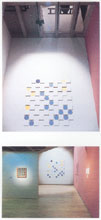
Pero Elena del Rivero se ha apropiado de esta fotografía y la ha digitalizado, para imprimirla en múltiples fragmentos rectangulares que ha dispuesto luego como un mural en cinco hileras horizontales. Hay unos pequeños marcos blancos de separación entre los cuadraditos, como si éstos fueran las viñetas de una gran fotonovela. Y es esta sutil contaminación de un género narrativo lo que convierte al documento de Pasadena en una historia: cada fragmento del espacio se transmuta en una unidad de tiempo, como si la nueva lectura secuencializada de la imagen obedeciera a cada uno de los movimientos sucesivos de las piezas en el juego del ajedrez. Ahora bien: delante de Eve Babitz, tapándola por completo, hay otra mujer, sentada en la misma posición, y con el rostro oculto, igualmente, por una melena negra. No es la Eva (del) original, ofrecida desnuda al juego más o menos interminable, sino una mujer mundana, notoriamente vestida, entregada a la contemplación ensimismada de unos collares de perlas, símbolos tradicionales de la vanidad. Se diría que el relato continúa así fuera, en el ámbito donde se ha situado ahora la fotógrafa. Esa modelo (la propia artista, al parecer), con camisa de malla negra y amplia falda dorada, sería una seguidora hipotética de la narración que está detrás de ella, y su “identificación” con la chica que juega al ajedrez se opera en términos ficticios, como cuando vivimos vicariamente las peripecias de un personaje novelesco. ¿O tal vez no? Su atuendo y su postura recuerdan un poco al tema tradicional de la Magadalena arrepentida (pensamos, por ejemplo, en la interpretación de Caravaggio); la ropa, desde luego, no es la de un vestido de novia, y bien podría ser la de una (falsa) princesa o la de una prostituta de lujo ataviada para una fiesta de “solteros”, même. En cualquier caso, una mujer anónima (no tiene un rostro visible), tan completa y ostentosamente vestida, sentada delante de esa foto de Duchamp, ¿nos está invitando al desnudamiento?

Y dado que la narración debe seguir, ¿quién lo ha de realizar? O más claramente, ¿quién ha de suplantar, por obvias razones de simetría, a la figura de Marcel Duchamp que continúa visible en los recuadros escaneados clavados en la pared de atrás? Parece evidente, en fin, que esta presencia femenina exige la de un ente masculino, même, situado en frente, presumiblemente desnudo, que daría una vuelta de tuerca en el interminable proceso del desnudamiento. No creo que sea disparatado hacer una lectura algo feminista de una obra como ésta, que parece hacer recíproca la proposición duchampiana: “el (recién) casado desnudado por su(s) soltera(s), mismamente”. Pero es el vacío de ese hipotético ente masculino, su hueco espacial, lo que parece obligarnos a situar a Les amoureuses (Elena & Rrrose) de Elena del Rivero (2001) en la estela de los Étant donnés. En efecto, en la instalación póstuma de Duchamp que conserva el Museo de Filadelfia, es el mirón el que completa la obra, participando en una actividad amorosa que se ofrece, como promesa, a través de los agujeros del portalón. Elena del Rivero parece invitarnos, igualmente, a plantar nuestra silla frente a su muchacha vestida: soy yo, el espectador, un ser humano concreto (o más específicamente un hombre), el protagonista que falta. La artista sugiere de esta manera que mirar es sólo una actividad preliminar, y que nada percibiremos, tal vez, si no nos desnudamos y si no estamos dispuestos a jugar.

J.A.R., enero de 2002


NOTES

1. Todos los detalles de aquella sesión, incluyendo reproducciones de las tomas fotográficas descartadas, pueden encontrarse en Dickran Tashjian, “Nothing Left to Chance: Duchamp’s First Retrospective”. En Bonnie Crearwater (editor), West Coast Duchamp. Grassfield Press, Miami Beach, Florida, 1991, pp. 61-83.


Response to “The Magic Number”

Dear John,

Thank you for the thorough reading of my pieces (yup, and Hirschhorn is certainly an intelligent enough artist not to have fallen into my little trap!). There is, of course, a very detailed article on the 8/9 bachelors in the pages of Tout-Fait: The Bachelors: Pawns in Duchamp’s Great Game

In terms of the 1964 edition, your thoughts are intriguing, yet the numbers do not quite add up. It becomes pretty tricky. The number of the entire set of Ready-mades (and semi-ready-mades, etc.) in this edition is 14. Each of them is numbered 1/8-8/8. Yet in addition to those there are three replicas reserved for artist (MD), publisher (A. Schwarz) and the Philadelphia Museum. On top of that, there are two more replicas for museum exhibitions, bringing the number up to 13 (!). Research throughout the years has led us to conclude that a much higher number was produced (some stolen from Schwarz’s warehouse, missing the small copperplate or the case and/or the signatures. All in all, it’s a pretty fuzzy affair.

Best, Thomas Girst


The Magic Number

Tom Girst, Editor in Chief:

Have been greatly enjoying latest issue of Tout Fait, after noting not once, but twice you brought attention to Duchamp’s 1964 Readymades edition. In the Barns interview it was surrounded by the usual dismay this edition brings, fair enough. Then, in the corespondence with Hirschhorn you appeared to have taken a decidedly heavy hand in reference to this edition, using it as a form of entrapment to elicit a responce from Hirschhorn in regards to his own recent works potential “commercial” value. It was to Hirschhorn’s credit that he did not “trip” on this edition or reference it to his own works, but he clearly rebuked any notion that Duchamp ever compromised his own works, Bravo, Hirschhorn. I believe I can shed some light around the “dismay” of this Duchamp/Schwarz venture. First, in the Barnes interview he preferences his concern by stating that at least in regards to Etant donnés the work appears “to flesh out the Bride” placing it full cycle in relation to the Large Glass. The very same statement can be said of the Ready-mades edition, as usual with Duchamp the “shock” is hidden in plain sight. The answer, Dear Tom, is in the exact number of the editions “8”.

Does this number ring any bells? As Etant Donnés belongs to the realm of the Bride, so the Ready-mades belong to the realm of the Bachelors. Return to the notes in the Green Box, where Marcel lets us know that the Bachelors were conceived as a game of 8!, only changed to 9 with the addition of himself, a reluctant station master (in an non-autobiographic way as possible). As reluctant as the “lost” original Ready-made brings the number 8 to 9! In fact seen from this angle the Ready-mades appear as a collective form of “portraiture”, a sort of Bachelors composite (although non-auto, you understand). Keep up the great work.

Sincerely,

John Mcnamara
mac2u22@hotmail.com


Bicycle Wheel Stool


click to enlarge
Bicycle Wheel
Figure 1
Marcel Duchamp,
Bicycle Wheel
(Fork)
, 1964

As a small point, the ‘straight fork’ (Fig. 1) might not be a functional on the road fork at all, but rather a wheel truing stand. These are still available to those of us who ride regularly, and resemble forks. When wheels go over bad bumps, over time, the spokes can loosen and the rim needs to be pulled back into shape. It is adjusted in such a bracket with added measuring tools to detect wobble and roundness. I don’t know how this enters into the thinking about the bike wheel, but I thought it might be useful to share. I am delighted to contribute to anything Stephen Jay Gould had a hand in. His work has given me so much pleasure and clarity of thought. Thank you.

Fig. 1
©2003 Succession Marcel Duchamp, ARS, N.Y./ADAGP, Paris. All rights reserved.