

1. “Be your own university”— An introduction
It was last June when I decided to go for an interview in the Kunstmuseum (Museum of Art) in Vaduz in Liechtenstein. In my letter of application I mentioned the barriers between different arts as well as the resulting ‘pigeonholing’–to stress the fact that in my mind it is essential to see those barriers not in the sense of limits but rather as challenges. After all I applied for a position which is not exactly tailored to a future high school teacher of History and English. One could interpret this short ‘philosophical interval’ in my letter as a kind of justification–though this was definitely not my aim. Instead I refuse to be labelled as a Historian or English linguist when my interests are distributed among different areas.
“Art is not an escape from life, but rather an introduction to it.”(1)
-John Cage
In my short introductory remark I already mentioned barriers as a central term. I am interested in barriers between different arts and disciplines not in the sense of respecting them but in the sense of blurring. Both, Duchamp and Cage offered me a lot of input through their art, music, philosophy and their blurring of the distinction between art and life. They were in search for a way to escape from traditional painting respectively music. Cage was particularly interested in Zen Buddhism and accordingly invented a new notion of music by using chance as a compositional tool. He was trying to break the traditional barriers between not only theatre, music, dance and fine arts: “I am out to blur the distinctions between art and life, as I think Duchamp was. And between teacher and student. And between performer and audience, etcetera.”(2)
Both Cage and Duchamp revolutionized the common understanding of modern art. They withdrew themselves from commitments to what I call ‘entertaining’ artists who were interested in pleasing a large audience. Duchamp, during his whole lifetime refused to be labelled an artist. “My attitude towards art is that of an atheist towards religion. I’d rather be gunned, kill myself or somebody else than creating art again.”(3) Duchamp was certainly doing art while provocatively refusing it, but here the central message was that he did not want to be categorised in any way. In an interview, he similarly remarked that “a human is a human, as an artist is an artist; only if he is categorised under a certain ‘- Ism’ he can’t be human nor artist.”(4)As I continue my lines of thought at this point it only indicates the beginning of a long walk along these (sometimes invisible) barriers. My ‘philosophical walk’ will be that of an amateur wanderer, someone who got deeply inspired by three outstanding, challenging and at the same time, enigmatic characters.
John Cage first attracted my interest at a lecture in college where our English professor acquainted us with an apparently bright and free mind. When I learned about Cage’s ideals in education I realized that this was the opposite of what we mostly experienced as college students. Reproduction of knowledge is the most common and also most uncomplicated form of assessment, while the written and oral creative output of a student, even when studying languages, lies at a minimum. However, university, as I experienced it, greatly encouraged the meeting with others. It is a place where social exchange can usually take place on a spontaneous basis.
An appealing aspect while working with Cage was the fact that his influence was not just felt in music, but also in visual arts, dance and aesthetic thought in general. He believed that art was intimately connected with our lives and thus not to the museums. Cage stressed the concepts of diversification for unification, of multiversity for university–to express the idea of bringing joy and liveliness into education. He brought into question the term ‘university’ which, he believed, was not encouraging the meeting with oneself.(5) The first rethinking process has to take place in our own minds, thus my title ‘Be your own university.’
My walk will sometimes take place on thin ground, but this interest in border areas would be also in the sense of Cage and Duchamp. Both artists were in search for means to escape tradition. Cage, by inventing compositional tools other than harmony, Duchamp by “unlearning to draw.”(6)In the course of examining those two characters I found many common elements in relation to the mentioned blurring that my final interest focused on this topic. The fact that they shared a lifetime friendship as well as their likewise, but also contrasting ideas and artistic tools represented other interesting elements when studying both characters. Duchamp, more than Cage, created a real challenge for me as his often paradoxical and ironic statements made it hard to ‘complete the puzzle.’ I decided to partly leave the puzzle unfinished–with the slight intention to let my readers finish it.
During the last 50 years, there have been numerous publications on both Duchamp and Cage. I must admit that, for some reasons I intentionally have not read many of them. One reason is that, if I would have, this paper would have ended in a life-time project. Moreover, if the information load is too heavy, one would support unconscious reproduction of different information sources. And I wanted my mind to keep a sense of freedom and space. I gained a great understanding through primary sources as interviews, lectures, texts and letters. Now and then I grabbed books which had only indirectly to do with my topic, such as Rodin’s Art or Gertrude Stein’s Everybody’s Autobiography….in order to keep my mind a bit detached. Thanks to technology it is not much of a problem to get a lively impression of Cage fooling around with the interviewer in a live discussion about his Roaratorio. Those conversations transported the sense of humour and lightness in Cage. I also tried to get familiar with his music–with the rhythms I have heard so much about and still could not guess how they sounded in reality. Sometimes it was indeed an adventurous listening practice and I literally had to keep in mind Cage’s quotation that “disharmony is simply harmony we are unaccustomed to.”(7)
It is worth stating at this point that this project is not intended to be a scientific text in the common sense (as some may have noticed already) Many art historians, at least in German, tend to write in a manner which is apparently designated for a minority target group. It is not the fact that it is impossible for someone interested to understand such a text but that it seems to be an interminable play with words. It appears that they often claim a sense of totality if not universality and thus maintain a clear distinction between art specialists and public. Both Cage and Duchamp have not left behind the impression that their ideas are not accessible to the interested public. After having read some of Cage’s interviews and quotations I almost feel that it is needless to add anything. Many quotations I will cite in the course of this paper could indeed speak for themselves. I guess I just did not have the nerve to leave the space blank in between. Now honestly – I believe that one should first of all enjoy both artists without much scholarship. Cage, in particular, strived to make his work accessible and useful.
This project is best described as an attempt to find my personal way of approaching two artists. I doubt that Duchamp or Cage can be ‘understood’ in the common sense. Duchamp rather left the door open by saying that observers complete works of art themselves. In the end it is up to the audience if a sculpture or a painting is worth surviving. And still, there is something hermetic and mysterious about his work. I must admit that I feel no need to completely uncover its mystery as this would be in contrast to his intentions. The following text will not be scientific in the sense that I do not exclusively intend to give answers but rather challenge new questions. Cage once mentioned in an interview on Duchamp: “‘What did you have in mind when you did such and such?’ is not an interesting question, because then I have his mind rather than my own to deal with.”(8) The paper does not claim comprehensiveness as it, among other things reflects my own experience with both artists.
In order to give hints about what my chapters will be about, I used various quotations which I thought would quite well convey the central topic of the respective essay. However, I refrained from giving too much away and also deliberately missed writing summaries of my ‘essay results.’ The topic is too complex to be packed in a few words and I wanted to allow a space where some doors remain open.
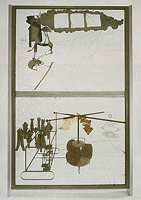
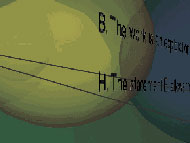
The idea to partly use translucent paper originates from a quotation by John Cage. In his interview with Moira Roth he was asked if his idea of silence had anything in common with Duchamp’s. He answered:
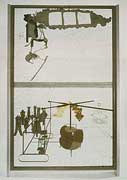
“Looking at the Large Glass (*which is considered to be Marcel Duchamp’s masterpiece), the thing that I like so much is that I can focus my attention wherever I wish. It helps me to blur the distinction between art and life and produces a kind of silence in the work itself. There is nothing in it that requires me to look in one place or another or, in fact, requires me to look at all.”(9)
A glass indeed does not require the spectator to observe the artwork itself, but encourages him to see the environment behind it. In my mind the notion of ‘looking beyond’, that is not being dictated to focus on the work of art itself is a wonderful idea. Through the symbolic use of translucent paper for the initial chapter pages the environment becomes visibly through the pages. As the pages are closed, one can see traces of the next page’s writing. The paper’s contents are blurring in view of the next page’s font. In case my readers believe they are not learning anything new, I invite them to skip parts of the paper.
In History seminars we were taught about the crucial objectivity of a historian. Objectivity is certainly a necessity or at least something to accomplish in this particular area, while at the same time it is almost impossible. Our personal background will, at least subconsciously, make it difficult to maintain objectivity. In view to Cage’s and Duchamp’s overwhelming philosophical input I found it hard to perpetually keep scientific objectivity. I must admit that I did not manage to repress some creative outbreaks. Regarding objectivity, Cage’s introduction to his Autobiographical Statement seems to be quite apt to end my introduction:
“I once asked Arragon, the historian, how history was written. He said, ‘you have to invent it.’ When I wish as now to tell of critical incidents, persons and events that have influenced my life and work the true answer is all of the incidents were critical, all of the people influenced me, everything that happened and that is still happening influences me.”(10)
####PAGES####
2. “There is only one-ism and that is idiotism”(11)
attempt to de-categorise marcel
Paul Cézanne, frequently referred to as the father of Modern Art, once mentioned the line “The great artist is defined by the character he imparts everything he touches.”(12) These words almost ascribe a certain sacredness to the artist. Duchamp’s early oil paintings, in particular the Portrait of the artist’s father or The chess game were apparently influenced by Cézanne. However, as he later self-confidently recalled, those “were only the first attempts at swimming.”(13) At the age of about 25, Duchamp found his own way of self-expression. He more and more distanced himself from what he called “retinal painting” where colour and form of an artwork were overvalued. Oil painting, to his mind, could no longer claim perpetuity. Duchamp believed that true art could only be found in the conceptual space of human mind rather than on the surface of the canvas. This idea reminded me of Kandinsky, who, in his famous Essays on Art and Artists(14), similarly wrote that it is not so much the form of a work of art which is of significance, but the spirit behind it. Duchamp was one of the first artists who made every effort to desacrifice the common notion of art.
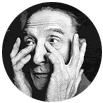
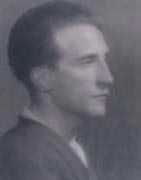
Figure 1
Marcel Duchamp
Who is this Marcel Duchamp?
“He neither talks nor looks, nor acts like an artist. It may be in the accepted sense of the word he is not an artist.”(15)
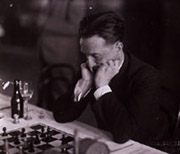
I think of Duchamp (Fig. 1) primarily as an intelligent deceiver. Most of the time he led us believe he was not doing art, as when he was playing chess. Cage commented on him: “All he did was go underground. He didn’t wish to be disturbed when he was working.”(16) In his ‘professional life’ Duchamp wanted to make his own way, accepting a certain isolation. It seems that he often enclosed himself in the solitude of his studio, not telling anybody of his artistic activities. In this way he made a real distinction between his life as artist and his social life. Duchamp wished to be an ‘invisible’ artist as he constantly pretended art did not play a crucial role in his life. He gave up art for chess, experimented with language, eluded us and well kept his mystery. Duchamp’s enigmatic silence led us to questioning and next to the analysis. His silence, among other things, caused curiosity and made him such an interesting character for the public. Joseph Beuys, however, interpreted his silence as ‘silence is absent’(17) and thus criticised Duchamp’s anti-art concept. He believed that Duchamp’s silence was overrated. Beuys’ statement probably also adverts to his giving up art for chess and writing. On the other hand, Beuys’ artistic goal had much in common with Duchamp’s–he also felt that the action of the artist was more important than the final product. Beuys, by using everyday materials such as fat and felt, also pivotally contributed to the blurring of the distinctions between art and life.
“It’s very important for me not to be engaged with any group. I want to be free, I want to be free from myself, almost.”(18)-Marcel Duchamp

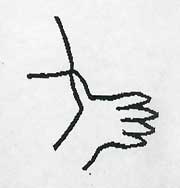
Figure 2
Marcel
Duchamp, Note of 1913
A note, written in 1913, (Fig. 2) reveals an interesting thought, which, in my mind turned out to be central in Duchamp’s artistic life: “Can one make works of art which are not works of art?”(19) As is known, he did make works of art which were up to that point not considered as such–however, he revolutionized the art concept at least for himself. Duchamp wanted art to be intelligent instead of aesthetic. It seems as if he wanted to escape art as practiced in his environment. Duchamp always distanced himself from mainstream artists or what he called “society painters.”(20) However, as we well know, his small, but controversial output exerted a strong influence on the development of the 20th century avant-garde art.
Duchamp was not only interested in art–but in many different areas such as literature, music, mathematics and physics which he tried to incorporate in his art. The fact that he was worrying about problems aside from art, in my mind made him a philosopher. And sometimes history teaches us that a philosopher is more successful than an artist who concentrates too much on art itself. Paradoxical as it may seem, Duchamp did not give up life for art but instead made his life a work of art by living and practicing anti-art. He was probably the first anti- respectively non-artist in history. In an interview he once remarked: “I am anti-artistic. I am anti-nothing. I am against making formulas.”(21) He denied himself as an artist. Some years later he interestingly revised his thoughts by saying that he
“became a non-artist, not an anti-artist…The anti-artist is like an atheist–he believes negatively. I don’t believe in art. Science is the important thing today. There are rockets to the moon, so naturally you go to the moon. You don’t sit home and dream about it. Art was a dream that became unnecessary.”(22)
Anti- or non-artist–in view of Duchamp’s often contradicting statements this question is beside the point. He questioned art as an institution. As Cage mentioned in his 26 Statements Re Duchamp, he “collected dust”(23) while other artists concentrated on being artists. Duchamp refused to lead a painter’s life as he refused to exhibit his works of art. In a letter to an artist fellow, he ironically responded (on the question if he wanted to take part in a public exhibition): “I have nothing to exhibit and, in any case the verb exposer (French word for exhibit) sounds too much like the verb épouser (to marry).”(24) Paradoxically, he did take part in numerous exhibitions of his time…duchamp the intelligent deceiver…Duchamp could obviously live comfor without creating artworks, but never ceased to be an artist of the mind.
Duchamp’s characteristic anti-position was not only expressed in art. Cage, in relation to this, commented: “Marcel was opposed to politics. He was opposed to private property. He was opposed to religion as is Zen. However, he was for sex and for humour.”(25) It seems that what Duchamp refused to do often carried as much significance as what he actually did.
“I am a réspirateur (breather). I enjoy it tremendously.”(26) -Marcel Duchamp
Duchamp had an ironic way of referring to himself in terms as lazy–as a réspirateur or breather–but in fact he was very efficient. In the interview with Cabanne he noted that he preferred breathing to working. When asked how artists manage to make their living, he answered “they don’t have to live. They simply breathe.”(27) According to Duchamp, every breath is itself an artwork without being visually recognizable. He did nothing against the rumour that he had stopped being an artist since the forties–while he was secretly working on Etant Donnés, his last masterpiece, for two decades. Apparently, Duchamp did not even induct his friends into his artistic secrets. Cage commented: “Of course, he was referring to the Etant Donnés, without my knowing that the work existed. He had two studios in New York, the one people knew about, and one next door to it, where he did his work, which no one knew about. That’s why people were able to visit his studio and see nothing going on.”(28) Duchamp managed well to deceive us.
At first sight, Duchamp seemed to be a confirmed anti-materialist. He rarely took a job as he viewed the bourgeois business of having a job and making money as a waste of time. In Paris he worked as a librarian for about two years only to escape from the artistic life there. When he came to America, he gave French lessons in order to bring in enough money to live on. Among his friends, Duchamp was well known for his economy regarding his garments. Cage, in this respect mentioned that Duchamp “was opposed to private property” and recalled the following story:
“Before he married Teeny, he went to visit her on Long Island. Bernard Monnier, her future son-in-law, went to meet Marcel at the station. He said. ‘Where is your luggage?’ Marcel reached into his overcoat pocket and took out his toothbrush and said. ‘This is my robe de chambre.’Then he showed Bernard that he was wearing three shirts, one on top of the other. He had come for a long weekend.”(29)
Art should not be mixed up with commerce(30), he said–although he could have easily made a fortune from Cubistic paintings. This attitude, however, did not prevent him from buying and selling works of art as a means to earn a living. After having read some of Duchamp’s letters in Affectionately Marcel, I got the impression that he was much more than just an art dealer because of existential reasons. His often dry diplomatic letters to Katherine Dreier and the Arensberg family do not sound much like Duchamp, the réspirateur and anti-materialist. “Budget. Enclose the figures on separate sheet: On one side what I received, on the other side the expenses (I have already paid many things or deposited advances). You will see that on account of the new price of the port-folios, I will be lacking 1221 francs in the end.”(31) Cage, in relation to this said that Duchamp was actually
“extremely interested in money. At the same time he never really used his art to make money. And yet he lived in a period when artists were making enormous amounts of money. He couldn’t understand how they did it. I think he thought of himself as a poor businessman (…) He couldn’t understand why, for instance Rauschenberg and Johns should make so much money and why he should not. But then he took an entirely different life role, so to speak. He never took a job.”(32)
Cage’s statement reveals interesting insights in view to Duchamp’s anti-materialistic attitude (which was of course not truly anti-materialistic) in view to art. Cage indirectly suggested Duchamp’s jealousy of other artists of his time. Without my aiming to give a pseudo-psychological comment, Duchamp apparently resigned making money from art as it did not work out for him. This (well pretended) notion of the anti-materialist fits perfectly into his role as the anti-artist and his withdrawal from painting and the art-world in general, and …it seems as if he once again managed well to deceive us. Duchamp’s self-contradiction must not confuse us, for it is as much one of his trademarks as deception.
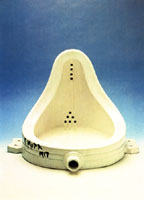
Duchamp tried to break with the traditional aesthetic predominance through provocation and irony. He thought that painting as a manual activity increasingly covered the true nature of art by overvaluing retinal aspects. With the invention of his readymades, Duchamp completely changed the direction of modern art. By declaring banal, everyday objects as works of art, he did not only desacrifice art in general, but also the artist himself. “Good taste is repetitive and means nothing else than the rumination of traditional forms of taste.”(33)This certainly meant a provocation for artists who felt related to an art movement such as the Cubists or Abstract Expressionists. Duchamp chose his readymades “on the basis of a visual indifference, and at the same time, on the total absence of good or bad taste.”(34) They were no longer created by the artistic skill, but by the mind and decision of the artist.
Duchamp wanted to break with art as a movement or constitution by turning away from naturalistic modes of expression and inventing his own symbols. Duchamp did not yearn to reach a large audience. Moreover, Marcel was prepared to be misunderstood by the public. He wished to make his own way, accepting a certain isolation: “In 1912 it was a decision for being alone and not knowing where I was going. The artist should be alone…Everyone for himself, as in a shipwreck.”(35) Duchamp, much in contrast to Cage, was never fond of working in a team. He preferred to be an outsider. This outsider role in view to his ‘job’ as an artist, however, must not be confused with the role he took in social life. Duchamp was often described as sociable by his artist fellows, and interviewers “marvelled at how easy it was to talk with Duchamp.”(36)
After a three-months stay in Munich in 1912, Duchamp noted:
“I was finished with Cubism and with movement–at least movement mixed up with oil paint. The whole trend of painting was something I didn’t care to continue. After ten years of painting I was bored with it–in fact I was always bored with it when I did paint, except at the very beginning when there was that feeling of opening the eyes to something new. There was no essential satisfaction for me in painting ever…anyway, from 1912 on I decided to stop being a painter in the professional sense. I tried to look for another, personal way, and of course I couldn’t expect anyone to be interested in what I was doing.”(37)
Apparently, Duchamp tried somehow to escape the traditional notion of being an artist. When Duchamp speaks of trend in relation to art, it sounds unusual as it is frequently associated with fashion. The public art world must have become too superficial and materialistic for him. He was not interested in art in the social sense. Duchamp felt more attracted to the individual mind as such, as he believed most artists were simply repeating themselves. He worked conceptually, putting art “in the service of the mind”(38), as he would say.
Cabanne:
“You were a man predestined for America.”
Duchamp: “So to speak, yes.”(39)
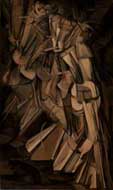
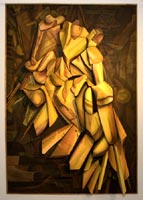
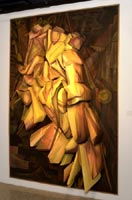
Things had to change. Duchamp, in a letter to his American friend Walter Pach expressed his dislike for the Parisian art milieu. “I absolutely wanted to leave. Where to? New York was my only choice, because I hope to be able to avoid an artistic life there, possibly with a job that would keep me very busy (…) I am afraid to end up being in need to sell canvases, in other words, to be a society painter.”(40) These lines express crucial reasons for his giving up life as an artist in the professional sense. Duchamp felt incompatible with the French art milieu and wished to escape the prison of tradition where the artist ended up in ‘producing’ paintings in order to earn his living. He felt a strong disapproval of meeting up with other artists. Paris bored him and represented everything he associated with tradition. Duchamp, at this point did not only break with the artistic ties but also with those of his home country. He fled to a country where “they didn’t give a damn about Shakespeare.”(41) His arrival in New York in 1915–Duchamp was 28 at that time–would prove the beginning of a new Duchampian era. By that time, he was already known in America, as his painting Nude descending a staircase caused a scandal at the famous New York Armory Show, an international exhibition of Modern art two years earlier. New York, in contrast to Paris, offered him a “feeling of freedom” and as he said he “loved the rhythm of this town.”(42)Duchamp and America turned out to be the perfect couple.
Duchamp obviously never felt part of an artistic group such as the Dadaists. Moreover, he constantly expressed his dislike for categorisation. From the very outset, he never aimed to describe objects or comment on painting. The more paradox I found the fact that, in most encyclopaedias, Duchamp is either associated with the Cubists or Dadaists. We must rethink the common notion of art in order to get involved with Duchamp. We must free ourselves from convention, categorisation and from -Isms. The following mesostic written by Cage expresses very well Duchamp’s ultimate artistic intention. He wrote it shortly after he had died.
The iMpossibility of TrAdition the loss of memoRy: To reaCh ThEse Two’s a goaL (43)
For those of you who nevertheless feel they have to look up Duchamp’s encyclopaedic biography–(I
am not keeping the secret) See next page.
that is idiotism: John Gillard, a friend, published postcards
with his thoughts–one of them read “There is only one
-ism and that’s a prism.” The idea to change it to ‘idiotism’
came after I was inspired by Kandinsky’s Essays on art and
artists. Kandinsky, like Duchamp often was in the centre
of interest in art criticism. One German art critic called him
the founder of a new art movement called “idiotism.”
whose small but controversial output exerted a strong influence on the development of 20th-century avant-garde art.
Born on July 28, 1887, in Blainville, brother of the artist Raymond Duchamp-Villon and half brother of the painter Jacques Villon, Duchamp began to paint in 1908. After producing several canvases in the current mode of Fauvism, he turned toward experimentation
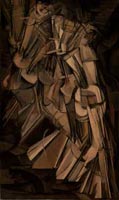
and the avant-garde, producing his most famous work, Nude Descending a Staircase, No. 2 (Philadelphia Museum of Art) in 1912; portraying continuous movement through a chain of overlapping cubistic figures, the painting caused a furor at New York City’s famous Armory Show in 1913. He painted very little after 1915, although he continued until 1923 to work on his masterpiece, The Bride Stripped Bare by Her Bachelors, Even (1923, Philadelphia Museum
of Art), an abstract work, also known as The Large Glass, composed in oil and wire on glass, that was enthusiastically received by the surrealists.
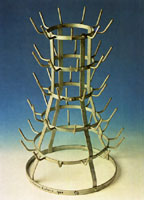
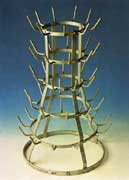
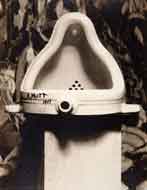
In sculpture, Duchamp pioneered two of the main innovations of the 20th century–kinetic art and ready-made art. His “ready-mades” consisted simply of everyday objects, such as a urinal and a bottle rack.
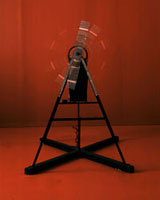
His Bicycle Wheel (1913, original lost; 3rd version, 1951, Museum of Modern Art, New York City), an early example of kinetic art, was mounted on a kitchen stool.
After his short creative period, Duchamp was content to let others develop the themes he had originated; his pervasive influence was crucial to the development of surrealism, Dada, and pop art. Duchamp became an American citizen in 1955. He died in Paris on October 1, 1968.(44)
####PAGES####
3. Silent biography Introduction to John Cage
I thought that the best introduction to John Cage would be an ‘incomplete’ or ‘imperfect’ mestostic. ‘Incomplete’ as I would like to leave enough space for thoughts. Cage described his mesostic technique as follows:
“Like acrostics, mesostics are written in the conventional way horizontally, but at the same time they follow a vertical rule, down the middle not down the edge as in an acrostic, a string spells a word or name, not necessarily connected with what is being written, though it may be. This vertical rule is lettristic and in my practice the letters are capitalized. Between two capitals in a perfect or 100% mesostic neither letter may appear in the lower case. In the writing of the wing words, the horizontal text, the letters of the vertical string help me out of sentimentality. I have something to do, a puzzle to solve. This way of responding makes me feel in this respect one with the Japanese people, who formerly, I once learned, turned their letter writing into the writing of poems (…)”(45)
My mesostics follow a vertical line while the horizontal words consist of different quotations by Cage. Quotations which, in the case of Cage, contain a stronger message than an encyclopaedic biography. Respecting Cage’s ideas such as experience, silence and non-teaching, I would like to leave the reader with the following mesostic. In order to make it easier to identify Cage’s thoughts, I used different type faces. To my astonishment, I found out later that Cage, as a consequence of dealing more and more with the media, also used various font types in various chapters of his book A Year from Monday. In the first chapter,Diary: How to improve the world (you will only make matters worse) 1965, Cage made use of twelve different type faces, letting chance operations determine which face would be used for which statement.
“As far as COnsistency Of I aM here and ThERe is iS NothING To say L SPACE FOR YOUR THOUGHTS SIMPLY GOES HARMONY WEARE PREFER EVERYTHING IS PERMITTED INCONSISTENCY UNCUSTOMED ZERO IS THE BASIC THOUGHT WE NEED NOT FEAR THESE SILENCES.”
Cage, John Milton, Jr. (1912-92), American composer, who had a profound influence on avant-garde music and dance. Born September 5, 1912, in Los Angeles, he studied with the American composers Henry Cowell and Adolph Weiss and the Austrian-born composer Arnold Schoenberg. In 1942 he settled in New York City. Influenced by Zen Buddhism, Cage often used silence as a musical element, with sounds as entities hanging in time, and he sought to achieve randomness in his music. In Music of Changes (1951), for piano, tone combinations occur in a sequence determined by casting lots. In 4’33” (1952), the performers sit silently at instruments; the unconnected sounds of the environment are the music. Like Theatre Piece (1960), in which musicians, dancers, and mimes perform randomly selected tasks, 4’33” dissolves the borders separating music, sound, and nonmusical phenomena. In Cage’s pieces for prepared piano, such as Amores (1943), foreign objects modify the sounds of the piano strings. Cage wrote dance works for the American choreographer Merce Cunningham. His books include Silence (1961), Empty Words (1979), and X (1983).(46)
To refer back to Cézanne’s quotation at the beginning of this chapter–Duchamp proposes the work of art as an independent creation, brought into being a joint effort by the artist, the spectator, and the unpredic actions of chance–a freer creation that its very nature, may be more complex, more interesting, more original, and truer to life than a work that is subject to the limitations of the artist’s personal control.
####PAGES####
4. Passionate encounters Johnand Marcel
click to enlarge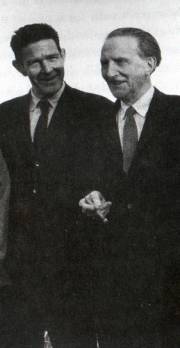
Figure 3
Photograph
of
Duchamp and Cage
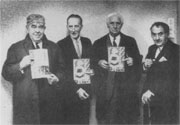
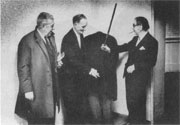
John Cage’s and Marcel Duchamp’s (Fig. 3) ways first crossed in 1942. Duchamp, as many European artists, spent the war years in New York. They met in famous Hale House, home of Peggy Guggenheim and Max Ernst which was then well known as the meeting place for European artists in exile. 30 year-old Cage, originally from Los Angeles was invited by his artist-friend Max Ernst to stay in Hale House. When, after a short period, Peggy informed Cage and his wife Xenia who were penniless at the time, to move out of Hale House, Cage “retreated through the usual crowd of revellers until he came to a room that he thought was empty, where he broke down in tears. Someone else was there, though, sitting in a rocker and smoking a cigar. It was Duchamp.” Cage mentioned that “he was by himself, and somehow his presence made me feel calmer. Although I could not recall what Duchamp said to me, I thought it had something to do with not depending on the Peggy Guggenheims of this world.”(47)
Their first encounter reveals interesting aspects of their prospective friendship. Duchamp, the cool smoking type, sitting in a room all by himself, mumbling something amusingly at a desperate stranger. “He had calmness in the face of disaster”(48), Cage said later. Duchamp could not so easily be disconcerted. The odd encounter scene between Duchamp and Cage somehow conveys Duchamp’s inclination to indifference. Years after they had first met each other, Cage noted in his 26 Statements Re Duchamp: “There he is, rocking away in that chair, smoking his pipe, waiting for me to stop weeping.”(49) Cage obviously experienced Duchamp’s cool indifference first-hand.
Cage, in many interviews, mentioned his friend’s sense for wittiness. As he told Moira Roth, Duchamp was paradoxically “very serious about being amused and the atmosphere around him was always one of entertainment.” He further remarked that “we get to know Marcel not by asking him questions but by being with him.”(50) The reason why Cage did not want to disturb him with questions was that he then would have had Duchamp’s answer instead of his personal experience. Indeed, the concept of experience, deriving from Zen Buddhism, is central in Cage’s philosophy and should not merely be considered in context of his music. He believed that experience, in most respects, was more significant than understanding. It seems that Cage rather wanted to let things happen when spending time with Duchamp. This philosophy has much in common with Cage’s notion of ideal education, but also with his idea of silence and chance in music. Cage was amazed “at the liveliness of Duchamp’s mind, at the connections he made that others hadn’t (…).”(51) These words undoubtedly give evidence of a unbroken Duchamp admirer. When asked what artist had most profoundly influenced his own work, Cage regularly cited Marcel Duchamp.
Duchamp, on the other hand, fondly spoke of Cage as someone full of lightness. “He has a cheerful way of thinking. Not ingeniously (…) He is not acting like a professor or schoolmaster.”(52) I believe that Duchamp did not either want to appear like a schoolmaster, but the respect many people showed towards him, naturally made him less affable. Duchamp, as a consequence of his voluntary artistic isolation, stroke others as aloof.
“Had Marcel Duchamp not lived, it would have been necessary for someone exactly like him to live, to bring about, that is, the world as we begin to know and experience it.”(53) -John Cage
Cage’s respect for Duchamp had blossomed into a sporadic, yet close friendship. In his introduction to 26 Statements Re Duchamp, Cage noted that due to his view “he felt obliged to keep a worshipful distance.”(54) Duchamp’s often mentioned aloof character must have initially had an impact on their friendship. Following Cage’s remarks preceding his 26 Statements, his admiration must have led to dubitation concerning Duchamp. It seems as if he was inapproachable to Cage:
“Then, fortunately, during the winter holidays of ’65-’66, the Duchamps and I were often invited to the same parties. At one of these I marched up to Teeny Duchamp and asked her whether she thought Marcel would consider teaching me chess. She said she thought he would. Circumstances permitting, we have been together once or twice a week ever since, except for two weeks in Cadaqués when we were every day together.”(55)
Cage’s memories leave the impression as though he had long waited for an occasion to ask Duchamp teaching him chess. He later told Calvin Tomkins that Marcel’s quiet way often gave him the feeling that he did not want attention, “so I stayed away from him, out of admiration.”(56) In contrast, it is hard to imagine Duchamp in the role of the passionate admirer. Duchamp rarely spoke about artists that he thought influenced or inspired him. He soon disengaged himself from a model once he grasped it. However, in the case of Raymond Roussel, a writer whose piece Impressions d’Afrique “greatly helped him on one side of his expression”, Duchamp made an exception: “I felt that as a painter it was much better to be influenced by a writer than by another painter. And Roussel showed me the way.”(57)Duchamp found his models less in art than in literature. He was on the way to erase the borders between different arts.
Duchamp, more than Cage, was the type of artist who, due to his mixture of charm and extravagant aloofness, seduced his admirers into an uncritical adulation of his art. He had more of the cool, indifferent type of character who sometimes preferred not to be understood. Though Cage and Duchamp are often discussed in terms of the same artistic circle–along with Jasper Johns and Robert Rauschenberg, their characters appeared to be quite different. Duchamp’s indifference among other things served to keep others from getting to close. I can only to some extent agree with Tomkins who wrote in this respect that “his lack of passionate attachments seemed rather to make him more lighthearted, more alert to everything, and less competitive than others.”(58) Someone who is equally passionate about gathering mushrooms and writing ambitious philosophical texts is in my mind more lighthearted than a professional chess player.
click to enlarge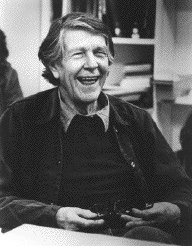
Figure 4
John Cage
Cage’s sometimes amusing humbleness expressed in his interviews give evidence of his joyful character and his sense of humour (Fig. 4). As Anne d’Harnoncourt, one of Cage’s favourite scholars wrote, he was indeed a delight to observe observing. “Surveying the ground as he walked in a wet field, he found mushrooms; listening to a roomful of silence, he heard his blood circulate in his veins; concentrating on a game of chess, he enjoyed a nearby waterful.”(59) Cage’s interviews, I am thinking in particular of Musicage with Joan Retallack, are interspersed with laughter. Listening to Laughtears–a conversation on Roaratorio, it is not unduly to assert that both the interviewer and Cage laughed their heads off.(60) Though both Cage and Duchamp are frequently described as humorous, Cage’s optimistic and sometimes self-ironic personality probably made him more approachable:
“In connection with my current studies with Duchamp, it turns out I’m a poor chess player. My mind seems in some respect lacking, so that I make obviously stupid moves. I do not for a moment doubt that this lack of intelligence affects my music and thinking generally. However, I have a redeeming quality: I was gifted with a sunny disposition.”(61)
Isn’t it wonderfully amusing to find someone as Cage philosophising about his ‘lack of intelligence’? Duchamp appeared to be more amusing than humorous as a contemporary described him “(…) His blunders are laughable, but he laughs long before you do; as a matter of fact, you laugh at his amusement, not at him.”(62)After having read parts of Duchamp’s letters and interviews, I must add that I found him very amusing. However I would cagely say that his nature of humour was more subtle and black than Cage’s. Duchamp enshrouded himself in a cloud of mystery. After having finished this chapter you will understand what Cage wanted to express by the following mesostic in memory of Duchamp:
Don’t YoU ever want to win? (impatienCe.) How do you mAnage to live with Just one sense of huMor? She must have Persuaded him to smile.(63)
click to enlarge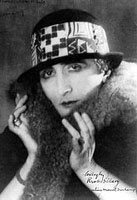
Figure 5
Marcel
Duchamp, Rrose
Sélavy by Man Ray,
1921
As already mentioned in the last chapter, Duchamp was a convinced anti-artist. This attitude was expressed by the adoption of various ‘roles’ such as ‘Duchamp, the dandy’ or ‘Duchamp, the chess player.’ As Roth already wrote in her essay Duchamp in America, Duchamp could be described as a dandy who, as Baudelaire once put it, was obsessed with a “cult of self who used elegance and aloofness of appearance and mind as a way of separating himself from both an inferior external world, and from overt pessimistic self-knowledge.“(64)His dandy appearance also found expression in his ‘roles’ …duchamp the intelligent deceiver… such as Rrose Sélavy (Fig. 5), a self-made, female image inhabiting the idea of an artist-substitute for Duchamp. There is nothing particular in taking on another name – many artists still do. However, he could not so easily take on another sex. Duchamp’s enacted deception was meant as a word play: “(…) Much better than to change religion would be to change sex …Rose was the corniest name for a girl at that time, in French anyway. And Sélavy was a pun on c’est la vie.(65) Duchamp, wearing a seductive fur dressed up as a female and posed for Man Ray’s camera. Rrose Sélavy clearly is the product of an artist who managed to deceive us more than once. After all, he left no indication he was a homo or transsexual.
The most famous role Duchamp however adopted was that of the chess player which again showed himself as the anti-artist. Both Cage and Duchamp devoted much of their energy to playing chess. Duchamp, however, was the more obsessive player. How addicted to chess must one be to neglect one’s bride by spending day and night playing chess during honeymoon? For Duchamp, chess apparently also served as a way to distract himself. Duchamp’s first wife, Lydie, was said to become such annoyed by her groom solving chess problems one night that she got up and glued the pieces to the board.(66) During his 9-months stay in Buenos Aires, Duchamp wrote to a friend: “I feel I am quite ready to become a chess maniac (…) Everything around me takes the shape of the Knight or the Queen and the exterior world has no other interest for me other than in its transformation to winning or losing positions”(67)
For Cage, the goal of winning was clearly beside the point. His motto could be compared to that of the Olympic athletes, “taking part means everything”, under the premise of Duchamp as the antagonist. He was interested in the Buddhist notion of letting things happen, especially when spending time with Duchamp. Cage could apparently confirm Duchamp’s chess addiction – in his interview with Roth he remembered one game of chess where Duchamp got quite angry with him and ‘accused’ him of not wanting to win:
“The only time he disturbed me was once when he got cross with me for not winning a game of chess. It was a game I might have won; then I made a foolish move and he was furious. Really angry. He said ‘Don’t you ever want to win?’ He was so cross that he walked out of the room, and I felt as though I had made a mistake in deciding to be with him–we were in a small Spanish town–if he was going to get so angry with me.”(68)
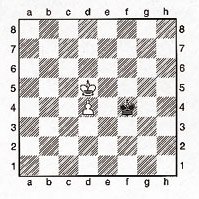
Duchamp was an excellent chess player, who, in the role of the tireless thinker even made it to the French national team. After his immigration to the United States, Duchamp was ranked among the top twenty-five chess players in the twenties and thirties. In 1932, he published a chess book titled Opposition and Sister Squares Are Reconciled which was devoted “to a very rare situation in the end game, when all the pieces have been captured except for the opposing kings and one or two pawns on each side.”(69) The book gives evidence of Duchamp’s mathematical gift. Cage, on the other hand, used his mathematical ambitions for chance operations in music.
Duchamp and Cage spent more and more evenings together playing chess. “I saw him every night, four nights in a row,“(70) Cage recalled. What did they do when they were not indulged in their passion? It is certain that they were not talking about each other’s work, according to Cage’s interview with Moira Roth.(71) Meanwhile, they were rather ‘experiencing’ each other simply by spending time together. Cage, rather humble in his statements, often admired his friends’ genius for chess:
“I rarely did (play chess), because he played so well and I played so poorly. So I played with Teeny, who also played much better than I. Marcel would glance at our game every now and then, and in between take a nap. He would say how stupid we both were. Every now and then he would get very impatient with me. He complained that I didn’t seem to want to win. Actually, I was so delighted to be with him that the notion of winning was beside the point. When we played, he would give me a knight in advance. He was extremely intelligent and he almost always won. None of the people around us was as good a player as he, though there was one man who, once in a blue moon would win. In trying to teach me how to play, Marcel said something which again is very oriental, ‘Don’t just play your side of the game, play both sides.’ I tried to, but I was more impressed with what he said than I was able to follow it.”(72)
click to enlarge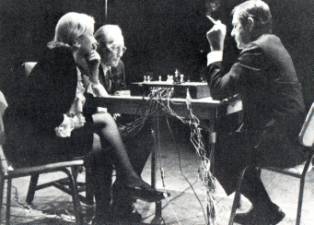
Figure 6Photograph
of Reunion
performance, 1968
For Cage, chess apparently served as a pretext to spend time with Duchamp. In 1968, the year of Duchamp’s death, Marcel and his wife were invited to take part in a musical event entitled Réunion by John Cage (Fig. 6). Cage’s idea behind thishappening was that, in his mind, chess contained a finality in itself, as its goal was to win. Cage thus wanted to alienate the game from its ‘purpose’ by distributing sound sources each time movements took place on the chess board. He noted that “the chess board acted as a gate, open or closed to these sources, these streams of music (…). The game is used to distribute sound sources, to define a global sound system, it has no goal. It is a paradox, purposeful purposelessness.”(73) The event consisted of Cage and Duchamp (and later Cage and Teeny) playing chess on stage on a board that had been equipped with contact microphones. Whenever a piece was moved, it set off electronic noises and images on television screens visible to the audience. Cage’s alienation of the chess game from its original purpose is an interesting concept in view to both Duchamp’s and Cage’s understanding of art. Alienation indeed played a crucial role in both artists’ lives. I am thinking now in particular of Duchamp’s readymades and of Cage’s Prepared Piano. Duchamp later amusingly recounted the chess event: “It went very well, very well, it began about eight-thirty. John played against me first, then against Teeny. It was very amusing.” Asked whether there was any music, he replied “Oh yes, there was a tremendous noise.”(74)
Chess brought in no money for Duchamp, but provided richer satisfaction. After all, he was aréspirateur. But why chess? When I learned how to play chess at about 14, I was fascinated about it and eagerly taught it some of my friends. However, I never aimed to perfect it, to rack my brain endlessly about possible combinations. A friend of mine is a passionate chess player and I was quite curious what he found so fascinating about it. He spontaneously answered: “Chess is completely different from other games–it has nothing to do with chance or luck.” I found this statement quite interesting in respect to Duchamp’s use of artistic tools–chance was not only typically Cagean, but in fact used by Duchamp in his music pieceErratum Musical already in 1912, the year Cage was born.(75) For both artists, chance functioned as a means to escape from tradition, taste and conscious intentions. Thus it appears that chess stood in strong contrast to various methods and ideas both Cage and Duchamp used in art. An instinctive compensation? Cage, according to an interview, was interested in mushrooms and chess as a compensation for his concern with chance.(76) This was apparently also true for Duchamp–after all he was well aware of the contradiction between chess and art: “The beautiful combinations that chess players invent–you don’t see them coming, but afterward there is no mystery–it’s a pure logical conclusion. The attitude in art is completely different, of course; probably it pleased me to oppose one attitude to the other, as a form of completeness.”(77)On the other hand, Duchamp believed that art and chess were in fact closer to each other than they seemed. He thought that the game had a visual and imaginative beauty that was similar to the beauty of poetry. Duchamp ended his remarks by saying that “from my close contact with artists and chess players, I have come to the personal conclusion that while all artists are not chess players, all chess players are artists.”(78) When Cage asked Duchamp to write something in his book on the end game, he wrote: “Dear John, Look out! Another poisonous mushroom.”(79) Chess and mushrooms were obviously opposed to the chance operations both Cage and Duchamp used in their art.
What immediately came to my mind when I heard about luck in the course of the chess conversation with my friend, were some thoughts Duchamp wrote to his sister’s husband Jean–on the enquiry, what Duchamp thought about one of his works of art:
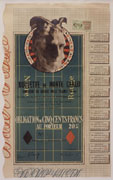
“Artists throughout the ages are like Monte Carlo gamblers and the blind lottery pulls some of them through and ruins others (…) It all takes place at the level of our old friend luck. Artists who, in their own lifetime, have managed to get people to value their junk are excellent salesmen, but there is no guarantee as to the immortality of their work. And even posterity is a terrible bitch who cheats some and reinstates others, and reserves the right to change her mind again every 50 years.”(80)
This statement carries a touch of resignation. Duchamp believed that artistic luck had nothing to do with real genius. According to him, “a good artist is just a lucky guy, that’s all.” It seems that Duchamp refused to take part in the ‘artistic lottery’, in the useless competition between artists. Chess, in contrast, justly rewarded those who had a real talent. His passion required him to ‘work hard’ in order to win. Duchamp apparently forgot about his self-made image of the réspirateur when sitting in front of a chess board.
I found it interesting to observe that both Cage and Duchamp had obsessions which cannot immediately be connected to art. Duchamp did not exclusively devote his life to art, as did Cage not concentrate merely on music. The former had a passion for chess, the latter for mushrooms and cooking. Cage was aware of the fact that many people criticised him for not devoting his life to music utterly. When he began his studies with Schönberg, he told his teacher that could not afford the price. Schönberg then asked him if he would devote his life to music and Cage’s answer was “yes.”(81) But–why devoting one’s life to art respectively music if all areas are interrelated? Cage, in this respect said that “I still think I’ve remained faithful. You can stay with music while you’re hunting mushrooms(…)”(82) Both Duchamp and Cage expanded the notion of art into areas which were up to that time clearly separated from art itself. Chess cannot be simply regarded as a pastime for Duchamp, as Cage’s mushrooms and cooking passion were not merely an amusement. They did not only function as a counterbalance to their work as artists. Instead, they were integrated within their thinking and philosophy. Both artists transposed the idea of blurring the distinctions between art and life simply by their way of life. A female friend of Cage interestingly reflected on him:
“The months that followed, which extended into years, afforded me close proximity to both the man and his work. What I came to see was that there was very little difference between the two. That is Cage cooking was Cage composing was Cage playing chess was Cage shopping was…You get the picture. All of his daily activities, from the most sublime to the most mundane, were equally infused with a kind of mindful detachment.”(83)
The way Cage devoted himself to an ‘ordinary business’ such as mushrooms and cooking, is certainly remarkable. Much of his experimental writing and also music was dedicated to his mushroom passion. It seems that whatever Cage experienced in his daily life became raw material for his art. Many of his elaborate remarks in A Year from Monday rather reminded me of an affectionate cook. As in the second part of his Diary: How to Improve the World, where he wrote: “After getting the information from a small French manual, I was glad to discover that Lactarius piperatus and L. vellereus, large white mushrooms growing plentifully wherever I hunt, are indeed excellent when grilled. Raw, these have a milk that burns the tongue and throat. Cooked, they’re delicious. Indigestion.”(84)
Similar to Beuys, who worked with felt, fat and cloth after these materials saved his life after an aircrash, Cage’s interest in mushrooms originated from necessity during the World Depression. He then solely lived on mushrooms for one week and after this experience decided to occupy with them intensely. According to Cage, much could be learnt from music by devoting oneself to the mushroom. “It’s a curious idea perhaps, but a mushroom grows for such a short time and if you happen to come across it when it’s fresh it’s like coming upon a sound which also lives a short time.”(85)Cage found many parallels between mushrooms and music. However, he was well aware of the fact that his mushroom passion, like chess, was in fact in conflict to his idea of chance in music. To leave it to chance whether to eat a mushroom or not could after all end fatal. Mushroom growth is not even determined by chance. They are rather choosy–grow on wet grounds only. Like Duchamp, Cage published a book on his passion in cooperation with two other mycologists. And – surprisingly, he did make money with his mushroom passion. Cage once appeared on an Italian show as mushroom expert and won 6000 US dollars by answering ‘mushroom questions’ correctly (86)
Mushrooms fired Cage’s imagination. His idea was that everything on earth should be audible because of vibration–including mushrooms. “I’ve had a long time the desire to hear the mushroom itself, and that would be done with a very fine technology, because they are dropping spores and those spores are hitting surfaces. There certainly is sound taking place.”(87)Proceeding on this assumption, he made explorations on which sounds further the growth of which mushrooms. Besides being one of the founders of the Mycological Societyin New York, Cage taught a course called ‘Mushroom Identification’ at the NY School for Social Research. One lecture he held dealt with the ‘sexuality’ of mushrooms:
“We had invited a specialist from Connecticut, who had cultivated a certain species of mushroom, a Coprinus, in very large quantities to study their sex. In his lecture, he taught us that the sexual nature of mushrooms wasn’t so very different from that of human beings, but that it was easier to study. He explained that there are around eighty types of female mushrooms and around one hundred and eighty types of males in one species alone. Some combinations result in reproduction, while others do not. Female type 42, let’s say, will never reproduce with male type 111, but will with certain others. That led me to the idea that our notion of male and female is an oversimplification of an actually complex human state.”(88)
Would you have thought of mushrooms in terms of female and male? I would not and besides enjoying myself immensely, I am continually amazed at Cage’s affectation of details. He had an extraordinary ability to exploit these new insights and incorporate them into his artistic thinking. And yet at the same I am asking myself how one can possibly have such a playful mind in order to connect sounds with mushrooms…I wonder if Cage was aware of his mushroom passion as something which many people would simply consider absurd if they did not study him thoroughly. To my astonishment I found the answer on the very last page of Cage’s first book Silence. Cage’s thoughts prove that he was hardly someone worldly innocent.
“In the space that remains, I would like to emphasize that I am not interested in the relationships between sounds and mushrooms any more than I am in those between sounds and other sounds. These would involve an introduction of logic that is not only out of place in the world, but time-consuming. We exist in a situation demanding greater earnestness, as I can testify, since recently I was hospitalised after having cooked and eaten experimentally some Spathyema foetida, commonly known as skunk cabbage. My blood pressure went down to fifty, stomach was pumped, etc. It behoves us therefore to see each thing directly as it is, be it the sound of a tin whistle or the elegant Lepiota procera.”(89)
“Isn’t cooking all about mixture and letting individual flavours hold our attention?”
-Anne d’ Harnoncourt
In the late 70s, Cage, after serious health problems, began a macrobiotic diet on the advice of John Lennon and Yoko Ono(90). The idea of the macrobiotic diet is to make a shift from animal fats to vege oils. What fundamentally distinguishes the macrobiotic diet from other health programs is that, rather than consisting of a fixed list of foods to be consumed or avoided, it provides a structure which applies to the whole range of available choices, an orientation which many adherents of the diet extend to a whole cosmology. For Cage, macrobiotics undoubtedly meant more than just cooking or eating. However, he did not take the diet too seriously–he used herbs and spices which he enjoyed. In the short introduction to his macrobiotic recipe collection in his Rolywholyover – A Circus Box, Cage wrote: “The macrobiotic diet has a great deal to do with yin and yang and from finding a balance between them. I have not studied this carefully. All I do is try to observe whether something suits me or not.”(91) Strictly following a recipe would not sound much like Cage–reading his recipes for chicken or beans indeed sound a bit like his notations in music–they allow enough room for the performer’s interpretation.
Cage’s discovery of macrobiotics is no coincidence–with its oriental origin and its application of yin and yang, the macrobiotic diet fits in very well with both Zen and with the temperament of Cage. He believed he had already been affected by the ideas of the diet before he actually started it: “I accepted the diet you might say aesthetically before I accepted it nutritionally.”(92) As Harnoncourt’s interesting quotation (“Isn’t cooking all about mixture and letting individual flavours hold our attention?”) suggests, cooking has a great deal to do with music where individual sounds hold our attention. After studying Cage, I cannot suppress the impression that he could have utilized all daily activities in his art. Cage’s kitchen probably was one big sound studio:
“In all the many years which followed up to the war, I never stopped touching things, making them sound and resound, to discover what sounds they could produce. Wherever I went, I always listened to objects. So I gathered together a group of friends, and we began to play some pieces I had written without instrumental indications, simply to explore instrumental possibilities not yet catalogued, the infinite number of sound sources from a trash heap or a junk yard, a living room or a kitchen…we tried all furniture we could think of.”(93)
Cage was astonished by the positive results of the macrobiotic diet. “Your energy asserts itself the moment you wake up at the beginning of the day. It remains constant. It doesn’t go up and down, it stays level, and I can work much more extensively. I always had a great deal of energy, but now it is extraordinary. At the same time,” he added, “I’m much more equable in feeling; I’m less agitated.”(94) His improvement so amazed him that he kept up the diet from that time onwards and frequently recommended it in interviews:
“Now, however, after, say, four years of following the macrobiotic diet, my health has so greatly improved that I would seriously advise almost anyone who would lend me an ear to make a shift in diet from animal fats to vege oils, to exclude dairy products and sugar, to ‘choose’ chicken only if it actually is a chicken, that is, free from injected hormones, agribusiness, etc., to eat fish, beans and whole grains, nuts and seeds, and vege s with the exception of theSolanaceae (potatoes, tomatoes, egg-plant, and peppers)”(95)
Macrobiotics also inspired Cage to a growing concern with nature and ecological matter. Big business and agribusiness, he stressed, damage our meat, vege and water supplies. Food which he mostly advised in special books of recipes include proper preparations for brown rice, zucchini, beans and chicken. In connection with the museum project calledRolywholyover Circus(96), John Cage published various macrobiotic recipes. Four of them I will include at the end of this chapter.
“I try to discover what one needs to do in art by observations from my daily life. I think daily life is excellent and that art introduces us to it and to its excellences the more it begins to be like it.”(97) –John Cage
Cage’s devotion to macrobiotics and mushrooms are interesting insofar, as they once again witness his contribution to the blurring of the distinction between art and life. As already suggested, Cage’s passions cannot be simply regarded as pastimes or, as in the case of cooking, in the context of a human necessity–though Cage began his macrobiotic diet on medical grounds, thus out of a necessity. We certainly do not get past spending time to prepare our daily food–nevertheless it is a question of how we deal with those daily routines. Cooking was as much a part of Cage’s life as composing music and poetry. Once Cage managed the shift from ordinary cooking to macrobiotics, he consciously devoted more time to what can be called the ‘act of cooking.’ This is at least the impression he left behind in his elaborate recipe descriptions. As Kuhn wrote in her essay, it was hard to distinguish Cage from his work: “Cage cooking was Cage composing was Cage playing chess was Cage shopping was…”
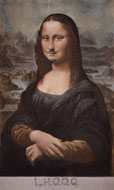
Cage, in contrast to Duchamp, frequently made his friend the theme in his writings as well as music. Cage’s ‘homages to Duchamp’ give evidence of the importance of this friendship for him. In his book, A Year from Monday he dedicated 26 Statements on Re Duchamp to his artist friend. The Statements are among other things Cage’s reflections on Duchamp’s artistic methods: “The check. The string he dropped. The Mona Lisa. The musical notes taken out of a hat. The glass. The toy shot-gun painting. The things he found. Therefore, everything seen–every object, that is, plus the process of looking at it–is a Duchamp.”(98)Cage continued his reflections on Duchamp in the second and third part of his Diary: How to Improve the World. In the late 40s, Cage wrote the music for a Duchamp sequence in Hans Richter’s famous avant-garde film Dreams that Money Can Buy. The song is called Music for Marcel Duchamp. In his M–writings ’67-’72, Cage composed several mesostics in memory of Marcel. The following mesostic was written shortly after Duchamp’s unexpected death in 1968. Cage remarked, “it was a loss I didn’t want to have.”(99)
click to enlarge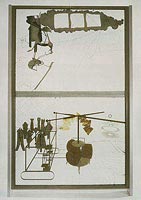
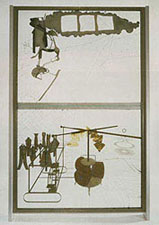
Figure 7
Marcel Duchamp,
The Bride Stripped
Bare by Her Bachelors, Even,
1915-23
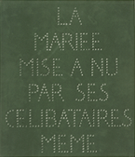
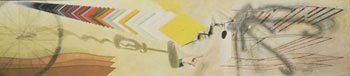
Undoubtedly, Duchamp’s work and philosophy lived on in the work of John Cage – as in the case of his visual work titled Not Wanting to Say Anything about Marcel (1969). The work consists of a Plexiglas field on which one may find letters and fragments of words. Anne d’Harnoncourt wrote about it that “Cage characteristically sought to maintain both multiplicity and transparency by setting eight sheets of clear plastic printed with words in stands so that the viewer peered through them; and if he wasn’t careful, his gaze passed beyond them.”(101) The work is indeed very reminiscent of Marcel Duchamp’sLarge Glass (Fig. 7). As the title suggests, Cage did not want to say anything about his artist friend and thus subjected words to chance operations. He possibly wanted to leave the spectator with language fragments in order not to take him in completely. There is no point in attempting to ‘resolve’ Not Wanting to Say Anything about Marcel. I believe it is a homage to a very good friend.
Another interesting work which Duchamp apparently inspired him to, was the box which I already mentioned in connection with his macrobiotic recipes. Duchamp, in his artwork called Boite, gathered together small reproductions of his artworks unbound in boxed form rather than in an album or a book. So did Cage: Rolywholyover – A Circus is a reflecting box which was designed in consultation with Cage himself. The publication accompanied with a major exhibition at The Museum of Contemporary Art Los Angeles conceived of by Cage as a “composition for museum.” The box is an artwork fully in keeping with his philosophy. It contains a wide range of materials, printed in different formats–such as reprints of texts that Cage found useful and inspiring. The texts can be read in any order. The box also includes reproductions of works by Cage, musical scores, recipes, advice on healthy eating and photography. As Cage said in discussing the box,
“The world is vast, give the impression that the materials are endless.”(102) -John Cage
Despite Cage’s intense occupation with Duchamp, he always remained a somehow mysterious mind. In the foreword to his alphabet in X-writings ’79-’82, Cage reflected on Satie, Joyce and Duchamp–three artists who greatly inspired him. Cage is quite explicit about his ‘goals’ in respect to those three artists–namely that he is not interested in ‘understanding’ in the sense of giving ultimate answers. His humbleness nevertheless gives evidence of an exceptional bright and free mind. In relation to Joyce’s masterpieceFinnegan’s Wake he wrote:
“When I was in Ireland for a month last summer (…) many Irishmen told me they couldn’t understand Finnegan’s Wake and so didn’t read it. I asked them if they understood their own dreams. They confessed they didn’t. I have the feeling some of them may now be reading Joyce or at least dreaming they’re reading Joyce. Adaline Glasheen says: ‘I hold to my old opinion. Finnegan’s Wake is a model of a mysterious universe made mysterious by Joyce for the purpose of striking with polished irony at the hot vanity of divine and human wishes.’ And she says: “Joyce himself told Arthur Power, ‘What is clear and concise can’t deal with reality, for to be real is to be surrounded with mystery.’ Human kind, it is clear, can’t stand much reality. We so fiercely hate and fear our cloud of unknowing that we can’t believe sincere and unaffected, Joyce’s love of the clear dark–it has got to be a paradox….an eccentricity of genius.”(103)
I was impressed by Joyce’s quotation–for reality is indeed often mysterious and inexplicable. In Cage’s interview on his Roaratorio–An Irish Circus on Finnegan’s Wake, Cage remarked that “Joyce didn’t mean Finnegan’s Wake to be understood, he meant it to be a piece of music.”(104) We tend to question everything which is unfamiliar with. Asking questions is one thing but expecting precise answers is another. In relation to Duchamp, Cage thought that asking him questions was the wrong tactic. He had no special intentions when spending time with him. I believe that we can learn a lot from Cage when trying to study Duchamp. Asked on how Cage would circumscribe his friendship with Duchamp, he answered:
“If, for instance, you go to Paris and spend your time as a tourist going to the famous places, I’ve always had a feeling you would learn nothing about Paris. The best way to learn about Paris would be to have no intention of learning anything and simply to live there as though you were a Frenchman. And no Frenchman would dream of going to, say, Notre Dame.”(105)
Nevertheless, there remained a hermetic aspect of Duchamp’s work. Cage once spoke to Marcel’s wife, Teeny Duchamp about this: “I said, ‘You know I understand very little about Marcel’s work. Much of it remains very mysterious to me.’ She answered “It does to me, too.”(106) We must be satisfied with what we are offered by Duchamp–otherwise we will end in a never ending helix. John and Marcel simply enjoyed each other’s presence, without much talking about their work. In order to contribute something to your enjoyment – my suggestion is that you try Cage’s Roast chicken before you continue with the next chapter. In case you are not hungry you will enjoy reading them.
‘Passionate encounters’, this chapter’s motto, is dedicated to the personalities of both Cage and Duchamp as well as their friendship – a friendship which was very much formed by their passions. Though chess initially functioned as a pretext for Cage to spend time with Duchamp, it became an important and enjoyable common amity experience. While writing about chess, I found many parallels in Cage’s passions repertoire and thus tried to examine it also in view to the central notion of the essay–the blurring of the distinction between art and life. Moira Roth’s interview with John Cage has helped me a lot to get an insight into their nature of friendship. However, this only gives a one-side impression and as Duchamp’s documented statements on Cage were comparatively rather rare, it is far from completing the puzzle. I am writing this with the humble precaution of a historian who was taught to take all possible historical resources into account.
As I am writing these lines, my thoughts lead me to Duchamp, the perpetual intelligent deceiver. I am thinking of the Duchamp who was never willing to give away too much. While listening to the last beats of Cage’s Music for Marcel Duchamp I am constantly reminded of the Duchamp who managed well to surround himself with mystery. One should be a clairvoyant rather than a historian.
Recipes À LA JOHN CAGE
“Cage’s scores for music, scores for prints, recipes for chicken, all exist for realization by the artist in real time, and he invited his audience (or his dinner guests) to realize that listening, cooking, and eating are also creative acts.”(107) -Anne d’Harnoncourt
John Cage’s recipes are an interesting experience in view to his whole philosophy. His cooking advices are precise and clear, but far from elitist. They give evidence of his pedagogical gift not to impose his ideas on anybody. Cage, for example did not use the imperative form of “you do …(such and such)”, but instead used the self-referential “I” when explaining the cooking procedures. Interesting also, that his recipes are be inspired by various cultures. The following recipes should offer a possibility to ‘experience’ John Cage. I found it quite interesting what Cage said about experience:
“I think that there is a distinct difference between…. I think that the most pointed way to put this distinction is by using the word “understanding” as opposed to “experience.” Many people think that if they are able to understand something that they will be able to experience it, but I don’t think that that is true. I don’t think that understanding something leads to experience. I think, in fact, that it leads only to a certain use of the critical faculties. Because…say you understand how to boil an egg. How will that help you in cooking zucchini? I’m not sure. One could make the point more dramatically by saying, “How will that help you to ride horseback?” But that probably goes too far. I think that we must be prepared for experience not by understanding anything, but rather by becoming open-minded.”
Roast Chicken
Get a good chicken not spoiled by agribusiness. Place in Rohmertopf (clay baking dish with cover) with giblets. Put a smashed clove of garlic & a slice of fresh ginger between legs and wings and breasts. Squeeze the juice of two & three lemons over the bird. Then an equal amount of tamari. Cover, place in cold oven turned up to 220°. Leave for 1 hour. Then uncover for 15 minutes, heat on, to brown. Now I cook at 170°, 30 minutes to the pound. Or use hot mustard and cumin seeds instead of ginger. Keep lemon, tamari or Braggs and garlic. Instead of squeezing the lemon, it may be quartered then chopped fine in a Cuisinart with the garlic & ginger (or garlic, cumin & mustard). Add tamari. The chicken & sauce can be placed on a bed of carrots (or sliced 3/4-inch thick bitter melon obtainable in Chinatown)
Brown Rice
Twice as much water as rice. If you wish, substitute a very little wild rice for some of the brown rice. Wash or soak overnights then drain. Add a small amount of hijiki (seaweed) and some Braggs. Very often I add a small amount of wild rice. Bring to good boil. Cover with cloth and heavy lid and cook for twenty minutes over medium flame, reduce flame to very low and cook thirty minutes more. Uncover. If it is not sticking, cook it some more. If it is sticking to the bottom of the pan, stir it a little and then cover again and let it rest with the fire off. When you look at it again after ten minutes or so it will have loosened itself from the bottom of the pan. Another way to cook rice: using the same proportion of rice, bring to a boil and then simply cover with lid without the cloth, reducing the fire to low. After forty-five minutes, remove from fire but leave lid on for at least 20 minutes.
BEANS
Soak beans overnight after having washed them. In the morning change the water and add Kombu (seaweed). Also, if you wish, rosemary or cumin. Watch them so that they don’t cook too long, just until tender. Then pour off most of the liquid, saving it, and replace it with tamari (or Braggs). But taste first: you may prefer it without tamari or with very little. Taste to see if it’s too salty. If it is, add more bean liquid. Then, if you have the juice from a roasted chicken, put several teaspoons of this with the beans. If not, add some lemon juice. And the next time you have roast chicken, add some of the juice to the beans. Black turtle beans or small white beans can be cooked without soaking overnight. But large kidney beans or pinto beans can be cooked without soaking overnight. But large kidney beans or pinto beans, etc. are best soaked (So are the others.) Another way to cook beans which has become my favourite is with bay leaves, thyme, garlic, salt and pepper. You can cook it with some kombu from the beginning. I now use the “shocking method.” See Avelines Kushi’s book. And now I’ve changed again. A Guatemalan idea: Bury an entire plant of garlic in the beans without bothering to take the paper off. Cook for at least 3 hours.
Chick-Peas (Garbanzos)
Soak several hours. Then boil in new water. Until tender. They can then be used in many ways. 1. Salad. Make a dressing of lemon or lime with olive oil (a little more oil than lemon), sea salt and black pepper, fresh dill-parsley, and a generous amount of fine French mustard (e.g., Pommery). 2. Or use with couscous having cooked them with fresh ginger and a little saffron. 3. Or make hummous. Place, say, two cups of chick-peas with one cup of their liquid in Cuisinart. Add a teaspoon salt, lots of black pepper, a little oil and lemon juice to taste. Add garlic and tahini. Now I no longer add salt, but instead a prepared gazpacho.
####PAGES####
5.
“If that’s art, I’m a Hottentott”
“Everyone is doing something, and those who make things in a framed canvas, are called artists.” (109)–Marcel Duchamp
Duchamp was apparently interested in a general conception of art. What do we call art? Or better what is not considered as art? Can we define works of art which are not works of art–as Duchamp already questioned. Moira Roth, in relation to this wrote that “if one is Duchamp the answer is probably no, although he did ‘make’ works which were not immediately works of art.”(110) Otherwise, these questions are not easy ones to answer–on the contrary, they provoke a number of new question marks. Where is the border between art and non-art? And then–how do we define non-art?
As a historian, I was first of all interested in a definition of art. And as it turned out I had to dig a bit into philosophy. Art originally derived from Sanskrit and meant ‘making’ or ‘creating something’. Plato took up the definition and went one step further by distinguishing artists into two categories: those who are productively creating objects such as architects or carpenters and those who are restricted to the already existing or imitation (what he calledMímesis)(111). Plato honoured the craftsman more than the artist as he believed that the former was oriented at the ideas of the mind, while the latter was simply creating an imitation of the already existing. According to Plato, the painter distanced himself from the truth–in order to attain it, one has to leave all appearances behind and should not duplicate it by a sort of reflection. In the Middle Ages, art (Ars) was generally interpreted as a production and design of everyday objects. It was a skilled trade which was thus never valued under just aesthetic aspects.(112) If we strictly stick to this definition, an artist is nothing else than a workman. And as Duchamp said in an interview, everyone of us is somehow a workman(113)–in different areas of course. Artworks have not always been valued under just aesthetic characteristics–as this short historical outline teaches us.
An important milestone in so-called ‘aesthetic’ art was the beginning of the 19th century. The Impressionists’ usual subjects were landscapes or social scenes like streets and cafés. While Impressionist paintings are commonly regarded as ‘beautiful’, it is also undeniable that they helped to create and to preserve–in their depiction of the pleasures of café life, the comfor ladies at bath–a class divided from the world in its comforts and signs of sophistication. Beauty, here, was a means of escaping from the issues and obligations of the day. Beauty separated those who appreciated it and wished to reside within its frontiers. Expressionism, on the other hand represented a move away from the Impressionist trends and was concerned with conveying the artist’s emotions as aroused by his subjects. Any painting technique that helped to express these feelings was considered a valid medium.(114)
I found it quite interesting to observe that all art movements or -Isms were somehow a response or artistic counteraction to the preceding movement. The Impressionists strongly rejected the Romantic idea that a painting should convey strong emotions. Expressionism, on the other hand, aimed at stressing the artist’s emotions, which was again in contrast to Impressionism. Duchamp lived in a time where he could choose from Abstract Expressionism, Cubism or Surrealism. However, none of the -Isms pleased him enough to get involved with it. He invented his own -Ism and it turned out to be a counteraction to all the previous art movements.
I was quite amazed by the fact that the common notion of ‘beautiful’ art had not always honoured. However, there was a long way to go between Plato and Duchamp. Duchamp’s idea of taste may be interpreted as a response to the governing taste concept since the 18thcentury where
“taste was centrally connected with the concept of pleasure, and pleasure itself was understood as a sensation subject to degrees of refinement. There were standards of taste, and a curriculum, in effect, of aesthetic education. Taste was not merely what this or that person preferred, all things being equal, but what any person whatever ought to prefer.”(115)
Duchamp’s taste revolution, however, cannot only be interpreted as a denial of all -Isms and taste concepts at the time, but also as a very personal decision in search for his own expression. Defining art as a concept seems like an endless enterprise–not only because every point in history offers us its own definition, but because every single artist provides us with hints of his own world.
“For us, art is that which we find under this name: something which simply is, and which doesn’t need to conform to laws in order to exist; a complicated social product.”(116) -Robert Musil
Let us imagine a scene in a Museum of Modern Art. A rather perplexed visitor and his child critically observe a Pollock. He turns to his son and whispers, “you could have done this with your left hand, don’t you?” A scene which is so familiar to us that it almost seems like a déjà-vu. Now, fine: “Every human being is an artist”, an impressive line Beuys once mentioned. In a broad sense–if we take together all definitions art history provided us–this statement can retain validity for we all ‘make’ or produce something. The father demonstrated with his statement that in his view art must have something to do with artistic skill. And–skill usually creates an aesthetic product, however the term aesthetic is defined. Van Gogh or Monet would be generally considered as ‘beautiful’ by the majority. Yet History has taught us that every masterpiece of modern art, whether Picasso, Cage or Duchamp, was first met with an outcry of indignation: “this is not art!” (or, maybe “If that’s art I’m a Hottentott”) Art is what we or what critics call art–as different the result may be. Robert Musil’s quotation on art hits the bull’s eye. Art is too complicated to be defined – as it is the product of human beings. It is impossible to find an objective explanation for something that is the most subjective expression of a human-being. The borders between art and non-art are blurring. In my view, art could be compared to a handmade mirror made by a reflecting individual at a particular point of history–whether we find it beautiful or not is beside the point.
It may be hard to understand why Duchamp invented his readymades or why Cage first rejected harmony and welcomed noise as an artistic tool. Both, Duchamp and Cage were interested in conceptual art which means that the idea behind a work of art, in the end, was more important than the finished work itself.
Duchamp believed that there was nothing inherently sacred about an art-object. This concept is realized in Duchamp’s readymades. He believed he could elevate common, store-bought items to the status of artworks by declaring them so. Cage wished to free himself from his likes and dislikes–by asking questions instead of making choices, by using chance as a compositional tool. Both artists rejected terms like tradition and categorization and were in constant search for an individual form of expression. There is no recipe for what is beautiful or musical–after all it is up to the audience if a work of art is worth preserving or not.
click to enlarge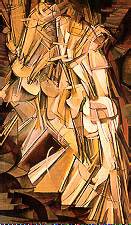
Figure 8
Marcel Duchamp, Nude
Descending a Staircase ,No. 2,
1912
Duchamp’s taste revolution started rather turbulently. After some years of Cézanne’s and Matisse’s influence, Duchamp soon found his own path. His famous painting Nude descending a staircase (Fig. 8)scandalised the New York art world in 1913. When he first submitted his picture for exhibition in Paris, it was rejected on the grounds that it had “too much of a literary title, in the bad sense–in a caricatural way. A nude never descends stairs–a nude reclines….”(117) Duchamp, at this point, apparently broke with all artistic conventions. He attempted to capture a figure in motion – a concept that apparently proved difficult for the audience of that time to understand. One critic wrote that this landmark painting resembled an explosion in a shingle factory.(118)When observing the Duchamp’s Nude, I was immediately struck by the cubistic elements–because of the darkish brown and grey colours as well as the characteristic angular forms. However, the painting was far from depicting the ideas of any -Ism. The Nude was rather made by a Duchamp who once again proved to be an intelligent deceiver. As Calvin Tomkins wrote, “nudes weren’t supposed to come down stairs and paintings weren’t supposed to have their titles written on the canvas, and any artist who broke the rules in such an irreverent manner must be kidding, right?”(119) I would not say that his intention was to make fun of the Cubists–Duchamp was too much the indifferent type as to make fun of an art movement by such direct means. He did not even make efforts to explain his works of art–and if he did, he did so by making some remarks years later–as in the case of his Nude:
My aim was a static representation of movement, a static composition of indications of various positions taken by a form in movement–with no attempt to give cinema effects through painting. The reduction of a head in movement to a bare line seemed to me defensible. A form passing through space would traverse a line; and as the form moved the line it traversed would be replaced by another line–and another and another. Therefore I felt justified in reducing a figure in movement to a line rather than to a skeleton. Reduce, reduce, reduce was my thought–but at the same time my aim was turning inward, rather than toward externals. And later, following this view, I came to feel that an artist might use anything–a dot, a line, the most conventional or unconventional symbol–to say what he wanted to say.”(120)
Interesting what Duchamp says about abstraction in terms of his painting. I do not believe, however, that the abstraction he mentioned carried much significance in his future career. Duchamp gave up painting altogether–as he said he tried to “unlearn to draw” in order to escape the prison of tradition.(121) Cage did not have to make efforts to forget music, as he admitted he never had a feeling for harmony. “I certainly had no feeling for harmony, and Schönberg thought that that would make it impossible for me to write music. He said, ‘You’ll come to a wall you won’t be able to get through.’ So I said, ‘I’ll beat my head against that wall.’”(122) Cage indeed disposed of a strong ability to assert himself. Although Duchamp and Cage apparently had different initial positions, they both landed on a similar artistic track.
“The first question I ask myself when something doesn’t seem to be beautiful is why do I think it’s not beautiful. And very shortly you discover that there is no reason.” -John Cage
click to enlarge
Figure 9
Robert
Rauschenberg, White Paintings
Let us begin from zero–silence, emptiness, nonsense. Rauschenberg’s White Paintings (Fig. 9). Empty space–no message, no dictatorship–we are free to bring in ourselves. Empty canvas–no need for interpretation; we need not say anything about it if we don’t feel like it. The blankness of the white paintings strongly reminded me of Cage’s silence. Rauschenberg, like Duchamp and Cage, was also interested in breaking down the barriers between art and life by using everyday artistic tools. Cage was indeed mesmerized by Rauschenberg’s empty walls. ”I responded immediately,” he said, “not as objects, but as ways of seeing. I’ve said before that they were airports for shadows and for dust, but you could also say that they were mirrors of the air.” What fascinated Cage about the White Paintings was Rauschenberg’s idea of emptiness: “A canvas is never empty”(123), Rauschenberg said; it acts as a landing-ground for dust, shadows, reflections. The White Paintings somehow gave Cage ‘permission’ to proceed with the composition of his silent pieces: “When I saw those, I said, ‘Oh yes, I must; otherwise I’m lagging, otherwise music is lagging.’”(124) “It’s out of that emptiness, and not being put off by ‘nothing’ happening–and when you see it, it really impresses you–that hearing it, hearing the emptiness becomes a possibility all over again.”(125) Rauschenberg’s white paintings greatly inspired Cage to silence in music. He was interested in a silence that was “not the absence of sound but the fact of having changed one’s mind to be interested in the sounds that there are, to hear them.”(126)
Silence turned out to be one of Cage’s central concept in his music and philosophy. He defined silence as simply the absence of intended sounds, or the turning off of our awareness. At the same time he made it clear that he believed there was no such thing as silence, defined as a total absence of sound–similar to Rauschenberg, who did not believe in emptiness in terms of an empty canvas. In 1951, he visited a sound-proof chamber at Harvard University in order to ‘hear’ silence. “I literally expected to hear nothing,” he said. Instead, he heard two sounds, one high and one low. He was told that the first was his nervous system and the other his blood circulating. This was a major revelation that was to affect his compositional philosophy from that time on.
“The history of art is simply a history of getting rid of the ugly by entering into it, and using it. After all, the notion of something outside of us being ugly is not outside of us but inside of us. And that’s why I keep reiterating that we’re working with our minds. What we’re trying to do is to get them open so that we don’t see things as being ugly, or beautiful, but we see them just as they are.”(127)-John Cage
Cage’s taste ®evolution started rather loud and clear. In 1940, he made the Prepared Piano. Before Cage left Cornish school, he was invited to compose the music for an African dance. The only instrument available was a piano. “I knew that wouldn’t work for Bacchanale which was rather primitive, almost barbaric,”(128) Cage recalled. He finally realized that he had to change the piano. Cage tried placing objects between the strings. “The piano was transformed into a percussion orchestra having the loudness, say, of a harpsichord.”(129) Noise as a compositional tool was born….interpenetration of life and art.
“You have to remember how straight-laced everything had always been in music…Just to change one little thing in music was a life’s work. But John changed everything…John was freer than the rest of us.”(130) – Morton Feldman
When Cage was writing percussion and prepared piano pieces, he became concerned with a new change. He noticed that although he had been taught that music was a matter of communication, when he wrote a sad piece people laughed, and when he wrote a funny one they started crying. From this he concluded that people did not understand each other’s music, that “music doesn’t really communicate to people. Or if it does, it does it in very, very different ways from one person to the next.”(131) Cage said that “no one was understanding anybody else. It was clearly pointless to continue that way, so I determined to stop writing music until I found a better reason than ‘self expression’ for doing it.”(132) Cage’s reaction to ‘common composition’ is very much reminiscent of Duchamp’s rejection of what he called ‘retinal painting’. Strictly speaking, Cage stopped being a composer in the traditional sense, similar to Duchamp who refused to lead an artistic life.
“The reason I am less and less interested in music is not only that I find environmental sounds and noises more useful aesthetically than he sounds produced by the world’s musical cultures, but that, when you get right down to it, a composer is simply someone who tells other people what to do. I find this an unattractive way of getting things done. I’d like our activities to be more social and anarchically so.”(133)
Cage wanted to create music that was free of melody, harmony and musical theory. In an interview he once gave on his project Roaratorio, an Irish Circus on Finnegan’s Wake, Cage said that “he wanted music not to be in the sense of music, but in the sense of Finnegan’s Wake” which means that he wanted to turn away from music itself–just like Joyce turned away from conventional writing. Cage, by writing Roaratorio, actually turned literature into a piece of music. He made a text from the original and catalogued the sounds and locations mentioned in Finnegan’s Wake. All sound effects were inspired from the text and many recorded in Ireland, with traditional instruments such as flutes, pipes, fiddles and bodhrans (a special drum type).
To link up with Cage’s conception of music as an unapt means of self-expression (“when he wrote a sad piece people laughed, and when he wrote a funny one they started crying.”) – Cage had determined that the purpose of music could not be communication or self-expression. What then, was its purpose? The answer came from Gira Sarabhai, an Indian singer and tabla player: “The purpose of music is to sober and quiet the mind, thus making it susceptible to divine influences.”(134)Cage was tremendously struck by this. For more than a year he immersed himself in the philosophy of East and West, and began studying Zen Buddhism with Daisetz T. Suzuki, a Japanese Zen teacher who taught at Columbia University. “I had the impression that I was changing–you might say growing up. I realized that my previous understanding was that of a child.”(135) Cage was determined to find out more about the “divine influences”, Gira Sarabhai had told him about. He came to the conclusion that they were the sounds and events that were free to everyone, that is, those of our nature and environment. Buddhism also teaches the transitoriness and fugacity of all creatures and objects. Its ultimate goal is the recovery of a higher purpose which is one independent of likes and dislikes–and thus of everything that is intentional.(136)
As soon as Cage gained those insights from oriental philosophy, he introduced it into his music. A quiet mind, he determined, was one free of dislikes; but, since dislikes require likes, it must be free of both likes and dislikes. “You can become narrow minded, literally, by only liking certain things and disliking others, but you can become open-minded, literally, by giving up your likes and dislikes and becoming interested in things.”(137) Thus, Cage more and more became interested in sounds and noises. He gave up harmony, which he believed, had nothing to do with noises. “Sounds should be honoured rather than enslaved. Every creature, whether sentient (such as animals) or non-sentient (such as stones and air), is the Buddha. Each being is at the centre of the universe.”(138) This oriental insight may also express Cage’s passion for mushrooms and his belief to hear the sounds of any plant or object: “I have recently learned that plants respond to the affection you show them! They can almost tell you exactly who cares for them. And they won’t grow if they’re not loved.”(139)
In Cage’s mind, the function of music was not to entertain or communicate, but to be a process of discovery, to become aware and sensitised to the environmental sounds that are all around us, and to be free from personal taste and manipulation. The following statement by Cage summarizes this point of view:
“Art may be practiced in one way or another, so that it reinforces the ego in its likes and dislikes, or so that it opens that mind to the world outside, and outside, inside. Since the forties and through the study with D. T. Suzuki of the philosophy of Zen Buddhism, I’ve thought of music as a means of changing the mind. I saw art not as something that consisted of a communication from the artist to an audience but rather as an activity of sounds in which the artist found a way to let the sounds be themselves. And, in being themselves, to open the minds of people who made them or listened to them to other possibilities than they had previously considered.”(140)
Thus, music lost its purpose of communication and expression. In contrast to the Western practice of making hierarchies–of separating, discriminating and dividing–Zen Buddhism suggested the opposite: no single centre (no best or least), only “an endless plurality of centres, each one world honoured.”(141)
Cage believed that emotions, like tastes and memory were too closely linked with the self and that the ego would not open the minds to noises and sounds. There was a way out–that is, Cage’s notion that art and life should no longer be separate but one and the same: “Art is not an escape from life, but rather an introduction to it.”(142) This idea led him to the concept of interpenetration. Previously, sounds that were outside the composer’s intentions were considered alien intrusions, unwelcome ‘noises’. Cage, for example, welcomed noises that were unintentionally produced by the audience–such as coughs or whispers. As a result of including sounds outside of the composer’s and performer’s intentions, Cage welcomed interpenetration.
Another important dictum which greatly inspired Cage to his new musical thought were the works of Ananda Coomaraswamy who wrote that “art is to imitate nature in her manner of operation.”(143) This idea should not be confused with imitating nature’s appearance. But how does nature operate? According to the naturalistic evolution theory and natural phenomena, they are not based upon a mechanical, deterministic model, but based on interdeterminacy and chance, such as in quantum mechanics and chaos theory. In the time of the Big Bang, there was a total chaos (a mixture of gases and other elements), and paradoxical as it may seem, this chaos was from time to time organised by chance.(144) In fact we are all existed by chance. As Cage’s works demonstrate, chaos is not really chaos, but unexpected order. I hope there are not too many critical mathematicians and physicists among you… Cage’s response to the chaos of our world was to welcome both its order and its disorder to the greatest extent possible. “Here we are. Let us say Yes to our presence together in Chaos.”(145) Cage met this chaos by using chance operations which encouraged him to shift his focus of attention away from the making of choices to the asking of questions. Likes and dislikes became irrelevant. Cage used his aesthetic of non-intention for making music, poetry and visual art. However, he assured that he did not use it when crossing the street, playing chess, hunting for mushrooms or making love. (146)
“What his music is ‘about’ is changing the mind–creating musical situations which, being analogous to life, have the effect of returning himself and his listeners to a level of consciousness freed from intrusive preconceptions, desires and intentions, and leading them toward an unfettered experience of what is before them in the present.”(147) – Laura Kuhn
I believe that knowing about Cage’s philosophy is crucial in order to comprehend his musical pieces as serious artworks. Only then we are able to understand that his silent piece or 4’33”was not a deliberate affront or insult to the audience or the act of a fool who made a child’s play. Cage repeatedly stated that he was not interested in shocking or insulting audiences. “I have never gratuitously done anything for shock.”(148) He had no intentions to shock, but the audience did not always perceive it that way. The first performance of John Cage’s 4’33”created a scandal. Written in 1952, it is Cage’s most notorious composition, his so-called “silent piece”. The piece consists of four minutes and thirty-three seconds in which the performer plays nothing. At the premiere some listeners were unaware that they had heard anything at all. It was first performed by the young pianist David Tudor in New York, for an audience supporting contemporary art.
“Tudor placed the hand-written score, which was in conventional notation with blank measures, on the piano and sat motionless as he used a stopwatch to measure the time of each movement. The score indicated three silent movements, each of a different length, but when added together totalled four minutes and thirty-three seconds. Tudor signalled its commencement by lowering the keyboard lid of the piano. The sound of the wind in the trees entered the first movement. After thirty seconds of no action, he raised the lid of the first movement. It was then lowered for the second movement, during which raindrops pattered on the roof. The score was in several pages, so he turned the pages as time passed, yet playing nothing at all. The keyboard lid was raised and lowered again for the final movement, during which the audience whispered and muttered.” (149)
Cage said later that “people began whispering to one another, and some people began to walk out. They didn’t laugh–they were just irritated when they realized nothing was going to happen and they haven’t forgotten it 30 years later; they’re still angry.”(150)
Maverick Concert Hall, the site of the first performance, was ideal in allowing the sounds of the environment to enter, because the back of the hall was open to the surrounding forest. One could hear raindrops patterning the roof –and Cage welcomed all those unexpected, natural sounds. When Tudor finished, raising the keyboard lid and himself from the piano, the audience burst into an uproar–“infuriated and dismayed”, according to the reports.(151) Even in the midst of an avant-garde concert attended by modern artists, 4’33” was considered “going too far.”(152)
As I am so eagerly writing about Cage’s discovery of Oriental philosophy, Zen Buddhism and the impact they had on his music and thinking in general, I am reminded of his mushroom passion, the macrobiotic recipes, his use of chance and I have the impression that I am writing in circles–that is, I am repeating Cage’s ideas which once again witness the unity in his philosophy as well as in all his daily activities. Cage’s interpenetration of art and life is thus also apparent in my writing–I somehow feel that my chapter mottos do not (exclusively) convey the contents of the respective chapters–everything is blurring in view to Cage’s entirety philosophy. Though a bit confusing, I believe that this is an interesting insight in view to the topic of this paper. It seems as if I am ‘experiencing’ what I am writing about.
The fact that Cage was interested in noise and sounds and consequently incorporated it into his music seemed somehow familiar to me. Yesterday I dug out the first compact disc I received from my parents around Christmas 1990. I was 14 years old by that time and a crazy Beatles fan. Up to that time I had listened to earwigs such as Let it be, Yellow submarine, Two of us or Dear Jude and eagerly tried to play them on the guitar. I can vividly remember my disappointment at first listening to Sgt. Pepper’s Lonely Heart Club Band. The songs seemed strange to me, they sounded completely different from the cheerful songs I had listened before. At least I was compensated with When I’m sixty four and With a Little Help from my Friends, but what about songs like Within you Without you? What was George doing with his voice and with all those weird instruments? Or the church like singing of She’s Leaving Home… The cover featuring the wax figures was so queer, not to mention about the odd costumes they wore. Nevertheless, I could not stop listening to the strangeness of the music. I was listening to the songs again and again and with the time I became fascinated about the Beatles’ different music aspect. I tried hard to figure out the contents of songs like Lucy in the Sky with Diamonds and was wondering what Lennon wanted to tell us by ‘marmalade skies’ or ‘plasticine porters with looking glass ties’. Those mysterious songs somehow transferred me into another, mysterious world, if only for a few minutes. Maybe one’s ears slowly have to familiarise with good music.
“The Beatles insisted that everything on Sgt. Pepper had to be different,” says Emerick, “so everything was either distorted, limited, heavily compressed or treated with excessive equalisation. We had microphones right down the bells of the brass instruments and headphones turned into microphones attached to violins. We plastered vast amounts of echo onto vocals, and sent them through the circuitry of the revolving Leslie speaker inside a Hammod organ. We used giant primitive oscillators to vary the speed of instruments and vocals and we had tapes chopped to pieces and stuck together upside down and the wrong way around.” (153)
The Beatles apparently wanted to turn all musical conventions upside down when recordingSgt. Pepper. The album is seen by many people to be the Beatles’ masterpiece. It is especially denoted by its asymmetrical musical phrases and rhythms and its integrated use of electronic music techniques and Indian sitar sound. The album is very experimental. Around the timeSgt. Pepper was released, all Beatles were more or less occupied with Indian philosophy. They attended a seminar by Maharishi Mahesh Yogi and learned about sublime consciousness and inner peace and these insights undoubtedly influenced their music. What struck me when I listened to songs like Sgt. Pepper’s Lonely Hearts Club Band was that you heard the orchestra rehearsing before the song actually started. In between you could perceive the audience laughing and applauding (although it was studio recorded). Interesting also, that some songs ‘interpenetrate’, which means that there are no pauses in between the songs. I found these impacts more than interesting after studying Cage’s understanding of music. I was struck….
“The very end of the album typifies the advanced studio trickery applied throughout Sgt. Pepper. After the last droplets of the crashing piano chord of ‘A Day in the Life’ have evaporated, come a few seconds of 15 kilocycle tone, put there –especially to annoy your dog–at the request of John Lennon (it contains a note that is so high-pitched that it is only audible to dogs) Then, as the coup de grace, there is a few seconds of nonsense Beatle chatter, taped, cut into several pieces and stuck back together at random so that, as George Martin says, purchasers of the vinyl album who did not have an auto return on their record player would say “What the hell’s that?” and find the curious noise going on and on ad infinitum in the concentric run-out groove.”(154)
The Beatles undoubtedly wanted to include some elements that caused some unexpected reactions by the audience. Besides applying different rhythms in one and the same song, they used everyday life sounds such as alarm ringing and someone gasping. They did not even frank us from chance–some of the recordings were stuck together by chance order. Interesting also, the topics of the songs on Sgt. Pepper which differ a great deal from the lighthearted love songs they wrote before. The Beatles were inspirited by different, daily life sources–Lennon wrote Good Morning Good Morning after he was inspired by a TV-spot on Cornflakes. McCartney sang about ”Fixing a hole where the rain gets in (…).” In A Day in the Life, John Lennon reads a newspaper report on a fatal car accident. Harrison’s Within You Without You was inspired by Indian philosophy and turned out to be a co-project with Indian musicians–it was recorded without Lennon, McCartney and Starr. The borders between the music of Sgt. Pepper and life are blurring.
It would be interesting to find out what Cage thought about this innovative Beatles album–I can imagine he would have loved the illogical barrage of noise at the end of A Day in the Life. However, I doubt that Cage would have wanted to listen Sgt. Pepper in any recorded version. He did not even listen to the radio. “If you’re in a room and a record is playing and the window is open and there’s some breeze and a curtain is blowing, that’s sufficient, it seems to me, to produce a theatrical experience.”(155) I suppose that Cage would have enjoyed experimenting with the Beatles on the different sound effects. Once asked about popular music in general, Cage responded that
“it’s very hard for me to listen to music nowadays with a regular beat; so that I have a hard time to begin with, with most popular music. On the other hand, some of it gets free of it. Rock seems to me to get free of it, because it calls so much attention to loudness that you forget the beat.”(156)
Sgt. Pepper is of course far from popular. It is a rather a unique music experience, full of surprising sounds and noises. It allows us to dip into a different world.
“He simply found that object, gave it his name. What then did he do? He found that object, gave it his name. Identification. What then shall we do? Shall we call it by his name or by its name. It’s not a question of names.”(157) -John Cage
The last pages, besides digressing briefly on the Beatles, were dedicated to Cage’s study of Zen Buddhism and accordingly his invention of dichotomies like silence, sounds and noises in music. Although Duchamp had no direct connections with oriental thoughts, he madereadymades to which said to be completely indifferent.(158) This notion has of course a lot to do with the Cage’s idea of freeing oneself from one’s likes and dislikes.
click to enlarge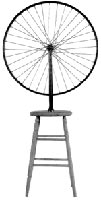
Figure 10
Marcel Duchamp,
Bicycle Wheel,
1913/1961
Figure 11
Marcel Duchamp, In
Advance of the Broken
Arm, 1915
In 1913, Duchamp took a bicycle wheel, turned it upside down and mounted it on a kitchen stool. The Bicycle Wheel (Fig. 10) was originally not intended to be shown, it was just for Duchamp’s own use. One year later, this wheel was the first of what came to be known as readymades, ordinary objects delocated and decontextualised. According to Duchamp, his first readymadecan also be seen as a “homage to the useless aspect of something generally used to other ends”, as well as an “antidote to the habitual movement of the individual around the contemplated object.”(159) These lines clearly witness Duchamp’s anti-artistic attitude, his revolt against the tradition where museum visitors admire works of art. He stressed that his readymades were chosen on visual indifference–while, on the other hand he said that looking at the Bicycle Wheel gave him the same kind of pleasure than watching a log fire. Calvin Tomkins’ statement on Duchamp’s first readymade reveals the erotic aspect of his work: “He found it wonderfully restful to turn the wheel and watch the spokes blur, become invisible, then slowly reappear as it slowed down; something in him responded, as he said, to the image of a circle that turns on its own axis, endlessly onanistically.”(160)
If Duchamp now found pleasure in observing his Wheel, he is clearly contradicting himself in terms of his idea of indifference. But – is it possible to completely ignore taste when choosing objects? Human-beings are subjective characters and I believe it is basically impossible to separate oneself from likes or dislikes. Our subconsciousness will not play along. However, Duchamp got quite close to the artistic realization of visual indifference. An ordinary object could after all attain the status of areadymade merely by giving it a title and signature. Duchamp’s goal of desacrificing an artwork was attained – other people could buy it and it could easily be replaced. After buying his second readymade, a snow shovel which became known as In advance of the broken arm (Fig. 11), he wrote the following lines to his sister Suzanne in Paris. In this letter he first mentioned the term readymade.
“Now, if you went up to my place you saw in my studio a bicycle wheel and a bottle rack. I had purchased this as a sculpture already made. And I have an idea concerning this bottle rack: Listen. Here in N.Y., I bought some objects in the same vein and I treat them as ‘readymade.’ You know English well enough to understand the sense of ‘ready made’ that I give these objects. I sign them and give them an English inscription. I’ll give you some examples: I have for example a large snow shovel upon which I wrote at the bottom: In advance of the broken arm, translation in French, En avance du bras cassé. Don’t try too hard to understand it in the Romantic or Impressionist or Cubist sense–that has nothing to do with it. Another ‘readymade’ is called: Emergency in favour of twice, possible translation in French: Danger (Crise) en faveur de 2 fois. This whole preamble in order to actually say: You take for yourself this bottle rack. I will make it a ‘Readymade’ from a distance. You will have to write at the base and on the inside of the bottom ring in small letters painted with an oil-painting brush, in silver and white colour, the inscription that I will give you after this, and you will sign it in the same hand as follows: (from) Marcel Duchamp.”(161)
click to enlarge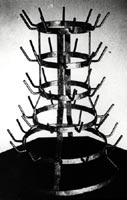
Figure 12
Marcel Duchamp, Bottle
Dryer, 1914
Duchamp had a clear notion about his readymades. Those objects he chose for readymades were easily to replace, under the premise that Duchamp signed them. Duchamp could make contracts with art dealers, authorizing them to make editions of his readymades: “10 $ for myBottle Dryer. If you’ve lost it, maybe buy another one at the Bazar de l’Hotel de Ville.”(162) Almost all original pieces actually got lost–among them the famous Bottle Rack (Fig. 12) and the Bicycle Wheel, which had been both thrown out by Duchamp’s sister. She must have decided they were useless junk.(163) A similar fate befell Joseph Beuys’ Fat Wedgewhich was conscientiously scrubbed by the cleaning ladies. The fusion of art and life became more and more visible.
Duchamp’s readymades were actually a denial of aesthetics and taste and had nothing to do with the artist, his consciousness or his autobiography. It was not anymore a question of visualization, but the simple fact that existed: “You don’t have to look at the readymade in order to respond to it. The readymade is practically invisible. It is a completely grey substance, anti-retinal, so to speak.”(164) Freeing oneself from likes and dislikes required an objective mind which was free from the ego. And yet, Duchamp emphasised his ego, by, for example saying that “everything in life is art. If I call it art, it’s art, or if I hang it in a museum, it’s art.”(165) It seems rather clear that Beuys, with his dictum that “Everyone is an artist” did not much sympathise with Duchamp. John Cage got closer to freeing himself from the ego by using chance operations. Moira Roth, in her essay “Marcel Duchamp in America” wrote in this respect that
“The readymades are acts of a dandy’s arrogance. He, and he alone, can point to an object and make it art. He can do what he likes. He makes his own rules. Some critics, and even some artists, might like to imagine it, but the message from Duchamp’s readymades is clear: anything and everything does not constitute art, not is anyone and everyone an artist. Duchamp makes readymades. Other people do not.” (166)
Roth’s interpretation of Duchamp’s readymades as products of a dandy’s arrogance seems to fit quite well into the whole context of Duchamp. Let us take the famous Fountain, for example. Duchamp took a porcelain urinal, turned it upside down and signed with the pseudonym – R. Mutt. The most banal of objects was made holy by a decision to place it in a museum–because HE chose it and HE signed it. Duchamp’s idea behind it was that “whether Mr. Mutt with his own hands made the fountain or not has no importance. He CHOSE it. He took an ordinary article of life, placed it so that its useful significance disappeared under the new title and point of view–created a new thought for that object.”(167) Duchamp’sreadymades were not an expression of artistic skill but the result of the artist’s choice. TheFountain was rejected on the grounds that it was immoral. Consequently, Arensberg, one of Duchamp’s collectors and friends, responded to the sponsors by saying that “this is what the whole exhibit is about; an opportunity to allow the artist to send in anything he chooses, for the artist is to decide what is art, not someone else.”(168)
click to enlarge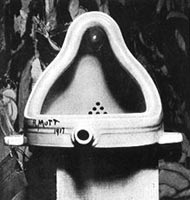
Figure 13
Marcel Duchamp, Fountain
, 1917
Duchamp’s reaction on the Fountain’s (Fig. 13) rejection was expectedly one of amusement. His urinal was out of question a deliberate provocation perfectly enacted. Duchamp attained the goal of desacrificing his works of art–however, he was far from desacrificing himself as an artist. Whereas the Fountainplayed a supporting role, Duchamp was the main actor. “Some contended it was immoral, vulgar. Others it was plagiarism, a piece of plumbing. Now Mr. Mutt’s fountain is not immoral, that is absurd, not more than a bathtub is immoral. It is a fixture that you see every day in plumbers’ show windows.”(169) Strictly speaking, Duchamp’s statement was indeed justified, for he had simply taken an everyday object, decontexualised it and thus gave it a new meaning. What was vulgar about a common urinal? After all, it could even suggest something aesthetic–as one of Duchamp’s art collectors and friends had proved: “Arensberg had referred to a ‘lovely form’ and it does not take much stretching of the imagination to see in the upside-down urinal’s gently flowing curves the veiled head of a classic Renaissance Madonna or a seated Buddha (…).”(170) As a matter of fact, the Fountain as a symbol of sexuality that underlay most of Duchamp’s later work has been subject of endless speculations. The taste revolution undoubtedly reached its climax–and no one had been prepared to it already in 1917.
I am slowly trying to get back to the starting point of this chapter where I philosophised about questions like “where is the border between art and non-art?” In the course of a historical analysis concerning the definition of art as well as my personal approach, I came to the (possibly possible) conclusion that the borders between art and ‘non-art’ are blurring. Both Duchamp’s and Cage’s artworks can be regarded as mirrors of a time where radical changes in all possible areas took place. This more or less universal explanation, however, is only one side of the coin. It would be rather paradoxical to find one generally valid interpretation of Duchamp’s and Cage’s highly complex as well as personal taste revolution.
“I have never been able to do anything that was accepted straight off.” ¾Marcel Duchamp
I believe that Duchamp’s taste revolution was primarily the result of his very personal protest against almost everything connected with art as an institution. He wanted to revolutionize the common understanding of art by turning all possible artistic conventions upside down. The following interview extract is only one of Duchamp’s bitterly sarcastic statements about the (then) current state of art:
“The entire art scene is on so low a level, is so commercialised–art or anything to do with it is the lowest form of activity in this period. This century is one of the lowest points in the history of art, even lower than the 18th Century, when there was no great art, just frivolity. Twentieth century art is a mere light pastime, as though we were living in a merry period, despite all the wars we’ve had as part of the decoration. All artists since the time of Courbet had been ‘beasts’ and should be put in institutions for exaggerated egos. Why should artists’ egos be allowed to overflow and poison the atmosphere? Can’t you just smell the stench in the air?”(171)
These words speak volumes about Duchamp, the confirmed anti-artist. His cynical expression is of such intensity that the outcome is simply Duchampian–in other words, bitterly sarcastic and amusing. In order to fight the war against all retinal artists he used weapons such as sarcasm and provocation. He refused to establish any art school as he refused tradition as a doctrine. Duchamp wished to break the aesthetic predominance of the past as he believed that the distinction between beautiful and ugly simply had been acquired. For Duchamp it was important not to be stereotyped in any way. He wanted to be free of tradition and of categorisation. Duchamp’s taste revolution was the product of a thoroughly convinced protest artist. I will keep in memory Duchamp, the artistic nihilist who could not yet live without creating works of art.
Cage’s taste revolution, in contrast, was much more the product of an artist in constant search for self-expression. His life is an example of a multiplicity of interests. As a result of studying Zen Buddhism and Oriental philosophy, Cage’s work became an adventurous experience of dichotomies such as silence and sounds. Not only Zen inspired Cage to create artworks free from intention but an endless kaleidoscopic mixture of interior and exterior influences such as
…………………………………………………………………………………………………………………………………….
…………………………………………………………………………………………………………………………………….
…………………………………………………………………………………………………………………………………….
DAILYLIFE Mushrooms Marcel
Duchamp……. Cage’s sense of humour and openness………….Arnold Schönberg DadaismMacrobiotics, Language, Jasper Johns, chance, Zen, Merce Cunningham, Visual Arts, Eric Satie, James Joyce………………………
Cage’s convictionoriginalityflexibilitydevotionhonestyintegrityaffability(172)……………………..Robert Rauschenberg, Buckminster Fuller, Chess, Anarchy, Theatre, Henry David Thoreau, Dance, Pedagogy, Literature, Ludwig Wittgenstein…………………..Oscar Wilde, Andy Warhol, White paintings, HIS Audience, Avant-garde, Bauhaus, The Large Glass…………………. Architecture, the Eastern comedic view of Life, Emptiness, Emotions, I-Ching or The Book of Changes, the Magic Square, Ulysses, Finnegan’s Wake, Henry David, Chaos Theory, Cornish School, Meister Eckhart, Etant Donnés…………………….. Finnegan’s Wake, Michel Foucault, Sigmund Freud, Haikus, Hermann Hesse, Japanese culture, Marshall McLuhan, Mathematics, Number Systems, Realism, Nam June Paik, Ezra Pound, Pythagoras, Kurt Schwitters…………………………….. Spirituality, Gertrude Stein, Virgil Thomson, Mark Tobey, Media, Utopianism, Surrealism, Walt Whitman, Zukofsky Paul, to name but a few
…………………………………………………………………………………………………………………………………….
…………………………………………………………………………………………………………………………………….
…………………………………………………………………………………………………………………………………….
…………………………………………………………………………………………………………………………………….
…………………………………………………………………………………………………………………………………….
…………………………………………………………………………………………………………………………………….
I guess this list could be stretched to …..an infinite number of pages but I do Not Intend to Waste your time any Longer.
IN case you still have some time left ………….you are warmly welcome to philosophise about this Cage quotation……………….
“Which is more musical: A truck passing by a factory or a truck passing by a music school?”(173)
####PAGES####
6. A visit in the Virtual DuCage Museum An imaginative meeting with Works of Ducage
I am sitting somewhere in a stuffy room in a Museum of Modern Art. Tired of all the impressions, of the numerous paintings and sculptures I have already observed. The cosy bench in the middle of the exhibition room is apparently there for people who want to observe some paintings in elaborate detail. I guess I am not one of the pseudo art connoisseurs who sit on this bench to discuss with their partner about the revealing colour ‘distribution’ of Jackson Pollock’s Number 4. I find it more interesting to hear the wooden floor cracking as a middle-aged couple enters the room. My head feels in a dubious state; I feel like leaving the museum and yet wish to stay to watch people watching. The couple is walking through the room as soon as they have entered. The artworks apparently did not appeal to them. Which artworks? I have not yet paid attention to the objects that are all around me. Too tired to focus my attention on any painting or one of those small printed plates which contain loads of information on the artist and the work itself. I am turning my head a little so that I get an elusive overview of the works of art surrounding me.
click to enlarge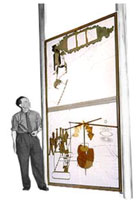
Figure 14
Something unidentifiable has focused my attention and overthrown my tiredness. Looks like a huge window divided in two that has been deliberately cracked and then fixed again. (Fig. 14) On the glass there are weird technical drafts. Big question mark……My eyes are slowly wandering to the window behind and the life outside. The church bell is already ringing a loud and clear 5th time. I can perceive a young mother eagerly trying to catch her son who is running away from her. She is wearing high heels which make it almost impossible to catch up with the runaway. The boy and his mother disappear. My eyes are wandering back to the strange object. The second time I watch it, it seems already familiar. The upper half of the glass is somehow more artistic than the lower one which reminds me of a technical draft of whatever. I like the three ‘windows’ on the very top of the upper half. A frame on a frame….it is like featuring a TV on TV…have you seen the movie Pleasantville? The three ‘windows’ tempt me to watch beyond the glass a second time. This time, however, I am focusing my attention on the mysterious glass. Do not misunderstand me – I do not ‘like’ this art-object – after all I would not say it’s beautiful, though it’s not ugly either. It’s simply there. One could object now that everything in this museum is ‘there’. That’s right. But the other paintings hanging on the white walls are not sui for tired museum visitors like me. They call for attention. The glass is different. I am walking around a little and observe the glass from a different angle. It looks different from behind – I can see through it the painting on the opposite wall. Now I know – it’s the unobtrusiveness that makes the glass somehow special for me. The fact that it’s there and yet seems to dissolve in the background….it can be looked at and looked through at the same time….the glass encourages me to see the world behind. And the world somehow looks different through it. I have never had such an experience in a museum.
“Use ‘delay’ instead of picture or painting…It’s merely a way of succeeding in no longer thinking that the thing in question is a picture … to make a delay of it in the most general way possible, not so much in the different meanings in which delay can be taken, but rather in their indecisive reunion.”(174)
—Marcel Duchamp
This is how Duchamp referred to The Large Glass or better The Bride Stripped Bare by her Bachelors, Even in one of his working notes that he collected in The Green Box. He meant it to be a “delay” instead of a picture. Delay…does this make any sense? Delay: make or be slow or late (be delayed by traffic); put off until later (delay a journey)(175). Maybe Duchamp simply opened his dictionary and chose first term his eyes spotted – or delay was meant as one of Duchamp’s numerous wordplays: “One Duchampian has suggested that it be read as an anagram for ‘lad(e)y,’ so that “delay in glass” becomes glass lady.”(176) Whatever the case, he managed well to keep the secret. The Large Glass is probably Duchamp’s most complex and mysterious artwork and has been subjected to endless analysis. As with Duchamp’s most statements on his artworks, his notes published in The Green Box are very hard if not impossible to decode and leave much space for speculation. Duchamp wanted to leave the door open, for in his mind, the spectator ultimately finished the artwork by observing and interpreting it. Or he did not want us to understand The Glass at all. Duchamp would have probably commented on the numerous speculations on his masterpiece “there is no solution as there is no problem.”(177) I am sure that he would have been quite amused at the endless number of interpretation attempts.
“All in all, the creative act is not performed by the artist alone. The spectator brings the work in contact with the external world by deciphering and interpreting its inner qualifications and thus adds his contribution to the creative act.”(178) Marcel Duchamp
Unfortunately I have not yet seen the Large Glass in the Philadelphia Museum of Modern Art – unless in my imagination. When observing pictures of The Glass, I do not focus my attention on any of the objects resembling the bride or the bachelor – nor am I tempted to find out about the meanings of the individual elements…The central message for me is the medium of the artwork itself – that is the glass. The glass as a strong contrast to the traditional paintings drawn on canvasses. I like the idea of an artwork that can be looked at and looked through at the same time. The experience of looking at or beyond the glass is an endless one. Whatever is beyond the painting – it looks different when seen through the cracked glass. In fact, it is not only the environment which is in constant change, but also the artwork itself. The life outside the museum window becomes art – interpenetration of art and life. Thus, the experience of observing an artwork is an unexpected and unique one.
Cage, in his interview with Joan Retallack commented on the Large Glass: “The experience of being able to look through the glass and see the rest of the world is the experience of not knowing where the work ends. It doesn’t end. In fact it goes into life.”(179) The elements depicted on the glass are not beautiful nor ugly – but rather indifferent and thus do not much focus the viewer’s attention. Duchamp remarked that “every image in the glass is there for a purpose and nothing is put in to fill a blank space or to please the eye.”(180) His message is clear: Duchamp, as a consequence of ‘unlearning to draw’, wanted to create an artwork which was completely anti-retinal and free of artistic tradition. Besides using glass instead of a canvas, he worked with unconventional materials such as lead foil and wires. I found it quite interesting that Duchamp never actually ‘finished’ his masterpiece. He remarked that “it may be subconsciously I never intended to finish it because the word ‘finish’ implies an acceptance of traditional methods and all the paraphernalia that accompany them.”(181) It is up to us to ultimately ‘finish’ his Large Glass. Duchamp’s wish to escape the prison of tradition is not something we are unfamiliar with. He wanted to find a way of expressing himself without being a painter or a writer, without taking one of these labels and yet producing something that would be a product of himself.
As Duchamp meant it to be, The Glass is far from retinal as it represents a complex subject which cannot possibly be decoded by simply looking at the artwork. The process of thinking, according to Duchamp, is more significant than the artistic result. If that was the case – why wouldn’t he have wanted to make his ideas as clear as possible? We must at least read Duchamp’s notes or statements and even then we are confronted with the cryptic nature of this artwork. Who would guess an act of love behind the weird mechanical elements of theBride? One could never suspect the subject of sexual desire from simply looking at TheGlass. Duchamp left us behind some more or less abstruse indications in his Green Boxnotes:
“The Bride is basically a motor. This bride runs on love gasoline which is ignited in a two-stroke cycle. The first stroke, or explosion, is generated by the bachelors through an electrical stripping whose action Duchamp compares to the image of a motor car climbing a slope in low gear…while slowly accelerating, as if exhausted by hope, the motor of the car turns faster and faster, until it roars triumphantly.”(182)
It is not hard to guess from Duchamp’s formulation that the subject of the Bride is nothing else than the sexual intercourse. However, I do not intend to analyse Duchamp’s notes or statements nor am I interested in reflecting on the numerous interpretations written on Duchamp’s complex masterpiece. I have already commented on my personal interpretation of the artwork and thus believe that I cannot contribute anything more to the endless number of interpretation attempts. My readers, however, can…as every person responds in his own way. Listen to Duchamp’s ‘theory’ how in his mind works of art become works of art:
“A work of art exists only when the spectator has looked at it. Until then it is only something that has been done, that might disappear and nobody would know about it, but the spectator consecrates it by saying this is good, we will keep it, and the spectator in that case becomes posterity, and posterity keeps museums full of paintings today. My impression is that these museums – call it the Prado, call it the National Gallery, call it the Louvre – are only receptacles of things that have survived, probably mediocrity. Because they happen to have survived is no reason to make them so important and big and beautiful, and there is no justification for that label of beautiful. They have survived. Why have they survived? It is not because they are beautiful. It is because they have survived by the law of chance. We probably have lot many, many other artists of those same periods who are as beautiful or even more beautiful…”(183)
It is our responsibility if an artwork is worth preserving or not. According to Duchamp, a work of art is incomplete until it has been seen and thought about by one or more spectators.(184) We are no longer passive observers but part of the creative process – as the artist himself.
Cage’s idea of blurring the distinction between audience and performer was a different one than Duchamp’s. Cage, more than Duchamp was interested in actively incorporating the audience into his art – I am thinking now I particular of Cage’s Silent piece. Cage said that “the performance should make clear to the listener that the hearing of the piece is his own action – that the music, so to speak is his, rather than the composer’s.”(185)The performer’s responsibility thus shifted from self-expression to opening a window for the sounds of the environment. Cage wished to create a music that was performed by everyone. In Cage’s performance of 4’33”, it was actually the audience that was ‘performing’ by contributing sounds such as whispers and coughs. He wanted his music to be free of his own likes and dislikes and let the audience feel that ‘silent music’ was more interesting than the music they would hear if they went into a concert hall.(186) Cage, as a result of welcoming everything that was non-intentional and natural, aimed at creating a music that was a mixture of all sounds the environment and audience offered him.
Cage’s ideas of incorporating the audience into his live performances are vividly expressed in numerous interviews. I believe his statements do not need any further explanation – instead, they rather speak for themselves. His interviews are a real pleasure to read.
“I think perhaps my own best piece, at least the one I like the most, is the silent piece – 4’33”, 1952. It has three movements and in all of the movements there are no sounds. I wanted my work to be free of my own likes and dislikes, because I think music should be free of the feelings and ideas of the composer. I have felt and hoped to have led other people to feel that the sounds of their environment constitute a music which is more interesting than the music which they would hear if they went into a concert hall.”(187)
“More and more in my performances, I try to bring about a situation in which there is no difference between the audience and the performers. And I’m not speaking of audience participation in something designed by the composer, but rather I am speaking of the music that arises through the activity of both performers and the so-called audience.”(188)
“Well, music is not just composition, but it is performance, and it is listening. The Amplification of those cards, though it was high, almost at the level of Feedback – which we heard now and then – produced sounds that were still so Quiet that one could hear the audience as performers too. And I’m sure that they noticed that themselves. You noticed, for Instance, the man in The Back who was having trouble with his digestion. And I would hear many different kinds of coughing and I’m sure that people heard those themselves as sounds, rather than as interruptions. I hope, and I’ve hoped this now for thirty years, when I make music that it won’t interrupt the silence which already exists. And that silence includes coughs. I thought the Audience behaved/Performed beautifully, because they didn’t intend to cough – they were obliged to cough; the Cough had its own thought, interpenetrated – nothing obstructing anything Else.”(189)
“I just performed Muoyce which is a whispered version of my Writing for the Fifth Time Through Finnegan’s Wake, and it was done in Frankfurt. It lasts for two and a half hours. Klaus Schöning of Hörspiel WDR told the audience which was large, about four or five hundred Joyce scholars, that the doors were open; that once the performance began, they could leave as they wish, and that they could also come back if they wanted. After twenty minutes, they began to leave, and he told me later that only about half of the audience was there at the end. So I think that the work is still irritating. People think, perhaps, that they are no longer irritated, but they still have great difficulty paying attention to something they don’t understand. I think that the division is between understanding and experiencing, and many people think that art has to do with understanding, but it doesn’t. It has to do with experience; and if you understand something, then you walk out once you get the point because you don’t want the experience. You don’t want to be irritated. So they leave, and they say the avant-garde doesn’t exist. But the avant-garde continues, and it is experience.”(190)
…I am feeling a bit dizzy of all the writing right now and decide to turn on my CD-player. My friend has recently recorded some John Cage pieces for me. Among them Music for Marcel Duchamp, 4’33” and Imaginary Landscape I do not really know what to expect – yet I have some vague ideas what Cage could sound like. A frenzy huggermugger of sounds and noises is what first comes to my mind….I won’t speculate any longer, I’ll press the play button….The first piece sounds a bit silent; must be 4’33”… I am curious if I can perceive any background noises, but I don’t. At least I have been waiting in expectation for exactly 4 minutes and 33 seconds. Cage well managed to keep me curious for this period of time ;)…..The next piece reminds me a bit of a dramatic scene in a horror film. The music gets faster and faster….. My heart feels like bumping in the same rhythm as the music. It makes me feel nervous. At the point it reaches its climax, the piece unexpectedly ends…….The following track sounds, I would say, totally un-cagean…..harmony pure. This is what the beginnings of electronic music must have sounded like. The music permits me to slowly familiarise with it….Cage was apparently working with compositional tools such as repetition….and, believe it or not, the result sounds harmonious. Probably unintentional harmony. I would say that this is the first piece which permits me to think of something else than the music I am listening to. It does not completely take me in……Cage’s pieces are rather short in length…think I need a short break now in order to ‘digest’ this cagean music experience…..The next track starts with a sound I can hardly endure. Reminds me of an extremely boisterous aeroplane departure…. that suddenly turns into a vacuum cleaner noise. If we were able to receive all frequencies surrounding us, it would assumedly sound like this. The music is increasing in loudness and intensity that I have to skip to the following track………Relief…….The piece I am now listening to sounds like a conversation between two instruments. The one is a dominant cello, the other a timid bell. As different as they may be, they seem to be fond of each other. I begin to like the constant changes in rhythm…they bring about a sense of dramatic tension and yet a touch of playfulness. …I think I will now leave the Cagean music experience in order to reflect…
I would very much like to place myself in the position of being a spectator in Cage’s performance of 4’33”, but I think that it is impossible at least at the time. I have ‘listened’ to it on tape and unfortunately could not perceive any of the background noises. I don’t think, however, that the actual experience of having been ‘real’ part of the audience is what truly matters here. It is rather the idea behind the work which becomes part of our awareness once we have been acquainted with Cage’s philosophy. That is of course also the case with Duchamp.
Listening to Cage has been an exciting adventure. He offered me everything ranging from….complete silence, quiet harmony, refreshing sound……to unbearable noise. You never know what to expect when listening to Cage. My mind is wandering back to my virtual experience of Duchamp’s Large Glass……it permitted me to see the world beyond the artwork. Total blurring of the distinction between art and life.
Cage’s music left a different impression on me. Most of his music pieces, except of course his Silent piece, completely absorbed me. When listening to Cage’s pieces I was too involved in the musical experience in order to immerse in a different world. Too much intensity of sounds…..and thus little transparency. Cage wanted to incorporate environmental sounds into his music. The sounds we hear every day on the street do not have a distracting effect on us as we are used to them. However, we are not used to Cage’s intensification of these sounds. In my view, the blurring of the distinction between art and life did not work out in all of Cage’s music pieces – at least when listening to the recorded version. I can, of course, only speak about my subjective music experience – I suppose that it would be an entirely different experience if I were able to listen and watch his music in a concert hall. After all it should be considered that his pieces were originally not intended to be listened on CD or tape.
Duchamp, however, did not either constantly manage to realise his conception of breaking down the barriers between art and life. His last masterpiece, Etant donnés, is the exact reverse of the Large Glass. This disturbing and provocative work presents a startingly realistic nude made of leather and reclining on a bed of leaves in front of a mechanical waterfall. She is only visible through two peepholes in a massive wooden door.
“In 1943 Duchamp rented a studio on the top floor of a building in New York City. While everyone believed that Duchamp had given up “art,” he was secretly constructing this au, begun in 1946, which was not completed until 1966. The full title of the piece is:Given: 1 The Waterfall, 2. The Illuminating Gas. It consists of an old wooden door, bricks, velvet, twigs gathered by Duchamp on his walks in the park, leather stretched over a metal armature of a female form, glass, linoleum, an electric motor, etc. Duchamp prepared a “Manual of Instructions” in a 4-ring binder which explains and illustrates the process of assembling/disassembling the piece. It was not revealed to the public until July of 1969, (several months after Duchamp’s death), when it was permanently installed in the Philadelphia Museum of Art. No photographs of the interior of the piece or of the notebook of instructions were allowed to be published by the museum for at least 15 years. The viewer of the piece first steps onto a mat in front of the door, which activates the lights, motor, etc., and then peers through two “peepholes” to view the construction behind the door. The voyeurstrains, unsuccessfully, to see the “face” of the eerily realistic nude female form which lies supine on a bed of twigs, illuminated gas lamp in hand. In the distance, a sparkling waterfall shimmers, backlit by a flickering light, part of a realistically rendered landscape painting on glass.”(191)
It seems rather hard for me to imagine what feelings a real encounter with Etant Donnéswould evoke in me. After looking at the black and white reproductions, I had the impression that this artwork represented everything Duchamp so vehemently refused: it is far from anti-retinal – the nude lies there, fully exposed and opened by the position of her legs. In contrast to the Large Glass where the viewer can look at and through it from any angle, he is restricted to a particular position – we can only see the artwork through the peephole in the wooden door; the way Duchamp prescribed it. Duchamp’s Manual of Instructions for Etant Donnés again prescribes step for step how to take the artwork apart and put it back together. No room for interpretation for those who install it.
When I think of Etant Donnés, I see a big question mark. To me it seems that Duchamp, the confirmed anti-artist tried in vain to keep up his anti-(quite everything) attitude throughout his life. Etant Donnés is after all the best example for a very retinal artwork. His numerous self-contradicting statements give evidence of a character who was not thoroughly convinced of himself as an anti-artist. The following statement made by Duchamp reveals quite a lot in this respect: “I have forced to contradict myself in order to avoid confirmation to my own tastes.”(192)This line may also express Duchamp’s ‘gap’ in maintaining the blurring of the distinction between art and life. Who knows, maybe Etant Donnés was Duchamp’s only ‘honest’ artwork.
I believe, however that there is not only one possibility of realizing the blurring of art and life. Maybe Etant Donnés contributed as much to the blurring as the Large Glass. Duchamp probably wanted the spectator not immediately to see the ‘retinal’ aspects of his artwork, but rather what is ‘behind’ it. The ‘behind’ I am thinking of in particular, is the artists’ life, his biography. In Etant Donnés, Duchamp undoubtedly expressed suppressed emotions for a woman he had been in love with before he got married to his second wife. Maria Martins was a woman who would not give up her marriage for Duchamp. Maybe, in Etant Donnés he saw her in a figurative sense raped by her husband. In my view, the lamp she holds in her hand symbolizes a mute cry for help. She cries in vain, for she is locked up behind the heavy wooden door. There is no right or wrong when it comes to interpreting artworks – in the end there are only speculations. Cage quite interestingly commented on his friends’ last masterwork:
“I can only see what Duchamp permits me to see. The Large Glass changes with the light and he was aware of this. So does any painting. But Etant Donnés doesn’t change because it is all prescribed. So he’s telling us something that we perhaps haven’t yet learned, when we speak as we do so glibly of the blurring of the distinction between art and life. Or perhaps he’s bringing us back to Thoreau: yes and no are lies. Or keeping the distinction, he may be saying neither one is true. The only true answer is that which will let us have both of these.”(193)
Cage’s quotation once again brings us back to the title of this project – the blurring of the distinction between art and life. Both Duchamp and Cage pivotally contributed to this blurring by realizing unique ideas in this direction – however, it also turned out to be an endless enterprise. It is now up to us to continue their project……….
####PAGES####
7.“That is a very good question. I do not want to spoil it with an answer” (194)
Some Final Remarks
This quotation is taken from Cage’s afternote to his Lecture on Nothing which is part of his book Silence. After delivering his Lecture on Nothing, “he prepared six answers for the first six questions asked, regardless of what they were.”(195)“That is a very good question. I do not want to spoil it with an answer” is one of them. Cage’s amusing idea originated from the belief that a discussion is nothing more than an entertainment. Cage, as a result of using chance operations in his music, made his responsibility that of asking questions instead of giving answers and making choices. He was not much interested in giving answers as well as in receiving definite answers – as the nature of Cage’s friendship with Duchamp well demonstrated. Experience, in Cage’s mind, was much more important than understanding. Duchamp, on the other hand, made every effort to make his art mysterious. He was not either interested in giving ultimate answers as he believed that the creative act was a joint effort by the artist and the spectator.
I am introducing the final paragraphs of my paper with the analysis of a quotation that I believe is quite apt to ‘finish’ the never ending circle of the DuCage experience. Both Duchamp and Cage demonstrated with their artworks that there is much space for the spectator’s experience and curiosity. They do not offer ultimate answers but leave much space for our own imagination. Like Duchamp and Cage, I am not concerned here with an ultimate answer or ‘summary’ of my project. I see no point in writing a ‘summary’ after having studied those two artists. It would at least seem rather paradoxical to me. Instead, I would like to leave you with the voices of Duchamp and Cage as a ‘stepping stone’ for your own imagination:
“People took modern art very seriously when it first reached America because they believed we took ourselves very seriously (…) A great deal of modern art is meant to be amusing. If Americans would simply remember their own sense of humour instead of listening to the critics, modern art will come into its own.”(196) —Marcel Duchamp
“This is also for me the effect of modern painting on my eyes, so when I go around the city I look, I look at the walls….and I look at the pavement and so forth as though I’m in a museum or in a gallery. In other words, I don’t turn my aesthetic faculties off when I’m outside a museum or gallery.”(197) —John Cage
……………………………………………Why did I choose these two quotations?………………………
I believe that many people associate with modern art something that is worldly innocent, something that has nothing to do with their reality. After having had the possibility to immerse in the world of DuCage, I am not so sure if there is a difference between art and the life around us. Art, for them, was normality – it was a part of their life as was the street they were living in. Museums then, would symbolize nothing else than life – or we may also change this expression like a parable – namely that life is one big museum… Isn’t every single artwork simply an emotional expression of an individual? If that is so, isn’t then art all about the capability of interpreting the things that are going on around us? I believe it is enough if we try to comprehend a little of this mystery every day. This is what being a glass wanderer is all about.
Bibliography(198)
Baruchello, Gianfran co and Martin Henry. Warum Weshalb Wozu Duchamp. Klagenfurt: Ritter,1993.
Bischof, Ulrike et al. Kunst als Grenzbeschreitung – John Cage und die Moderne. Düsseldorf: Richter-Verlag, 1992.
Bianco, Paolo und Doswald Christoph. Andy Warhol – Joseph Beuys. Gegenspieler. Frankfurt/Main: Fischer Taschenbuch Verlag, 2000.
Cabanne, Pierre. Dialogues with Marcel Duchamp. London: Paperback, 1988.
Cabanne, Pierre. Duchamp & Co. Paris: Terrail, 1997.
Cage, John. Silence. Middletown/Connecticut: Wesleyan University Press, 1967.
Cage, John. M-Writings ’67-’72. Middletown: Wesleyan University Press, 1973.
Cage, John. A Year from Monday. Lectures and Writings. London: Marion Boyars, 1985.
Cage, John. X-Writings ’79-’82. Middletown: Wesleyan Paperback, 1986.
Cage, John. Composition in Retrospect. Cambridge/MA: Exact Change, 1993.
Cage, John. The Charles Eliot Norton Lectures. Cambridge/MA: Harvard University Press, 1990.
Charles Daniel. For the Birds – John Cage in Conversation with Daniel Charles. London : Marion Boyars, 1995.
Charles Daniel. John Cage oder Die Musik ist los. Berlin: Merve Verlag, 1979.
Daniels, Dieter. Duchamp und die Anderen. Köln : DuMont Buchverlag, 1992.
De Duve, Thierry. Kant after Duchamp. Cambridge/MA: MIT Press, 1996.
D’Harnoncourt, Anne and McShine Kynaston. Marcel Duchamp. New York : Prestel, 1989.
D’Harnoncourt, Anne et al. Joseph Cornell/Marcel Duchamp…in Resonance. Houston: Cantz, 1998.
Duchamp, Marcel. A l’Infinitif. The Typosophic Society. Over Wallop/UK: BAS printers, 1999.
Fetz, Wolfgang, Hrsg. Sommerprojekte Bregenz 1998. Kunst in der Stadt 2. Bregenz: Teutsch, 1998.
Fetz, Wolfgang, Hrsg. L’Art est Inutile. Avantgardekunst/Arte D’Avanguardia 1960 – 1980. Bregenz : Hecht Druck, 1993.
Geddes & Grosset. Dictionary of Art. New Lanark/Scotland: Brockhampton Press, 1995.
Gena, Peter and Brent Jonathan. A John Cage Reader. New York: C.F. Peters Higgins, 1998.
Glasmeier, Michael und Hartel, Gaby, Hrsg. Beckett, Samuel. Das Gleiche noch mal Anders. Texte zur Bildenden Kunst. Frankfurt/Main: Suhrkamp, 2000.
Gough-Cooper, Jennifer et al. Marcel Duchamp. London : Thames and Hudson, 1993.
Hauskeller, Michael. Was ist Kunst? Positionen der Ästhetik von Platon bis Danto. München: C.H. Beck, 1998.
Kandinsky, Wassily. Essays über Kunst und Künstler. Bern: Benteli Verlag, 1973.
Kostelanetz, Richard, ed. Conversing with Cage. New York: Limelight Editions, 1988.
Kostelanetz, Richard, ed. John Cage. London: Penguin, 1971.
Klotz, Heinrich. Kunst im 20. Jahrhundert. Moderne – Postmoderne – Zweite Moderne. München: C.H. Beck, 1999.
Kotte, Wouter. Marcel Duchamp als Zeitmaschine. Köln: Walther König, 1987.
Naumann, Francis and Obalk Hector, ed. Affectionately Marcel: The Selected Correspondence of Marcel Duchamp. Ghent: Ludion Press, 2000.
Perloff, Majorie et al. John Cage. Composed in America. Chicago: University Chicago Press, 1994.
Retallack, Joan, ed. Musicage – Cage muses on Words, Art, Music. John Cage in Conversation with Joan Retallack. Hanover/NH: Wesleyan University Press, 1996.
Revill, David. The Roaring Silence. John Cage: A Life. London: Bloomsbury, 1992.
Rodin, Auguste. Die Kunst. Gespräche des Meisters. Zürich: Diogenes, 1979.
Roth, Moira and Katz D. Jonathan. Difference/Indifference. Musings on Postmodernism, Marcel Duchamp and John Cage. Amsterdam: G + B Arts International, 1998.
Rotzler, Willi. Objektkunst. Von Duchamp bis zur Gegenwart. Köln: DuMont Buchverlag, 1981.
Ruhrberg, Karl. Kunst des 20. Jahrhunderts. Malerei, Skulpturen und Objekt, Neue Medien, Fotografie. Köln: Benedikt Taschen Verlag, 2000.
Stauffer, Serge, Hrsg. Marcel Duchamp. Interviews und Statements. Stuttgart : Cantz, 1991.
Stauffer, Serge, Hrsg. Marcel Duchamp. Die Schriften. Zürich: Regenbogen-Verlag, 1981.
Stein, Gertrude. Everybody’s Autobiography. New York: Random House, 1964.
Stein, Gertrude. Was sind Meisterwerke? Zürich: Die Arche, 1962.
Tomkins, Calvin. Duchamp. A Biography. New York: Henry Holt, 1996.
Tomkins, Calvin. The Bride & the Bachelors. New York: Penguin/Viking, 1965.
Wellershoff, Dieter. Die Auflösung des Kunstbegriffs. Frankfurt/Main: Suhrkamp, 1981.
More Resources
- Tout-fait – The Marcel Duchamp Studies Online Journal #3 www.toutfait.com
- The Museum of Contemporary Art. Rolywholyover – A Circus. Los Angeles: 1993.
- Microsoft Encarta ’95. The Complete Interactive Multimedia Encyclopedia. 1995 Edition.
- Leo Truchlar – Lecture Script
- Special thanks to ….Sweet Surprise Postcards © John Gavin Gillard
- Websit
https://www.freshwidow.com/etant-donnes2.html
https://www.english.upenn.edu/??afilreis/88/cage-quotes.html
……….and finally……Thanks…… for more inspiration to:
my best friend Markus for not losing patience in endless discussions and his inspiring piano music my parents for distracting me now and then; Mr. Truchlar for granting me so much freedom and space; Christoph; Dido, Sinéad O’Connor, Era and The Beautiful South for their inspiring music.
####PAGES####
More Resources
 1. Richard Kostelanetz, Conversing with Cage (New York: Limelight Editions, 1988) 211.
2. Moira Roth & William Roth, “John Cage on Marcel Duchamp”, in Difference/Indifference-Musings on Postmodernism, Marcel Duchamp and John Cage (Amsterdam: G+B Arts, 1998) 72.
3. Serge Stauffer, Marcel Duchamp (Stuttgart: Edition Cantz, 1992) 29.
4. Ibid. 14.
5. I am referring here to a lecture held by Prof. Truchlar, teaching Americanliterature at the University of Salzburg–however, Cage’s ideas concerning education can be read in Richard Kostelanetz’s Conversing with Cage.
6. Calvin Tomkins, Duchamp, A biography (New York: Henry Holt, 1996) 127.
7. Kostelanetz 91.
8. Roth, Difference/Indifference 73.
9. Roth 80.
10. John Cage, “An Autobiographical Statement”–first appeared in the Southwest Review, 1991. I found it reprinted in the Web: https://www.newalbion.com/artists/cagej/autobiog.html
11. SEE NOTE AT THE END OF THE ESSAY
12. I read Cézanne’s quotation on this year’s Harenberg tear-off calender (8th September). I found his thoughts quite interesting in contrast to Duchamp’s idea of desacrificing art.
13. Tomkins 42.
14. Original title: Wassily Kandinsky, Essays über Kunst und Künstler (Zürich: Benteli, 1955). Kandinsky’s book inspired me a great deal before I started my readings on Cage and Duchamp. He expressed many ideas which strongly reminded me of Cage’s and Duchamp’s philosophy. I can imagine that in view to the books’ popularity (it first appeared in 1911) both artists must have sooner or later come across it.
15. Roth, “Marcel Duchamp in America,” in Difference/Indifference 22.
16. Roth, “John Cage on Marcel Duchamp” 76.
17. Wouter Kotte, Marcel Duchamp als Zeitmaschine (Köln: Walther König, 1987) 36/37.
18. Wolfgang Fetz, Kunst in der Stadt 2 (Bregenz: Teutsch, 1998) x -no page reference.
19. Tomkins 116.
20. Ibid. 142.
21. Stauffer, Marcel Duchamp 45/46.
22. Tomkins 408.
23. Cage, A year from Monday 70. Cage obviously referred to a joint work by Duchamp and Man Ray calledDust Breeding–“A glass panel which had been lying flat on sawhorses collecting dust. The resulting image was like a lunar landscape (…) Duchamp later fixed the dust with varnish on the sieves.” (Tomkins p. 229) –another, probably even more relevant explanation could be Duchamp’s “story of his 2 studios.” Cage recalled, “He had 2 studios. One was the one he was working in and the other was the one where he had stopped working. So that if anyone came to visit him they went into the studio where he wasn’t working, and there everything was covered with dust. So the idea was spread around that he was no longer working. And you had proof of it! –dust collected where he worked (laughs).” (Joan Retallack, Musicage p. 111)
24. Tomkins 236.
25. Roth, “John Cage on Marcel Duchamp” 82.
26. Stauffer 85.
27. Pierre Cabanne, Dialogues with Marcel Duchamp (London: Paperback, 1988) 8.
28. Roth, “John Cage on Marcel Duchamp” 76.
29. Roth 82.
30. Tomkins 270.
31. Francis N. Naumann ed., Affectionately Marcel: The selected correspondence of Marcel Duchamp (Ghent: Ludion Press, 2000) 212.
32. Roth 77.
33. Cabanne, Dialogues with Marcel Duchamp 67.
34. Tomkins 157.
35. Ibid. 93.
36. Ibid. 15.
37. Tomkins 113.
38. Roth 23.
39. Ibid. 17.
40. Tomkins 141/142.
41. Tomkins 143.
42. Ibid. 152.
43. This ‘mesostic’ about Duchamp was published in Cage’s M–writings ’67-’72 (Middletown: Wesleyan University Press, 1973) 34.
44. “Duchamp, Marcel,” Microsoft (R) Encarta. Copyright (c) 1994 Microsoft Corporation. Copyright (c) 1994 Funk & Wagnall’s Corporation.
45. John Cage, Quotations found in the Web: https://www.english.upenn.edu/??afilreis/88/cage-quotes.html
46. “Cage, John Milton, Jr.,” Microsoft (R) Encarta. Copyright (c) 1994 Microsoft Corporation. Copyright (c) 1994 Funk & Wagnall’s Corporation.
47. Tomkins 330/331.
48. Kostelanetz, 11.
49. John Cage, A Year from Monday-Lectures and Writings (London: Calder & Boyars Ltd, 1968) 71.
50. Roth 74.
51. Ibid. 73.
52. Stauffer 201.
53. John Cage, A year from Monday 70.
54. Ibid. 31.
55. Ibid.
56. Tomkins 411.
57. Ibid. 91.
58. Tomkins 176.
59. Anne d’Harnoncourt, “Paying attention” in Rolywholyover-A Circus (Los Angeles: The Museum of Contemporary Art, 1993).
60. I would recommend this to anyone who is interested in enjoying a live interview with Cage. I found it in the Internet: https://www.2street.com/joyce/gallery/roaratorio.html
61. Cage, A year from Monday x (Foreword).
62. Tomkins, 151.
63. John Cage, M-Writings ’67-’72 (Middletown: Wesleyan, 1973) 27.
64. Roth, “Marcel Duchamp in America“ 19.
65. Tomkins 231.
66. Ibid. 282.
67. Ibid. 214.
68. Roth, “John Cage on Marcel Duchamp“ 78.
69. Tomkins 290.
70. David Revill, The Roaring Silence. John Cage: A Life (London: Bloomsbury, 1992) 214.
71. Roth 74.
72. Ibid.
73. Cage, For the birds 168.
74. Jennifer Gough-Cooper & Jaques Caumont, Ephemerides on and about Marcel Duchamp and Rrose Sélavy 1887-1968 (London: Thames and Hudson Ltd, 1993) no page references!
75. Erratum Musical is a musical composition which was Duchamp’s first implementation of chance–Duchamp jotted down the notes as he drew them out of a hat; he was supposed to sing the resulting score with his two sisters, Yvonne and Magdeleine.
76. Kostelanetz, 18.
77. Tomkins 253
78. Ibid. 211.
79. Roth 81.
80. Francis N. Naumann , Affectionately Marcel 321.
81. Kostelanetz 5.
82 Ibid.
83. Laura Kuhn, “John Cage in the Social Realm“ in Rolywholyover-A Circus.
84. Cage, A year from Monday 61.
85. Kostelanetz 5.
86. Cage, Biography in Rolywholyover-A Circus.
87. Kostelanetz 89.
88. Cage, For the Birds 226.
89. John Cage, Silence (Middletown/Connecticut: Wesleyan, 1967) 276.
90. I must smile at this point–a good friend repeatedly told me in high school that no matter what I write about, I always include John Lennon. It seems as if I hold up to this tradition ;)) John Lennon and Yoko Ono were friends of Cage and sent him six cookbooks on macrobiotics.
91. John Cage, Macrobiotics Recipes , in Rolywholyover – A Circus (Los Angeles: The Museum of Contemporary Art, 1993).
92. Revill 259.
93. Daniel Charles, For the Birds-John Cage in conversation with Daniel Charles (London: Marion Boyars, 1995) 74.
94. Kostelanetz 30.
95. Daniel Charles, For the Birds 233.
96. Cage, Macrobiotic Recipes in Rolywholyover-A Circus.
97. Anne d’Harnoncourt, “Paying Attention” in Rolywholyover-A Circus.
98 Cage, A year from Monday 70.
99. Revill 230.
100. Cage, M – Writings ’67 – ’72 34.
101. Anne d’Harnoncourt, “Paying Attention“ in Rolywholyover-A Circus.
102. Cage, Introductory Notes in Rolywholyover-A Circus.
103. Cage, X-writings ’79 – ’82 54.
104. Interview Roaratorio.
105. Roth, “John Cage on Marcel Duchamp” 74.
106. Roth 73.
107. D’Harnoncourt, “Paying Attention“ in Rolywholyover-A Circus
108. Quotation by Harry S. Truman
109. Cabanne 11.
110. Roth, “Marcel Duchamp in America“ 27
111. Michael Hauskeller, Was ist Kunst? Positionen der Ästhetik von Platon bis Danto (München: C.H. Beck, 1998) 11.
112. Ibid. 22.
113. Fetz, Kunst in der Stadt 2 x.
114. Those insights are a derived from a mixture of sources such as Brockhampton’s Reference Dictionary of Art (London: Brockhampton Press, 1995) and Microsoft Encarta ’95.
115. Arthur C. Danto, “Marcel Duchamp and the end of taste: A defence of contemporary art” (Tout-fait The Marcel Duchamp Studies Online Journal #3) https://www.toutfait.com/issues/issue_3/News/Danto/danto.html
116. Thierry De Duve, Kant after Duchamp (London: MIT Press, 1996) 3.
117. Gough-Cooper, Ephemerides (reference to be found under 18th March 1912).
118. Tomkins 117.
119. Tomkins 117.
120. Ibid. 79.
121. Ibid. 127.
122. Cage, Quotations
123. David Revill, The Roaring Silence (London: Bloomsbury, 1992) 164.
124. John Cage, The Charles Eliot Norton Lectures (Cambridge: Harvard University Press, 1990) 26.
125. Joan Retallack, Musicage (Hanover: Wesleyan University Press, 1996) 91.
126. Cage, A conversation on Roaratorio (1976/79): https://www.2street.com/joyce/gallery/roaratorio.html
127. Julie Lazar, “Nothingtoseeness“ in Rolywholyover – A Circus.
128. Revill 69.
129. Ibid. 70.
130. Roth 2.
131. Kostelanetz, 120.
132. Ibid. 215.
133. Cage, A Year from Monday ix.
134. Cage, An Autobiographical Statement 3.
135. Calvin Tomkins, The Bride & the Bachelors (New York: Penguin/Viking 1965) 100.
136. Ulrike Bischoff (Hrsg.), Kunst als Grenzbeschreitung John Cage und die Moderne (München: Richter Verlag, 1991) 89.
137. Kostelanetz 231.
138. Ibid. 232.
139. Charles, For the birds 227.
140. Charles 42.
141. Ibid. 91.
142. Kostelanetz 211.
143. Cage, A Year from Monday 31
144. Thanks to my friend who is very much into Stephen Hawking and physics. If you are interested in finding out more about the Chaos Theory, I would recommend Hawking’s well known The Illustrated Brief History of Time.
145. Cage, Silence 195.
146. Charles, For the Birds 43.
147. Laura Kuhn, “John Cage in the Social Realm“ part of Rolywholyover
148. Richard Kostelanetz ed. John Cage (London: Penguin 1971) 117.
149. Tomkins 1965, 119.
150. Kostelanetz, Conversing with Cage 66.
151. Revill 166.
152. Tomkins 1965, 119.
153. Quotation from page 1 of Sgt. Pepper’s Lonely Heart Clubs Band’s cover
154. Ibid.
155. Kostelanetz 1988 101.
156. Kostelanetz 1988 225.
157. Cage, A Year from Monday 71.
158. Tomkins, Duchamp, A Biography 157.
159. Naumann, Affectionately Marcel 346.
160. Tomkins 135.
161. Naumann 44.
162. Ibid. 359.
163. Tomkins 158.
164. Stauffer 230.
165. Tomkins 401.
166. Roth 27.
167. Tomkins 185.
168. Ibid. 182.
169. Ibid. 185.
170. Ibid. 185/186.
171. Tomkins 418/419.
172. Don’t pay attention to the anarchic writing
173. Cage, “Quotations”: https://www.english.upenn.edu/??afilreis/88/cage-quotes.html
174. Tomkins 1.
175. The Oxford English Reader’s Dictionary.
176. Tomkins 1.
177. Ibid. 464.
178. Ibid. 397.
179. Retallack, 110.
180. Tomkins 124.
181. Tomkins 250.
182. Tomkins 5.
183. Fetz, Kunst in der Stadt 2 x.
184. Tomkins 397.
185. Peter Gena and Jonathan Brent, A John Cage Reader (New York: C.F. Peters Higgins, 1998) 22.
186. Kostelanetz 65.
187. Ibid. 65.
188. Ibid. 111.
189. Ibid. 129.
190. Ibid. 115.
191. Info about Etant donnés found in the Internet: https://www.freshwidow.com/etant-donnes2.html
192. Tomkins 419.
193. Roth 80.
194. Cage, Silence (Afternote to his “Lecture on Nothing“) 126.
195. Ibid.
196. Tomkins 226.
197. Fetz, Kunst in der Stadt 2 x.
198. The bibliography contains some books I have not cited in the paper itself – it is a mixed collection of books that have been piling up in my shelves in the course of writing…most of whom were quite helpful