image_pdfimage_print

All posts by robert

Becoming Duchamp

[An earlier version of this article was first published in German as “Duchamp Werden,” in: CROSSINGS: Kunst zum Hören und Sehen, Vienna: Kunsthalle, 1998 (exh. cat.), p 55-61]

“They did not speak. They did not sing, they remained,
all of them, silent, almost determinedly silent; but from
the empty air they conjured music. Everything was music…”

Franz Kafka, Investigations of a Dog

John Cage first met Marcel Duchamp in the 1940s. Duchamp asked Cage to write music for his part in Hans Richter’s film “Dreams that Money Can Buy” (1946). But it took twenty more years before the two actually became close. Cage didn’t want to bother Duchamp with his friendship until he realized that Duchamp’s health was failing. Then he decided to actively seek his company. He knew that Duchamp was taking chess very seriously, and it was easy for Cage to use this pretext, so he simply asked him to teach him the game. And for the last three years of Duchamp’s life the two men and Teeny Duchamp, the bachelor’s bride, met at least once a week and played chess. (1)

It was widely believed at the time that Duchamp had stopped working. Visitors reported that his studio was empty. And it was. The studio was precisely made for that – for not making art. Duchamp had another space next door no one knew about, where he did his work. (He was putting together Étant Donnés, his last project).

Coming from Duchamp nothing was too unbelievable. Even Cage gave him credit for what he didn’t understand – for making Étant Donnés this voyeuristic show, for instance, after having renounced retinal art. Maybe he meant to contradict himself. The truth is, no one could tell for sure. Even when Cage learned that Duchamp may have taken his subject matter from Alfred Jarry, he recovered quickly from the shock. His friend must have had his reasons.

Every year Duchamp would pay a visit for a week to Salvador Dalí in Cadaquès, Spain, with Teeny and Cage in tow. Cage was mystified by the reverence Duchamp kept showing Dalí whom he himself disliked intensely like so many others. Everybody loved Duchamp, of course. The self-proclaimed genius and the self-effacing sage. The bulimic and the anorexic. Ubu Roi and Gregor Samsa. But maybe they were just two sides of the same coin. Both were busy deflating the piety of Capital – Dalí with his bloated cynicism (Breton came up with the anagram Avida Dollars to describe him best) and Duchamp with his imperceptible humor (Rrose Sélavy). The visionary paranoiac and the conceptual schizophrenic. Their delirium was paradigmatic of the age.

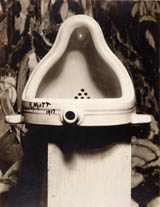
At bottom, Duchamp was Duchamp, an enigma to himself as to everyone else. Only he was capable of scrambling codes and genders with a strange, impersonal elegance. “Mince,” thin, slim, was Duchamp’s favorite word as “petit” or “menu” was Deleuze’s (as when he declared: “I am not sick, I simply have a petite health”). Duchamp found “infra-mince” even better as a concept. He was convinced that it took us to another space, from the second to the third dimension. Duchamp, the thin man, the hunger artist, el ombre invisible. His best performances were disappearing acts. And yet he always left traces of a sort – a signature on Fountain.


click to enlarge

Fountain

Figure 1
Marcel Duchamp,
Fountain, 1917

Duchamp didn’t especially like listening to music, but its evanescence fascinated him. He kept dreaming of even more elusive sounds, sounds like the faint rustle of corduroy pants in a dance (he was always precise). Sounds for the birds. No wonder Cage got trapped.

“Duchamp placed chess above everything, and Cage was his partner.” This is what flashed in my mind when one day, out of the blue, Cage called me for a game. “You’re French,” he said, “so you must play chess.” Duchamp and me. That was in 1975, a few weeks after Cage and I first met. I cowered for a few more weeks, imagining Duchamp’s ghost breathing down my neck as I leaned over a chessboard. But Cage nudged me again and I surrendered to my destiny. We met, and played. I could hear music coming from the empty space. He narrowly won our first game.

As it turned out, he wasn’t such a formidable adversary. He was no adversary at all. It was then that he told me the Chess Master had found him a real disappointment. “Don’t you ever play to win?” Duchamp had kept asking, exasperated. Cage was a Zen Buddhist to the core: why should anyone have to win? He had already won what he wanted: spending time with Duchamp.

Cage got somewhat better at playing chess after that, trying his hand, I guess, on vague Duchamp surrogates like myself. And then there was Teeny, of course.


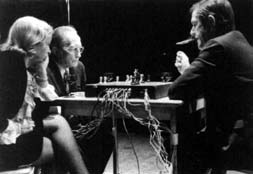
click to enlarge

Duchamp, Teeny, and Cage playing
chess

Figure 2
Duchamp, Teeny, and Cage playing
chess in a performance, Sightssoundsystems,
a festival of art and
technology in Toronto, 1968

Actually, Cage hadn’t lost every single match with Duchamp. There was one that he definitely won, after a fashion. It happened in Toronto, in 1968. Cage had invited Duchamp and Teeny to be with him on the stage. All they had to do was play chess as usual, but the chessboard was wired and each move activated or cut off the sound coming live from several musicians (David Tudor was one of them). They played until the room emptied. Without a word said, Cage had managed to turn the chess game (Duchamp’s ostensive refusal to work) into a working performance. And the performance was a musical piece. In pataphysical terms, Cage had provided an imaginary solution to a nonexistent problem: whether life was superior to art. Playing chess that night extended life into art – or vice versa. All it took was plugging in their brains to a set of instruments, converting nerve signals into sounds. Eyes became ears, moves music. Reunion was the name of the piece. It happened to be their endgame.

Well, not quite. Less than a year later Duchamp was gone, but for Cage the game wasn’t over; it was rather like jumping into the middle of Duchamp’s disappearance act. Duchamp’s studio didn’t remain empty for long. Cage, so to speak, quickly moved in. Discreet, but focused and industrious, he gave Duchamp a piece of his own mind. From then on, it would be work as usual. There were countless traces to be picked up in Duchamp’s trail – slim cues, silent music. Cerebral circuits had to be delicately hooked on to other machines, imaginary solutions invented. Example of nonexistent problems: “What belongs to Duchamp and what belongs to me?” The problem wasn’t just crossing over – what’s identity anyway? – but making the two separate spaces work together.

In a sense Duchamp was as much alive in his death as he had been in his life. Didn’t he always want to “go underground” anyway? The imaginary solution already was at hand, and it would affect the living as well as the dead. “The effect for me of Duchamp’s work,” Cage wrote, “was to so change my way of seeing that I became in my way a Duchamp unto myself.” (2)

Cage had to see things for himself in such a way that Duchamp’s work would be kept alive through his own. The only way to celebrate Duchamp was to “recerebrate” him – a Duchampian pun Cage invented – which meant to plug Duchamp’s mind into one’s own, the way the chessboard had been plugged to the sound system. And the music would be both theirs.

This uncanny collage – this ménage à deux, moins Duchamp – remains exemplary of the kind of creative crossings that can be achieved between the various arts, but also between art and life, and art and death. Becoming someone else (Jarry-Duchamp-Cage) is a way of becoming oneself, which became the condition for Cage’s own poetics of chance and politization of aesthetics. His creative anarchism.

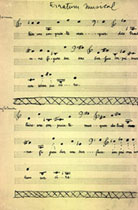
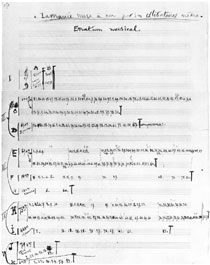
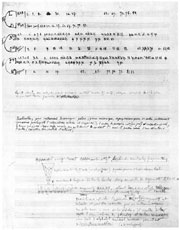
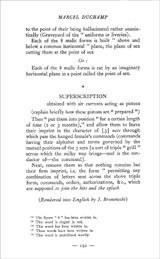
Very early on, in 1913, the year Cage was born, Duchamp composed a music piece en famille, Erratum Musical,


click to enlarge

Erratum Musical


Erratum Musical

Figure 3
Marcel Duchamp,
Erratum Musical, 1913

by using chance operations. The procedure was far too simple for Cage’s taste – he favored more complex operations leaving no room for intention – but it was precisely that kind of simplicity that Duchamp liked, drawing jumbled notes at random from a hat. Duchamp composed Erratum Musical with his sisters Yvonne and Magdeleine, seventy-five notes picked by chance to accompany as many syllables of the randomly chosen dictionary entry for imprimer. (3)“How is it that you used chance operations when I was just being born?” Cage asked Duchamp. This was a straight-faced question, but I don’t doubt that Cage saw in this synchronicity the start of their collaboration. He always experienced the past in the future tense – as a futur anterieur – and reclaimed this experience as his own, like everything else that concerned Duchamp. He would occasionally use chance the way Duchamp did (pulling slips of paper out of a hat) whenever he happened to be some place without his own I Ching simulation program. He always kept his “IC” in a black suitcase reminiscent of the famous “valise” in which Duchamp, ever the salt salesman (marchand du sel), kept small replicas of his art. Becoming Duchamp in the most “detailed” way.
Cage always considered music far more “detailed” than painting or visual work. In 1978, though, he was invited to make etchings at Crown Point Press. Not being an artist himself, and quite incapable of drawing, he decided to treat etchings like music – his own music – and draw into the plate with his eyes closed. But after spending two weeks every year, for fourteen years, making etchings and watercolors, they became so complex, he said, that he considered them “probably the most musical…the most detailed work, with very subtle changes in the colors and shapes.”

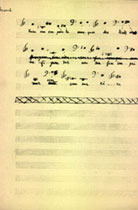
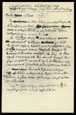
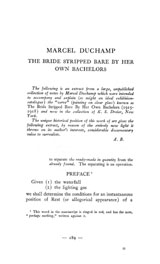
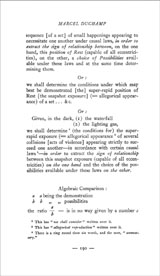
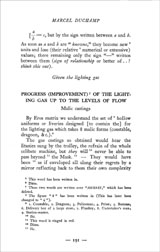
Duchamp didn’t especially like listening to music, and yet he made forays of his own into the world of sounds. In his writings (The Bride Stripped Bare by Her Bachelors, Even: Erratum Musical, 1913),


click to enlarge

The Bride Stripped Bare
by Her Bachelors


The Bride Stripped Bare
by Her Bachelors

Figure 4
Marcel Duchamp,
The Bride Stripped Bare
by Her Bachelors, Even:
Erratum Musical
,1913

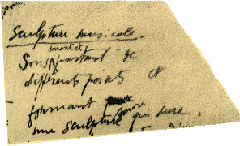
he conceived what Cage called after him “Duchamp’s Train,” in which each freight car would carry a different octave on the piano, so that each of the “cars” would have its own notes. Cage eventually used this idea for one of his own violin pieces. (Unlike the piano, the violin allowed him to chose sustained intervals.) For this, he had to disregard the fact that Duchamp’s train was meant for a pianist to go through the eighty-five notes of the keyboard (the standard range for a piano of that time), which the violin doesn’t have. Crossings don’t just happen between the ear and the eye, they also occur within the same medium. Actually, they always happen between the two ears – in the empty studio of the brain. As far as he was concerned, Cage always kept an eye on the eye, starting with the intricate layouts for his Mesostic texts, these acrostic-like compositions with the key letters running down the middle of the text. But the poems would also lead him onto another track. The source material would become the starting point for other experiments involving source material he didn’t even know, like German or Japanese – we could call this endo-crossing – or he would let the repetition of sounds bring him back to the world of music – exo-crossing. Innovations between the arts, therefore, are not just a matter of crossing a barrier, even the frontier between sound and form, or synthesizing the two. It is essentially rhizomatic and can proliferate in every direction. Once Cage showed me a scrap of paper that he got from Duchamp in the late 1960s.(4) Duchamp’s scribble read as follows: Sculpture Musical.


click to enlarge

Note from the
Green Box

Figure 5
Marcel Duchamp,
Note from the
Green Box, 1934

Sons durant et partant de différent points et formant une sculpture sonore qui dure. (“Musical Sculpture. Sounds lasting and leaving from different places and forming a sounding sculpture that lasts.”) Until then Cage had been thinking of himself as a “percussion composer,” someone who could strike anything – traffic sound, ambient noise, sounds that weren’t musical – investigating each sound for itself. But these sounds didn’t give him a feeling of space. You couldn’t walk around them as you would if they were emitted from three sources, instead of one or two. They didn’t provide a sculptural experience; they were two-dimensional. And Duchamp, just by pointing out the virtual volume of sounds, made it possible to take them to the third dimension.
As a visual piece, Étant Donnés remains a puzzle. But the extreme attention Duchamp paid to the details of its installation are even more intriguing. He specially wrote a “Manual of Instructions” spelling out the disassembling and reassembling of his work, from his 10th Street studio in Manhattan to the Philadelphia Museum of Art, Étant Donnés’s final resting place. Why? Could it be that there was more there than could meet the eye? Duchamp left so little behind – his work was so slim – that any scrap or relic was worth treasuring and nurturing with the greatest care until it assumed its proper dimension. “Anything he did,” Cage wrote, “was of the utmost importance.” If Duchamp envisaged to take Étant Donnés down and putting it back, Cage went on, riffing around the idea and making it its own, it had to produce a sound. Therefore it was a musical work, the most musical of his works. Besides, Cage declared, closing the circle, “the whole structure of Étant Donnés is done with something that corresponds to a chessboard, in principle at least…It’s the most fantastic artifact.”

In 1988, four years before he died, Cage conceived of an opera that would be called “Nohopera,” which he subtitled – this was only partly in jest – “the Complete Musical Works of Marcel Duchamp.” It would be produced in Tokyo and would encompass both the Orient and the Occident. All of Duchamp’s “musical works” would be carefully staged, performed and choreographed in order to bring out what was lying latent in Duchamp: his “total work.” It would be the Grande Oeuvre of this fin-de-siècle – actually the “petite” oeuvre – and the culmination of Cage’s life efforts. Something like “Duchamp on the Beach.

Erratum Musical would be there, the songs Duchamp had fished in a hat and sang with his sisters (Music Hall). Also the toy train of The Bride Stripped Bare by Her Bachelors, Even: Erratum Musical, loaded with excerpts from Nohdrama and European Opera (Theater). Then the Sculpture Musicale, executed by David Tudor, Takehisa and Cage himself (Music). And last but not least: Infra-Mince, choreographed by Merce Cunningham (Ballet).A “Manual of Instructions” would begin “Nohopera” with a reconstruction/reassemblage of Étant Donnés, after the original art piece, across the entire stage, accompanied by other “musicals” by Marcel. (Rrose Sélavy). As for Cage, he would be “the composer of the entire work, but almost nothing, or very little would be by me.” A slim project, by any account. A minor Gesamtkunstswerk. What is for certain is that by the time this Noh-opera (pointedly, Cage added a dash at the right place to register his hope that his project would eventually take shape) was about to leave the draft-board, the effect on Duchamp of Cage’s way of seeing was such that Duchamp himself had become in his way a Cage unto himself.


Notes

Footnote Return 1. Cf. “John Cage on Marcel Duchamp: An Interview, ” by Moira Roth and William Roth, Art in America (November-December, 1973), p. 151 – 161.

Footnote Return 2. John Cage, X: Writings ‘79-’82. (Middletown, CT: Wesleyan UP, 1983), p. 53.

Footnote Return 3. Many passages of this article are indebted to the rich diet of interviews between Joan Retallack and John Cage in Cage’s and Retallack’s Musicage: Cage Muses on Words Art Music. (Middletown, CT: Wesleyan UP, 1996). See especially pages 153, 178, 229, 341.

Footnote Return 4. This note now is at the Music Library of Northwestern University in Evanston, Ill.

Figure 1~5 © 2000 Succession Marcel Duchamp ARS, N.Y./ADAGP, Paris. All rights reserved.

Duchamp’s Financial Documents: Exchange as a Source of Value

Introduction

“You know, I like signing all those things – it devalues them,” Duchamp confided to Richard Hamilton at the Pasadena Art Museum. (Tomkins 1965, p. 68.) A retrospective of his work had just opened (1963) and without reluctance Duchamp spent the morning signing papers, posters and other objects. His fame in America was greater than ever, and as Duchamp recalled himself he would sign anything in those days. (cf. Judovitz 1995, p. 162.) Many more shows were put together in the years to follow. Vogue interviewed Duchamp, museums organized round table discussions where Duchamp himself would frequently show up, and slowly a body of literature emerged that vainly tried to pin down the meaning of his work.

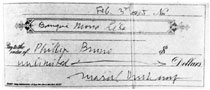
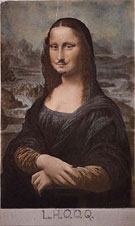
A little over a year after Pasadena, the same ritual took place: a show opened at the Cordier & Ekstrom Gallery in New York and an unknown man entered.(1) Philippe Bruno, more of a groupie than an art collector, had cut out all newspaper reviews of the show and pasted them in his copy of the show’s catalogue. If Duchamp could sign this please, maybe on the blank check that was attached with a paperclip to the page where the Tzanck Check was reproduced (facing L.H.O.O.Q.)


click to enlarge
Cheque Bruno
Figure 1
Marcel Duchamp,
Cheque Bruno, 1965
© 2000 Succession Marcel
Duchamp ARS, N.Y./ADAGP, Paris.

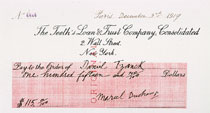
With the “Cheque Bruno a quartet of financial readymades had been completed. Duchamp created the first of them in 1919 (Figure 2)


click to enlarge

Tzanck Check

Figure 2
Marcel Duchamp,
Tzanck Check, 1919
© 2000 Succession Marcel Duchamp
ARS, N.Y./ADAGP, Paris.

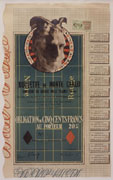
for his dentist Tzanck, followed five years later by a bond issued to finance a roulette project. (Figure
3)
In the same year that he signed Philippe Bruno’s check (1965), Duchamp had also converted a Czech membership card into a readymade by wittily naming it “Czech Check.” Duchamp’s four financial readymades have hardly received attention.(2)


click to enlarge

Monte
Carlo Bond

Figure 3
Marcel Duchamp, Monte
Carlo Bond
, 1924
© 2000 Succession Marcel
Duchamp ARS, N.Y./ADAGP, Paris.

The status of the Czech Check and the Cheque Bruno is particularly ambiguous, as if Duchamp’s interpreters have understood his lesson all too well (or not at all). The checks have never been institutionalized as proper works by Duchamp.(3) At the same time, they have been noticed too often to live in oblivion altogether.

Duchamp’s financial documents both specify and generalize his overall artistic enterprise. Rather than addressing all institutions of the art world, they nail art down at one specific institution: the art market. Rather than questioning artistic worth, they address the general question of how value comes into being. As epitomes of the readymade, Duchamp’s financial documents defy general interpretations. They may be fingerprints of a charlatan, but it is impossible to deny their critical potential as readymades. Conversely their refined critique of the art market’s perversity can only be seen by ignoring Duchamp’s biography; it recounts how Duchamp was highly implicated in the market mechanisms the financial documents allegedly critique.

Four financial documents

Drawn on “The Teeth’s Loan and Trust Company, Consolidated, 2 Wall Street” in the amount of $115, Duchamp created the Tzanck Check in 1919 to pay for the services of a Parisian dentist, Daniel Tzanck. Apart from its larger size, the check resembles the design of standard checks accurately. Duchamp minutely drew the whole check by hand and had a stamp manufactured for the background print which reads “theteeth’sloanandtrustcompanyconsolidated,” repeated over and over.(4) Whereas his other readymades questioned the value of artistic craftsmanship in a capitalist society, the Tzanck Check traveled the opposite direction by importing this value in the world of finance.

The Monte Carlo Bonds (Obligations pour la Roulette Monte Carlo) were issued five years later to raise funds for a gambling project. In an interview Duchamp recalled that he created the bonds “to make capital to break the Monte Carlo bank” (Lebel 1959, p. 137): roulette would be converted into a game of chess by removing luck from the table and relying on mathematical calculations instead. Like the Tzanck Check, the Monte Carlo Bond is a look-a-like of the actual financial document.(5) On top of the bond is a photograph by Man Ray of Duchamp’s face covered in shaving foam, while the background reads “moustiques domestiques demistock” (“domestic mosquitoes half-stock”). The document is signed by Rrose Sélavy, president, and Marcel Duchamp, one of Sélavy’s administrators.(6) Of the thirty bonds that were created, about twelve would eventually be sold for 500 francs each. All owners of the bonds were entitled to an annual dividend of 20%.(7)

After the Monte Carlo Bonds, it would take a long time before Duchamp resumed making art.(8) Indeed, the other two checks came into being towards the end of Duchamp’s life.  With the Czech Check (Figure 4)


click to enlarge
Czech
Check
Figure 4
Marcel Duchamp, Czech
Check
, 1965
© 2000 Succession Marcel Duchamp
ARS, N.Y./ADAGP, Paris.

, Duchamp supported his friend John Cage who was organizing a fund-raising action for the Foundation for Contemporary Performance Arts. Instead of a real check, the document is Cage’s membership card at the Czech Mycological Society which Duchamp merely signed. The check was sold for $500 at the fund-raising event. Finally the Cheque Bruno came into being when Duchamp complied with Philippe Bruno’s request to sign the check he had included in his catalogue from the Cordier & Ekstrom show. Duchamp wrote the check in an unlimited amount to the “Banque Mona Lisa.”

Expositions of value

When Jane Heap, editor of the American Little Review, received a copy of the Monte Carlo Bond from Duchamp she advertised it as follows: “If anyone is in the business of buying art curiosities as an investment, here is a chance to invest in a perfect masterpiece. Marcel’s signature alone is worth much more than the 500 francs asked for the share. Marcel has given up painting entirely and has devoted most of his time to chess in the last few years. He will go to Monte Carlo early in January to begin the operation of his new company.” (Lebel 1959, p. 185.) It is unclear if Heap intended to be ironic or if she was simply unable to read underneath the economic surface of the bonds, but just like the other readymades Duchamp’s financial documents obviously criticize an art world where the signature certifies both artistic and economic value, where the authority of the artist and the authenticity of the work are seemingly all that counts. And if Duchamp had to face the fact that people ended up ascribing aesthetic value to his readymades whereas his choices were informed by aesthetic indifference, the financial documents were an effective remedy.(9) Thus Duchamp’s readymades express the intent “to eliminate art as an institution,” as avant-garde’s advocate Peter Bürger puts it:

When Duchamp signs mass-produced objects…and sends them to art exhibits, he negates the category of individual creation. The signature, whose very purpose it is to mark what is individual in the work, that it owes its existence to this particular artist, is inscribed on an arbitrarily chosen mass product, because all claims to individual creativity are to be mocked. Duchamp’s provocation not only unmasks the art market where the signature means more than the quality of the work; it radically questions the very principle of art in bourgeois society according to which the individual is considered the creator of the work of art. (Bürger 1974, p. 51-52.)

The financial documents take Duchamp’s general critique of value one step further by not only questioning the distinction between art and non-art, but also exposing the congruency between the art world and the economy. The financial documents made artworks equivalent to monetary tokens, conflating the categories of culture and finance in one object. To be sure, Duchamp was highly critical of art’s marriage to commerce in the modern art world. When asked why he had stopped painting, Duchamp answered, “I don’t want to copy myself, like all the others. Do you think they enjoy painting the same thing fifty or a hundred times? Not at all, they no longer make pictures; they make checks.” (Naumann 1984, p. 192.) And to one of his American patrons, Katherine Dreier, he complained that economic success corrupted artists, while art lovers would only be able to value a work once it had a high price.(10) (Tomkins 1996, p. 285.)

The Tzanck Check, with the word “original” printed on it, more specifically questions the value of originality and addresses issues of forgery, common to the worlds of both finance and art. (Read 1989, p. 99.) Likewise the Cheque Bruno addresses the art historical canon, and the way it is safeguarded by the museum (the Louvre being the most likely candidate for the “Banque Mona Lisa,” with Mona Lisa’s pricelessness as an analogy to the unlimited sum of the check), while the Monte Carlo bonds point at the speculative nature of both gambling and the art world: success is based on luck rather than merit. As Duchamp argued in a letter to Jean Crotti: “Artists throughout history are like gamblers in Monte Carlo and in the blind lottery some are picked out while others are ruined… It all happens according to random chance. Artists who during their lifetime manage to get their stuff noticed are excellent traveling salesmen, but that does not guarantee a thing as far as the immortality of their work is concerned.” (Judovitz 1995, p. 182.)

Economic implications

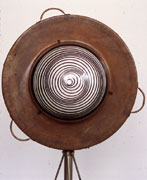
Given his condemnation of the art market, it is hardly surprising that rather than getting involved in commercial transactions, Duchamp gave away the major part of his oeuvre. Collectors are said to have rarely left his studio without a gift. When the art collector and couturier Jean Doucet financed the production costs of Duchamp’s second optical machine, the Rotary Demisphere (Figure 5)


Click image for video (QT 0.3MB)
Rotary Demisphere
Figure 5
Marcel Duchamp,Rotary Demisphere, 1925
© 2000 Succession Marcel
Duchamp ARS, N.Y./ADAGP, Paris.

, the artist gave him the machine in return. He insisted that the transaction was “an exchange and not a payment.” (Tomkins 1996, p. 255.) Furthermore, Duchamp seemingly avoided involvement in the art world, urged his main patron Walter Arensberg not to lend his works to others, and frequently denied requests to have his art exhibited. “All expositions make me ill,” he wrote to Doucet. Duchamp disapproved of commercial transactions in art in particular and wrote in a letter to Alfred Stieglitz that “[t]he feeling of the market here is so disgusting. Painters and Paintings go up and down like Wall Street Stock.” (Tomkins 1996, p. 285)

At the same time however, Duchamp was highly implicated in the mechanisms and institutions he critiqued in word and object. To begin with, he was extremely well connected in the art world. During the course of his life, Duchamp became friends with bourgeois art collectors like Jean Doucet, Katherine Dreier, and Walter and Lydia Arensberg; with (would-be) art dealers like Sidney Janis, Julien Levy and Arturo Schwarz; and with museum officials like Alfred Barr, Walter Hopps (Pasadena Museum of Art) and Fiske Kimball (Philadelphia Museum of Art). More than once he used this network to do favors for befriended artists. Furthermore Duchamp functioned as executor of the estates of Dreier and of Mary Reynolds, frequently gave assistance to galleries (11) and was active organizing exhibitions and spotting new talents as co-founder of the Société Anonyme, a short-lived museum for contemporary art in New York. At the 1917 show of the Society of Independent Artists (where R. Mutt submitted his urinal) he played a double role, being an artist as well as president of the hanging committee. (De Duve 1990, p. 63.) Duchamp was very keen on keeping his work together in the collections of Dreier and Arensberg, and seemed to be extremely pleased with the abundance of attention he got in the United States towards the end of his life. (cf. Jones 1994.)

From the mid 1920s to the 1940s, Duchamp made a partial living from trading art. In 1926 he helped out his friend Francis Picabia by buying eighty of his works directly from the artist. After framing them and making a catalogue (with an entry by Rrose Sélavy) Duchamp sold the works at one of Hotel Drouot’s auctions in Paris. Afterwards Duchamp and one of his best friends Henri-Pierre Roché bought twenty-nine sculptures by Brancusi from the estate of John Quinn, a rich American collector of modern art and early buyer of Brancusi’s work. They were encouraged to do so by Brancusi himself who was afraid that the sculptures would not be able to maintain their value if dumped on the market in such a large quantity. After this transaction, Duchamp organized a Brancusi exhibition at the Brummer gallery in New York, where some of the works were sold. Over the fifteen years to follow, he sold the rest of his share piece by piece.

The anticlimax of these commercial transactions was Duchamp’s cooperation with the writer and art dealer Arturo Schwarz, who reproduced thirteen of his readymades in 1964, including Fountain, Bottle Rack and Bicycle Wheel. According to Schwarz it was Duchamp who came up with this idea because he regretted the fact that many of the readymades had been lost, and it was impossible to see the surviving ones together. Duchamp was highly involved in establishing the price of the edition, its size, production process and presentation (Camfield 1989, p. 91-92); Schwarz sold the edition in his gallery on a commercial basis.

Duchamp’s compromise

Probably the main motivation for Duchamp to partake in these commercial activities was simply to make a small profit. Since he had given most of his works away, his reputation had not been translated into economic terms. Apart from commercial reasons, the replicas had artistic repercussions which Duchamp did not eschew. The American painter Douglas Gorsline, for instance, who asked Duchamp to sign his bottle-dryer, got the following reply in the mail: “In Milan I have just made a contract with Schwarz, authorizing him to make an edition (8 replicas) of all my few readymades, including the porte bouteille [bottle-dryer]. I have therefore pledged myself not to sign anymore readymades to protect this edition. But signature or no signature, your find has the same ‘metaphysical’ value as any other ready-made, [it] even has the advantage to have no commercial value.” (Naumann 1999, p. 245.)

Thus Duchamp suggested that his signature decreased rather than increased the value of his readymades, since the commercial value that the signature generated was a vice rather than a virtue. Likewise his friend Max Ernst, who first thought that “the value of the gesture which established the great beauty of the readymade seemed compromised,” started wondering later on if the transaction was not merely “a new attempt to throw public opinion, to confuse minds, to deceive admirers, to encourage his imitators by his bad example, etc.” (Naumann 1999, p. 25.) When Ernst asked Duchamp, the latter laughingly agreed.

Duchamp’s commercial excursions were condemned nevertheless, for they seemed to turn the readymade’s original critique into a celebration of exchange value. Robert Lebel, one of the first experts on Duchamp, refused to include any of these replicas in an exhibition. (Naumann 1999, p. 22.)

Daniel Buren maintained that “Duchamp totally betrayed himself…when he allowed Schwarz to make replicas.” John Cage wondered why he permitted the creation of these replicas that looked more like business than art (12) and many other people could not understand why their model of artistic integrity no longer resisted the temptations of the market. Critics of Duchamp saw their doubts confirmed.

If the readymades deconstructed “modernist notions” of originality, the replicas deconstructed this very critical potential. Because of his commercial joint venture of the 1960s, Duchamp became “a factory foreman…O.K.ing a product” rather than an “originary genius authenticating a creative work through his signature.” (Jones 1995, p.140.) Thus Duchamp exactly enacted what Peter Bürger warned the neo avant-garde about: that the means by which art could be sublated, would be burdened with the status of an artwork, fully institutionalized and incorporated into the market.(13) (Bürger 1974, p. 57-58.)

Anti-market perspective

So here we are at a dead end. Duchamp’s own defense with respect to Schwarz’s reproduction of the readymades, that all great painters have made copies of their work, that hardly any sculpture in the history of art is unique, that “it is rarity which gives the artistic certificate.” (Camfield 1989, p. 94.) Obviously these defenses only add insult to injury. We are stuck with a body of work whose critical impact is unmistakable, but a biography which seems to be entirely affirmative of Institution Art.

But let’s return one more time to the first of Duchamp’s financial documents, the Tzanck Check, and take a close look at its economic biography. Since Duchamp made the Tzanck Check (just before he created L.H.O.O.Q) to pay for the services of a dentist, the origin of the work is in economics, not art; only later would the document move back into the art world. Tzanck, who was an established Parisian art collector, accepted the check wholeheartedly. The Tzanck Check – Thank Check? – thus constituted an ambiguous transaction, a mixture of ordinary market exchange, barter trade, and gift-giving based on reciprocity. Duchamp probably knew the dentist via his brother-in-law Jean Crotti, Suzanne Duchamp’s husband; many artists and poets went to see him because of his willingness to accept art work as a means of payment. (Tomkins 1996, p. 220.) Of course the check had no direct monetary value, and contrary to the other works Tzanck accepted the aesthetic value of this piece was negligible as well, but by “buying” Tzanck a place in the art world the check definitely had sumptuary value. (cf. Foster 1996, p. 108.)

The work remained in Tzanck’s collection for more than two decades. In 1940 Duchamp was busy putting together the first edition of the Boîte-en-valise. The war had started but he was still able to find the materials he needed to create the boxes. Furthermore, he found his patron Arensberg willing to finance the project. As a counter-gesture, Duchamp created the opportunity for Arensberg to buy the Tzanck Check for $50 from Tzanck and L.H.O.O.Q., which Duchamp still owned himself, for another $100. (Tomkins 1996, p. 319.) For unknown reasons, Arensberg declined the offer.

Eventually Duchamp would buy the check himself for 1000 francs, somewhat more than the stated value of $115. In an interview with Cabanne, Duchamp vaguely recalls giving the check away later to the painter Roberto Matta (Cabanne 1967, p. 59), but in fact Matta’s wife Patricia, future daughter-in-law of Henri Matisse and admirer of Duchamp, bought the work from him together with the original L.H.O.O.Q. and Network of Stoppages (Tomkins 1996, p. 391).

In 1965 the work would be shown at the Cordier & Ekstrom Gallery in New York after which it ended up in the Mary Sisler Collection, together with a number of other works like the Rotary Demisphere, a large number of early works by Duchamp, and a set of Schwarz’s edition of readymades.(14) Probably this transaction did not get much approval by Duchamp: in the eyes of Duchamp and gallery owner Ekstrom, Mary Sisler turned out to be less of an art lover than they had assumed. They expected her to donate the whole collection to a museum, but instead she sold parts of it off. Ekstrom: “She had no real interest in or feeling for the work.” (Tomkins 1996, p. 436.) The Tzanck Check was later sold by Sisler to Arturo Schwarz, who recently donated the work to the Israel Museum (Jerusalem).

The social/cultural subtext of exchange

Defying the “anti-market” perspective prevalent in the humanities, the economic biography of the Tzanck Check points at the highly personalized nature of economic transactions in art. Indeed, almost all of Duchamp’s artworks have been owned by persons he had known for a long time, and the majority of them ended up with two collectors, Walter Arensberg and Katherine Dreier who were patrons of Duchamp for almost all of his life (they donated their collections to the Philadelphia Museum of Art, the Museum of Modern Art and the Yale Art Gallery respectively). Copies of the Monte Carlo Bond were owned by his friends André Breton, Jacques Doucet, the painter Marie Laurencin (an ex-lover of Apollinaire, who had been represented along with Duchamp and seven other artists in Apollinaire’s The Cubist Painters), Daniel Tzanck and the Museum of Modern Art in New York, which had received a copy from Duchamp as a gift in 1939. (Lebel 1959, p. 171.)

Analogous to Greek or Medieval societies, where commercial exchange was largely the domain of strangers rather than citizens proper, or to contemporary society, where commercial transactions are avoided as much as possible in intimate relationships, Duchamp seemed to have discriminated deliberately between the transactions he got involved in. Whereas he made a partial living from buying and selling works that were more remote from his own studio, he avoided commercial transactions in the works he created himself by giving them away.(15) The impersonal financial systems signified by the Tzanck Check, theCheque Bruno and the Czech Check not withstanding, these checks were in fact subjects of gift relationships.

The economic biography of the Tzanck Check also defies the anti-market mentality that is still so common in the humanities by qualifying the concept of commodification: artworks, like other goods, merely go through “commodity phases.” (cf. Appadurai 1986.) The evaluational history they adopt in their non-commodified status – from admirers talking informally about the work in a private setting to highly specialized and institutionalized scholarly analysis – is inevitably taken into the economic realm every time an artwork enters a commodity phase.

Interrogated by Cabanne about the opportunities he continuously created for Arensberg to acquire his works, Duchamp answered, “I had a certain love for what I was making, and this love was translated into that form.” (Cabanne 1967, p. 74.) Valuation in the domain of art in other words spills over into the domain of the market, and thus both domains are blurred. “Value is created through exchange, through the display, circulation, and consumption of the work, in a game where worth has no meaning in and of itself.” (Judovitz 1995, p. 163.)

Seen in this light, the financial documents take Duchamp’s “ordinary” readymades one step further: whereas the readymades had defied Marxian notions of value by indicating that objects can have value without “embodying” labor, they obscured the source of this value in the signature and institutional setting of the work. The financial documents indicate by contrast, that exchange, both inside and outside of the economic realm, may be closer to the source of value and of our desire to own a good. Desire, in other words, is at the same time satisfied and generated by exchange.

Rather than signifying the commensurability of art on the market (commensurate, for instance, to the services of a dentist), they highlight the social and cultural subtexts of exchange. The financial documents emphasize the fact that both money and art work are dependent on trust, while both need a social setting in order to function. Just as the paper money and checks we use in everyday transactions are fiduciary and do not embody any value themselves, Duchamp’s checks destroy any illusions we may still have had about the intrinsic value of art. Instead, its value is based on a discursive context which initiates the production of belief. (cf. Bourdieu 1993.) As one interpreter concludes:

Rather than viewing Duchamp’s commercial activity as a betrayal of both his artistic detachment and putative disinterest in financial value, his fascination for the speculative value of art can be better understood in intellectual terms. It is a fascination with how artistic and monetary value is generated arbitrarily through social exchange. Duchamp’s interest in the speculative character of money does not translate itself into the subservience of his own artistic work to monetary considerations. Instead, it expresses the recognition that value, be it artistic or financial, is embedded in a circuit of symbolic exchange. (Judovitz 1995, p. 167.)

And Duchamp? Yes, both making a living and making art could surely be done simultaneously, “without one destroying the other,” and no, not too much attention should be paid to his activities as an arts marketer. Admittedly, “I bought back one of my paintings…Then I sold it, a year or two later, to a fellow from Canada. This was amusing. It didn’t require much work from me.” (Cabanne 1967, p. 74.) Or, in other words, “it is not that important.”


Notes

Footnote Return1. Not Seen and/or Less Seen of/by Marcel Duchamp/Rrose Sélavy, 1904-1964.

Footnote Return2. For exceptions, see De Duve (1990), Judovitz (1995), Joselit (1998) and Read (1989).

Footnote Return3. By contrast, the Tzanck Check was published under the title Dessin Dada in Francis Picabia’s short-lived magazine Cannibale in 1920. Duchamp included the Check in the Boîte-en-valise (Box-in-a-suitcase), which he started working on in the late 1930s (Tomkins 1996, p. 317), and it was part of a number of main collections. Furthermore Alfred Barr included André Breton’s copy of the Monte Carlo Bonds in his 1936 exhibition Fantastic Art, Dada, Surrealism, whereas the Tzanck Check was exhibited in 1945 at Yale in a show of Duchamp and his two brothers, Jacques Villon and Raymond Duchamp-Villon. (Tomkins 1996, p. 346.)

Footnote Return4. In an interview he stressed the labor of making it: “I took a long time doing the little letters, to do something which would look printed – it wasn’t a small check.” (Cabanne 1967, p. 63.)

Footnote Return5. Arturo Schwarz has coined pseudo-readymades like the Tzanck Check and Monte Carlo Bonds “rectified readymades.” (Schwarz 1997, p. 45.)

Footnote Return6. As Amelia Jones (1994) notices, Rrose Sélavy thus became an authority over her author Marcel Duchamp.

Footnote Return7. Duchamp did try out his system but unsurprisingly the profits were not large enough to make more than a fraction of the dividends payable. (cf. Lebel 1959, p. 137.) The only person known to have received any dividends is the Parisian couturier and art collector Jean Doucet.

Footnote Return8. Instead, he concentrated on playing chess. However, with the Monte Carlo Bonds in mind Duchamp wrote playfully to Picabia: “You see, I haven’t quit being a painter, now I am drawing on chance.” (Lebel 1959, p. 187.)

Footnote Return9. In a letter to Hans Richter Duchamp had complained that “in Neo-Dada they have taken my ready-mades and found aesthetic beauty in them. I threw the bottle-rack and the urinal into their faces as a challenge and now they admire them for their aesthetic beauty.” (Camfield 1989, p. 96.)

Footnote Return10. This complaint echoes the American economist and social critic Thorstein Veblen. Value, Veblen argued in The Theory of the Leisure Class (1899), is informed by “pecuniary canons of taste”: for an object to appeal to our sense of beauty, it must have aesthetic qualities as well as the looks of expensiveness. And if beauty and expensiveness are related, this is because we tend to value an object “in proportion as they are costly.” (Veblen 1899, p. 108.) Because of its high price art is an exemplary tool for what Veblen calls “invidious distinction” or, in other words for being a marker of status.

Footnote Return11. Sidney Janis, for instance, recalls Duchamp’s help in putting together the Dada show at his gallery in 1953: “A most difficult show to do since collectors were hesitant to risk invaluable loans, but Marcel’s frequent intercession smoothly resolved these problems.” (Janis in D’Harnoncourt and McShine 1973, p. 202.)

Footnote Return12. When Buren asked Duchamp why he did that, Duchamp supposedly answered that “[t]he notion of original extends to eight…today.” (De Duve 1991, p. 309.) Ironically, Cage induced Duchamp to make a reproduction of the Czech Check, desiring to own Marcel’s signature on his membership card himself. When Cage coincidentally received a new membership card on the day the old one was sold at the fund-raising action, Duchamp did not mind signing the new card as well.

Footnote Return13. As a review of a recent exhibition of Marcel Duchamp’s works in a New York gallery noted: “While Duchamp often blurred such distinctions, they become important in defining his market. A good signature and the artist’s touch still means something in terms of prices.” (Art and Auction Magazine, October 1999.)

Footnote Return14. Sisler acquired most of the works before they were exhibited at Cordier & Ekstrom in 1965, mainly from Henri-Pierre Roché, who had died in 1959, and Gustave Candel. (Naumann 1984, p. 17.) It is unclear however how she acquired the Tzanck Check and sold it afterwards.

Footnote Return15. As Foster argues, the gift is one of the ways to challenge capitalist exchange and its presupposition of equivalence symbolically. (Foster 1996, p. 115.) Likewise Lewis Hyde has noted that gift-giving acknowledges similarities between the persons involved in the transaction: “an academic scientist who ventures outside of the community to consult for industry expects to be paid a fee (…) The inverse might be the old institution of ‘professional courtesy’ in which professionals discount their services to each other. The custom is the opposite of a ‘fee for service’ in that it changes what would normally be a market transaction into a gift transaction (removing the profit) as a recognition of the fact that the ‘buyer and seller’ are members of the same community and it is therefore inappropriate to benefit from each other’s knowledge.” (Hyde 1983, p. 78.)


Bibilography

Appadurai, Arjun, ed. The Social Life of Things. Commodities in Cultural Perspective. Cambridge: Cambridge University Press, 1986.

Bourdieu, Pierre. The Field of Cultural Production. Essays on Art and Literature. New York: Columbia University Press, 1993.

Bürger, Peter. Theory of the Avant-Garde. Translated by M. Shaw. 1974. Minneapolis: University of Minnesota Press, 1996.

Cabanne, Pierre. Dialogues with Marcel Duchamp. Translated by R. Padgett. 1967. New York: Da Capo Press, 1971.

Camfield, William A. Marcel Duchamp. Fountain. Houston: Houston Fine Art Press, 1989.

Cordier & Ekstrom Gallery. NOT SEEN and/or LESS SEEN of/by MARCEL DUCHAMP/RROSE SELAVY 1904-64. Exhibition Catalogue, New York, 1965.

Sanouillet, M. and E. Peterson, eds. Salt Seller: The Writings of Marcel Duchamp. 1959. New York: Oxford University Press, 1973.

De Duve, Thierry. “Marcel Duchamp, or The Phynancier of Modern Life,” October 52 (1990), 60-75.

De Duve, Thierry, ed. The Definitively Unfinished Marcel Duchamp. Cambridge: MIT Press, 1991.

Foster, Hal. Return of the Real: The Avant-Garde at the End of the Century. Cambridge: MIT Press 1996.

D’Harnoncourt, Anne and Kynaston McShine, eds. Marcel Duchamp. 1973. Munich: Prestel, 1989.

Hyde, Lewis. The Gift: Imagination and the Erotic Life of Property. New York: Random House, 1989.

James, Carol P. “An Original Revolutionary Messagerie Rrose, or What Became of Readymades,” in Thierry De Duve, ed., The Definitively Unfinished Marcel Duchamp. Cambridge: MIT Press, 1991.

Jones, Amelia. Postmodernism and the En-gendering of Marcel Duchamp. Cambridge: Cambridge University Press, 1994.

Joselit, David. Infinite Regress: Marcel Duchamp, 1910-1941. Cambridge: MIT Press, 1998.

Judovitz, Dalia. Unpacking Duchamp: Art in Transit. Berkeley: University of California Press, 1995.

Lebel, Robert. Marcel Duchamp. Translated by G.H. Hamilton. New York: Trianon Press, 1959.

Naumann, Francis M. The Mary and William Sisler Collection. New York: The Museum of Modern Art, 1984.

Naumann, Francis M. Marcel Duchamp: The Art of Making Art in the Age of Mechanical Reproduction. Ghent: Ludion Press, 1999.

Paz, Octavio. Marcel Duchamp. Appearance Stripped Bare. Translated by R. Philips and D. Gardner. New York: Viking Press, 1978.

Read, Peter. “The Tzanck Check and Related Works by Marcel Duchamp,” in R. Kuenzli and F. Nauman, eds., Artist of the Century, Cambridge: MIT Press, 1989.

Schwarz, Arturo. The Complete Works of Marcel Duchamp. 3rd ed. New York: Delano Greenidge, 1997.

Tomkins, Calvin. The Bride & The Bachelors. The Heretical Courtship in Modern Art. 1962. New York: Viking Press, 1965.

Tomkins, Calvin. Duchamp. A Biography. New York: Henry Holt, 1996.

Veblen, Thorstein. The Theory of the Leisure Class. 1899. New York: Dover, 1996.

Sending and Receiving


click to enlarge
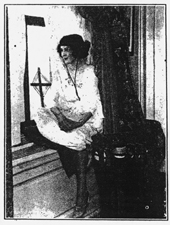
Send Me a Kiss by Wireless
“Send Me a Kiss by Wireless”,
QST, May 1922, p. 54 (photo: Underwood & Underwood) This
picture was reproduced in many newspapers across the country during
the radio boom. The male radio amateurs reacted with new proposals
for captations, like “See the Shaft – on the Variometer”

Everything that we call electronic mass media today begins with the sending and receiving of signals without any material connection, with the miracle of “wireless” that started shortly before 1900. From 1920 on, this transmission technique of then primarily strategic military use develops into radio broadcasting. As a result, material things disappear from mass distribution and the media turn into something “immaterial”. The uniformity of all products for all people caused by industrialization – as is expressed by the lexical term “ready made” – is only a preliminary stage towards a globally synchronized perception of a “radio-made” experience world. With the Greenwich time signal, which has been broadcast by radio transmission from the tip of the Eiffel Tower since 1910, this immaterial synchronization reaches all of Europe. And only a year after that a time signal is transmitted around the world through a chain of wireless stations.

Radio is not a word but a prefix. It denotes something that emits radially: from one point to many, carried by electromagnetic waves. According to the intentions of its inventors, radio transmission ought to deliver a signal from a transmitter to one single receiver. But despite all efforts they cannot mold the Hertz waves to fit into the concept of cable connections: the signal would always reach more receivers than it was supposed to. Thus, the military becomes concerned with the secrecy of their radio messages. At the same time, this circumstance delights the radio amateurs who devotedly listen to everything their homemade apparati allow them to receive way before actual radio programs emerge. These craftsmen and amateurs form the basis of the unexpectedly developing radio boom starting in 1920, which creates a medium nobody had planned. The same happens again in the 1980s when hackers, being the first private users of the global computer and telecommunications network, represent the forerunners of the Internet boom of the 1990s.

Indeed, radio – and therefore the beginning of all electronic mass media – is invented by receivers, not by broadcasters. One might modify Duchamp’s famous quote that the onlookers make the pictures: “Ce sont les récepteurs, qui font les médias.” And even though today it seems as if the broadcasters alone possessed all power over the mass media, there is an almost anarchical criterion, on which all is based and in which the power of the receivers has been preserved: In TV ratings are everything.


click to enlarge
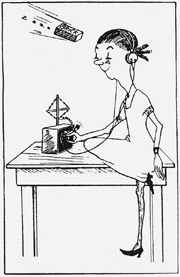
Radio Girl
“Radio Girl”, QST,June 1922, p. 68. Sketch of an
amateur from Poduch, NJ, reacting to the photograph
“Send Me a Kiss by Wireless,” including a reader’s letter (excerpt)
: “This radio game is getting too much punk lately.
Why, pick up any newspaper and take a look at some of the radio
pictures they are printing. Swell janes talking into sets that have
no tubes in the sockets.” Signed: “Your brass pounder. Amplifier
Ambrose.”

How could the power of the receivers be great enough to turn the entire media machine upside down and change it from a strategic into a distributive system? What fascination initiated all that constitutes our present-day electronicized worldview? For one thing, there is the “bricolage” or fiddling with ominous elements such as wire, lacquer, magnets, crystals and so on. Under one’s own hands an apparatus comes into being that brings forth strange signals from the nothingness of the air. The enigma lies in how something develops out of nothing and how this something is interconnected with the rest of the world. For there are signals telling of news from far away, of temperatures, stock market rates, other radio amateurs and sometimes even of sensations like the SOS signal of a distressed ship. The power of the receivers lies in the invention of listening – first there were the listeners, next broadcasting stations emerged addressing this unknown and scattered community, then a radio boom arose, which was very much comparable to today’s internet boom. During the first years of radio, listeners would experience and describe receiving as global raptures of listening to boundless spaces. ”

“…to feel at home in the surge, in the motion, in the fleeting and infinite. Not to be at home and yet to feel at home anywhere; to see the world, to be in its center and to be concealed from it.” These words may serve to describe the listening experience that would fascinate so many from the time of the amateurs to the beginning of radio. Yet they come from Charles Baudelaire and relate a flaneur’s experience in the anonymous mass of a modern metropolis, “from this universal communion he gains a unique sort of inebriation.”(1)
click to enlarge
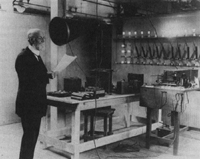
The first
radio lecture
The first
radio lecture being delivered by radio from Tufts University, 1922.
Initially, radio is being promoted as a great instrument of education
for the masses. In the USA it is announced that the “University
of the Air” will have more students than all universities of the
country combined. At the first radio lecture at Tufts University
in 1922 it looks as if Freud himself speaks into the apparatus of
the soul – should it be viewed as a premonition of the libido’s
might, which would ultimately eliminate all educational value from
mass media? (see: Susan J. Douglas, Inventing American Broadcasting
1899-1922
, Baltimore and London: Johns Hopkins UP, 1987, esp.
pp. 292-314)

The poet is a particularly sensitive receiver who by creating poetry becomes a sender himself. He bridges the centuries in the same way as it is depicted by Baudelaire’s marine metaphor of “Lighthouses” signifying intellectual authorities that send each other signals through the ages. What if the “universal communion” turned into a universal communication?

Many a time Baudelaire meets Baudrillard back to back on the shelves of a well-arranged private library. But beyond all alphabetical alliterations, premonition and abgesang of the sender’s power meet when Baudrillard writes in his “Requiem for the media”: “In the symbolic exchange relation, there is a simultaneous response. There is not transmitter or receiver on both sides of a message: nor, for that matter, is there any longer any ‘message’. […] Thus, the receiver (who in fact ceased to be one) intervenes here at the most essential level” by a “subversive reading” of the transmitter.(2)

It is exactly one such subversion of the broadcaster’s power through the receiver that 20 years before Baudrillard had been undertaken by John Cage’s “Imaginary Landscape No.4”: 24 performers convert 12 radios from reception to production devices. Something quite similar had already been done with record players in the 1939 piece “Imaginary Landscape No.1.” The transformation of a receiving device into a source of continuous original production has become an everyday aspect of mass entertainment in the era of the Techno-DJs. “Do you remember your thinking at the time?” Cage is asked. “Yes, my thinking was that I didn’t like the radio and that I would be able to like it if I used it in my work. That’s the same kind of thinking that we ascribe to the cave dwellers in their drawings of frightening animals on the walls – that through making the pictures of them that they would come to terms with them.”(3)

It seems as if media and machines have replaced wild beasts in the way they are depicted in art and literature of the 19th and 20th century: dangerous and fascinating, they cannot be conquered by the individual but are at the same time indispensable for the nutrition of the whole of the entire human society. The hoard of those, who are avantgarde fighters in the field of media and machines, is as purely male by definition as any prehistorical group of animal hunters.

One of the most famous wild beasts is Herman Melville’s “Moby Dick”. Here, the danger lurks in the deep – of the soul and of the sea – and both confront each other in such a dramatic way that the book becomes a world success. The metaphor of wild nature is replaced by technology in Melville’s almost unknown fantastic narration “The Paradise of Bachelors and the Tartarus of Maids” of 1852. It describes a bizarre world that comprises nine bachelors and a large machine, which is operated by lonely, freezing virgins and produces some sort of spermatozoid liquid from old clothes. Jean Suquet pointed out that the narration constitutes a counterpart to the “Bachelor Machine” of the Large Glass. Both agree even in details such as names and numbers, even though it is certain that Duchamp had never read Melville.(4)

It may seem almost natural that all radio amateurs and computer hackers of the 20th century are true bachelors. They are “amateurs”, i.e. lovers in the proper sense, who already get confused by the fact that with the opening up of their domain to a mass audience women might now be present on the air and on the Internet, respectively. This way, the previously celibatic purity of technology is sacrificed, making space for a playground of media-erotomaniac identity games that are based on the technical ambivalence of distance and proximity.

But in the depth of language the secret goal of all hackers is buried: The “matrix” is the net of all nets and at the same time it is the mother’s womb. The painful rebirth of Neo alias Keanu Reeves into the real world as shown in the movie “The Matrix” (1999) offers the best visualization of this double meaning. Perhaps, the ultimate goal of all those hackers, amateurs and lovers in regard to their media could be compared to Paik’s “Danger Music”(5)for Dick Higgins: to crawl into the vagina of a live female whale in order to become one with what separates them from the world – thereby, without being explicitly sexual, reinstating the prenatal experience of absolute seclusion in a man-made natural environment. But alas, there is no escape: ultrasound will detect the embryo in a mother’s womb as well as the whale in the depths of the sea. Technology advances into realms that previously were considered unknowable and therefore remained in the unconscious mind.


click to enlarge
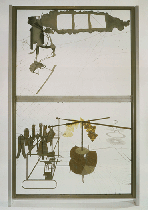
The Bride Stripped Bare by her Bachelors
Marcel Duchamp,The Bride Stripped
Bare by her Bachelors, even (The Large Glass)
,
1915-23© 2000 Succession Marcel
Duchamp ARS, N.Y./ADAGP, Paris

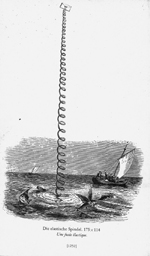
In the Large Glass the bachelors and the bride stand divided by a translucent horizon, yet they are connected through “wireless”.(6)Media technology surpasses the horizon between the two irreconcilable worlds – just like in Grandville’s enigmatic woodcarving from 1844, which shows a letter shooting up from the depths of the sea on a spiraling cable. Here, reference is made to the first submarine telegraph cable.(7)


click to enlarge
Une fusée élastique
Jean-Jacques Grandville, “Une fusée élastique,
” in: Un Autre Monde, Paris:
H. Fournier, 1844

Is it coincidence that during the last years of the 19th century two disciplines that – due to their lack of physical substance – the ordinary mind found unimaginable are investigated almost synchronous: wireless transmission technology and psychoanalysis? Both of these are the last great gifts of the 19th to the 20th century where they would have enormous effects. Both have lead to a new form of non-dialogic one-way speech that clearly assigns the sender and the receiver their respective separate sides of couch and microphone. And both turn the flow of natural language into a new form of “automatic” speech. The surrealists utilized this phenomenon in their “écriture automatique”, which, in turn, is based on the futurist’s “wireless imagination”, a language lacking any regard to syntax and punctuation. The difference between the approaches of the surrealists and the futurists is that the latter refer to the electric, wireless medium while the former employ the psychological or even para-psychological meaning of “medium” as a model. In the libidinous and immaterial wireless connection between the bachelors and the bride of theLarge Glass technology and psychology are put to work together.

Like submarine commanders in the sea of the unconscious, bachelors of all ages and media send out signals through their machines, without even knowing that by doing so they are but trying to reach prospective brides. Though, strategically they seem just as helpless as the submarine Cage’s father, an inventor, had constructed. Cage compares his father without hesitation to Duchamp in that they were both “bricoleurs”.(8) The submarine, however, was never put to service in WW I, because it could be detected too easily due to the bubbles that would rise from it. This is why “… and bubbles on surface” is frequently heard from Cage in his readings and writings.

Thus is the state of the subconscious that it is nothing but a sunken cultural asset lurking deep down on the bottom of common sense where we can detect it through bubbles on the surface of the media.(9)

Today, the last adventures in an overly well-known world await the surfer in the depths of the Internet. He dives deep into the waves of the information tide, as did the radio amateurs who would lose themselves in the global waves of the ether. Only rarely he surfaces to obtain the bare necessities for survival from the world of “ready-made” goods.(10)

The ever-identical object from the world of mass-produced goods becomes obvious only through the attachment of a pseudo-indivduality to a single “ready-made” object. In the same manner, the world of “radio-made” information becomes distinguishable from static only through the random selection of a single one out of many signals. Since the appearance of “ready-mades”, producing and presenting as the basic principles of mass production have become as dubious as sending and receiving have for media technology since Cage’s “Imaginary Landscape No.4”. George Brecht follows Cage’s path with his “Candle piece for radios” and the concept of “listener as virtuoso”.(11)

But aren’t even the songs of whale recorded, as if they were messages encoded for us humans? Whenever a signal is sent man thinks it happened on his behalf.(12)

Certainly, the spiritualistic medium of occultism has – in part – been inspired by “wireless” technology. Yet it remains a pre-technological model, even if the shortcut between sender and receiver in a psycho-technology of make-beliefs may be comparable to the collaps of the sender-receiver model in the mass media according to Baudrillard.(13) But it is the privilege of artists to transcend the division of sender and receiver without losing their credibility. Thus, claims Duchamp, artists play a “mediumistic” role allowing the worth of a work of art to remain “completely divorced from the rationalized explanations of the artist. […] All in all, the creative act is not performed by the artist alone; the spectator brings the work in contact with the external world by deciphering and interpreting its inner qualifications and thus adds his contribution to the creative act.”(14) The work of art reaches the viewer like the signal reaches the listener, like the sonar reaches the whale.

click images to enlarge

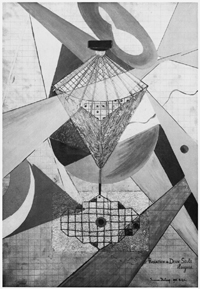
  • Emitting antenna
  • Radiation of Two Lone Ones at a Distance
  • “Cage-type emitting antenna,
    from: Henri Poincaré and Frederick Vreeland,
    Maxwell’s Theory and Wireless Telegraphy,
    New York, 1904, p. 142
    ” (image from:
    Henderson, cf. note 6, ill. no. 103)
  • Suzanne Duchamp, Radiationde Deux Seuls
    Éloignés (Radiation of Two Lone Ones at a Distance),
    1916-18-20. The combination of wireless technology
    and erotic desire becomes more explicit in this work
    by Suzanne than in her brother’s Large Glass.
    According to Linda Dalrymple Henderson “The upper form
    resembles a cage-type emitting antenna [see adjacent image]
    and the lower gridded one implies a surface on which the
    ‘radiations’ are to be recorded. […] the theme seems to
    echo that of the Large Glass: here an antennalike
    ‘Bride’ (Suzanne herself?) projects her message.”
    (Henderson, cf. note 6, p. 112). The metaphor of an
    electric or magnetic attraction between lovers has its
    roots way back in the age of romanticism: In 1827,
    Goethe told Eckermann “between lovers the magnetic
    force is especially strong.” Around the same time,
    the possibility of telegraphy via the “loving
    needles” of two distant compasses synchronized by myserious
    forces was seriously discussed.

Notes

Footnote Return1. Charles Baudelaire, quoted after Wolfgang Kraus (ed.), Symbole und Signale: Frühe Dokumente der literarischen Avantgarde, Bremen 1961, pp. 46 – 47 (see also: Charles Baudelaire’s “The Painter of Modern Life,” in:The Painter of Modern Life and Other Essays, London: Phaidon, 1964, pp. 1-40; Charles Baudelaire, Paris Spleen, New York: Norton, 1988, transl. by Louise Varese)

Footnote Return2. Jean Baudrillard, “Requiem for the Media” (1972), in: For a Critique of the Political Economy of the Sign(Charles Levin, transl.), St. Louis, Mo.: Telos Press, 1981, pp. 164-84

Footnote Return3. Richard Kostelanetz and John Cage, “A Conversation about Radio in Twelve Parts,” (1984) in: John Cage at Seventy-Five (Bucknell Review, v. 32, no. 2), Cranbury, NJ: Associated UP, p. 278 (pp. 270-302).

Footnote Return4. Jean Suquet, Miroir de la Mariée, Paris 1973, S. 228 – 231. The term “bachelor machine” stems from the “Green Box” of 1934, Duchamp’s collected notes for his “Large Glass”. Numerous authors pick up on the term, applying it to a wide variety of phenomena, e.g. in: Michel Carrouges, Les Machines Célibatiares (1954), Paris 1975 and Gilles Deleuze & Félix Guattari, Anti-Oedipe, Paris: Editions de Minuit, 1972

Footnote Return5. Nam June Paik, Niederschriften eines Kulturnomaden, Edith Decker (ed.), Köln 1992, p. 16

Footnote Return6. cf. Linda Dalrymple Henderson, Duchamp in Context: Science and Technology in the Large Glass and Related Works, Princeton 1998, see esp. pp. 103-115: “Wireless Telegraphy, Telepathy, and Radio Control in the Large Glass”

Footnote Return7. Jean-Jacques Grandville, “Une fusée élastique”, in: Un autre Monde, Paris 1848/49

Footnote Return8. Conversation of the author with John Cage, Cologne, 1987

Footnote Return9. So to speak the “subconscious” (German: unterbewusst) is a Freudian misconstruction based on a misunderstanding of Sigmund Freud’s “unconscious” (German: unbewusst). For the notion of the unconscious topologically located “underneath” the conscious, to be found somewhere ‘down there’, like some kind of primeval sludge rising that resurfaces every now and then, is not in any way related to Freud’s concept of the unconscious. In fact, his writings call for a very different model of the relationship between the conscious and the unconscious, with the conscious arising from the unconscious, being enclosed by it while both are subjected to their mutual state of continuous correlation.(from an e-mail correspondence with Sigrid Schade).

Footnote Return10. E-mail correspondence with Sigrid Schade

Footnote Return11. Both net-pop culture and art offer comparable experiments by which one’s entire lifestyle, from food to furniture to sex partners are organized via the internet; cf. Dirk Lehmann, “Überleben mit dem Internet”, in:Konr@d, December/January 1998 – 99, pp. 22 – 28 and Christian Jankowski, Let’s get physical/digital, Galerie Klosterfelde, Berlin June/August 1998; also: www.artnode.se/physical/digital

Footnote Return12. George Brecht, Notebooks I – III, 1958 – 1959, Facsimile Editon, Dieter Daniels (ed.) with collaboration of Hermann Braun, Köln 1991, vol.. III, p. 111 and footnotes

Footnote Return13. cf. Wolfgang Hagen, “Der Okkultismus der Avantgarde um 1900”, in: Sigrid Schade, Georg Christoph Tholen (eds.): Konfigurationen zwischen Kunst und Medien, with CD-ROM by Heiko Idensen (ed.), Paderborn 1999

Footnote Return14. Marcel Duchamp, English translation from the French quoted after: Michel Sanouillet and Elmer Peterson (eds.), The Writings of Marcel Duchamp, New York 1989, pp. 139f

Variations on The Large Glass’s Chocolate Grinder

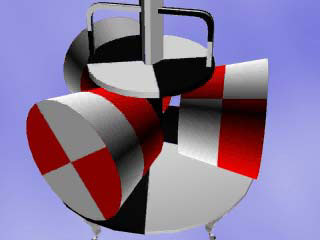
The following animations are based on Marcel Duchamp’s paintings Chocolate Grinder, No. 1, 1913 and Chocolate Grinder, No. 2, 1914, both at the Philadelphia Museum of Art. Duchamp based these images on a machine he saw in a confectionary shop (Gamelin’s) in Rouen. These images are significant to Duchamp’s oeuvre because they prefigure the Large Glass (his most renowned work) through clarity of drawing, observance of perspective and the incorporation of mechanism and rotation

Click image for video (QT 0.5MB)

  • 1st Animation – Copyright 1999 Stuart Smith/Mark Jones
  • 2nd Animation – Copyright 1999 Julian Baum/Mark Jones]

I have been analyzing Duchamp’s manipulation of perspective as a research topic for an MPhil/PHD at Manchester Metropolitan University. This research has involved visiting chocolate manufacturers to see similar machines working and correspondence with a number of eminent Duchamp scholars. My aim is to clarify whether Duchamp has, as he claimed, reinvented perspective in the 20th century.

The research involves practical creative work, producing measured perspectives, 3D models and computer animations in conjunction with Ian Marland at British Aerospace, Chadderton, UK.

The animation in red and white checker board is one of six produced by Stuart Smith that is speculating on the motion of the grinder. The other animation, created by Julian Baum, is a simulation of the grinder based on Duchamp’s notes in the Green book.

  • The team involved includes
  • Mark Jones – Research and model making
  • Frazer Gregory – Multimedia
  • Stuart Smith – Animations
  • Julian Baum – Animations
  • Anneliese Cheadle – PR
  • Ian Marland – AutoCAD

Jarry, Joyce, Duchamp and Cage

The following essay is appearing for the first time in English. An Italian version appeared in the Catalogue for the 1993 Venice Biennale. The three-part fragmented format was due to my underestimating or misconstruing the publisher’s desires regarding length.

A little way into Part II of Goethe’s Faust, a short, cacophonous scene transpires in which various poets – poets of nature, court poets, love poets – are so intent on being heard that not a word can be understood by the audience. One poet, the Satirical Poet, does manage at last to get a decipherable word in above the din – it’s his only line in the play: “Do you know what would really delight me as a poet? To write and recite what no one wants to hear.”

With this one line, Goethe telegraphed with marvelous accuracy one of the most conspicuous features of the twentieth century avant-garde. I am thinking particularly of the work of three related giants: James Joyce, Marcel Duchamp and John Cage.

Never before has a work of literature been so universally known by name yet so little read as Joyce’s Finnegans Wake. Similarly, there is no precedent for a body of artwork so widely disseminated yet so little understood as Duchamp’s oeuvre from 1913 on. And in John Cage we have a composer who, even before his death, was being cited as the most influential composer of the twentieth century. Yet how many music lovers rush home from the record store to put on the latest Cage CD? It then comes as no surprise that Joyce was Cage’s favorite contemporary writer, Finnegans Wake his favorite work of twentieth century literature, and Duchamp his favorite artist.

Goethe’s Faust was admired and gleefully plundered by the eccentric French poet and playwright, Alfred Jarry. His extended take-off, Faustroll, contains stream of consciousness passages, which look forward to Joyce’s Ulysses, and numerous invented words, which help prepare us for Finnegans Wake.(1)
Faustroll
is, on the whole, a work of such complexity that Jarry added these words to the completed manuscript: “This book will not be published integrally until the author has acquired sufficient experience to savor all its beauties in full.” In fact, Faustroll, was not published until 1911, four years after Jarry’s death at the pitiable age of thirty-four.

As Jarry was informed by Goethe’s sentiments, Joyce, Duchamp and Cage were informed by Jarry’s (Joyce and Duchamp, I believe, directly; Cage, according to my thesis, more by his love of Joyce and Duchamp). John Cage did not enjoy what he knew of Jarry. When I broached the subject, Cage said the following:

I have an allergy, you might call it, against the kind of expression that was Jarry’s, but it’s clear that Duchamp did not. But I agree with the view that everyone was influenced by Jarry. I myself think that Duchamp and Joyce having used Jarry is far more interesting than anything Jarry himself did.(2)

I never learned exactly how much of Jarry John Cage had read, but he admitted that he had read some. In 1989, at his suggestion, I loaned him my copy of the English translation of The Supermale.(3)

I had noted on the blank pages numerous passages which correspond with parts of Duchamp’s notes and with sections of Ulysses and Finnegans Wake. After a few days Cage returned the book, sayingthat it was a novel and he couldn’t read novels. A short time after thishe volunteered that my interest in the subject had brought him back to Jarry. Cage gave no titles and never indicated that his “allergy” had left him. I believe that if he had read more of Jarry, Faustroll in particular, his feelings might have changed. After all, in addition to his love for Joyce and Duchamp, who he agreed were influenced by Jarry,he repeatedly commented that he followed Antonin Artaud’s philosophy of theater. Artaud was, in fact, such a disciple of the writer that he named his theater “The Alfred Jarry.”

Ironically, John Cage had more similarities with Jarry than did either Joyce or Duchamp. His sexual orientation was much closer to Jarry’s than to that of the other two, although he was as soft-spoken on the subject as Jarry was blaring. And Cage, like Jarry, was an avowed anarchist. Here, too, the difference was more in the manner of expression and emphasis than in the bottom line commitment. But perhaps the most significant parallel between the two reveals itself when we look at their respective interest in Chance. We know that Cage studied with the Zen teacher, Daisetz Suzuki, and that as a result he started to use chance operations in his compositions around 1950.

Jarry was equally involved with Chance. His Pataphysics, an alternate hypothesis for the workings of the universe, assigns an important role to l’accident. The same holds true when he writes of matters à l’amour: “Men and women think they choose each other…as though the Earth should boast of revolving on purpose! It is in this passive inevitability, as of a falling stone, which men and women call love.” This “falling stone” remark may well have planted a seed in Duchamp which
resulted in the Standard Stoppages, by which he hoped to create “a new image of the unit of length.” The Jarry line which follows the “falling stone” reference runs: “The god and goddess are about to unite…in order to meet, they need a length of time which, according to human measurements,
varies between a second and two hours.” While this touches on the measurement of time, elsewhere (in How to Build a Time Machine) Jarry states bluntly that “space and time are commensurate.” He goes on to share his reasoning: “To explore the universe by seeking knowledge of points in Space can be accomplished only through Time: and in order to measure Time quantitatively we refer to Space intervals on the dial of a chronometer.”

Tapping another Jarry source, I have written:(4)


click to enlarge


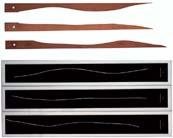
Marcel Duchamp,3 Standard
Stoppages
, 1913-14
© 2000 Succession Marcel Duchamp
ARS, N.Y./ADAGP, Paris.

Jarry’s Doctor Faustroll has an almost obsessional fascination with standards of measure. He carries in his pocket a “centimeter, an authentic copy in brass of the traditional standard,”
and he also possesses a tuning fork, its period “carefully determined…in terms of mean seconds.” These habits are a parody of traditional Western science, which Jarry anarchically undermined. Discussing science, he remarked, “Universal assent is…a quite miraculous and incomprehensible prejudice.” Duchamp shared this attitude. The 3 Standard Stoppages, for example, in which the artist believed he had “trapped the mainstream of [his] future,” reflects his mock-scientific intention “to create a new image of the unit of length,” and to obtain a specimen of “canned chance.” The very method of their making – “a thread one meter long [falling] straight from a height of one meter on to a horizontal plane twisting as it pleases” – recalls a line in Jarry: “When a piece of copper is dropped…it will float down slowly as though a viscous liquid occupied the space.”
(5)

There are many passages in each of his major works in which Jarry reveals strong feelings about chance. One description in The Supermale is particularly apt. The Supermale (Marcueil) wants to get into his disguise for the 82 ravishments of Ellen Elson within 24 hours.”It was ten o’clock, and André Marcueil was looking for an excuse to slip off to make way for the Indian. Chance – or perhaps some previously determined assistance brought about by chance – supplied him with one.” In Duchamp’s notes pertaining to his making of the 3 Standard Stoppages, he almost literally describes a previously determined assistance brought about by chance.

André Breton maintained that “beginning with Jarry…the differentiation long considered necessary between art and life has been challenged to wind up annihilated as a principle.” Duchamp presented manufactured products from life as art, a gesture surely in tune with this stance of
Jarry’s. And Cage’s composition 4’33”,
in which the natural sounds occurring during that length of time constitute the piece, likewise demolishes this distinction. Cage often said that 4’33” was his favorite of his own works, and that he believed that the most beautiful music was the natural sounds around us.
(6)

click images to enlarge

  • John Cage,
    4’33”, 1960
    Reproduced with permission of
    Henmor Press, Inc. New York
  • John Cage,
    4’33”, 1960
    Reproduced with permission of
    Henmor Press, Inc. New York

click images to enlarge

  • John Cage,4’33”, 1960
    Reproduced with permission of
    Henmor Press, Inc. New York
  • John Cage,4’33”, 1960
    Reproduced with permission of
    Henmor Press, Inc. New York

The characters in Jarry’s Faustroll parody and, at times, ridicule Jarry’s great model, Goethe’s Faust. Duchamp’s improvised mustache performs a similar service for Leonardo’s La Gioconda. And so it is also with the vocalists in Cage’s Europeras 1,2,3,4 & 5, who are instructed to perform arias of their own choosing simultaneously with chance chosen excerpts, both orchestral and vocal, from existing masterworks. For a lover of Mozart or Monteverdi to hear a beloved aria overlaid with the sounds of a frothy bit of pastry from a popular operetta, the experience can readily be compared to that of an aficionado of Da Vinci’s works first encountering Duchamp’s desecrated icon,


click to enlarge


Marcel Duchamp,>L.H.O.O.Q., 1919
© 2000 Succession Marcel Duchamp ARS, N.Y./ADAGP, Paris.

L.H.O.O.Q.

There is a passage in Faustroll in which Jarry pokes such delicious fun at painters that I believe its publication in 1911 may have helped Duchamp decide to call it a day at the easel. In it, Jarry likens painting to masturbation, an urge so strong and irrepressible that there will be painting even after the end of the living world. Once again, Chance plays an important part in his fantasy:

“…Meanwhile, after there was no one left in the world,the painting machine, animated inside by a system of weightless springs, revolved…like a spinning top…dashed itself against the pillars, swayed and veered in infinitely varied directions, and followed its own whim in [ejaculating] onto the walls’ canvas the succession of primary colors ranged according to the tubes of its stomach…this modern deluge…”

When Jarry attacks the scientific rationale, he concludes by putting forth “purely accidental phenomena” as the more realistic explanation: “the laws which it is believed have been discovered in the traditional universe [are but] correlations of exceptions…of purely accidental phenomena.”And l’accident occurs as a pivotal idea in his definition of Pataphysics, given here in a shortened version:

Pataphysics…is the science of that which is superinduced upon metaphysics, either within, or outside of, the confines of the latter, extending as far beyond metaphysics as metaphysics extends beyond physics. E.g., the epiphenomenon [that which is superinduced upon phenomenon] often being the accident, Pataphysics will be above the science of the particular, even though it is said that the only science is that of the general. It will study the laws governing exceptions and will explain the universe supplementary to this one…”

In the early 1980s, at a festival of new music in Venice, I attended numerous concerts with John Cage, sometimes several in a single day. I made the observation that when I was listening to anyone else’s music I could pick up echoes of Berg, Stravinsky, Webern, Bartok, Schoenberg, or whomever. But then something of his would be played and I was on my own. No traces of ideas from earlier composers could be heard. His music was full of ever-new sound and structure, guaranteed no doubt by his use
of chance. For all I knew, his music could have come from another world.His polite smile of agreement reminded me that his way of listening could not be further from mine; his whole approach was ahistorical.

Robert Rauschenberg has remarked that he likes to operate in the ever-narrowing gap between life and art. John Cage has responded that he’d rather collapse them both together. If we think of the radical freshness of the Europeras, in effect built from the bits and pieces of the old – its debris you might say – Jarry’s introduction to Ubu Enchained, with which he greeted the last century in 1900, seems to be at least indicated, if not vindicated:

Pa Ubu: “Hornstrumpet! We shall not have succeeded in demolishing everything unless we demolish the ruins as well. But the only way I can see of doing that is to use them to put up a lot of fine, well-designed buildings.”(7)

© 1993, 2000 William Anastasi

*******************

April 24, 1993

A short time after John Cage learned that I was researching correspondences between Jarry’s writings and Duchamp’s notes and art works, he asked, “What have you found?” I listed some of the pieces by Duchamp, which seemed most clearly connected to certain passages or images in Jarry.
This list included:

The Large Glass, Étant Donnés, Bicycle Wheel, Bottle Dryer, In Advance of the Broken Arm, Tu m’, To Be Looked At With One Eye…, Monte Carlo Bond, L.H.O.O.Q., Why Not Sneeze Rrose Sélavy?, Comb, With Hidden Noise, Apolinère Enameled, Traveler’s Folding Item, Fountain and With My Tongue In My Cheek.

When I paused, trying to remember additional items, he asked whether I had found anything in Jarry, which might have pointed toward Duchamp’s “musical sculpture” paragraph, which is in the Green Box notes. [Muscial sculpture. Sounds lasting and leaving from different places and forming a sounding sculpture which lasts.”] I answered that I had found a possible link in The Supermale, which was perhaps a less literal and certainly a more complex connection than the links I had been finding for many of the art works.

The images which make up this connection appear in a section of the novel in which suddenly a wide variety of sounds are being described for us at every turn. In some cases, sounds emanating from different places at different times are described as arriving intermingled at one place. Repeatedly we are given descriptions of three-dimensional objects giving off sounds – “sound sculptures,” if you will. The sound images include “the clicking of heels,” “a burst of laughter,” “a crystalline chatter…like parakeets, deliciously out of tune, like the sound of love instruments tuning up,” “a rustling sound,” “a light and rapid step [is heard],” “the beating of [one girl’s] little fists” as she “drums” on an ironbound door,a voluminous quarter-hourly clock-chime, while “downstairs…violins weretuning up,” etc. Making reference to the clock-chimes which punctuate the entire section, or rather the space of silence between them, he writes, “It was one o’clock, it was any time, then it was eleven o’clock in the evening, and the distant music struck through the silence as confusedly as nervous fingers straining after the eye of a needle.” Since a church’s spire with quarter-hourly chimes pouring forth could very aptly be described as a “sounding sculpture,” the following passage seems relevant: “…at
irregular intervals the highest notes of the top strings rose like spires piercing through the fog.” These high notes, we are told, are interspersed with the deafening chimes and other sounds, helping the reader to imagine a veritable concerto performed by three-dimensional objects: “…its booming filled the long room, the chandelier vibrated, the picture frames trembled, and near the ceiling, a pane of glass vibrated.” Jarry, who Breton tells us annihilated the difference between life and art, often describes natural sounds in pointedly musical terms. For example, in a passage already partially quoted, Jarry describes the sound of seven harlots gossiping as “crystallinechatter, deliciously out of tune, like the sound of love instruments tuning up, one might imagine.” Jarry is not only comparing their “chatter” to the sounds of musical instruments – he is also telling us that as prostitutes, they themselves are “love instruments” to be played, obviously, by their customers. In Faustroll he describes “stones [which] are as cold as the cry of trumpets,” contrasting them with others which have “the precipitated heat of the surface of kettledrums.”

I paused after having given John Cage a precis of the above, thinking there might be a response. When none came, I went on to describe a more direct connection between another passage in Jarry and a Duchamp note. It was not about a piece of Duchamp’s, but rather about one of many component parts of a piece (The Large Glass). When Jarry first describes Doctor Faustroll’s raiment, he pictures for us “tiny little gray boots, with even layers of dust carefully preserved on them, at great expense, for many months past…” Duchamp, in the Green Box notes, wrote, “For the sieves in the glass – allow dust to fall on this part a dust of 3 or 4 months…” I pointed out that the idea of “sieves” itself may well have come from the same book of Jarry’s. Chapter six of Faustroll is titled Concerning the Doctor’s Boat, Which is a Sieve. The Doctor describes in minute and obsessive detail the magnificent seagoing properties of this bark, then ends by informing the reader that “we shall not be navigating on water but on dry land.” By coincidence or otherwise, Man Ray’s photograph of Duchamp’s Dust Raising


click to enlarge


Dust Raising
by Man Ray and Marcel Duchamp, 1920
© 1960 Marcel Duchamp, George Heard Hamilton, Richard Hamilton

, reproduced on the page facing the Duchamp note in Richard Hamilton’s typographic version of the Green Box notes, which John Cage had by now opened in front of us, resembles, more than anything else, an aerial view of some extremely flat dry land.

I was emboldened to say that these connections, and a hundred others like them, left me with the impression that Duchamp, perhaps consciously, had been playing a game in which he used hints from Jarry’s writings in every major piece as well as in most of the lesser ones. Duchamp unfailingly left clues about the Jarry connection in the title, in the appearance, or in the accompanying notes of his work. At the same time, Duchamp unfailingly diverted attention elsewhere whenever an interview or conversation seemed headed in that direction.(8)

Again there was no response for some time. Then John Cage said, “Well, he was a wonderful man and I was extremely fond of him, but he did love secrets.”

Thinking of this remark, it has occurred to me that John Cage’s well-known openness is 180 degrees away from the stance of his friend. Cage, in addenda to his compositions, to his etchings or drawings, and even to many of his written works, took great pains to lovingly describe his methods in whatever detail necessary to attain the greatest clarity. Duchamp’s notes, by comparison, seem a maze of intentional obfuscation. I am aware of only one instance in which the artist left a document solely meant to illuminate. I am referring to the Manual of Instructions for the fabrication of Étant Donnés, revealed to the world after his death. And this manual was left for the excellent reason that without it there would have been no earthly way of assembling the intricately designed tableaux in the manner intended by the artist.

I once discussed this issue of artistic disclosure with John Cage. It was not in regard to Duchamp per se, but rather in regard to an admirer of both Cage and Duchamp, – Jasper Johns, who at that time, according to certain remarks attributed to him, seemed to share Duchamp’s fondness for mystery. John Cage made light of the issue. “Oh, I think it’s just a question of personality,” he said.

*************

I asked Dorothea Tanning if she would read a new and unpublished essay I had written titled Who Broke the Glass, which presents evidence to support the argument that The Large Glass was not broken accidentally, as the world has been told, but intentionally by, or at
the behest of, the artist.(9)

Ms. Tanning, who with her late husband Max Ernst, knew Duchamp well, has been generous with her help and encouragement. Both she and Max Ernst were great lovers of Alfred Jarry, and since she and I also share a fondness for Joyce, we are never at a loss for conversation. When she had handed my essay back she said it had convinced her, and she showed me something she had written in the margin of the last page. It referred to Duchamp, and she said that I could use it in future writings with attribution, or without. It reads, “All is formulaic and calculated. This meticulous planning leaves nothing to chance, that force so often claimed by the artist.” (Emphasis Dorothea Tanning’s.)
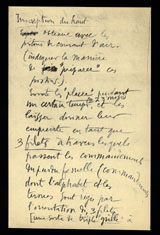
Reading this I found myself thinking once again about the parallels and differences between Marcel Duchamp and his friend John Cage. They both claimed Chance as an assistant. But in Duchamp’s case, at least according to Ms. Tanning’s view, nothing could be further from the truth.
(10)
Years ago, wanting to test Duchamp’s commitment to chance I had tried his thread-dropping experiment for the 3 Standard Stoppages – canned chance, as he called it. Tirelessly, with a wide variety of thread materials and thickness, I followed his “instructions” as they appear in the Green Box notes. Not once did the results come close to those three gentle and elegant arcs that he permanentized as the stoppages. John Cage, honoring Duchamp, tried this same experiment in making some of his earliest etchings. His results were as far from Duchamp’s as mine were, and not surprisingly, just about identical to my results. We talked this over a number of times, wondering what could account for the difference.

I have by now come to the conclusion that when a man as intelligent as Duchamp, as elegantly articulate, civilized and gracious says, “Every word I tell you is stupid and false”, and, “All in all I’m a pseudo, that’s my characteristic” – when he gives us one self-portrait titled With My Tongue In My Cheek, another as a wanted felon, a third as an old whore, and a fourth as the very devil – the net effect on most observers is to cause them to believe his every word, perhaps more than they might have had he never brought up the subject. It seems as though Duchamp managed to hide very well behind these statements and shady personas. Maybe most of us have difficulty believing that a man
of such genius and elegance would be capable of doing something so expected, so unimaginative, as to be telling the truth when he calls himself a liar. It is easier to believe that the disclaimers themselves were part of a game, a put-on, an act – that the real Duchamp was as straightforward as his famous profile.

John Cage and Marcel Duchamp can be seen then as being equally guilty of saying what they mean and meaning what they say. Duchamp, again and again, in a spectacular assortment of gestures, warned us not to take him too seriously. John Cage was fond of saying that a thing is what it is and his favorite of his own works accepts whatever sounds occur. In his life as in his art, Cage had not the slightest use for secrets, a fact which characteristically did not in the least prevent him from loving
and admiring the very artist who, above all others, thrived on them.

© 1993, 2000 William Anastasi


Notes

1. According to my reading of Finnegans Wake, Joyce refers to Alfred Jarry as “me innerman monophone” and “me altar’s ego in miniature,” and retells or recalls various scenes from the life, as well as from every novel and theater piece, of the French author. In addition, one of the book’s four main characters, Shem (a.k.a. Jerry), is based in the largest part on Jarry himself.

2. Speaking of Duchamp and himself, Cage said, “I think the difference between our attitudes towards chance probably came from the fact that he was involved with ideas through seeing, and I was involved through hearing.” Similarly, Jarry’s “…one has only to look” sets off Cage’s “One has only to listen.”
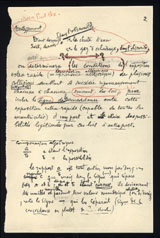
3. Translated from the French by Ralph Gladstone and Barbara Wright, New Directions Pub., NY, 1977.

4. From William Anastasi, “Duchamp on the Jarry Road”, Artforum (September, 1991).

5. John Cage, referring to the 3 Standard Stoppages, made the observation to Duchamp that when he, Cage, was two years old, the artist was already using chance. And on a number of occasions Cage said that this was his favorite of Duchamp’s entire oeuvre.

6. In 1975, Cage said, “All of my music since [4’33”] I try to think of as something which doesn’t fundamentally interrupt that piece.”

7. Pére Ubu: Cornegidouille! Nous n’aurons point tout démoli si nous ne démolissons même les ruines! Or je n’y vois d’autre moyen que d’en équilibrer de beaux edifices bien ordonnés.

8.I have since come across a half dozen or so instances in which Duchamp either brought up Jarry for praise or, in response to questions about Dada, praised “his spirit” – once going so far as to call him “a great man.” I have yet to learn of a case in which someone else brings up the subject and Duchamp chimes in.

9. A recent expanded version of this article has since been published in this journal under the title Alfred Jarry and l’accident of Duchamp, December 1999.

10. I have discovered at least one instance in which Duchamp seems clearly to have been guided by chance. In the early nineties I visited Duchamp’s friend and sometime collaborator the painter Enrico Donati. It was he who had been commissioned by Duchamp to execute a roomful of “pink foam-rubber breasts” (a readymade taken from a set of “falsies” which Duchamp had designed for the cover of the catalogue to the Paris exhibition Le Surréalisme en 1947). Donati told of having covered his studio floor with these delights for Duchamp’s first viewing. Duchamp entered the room and for a spell no one spoke. Finally, to end the silence, Donati said, “Please touch.” Without missing a beat, Duchamp turned to him with pointing finger and said, “That’s the title.” Perhaps Arturo Schwarz was unaware of this exchange. Regarding “Please touch” he writes, “Whether this request arises from the Bride’s desire or the bachelor’s wishful thinking, the result is the same.” (The Complete Works of Marcel Duchamp, 1997 p. 228) It would seem that it rose, in fact, from Donati’s off-handed icebreaker and Duchamp’s relaxed suggestibility.

Science meets Art: This Quarter and Jacob Bronowski


click to enlarge

Cover for This Quarter, article
by André Breton, edited by Edward W.
Titus, Paris: The Black Manikin
Press, September 1932

This Quarter (vol. V, no. 1) of September 1932 was published and edited by Edward B. Titus. In his third year as editor for the The Black Manickin Press, he also published the memoirs of Kiki de Montparnasse and books by Anaïs Nin. This Quarter‘s “Surrealist Number” contains articles, prose and poems by important artists and writers of the movement, among them Salvador Dalí, Paul Eluard, Max Ernst, René Crevel and Tristan Tzara. Samuel Beckett also translated some of the poems. In his editorial note, Edward W. Titus describes the tremendous impact of Surrealism, however acknowledging with embarrassment the unhappiness of guest editor André Breton at having been asked to leave out “politics and such other issues not be[ing] in honeyed accord with Anglo-American censorship usages.” It is in this issue that for the first time ever, various unpublished notes by Duchamp appear, two years prior to the publication of his Green Box in 1934. Curiously enough, the chosen notes include various mentionings of the title of Duchamp’s posthumously revealed work: Given: 1. The Waterfall, 2. The Illuminating Gas (1946-1966).

With a preface by André Breton, This Quarter published these notes in English, translated by J. Bronowski. Besides a longer note titled ‘Preface’ and an ‘Algebraic Comparison,’ This Quarter contained Duchamp’s thoughts on the ‘Malic Moulds’ and the ‘Draft Pistons,’ the former being an integral part of the Large Glass‘s lower half, the domain of the Bachelors, and the latter being integral to the upper half, the domain of the Bride.

Notes by Marcel Duchamp (1911-15) which Bronowski translated from, in: This Quarter

English translation of Marcel Duchamp’s notes by J. Bronowski, in: This Quarter, edited by Edward W. Titus, Paris: The Black Manikin Press, September
1932, p.189-192

In his preface, André Breton (who published three of the same notes in the fifth issue ofSurréalisme au Service de la Révolution, May 1933) (1) calls the notes an abstract “from a large, unpublished collection […] intended to accompany and explain (as might an ideal exhibition catalogue) the ‘verre’ (painting on clear glass) known as The Bride Stripped Bare By Her Own Bachelors.” He goes on to maintain that the extract “is of considerable documentary value to surrealists.”

Richard Hamilton, who in 1960 published a typographic version of the Green Box, was somewhat dissatisfied with J. Bronowski’s first translation of and graphic attempt at the notes. “This Quarter gives translations of four separate notes though the layout does not make this clear. The translator has been at some pains to transpose the visual complication of the manuscript. “Limited to printed text, “Bronowski’s extract […] must be selective.” (2).

But who was J. Bronowski? (3)

Jacob Bronowski was born in Lodz, Poland, in 1908. Fleeing World War I, his family moved to London, where Bronowski eventually won a math scholarship to Cambridge, working in a specialized area of algebraic geometry. Between 1929 and 1942 he published his papers, bearing titles like “The Figure of Six Points in Space of Four Dimensions” (1942), in the Cambridge Philosophical Society Proceedings and other learned journals. During World War II, due to his mathematical training, he led the development of the Operational Research units for both the British Ministry of Home Security and the Joint Target Group in Washington. As head of the Chiefs of Staff Mission, he was among the first to be sent to Nagasaki to survey the damage of the atomic bomb. According to his wife, Rita Bronowski, “this was the great turning point in Bruno’s [as she refers to her late husband] life.” His three lectures given at the Massachusetts Institute of Technology in 1953 called for a responsible combination of humanistic values and scientific endeavors. After World War II he did not return to his university job but started a research laboratory for the British National Coal Board. “An early environmentalist and ecologist, he invented and developed a new kind of smokeless fuel from coal,” his wife noted. In 1963 Bronowski returned to teaching, at the Salk Institute of Biological Studies in California. His lifetime interest in cultural and anthropological evolution culminated in a highly popular 13-hour television series called The Ascent of Man.

Bronowski died in 1974, leaving behind numerous popular books like Science and Human Values (1956) and a groundbreaking study of William Blake (William Blake: A Man Without a Mask, 1944). Jacob Bronowski had a lifelong interest in literature. While still an undergraduate he started a small avant-garde magazine called Experiment. There one can find the earliest writings of William Empson, Paul Éluard, W.H. Auden and many more. Rita Bronowski remembers that “after receiving his Ph.D. and conducting three years of research, it became clear that being a Jew, Bruno would not be made a Fellow at his college (Jesus College, Cambridge). He decided to ‘drop out.’ Like so many young students (hippies, thirty years later), bearded and down-at-heel, he went to Paris to write. There he met, among others, Samuel Beckett, and they jointly edited an anthology called European Caravan (1931).” It was in Paris that Bronowski bumped into the Surrealists and together with Beckett, he helped translate the Surrealist Number of This Quarter. According to Rita Bronowski, her husband was picked to translate Duchamp’s notes since he was not only a poet but, most of all, a trained scientist.

A poet all his life, Bronowski once wrote: “The great poem and the deep theorem are new to every reader and yet are his own experience because he recreates them. They are the marks of unity in variety and in the instant when the mind seizes this for itself in art or science, the heart misses a beat.” (4). In 1939, Jacob Bronowski wrote the following and previously unpublished poem on the death of the Austrian satirist Karl Kraus (5):

  • Jacob Bronowski
    The Death of Karl Kraus
    Kraus died in time: before the God
    he honored as his equal, who shot
    Lorca, and brutally smashed
    Mühsam’s delicate ears, washed
    Vienna with his cleaning squads.

    Now becomes God the anger which
    Kraus spilled upon the dunged and rich
    ferment Vienna. God also saw
    the Danube spawn this medlar culture,
    and plunged to drain it like a ditch.

    Would Kraus to-night think it given
    him as a grace, if he were driven
    by boors to clean latrines? Or would
    that bitter Jew pray for his God’s
    forgiveness, but would not forgive?
  • O yes, the age which he disowned
    was easy, ageing, overblown.
    Kraus prayed an age sharp as day
    might etch his eyes: who, had he stayed,
    would see an age like night come down,

    and sharp and savagely blind
    the poet’s eyes, and splash his mind
    bloody from a knacker’s wall.
    Hate and terror walk the malls.
    Below the city, torture mines

    the cellars.O Mühsam, Lorca,
    I call to you across the dark
    age, ere my voice too is dumb.
    Give courage when the headsmen come.
    Give to the desecrated God
    who Kraus unleashed, once more his manhood.
    Give light where only ghosts, your ghosts are.

Notes

1. Francis M. Naumann, The Art of Making Art in the Age of Mechanical Reproduction, (Ghent, Amsterdam: Ludion Press, 1999), p. 112.

2. Richard Hamilton, Collected Words, (London: Thames and Hudson, 1982), pp.184-186.

3. The information and quotations of this and the following paragraphs come from “Bruno: A Personal View,” by Rita Bronowski in: Leonardo (vol. 18, no. 4, 1985), pp. 223-225, and a telephone conversation with Ms. Bronowski, 4 April 2000.

4. Jacob Bronowski, Science and Human Values (bound with The Abacus and the Rose: A New Dialogue on Two World Systems), (New York: Harper & Row, 1960), p. 32.

5. Karl Kraus (1874 – 1936) was a satirist, publisher, poet, essayist, and playwright in Vienna during a time of economic, social and political change in Austria. A member of the café bohemia, Kraus focused his acerbic sarcasm on people (including his own social set), events and the fallacies of political and social elements of turn-of-the-century Vienna. The son of a successful businessman, Kraus was financially supported by his family, which allowed him to spend six years at the University of Vienna (starting in 1892), studying law for two years before switching to philosophy and German studies. In April 1899, shortly after he left the University (without attaining a degree), he started the stinging journal Die Fackel (The Torch), which remained in existence until four months before his death. Kraus’s most noted play was Die letzten Tage der Menschheit (The Last Days of Mankind), written between 1915 and 1917, and among his many essays are “Die Demolierte Literatur” (“The Demolished Literature”) and “Sittlichkeit und Kriminalität” (“Morality and Criminality”).

Figs. 2-5 © 2000 Succession Marcel Duchamp, ARS, N.Y./ADAGP, Paris. All rights reserved.

The Unfindable Readymade

The following is part of a lecture, directly written in English, that was first given at the Conference of The College Art Association, Boston, MA, February 21-24, 1996. The lecture was presented in a session directed by Francis M. Naumann called “Marcel Duchamp and the Ready-made: From Origin to Consequence.” The author is begging indulgence to the reader for his fancy English.


click to enlarge

André Breton and Paul Eluard

Figure 1
André Breton and Paul Eluard,
Dictionnaire Abrégé du Surréalisme
,
1938, p. 23

chapter 1. The traditional definition of a readymade

The only definition of “readymade” published under the name of Marcel Duchamp (“MD” to be precise) stays in Breton and Eluard’sDictionnaire abrégé du Surréalisme: “an ordinary object elevated to the dignity of a work of art by the mere choice of an artist.” (Figure 1)

If you accept a readymade as an artwork, it means that you assume that the diverse traditional qualities of an artwork – such as contemplation, composition, manner, skill, style, expression, taste, beauty, etc. – suddenly become not relevant anymore.

In other words, since readymade is art, the concept of art is completely revolutionized. That revolution has an author: Marcel Duchamp. And his historical and revolutionary readymades are all dated between 1913 and 1919.

Such are in a few words the elements you can find in any recent history of art. It is on the base of this definition of readymades, that philosophers such as Dickie, Danto, de Duve, Genette and many others, have built a paragraph, a few pages, a chapter or the whole of their own esthetics theory. Let’s now go back to the Duchampian artworks themselves.

chapter 2. The “not-assisted” readymades

It is obvious that only a few readymades of Marcel Duchamp are concerned with this general and basic definition: those which are not physically “assisted” or “corrected” or “aided” or “imitated.”

For example Why not sneeze Rrose Sélavy?, which is a real construction, like a Dali’s “objet à fonctionnement symbolique,” is not a readymade. If a so-called readymade consists in the putting together of several objects, even very few, this assemblage would require after all solving a problem of composition, and thus, it is no longer a readymade. At least, it is no longer a readymade which revolutionizes the concept of art. Therefore, these readymades are to be rejected from our interest:

  • readymade aidé (à bruit secret) [With Hidden Noise], Pâques 1916, New York
  • Why not sneeze Rrose Sélavy?, before June 1921, New York
  • Belle Haleine Eau de Voilette, April 1921, New York
  • Sculpture de voyage, 1918, Buenos Aires/lost

For the same reasons, all the readymades which have been corrected with pencil or with paint have to be rejected:

  • Pharmacie, January 1914, Rouen
  • Nu descendant un escalier n°3, 1916, New York
  • Apolinère Enameled, 1916-17, New York
  • L.H.O.O.Q., October 1919, Paris

For the same reasons, the constructions which consist in reduced models of ordinary objects, such as windows, are also to be rejected:

  • Fresh Widow, copyright Rrose Sélavy, Winter 1920, New York
  • La bagarre d’Austerlitz, [par] Rrose Sélavy, November 1921, Paris
  • Also, if the work consists in the transformation of a chosen object, it is not a readymade:
  • Ready-made malheureux, a geometry book, April 1919, Buenos Aires/Paris/destroyed

Even the famous air de Paris which cannot be reduced to the choice of a certain quantity of air, has to be rejected:

  • 50cc air de Paris, a volume of air sealed inside a bulb and sent to America, December 1919, Paris/broken and repaired

The only readymades we are interested in for this paper – not that the other readymades are not interesting (they are maybe more interesting artistically speaking, but not philosophically) – are pure objects resulting of a single choice. Traditionally, these “mere” readymades are:

  • a bicycle wheel: [Roue de bicyclette], 1913, Neuilly
  • a bottle rack: [Porte-bouteilles], May or June 1914, Paris
  • a shovel: In advance of a broken arm, November 1915, New York
  • a chimney cowl: Pulled at four Pins, 1915, New York
  • a comb: [peigne], 17 February 1916, 11 A. M, New York
  • a restaurant fresco: [Fresque Murale], 1916, New York
  • a typewriter cover: […Pliant…de Voyage], 1916, New York
  • a hat-rack: Readymade [Porte-chapeau], 1917, New York
  • a coat-rack: Trap [Trébuchet], 1917, New York
  • a urinal: Fountain by Richard Mutt, April 1917, New York

Of course, we could still discuss the fact that these final readymades are not assisted in any way. The bike is vissé [screwed down] on a stool. All of theses readymades (except the restaurant fresco and the hat-rack) have very inventive (poetical or humorous) titles, all probably inscribed on the object. And some of them demand a very specific installation in the space: the hat-rack and the shovel hang from the ceiling, the coat rack is vissé on the floor, the urinal is reversed at 90º. (All these accessory details deserve a specific study, because much information is still missing.)

But for the moment, I suggest to forget these details and to consider these ten readymades in spite of their literary titles and inscriptions, their installation in a space and the artistic context in which they could be shown.

Under these conditions, it must be clear that there is, a priori, no physical difference between these readymades and the correspondent objects you could find in a shop. In other words, the difference does not appear if you consider the work physically (there is no work on a readymade), but only if you consider the artist’s mind. Let us try to penetrate Duchamp’s mind.

intermediary question

The first statements from the mouth of Marcel Duchamp concerning readymades are a bit late: in 1945 to Janis, and in 1955 to Sweeney.

Indeed, you have only two ways of trying to penetrate the mind of Marcel Duchamp between 1913 and 1917, the time of these “not-assisted” readymades:

  • You can study the story of the objects themselves.You can study the Notes, written at the same period.

Let us begin with the story of the objects.

chapter 3. The story of the objects

If you carefully inspect the last and best chronology, established by J. Gough Cooper and J. Caumont (or Claude Rameil?), you notice that none of these ten readymades were exhibited for a long time (nearly twenty years), except for twice and under very peculiar conditions.

The first time, it was in the Bourgeois Gallery, New York (Modern Art after Cézanne, 3 – 29 April 1916) under a reference in the catalogue (“No. 50, 2 Ready Mades”). We have no certainty about which were these “2 Ready Mades,” but we know that they were placed in some kind of antechamber, perhaps in an umbrella stand, but not displayed in the real showroom of the gallery with a real label telling their title and author, as was done with the other works.

The second time is the famous Fountain story, at The Society of Independent Artists, New York, 9 April – 6 May 1917. I won’t argue about the fact that the piece was indeed not exhibited, as the rejection was not the will of the artist. The readymade object was actually proposed as an artwork, but not under the name of Marcel Duchamp, not even under the name of Rrose Sélavy: it was under the name of a non-existant guy called Richard Mutt. In fact, I am not arguing that Duchamp is not behind Mutt. But if a readymade is the conjunction, a “rendez-vous,” between Marcel Duchamp and a chosen object, or more generally between the clear identity of an artist and the “mere choice of an object,” I just want to point out that in the Bourgeois Gallery, the chosen objects were more or less hidden and that in the Independents’ show the identity of the artist (whose name “Mutt” is very near “Mott,” a trademark of urinals), was at least doubtful. So in both cases the “rendez-vous” was not clear.

Then you have to wait till 1936 before the bottle rack is exhibited, in a Breton Parisian show at the Galerie Charles Ratton (22 – 31 May 1936), named Exposition Surréaliste d’objets mathématiques, naturels, trouvés et interprétés where the bottle rack was lying near some strange objects, which are also not regularly called art, such as: eggs, “christals containing millenary water,” carnivore plants and scientific objects. But from that date, and especially from 1945, when historical retrospective exhibitions on Dada began to appear, replicas of Duchamp’s readymades never stopped to be shown in numerous regular exhibitions at galleries and museums.

Going back to the pioneer era of Marcel Duchamp’s readymades (second half of the 1910’s), let’s consider again the Marcel Duchamp of that time. Here is a man

  • who worked on the Large Glass till 1923,
  • who published under his name the reproduction of his Chocolate Grinder in his review The Blind Man
  • who was present through his works in 35 different shows (with no readymades featured except once) from his arrival in New York in 1915 till 1935,
  • who was so well considered in the US art world that he could make the most advanced galleries or institutions accept anything (if assumed by his artist’s authority).

There is no doubt that this man obviously didn’t want to exhibit his readymades at that time.

My question is : Why?

chapter 4. The Notes

Now let’s see some Notes.

Only two notes name directly a precise object to be good for readymades: a pair of ice-tongs and the Woolworth Building.

boîte verte 4.5


click to enlarge
The
Green BoxThe White Box
Left : Figure 2
Marcel Duchamp,Note from The
Green Box
, 1934 © 2000 Succession
Marcel Duchamp, ARS, N.Y./ADAGP, Paris.
Right: Figure 3
Marcel Duchamp, Note from
The White Box, 1967 © 2000
Succession Marcel Duchamp,
ARS, N.Y./ADAGP, Paris.

Acheter une pince à glace comme Readymade

translation
Buy a pair of ice-tongs as a readymade
boîte blanche 1.3 (Figure 3)
trouver inscription pour Woolworth Building comme readymade
translation
find inscription for Woolworth Building as readymade

The three following notes don’t name any object but describe the way these objects could be grasped and/or presented.


In this note for example:

boîte verte 4.3


click to enlarge

The Green Box

Figure 4
Marcel Duchamp,Note from
The Green Box, 1934
© 2000 Succession Marcel Duchamp,
ARS, N.Y./ADAGP, Paris.

Tirelire. (ou conserves)

Faire un readymade avec une boîte enfermant quelque chose irreconnaissable
au son et Souder la boîte fait déjà dans le semi Readymade [schéma]
en plaques de cuivre et pelote de corde.

Piggy Bank. (or canned goods)


Make a readymade with a box containing something unrecognizable
by its sound and solder the box already done in the semi readymade
of copper plates and a ball of twine.

MD lets you know only the sound of the object. And, in order to be more complicated than the well-known With Hidden Noise [à bruit secret], he insists on the fact that this noise must be unrecognizable.

The imagination of Marcel Duchamp is very fertile to invent difficulties, to install a subtle labyrinth between him (or you) and the ordinary object itself.

boîte verte 4.1


click to enlarge
The
Green Box
Figure 5
Marcel Duchamp,Note from The
Green Box, 1934
© 2000 Succession Marcel
Duchamp, ARS, N.Y./ADAGP, Paris.

Préciser les “Readymades”.


en projetant pour un moment proche à venir (tel jour, telle
date telle minute), “d’inscrire un readymade”. – Le readymade pourra
ensuite être cherché (avec tous délais). –

L’important alors est donc cette cet horlogisme, cet instantané,
comme un discours prononcé à l’occasion de n’importe quoi mais à
telle heure
. C’est une sorte de rendez-vous.

Inscrire naturellement cette date, heure, minute sur le readymade,
comme renseignements.

aussi le côté exemplaire du readymade
.

translation

Specifications for “Readymades”.

By planning for a moment to come (on such a day, such a date such
a minute), “to inscribe a readymade” – The readymade can later be
looked for (with all kinds of delays). –

The important thing then is just this matter of timing, this snapshot
effect, like a speech delivered on no matter what occasion but at
such and such an hour. It is a kind of rendez-vous. Naturally inscribe
that date, hour, minute on the readymade as information.


Also the serial characteristic of the readymade.

In the latter note, he only sets for himself the date (exact time) of the inscription of the object. Because the choice can be anything, it is the easiest thing to do, but also the most difficult thing to do on a metaphysical level: if you want this choice to remain “indifferent,” without taste and without particular meaning.(1) You know the story of the Buridan ass who hesitates between a pot of oats and a pot of water, and finally dies of hunger and thirst. To avoid this tragic “embarras du choix” (difficulty of chosing), Marcel Duchamp invents a situation of emergency according to which, at that precise date, he will have to “inscribe” the first thing which would come to the top of his mind and within hand reach.

Here again, the creation, the talent, the imagination… of Marcel Duchamp is definitely not in the choice of the object (we don’t even know which it is), but in the fancy screenplay of the process of this choice.

note posthume, MAT 172


click to enlarge
Note 172
Figure 6
Marcel Duchamp,Note 172, from
Paul Matisse, Marcel Duchamp: Notes,
1980© 2000 Succession Marcel D
uchamp, ARS, N.Y./ADAGP, Paris.

Chercher un Readymade qui pèse un poids choisi à l’avance
Déterminer d’abord un poids pour chaque année et forcer tous les
Readymade d’une même année à être du même poids. chaque année

translation
–Look for a Readymade which weighs a weight chosen in advance First decide on a weight for each year and force all Readymades of the same year to be the same weight.

In this note now, which is one of my favorites, MD gives the object only its weight. It is very difficult to imagine an object through its weight. Not because the weight is more imprecise than the visual aspect, but because the weight is humanly less identifying. In philosophy, we call it a less salient property of an object. And, in the second paragraph, MD still puts the objects conceptually farther from us, by introducing some fuzziness on the weight of the readymades, by giving only an annual mathematical average of them. MD loves this progressive complication, because it makes the objects always less graspable and always more conceptual.

You could tell me that MD nevertheless made three works for real in connection with each of these preceding three notes: With Hidden Noise which contains a secret object, the comb which is dated “day, hour, and minute,” and the cage containing pieces of sugar which are made in marble and thus weigh incredibly more.

Yes, but these works are precisely not readymade objects. The conclusion is: either the readymade is a speculation (like those in the notes), or it is not a readymade.

If you are not convinced, let’s go back to the note concerning the sound.

boîte verte 4.3

Tirelire. (ou conserves)

Faire un readymade avec une boîte enfermant quelque chose irreconnaissable au son et Souder la boîte fait déjà dans le semi Readymade [schéma] en plaques de cuivre et pelote de corde.

translation

Piggy Bank. (or canned goods)

Make a readymade with a box containing something unrecognizable by its sound and solder the box already done in the semi readymade of copper plates and a ball of twine.

You will notice that he calls a readymade the object which wouldn’t be recognizable by its sound. But he calls semi readymade the real object which could give a body to such a project. In other words: when you make known that you make a readymade, you make a semi-readymade – there is no other way. In both projects, the work is not a readymade, it is a handwritten note here, it is a “not readymade” sculpture there.

My first conclusion is that, in the case of Marcel Duchamp, the readymade is never a work of art; it is only the subject matter of a work of art.

Of course all these notes are excellent, and here again you have to admit that Duchamp’s creation consists, in every case, in the way he presents, through the sound, through the weight, through the programmed date, the far existence of the chosen object. That is why Duchamp’s works of art definitely don’t consist in the reality and not even in the “good” choice of the object. A readymade is “une chose que l’on ne regarde même pas (…) qu’on regarde en tournant la tête.” (2) It is as if the readymade was the hero of a fable, of a story, of a school hypothesis, of a speculation according to which “an ordinary object [could] become an artwork because of the mere choice of an artist.”

Moreover, the anthropomorphism of the readymade in the vocabulary of Marcel Duchamp goes also towards a kind of fiction character making: he imagines readymades that could bemalade, malheureux, assisté or aidé as if they were handicapped human beings.

Now, if you still claim that :

these notes written in the 1910’s,or these semi-readymades exhibited here and there, or these naked objects photographed in his 1917 studio

prove the existence of “readymades” as works of art, then you make the same philosophical error as confusing the existence of Madame de Récamier with the existence of the painting portraying Madame de Récamier.

Confirmations of the preceding question (chapter 3)

This principle according to which “a readymade is not a work of art for Duchamp, but the subject matter of some of his works” is the mere reason why the objects were not exhibited at this time.

Moreover, it gives also a very satisfying explanation that almost all of them have been lost or destroyed :

  • the bicycle wheel: [Roue de bicyclette]/lost
  • the bottle rack: [a sentence was inscribed]/lost
  • the shovel: In advance of the broken arm/lost
  • the chimney cowl: Pulled at four Pins/lost
  • the comb: [peigne]/Arensberg collection, Philadelphia museum
  • the restaurant fresco: [fresque murale]/destroyed
  • the typewriter cover: […pliant …de voyage]/lost
  • the hat-rack: Readymade [Porte-chapeau]/lost
  • the coat-rack: Trap [Trébuchet]/lost
  • the urinal: Fountain by Richard Mutt/lost

It is relevant to notice that nine out of the ten original not-assisted readymades don’t exist anymore, if you take into consideration that almost all of the other readymades have been carefully preserved (except for pliant de voyage), as well as his other more “regular” artworks (chocolate grinder paintings, small glasses, drafts for the Bride, etc).

Intermediary question

If a readymade is an object of speculation, then, why such speculations? What place do they take in Marcel Duchamp’s life, thought and work? To understand this, you have to read again the posthumous notes concerning the “infrathin.” The notes on infrathin, which appear probably in the late thirties, prolong Marcel’s speculations on the readymades.

chapter 5. The infrathin

What means infrathin? Marcel says, “On ne peut guère en donner que des exemples. C’est quelque chose qui échappe encore à nos définitions scientifiques.” (3) It is now time to try to give a definition, even if this proposed definition is partial, and would merit a much longer development.

“Infrathin” generally characterizes a thickness, a separation, a difference, an interval between two things.

At first step, “infrathin” means “very, very, very thin.” It could be “1/10e mm = 100 µ = minceur des papiers” as MD says in note MAT 11. But at this level, the concept means “infinitesimal,” it is not new nor interesting.

At a second step, “infrathin” characterizes any difference that you easily imagine but doesn’t exist, like the thickness of a shadow: the shadow has no thickness, not even at an Angstroem’s precision.

At a third step, the most beautiful one, “infrathin” qualifies a distance or a difference you cannot perceive, but that you can only imagine. The best example to introduce you to this notion is this note:

note posthume, MAT 12


click to enlarge
Note 12, from Paul Matisse
Figure 7
Marcel Duchamp,
Note 12, from Paul Matisse,
Marcel Duchamp: Notes,1980
© 2000 Succession Marcel Duchamp,
ARS, N.Y./ADAGP, Paris.

Séparation infra mince
entre le bruit de détonation d’un fusil (très proche) etla marque de l’apparition de la marque de la balle sur la cible.
(maximum distance maximum 3 à 4 mètres. – Tir de foire)

translation

Infra thin separation between the detonation
noise of a gun (very close) and the apparition of the bullet hole in the target.
(maximum distance 3 to 4 meters. – Shooting gallery at a fair)

You know that there is a certain duration between the detonation noise of the shot and theapparition of the hole in the target, but this duration is not perceptible. Marcel Duchamp is certainly not interested in finding the instruments with which you could physically perceive this separation through some new technology. What interests him is making you understand that it is just enough to imagine it.

The more invisible this difference is, the greater is the infrathin dimension of it:


click to enlarge
Note 18, from
Paul Matisse
Figure 8
Marcel Duchamp, Note 18, from
Paul Matisse, Marcel Duchamp: Notes,
1980 © 2000 Succession Marcel Duchamp, ARS, N.Y./ADAGP,
Paris.
Note 35, from Paul
Matisse
Figure 9
Marcel Duchamp,Note 35, from Paul
Matisse, Marcel Duchamp: Notes,
1980© 2000 Succession Marcel
Duchamp, ARS, N.Y./ADAGP,Paris.

La différence (dimensionnelle)
entre 2 objets faits en série [sortis du même moule] est inf
un infra mince quand le maximum (?) de précision a été est
obtenu.

translation

The difference (dimensional)
between 2 mass produced objects [from the same mold] is an infra thin
when the maximum (?) precision is obtained.

note posthume, MAT 35(Figure 9)

Séparation infra-mince.


2 formes embouties dans le même moule (?) diffèrent l’une de
l’autre
entre elles d’une valeur séparative infra mince.
Tous les “identiques” aussi identiques qu’ils soient, (et plus ils
sont identiques) se rapprochent de cette différence de séparative
infra mince.

translation

Infra-thin separation.
2 forms cast in the same mold (?) differ from each other by an infra
thin separative amount.
All “identicals” as identical as they may be, (and the
more identical they are) move toward this infra thin separative
difference.

With these two last notes, we are now very close to the readymades. In an interview in 1960, MD insisted “C’est un objet tout fait, (…) généralement un objet de métal plus qu’un tableau.” (4)

To Serge Stauffer in 1961, he gives precision about “‘the serial characteristic…’ càd. le coté ‘mass production‘” of the readymade. And indeed only industrial forms, especially metallic, once taken out of the same mold, look so much alike that their differences are greatly infrathin. Here comes the real reason why Marcel Duchamp’s readymades were chosen amid industrial forms. Not at all because they are beautiful, as Louise Norton hints in Marcel’s review The Blind Man, in 1917: their beauty doesn’t need Marcel Duchamp. But because there is a very Duchampian question about them, which is: is there any difference between “2 mass-produced objects taken out of the same mould?” Is there a difference between two copies of the fifty-pronged bottle rack?

And it is true that the very very old philosophical questions about identity versus similarity, or about the existence of concepts versus the true singularity of individuals, must have been completely removed by the Industrial Age. Examples are very important in philosophy and the examples that the greatest philosophers – Duns Scotus, Plato, Occam, Hobbes, whoever – had in mind to discuss these matters could be faces, tables, pebbles or flowers. But all these objects, so similar could they be, remain very different to the naked eye. And the “argumency” was easy for Hobbes, for example, to demonstrate the irreducible singularity of single things by pointing out the difference between “even” 2 flowers of the same age and species. Confronted with mass-produced objects, such as packs of cigarettes or bottle racks, our notion of identity or our humanist notion of singularity is much more difficult and interesting to maintain.

The following note confirms that MD had this in mind, even in a naive way:

note posthume, MAT 7(Figure 10)

click to enlarge
Note 7, from
Paul Matisse
Figure 10
Marcel Duchamp,Note 7, from
Paul Matisse, Marcel Duchamp: Notes,
1980© 2000 Succession Marcel Duchamp,
ARS, N.Y./ADAGP, Paris.

Semblablité
Similarité
Le même (fabrication en série)
approximation pratique de la similarité.

Dans le temps un même objet n’est pas le même à 1 seconde d’intervalle

Quels Rapports avec le principe d’identité?

translation

Sameness
similarity
The same (mass prod.)
practical approximation of similarity.


In Time the same object is not the same after a 1 second interval
what Relations with the identity principle?

In front of two identical bottle racks, you know that they are not the same because they are two, but you also know that you could be rapidly mistaken if you don’t spot them together. You stick to coordinates in time and space to identify them, but you know how much these references
are moving and unserviceable.


click to enlarge
Phare de la Mariée,”
in Minotaure
Figure 11
André Breton,”Phare de la Mariée,”
in Minotaure, n. 6, 1935, detail
of p.46© 2000 Succession Marcel
Duchamp, ARS, N.Y./ADAGP, Paris.

On the next day, a third bottle rack is presented to you, and you have an absolute doubt about its identity. Is it a third one? Or one of the first two?

Now, is there a difference between a bottle rack and the very same bottle rack chosen by MD? No. There is no difference. Yes, there is an infrathin difference, which is invisible: it is his artistical intention. The difference lies in the brain fact of considering this bottle rack as an object of the Bazar de l’hôtel de ville and that one as a true artwork.

But MD never made such statements, only Richard Mutt did. Probably MD would have found such a statement rather pompous and ridiculous; it is a fact that he always said the opposite (“c’est une œuvre d’art qui n’en est pas une”; “c’était simplement une distraction”; “c’est un objet qui n’est même pas une œuvre d’art“). He never even wrote that readymades “elevate an ordinary object to the dignity of a work by the mere choice of the artist.” It doesn’t sound like MD to talk about dignity of an artwork. Thanks to André Gervais, we now know this definition has been written by André Breton, because you get a very similar sentence in his 1935 famous article “Phare de la Mariée.” (Figure 11)

What MD was, on the contrary, highly interested in, was imagining such a situation, as a pure fiction, between two copies of an ordinary object in the privacy of his own studio or on the written speculations of his personal Notes.

Chapter 6. Back to a 1923 note

Let us see now one of the last notes, probably dated 1923. [Incidentally, Claire Bustarret from the C.N.R.S. and I have been working on the analysis of the paper in order to determine a more accurate dating of the Notes of Marcel Duchamp.]


click to enlarge

Note 169, from
Paul Matisse

Figure 12
Marcel Duchamp,Note 169, from
Paul Matisse, Marcel Duchamp: Notes,
1980© 2000 Succession Marcel
Duchamp, ARS, N.Y./ADAGP, Paris.

Acheter ou prendre des
tableaux connus ou pas connus et les signer du nom d’un peintre connu
ou pas connu.


La différence entre la “facture” et le nom inattendu pour
les “experts”, est l’œuvre authentique de Rrose Sélavy et
défie les Contrefaçons
.

translation

Buy or take known or unknown paintings
and sign them with the name of a known or unknown painter.

The difference between the “style” and the unexpected
name for the “experts”, is the authentic work of
Rrose Sélavy and defies forgeries.

Let’s suppose that the painting is a painting by Delacroix and the name of the “painter known or unknown” is named Durand.

In this note, what work is Marcel Duchamp the author of? Certainly not the Delacroix painting. Nor the idea of exhibiting Durand as the author of a Delacroix. Much more subtly, his work is the difference between a painting which, in view of its “style,” is a Delacroix and the same painting which, in view of its signature, is supposed to be a Durand. The difference between a Delacroix and a Durand is a Duchamp. Can you imagine a more infrathin difference? Or to be more complete, Duchamp is the author of Rrose Sélavy who is the author of Durand who is the author of a Delacroix as a readymade.

With Marcel, it is always a question of heightening the degrees of a situation, by encircling with bigger circles the preceding circle of the situation. It is not a question of putting his name everywhere.

When I look at this last note, I think there is composition, manner, skill, style, expression, taste, beauty, but also humour, game, profoundness and cleverness. It is fair enough to call it art. All Duchamp’s art is here, in these two sentences, in the story they tell, in the way the words are put together, in the rhythm and in the ellipses, in the human coolness and a certain taste for games, and in the simplicity of syntax to say such complicated things. This note deals with the notion of readymade, but is definitely not a readymade. Because a readymade is not a work, it is a notion. If Marcel Duchamp’s works have changed the concept of painting or literature or sculpture or fiction, they haven’t changed at all the concept of art.

I could stop my paper here with that conclusion, hoping to convince the audience that Duchamp is not a magician nor a swindler who transforms, as with a magic wand, an ordinary object into a wonderful artwork. He is a thinker who expresses himself artistically.

chapter 7. Back to the first readymades

Let us go back to the real “readymades” before they were lost. We have photographs of them hanging in Duchamp’s studio, we have letters to Suzanne dealing with them. But there is nothing public. Who cares? – Could you tell me. Duchamp could have painted canvases at the same time and never have exhibited them, without us having doubts that they were Duchamp’s works. But, precisely, a painting exists from the fact that it has been painted. Not a readymade. A readymade has to carry some contextual details which say: “this is a readymade.” If not, it is only a shovel decorating the studio of an eccentric Frenchman. It is not enough that MD bought a bottle rack without using it to dry up bottles. It is not enough that MD believes and makes believe that this bottle rack is a work of art (because any collector considers any of the weird things he gets and installs in his house for plastic reasons, as pure and marvellous artworks – such as keyholders, coffee grinders or advertising ceramic plates). MD also has to believe and make believe that he (and not the designer) became the author of these chosen objects. And the only way to do so is to exhibit clearly the chosen object in an art show amid other works of art and with the same status. Such an exhibition didn’t take place. So if there is no work on the object (because it is only chosen), and if there is no exhibition of the chosen object, there is no readymade, and consequently there is no new artwork. It is like a knife without a blade, and to which the handle is missing.

Paris, February 1996


Notes

Footnote Return1. “Donc, l’idée du choix m’a intéressé d’une façon métaphysique, à ce point-là. Et ç’a été le début, et j’ai acheté ce jour-là un porte-bouteilles au Bazar de l’Hôtel de Ville, et je l’ai apporté chez moi. Et ç’a été le premier ready-made.” (Interview with G. Charbonnier: Entretiens avec Marcel Duchamp [Paris, 6 December 1960 – 2 January. 1961, 99’15”], RTF, radio, 9 December 1960). Editor’s translation of text: “The idea of choice interested me in a metaphysical sense, at that point. And that was the beginning, and that was when I bought a bottle rack at the Bazar de l’Hôtel de Ville and brought it home. And that was the first readymade.”

Footnote Return2. Interview with A. Jouffroy: “Conversation avec Marcel Duchamp” [New York, 8 December 1961], Une Révolution Du Regard, (Paris: Gallimard, 1964) 111-124.

Footnote Return3. Interview with D. de Rougemont: “Marcel Duchamp mine de rien” [Lake George, New York, 3-9 August 1945], Preuves, Paris, no. 204 (February 1968): 43-47; reprinted in Journal D’une Époque 1926-1946, Paris: Gallimard, 1968. Editor’s translation of text: “One can hardly give examples [of infrathin]. It’s something that escapes even scientific definition.”

Footnote Return4. Interview with G. Viau: [New York, May 1960, 28′] Radio-Canada, televised series, “Premier plan”, G. Chapdelaine réal., Montreal, 17 July 1960. Editor’s translation of text: “It’s an object already made…generally an object made of metal more than a tableau.”

The Substantial Ghost: Towards a General Exegesis of Duchamp’s Artful Wordplays

I. Introduction: The Depth of Trifles and the Status of Puns

The Duchampian pun that covered each piece of candy at the opening of Bill Copley’s 1953 Parisian show might, in its richness and ambiguity of meaning, suggest Churchill’s famous description of Soviet
Russia as “a riddle wrapped in a mystery inside an enigma.” (1) Duchamp designed the square tinfoil wrappers, and inscribed each little gift to the invitees with a simple and original phrase that may well be regarded as his deepest and richest play on words: A Guest + A Host = A Ghost.

At face value, adding only the most obvious and minimal interpretation, the pun seems gentle and harmless enough at a few evident levels that might catch anyone’s interest and mild appreciation:

1. The single resultant (ghost) arises as an amalgamation of the two inputs – the initial consonants of each word in sequence (g of guest followed by h of host), the final two consonants shared by both words (st), and the vowel of one (the retained o of host) used instead of the vowels of the other (the eliminated ue of guest).

2. At a first level of meaning (definitional) behind the amalgamation of letters, the joining of these paired and opposite words (the host who provides hospitality and the guest who receives it) leads to their annihilation (ghost). This curiosity merits at least a smile, and must have intrigued Duchamp.

Click to enlarge
Marcel Duchamp,
A Guest + A Host = A Ghost, 1953
© 2000 Succession Marcel Duchamp, ARS, N.Y./ADAGP, Paris.

3. At a second level of meaning (contextual), the phrase seems even more humorous when inscribed on a candy wrapper – for after one eats the candy, the wrapper remains as a shroud or ghost, the former and now empty covering of an annihilated substance.

4. At a third level (functional), the people were guests at a host’s exhibition – and they left with a ghost generated by the gift of a host followed by receipt and intended usage of a guest.

These levels of meaning might be deemed sufficient to warrant notice and minimal commentary, but scarcely complex or interesting enough to inspire any scholarly exegesis or artistic appreciation. I would like to argue, on the contrary, that Duchamp’s extensive and pervasive wordplays in general (appearing throughout his career, in all formats from offhand remarks, to the titles of most of his works, to explicit publications spanning a full spectrum from single items to extensive lists, and also to large chunks of his posthumous notes) – and the 1953 ghost pun in particular (as perhaps the most complex and revealing example of all) – occupy a
vital and central place in the totality of his life’s work. Moreover, with the conspicuous exception of André Gervais’s book, very little commentary or explication has ever been devoted to Duchamp’s verbal creations, while most of his visual creations have been analyzed to a level of detail and argument usually reserved for sacred writ. (Gervais’s own book uses a pun for its title, for La raie alitée d’effets speaks both of the homophonic “reality’ and the literal “line confined to its bed’ (raie alitée).)

Any analysis of puns and wordplays must begin by acknowledging the discouraging fact that the entire genre has been relegated to a particularly low status by self proclaimed intellectuals. Many classic deprecations could be cited, but James Boswell’s famous damning with faint praise (from
his celebrated life of Dr. Johnson, first published in 1791) will suffice as an example:

I think no innocent species of wit or pleasantry should be suppressed; and that a good pun may be admitted among the smaller excellencies of lively conversation.

How, then, can this lowest form of humor, representing the most neglected (and presumably most minor) aspect of Duchamp’s oeuvre, possibly merit any extensive analysis or be regarded as potentially replete with insight?

Duchamp himself, however, seemed to rank his verbal punning as important, at least as a source for his own inspiration and an embodiment of his general procedures – so perhaps we should take him at his (admittedly always cryptic) word and explore the issue further. Interestingly, Duchamp himself quoted one of the standard indictments of puns (“a low form of wit”) in his most forthright statement on their importance in his work (as cited by Gervais from a 1961 interview with Katharine Kuh):

I like words in a poetic sense. Puns for me are like rhymes. … For me, words are not merely a means of communication. You know, puns have always been considered a low form of wit, but I find them a source of stimulation both because of their actual sound and because of the unexpected meanings attached to the interrelationships of disparate words. For me, this is an infinite field of joy – and it’s always right at hand. Sometimes four or five different levels of meaning come through.

II. Duchamp’s Verbal Creativity: Big Oaks and Little Acorns

I shall not, in this article, try to explicate all of Duchamp’s verbal creations, or to present a synthetic account of the intrigue or utility of wordplays in general. But this topic surely transcends nitpicking or particularism because most, and perhaps nearly all, of Duchamp’s verbal constructions – again, with the ghost pun as the best and richest example I know – embody a guiding principle that also illuminates his lifetime of visual work, and underlies his general concept of the nature of creativity itself. I shall present four Duchampian categories of wordplay, each explored across a full range of potential meanings as illustrated by three modes in four categories. But all these usages proceed from the single principle that tiny variations – whether of sound or of orthography, and often so small as to pass beneath our discernment in the usual human style of lazy
or passive reading – can generate enormous, and wonderfully interesting, differences in meaning. This central principle corresponds with the basic definition of “pun,” as given in the Oxford English Dictionary:

The use of a word in such a way as to suggest two or more meanings or different associations, or the use of two or more words of the same or nearly the same sound with different meanings, so as to produce a humorous effect; a play on words.

As an opening example, and to show the long pedigree and pervasive importance of punning in Duchamp’s own conception of his work, a rarely explicit comment in one of his interviews with Pierre Cabanne seems especially revealing. (I thank Charles Stuckey of the Kimbell Art Museum for pointing out this passage to me.) Here, Duchamp discusses the title that he gave to one of his most important early works, the predecessor (in a sense) to his Nude Descending a StaircaseSad Young Man on a Train, or, in the relevant French original, Jeune homme triste dans un train.

Duchamp said to Cabanne: “The ‘Sad Young Man on a Train’ already showed my intention of introducing humor into painting, or, in any case, the humor of word play: triste, train . . . “Tr” is very important.” But why should the simple alliteration of “tr” for both the man (in his adjectival designation as sad, or “triste“) and the vehicle (“train“) represent anything more than a tiny bit of elegant care introduced to make a title just a bit more melodious, salient, or agreeable to the ear?

In the immediately preceding comment to Cabanne, Duchamp spoke of his attempts to depict “the successive images of the body in movement” in both the Sad Young Man, and in Nude Descending.He particularly emphasized how he wished to display the parallel movement
of the train and the man walking down the train’s corridor. He spoke of the Sad Young Man, completed in December 1911: “First, there’s the idea of the movement of the train, and then that of the sad young man who is in the corridor and who is moving about; thus there are two
parallel movements corresponding to each other.”

At an evidently basic level, Duchamp’s verbal alliteration emphasizes the parallel movement of both train and man in the same constrained direction – the train on its track, and the man along the same path, now represented by the corridor of the elongated car. We need no more depth of meaning to understand Duchamp’s alliteration of the triste man on the
long train as a small and careful integrative touch, the kind of “God (or devil) in the details” (different sources for this common quotation cite either the Lord or Lucifer) that permeates the work of nearly all creative people (however much they may deny the concept and speak only
of spontaneity, or even of randomness).

But I suspect that here, as with nearly all Duchamp’s punning, several additional, and probably conscious, levels of meaning can also be specified (after all, Duchamp himself spoke of four or five levels of meaning in the quotation cited previously). First,
why is the young man “sad” at all; I see nothing in the painting that intrinsically suggests any particular emotional state for the gentleman involved. Perhaps he became “sad” primarily to create the integrative alliteration of triste and train.

We may then continue this line of thought, both situationally for he must walk (within the corridor) the same line – that is, the same one-dimensional route of truly minimal flexibility for directional motion – that the train on the track must also follow. Such phrases as “one-track mind” and “straight and narrow” (in the pejorative rather than the original theological sense) indicate the frequent metaphorical linkage of limitation and one-dimensional movement. Moreover, the man cannot, by his walking (or even his running), add more than a small increment to the sum total of man plus train in the same direction.

Finally, as I learned from Le Robert (the French equivalent of the Oxford English Dictionary), several current usages of “train” – and, even more relevant, the original meaning as well – reinforce an equation with sadness and limitation. We tend to think of trains as rapid facilitators of our motion (at least where they work well in Europe or Japan). But the word long antedates our modern era of fast transport, and most of the original meanings suggest forced motion in a line. In fact, the etymology harkens back to the Latin trahere, to draw – that is, with the implication of entrained, or being pulled along (against one’s preferences), rather than a primary meaning of voluntary enhancement or acceleration! Robert begins its entry by stating (my translation): “In the earliest texts . . . it means ‘to force to go somewhere’ or ‘to pull someone along.'”

Finally, and this curiosity must have caught Duchamp’s fancy – for Duchamp loved and pored over dictionaries, so he probably encountered the example – an old French phrase, originally spelled trantran, arose as an onomatopoetic representation of a hunting horn, and acquired the meaning of a dull or enforced routine (“ya gotta get up, ya gotta
get up, ya gotta get up in the morning” – as the common “translation” of an army bugler’s reveille). Interestingly, the spelling then shifted to the homophonic traintrain (beginning in the 1830’s), probably, or so Robert speculates, by transference to a new image
of enforced motion suggested by the invention of the railroad. How could Duchamp have resisted this verbal version of his favored double “tr” – especially as imposed by a quirky linguistic shift to a visual metaphor, based on public fascination with a newfangled invention, after
the old aural context had faded from memory.

III. A Classification For the Richness and Extent of Duchamp’s Word Games

The four categories that I shall discuss in a more systematic way – before treating the ghost pun as a summary of all the strategies for extracting large differences and striking conjunctions from small disparities (or from identities with alternate meanings) – include a wide range of bases for their common generation of humor. I claim no expertise in the extensive literature on the nature and sources of humor, but perhaps the most widely cited principle of “punch lines” invokes a sudden shift of expected context – as in the riddle: “What do you do to an elephant with three balls?” Answer: “Walk him and pitch to the rhino.” This joke rests upon a visual and functional shift (enhanced, of course, by some old fashioned sexual ribaldry, which, as they say, never hurts) – from a pitiful and anomalous elephant with an extra item of anatomy, to a worthy batsman recast as a runner on first base with a less fearsome hitter at the plate. The usual verbal counterpart of this “sudden shift” principle works by disparity between the minimal difference of sounds or letters and the maximal consequence of a quirky outcome or an extensive change of meaning generated by such a tiny alteration of input – as in the answer (a lame joke in this case, but illustrative of the principle) to: “What’s
another name for a New York wine cellar?” “A Knickerbocker liquor locker.”

Each of Duchamp’s four categories generates its humor by this principle of small difference cascading to large, quirky and unexpected effect. The categories span a wide range of linguistic possibilities – from visual rearrangement of letters, to aural likeness, to plays on differences between the names and sound values of letters, to the use of common verbal
roots for generating an extensive range of meanings along numerous routes of minor change. I will illustrate the potential range of each category by presenting Duchampian examples in three widely varying modes: interesting conjunctions yielding more than the sum of parts; direct contradictions between the two tiny differences; and “annihilations” (a special intensification
of the second mode), where one member of the contradiction annihilates the
other, directly and causally.

Click to
enlarge
Marcel Duchamp,
Note 208, from Paul Matisse, Marcel Ducahmp: Notes, 1980
© 2000 Succession Marcel Duchamp, ARS, N.Y./ADAGP, Paris.

1. Anagrams, or extracting different meanings from the same letters rearranged in alternate sequences. This entirely spatial and visual category (for generating differences) represents a staple for fans of crossword puzzles and literary games. The sophisticated British style of crossword puzzle generally goes by the title “puns and anagrams,”
thus validating my separation of categories – for two types of punning,
or aural differences, will follow this visual category.

Mode One: Interesting Conjunction. As an obvious example of a fruitful anagram
that juxtaposes two arrangements of the same letters into an unexpected union and quirky context that Duchamp then exploited in a major work of his career – by turning the odd name into an actual product. Anemic Cinema may be reckoned as either puerile or powerful in execution, but the title is objectively anagrammatic.

Click to enlarge
Marcel Duchamp,
Note 237, from Paul Matisse, Marcel Ducahmp: Notes, 1980
© 2000 Succession Marcel Duchamp, ARS, N.Y./ADAGP, Paris.

Mode Two: Opposition. Silent et listen (P.N. number
208) (2).
Just rearrange the letters, and we can only do the latter in vain when
the condition of the former reigns.

Mode Three: Annihilation. I particularly like the following example as a resident in two categories: both a perfect anagram and a pun based on small aural differences between the two parts (category 2B to follow). Etrangler l’étranger (P.N., 237) – to strangle the stranger. Just move the “l” from the verb and make it the definite article for the noun. The action of the verb will then annihilate the noun. But the two parts of speech remain alike both visually (as a perfect anagram) and aurally (as a good pun).

2A. Puns as homonyms. If anagrams produce their large differences in meaning from spatial rearrangement of identical components (leading to a visual joke), then homonymic puns operate as a strict analog in the aural dimension – for the joke now arises from oddly disparate meanings generated by the same sounds (usually spelled differently or parsed into different words). The poor reputation of punning can largely be ascribed to childish efforts in this category, as in the American schoolboy’s joke: “What’s the difference between a place to drink and an elephant’s fart?” “A place to drink is a bar room, and an elephant’s fart is barroooooom!” Most “knock-knock” jokes also reside here, and their “ouch” records their status – as in “Who’s there?” “Petunia.” “Petunia who?” With the answer then given in song: “Petunia old grey bonnet . . .”

Click to enlarge
Marcel Duchamp,
Note 232, from Paul Matisse, Marcel Ducahmp: Notes, 1980
© 2000 Succession Marcel Duchamp, ARS, N.Y./ADAGP, Paris.
Click to enlarge
Marcel Duchamp,
Note 241, from Paul Matisse,
Marcel Ducahmp: Notes
, 1980
© 2000 Succession Marcel Duchamp, ARS, N.Y./ADAGP, Paris.

Mode One: Interesting Conjunction. Duchamp created many puns in this most widely exploited category within the entire genre of wordplays. I confess that I don’t grasp the depth in some examples that must have pleased Duchamp because he repeated them so frequently, but
I may be missing some interesting innuendoes that would be apparent to a native speaker of French. “Un mot de reine; des maux de reins” (P.N., 241) contrasts “a word of the queen” with, literally, “kidney diseases,” but more generally and commonly, “backaches,” under a virtually identical pronunciation. (Perhaps, as a sexist crack, the pun means to identify forceless pronouncements from the boss’s subsidiary with “oh, my aching back.” Or perhaps as Sarah Skinner Kilborne, Toutfait‘s Senior Editor, suggested to me, backaches correspond to the queen’s word because pain speaks to us by giving us a word about body parts in trouble, while any statement from the queen also represents a word from the back — either negatively from the king’s annoying subsidiary, both literally and figuratively behind him, or more positively from his second in command, or backup.) Similarly, “my niece is cold because my Knees are cold” (P.N., 232) puzzles me as an apparently meaningless conjunction of different significations with nearly identical sounds, but perhaps our thoughts should turn to unconsummated incest (and perhaps they shouldn’t on the sensible principle that cigars and bananas are often just cigars and bananas. But why does Duchamp often capitalize only the word “Knees” of the male body part?).

I regard “head tax thumb tacks” (P.N., 272) as more satisfying (or perhaps only more personally comprehensible) because the use of a different body part as an adjectival modifier to the exact same sound (albeit represented by two distinct words of different spelling) yields such an interesting contrast of meanings – a form of taxation (popular in many European countries) based on fixed amounts per person (also, called a “capitation” from the Latin caput, or head), versus a humble bit of hardware pushed in by the stated body part.

Click to enlarge
Marcel Duchamp,
Note 272, from Paul Matisse, Marcel Ducahmp: Notes, 1980
© 2000 Succession Marcel Duchamp, ARS, N.Y./ADAGP, Paris.
Click to enlarge
Marcel Duchamp,
Nous Nous Cajolions, 1943
© 2000 Succession Marcel Duchamp, ARS, N.Y./ADAGP, Paris.

The potential richness of this otherwise somewhat
limited category of homonyms can be enhanced, as Duchamp so often does throughout his catalogue of wordplays, by combining both visual and aural versionsof the same image. In a lovely example, far more complex than I first realized, Duchamp drew a rebus in 1925 (Schwarz, number 412) for one of his oft-repeated homonymic puns: nous nous cajolions. Here, he breaks this full phrase
(“we flatter (or pet) each other”) into two visual parts – a woman caring for a child, representing a nanny (nounou in French, with the exact same pronunciation as nous nous), followed by the more obvious lion behind bars (cage au lion, or lion’s cage, pronounced exactly as
cajolions).

I only appreciated the depth
of Duchamp’s construction when I studied the etymology of cajoler in Robert. The probable origin of this verb, meaning to flatter or to wheedle, can be traced to the singing of birds in a cage. Moreover, the derived noun cajolerie specifically identifies the condescending tone that men often adopt in trying to influence women or children. Hence, both images of the rebus specify a historical source for the full phrase thus represented – the woman and child of the first part, followed by the caged animal of the second part.

Click to enlarge
Marcel Duchamp,
Objet-Dard, 1951
© 2000 Succession Marcel Duchamp, ARS, N.Y./ADAGP, Paris.

Mode two: Opposition. I suspect that Duchamp called his late and evidently phallic structure “Objet dard” because the piece both looks like a dart (or just to mark the word’s membership within the large set of nicknames for a penis), and also stands in opposition to the retinal style of conventional “fine art” that perpetually strives to fashion an “objet d’art” of the same pronunciation. However, for Duchamp’s best products in this mode, I nominate, for first prize, “do shit again and douche it again” (P.N., 232) as truly identical soundings with opposite meanings foul it again vs. wash it again); and, for second prize, the delicious bilingual homonym (P.N., 229) “coup de gueule / good girl” (a smack in the face and a well behaved lass – pronounced almost identically, with he first sounding like the second spoken with a French accent, despite the difference in meaning and orthography in the two languages).

Click to enlarge
Marcel Duchamp,
Note 229, from Paul Matisse,
Marcel Ducahmp: Notes
, 1980
© 2000 Succession Marcel Duchamp, ARS, N.Y./ADAGP, Paris.

Mode Three: Annihilation. Duchamp frequently split “literature,” the aspiration of all wordplaying, into three separate words of nearly the same pronunciation “lits et ratures” (P.N., 224). But these words would annihilate any pretense to creating great written works, for we use our beds (“lits”) for the two most frequent activities, sleep and sex, that steal time from our literary struggles – while “ratures” are erasures! (3)

2B. Puns as transpositions (near homonyms). This category encompasses the more subtle and systematic near homonyms (large differences in meaning generated by small alterations in sound) that generally win more respect than truly homonymic puns because they often originate by careful and thoughtful construction, rather than by the sheer accident
of an unconsidered alternative meaning for a chosen statement (or a consciously forced and painful likeness in the “ouch” mode of knock-knock jokes). However, some puns in this category, while also systematic in their structure, do arise unintentionally, and even win their humor for the embarrassment
thus created as a lapsus linguae (or slip of the tongue). The classics of this subgenre are called “spoonerisms” for their hapless eponym, The Reverend William Spooner (1844-1930), who apparently couldn’t help himself. Some spoonerisms have been traced to the source himself – as when the good Reverend confidently responded to a parishoner’s praise for his sermons: “many thinkle peep so.” Others, one suspects, have been purposely devised by legions of “admirers” and then attributed to the poor man – as in “a half warmed fish” masquerading as an imperfectly conceptualized desire.

Click to enlarge
Marcel Duchamp,
Note 224, from Paul Matisse, Marcel Ducahmp: Notes, 1980
© 2000 Succession Marcel Duchamp, ARS, N.Y./ADAGP, Paris.

I don’t know any common English distinction between these two types of puns (homonymic and transpositional), but the French language, while using “jeu de mots” (word game) as the vernacular term for puns in general, does make a formal separation with two less common words that also attribute greater value to the transpositional category. Robert defines calembour as a “witticism based on words that have a double meaning, or an ambiguity of words [forming] phrases that are pronounced in an identical manner.” But Robert then specifies the lower status of a calembour by recognizing an expansion of meaning that began in the early 19th century: “By extension, it means a poor pun (un mauvais
jeu de mots).”

By contrast, Robert defined a contrepèterie as “an inversion of two sounds (vowels or consonants) between two words transforming the meaning of a phrase, generally in a scatological direction.” From this original 15th century meaning, Robert then reports an extension of sense to the full category that I have called “transpositional” – with a clear implication of higher value: “The word designates a permutation of sounds, letters, or syllables in a phrase, in such a way as to obtain another phrase with a droll meaning.” Interestingly, Robert gives two hypotheses for the derivation of contrepèterie: either from the verb péter (to make a blast, more specifically to fart – as in a common phrase that many English speakers use in ignorance of its etymology – to be hoist by one’s own petard), thus meaning, literally, a backfire; or from pied (a foot) in reference to the “counter foot” or other meaning of the phrase. In any case, Duchamp uncorked a set of eminently worthy contrepèteries in all three modes:

Click to enlarge
Marcel Duchamp,
Note 231, from Paul Matisse, Marcel Ducahmp: Notes, 1980
© 2000 Succession Marcel Duchamp, ARS, N.Y./ADAGP, Paris.

Mode One: Interesting Conjunction. Among several that could be cited, two Duchampian concoctions especially intrigue me for their complexity of difference obtained by transposing a single sound between two words in a phrase. In the first example, Duchamp asks why a baby at the breast may be compared with first prize in a vegetable contest (P.N., 232): “Le premiere est un souffleur de chair chaude et le second un chou-fleur de serre chaude” – literally, “the first is a blower of warm flesh and the second a cauliflower from a hothouse.” The contrast in meaning is wonderfully absurd, but not without some amusing similarity in the great difference – as both cited items are round and warm (the baby’s head and the hothouse
cauliflower). But the pronounced alteration of meaning arises entirely from a small reciprocal shift in a pair of similar sounds – “s” and “ch” (pronounced “sh”) – in two words: for souffleur becomes chou-fleur, changing s to ch, while, later in the phrase, chair becomes serre, changing ch back to s.

Click to enlarge
Marcel Duchamp,
Disk Inscribed with Pun, from Anémic Cinéma, 1926
© 2000 Succession Marcel Duchamp, ARS, N.Y./ADAGP, Paris.

If the first example links two entirely different phrases by a similarity in form (warm round objects), the second describes a functional union in the sexual mode favored by contrepèteries. Duchamp labels this pun as a “question of intimate hygiene”: “Faut-il mettre la moelle de l’épée dans le poil de l’aimée” (from the 1939 pamphlet of Duchampian
aphorisms, Rrose Sélavy, and in P.N., 231 in a slightly different version) – an interesting and partly metaphorical description of copulation from a male point of view: “is it necessary to put the pith of the sword into the fur of the (female) beloved.” Again, the change of meaning arises from a single reciprocal transposition – m for p – between
two words: “moelle de l’épée (pith of the sword) and “poil
de l’aimée” (fur of the beloved).

Interestingly, Duchamp improved the pun (both in sound, objectively, and in meaning, in my opinion) when he changed poil (fur) to poêle (oven, and a better rhyme with moelle) in recycling this phrase on an anemic cinema disc (Schwarz, number 421).

Click to enlarge
Marcel Duchamp,
Note 249, from Paul Matisse, Marcel Ducahmp: Notes, 1980
© 2000 Succession Marcel Duchamp, ARS, N.Y./ADAGP, Paris.

Mode Two: Opposition. The same kind of simple transposition can also yield two phrases of opposite meaning. In one example, the transposition of c and l converts an order to cease singing into a command to permit this particular song (P.N., 249):

cessez le chant (stop the song)
laissez ce chant (leave this song)

In another case, number 254 of the Posthumous Notes, and labeled a “devinette” (riddle) by Duchamp, a more complex rearrangement of four syllables or combinations of syllables (rien, de, véné, and rable) highlights an opposition between something both honorable and persistent (venerable) and a mode of destruction in disgrace (râble de vénérien). André Gervais notes that we may also consider this form of wordplay as an anagram of syllables rather than letters:

“He has nothing venerable, but a back of a person with a venereal disease.”

Click to enlarge
Marcel Duchamp,
Note 225, from Paul Matisse, Marcel Ducahmp: Notes, 1980
© 2000 Succession Marcel Duchamp, ARS, N.Y./ADAGP, Paris.

Mode Three: Annihilation. In a wonderfully complex transposition, involving both sounds and letters (P.N., 225, and as a slight variant, appearing in the form cited here, in the 1939 booklet, Rrose Selavy, that collected 43 Duchampian aphorisms, most published previously and singly), Duchamp inverts the cr-s of a word in the first phrase (crasse) into s-cr in the corresponding word of the second phrase (Sacre). He then inverts the t-m and p-n of a word in the first phrase (tympan) into p-n followed by t-m for a word in the second phrase (Printemps). The result becomes a mordant comment about a famous incident in the long history of public opposition to avant-garde works of art – the angry crowd reaction (including prolonged catcalling and even some throwing of chairs) that followed the premiere of Stravinsky’s Rite of Spring in 1913: “La crasse de tympan et non le Sacre de Printemps” – “The filth of the eardrum and not the Rite of Spring.” The mocking crowd annihilates Stravinsky’s piece by transposition to an ultimate affront upon their aural receptors; (an opponent might also nullify the composition by plugging up his ears so completely that no sound can get through). (4)

####PAGES####

Click to enlarge
Marcel Duchamp,
L.H.O.O.Q., 1919
© 2000 Succession Marcel Duchamp, ARS, N.Y./ADAGP, Paris.

3. Alternatives. In a quite different concept for producing humor by the same effect (the drawing of two disparate meanings from identical or highly similar starting points, either visual or aural), Duchamp sometimes exploited the dual possibilities of a word’s orthography – first, the usual mode of assigning sound values to each letter and reading the resulting word or combination; and second, the generally unintended, but fully sensible, strategy of pronouncing the names of the letters sequentially to form a sentence or statement – a clever play on the very notion of literacy, for our visual representations of speech (at least in alphabetical systems) must both possess names concretely (or we couldn’t identify them to teach spelling) and represent sounds symbolically (or we couldn’t use them to read words). At least two of Duchamp’s works bear titles that exploit this duality: most notably the L.H.O.O.Q. (1919) inscribed at the bottom of his mustachioed Mona Lisa, and suggesting the near English reading of “look” but obviously intended primarily to designate the meaning rendered by the names of the letters in their French pronunciation: el-hache-o-o-ku, or “elle a chaud au cul” (she has a hot ass). Another piece, entitled M.E.T.R.O. and done as a prospective cover for an architectural magazine named “Metro” (for public transportation), also honors brave men – “aimer tes héros,” (to ove your heroes). Although these uses have been well recorded, Duchamp’s larger exploration of this category has not been extensively reported
because he published few of his other efforts, and most remain as jottings in the Posthumous Notes.

Click to enlarge
Marcel Duchamp,
Aimer tes héros, 1963
© 2000 Succession Marcel Duchamp, ARS, N.Y./ADAGP, Paris.

(I also suspect that he felt less satisfied with his products in this difficult category, and refrained from publishing most of his jottings because he remained unhappy with their only approximate renditions of the intended dualities, as several of the following examples will show. I also admit that some of my own interpretations in this category
must be regarded as more tentative and conjectural than the clear meanings of most cases in the other three categories).

Mode One: Interesting Conjunction. I will confess upfront to a conjectural reading in this case, but I was intrigued by a statement in the Posthumous Notes (number 248) linking the Mona Lisa to a striking visual image:

LHOOQ
Elle a chaud au cul comme
des ciseaux ouverts

(LHOOQ / she has a hot ass like / open scissors).

Click to enlarge
Marcel Duchamp,
Note 248, from Paul Matisse, Marcel Ducahmp: Notes, 1980
© 2000 Succession Marcel Duchamp, ARS, N.Y./ADAGP, Paris.

Perhaps Duchamp intends nothing more than the conjunction of two visual images of female sexuality – a hot ass and the obvious comparison of open scissors to a woman with legs spread apart. But I wonder – especially since Duchamp wrote LHOOQ, the letter version of the famous Mona Lisa statement, in the first line – whether he also wished to suggest the closest letter approximation to “des ciseaux ouverts,” the admittedly imperfect (but not
so bad) DCOUVR (close to découvrir, or discover (or, better yet, uncover), and missing only the “z” sound from ciseaux). If so, the conjunction’s double meaning becomes reinforced in both comparisons – the hot ass and spread legs of the full phrases, and the “look” and “uncover” of the corresponding letters read as single words.

Click to enlarge
Marcel Duchamp,
Note 240, from Paul Matisse, Marcel Ducahmp: Notes, 1980
© 2000 Succession Marcel Duchamp, ARS, N.Y./ADAGP, Paris.

Mode Two: Opposition. Duchamp played extensively with bilingual puns. Among his many jottings in this category of alternatives (letters read as a single word vs. letters read individually by their names), I note several, probably not accidental given his evident pleasure in the duality (as best shown in the M.E.T.R.O. piece), that work as examples of opposition in two senses of meaning and language (read as a single word in one language vs. read as a sequence of letters in French). Two of these (Latin vs. French) appear together (among other items) in number 240 of the Postumous Notes, thus reinforcing my conjecture of common
intent:

éffacer FAC
assez AC

Click to enlarge
Marcel Duchamp,
Note 266, from Paul Matisse, Marcel Ducahmp: Notes, 1980
© 2000 Succession Marcel Duchamp, ARS, N.Y./ADAGP, Paris.

The first, “to erase” by letters read sequentially in French states the opposite command “make” (“fac“) as a single Latin word; while the second, “enough” in French reading, asks for more as an opposite Latin word (“ac” meaning “and”). (5) I would also add an English example from the Posthumous Notes (number 266): “j’ai été and GET” – or “I have been” in a French statement about something already done, contrasted with the English command to do something now, or “get.”

Mode Three: Annihilation. I make my biggest stretch in this case (P.N., 266), but the following jotting intrigued me:

AVKQIT avec acuité

The comparison is admittedly imperfect (for one must move the “v” from second to fourth position as AKQVIT) – but if one drinks too much schnapps (aquavit, literally water of life), he will annihilate all potential for functioning with precision (avec acuité).

4. Generations and Compressions. My final category of wordplay evokes yet another, and quite different, principle used for the same purpose of constructing major disparities from homonyms or minor differences. Many words embody great potential for spinning out a wide range of meanings from a common source – both because the word itself may bear several alternative definitions, and also because the same word, in different combinations or used in different parts of speech, attains several contrasting significances. For example, an old English joke displays the full range for one of our most flexible and pungent words: A ship’s captain asks a sailor with no great mechanical expertise to go below and find out why the engine has stalled. The man descends, and finally emerges from the engine room with the following fully comprehensible diagnosis made of an exclamation, an adjective, a noun and a verb: “Fuck, the fucking fuck is fucked.”

For this category, I identify two different modes (from those cited in my discussion of the other categories), each linked to the most obvious physical structure of the wordplays:

Click to enlarge
Marcel Duchamp,
Note 252, from Paul Matisse, Marcel Ducahmp: Notes, 1980
© 2000 Succession Marcel Duchamp, ARS, N.Y./ADAGP, Paris.

Mode One: Generations to Expand Meaning. The nonsense phrase of posthumous note number 252 provides an excellent, albeit nonsensical, example of this conceit in wordplays – four oddly conjoined and very different meanings (a verb linked with three unrelated nouns for a person, an object and a place), but all represented by virtually the same sound: “Le Sommelier a sommeillé sur un sommier lié de Somalie” – the wine steward (sommelier) napped (sommeillé) on a tied spring mattress (sommier lié) from Somalia (Somalie).

More significantly, Duchamp made a lovely conjunction between this verbal play in generating several meanings from a single source, and the visual action in one of his most interesting optical creations – the Rotary Demisphere (now on display in working condition at MOMA) that produces the appearance of an outwardly cascading spiral
as the device turns. (6)
(Interestingly, this effect is an optical illusion, for the actual piece consists entirely of concentric black and white circles. But the varied spacings and widths of these circles yields a spiral effect in rotation). On the edge of this rotary disc, carefully inscribed in elegant industrial perfection, Duchamp wrote one of his favorite, and oft repeated,
generative puns: “Esquivons les ecchymoses des Esquimaux aux mots exquis” – let us avoid the bruises of the Eskimoes in exquisite words. The text may sound ridiculous, but the pun becomes complex and clever through its union of similar sounds with different spellings. In the four generated phrases of nearly identical sound (esquivons, ecchymoses, Esquimaux and, with inverted syllables, mots exquis), the common sound moze receives different spellings in each of the three words (moses, maux, and mots); while the other nearly common sound of all four words uses three permutations of the first part (es, ek, and eks) with a constant second part (key) – Esquimaux as es-key, ecchymoses as ek-key, and exquis as eks-key. Moreover, and to show Duchamp’s care in detail, moze becomes the identical sound of three words only because, in two cases, an elision to the following word (Esquimaux
aux
, and mots exquis) triggers the voiced “z” of moze in a word that would, if standing alone, be pronounced moe.

Click images
for videos (QT 0.3MB)
Marcel Duchamp, Rotary Demisphere,, 1925
© 2000 Succession Marcel Duchamp, ARS, N.Y./ADAGP, Paris.
Click to enlarge
Marcel Duchamp,
La Bagarre d’Austerlitz, 1921
© 2000 Succession Marcel Duchamp, ARS, N.Y./ADAGP, Paris.

Finally, expansions can be constructed in a
more subtle manner to accrete meaning by simply adding a few letters to the first meaning, and not by generating an entirely new word. The two phrases may then achieve an intriguing and meaningful conjunction – as in Duchamp’s clever title (not always fully appreciated) for one of his better known
works: Bagarre d’Austerlitz (also in P.N., 272). A bagarre is a brawl – and Napoleon won one of his most important battles at Austerlitz. Moreover, a major Parisian railroad station (gare) honors this victory – so the station (officially named Gare d’Austerlitz) commemorates the slightly longer battle, or bagarre d’Austerlitz. (The pacifist in me then yearns to add the Scroogian “bah, humbug” to all the vainglories of military honorifics). Truly finally, and looking forward to the next category, expansions of this kind can also be read in reverse as contradictions – the reduction of a great victory (sardonically called a brawl, or bagarre, in this case) to a memory embodied in a railroad terminal (a gare).

Mode Two: Contractions to Compress and Enhance Meaning (portmanteau words, in Lewis Carroll’s famous coinage). We have seen, throughout this catalogue of examples, how Duchamp loved to combine the visual and aural significance of his creations. This fourth category embodies the most explicit use of this principle, as a visual geometry of expansion or contraction becomes linked with the verbal significance of extended and compressed meanings. In the first, more obvious, mode of this category, we have just noted how visual expansions if a single word (shown even more dramatically in motion as an enlarging spiral in the Rotary Demisphere) can generate a growth in meaning as well. The opposite mode of contraction – overlapping two phrases into one by sharing several letters – need not join the two ideas conceptually. But Duchamp’s clearest examples of this more subtle mode do link visual compression with conjoined meaning. For example, he signed a letter, written in November 1921, soon after creating his feminine alter ego Rrose Sélavy, “Marsélavy” – obviously fusing his male and female personae by sharing the middle three letters “sel” (pronounced, at least without the accent aigu, just as the “cel” of his masculine name). In another more subtle example from the Posthumous Notes (number 241), Duchamp combines a diminutive testicle (orchidée) with a familiar French expression for inflexibility in thought – idée fixe, or fixed idea. The shared letters (idée) allows us to read the combined statement as a “fixed small
testicle,” thus merging two images for impotence – a small ball and an
unchangeable idea into an undersized nonworking sexual organ.

IV. The Ghost Pun as a Brilliant Epitome of All Categories

Click to enlarge
Marcel Duchamp,
Cover for “S.M.S.”, 1968
© 2000 Succession Marcel Duchamp, ARS, N.Y./ADAGP, Paris.

The preceding classification of Duchamp’s wordplays in four categories allows us to explicate the richness of the 1953 ghost pun. In short, and summarizing why I regard this deceptively simple statement as the richest of all Duchampian literary creations, the ghost pun resides in all four categories simultaneously, each adding a level of significance and expanding the scope of an apparently trivial scribbling on a candy wrapper. (Duchamp evidently liked this creation, for he wrote the phrase again as the only entry on the otherwise entirely white back cover of his S.M.S. portfolio design of 1968 (Schwarz,
number 654).

A Guest + A Host = A Ghost

In category one (visual as opposed to aural), this wordplay may be explicated as an anagram of a complex kind – combining selected letters (some common to both and others unique to one) of two words, while rejecting others, to form a new and distinctive word that continues the process of elimination in a different conceptual sense by turning the two inputs, conjoined in a reciprocal relationship, into their negation.

I will return to Category 2A of homonymic puns, for this meaning flows from something that I first noticed, and that served as the inspiration for this article. (Please forgive my conceit of saving my own contribution and potential discovery for a last word).

In Category 2B of transpositional puns (contrepèteries), we now encounter the verbal counterpart for the visual anagram of the first category. (Such wordplays often, and inevitably, feature both a visual anagram and an aural pun – as in Duchamp’s “étrangler l’étranger,” discussed above). The sound of the resultant “ghost” represents a small aural transposition of both inputs – guest by altering just one vowel sound (eh to oh), and host by changing the sound of the initial consonant (h to g, taking one step backwards in the alphabet).

In Category 3 of alternatives in reading words and sounding their letters, I confess my weak ground in the following conjecture, but I could not help wondering if Duchamp enjoyed the power that he gained in removing the “ue” of guest – that is, by taking these letters away in reading their French pronunciation (UÉ or, admittedly approximately, “away”) – and then substituting, with an exclamation of surprise (“oh“), the emptiness of zero or “o” to turn his living invitee into a shroud. (Or perhaps, having taken the ue of guest away, leaving g__st as a surrounding shell, Duchamp then followed a common instruction of commercial cooking products: “just add water.” Water, in French, is eau, pronounced just as the added letter “o.” Water, chemically, is H2O – exactly the added letters to “ghost,” with “h” in the second position).

But when we consider Category 4 of Generations and Contractions, we can finally grasp the depth and interest of this otherwise trivial construction. With some admitted envy, I must credit André Gervais for recognizing, a long time before I discovered the same point ignorantly and independently (see page 208 of his book, La raie alitée d’effets), the status of this wordplay as both an initial expansion and a later contraction when considered etymologically. (Incidentally, this etymological point probably explains why Duchamp wrote the ghost pun in English for an exhibition held in Paris. The etymological argument doesn’t work in French, where neither of the two main words for guest will permit the wordplay – for hôte means both “guest” and “host” in French, so no duality arises from a single sound, whereas the other common term for “guest” (invitée) derives from a source with no etymological relation to the word for “host.”

In my previous discussion of Category Four, I argued that most contractions flaunt their meaning by intensifying the two fragments thus combined. But can an opposite significance – what I called “annihilation” in providing examples for each of my three other categories – ever be drawn, albeit paradoxically (for a cementing together would then destroy rather than reinforce the result), from a wordplay wrought by contraction? Classical portmanteau words always cement the two meanings – as in “smog” for smoke plus fog.

Click to enlarge
A statement page from
the advertising pamphlet for the ROSEWOOD HOTEL & RESORTS

The ghost pun represents the only example I know of a Duchampian creation in this deliciously paradoxical mode – but this added exegesis now requires a bit of scholarly sleuthing into the etymology of the three components. In modern usage, guest and host represent opposite aspects of a common functional pairing. One might even say that each word has little meaning without the other. (Interestingly, I spent a night in a Dallas hotel just after I had begun to write this article. An advertising pamphlet in my room quoted a statement from the honorary chairman of the board of Rosewood Hotels and Resorts, my hosts for the evening. The statement read in full: “Someone once told me that there are two kinds of people in the world – hosts and guests. Hosts take pleasure in making other people comfortable. Guests enjoy and appreciate what a good host has to offer.”) We may, indeed, regard guest and host as a duality that can achieve completion only by interaction.

We can now grasp the malicious irony of Duchamp’s verbal creation. By conjoining the words in a purely physical way, rather than by linking their meanings in a definitional manner, he produces an opposite result. Now the guest and host interact to annihilate each other (that is, to produce a ghost in their joining) rather than to fulfill their shared destiny in interaction! In other words, Duchamp has created
a contraction where the definitional result (a ghostly output that annihilates the two living inputs) reinforces the eliminations of letters required to construct the physical result – whereas most contractions yield the opposite effect of compressing two parts into a mutually intensified meaning.
(7)

Diagram

The etymological observation now brings the irony to full realization. (And I assume that Duchamp – an inveterate and careful student of dictionaries – must have encountered this point, which probably provided his initial impetus for inventing this wordplay in the first place). “Guest” and “host” not only sound and look alike, but they also share the same etymological root, despite their later evolution to contrasting aspects of the same concept. Both words originated from the Latin root hospes, from which we also derive such words as hospitality (the shared concept uniting a guest and a host) and hospital. Thus, the ghost pun runs through a full life cycle – beginning as an expanding generation in the first mode of my fourth category, as the original and common root branches (from its birth, perhaps in the hospital of its etymological origin) and then growing in two directions to generate guests and hosts. Duchamp then brings the life cycle to its close in death – thus infusing the entire design with a lovely and dynamic symmetry – by fusing the two words together again (a contraction in the second mode of my fourth category, achieved by a physical amalgamation of letters rather than by a functional union of meaning), and killing both parts in the ghostly conjunction!

Let me then, and finally, return to my category 2A of homonymic puns, and to my own addition to this expanding exegesis, now extended to all categories. The most interesting and confusing of all linguistic ambiguities may well reside in the category of perfect homonyms – that is, identical words of exactly the same spelling and sound, but derived from different roots, and expressing different meanings. (Biologists like myself refer to this phenomenon of striking similarity, evolved independently from entirely different sources, as “convergence.” But persisting between the two versions of such striking similarity – the hair, rather than the feathers, on a bat’s wing, otherwise aerodynamically indistinguishable from a bird’s wing, for example. But how can we identify a convergence so perfect and complete that the two independent products become absolutely identical – as in homonymic words of the same spelling and pronunciation? Now, we simply cannot make the distinction from the products themselves. We can only recognize the difference if we find enough historical evidence to trace the identical products back down their independent lineages to their distinct origins.)

My favorite example of a complex and perfect set of homonyms derives from a mnemonic poem found, along with so many others, in schoolbooks for teaching Latin to past generations of students. The thrust of this example has been greatly enhanced by Benjamin Britten’s setting of the verse as the dominant leitmotif (with a stunningly sweet but utterly eerie tune) for his masterful chamber opera based on Henry James’s famous story: The Turn of the Screw. (For example, the tune sounds one last time to end the opera as the boy Miles falls dead on the stage). The verse teaches students four completely independent meanings (and derivations) for the single Latin word malo:

Malo: I would rather be
Malo: in an apple tree
Malo: than a naughty boy
Malo: in adversity

The poem rhymes and scans well, but its (admittedly minor) cleverness lies mainly in the fact that each set of words following “malo” provides a fully accurate translation for one distinctive root and meaning of this multiply convergent perfect homonym – malo as the first person singular of the verb malle, to prefer; malo as the ablative of the noun malus, an apple tree; malo as a masculine singular form of the adjective malus, meaning bad; and finally, malo as the ablative of the noun malum, or misfortune.

As noted by Gervais, and as argued further above, the cleverest features of the ghost pun must be exemplified within the contraction principle of category four – that, by their conjunction, the host annihilates the guest to generate the resulting emptiness of a ghost. The etymological argument – that Duchamp’s physical conjunction closes a life cycle of birth, growth, decline and death, by mimicking the original status of the two words as descendants of a single root – strongly intensifies the irony of annihilation.

As a final argument for the richness of Duchamp’s little conceit, I now add, from the homonymic category 2A, the additional etymological observation that the English word host includes, under its umbrella of identical spelling and sound, three entirely distinct words of fully independent origin – and that an aspect of each independent host annihilates a guest into a ghost! The meaning that ties host to guest in true etymological and evolutionary union must be regarded as primary (as discussed above), but the two additional definitions and origins for host could not have eluded, and must have delighted, Duchamp as well.

1. An entirely different word host derives from the Latin hostis, and may designate a crowd or, usually and more specifically, an army – not a friendly bunch, as the most common cognate “hostile” suggests. Most native speakers of English probably do not realize that several common usages of “host” – ranging from such vernacular phrases as “a host of troubles” to two common biblical sources described in the next sentence – derive from this distinctively different meaning, and not from the host who grants hospitality to a guest. In the King James Bible, host sometimes designates a crowd in neutral fashion (usually applied to angels and other astral beings in the “heavenly host”) – as in Luke’s
nativity story (2:13): “And suddenly there was with the angel a multitude of the heavenly host.” But the most common Biblical invocation – the frequent translation of one of God’s Old Testament names as “Lord of Hosts” (an English version of the Hebrew Yahweh Ts’baoth) – specifically designates the leader of a fighting force, the God of armies or battles (translated in the Latin Bible, the Vulgate, as Dominus exercituum, literally Lord of the armies).

In short, this second kind of host designates an
opposing army that will certainly, and with maximal efficiency, turn any
guest of the other side into a ghost.

2. Yet a third meaning of host derives from another completely independent word – hostia, meaning a victim or a sacrifice. An archaic English usage applied the word to Jesus, for obvious reasons reflected in the gospel stories of his death. This meaning persists in modern theological usage as the bread or wafer taken at communion, and regarded by Catholics (Duchamp’s background, of course) as the transubstantiated body of Christ, representing his sacrifice for us. If a guest at my church takes the host at communion, he achieves closer contact with the Holy Ghost who is one (in the trinity) with God the Father and Christ the Son.

V. A Closing Thought

The richness of the ghost pun, still imperfectly tapped, epitomizes Duchamp’s fascination with wordplays, or verbal creations, not only for their unity in concept and execution with his visual productions,
(8) but also for explicating his integrative ideas about human creativity in general, as best embodied in his concept of the infrathin – that effectively invisible plane of separation, through which all products of human brilliance must pass in their transition and promotion from the tiny and palpable into wondrously diversifying realms of ever expanding meaning and signification. What better illustration than the humble and neglected wordplay that transforms a tiny and almost risible difference into a marvelously evocative cascade of ever diversifying meanings?

In this important sense, I think, the wordplay joins the readymade to fuse the central principle of Duchamp’s art, and of intellectual life in general: seek the richness that the human mind can extract from every item in our endlessly complex universe, even from things so apparently coarse or trivial – the mass-produced industrial tool or the crude and silly wordplay – that they pass beneath the notice, or fall under the active contempt, of most people. Keep your eyes and ears – and your mind – open, for the world does lie exposed in a grain of sand, and heaven in a flower. One might even make the principle more practical and partisan by privileging the humble and the despised as even more worthy than the showy and mighty – the belief of all revolutionaries, both in politics and art. For the last shall be first, as Jesus said, while Mary’s great effusion of thanks to God (the Magnificat of Luke, chapter 1) praised him most for this geometric and moral reversal: deposuit potentes de sede et exaltavit humiles (he hath put down the mighty from their seats, and exalted them of low degree).

I have read (but not been able to confirm) that the candy wrappers bearing the ghost pun at its original appearance in 1953 surrounded a chunk of caramel. If so, then even the first version gave each recipient an inside essence to chew on, something to sink one’s teeth into. (9)
And so the ghost of Marcel Duchamp, the ultimate (and arrogant) Cartesian rationalist, covering his consummately intellectual ass in a nihilistic shroud of Dada, laughs at us as he urges both his fans and enemies to envelop his sweet little jokes in sharp and multiple layers of meaning.


Notes

1. To avoid inevitable confusion, I need to state up front that I am using the term “pun” in the expanded and generic sense now most frequent in vernacular American speech – that is, as a synonym for wordplays of any sort – and not in the original, restricted and more technical meaning of a particular form of wordplay based on different meanings from the same (or very similar) sounds of words. Webster’s Third New International Dictionary lists both meanings in sequence, with my general usage following the more specific sense: “the humorous use of a word in such a way as to suggest different meanings or applications or of words having the same or nearly the same sound but different meanings: a play on words.” In particular, by referring to the featured item in this article as “the ghost pun,” I obviously intend the generic meaning, as I attempt to show how Duchamp’s single phrase includes aspects of all major styles of wordplay.

2. Duchamp presented most of his wordplays in several different places (and sometimes in different versions), both in publications and private notes. I have not tried, in this article, to list and collate all the uses. In most cases, I will only cite the version first presented in the most comprehensive source, the Posthumous Notes (abbreviated P.N., followed by the number of the note as given and reproduced in Marcel Duchamp, Notes, arranged and translated by Paul Matisse (although I will work from the French originals), with a preface by Pontus Hulten, and published in 1980 by the Pompidou Center in Paris. When another source is relevant to my arguments (the Schwarz Catalogue Raisonné, for example), I will cite this version in my text as well.

3. In his review of my first draft, André Gervais argued that “lits et ratures” should not be classed as a homonym because the full phrase, read in French, adds a “z” sound in eliding the first two words. I appreciate and acknowledge this point, of course, but continue to regard the splitting of “literature” into three words as nearly homonymic because I’m not sure that Duchamp wants us to read the three words as a coherent phrase. He is telling us, I think, that “beds” and “erasures,” as separate and unconjoined items, destroy literature. But Gervais also makes the fascinating point that the full phrase of three words, read in French, sounds like “lisez ratures,” or “read the erasures.” So perhaps he was also telling us to decipher the various crossings out of his notes, an effort recently accomplished, with remarkable results and new insights, by Hector Obalk and André Gervais.

4. My praise, once more, to André Gervais, who always sees further into the richness of Duchampian wordplays. In his comment on my first draft, he points out that, in inverting tympan to Printemps, Duchamp adds a sound as well — the letter “r,” pronounced “air” and meaning “aria” or added music. What a lovely expansion of my suggested meaning: one adds music to the plugged eardrum that cannot hear, and one obtains Stravinksy’s great and challenging piece.

5. Another brilliant addition from André Gervais: if one follows the French instruction and erases the first letter from FAC, one still has AC, or “enough” (“assez“) — all of which reminds me of the famous French and English pun about the sufficiency of single things: un oeuf is enough (“one egg is enough”).

Click to enlarge
Marcel Duchamp,
Cover for “Le Dessin dans l’Art Magique“, 1958
© 2000 Succession Marcel Duchamp, ARS, N.Y./ADAGP, Paris.

6. In another combination of verbal and visual expansions (Schwarz, number 561), Duchamp drew a device for generating a bevy of French words by affixing different prefixes to the common ending mages (including images, cheeses (fromages) and injuries (dommages)). He depicts the prefixes as an ellipse surrounding the central mages – meaning “Magi” (wise magicians) when standing alone, and a fitting image for his catalogue cover to a show entitled Le dessin dans l’art magique.

7. Duchamp’s second use of the ghost pun (on the back cover of the 1968 S.M.S. portfolio) indicates that he conceived the major meaning of this wordplay as a contradiction in my fourth category – and that I am not forcing my own interpretation upon his concept in this exegesis. I am confident that he regarded wordplays in expansion and contraction as opposite modes of a common category – for he placed a reproduction of the anemic cinema disc with his favorite expansion pun (“esquivons les ecchymoses des Esquimaux aux mots exquis,” as discussed in Section III) on the front cover, while inscribing the back cover with his ghost pun: an expansion pun for the opening of a portfolio (to presage a forthcoming generation of a plethora of items from a single source), and a contraction pun (with the added meaning of annihilation) for the closing on the back cover!

8. As another example of correspondence between Duchamp’s verbal and visual creations, and as a further argument for the centrality of the ghost pun, I couldn’t help noticing that, in my fourth category of contractions, the resultant “ghost” represents a complex portmanteau word, as an anagrammatic amalgam of “guest” and “host.” In French, a portmanteau word is a “mot valise” – and Duchamp called the epitome of his life’s visual work a “boîte-en-valise.” So ghost, as a mot valise may be the verbal analog to his mostly visual boîte-en-valise. Two modes of immortality: a concrete and portable summary, and a permanent haunting by the most brilliant spirit of twentieth century art. Yes – pack all your work and troubles in your old kit bag (your verbal and actual valise), and smile, smile, smile!

9. Again, and one last time, my enormous thanks to the grand master of interpretation for Duchamp’s wordplays – André Gervais, who, in his very kind and lengthy review of my first draft, again caught something I had missed: caramel also yields the deliciously relevant anagram à Marcel, or “to Marcel.”

Duchamp Bottles Belle Greene: Just Desserts For His Canning

“There are many people who may have contemplated the treasures of the Morgan Library without ever meeting personally its erstwhile director, Belle da Costa Greene. But no one there could have been unaware of her taste, her intelligence, her dynamism. For it was Miss Greene who transformed a rich man’s casually built collection into one that ranks with the greatest in the world.”
Aline B. Louchheim
New York Times,
April 17, 1949

“Duchamp was apparently paid by the Morgan Library through Belle Greene, and this somewhat unusual arrangement took care of his financial needs for the next two years.”
Calvin Tomkins
Marcel Duchamp, A Biography, p. 155


click to enlarge
Belle Haleine: Eau de voiletteBelle Haleine: Eau de voilette
Illustration 1
Marcel Duchamp,Belle Haleine: Eau de voilette, 1921
© 2000 Succession Marcel Duchamp ARS, N.Y./ADAGP, Paris

The sound of Belle Greene’s name brings to mind a recent unpublished fact about Duchamp’s Belle Haleine: Eau de Voilette(1921), an assisted readymade using a Rigaud perfume bottle with an altered label. The label features a Man Ray photograph of Duchamp dressed as a woman. It reads “Belle Haleine: Eau de Voilette” [Beautiful Breath, Veil Water], and Duchamp signed the accompanying perfume box “Rrose Sélavy.”(See Illustration 1)

Recently, Rhonda Roland Shearer discovered that Duchamp altered the perfume bottle,(1)by changing the bottle’s original peach color to green — and it is important to note that peach was the only color ever used for Un Air Embaumé, the particular Rigaud perfume that Duchamp appropriated. (See Illustrations 2A of the standard Rigaud bottle color with box. In illustration 2B, the tint has been washed off a Rigaud bottle with water, leaving clear glass.
click images to enlarge

  • Rigaud perfume bottle
    Illustration 2
    Rigaud perfume bottle
    (before wash off)
  • Box for Rigaud perfume bottle
    Illustration 2A
    Box for Rigaud perfume bottle
  • Clear glass Rigaud bottle after washing
with water
    Illustration 2B
    Clear glass Rigaud bottle after washing
    with water (Note: Rigaud changed the box and bottle label in later
    designs but still kept the peach tinted bottle.)

Shearer notes, “By looking carefully at Duchamp’s green bottle, one will see peach color remaining in the cracks at the bottle’s bottom.”) Furthermore, Shearer noticed that Duchamp depicted the color of his green bottle as red in New York Dada (1921) and that the bottle later appears in the original peach color in The Box in a Valise (1941). (See Illustrations 3A, B, and C)

Duchamp changed the color of the perfume bottle, a fact that no one noticed even after it was first exhibited in 1965. (2) In addition, any degree of underlying meaning or ironic suggestion intended
by passing a common readymade peach-colored bottle for green likewise remained unknown. What new relationships could emerge when considering this new information of Duchamp’s green colored bottle actually having a peach past?

click images to enlarge

  • Belle
Haleine: Eau de voilette
    Illustration 3A
    Marcel Duchamp,Belle
    Haleine: Eau de voilette
    , 1921
    © 2000 Succession Marcel Duchamp
    ARS, N.Y./ADAGP, Paris
  • Cover for
“New York Dada”
    Illustration 3B
    Marcel Duchamp, Cover for
    “New York Dada”
    , 1921
    © 2000 Succession Marcel Duchamp
    ARS, N.Y./ADAGP, Paris
  • 
The Box in a Valise
    Illustration 3C
    Marcel Duchamp, Original peach from
    The Box in a Valise, 1941
    © 2000 Succession Marcel Duchamp
    ARS, N.Y./ADAGP, Paris

While reading a short passage about Belle da Costa Greene and Duchamp, I began combining this new information with Duchamp’s propensity to play with sounds and meaning. (3) The action of dying the bottle and the resulting color was, for me, a path to Belle Greene: Bottle Dye Color
Green, Belle Da Costa Greene. My curiosity was piqued. I wondered if Belle da Costa Greene was Duchamp’s inspiration for the mysterious artwork Belle Haleine.


click to enlarge
Marcel duchamp
as Belle HaleineMarcel duchamp
as Rrose Sèlavy
Illustration 4A
Marcel Duchamp,Marcel duchamp
as Belle Haleine
, 1921
© 2000 Succession Marcel Duchamp
ARS, N.Y./ADAGP, Paris
Illustration 4B
Marcel Duchamp,Marcel duchamp
as Rrose Sèlavy
, 1921
© 2000 Succession Marcel Duchamp
ARS, N.Y./ADAGP, Paris

Duchamp signs this work “Rrose Sélavy.” Yet the picture of Duchamp dressed as a woman on the perfume bottle label that he designed and printed is distinctly different from later photographs of Duchamp passing as Rrose. (See Illustrations 4A and B depicting the two Rrose Sélavy versions.) Perhaps Duchamp was passing as Rrose passing as Belle Haleine passing as Belle Greene. That is, did the photograph on the label contain clues that pertained to Belle Greene? Duchamp draws our focus to the letter ‘r’ as it is the only letter he draws in mirror reverse. (See Illustration 5).
Moreover,

click to enlarge
Label forBelle
Haleine: Eau de voilette
Illustration 5
Marcel Duchamp,Label forBelle
Haleine: Eau de voilette
,1921
©2000 Succession Marcel Duchamp
ARS, N.Y./ADAGP, Paris

Moreover,our attention is further directed to the letter ‘r’ because it is one of the first times, here on this Belle Haleine work, that Duchamp signs Rose as Rrose, adding a second ‘r’.
(4) Would this change in spelling, and the addition of a second ‘r’, also relate to Belle Greene?

First, who was Belle da Costa Greene? (see Illustration 6) Belle Greene became J.P. Morgan’s librarian in 1905, and following his death she became the director of his library, working there for a total of forty-three years. Empowered by J.P. Morgan, and then by his son Jack, Greene spent millions of dollars buying and selling rare manuscripts, books and art.


click to enlarge
 Belle de Costa Greene
Illustration 6
Photograph of Belle de Costa Greene
by Clarence White, 1911 © Archives of
the Pierpont Morgan Library,New York.

She traveled frequently and lavishly to Europe, staying at the best hotels — Claridge’s in London and the Ritz in Paris. It was even said that “on trips abroad, made on Morgan’s behalf, she would take along her thoroughbred horse, which she rode in Hyde Park.” (5) Belle Greene was described as beautiful, sensual, smart and outspoken. (Illustration 6) One author writes that “she daringly posed nude for drawings and enjoyed a Bohemian freedom.” (6) Never married, she favored affairs with rich or influential men, with a focus on art scholars. Another scholar states, “her role at the Morgan Library placed her at the center of the art trade and her friendship was coveted by every dealer.” (7)For many years, Belle Greene wielded an astounding amount of power in the art world and moved comfortably in elite social circles.

One piece of information draws an amazing parallel between Belle Greene and the color change of Duchamp’s Belle Haleine bottle. Belle Greene was a black woman who denied her color to pass herself as white. (8) Evidence indicates that whispers and rumors about her passing circulated around her throughout her life. People like Isabella Gardner, society patron of the arts with close ties to Harvard and a peer of Morgan’s, wrote that Belle Greene was a “half-breed” in a private letter (1909) to Bernard Berenson and his wife, Mary, saying, “But first you must both swear secrecy. If not, please do not read anymore of this.” (9)

Bernard Berenson, a Harvard-trained art historian, also Belle Greene’s lover and later a friend for many years, reportedly said to his next paramour that Greene was “handicapped only by her part-Negro inheritance.” (10) (As so often happens, sworn secrecy is no match for the seduction of perpetuating rumor.) Cleve Gray, translator for Duchamp’s mathematical notes and close friend of Duchamp’s brother Villon, reports that when he was a student at Princeton he visited the Morgan Library, met Belle Greene, and was aware of the rumors.(11)(Cleve Gray, being a Princeton man, was an exception, as everyone in Belle Greene’s circle seemed to be Harvard men, including Morgan himself.) Apparently, these rumors persisted even after Greene’s death. Jean Strouse’s richly-detailed, well-researched biography of Morgan is the first published account of Belle Greene that throughly investigates her background. These rumors eventually served as successful guides for Ms. Strouse’s research.(12)

click to enlarge
Richard Theodore Greener
Illustration 7
Richard Theodore Greener

In order to pass, Greene and her mother decided to change their name. (Actually, you could say that they altered their label.) They added “da Costa,” claiming to be part-Portuguese to account for their dusky appearance, a common strategy used for passing. True to the rumors, not only were they black passing for white, but Belle Greene’s father was the distinguished lawyer and public figure, Richard Theodore Greener, the first black undergraduate to receive a degree from Harvard.(13) (See Illustration 7) Jean Strouse writes that in an issue of the Harvard alumni news, Greener and his daughter, Belle Marion, are both mentioned. Obviously, being the first black graduate of Harvard would draw a lot of attention, especially since he worked in politics and wrote on controversial issues such as Irish rights. After he retired and settled in Chicago in 1908, he continued to write on these topics and was a member of the Harvard Club. (The Harvard connection for Duchamp began with Walter Arensberg, a Harvard graduate who was Duchamp’s host when he first arrived in New York in 1915. Arensburg immediately included Duchamp in a group of Harvard alumni chess players and soon became his great patron.) (14)

In order to further distance themselves from the famous African American Richard Greener, Belle and her mother dropped the ‘r’ from their last name. (15) When passing for a woman, Duchamp absurdly adds an ‘r’ to become Rrose Sélavy, whereas for Belle Greener, to pass as a white, she drops the ‘r’from Greener. Is there a connection?

In 1921, Duchamp chose to change the spelling of Rose Sélavy to Rrose Sélavy, resulting in our attention being drawn not only to the added ‘r’ but also to the act and idea of an absurd change in spelling itself. (16)
Fundamentally, the choice of adding or subtracting the ‘r’ of her last name was the critical move that determined whether or not Greene lived in a white (Belle Greene) or a black (Belle Greener) world.

A summary of the factual analogies and reversals connecting Duchamp’s Belle Haleine to Belle Greene are as follows:
· Duchamp is a man passing as a woman.
· Belle Greene is a black woman passing as white.
· The commonly-sold Rigaud peach-colored bottle is passing as green-colored.
· Belle’s lover, Bernard Berenson, was (famously) a Jew passing as a Christian(17)
· Belle Greener dropped the last letter — an ‘r’ — of her name (a label), whereas, Duchamp, as Rose Sélavy, absurdly adds a first letter — an ‘r’– to her label.


click to enlarge
PearBelle-Hélène
Illustration 8
PearBelle-Hélène

Looking at the full title of this work, Belle Haleine: Eau de Voilette, more connections emerge. If we combine literal translations and the sound of the title, we get Eau de Voilette, which means “veiled waters.” “Da Costa” also means “the coast” (along the water). In effect, Belle used da Costa, the coast along the water, to veil, mask or conceal her identity. Belle Haleine also sounds like Belle Hélène, the classic French dessert whose basic ingredient is a chocolate-covered pear..(18) (See Illustration 8) A chocolate-covered, shapely pear reflects an image of “the beautiful slim-waisted sensual figure”(19)of Belle Greene. To our list of analogies and reversals, we can add a peeled, white pear (previously green-skinned) passing as chocolate. Belle Hélène, the dessert, works now in reverse, a white (pear) passing for black (chocolate), or if you prefer, a pair (Belle Greene and a pear) both dipped in chocolate.

As previously mentioned, we see an image of Duchamp dressed as Rrose Sélavy on the label of the perfume bottle. The box for the perfume carries her signature. The difference between the Belle Haleine version of Rrose Sélavy and later ones is striking (for comparison, see the Man Ray photographs previously illustrated). Rrose Sélavy (on Belle Haleine) wears what looks like pearls, a fancy hat, a grand collar on her dress, lots of make-up and a haunting, stern look. Pearls, in 1921,were a very expensive status symbol. Beautiful pearls were five to ten times more expensive than they are today. The pearls, the hat, the look of this Rrose on the label of Belle Haleine reflect wealth. The second version of Rrose, depicted in the Man Ray portraits, has a contemporary, youthful hat, no pearls, a coat with a coquettish fur collar and similarly coquettish facial expression. (Duchamp inscribed a note on one of the photographs of this second version of Rrose, “Hat and hands [belong to], Germaine Everling.” (20) See again previous illustrations). The second Rrose is much younger and more casual than the first society lady Rrose Sélavy.


click to enlarge
Belle Greene with Pearls
Illustration 9
Belle Greene with Pearls

The Rrose in Belle Haleine certainly seems to approximate the style and look of Belle Greene. The report of her stating, “just because I am a librarian doesn’t mean I have to dress like one,”(21)
did not prepare me for the descriptions of Greene at work. One scholar writes, “glamorous and heavily-perfumed, and dressed in Renaissance gowns adorned with matching jewels.”(22)Another writer states, “she always carried a large green silk handkerchief that she used for dramatic effect.”(23) Apparently Greene liked pearls, too. The author of The Book of the Pearl (1908) inscribed a copy to Belle Greene. (See Illustration 9) (24) More importantly, she was photographed wearing her long pearl necklace.(25)


click to enlarge
Marcel duchamp
as Belle HaleineBelle de Costa
Greene
Illustration 10
Marcel Duchamp,Marcel duchamp
as Belle Haleine
, 1921
© 2000 Succession Marcel Duchamp ARS,
N.Y./ADAGP, Paris
Illustration 11
Photograph of Belle de Costa
Greene,1911

She obviously dressed to accentuate her power, glamour and access to wealth through her femininity. At other times it is reported that Belle dressed to express her power and access to wealth in a surprisingly opposite masculine style. “She would stride about in a tweed suit, throwing colorful remarks offhand over her shoulder. Or, with her jacket removed she would stand belligerently while she talked with you…” (26) (Imagine what ‘standing belligerently’ might look like and consider the severe facial expression of Rrose on the label of Belle Haleine.)(See Illustrations 10 and 11)

There is some uncertainty over which art object Duchamp first signed with the double ‘r’ (Rrose). It may have been on the perfume bottle box or on a painting Picabia invited many artists to sign, L’oeil cacodylate (1921), a Dada collaboration. However, scholars agree that the Rrose Sélavy with the extra ‘r’ was first published in Le Pilhaou-Thibaou (July 10th, 1921), the illustrated supplement of Francis Picabia’s Dada magazine 391. (See Illustration 12, Duchamp’s pun as it appeared in Le Pilhaou-Thibaou) Rrose’s signature appeared under a pun that Duchamp had originally sent to Picabia from New York, in an undated letter of January, 1921.(27)

click to enlarge
 Pun from Le Pilhaou-Thibaou
Illustration 12
Marcel Duchamp, Pun from Le Pilhaou-Thibaou
(illustrated supplement of 391), 1921

Rrose writes:
Si vous voulez une règle de grammaire: le verbe s’accorde avec le sujet consonnament: Par exemple: le nègre aigrit, les négresses s’aigrissent ou maigrissent.(28)

[“If you want a rule of grammar: The verb agrees with the subject consonantly: For Example: the Negro embitters, the Negresses become embittered and thin.”]

Significantly, we can interpret this pun as describing Belle Greene’s and her mother’s relationship to Richard Greener. The black man (Greener) has caused the black women (Belle and her mother, the former Mrs. Greener) to become hostile (bitter) and their name without the ‘r’ (thinner). See Stephen Jay Gould’s informative discussion about the relationship of this pun to Belle Greene in the text box below.

Linking Belle Greene to Duchamp’s Rule of Grammar
Stephen Jay Gould

My analysis may be judged largely conjectural here, but if the 1921 Negro pun also refers to Belle Greene’s passing, and to the dropping of the final “r” from her name, then the conjunction in meaning between this verbal play and the visual creation of Belle Haleinebecomes truly striking — and (presumably) expresses Duchamp’s anger and bitterness arising from the shame of his rejection (at least as a patron, and perhaps as more than just a friend) by this fascinating woman. Duchamp wrote to Picabia at the most relevant time of January, 1921 (and later published the statement in July of 1921), virtually contemporaneously with the Belle Haleine bottle:

Si vous voulez une règle de grammaire: le verbe s’accorde avec le sujet consonnament: Par exemple: le nègre aigrit, les négresses s’aigrissent ou maigrissent.

This pun has puzzled many people, for the point seems so lame (see André Gervais’s La raie alitée d’effets, p. 41 et seq.) In translation, the statement says “If you want a rule of grammar: the verb accords with the subject consonantly: for example, the Negro embitters, the Negresses become embittered and get thin.” So what’s the big deal about consonance? Yes, when you feminize and pluralize the word for a single black male (nègre), obtaining négresses, then the near rhyme with the appended verb is preserved: nègre and aigritchanges to négresses and s’aigrissent or maigrissent. But so what? Pluralizations of nouns and verbs often yield such consonance in both grammar and sound in French. Duchamp must have had more in mind.

But now suppose that Duchamp knows the rumors of Belle Greene’s passing –that to do so, she changed her father’s name Greener by dropping an “r” and becoming Greene, thus hoping to break the familial tie and be able to pass as a white woman. Now the pun achieves a complex and truly pungent meaning (if not downright nasty for anyone who knew the full context). Take out the comma and read “les négresses” as both the object of “le nègre” and as the subject for the next part. We now get for the first part: “The black male embitters the black women” — as Richard Greener did for Belle and her mother, both of whom wished to pass for white, but could not do so if the tie to Greener were known, therefore poisoning their plan. The second part then reads: “The black women become embittered and get thinner.” Even more incisive. Belle and her mother become bitter about the limitations imposed by their racial affiliation (and what a comment on the evils of the far more racist American society of the 1920’s), and they get thinner — wasting away from the bitterness perhaps, but probably also a wry comment on their strategy of distancing themselves from Greener by dropping the final “r” from their name to achieve a new, and literally thinner, identity.

So far so good. This part seems sound to me. Let me now be a bit more conjectural about the first line. (If even some of this speculation holds, then Duchamp’s pun becomes truly deep and almost diabolical). “Une règle de grammaire.” Yes, a grammatical rule but also, with almost the same pronunciation, “une règle de grandmère” — or “grandmother’s rule,” perhaps a statement on the ineluctability of racial heritage. We then continue: “le verbe s’accorde…” “Verbe” is a near homonym of “vert,” meaning “green” in French. Even more incisively, “verbe” could be a contraction for “verte Belle” or “green Belle.” “Verte Belle is a near homonym of “verbal” — so Duchamp might be indicating a “verbal accord” with the subject. The subject of the pun sentence is “Le nègre.” So green Belle, trying to pass for white, cannot escape the accord with her black father, the subject of the pun. Moreover, “nègre” just happens to be an anagram of “green”!

Now consider “s’accorde”: Inoffensively, in French, the word just means “agrees” (third person singular of the reflexive verb s’accorder, to agree or harmonize with). But, as a pun, “s’accorde” could also be “sa corde” — that is “her rope,” or metaphorically her burden. (“Corde” is masculine, so proper grammar would read “son corde,” but sexual gendering of inanimate objects should not be allowed to destroy a pun). So we now have “le verbe s’accorde,” or “green Belle, her rope.” But we can also glimpse the solution actually taken by Ms. Greene. Drop the “r” from s’accorde (as Belle dropped the “r” from her name to distance herself from her black father), — and we get “s’accode” or, punningly, “sa code.” In French, code is also masculine and should be “son code” — but the meaning could not be more incisive: her code! (Perhaps Duchamp even valued the grammatically false gendering, for the rope and the code, while grammatically masculine, apply here to a woman — so why not make them feminine)?


click to enlarge
Coffin-like Rigaud box
Illustration 13
Coffin-like Rigaud box for Un Air Embaumé
perfume (Note: Rigaud changed the box
and bottle label in later designs but
still kept the original shape of the box.)

The Un Air Embaumé Rigaud label text and box reminded Shearer of Duchamp’s emphasis on the death and mausoleum storage of art in museums, with its coffin-like box shape and the alternative reading of Embaumé as “embalmed.” (See illustration 14 the Rigaud box coffin-like appearance) Shearer offers that perhaps Duchamp wanted to preserve (as Egyptions use perfumes to embalm) Belle Greene’s lie for posterity. (29)

Gould writes more on Un Air Embaumé Rigaud punning. See text box below.

From the Bitter Negro Pun to the Beautiful Breath Bottle
Stephen Jay Gould

The case for viewing Duchamp’s Belle Haleine bottle as an ironic commentary upon his feelings for Belle Greene and her efforts, as a light-skinned African American, to pass for white gains great strength, as Bonnie Garner has shown, by linking the otherwise lame 1921 “Negro pun” to Belle Haleine. Even though uncertainty surrounds the timing of Duchamp’s signature for Rrose (with the double R) Sélavy on the box of Belle Haleine, scholars agree that Duchamp used the double R for the first time when he wrote the Negro pun. (The double R represents an important argument in Garner’s case because, in her effort to pass, Belle Greene dropped the final “r” of her famous father’s name, Richard Greener, the first African American graduate from Harvard. Note also that scholars have, for years, debated the origin and meaning of the double R, and have compiled a long list of disparate theories. Ms. Garner may now have found a much simpler and more satisfactory basic explanation).

The full case would become even stronger if we could link the 1921 pun to the 1921 bottle by more than the common subject of their final outcome. I believe that a persuasive, albeit unproven, argument can be made for such a connection.

How did Duchamp get his idea to alter a perfume bottle, and why did he choose his particular substrate for Belle Haleine? The answer may lie in Duchamp’s affinity for punning. We know that the original bottle held a brand of perfume manufactured by the Rigaud company and called Un air embaumé (literally, perfumed air). But the verb embaumer means either to perfume or to embalm (an obvious commonality of process despite the different purposes). Moreover, in French, the word air and the name of the letter “r” have exactly the same pronunciation — and we know that Duchamp loved, and frequently created, puns based on different meanings for the names and sound values of letters (with LHOOQ as a primary example, but see my general discussion in my article, in this issue on “Duchamp’s Substantial Ghost“).

Thus, “un air embaumé” becomes a perfect homonymic pun meaning either “perfumed air” (as Rigaud intended) or “an embalmed r” as I suspect Duchamp recognized.


click to enlarge
Rigaud

Could Duchamp have resisted such a temptation to alter the bottle for a second statement (following the Negro pun written a few months earlier) to “out” Belle Green by showing the world in concrete fashion — that is, by embalming so that it could not decay away, as Ms. Greene wished — the telltale missing r of her original name?

Moreover, and making the pun even more delicious, the verb rigolermeans “to laugh, have fun, or be joking,” and the derived adjective and noun rigo (masculine, rigote feminine) means “funny” or “odd” as an adjective, and (even more strikingly) a “wag” or a “phoney” as a noun. Rigo and the name of the perfume maker Rigaud have exactly the same pronunciation in French. So we have “an embalmed r” manufactured by a jokester or phoney. How could Duchamp not have used such a bottle to house his evil genie, a being cryptic enough not to blow Belle’s cover (for I doubt that Duchamp wished to destroy Belle, as the exposure of passing would certainly accomplish in the racist America of the time), but more than sufficient to make her squirm (though I doubt that she ever knew or suspected — or that the supremely arrogant Duchamp gave a damn whether she did or didn’t. He had made his point and achieved his personal revenge!)

In a purely technical sense, Bonnie Garner’s case remains circumstantial. But one reaches a point — achieved, I think, with the linkage of the Negro pun and the Belle Haleine bottle, and with the plethora of independent affirmations for each piece taken separately — when the cascade of independent items of confirmation, all pointing in the same direction, becomes so overwhelming that no other single explanation could possibly coordinate all the data. At this stage, we reach the style of confirmation — different from the usual mode of proof in science, but no less powerful — that William Whewell, the great 19th century British philosopher of science, called “consilience,” literally the “jumping together” of so many otherwise unconnected facts that the sole coordinating explanation becomes unavoidable. I believe that Ms. Garner has made her case by consilience, and that the burden of disproof must now lie with scholars who wish to deny the link of Belle Greene and her missing r both to the addition of the extra and initial r to Rrose Sélavy, and to the creation of Belle Haleine.

In addition, Duchamp would know Belle Greene to be caustic and hostile (“bitter” as in the pun) from both her reputation and from direct experience. Duchamp worked for Greene, although not for long. Her reputation then was for being mercurial in temper, demanding and, at times, ruthless. One man, who worked as an assistant director at the Morgan Library under Greene, said, “She (Belle) was a real tartar. You’d have to work under her to know it. (30)

click to enlarge
The ship Duchamp would sail on to New
York in 1915
Illustration 14
The ship Duchamp would sail on to New
York in 1915

Before Duchamp sailed for America in 1915, on April 2, he wrote to his friend, Walter Pach, “I would willingly live in New York. But only on the condition that I could earn my living there. 1st. Do you think that I could easily find a job as a librarian or something analogous that would leave me great freedom to work (Some information about me: I do not speak English […] I worked for two years at the Bibliothèque Sainte-Geneviève as an intern)” (31)

click to enlarge
Marcel Duchamp
Illustration 15
Photograph of Marcel Duchamp, 1915
© 2000 Succession Marcel Duchamp ARS,
N.Y./ADAGP, Paris

After receiving this letter, Pach arranged for his father to provide a letter of introduction to Belle Greene so that Pach could see if Greene knew of any work for Duchamp. During the spring, she reported to Pach that she was unable to find any work anywhere for Duchamp. After Duchamp arrived, in the summer of 1915, Pach brought Duchamp to the French Institute. (Illustration 14 and 15 depicting the ship Duchamp sailed on and Duchamp’s appearence in 1915)Duchamp made friends with one of the workers who told Duchamp that they thought a position might open up and that Belle Greene would be in charge. Pach had just written to Quinn (another member of the Harvard (Law) circle) to ask his advice about his (Pach) approaching Greene again, or to see if it would be better if Quinn contact her himself. Duchamp next told Pach about the news that he had just learned about a possible job opening at the French Institute. The next day, Pach wrote to Quinn with the new information and made a direct request for Quinn to appeal to Greene on behalf of Duchamp.

Quinn then wrote to Greene, who agreed to meet with Duchamp at the Morgan Library. After the first meeting, Duchamp wrote Quinn that his hopes were surpassed as Greene said she would ask the president of the French Institute for part-time work at $100 per month (the equivalent today of about $1,600). The night of their first meeting, Greene wrote to Duchamp, who later shared this letter with Quinn and was in a happy mood. The following week Greene introduced Duchamp to Hawkes, president of the French Institute. All seemed to go well. Duchamp met with Greene the next day and together they went to the French Institute where she gave him provisional work. He was told that the position was temporary, pending the decision of a committee that was scheduled to meet in one month. Duchamp started work on the 14th of November, 1915. On the 18th Hawkes wrote to Greene. On the 26th Greene wrote a short, two-paragraph letter to Hawkes with an apology for her delay in answering him. Both paragraphs are about Duchamp, stating that he was not progressing as fast or as well as she hoped or desired and she very much feared that he would not suit their purpose. She ended the letter indicating that on the following day she would definitely determine whether or not to keep Duchamp. She concluded with a statement to the effect that she would bear the expense of the ‘try-out’ with Duchamp. (32)

Six weeks later, on January 12, 1916, Duchamp was let go by Greene. She paid him $60 for each month (not the hoped-for $100). Duchamp wrote to Quinn that Greene would write to him, as she instructed him to wait until he hears from her. After two weeks passed, Duchamp wrote Quinn to say that he had “not yet heard from Belle Greene.”(33) Greene had apparently handed Duchamp a “don’t call us, we’ll call you” firing and good-bye message.

click to enlarge
Marcel Duchamp
Illustration 16
Photograph of Marcel Duchamp,
© 2000 Succession Marcel Duchamp ARS,
N.Y./ADAGP, Paris

I suspect that this abrupt firing and brush-off was a humiliating experience for Duchamp. Both of his socially powerful friends, Pach and Quinn, had put great effort into securing this opportunity. Duchamp even wrote Quinn, on January 1st, that he liked the work and would write his intentions to Ms. Greene as suggested by his friend who worked there. Obviously Duchamp had a different view of himself and his work than the negative one painted by Greene in her letter to Hawkes.

Given the tone of Greene’s letter to Hawkes, it is probable that she and possibly Hawkes had the power to make the decision to hire or fire Duchamp, and it is likely that there never was a committee’s decision to wait upon, a fact that could be established by Duchamp’s contacts at the French Institute. Greene was known for her outspoken behavior and her indiscretion. Resulting rumors could only have embarrassed Duchamp further.

It is more than likely that Greene was aware of the fame around this young artist. Before beginning his work for her, Duchamp had appeared in five newspaper interviews. Since he had experienced notoriety in New York, he likely would have found Greene’s ill treatment beneath his status. After all, even his arrival in 1915 attracted the press — they were waiting for him at the dock! Young, handsome and charming, Duchamp clearly rode the wave of being the French artist of the Armory Show fame, but even so, Greene would have recognized, and been sensitive to, his lack of financial or academic substance. (34)
(See Illustration 16 of a nattily attired Duchamp in the country sometime during 1917) Greene, in her early 30s, was a liberated, independent, intelligent and beautiful woman with a focus and discrimination tuned to success. Although their art interests ran in different circles, there was overlap.Greene was a friend of Alfred Stieglitz and was invited to contribute an article to his famed magazine.
(35)
(See text box “What does 291 mean to me?” by Belle da Costa Greene, Camera Works, January 1915).

291

What does “291” mean to me? – The thrills received from Matisse, from Picasso, from Brancusi? The Rabelaisian delights of Walkowitz, the glorious topsy-turvydom of Marin or the glowing sincerity of Steichen? In vain do I try to convince myself that all of this is “291” – quite in vain – “291” is Stieglitz. I can see you rage as you read this, dear Stieglitz.

I can see that wonderful hirsute adornment of yours rise as if under the machiavellian hand of De Zayas – but you are quite helpless, you cannot apply the blue pencil – the Censor has never yet ben admitted to “291.”

Yes, Stieglitz, in spite of your “art stuff” you are It. In spite of your endless drool you are the magnet of Life.

I wish that I were able to repay you for the countless times you have so lavishly poured courage into my soul, enthusiasm into my living, and clarity into my thinking; – for the countless times I have come to you a hopeless incoherent mass, my courage like so much wet tissue paper, my mind fringed by the seeming uselessness of things, and left you an optimistic, determined and directed Endeavor.

I owe you much, Stieglitz, perhaps more than do your Satellites, for they, at least have seen the Light – they know that Rembrandt, Leonardo, Raphael, Velasquez and the other old fogies are weak, flabby and hopelessly defunct; they know that the Metropolitan Museum is but a morgue and as such should be relegated to its proper place under ground – but I, oh Stieglitz, am still groping in darkness – my eyes are still unopened – and when you are not looking, I creep back to that same Morgue, and find there, as I have at “291”, the glory you radiate.

Stieglitz – I salute you.

BELLE GREENE


click to enlarge
Belle Greene Bottled Green
Illustration 17
Belle Greene Bottled Green,
digital collage by Rhonda Roland
Shearer, 2000

Like Greene, Duchamp courted and was courted by the wealthy and powerful in art circles. So, each had his/her own sense of entitlement and perhaps confronting it in the other may have proved too much for both of them, or at least for Duchamp. If their personalities clashed, her criticism of his work at the Institute would be beside the point. However, what we do know is directly from letters by Greene, Quinn, Pach, and Duchamp. The bottom line resulting from the circumstances of Duchamp’s employment, strange as they may be (for example, why was Duchamp paid for his ‘trying-out period’ by Greene and not the French Institute? Moreover, why was Greene firing him at the Institute? How did she know, as soon as Duchamp began, that he would not ‘suit our purpose’? And why didn’t she want him there?), is that Duchamp was canned by Belle Greene. Perhaps my case now reveals that Duchamp, though he used restraint by not exhibiting the Belle Haleine bottle while Belle Greene was alive, had his private revenge for Belle da Costa Greene through his Belle bottle dyed green. (See Illustration 17)


Notes

Footnote Return 1.In November 1999, Shearer privately informed me of her unpublished discovery. See Rhonda Roland Shearer’s “Marcel Duchamp’s Impossible Bed,” part I and Part II for her general arguments about how the readymades are not readymade as Duchamp presents them or as scholars have believed. A letter that Duchamp wrote to his good friend and New York socialite Ettie Stettheimer, August 10, 1922, suggests that, on more than one occasion, he used green dye and hinted at Belle Green being connected to his Belle Haleine dye job. Duchamp writes: “a marvelous, raincoat-like, dark bottle green” . . . “I am waiting with impatience that you come to NY to show off Rrose Selavy in bottle green.” (From Ephemerides On or About Marcel Duchamp and Rrose Sélavy 1887-1968 by Jennifer Gough-Cooper and Jacques Caumont. Cambridge: MIT Press, 1993.)

Footnote Return 2. Duchamp waited to exhibit the green bottle of Belle Haleine until the 1965 exhibition, Not seen &/or Less Seen of/by Marcel Duchamp/Rrose Sélavy 1904-1964 at the Cordier & Ekstrom Gallery, New York (January 14-Febuary 13, 1965). Before 1965, only the New York Dada (1921) image of Belle Haleine in red, the Boîte-en-Valise version (1941) in peach, and the Man Ray photograph of the label were exhibited.

Footnote Return 3. Tomkins, Calvin. Duchamp, A Biography. (New York: Henry Holt and Company, 1996), 154-155.

Footnote Return 4. In his Marcel Duchamp: The Art of Making Art in the Age of Mechanical Reproduction (Ghent, Amsterdam: Ludion Press, 1999), Francis M. Naumann questions the time of the work’s signature (p. 94, note 49). In an e-mail to Thomas Girst of 2 April 2000 Naumann writes that he is now inclined to accept Duchamp’s stated version of when the work was signed. Arturo Schwarz reports in a fax to Rhonda Roland Shearer (4 April 2000) that Duchamp told him that he signed the label on the box of Belle Haleine after 1945.

Footnote Return 5. Casfield, Cass. The Incredible Pierpont Morgan, Financier & Art Collector. (New York: Harper & Row, 1974), 152. Although this statement is published, this may be part of the myth surrounding Belle Greene. In a conversation with Jean Strouse, she said she found nothing in her research to support this statement. In keeping with both Greene’s ability to develop and live with a myth (and her sense of humor), I suspect that if this “horse story” is not true, Greene might have enjoyed perpetuating or possibly originating such a prestige-evoking story of wealth.

Footnote Return 6. Chernow, Ron. The House of Morgan. (New York: Simon & Schuster, 1990),117.

Footnote Return 7. Samuels, Earnest. Bernard Berenson, The Making of a Legend. (Cambridge: Harvard University Press, 1987), 286.

Footnote Return 8. Strouse, Jean. Morgan, American Financier. (New York: Random House, 1999). This book contains a detailed and fascinating account of Belle Greene.

Footnote Return 9. Letter dated December 18, 1909. Strachey, Barbara and Jayne Samuels, eds. The Letters of Bernard Berenson and Isabella Stewart Gardner, 1887-1924. (New York: Harper & Row, 1974), 462.

Footnote Return 10. Secrest, Meryle. Being Bernard Berenson, A Biography. (New York: Holt, Rinehart and Winston, 1979), 249.

Footnote Return 11. As per private conversation, January, 2000, Ms. Shearer relayed to me what Cleve Grey told her in a personal conversation.

Belle Greene herself was well aware of the rumors, excerpts from a letter written by Belle Greene to Bernard Berenson in 1912: “I really had to laugh at your last letter complaining of all the scandal you were hearing about me—I suppose they say everything…but what difference does it make?….I’ve come to the conclusion that I really must be grudgingly admitted the most interesting person in New York, for it is all they seem to talk about—C’est a rire—You know perfectly well BB…that I get “hipped” on some man, regularly every six months and I suppose it will be so until I die—but I get over it all so very quickly that it does not really disturb the actual current of my life at all—and BB….these men and this talk and all is so stupidly unimportant and irreverent—the only time I was really ‘scandalous’ was in your own dear company so if I guarantee that I will be really wicked only with you isn’t it alright?…” (Morgan, American Financier, Jean Strouse. page 520.)

Footnote Return 12. Strouse, Jean “The Unknown JP Morgan” in The New Yorker (March 29, 1999).

Footnote Return 13. Strouse, Jean. Morgan, American Financier, 512.

Greener wrote a series called “The White Problem” and it was published in “The Cleveland Gazette” from the “St. Joseph’s Advocate” in 1894. The title ‘The White Problem’ is magnificently provocative. In 1906, in Washington, DC, Greener spoke before the literary society of the Metropolitan AME church. An article appeared in the Cleveland Journal, subtitled ‘Former Consul Greener speaks in Washington-Russian Jew can enjoy citizenship’. It may have appeared elsewhere. In November, 1920, an article titled ‘GREENER!’ appeared in the Union Newspaper. It discusses Greener’s education (1st from Harvard) and his career. It mentions that as a “bibliophile, he stands without a peer.”

Footnote Return 14. It is interesting to note that Duchamp was a frequent guest of the Stettheimer sisters. (It is to Floriene Stettheimer that Duchamp wrote his hint of ‘Rrose in bottle green’ mentioned in note 1) along with Carl Van Vechten, and his wife, actress Fania Marinoff. The Van Vechten’s promoted black performers and writers and knew the obstacles prejudice placed before them. (In fact, he was friend as well a literary sponsors of Nella Larsen and she dedicated her acclaimed novel Passing to the Van Vechtens.) Emily Farnham. Charles Demuth, Behind a Laughing Mask University of Oklahoma Press: Norman, Oklahoma. 1971.

Footnote Return 15. Strouse, Jean. Morgan, American Financier, 512.

Footnote Return 16. To explain the why, where and when of the added ‘r’, Duchamp offers us the same explanation in Dialogues with Duchamp (New York: Da Capo Press, 1971), an interview by Pierre Cabanne, that he states in another interview with Katherine Kuh in 1949 (Katharine Kuh. The Artist’s Voice: Talks with Seventeen Artists. New York: Harper & Row, 1962). In essence, Duchamp explains that when he was about to sign Picabia’s L’Oeil Cacadylate (1921) he was inspired by the double ‘r’ in the word arrose. In addition, he said to Katharine Kuh that he, “thought it clever to begin a word, a name with two ‘r’s like two ‘ll’s in Lloyd.” To Cabanne, Duchamp ends the same story with, “All of this was word play.”

Footnote Return 17. I include Berenson in this list for a few reasons. Berenson would hold a place of special interest for Duchamp. It was through connections provided by Berenson that Duchamp’s brother, Jacques Villon got caught making forged Constables (and narrowly escaped big trouble). From 1899 to 1902, Villon was known as a “speed Constable painter.” He apparently provided forgeries for a friend, an art dealer and a man named Van Kopp. (See Simpson, Colon. Artful Partners. New York: Macmillan Publishing Co., 1986.) Art authenticator and art historian Bernard Berenson would likely have remained a dubious character for Duchamp due to his connection to Van Kopp and his brother. (More on this subject by me in a forthcoming article.)

Berensons’s affair with Belle Greene (and their subsequent lifelong friendship) also stirred the rumor mill about Belle Greene. Berenson’s own public “act of passing” and its meaning in the context of his life and times is explored in an article by Meyer Schapiro, “Mr. Berenson’s Values,” in Encounter Magazine (January 16, 1961), which I recommend.

Footnote Return 18. Esscoffier, A. The Escoffier Cook Book. English translation by Guide Culinaire. Originally published in 1903. New York: Crown Publishers, 1973.

Footnote Return 19. Secrest, Meryle. Being Bernard Berenson, A Biography. (New York: Random House, 1979), 290.

Footnote Return 20. Schwarz, Arturo. The Complete Works of Marcel Duchamp, Volume Two. (New York: Delano Greenidge, 1997), 693.

Footnote Return 21. Strouse, Jean. Morgan, American Financier, 510.

Footnote Return 22. Casfield, Cass. The Incredible Pierpont Morgan, Financier & Art Collector, 152.

Footnote Return 23. Secrest, Meryle. Being Bernard Berenson, 290.

Footnote Return 24. Kunz, George Frederick & Charles Hugh Stevenson. The Book of the Pearl: The History, Art, Science, and Industry of the Queen of Gems. New York: Century,1908.

Footnote Return 25. A beautiful picture of Belle Greene with her pearls is featured in Jean Strouse’s article “The Unknown JP Morgan.”

Footnote Return 26. Auchincloss, Louis. J.P. Morgan. The Financier as Collector. (New York: Harry H. Arbam,1990), 19.

Footnote Return 27. Jennifer Gough-Cooper and Jacques Caumont, “Ephemerides on and about Marcel Duchamp and Rrose Sélavy,” (July 10, 1921,) in: Pontus Hulten (ed.), Marcel Duchamp: Work and Life, Cambridge: MIT, 1993.

Footnote Return 28. in: Le Philaou-Thibaou: Supplément Illustré de 391 (July 1921), n.p.

Footnote Return 29. It is interesting to note that Greene uses the phrase “the Metropolitan Museum is but a morgue” – a remark similar in nature to Duchamp’s philosophy – in a statement for Stieglitz’ Camera Works, January 1915.

Footnote Return 30. Secrest, Meryle. Being Bernard Berenson, 291.

Footnote Return 31. Naumann, Francis M. “amicalement, Marcel: Fourteen Letters from Marcel Duchamp to Walter Pach,” in: Archives of American Art Journal (vol. 29, no. 3-4, 1989, pp.36-50) p. 39.

Footnote Return 32. From the Pierpont Morgan Library Archives.

Footnote Return 33. New York Public Library, Manuscript and Archives Division: Quinn Letters. All dates and information are from letters in this archive. (Other sources for the Greene letter and Duchamp’s letter to Pach have been previously cited.)

Footnote Return 34. Senda reported to her brother Berenson that Belle said her that she did not wish to marry but if she did it would be for “money—much money.” (Bernard Berenson, The Making of a Legend, Ernest Samuels. page 119.) Apparently, Berenson was not rich enough for Belle Greene.

Footnote Return 35. Strouse, Jean. Morgan, American Financier. (New York: Random House, 1999)

Announcing the “International Online Bibliography of Dada”

The International Dada Archive at the University of Iowa Libraries is pleased to announce the availability of its online catalog, the International Online Bibliography of Dada.

With some 19,000 titles (including nearly 2,000 related to Duchamp), the online catalog currently includes about thirty percent of the titles in our card catalog. Grant funding will permit us to continue conversion of the card catalog to electronic format at a good pace through the end of June 2000.

This is the culmination of twenty years of bibliographic work at the International Dada Archive. The Archive was established in 1979 with support from the National Endowment for the Humanities and the Jerome Foundation. Creation of the International Online Bibliography of Dada has been made possible by a University of Iowa Arts and Humanities Initiative Grant, and has been a collaborative project of Donna Hirst and Timothy Shipe of the University Libraries and Professor Rudolf E. Kuenzli of the Program in Comparative Literature.

The bibliography is currently a database within the University of Iowa Libraries’ online system, OASIS. The University Libraries will be migrating to a web-based catalog late this summer, at which point the IOBD will become considerably more web-friendly. In the meantime, you can access the IOBD via a telnet connection at the following url:

http://www.lib.uiowa.edu/cgi/oasis.cgi

Enter your terminal type (usually V1), hit “return” to bypass the log-on screen, enter “1” to get into OASIS, then enter “cho dada” to get into the IOBD.

For more information, see the web site of the International Dada Archive athttp://www.lib.uiowa.edu/dada/index.html.

Timothy Shipe, Curator, International Dada Archive The University of Iowa Librariestimothy-shipe@uiowa.edu