image_pdfimage_print

All posts by robert

Voyage through the Large Glass: With the Very First Computer Animation of the Large Glass


click to enlarge

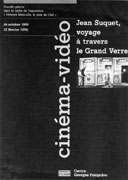
Brochure for Jean Suquet,
Voyage through the Large
Glass,Centre Georges
Pompidou, 24 October,
1995-12 February, 1996

 
A note on the translation:
Some French words from the original have been included in this translation to show the wordplay that takes place in Jean Suquet’s text which cannot be translated exactly into English. Also, in the original, several words were italicized for emphasis. Those words have been underlined in the translation since the added French has been set off in italics, as is customary. These minor adjustments have been made in order for the reader to appreciate as much of the intentioned subtlety as possible.

Click images for Jean Suquet’s animation of the Large Glass


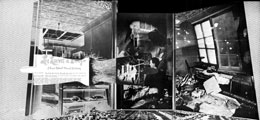
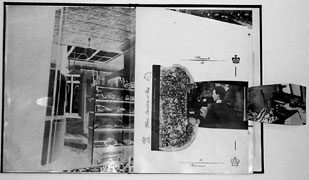
  • A slide of the Large Glass is projected onto the white wall of a room in a garret. On the right, a door, it’s obvious. Closed. The narrator enters into the projection cone and, having become prey to the cast shadows he transfuses his breath into them. Duchamp left three-fourths of the Large Glass transparent so that in the filigree of the extravagant machinery parading in the foreground we could read a poem. Without words [mots], with no motor [moteur].

    The initial lighting crackles with the title: The Bride stripped bare by her bachelors, even. In the sky, the Bride. On the ground, the bachelors. Between them, the horizon line. This line, Duchamp says, is the Bride’s clothing. Poor bachelors dreaming of stripping her bare! They carry before them in their own gaze the veil they can’t wait to unfasten. The horizon line is an imaginary boundary that recedes as one moves towards it. An inevitable escape from which the bachelors will have to disenchant themselves. Let’s join the nine red fellows who look like our brothers. Dressed in tight uniforms, nailed to the ground by their lead soles, they’re nevertheless in a flutter by a leak of illuminating gas, which in 1912 was the blood of the city lights. This spirit rushes into a journey through which must pass all states of matter. Solidified and liquefied into a puddle, it wanders around until some weight, falling down from who knows where, makes it splash out. It explodes. It declares its flame. It is dazzled by its own light that is projected into the sky by a playful configuration of mirrors. In the sky, the Bride is nude in every sense of the word. She unfastens her clothing, which falls to her feet and covers the world around. She escapes all outline, denies all representation. On the Large Glass we can only make out a hieroglyph too difficult to decode until we recognize, within it, the jagged chrysalis of a queen bee that the nuptial flight has dissolved into the clouds.

  • This queen is alive. Her pulse beats. From fair weather to tempests, she blossoms into a milky way flesh color. And the flesh is made word. Some letters, carried by the wind, bring orders and authorizations to the bachelors. Oh yes! In the Large Glass, the woman dictates law. How does she have her will come down to the ground? Thanks to a deus ex machina which links the top and the bottom. Duchamp personified it with a pedestal table. The god knocks at the door dressed up like a vagabond. The goddess dresses up like a whore and cracks the vocabulary with her hot lips. This last guest to the wedding is announced: the Tender of Gravity. A doctor, undisciplined in the transparency, not only takes action so that the weighty time [le pesante heure] gets rid of gravity [la pesanteur], but he also gives his remedy to anyone who cares to hear it: so heal! [guéris donc!] And if you’re cheerful, then laugh! [Et si tu es gai, ris donc!] To heal gravity is to laugh. And so, resumed in long strides, is the fairy tale of modern times, which tells us how the journey of the illuminating gas ends in l’éblouissement [the dazzling]. How the flight of the Bride drives it towards l’épanouissement [the blossoming]. Powered by la jouissance [sensual pleasure].

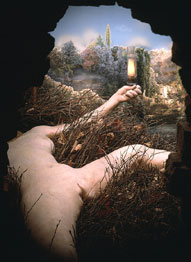
    At the heart of these three words, if one hasn’t lost the innocence of looking for “or” [gold] in “oreille” [ear], here is the word at the end: OUI [YES]. The narrator walks back through the cast shadows, pushes the door, leaves. In other words, he ENTERS the Large Glass. In the black rectangle where the Tender of Gravity DANCES, at the height of the horizon, a naked female arm brandishes a gaslamp. Lit up.

From Blues to Haikus: An interview with Charles Henri Ford


click to enlarge
Charles Henri Ford
Charles Henri Ford in
his New York apartment,
age 87 (2 May 2000)

In addition to writing surrealist literature, being a photographer and creating art objects, Charles Henri Ford (b. 1913 in Mississippi) edited such avant-garde magazines as Blues and View. As Alan Jones wrote in Arts Magazine, “Ford opened the pages of his ‘newspaper for poets’ to the swarm of European surrealists (Max Ernst, Yves Tanguy, André Breton, Marcel Duchamp) and the returning native sons and daughters all fleeing Europe for New York. Bridging the worlds of literature and art, View rapidly grew into an art magazine the likes of which the United States had never seen.”

Charles Henri Ford, together with Parker Tyler, authored the omnisexual novel The Young and the Evil, published in Paris in 1933 and banned in the United States and England for fifty years. His ambitions as a writer and editor brought him in contact with authors like William Carlos Williams, Wallace Stevens, Jean Cocteau and especially Djuna Barnes, for whom he typed up Nightwood in Morocco while visiting Paul and Jane Bowles. Ford became an early supporter of Pop Art and a crucial influence on Andy Warhol and his circle. Active as ever, he has recently shown his poster designs at the Ubu Gallery, New York and is preparing a publication of his latest collection of haikus.

On May 2, 2000, we met with a lively Ford, and his close friend, performance artist Penny Arcade, in Ford’s New York apartment to discuss, among other topics, a 1945 issue of View magazine devoted to Marcel Duchamp, which contained Ford’s poem about the artist, “Flag of Ecstasy.” We brought our copies of View to ask him about several curiosities.


click to enlarge
1922 – STIEGLITZ – 1972
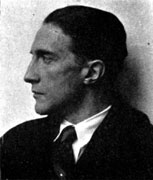
Marcel Duchamp
Marcel Duchamp At
The Age Of 35
Marcel Duchamp At
The Age Of 85
Marcel Duchamp At The
Age Of 85

View, Marcel Duchamp Number, vol. 5, no. 1 (March 1945), p. 54 (detail)
© 2000 Succession Marcel Duchamp, ARS/N.Y., ADAGP/Paris

Rhonda Roland Shearer: Do you know who took the photograph Duchamp at the Age of 85 that was published in the back of View’s Duchamp issue of March 1945?

Charles Henri Ford: You see that was an oversight, one never knew. The one to its left, showing Duchamp in 1922 is Stieglitz, isn’t it?

R.S. Yes that’s what it says but it doesn’t say who took the other one.

C.H.F. That’s right.

R.S. Some people said that this was a double, somebody that looked like Duchamp. But I think it’s Duchamp, and you know it is.

C.H.F. Oh yeah, of course it is. Otherwise it wouldn’t be, it wouldn’t …

R.S. …mean anything?

C.H.F. … it wouldn’t work. Duchamp was heavily made up to look old.

R.S. But you don’t remember who took the photograph?

C.H.F. Maybe I never even knew.


click to enlarge

Flag of Ecstasy
Charles Henri Ford, “Flag of Ecstasy,”
published in:View, vol. 5,
no. 1 (March 1945), p. 4
© 2000 Succession Marcel Duchamp,
ARS/N.Y., ADAGP/Paris

R.S. Page four of View magazine reproduces your poem “Flag of Ecstasy,” an homage to Duchamp, superimposed on a detail of Man Ray’s “Dust Breeding”, showing the lower part of the Large Glass. How did this come about, “Dust Breeding” with your poem on it?

C.H.F. Well, it’s something that the printer superimposed.

R.S. Did you pick it out for your poem or did Parker Tyler who did the typography of your Poets for Painters, published in the same year and also reproducing “Flag of Ecstasy”?

C.H.F. I don’t remember … so much water under the bridge, I can’t remember.

R.S. It’s a fabulous poem.

Thomas Girst: Your poem on Duchamp is a great one.

C.H.F. You like it?

T.G. Yes, I do.

R.S. Could you read it for us? Do you read your poetry still?


Click here for video (QT 3.5MB)
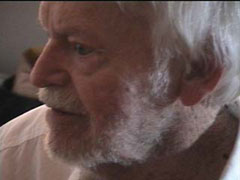
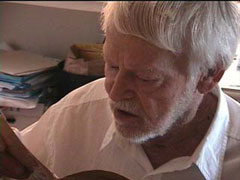
Charles Henri Ford
Charles Henri Ford reading
“Flag of Ecstasy”

C.H.F. Why, yes.

Over the towers of autoerotic honey
Over the dungeons of homicidal drives

Over the pleasure of invading sleep
Over the sorrows of invading a woman

Over the voix celeste
Over vomito negro

Over the unendurable sensation of madness
Over the insatiable sense of sin

Over the spirit of uprisings
Over the bodies of tragediennes

Over tarantism: “melancholy stupor and an uncontrollable
desire to dance” Over all

Over ambivalent virginity
Over unfathomable succubi

Over the tormentors of Negresses
Over openhearted sans-culottes


click to enlarge
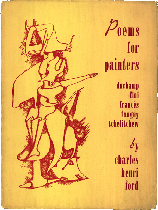
Poems for Painters
Charles Henri Ford,Poems for Painters,
New York: View Editions, 1945 (cover)

Over a stactometer for the tears of France
Over unmanageable hermaphrodites

Over the rattlesnake sexlessness of art-lovers
Over the shithouse enigmas of art-haters

Over the son’s lascivious serum
Over the sewage of the moon

Over the saints of debauchery
Over criminals made of gold

Over the princes of delirium
Over the paupers of peace

Over signs foretelling the end of the world
Over signs foretelling the beginning of a world

Like one of those tender strips of flesh
On either side of the vertebral column

Marcel, wave!

Penny Arcade: Marvelous.

R.S. Great, wonderful, beautiful. Thank you

C.H.F. I’m out of practice, I don’t read. People ask me
to read and I don’t usually read. But you win.


click to enlarge
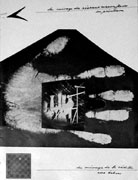
Frederick J. Kiesler and Marcel Duchamp
Frederick J. Kiesler and Marcel Duchamp,
center fold-out tryptich for View,
vol. 5, no. 1 (March 1945)
© 2000 Succession Marcel Duchamp,
ARS/N.Y., ADAGP/Paris

R.S. I thank you, we love your work. Tell us about the Frederick J. Kiesler fold out in View’s Duchamp number. You said that was very expensive to do. It’s beautiful. Do you like it?

C.H.F. Yes, sure. It cost a lot of money. I think it broke our budget.

R.S. So what do you remember in terms of Duchamp and Kiesler doing this? Were they pushing you to, saying it had to be done?

C.H.F. No, they just turned it in.

R.S. Yup, and you just liked it and had to do it.

C.H.F. Yeah, I thought that I would risk all.

R.S. Yeah, that’s what art is about, isn’t it? Who is Peter Lindamood that wrote the “I Cover the Cover.” as an introduction to the View magazine of March 1945? Is that just a pseudonym?

C.H.F. No. Peter Lindamood was from Mississippi, he was a corporal in the military and so on.

P.A. Was he a friend of yours from Mississippi?

C.H.F. Yes he was, yes. He edited a special Italian number, didn’t he?

P.A. I don’t know.


click to enlarge
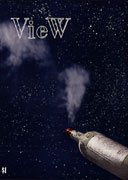
cover
for View magazine
Marcel Duchamp,front cover
for View magazine,
vol. 5, no. 1 (March 1945),
© 2000 Succession Marcel
Duchamp, ARS/N.Y., ADAGP/Paris
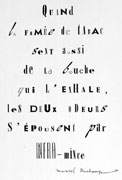
back cover
for View magazine
Marcel Duchamp,back cover
for View magazine,
vol. 5, no. 1 (March 1945),
© 2000 Succession Marcel Duchamp,
ARS/N.Y., ADAGP/Paris

R.S. And so he apparently worked very hard on this issue, the Duchamp issue, it says. What this talks about is that he heard that Duchamp went through a lot of trouble to make this special effect for the cover and apparently there’s all sorts of levels of trick photography in making this cover. Do you recall?

C.H.F. No.

R.S. But it’s beautiful.

C.H.F. Yes it is.


click to enlarge
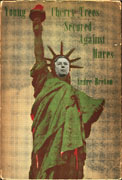
over for André Breton’s 
Young Cherry Trees Secured Against Hares
Marcel Duchamp,
cover for André Breton’s
Young Cherry Trees Secured
Against Hares
, New York, 1946,
© 2000 Succession Marcel
Duchamp, ARS/N.Y., ADAGP/Paris

R.S. Another of Duchamp’s covers for View Editions, “Young Cherry Trees Secured Against Hares,” André Breton’s collected poems, shows the Surrealist’s face through a cut-out, thus posing as the Statue of Liberty. Did you ask Duchamp to make this cover?

C.H.F. Yes. Duchamp always liked to be surprising and Breton of course was noted for not cherishing homosexuals. That’s why André Breton was put in drag.

T.G. Breton supposedly liked the cover.

C.H.F. He liked any attention that was paid to him. I mean nobody was publishing his poetry in America.

T.G. That was the only translated volume of poetry resulting from his time in New York.


click to enlarge
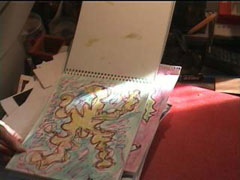
Sketchbook
Charles Henri Ford
flipping through his current
sketchbook (2 May 2000)

C.H.F. And then he came out with another edition too and they didn’t use his cover somehow. But its all water under the bridge…what I’ve been doing for the past few years is taking up where Matisse left off, doing cut outs and things but it was limited to the female sex so I’ve been making up for his neglect. I’ll show you an example.

R.S. Originally you’re from Mississippi?

C.H.F. Born in Mississippi, raised in Tennessee, if you don’t like my peaches, don’t you shake my tree.

T.G. From Columbus, Mississippi you started Blues in 1929, the short-lived poetry magazine which Gertrude Stein once praised as “the youngest and freshest of all the little magazines which have died to make verse free.” You were only 16 when its first issue came out.

C.H.F. Now I’m 87, about the same as Balthus and Cartier-Bresson.

T.G. And Balthus is still doing as well as you are.

P.A. Did you know Balthus?

C.H.F. I met him, once.

T.G. He’s very reclusive, Balthus. He lives in a tiny village in Switzerland, Rossinière, in a little chateau, with a beautiful wife maybe 40 years his minor.

P.A. Fascinating … we should send a message to Balthus, “Charles Henri Ford says ‘Hi.’ Still alive…”

T.G. “…we’re still standing, alive and kicking.”

R.S. Did you know the librarian at the Morgan library,
her name was Belle Greene? Did you know her?

C.H.F. No.

R.S. She was the woman that put the library together for Morgan. And she knew a lot of the artists, she posed nude for a lot of the artists and actually wrote an article in 291 and was hanging out with Stieglitz. I don’t know if you ran into her.

C.H.F. No. If she ran into me, I didn’t feel it. (An air of flirtation ensues.) Penny looks always surprised when she’s not at all surprised.

P.A. Not at all surprised. It’s your latent bisexuality.

C.H.F. Not only latent, it was executed.

R.S. Really?

P.A. Oh, yes. You can join the ranks of women like Frida Kahlo.

R.S. So does this mean that I have a chance?

C.H.F. Huh?

P.A. He doesn’t want to understand you.

R.S. He pretends he doesn’t. Does this mean I have a chance?

C.H.F. Oh. Yeah.

T.G.Your entry for the Dictionary of Literary Biography mentions your submission of a poetic prose piece to Readies for Bob Brown’s Machine. Your contribution of 1931 was intended for a Reading Machine that allowed readers to speed the words past their eyes via reels and a crank. The streamlined sentences should be as far away from conventional books as sound motion pictures were from the stage. You simply eliminated all punctuation and capital letters.

C.H.F. e.e. cummings did that too

P.A. One of the things that’s unusual about Charles is that he actually acknowledges other artists. Once I said to Charles, “One of the things that I really love about you is that you promote other artists.” And you said, “I don’t promote other artists,” and I said, “But you published other writers, you promoted other writers,” and you said, “I wasn’t promoting other artists, I was exercising my taste.”


click to enlarge
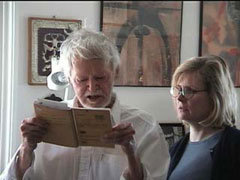
Charles Henri Ford
Charles Henri Ford
reading a haiku

T.G. And you still write poetry, right? You write haikus.

C.H.F. Only haiku… I have a thousand page book I think of haiku and a friend of mine is going to make a typescript for that book.

T.G. Do you write them daily, haikus?

C.H.F. Yeah, I guess so, but I don’t make a point of it. If they come to me, I have to write them down quick, otherwise they fly out of my head.

R.S. Would you read a couple?

C.H.F. Good with the bad
Charles is ready when you are
Good with the bad, what does that mean?

Unbelievable! Somebody’s going to type up all of those for a big book.

Let the other people be homosexual,
As for him,
He’s not that queer


R.S. How about this one?

C.H.F. To my unexpected
Nude niece: “Get out of here,
You look like a bum!”

T.G. In 1924 Duchamp published something more longingly on the themes of nieces: “My knees are cold because my niece is cold.”

C.H.F. Oh yeah.

T.G. I actually have another question about him for you.

C.H.F. Well, let’s see if I know the answer.

T.G. In recent years, Duchamp scholars like Amelia Jones and Jerold Seigel have discussed Duchamp’s possible bi- or latent homosexuality, a claim that seems solely supported by Duchamp in drag as Rrose Sélavy and other androgynous themes running through his oeuvre. Bisexual? Marcel?

T.G. Mm-hm.

C.H.F. Yeah, he’s really a real actor.


Picture Gallery: Charles Henri Ford

click images to enlarge
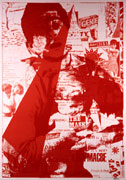
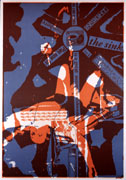
  • Irving Rosenthal as l’Epoux Abandonné, Poem Poster Series
    Charles Henri Ford,
    “Irving Rosenthal as l’Epoux Abandonné, Poem Poster Series, 1964/65 courtesy of Ubu Gallery,
    New York
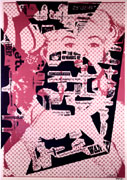
  • “Fallen Womane”, Poem Poster Series
    Charles Henri Ford,
    “Fallen Womane”, Poem Poster Series, 1964/65 courtesy of Ubu Gallery,
     

    New York
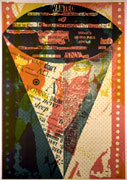
  • “Jane as Jane”, Poem Poster Series
    Charles Henri Ford,
    “Jane as Jane” (Violet/Blue), Poem Poster Series, 1964/65 courtesy of Ubu Gallery,
    New York
  • “One of the World’s Giant Queens,”, Poem Poster Series
    Charles Henri Ford,
    “One of the World’s Giant Queens,”, Poem Poster Series, 1964/65 courtesy of Ubu Gallery,
    New York


Four more haikus by Charles Henri Ford

Weeping and wailing
And grinding of teeth … you don’t
Have to go below

I don’t know if I’ve
Settled down or not but I’m
Not moving for now

You haven’t changed she
Said I thought I looked a
Little better I said

If it’s worth reading
Once it’s worth reading twice so
You know where to start


We are grateful to Penny Arcade and Indra Tamang, Ford’s longtime personal assistant and frequent collaborator, for making this interview possible. For more information on View, we recommend Charles Henri Ford (ed.), View: Parade of the Avant-Garde, 1940-1947 (with a preface by Paul Bowles), New York: Thunder Mouth, 1991

The interview was conducted at Charles Henri Ford’s New York apartment on May 2, 2000. It is preserved in part as a digital videotape (filmed by Martin Samsel) and available in full on audiocassette. © ASRL, 2000.

Shooting Bullets at the Barn


click to enlarge
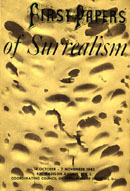
First Papers of SurrealismFirst Papers of Surrealism
Left subtitle
Marcel Duchamp, Cover for the First
Papers of Surrealism
, New York, 1942 (verso)
© 2000 Succession Marcel Duchamp ARS, N.Y./ADAGP, Paris
Right subtitle
Marcel Duchamp, Cover for the First Papers
of Surrealism
, New York, 1942 (recto)
© 2000 Succession Marcel Duchamp ARS, N.Y./ADAGP, Paris


click to enlarge
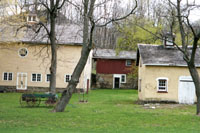
Kurt Selingmann's farmhouse
Kurt Selingmann’s farmhouse
in Sugar Loaf, NY, 26 April 2000

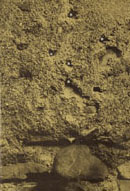
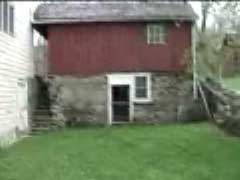
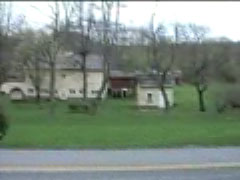
In 1942 Marcel Duchamp is said to have fired five shots at the base of artist-friend Kurt Seligmann’s barn in Sugar Loaf, New York. Shortly thereafter, for the 1942 New York exhibition, First Papers of Surrealism, organized by the exiled Surrealist leader André Breton, the cover of the catalogue was perforated where Duchamp’s bullets hit the nineteenth century stone wall. Other holes on the cover look similar but remain without cut-through circles.


click to enlarge
The Bride Stripped Bare by her Bachelors
Marcel Duchamp,The Bride
Stripped Bare by her Bachelors,
Even
, (a typographic
version by Richard Hamilton,
Percy Lund, Humphries: London, 1960),
n.p.

It has been suggested that by firing the bullets, Duchamp was referring to the Nine Shots of the Bachelors in the Bride’s Domain of his Large Glass, whose location,according to one of his notes (written between 1911-15) published in the Green Box (1934), was to be achieved by randomly firing matches dipped in fresh paint from a toy cannon. (1)

On close examination almost sixty years later, the exact location of the barn’s detail depicted on the cover of First Papers of Surrealism can no longer be made out on the surface of the crumbling and weather-beaten wall. As for the cheese on the back of the cover, the debate still continues. It is definitely Swiss cheese (2), from Seligmann’s native country, but is it a refined “gruyère” as Francis M. Naumann and Arturo Schwarz maintain or just “emmentaler,” as Stephan E. Hauser (3)claims? One final incidental: According to Charles Shaughnessy, a longtime family friend and neighbor, the .22 rifle Duchamp used is considered the same one that killed Seligmann twenty years later.


click image for video (0.8 MB)

  • Kurt Seligmann’s barn
  • Kurt Seligmann’s farmhouse
  • close-up video of
    Kurt Seligmann’s barn in
    Sugar Loaf, NY, 26 April 2000
  • video of Kurt Seligmann’s
    farmhouse and barn in Sugar
    Loaf, NY, 26 April 2000

On Wednesday, April 26th, 2000, Bonnie Garner,Lester Lockwood and the author drove to the Seligmann homestead, 26 Oak Drive, Sugar Loaf, New York (Telephone: 914-469-3849), to examine the barn. We’d like to thank Ms. Patricia Gilchrest, Executive Director of the Orange County Citizens Foundation, and Mr. Charles “Chuck” Shaughnessy for their hospitality. We’d also like to thank Stephan E. Hauser for establishing the contact.


Notes :


Footnote Return 1. Francis M. Naumann. The Art of Making Art in the Age of Mechanical Reproduction. (Ghent, Amsterdam: Ludion Press, 1999), pp. 151. (See also: pp. 150, 153.)

Footnote Return 2. Martica Sawin. Surrealism in Exile and the Beginning of the New York School. (Cambridge: MIT, 1995), pp. 224-226.

Footnote Return 3. Stephan E. Hauser. Kurt Seligmann (1900-1962): Leben und Werk.(Basel: Schwabe, 1997), pp. 221-222.

An Open Letter to Donald Kuspit

All quotations in the following letter were taken from a taped recording of the “Jewis Holocaust in Art” session (24 February 2000; 9:30 AM – Noon) at the 88th Annual Conference of the College Art Association held at the Hilton Hotel in New York City, 23 – 26 February 2000. The recording was made by the CAA.

Dear Donald:

In regard to an exchange of words we had at the College Art Association Conference 2000 during the panel “Jewish Holocaust in Art” (February 24, 2000), I would like to add the following.


click to enlarge
Rudolf Herz, Zugzwang
Rudolf Herz, Zugzwang,
1995 (Room installation at the
Kunstverein Ruhr e.V.,
Essen, Germany)
© photo:
Werner J. Hannappel

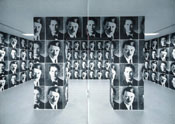
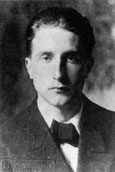
You were on the dais with several co-presenters in easy reach of a microphone and I was sitting in the audience attempting to voice my puzzlement on a specific work of art being presented by Norman Kleeblatt of the Jewish Museum. The work in question was a wall-like installation by the contemporary German artist and photo-historian Rudolf Herz, depicting reproductions of photographs of Marcel Duchamp and Adolf Hitler. The work was completed in the late 1980s and, according to Kleeblatt, the images were “probing [a] new aesthetic discourse on Nazi representation.” The work’s raison d’être was the apparent discovery that photographer Heinrich Hoffmann photographed Duchamp when he was in Munich in 1912, and later became Hitler’s official photographer. Both subjects appear to be dressed in a dark coat and tie.

I was puzzled about the work and asked for clarification. In my short discourse I said I thought that the juxtaposition of Duchamp with Hitler was bizarre, and I suggested (tongue in cheek) that it might have been appropriate to also include a photograph of Lee Miller since Man Ray (who had become the (un)official photographer of Duchamp) also photographed Miller. Plus, Lee Miller, who reportedly bathed in Hitler’s tub, was one of the subjects of a presentation by Carol Zemel of the State University of New York, Buffalo. In her discussion of the so-called liberation photographs by Margaret Bourke-White and Miller, Zemel suggested that the two women’s photographs tended to “anesthetize and aestheticize” the Holocaust. I could not agree more and I indeed feel that Herz’s Zugzwang “anesthetizes and aestheticizes” Hitler.

Kleeblatt was confused by my question — indeed he had a right to be — but you, Donald, asked for the microphone and said, “I don’t think it’s so bizarre at all. Duchamp was a terrorist, wasn’t he? [Microphone disturbances] I just wanted to say that I don’t think it’s so bizarre at all. Duchamp was a terrorist and so was Hitler, and Duchamp was a fetish object, as Hitler is. And a lot of art historians, there are a whole group of art historians who click their intellectual heels and make the Duchamp salute these days. They are both fairly disruptive figures. I think Duchamp was an extremely disruptive influence on art, despite the rationalization of it as, quote,conceptual and so forth. So I think it is a wonderful and actually rather insightful connection to put Hitler and Duchamp together.”


click to enlarge
Marcel Duchamp
Photograph of Marcel
Duchamp by Hans Hoffmann,
Munich, 1912

At this point I said,”The fact that Duchamp skipped out of France in World War I might make him a draft-dodger or a coward … but to call … a coward a terrorist is ridiculous.” Your response was: “Cowards can be terrorists — the art world is a place were artists can be terrorists.” This drew some laughter from the audience as I protested and gestured trying to show you that there was no proportion to your statement.

The discussion moved on to other statements and questions but toward the end of the session you took hold of the microphone again and said, “Incidentally, I’d like to say one last thing to defend myself about what looks like mockery —artists as cowards — you know, the art world as cowards. There is a famous incident … there was a Dadaist happening in Germany and … I believe there was one of the events where one of the Dadaists went and took all the money and invited people to a lecture and didn’t give the lecture — took the money and made some mockery. They were brought into court — this is documented, okay. They were brought into court — some famous Dadaist,and they were trembling, trembling — brought into court and the judge said to them, ‘How do you explain the fact that you stole all the people’s money?’ Then he looked at them trembling and said, ‘Oh, you’re artists,you were artists. Oh, okay. Case dismissed.'”

If the case existed (neither I nor those I’ve consulted have found any evidence of it), its German judge was the Weimar equivalent of the New York Supreme Court Judge “turn ‘em loose Bruce” Wright of the 1970s. And who was the “famous” Dada artist or artists? The Jew Tristan Tzara, the Communist George Grosz or the diminutive Helmut Herzfelde, a.k.a. John Heartfield — who in utter disgust for the Kaiser’s militarism anglicized his name after WWI and who depicted the Nazis, Hitler, Göhring, et al, in unflattering situations?cowards, you say. Yes, I suppose in the end they were cowards because they did choose to flee (an instinct we share with other species when they or we feel threatened).

I suppose that cowards can be terrorists, but we more often associate terrorists with martyrs.Can one call Hitler a terrorist? I believe that one can call Hitler any bad name possible. I prefer mass-genocidal murderer, myself. Does Duchamp fit those descriptions? No!

As for the “fetish object” association you assigned to both Duchamp and Hitler, were you referring to Rrose Sélavy of the Man Ray photographs or Duchamp portraying the fig-leafed Adam on stage, his playing chess with a nude woman, or smoking a cigar? Dare I say that skinheads surround themselves with Nazi images, and not with those of Duchamp? Were you being cynical when you said that “they are both fairly disruptive figures”? But lastly, I can’t help but put together rather horrible images and thoughts about Nazis when in two short sentences you use “fetish,” “clicking … heels” and “salute” to describe Duchampian art historians. Who would that include? Arturo Schwarz? Francis Naumann? Rosalind Krauss? Calvin Tomkins? Rhonda Shearer? Arthur Danto? Who? Wha?

Sincerely,

Elliott Barowitz

A Life in Pictures Revisited

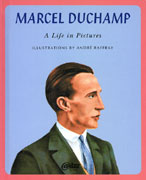
Marcel Duchamp: A Life in Picturesby Jennifer Gough-Cooper & Jacques Caumont,Translated by Antony Melville,Illustrations by André Raffray,Atlas Press, 1999. (UK 5.99 USA $8.95) 26 pages


click to enlarge
Cover for Marcel Duchamp
A life in Pictures
Cover for Marcel Duchamp
A life in Pictures, 1999
©1999, André Raffray and Atlas Press

See Marcel. See Marcel pun. See Marcel’s toys: Why Not Sneeze Rose Sélavy is Lego. The Box-in-a-Valise is a Matchbox dinky car suitcase. Given is a Bar bie StrippedBare By Her Kens, Even. I was hoping that Jennifer Gough-Cooper and Jacques Caumont’s new kid-focused biography, Marcel Duchamp: A Life in Pictures, would really exploit the silly, outrageous possibilities of M.D.’s work. Just as the Box-in-a-Valise enchantingly opens, then unfolds and even slides into place, I was looking for a little bit of innovation here: pop-up features, scratch-n-sniff illustrations, interactive text, maybe even one or two pull-out posters. But this compact biography, the first English translation of the 1977 work La Vie illustrée de Marcel Duchamp, though indeed elegant and informative, seems more geared for the art world set than for the sandbox crowd. It makes Duchamp, and his work, appear quite adult-serious, even.


click to enlarge
Gamelin chocolate shop
Marcel Duchamp at the window
of the Gamelin chocolate shop
©1999, André Raffray and Atlas Press

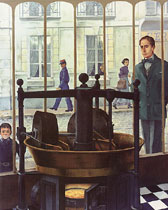
What the biography does well is cover eighty-one years of a fairly event-filled life. In less than thirty, compact pages we follow M.D. from his early days in Blainville, to his rebuff at the hands of the jury of the Salon des Indépendants, to his revelatory viewing of Roussel’s Impressions d’Afrique and finally to his lionization in New York. The writing, though occasionally a touch technical, is never condescending: “Far from being oppressed by the event he found that fate had arranged things quite well, and the symmetry of the cracks looked rather intentional; instead of being disfigured the work was actually embellished.” And the book’s general shape may appeal to some young readers as it physically resembles the classic Golden nursery book: small and colorful with glossy pages and a hardcover. André Raffray’s vivid illustrations, however, so replete with Duchampian allusions (note the brides, bachelors and fresh widows hinted at in his chocolate grinder picture) seem, again, more adult than kiddy-ready.

The idea of a Duchamp-bio for children is very cool and it may be just the infinitely amusing potential of such an idea that renders A Life in Pictures merely satisfactory. I imagine – if only for Raffray’s intriguing pictures – that most Duchampions will want to check out this little volume but I can’t see too many others, especially the juniors, squealing about either the text or the art. So for now, I suppose, it’s back to the Playstations, the Furbys, and the Easy Bake ovens.See Marcel. See him frown.

Leonardo’s Optics Through the Eyes of Duchamp: A Note on the Small Glass


click to enlarge
To Be Looked at with One Eye
Marcel Duchamp,To Be
Looked at (from the Other Side
of the Glass) with One Eye,
Close to, for Almost an Hour
, 1918
© 2000 Succession Marcel
Duchamp, ARS, N.Y./ADAGP, Paris

The following example of Marcel Duchamp’s overlooked encounter with the mind of Leonardo da Vinci is excerpted from a longer essay. The edition of Leonardo’s Treatise on Painting referred to is Josephin Peladan’s 1910 French translation Leonard de Vinci, Traite de la Peinture. This publication aroused gr eat interest among the Duchamp brothers and their Cubist friends at Puteaux.

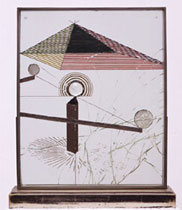
To Be Looked At, With One Eye, Close To, For Almost An Hour (in French: A regarder d’un oeil, de près, pendant presqu’une heure) is a cruel set of commands. Nobody would want to look at anything following this prescription. Duchamp wrote the phrase in small capital letters across the face of a glass painting,
and insisted that his directive, issued in the infinitive, serve as its title. But the owner of this work, Katherine Dreier, hated the title, and referred to it instead as Disturbed Balance.

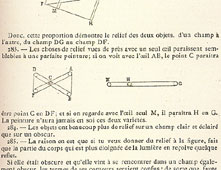
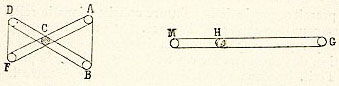
Duchamp, however, was being uncharacteristically descriptive with To Be Looked At… because the image on glass is based upon optics and experiments with the functioning of the eyes. It follows Leonardo da Vinci’s study of vision.In fact, the idea, the image and the phrase itself all come from this short illustrated passage in the Treatise on Painting (1):

Objects in relief, viewed close up with one eye [vues de près avec un seul oeil], seem like a perfect painting. If the eyes A and B look at Point C, C will appear at

click images to enlarge

  • Treatise on Painting

Leonardo de Vinci,Treatise on Painting, 1651 © 1910 Joseph Peladan, Leonard de Vinci, Traite de la Peinture, Librairie Delagrave, Paris


D F. But if you look at it with one eye, M, it will seem to be at G.Painting only presents this second form of vision.


click to enlarge

Note

Marcel Duchamp, Note, 1919
© 1993 Pontus Holten, ed.
Marcel Duchamp: Work and Life
,
The MIT Press, Cambridge, Mass.

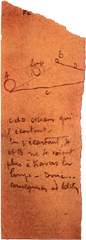
Paintings are flat surfaces.Spacial illusions in paintings are derived from monocular, not binocular,vision. Leonardo was fascinated by the transformation from physiological optics to the artifice of painting, so he studied the behavior of a pair of human eyes. When an object to be looked at is placed close to the face, the paths of vision of the two eyes cross. Duchamp took Leonardo’s X-shaped diagram of cross-eyed vision, along with the wording of his title, directly from this passage in the Treatise. In a posthumously-published sketch for To Be Looked At… he even used Leonardo’s letters “A” and “B” to identify the eyes, or viewing points, represented by circles at the extremities of the cross. But he then placed the configuration on a receding plane, in perspective, and turned it into a pair of giant scissors, a device soon to appear in The Large Glass. Now the cross-eyed observer, it would seem, could cut his way through the visual field by flexing his eyeballs together and apart to make the scissors work. In the small glass To Be Looked At… most of this peculiar tool lies outside the rectangle of the picture, so only its tips can be seen.

The squat, transparent pyramid hovering above the scissors would appear to transport the setting of this one-act farce for eyeballs to ancient Egypt. But it does not.Instead we are right back in the arena of the optics of Leonardo, who wrote frequently and vehemently about the “pyramid of vision.” According to Leonardo:

The body of the atmosphere is full of infinite pyramids composed of radiating straight lines (or rays of light), which are produced from the bodies of light and shade, existing in the air; and the further they are from the object which produces them the more acute they become, and although in their distribution they intersect and cross they never mingle together, but pass through all the surrounding air, independently diverging, spreading, and diffused.(2)
If you look into a mirror and close one eye, you will have formed a visual pyramid pointing at your open eye, whose base is the shape of your face. Leonardo displays remarkable insight into the mechanism of light as it reflects off our surroundings. The receiving human eye always forms the apex of a complex geometric solid, whose base is delineated by the outline of an object in view, and whose sides are formed by the rays of light racing towards the viewpoint from its edges. Leonardo’s use of the word “pyramid,” however, is confusing, because in common usage a pyramid sits on the earth, on a perfectly square base, its axis pointing up to the sky. Duchamp’s Egyptian pyramid in To Be Looked At… is a deliberate and mocking distortion of Leonardo’s idea as it occurs, in the Treatise on Painting, at the center of his theory of optics.

In 1918, from the isolation of Buenos Aires, where he made To Be Looked At…, Duchamp had good reason to poke fun at the visual pyramid. He was probably sick to death of it. His brother, the painter Jacques Villon, was, in contrast, obsessed. Villon believed that Leonardo’s pyramid could provide the unifying theory in his enterprise to make Cubism more than just a passing fad, to transform it into an enduring, classical art form. In 1915, the last time the two were able to meet until after the Great War, Villon would talk of nothing else. All this had started in 1911, when the brothers and their Cubist friends became fascinated by Leonardo’s optical formulations: “Every body in light and shade fills the surrounding air with infinite images of itself; and these, by infinite pyramids diffused in the air, represent the body throughout space and on every side.”(3)

Was Leonardo da Vinci a Cubist himself? He was, it is true, presenting a vision of the space around objects filled with latent images. The eye at any given location could only perceive one image at a time. Visual pyramids “intersect and cross [but] they never mingle together…” But could a painter, a Cubist painter, overcome the laws of light and vision? Could his imagination and intuition capture these half-formed, transparent images, as evoked by Leonardo, before they are condensed into a point, as they overlap, interpenetrate, and jostle for predominance? Jacques Villon struggled to embed this concept of latent visual pyramids into his paintings for the rest of his life.

Marcel Duchamp discussed these ideas with his brother in the early days of Cubism. Then he chose a different path, a directly-perceptual method of creating transparency and overlapping planes in the visual field. He preferred the method that children use. He crossed his eyes.


click to enlarge
Portrait of
Chess Players
Marcel Duchamp,Portrait of
Chess Players
, December 1911
© 2000 Succession Marcel
Duchamp, ARS, N.Y./ADAGP, Paris

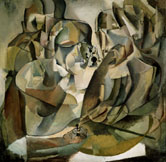
Only one painting, supported by a group of studies, was produced using the cross-eyed method: the Portrait of Chess Players.


click to enlarge
Portrait of
Chess Players
Marcel Duchamp,Portrait
of Chess Players
, December 1911
© 2000 Succession Marcel
Duchamp, ARS, N.Y./ADAGP, Paris
For a Game of Chess
Marcel Duchamp,For a
Game of Chess
, October 1911
© 2000 Succession Marcel
Duchamp, ARS, N.Y./ADAGP, Paris

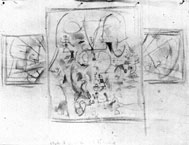
Duchamp asked his two brothers, Jacques and the sculptor Raymond Duchamp-Villon, to sit in front of a chess table, in the midst of a game, and face each other nose-to-nose. Marcel then stationed himself within a foot of his motif, and, in an experiment with scissored configurations of his binocular vision, observed his brothers’
profiles merging and multiplying, engulfing the armies of chessmen behind them. Next, to sort things out, he studied Jacques, on his right, “with one eye, close to, for nearly an hour.” He followed this procedure with Raymond, this time with his left eye, all the while intending the physical proximity of the three artist-brothers (one behind and two in front of the canvas), clustered around their favorite game, to reflect their intellectual and emotional closeness. It is a rare glimpse into a private world.

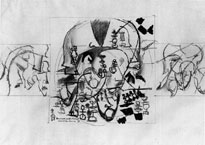
Duchamp left a clear record of the steps leading up to his finished painting. Five preparatory drawings survive. One is in the format of a triptych, with a central square drawing flanked by two smaller contiguous squares. At first glance it looks as if all three squares are filled with Cubist studies of a man’s head. A closer look reveals Raymond’s, then Jacques’s, physiognomies,delineated separately on either side, on the flanking panels. These two monocular visions are repeated, combined and merged in the central panel, which became the prototype for the final painting, the Portrait of Chess Players. Duchamp had put Leonardo’s visual scissors, as depicted a few years later in the small glass painting of 1918, into practice, in the service of Cubism. He never repeated this experiment.


Notes


Footnote Return 1. Josephin Peladan, translator and editor, Leonard de Vinci, Traite de la Peinture (Paris: Librairie Delagrave, 1910), 113. English translations in A. Phillip McMahon, translator, Treatise on Painting by Leonardo da Vinci (Princeton: Princeton University Press, 1956), 177, and Edward
MacCurdy, translator and editor, The Notebooks of Leonardo da Vinci (New York: George Braziller, 1954), 241.

Footnote Return 2. Peladan, Leonardo de Vinci, 89. English translation in Jean Paul Richter, The Notebooks of Leonardo da Vinci, Volume I (New York: Dover Publications, 1970), 39.

Footnote Return 3. Richter, The Notebooks of Leonardo da Vinci, Volume I, 39.

Duchamp as Trickster


click to enlarge
Duchamp
Photograph of Duchamp
sitting in front of a chess set
designed by Max Ernst, 1968 © 2000
Succession Marcel Duchamp ARS,
N.Y./ADAGP, Paris.


click to enlarge
The white square
The white square needs
to be in the lower right-hand
corner. Seen in James Eade,
Chess for Dummies, 1996, p. 11
Chess for
Dummies
Cover for the “Chess for
Dummies,” by James Eade,
IDG Books Worldwide, Inc., 1996

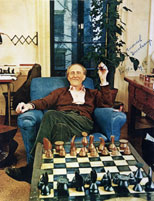
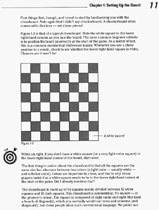
In the accompanying photograph of Duchamp sitting in front of a Max Ernst designed chess set, the master chess player Duchamp has the board set up with a dark square in the lower right corner! (The proper setup is to always have a light square in that corner.) Following the theme of the articles in the first issue of this journal, Duchamp seems to always both 1) deceive, yet 2) leave clues of his deception. (Of course, a deception a without a clue would be hard to uncover.)

As a personal note, most of my previous scholarly work has been on Wittgenstein’s philosophy of mathematics. I have just begun an investigation of the confluences between Duchamp’s readymades and Wittgenstein’s conception of ordinary language. For the moment, I have a title — “Still Life with Wittgenstein and Duchamp” — and some hints. Consider the following sample from remark 129 of Wittgenstein’s Philosophical Investigations:

“The aspects of things that are most important for us are hidden because of their simplicity and familiarity. (One is unable to notice something — because it is always before one’s eyes.)[…] we fail to be struck by what, once seen, is most striking and most powerful.”

Chess should play an illuminating and complicat
ing role, as in this passage from Wittgenstein’s Blue Book (p. 65): “I want to play chess, and a man gives the white king a paper crown, leaving the use of the pieces unaltered, but telling me that the crown has a meaning to him in the game, which he can’t express by rules. I say: ‘as long as it doesn’t alter the use of the piece, it hasn’t what I call a meaning’.'”

I hope to report further in a future issue of Tout-Fait. Fellow investigators are welcome to contact me at Steven.B.Gerrard@williams.edu.
[José Antônio Fabiano Mendes Rio de Janeiro, Brazil, informs Tout-Fait’s readers that 39 chess games played by Marcel Duchamp can be retrieved at http://www.chesslab.com/positionsearch.htmlDate range: select Historical archive(1485-1990)].

The Gift of Cassandra


click to enlarge
Exterior view of :1. The Waterfall /
2. The Illuminating Gas
Interior view of :1. The Waterfall /
2. The Illuminating Gas
Left
Marcel Duchamp,Exterior view of Etant donnés: 1° la
chute d’eau / 2° le gaz d’éclairage
(Given: 1. The Waterfall /
2. The Illuminating Gas), 1946-1966 © 2000 Succession Marcel
Duchamp ARS, N.Y./ADAGP, Paris.
Right
Marcel Duchamp, Interior view of Etant donnés: 1° la
chute d’eau / 2° le gaz d’éclairage
(Given: 1. The Waterfall /
2. The Illuminating Gas),1946-1966 © 2000 Succession Marcel Duchamp
ARS, N.Y./ADAGP, Paris.

In the spring of 1961,Euripides’s The Women of Troy opened at the Récamier Theater in Paris. The first night was attended by many of the intellectual elite: André Pierye de Mandiargue, Alain Jouffroy, Robbe-Grillet and Octavio Paz; our party was made up of Noma and Bill Copley, Marcel Duchamp and myself. The Women of Troy, being both anti-war and anti-misogynist, has been produced more times than any other Greek play so that Marcel might have seen it before, though he did not say so. The play was given an extravagant production in New York in 1964, so he might have seen it again at the very time he was changing the name of the foundation that was to donate his yet secret work [Given: 1. The Waterfall, 2. The Illuminating Gas] to the Philadelphia Museum of Art.


click to enlarge

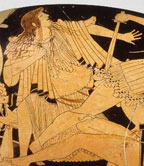
Brygos Painter Vase

Attributed to the Brygos
Painter Vase,
ca. 480
B.C. – 475 B.C.
© Museé du Louvre

Euripides opens his play with Cassandra, possessed with prophecy, coming on stage with a flaming torch in each hand. One she places in a sconce on the statue of Hymen, God of Marriage, and the other she holds high in her right hand singing the marriage song, prophesying her betrothal to Agamemnon; this despite the fact that even Apollo had respected her virginity.

“Hecabe,”says Hephaestus. “In our weddings you are the torch-bearer; but this torch-bearing is a hideous mockery.”

At dinner after the play the four of us discussed the predicament in which Cassandra had put Apollo. Apollo appeared to her and promised to teach her the art of prophecy if she would lie with him. After accepting his instruction, Cassandra went back on the bargain. A successful teacher communicates the facility of achieving certain significant results which become intuitive once acquired by the student. So it was with Cassandra, and she saw no reason to lose her virginity for something that was already hers. (This is heuristic education and can at times be disconcerting.) Apollo, accepting the fact that what he taught her was irretrievably hers, begged her to give him just one kiss. A sentimental compliance to what seemed to be an innocent reward was her demise. As she gave Apollo his kiss, he spat into her mouth thus ensuring that none would ever believe what she prophesied.What he did in spite was not instruction but a God-given gift.

Not long after this I made a sculpture called The Torch of Cassandra which was bought by Barnet Hodes, one of the directors, along with Marcel Duchamp and Noma and William Copley, of the William and Noma Copley Foundation. Some years later, Hodes told me that because of my sculpture he had investigated the story of Cassandra, so that when Marcel presented the motion to change the name of the foundation to the Cassandra Foundation, he (Hodes) said, he was the only one to know her story.

Bill Copley recounted an incident that happened in his sixty-ninth street apartment in New York.Noma did not, naturally enough, see why the Noma and William Copley Foundation should be changed to the Cassandra Foundation. Marcel was waiting in the living room while Bill was in the bedroom, which was just off the living room, trying to convince Noma to change the name of the Foundation. After quite a time, Bill blew a cloud of white cigarette smoke out the door of the bedroom to let Marcel know that he had been successful.

I see a relation between Marcel Mauss’s “Essai sur le don,” “Étant donnés,” “don de la Fondation Cassandra,” the gift of Cassandra (which Marcel seemed to think was among his gifts as well) and all that potlatch entails. Marcel spent the war in the German-speaking part of Switzerland and had lived in Germany and so was able to add a common Teutonic word to his arsenal of puns, “Gift”: die Gift, gift, das Gift, poison.

(In a telephone conversation, March 1, 2000, Noma Copley would not comment on Mr. Metcalf’s remarks. However she assured us that “his statements are all fine.”)

L’inventeur du temps gratuit

Un Chapeau

Robert Lebel (5 janvier 1901–28 février 1986), écrivain, expert d’art (à partir de 1935) et expert en tableaux anciens près les tribunaux et les cours d’appels (à partir de 1953), est né et mort à Paris.

C’est à New York, à la galerie d’Alfred Stieglitz, An American Place, en juillet 1936 selon toute vraisemblance, qu’il a rencontré Marcel Duchamp, alors aux États-Unis afin de réparer le Grand Verre.

C’est encore à New York, à l’occasion de la Deuxième Guerre, durant l’exil forcé, qu’il a écrit “L’inventeur du temps gratuit”, vers 1943-1944, “à une époque où je voyais Duchamp presque tous les jours. Le titre Ingénieur du temps perdu date de beaucoup plus tard et je crois que Duchamp s’est inspiré de mon titre plutôt que moi du sien. Je lui avais montré mon texte peu après l’avoir écrit”.(A) Ce “conte féérique et sacrilège en pleine civilisation du gratte-ciel et du métro aérien”(rabat de la couverture, édition de 1977) sera publié une quinzaine d’années plus tard en revue: Le surréalisme, même, Paris, nº 2, printemps 1957, avec trois photos de l’Elevated, justement (B), puis sept années plus tard en livre: La double vue suivi de L’inventeur de temps gratuit, avec un diptyque gravé à l’eau-forte par Alberto Giacometti et un pliage (La pendule de profil, 1964) de Marcel Duchamp, Paris, Le Soleil noir, 1964; ce livre a reçu le prix du Fantastique en 1965.

Enfin, c’est vers 1949 que Robert Lebel a le projet de consacrer un livre — biographie et catalogue — à Marcel Duchamp, livre auquel il travaille de façon élaborée du printemps 1953 à l’automne 1957 et qu’il complète et corrige en 1958, au moment de sa traduction en anglais. Ce livre, qui sera le premier livre, aura été précédé et suivi d’une vingtaine d’articles (sur Duchamp, mais aussi sur Picabia et Duchamp, de Chirico et Duchamp, Breton et Duchamp, Man Ray et Duchamp, etc.) parus à partir de 1949, justement, et qui n’ont pas tous été repris dans l’édition entièrement recomposée de 1985:

Sur Marcel Duchamp, Paris, Trianon Press, 1959; traduit en anglais par George Heard Hamilton, New York, Grove Press, 1959; traduit en allemand par Serge Stauffer, Cologne, DuMont Schauberg, 1962;

• 2e édition, américaine augmentée, New York, Paragraphic Books, 1967; 2e édition allemande revue et augmentée, Cologne, DuMont Schauberg, 1972;

Marcel Duchamp, 2e édition française revue et augmentée, bien qu’élaguée de son catalogue, de ses illustrations et de sa mise en page, Paris, Belfond, coll. “Les dossiers”, [septembre] 1985;

• réimpression en fac-similé de l’édition courante de 1959, augmentée sur feuilles volantes de 4 lettres de Marcel Duchamp à Robert Lebel, Paris et Milan, Mozzotta, et Paris, Centre Georges Pompidou, 1996.

Avec Francis Picabia (à partir de 1911), peintre et poète, Man Ray (de 1915), peintre et photographe, et Henri-Pierre Roché (de 1916), collectionneur et diariste, Robert Lebel aura sans doute été le dernier complice de Marcel Duchamp. “Tout en étant très amis, nous étions restés sur une certaine réserve” ainsi résumera-t-il, à la fin de sa vie, cette complicité.

André Gervais
9 avril 2000

Footenote ReturnA. Robert Lebel, lettre à André Gervais, Paris, 21 mai 1979. Ingénieur du temps perdu est le titre de la réédition, en 1977, des Entretiens avec Marcel Duchamp (1967) de Pierre Cabanne.

Footenote ReturnB. Dans un article sur Robert Lebel et Marcel Duchamp (Critique, Paris, nº 149, octobre 1959), Patrick Waldberg précise que “le brillant et curieux texte de Robert Lebel, L’inventeur du temps gratuit, véritable spéculation, au sens où l’entendait Jarry”, aurait pu paraître dans le Da Costa encyclopédique, preparé à partir de 1946. Et il ajoute: “On reconnaît sans peine, dans l'”inventeur” en question, sinon Marcel Duchamp en personne, tout au moins l’un de ses frères en esprit.”

L’inventeur du temps gratuit

par Robert Lebel

Tous les photos reproduit ici étaient publiée avec l’article original.
(Le surréalisme, même, Paris, nº 2, printemps 1957.)

Dès qu’il laissait derrière soi, vers la pointe de l’île, la silhouette mutilée déjà du terminus, l’Elevated pénétrait dans des rues étroites dont il frôlait les façades aux escaliers de fer. Front street, Pearl street qu’il recouvrait et calfeutrait comme de longs tunnels, ne menaient au-dessous de lui, dans l’intervalle de ses ébranlements, qu’une existence illusoire et silencieuse d’ancien décor. Scellées de volets imprenables ou aveuglées de crasse, les fenêtres avaient cessé l’une après l’autre de s’ouvrir. C’était, entre les docks de l’East River et les gratte-ciel de Wall street, l’étrange ville morte où tout ce que New York recelait de menaçant venait se terrer et attendre.

Ce quartier m’attirait et j’ai souhaité d’y vivre mais les maisons y étaient à ce point inhabitées qu’un locataire éventuel y faisait aussitôt figure de suspect. Personne ne voulait croire que l’on songeât sérieusement à s’établir dans ces bâtisses délabrées, à l’écart de tout ce que le zèle urbaniste proposait de dignité et de confort. En vain avançais-je l’excuse que je me donne volontiers d’être artiste. Cet argument qui est accueilli souvent avec indulgence ne provoquait ici qu’un surcroît de méfiance et d’hostilité.

Je n’en poursuivais pas moins mes démarches de porte en porte. La déception que j’éprouvais à me heurter inévitablement à de nouveaux échecs se trouvait amplement compensée par mes découvertes à l’intérieur des maisons que je visitais de fond en comble. J’y errais parfois deux ou trois heures sans rencontrer un être vivant. C’est au cours de l’exploration d’un immeuble qui me parut totalement abandonné que je lus à une porte l’inscription suivante, en français:

A. Loride, L’Inventeur du Temps Gratuit – Cela était écrit à la plume, négligemment, sur une feuille de papier fixée par deux clous.

J’avais déjà pu parcourir, aux autres étages, les bureaux d’une compagnie de navigation, l’atelier d’une imprimerie et un établissement de bains, tous également déserts. J’entrai donc sans hésiter. Il était trois heures de l’après-midi d’un jour ouvrable.

Au centre d’une sorte de vaste entrepôt extraordinairement encombré, un homme entièrement nu exécutait des mouvements de culture physique. Il se retourna et je constatai qu’il devait avoir dépassé cinquante ans, bien que son corps fût toujours assez svelte. Il était glabre et son apparence de méticuleuse propreté dans un tel milieu surprenait. Pourtant je fus surtout frappé par son absence d’embarras. Sans penser à se couvrir, à marquer son étonnement ou à justifier sa tenue, il me considérait avec calme et attendait mes explications.

Je ne trouvai d’abord, plutôt sottement que: “Etes-vous Français?”, ajoutant après un silence: “Je viens pour votre invention”.


click to enlarge
Cliquez pour agrandir

D’un signe, il me permit de m’asseoir mais, sauf un lit où était couchée une très jeune femme, on n’apercevait aucun siège et je m’appuyai contre une caisse, poliment. “Je vous écoute”, dit-il. “A ce moment, l’Elevated surgit au ras des fenêtres et tout se mit autour de nous à vaciller.”

“Monsieur,” lui répondis-je enfin, dès que l’on put s’entendre, “je ne vous cacherai pas que je m’intéresse prodigieusement à vos découvertes et c’est parce qu’il me tarde d’en discuter avec vous que j’ai omis de prendre, avant d’entrer ici, les précautions d’usage.”

˜Je ne reçois que sur rendez-vous,” répliqua-t-il brièvement. “Inscrivez votre nom et votre adresse (il me désigna un mur couvert de notes et de chiffres), je vous convoquerai” et, me tournant le dos, il se remit à sa gymnastique.

Sa lettre ne me parvint que trois semaines plus tard. Elle était rédigée sur une feuille à en-tête de A. Loride and Company. “Je vous préviens, écrivait-il, que je ne suis ni fou, ni mystique, ni philosophe, ni inspiré, ni poète. Je me livre à des recherches positives et mon activité correspond, dans une large mesure, au titre peut-être un peu trop affirmatif que je me suis décerné. Engagé dans une entreprise réelle, la nécessité pratique m’obligeait à lui donner une raison sociale. D’autres s’intitulent bien roi du pétrole ou pharmacien de l ère classe. Quoi qu’il en soit, nos rapports éventuels, permettez-moi de le stipuler, ne pourront être que strictement commerciaux. Je ne désire pas de nouveaux amis, mon excentricité ne regarde que moi et ce n’est pas sans intention précise que j’ai choisi, pour m’y retirer, un lieu où seules votre curiosité et votre extrême indiscrétion devaient vous emmener à me découvrir.” Et il m’assignait un entretien pour un jour suivant.

Je fis le chemin mas l’Elevated. A plusieurs reprises déjà, depuis notre première entrevue, j’avais tenté l’expérience de passer devant ses fenêtres, espérant le surprendre en quelque posture significative mais, du compartiment, s’il eût suffi de se pencher à peine pour frapper à sa vitre, on ne distinguait rien qui permit de soupçonner sa présence.

Il me reçut avec l’impassibilité que j’avais observée précédemment. Il n’était ni réticent, ni chaleureux. C’est armé d’une bonne grâce un peu lointaine qu’il se présentait à ce tête-à-tête dont, visiblement, il n’attendait mais aussi ne redoutait rien. Vêtu non sans recherche, il me guida courtoisement à travers un remarquable désordre de machines, d’établis, de poutres, d’horloges, de coffres-forts, jusqu’au lit qui n’était pas occupé.

“Vous avez beaucoup de matériel,” lui dis je pour amorcer la conversation. “Tout ce que vous voyez dans cette pièce, ou mieux dans ce magasin, y a été laissé par de précédents locataires,” répondit-il. “Vous n’y verrez donc pas grande chose qui m’appartienne, mais je préfère ces instruments de hasard. La diversité de leur nature m’interdit de me borner à un seul mode de réflexions et, dans ce laboratoire dont j’inventorie systématiquement et, bien entendu, à contresens les ressources, mon imagination s’expose moins à marquer le pas.”

“Mais le temps?” demandai-je.

“J’y venais puisque j’ai mis au point ma théorie grâce à la réunion toute providentielle devant moi de ces trois horloges dont une fonctionne avec exactitude, une autre irrégulièrement et la dernière pas du tout. De même, cette bascule m’a conduit à réviser mes vues sur le isotopes et je dois à cette essoreuse électrique des révélations inattendues sur la suspension pyrrhonienne.” Mais, rencontrant mon regard, il ajouta vivement: “Surtout ne me prenez pas pour une espèce de penseur. Je ne vise qu’à relier des notions éparses, je ramasse les miettes des grandes idées. Je hais les abstractions. Toutes ces machines, pour la plupart déficientes, me ramènent sans cesse aux détails, aux vérifications fragmentaires et m’astreignent à un bricolage mental d’une heureuse incohérence. Elles imposent à mon interrogation sa forme concrète tandis que leur caractère éminemment fictif me retient de céder, comme le font les physiciens et comme l’ont fait, malheureusement, tant d’alchimistes, au souci mortel du résultat. J’apprends ici à tirer inutilement parti du tout. Ainsi, le passage inéluctable de l’Elevated assume pour moi une fonction aussi fondamentale que le cycle des marées. Il exprime avec autant de perfection le piétinement humain mais, en outre, il a l’immense avantage de maintenir l’organisme dans un état d’exaspération latente. Le flux et le reflux ne nous incitent jamais qu’à nous résigner, alors que l’Elevated nous pousse directement à la révolte contre ce qu’on persiste à nous présenter comme notre condition.”

“Mais le temps?” insistai-je.

“Nous y sommes. Chacun de nous aspire à l’intensité d’une vie de chien, à ces journées bien remplies qui préludent traditionnellement à un repos bien gagné. Notre époque a beau jumeler en un culte dérisoire la liberté et le loisir, les êtres les plus satisfaits sont toujours les plus affairés, donc les plus asservis. Or il est clair qu’aucun progrès n’est à notre portée si nous ne surmontons d’abord la compulsion de l’activité utile. C’est cependant elle, et elle seule, qui continue à régir notre concept du temps. Tenez, fit-il en saisissant un bâton pour désigner les horloges, chacun de ces cadrans figure le temps sous un de ses trois aspects. Pour la quasi totalité des hommes, il n’en existe qu’un. Les individus dits évolués en pressentent peut-être deux, mais je suis un des rares à en définir explicitement le troisième, si bien que je puis, sans trop d’imposture, m’en présumer l’inventeur. Mon but, d’ailleurs, est moins de le formuler théoriquement que de lui donner une consistance. J’ai l’ambition d’en faire une véritable denrée, un simple objet de consommation et d’échange, au même titre que ces remèdes dont les chimistes sont seuls à connaître la composition, mais qui se vendent à tous les comptoirs. C’est pourquoi je me flatte d’être un commerçant et non un philosophe.”


click to enlarge
Cliquez pour agrandir

Il se tut, alla s’installer devant une machine qui se trouvait à proximité des horloges et, du pied, mit une pédale en marche. Bientôt, de minces baguettes de bois commencèrent à jaillir d’un orifice d’échappement. “Excusez-moi,” dit-il, “je dois satisfaire à une commande pressée.”

“Seraient-ce là vos comprimés de temps?” m’écriai-je. Je les eusse plutôt imaginés cristallins et sous les dehors de quelque pastille.

“Peu importe le symbole,” fit-il, tout en continuant à pédaler. “Il se trouve que, sans y être pour rien, j’ai à ma disposition cet appareil qui débite des rondins dont les quincailliers du voisinage, mes clients, se sont révélés avides. Un sculpteur surréaliste en ferait même, me dit-on, courant usage. Toujours est-il que cette industrie exige à peine de moi la somme d’attention dont je suis capable à l’égard de ce qui me fait vivre. Je puis m’y livrer sans quitter des yeux cette première horloge et, aussi aisément que, de cette même place, je vois venir, passer et disparaître l’Elevated, je vois, sur ce cadran, venir, passer et disparaître le temps qui ne s’interrompt jamais, le temps qui possède une valeur vénale. Ces aiguilles déjà vétustes tournent avec une régularité qui ne peut tenir que du prodige. Il semble que ce soit leur destin de tourner, quoi qu’il arrive. Leur bonheur consiste à n’être ni en avance, ni en retard, ni surtout arrêtées. On discerne dans leur mouvement net, résolu, sûr de soi, la satisfaction cocardière dont resplendit le visage de l’honnête serviteur, de la ménagère diligente, de l’ouvrier consciencieux, du fonctionnaire méthodique, de l’homme d’affaires entreprenant, de tous ces gens que je vois se bousculer le matin dans l’Elevated pour se rendre à leur travail, et s’y écraser de nouveau le soir pour regagner leur domicile. Or ce temps se déroule devant moi comme un film. Je sais, je sens que j’y suis étranger. Littéralement j’y échapper, mais serait-ce en vertu de mon horaire que l’on peut estimer fantaisiste? Je ne le crois pas. Comparez les physionomies que je vous ai décrites avec celles qui les remplacent aux heures que l’on nomme si justement creuses, lorsque les compartiments presque vides sont devenus à peu près confortables. Les privilégiés qui, pour des raisons généralement très douteuses, ont bénéficié d’une levée d’écrou, loin de se montrer ravis, paraissent, au contraire, pour la plupart, inquiets et tourmentés. Ils parcourent distraitement leur journal, ils se crispent nerveusement sur leur banquette, la lenteur des trains les irrite. En bref, leurs symptômes sont ceux d’une rumination morbide.”

S’interrompant soudain, il repoussa du pied les baguettes qui s’étaient accumulées devant l’orifice et il reprit sa manœuvre. “Rassurez-vous,” continua-t-il, “mes voyageurs des heures creuses ne sont aucunement dévorés de remords. Au surplus, la réaction du privilégié devant l’esclavage des autres se traduit plutôt par un cynique contentement. Non, l’explication est ailleurs. Si vous passiez comme moi plusieurs heures par jour à braquer vos lorgnettes sur l’Elevated du haut de cette chaire de prédicateur anglican (ce qui me permet de tout voir sans risquer d’être aperçu), vous pourriez constater que ces voyageurs se subdivisent en deux catégories bien distinctes. Simple problème d’interprétation que j’ai dû résoudre à la façon de l’ethnographe ou de l’anthropologue par une exhaustive confrontation des caractères individuels. Certains voyageurs que l’on surprend, aux heures creuses, à sourire, voire à se détendre, sont en réalité des membres provisoirement détachés de la grande fourmilière. Selon le langage des bureaux, ils sont en course ou, comme disent plus noblement les militaires, en service commandé. Leur sérénité, leur désinvolture, qui les différencient aussitôt de leurs voisins immédiats, n’ont pas d’autre origine. Pour eux, l’heure ne saurait être creuse puisque la société qui ne les perd pas de vue en consacre la densité. Le temps où l’usage a frappé une monnaie reste le lien même qui les rive à leur agitation.”

Tandis qu’il dégageait de nouveau les issues de son appareil, je me permis d’objecter: “Cependant, pour les autres voyageurs des heures creuses, ceux qu’à plus ample examen vous classez toujours parmi les oisifs véritables, comment expliquer leur mélancolie si vous écartez l’hypothèse de scrupule? Aurons-nous recours à l’exploitation banale de l’angoisse dont nos voyageurs sont supposés être saisis devant la perspective de leur disponibilité?”

˜Nullement,” répliqua-t-il avec un peu d’humeur. “Ce serait rendre à l’argument spécieux par excellence, celui dont on se sert communément pour justifier les inégalités sociales et démontrer le bien-fondé de la servitude en exagérant à la fois les responsabilités de l’oisif et les dangers que courrait un homme libre. Si les individus qui parviennent à une relative indépendance sont, de fait, les plus désemparés et les plus ombrageux, c’est que, physiquement affranchis, ils demeurent mentalement des esclaves. Ils ne rectifient pas leur conception du temps alors que celui-ci modifie pour eux son rythme. Dès lors s’introduit dans leur existence le déséquilibre que ces secondes aiguilles miment adéquatement. Elles ne sont plus animées que d’un mouvement erratique, fiévreux en quelque sorte et rompu par de longs moments d’immobilité pesante. Sans cesse, elles sont en avance ou bien en retard mais sur quoi, pourrait-on demander, puisque précisément c’est en dehors du circuit de la ponctualité qu’elles se situent? D’où vient cette inconséquence si ce n’est de la conscience très vive qu’elles conservent encore du temps social? En définitive, leur regret d’en être exclues l’emporte sur leur soulagement d’en être dispensées. Une horloge déréglée, donc libre, n’oublie pas l’horloge exacte qu’elle fut. L’heure qu’elle marque n’est jamais absolument délivrée de l’autre dont un timbre antérieur s’obstine à sonner le souvenir.”


click to enlarge
Cliquez pour agrandir

Sans quitter sa machine, il se prit à rire silencieusement.”Voyez-vous,” enchaîna-t-il, “je n’accepterais le titre de penseur que suivi de l’épithète comique, mais au sens non douloureux du terme et comme Stendhal envisageait de devenir “the comic bard”. Contrairement à Molière et à sa misérable suite de vaudevillistes, je ris moins de l’homme lui-même que des abstractions dont il est pénétré. Le comique de la pensée est beaucoup plus irrésistible que celui des caractères. Il est grand temps d’en finir avec la comédie classique et son arsenal de types à jamais flétris pour lui substituer une comédie de la connaissance qui se terminerait par un beau massacre d’idées, au lieu de conclure systématiquement par l’écrasement du “drôle”. Je vois fort bien, par exemple, une comédie sur la notion du temps, vielle coquette aux minauderies sordides, qui compte et recompte inlassablement son or à mesure qu’il lui glisse des doigts. Ce serait elle qu’il s’agirait de confondre et de rosser en lui laissant, comme il sied, sa configuration idéographique. J’aime souvent à croire que les formes surprenantes dont l’art moderne a été prodigue sont des idées qui ont pris corps et s’apprêtent pour la scène future où elles seront rouées de coups. Ce sont les personnages de notre nouvelle comédie et leur aspect, parfois repoussant à première vue, ne fait que confirmer leur signification mythique et annonce le sacrifice bouffon auquel ils sont destinés.”

Les piles de rondins avaient atteint une hauteurs considérable et, jugeant sans doute suffisant le résultat de son effort, mon hôte cessa de pédaler, se leva, désigna de nouveau la seconde horloge et reprit: “Ce temps qui a cessé d’être social et qui n’a pas encore commencé d’être individuel, ce temps amorphe, incolore, insipide, constitue un intolérable poids mort pour ce qu’on est convenu d’appeler l’évolution humaine. Ou bien celle-ci n’est qu’imaginaire et, parmi des masses éternellement primitives, nous ne représentons qu’une écume négligeable de dissidence, ou bien, dès son départ, cette évolution s’est engagée dans une impasse où elle butte à un obstacle qui la fait irrévocablement refluer. Mais qu’on y prenne garde, le désir même de liberté ne résistera pas indéfiniment au démenti terrible que lui infligent les faits. Entre les paroles que nous énonçons et notre comportement notoire, la brèche scandaleuse s’élargit chaque jour. Autour de nous, les défaillances se précipitent et les plus rebelles font parfois penser à ces femmes émancipées qui souhaitent secrètement un homme à poigne. Il ne leur manque jamais qu’une cause pour s’y consacrer “de toute leur âme”. Reconnaissons-le, ce temps social sait entretenir chez ceux qui, momentanément, s’en étaient écartés, une nostalgie particulièrement écoeurante. Les uns sont à la merci de la première équivoque venue, les autres, orgueilleux de leur fermeté, rédigent avec un raffinement morose les codes de leurs nouvelles contraintes. Ceux-là mêmes, si peu nombreux, qui s’accommodent d’être seuls, paient leur tribut sous forme de gémissements. Ils s’ennuient, ils désespèrent ou, plus ridiculement encore, ils travaillent. Chaque bribe de ce temps, qu’ils ont si péniblement conscience de soustraire à la société, acquiert à leurs yeux une valeur extravagante. Ils s’en instituent personnellement les usuriers et, pour mieux faire fructifier leurs tristes épargnes, ils calculent, ils inventent, ils bâtissent, ils peignent, ils écrivent avec une ardeur désolée. Sans doute se livrent-ils à une sorte de transfert: ils convertissent leur temps papier en temps or, ils le consolident et l’on utilise d’instinct pour cette opération mentale un langage de finance. Il n’est question que d’un placement pour les cieux jours ou, suprême ambition de banquier philanthrope, spéculateur à long terme, d’un moyen de se perpétuer.”

“Voyez-vous,” remarqua-t-il en souriant, “je me laisse à mon tour emporter par la satire. Je stigmatise l’homme moderne, l’homme libre, celui qui, semblable aux anciens duellistes, se tient pour comblé dès qu’on lui accorde le choix des armes qui le tueront. Suivez son manège lorsqu’il hésite triomphalement entre les journaux, entre les professions, entre les églises. Entendez-le s’exprimer à son aise dans des langues qui confondent le temps et la cadence, comme l’anglais time ou l’italien tempo. Regardez-le s’éloigner avec assurance, persuadé qu’il pourrait, à son gré, ne plus revenir, alors qu’il porte en lui, plus contraignant qu’un philtre d’amour, le gage de sa soumission. Dans la forêt même où parfois il s’aventure, les fées, les sorcières, les voix anonymes sont autant d’horloges métaphoriques dont la fonction est de lui rappeler l’heure. Sous son regard, chaque surface est un cadran lisible, chaque ombre, une montre embusquée. L’agonie des minutes brame à tous les échos et, jusque dans l’emportement de son vertige, le voyageur s’écoute vieillir car c’est le temps qui bat son pouls, inexorable chef d’orchestre intérieur. Rebrousser chemin, retrouver le “temps perdu”, quelle tentation pour qui, ayant cru fuir, lui aussi, la vielle terre, reprend à son compte l’exclamation désenchantée d’un auteur connu: “Ce n’est rien, j’y suis, j’y suis toujours”.

Depuis quelques instants, mes yeux s’étaient fixés sur le troisième cadran dont l’aspect immuable commençait à me fasciner. “Que cette inertie ne vous inspire pas des images faciles de néant ou d’éternité,” me dit mon hôte d’un ton sardonique. “Dans cette horloge arrêtée, imaginez au contraire un mécanisme plus sensible que les autres, trop parfait pour enregistrer les vibrations grossières du temps social. Ailleurs, en quelque partie soigneusement occultée de ses rouages, d’imperceptibles oscillations révéleraient le passage presque impalpable du temps gratuit. Certes, la façade figée et comme morte de ce cadran est bien faite pour éloigner ceux qui reculent naturellement devant une mutation possible. Tout annonce un passage à franchir, une rupture à réaliser. Entre ce monde et l’autre, aucune transition légendaire, aucune communication discursive. On ne nous offre pas la clé d’un autre nirvana puisqu’il semble même que là où nous allons, l’extase n’ait plus de raison d’être. Nous ne renouons avec rien et peut être aurons-nous enfin brisé avec tout. Ni cérémonial, ni incantations, ni rites, mais atteindre ai point de lucidité où la notion du temps devient un fruit que l’on pèle”, et il fit avec ses doigts de petits mouvements déliés.

Je brûlais de poser une question mais, me devançant, il ajouta: “Ai-je besoin de spécifier qu’en nous retranchant du temps utile, nous entendons en aucun cas nous restreindre à la quiétude neutre du spectateur, à cette transcendance sceptique ou contemplative qui, pour ma part, me répugne absolument? Le domaine du temps gratuit est celui du risque extrême, de l’exaltation soutenue car il est à la fois le seul où l’on perde sciemment son temps, donc sa vie et le seul où tout effet dramatique, toute emphase soient inadmissibles. Le jeu lui-même s’y dépouille des compensations verbales ou passionnelles que lui avait léguées le temps social où nul acte ne se justifie sans dividende. Les anciens aristocrates prenaient la précaution de réunir tous leurs invités avant de jeter leur argenterie au fond de l’eau et les mises à mort, dans la littérature moderne, ont souvent conservé ce style tapageur. Pour nous, le gaspillage est obligatoirement non ostensible et nous chercherons surtout à donner le change. Nous ne serons ni mages, ni héros, ni justiciers, ni prophètes, mais nous aurons soin de jouer des rôles quelconques avec un faux sérieux qui pourra faire illusion. C’est à l’intérieur même du temps social et non à l’écart, ce qui déjà serait édifiant, que nous créerons, sans nécessairement le laisser entendre, des zones de refus et de légèreté.”

A cet instant, une jeune femme entra. Ce n’était pas celle que j’avais déjà vue. Elle se contenta d’incliner la tête et vint s’asseoir sur le lit sans prononcer un mot. Je me disposais à poursuivre l’entretien lorsque je m’aperçus que, manifestement, les pensées de mon interlocuteur avaient pris un autre cours.


click to enlarge
Cliquez pour agrandir

“Puis-je vous prier de ne plus revenir?” me dit-il après quelques minutes de silence. “Epargnez-moi la disgrâce de reprendre ces démonstrations orales qui ne trahissent jamais que nos propres tergiversations. Un bruit de paroles qui prétendent convaincre et il n’en faut pas davantage au temps social, momentanément conjuré, pour retrouver son arrogance.” Et me poussant aimablement vers la porte, il conclut: “La gratuité ne se sépare jamais d’un certain mutisme. Sans doute en ai-je déjà trop dit.”

Constructing Life


click to enlarge
Etant
donnés: 1º la chute d’eau / 2º le gas d’éclairage, 1946-66
Marcel Duchamp, Etant
donnés: 1º la chute d’eau / 2º le gas d’éclairage
, 1946-66

First you have to get far enough back from everything. How ridiculous to let any taboos linger. Having smashed the king of all taboos we looked around to see if anyone else had smashed through as well. Not exactly. Not yet. But had our old friend also sought to defy death? Had he constructed an architectural surround to return to? If “after all death is always only for others,” should not the ironic artist, first off, busy himself with a tomb for himself?!? Revitalizing tombs are Mallarmé’s specialty. His ” Tomb of Baudelaire” serves as point of departure, framing context, and signaling scaffolding for Marcel Duchamp’s heroic but limited, for being local and self-contained, effort to fit himself a tomb. His “Etant Donnés, involving, it would now appear, a returning to this world, might better bear the title ” Encore Etant Donnés” or “To Return To.*”

*Title of a critical essay on Etant Donne by Madeline Gins and Arakawa

*Title of a critical essay on Etant Donne by Madeline Gins and Arakawa


click to enlarge
Click here for video (QT 0.7MB)
Madeline Gins
Madeline Gins

Etant Pris

D. drinks M. drinking B.–drinks-toasts.

Muddy ruby-filled brew.

Pubis, liquid, illuminating gas.

Eternal afternoons—— of cities without night.

Symbols that gaze back at . . . . . . .

Forests of gazing-back symbols–

Dried foliage–

The bec Auer and its predecessor the bec papillon–
or the butterfly or bat’s wing burner

The wick’s desire . . . to be put . . . inserted.

M. Gins


click to enlarge
Click here for video
(QT 0.7MB)
Madeline Gins
Madeline Gins
Marcel
Duchamp as Rrose Sélavy, 1921
Marcel Duchamp, Marcel
Duchamp as Rrose Sélavy, 1921

Being Taken—Having Taken It To Be
by S. Mallarmé or R. Sélavy

Nature is a temple
Whose living pillars
Release confused words
Perfumes, colors, sounds
Are everywhere let loose
All over the place

Humans pass there
Traversing forests of symbols
Which observe them with
A gaze akin to a familiar regard

M. Gins

[Note: Italized words that come up from the last stanza
of Baudelaire’s poem, Correspondances, to invade its first stanza plus all those that exceed the usual bounds of translation.]


Click here for video (QT 0.5MB)

Madeline Gins

“The Tomb of Charles Baudelaire”

The buried temple divulges from its sepulchral mouth
Sewerage: mud and rubies
Abominably an Anubis
The whole of its muzzle aflame with wild ferocious baying

Or that [as] the [most] recent gas twists the squinty wick,
A sweeper away, one knows, of infamies undergone,
It ignites a haggard immortal pubis
Whose flight moves up and off according to movements
Within and off out from the gas street lamp.

What dried-out foliage in “les cités sans soir”*
Votive, could bless like her, she, in her settling down again
Vainly against the marble vainly of Baudelaire

In the veil that wraps her around, absent with shivers,
Always to breathe
This, she, his Shade
Even if it be a tutelary poison
from which…of which…we perish.

by Stéphane Mallarmé
first translated by Roger Fry
adjusted and retranslated by Madeline Gins

Etant Pris

D. drinks M. drinking B.–drinks-toasts.

Muddy ruby-filled brew.

Pubis, liquid, illuminating gas.

Eternal afternoons—— of cities without night.

Symbols that gaze back at . . . . . . .

Forests of gazing-back symbols–

Dried foliage–

The bec Auer and its predecessor the bec papillon–
or the butterfly or bat’s wing burner

The wick’s desire . . . to be put . . . inserted.

M. Gins

Telescopic/Paralll Malic Moulds
by Rrose Sélavy

Charles Baudelaire 1821-1867
Arthur Rimbaud 1854-1891
Henri Poincaré 1854-1912
Stéphane Mallarmé 1871-1898
Marcel Duchamp 1887-1968

M.Gins

Poincaré’s Infra-thin

A.

Because

we cannot

a curve

without width

and must a straight line

under the form of

a rectilinear band

having breadth.

But well know these lines have no width.

Have them be narrower and narrower

thus to approach the limit;

so we do in a certain measure,

but we shall never attain this limit.

Always picture these two narrow bands,

one straight, one curved,

in a position such that

they encroach slightly one upon the other

without crossing.

A hand made of paper

and a hand made of gentle breeze

were made to shake hands

so that zeroing in on

the as-always oversized

triggering-zero might keep narrow. . . .

B. [tangent at infra-thin]

A high-tension non-wire

The tension needed to hold the image of a line.

The width of this line shall not exceed the posited non-width.

The tension needed to hold the thought-the breaking into thinking–
of a line.

The-tension-needed-to-hold-the-image-of-a-line’s width, non-width,
or near-non-width.

The-tension-needed-to-hold-the-thought-of-a-line.

T-T-T . . . te te te te te

A cross-sectional slice, a shaving, a would-shaving of
…tentativeness….


M.Gins

Figs. 1, 4 © 2000 Succession Marcel Duchamp, ARS, N.Y./ADAGP, Paris. All rights reserved.