image_pdfimage_print

All posts by robert

Dreaming with Open Eyes:The Vera, Silvia and Arturo Schwarz Collection of Dada and Surrealist Art at the Israel Museum, Jerusalem


click to enlarge
Click to see video


video1(1.4mb)
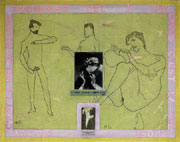
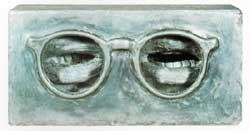
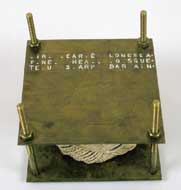
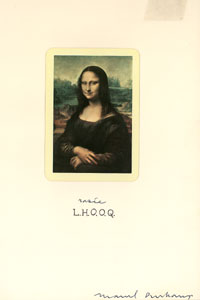
Marcel Duchamp, Why
Not Sneeze Rrose Sélavy?
, 1921/1964 © 2000
Succession Marcel
Duchamp, ARS, N.Y./ADAGP, Paris

.
. . . and may I, who am still searching for something in this world,
be left with open eyes, or with closed eyes in broad daylight,
to my silent contemplation.
André Breton, Le surréalisme et la peinture, 1928

The vast collection of works donated by the Milanese scholar, poet, and collector Arturo Schwarz as a gift to the Israel Museum at the beginning of 1998 was an offering of unique scope and importance. Consisting of about 750 works by approximately 200 artists in a variety of styles and techniques, the Vera, Silvia, and Arturo Schwarz Collection of Dada and Surrealist Art constitutes the major part of the total collection amassed by Arturo Schwarz. (The other parts are to be found in the National Gallery of Modern Art in Rome and the Tel Aviv Museum of Art.) This is one of the world’ s greatest collections of Dada and Surrealist art, and since its addition to the Museum’s existing holdings, which include the collector’s extensive library, the Israel Museum has become a global center for the study and display of these two seminal movements in modern art.*

Arturo Schwarz’ s connection with the Israel Museum began in 1972, when he gave the museum a set of thirteen replicas of Marcel Duchamp’s readymades. During the Gulf War of 1991, he decided to donate most of his collection and his entire library to the Israel Museum, and already in 1992 we received the vast library containing more than a thousand items, including limited-edition books, many with original prints, and full runs of Dada and Surrealist periodicals, as well as documents, manifestos, and Schwarz’ s extensive personal correspondence with the movements’ leading figures.

Arturo Schwarz was born in 1924 in Alexandria, Egypt, to Jewish parents: a German father and an Italian mother. In his youth, he was very active in clandestine political circles. At first he was affiliated with the Zionist movement and spent several months on a kibbutz in Palestine; later he became involved in a Trotskyist group in Alexandria. At the same time Schwarz made the acquaintance of the Egyptian Surrealists and from 1945 to 1948 ran a publishing company and a bookstore. Arrested several times for his political activities, he was expelled from the country in 1949. He settled in Milan, where he founded another publishing house and, at the beginning of the 1950s, opened a bookstore which later developed into Galleria Schwarz, which closed in 1975. The gallery held exhibitions of the best Dada and Surrealist artists and of contemporary artists throughout the world. Simultaneously, Schwarz wrote poetry, published scholarly books such as a catalogue raisonné of the works of Marcel Duchamp, gave lectures and organized international Dada and Surrealist exhibitions. His intense involvement in the Surrealist movement and his personal acquaintance with many of its members made him a leading authority on its history.

Arturo Schwarz wrote that “Dada was the first movement in the history of art to liberate the creative process from the shackles of rules and academisms . . . and in Surrealism I discovered a philosophy of life whose cardinal points – love, freedom and poetry – coincided with my own. I have thus never seen myself as an ‘art collector’ but rather as a convinced Surrealist, keen to acquire the works which were inspired by my own convictions.” Indeed, the imprint of his life and personality is manifest in the collection he assembled for years, and the personal portrait reflected in it reveals a combination of two seemingly opposite forces: a romantic-surrealistic vision of imagination, dreams, and love is countered by the critical eye of a scholar and historian who wishes to investigate, to document, and to explain. On the one hand, there is a passion for collection and a spirit of adventure; on the other, methodical assemblage and scholarly classification. Schwarz’s deep conviction that Surrealism is not only an artistic-stylistic trend but a universal spiritual and ideological manifestation that seeks “to break the habit of looking at things in the same way, to revolutionize our vision” is evident in his desire to capture and document every cultural, geographical, and historical aspect of the phenomenon. Thus, his collection contains oil paintings alongside photographic portraits, and books of poetry next to documents, representing a range from Europe to South America and from the sixteenth century to the present. His selection disregards both conventional aesthetic distinctions and any accepted hierarchy of major and secondary works or important and unimportant artists. The result is an encyclopedic cultural mosaic that is impressive and astonishing, especially if one takes into account that it is the lifework of a single individual. Schwarz has explained his criteria by saying, “It is not physical beauty that interests me; it is spiritual beauty and the idea behind it, and when it is strong enough it becomes physical beauty, but not the other way round.”


click to enlarge


video2(1.4mb)
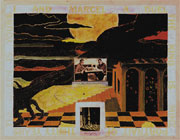
Marcel Duchamp, Female Fig
Leaf
, 1950/1951 © 2000 Succession Marcel
Duchamp, ARS, N.Y./ADAGP, Paris

At the end of the year 2000, the Museum will present a major sampling of the Vera, Silvia, and Arturo Schwarz Collection to the public for the first time. Combining Schwarz’s insight and personal approach to collecting with a museological, historical presentation of Dada and Surrealist art, the exhibition Dreaming with Open Eyes will feature 350 representative works in a variety of techniques – paintings, drawings, collages, prints, photographs, sculptures, and readymades – along with dozens of items from the unique library of periodicals, documents, and books. A short introductory film presents the life story of Arturo Schwarz through personal photographs and excerpts from interviews. Using contemporary design language, the exhibition conveys the radical spirit of these two movements. Occupying several galleries, it is arranged by topic as well as in historical order, largely reflecting the main divisions of the original collection.

“Dada Doesn’t Mean Anything”
The Dada movement, which came into being in Europe and the United States in protest at the horrors of the First World War, rebelled against artistic convention and sought to subvert the existing social and political order. The works exhibited, whose main source is the legacy of one of the leaders of Dada, Tristan Tzara, represent the oeuvre of such major artists as Marcel Janco, Jean Arp, Raoul Hausmann, Max Ernst, Francis Picabia, and Kurt Schwitters. Mainly drawings and collages, they exemplify typical elements of Dada: the accidental, the absurd, protest, and criticism. The Dadaists’ desire to fuse life and art and to embrace all areas of creativity is reflected in the accompanying display of their radical periodicals and manifestos, together with excerpts from the early films of Hans Richter.

The Chess Players: Marcel Duchamp and Man Ray
click to see video


  • video3(1mb)

  • video4(1.7mb)

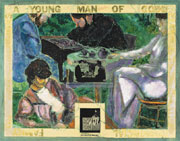
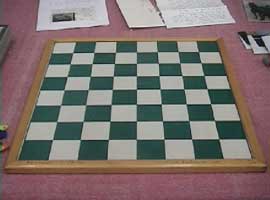
  • Marcel Duchamp,Chessboard
    , ca. 1946 © 2000 Succession
    Marcel Duchamp, ARS, N.Y./ADAGP, Paris

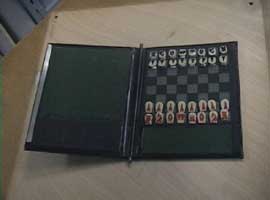
  • Marcel Duchamp,Pocket Chess
    Set
    , 1943/1961~64© 2000 Succession
    Marcel Duchamp, ARS, N.Y./ADAGP, Paris

The revolutionary work of Marcel Duchamp and Man Ray had a profound influence on Dada and Surrealist artists and on later trends in twentieth-century art. Arturo Schwarz began to correspond with Marcel Duchamp in the early 1950s and through him made the acquaintance of Man Ray. He demonstrated his deep appreciation of these two artists and his devotion to them by arranging exhibitions, producing series of readymades, acquiring dozens of their works and writing authoritative scholarly books about them. The seventy works by these two artists in the exhibition, which demonstrate their conceptual approach and bear witness to their fertile imaginations, are replete with irreverence, iconoclasm, humor, playfulness, sexuality, and eroticism.


click to enlarge

video5(1.5mb)
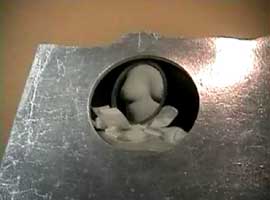
Marcel Duchamp, In
the Manner of Delvaux
, 1942
© 2000 Succession Marcel Duchamp,
ARS, N.Y./ADAGP, Paris

“Pure Psychic Automatism”: Surrealism
The ideologues of the Surrealist movement, whose conceptual platform was formulated by André Breton in the First Surrealist Manifesto of 1924, wished to develop patterns of thought and expression which would lay bare an inner irrational and subconscious reality like that revealed in dreams, psychoanalysis, and the drawings of children and the insane. Surrealist artists experimented with automatism as a basic principle of random and unmediated creativity, and with illusory dream images in fantastic forms and surprising combinations. In this part of the exhibition, there is a rich collection of more than a hundred works from various periods. Among the artists exhibited are some of the members of the original circle of the Surrealist movement in the 1920s and ’30s, such as André Breton, Joan Miró, Yves Tanguy, André Masson, and Max Ernst, and others who were influenced by it and joined after the Second World War, like Victor Brauner, Wifredo Lam, and Matta. A prominent place is occupied by women artists like Claude Cahun, Remedios Varo, Kay Sage, Dorothea Tanning, and Meret Oppenheim. The works on show illustrate the variety of methods used by the artists to liberate their imaginations from the domination of the critical consciousness, ranging from automatic drawing, collage, and photomontage to collective drawings, dream pictures, and assemblage.

“The Sleep of Reason”: Forerunners of Surrealism
From the very beginning of the Surrealist movement, writers and artists turned to the works of the past for inspiration and affirmation. In art and literature, they did, in fact, find evidence of a timeless interest in dreams, the supernatural, the magical, and the irrational. In the art of the Middle Ages, the Renaissance, and the Baroque, these elements were to be found in such subjects as the Apocalypse, monsters, alchemical symbols, scenes of temptation, and erotica, and in grotesque and hybrid images. From the beginning of Romanticism in the eighteenth century to the Symbolist movement in the nineteenth, the taste for fantasy and the irrational grew stronger: the industrial era gave rise to anxiety and to a longing for a mystical, otherworldly experience. Like Breton and others, Arturo Schwarz assembled examples of pre-Surrealist works characterized, as he said, by “their spiritual attitude toward the marvelous – as well as their subversive element.” This variegated collection includes paintings, prints, and drawings dating from the sixteenth to the twentieth century by artists such as Dürer, Goya, Moreau, and Redon, along with tribal masks and artifacts from Africa, Oceania, and North America.


click to enlarge
Click to see video

video6(1.1mb)
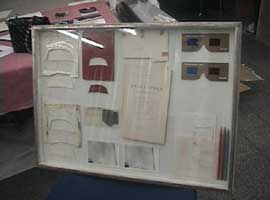
Marcel Duchamp, Cheminée
anaglyphe (Anaglyphic Chimney)
and related
material, 1968 © 2000
Succession Marcel Duchamp,
ARS, N.Y./ADAGP,Paris

Talking Heads:
The Library Portraits of Surrealist artists and writers immortalized by their photographer and painter colleagues constitute a separate section, which Arturo Schwarz calls “memorabilia.” These works have a special value, apart from their documentary and historical importance, in that they shed light on the personal relationship between the artist who depicts and the person depicted. The collection of portraits is combined with a selection of Dada and Surrealist books illustrated with original prints. There are also artists’ books in special editions by Max Ernst, Man Ray, Masson, Picabia, and others, and books produced jointly by pairs of artists like Tristan Tzara and Jean Arp, Benjamin Péret and Yves Tanguy, Robert Desnos and Pablo Picasso, and Paul Eluard and Man Ray. The collaboration between artists manifested in these portraits and books illustrates the intellectual ferment of Surrealism and the spiritual bond that existed among the members of the movement.

The exhibition will be accompanied by a comprehensive 250-page catalogue, which includes an illustrated inventory of all the works in the Vera, Silvia, and Arturo Schwarz Collection in the Israel Museum. An exploration of a perennially fascinating subject, Dreaming with Open Eyes promises to be one of the Museum’s most important and enlightening exhibitions as we begin the new millennium.

* For more on the collector and his gifts to the Israel Museum, see The Israel Museum Journal XVI (1998): 61-70.

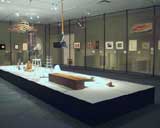
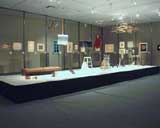
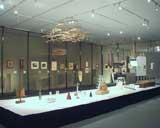
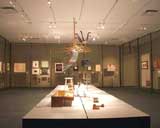
Installation
views of the exhibition’s Marcel Duchamp and Man Ray section

click images to enlarge

The Vera, Silvia and Arturo Schwarz Collection of Dada and Surrealist
Art, Israel Museum, Israel, 2000

Marcel Duchamp –Étant donnés: Det Dekonstruerede Maleri (The Deconstructed Painting)

Picasso (1881-1973) og Duchamp (1887-1968) var stort set samtidige. De levede begge længe og havde begge en stærk tilknytning til Paris og den europæiske modernisme – og de kaldes begge for “det 20. århundredes kunstner”. Alligevel udviklede de sig til at blive næsten kunstneriske modpoler.

Duchamps navn er velkendt og højt estimeret indenfor kunstens og kunstinstitutionens indercirkler, men mindre kendt i de mere perifere kunstinteresserede cirkler. En af årsagerne hertil er nok at Duchamps livsværk er ret begrænset i omfang og at størstedelen af hans værker desuden er samlet på et enkelt museum i Philadelphia, U.S.A. Dette betyder at det for eksempel ikke er muligt at studere nogle af Duchamps værker i original (eller replica) noget sted i Danmark.

Derimod er Picassos navn kendt af næsten enhver. Malerierne flød fra Picassos hånd, og ethvert moderne museum med respekt for sig selv har Picasso repræsenteret ved et eller flere værker. Virtuost valfarter Picasso gennem modernismens mange ismer, og menneskeskikkelsen forbliver et vedvarende udgangspunkt for hovedparten af hans malerier. Men selvom Picasso aldrig abstraherer sig fuldstændigt fra virkeligheden, så er hans kunst dog alligevel næsten ensbetydende med det moderne, abstrakte maleri. For Picasso abstraherer sig, gennem diverse stilarter, fra virkelighedens motiver, og gør selve maleriet, eller stilen, til det egentlige motiv.


click to enlarge
viser Étant donnés 
front, døren
Figure 1a
viser Étant donnés
front, døren,© 2000 Succession
Marcel Duchamp ARS, N.Y./ADAGP, Paris

Duchamp var også oprindeligt maler, og ligesom Picasso har han valfartet gennem diverse af modernismens mange maleriske ismer. Fauvisme, kubisme og futurisme er betegnelser som kan tilknyttes Duchamps tidlige malerier. Og ligesom for Picassos vedkommende er menneskeskikkelsen næsten altid i fokus, som motiv eller udgangspunkt, for hans tidlige malerier og senere værker. Men Duchamp ender med at eller vende ryggen til maleriet. For i stedet for at abstrahere sig fra motivet – som hovedparten af Duchamps malerkolleger er i færd med – abstraherer Duchamp sig fra maleriets grundplan (og dermed fra kunsten som den traditionelt er blevet forstået).


click to enlarge
viser det indre af 
Étant donnés
Figure 1b
viser det indre af
Étant donnés
.
© 2000 Succession
Marcel Duchamp
ARS, N.Y./ADAGP, Paris

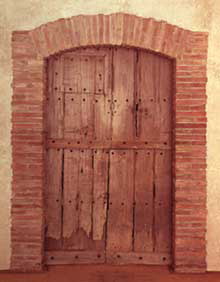
Étant donnés (dansk:det Givne) er Duchamps sidste større værk. Det er fremstillet i hemmelighed i en årrække efter 2. verdenskrig – fra 1946 til 1966 – og blev efter Duchamps død i 1968 permanent installeret på Philadelphia Museum of Art, i Philadelphia, U.S.A. Étant donnés må derfor kunne ses som Duchamps kunstneriske testamente, hans konklusion på kunsten. Værkets gamle trædør, Étant donnés umiddelbare “facade”, møder beskueren i et lille rum bagved det store lyse udstillingsrum, hvor museets øvrige Duchamp-værker er at finde. Det lille rum er en slags “blindtarm” på det store rum – det er ikke et gennemgangsrum, og indeholder ved første øjekast blot døren – bag hvilken den øvrige del af værket er installeret. Når man træder ind i det lille rum og kigger til venstre, ser man en stukkeret mur, der udstrækker sig fra gulv til loft og fra væg til væg. I centrum af denne stukvæg er en stor buet murstensdørkarm, der danner rammen om den gamle trædør. Det er tydeligt at døren ikke kan åbnes, men i midten af døren, ved øjenhøjde, er to små kighuller(1).

Værket var udgangspunkt for mit cand. phil. speciale, og denne artikel kan ses som en kort introduktion til de teser, problemer og konklusioner jeg rejser i relation til Duchamps Étant donnés. Jeg tog udgangspunkt i værkets fysiske fremtrædelsesform, og anvendte hertil de skitser af værket som den franske filosof Jean-François Lyotard har fremstillet til sin bog Les TRANS formateurs Duchamp.


Figure 2
viser et tværsnit af perspektivkassekonstruktionen
Étant donnés

Illustrationen er oprindeligt fremstillet af Lyotard, men benævnelserne på de forskellige niveauer af Étant donnés er tilføjet af denne artikels forfatter. Jeg vil her især fremhæve afsnittet om billedplanet, da mange facts tyder på at netop dette niveau af værket er meget væsentligt(2). I afsnittet om billedplanet undersøger jeg først det historiske billedplan og den særlige status, som maleriet erhverver i renæssancen. Derefter undersøger jeg billedplanets status i den moderne epoke, hvor maleriet frigør sig fra sin tidligere bundethed til historie, litteratur, rum og motiv m.v. Derefter vender jeg tilbage til det billedplan som Duchamp har nedbrudt i Étant donnés, samt til de værker der relaterer sig til denne nedbrydning.

Mit udgangspunkt for overhovedet at fokusere på Duchamps Étant donnés i første omgang, opstod oprindeligt i forbindelse med mine studier af optik og perspektiv. Derfor kan min afhandling også ses i relation til den debat der har cirkuleret omkring perspektivet og spørgsmålene om perspektivets objektivitet. I modsætning til blandt andre Norman Bryson, opskriver jeg med Duchamp det perspektiviske blik, the Gaze, og jeg de-konstruerer i relation hertil den klassiske perspektivkonstruktion.

En anden årsag til min interesse for netop dette værk udspringer af værkets negative status. Duchamp-forskerne har ofte ignoreret værket, eller ofret det mindre opmærksomhed end for eksempel the Large Glass (dansk: det Store Glas). I modsætning til mange af Duchamp forskerne – anser jeg Étant donnés for at være Duchamps mesterværk. Ja, – jeg ser værket som en af kunsthistoriens mesterværker. Det er et af de mest udfordrende kunstværker der overhovedet findes – med egne ord: “the most thrilling work of art”(3).

Værket udformer sig ikke bare som en konklusion på Duchamps livsværk. Det kan også ses som en konklusion på kunstens tilstand i det 20. århundrede – i mere generel forstand. Étant donnés er – i forhold til the Large Glass – langt nærmere på det fuldkomne anti-kunstværk. For i Étant donnés lykkes det for Duchamp at fremstille et værk der ikke er et kunstværk (a work which is not a work of “art”) – eller rettere sagt – så lykkes det der ser ud til at være Duchamps livslange projekt endelig til fuldkommenhed med dette værk. Og dette paradoksale projekt synes at gå ud på at fremstille et billede uden billedplan, eller et maleri uden lærred, hvilket er præcis det modsatte af hvad Duchamps samtidige malerkolleger er i færd med. (Duchamps samtidige malerkolleger, for eksempel Picasso, abstraherer i stigende grad deres malerier fra det traditionelle motiv. De favoriserer billedplanet eller det todimensionale lærred på bekostning af perspektiv og rum(illusion). I modsætning hertil kan man sige at Duchamp favoriserer “perspektivet” – eller det perspektiviske blik, the gaze – på bekostning af billedplanet eller lærredet.

En readymade kan i relation hertil ses som et motiv der ikke er omsat i mediet kunst. I relation til maleri kan en readymade sammenstilles med et realistisk perspektivmaleri eller et fotografi. Mange af disse readymades har da også en frontalitet, der appellerer til et fotografisk blik.(4)

Projektets begyndelsesfase kan allerede studeres i the Large Glass – hvis gennemsigtige glas-billedplan næsten er forsvundet. Den er der dog stadigvæk som grundplan for værkets nedlagte figurer eller formationer. For beskueren ser ikke blot igennem the Large Glass, men må også samtidig se på glasset. Der er derfor stadig meget af Duchamps gamle malerier i the Large Glass og billedplanet er endnu ikke fuldt ud negeret(5).


click to enlarge

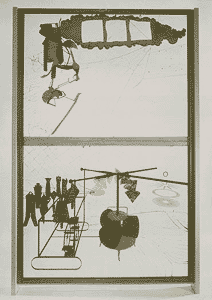
The Large Glass

Large Glass, der
blev fremstillet i årene 1915-23.
Her er det fotograferet i Katherine
Dreiers dagligstue.

Derimod er “maleriets” billedplan i bogstaveligste forstand forsvundet i Étant donnés, hvor Duchamp først bygger værkets billedplan op som en mørk mur – for derefter at nedbryde eller negere den.

Men hvorfor har Duchamp følt denne trang til at negere billedplanet? Hvad er meningen? Og er der ikke mange andre betydningsfulde “detaljer” at studere i værket? Jo, det er der naturligvis, men jeg holder på at denne “detalje”, denne nedbrydning af billedplanet – som oftest overses – idet man har set “igennem” billedplanet eller værket – faktisk er værkets vigtigste “detalje” og Duchamps hovedformål med værket.

Når jeg kalder Étant donnés for et dekonstrueret maleri, så er det en henvisning til den konstruktion, Étant donnés, ved hvis hjælp Duchamp dekonstruerer en anden konstruktion – tydeligst det traditionelle perspektivmaleri. I et sådant maleri er lagene eller niveauerne lagt ovenpå hinanden, så de “smelter” sammen til et niveau, der materialiserer sig ved hjælp af billedplanet. Når man betragter et sådant perspektivmaleri vil man på et mere illusionistisk plan opleve at billedet udvider sig bagved planet, bag “Albertis vindue”, og der blotlægger – om ikke altid et realistisk virkelighedsbillede – så dog noget der har et temmelig overbevisende realismepræg. Det abstrakte maleri kan ikke dekonstrueres på samme bogstavelige måde som perspektivmaleriet kan – idet den “rumlighed”, som det abstrakte maleri – trods sin tilstræbte fladhed – ofte postulerer, er af en mere “åndelig” eller “usynlig” art. Alligevel vil jeg påstå at det abstrakte maleri i allerhøjeste grad indgår som et “led” eller en “side” af dette dekonstruerede maleri, dette visuelle opslagsværk(6). Faktisk er det som om det netop er udviklingen af det moderne abstrakte maleri, og konsekvensen af dette maleri, der har været Duchamps udgangspunkt for Étant donnés.

Det er en kendt sag at Duchamp afskyede det “retinale” eller meget “maleriske”maleri, som for eksempel kommer til udtryk i den abstrakte ekspressionisme. Dette moderne og emanciperede maleri har frigjort sig fra alt andet end sit eget grundplan og sit eget materiale, som derved synliggøres. Men derved har det abstrakte maleri også frigjort sig fra alt det der tidligere kunne appellere til “the grey matter” – til tolkning.

Denne udvikling må Duchamp se som alt andet end “frigørende”. Og det abstrakte maleri gør sig heller ikke fri af sin største konvention – det gør sig ikke fri af sit grundplan eller af billedplanet, men accentuerer det derimod.

I Étant donnés frigør Duchamp værket fra billedplanet – men han gør det på det perspektiviske bliks betingelser. Han ærer derved det intelligente øjes potentiale – men på en måde der overskrider det gamle perspektivmaleris muligheder. I det gamle perspektivmaleri havde “perspektiv” og billedplan indgået et forlig! Perspektivbilledet var fikseret til billedplanet – på bestemte betingelser. I Étant donnés er der ikke noget der på forhånd er fikseret til lærred, træ eller væg. Det er kun beskueren der kan “fiksere” billedet (eller maleriet). Derfor giver værket ingen mening eller betydning uden denne beskuer. Billedet (eller maleriet) eksisterer kun i beskuerens sind. Og da der ikke er noget fælles eller fast billede fikseret nogen steder, kan der heller ikke være nogen fælles tolkning(7).

Étant donnés er et kompliceret og anarkistisk værk, der på mange niveauer udsender meddelelser eller indbyder til associationer. Desværre er det ikke i denne artikel muligt for mig at yde hverken værket eller mit arbejde med værket fuld retfærdighed. Jeg vil dog nævne et andet aspekt af værket der også er blevet “overset”. I Étant donnés er kunstværkets ekshibitionistiske element overdrevet – idet billedet så at sige afslører sine nøgne kønsorganer ved et overraskelsesangreb – ligesom ekshibitionisten gør. Dette kan kun ses som en kommentar til alle maleriers, eller alle kunstværkers, iboende ekshibitionisme, ogÉtant donnés kan derfor ses som et yderliggående alternativ til det selvabsorberede abstrakte maleri. Det abstrakte maleri havde vendt ryggen til beskueren og blokeret for sin traditionelle mediefunktion – og derved også fra sin egen beskuers indsigt eller tolkning.

Det er tankevækkende at værket er fremstillet i årene efter 2. verdenskrig, atomvåbenkapløbet ihukommende. Étant donnés kan ses som et “kunstens (og dermed civilisationens) vanitas maleri”. Og derved må Duchamp først og fremmest kritisere den kunstige (moderne) kunst – altså den kunst der kun har sig selv som motiv. Værket ærer det Givne eller naturen og negerer det kunstige eller menneskeskabte. Det er et selvkritisk og meget melankolsk værk. Men derved negerer det ikke beskuerens oplevelse af værket. Beskueren bliver derimod værkets (med)skaber og fortolker.

I Étant donnés har Duchamp udtrykt sig “sprogligt” ved at opstille fuldstændigt genkendelige elementer eller tegn (døren, nøgenfiguren, landskabet m.v.), der appellerer til aflæsning. Denne intellektuelle udfordring må også være et af værkets væsentligste aspekter – for Étant donnés er et kunstværk – på trods af sin modvilje overfor kunsten og det menneskeskabte. Duchamps Étant donnés foregriber den “Return of the Real”, som vi er vidne til i nutidskunsten. Ligesom Étant donnés åbner meget af nutidskunsten op for en overflod af (relativistiske) tolkninger. På mange måder kan Étant donnés ses som en “hybrid” – en sammensmeltning mellem det gamle perspektivmaleri og den nutidige installationskunst. Den nutidige installationskunst kan derfor ses som det gamle perspektivmaleris naturlige arvtager(8).


Noter

1. Beskrivelsen af mødet med døren bygger på egne iagtagelser, da jeg to gange – i juli 1998 og i februar 1999 – har besøgt museet. Jeg vil ikke i denne artikel inkludere overvejelser over den strategi der synes at være udtænkt i forbindelse med værkets placering på museet. Jeg reflekterer heller ikke her over forskellige beskuertyper og deres eventuelle forhåndskendskab til værket og heller ikke over forskellige voyeuristiske aspekter af værket.

2. Selvom Étant donnés tydeligvis har meget at gøre med perspektiv og også er blevet erkendt som en perspektivkassekonstruktion, så er der så vidt jeg ved ikke nogen der har hæftet sig ved at den mørke murstensmur fungerer som værkets billedplan. For eksempel beskriver den spanske forsker Juan Antonio Ramírez i bogenDuchamp, Love and Death, Even (1993), ikke muren som andet end “the Brick (or holed) Wall“. Reaktion Books, London, 1998.

3. Det har ikke været min primære hensigt at hylde Étant donnés på bekostning af the Large Glass… men værket trænger til en kærlig hånd, en opskrivning. I mammutværket Downcast Eyes omtaler historikeren Martin Jay den negative holdning til værket der er (eller har været) almindelig blandt Duchamp forskerne, men beskriver desuden værket på en mere positiv måde: “To its detractors the Étant donnés is little more than another of Duchamp’s hoaxes, “the ultimate bluff against art and the whole superstructure, an obscene diorama pawned off on a reputable museum because of the reputation of the “artist” and the brilliant literary apparatus lending it prestige.” To those less hostile, it represents Duchamp’s most profound exploration of the troubled confluence of vision and desire.” Citat fra Martin Jay, Downcast Eyes, The Denigration of Vision in Twentieth-century French Thought, p. 169,
University of California Press, 1994.

4. Rosalind Krauss har også bemærket readymaden og snapshot’ets parallellitet, og hun skriver: “the readymade’s parallel with the photograph is etablished by its process of production. It is about the physical transposition of an object from the continuum of reality into the fixed condition of the art-image by a moment of isolation or selection.” Krauss: The Originality of the Avantgarde and other Modernist Myths, p. 206, Cambridge Massachusett and London, 1993.

5. Den franske forsker Jean Clair har i artiklen “Duchamp and the classical perspectivists” gjort opmærksom på Duchamps interesse for de gamle perspektivtraktater. Han skriver: “An obvious fact which need to be stressed is that by substituting a plate of glass for an opaque canvas spreed on a stretcher as support, Duchamp was doing no more than applying the analysis of the classical perspectivists to the letter in making a real “parrete di vetro” (wall of glass).” Jean Clair viser tillige, hvordan Duchamps the Large Glass synes at illustrere perspektivtraktaterne, i selve designet af glasset, både i ikonografiske detaljer og i kompositionen. Citat fra Art Forum, Marts 1978, p. 40-49.

6. Når jeg kalder værket et dekonstrueret maleri og et visuelt opslagsværk, så skyldes det værkets fremtrædelsesform, der kan iagtages som leddelt eller som noget der er splittet fra hinanden. Jeg følger egentlig blot den dekonstruktion Duchamp allerede har foretaget, og derfor skal denne dekonstruktion ikke sammenstilles for nøje med Derridas filosofiske dekonstruktion. Når jeg kalder værket for et opslagsværk, skyldes det ligeledes værkets leddeling. Hvert led i værket synes at udsende en talestrøm – der i relation til udviklingen af maleriet i det 20. århundrede, kan aflæses eller tolkes på bestemte måder samtidig med at værket i bogstaveligste forstand er åbent for fortolkninger.

7. Étant donnés har da også givet anledning til diverse fantasifulde tolkninger, og nogle af disse er blevet afvist som “forkerte”. Jeg mener dog ikke at det er meningen at de skal afvises. I mit speciale har jeg studeret Duchamps interesse for stereoskopi og anamorfoser. Den tidligere nævnte franske forsker Jean Clair har beskrevet det stereoskopiske billedes særlige karakter: “Because it has no material reality it does not permit symbolic exchange.” Sammensmeltningen af det stereoskopiske billedes to moderbilleder eksisterer også kun i beskuerens sind, hvilket må have fascineret og inspireret Duchamp. Jean Clair: Opticeries, October 5, Summer 1978.

8. Sætningen “The Return of the Real” er en henvisning til Hal Fosters bog af samme navn. Foster: The Return of the Real, the Avant-Garde at the End of the Century, Cambridge, Massachusetts, 1996.

Pata or Quantum: Duchamp and the End of Determinist Physics

The early 20th Century saw a breakdown, a deconstruction if you will, of the classical Enlightenment assertion that the world is fundamentally knowable to us. In the art and philosophy of the Enlightenment era, the rational capacity of the human mind to analyze and comprehend itself and the world was trusted implicitly. In science, the classical Newtonian physical model was the dominant paradigm. This model held that given sufficient knowledge of a physical system’s initial state, its behavior could be understood and predicted completely. Everything in the world that was hidden or obscured could in theory be explained and brought to light by the proper application of human reasoning. But beginning with mathematical thinking in geometry done in the 1860s, these enlightenment ideals began to lose their hold on the world of ideas. Work done in physics, psychology and art began to reformulate a picture of reality that was less certain, and involved more risks.

The current of ideas that carried modern thought away from this determinist position was varied and complex, spanning many disciplines and years. This essay is an attempt to explore some connections and parallels between the art of Marcel Duchamp and developments in modern physics that question the existence of a rational, predictable world. As part of Duchamp’s work, he created fictional, quasi-scientific systems that he worked into his visual designs. Calling these playful systems “pataphysics,” he used the current scientific thinking of the time in a satiric way, making fun of rational, determinist systems and celebrating interesting new developments that cast doubt on traditional thinking. The most complex of these systems is described in The Bride Stripped Bare by Her Bachelors, Even, also known as the Large Glass (begun in 1912). Important insights can also be drawn from 3 Standard Stoppages (1914) and the theories inherent to the Readymades (executed between 1913 and 1917).

The scientific groundwork for some of Duchamp’s ideas in these works comes from investigations of non-Euclidean geometries, concepts of 4th dimensional space, work done on x-rays, radiation, and electro-magnetism. Later developments in science, especially the foundations of modern quantum mechanics, continue the trend of less deterministic ways of viewing reality, almost re-iterating some of Duchamp’s playful science fiction as science fact. The Heisenberg Uncertainty Principle contextualizes scientific measurement, considering the impact of the viewer on the object being viewed, and introduces an irreducible uncertainty as to the exact energy states of basic particles. Erwin Schrödinger’s set of quantum equations (which links the particle/wave behaviors of electrons, photons, and other particles) expresses their movements in terms of statistical probability fields, such that it becomes meaningless to talk of the particle as having a distinct position at any given time.

This breaking down of assumptions concerning the predictable, rational behavior of the world in Duchamp’s work and in the sciences shares traits with several movements that emerged in and around World War I. Groups like the Cubists, the Futurists and the Dadaists shared a mission of transforming perceptions of the world in order to change how people relate to the world. While it can be difficult to interpret the true intent of the (often contradictory) manifestos and performances of the Dada group, we may try to deduce some valuable structures from their story. Rebelling against the rationalist social structures responsible for the devastating war, Dadaists attempted to create new languages for artistic (or even anti-artistic) expression. The Dada project recognized the inadequacies of existing forms of expression to compass a real understanding of the changing world, and sought to destroy all rationalistic cultural norms in art. By satirizing, mimicking, and distorting the systems they attacked, the Dadaists may have sought to demonstrate the inadequacies of their targets and point the way to the possibility of better forms. In a way, the Dadas acted as a sort of social resistor, slowing down the cultural machinery of the time, helping to re-orient society in a different direction. Duchamp, who is often seen as a sort of cultural father to the Dadaists, had a large impact on this cultural resistance that has been extensively researched and discussed. But the scientific inquiry in his pataphysics and the ways it might be seen as an antecedent to current thinking in quantum physics has not been adequately explored.

The word “pataphysics” was first introduced in 1893 by playwright Alfred Jarry who was attempting to create what he called a “science of imaginary solutions.” As historian Linda Henderson explains, “Jarry was deeply interested in contemporary developments in science and geometry, which offered a means to challenge traditional positivism” (Henderson, 47). One of these developments was the mathematical description of non-Euclidean geometries.

Classical geometry, as first formulated by Euclid in Alexandria circa 300 BCE, has within it the fundamental assumption that two parallel lines will extend indefinitely and never meet. This assumption was held to be a priori fact until work done by Carl Friedrich Gauss, Georg Riemann, and others around the 1860s pointed the way toward internally consistent geometrical systems that behaved very differently from the classical model. While working in a Paris library in the early 1910s, Duchamp was exposed to the writing of French mathematician Henri Poincare, whose writings in support of the new mathematical models against the Enlightenment traditions of classical rationalism were an inspiration to him.


click to enlarge

3 Standard Stoppages

Figure 1
Marcel Duchamp,
3 Stoppages Étalon (3 Standard Stoppages)
, 1913-14, wood, glass,
threads, varnish and glass. Katherine S. Dreier Bequest, The Museum
of Modern Art, New York © 2000 Succession Marcel Duchamp, ARS, N.Y./ADAGP,
Paris

The work that most exemplifies Duchamp’s interest in non-Euclidean geometries (with its implications of non-intuitive curved spaces) is 3 Standard Stoppages of 1914. Duchamp describes the piece in a questionnaire from the Museum of Modern Art as “a joke about the meter – a humorous application of Riemann’s post Euclidean geometry which was devoid of straight lines” (Henderson, 61). As with all of Duchamp’s work, this art object functions on several different levels simultaneously.

The object itself consists of three pieces of wood cut to the pattern of a length of string which Duchamp claims to have dropped three times, so the resulting pattern is a random distortion of a straight line. Recent investigations of this crucial work also point out the nature of the French ‘stoppage’ or ‘invisible mending’ in relation to small alterations the artist made to the supposedly random shape. Most of Duchamp’s work contains an element of social parody or satire, and 3 Standard Stoppages is no exception. France at the time considered itself to be an arbiter of European High culture, and also acted as the official organ of the relatively recent metric system. By creating a new standard of measurement based on chance, Duchamp lampoons the French national pride in its standard measurement.

The Standard Stoppages also represent a major investment in the use of chance as an expressive medium (the piece is sub-titled “Canned chance, 1914”). But there is a deeper element to the proclamation Duchamp makes with the Stoppages, which becomes manifest in the Large Glass. The Stoppages stand as the foundation of the fictional physical system that Duchamp describes in the notes of the Green Box, and diagrams in the Large Glass. He decisively breaks away from the classical, rationalist physical model and determines a new fundamental unit for his new science.

Duchamp refers to Jarry’s ideas and consciously speaks about his desire to re-invent the physical model of the time when he describes the Stoppages as “casting a pataphysical doubt on the concept of the straight line as being the shortest route from one point to another” (Henderson, 62). He states in his notes that he is interested in describing “a reality which would be possible by slightly distending the laws of physics and chemistry,” (Henderson, xix) and the original Stoppages represent a fundamental unit of that distension. Rather like Planck’s constant in quantum mechanics, or the speed of light in General Relativity, the Stoppages represent a new basic metric for describing and measuring the profoundly irrational space that is described in The Bride Stripped Bare by Her Bachelors, Even. This relationship is evident in the placement of a Network of Stoppages in the Large Glass, a pataphysical device that carries the spray of the Bachelor Machine to the sieves and parasols. He places the new metric directly into the system, using his measuring device to transport the erotic energy of the Bachelors.


click to enlarge

The Bride
Stripped Bare by her Bachelors

Figure 2
Marcel Duchamp, The Bride
Stripped Bare by her Bachelors, even (The Large Glass)
, 1915-23
© 2000 Succession Marcel Duchamp ARS, N.Y./ADAGP, Paris

The Bride Stripped Bare by Her Bachelors, Even is a modern day chimera, with almost as many interpretations as it has had viewers. In some sense, though, it can be called a pataphysical system that makes a “…critique of scientific laws and determinist causality” (Henderson, 185). Duchamp incorporates many different scientific ideas of his time into the workings of the piece, and had been exploring these ideas for some time. Beginning with the Cubists and their exploration of Bergsonian ideas of simultaneity, Duchamp also worked with the evolving notions of fourth dimensional space and X-ray exploration of previously hidden realities. His ideas of the experience of time went into his Nude Descending a Staircase, No. 2 in 1912. Although he started work in this vein under the auspices of the Cubists (including his brothers, artists Jacques Villon and Raymond Duchamp-Villon) the execution of the Nude proved too radical for the Cubists, and Duchamp subsequently declared he was through with art “Movements.” From there, Duchamp explores even further his ideas of 4th dimensional space in his series of studies of the Bride figure.
The Large Glass itself contains many interlocking mechanisms whose function appears to be to transform and transport the “illuminating gas” from the Bachelor Machine to the 4th dimensional realm of the Bride, where it is stored in a reservoir as “love gasoline” which the Bride uses to create her “cinematic blossoming.” The Bride is a 4th dimensional being, at once an automobile, a wasp, a tree, a steam engine, etc., while the Bachelors consist of 9 “mallic moulds” which contain the invisible illuminating gas and function as 3-dimensional template shapes, analogous to the 2-dimensional negative’s relationship to the photographic print. Duchamp at once mimics scientific description of these mechanical systems and parodies scientific understanding, which was thrusting itself on the Western consciousness in the form of massive industrialization and mechanization. Some of the imaginative physical processes described in the Green Box (the notes that accompany the Large Glass) include the stretching of the unit of length, the oscillating density, emancipated metal, and friction re-interpreted (Henderson, 192).

In positing this system, Duchamp seems to place his science in the context of irrational desire and exploration. It is as if he took standard physical systems, and substituted erotic lust as the prime motive force instead of gravity or momentum. Duchamp functions here almost as a Freudian physicist, attacking the conventional norms of the rational, determinist conventions of the time on multiple, multivalent levels. By inserting the irrational desires of the Freudian id into the newly forming non-deterministic physical models, he disarms and “unloads” classical positivist social, physical, and psychological ideas.

While certain elements of the coming revolution in particle physics were already in evidence at the time Duchamp was working on the Large Glass, the breakthrough work establishing a scientifically sound, physical basis for indeterminacy came in 1926 when Schrödinger published his famous equations unifying the particle/wave dualism observed in the behavior of certain particles. Establishing the basis for what is now field theory, Schrödinger’s equations describe particles as discrete quanta of energy that exist as a statistical flux, or a range of possible positions or states. The implication of this model is that, under certain definable conditions, it may not be possible to predict exactly what these particles will do next. Furthermore, further quantum theories postulate that in a real sense these particles do not have precise positions during certain interactions until they crash into something that can be observed and measured.

By the time these postulates become established, classical Newtonian physics no longer seemed to apply to physics on the sub-atomic scale. In fact, it is only by a statistical summing over of these stochastic irregularities at a much larger scale that the classical Newtonian behaviors of everyday objects are explained. These formulations were highly controversial, and scientists like Einstein and even Schrödinger himself rejected them as too irrational and mysterious. This unmeasureability in particle physics has a direct antecedent in the work of Duchamp, particularly in his conception of the Bride in the Large Glass. He conceives of her as inhabiting a 4th-dimensional world above that of the Bachelors that is unmeasureable. The Bride herself is a 4th-dimensional being who cannot be measured in any conventional sense. In order to claim a common ideological ancestry of these concepts, there must be a common link that they share. To find that link, we may look to mathematician Henri Poincare, especially his outlook on scientific and mathematical descriptions of the world called conventionalism. Poincare’s attitude toward the non-Euclidean geometries discussed above was that they were just as valid constructs for solving certain kinds of problems as the more traditional Euclidean descriptions that had been perceived to be eternal and unshakably true for over two centuries. He felt that scientific theories are only conventions used by scientists to describe the patterns they see in nature. This is a sharp contrast to the realist perspective that scientific laws have a real existence that supercedes their manifestation in nature, a classical determinist formulation.

This conventionalist attitude would, perhaps, have been necessary before Schrödinger could have formulated his theories as he did. The model of a sub-atomic component as both a wave and a particle is an imagined metaphor for what the interactions might look like if we were able to perceive them directly. But no such thing that is both a wave and a particle exists in our direct experience. To formulate such a model and work under the assumption that it is an accurate and useful depiction of the actual interaction presupposes that the author understands the model as being a convenient metaphor, an initial convention, not necessarily a discovery of the true laws of nature. We see the roots of conventionalism in Duchamp’s pataphysics as well. His declaration of an intent to describe a reality formed by “slightly distending the laws of physics and chemistry” is a statement that he intends to explore a system with altered conventions. He understood the power of the imagined scientific metaphor and wished to apply it in his own artwork.

The next major piece of the indeterminacy puzzle arrived in 1927 with the publication of Heisenberg’s uncertainty principle. Heisenberg had analyzed the implications of measuring the state of a particular particle. The only way to determine anything about the position or momentum of an object is to interact with it, to shine a light on it, or hit it with something else and measure how the second object reacts. But at the scale of the sub-atomic, “shining a light on it” is the same as hitting with something; at that scale, light interacts as a particle itself (called the photon) which has a definite mass and momentum of its own. If one wants to determine the position of an electron, one must hit it with something like a photon, measure how the photon’s trajectory is altered by the collision, and deduce from the trajectory of the electron. The only catch is, there is nothing with which to hit the electron that is small enough not to perturb its initial trajectory. By the act of measuring the state of the electron, one must alter its initial trajectory. By this, Heisenberg deduced that one can never be certain of both the position and momentum of a sub-atomic particle such as the electron. In addition, because of the seemingly unpredictable implications of the particle/wave duality, the photon alters the trajectory of the electron in a statistically random way. This is quite an ontological blow to the Enlightenment doctrine that the world is inherently knowable; here we have convincing scientific evidence that there are some kinds of information which are physically impossible for us to gather.

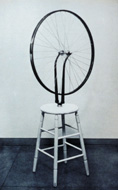
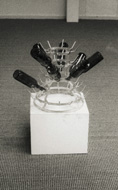
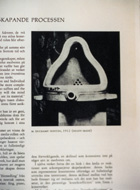
In this way, Heisenberg contextualizes the scientific act of measurement. By considering the effect of the observer on the observed system, he changes the rules of science. No longer are we simply gatherers of knowledge that has an absolute existence in the world independent of us; we are active participants in a system that changes as a result of our interactions with it. Duchamp by this time had already been engaged in a similar enterprise aimed at the contextualization of the art world. His readymade works, such as Fountain, Bottle Rack and Bicycle Wheel, force the reconsideration of the nature of the art object. By discarding the accepted context of the perceived object, the artist forces the viewer to be an active participant in an experience Duchamp insists to be art. He believed that the art experience was one created not only by the artist, but also the spectator. In a speech to the American Federation of Artists in 1957 he said,

“… The creative act is not performed by the artist alone; the spectator brings the work in contact with the external world by deciphering and interpreting its inner qualifications and thus adds his (her) contribution to the creative act.”

The forces that Duchamp explores in his work are invisible, obscured. His interest in x-rays, radio waves, and magnetism inform and give shape to his pataphysics, as they also define the trends in physical sciences discussed here. The psychoanalytic theories of Freud and Jung that were so terribly influential on European and American artists of the time emphasize the hidden aspects of the personality; the subconscious is that which cannot be known or experienced by us directly but has a substantial impact on our actions and who we believe ourselves to be. There was at the time a confluence of thought accepting the existence of hidden mysteries with the intent to explore their boundaries. Gabriel Buffet Picabia characterized the 1910s as a time of “an ebullience of invention, of exploration beyond the rational in every domain of the mind- science, psychology, imagination.… It would seem, moreover, that in every field, a principle direction of the 20th century was the attempt to capture the ‘non-perceptible'”(Henderson, XX).
It is unlikely that Duchamp’s work had any direct influence on the scientists working in the areas that I have described, but the current of thought that has been carried through in so many ways through so many different permutations has had a profound impact on how we view the world around us. The complexities of Marcel Duchamp’s thought and the rich history behind the development of indeterminate quantum physics deserve far more attention than I have been able to give them here. It would be valuable to invest more attention into the roots of the Enlightenment ideals I have referred to, and to explore the reactions of the guardians of the Enlightenment ideals to early 20th century doubts. Further investigation of Duchamp’s notion of “unloading” ideas from objects and systems that he explored in the readymades warrants further investigation, to see the effect of his unloading in scientific gestalt of the era. The chaos mathematics that has become such a powerful way to investigate patterns in seemingly random behaviors may have some very interesting parallel ideas to some of those presented here. This essay only scratches the surface of many relevant topics. But the exercise of examining the ideas from the different disciplines I’ve touched on (art, science, and psychology) seems a very productive one, and the similarities and differences in the conceptions of the world help enrich our understanding of ourselves and how we have come to believe the things we believe.


Sources

Henderson, Linda Dalrymple. Duchamp
in Context, Princeton University Press, 1998

Marcel Duchamp – Étant donnés: The Deconstructed Painting

Picasso (1881-1973) and Duchamp (1887-1968) were more or less contemporaries. Both artists lived to a ripe old age and had strong links to Paris and European modernism, and both are referred to as ‘artists of the 20th century.’ Despite this, the two developed, artistically speaking, into almost diametric opposites.

Duchamp’s name is well known and highly regarded within the inner circles of art and art institutions, although he is less known in more peripheral, art-interested circles. One of the reasons for this is probably that Duchamp’s total production is quite limited and most of his works have been donated to a single museum in Philadelphia, Pennsylvania, USA. This means that it is not possible to study some of Duchamp’s works in the original, or in reproduction, anywhere in Denmark.

Practically everyone, on the other hand, is familiar with the name of Picasso. Paintings flowed from his hand, and every modern museum with any self-respect has Picasso represented by one or several works. With great virtuosity, Picasso goes on a pilgrimage through modernism’s many ‘-isms’, or styles, keeping the human form as a constant point of departure for the majority of his paintings. Even though Picasso never completely abstracts himself from reality, his art has almost become synonymous with modern, abstract painting. Picasso abstracts himself, via diverse styles, from the motifs of reality, turning the painting itself, or the style, into the real motif.


click to enlarge

Footnote Return

Figure 1a
View of the front door for
Etant donnés:
1º la chute
d’eau / 2º le gas d’éclairage,
1946-66
© 2000 Succession Marcel
Duchamp ARS, N.Y./ADAGP, Paris

Duchamp was also originally a painter and, like Picasso, he went on a pilgrimage through diverse idioms of modernism’s many ‘-isms’ of painting. Fauvism, Cubism and Futurism are names that can be applied to Duchamp’s early paintings. Similarly to Picasso, the human form is almost always in focus, as a motif or point of departure, in his early paintings and later works. As his career advanced, Duchamp turned his back on painting. Instead of abstracting himself from the motif, as the majority of Duchamp’s fellow painters were doing, Duchamp abstracted himself from the ground plane of painting, and thus from art in its traditional sense.


click to enlarge
Footnote Return
Figure 1b
viser det indre af
Étant donnés
.
© 2000 Succession
Marcel Duchamp
ARS, N.Y./ADAGP, Paris

Étant donnés (in English: Given) is Duchamp’s last major work. It was produced in secrecy over a number of years after the Second World War, from 1946 to 1966, and, after Duchamp’s death in 1968, was permanently installed at the Philadelphia Museum of Art.Étant donnés may therefore be considered to be Duchamp’s artistic testament, his conclusion to art. The old wooden door of the work, the immediate ‘facade’ of Étant donnés, meets the onlooker in a small room behind the large, well light exhibition room, where the rest of the Duchamp works are found. The small room is a kind of ‘appendix’ to the large room. It does not lead anywhere and, at first glance, only contains the door, behind which the rest of the work is installed. When you enter the small room and look to the left, there is a stucco wall that stretches from floor to ceiling and from wall to wall. In the center of this stucco wall there is a large, arched brick doorway that forms a frame around the old wooden door. It is obvious that the door cannot be opened, but in the middle of the door, at eye-level, there are two small peepholes(1).

This article can be seen as a short introduction to the hypothesis, problems and conclusions raised in relation to Etant donnes. Specifically I begin with the work’s actual physical form, and use, in this connection, sketches of the work, that the French philosopher, Jean-Francois Lyotard, has made for his book Les TRANS formateurs Duchamp.

Footnote Return
Figure 2
Diagram, the cross-section of the peepshow
construction of
Etant donnés: 1º la chute d’eau
/ 2º le gas d’éclairage, 1946-66

The illustration was originally done by Lyotard, but the names of the various layers of Étant donnés have been added. In particular, I would like to emphasize the picture plane, as it is central to the work(2). This initial section focuses on the historical picture plane and particular status which the painting acquires during the Renaissance. I continue to investigate the status of the picture plane in the modern era, where the painting liberates itself from the former constraints of history, literature, space and motif, etc. To conclude, I return to the picture plane that Duchamp has demolished in Étant donnés and to the works that are related to this demolition.

From earlier studies of optics and perspective, I have analyzed Duchamp’s Étant donnés. This thesis can also be seen in relation to the debate that has circulated concerning perspective and questions of the objectivity of perspective. Unlike, Norman Bryson and others, I, along with Duchamp, focus on the perspective look, the Gaze, and deconstruct the classical perspective construction.

Étant donnés‘ negative status makes it intriguing piece. Duchamp researchers have often ignored the work, or devoted less attention to it than, for example, to the Large Glass. Unlike many Duchamp researchers, I consider Étant donnés to be Duchamp’s masterpiece. Indeed, I see the work as one of the masterpieces of the history of art. It is one of the most challenging works of art that exists anywhere, and in my own words: ‘the most thrilling work of art’(3).

The work not only constitutes a conclusion to Duchamp’s life’s work as an artist, but can also be seen as a conclusion to the state of art in the 20th century, in a more general sense. Compared to the Large Glass, Étant donnés is far closer to the perfect anti-work of art. For in Étant donnés, Duchamp successfully produces a work that is not a work of ‘art’, but rather, what would seem to be Duchamp’s lifelong project finally reaching perfection in this work. This paradoxical project would seem to consist of producing a picture without a picture plane, or a painting without a canvas, which is precisely the opposite of what Duchamp’s contemporary artists were busy doing. (Duchamp’s fellow painters, such as Picasso, abstract their paintings from the traditional motif. They favor the picture plane or the two-dimensional canvas at the expense of perspective and space; illusion.) One could say that, unlike them, Duchamp favors ‘perspective,’ or rather the perspective look, the Gaze, at the expense of the picture plane or the canvas.

Therefore, a readymade can be seen as a motif that has not been transformed into the medium of art. In relation to painting, a readymade can be compared to a realistic perspective painting or a photograph. Many of these ready-mades also have a frontality that appeals to photography(4).

The initial phase of the project can already be studied in the Large Glass, whose transparent glass picture plane has almost disappeared. It is nevertheless present as a ground plan for the figures or formations laid down in the work. The onlooker not only sees through the Large Glass but may also look at the glass itself. For that reason, there is still much of Duchamp’s old paintings in the Large Glass, as the picture plane has not yet been completely negated(5).


click to enlarge

Footnote Return

Figure 3
Photograph of Duchamp’s
Large Glass (1915-23)
in Katherine Dreier’s
living room.

On the other hand, the picture plane of the ‘painting’ has quite literally disappeared in Étant donnés, where Duchamp first builds up the picture plane of the work as a dark wall – only to demolish or negate it.

Why has Duchamp felt this urge to negate the picture plane? What is the point? Are there not many other significant ‘details’ to be studied in the work? Yes, of course there are, but I maintain that this ‘detail’, this demolition of the picture plane – which is normally overlooked, since the picture plane or the work has been looked ‘through’ – is in fact the work’s most important ‘detail’ and Duchamp’s main purpose with the work.

When I call Étant donnés a deconstructed painting, it is a reference to the construction, Étant donnés, with the aid of which Duchamp deconstructs another construction, most clearly traditional perspective painting. In such a painting, the layers or levels are laid on top of each other, so that they ‘melt’ into one level that materializes itself with the aid of the picture plane. When one looks at such a perspective painting, one experiences at a more illusionistic level that the picture stretches out behind the plane, behind “Alberti’s window”, and exposes – if not always a realistic picture of reality. At least something which has a fairly convincing stamp of realism. The abstract painting cannot be deconstructed in the same literal way as the perspective painting. The spatiality which the abstract painting often postulates, despite its strive for flatness, is of a more spiritual or invisible nature. I would claim, even so, that the abstract painting is very much ‘part of’ or an ‘aspect’ of this deconstructed painting, this visual work of reference(6). In fact, it is as if it is precisely the development of the modern abstract painting, and the consequence of this painting, that has been Duchamp’s starting point for Étant donnés.

It is well known that Duchamp detested the retinal or highly painterly painting, as is expressed in, for example, abstract expressionism. This modern, emancipated painting has liberated itself from everything except its own ground plan and its own material, which is thereby made visible. In doing so the abstract painting has also liberated itself from everything that could formerly appeal to “the grey matter,” in other words, to interpretation.

Duchamp must have viewed this trend as anything but liberating. The abstract painting does not free itself from its greatest convention. It does not free itself from its ground plan or of the picture plane; on the contrary, it accentuates it.

In Étant donnés, Duchamp liberates the work from the picture plane, but he does it on the terms of the perspective look. In doing so, he praises the potential of the intellectual eye, but in a way that exceeds the possibilities of earlier perspective painting. In earlier perspective painting, perspective and picture plane had arrived at a compromise! The perspective picture was fixed to the picture plane on definite conditions. In Étant donnés there is nothing that is fixed to the canvas, wood or wall. It is only the onlooker who can ‘fix’ the picture (or the painting). Therefore, the work has no sense or meaning without the onlooker. The picture (or the painting) only exists in the mind of the onlooker. Since there is no common or set image fixed anywhere, there cannot be any common interpretation (7).

Étant donnés is a complex, anarchistic work that at many levels sends out messages or invites associations. Unfortunately, it is not possible for me in this article to do complete justice to the work. I would, however, like to mention another aspect of the work that has also been ‘overlooked’. In Étant donnés, the exhibitionist element of the work of art has been exaggerated, since the picture, so to speak, exposes its own naked genitals in a surprise attack, just as the exhibitionist does. This can only be seen as a comment on the innate exhibitionism of all paintings, or all works of art. So Étant donnés can thus be seen as an extreme alternative to the self-absorbed abstract painting. The abstract painting had turned its back on the onlooker and blocked its own traditional function as a medium, and thus cut itself off from its own onlooker’s insight or interpretation.

It is thought provoking that the work was produced in the years after the Second World War, bearing the nuclear arms race in mind. Étant donnés can be seen as a ‘vanitas painting of art (and thereby civilization)’. Meaning that Duchamp must first and foremost criticize artificial (modern) art, i.e. the art that only has itself as its motif. The work praises Given, or nature, and negates the artificial, or man-made. It is a self-critical and extremely melancholy work. But that does not mean that it negates the onlooker’s experience of the work. On the contrary, the onlooker becomes the (co-) creator and interpreter of the work.

In Étant donnés, Duchamp has expressed himself ‘verbally’ by setting up completely recognizable elements or signs (the door, the naked figure, the landscape, etc.) that call out for decoding. This intellectual challenge must also be one of the work’s most important aspects, for Étant donnés is a work of art, despite its dislike of art and the man-made. Duchamp’s last work anticipates the “Return of the Real'” that we are witnessing in contemporary art. Just as Étant donnés opens up much of contemporary art to an abundance of (relativist) interpretations. In many ways, Étant donnés can be seen as a ‘hybrid’ – an amalgam of earlier perspective painting and present-day installation art. Contemporary installation art can therefore be seen as the natural heir of earlier perspective painting(8).


Notes

Footnote Return1. The description of the meeting with the door is based on personal observations, since on two occasions – in July of 1998 and February of 1999 – I visited the museum. I do not want in this article to include ideas about the strategy that would seem to have been worked out in connection with the positioning of the work at the museum. Nor do I reflect on various types of onlookers and their possible advance knowledge of the work. Additionally, I have chosen not to deal with various voyeuristic aspects of the work.

Footnote Return2. Even though Étant donnés clearly has a lot to do with perspective and has also been recognized as a peepshow construction, no one, as far as I know, has paid attention to the fact that the dark brick wall functions as the work’s picture plane. For example, the Spanish researcher Juan Antonio Ramírez in his book Duchamp, Love and Death, Even (1993), only describes the wall as ‘the Brick (or holed) Wall’. Reaktion Books, London, 1998.

Footnote Return3. It has not been my main intention to praise Étant donnés at the expense of the Large Glass… but the work is in need of some tender care, and of being upgraded. In his mammoth work Downcast Eyes, the historian Martin Jay writes about the negative attitude towards Etant donnes that is (or has been) common among Duchamp researchers; he also describes the work in a more positive light: ‘To its detractors the Étant donnés is little more than another of Duchamp’s hoaxes, “the ultimate bluff against art and the whole superstructure, an obscene diorama pawned off on a reputable museum because of the reputation of the ‘artist’ and the brilliant literary apparatus lending it prestige.” To those less hostile, it represents Duchamp’s most profound exploration of the troubled confluence of vision and desire.’ Quotation from Martin Jay, Downcast Eyes, The Denigration of Vision in Twentieth-century French Thought, p. 169, University of California Press, 1994.

Footnote Return4. Rosalind Krauss has also noticed the parallel with the readymade and the snapshot. She writes: ‘the readymade’s parallel with the photograph is established by its process of production. It is about the physical transposition of an object from the continuum of reality into the fixed condition of the art-image by a moment of isolation or selection.’ Krauss: The Originality of the Avant-garde and other Modernist Myths, p. 206, Cambridge Massachusetts and London, 1993.

Footnote Return5. The French researcher Jean Clair, in his article ‘Duchamp and the classical perspectivists’ has drawn attention to Duchamp’s interest in the old treatises on perspective. He writes: “An obvious fact which needs to be stressed is that by substituting a plate of glass for an opaque canvas spread on a stretcher as support, Duchamp was doing no more than applying the analysis of the classical perspectivists to the letter in making a real ‘parrete di vetro’ (wall of glass).” Jean Clair also shows how Duchamp’s the Large Glass seems to illustrate the treatises on perspective in the actual design of the glass – both in iconographic details and the composition. Quotation from Art Forum, March 1978, pp. 40-49.

Footnote Return6. When I call the work a deconstructed painting and a visual work of reference, this is due to the form of manifestation of the work, which can be observed as segmented, or as something which has been split apart. I am really only following the deconstruction which Duchamp has already undertaken, so this deconstruction should not be compared too closely with Derrida’s philosophical deconstruction. When I call the work a work of reference, this is also due to the segmentation of the work. Each segment of the work seems to emit a flow of speech – which in relation to the development of painting in the 20th century can be decoded or interpreted in particular ways, at the same time as the work, in the most literal sense, is open to interpretations.

Footnote Return7. Étant donnés has often given rise to various highly imaginative interpretations, and some of these have been rejected as ‘incorrect’. I do not, however, think that they should be rejected. In my thesis I have studied Duchamp’s interest in stereoscopy and anamorphosis. The previously mentioned French researcher Jean Clair has described the special nature of the stereoscopic picture: ‘Because it has no material reality it does not permit symbolic exchange.’ The amalgam of the two mother images of the stereoscopic picture also only exists in the onlooker’s mind, which must have fascinated and inspired Duchamp. Jean Clair: Opticeries, October 5, Summer 1978.

Footnote Return8. The phrase “The Return of the Real” is a reference to Hal Foster’s book of the same name. Foster: The Return of the Real, the Avant-Garde at the End of the Century, Cambridge, Massachusetts, 1996.

The Art of Looking Back and the Reward of More or Less Being Seen

The danger is in pleasing an immediate public: the immediate public
that comes around you and takes you in and accepts you and gives you success and everything. Instead of that, you should wait for fifty years or a hundred years for your true public. That is the only
public that interests me.

Marcel Duchamp

It is the REGARDEURS who make the pictures.

Marcel Duchamp


click to enlarge

The
Critic Sees

Figure 1
Jasper Johns, The
Critic Sees
, 1961

Our ability to believe our eyes is often overridden by our unquestioning confidence in the judgment of “experts”. As in Jasper John’s The Critic Sees(Fig. 1), we seem to put more trust in the words of these experts whose insights are often the reiteration of yet others’ conclusions, than in our own ability to bear down and witness what is before us. Marcel Duchamp understood the human tendency to categorize and simplify as well as rely on the filters of contemporary opinion to color observation; I believe he used this knowledge to make a powerful commentary on the state of affairs of modern thought and the direction that art was taking in his lifetime. Duchamp fought quietly against the move in twentieth century art towards the purely visual experience, the ‘retinal shudder’ as he put it, where “aesthetic delectation depends almost exclusively upon the sensitivity of the retina without any auxiliary interpretation.”(1) This auxiliary interpretation was to Duchamp the operation of the intellect in making and understanding art. Duchamp rejected the Matissean and later the related Greenbergian theoretical view that saw art in terms of expression and taste rather than concept. As a result, Duchamp sought to transform his art and its appreciation into an intellectual endeavor that would restore it’s ties “with society” by once again including “the religious, philosophical and moral content that bonded the two together.”(2)

I believe it was this multi-dimensional conceptual stance on art, investigations into the wonder of human perception and a drive to subvert the art world’s digestive cycle, rather than a Dada prankster spirit, that may in part have motivated Duchamp to design and handcraft his ready-mades and thereafter claim them to be found objects as recent discoveries suggest. The litany of contradictory statements regarding their provenance and the mysterious loss or destruction of the original ready-mades denying any close inspection stood as a challenge to his generation as it continues to be to ours to look not just through the glasses of contemporary interpretation but to have confidence in the complexity of our own mind’s eye and what it can discern. Calvin Tomkins quotes and paraphrases Duchamp from an interview he gave to promote the Société Anonyme in 1920 as follows: If Americans would simply remember their own “far famed…sense of humor when they see our pictures,” he added, and think for themselves instead of listening to the critics, “modern art will come into its own.”(3)

click images to enlarge


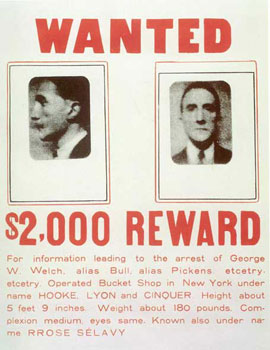
Wanted

Figure 2
Marcel Ducahmp,
Wanted: $2,000 Reward, 1922 © 2000 Succession Marcel Duchamp,
ARS, N.Y./ADAGP, Paris

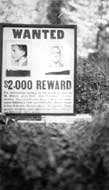
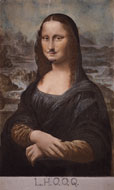
In Wanted: $2000 Reward (Fig. 2) Duchamp puts a price on this challenge and offers not only monetary compensation but seemingly a clear set of clues to any who wish to question accepted interpretations and jump beyond retinal readings of this and his other works. Today we know through the research primarily of Rhonda Roland Shearer and a growing number of others that the ready-mades and rectified ready-mades such as L.H.O.O.Q.(4) andApollinaire Enameled(5) were not purely operations of choice by the artist but in fact highly manipulated wholly original works.

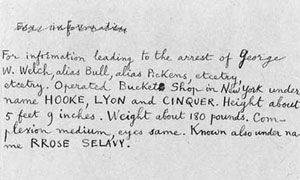
Wanted: $2000 Reward of 1923 is traditionally classified as a rectified readymade and “according to [Arturo] Schwarz this work, which is now lost, was made from a joke poster Duchamp found in a New York restaurant. He attached his own photographs within two blank rectangles and had the last line of the lower text altered by a printer so that Rrose Selavy could be included in the list of aliases.”(6) It reads as follows:

For information leading to the arrest of George
W. Welch , alias Bull, alias Pickens, etcetry,
etcetry. Operated Bucket Shop in New York under
name HOOKE, LYON, and CINQUER . Height about
5 feet 9 inches. Weight about 180 pounds. Com-
plexion medium, eyes same. Known also under na-
me RROSE SELAVY.

click images to enlarge

  • Figure 3
  • Figure 4
  • Marcel Ducahmp, Photograph of the original
    Wanted
    (1922) Poster, 1936 © 2000 Succession
    Marcel Duchamp, ARS, N.Y./ADAGP, Paris
  • Marcel Duchamp,
    Photo of the handwritten transcription
    for Wanted: $2,000 Reward, 1938
    © 2000 Succession Marcel Duchamp, ARS, N.Y./ADAGP, Paris

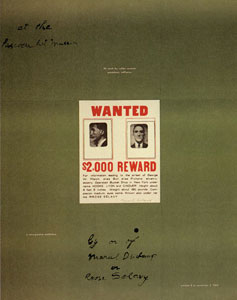
This work originally appeared sometime between 1922 and 1923 and later in 1938, when Duchamp used photos taken in 1936 of the original (Figs. 3, 4) to reconstruct it.(7) In 1963 Duchamp used Wanted: $2,000 Reward as the central image, a poster within a poster, for his first museum retrospective, by or of Marcel Duchamp or Rrose Selavy (fig.5). In the context of his retrospective, where 114 of his works were displayed,(8) we are left wondering why Duchamp sought to portray himself as a criminal. The implication being that the character pictured, Duchamp, has gotten away with something, the question is what? This analysis attempts to determine the nature of the crime as it was presented in the exhibition poster to spectators in Pasadena in 1963 and in doing so reveals that Wanted: $2,000 Reward may not be a simple rectified readymade but instead a wholly original work.

click images to enlarge


A Retrospective Exhibition

Figure 5
Marcel Duchamp, A Poster Within a Poster,
poster for “Marcel Duchamp: A Retrospective
Exhibition,” Pasadena Art Museum, October 8 – November 3, 1963 ©
2000 Succession Marcel Duchamp, ARS, N.Y./ADAGP, Paris

We know at least from Genre Allegory (George Washington) of 1943 that Duchamp is familiar with this well-known first President in American history though we cannot determine whether he was aware of him in 1923. If we assume that in the interval between his first arrival to the United States in 1915 and 1923 Duchamp learns of George Washington, we can then speculate that perhaps the middle initial “W” as in the common abbreviation GW, in the first sentence of Wanted: $2000 Reward is a stand in for Washington resulting in the proper name “George Washington Welch”. I make this leap in considering simultaneously the proceeding word “Welch” and how it interacts with the name and mythology of George Washington. If we look up welch in Merriam Webster’s Collegiate Dictionary we find that it is a variation on Welsh a word already in usage by 1905, whose second entry means to break one’s word:

Main Entry: welsh(9)
Pronunciation: ‘welsh, ‘welch
Function: intransitive verb
Etymology: probably from Welsh, adjective
Date: 1905
1 : to avoid payment — used with on welched on his debts
2 : to break one’s word : RENEGE welched on their promises
welsh·er noun


click to enlarge

 Genre Allegory

Figure 6
Marcel Duchamp, Genre
Allegory [George Washington]
, 1943 © 2000 Succession Marcel
Duchamp, ARS, N.Y./ADAGP, Paris
Self Portrait in Profile
Figure 7
Marcel Duchamp,
Self Portrait in Profile,
Zinc template, 1957 © 2000
Succession Marcel Duchamp, ARS, N.Y./ADAGP, Paris


With Hidden Noise

Figure 8
Marcel Duchamp,
With Hidden Noise
(bottom), 1916 © 2000 Succession Marcel Duchamp,
ARS, N.Y./ADAGP, Paris

Thus, the noun “welch” after the name “Washington” disappoints our expectations as we are more likely to remember Washington for his virtue since his character is often defined by the well known story of the cherry tree and the famous line “I cannot tell a lie….” The juxtaposition of the symbolism surrounding “George Washington” and the definition of “Welch” yields a construction such as virtue-purity (George Washington) reneged-broken (Welch). If we apply this notion of purity to the readymades, since after all they demonstrate that choice is the purest possible artistic expression, we begin to realize the significance of the concept “purity reneged.” This occurs only if we accept that compelling evidence today reveals that the ready-mades such as In advance of a Broken Arm (1915) or Hat Rack (1917)(10) are not the operation of pure choice but cleverly crafted to appear as if hand selected industrially produced objects. An additional interpretation of ‘George W Welch’ transposes the persona of a dishonest Washington directly to Duchamp himself (Figs.6, 7), where we can see that perhaps Duchamp wishes to portray the nature of his crime through the characterization of a virtuous or honest artist/leader that has broken his word. With either reading already we sense a theme of deception.

This theme continues in the same sentence with the use of the words alias and etcetry visually linked by repetition and their appearance in lowercase. The word alias is significant when the proper English pronunciation “el – e – as” is mildly re-stressed, resulting in the sound “a – lie- as.” The beginning “a” sound disappears completely when the two aliases are pronounced in succession, the resulting sound yields – lies, lies. The second set of repeated words in lowercase letters in this sentence is “etcetry, etcetry.” The word “etcetry” is a playful variation of et cetera spoken with a southern drawl, signifying others of the same kind, but if we look at it as a French homophone it takes on new meaning. I should note that Duchamp was deeply interested in the writings of Raymond Roussel dating back to 1912 and particularly in his word play(11) that was based on a system of slightly distorted homophones.(12) Also, we see in other works such as With Hidden Noise (Fig. 8) of 1916 that Duchamp already easily jumps between French and English. Therefore it is not a great leap to transform etcetry into “et c’est [le] tri” the final try(pronounced: tree) perfectly correlating with tri, the participle of the verb trier in French. Le Grand Robert dictionary of the French language gives a definition of this verb and dates its first appearance in the language:

TRIER v. tr. – V. 1160; p.e. bas lat. Tritarebroyer , du class.
terere, parce qu’ on broie le grain pour en separer les parties inutilisables
   

1. Choisir parmi d’autres; extraire d’un plus grand nombre, après
examen. Trier des semences une a une. Ouvrier qui trie les assiettes
sans defaut. Trier les homes propres au service
. Selectionner.- Trier
des graines sur le volet. – Au fig. Choisir en operant une selection
tres stricte. On restreint le nombre des nouveaux arrivants, on les
trie sur le volet
(13).

The translation from French to English for trier is to sort, select, pick or hand pick.(14) The resulting phrase “et c’est [le] tri” translates to the English “and it is [the] sorting” or “and it is [the] choosing”. Now, if we combine the lowercase words alias and etcetry linked by their proximity, repetition and lowercase status in the sentence we arrive at the phrase “lies and it is [the] choosing, lies and it is [the] choosing” or “lies, lies, and it is [the] choosing, and it is [the] choosing.” As in the case of George Washington Welch, the theme of deception emerges from the text in Wanted: $2000 Reward. In this example an allusion to the ready-mades, defined as objects “elevated to the status of art by the mere act of the artist’s selection,”(15) may surface as the act of selection is directly addressed by the use of trierwhile simultaneously the definition of the ready-mades as a process of selection is put to question by prefacing the act with the notion of lying. As we will see, the next example reiterates this emerging theme of false choices.

In the same sentence we find the proper names “Bull” and “Pickens” thematically connected by the use of capital letters. Other than the large male farm animal, “Bull” signifies a falsehood or a down-right lie in a colloquial sense, as in the common expression “that’s a load of bull.” The next word “Pickens” is the southern drawl equivalent of “pickings” from which one need not go far to arrive at its synonym, “choices [selections]”. When these two words are combined the result is “Bull Pickens [Pickings]” or ” false choices [selections].” In light of the previous two examples and in the context of the ready-mades this example also seems to challenge the authenticity of the ready-mades as everyday objects raised to the status of art solely through an artist’s choice.

The following sentence – “Operated Bucket Shop in New York under name HOOKE, LYON, and CINQUER” – may further the theme of deception in connection to the ready-mades. First, we should take note of Duchamp’s use of “Operated” at the beginning of this sentence since he often uses the term “operation” when referring to processes surrounding the ready-mades. An example appears in one of his notes in the The Green Box that states,” to separate the mass-produced ready-made from the ready found – the separation is anoperation.”(16) A definition for “bucket shop” from Merriam Webster’s Collegiate Dictionary a term that dates back to 1875, aids in addressing the remainder of the sentence:

Main Entry: bucket shop(17)
Function: noun
Date: 1875
1 – : a saloon in which liquor was formerly sold from or dispensed in open containers (as buckets or pitchers)
2 -a- : a gambling establishment that formerly used market fluctuations (as in securities or commodities) as a basis for gaming b- : a dishonest brokerage firm; especially : one that formerly failed to execute customers’ margin orders in expectation of making a profit from market fluctuations adverse to the customers’ interests.


click to enlarge

The Blind Man

Figure 9
Marcel Duchamp, The Blind Man, no. 1,
1917 © 2000 Succession Marcel Duchamp,
ARS, N.Y./ADAGP, Paris

The operator of a bucket shop thus capitalizes on the gullibility and blindness of individuals to see that they are being taken (Fig. 9). A successful sale requires that the customer take the bait as the expression goes, “hook, line and sinker” a homophone derived from the aliases HOOKE, LYON and CINQUER appearing at the end of the sentence. Duchamp then, may see himself in New York as the operator of a bucket shop of sorts where questionable gaming or brokering may translate literally to his not following art world rules. From the “dishonesty” of claiming the ready-mades, a product of the artist’s choice, to the eventual signing of inaccurate versions of the ready-mades Duchamp’s actions become the equivalent of selling margin orders for profit adverse to customers’ interests or when put into the art context, the audience’s expectations. By delivering an inaccurate story to his immediate audience, Duchamp drives the figurative ‘HOOKE’ deeper and with every passing generation his “crime of deception” quietly fades from view, as the surrogates he happily signs(18) become the “sign” for the lost originals. Through the proliferation of the photographic documentation of these over time he virtually replaces the few smoking gun originals that nevertheless co-exist, as those in theBox in the Valise of 1941. In 1963 around the time of the Pasadena retrospective, Teeny [Duchamp] describes Marcel Duchamp’s reaction to Richard Hamilton’s article for Art International as making Duchamp feel “transparent… as some fish are, showing their bones and everything.” (19) In it Hamilton writes:

Duchamp has busied himself for many years in the propagation of his achievements thorough the media of printed reproductions and certified copies so that now we begin to accept the substitute as the work. I certainly fell in the well-laid trap so thoroughly that I boasted of knowing what he had done without ever having seen more than a few things in the flesh…(20)

Indeed up until a few years ago, our reading of Duchamp’s oeuvre had long ago shifted from direct observation to glimpses at inaccurate versions of the ready-mades and the reiterated voices of what the critics saw and see as Jasper John’s cast sculpture reveals so eloquently. Even early on, though, there were murmurs that may have pointed at the “deception.” André Breton, founder of the surrealists and friend of Duchamp, may have made allusions to it in the publication Minotaure from 1935:

Marcel Duchamp’s journey through the artistic looking glass determines a fundamental crisis of painting and sculpture which reactionary maneuvers and stock-exchange brokerages will not be able to conceal much longer.(21)

I wonder still if Breton’s mention of reactionary maneuvers and stock-exchange brokerages is a direct reference to Duchamp’s bucket shop bait and switch strategy of signing his name to copies of lost ready-mades or simply to moves in the art world in the 1930s. In 1964 the “deception” was questioned again when Alfred Barr challenged Duchamp’s concept of indifference in selecting the ready-mades at a panel discussion at MOMA by asking “why do they look so beautiful today?” Duchamp answered,”Nobody’s perfect.”(22)

Perhaps the imperfection was always intended; perhaps the fugitive pictured in Wanted: $2,000 Reward wants to get caught, just not immediately. The remaining text in Wanted: $2,000 Reward seems more descriptive than cryptic describing a set of physical attributes following the convention of wanted type posters. Other than the well-known homophone RROSE SELAVY, Duchamp’s female alter ego first appearing in 1920, which when pronounced in French yields “Eros, c’est la vie” or in English, “Eros, [that] is life,” this final text appears barren of secondary meanings. It seems simply to function as a delay in the capture of the “criminal” by misdirecting our attention and keeping us from challenging the “official story” of Wanted: $2,000 Reward.

But does it really end there? If we continue looking for further wordplay relating to the ready-mades we could read “Height” as its equivalent in French, “Hauteur” a homonym forauteur that translates to the English author followed by the numbers 5 and 9 correlating to feet and inches. Could these instead be an approximation of the number of important ready-mades ‘about’ 14 that Duchamp ‘authored’ and wishes to be measured against? And could ‘Weight’ be a homonym for “Wait” or delay, a concept Duchamp explored from his subtitling the Large Glass of 1923 delay in glass,(23) to the various delays in the publication of his notes, to his posthumous unveiling of Etant Donnes in 1969 to our present delayed further understanding of his works? If we continue to translate measures, could we take the 180 lbs. in the context of delay and translate it to the French kilogram and end up with 81.81(repeating), Duchamp’s age at death. This number also roughly matches the number of years in delay from the unveiling of the first well known ready-made, Fountain of 1917, to our present understanding that it along with the other ready-mades were more than simply operations of choice. Indeed this particular delay brings us to a time in history when we can finally asses the true “weight” of his oeuvre, particularly when we recall that he was willing to wait fifty or a hundred years for his ideal audience. And if as they say, “time is money” can we translate the $2,000 or 2K from money to years and mark our time and ourselves as the arrival of his much ‘wanted’ ideal audience?

Many of these last observations, I realize, may be marred with conjecture but I offer them to raise the question of intentionality in reading Duchamp’s work. When is one over reading or misinterpreting the work and when are certain connections justified? When our readings turn up incredible results we are left to wonder whether it is just our imagination or if it is possible for one man to juggle simultaneously such a vast amount of multiplicity of meaning.

Whether he could, could not or did should be debated and in terms of Wanted: $2000 Reward the apparent references to lies, choices and the ready-mades should be central to the discussion. To answer the question of intentionality I believe it is important first to attempt to find a version of the original joke poster, if there ever existed one. If the search turns up an original then the argument is settled and Duchamp simply found an extremely appropriate ready-made in 1923 and modified it slightly.


click to enlarge

The Box in a Valise

Figure 10
Marcel Duchamp, Boite-en-valise
(The Box in a Valise)
, folder 9, 1941 © 2000 Succession Marcel
Duchamp, ARS, N.Y./ADAGP, Paris

On the other hand, if there is no evidence of such a poster then this analysis may aid in re-definingWanted: $2000 Reward as one amongst the growing group of highly layered handcrafted works originally classified as ready-mades, rectified ready-mades, and assisted ready-mades to name a few of Duchamp’s designations. From urinal to snow shovel present findings consistently demonstrate that Duchamp may have never settled for simple choice, though he went to great pains to make it appear so. There are many inconsistencies surrounding Wanted: $2,000 Rewardthat point to this being the case. For one, Wanted: $2,000 Reward is grouped in Duchamp’s portable museum, Box in a Valise of 1941 (Fig.10), with three other works including L.H.O.O.Q. that has now convincingly been proven by Rhonda Roland Shearer to be a deftly refinished photo composite of Duchamp’s face and the Mona Lisa’s instead of a cheap chromo reproduction of the Gioconda as the “official story” claims.(24) The other two works in the grouping, Tzanck Check (1919) and Obligation de Monte Carlo (1924), both known to be handcrafted surrogates of actual documents, classified as imitated rectified ready-mades. It seems, therefore, implausible in terms of the grouping in the Box and in the broader context of the other handmade ready-mades that Duchamp would include such a simple slightly altered found object in his oeuvre. And furthermore, it is difficult to imagine a self-described meticulous man keenly aware of his place in history and moreover the workings of posterity choosing what overtly looks like a slightly altered playful “joke” as the attraction to his most important exhibition.(25) Other incongruities remain, such as the many homophonic allusions and particularly those that jump from English to French, a trademark in Duchamp’s punning. Would a New York joke poster writer, writing for an English speaking audience in the 1920s pun in French? And finally, can the correlation with present knowledge of false ready-mades be ignored in light of the apparent repeated references to deception and selection in Wanted: $2,000 Reward as deciphered in this essay?

As the body of evidence grows and demonstrates Duchamp’s ability and wish to visually layer his works in terms of multiplicity of viewpoints and simultaneity of meaning then it follows that he may have pursued similar ends in works like Wanted: $2,000 Reward that focus on the dimension of language. Duchamp puts it best:

I like words in a poetic sense. Puns for me are like rhymes … for me, words are not merely a means of communication. You know, puns have always been considered a low form of wit, but I find them a source of stimulation both because of their actual sound and because of unexpected meanings attached to the interrelationship of disparate words. For me, this is an infinite field of joy and it’s always right at hand. Sometimes four or five different levels of meaning come through.(26)

If we take Duchamp at his word in this instance, we hear clearly that he not only can arrive at multiple meanings (up to four or five levels) but also enjoys bending language in the manner this deciphering of Wanted: $2,000 Reward proposes he may have done.

To end I want to add one last possible reference to the ready-mades and the meaning of art in general found in the title of the piece, WANTED, printed in bold red block lettering at the top of the poster. The connection comes when we think of the reason for wanted posters in the first place.


click to enlarge

 L.H.O.O.Q.

Figure 11
Marcel Duchamp, L.H.O.O.Q.,
1919 © 2000 Succession Marcel Duchamp,
ARS, N.Y./ADAGP, Paris


click to enlarge

L.H.O.O.Q. Shaved

Figure 12
Marcel Duchamp, L.H.O.O.Q.
Shaved
, 1965 © 2000 Succession
Marcel Duchamp, ARS, N.Y./ADAGP,
Paris

Wanted posters are meant to activate looking in the eventual hope of finding. As when we “L.H.O.O.Q.” [read: LOOK] closely in 1919 and find Marcel Duchamp where the Mona Lisa should be and “rasée” [read: re-see] in 1965(Figs.11,12) that he has gone again,(27)then perhaps in Wanted: $2000 Reward, Marcel Duchamp affords us another chance to find him out and in the process of re-discovery we end up claiming our reward: a way back to an active role in the appreciation of art that involves not only looking with our eyes but also with our imagination and the full capacity of our intellect or as Jasper Johns describes “through the retinal boundaries which had been established with Impressionism into a field where language, thought and vision act upon one another.”(28) And, if we accept this role, in the end we become artists in a sense as our readings – what we choose to see – become the true ready-mades found again in the wake of their disappearance.(29) After all, tout-fait (ready-made) is a homophone for tu fait (you make).(30)

A ready-made is a work of art without an artist to make it.
Marcel Duchamp, 1963

click images to enlarge


Duchamp with moustache

Marvin Lazarus, Retouched
photograph of Duchamp with moustache and goatee drawn on his face
at the 1961 “Assemblages” exhibition at the Museum of Modern Art
© 2000 Succession Marcel Duchamp, ARS, N.Y./ADAGP, Paris


Notes

Footnote Return1. Ades, Dawn; Cox, Niel; Hopkins, David. Marcel Duchamp. London: Thames and Hudson, 1999, p. 71.

Footnote Return2. Ades, p. 71.

Footnote Return3. Tomkins, Calvin. Duchamp, A Biography. New York: Henry Holt and Company, 1996, p. 226.

Footnote Return4. Follow this link to read compelling evidence in Rhonda Roland Shearer’s scientific discoveries that reveal the ready-mades are not.

Footnote Return5. Follow this hyperlink to see more evidence by Rhonda Roland Shearer that points to unexpected dimensions in Duchamp’s art.

Footnote Return6. Joselit, David. Infinite Regress, Marcel Duchamp 1910-1914. Cambridge, Mass.: MIT, 1998, p.108.

Footnote Return7. Bonk, Ecke. Marcel Duchamp, The Box in a Valise. New York: Rizzoli, 1989, p. 243.

Footnote Return8. D’Harnoncourt, Anne; McShine, Kynaston (eds.). Marcel Duchamp. Munich: Prestel, 1989, p. 28. Walter Hopps organized the exhibition held at the Pasadena Art Museum between October 8 and November 9, 1963. Duchamp designed the poster and catalog cover for the exhibition.

Footnote Return9. Merriam-Webster’s Collegiate Dictionary, 10th ed., 1999, Merriam-Webster, Incorporated. “Welch” is a variation of “welsh.” To confirm the existence and match the definition to the era, I have verified in a 1920 copy of Webster’s New International Dictionary that the definition is consistent with its use in the analysis. I have chosen to use the updated version because the tenth edition includes the sense of the word in the 1920s but also gives a more nuanced definition as well as provides the date of its first appearance in the English language.

Footnote Return10. Rhonda Roland Shearer convincingly demonstrates that both of these ready-mades are not simple found objects. In the case of In Advance of a Broken Arm, the meeting of the arm to the shovelhead is so fragile that the shovel would break at the neck if used to shovel snow. Furthermore, the shovel scoop is unsupported in the back, thus making it flimsy and unusable as a surface for shoveling. The Hat Rack is equally problematic as a real object as it appears in The Box in a Valise reproduction as an asymmetrical five hooked impossible looking construction. This differs greatly from subsequent versions (i.e. Schwarz) that offer six symmetrical hooks. Follow this link to read about these discoveries in more detail.

Footnote Return11. Follow this link to read more about Duchamp’s word play. Through a collection of excellent examples this article by Steven Jay Gould extensively explores, deciphers and catalogues many of Duchamp’s creative uses of language.

Footnote Return12. Ades, p. 109.

Footnote Return13. Le Grand Robert de la Langue Francaise, Deuxieme Edition copyright © 1985 by Dictionnaires Le Robert, Paris.

Footnote Return14. The Collins Robert French Dictionary, 1995, New York: HarperCollins, Paris: Dictionnaires Le Robert. I should point out that trier comes from the Latin tritare whose French synonym is broyer, to grind as appears in the definition of trier in Le Robert. This connection is difficult to overlook when we consider that Duchamp focuses on the grinding and milling process in three other works, his Chocolate Grinder (Broyeuse de Chocolat) of 1913, Coffee Mill (Moulin a Café) 1911 and Glider Containing a Water Mill in Neighboring Metals of 1913-15. Furthermore, both the Chocolate Grinder and the Water Mill reappear as central images in the Large Glass of 1923. The process of selection as a sorting out of useful and useless (“qu’on broie le grain pour en separer les parties inutilisables”) as well as a generating force (Water Mill) may point to a theme in the Large Glass centering on the creative process itself particularly in terms of idea generation [water mill], filtering [sieves], and whole to parts [grinder].

Footnote Return15. Naumann, Francis. Marcel Duchamp, The Art of Making Art in the Age of Mechanical Reproduction. New York: Harry N. Abrams, Inc, 1999, p. 299.

Footnote Return16. Ades, p. 155.

Footnote Return17. Merriam-Webster’s Collegiate Dictionary, 10th edition, 1999, Merriam-Webster, Incorporated. To confirm the existence and match the definition to the era, I have verified in a 1920 copy of Webster’s New International Dictionary that the definition is consistent with its use in the analysis. I have chosen to use the updated version because the tenth edition gives a fuller definition outlining the history of the expression as well as providing the date of its first appearance in the English language.

Footnote Return18. Incidentally, Duchamp signed these copies with the inscription “pour copie conforme,” re-written as a homophone in English it yields “poor copy con for me”. By “poor copy” Duchamp may be referring to the growing evidence (by Rhonda Roland Shearer) that the ready-mades are impossible objects whose construction in three dimensions is quite simply impossible since the lost originals, now only seen in photo form, appear to be composite images comprising multiple viewpoints spliced to form one coherent image. The “con for me” reference may thus point to the notion that with every new manifestation of an incorrect three dimensional version of a readymade we grow blinder to the discrepancies in the originals thus the new version serves to support Duchamp’s ruse and thus the con [is made] for him.

Footnote Return19. Naumann, p. 235.

Footnote Return20. Ibid.

Footnote Return21. André Breton from Nauman, p.161.

Footnote Return22. Tomkins, p. 427.

Footnote Return23. Joselit, p.143.

Footnote Return24. d’Harnoncourt, p. 289.

Footnote Return25. In Tomkins, p. 445, Duchamp discusses with the author in 1964 the roughly fifty year cycles that scientific ideas go through before being replaced by newer ideas that challenge everything before them. He also touches on humor as follows: I never could stand the seriousness of life, but when the serious is tinted with humor, it makes a nicer color. Duchamp further explains his position on posterity in 1952 in Bonk, p. 18, from a conversation with Suzanne Duchamp and Jean Crotti: “Artists of all times are like the gamblers of Monte Carlo, and this blind lottery allows some to succeed and ruins others. In my opinion, neither the winners nor the losers are worth worrying about. Everything happens through pure luck. Posterity is a real bitch who cheats some, reinstates others (El Greco) and reserves the right to change her mind every 50 years.”

Footnote Return26. Marcel Duchamp, quoted from: Kuenzli, Rudolf and Francis M. Naumann (eds.). Marcel Duchamp, Artist of the Century. Cambridge, Mass.: MIT, 1989, p. 6.

Footnote Return27. Follow this hyperlink to see the hide and seek Wilson-Lincoln effect illustrated. For Duchamp, the ephemeral nature as well as the relativistic aspect of perception may be central to his oeuvre, where the theme of “now you see it, now you don’t” constantly surfaces. This is consistent with the frustration of trying to grasp multiple viewpoints/meanings simultaneously in Duchamp’s work both with his puns as well as the “impossible ready-mades.”

Footnote Return28. Johns, Jasper. “Marcel Duchamp (1887-1968),” Artforum 7, no. 3. (November 1968), p. 6.

Footnote Return29. Tomkins, p. 397. Duchamp speaks of the artist’s role: the creative act is not performed by the artist alone. The spectator brings the work in contact with the external world by deciphering and interpreting its inner qualifications and thus adds his contribution to the creative act.

Footnote Return30. Special thanks to Monsieur André Gervais whose comments during the writing of this article have strengthened the final result.

Duchamp in Sweden 1933-1970: A Critical Review

This is the first chronological presentation of Marcel Duchamp´s appearance in the context of Swedish art.

This review is based on material related to Marcel Duchamp published in Sweden from 1933-1970. My sources are art magazines, literature magazines, essays, monographs, catalogues, and similar printed material in my archive: The Swedish Archive of Artists Books, Malmö, Sweden (SAAB). (See appendix.)

The reasons for this critical review are simple. First, I want to show how Duchamp was introduced in Sweden and by whom. Secondly, I aim to trace how and when his works gained public recognition, beyond the contexts of Cubism, Futurism, Dadaism, and Surrealism.

My study shows that the Swedish art world was the first to recognize this specific quality of Duchamp’s work. In Ulf Linde´s latest book Marcel Duchamp, Stockholm, 1986, page 26, he remarks: “Pontus [Hultén] was the first to interest himself in Duchamp in this country[Sweden] and, partly, he considered the exhibition [“Art in Motion,” 1961] as a tribute to Duchamp.” (1)

click images to enlarge

  • Linde, Marcel Duchamp, 1986
  • The Complete Works of Marcel Duchamp
  • 1. Ulf
    Linde, Marcel Duchamp, 1986.
  • 2. Arturo Schwarz,
    The Complete Works of Marcel Duchamp,
    revised and expanded edition,
    1997.

I have used Arturo Schwarz´s critical catalogue raisonné of 1997, The Complete Works of Marcel Duchamp, the revised and expanded edition, Thames and Hudson, 1997, as a main reference for Duchamp’s works. As far as I know, it is the latest published to date. In the following text an ‘S,’ for Schwarz, followed by the catalogue raisonné number, identifies a work by Marcel Duchamp. (2)

Notes on How Schwarz Deals with Duchamp’s Appearance in Sweden in His Index and Bibliography of 1969 and 1997.

It is obvious that Schwarz has not understood the importance of the Swedish art context in connection with Duchamp’s kinetic works and readymades.

In Schwarz´s index, pages 619-630, from 1969, the following entries refer to Swedish art figures: Ilmar Laaban, Ingemar Gustafson (Leckius) and Erik Lindgren on page 592, (seeSalamander below), while Pontus Hultén has three entries on pages 482, 496, and 600. The Moderna Museet, (Stockholm), has sixteen entries, but they all refer to the replicas of Duchamp’s readymades made by Linde and Hultén during 1960-1963. Though Ulf Linde has as many as twenty-six entries, there are no remarks about how important his involvement must have been to the general acceptance of Duchamp and his readymades.

Hultén’s three entries in Schwarz’s index, 1969, mention the replica of the “Rotary Glass Plates (Precision Optics),” 1920, S 379 a, and the replica of “Door: 11 rue Larrey, 1927,” S 426, both made in 1961. The last entry refers to the “Bicycle Wheel.” Of Ulf Linde’s twenty-six entries, ten refer to his participation in Schwarz´s book Marcel Duchamp ReadyMades,1913-1964, Milan, 1964 (3). Twelve entries refer to Linde’s readymade replicas, one to Linde’s Swedish translation of “The Green Box” in Konstrevy,1961-1963, (see entry), one to his book Marcel Duchamp, 1963, and three to his interviews.

click images to enlarge

  • Walter Hopps
  •  K. G. Hultén
  • 3. Walter Hopps, Ulf Linde, Arturo
    Schwarz, Marcel Duchamp, Readymades,
    etc. (1913-1964)
    , 1964
  • 4. K. G. Hultén (Pontus
    Hultén ed.), Rörelse i konsten,
    Bewogen Beweging,
    1961.

The three Swedish poets Ilmar Laaban, Erik Lindegren, and Ingemar Gustafson (Leckius) are in the index for their Swedish translation of SUR cen SUR and Breton’s Lighthouse of the Bride in Salamander, no. 1, 1955, (see entry).

Under Section XX, “Bibliography of Works Quoted,” 1969, only Ulf Linde’s MARiée CELibataire is noted from Schwarz´s Marcel Duchamp: Readymades, Etc., 1964.

In Schwarz’s 1997 edition, Pontus Hultén’s index is not mentioned at all, which is strange. His name does, however, appear in Section XXII, on page 910 [Under the “Bicycle Wheel”] for the catalogue “Bewogen Beweging” (“Art in Motion,” 1961, Amsterdam), which is the same note cited as no. 144, page 600, in the 1969 edition. (4)

Yet, these entries are incorrect. What Schwarz refers to might be K. G. (Pontus) Hulten’s text A Short Survey about the History of Kinetic Art During the 20th Century, published in the catalogue of “Art in Motion.” Schwarz also forgets to mention that this exhibition was curated for the Moderna Museet and that Hultén, along with Carlo Derkert, Daniel Spoerri and Billy Klüver, was a member of the exhibition committee. Pontus Hultén was actually the editor of the catalogue. It is clear that he was in fact the one who initiated “Art in Motion.” (See above quote from Linde’s book,1986). In addition, Schwarz only mentions the Amsterdam venue. The reasons for Schwarz’s oversight in this area, specifically in Hultén’s involvement, are unclear. Even Linde has no more than seven entries in the 1997 edition. These include no. 169, no. 175, and no. 195, which are all interviews with Duchamp. The other four entries refer to Linde’s translation of the “Green Box” and his participation in Arturo Schwarz´s book Marcel Duchamp: Readymades Etc., 1964.

Under Schwarz´s “Bibliography of Works Quoted,” Section XXIII, 1997, is Hultén, Karl Gunnar Pontus, The Machine, 1968, and Marcel Duchamp, Work and Life, 1993. Only Ulf Linde’s book Marcel Duchamp, 1963, and his contribution, MARiée CELibatairein in Schwarz´s Marcel Duchamp: Readymades Etc., 1964, are mentioned here.

In Schwarz´s 1997 edition, Section XXIV, Timothy Shipe’s “Bibliography 1969-95,” acts as a supplement to the descriptive bibliography for the 1969 and 1970 editions. Here, Linde’s two books of 1963 and 1986 are mentioned. Additionally, he has three entries under Section 4, within the bibliography, “Secondary Literature: Articles and Essays”. Two of them appear in the catalogue that was published for Duchamp’s retrospective exhibition at the Centre Georges Pompidou in 1977. Under Section 5 of Shipe’s bibliography, “Exhibition Catalogues,” Linde appears again, now as the editor for the catalogue published by the Moderna Museet, 1986-1987, for the exhibition “Marcel Duchamp.” Pontus Hultén is now mentioned as the editor of the catalogue published by Palazzo Grassi, Venice, 1993.

Section XXV, “Exhibition History,” of the 1997 edition, is organized in two parts. The first part documents solo exhibitions from 1937. The second part records group shows in which Duchamp participated during his lifetime. This last section is highly selective according to Timothy Shipe. The following solo exhibitions in Sweden are recorded: Marcel Duchamp,Bokkonsum, 1960, Marcel Duchamp,Galerie Burén af Eva, 1963, and Marcel Duchamp,Moderna Museet, 1986-1987. The group exhibitions are Art in Motion,” 1961, and Dada,Moderna Museet, 1966. These are all listed, but Pontus Hultén’s exhibitions “Art in Motion” and “Bewogen Beweging” are the only major references. The fact this was ignored remains somewhat perplexing.

Though Schwarz has mentioned those who were interested in Duchamp’s works in Sweden, he has excluded essential information and conclusions concerning Duchamp’s early appearance in the context of Swedish art. Thus ignoring its effect on his career since the mid-fifties in regard to his kinetic works and readymades.

Comments on Lebel’s Index

Robert Lebel’s first monograph from 1959, (5) was published five years after the exhibition at Samlaren in collaboration with Duchamp. Curiously enough, that show and the magazine,KASARK [no. 1], are not listed. In Lebel’s bibliography, under “General References,” no. 98, is the Hultén (K) & Vasarely (V) catalogue Le Mouvement, Galerie Denis René, Paris, 1955. Under “Special Studies and Documents,” no. 68, is Bo Lindwall’s article Saboteur et anti-artiste, from Konstrevy,1955 (see entry).

In Lebel’s revised edition of 1967, (6) Ulf Linde’s book, Marcel Duchamp, 1963, appears under the “Bibliography: Addenda, Part 3” no. 93. In part 5 of the “Addenda,” under no.103, is “Bokkonsum, Invitation Card,” with a foreword by K. G. Hultén, Stockholm, 1960. No.108 lists “Art in Motion,” Amsterdam, Stockholm, and Copenhagen.

Lebel writes in “Catalogue Raisonné: Addenda, Part 2,” 1967, “Until 1960, Duchamp had usually made or chosen himself the replicas and editions of his own works. In 1960, a group of his Scandinavian admirers, including K. G. Hultén, Director of the Stockholm Moderna Museet, Ulf Linde, P. O. Ultvedt and Magnus Wibom, started working together on replicas which were later approved and signed by Duchamp.” Though Lebel’s comments are correct, he, like Schwarz, does not see the crucial importance of Duchamp’s early appearance in Sweden in regard to his kinetic works and readymades.

click images to enlarge

  • Robert Lebel
  • Robert Lebel
  • 5. Robert Lebel, Marcel
    Duchamp
    , 1959.
  • 6. Robert Lebel, Marcel
    Duchamp
    , 1967.


click to enlarge
KASARK
[no. 1]
7. KASARK
[no. 1], 1954, Galerie Samlaren.

The following compilation delineates how and when Marcel Duchamp was introduced within the context of Swedish art. It was quite early, beginning in 1933. At this point, most of the early articles discuss Duchamp within the realms of Cubism, Futurism, Dadaism, and Surrealism.

Pontus Hultén was the first to acknowledge Duchamp’s crucial works of kinetic art and readymades. The first time he did so was in the inaugural issue of KASARK, 1954 (Published by Galerie Samlaren, Stockholm) (7), and continued to do so in the following three issues. These articles became a platform for Hultén’s concepts and extensive knowledge of Duchamp’s kinetic art and readymades. KASARK is one of the rarest art magazines published in Sweden, (see following entry), and can be compared with The Blind Man. (The name KASARK originates from Mark Twain´s short story The Ascension of Captain Stormfield. It is defined as a unit of weight. One kasark equals the weight of one million earths.)

Readymades at Galerie Eva af Burén, Stockholm, 1963

The exhibition, including Linde’s replicas of Duchamp’s readymades at Galerie Eva af Burén, Stockholm,1963, was the first show to ever concentrate on his readymades. Duchamp was quite enthusiastic about the proposal. He wrote back, “For the show at Mrs. Buren’s I agree thoroughly with your idea to have every Readymade shown in exact replicas, Marcel,” and thought that Schwarz should use Linde’s replicas as models for the 1964 editions of the readymades. (Ulf Linde’s Marcel Duchamp, 1986, pages 52, 57). Concerning the release of the replicas in 1964 in Milan, Schwarz borrowed Linde’s copies for the show. It was there that Duchamp signed Linde’s versions, which are now at the Moderna Museet, Stockholm.

Crucial Exhibitions in Sweden

My study attempts to shows how important the Swedish art world must have been to the overall appreciation of Duchamp’s kinetic works and readymades. When looking at the record of exhibitions related to Marcel Duchamp since the 1950s, one consistently finds the involvement of Pontus Hultén. It began in 1954 with the exhibition Objects or Artefacts Reality Fulfilled at Agnes Widlund’s Galerie Samlaren, February – March, Stockholm, 1954, and continued with “Le Mouvement,” at the Galerie Denise René, Paris, 1955, (8). The exhibitions “Marcel Duchamp,” Bokkonsum, Stockholm, 1960, (9) “Art in Motion,” Amsterdam, Stockholm, Louisiana, Denmark, 1961, and “The Machine,” the Museum of Modern Art, New York, 1968-1969 (10), followed. Some of these exhibitions are listed in Lebel’s and Schwarz’s texts, but both failed to acknowledge their importance.

In 1960 Ulf Linde published Spejare (11) that had an enormous impact on Sweden’s art world, primarily due to his presentation of Marcel Duchamp’s works. Yet even Linde forgot to mention Galerie Samlaren and KASARK in his text and made a significant mistake about the “Bottlerack” by saying “1914 [Duchamp] took a bottlerack from a cafe and exhibited it at a salon as a sculpture,” page 43. This, as I explain later, is an incorrect statement. (see entry).

click images to enlarge

  •  Le Mouvemenet,
Galerie Denise René
  • Bokkonsum, announcement card
  • 8. Le Mouvemenet,
    Galerie Denise René,
    Paris, 1955.
    .
  • 9. Bokkonsum, announcement
    card, 1960.

click images to enlarge

  • The Machine, Museum
of Modern Art
  • Ulf Linde, Spejare
  • 10. The Machine, Museum
    of Modern Art 1968-1969.
  • 11. Ulf Linde, Spejare,
    1960.

Duchamp’s Intriguing Titles

It is well known that Duchamp was very specific about his titles. Therefore, I have chosen to quote the titles from Arturo Schwarz’s latest catalogue raisonné for three reasons. First, it is the most complete list of Duchamp’s works, like Köchel’s register of Mozart’s works. Second, it is based on Schwarz’s direct collaboration with Duchamp, as was the previous catalogue raisonné of 1969, revised and updated in 1970 and 1997. Third, Schwarz has a cross-reference to Robert Lebel’s catalogue raisonné, the first Duchamp monograph published in 1959 and later revised in 1967.

Duchamp’s titles have probably been altered or misunderstood through the years. I have therefore quoted the titles as they stand in the captions of the Swedish material, and place parentheses around the titles as they appear in Schwarz´s latest catalogue raisonné.

Common Errors Made Concerning Duchamp’s Readymades

In my study, I examine some of the misunderstandings of Duchamp’s works that are commonly made by art critics and readers. For example, it is often said that his readymades have been exhibited in their original versions. This is untrue, as they have obviously been copies or replicas. He specifically confirmed new replicas of lost readymades made by Ulf Linde, Richard Hamilton and others. Additionally, there are the Schwarz editions from 1964 that celebrate the fiftieth Anniversary of the readymades’ introduction in the art world. I do not think Duchamp had any objections about that, because it coincides with his attitudes towards art and the art world. His opinion about art and artists can be examplified in his response to the question “Who is a famous artist?” to which he answered: “He’s a lucky guy.” (Interview with Ulf Linde, Stockholm, 1961.)

(For a closer look at Duchamp’s readymades refer to Hector Obalk’s essay The Unfindable Readymades in ToutFaitJournal, Vol. 1, Issue 2, 1999.)

Due to all the errors concerning the provenance of Duchamp’s works, particularly his readymades, I have listed them in an appendix. If a work exists, it is listed along with its current location. The appendix also includes Schwarz’s inclusive categories of each item.

In the appendix, I have also listed my primary sources chronologically and indicated further readings regarding people of interest.

Marcel Duchamp in Sweden 1933-1970

1933

Nya Strömningar, Fransk Surrealism, Spektrums Förlag, 1933

Marcel Duchamp first appears in a Swedish publication in Nya Strömningar, Fransk Surrealism, published by Spektrum Press in 1933. Gunnar Ekelöf, the Swedish poet, wrote the introduction and was responsible for translating this anthology of French surrealist poems. (12) (13)

click images to enlarge

  • nya strömningar,
spektrum förlag
  • surealistiskt
föremål
  • 12. nya strömningar,
    spektrum förlag, 1933.
  • 13. Marcel Duchamp, surealistiskt
    föremål, illustration in “nya strömningar 1933”.

Marcel Duchamp appears twice in this book. He is first mentioned in a note on page 47. That note refers to a critique about the film history written by Salvador Dali where he comments on René Clair’s film Entr´Acte. “Despite René Clair, it really resumes the concepts of Marcel Duchamp, Man Ray and Francis Picabia…”

Duchamp’s second appearance is in conjunction with Benjamin Péret’s poem För Att Fördriva Tiden, (While Away the Time), page 53. The poem is illustrated with one of Duchamp’s kinetic works, a very advanced choice of illustration at the time. The Swedish caption reads “Marcel Duchamp, surrealistiskt föremål” followed by the pun in French“rose selavy et moi, nous estimons les ecchymoses des esquimaux aux mots exquis.” The correct title is actually “Rotary Demisphere (Precision Optics),” 1925, Paris, S 409. The piece was exhibited in Stockholm in 1961 at “Rörelse i konsten” (“Art in Motion”). According to Schwarz, “Precision Optics” has been in the collection of the Museum of Modern Art (MoMA), New York, since 1970.

1934

BLM, Bonniers Litterära Magasin, Volume 3, no. 3, 1934

In Bonniers Litterära Magasin, 1934, (14) Gunnar Ekelöf published his article Från Dadaism till Surrealism. He introduced Marcel Duchamp, Francis Picabia, and Andre Breton on page 36, where he wrote: “A major contribution to the continuing development of the movement [Dada] became the figures who transported it to Paris. They consisted of Francis Picabia and Marcel Duchamp, both astounding word jugglers experimenting with artistic values, and a group of young writers centered around the magazine ‘Literature’ published by Andre Breton.”

Ekelöf also mentions that Duchamp and Picabia had access to the following magazines: Duchamp’s Wrong-Wrong, ( Rongwrong, 1917), S 348, The Blind Man, (The Blind Man No. 1: Independents´ Number, 1917), S 346, The Blind Man No. 2: P.B.T., 1917, S 347 and Picabia’s 291, 1915, and 391, 1920.

Ekelöf even points out that “[‘Fountain,’ (1917, S 345)] … which under the pseudonym R. Mutt was sent into the Independents Show in New York, originated from someone in the circle. Since the Fountain simply was a urinal, it was therefore rejected.”

click images to enlarge

  • BLM, no. 3
1934
  • konkretion
  • 14. BLM, no. 3
    1934. Gunnar Ekelöf, “Från dadaism till surrealism”
  • 15. konkretion,
    no. 5-6 double-issue 1936.

1936

Konkretion, no. 5-6, 1936

Two years later, Duchamp appears in Vilh. Bjerke-Petersen’s magazine Konkretion, no. 5-6, 1936, published in Copenhagen, Oslo and Stockholm. This magazine is written mainly in Danish. (15)

This is the final and special double-issue about “Surrealism in Paris”. Duchamp’s contributed an illustration for the Belgian poet, Gisèle Prassino’s text Den forfuulgte unge pige, (The Pursued Young Girl) 1935. The caption reads, “Marcel Duchamp: ‘Moustiques domestiques demistock’. Photo Man Ray.” In Schwarz, the title of the work is “Monte Carlo Bond,” Paris, 1924, S 406, and called an “Imitated Rectified Readymade.” Duchamp made less then eight of the planned 30 copies of version a. of the “Monte Carlo Bond.” Version b. of the work was done in 1938, and a version c. in 1941.

1948

Prisma, no. 1, 1948

Duchamp appears in a Swedish text twelve years later in the inaugural issue of the exclusive magazine Prisma, no. 1, 1948.(16) He is mentioned in the section called “Experimentalfältet (The Field of Experiments),” page 99, where Ebbe Neergaard writes about “French-American-German experimental film” in New York, specifically the film “Dreams That Money Can Buy.” The film consists of six parts compiled by Hans Richter and includes works by contributing artists Fernand Léger, Max Ernst, Man Ray, Alexander Calder, and Marcel Duchamp. The article is illustrated with five photographs, one of which is illustration no. 5, a detail from Duchamp’s scandalous painting, “Nude Descending a Staircase,” S 342.

This film was also shown on May 21, 1958 at the Moderna Museet’s film studio during “Apropå Eggeling, Avant-Garde-Film.” (17)

click images to enlarge

  • Prisma
  • Apropå Eggeling
  • 16. Prisma,
    no. 1 1948.
  • 17. Apropå Eggeling,
    Avantgarde Film Festival,
    catalogue, 1958.

1948

Konstrevy, no 3, 1948

In Konstrevy, no. 3, 1948, Haavard Rostrup writes about Marcel Duchamp’s brother Jacques Villon (18). Rostrup refers to Marcel in the following passage: “Jacques Villon’s name is really Gaston Duchamp and brother to the cubist sculptor Raymond Duchamp-Villon, who died in 1918, and to the painter Marcel Duchamp. First a cubist painter and later one of the founders of Dadaism, but since 1920, turned his back on art and devoted himself to chess.”

click images to enlarge

  • Konstrevy
  • Konstrevy
  • 18. Konstrevy,
    no. 3 1948.
  • 19. Konstrevy,
    no. 4-5 1950.

1950

Konstrevy, no 4-5, 1950

Konstrevy’s double issue, no. 4-5, 1950, features Gabrielle Buffet-Picabia’s article “Några minnen från den abstrakta konstens första år” (Some Memories From the First Years of Abstract Art). (19)

She writes: “In 1910 I became acquainted with the brothers Duchamps the oldest Raymond Duchamps, and the nowadays the widely appreciated, completely personal painter, Jacques Villon. [Both were] careful spectators to the fast development of painting. But the youngest, Marcel Duchamp, already showed distinctive qualifications to be as controversial as he was: one of the strangest spirits of his time and the deepest influence on abstract art. Marcel Duchamp was among the young circle that was eager to fight. With his work, consisting of a few paintings, his opinions and way of living, [he] had his own intuition and intelligence. Yet without effort and affection, [Marcel Duchamp] reached beyond the systematic destruction of the traditional standards of art, which up until now were reverentially accepted theories. Thus he appears as one of the predecessors of surrealism; but the peak of the anarchism was first achieved in 1915. When we first met Duchamp, he was sincerely engaged with an issue that was developed by Italian Futurism i.e. the possibility to express movement within the frame of static painting. One of his earliest and most well known canvases ‘Nu Descendant au Escalier’ shows an almost cinematographic decomposition of movement within the context of a skeleton. Duchamp’s acquaintance with Picabia was of great importance to both of them.”

Further on she writes: “In 1910, at rue Trouchet was an exhibition with Picasso, Duchamp and Picabia, already showing paintings with a striking boldness, but still far from the character they later achieved.”

Her article continues on about the Salon d’Independent, 1912, where she writes: “That same year there was the great exposition ‘La Section d’Or’ with works by, Duchamp, Gris, Delaunay and Picabia. Finally in January 1913 in New York there was a large audience of genuine American characters invited to a giant exhibition in order to educate them in the abstract art. I attended the opening, en elaborate, elegant affair. I remember that a man in a white tie opened the ceremonies. On a rostrum he explained: ‘Ladies and gentlemen, this exhibition that covers such an expanse of wall space, consists of so many canvases and has cost us such a considerable expense to arrange is presented before you. It is now your task to learn and to understand modern art, and that’s that.’ Without finding any understanding the new art had conquered its place in the intellectual life, but also in another field: The Speculation. Since that time it has tried and often succeeded to even involve art into its unceasing and humiliating race, similar to that of the value of stocks.”

Three works of Duchamp and Picabia illustrate the article. Included is Marcel Duchamp’s”Why Not Sneeze Rose Sélavy?” 1921, (Photo: R. Sélavy, a Semi-Readymade, New York 1921, S 391). According to Schwarz, the original is at the Philadelphia Museum of Art. A replica by Ulf Linde made in 1963, for Duchamp’s exhibition at the Galerie Eva af Burén, is now at the Moderna Museet (MMS), which was signed and dated by Duchamp in Milan in 1964.

In reference to Duchamp’s “Elevage de poussière,” Photo: Man Ray 1920, (“Bred Readymade [DustBreeding],” S 382),Schwarz writes that both Man Ray and Marcel Duchamp took this photograph. It currently belongs to the Jedermann Collection, N.A.

Marcel Duchamp’s “Nu Descendant un Escalier,” 1912, (“Nude Descending a Staircase No. 2,” S 242), now resides at the Philadelphia Museum of Art along with Duchamp’s first version, S 239.

The chief editor of Konstrevy in 1950 was Mrs. Ingrid Rydbeck-Zuhr. Choosing Duchamp’s pieces as illustrations was an advanced and visionary decision for 1950, as those works were somewhat controversial at the time.

1951

Konstperspektiv, 4, 1951

In issue no. 4, 1951, Gunnar Hellman writes an article Variationer på ett gammalt tema(Variations on an Old Theme), where he quotes Oscar Reutersvärd’s catalogue text from the exhibition “Neo-Plastic Art” at the Galerie Samlaren, Stockholm, 1951. Hellman’s article is illustrated with Duchamp’s “Nu Descendant un Escalier,” 1912, (“Nude Descending a Staircase No. 2,” S 242), with the following caption, “In 1912 the Frenchman Marcel Duchamp did this nude model, descending a staircase.” Hellman’s reason for using Duchamp’s painting as an illustration remains unclear, for according to the catalogue; it was never actually shown at the exhibition. (20)

click images to enlarge

  • Konstperspektiv
  • Konstrevy
  • 20. Konstperspektiv,
    no. 4 1951.
  • 21. Konstrevy,
    no. 2 1952.

1952

Konstrevy no 2

In Konstrevy no. 2, 1952, Gabrielle Buffet-Picabia submitted the article I dadaismens tid (In the time of Dadaism) where she discusses Duchamp’s stay in New York. (21)

“Dadaism existed before it got a name,” she writes.

Gabrielle describes her ten-year experience of the Dada-epoch and divides it into three parts. She names the first Dada-epoch in New York, Pré-Dada. The second, the real Dada-epoch, she writes, took place in Zurich while the third Dada-period was in Paris.

She continues to describe Dadaism in Germany with Max Ernst and Hans Richter in Düsseldorf, Huelsenbeck in Berlin, and with Schwitters in Cologne. The latter, the author characterizes as the complete Dadaist, from the very language he used to his specifically arranged home and lifestyle. Laconically, she states that Dada was born in 1917.

Buffet-Picabia tells the story about the conception of Dada, which many Dadaists have claimed to coin. She explains that it can be traced to a minor accident. The Larousse dictionary happened to open onto the page where the word “Dada” was listed, as Hugo Ball and Hulsenbeck were looking for a sensational name for a dance sketch. A sketch in which Emmy Hennings, Hugo Ball’s wife, would perform at Cabaret Voltaire.

She writes, “Picabia and Duchamp, the first newsmakers of the period that tore [the year] 1910 from all bonds with classicism and the four Gospels. Though they were each other’s opponents, both in reactions and methods, there was a strange competition to reach destructive and paradoxical, blasphemously and inhuman suggestions. Guillaume Apollinaire often took part in these attempts of demoralization, which were also attacks of witticism, puns, and jokes, and even replaced the formal values of beauty with personal dynamism and suggestive, inventive and individual forces. This playful search into the unknown dimensions and into the unexplored regions of being, this spirit of invention, which has never come back, it seems to me, contained all the seeds, which later became Dadaism, and even that, has since then grown on to new ramifications.”

She continues, “For his personal use Duchamp came to create a mechanical world of fantasy, consequence and logic, applied to a sentimental gearwheel deed, specifying one necessary text in order to understand the painting as ‘la Marié Mise à nu par ses Célibataires Mêmes´.” (S 404)

And further,

“In this art environment Duchamp received a popularity, which he got due to the lasting success of his first exhibited work in the United States: ‘Nu Descendant un Escalier’. Between two whiskies and two puns he demonstrates an attitude of distance from everything, even from himself; his lacking interest in human standards is not the least of reasons that he is subject to a pleasant curiosity in the admiring milieu. Soon he declares that he is going to end all artistic production and keeps his word. If he still takes part in any artistic manifestations, he does it in order to create a scandal. For example, he shows, at the New York Independents Show, one Ready-made called ‘Fountain,’ which is nothing else but a urinal. Later, not the least, sensational scandal, he puts a moustache on the Mona Lisa, symbolizing his contempt for the fetishism of art…”

“…It is during this period when Cravan, boxer, poet and, since 1912, publisher of a small avant-garde magazine ‘Maintenant,’ made his notorious lecture. Cravan was asked to give an enlightening lecture for a select party. He was drunk and insulted, in obscene terms, his audience of elegant ladies and started calmly to undress until two policemen took him away with handcuffs. He was immediately released by Arensberg’s intervention and was enthusiastically congratulated by his friends Picabia and Duchamp, who were actually responsible for the scandal.”

This article is illustrated with works by Picabia, Duchamp, Jean Arp, Sophie Tæuber Arp, and Kurt Schwitters.

Marcel Duchamp’s contribution to the article is the infamous “La Joconde.” The correct title is L.H.O.O.Q. according to S 369, and is a “Rectified Readymade” made in Paris in 1919. The original currently belongs to a private collector in Paris. In regard to this major work, Schwarz describes five replicas, one of which was made in an edition of 38 numbered copies. The first 35 are signed and three remain unnumbered.

An ambiguity remains with this work, as with so many of Duchamp’s pieces. It is unclear as to which works, particularly which readymades, were exhibited as originals.

(In my own essay in Konstmagasinet, no. 14, 1991, (22) I have listed Duchamp’s readymades that still exist in their original versions. His “Bottle Dryer [Bottlerack],” S 306, is perhaps the best example of uncertainty concerning the provenance of Duchamp’s Readymades. See index below.) Picabia’s “La Joconde” raises such as issue. He originally intended to use Duchamp’s work as a cover illustration for the magazine 391, but Duchamp’s piece did not arrive in time. Therefore Picabia resorted to making his own version without the goat’s beard, which Duchamp later corrected.


click to enlarge
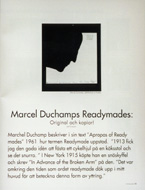
Original och kopior!
22.
Konstmagasinet
, no. 14 Nov. 1991, Leif Eriksson, “Marcel Duchamps
Readymades: Original och kopior!”

The Bottle Dryer [Bottlerack]

Inconsistencies arise when discussing Duchamp’s most famous ready-made, “Bottle Dryer [Bottlerack].” Even one of the best exegetes of Duchamp’s works, Ulf Linde, erred in his book Spejare, where he wrote: “In 1914 he fetched a Bottle Dryer [Bottlerack] from a cafe and exhibited it at a salon as a sculpture.” Considering that Linde’s book was the first penetrating analyses of Duchamp’s works in Sweden, it had an unfortunate impact, for that inaccurate description still remains. The original version has actually never been exhibited, like so many of Duchamp’s readymades.(23)

I think that Duchamp did not care if it was an “original” or a “replica” that he exhibited. His comment on various interpretations or replicas of his works was “It amuses me.” This remains congruent with his attitude towards art and the art world, against which he protested through the act of choosing the readymades.

click images to enlarge

  •  Bottlerack
  • The Selected Correspondence of Marcel Duchamp
  • 23. Leif Eriksson. Some versions
    of Bottlerack 1914-,
    1987.
  • 24. Francis M. Naumann
    & Hector Obalk, Affectt._ Marcel The Selected Correspondence
    of Marcel Duchamp
    , Thames & Hudson 2000.

The original version of “Bottle Dryer [Bottlerack]” is lost. Duchamp bought his first one at Bazaar de l’ Hotel de Ville in Paris, 1914. The disappearance of the original version is due to his sister, Suzanne, whom Duchamp had asked to clean his apartment in Paris while he was away in New York. She simply cleaned it away.

In a new book (24) Affectt Marcel, The Selected Correspondence of Marcel Duchamp by Francis M. Naumann & Hector Obalk, (Thames & Hudson, 2000), there are two letters written in January and October of 1916 to Suzanne Duchamp where Marcel introduces his concept of the ready-made. “Now, if you have been up to my place, you will have seen, in the studio, a bicycle wheel and a bottle rack. I bought this as a readymade sculpture. And I have a plan concerning this so-called bottle-rack. Listen to this: here in N. Y., I have bought various objects in the same taste and I treat them as ‘readymades’. You know enough English to understand the meaning of ‘ready-made’ that I give these objects. I sign them and I think of an inscription for them in English. I´ll give you a few examples. I have, for example, a large snow shovel on which I have inscribed at the bottom: In advance of the broken arm, French translation: En avance du bras cassé. Don’t tear your hair out of trying to understand this in the Romantic or Impressionist or Cubist sense-it has nothing to do with all that. Another ‘readymade’ is called: Emergency in favour of twice, possible French translation: Danger /Crise/ en faveur de 2 fois. This long preamble just to say: take this bottle rack for yourself. I’m making it a ‘readymade,’ remotely. You are to inscribe it at the bottom and on the inside of the bottom circle, in small letters painted with a brush in oil, silver white colour, with an inscription which I will give you herewith, and then sign it, in the same handwriting, as follows: [after, Marcel Duchamp (end of letter could very well be missing)]”

In the letter dated October 16, 1916, he returns to the same subject and asks, “Did you write the inscription on the ready-made? Do it. And send it, [the inscription], to me and let me know exactly what you did.”

Later Duchamp, in his text Apropos of Readymades, 1961, describes how the term Readymade arose. “In 1913 I got the good idea to attach a bicycle wheel to kitchen chair and saw it turn.” In New York in 1915 he bought a snow shovel and wrote on it: In advance of the Broken Arm. “It was about this time the word readymade come to my mind to describe this form of appearance.”

Duchamp bought the second version of “Bottle Dryer [Bottlerack]” for his sister in 1921. The work was signed by Duchamp: “Marcel Duchamp/Antique certifie,” S 306 a., and was reproduced in Lucy R. Lippard’s essay in the MoMA’s Duchamp catalogue in 1973. This version belonged to the collection of Robert Lebel, and is currently in the collection of his son, Jean-Jacques Lebel, in Paris.

Duchamp produced his third version of “Bottle Dryer [Bottlerack]” in 1936. It was exhibited the same year at Charles Ratton’s gallery in Paris, May, 1936. This third copy belonged to Man Ray, but there is no record of its current location. Yet it appears in the photograph showing the interior of Ratton’s gallery, reproduced in the catalogue “Dada and Surrealism Reviewed,” London, 1978. Robert Rauschenberg bought a “Bottle Dryer [Bottlerack]” in which Duchamp signed the following, “Impossible de me rappler la phase original/Marcel Duchamp/1960.” This third version was exhibited at the Pasadena Art Museum, 1963, in Duchamp’s first retrospective exhibition.

In 1961, Duchamp selected a “Bottle Dryer [Bottlerack]” for his wife Alexina Duchamp, (She was deceased in 1995), with the inscription, “Marcel Duchamp 1914,” (Replique, 1961).

In 1963, Ulf Linde made a “Bottle Dryer [Bottlerack],” now at the Moderna Museet. This version was exhibited at the Schwarz Gallery, coinciding with the release of the edition of replicas made by the gallery in Milan, 1964, in order to celebrate the 50th Anniversary of Duchamp’s first Readymade. Schwarz released an edition of eight signed copies. Two copies outside the edition were reserved for the artist and Schwarz and are inscribed, “ex Rrose and ex Arturo.Another two copies were produced for exhibition purposes and contain the following inscription, “Ex. h.c. pour exposition, 1964” and “Ex I/II donated to Israel Museum, Jerusalem, on the occasion of a Duchamp retrospective, 1972,” S 306.

There are also other versions, specifically one, which Daniel Spoerri lent to Bokkonsum’s exhibition in 1960. This version is not mentioned in Schwarz, perhaps because Duchamp never signed it. One of the most recent “Bottlerack” I have seen was shown in the exhibition “A House is Not a Home” at Rooseum in Malmö, October 18 – December 14, 1997.

When I asked the museum director, Bo Nilsson, where he had found the “Bottle Dryer [Bottlerack],” he told me that he and the former director, Lars Nittve, had some serious problems finding a copy. “You could have called me,” I answered, sensing a distinct note of irritation.

My own copy of the “Bottle Dryer [Bottlerack]” was purchased by my friend Torsten Ridell in the late 1970’s at Bazaar de l’ Hotel de Ville. My version is a meta piece, a re-made, which brings it back to its original purpose, i.e. to dry wine bottles.

In 1997, I ordered a new bottlerack made of plastic by my friend Jean Luc Guinnement in Paris, but he misunderstood my request and sent me a green painted metal copy also purchased at Bazaar de l’ Hotel de Ville in Paris. Following this mistaken delivery, Angelica Juhlner in Fox Amphoux, succeeded in finding the plastic variant in Bajoule, Provence. This copy has a bright yellow bottom plate and a blue rack, which can be dislocated into smaller parts. This version is included in my own project “Pole Room,” 1977, where all the items allude to the fact that blue and yellow become green when mixed. This plastic version has an amusing connection to the description of what Elvis Presley was wearing when he was found dead in his bathroom: “He died in his pajamas, blue top and yellow bottom.”

Duchamp’s “Bottle Dryer [Bottlerack]” shows indeed that “Ars longa vita brevis…” to use a common incomplete quotation.

Duchamp’s “Bottle Dryer [Bottlerack]” was exhibited at MoMA’s Fantastic Art, Dada, Surrealism,” 1936-37. This is not entirely the case, for that “Bottle Dryer [Bottlerack]” was actually Man Ray’s photograph of a “Bottle Dryer [Bottlerack],” probably the copy, which was exhibited by Charles Ratton in May, 1936. The MoMA’s catalogue pictures a reproduction, in which the “Bottle Dryer [Bottlerack]” stands on a corner of a table. That catalogue does contain the proper origin, but that information is lost in later catalogues and books. (25)
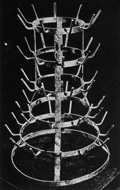
Ready-made
25. Duchamp:
“Ready-made,”
1914. Photo Man Ray.

KASARK is a seven-page magazine, (26), published by Galerie Samlaren in February, 1954. Galerie Samlaren was one of the most important galleries in Stockholm from 1943 to 1977. During the 1950s, Pontus Hulten and Oscar Reutersvard and Hans Nordenstrom were the curators and editors of Kasark. On page 6, K. G. H. (Pontus Hultén) wrote an article with the headline “READY-MADE.” This is the first time someone in Sweden attempts to explain what Duchamp’s readymades represent. The following two works by Marcel Duchamp are reproduced in this issue of KASARK. (sic)

Marcel Duchamp: “Ögat i Biljardbollen,” 1935, Rotorelief för grammofon. Bilden roterar med lägsta hastighet och betraktas med ett öga, (The eye in the billiard ball, 1935. Rotorelief for gramophone. The image will rotate at the slowest speed and looked at with one eye), “Rotoreliefs (Optical Disks),” 1935, S 441. First edition, 500 sets, each set with 6 cardboard disks printed on both sides. About 300 sets were lost during World War II.

Marcel Duchamp: “Flasktorkare, Ready made,” 1914. (Bottle Dryer [Bottlerack]), Ready-made, 1914, S 306.

click images to enlarge

  • KASARK [no 1 1954]
  • Catalogue Galerie
Samlaren
  • 26. KASARK [no 1 1954]. K. G. H.
    (Pontus Hultén) READY-MADE.
  • 27. Catalogue Galerie
    Samlaren, Stockholm 1954.

1954

Konstrevy, no. 3

On page 131, Ulf Linde reviews the exhibition “Object or Artefacts Reality Fulfilled” at the Galerie Samlaren in Stockholm, 1954 (27). He mentions Dada and makes a specific comment on a piece bought at EPA, a one price store company in Sweden, similar to Bazaar de l’ Hotel de Ville in Paris, that sold a variety of inexpensive goods. His comment refers to a piece no. 33 in the exhibition catalogue by V. Enhult, (an anagram and pseudonym for Pontus Hultén, an organizer of the exhibition), with the title “Object with unknown application, ready-made found at One Price Store EPA in Stockholm, 1952.” Linde writes,“The title must be understood as an attempt to release the object from all trivial relations to flour bags in order to make it an aesthetic object of ‘exclusive uselessness.'” He does not write anything about Duchamp.

1954

Odyssé, no. 2 -3

In this issue there is a note about Picabia, mentioning that Duchamp published Dadaist publications 291 and 391.

1954

Odyssé, no. 4

Dag Wedholm published Odyssé. The other editors included Ilmar Laaban, Öyvind Fahlström, Gösta Kriland, Pär Wistrand, and V. Lundström. (28) (29)

click images to enlarge

  • Odyssé no.
4
  • Odyssé no.
4
  • 28. Odyssé no.
    4, 1954, cover
  • 29. Odyssé no.
    4, 1954, “Marcel Duchamp”.

Gösta Kriland, artist, and Ilmar Laaban, poet, have translated fourteen of Marcel Duchamp’s notes. There is also a biographical note about Duchamp, which points out that he is one of the leading Dadaists, who published a number of magazines together with Picabia and others. “[He has used the pseudonym] L.H.O.O.Q. – Elle a chaud au cul. Book: Rrose Sélavy. Film: Anemic Cinema. After 1920 [Duchamp] only temporarily devoted himself to art – but more to chess.” (L.H.O.O.Q., S 369.)

1954

Gåsblandaren, hösten, 1954

Students at the Royal Institute of Technology in Stockholm have published Gåsblandaren and Vårblandaren (Goose Blender and Spring Blender) since 1863. Among the editors during 1951-1955 was Hans Nordenström, one of Pontus Hultén’s closest friends, who participated in many of Hulten’s early projects in the 1950s and 1960s. On the front cover is a collage of Gåsblandaren, autumn, 1954, where you can find one of Duchamp’s Rotoreliefs, S 441. (See item no. 2 in “Das gedruckte Museum von Hulten,” 1996.) (30)(31)

click images to enlarge

  • Gåsblandaren,
autumn
  • Lutz Jahre,
Das gedruckte Museum von Pontus Hultén, 1996
  • 30. Gåsblandaren,
    autumn 1954.
  • 31. Lutz Jahre,
    Das gedruckte Museum von Pontus Hultén,
    1996.

1955

Vårblandaren, våren, 1955

Vårblandaren was a box containing lose material referring to art in a Dadaist fashion. It is said that George Machunias, the Fluxus leader, later used this box-issue as a model for his own different kits. (32)

1955

Konstrevy, no. 1

In this issue, the inside of the front cover contains an advertisement published by the Galerie Samlaren, Stockholm, with the following caption, “marcel du champ, new york/hultén/.”The reason for Duchamp’s rare appearance in such an advertisement is somewhat mysterious. It can be some kind of tribute to the artist due to Hultén’s interest and appreciation of Duchamp’s work. At the time, Hultén was working for the Galerie Samlaren while editing KASARK, in which he repeatedly wrote about Duchamp. (33)

click images to enlarge

  • Boulevardkartongen,
Tvångsblandaren in a box
  • Konstrevy no.
1 1955
  • Salamander no.
1, no. 2, no. 3
  • 32. Boulevardkartongen,
    Tvångsblandaren in a box, spring mcmlv (1955).
  • 33. Konstrevy no.
    1 1955.
  • 34. Salamander no.
    1, no. 2, no. 3 1955.

1955

Salamander no. 1

C. O. Hultén opened his Galerie Colibri, Malmö in January 1955 and the first issue ofSalamander was published that same year. Only three issues were published during the period of 1955-1956 (34). In the first issue is a translated fragment of André Breton’s text“Phare de la Mariée,” (Bruden som fyrbåk [Lighthouse of the Bride]), first published inMinotaur, no. 6, 1935. Ilmar Laaban and Ingemar Gustafsson (Leckius), both poets, did the translation. Three of Duchamp’s works appear in this issue.

Illustrations:

“Bruden som avklädd av sina ungkarlar, t.o.m. Glasmålning.” (“The Bride Stripped Bare by Her Bachelors, Even [The Large Glass]”), S 404.

“Övergång mellan jungfru och brud,” Olja 1912. (“The Passage from Virgin to Bride”) 1912, S 252.

“Nio hanliga gjutformar, detalj ur glasmålningen,” (“Nine Malic Moulds, detail from the Large Glass.”)

There must be something wrong with the title of the later piece. If it actually is a detail from “The Large Glass,” a part of the water mill would be visible, but it is not, even though “Nine Malic Moulds” is a part of the bachelors region of the larger work. According to Schwarz, Duchamp made four versions of “Nine Malic Moulds.” The original version, done in 1914-15, S 328, was cracked in 1915. The second was made in 1934, and its present location is unknown, S 328 a. In 1938 Duchamp made a miniature reproduction of the work for “The Box in a Valise,” S 328 b. The third version was produced in 1963, S 328 c.Salamander was published in 1955 and shows a cracked “Nine Malic Moulds.” Therefore, this must be the original version that has belonged to Alexina Duchamp since 1956. In the catalogue from the Pasadena retrospective exhibition in 1963, there is a reproduction of the second version dated as 1963, with little similarity to the second version of the piece from 1934 in Schwarz, 1997.

You can also find Marcel Duchamp’s “SURcenSUR” originally published in L’ usage de la Parole, Paris, 1, no. 1, December, 1939, translated by Erik Lindgren, the poet, and Ilmar Laaban. This text is illustrated with Duchamp’s “Témoins Oculistes (Oculist Witnesses),” 1920, New York. S 383. It is now at the Philadelphia Museum of Art (PMA).

Additionally, Ingemar Gustafsson (Leckius) has written a short biographical note about Duchamp.

This is the first time Duchamp’s major work “The Large Glass” was reproduced in Sweden. It is the original, which was later cracked during transportation from the Brooklyn Museum of Art in 1927. Now it too resides at the PMA, at Kathrine S. Dreier’s bequest.

There are several different versions of Duchamp’s “The Large Glass.” Among them is Ulf Linde’s version signed “pour copie conforme/ Marcel Duchamp/Stockholm 1961.” This version was exhibited in the Pasadena Art Museum, 1963.

The copy at the Tate Gallery, London was made by Richard Hamilton and signed “Richard Hamilton/pour copie conforme/Marcel Duchamp/1965.” A third copy can be found at the Art Museum of the College of Arts and Sciences, University of Tokyo, made in 1980.

A fourth replica was made in 1991-1992 by Ulf Linde, Henrik Samuelsson and John Stenborg and has been authorized by Alexina Duchamp.

1955

Konstrevy 3

In this issue, the art critic Bo Lindwall has published his article Marcel Duchamp-saboteur och anti-konstnär (Marcel Duchamp-saboteur and anti-artist). (35)

click images to enlarge
Konstrevy
no. 3
35. Konstrevy
no. 3 1955.

He writes the following: “His intellect is as sharp as a razor analyzing every given possibility to pieces. He started to detest all styles which he completely controlled, he found that even the most radical cubists yield to disgusting aestheticism, already towards a petrified academism. His creativity was paralyzed. The paralysis could not be stopped as long as he dreamt about renewing the art when he succeeded to convince himself that serious artistic activity was meaningless, then the paralysis disappeared. A coffee mill became his rescue in the first difficult crisis. 32 years ago he put down his brush for good. He is still alive.”

The coffee mill Lindwall refers to is “Coffee Mill” which Duchamp painted for his brother Raymond Duchamp-Villon’s kitchen, S 237. Since 1981, it has been at the Tate Gallery, London.

This piece is an important reference for Ulf Linde’s actual geometrical analysis of Duchamp’s last major work “Etant Donnés: 1 la chute d’eau/2 le gaz d’èclairage,” 1946-66, S 634. The piece is currently at the PMA. (But the latest news about this project is that Linde has left it unfinished.)

Illustrations:

Marcel Duchamp: “Porträtt av konstnärens fader,” 1910. (“Portrait of the Artist’s Father,” 1910), S 191, currently at the PMA.

“Sonaten (Konstnärens mor och tre systrar),” 1911, (“Sonata,” 1911), S 229, at the PMA, as well.

“Fresh Widow,” 1920, S 376, resides in the MoMA. There are two other versions of this piece; Ulf Linde’s of 1961, which is at the MMS, and Schwarz´s anniversary edition from 1964.

“Modeller till schackpjäser,” 1922. (“Chess Pieces,” 1918-19), S 377 is now at the MoMA.

“Ungkarlarna,” 1914, (“Cemetery of Uniforms and Liveries No. 2,” 1914), S 305, is currently at the Yale University Art Gallery.

“Monte Carlo,” 1924, (“Monte Carlo Bond,” 1924), S 406 (See above entry).

“Ready-made,” 1914 (“Bottle Dryer [Bottlerack],” 1914), S 306 (See above entry).

“3 Stoppages Étalon,” 1913, (“3 Standard Stoppages,” 1913-14), S 282. The original is at the MoMA while the replica made by Ulf Linde in 1963 is at the MMS. A replica from 1963 is at the Norton Simon Museum in Pasadena.

“Förvandlingen från jungfru till brud,” (“The Passage from Virgin to Bride,” 1912), S 252, is currently at the MoMA.

(The titles in Schwarz latest catalogue raisonné and the Swedish captions do not always correspond.)

In the same issue, page 127, Konstrevy presents Denis René’s exhibition “Le Mouvement.” Pontus Hultén curated that exhibition together with Robert Breer and Jean Tinguely. A few of Duchamp’s mechanical works were represented, “… in some cases they have, as Duchamp used, clockworks or electricity to operate machinery.” The curators point out thatSamlaren’s exhibition in 1954,(see previous entry), was a forerunner to Denis René’s exhibition.

1955

Salamander, no. 2

In Salamander, no. 2 there is an article about Robert Matta written by James Thrall Soby where he suggests Duchamp’s influence on Matta. Soby refers to the Surrealist exhibition “First Papers of Surrealism” in New York, 1942. The author implies that Matta has been influenced by Duchamp’s Sixteen Miles of Strings, S 488, which ran back and forth in the exhibition. He continues, “The effect on his [Matta’s] paintings is more likely that Duchamp’s influence had a great impact.”

Sydsvenska Dagbladet (SDS), Tuesday, June
14, 1955

click to enlarge
Sydsvenska
Dagbladet
36. Sydsvenska
Dagbladet,
Tuesday, June 14 1955.

In this daily newspaper, Duchamp made an indirect appearance in Sweden in a print advertisement (36). Sellers & Co., an advertising agency, used this work to reach a new clientelle. They used the “Mona Lisa” with the headline “att satta mustascher pa MONA LISA” (to put a moustache on MONA LISA) and in a footnote, refer to Marcel Duchamp.‘”Why not be original?’ the Dadaist Marcel Duchamp thought in the 20’s and put a moustache on the Mona Lisa! Both Duchamp’s fantastic trick and Dadaism had a short lifetime like a dragonfly. How many, for example, today know anything about monsieur Marcel Duchamp’s herostratic creation of art?”

1955

KASARK no. 2. okt, 1955.

In this issue, K. G. Hultén (Pontus Hultén) presents “Art in Motion-Kinetic Art.” I think Hultén is the first one to write and point out this field of art. On the cover, printed in bold and light red capital letters is the following headline: “Om den ställföreträdande friheten eller om rörelse i konsten och Tinguelys metamekanik av Karl G. Hultén” (“The Substituted Freedom or About Art in Motion and Tinguely’s Metamechanic” by Karl G. Hultén). (37)

click images to enlarge
KASARK
no. 2
37. KASARK
no. 2, autumn 1955.

Hultén was one of the curators of “Le Mouvement” at Galerie Denise René in Paris, 1955 (See previous entry). Since then, Hultén has dealt with art in motion extensively.

(The best, concise information about his writings on this matter is in Das Gedruckte Museum von Pontus Hulten, 1996. There you can read about the exhibitions “Le Mouvement” Paris, 1955, “Marcel Duchamp, Bokkonsum,” Stockholm 1960, Rörelse i konsten (Art in Motion),” 1961, “The Machine,” MoMA, 1968, “Marcel Duchamp,” Centre George Pompidou, 1977, and “Marcel Duchamp,” Palazzo Grassi, 1992-3.)

In this issue he makes an early attempt to introduce the importance of kinetic art, where Duchamp has played a major roll. On pages 7-13, Hultén presents Duchamp’s moving and mechanical works and as well as his defining role in the field.

Hultén’s article is illustrated with the following images:

A photo of Duchamp’s studio in New York, where his “first readymade” is seen, a replica of “The Bicycle Wheel,” S 278, and, on the floor, “Trébuchet,” S 350.

“The Large Glass,” S 404, the cracked version in Katherine S. Dreier’s home.

Photos of the “Rotary Glass Plates (Precision Optics),” one in motion and one still, S 379, currently at the Yale University Art Gallery. In the article, the work is called “Rotary Glass Piaques,” which must be a printing error. It should be “Rotary Glass Plaques,” Duchamp’s first motor-driven object from 1920.

A photo of “Rotary Demisphere,” 1925, S 409. The work is currently at the MoMA.

Photos of three of Duchamp’s “Rotoreliefs,” 1935, S 441.

1956

AVANTGARDE-FILM, by Peter Weiss, Stockholm, 1956.

In his book, pages 21-40, Peter Weiss has a chapter about the avant-garde films in the 1920s. Included are Marcel Duchamp´s “Anemic Cinéma,” 1927, and his roll in René Clair´s “Entr’ acte,” 1924, in the famous chess party scene with Man Ray on a Paris rooftop. The text is illustrated with that scene and stills from Duchamp’s own film. (37 b)

click images to enlarge
Avangardefilm,
1956
37b. Avangardefilm,
1956

1956

Konstspegeln no. 3-4

This is a small and local art magazine published in the south of Sweden. In no. 3-4 Max Walter Svanberg writes about The Magic Art. He mentions the Dadaist, Duchamp. The article is illustrated with “The King and Queen Traversed by Nudes at High Speed” S 246 a, which is now at the PMA. In a special caption Svanberg makes the following remark,“Duchamp, is one of the most important and innovative artists according to the new direction of art, which in this article is called “the non geometrical abstractions.” (38)

click images to enlarge

  • Konstspegeln no.
3-4
  • KASARK no.
3 Maj
  • 38. Konstspegeln no.
    3-4 1956.
  • 39. KASARK no.
    3 Maj (1958).

1958

KASARK no. 3. Maj 58.

In this issue, K.G.H. (Pontus Hultén) writes about collage or fantastic realities. On page 8, he points out that Duchamp used chance to create “3 Stoppages Étalon,” S 282. It is now at the MoMA. (39)

1959

Konstrevy no. 3

In his review “Utställningar i Stockholm, Mars – April” (Exhibitions in Stockholm March-April) Eugen Wretholm, mentions that Öyvind Fahlström uses chance similarly to Duchamp. This is probably the first time Duchamp’s influence on other artists is mentioned in Sweden. (40)

click images to enlarge

  • Konstrevy
no. 3
  • KASARK no.
4
  • 40. Konstrevy
    no. 3 1959
  • 41. KASARK no.
    4 april 1960.

1960

KASARK no. 4. April, 1960.

This issue was published about the exhibition “Edition MAT” (Daniel Spoerri) at Bokkonsum in Stockholm, April 1960. (41)

Even in this issue, K.G.H. (Pontus Hultén) writes about Duchamp. The headline reads: “A Work of Art has No Price,” and continues to quote Duchamp, “Modern art looks for its Gutenberg.” Duchamp is presented as a, “Painter, poet, chess player, and a forerunner within Dadaism, Surrealism and kinetic art. In 1936, Duchamp exhibited his Rotoreliefs at the inventor’s exposition in Paris. Born in Blainville, France.” (See entry).

1960

Konstrevy no. 3

Eugen Wretholm writes about the exhibition at Bokkonsum, which he calls “Dadaistica.” He mentions Marcel Duchamp and reproduces his Rotoreliefs placed on the pavement in front of the gallery together with other items from Edition MAT.

1960

Bokkonsum

Saturday May 7, 1960, Bokkonsum opened an exhibition with some replicas of Marcel Duchamp’s readymades made by Per Olof Ultvedt and Ulf Linde (38). In Das gedruckte Museum von Hulten, 1996, page 83, the circumstances of this exhibition are described. Linde describes the event quite differently in his book Marcel Duchamp, 1986.

Page 10 of Marcel Duchamp contains a reproduction of the announcement card from Bokkonsum’s exhibit and other photographs taken on the occasion (42). In one, of the shop-window, there is a large copy of Eliot Elisofon’s photo from Life Magazine, April, 1952, of “Duchamp descending a staircase,” a paraphrase of his painting “Nude Descending a Staircase.” The same photograph was later used as the cover of the revised edition of Robert Lebel’s monograph Marcel Duchamp, published by Paragraphic Books, Grossman Publishers, New York, 1967. In that edition, Lebel extended his catalogue raisonné with little information about Duchamp’s appearances in Sweden.

The book also depicts Ulf Linde’s version of the “Bicycle Wheel,” 1960, S 278 c, now at the MMS. “Fresh Widow,” S 376, was made by a carpenter on Linde’s request and was later acknowledged and signed by Duchamp “pour copie conforme Marcel.” This version is now in the collection of the MMS. In his book from 1986, Linde calls it a readymade, but according to Schwarz, it is not. You can also see the “Chocolate Grinder, No. 2,” 1914, S 291. Additionally, there is a small version of “The Large Glass,” which Linde says, “happily disappeared.”

In the Bokkonsum’s show was also “Bottle Rack” which Daniel Spoerri had purchased at Bazaar l’ Hotel de Ville in Paris, and lent to the show. This copy is not mentioned in Schwarz.

click images to enlarge

  • In and
outside Bokkonsum
  • Paletten no.
3
  • 42. Ulf Linde. “Marcel
    Duchamp” 1986 p. 10, In and
    outside Bokkonsum 1960
  • 43. Paletten no.
    3 1960.

1960

Paletten, no. 3

On page 91, they publish Marcel Duchamp’s The Creative Act, translated by Folke Edwards, the chief editor. This lecture was given by Duchamp at the Convention of the American Federation of Arts in Houston, April, 1957. On page 99 of the same issue, there is additional information about Duchamp as a contributor to this issue. (43)

1960

Spejare by Ulf Linde

Linde’s book Spejare (Searcher) (See 11) was one of the catalysts of the great artistic debate in Sweden later named “Är allting konst?” (Is everything art?). Perhaps it was one of Linde’s statements that awoke the most anger among artists and members of The Royal Academy of Arts, for Linde stressed Duchamp’s opinion that it is the viewer who creates the work. Duchamp’s opinion was already released in 1957 in his lecture The Creative Act.

Rabbe Enckell, chairman of the Royal Academy of Arts, actually started Sweden’s notorious art debate. He delivered a speech entitled, “Ikaros och lindansare, ett försvar för klassisismen, (Ikaros and Ropewalkers, a Defence for the Classicism)” to the academy on May 30, 1962. Thereby dissociating himself and the academy from the tendencies that he felt threatening to the order of art. This huge debate was later published in book called Är allting konst? (Is everything art?),Stockholm, 1963, with Duchamp’s “Bottle Dryer [Bottlerack],” on the cover.

It was not only Linde’s book that caused this violent turbulence in the Swedish art world. There were other art events, which in the beginning of the 1960s contributed to the debate. A specific catalyst was the purchase of Brancusi’s “Le Nouveaux-né,” 1961 from Rolf de Marée by the Moderna Museet in Stockholm, for the total of a 161,000 Swedish crowns. In 1961, this was considered an exorbitant amount for a modern artwork, and many thought that it was an excessive waste of museum funds.

Art in Motion and Four Americans

In 1961 K.G. Hultén, Carlo Derkert, Daniel Spoerri, and Billy Klüver opened one of the most important exhibition at the Moderna Museet called “Art in Motion,” from May 17th to September 3rd. Realizing that the exhibition would be a shock to the Swedish art public, it was first shown at the Stedelijk Museum in Amsterdam from March 10th to April 17th. It was also shown at Louisiana, Humblebaeck, Denmark from September 22nd until October 22nd, 1961. (See Moderna Museet Stockholm 1958-1983, page 36, (See 4))

I can personally remember what a debacle it was when the Moderna Museet presented “4 Americans” in March of 1962. Robert Rauschenberg’s works created a scandal especially his “Monogram,” a longhaired goat with a painted face and a tire around his stomach. “The Bed,” a painted bed with cushion, sheets and a quilt hanging on the wall, raised the question if it could even be considered art.

It was during these two exhibitions that Linde’s concept of the viewer’s role gained its breakthrough, aided by the controversial publicity the shows had received. The issues were related. It was not odd that the conservative public and art critiques and artists were terrified, for, in a way, they had become obsolete.

1961

Konstrevy, no. 1

Öyvind Fahlström writes a review about Ulf Linde’s Spejare, 1961.

“The central point in ‘Spejare’ is the analyses of Marcel Duchamp’s large painting, [The Large Glass], which for the first time here is given the proper importance [compared with the confusion in connection with Duchamp’s exhibition at Konstsalongen, (Bokkonsum), Vallingatan.] ‘Spejare’ is the most stimulating and beautifully written book in Swedish which I have read.”

1961

Rörelse i konsten, Moderna Museet, Stockholm 17 May -3 September, 1961, catalogue

This exhibition is one of the most important shows organized in the twentieth century (see 4). The committee consisted of K.G. Hultén, (Pontus Hultén), Carlo Derkert, and Daniel Spoerri and from the U.S.A., Billy Klüver. Pontus Hultén was editor of the catalogue in which he writes in the introduction,

“Contemporary art is often pessimistic, defeatist and passive; completely natural, one can say. But there is also an another kind of art. That is what this exhibition wants to show [dynamic, constructive, full of joy, confusing, ironical, humorous, aggressive]. It is probably even typical for our time.

“The 19th century exhibitions were visited by the same curious and interested masses of spectators that are currently visiting the motor shows. But will they, in the end, find what they are looking for? Apollinaire wrote in 1913, according to Marcel Duchamp, that only an art which is liberated from aesthetic concerns and which deals with energy as a pictorial material, can hope to ‘re-unite the Art and the People.’

“The camera is the machine to take a picture with, and is available to everyone. But there are other art machines, perhaps more independent, which also talk to us and tell us who we are. They appear in many forms and materials, sometimes they look like scientific research or camouflage themselves as toys.

“Kinetic art has, during the twentieth century, been developing in many different ways, at least equal in varying forms to static art. To use the physical movement as an instrument of expression gives it a freedom, which art has been trying to attain for a long time…

K.G. Hultén”

In the catalogue, there is a short dictionary about the artists working with kinetic art. The biographical note about Marcel Duchamp, mentions his first two readymades, “Pharmacy,” S 283 and “Flaskstället” (“Bottle Dryer ([Bottlerack],” 1914, S 306). (Refer to the below entry about Duchamp’s works in the exhibition.)

The catalogue quotes Duchamp, “I did not stop painting in order to play chess. That is a myth. It is always like that. Because someone begins to paint it does not mean that he must continue with that. He is not even forced to stop. He just does not do it any more, in the same way that you do not make omelets any longer, if you prefer meat. I do not think that it is necessary to classify people and, above all, treat painting as a profession. I do not understand why people try to do painters of civil servants and civil servants of the ministry of the fine arts. There are those who get medals, and those, who paint.”

There is also a short review about the history of kinetic art in the 20th century by K.G. Hultén. He begins with futurists artists, continues with Marcel Duchamp’s “Coffee Mill,” 1911, and ends the Duchamp presentation with his “Rotoreliefs” made in 1936.

Nine of Duchamp’s important kinetic works were shown at “Art in Motion” in addition to “Boite-en-valise” which was represented at the show. Therefore one can say that all of Duchamp’s major works were present. For in fact, “Boite-en-Valise” represents a retrospective exhibition in a small suitcase. That was the first time Duchamp’s works were presented to a larger public in Sweden, perhaps for the first time in the world, without being related to Cubism, Futurism, Dadaism, and Surrealism. If this was actually his major breakthrough in the context of Swedish art, is yet to be decided. Though he did become absolutely accepted by the institutional art world at that time, his standing today is another question.

Works by Duchamp in the exhibition:

“Cykelhjulet,” 1913, reconstruction, (“Bicycle Wheel”), S 278c.

“Chokladkvarn, No. 2,” 1914 (“Chocolate Grinder No. 2”), S 291.

“Naken går nedför en trappa, No. 3,” 1916 (“Nude Descending a Staircase, No. 3”), S 343.

“Bruden avklädd t.o.m. av sina ungkarlar,” 1915-23, reconstruction, 1961 (“The Bride Stripped Bare by Her Bachelors, Even [The Large Glass]”), S 404.

“Rotary Glass Plaques (Optique de Precision),” 1920, reconstruction, 1960 (“Rotary Glass Plates [Precision Optics]”), S 379.

“Demisphère Rotative (Optique de Precision),” 1925 (“Rotary Demisphere [Precision Optics]”), S 409.

“Skivor med ordspråk,” 1926 (“Anemic Cinema: Disks Inscribed with Puns”), S 415-23.

“Dörren i 11, rue Larrey,” Paris, 1927, reconstruction, 1960 (“Door: 11, rue Larrey”), S 426.

“12 Rotoreliefer,” 1935 (“Rotoreliefs [Optical Disks]”), S 441.

“Boite-en-Valise,” (From or by Marcel Duchamp or Rrose Sélavy [“The Box in Valise”], 1935-41), S 484.

For the exhibition “Rörelse i konsten” (“Art in Motion”) in Amsterdam and Stockholm, Pontus Hultén, Per Olof Ultvedt and Magnus Wibom made a replica of “Rotary Glass Plates (Precision Optics),” S 379. Hultén and Daniel Spoerri made a replica of “Door: 11 rue Larrey,” S 426. It was destroyed after the exhibitions. (See 4)

1961

Konstrevy, no. 3

On page 99, is an article about “Art in Movement” at the Moderna Museet, illustrated with a photo of Duchamp visiting Iris Clert’s gallery in Paris.

In Eugen Wretholm’s review “Utställningar i Stockholm” (Exhibitions in Stockholm), page 112, Duchamp’s “Fountain” and “Bottle Dryer [Bottlerack]” are mentioned. You can also find Umbro Apolloninos’ article “The Inner Movement” where he refers to Duchamp and uses “Nude Descending a Staircase” as an illustration.

1961

Konstrevy no. 4

Eugen Wretholm writes about “Art in Motion” once again, where he mentions Duchamp’s “Nu Descendant un Escalier.” He remarks that the exhibition originated in Paris as “Le Mouvement” at Denis René by K.G. Hultén and refers to his text about “Art in Motion” inKASARK 3, October, 1955.

1961

Konstrevy, no. 5-6

Ulf Linde writes the essay Framför och bakom glaset (In front of and behind the glass) pages 162-165 (44). This is an important article about Duchamp’s “The Large Glass”. It is illustrated with six photographs taken of the assembling of Linde’s first reconstruction of “The Large Glass” together with Duchamp. The essay is a partial interview with Duchamp.

The other illustrations are:

Marcel Duchamp photographed as a woman by Man Ray. The correct title as listed in Schwarz’s text is “Marcel Duchamp as Belle Halleine,” photo Man Ray, 1921, S 385.

“Chocolate Grinder no. 2.” S 291.

“The Bride Stripped Bare by Her Bachelors, Even,” S 404, 1915-1923. Currently, it is at the PMA.

Page out of “Boite Verte, The Green Box.” A box containing 93 notes, drawings, photographs, and/or facsimiles by Duchamp housed in a green-flocked cardboard box, 1934, S 435.

On pages 224-227, Öyvind Fahlström writes about “The Art of Assemblage” at the Museum of Modern Art, New York, and he mentions Duchamp’s last painting “Tu m´,” S 354. The work is currently at the Yale University Art Gallery. His article is illustrated with the version of “Bottle Dryer [Bottlerack]” on a table, photographed by Man Ray and sent in by Duchamp to the Museum of Modern Art exhibition, 1936-37.

click images to enlarge

  • Konstrevy no. 5-6
  • Paletten no.
1
  • 44.
    Konstrevy no. 5-6 1961.
  • 45. Paletten no.
    1 1961

1961

Paletten, no. 1

Paletten no. 1, 1961, published an article Marcel Duchamp: Anti-Artist by Harriet and Sidney Janis and translated by Folke Edwards, chief editor. (45)

This article is richly illustrated with major works from Duchamp’s production.

“Bride,” 1912, S 253.

“Coffee Mill,” 1911, S 237.

“Rotoreliefs,” 1935, S 441.

“Bicycle Wheel,” 1916, (1913), S 278.

“Marcel Duchamp,” portrait by Man Ray, 1920, or “Marcel Duchamp as Belle Haleine,” S 385.

“L.H.Q.O.Q.” 1919. The correct title is “L.H.O.O.Q., 1919, Paris,” S 369.

“Bachelors,” 1914. Properly titled “Nine Malic Moulds,” S 328. It is hard to see which version it is because the editor has only reproduced a part of the original. It seems to be the original version that Duchamp had made in 1914.

“The King and Queen Traversed by Nudes at High Speed,” 1912, S 246.

“Nude Descending a Staircase, No. 2,” 1912, S 242.

“Bottle Dryer [Bottlerack],” 1914, S 306. This photograph is another version taken by Man Ray in 1936. It has both a shadow and a white reflection below its base. The photograph appears to have been retouched.

“Trois Stoppages Étalon (3 Standard Stoppages),” 1913-14, S 282.

“La Mariée mise a nu ses clélibataires, meme,” 1914-1923, S 404. The cracked version in Katherine S. Dreier’s home.

“Fresh Widow,” 1920, S 376.

“Tu m´,” 1918, S 354.

“Roterande glasplattor (Precisionsoptik),” 1920. The correct title is “Rotating Glass Plates

(Precision Optics),” S 379.

“Chocolate Grinder No.1,” 1913, S 264.

1961

Paletten, no. 2

In this issue Elisabet Hermodsson, artist and poet, refers to Linde’s book Spejare. Her contribution is titled “Critics as a Benefit Moralist” and she quotes Linde: “By itself nothing is art. First you have to call it art, see it as a work of art.”

Linde replies in the same issue in his discussion of Duchamp’s readymade “Why not sneeze”. He writes, “You have to do something with the art work, that it could ‘be’ art.”Hermodsson’s reaction was typical among the conservative artists in Sweden who were afraid of losing their territory within the art world.

The editor, Folke Edwards comments on the exhibition “Art in Motion.” He notes that many of the pioneers of kinetic art participated in the exhibition and considers Duchamp a representative for Futurism, Constructivism, and Dadaism.

1961

Rondo no. 3

Öyvind Fahlström comments on Duchamp’s “SurcenSur” and notes that “Duchamp has, as usual, done it before,” page 27. (46)

click images to enlarge
Rondo
no. 3
46. Rondo
no. 3 1961.

1961

Paletten no. 3

Torsten Andersson, the painter, contributes the article One Price Store Culture or Artistic Dictatorship. He writes “In the shadow of Duchamps… I don’t stop any man in the world by presenting a ‘Bottle Dryer [Bottlerack]’ or let the public fire a pistol.”

1962

Konstrevy no. 1

In this issue, Linde begins to present his translation of Duchamp’s notes on “The Large Glass”, S 404. The notes 1-11 are published and are illustrated with sketches from the “Green Box.” S 435. (47)

click images to enlarge
Konstrevy
no. 1
47. Konstrevy
no. 1, 1962. In this issue, Ulf Linde begins his translation of
notes from “The Green Box”

1962

Konstrevy, no. 2

In this issue Linde continues his translation of Duchamp’s notes about “The Large Glass”, notes 12-33. It, too, is illustrated with sketches from the “Green Box.”

1962

Konstrevy no. 3

In this issue Linde continues his translation of Duchamp’s notes about “The Large Glass”, notes 34-39. It is illustrated with sketches from the “Green Box.”

1962

Konstrevy, no. 4

In this issue Linde continues his translation of Duchamp’s notes about “The Large Glass”, notes 40-48. It is illustrated with sketches from the “Green Box” and a photo of “Nine Malic Moulds”.

Under the review “Exhibitions in Paris”, is a note about an exhibition at Galerie L’Oeil where they showed the art magazine Minotaur. Included in the works mentioned, are Marcel Duchamp’s “The Green Box” and “Rotoreliefs.”

1962

Konstrevy, no. 5-6

In this issue Linde ends his translation of Duchamp’s notes about “The Large Glass”, notes 49-78, which he produced in collaboration with Malou Höjer. It is illustrated with sketches from the “Green Box.” This contains 93 notes on “The Large Glass.” In Art Review No. 1, 1963, he publishes his comments on the subject. (See entry below.) (48)

click images to enlarge
Konstrevy
no. 5-6
48. Konstrevy
no. 5-6 1962. In this issue, Ulf Linde ends his translation
of “The Green Box”.

1962

Paletten, no. 4

C. G. Bjurström writes “Artworks and Things” where he discusses Linde’s interpretation of Duchamp’s “Bottle Dryer [Bottlerack].”

1963

Konstrevy no. 1

Here you find Ulf Linde’s essay Kommentar till Marcel Duchamps Bruden avklädd av sina ungkarlar, t.o.m. (Comment to Marcel Duchamp’s The Bride Stripped Bare by Her Bachelors, Even). It is illustrated with drawings from the “Green Box” and photographs of Marcel Duchamp taken by Lütfi Özkök in Stockholm, 1961. (49)

1963

Konstrevy, no. 2

This issue contains a full size advertisement of Marcel Duchamp’s exhibition at the Galerie Eva af Burén April – May, 1963. Illustrated by a photograph of Duchamp’s “Female Fig Leaf,” S 536. (50)

click images to enlarge

  • 49. Konstrevy no.
    1, 1963, Comments on Marcel Duchamp´s ”
    The Bride Stripped Bare
    by Her Bachelors, Even.”
  • 50. Konstrevy no.
    2, 1963, Female Fig Leaf. Advertisement
    for Galerie Eva af Burén.
  • 51. Anthology: Är allting
    konst?,
    1963.

1963

Är allting konst?

A collection of contributions to the debate Is everything art? published by Tribunserien, Bonniers, 1963. (See above.) Ulf Linde’s reply to Torsten Bergmark’s criticism is perhaps the sharpest and clearest I have ever read. (51)

1963

Galerie Eva af Burén – Marcel Duchamp

Ulf Linde released his book Marcel Duchamp, (52) in connection with Duchamp’s exhibition at Galerie Eva af Burén, Stockholm, 1963, of replicas of his ready-mades. Linde begins his text with an odd request, “I must ask the reader not to read the text – it is secondary. It is the captions, which are primary. I must ask you to read them first.”

This is the first book published in Sweden concerning the complexity of Duchamp’s works. One receives a glimpse of Duchamp’s aesthetics and anti-aesthetics views that he has used since distancing himself from retinal art.

In Linde’s 1987 book, he explains how his first book, Marcel Duchamp, 1963, finally came to be published. Initially, Linde’s text was written by request from Marcel Duchamp, forMetro, a very exclusive magazine in Milan, which had offered Duchamp 32 pages in issue no. 9. Duchamp, who had read Linde’s text in Spejare, asked the author if he could take care of the text for Metro by using the content from Spejare, adding only a few corrections and perhaps a new text. Duchamp wanted Linde to emphasize his ready-mades and use a few of his own writings of which Linde could make his own choice. Ulf Linde’s text was never published in Metro, but he began to plan its publication.

The issue of finances was solved when Duchamp offered his “Self-Portrait in Profile” in a special edition of 25 copies (53). It sold well and covered a part of the printing costs, S 557 b. An unnumbered edition was also published in regard to the Galeria Eva af Burén exhibition.

The show actually began when Linde visited Galerie Burén. During the call, he began discussing ways to display Duchamp’s “Boite en Valise.” Eva af Burén had purchased the work and wanted to exhibit it at her gallery. She wanted to consult the possibilities with Linde. “After a while we had planned an exhibition, which should contain replicas of almost every readymade by Duchamp. Only two were available in Stockholm – Bicycle Wheel and Fresh Widow, both signed by him when he was here [1961] – but one could ask Duchamp to manufacture the rest. – We wrote to Duchamp and received an immediate reply.” (See above.)

In total, there were nine replicas made for the show. They are now in the collection of the Moderna Museet, Stockholm, as a gift from the Friends of the Moderna Museet.

Replicas made for the exhibition at Burén:

“3 Stoppages Étalon” by Ulf Linde, 1963. Signed 1964 in Milan. S 282 a.

“Bottle Rack” by Ulf Linde, 1963. S 306 e, not signed.

“Le Peigne” by Ulf Linde, 1963. Signed in Milan, 1964, S 339 a.

“A bruit secret by Ulf Linde, 1963. Signed in Milan, 1964, S 340 a.

“Air de Paris” by Ulf Linde, 1963. Signed in Pasadena, 1963. Signature lost at Louisiana, Humlebæck, 1975. S 375 c.

“Fountaine” by Ulf Linde, 1963. Signed in Milan, 1964. S 345 c.

“…pliant de voyage…” by Ulf Linde, 1963. Signed in Pasadena, 1963. S 341 a.

“Why not sneeze?” by Ulf Linde, 1963. Signed in Milan, 1964. S 391 a.

“In Advance of the Broken Arm” by Ulf Linde, 1963. S 332 b.

Replicas Made for Bokkonsum:

“Bicycle Wheel” by P. O. Ultvedt and Ulf Linde, 1960 for Bokkonsum, signed in 1961. S 278 c.

“Fresh Widow” by P. O. Ultvedt and Ulf Linde, 1960, for Bokkonsum, signed in 1961. S 376 a.

“La mariée mise à nu par ses célibataires, même” by Ulf Linde 1961. Signed in Stockholm, 1961 for “Art in Motion.” S 404 a.

Other works by Duchamp at Moderna Museet

“Cœur volant.” S 446 c.

“Rotorelief.” S 441.

“Rotary Glass Plaques” replica by P. O. Ultvedt, M. Wibom and (K. G. Hultén). S 379 a.

“Objet Dard,” 1951. S 542.

(Source: Katalogen Moderna Museet, 1976.)

“Pharmacie” replica by Marcel Duchamp, 1963. Gift of Ulf Linde, 1977. S 283.

(Source: Supplement, catalogue, Moderna Museet, 1983.)

“Marcel Duchamp” by Ulf Linde, edition de luxe published by Eva af Burén, 1963. S 557.

“Bouche-évier, Cadaqués,” 1964. S 608.

“Étant donnés le gaz d’clairage et la chute d’eau.” Esquisse, is a gift from Thomas Fisher. S 526.

“Étant donnés le gaz d’clairage et la chute d’eau.” Gift from Thomas Fisher. S 531.

“La machine célibataire,” model made by Håkan Rehnberg, 1984. It is not in Schwarz.

“Le surréalisme même.” S 548.

Statens Konstmuseer, Stockholm

“Boite en valise,” Statens Konstmuseer. S 435.

“A l’infinitif,” Statens Konstmuseer. S 637.

“Prière de toucher,” Statens Konstmuseer. S 521-523.

(Source: Catalogue Marcel Duchamp, Moderna Museet, Stockholm, 1986-1987)

1963

Paletten, no. 3

Arne Törnqvist reviews Ulf Linde’s book Marcel Duchamp (52) on pages 123 and 125, in “Reflexer”, where Törnqvist writes about the Moderna Museet’s purchase of Linde’s Duchamp replicas. (sic)

click images to enlarge

52.Ulf Linde, Marcel Duchamp, 1963.

1964

Konstrevy, no. 4

Marcel Duchamp’s “Virgin, No. 1,” 1912, S 250, drawing, illustrates Karin Bergqvist-Lindegren’s review about Dokumenta III. (Later she became director of the Moderna Museet.)

1964

Paletten, no. 4

This contains an advertisement for the special edition of 25 copies of Ulf Linde’s bookMarcel Duchamp, published by Galerie Eva af Burén. Duchamp’s “Self-portrait in Profile”, S 557 b, is featured in the advertisement. (53)

1965

Moderna Museet besöker Landskrona Konsthall

K.G. Hultén (Pontus Hultén) wrote the introduction for the catalogue.

Exhibited works:

“Bicycle Wheel,” 1913, S 278 c.

“Bottle Dryer (Bottlerack),” 1914, S 306 e.

“Peigne, (Comb),” 1916, S 339 a.

“A bruit secret, (With Hidden Noise),” 1916, S 340 a.

“Fontaine, (Fountain),” 1917, S 345 c.

“…pliant de voyage…(Traveler’s Folding Item [Underwood],” 1917, S 342 a.

“Fresh Widow,” 1920, S 376 a.

“Why Not sneeze, (Why Not Sneeze Rose Sélavy?),” 1921, S 391 a.

“Rotorelief,” 1930, “(Rotoreliefs [Optical Disks]),” 1935, S 441.

“Boite en valise,” 1942, (From or by Marcel Duchamp or Rrose Sélavy [The Box in Valise], 1935-41), S 484.

“Objet Dard” 1951, (“Objet-Dard [Dart Object,” 1951]), S 542.

“Feuille de Vigne,” 1951, (“Feuille de Vigne Femelle [Female Fig Leaf, 1950]”), S 536.

1965

Fyra artiklar av Ulf Linde

After these four articles had been published in the daily newspaper, Dagens Nyheter, spring, 1965, Linde retired as their art critic. The articles were later published in a book with the same title by BLM biblioteket, Bonniers, Stockholm, 1965. (54)

He had had enough. All four articles were the result of the great Swedish art debate, which started in 1962. In the fourth article he writes about Duchamp’s attitude towards his readymade “Fountain”. Linde quotes the artist, “Whether Mr Mutt did the fountain with his own hands or not has no relevance. He CHOSE it. He took well-known utility goods and presented it so that its common idea disappeared. A new title and a new point of view made it possible; he created a new concept for the item in question.” (See The Blind Man, P.B.T. no. 2 May, 1917. This editorial has often been attributed to Duchamp himself, but according to Schwarz, 1997, Section XXII, no. 10, page 898 “Duchamp explains that this editorial was ‘rather written by the editorial board.'”)

(Refer to Hector Obalk’s article “The Unfindable Readymades” ToutFaitJournal Vol. 1 Issue 2, 1999, and Beatrice wood’s autobiography I Shock Myself, 1992 [1985], pp. 26-36.)

click images to enlarge

  • 53.Paletten no. 4, 1964, Advertisement
    for Galerie Eva af Burén
    about the special edition of Linde´s
    book “Marcel Duchamp”.
  • 54. Ulf Linde, Fyra
    artiklar
    , 1965.

1966

Gorilla [1], [kalender]

This is one of the most original publications about art and culture in Sweden in an era that was characterised by Marshall McLuhan. Only two issues were released. In this first issue Leon Rappaport, a Polish mathematician, physicist, diplomat and author of Determinantan and Eva, writes Kring konsten (About Art). He polemizes against Marcel Duchamp, and writes how Duchamp has mixed two completely different things in his work. (55)

1966

Meddelande från Moderna Museet no. 19

This issue of the Moderna Museet’s bulletin was published as a catalogue for the DADA exhibition in 1966 (56). On page 17, K.G.H. (Pontus Hultén) presents Marcel Duchamp. Hultén writes about Duchamp’s ready-mades and his waning faith in traditional art. 14 works by Duchamp are in the exhibition, 10 of which are Linde’s ready-made replicas. Each item is described in detail.

Hultén’s article is accompanied by a facsimile of a letter written to Duchamp with questions concerning the origins of his ready-mades. The artist wrote his replies within the margins of the letter and specifically comments on the Bicycle Wheel. “Yes, but no name, not even ready made 1913. Never exhibited and lost after moving,” Duchamp wrote.

(See the letters to Suzanne Duchamp and Schwarz, S 278 a, lost replica.)

click images to enlarge

  • 55. Gorilla [1], kalender,
    1966.
  • 56. Moderna Museets
    Vänner,
    no. 19, 1966.
  • 57. Vår Konst no.
    6, 1966.

1966

Vår konst, no. 6, 1966

Vår Konst, no. 6, published an article about “grammonskivor, pocketböcker, multikonst” (gramophone records, pocket books, multiple art) by Kristian Romare. (57)

He writes: “A modern folk art of mass-produced artistic objects to experience, distributed in the same way as pocket books and gramophone records into our daily life, are necessary, if not, visual art shall remain an isolated phenomenon inside the walls of the museums…”

He tells us how Daniel Spoerri started Edition-MAT in 1959, and that he and other artists asked Marcel Duchamp, Man Ray, Vasarely, Tinguely to create hundreds of copies of three dimensional artworks, to be sold for a couple of hundred crowns. Romare continues: “In the springtime, in connection with Riksutställningar’s – Konstfrämjandet’s campaign of the multi art project, 1966, a gallery in Stockholm arranged an exhibition with multiple editions by Edition-MAT, [100 copies of Duchamp’s 1953 edition], with a great sale success. [Romare is wrong about the year, because that exhibition was arranged in 1960.] [The editions] by Spoerri’s friend, Per Olof Ultvedt, [were shown] with the first Edition MAT collection at Bokkonsum in Stockholm and in the ‘polemical pamphlet’ called Kasark.”

Romare continues: ” ‘Modern art looks for its Gutenberg,’ Duchamp has said. He is also the one who first and most radically broke with the idea about the unique, valuable Work of Art and looked for ways to communicate the idea of art, the conceptual expression, by mass fabricated things. Either already produced objects, like his famous ‘Bottle Rack’ and ‘Bicycle Wheel’, or his own images, the production is as natural as when a manuscript is printed or gramophone record is pressed. With his Rotoreliefs, 1935 – optical disks which are records for the eye – he has demonstrated how mass fabricated artworks could be done.”

This article is illustrated with the following works:

“Grammofonskiva för ögat: Marcel Duchamp’s rotorelief från” 1935, utgiven av Moderna Museet i Stockholm, att ses i rörelse. (Optical disk for the eye: Marcel Duchamp’s Rotoreliefs, to be seen in motion, published by Moderna Museet, Stockholm. [For this work, see S 441 page 731 under Reproductions 5. Corolles.])

1967

Paletten, no. 2

Per Drougge: “Strip-Tease på barrikaden, ett spel med figurer och innebörder”. (Strip-Tease on the barricades, a play with figures and meanings.)

Drougge writes: “The strangest myth in the modern history of art is probably that [which] has appeared around Marcel Duchamp…”

1967

Konstrevy, no. 5-6

This issue is dedicated to the Surrealism and contains a translation from Marcel Duchamp’sA l’infinitif, Neuilly, 1913. (58)

click images to enlarge

58. Konstrevyno.5/6, 1967, Marcel
Duchamp, “A l’infinitif”, 1913.
1970 Paletten, no. 4P. G. Hultén’s article,
“Maskinen,” (The Machine), is about the
exhibition at the Museum of Modern Art, 1968.

Appendix:

Printed sources:

Nya Strömningar, Fransk Surrealism, Antologi, Spektrums Förlag, 1933.

BLM, Bonniers Litterära Magasin, 1932-.

konkretion , art magazine, 1935-1936, sixth issue, 5-6, was a double-issue.

Prisma, 1948-1950.

Konstrevy, 1925-1970.

Konstperspektiv, 1945-1964.

KASARK, 1954-.

Odyssé, 1953-1955.

Vårblandaren, spring, 1954, Gåsblandaren, autumn, 1954, published since 1863. My reference is the autumn issue, 1954.

Salamander, 1955-1956.

Sydsvenska Dagbladet(SDS, newspaper), Tuesday, June 14, 1955.

Konstspegeln , 1954-1956.

Bokkonsum, exhibition, and invitation card, 1960.

Paletten, 1940-.

Spejare by Ulf Linde, Stockholm, 1960.

Rörelse i konsten, catalogue, Moderna Museet, Stockholm 17 May – 3 September, 1961.

Är allting konst?,anthology with articles published on the great debate about art, Stockholm, 1963.

MarcelDuchamp, by Ulf Linde, Stockholm, 1963.

Moderna Museet visit Landskrona Konsthall , catalogue, 1965.

Fyra artiklar by Ulf Linde, Stockholm, 1965.

Gorilla (1), Kalender, 1966-1967.

Vår konst, 1966.

The Machine, catalogue, 1968.

“The Unfindable Readymades” (Hector Obalk)

Affect Marcel, The Selected Correspondence of Marcel Duchamp, Francis M. Naumann & Hector Obalk, 2000.

Index:

Torsten Andersson, artist.

Torsten Bergmark, artist and art critic.

Karin Bergqvist-Lindegren, author and former director of the Moderna Museet, Stockholm.

Vilh. Bjerke-Petersen, Danish artist and publisher, 1909-1957.

C. G. Bjurström, author.

Gabrielle Buffet-Picabia.

Eva af Burén, Galerie Eva af Buren, Stockholm.

Carlo Derkert, curator at the Moderna Museet, Stockholm.

Per Drougge, art critic.

Folke Edwards, Swedish art critic, author and former chief editor of Paletten.

Gunnar Ekelöf, author and poet. 1907-1968. Lived in Paris, 1929-1930.

Rabbe Enckell.

V. Enhult, pseudonym and anagram for Pontus Hultén.

Öyvind Fahlström, artist, poet and author.

Ingemar Gustafsson (Leckius), poet.

Gunnar Hellman, art critic.

Elisabet Hermodsson, artist and poet.

C. O. Hultén, artist, founder of gallery Colibri, Malmo, Sweden and publisher ofSalamander.

K. G. Hultén, [K. G. H.], (Pontus Hultén).

Harriet Janis, New York.

Sidney Janis, New York.

Angelica Juhlner, Swedish artist, Fox Amfoux, France.

Billy Klüver, engineer, New York.

Gösta Kriland, artist.

Ilmar Laaban, poet and author.

Ulf Linde, art critic and author.

Erik Lindegren, author and poet, 1910-1968.

Bo Lindwall, art critic and author.

V. Lundström, author.

Francis M. Naumann

Ebbe Neergaard, author.

Bo Nilsson, art critic and director at Liljevalchs Konsthall, Stockholm.

Lars Nittve, art critic and curator at the Moderna Museet, director at Rooseum, Malmö, Louisiana, Humlebaeck, director at the Tate Modern, London.

Hans Nordenström, artist and professor.

Hector Obalk, France.

Leon Rappaport, Polish (Swedish) mathematician, physicist, diplomat and author.

Carl-Fredrik Reuterswärd, artist, poet and author.

Oscar Reuterswärd, professor and artist.

Torsten Ridell, artist and curator.

Kristian Romare, art critic and author.

Haavard Rostrup, Danish author.

Ingrid Rydbeck-Zuhr, chief editor Konstrevy.

Henrik Samuelsson.

Daniel Spoerri, artist.

John Stenborg.

Arne Törnqvist, author and art critic.

Per Olof Ultvedt, artist.

Lars Vilks, artist and professor of art history.

Dag Wedholm, author.

Magnus Wibom.

Agnes Widlund, Galerie Samlaren, Stockholm.

Pär Wistrand, author.

Beatrice Wood, author an artist.

Eugen Wretholm, art critic and author.

Lütfi Özkök, photographer Sweden.

Marcel Duchamp’s ready-mades are classified

in following categories in Schwarz, 1997:

Categories:

Ready-made

Assisted Ready-made

Rectified Ready-made

Semi-Ready-made

Provoked Ready-made

Imitated Ready-made

Bred Ready-made, changed to Photograph S 1997

Reciprocal Ready-made changed to Modified Printed Ready-made S 1997.

Marcel Duchamp describes in his essay Apropos of Ready-mades, 1961: “In 1913 I got the happy idea to fasten a bicycle wheel to a kitchen chair and watch it turn… In 1915 I bought at a hardware store a snow shovel on which I wrote “In advance of the Broken Arm”. It was around that time the word ‘readymade’ came to mind to designate this form of manifestation.”

According to Schwarz, 1997, Marcel Duchamp

had chosen following ready-mades:

Ready-mades:

“Bottle Dryer,” Paris, 1914, original lost. S 306.

“Pulled at 4 Pins,” New York, 1915, present location unknown (lost). S 331.

“In Advance of the Broken Arm,” New York, 1914, original lost. S 332.

“Emergency in Favour of Twice,” New York, 1915, original lost or unrealized not recorded. S 333.

“Comb,” New York, 1916, S 339. Philadelphia Museum of Art (PMA).

“Battle Scene,” New York, 1916, original destroyed. S 341.

“Traveller’s Folding Item,” New York, 1916, original lost. S 342.

“French Military Paper,” New York, 1918, present location unknown. S 352.

“Paris Air,” Paris, 1919. S 375. PMA.

The Non-Dada, New York, 1922. S 402. Gabrielle Keiller, London.

“L.H.O.O.Q. Shaved,” edition of approx. 100, New York, 1965. S 615.

“Hommage à Cassia (Homage to Cassia),” edition of 30, New York, 1966. S 632.

“Pollyperruque,” New York, 1967. S 644. Graphische Sammlung, Staatsgalerie Stuttgart.

Assisted Ready-made:

“Bicycle Wheel,” Paris, 1913, original lost. S 278.

“With Hidden Noise,” New York, 1916. S 340. PMA.

“Fountain,” New York, 1917, original lost. S 345.

“Trébuchet (Trap),” New York, 1917, original lost, S 350.

“Hat Rack,” New York, 1917, original lost. S 351.

“Unhappy Ready-made Buenos Aires,” 1919 original lost. S 367.

“Belle Haleine: Eau de Voilette (Beautiful Breath: Veil Water)” [Perfume Bottle], New York, 1921. S 388. Private collection Paris.

Rectified Ready-mades:

“Pharmacy,” Rouen 1914. S 283. Collection Arakawa, New York.

“Apolinère Enameled,” New York, 1917. S 344. PMA.

“Handmade Stereopticon Slide,” Buenos Aries, 1918-19. S 365. Museum of Modern Art, New York (MoMA).

“L.H.O.O.Q.,” Paris, 1919. S 369. Private collection Paris.

“Wanted $ 2,000 Reward,” New York, 1923. S 403. Collection Louise Hellstrom.

“Pocket Chess Set,” edition of 150 but only 25 assembled, New York, 1943, S 504.

Semi-Ready-made:

“Why Not Sneeze Rose Sélavy?,” New York, 1921. S 391. PMA.

Provoked Readymades:

“The Corkscrew’s Shadow,” New York, 1918. S 353 and S 354. Shadow cast by a corkscrew (“Tu m´”), now at the Yale University Art Gallery.

“Urn with the Ashes of Duchamp[‘s Cigar],” Paris, 1965, S 618. Michel Sanouillet, Nice.

Imitated Rectified Ready-mades:

“Belle Haleine: Eau de Voilette (Beautiful Breath: Veil Water)” [Label], New York, 1921. S 386. Collection Carl Fredrik Reuterswärd, Stockholm.

“Monte Carlo Bond,” a planed edition of 30 only less than 8 assembled Paris, 1924. S 406.

“Eau & Gaz á tous les étages (Water & Gas on Every Floor),” edition of 10 plus 17, Paris, 1958. S 560.

“Couple of Laundress’s Aprons,” edition of 20, Paris, 1959, edition of 20. S 574.

Reciprocal Ready-made:

“A Rembrandt used as an ironing board,” now Schwarz calls it “Modified Printed Ready-made.”

Among these 34 ready-mades, 12 originals are missing, according to Schwarz. Three of these are Duchamp’s most well known works. These are:

Bicycle Wheel, 1913, Paris. (59)

A re-made of the Bottlerack, Leif Eriksson, 1977. (See caption 60)

Fountain, 1917, New York. (61)

click images to enlarge

  • 55. Gorilla [1], kalender,
    1966.
  • 56. Moderna Museets
    Vänner,
    no. 19, 1966.
  • 57. Vår Konst no.
    6, 1966.

Ironically, though these three ready-mades are the most important works of art in the history of art they have never been exhibited in their original version.

According to Schwarz, 1969, and Lebel, 1959, In Advance of the Broken Armand “Traveler’s Folding Item” might have been exhibited in New York in 1916 at the Stephen Bourgeois Gallery. The works were subsequently registered in the catalogue under “Sculptures: Two Ready-mades”, but then disappeared. In Schwarz’s revised edition in 1997 he completey omits this information.

This means that when these ready-mades are “exhibited” or reproduced in books, they are either photographs of the original or replicas. For example, for the exhibition “Fantastic Art Dada Surrealism” at the Museum of Modern Art in New York, 1936-1937, Duchamp signed and sent Man Ray’s photograph of a bottle dryer, which has a shadow at the bottom. This shadow was retouched on the version included in “Box in a Valise”.

Almost every readymade on view in museums today are replicas, which Schwarz released in 1964.

Some of Duchamp’s ready-mades are rather unknown such as “Pulled at 4 Pins”, S 331. According to Schwarz, this was Duchamp’s first ready-made in New York in 1915. It was an unpainted tin chimney cowl and was never recorded. In 1964, a replica was made, a copperplate where Duchamp has engraved a chimney, S 609. Today it is available in different editions on several papers released by the Schwarz gallery.

Another unknown ready-made is “The Battle Scene”, New York, 1916. Now destroyed, it was a mural at Cafe des Artistes, 1 West 67 Street in New York, on which Duchamp signed his name, S 341.

“French Military Paper”, 1918, New York, is a typed note-like a letter, signed (from) Marcel Duchamp, 1918, S 352.

“The Cork Screw’s Shadow” 1918, New York, S 353, is the shadow in Duchamp’s painting Tu m´, 1918, New York. From the surface of the painting a bottlebrush stands out at a right angel from a tromp l’œil rip mended with three actual safety pins. Think how close Duchamp was to anticipate the cut of Fontana’s canvas. The same painting incorporates the shadows of his “Bicycle Wheel” and “Hat Rack”, as well. Duchamp told Schwarz: “You can see the shadow of the cork screw as a ready-made rather than the cork screw itself”.

Duchamp’s myth tells us that he retired in 1924 in order to play chess. As previously explained, this is only partially true. He played a lot of chess and was a member of the French National Team of Chess. Meanwhile, Duchamp, the artist, had gone underground and continued to work, in silence, on his last major work “Etant donnés: 1° la chutte d’eau, 2° le gaz d’eclairage.” This piece was revealed only after his death on October 1, 1968.

Duchamp’s ready-mades have had an enormous impact on our conception of art. Yet there are very few, who truly comprehend the extent of this transgressive break that lead to a new paradigm of art. By choosing an object without aesthetic consideration, Duchamp performed an artistic castling, which many still cannot accept. He went further than that, into, what Hector Obalk calls, “infrathin” a world where everything is superthin, something you could neither touch nor see. (62)

click images to enlarge

62. Marcel
Duchamp. Photo Lüfti Özkök, Stockholm 1961.

In my view, Duchamp created his own syntax, i.e. a conceptual meta art – an art with cross-references to his own works and to other artists´ works. He created new ethereal and enigmatic works by interacting aspects of chance and ignorance. His art is an open concept of art with endless possibilities-his own mind as a readymade.

Afterward

During my research, I have found that the Swedish art context was probably the first to recognize Marcel Duchamp’s works in a unique perspective without connecting him to Futurism, Dadaism, and Surrealism. Instead, Pontus Hultén focused on Duchamp’s kinetic works while Ulf Linde focused on the ready-mades.

In my opinion, without Hultén’s engagement in Kinetic art since the 1950’s, that genre and category would not exist.

“Le Mouvement” at Galerie Denise René, Paris, 1955, “Marcel Duchamp” Bokkonsum, Stockholm, 1960, and “Art in Motion”, Amsterdam, and Stockholm, 1961, and Louisiana, Humlebæck are all due to Hultén’s initiative. In addition to his involvement in these shows, is the MoMA’s exhibition, “The Machine,” 1968-1969. As the director for the new Centre Pompidou (Beaubourg) in Paris, 1977, he arranged the first retrospective of Marcel Duchamp in France and in 1993 at Palazzo Grazzi, Venice.

© Leif Eriksson & The Swedish Archive of Artists´Books Malmö, Sweden. October 30, 2000. leif1.eriksson@telia.com

All illustrations, for this critical review, are taken by Leif Eriksson and selected from The Swedish Archive of Artists´Books, Malmö Sweden, when not otherwise stated.

The Bachelors: Pawns in Duchamp’s Great Game

Many metaphors borrowed from chess have
taken their place in the vocabulary of everyday
life…. Perhaps the commonest in modern usage is to represent diplomatists,
politicians or
anybody who is pursuing a large plan without revealing his ultimate intentions,
as engaged in a
game in which the Pawns are the innocent tools with which the plan is
carried through
(Murray, History 537).


click to enlarge

The Bride
Stripped Bare by Her Bachelors

Figure 1
Marcel Duchamp,
The Bride
Stripped Bare by
Her Bachelors,
Even
, 1915-23
© 2000 Succession
Marcel Duchamp, ARS, N.Y./ADAGP, Paris

Marcel Duchamp’s obsession with chess, for which he professed to “quit” making art in the early 1920s, has been meticulously documented by critics and historians. Virtually all of the principal studies of Duchamp’s career make reference to his lifelong association with the game, from his early drawings and paintings to his pursuit of the French Chess Championship. However, despite the abundance of literature concerning Duchamp’s many chess-related activities, scholars have, for the most part, neglected to regard the history of the game as a potential resource for imagery in Duchamp’s work. One segment of the history of chess, the evolution and symbolism of the individual chess pieces, may have been particularly appealing to Duchamp. In fact, one of the chief elements of Duchamp’s monumental The Bride Stripped Bare by Her Bachelors, Even or The Large Glass of 1915-23 (Fig. 1), namely the Nine Malic Molds, appears to have been derived from chess-piece history.

According to Harold James Ruthven Murray, England’s foremost chess historian, there were a number of popular sermons written in the thirteenth century collectively known as the chess moralities (History 537-49). These sermons were intended “to give instruction to all ranks of men by means of instances drawn from Biblical, ancient and modern history” using “the chessmen as typical of the various classes of men” (Murray, Short History 34). Due to their strong similarity, I believe that Duchamp modeled his malic molds after these allegorical chessmen – specifically the pawns – in the moralities, which he may have encountered through a number of sources. To support this proposition, I will consider the extensive influence of chess on the life and art of Duchamp, followed by a thorough study of the evolution of the molds and their remarkable concordance with the medieval allegorical pawns.

click images to enlarge

  • Figure 2
  • Figure 3
  • Figure 4
  • Jacques Villon,
    La Partie d’échecs
    , 1904
    © 2000 Succession Marcel Duchamp, ARS, N.Y./ADAGP, Paris
  • Marcel Duchamp,
    The Chess Game
    , 1910
    © 2000 Succession Marcel Duchamp, ARS, N.Y./ADAGP, Paris
  • Marcel Duchamp,
    The Chess Players
    , 1911
    © 2000 Succession Marcel Duchamp, ARS, N.Y./ADAGP, Paris

click images to enlarge

  • Figure 5
  • Figure 6
  • Figure 7
  • Marcel Duchamp,
    Portrait of Chess Players
    , 1911
    © 2000 Succession Marcel Duchamp, ARS, N.Y./ADAGP, Paris
  • Marcel Duchamp,
    King and Queen Surrounded
    by Swift Nudes
    , 1912
    © 2000 Succession Marcel Duchamp, ARS, N.Y./ADAGP, Paris
  • Marcel Duchamp, Trébuchet, 1917
    © 2000 Succession Marcel Duchamp,
    ARS, N.Y./ADAGP, Paris

It is perhaps prophetic that, at the age of thirteen, Duchamp was taught both painting and chess in the same year (Schwarz 1:64). A 1904 etching by Jacques Villon of a seventeen-year-old Duchamp embroiled in a match with his sister Suzanne (Fig. 2) testifies to his continued interest in the game. Three of Duchamp’s major works during the years 1910-11, The Chess Game, The Chess Players, and Portrait of Chess Players (Figs. 3-5), not only indicate the pervasiveness of the game in his life and art, but also foreshadow the complex strategies he would use both in his art and in his often antagonistic relationship with art world officials. While Robert Lebel stated in his influential biography of Duchamp that “chess seems to have had less place in his life from 1912 to 1922” (48), a brief survey of those years shows that Lebel’s assessment is clearly not the case. In 1912, shortly before he ceased working in traditional media, Duchamp executed a number of studies and an oil based on the theme of, according to Arturo Schwarz, “a mythical king and queen of chess” (1:64). This king and queen, a motif that Duchamp explicitly stated was derived from chess (D’Harnoncourt and McShine 260), formed the core of The King and Queen Surrounded by Swift Nudes (Fig. 6), in which Duchamp married the Nude Descending the Staircase of the same year with the static royalty of the chess figures. In 1917, Duchamp “accidentally” discovered one of his readymades when he nailed a coat rack to the floor of his studio (Fig. 7). He named this discovery Trébuchet or “trap,” which is chess jargon “for a pawn placed so as to ‘trip’ an opponent’s piece” (D’Harnoncourt and McShine 283).


click to enlarge
Poster for the French Chess Championship
Figure 8
Marcel Duchamp,
Poster for the French Chess Championship
, 1925
© 2000 Succession Marcel Duchamp, ARS, N.Y./ADAGP, Paris

By 1918, Duchamp was living in Buenos Aires and, in addition to being in the midst of the preparations for the Glass, devoting more and more time to chess. “I have thrown myself into the game of chess,” Duchamp said in 1919 (qtd. in Naumann 12), and, upon moving to New York in 1920, became a member of the Marshall Chess Club. Between 1923 and 1925, he played in several competitive chess tournaments against some of the finest players in the world, and surprised many by winning the Chess Championship of Haute Normandie in 1924 (Keene 125). He was pronounced a Chess Master by the French Chess Federation in 1925, the same year in which he designed the poster for the French Chess Championship in Nice (Fig. 8). While this short survey of chess in Duchamp’s life and art covers only twenty-five years of a long and distinguished career and leaves out many interesting and interrelated activities in both fields, it is clear that his contributions to both pursuits did not go unrecognized. His achievements are commemorated by his inclusion in The Oxford Companion to Chess, in which he is named “the most highly esteemed artist to play chess at master level” (Hooper and Whyld 116).

With this in mind, it would be difficult to argue that chess did not in some way play a role in the formation of the largest and most complex project of Duchamp’s early career, The Large Glass. Affinities between the Glass and chess have been previously noted, such as Yves Arman’s observation that Duchamp “arranged all the elements of the bride on one side, and all the elements of the bachelors on the other, and one can easily consider that their relative position or intended interaction have a lot to do with a game of chess” (19). While it would be futile to attempt to summarize the various aspects of the Glass, which consists of equal parts engineering, chemistry, physics, chance, humor and fantasy, it is significant to note that the Glass is both a sculpture and a mechanism, albeit a mechanism of conceptual rather than mechanical intent. The individual parts do not move; the mechanistic aspect of the Glass is entirely up to the imagination of the viewer. This aspect of the Glass corresponds strongly with comments Duchamp made about chess. In more than one conversation he made reference to the plasticity of the chess game, and described it to Laurence Gold as a “mechanistic sculpture” (qtd. in Schwarz 1:72). Though the pieces in a chess game do move, it is important to remember that the pieces are merely physical markers for a contest that is principally mental. Indeed, many of the great masters of chess played matches without ever looking at the board during the game, a type of play called blindfold chess (Hooper and Whyld 45). Thus, as in chess, the components of the mechanism of the Glass are not automatic, but require the visualization of the movement of the mechanism in order to play out the scenario.

Of the various sections of the Glass, the one that seems to have an especially close relation to chess is the Nine Malic Molds, which Calvin Tomkins noted “at first glance resemble chessmen” (89). The nine molds comprise the Cemetery of Uniforms and Liveries, which, according to Duchamp, “represents nine moulds or nine external containers of the mouldings of nine different uniforms or liveries” (D’Harnoncourt and McShine 277). Because my analysis is primarily iconographic, I will not discuss the complicated function of the molds and their relation to the Glass as a whole. However, I will attempt to trace the development of the molds within Duchamp’s career.

click images to enlarge

  • Figure 9
  • Figure 10
  • Figure 11
  • Marcel Duchamp,
    The Reservist
    , 1904-05
    © 2000 Succession Marcel Duchamp, ARS, N.Y./ADAGP, Paris
  • Marcel Duchamp,
    Policeman
    , 1904-05
    © 2000 Succession Marcel Duchamp,
    ARS, N.Y./ADAGP, Paris
  • The Undertaker, 1904-05
    © 2000 Succession Marcel Duchamp, ARS, N.Y./ADAGP, Paris

Duchamp began to show an interest in uniforms as early as 1904-05, when he executed numerous sketches of a variety of professions. Several of the occupations he depicted in these studies, including the reservist (presumably the antecedent of the gendarme), the policeman and the undertaker (Figs. 9-11), would reappear as molds in the Glass. It is clear from the majority of these sketches that Duchamp’s primary goal was to record the principal details of the various costumes rather than the individuals themselves, since most of the figures have either roughly delineated or no facial features. Moreover, Duchamp sketched several of these individuals, such as the policeman, from behind, concealing their faces completely. By the time of their inclusion in the Glass, these uniforms would be divested of the bodies completely, since the individuals wearing the uniforms did not contribute to the understanding of the clothing as representative of its respective profession. It is significant at this point to note that all of these early sketches are of men, and that each of the vocations depicted is, according to Tomkins, “an occupation for which there is no female equivalent” (89).

click images to enlarge

  • Figure 12
  • Figure 13
  • Figure 14
  • Marcel Duchamp,
    Dimanche
    , 1909
    © 2000 Succession Marcel Duchamp, ARS,
    N.Y./ADAGP, Paris
  • Marcel Duchamp,
    Mid-Lent
    , 1909
    © 2000 Succession Marcel Duchamp, ARS,
    N.Y./ADAGP, Paris
  • Marcel Duchamp,
    Portrait of Gustave Candel’s Mother
    , 1911-12
    © 2000 Succession Marcel Duchamp, ARS, N.Y./ADAGP, Paris

John Golding has linked the Molds to a cartoon by Duchamp titled Dimanche of 1909 (Fig. 12), in which a pregnant woman is walking down the street accompanied by a man, presumably her husband, who is pushing a carriage containing a baby (66). According to Golding, the juxtaposition of the pregnant woman and the occupied carriage indicates that Duchamp was “thus unequivocally making a parallel between her body and the machine/container” (66). Like the pregnant woman and the carriage, the molds are essentially containers, and thus perpetuated Duchamp’s fascination with “the idea of the body as an empty vessel capable of receiving other substances into it” (Golding 66). Another cartoon from 1909, titled Mid-Lent (Fig. 13), shows two seamstresses working on a dress that is mounted on a dress form. This headless, armless, and, though the lower portion is covered by the dress, presumably legless dress form bears a strong resemblance to a study for one of the molds executed four years later. Duchamp continued to explore the theme of a torso or bust resting on a base or stand in his Portrait of Gustave Candel’s Mother of 1911-12 (Fig. 14), which scholars have associated with contemporaneous studies for the Cemetery of Uniforms and Liveries (Ades, Cox, and Hopkins 68-69). The prospect that Duchamp was influenced by forms or mannequins was further investigated by Lebel, who sought to qualify an earlier theory proffered by Jean Reboul:

Jean Reboul’s very persuasive hypothesis, according to which [the malic moulds] could have been suggested by the show window of an American dry-cleaner’s, can scarcely be proven chronologically, for the Malic Moulds antedate Duchamp’s trip to New York, but an ordinary Parisian cleaner’s would perhaps have been sufficient (qtd. in Joselit 139).


click to enlarge

Manufacture Française d’Armes et Cycles de St. Etienne

Figure 15
Page from the catalog
of the Manufacture Française d’Armes et Cycles de St. Etienne, 1913, cat. p. 53

Once More to This Star

Figure 16
Marcel Duchamp,
Once More to This Star
, 1911
© 2000 Succession Marcel Duchamp, ARS, N.Y./ADAGP, Paris

The Bride Stripped Bare by Her Bachelors

Figure 17
Marcel Duchamp,
The Bride Stripped Bare by Her Bachelors
, 1912
© 2000 Succession Marcel Duchamp, ARS, N.Y./ADAGP, Paris

Cemetery of Uniforms and Liveries No. 1

Figure 18
Marcel Duchamp,
Cemetery of Uniforms and Liveries No. 1
, 1913
© 2000 Succession Marcel Duchamp, ARS, N.Y./ADAGP, Paris

In a similar vein, Michel Sanouillet noted an affinity between the molds and “the sportswear presentation on invisible dummies” (53) found in a 1913 catalog from the company Manufacture Française d’Armes et Cycles de Saint-Etienne (Fig. 15).

Duchamp’s enigmatic drawing Once More to This Star of 1911 (Fig. 16) is generally considered an early formulation of the seminal Nude Descending a Staircase. However, the bizarre figure on the left in the drawing, commonly interpreted as exhibiting female characteristics, can also be perceived as a precursor of the molds. Lawrence D. Steefel, Jr. noted that the upper torso of this figure resembles “a prepuced cylindrical shaft, a ‘capped trunk’ topped by a bushy scrawl of graffiti-like linear squirls from the waist up” (25). Steefel’s description of this figure could very well be applied to the molds. The “cylindrical shaft” of the female figure’s body may very well anticipate the largely cylindrical “bodies” of the molds, and the “bushy scrawl of … linear squirls,” which can conceivably be interpreted as hair, could be the predecessor of the various hats of the molds.

The first appearance of the bachelors proper and the theme of the Glass is seen in Duchamp’s 1912 drawing The Bride Stripped Bare by the Bachelors (Fig. 17). These threatening figures in the 1912 drawing, however, are a far cry from the benign, diminutive bachelors in the Glass. In addition to robbing them of their sinister, pointed protuberances, Duchamp made this drawing the first and last instance in which the bachelors would directly confront the bride (D’Harnoncourt and McShine 262). The first description of the bachelors as they would appear in the Glass is found in The Green Box of 1934, the collection of Duchamp’s notes for the Glass, which spans from 1911 to 1920. It is in these notes that the bachelors are first described as the “Malic Molds,” and the “Cemetery of 8 uniforms or liveries” (Sanouillet and Peterson 51). The designation “Malic” has been interpreted as meaning mâle, or “male-ish,” rather than masculine (Tomkins 89), and as a pun on the word “phallic” (Golding 65).
The first drawing representing the molds as they would appear in the Glass, titled Cemetery of Uniforms and Liveries No. 1 of 1913 (Fig. 18), shows the eight molds individually numbered and drawn in perspective. A key on the left identifies the uniforms, which are, from one to eight: a priest, a department-store delivery boy, a gendarme, a cuirassier, a policeman, an undertaker, a flunkey, and a busboy. Six months later, the number of molds became nine with the addition of the stationmaster. In an interview with Pierre Cabanne, Duchamp explained the transition from eight to nine molds, “At first I thought of eight and I thought, that’s not a multiple of three. It didn’t go with my idea of threes. I added one, which made nine” (48).


click to enlarge

Studies for the
Bachelors

Figure 19
Marcel Duchamp, Studies for the
Bachelors
, 1913
© 2000 Succession Marcel
Duchamp, ARS, N.Y./ADAGP, Paris

Cemetery of Uniforms
and Liveries No. 2

Figure 20
Marcel Duchamp, Cemetery of Uniforms
and Liveries No. 2
, 1914
© 2000
Succession Marcel Duchamp, ARS, N.Y./ADAGP, Paris

Sketches for the stationmaster from 1913 (Fig. 19) show that Duchamp originally conceived the figure much like the dress form in his drawing Mid-Lent and Gustave Candel’s mother, with a cylindrical body atop a thin stand with four legs. While the exterior of the mold approximates the respective uniform it represents, the actual depiction of the uniform is invisible to the eye. As Duchamp explained, “you can’t see the actual form of the Policeman or the Bellboy or the Undertaker because each one of these precise forms of uniforms is inside its particular mold” (D’Harnoncourt and McShine 277). The Cemetery of Uniforms and Liveries, No. 2 of 1914 (Fig. 20), a blueprint rendered in reverse for transferring the image to the glass, shows the final realization of the molds just prior to their transition to glass. Of greater interest to this study, however, is not the final composition, but the first drawing of the Cemetery of Uniforms and Liveries with only eight molds. Initially the number seems rather arbitrary. However, in light of Duchamp’s chess-related sketches and paintings from 1910 to 1912 and Tomkins’ assertion that the molds “resemble chessmen,” it follows that chess may have played a greater role in the conceptualization of the molds than has previously been considered.

One of the most significant developments in the social history of chess was the emergence of the chess moralities, which were allegorical sermons using the names and moves of the chessmen as the foundation for “ethical, moral, social, religious and political precepts” (Gizycki 23). Prior to the fifteenth century, several of the more conservative ecclesiastic establishments attempted to prohibit the playing of chess within the clergy, and these edicts often spread into the secular sphere as well. The Eastern Orthodox Church was especially zealous in its interdictions against chess, and members of the clergy known to indulge in the game were often castigated by those who abstained. One of the earliest documents containing a reference to chess to which an exact date can be assigned is a letter written by the eleventh-century Cardinal Petrus Damiani, Bishop of Ostia, who accused another bishop of “sporting away his evenings with the vanity of chess and so defiling with the pollution of a sacrilegious game the hand that offered up the body of the Lord” (Dennis and Wilkinson xx). On the whole, the Western Church was somewhat less impassioned about its proscriptions against chess, generally limiting its injunctions to the clergy and the knightly orders. Of the numerous decrees written in the twelfth, thirteenth and fourteenth centuries, perhaps the most well known is that of St. Bernard of Clairvaux, whose sanctions against the game for the Knights Templar were overturned in the fifteenth century (Murray, History 411). It is worthy of note that while chess was most explicitly forbidden within the clerical orders, the greater part of European chess literature from the Middle Ages was produced in churches and monasteries.

The repudiation of chess by the church was not wholly unfounded for several reasons. As indicated in Damiani’s diatribe, chess had strong associations with alea, an inclusive term used for all games of chance using dice, with or without a board (Murray, History 409). Indeed, a ninth-century variant of chess developed by the Muslims used dice, and written records suggest that this alternative format was popular in Europe during the twelfth and thirteenth centuries (Murray, History 410). The main attraction of involving dice in chess was that it sped up play; however, the introduction of chance into the game had an antipodal affect on the strategic element, and brought it dangerously close to gambling. In fact, the other aspect of chess that was most disturbing to the church was the regular involvement of stakes, which, for obvious reasons, was found intolerable. Despite the actions taken by the church, the spread of the game throughout Europe proved swift and unyielding, primarily due to its popularity with the aristocracy (Murray, History 428). In fact, according to Murray, “From the thirteenth to the fifteenth century, chess attained a popularity in Western Europe which has never been excelled, and probably never equaled at any later date” (History 428).

As the popularity of the game grew beyond the restrictive power of the church, the friars wisely chose to adapt chess to ecclesiastical purposes by writing the chess moralities, after which the game’s popularity rose to even greater heights. For the most part, the moralities were intended to provide moral instruction using the game as little more than a scaffold for religious precepts. The most famous of these moralities by far was written between 1275 and 1300 by the Dominican monk Jacobus de Cessolis, titled Liber de moribus Hominum et officiis Nobilum ac Popularium super ludo scacchorum (On the Customs of Men and Their Noble Actions with Reference to the Game of Chess). Arguably the most prominent book of its time, the number of existing manuscripts of Cessolis’s sermon indicates that it must have rivaled the Bible in popularity (Murray, History 537). Written in Latin, the sermon was translated into virtually every European language, often using texts that were themselves several generations away from the original text, which accounts for the wide variations one encounters from version to version. The most well known of these translations is the famed English printer William Caxton’s Game and Playe of the Chesse, which was published in Bruges in 1475, followed by a second illustrated edition printed in London in 1483. Caxton’s version, one of the earliest books to be printed in English, is a translation of a French adaptation of Cessolis’s manuscript written by the friar Jean de Vignay around the middle of the fourteenth century (Murray, History 547).

As indicated in the following passage from Hans and Siegfried Wichmann’s survey of the history of chess pieces, the individuated pawns served merely as vehicles for Cessolis’s narrative:

The pawns, which were largely non-representational, had no individual significance. The novel allegorical interpretation of the game in the spirit of the social order gave each piece a value in the general scheme and the pawns, too, now represented various trades and professions. The game thus presented a state based on philosophical and moral ideas, sanctioned by the church” (33).

Indeed, rarely in Cessolis’s exegeses are the pieces even mentioned. Perhaps the most common metaphorical use of the chess pieces was that of the game as an allegory of human life, which became a staple of the moralities. In addition to the obvious relationship between the game and medieval society, these authors recognized that after a piece was taken by an opponent it became obsolete, and thus all pieces, regardless of their rank on the board, were of equal stature after being removed. This aspect of the game made for a convenient analogy to the inevitability and utter finality of death for everyone regardless of one’s position in society, or, in Cessolis’s words (by way of Caxton), “For as well shall dye the ryche as the poure / deth maketh alle thynge lyke and putteth alle to an ende” (Caxton 80). In one of the final sermons, Cessolis imputed to the limited move of the pawn a symbolic meaning. For demonstrating “vertue and strengthe” by traversing the board one square at a time, the pawn is elevated to the status of queen (called pawn promotion) and receives “that thynge the other noble[s] fynde by dignyte” (Caxton 179), by which Cessolis undoubtedly meant divine right. Cessolis supported the possibility (albeit slight) of this kind of transcendence of the rigid stratification of medieval society through scripture, pointing out that David was a plebeian shepherd before he became king.


Book cover

Figure 21
Book cover from a French book about chess, 15th century,
illustrated in Jerry Gizycki, A History of Chess,
London: Abbey Library, p. 20.

click images to enlarge

  • Figure 22
  • Figure 22
  • oodcut of the Smith, illustrated
    in William Caxton, The Game and Playe of
    the Chesse
    , London:
    Elliot Stock,
    1883, p. 85
  • Woodcut of the City Guard,
    illus. in Caxton, p. 138

The pawns, which stood for the commonality, were subdivided into eight vocations: laborers and farmers, smiths, weavers and notaries, merchants, physicians, innkeepers, city guards, and ribalds and gamblers (Murray, Short History 34). Each pawn is clearly recognizable by the attributes of its trade, as seen in an illustration from the cover of a fifteenth-century French book on chess (Fig. 21), which is conveniently labeled (and, remarkably, includes the player or l’acteur in the upper right-hand corner). The placement of each vocation on the board was crucial, since the pawn had to be associated with the role of the more significant piece behind it. For instance, the smiths and city guards, as seen in two woodcuts from Caxton’s illustrated edition (Figs. 22 and 23), were placed in front of the knights because smiths were responsible for making bridles, saddles and spurs (Caxton 85), and the city guards received their military training from the knights as well (Caxton 139).

click images to enlarge

  • Figure 24
  • Figure 25
  • Figure 26
  • Figure 27
  • Weaver and Notary, illus. in color in Karl S. Kramer, Bauern, Handwerker und Bürger
    im Schachzabelbuch: Mittelalterliche Ständegliederung nach Jacobus de Cessolis, Munich: Deutscher Kunstverlag,
    1995, p.26.
  • Weaver and Notary, illus. in color in Kramer, p. 27
  • Physician, illus. in color in Kramer, p. 32.
  • Physician, illus. in color in Kramer, p. 33

Regardless of the translation, the images of the various pawns are always similar because Cessolis included vivid descriptions of how each respective pawn was to be depicted. For example, the weaver and notary, as seen in an illustration from a German translation of 1456 (Fig. 24) and a depiction from a Latin transcription of 1460 (Fig. 25), “shall have a pair of scissors in his right hand and a knife in his left. At his belt shall be writing utensils and a pen behind his right ear” (Wichmann 34-35). These instructions were not always followed to the letter, however, as seen in an illustration of the physician from a 1407 German manuscript (Fig. 26), who holds the book in his left hand and the jar of medicine in his right rather than vice versa, as is correctly shown according to Cessolis’s instructions in a 1454 German translation of either Bavarian or Austrian origin (Fig. 27).
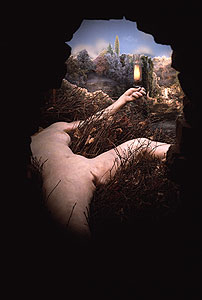
As with Duchamp’s Cemetery of Uniforms and Liveries, Cessolis’s strict guidelines for illustrating the various pawns indicate that the figures, or, more specifically, the bodies of the figures, were of less importance than the attributes of the pawn’s respective profession. Moreover, like the molds, the pawns were always represented as male (as instructed by the text), and as a whole were meant to represent a specific class of people. While most of the professions of the allegorical pawns do not directly correspond with those of the molds, it makes sense that Duchamp would have updated the professions to better suit twentieth-century society.


click to enlarge

Chessmen

Figure 28
Marcel Duchamp, Chessmen,
1918-19 © 2000 Succession Marcel
Duchamp, ARS, N.Y./ADAGP, Paris

Linda Dalrymple Henderson has claimed that the inclusion of “a priest as the first of the sexually desirous Malic Molds” is an example of Duchamp’s “iconoclasm” (182). However, in a fifteenth-century German compilation of moralities called the Destructorium vitiorum, which includes an extended version of the Innocent Morality (so called due to its association with Pope Innocent III), the pawns represent “the poor workman or poor cleric or parish priest” (Murray, History 534). While I do not argue that the insertion of a priest (which, as indicated by the scribbled-out word preceding “prêtre” in Cemetery of Uniforms and Liveries No. 1, was not Duchamp’s initial choice for the designation of the first mold) as a “sexually desirous” bachelor is in fact iconoclastic, I do contend that iconoclasm may not have been the sole inspiration for the inclusion of the priest. In fact, a more definitive statement of Duchamp’s iconoclasm – albeit a tongue in cheek one – was the omission of a cross at the top of the king from the chess set he designed and carved (with the exception of the knight) in Buenos Aires in 1918-19 (Fig. 28), an act he facetiously described to Arturo Schwarz as “my declaration of anticlericalism” (Schwarz 2:667).

If Duchamp’s Malic Molds were indeed inspired by pawns from chess history, it may not be the first instance in which Duchamp personified chess pieces in his art. Dario Gamboni observed that in Duchamp’s Portrait of Chess Players of 1911, the player on the left, a representation of Duchamp’s brother Raymond Duchamp-Villon, holds in his hand a chess pawn with strikingly anthropomorphic characteristics (Gamboni). This can be interpreted as a play on the French word for pawn “pion,” which also means “man” in reference to draughts or checkers, or the German “Bauer,” which can denote “peasant” as well as a chess pawn.

A crucial component of this study is identifying the sources through which Duchamp could have been introduced to the chess moralities, barring the possibility that he encountered them by word of mouth. One resource that has already been mentioned several times is Murray’s A History of Chess, published by the Clarendon Press in 1913, which, incidentally, was the same year in which Duchamp executed his first plans for The Cemetery of Uniforms and Liveries. Described in The Oxford Companion to Chess as “perhaps the most important chess book in English” (Hooper and Whyld 265), Murray’s 900-page History, the culmination of fourteen years of research, is an exhaustive exploration of the development of the game from its beginnings in the East to modern chess. Murray’s massive undertaking included learning Arabic in order to consult essential manuscripts, and studying the major collections of chess artifacts and literature, most notably the collection of John Griswold White of Cleveland, Ohio, the largest chess library in the world. Considering Duchamp’s already highly developed interest in chess at this time, it is conceivable that he would not only have known of Murray’s valuable study, but perhaps consulted it as well.

Pending conclusive evidence that Duchamp knew of Murray’s History, there remains a significant resource of books in several languages on the history of chess and chess literature with which Duchamp may have been familiar. Murray’s book was largely based on the work of the Dutch chess historian Antonius van der Linde, who published several books on the history of chess literature in Berlin at the end of the nineteenth century (Hooper and Whyld 219). In Paris, Librarie Hachette published Henry René d’Allemagne’s Récréations et Passe-Temps in 1905, which also includes a description of the chess moralities. Supplementing this short list of secondary sources for Cessolis’s sermon is the extensive number of primary sources, of which there are at least eighty versions of the Latin text alone (Murray, History 537), not to mention the profusion of existing French, English and German translations. Furthermore, an exact reprint of Caxton’s Game and Playe of the Chesse, including the woodcut illustrations, was printed by Elliot Stock Publishers in London in 1883, which made a formerly rare text readily available to the public and, more importantly, Marcel Duchamp.


Work Cited

1. Ades, Dawn, Neil Cox, and David Hopkins. Marcel
Duchamp
. London: Thames and Hudson, 1999.

2. Arman, Yves. Marcel Duchamp Plays and Wins. New York: Galerie Yves Arman, 1984.

3. Cabanne, Pierre. Dialogues with Marcel Duchamp.
Trans. Ron Padgett. New York: Da Capo, 1987.

4. Caxton, William. Game and Playe of the Chesse. 1474. London: Elliot Stock, 1883.

5. D’Allemagne, Henry René. Récréations et Passe-Temps. Paris: Librarie Hachette, 1905.

6. D’Harnoncourt, Anne and Kynaston McShine, eds. Marcel Duchamp. New York: Museum of Modern Art, 1973.

7. Dennis, Jessie McNab and Charles K. Wilkinson. Chess: East and West, Past and Present. Greenwich, Conn.: New York Graphic
Society, 1968.

8. Gamboni, Dario. Lecture. Spring 1999.

9. Gizycki, Jerry. A History of Chess. English ed. B. H. Wood. London: Abbey Library, 1972.
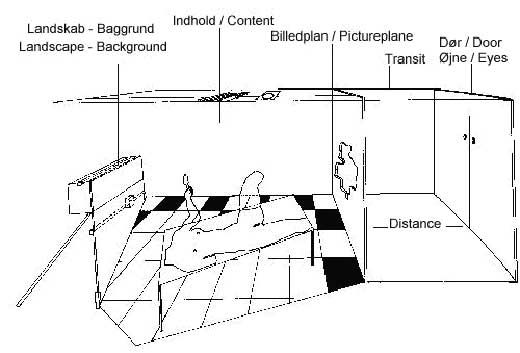
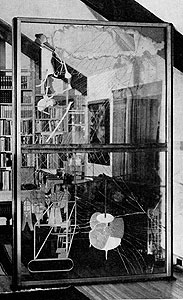
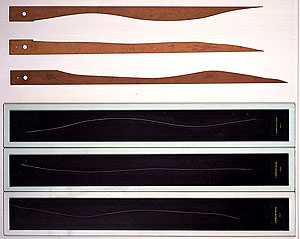
10. Golding, John. Marcel Duchamp: The Bride Stripped Bare by Her Bachelors, Even. New York: Viking, 1972.

11. Henderson, Linda Dalrymple. Duchamp in Context: Science and Technology in the Large Glass and Related Works. Princeton,
NJ: Princeton University Press, 1998.

12. Hopper, David and Kenneth Whyld. The Oxford Companion to Chess. New York: Oxford University Press, 1984.

13. Joselit, David. Infinite Regress: Marcel Duchamp (1910-1941). Cambridge, Mass.: MIT Press, 1998.

14. Keene, Raymond. “Principal Chess Happenings in the Life of Marcel Duchamp.” Duchamp: Passim. Ed. Anthony Hill. St. Leonards, Australia: Gordon and Breach Arts International; Langhorne, Pa.: International Publishers Distributor, 1994, 125.

15. Lebel, Robert. Marcel Duchamp. Trans. George Hamilton. New York: Grove Press, 1959.

16. Murray, H. J. R. A History of Chess. Oxford: Clarendon Press, 1913.

17. —. A Short History of Chess. Oxford: Clarendon Press, 1963.

18. Naumann, Francis M. “Affectueusement, Marcel: Ten Letters from Marcel Duchamp to Suzanne Duchamp and Jean Crotti.” Archives of American Art Journal 29.4 (1982): 3-19.

19. Sanouillet, Michel. “Marcel Duchamp and the French Intellectual Tradition.” Marcel Duchamp. Eds. Anne D’Harnoncourt and Kynaston McShine. 47-55.

20. Sanouillet, Michel and Elmer Peterson, eds. The Essential Writings of Marcel Duchamp. London: Thames and Hudson, 1973.

21. Schwarz, Arturo. The Complete Works of Marcel Duchamp.3rd ed. 2 vols. New York: Delano Greenidge, 1997.

22. Steefel, Lawrence D., Jr. “Marcel Duchamp’s Encoreà cet Astre: A New Look.” Art Journal, 36.1 (1976): 23-30.

23. Tomkins, Calvin. The World of Marcel Duchamp, 1887-1968. New York: time-Life, 1974.

24. Wichmann, Hans and Siegfried. Chess: The Story of Chesspieces from Antiquity to Modern Times. Trans. Cornelia Brookfield and Claudia Rosoux. New York: Crown, 1964.

“Macaroni repaired is ready for Thursday….” Marcel Duchamp as Conservator

“…while not as world-shaking as war, [Duchamp’s art] certainly has outlived
the latter. The survival of inanimate objects, of works of art through great
upheavals, is one of my consolations. My justification, if need be.”
(
Man Ray, Self-Portrait,1963)

Marcel Duchamp’s reputation involves a profound insouciance, and an apparent disregard for his own artworks. One of modernism’s most enduring myths is that, once an artist creates a work, it is launched into the world and endures on its own. James Joyce articulated this ideal in Portrait of the Artist as a Young Man (1916): “The artist, like the God of the creation, remains within or behind or beyond or above his handiwork, invisible, refined out of existence, indifferent paring his fingernails.” Joyce’s meaning is more deeply imbedded in notions of reception and the autonomy of the text, to be sure, but it can also be extended to describe an artist’s post-creative strategies. Indeed, Joyce was notorious for his endless revisions and for the extensive post-publication relationship he maintained with his works. Similarly, throughout his life, Duchamp maintained an intimate relationship with them, personally conserving, repairing, cleaning and preserving them. Indeed, such behaviors accounted for much of his private activity in the second half of his career.


click to enlarge

 Home

Illustration 1
Photograph taken in Katherine
Dreier’s West Redding,
Connecticut, home; summer 1936.

A photograph from 1936, taken in Katherine Dreier’s Connecticut home, suggests this more prosaic side (SeeIllustration 1). Wearing a pullover rather than his usually natty clothes, a five-o’clock-shadowed Duchamp stands wearily next to the Large Glass (1915-23) which he had just spent weeks reconstructing. This image, as well as Man Ray’s quote above, begs an interesting question. How is it that the unconventional and often fragile works of an artist who publicly eschewed those art world institutions that would normally be trusted to conserve them-dealers, galleries, museums-have come down to us in relatively fine condition, or indeed, at all? (1)

Duchamp’s acquaintances knew him to be inordinately concerned with issues of conservation, no matter whose works were involved. Georgia O’Keeffe’s first meeting with Duchamp was memorable for her not because of his outrageous behavior but because of his sober concern for artworks.

I was seated at a table very near [a] painting drinking something or other out of a glass and I finished it and put the glass in front of me. Duchamp walked over to me and very slowly took the glass and put it some other place away from the painting. He said that was not a good place for that glass of wine. That is how I met Marcel Duchamp. (2)

He was consulted in all matters pertaining to conservation. He arranged for the restoration of twenty-one damaged pictures by his brother-in-law Jean Crotti, and was then asked to have their Renoir paintings restored towards a new valuation of them. (3) Duchamp demonstrated particularly selfless devotion to the artworks of his friend and patron, Katherine Dreier. In 1951, at her request, Duchamp visited a church in Garden City, New York, to examine her 1905 mural The Good Shepherd. (4) Duchamp wished to supervise the restoration himself and, after inspecting it on a ladder with a “search light”–Duchamp was sixty-four-years-old at the time–he suggested no extensive restoration except the removal of the varnish and its subsequent waxing. ‘Waxing is much better than varnishing,’ he opined.(5) Duchamp’s judgment, it turns out, was technically sound. He eventually employed the services of the painter Fritz Glarner (1899-1972) who, he believed, was “an expert at cleaning paintings.” (6) After viewing the mural together, Glarner’s restoration took seven days, two hundred dollars, and Duchamp’s arrangements to draw money from a foundation set up for this very purpose. (7) Duchamp’s thoroughness in conserving his friend’s artwork–a piece that he must have known had little historical significance–is extraordinary. Moreover, he promised Dreier that, after this project was over, he would take her portrait of her father to New York for repair. (8) In startling contrast to his usual heightened concern for artworks, when Jackson Pollock’s Mural (1943, University of Iowa Museum of Art, Iowa City) would not fit the space for which it was painted–in Peggy Guggenheim’s apartment–Duchamp and David Hare cut off eight inches to make it fit. (9) This might be explained by his chill disinterest in abstraction, and by his pragmatism in solving problems. But it had been Duchamp who convinced Guggenheim to give Pollock his first one-man show, and it was he who suggested that Pollock paint the mural on canvas rather than directly on the wall so that it could be exhibited publicly.

As one might expect, whenever Duchamp was engaged in buying and selling artworks he was especially attentive to their condition. For instance, he sprang into action when the collector Jacques Doucet expressed interest in a slightly damaged Picabia collage, Plumes(ca. 1923-27), made of feathers, macaroni, cane and corn plasters; it was one of the works from the ’80 Picabias’ exhibition at the Hôtel Istria (Paris) which Duchamp had organized. After personally repairing it, he wired Doucet: “Macaroni repaired is ready for Thursday….”(10) And about the Picabia works he himself owned, also made of unconventional materials, Duchamp told Doucet that he would not consider selling them “except in conditions guaranteeing the precious side of these things.” (11)

In his capacity as dealer for Brancusi’s sculptures, Duchamp was often faced with delicate situations involving condition. Once, a small crack had been discovered in the white marbleBird in Space which was in transit to the 1933 Brummer Gallery exhibition. Characteristically resourceful, Duchamp found a way to exhibit it so that the crack was not noticeable. (12) And he was particularly watchful of the Brancusis in Dreier’s collection. He reminded her to move “the marble bird and the soft stone piece [the base]” of the BrancusiMaïastra out of her West Redding, Connecticut, garden for the winter. It had been Duchamp himself who had sold it to her. (13) Still, he realized that conservation was not its own end; it was a function of proffering sales, too. Years later, Duchamp advised Roché to accept an offer for Brancusi’s La Colonne sans fin which had stood for a long period outside Dreier’s home. After it had split in the back, “restorers” had painted it black. (14)

Duchamp’s concern for his own pieces is first of all apparent in his careful selection of materials. Although he used an enormously expanded range of media, he did so with an abiding concern for their durability and for protecting them. Early in his career Duchamp fantasized about the use of such unconventional materials as toothpaste, brilliantine, cold cream, shoe polish, and chocolate on glass. But he would only do so, according to his notes, if the works made from them could be cleaned. (15) His attitude had not changed when, four decades later, he used talcum powder and chocolate for a delicate landscape, Moonlight on the Bay at Basswood [Minnesota] (1953). He may have turned to these materials in the first place since he had no traditional artist’s materials on hand, and perhaps to compensate for the conventional nature of the work (a fairly straightforward landscape). In any case, his concern with the work’s well-being manifest itself when, within an hour of offering the recently made landscape to his patron, Duchamp “hastily” made a frame for the image “to protect the fragile surface from brushing against something and being marred.” (16) He later expressed his worries about the piece saying that he “hoped it will last and the poor chocolate, I’m afraid, will disappear or get white.” (17)

Modernists using non-traditional materials have often demonstrated obsessive concern about the condition of their pieces. Arthur Dove (1880-1946), for instance, whose dazzlingly advanced collages employ a broad range of unconventional materials, worried about the longevity of his works. Towards this end he read extensively on the subject of permanency, grinding his own colors, priming and stretching his own canvases, and even making his own pastels. (18)

As a painter, Duchamp had showed a decided preference for high-quality products. Robert Lebel observed that the artist’s “scrupulous study of paints and their properties led him to select the German Behrendt brand which he used exclusively.” (19) Duchamp established this preference–because of its reputation for permanence–during his brief Munich sojourn (1911-12) on the advice of his German friend, Max Bergmann. The Bride (1912) is painted with these pigments, which were, as Calvin Tomkins corroborates, “the best brand available.” (20)

Indeed, Duchamp lived long enough to test their quality. When his forty-year-old Portrait of Dr. Dumouchel (1910) arrived at the Arensberg’s very dirty, the artist assured them that they “will have no difficulty” cleaning it. He was confident that the restorer would recognize that it was made with Behrendt paints. Afterwards, Duchamp smugly confirmed he “was sure that Dumouchel [would] be surprisingly fresh after Miss Adler’s shower,” (21) “shower,” of course, being Duchamp’s anthropomorphizing euphemism for a cleaning. Looking back at paintings made decades earlier, he was generally pleased that many of them had remained stable and fresh looking. Referring to the pigments in his Nude Descending a Staircase, No. 2 (1912), for instance, Duchamp observed (1966) that “they’ve behaved very well, and that’s very important.” (22) Similarly, he had once boasted to Jasper Johns (1960) that the lacquered dust in the Large Glass was “just as good today as it was thirty years ago.” (23)Duchamp had beamed about the physical condition of that work to another interviewer a few years earlier. “Thank God, the color still looks fresh. It’s not a faded flower, not like an old master in a museum….(24)

Such was his sensitivity to materials that when he was asked his opinion about the future of painting, he often took it to mean the medium rather than the genre. “One can forget oil painting,” Duchamp said in a late interview. “It discolours. It needs repairing all the time. Yes, one can find something else.” (25) Though his response may have been a defensive strategy with which to sidestep empty speculation about then-current art trends, it is nonetheless interesting that it took this form. When Duchamp critiqued the commercial end of art, it was often by addressing the vulnerability of art objects:

Artists [in France are] selling their stuff like so many beans. Although much money has been derived from widespread sales, posterity will never see a great deal of the work we rave about because of frequent use of bad pigments. (26)

His resentment at easy sales is here expressed as a remonstrance about bad workmanship. At this particular moment his anxiety about the longevity of art may have been particularly acute. His public career had by this time greatly diminished and, more troubling still, Duchamp had just seen the destruction wrought upon his Large Glass first-hand.

Duchamp first considered using glass as a support in his artworks in part because it promised longer preservation for the pigments. (27)

After a short while, paintings always get dirty, yellow, or old because of oxidation. Now, my own colors were completely protected, the glass being a means for keeping them both sufficiently pure and unchanged for rather a long time. I immediately applied this glass idea to The Bride [the Large Glass]. (28)

Duchamp’s glass works required careful, sustained maintenance because of its fragility and since glass naturally reveals its dirt more conspicuously. (29) Duchamp’s friend H.-P. Roché remembered that the Large Glass was “washable on both sides under the shower,” and, as opposed to canvas, acquires “no dust on its backside.” (30) Still, such cleanings must have been complicated affairs. Duchamp once wrote Jacques Doucet to say that cleaning Glider Containing a Water Mill in Neighbouring Metals (1913-15), which Doucet had recently purchased, “will take me 2 or 3 afternoons.” (31)


click to enlarge

9 Malic Molds

Illustration 2
9 Malic Molds,1914-15,
painted glass, wire and sheet lead.
Teeny Duchamp Collection,France.

Though they may have preserved the materials applied to them, and though they may have been cleanable, Duchamp’s glass works were predictably vulnerable and underwent a dizzying history of damage and repair. For instance, the Nine Malic Moulds (1914-15) was first broken when it was placed against an armchair on castors which rolled away (SeeIllustration 2). Left temporarily at the apartment of a friend, Roché noticed later the same year that the work had scratched the piano. After it cracked once more, this time in the possession of another friend who placed it too close to the fireplace, Duchamp and Roché took it to the well-known framer Pierre Legrain. (32) It seems its greatest danger came from the casual treatment of the people who putatively cared for it. This must have been a sobering lesson for Duchamp who became even more attentive to his works’ conditions in the years that followed.

Decades later, he again turned his attention to the long-term safety of Nine Malic Moulds. “I was wondering if you could have your glass reframed in a manner more solid and definitive,” he wrote to Roché in Paris who now owned the piece. He outlined a complex process whereby its custom-made frame could be removed, the glass cleaned, and a new frame put around it. “Leave the mastic to dry several months without moving the glass,” Duchamp insisted. About a month later, he wrote again, repeating his instructions for strengthening the piece and conveying his concerns for its future: “If the glass must travel, it is essential that it arrives in perfect shape ‘for centuries to come.'” (33)

Given Duchamp’s concern for his artworks, one wonders if he would have made any of glass had he known their fate. Charles Demuth thought it so obviously unwise that he once lamented, “Dear Marcel, having used glass so often seems to have added difficulties for the Future–he would, of course.” (34) After the debacle of destruction and repair engendered by the Large Glass, he never made another work in that medium.

The major work of Duchamp’s early career, the Large Glass (1915-23), had only been exhibited once (Société Anonyme Exhibition, 1927) before it was broken en route from the Brooklyn Museum to Katherine Dreier’s home in West Redding, Connecticut. (35) Dreier conveyed the terrible news in Lille in 1933, where, over lunch, he could be expected to take the news with some restraint. Years later Duchamp recalled that, in order to spare Dreier’s feelings, he had gallantly expressed “a reaction of charity instead of despair.” (36) She may have been especially contrite since another of Duchamp’s glass works, To Be Looked at, (from the Other Side of the Glass) with One Eye, Close To, For Almost an Hour (1918), had earlier been broken while it was in her possession. Years after her death, Duchamp candidly described the broken Large Glass in painfully descriptive terms as “marmalade.” (37)

One wonders why Duchamp did not simply abandon the wrecked Large Glass at this point considering the extent of the damage and since his work on it had all along been fitful and inconclusive. And if the transparency of the glass were vital to the work, the cracks would severely compromise that. Why then, did Duchamp, notorious for his bored disengagement with art, go to such great lengths to restore it?

Having seen the devastated Large Glass in the autumn of 1933, he had some idea of the immense effort required for its repair. He informed Dreier of his plans: he had arranged to be in America for nearly three months, had studied an “invisible glue” with which to repair the work, and had conceived a plan to mount the reconstructed work between two heavy plates of glass. “Although very heavy,” Duchamp speculated, “it would make a solid[emphasis his; a gentle barb to Dreier?] piece of furniture when in place.” (38) Bearing a certain amount of responsibility for the damaged to the Large Glass, Dreier paid for everything connected to its repair, including materials and contracted labor. (39) She assured Duchamp of a room in her house, offered him thermoses of coffee, breakfasts on a tray in the mornings, and a carpenter on hand to assist in the reconstruction. (40) She even covered his passage to America.

It is a misconception that the Large Glass had merely cracked in the patterns one sees today, remaining more or less intact. In reality, except where some of the wire designs were holding some shards together, the work was reduced to an enormous pile of unattached fragments. Testimony is provided by an account in a local newspaper which described the carnage as “a 4 by 5-foot three hundred pound conglomeration of bits of colored glass.” (41)The title of another article, “Restoring 1,000 Glass Bits in Panels; Marcel Duchamp, Altho an Iconoclast, Recreates Work,” (42) called attention to the uncharacteristic manual labor now demanded of the notorious anti-artist involving gloves, glue pot and a pile of splintered glass. “It’s a job, I can tell you, ” Duchamp confessed to his interviewer, “like doing a jigsaw puzzle, only worse.” (43) Privately, he described his absorption in this gargantuan project:

I haven’t answered your letter, nor written, because I have turned into a glazier who thinks of nothing else from 9 in the morning to 7 at night but repairing broken glass. But it’s working. Another three weeks and the Bride will be back on her feet again. (44)

And to Brancusi, he described this period as something of a nightmare, “I’m waking up…. For 2 months I have been repairing broken glass and I am very far from my Parisian ways.”(45) Dreier, in turn, complained to one of her friends about the artist’s monomania at this time: “Duchamp is a dear, but his concentration on just one subject wears me out, leaves me limp.” (46) Intimations that the artist was tiresome in conversation are exceedingly rare in the historical record.

The Large Glass became a different work in the course of restoration, a portion of its original, intricate iconography having been lost altogether. The upper right hand side of the work, including the “inscription du haut” (“top inscription”) and the “9 tires” (“9 shots”) figure, was so fragmented that Duchamp was forced to insert three new pieces of glass. He had the holes for ‘9 tires’ redrilled and the missing part of the ‘inscription du haut’ completely restored. (47) The area of the Bride’s “clothes” were also remade in three narrow strips of glass inserted horizontally between the upper and lower panels. The only section free of cracks is the one including part of the “Milky Way.” Ultimately, the work became a mixture of old and new, Duchamp’s restoration “completing” the unfinished work, as it were.

The present format of the Large Glass–the original glass sandwiched between two thicker planes all held together by a metal frame–was a contingency of the restoration. Duchamp had previously repaired the broken To Be Looked at (from the Other Side of the Glass) with One Eye, Close to, for Almost an Hour (1918) in this fashion and, satisfied with the result, performed a similar operation on Nine Malic Moulds (1914-15) a couple months later. (48)By the time he addressed the restoration of the Large Glass, the repair strategy was a familiar one. After completing the restoration of the Large Glass, Duchamp regarded it as a different work than the one he had begun more than two decades before. Along with the title, he now inscribed the words “-cassé 1931/ -réparé 1936.” He apparently felt that the history of the piece, including its restoration, was important for viewers to know.


click to enlarge

3 Standard Stoppages

Illustration 3
3 Stoppages Étalon(Standard Stoppages), 1913-14, wood, glass, threads, varnish and glass. Katherine S. Dreier Bequest, The Museum of Modern Art, New York.

Duchamp used his restoration junket to Connecticut to conserve other of his works in Dreier’s collection. He had theRotary Glass Plates (Precision Optics)(1920)–which Dreier had been unable to locate–and the 3 Standard Stoppages(1913-14) (See Illustration 3) taken out of storage. He cleaned, reassembled and replaced the motor on the former. And it was only at this time that 3 Standard Stoppages assumed its final shape. He mounted the three narrow canvas shapes on glass and photographed them against the clapboarding of Dreier’s house. This provided something of a grid background for the photograph of the piece that would be included in the Boîte en valise. (49)Duchamp altered a long, wooden croquet-mallet box to hold both the glass plates and the original wooden “yardsticks.” Indeed, much of the format of the piece, as we shall see, is a function of his concerns for its preservation.

Not just an engineering problem to be solved, the damage to the Large Glass jolted Duchamp’s sense of his career. It occurred when his production of artworks had virtually stalled, perhaps just when his sense of himself as an artist was particularly vulnerable. Calvin Tomkins has observed that “the shattering of Duchamp’s most important work seemed like one more confirmation of his decision to give up being an artist.” (50) Surveying the damage and undertaking its repair galvanized his resolve to enter that phase of his career which involved the large-scale reiteration and reproduction of his works in multiples. Jean Suquet has observed that even before Duchamp began repairing the broken Large Glass, he first published the Green Box (Paris, 1934). “Only then,” Suquet says, “did he restore the image between two new plates of glass, now to be read through the foundational grid of his writings.” (51) The artist himself admitted that “the notes [in the Green Box] help to understand what it [the Large Glass] could have been.” (52) The following year, perhaps still reeling from the destruction of his major work, Duchamp began thinking of making an “album” of all that he had made until then. This would later be realized in hundreds of copies as the Boîte en valise–for all intents and purposes a portable museum of his most important artworks.

Indeed, the damage wrought upon the Large Glass had provided dark inspiration for theGreen Box. The scraps of paper in the Green Box reminded a startled Katherine Dreier of the broken shards of the Large Glass. (53) Duchamp himself mused about the appropriateness of splinters and shards for their historical moment. He told his author friend Anaïs Nin that the form of the Green Box–which, as a box of scraps resembled the crate full of shards that was now the damaged Large Glass–should replace the conventional codex, adding, “It is not the time to finish anything. It’s the time of fragments.” (54)

It is part of the Duchamp legend that the artist viewed the destruction of the Large Glasswith dispassionate resignation. The artist himself helped give this perception currency. The filmed interview, “A Conversation with Marcel Duchamp,” with James Johnson Sweeney at the Philadelphia Museum of Art (1956), opens with Duchamp looking at the Large Glass. He first recounts the story of the damage to the work then adds, “The more I look at it, the more I like the cracks.” (55) This appears to be the first intimation that the breakage was part of an “incorporation of chance” in the work. The legend of Duchamp’s appropriation of accident into the work’s aesthetic later gained momentum through John Cage’s advocacy of aleatory effects. Some observers, however, found nothing enchanting nor conceptual about the damage. “Anyone can get their painting wrecked,” quipped one critic. (56)

Duchamp, too, seemed to realize that the restoration could not make the work pristine again, nor would the cracks make it a more interesting work. Worried how a museum might regard the repaired Large Glass-before it had found a permanent home-he sullenly speculated, “I have a hunch that broken glass is hard to swallow for a ‘museum.'” (57) In the end, Duchamp regarded the piece as a broken and repaired work of art. Asked in another filmed interview a decade later whether the cracks in the glass are fundamental to the work, he responded simply and definitively, “No, no.” (58) Poignantly, he once downplayed its damage describing it not as a “ruin,” but merely “wrinkled.” (59) Likewise, Duchamp would have been saddened-not delighted as is often claimed–to learn that the replica of “In Advance of the Broken Arm” (1915), the show shovel readymade, was used by an unwitting janitor to clear the sidewalks outside an exhibition of his works. (60) By now it is clear that he could not have looked smilingly on such lapses in conservation. Such legends gain plausibility by confusing the nonchalant provocation of his art with his professional aspirations. Duchamp’s reconstruction of the Large Glass is seldom recounted in the literature, for much the same reason. But it demonstrates his profound concern for his works and his willingness to endure much hardship and tedium to restore them. Certainly, there exists no other modern artwork of the same calibre as the Large Glass on which its author labored so intensively to restore it.

Since Duchamp had never surrendered his works to a dealer, at least until the last few years of his life, his pieces were not scattered widely across private collections. And because he was obsessive about keeping his relatively small oeuvre together, he had unique access to his works. Thus, he could more easily track their whereabouts and monitor their conditions. Although Duchamp’s concern for his works’ preservation was an ongoing one, his efforts along these lines accelerated in the late 40s and early 50s. This was the period when his historical reputation was being consolidated through increasing exhibitions and a burgeoning literature devoted to him. This was also the period when the Arensbergs were looking for a museum to which they would bequeath their collection. Reassured that they already owned most of his artworks, Duchamp nevertheless felt personally responsible for maintaining them.


click to enlarge

Louise and Walter Arensberg Collection

Illustration 4
King and Queen Surrounded by
Swift Nudes
, 1912, oil on canvas.
Louise and Walter Arensberg Collection,
Philadelphia Museum of Art.

When he visited them in April, 1949, for example, he discovered that Paris Air (1919), a sealed glass ampule, had broken. He had already mended it once before, but now the damage seriously compromised the integrity of the piece. Duchamp wrote a letter to Roché in Paris requesting that he procure a similar ampule from the same pharmacy from which he had bought the original. (61) In the same spirit of conscientiousness, in 1952, as the Arensberg Collection was destined for permanent display at the Philadelphia Museum of Art, he retouched his painting Paradise (1910). (62) He had hoped to rectify a considerable craquelure that can still be seen in the painting on the back, The King and Queen Surrounded by Swift Nudes (1912) and lamented “Unfortunately this picture has not stood time as well as my other paintings….” (See Illustration 4) (63)

In general, Duchamp’s patrons shared his conservation concerns especially since some of his works required specific and unusual maintenance. For instance, the repaired Large Glass, now standing in Katherine Dreier’s home, had become a fragile, glass monolith. Because Dreier dared not move the piece, she considered converting her home into a “Museum in the Country.” (64) Still troubled by the matter at the end of her life, she confessed to Duchamp that she might not leave enough money to guarantee its upkeep and safety. (65) The issue was resolved only after her death when Duchamp–acting as her executor–decided that it should enter the Arensberg Collection in the Philadelphia Museum of Art, which already contained the preponderance of his works. That way, Duchamp knew, its maintenance would be assured–and the major work of his early career could stand beside his others.

It had been considerations of conservation that were critical to the choice of Philadelphia as the permanent home of the Arensberg Collection in the first place. The Arensbergs had been considering the Art Institute of Chicago until, during the period of loan for the exhibition “20th-Century Art from the Louise and Walter Arensberg Collection,” (20 October-18 December, 1949), an Alexander Calder sculpture of theirs had been broken (Mobile, 1934), and the frame of a Fernand Léger painting (The City, 1919) had been repainted without their permission. Moreover, the Arensbergs found some of the display construction shoddy and the overall presentation rough and unprofessional. (66)

Duchamp regarded the exhibition of his works as an opportunity to inspect them and, if necessary, to conduct repairs and conservatorial measures. On one occasion, he asked Michel Sanouillet to bring “two bottles of crystal mastic varnish” from Paris to the opening of the 1951 Sidney Janis Gallery (New York) exhibition, “Brancusi to Duchamp,” so he could treat his two paintings on display there. (67) Duchamp would apparently not settle for any varnishes he could have bought locally. After seeing his Genre Allegory (George Washington) (1943) at a MoMA exhibit (1948), Duchamp was troubled that the original deep-blue background had faded. He asked André Breton, its owner, if he could repaint the blue before the work returned to Paris. (68) It is not known whether he ever performed the retouching, but it is noteworthy that the work was only five years old at the time. Remarkably, Duchamp did not always require a first-hand look at his works to proceed with conservation. After seeing a photograph of Coffee Mill (1911), which was to be used as a reproduction in Lebel’s monograph on the artist, he recommended the painting receive “a very thin coat of transparent varnish.” (69)

As we saw in the repair of the Large Glass and in the conservation of Dreier’s mural, Duchamp generally heeded the judgment of professionals. For example, in response to an Art Institute of Chicago conservation report for one of his earliest paintings, Garden and Chapel at Blainville (1902), he agreed to have a new stretcher and liner made for it. (70)More often than not, however, the conservation of works already in museum collections involved cajoling institutions, the search for funds, contacting restorers and the like, all of which Duchamp himself was willing to undertake. He once expressed his anxieties about the rapid deterioration of works in the collection of the Société Anonyme to its director, George Heard Hamilton. Informed there was no money for conservation, Duchamp volunteered to approach Mary Dreier, sister of his deceased friend Katherine Dreier. After their meeting, he wrote Hamilton again, this time asking for a more detailed account of the conservation costs including–and this was his own plan–a capital sum for an endowment specifically devoted to that purpose. In the end, Mary Dreier was unable to fund an endowment but contributed $1,500 per year for conservation during her lifetime. (71) Not only had Duchamp originally helped amass the collection of the Société Anonyme, he had now provided for its long-term conservation.

Over the course of his career, Duchamp came to understand what every art mover, preparator, and curator knows: that artworks are most vulnerable while being moved. His own glass pieces had undergone a gauntlet of destruction brought largely about by their transport. These moves were a continual source of anxiety for both the artist and for his patrons as well. After patiently waiting years for Duchamp to finish the Large Glass, the Arensbergs sold it to Dreier when they moved to California in 1923. Presciently, and ironically, they feared it might be damaged in the move. (72) Not just those of his glass works, his paintings also sustained damage while in transit. The renowned Nude Descending a Staircase, #2 (1912) was torn slightly during its loan to the “Three Brothers” exhibit at the Guggenheim Museum (1957). Duchamp, along with a professional restorer, determined that the one-inch-long tear in one of the darker areas of the picture and some missing paint was not terribly serious. The artist suggested a temporary repair so that it could travel to its next venue. (73) Aware of the high degree of risk in moving artworks, Duchamp sometimes insisted on specific travelling guidelines for his pieces. Roché, who owned the repaired Nine Malic Moulds (See Illustration 2), received lots of advice along these lines, especially when it was to be exhibited. “For your glass, have it carried by someone, upright,” Duchamp suggested, “as we did for the Surrealist exhibition at Wildenstein’s [Exposition Internationale du Surréalisme,” Paris]. A year later, he thanked him for personally walking it to the Musée National d’Art Moderne show, “Le Cubisme 1907-1914.” Concerned about the piece travelling twice across the Atlantic–so it could be exhibited in the “Three Brothers” exhibition–Duchamp asked Roché if he would consider selling it while it was in America.(74) In making this request he was shrewdly killing two birds with one stone: it would lessen the risk to a glass work in transit, and also move the piece closer to the preponderance of his oeuvre. It appears that Duchamp implicitly charged his patrons with a certain level of safeguarding for his artworks. When the Arensbergs were to send him Paradise/The King and Queen Surrounded by Swift Nudes/Paradise (1910/1912), he told them that special insurance would be required since his New York studio was not fireproof. (75) A justifiable respect for fire was reflected in his assent that, if the Art Institute of Chicago wished to borrow his avant-garde film Anémic Cinéma (1925-26), they should first have a non-flammable copy made. (76) Such premeditated concerns work against Duchamp’s reputation for heedlessly courting the vicissitudes of fate.

Packing Duchamp’s unorthodox works for travel was often a sophisticated affair. He admonished Roché to pack “Why not sneeze Rose Sélavy?” (1921) “so that the weight of the marble doesn’t strain the bars or the base of the cage” when it was to travel to the MoMA’s “Fantastic Art, Dada, Surrealism,” (December, 1936). (77) On a much more ambitious scale, packing and moving the repaired Large Glass was too important to occur away from Duchamp’s watchful gaze. In September of 1943 he was on hand at Dreier’s home to supervise its transfer to the Museum of Modern Art where it was on loan until 1946. He personally directed the four installers as they crated and moved the piece and then, riding in the truck, gave strict instructions that its speed not exceed fifteen miles per hour. (78) Even so, a few slivers of glass, held only in place by gravity, were jarred out of place. Duchamp later “spent several hours fitting them back where they belonged.” (79) As might be expected, he supervised the removal of the Large Glass from the Museum of Modern Art three years hence (on 1 April 1946) in preparation for its return to Dreier’s home.

When the Large Glass was to be transported for the last time, now to its permanent disposition in the Philadelphia Museum of Art in 1952, Duchamp had become the undisputed authority on moving the fragile and unwieldy construction. The arrangements intensified; his communications to director Fiske Kimball reveal anxieties about the move. Duchamp expressed a fitful series of nervous requests and balks. He suggested they wait for good weather before proceeding and, after further thought, cabled Philadelphia suggesting, “Four strong men needed.” (80) Hoping to avoid the kind of damage originally wrought upon the work, a few days later he wired to say that he was “expecting to ride back on [the] truck.” (81) Although he only rode back as far as New York, he appeared in Philadelphia the next day to supervise the unloading. In the end, a relieved Duchamp was able to tell Dreier that the transport of the Large Glass “was a success.” (82) Eventually, under Duchamp’s supervision, the Large Glass would be cemented to the floor of the Philadelphia Museum of Art amidst the Walter and Louise Arensberg Collection. Though this protected the work from further damage, it also meant that the piece could never be exhibited elsewhere. Its immobility is one reason why exacting replicas of the Large Glass had to be made by Richard Hamilton (1966) and Ulf Linde (1961) for the Duchamp retrospectives they were then mounting. Hamilton also reproduced the Glider Containing a Water Mill in Neighboring Metals (1913-15) for the same reason. After years of worrying after the transport of his glass works, Duchamp, in his last years, seemed reluctant to see them move at all. To Hamilton’s queries about possible loans to his lionizing Tate Gallery retrospective (1966), Duchamp said he did not wish that the fragile To Be Looked at… (1918) should travel from the MoMA. (83) Evidently, its safety had become more important than its being looked at.

Duchamp’s anxieties about the condition of his pieces reflected his convictions about posterity and historical reputation. He believed that the physical condition of an artwork had a direct bearing on its place in history, metaphorically equating the endurance of an artwork with the span of a human life. The mortality of artworks lay both in their physical condition and in their historical significance–if a work was not “healthy,” it could not enjoy the “life” of a historical reputation. “Men are mortal, pictures too,” was his aphoristic description of the physical lifetime of a work. (84) Another statement from the same year further developed this notion.

I believe in [the] life and death of a painting, of a work of art, a short life something like fifty years, about a man’s life . . . painting especially dies after forty or fifty years when the pigment and everything has darkened, and so forth and really there is death there . . . look at Monet which has become completely black, when it was painted and young it was . . . exactly the image of life . . . of man’s life. (85)

Although Monet’s paintings may have lost some of their original vividness, they have hardly become black. This sort of hyperbole indicates Duchamp’s sensitivity to the conditions of artworks and their prospects for “life” in perpetuity.

Although most artists share Duchamp’s interest in preserving the original state of their pieces, Edgar Degas regarded an artwork’s gradual diminution as a desirable part of its appreciation. When the Louvre cleaned one of its Rembrandt paintings, the artist cried, “Time has to take its course with paintings as with everything else, that’s the beauty of it. A man who touches a picture ought to be deported. To touch a picture! You don’t know what that does to me.” (86) Though moved to conserve his pieces as effectively as possible, Duchamp did acknowledge the inevitability of an artwork’s decline. When Robert Lebel and Robert Dorival were trying to organize a major Duchamp exhibition in Paris, in 1966, they requested the artist solicit the Philadelphia Museum of Art about possible loans of his works. He responded, “Impossible for the glass: the [9] Malic Moulds–they are senile and no longer travel.” (87)

For Duchamp, artworks could “die” altogether, consigning their historical significance to oblivion. In the early 60s, art historian William Seitz asked him about contemporary artists who used unorthodox materials. Seitz was doubtless referring to the aesthetic implications such materials raise. But Duchamp’s answer says much about what he regarded as an artist’s central concern–the material longevity of his works.

Seitz:
It’s interesting that so many artists how work in very perishable materials, such as refuse and old newspapers.

Duchamp:
Yes that’s very interesting. It’s the most revolutionary . . . attitude possible because they know they’re killing themselves. It’s a form of suicide, as artists go; they kill themselves by using perishable materials. They know it will last five years, ten years, and will necessarily be destroyed, destroy itself.
(88)

Duchamp’s use of the word “suicide” implies that artworks represent artists’ historical existence. Artists are thus obligated to create works that are physically sound and durable. In ironic reaction to this anxiety, Duchamp once said that one attraction to chess for him was that “at the end of the game you can cancel the painting you are making.” (89)

It may seem surprising that a Dadaist would so insistently recoil at the idea of ephemeral artworks. A commonly held notion about Dada artists is that their nihilism was so pervasive that they and their works somehow self-destructed as a result of a perverse inherent logic. The anti-art attitude of the Dadaists, however, was more theoretical than actual. Gabrielle Buffet-Picabia recalled that, during Arthur Cravan’s notorious drunken speech and strip-tease at the Grand Central Gallery (site of the 1917 American Independents Exhibition), her circle of friends were worried lest Cravan damage a painting that was situated behind him.(90) Perhaps more than most avant-gardists, many Dada artists expressed a heightened interest in conserving their works and gestures for a posterity that would appreciate them. Along these lines, Lucy Lippard finds it ironic that the “ex-Dadas have been more concerned with their own histories than have been the participants in any other major movement.” (91)


click to enlarge

Art Gallery

Illustration 5
Tu m‘, 1918, oil on
canvas, bottle brush,three
safety pins, one bolt. Société Anonyme
Collection, Katherine Dreier Bequest,
Yale University Art Gallery, New Haven, Conn.

Considering Duchamp’s obsessive concern for the condition of his pieces, it is not surprising that he sometimes expressed the theme of conservation directly in some of his works. For instance, he painted a trompe l’oeil tear inTu’m (1918) (See Illustration 5) which he rudely “repaired” by three real safety pins. The hasty, ersatz “repair” suggests that conservation is often a crude compromise. The “tear” is widely regarded as a witty jibe at the preciousness of art. But it also suggests that paintings are fragile things and can sustain horrible damage. The tear, it is important to observe, is only an illusion of damage; perhaps Duchamp could not abide an actual one.


click to enlarge

Unhappy Ready-made

Illustration 6
Unhappy Ready-made,Boîte en
valise reproduction made by Duchamp
after Suzanne Duchamp-Crotti’s painting,
Le Ready-made malheureux de Marcel
(Paris, 1920).Guido Rossi Collection, Milan.

The title of his Readymade malheureux (Unhappy Readymade) (1919) implies that an artwork’s physical condition is integral to its meaning. It was comprised of a geometry book that he instructed his sister, then living in France, to hang on her porch (See Illustration 6). Predictably, the weather gradually destroyed it. The original idea for the piece was first expressed in a note, later included in The Green Box, in which Duchamp reminded himself to “Make a sick picture or a sick Readymade.” (92) The inspiration for Unhappy Readymade, then, involved the notion of the physical vulnerability of artworks. The Unhappy Readymade is unhappy because it will not endure; it is gradually deteriorating. Insofar as real weather tears the work apart, the piece is a metaphor for the damaging effect of time on art. (93)

Duchamp explored the idea of repair and conservation in 3 Standard Stoppages. (1913/14) (See Illustration 3). He had been inspired by a Paris shop sign, “stoppages et talons,”advertising invisible mending and heel repairs to socks and stockings (et talon, or étalon = “standard”). (94) Mending is, of course, an operation of repair and maintenance. Perhaps the varnished threads in 3 Standard Stoppages, whose shape has determined a new standard of measure, are meant to be read as threads which have become unraveled from an “invisible” mend. Interpreted in this way, what is being conserved in this work (mends) is the evidence of repair, now absurdly made standard in the templates. What makes this doubly preposterous is that the forms that repairs take are wholly contingent on the damage they seek to rectify. This work thus suggests something of the despairing futility of predicting and measuring repair. As mentioned earlier, he completed it in 1936 by cutting the canvases according to the shape of the varnished threads, gluing these to glass plates, and fitting them into a slotted, wooden box. Also included in the box are flat, wooden “templates” (yardsticks, of sorts) whose shapes were determined by threads dropped from a certain height. Thus completed, the format reflected his attempt to conserve the sophisticated documentation of a pataphysical experiment.


click to enlarge

Network of Stoppages Etalon

Illustration 7
Network of Stoppages Etalon
, 1914, oil on canvas.
Museum of Modern Art, New York.
Fresh
Illustration 8
“Fresh Widow”,1920,
miniature window frame, paint,
black leather. Museum of
Modern Art, New York.

The background of a related work, theNetwork of Stoppages Étalon (1914) (SeeIllustration 7), is actually an unfinished version of the painting, Young Man and Girl in Spring (1912), turned on its side. Thus, its very position is a contraversion of the proper handling of art. Its “stoppages,” the little mends, which look like little buttons or stays, create a pattern in accordance with the “damage” which the painting has ostensibly sustained.

“Fresh Widow” (1920) (See Illustration 8) is a miniature, carefully constructed French window that Duchamp commissioned from a carpenter. The piece requires a great deal of maintenance according to the artist’s jesting instructions. Instead of glass panes, it has leather panes that the artist insisted must “be shined every morning like a pair of shoes.” (95) The regular polishing, one assumes, is what keeps the widow/window “fresh.”

Besides their aesthetic implications, and their myriad semantic allusions, many of Duchamp’s readymades involve tools or implements that facilitate maintenance or organization. Bottle dryers, hat racks, urinals, snow shovels, typewriter covers, and so forth, all fall into this category. His notes, too, often describe objects of domestic utility and maintenance. One from the Box of 1914, for instance, exclaims “Long live! clothes and the racquet-press” (96) invoking clothing, a type of outer shell (clothes “make” the man) and the racquet-press, which protects the vulnerable gut strings of the tennis racquet. It appears that, even when he was inventing Dadaistic non-sequiturs, Duchamp tended to conceive of items of utility and conservation.

Decades of repairing and maintaining a (rather modest) oeuvre enabled Duchamp to make elaborate provisions for his posthumously unveiled Étant donnés: 1. la Chute d’eau 2. Le Gaz d’éclairage (Given: 1. The Waterfall 2. The Illuminating Gas) (1946-66). The complete title–all taken from a note reproduced in The Green Box-is a wordy description of the work: “Dismountable approximation executed in New York between 1946 and 1966. By approximation I mean a margin ad libitum [of freedom] in the dismantling and reassembling.” (97) The work had to involve an element of freedom in its reassembling because it would necessarily be done by others. The work is thus described as a new genre, a “dismountable approximation,” its title no longer involving the punning absurdity given to such early works such as The Bride Stripped Bare by her Bachelors, Even. Instead, it alludes to many of Duchamp’s concerns: authorship, chronology, media, genre, and conservation.


click to enlarge

1.
la Chute d’eau 2. Le Gaz d’éclairage

Illustration 9
Interior, Étant donnés:1.
la Chute d’eau 2. Le Gaz d’éclairage
(Given: 1. The Waterfall 2.
The Illuminating Gas)
, 1946-66, mixed media assemblage.
Philadelphia Museum of Art.

Originally constructed in his New York studios, Given was dismantled and reassembled in the Philadelphia Museum of Art after the artist’s death in 1968 (See Illustration 9). Its conception involved a built-in element of collusion with the museum for its construction and ongoing maintenance. To assist in the reconstruction of the piece, Duchamp composed two lengthy, handwritten notebooks, complemented by Denise Hare’s photographs and by a foldout construction. It is in effect a lengthy, precise instruction manual for assembling the work in his absence and as such is different from his other published material, i.e., The Green Box, the White Box, and so on, which are autonomous objets d’art. Nevertheless, it has wrongly taken its place among these editions, as if it were a densely aestheticized text ripe for decoding. (98) These instructions were specific and unequivocal, not meant to aesthetically enrich the work’s meaning in the manner that theGreen Box does for the Large Glass.

Duchamp advises on the brand of fluorescent lights used (“very white (General Electric) or pinkish”), the number of turns-per-second that the waterfall motor makes, as well as advice to have two people move the nude figure when necessary. Ironic in lieu of its description as an “approximation,” the notebook provides little margin for variance. Made with the knowledge that he would already be dead when the work was unveiled, the notebooks are an astonishing attempt to control the conditions in which his art would be experienced in a remote future.

Duchamp also left specific instructions for art made in connection with Étant Donnés. The small leather and plaster maquette (1948-49) that served as the model for the life-size nude in Étant Donnés bore instructions for its lighting and, if necessary, its restoration; he even made a case to protect the little leather figure. (99)

Mining Duchamp’s advanced art for ever-subtler allusions has directed attention away from his almost fetishistic concern for the physical wellbeing of his pieces. This study reduces some of the conventional distance between Duchamp and his works modifying his prevailing construction as the smirking demiurge who dashes off pieces, heedless of their fate. Conservation was, for him, central to the artistic process. Only artworks in sound condition could be given up to an unmanageable and uncertain future–one in which paintings turn black, glass pieces are reduced to “marmalade,” and one where artists might unwittingly commit art historical suicide.

Duchamp Festival at California State University, Hayward

A major exhibition of the work of MARCEL DUCHAMP “Artist of the Century” is being presented for the first time in Northern California at the center of a Duchamp Festival at California State University, Hayward. October 2001 – February 2002…

For many years Picasso and Matisse were considered the most influential artists of the 20th century. That evaluation has changed. Now, Marcel Duchamp is widely considered the most influential artist of the 20th century.

How he came to occupy this position is a long rich story much of which will be “told” in the CSUH Art Gallery and celebrated around the campus in the CSUH Duchamp Festival.

1) THE MAN & HIS ART

click to enlarge

 Duchamp

Photograph of Duchamp sitting in front
of a chess set designed by Max Ernst, 1968
© 2000 Succession Marcel Duchamp ARS,
N.Y./ADAGP, Paris.

According to Lanier Graham, the Gallery’s Director, “Duchamp is often thought of as the ‘Daddy of Dada,’ as it developed during World War I, and as the ‘Grandpa of Pop’, as Pop Art developed during the 1950s & ’60s, as well as the ‘Conceiver of Conceptual Art.’ But he was a great deal more. With remarkable spontaneity and seemingly effortless ease, he put forth a lifelong series of revolutionary objects and attitudes including a remarkable nonattachment to fame or fortune. His modesty astonished everyone who knew him, while his fertile ideas inspired millions of artists. Duchamp’s influence, which started during the period of Dada & Surrealism, continued to grow during the Abstract Expressionist era of Pollock and de Kooning and the Neo-Dada era of Johns and Rauschenberg. His influence continues to expand in the ever widening waves of Postmodernism today.

“He gave new status to artists by saying art is whatever the artist says is art, not what critics say art is. Many critics still hate him for that. In a world that had come to rely too much on reason, he emphasized the intuitive side of our brain by his explorations of chance and open-endedness, an open-endedness that said the viewer is the co-creator of every work of art. In short, he democratized art in a new way.

“Duchamp also was fascinated by science, especially electromagnetism. What electromagnetic energy is, and how it moves through our bodies and throughout the universe as a whole, occupied much of his thinking. Any number of his works bring together left-brain science with right-brain visualizations. In his famous work, “The Large Glass,” the Bride and the Bachelors are divided and never touch, yet they are connected by “wireless” energy. He later used telephone lines to symbolize this flowing of love-energy back and forth, and reminded us that people, not communication systems, are the real ‘media.’

“He grew tired of art that appeals only to the eye, and worked to elevate contemporary art above the merely visual and physical to the level of the metaphysical. His philosophical statements are among the most profound in the history of art.

“By using a good many words with his images, and by leaving meanings open-ended, he required that we think and feel at the same time. There was method to his madness. He based much of his work on the metaphysical ideal of Androgyny (true male-female balance) both in psychology and sociology. That earned him the rare respect of feminist art historians. Bringing together within ourselves the so-called ‘male’ capacity to be rational and the so-called ‘female’ capacity to be intuitive is the perennial goal of the great Wisdom Paths: Shamanism, Taoism, Hinduism, Buddhism, Judaism, Islam, and Christianity. This dynamic harmony is said to be the key to Enlightenment.

“Enlightenment became the supreme goal of Modern artists in their non-religious quest for wholeness, their secular search for the sacred. However, few were able to attain this ideal. Various kinds of self-centeredness got in the way. Duchamp was not without shortcomings and may not have attained total selflessness, but he seems to have come closer than most.

“In place of the usual (and often egocentric) insistence on self-expression, Duchamp pointed out that self-centeredness can be removed from the artistic process. In his ‘ready-mades’ (anonymous manufactured objects he selected and signed), he generated the idea of art-without-artists, and thus opened even further the opportunity for image-making to everyone. Selecting, he said, is a creative act. Moreover, by often replicating his earlier works, the concept of self moved even further away from the object and opened out toward the not-self. The unification of self and not-self is the ultimate aim of traditional metaphysical philosophy.

“However, he never lost respect for well-crafted quality. His every object was made with loving care, as were his relationships with others. Duchamp celebrated human nature in general and the erotic impulse in particular, advising above all loving and being loved. He also thought of the connection between art and life as a kind of oneness. And all along the way, he recommended laughter.”

2) THE FESTIVAL

The CSUH Duchamp Festival, based on California collections and California scholarship, will include a wide variety of experiences that reflect the many sides of Duchamp. In the University Art Gallery, “Marcel Duchamp & The Art of Life” will be a concise but comprehensive selection of his visual work on loan from major California museums such as the Norton Simon Museum in Pasadena, the San Francisco Museum of Modern Art, and The Fine Arts Museums of San Francisco, as well as from private collectors in the San Francisco Bay Area.

This is the first large-scale Duchamp exhibition in Northern California, and the most comprehensive Duchamp exhibition in California since his first museum retrospective in Pasadena in 1963.

The University Art Gallery also has organized a Symposium featuring recent Duchamp research by scholars from the San Francisco Bay Area. Included will be Wanda Corn, Professor of Art History at Stanford University, speaking on “Duchamp & Early American Modernism”; James Housefield, formerly of CSUH and now at Southwest Texas State University, speaking on “Duchamp & Leonardo da Vinci”; and Lanier Graham, Director of the University Art Gallery at CSUH, speaking on “Duchamp & Androgyny,” a paper that will include parts of Graham’s conversations with Duchamp when they played chess together in the 1960s.

The exhibition catalogue is being edited by Lanier Graham. Graham is well known in Duchamp circles for his book CHESS SETS (1968), which was assisted by Duchamp and dedicated to Duchamp, and for “IMPOSSIBLE REALITIES: MARCEL DUCHAMP & THE SURREALIST TRADITION” – the exhibition Graham curated at the Norton Simon Museum of Art in 1991.

Plays, dances, and music were important to Duchamp, from his earliest years to his later years when he was involved with John Cage (who was strongly influenced by Duchamp’s work), and Merce Cunningham whose dancers have often danced around inflatable Duchampian objects which were designed by Jasper Johns after Duchamp’s “Large Glass.”

In celebration of these aspects of Duchamp’s spirit, the CSUH Department of Theater & Dance is performing one of Duchamp’s favorite plays, UBU ROI, directed by Ric Prindle, and presenting a new Duchampian dance on the theme of chess, under the supervision of Laura Renaud-Wilson, who studied with Cunningham. CSUH musicians, under the supervision of the avant-garde composer Scot Gresham-Lancaster, are planning to present ‘music’ by Duchamp, and compositions by John Cage.

Duchamp authorities from coast to coast are praising the concept and content of the Festival, both for its breadth and its depth. Among those who are looking forward to the Festival and have contributed to helpful information are Bonnie Clearwater, of Miami Beach, editor of West Coast Duchamp, Linda D. Henderson of the University of Texas at Austin, author of Duchamp in Context: Science and Technology in the Large Glass and Related Works, Francis M. Naumann of New York, author of Marel Duchamp: The Art of Making Art in the Age of Mechanical Reproduction, Moira Roth of Mills College in Oakland,author of Difference / Indifference: Musings on Postmodernism, Marcel Duchamp and John Cage, Naomi Sawelson-Gorse of Claremont, editor of Women in DADA, and Michael Taylor, Curator of Modern & Contemporary Art at the Philadelphia Museum of Art, who is responsible for the most important Duchamp collection in the world.

For further information, contact Sylvia Medeiros, CSUH Arts Marketing Coordinator at (510) 885-4299, or smedeiro@csuhayward.edu

Drawing the Maxim from the Minim: The Unrecognized Source of Niceron’s Influence Upon Duchamp

When a skilled trickster poses a problem that either cannot be solved for logical reasons, or cannot be answered without information purposely destroyed beyond all possibility of recovery, then we rightly brand our adversary as cruel, perverse, or (at the very least) unfair. But when a master trickster hides a solution by a simple device that demands some unadvertised effort from our end, then we appreciate the depth and challenge all the more for demanding our input without deigning to inform us in any explicit manner. Duchamp, in purveying his wares at the pinnacle of this second, and wondrously engaging, strategy, made nothing easy for us, if only because he invariably hid his most profound insights, and his most important sources, in “trivial” jottings and scribblings, or in off-the-cuff pronouncements of no apparent significance.

click to enlarge
The Bride Stripped
Bare by her Bachelors
Marcel Duchamp,The Bride Stripped
Bare by her Bachelors, even,
[a.k.a.
The Large Glass
], 1925-23
© 2000 Succession Marcel Duchamp,
ARS, N.Y./ADAGP, Paris


click to enlarge
 Note from the White Box
Marcel Duchamp, Note from
the White Box, 1967
© 2000 Succession Marcel Duchamp,
ARS, N.Y./ADAGP, Paris

The White Box notes include a stunning example of this genre of ultimately fruitful misleading in a scribble that honors, for a particularly mordant and interesting reason, the wrong object in the right category. And, so far, everyone has fallen for the literality of Duchamp’s note. The nub of the problem may be briefly stated in both its general and specific form: Duchamp insisted, over and over again and in no uncertain terms, that he had read all the great treatises in classical perspective, and that he remained committed to its ideals and insights. He also stated, in a forceful claim well known (and much discussed) by Duchamp aficionados, that he wished to “rehabilitate” classical perspective, and that he had obeyed its precepts in constructing his masterpiece, the Large Glass. More specifically, he claimed that, as a young man, while working at the great research library of Sainte Geneviève (1913-14), he had read their entire section of antiquarian books on perspective. But he only mentioned one author and one work by name, in a White Box note much pored over by scholars :

Perspective,
See Catalogue
of Bbltq St G. [bibliothèque, or library, of Ste. Geneviève]
the whole section on
Perspective:
Niceron (the F. J-Fr).
Thaumaturgus
opticus.


click to enlarge
Portrait of Jean Francois
Niceron
Portrait of Jean Francois
Niceron (1613-46), 1646

This note refers to the 1646 Latin treatise on optics, theThaumaturgus opticus of the French mathematician, Father Jean-François Niceron of the Order of Minims. Several scholars have studied this book for indications of specific influences upon Duchamp in general and, in particular, for any clue about Duchamp’s choice of this volume and author, among all others, for explicit citation and praise. So far, they have failed. Thaumaturgus is a fine work, and Niceron was a fine scholar. The volume does present a good summary of optics and perspective based on direct vision. But nothing in this work seems particularly Duchampian, or particularly distinctive within this important genre of 17th century scholarship. (Niceron maintained a special interest in anamorphosis, as did Duchamp. But several other mathematicians and physicists of the time had written with equal verve and depth on this subject).

click to enlarge
Chocolate Grinder
Marcel Duchamp,Chocolate Grinder
No. 1
, 1913 © 2000 Succession
Marcel Duchamp,ARS, N.Y./ADAGP, Paris
Trébuchet
Marcel Duchamp,Trébuchet, 1917
© 2000 Succession Marcel Duchamp,
ARS, N.Y./ADAGP,Paris


click to enlarge

 1. The Waterfall / 2. The Illuminating Gas
Marcel Duchamp,Photographic Study
for the Nude in Given: 1. The Waterfall /
2. The Illuminating Gas
(1946-66), 1948
© 2000 Succession Marcel Duchamp, ARS,
N.Y./ADAGP, Paris

As for the larger mystery, scholars have simply and uncritically accepted Duchamp’s claim that he rigorously used these principles in his major works. Ironically, however, no one who actually attempted the experiment has ever been able to render the bachelor machinery of the Large Glass under classical perspective, unless they alter Duchamp’s own drawings and therefore conclude that he was not, after all, a very accurate geometer. The Chocolate Grinder, especially, does not seem properly drawn, and no one has been able to show how the device might turn without the wheels interpenetrating and thus, to make the metaphor literal, grinding to a halt. Other famous items in Duchamp’s work – including the Given torso and the odd bends and angles of the hooks in the sole depiction of Trébuchet – seem similarly disobedient to his stated claims about using or rehabilitating classical perspective.

We cannot solve this larger mystery here, but we can at least demonstrate that a proper reading of the Niceron note, and a deciphering of Duchamp’s drollery in making this influence difficult for us to discern, can identify the important and quite specific influences of Niceron upon Duchamp, and may also point towards a general resolution of Duchamp’s hidden theory of truly rehabilitated perspective – with proper homage to the Renaissance and Baroque masters carried forward to rigorous Duchampian novelty.
Jean-François Niceron (1613-1646) joined the Order of Minims and studied under their greatest scholar, the mathematician Marin Mersenne (1588-1648). In 1639, he became professor of mathematics at the order’s convent in Rome, Trinita dei Monti (where anamorphic works and other trompe l’oeil paintings of this age may still be seen on the curved vaults of the chapel). But, in 1640, his superiors also assigned him as official visitor to the order’s other monasteries. These frequent travels weakened Niceron’s perennially frail health (a condition probably not aided by the austere life style of the Minims, including a strictly vegan diet), and he died, at age 33, while visiting the monastery of Aix in 1646.

Moving to the main biographical point of Niceron’s work and Duchamp’s note, Niceron had intended to publish a fully serious and technical Latin monograph on all aspects of his studies in geometric optics. His full treatment would have included four books, the first an introduction based upon methods for drawing the five regular solids on two dimensional surfaces, especially on the curves and arcs so commonly encountered on church ceilings; the second on “optics, or direct vision”; the third on “catoptrics, or viewing by reflections in flat, cylindrical and conical mirrors”; and the fourth on “dioptrics, or viewing by refraction through lenses.” But Niceron died with the manuscript unfinished, and the text ofThaumaturgus opticus, edited by his friend and mentor Mersenne, only included the material of the first two books, leaving Niceron’s work on mirrors and refractions unpublished in his Latin culmination. In fact, Thaumaturgus opticus includes the poignant statement from Niceron that he will treat mirror reflections and lens refractions in a future volume “si Deus faverit, otiumque et vires ex eius immensa bonitate suppenditent” (if God will grant me, by his immense goodness, the leisure and the strength).


click to enlarge

Title page of La perspective curieuse

Jean Francois Niceron, Title page
of La perspective curieuse, 1638

We know the intended content of Niceron’s plans for his uncompleted Thaumaturgus because this partial Latin swansong is a vastly expanded, “cleaned-up,” and conventionally scholarly version of a much shorter, charming and delightful, playful and quirky, but mathematically exact and rigorous French treatise that he had published in 1638 as “La perspective curieuse, ou magie artificielle des effets merveilleux” (Curious perspective, or artificial magic of marvelous effects).
Duchamp’s style and personality simply did not tune well with the Latin technicality of Thaumaturgus, but I cannot imagine a better match of interest and temperament, or a better confluence of pure personal sympathy, than the Niceron of La perspective curieuse and Duchamp in the years just before World War I, as he painted his Nude descending; wrote the notes that would appear so much later in the Green and White boxes; studied perspective, dimensionality, optics and science; and set his life’s work and course.


click to enlarge
 Frontispiece of La perspective curieuse
Jean Francois Niceron, Frontispiece
of La perspective curieuse,1638


click to enlarge

Nude Descending a Staircase

Marcel Duchamp,Nude Descending a
Staircase, No. 2
, January 1912
© 2000 Succession Marcel Duchamp, ARS,
N.Y./ADAGP, Paris

The two men even looked a bit alike, as the frontispiece of Niceron from Thaumaturgusopticus indicates. When he published La perspective curieuse, Niceron was 25 years old – the same age as Duchamp when he displayed Nude descending at the Armory Show of 1913. More importantly, the chatty and irreverent tone of Niceron’s La perspective curieuse – so diametrically different from the highly formal Latinity ofThaumaturgus – surely had enormous appeal for Duchamp, who must have found, in Niceron’s vernacular work, a kindred spirit from a baroque world 300 years past. To cite just one theme that delighted both men, Niceron loved puns and anagrams, and festooned La perspective curieuse with such amusing asides – though not a single one breaks through intoThaumaturgus opticus.

For example, speaking of mirrors and their powers of reversal, Niceron presented an experiment involving King Francis I (see forthcoming discussion), but then digresses to state that when the current King Louis visited Bordeaux in 1615, the local citizens placed an anagrammatic banner under their triumphal arch: “Lois de Bourbon, bon Bourdelois” – or, Louis of Bourbon (the family name of the French Kings), good man of Bordeaux. Duchamp would later construct several anagrams of exactly the same nature, where two sequences use the same syllables (and spelling), but in different order and with disparate meanings. King Louis’s anagram is perfectly palindromic by syllables, whereas the following contribution by Duchamp runs the last four syllables of the second line as 4,2,3, and 1 in contrast with 1,2,3,4 of the first line, thus yielding the salacious:

  • Il n’a rien de vénérable
    Mais un râble de vénérien
  • (He has nothing venerable, but a back of
    a person with a venereal disease).

Niceron then embellishes his best example in dioptrics – his “conversion” of the faces of 12 Turks to the head of King Louis XIII (to be discussed later as a potentially important influence upon Duchamp’s greatest innovation in perspective) – with a lovely Latin anagram devised by a friend, and stating Niceron’s achievement with an anagram of his own name:

  • Frater Ioannes Franciscus
    Niceronus
    Rarus Feriens Turcas, Annon Conficies?
  • (Father Jean-François Niceron,
    What have you put together
    from these widely scattered Turks?)

At least three scholars well versed in the science of Duchamp’s interests in optics and perspective (Jean Clair, Linda Henderson and Craig Adcock) have followed Duchamp’s literal instruction, and searched Thaumaturgus opticus to locate the influence of classical works upon Duchamp’s understanding of perspective. But they found nothing beyond the undoubted status of Thaumaturgus as a good and standard text for its time. But when did Duchamp ever tell us anything directly, without placing us on some primrose path in the wrong direction, reversible only by our willingness to assume the role that Duchamp assigned to all students of the arts – the move from passive spectator to active interrogator by the recruitment of underutilized gray matter to transcend the merely retinal?

In this particular case, we suspect that Duchamp’s note purposely cited the wrong work of the right person – a “wicked” little experiment to see if anyone, failing to find any resolution of his claim in Thaumaturgus, would bother to consult Niceron’s other work. Indeed, we do know that La perspective curieuse also graces the shelves of the Ste. Geneviève library, if only because Henderson (1983, p.144) found the book there, noted its explicit discussion of catoptrics and dioptrics, acknowledged that “there are differences between the two books,” but erred in assuming a broader range in Thaumaturgus (perhaps from its far greater length), and then failed to recognize that two tantalizing potential sources for specifically Duchampian themes lie in the very sections of La perspective curieuse – the catoptrics of mirrors and the dioptrics of lenses – that receive no treatment at all in Thaumaturgus because Niceron died before reaching parts 3 and 4 in the projected Latin culmination of his life’s work.

We will close this article by discussing and figuring these two lovely and quite specific examples from Niceron, but we also wish to note in passing that the sections on catoptrics and dioptrics in La perspective curieuse (that is, the missing books of Thaumaturgus opticus) include several other shorter hints and passages that would repay further study, and that probably indicate an even greater influence of Niceron upon Duchamp. Consider just three short examples:
1. An extensive and learned literature has treated the optics in Duchamp’s wonderfully rich construction entitled “A regarder (l’autre côté du verre) d’un oeil, de près, pendant presque une heure” – a work whose effect arises, at least in part, from its incorporation of a lens that is flat on one side and strongly convex on the other, yielding (when viewed from both sides and at different distances) both enlargements and diminutions, and both recto and inverted images. In book 3 on catoptrics in La perspective curieuse, Niceron describes these very properties of just such a lens (p.76):

It is a most remarkable thing that a crystal, flat on one side and spherically convex on the other. . . as I have noted by experiment many times, can render two different appearances for the same object: one big and the other small; one upright and the other inverted.

2. The division of one into many, and the gathering together of many into one, stand as powerful and pervasive themes throughout Duchamp’s oeuvre, not only (of course) for their visual effects, but primarily for their conceptual meanings and metaphors about our construction of reality, and of the various dimensions of perception and understanding. The point, needless to say, is scarcely original with Niceron, and has been known and employed both for light humor and dark magic ever since the invention of decent mirrors. But Niceron writes with special charm, and at interesting length, about the power of mirrors to multiply and conjoin, at least to our retinas (and to the delight or consternation of our gray matter) – as in this passage on page 77:

What more can we say? Isn’t it a lovely thing to make a large army appear, by using mirrors, when you need only have a single man? Or to make a long row of columns, and a beautifully ordered building, by placing but a single column between two opposite mirrors? Isn’t this to become rich at very little expense – at least in appearance?

3. Galileo, Pope Urban VIII, and some common misconceptions about the false “warfare” between science and religion. Although not specific to any particularly Duchampian concern, we wish to indicate, in paying homage to the unfairly neglected Niceron, just one example of general insights about the history of art and science that such great works by generous intellects can supply. Niceron was a loyal Catholic priest and a fine scientist. He retained unquestioned fealty to the incumbent Pope Urban VIII who, in 1633, had enjoined Galileo’s appearance before the Roman Inquisition; forced his public recantation of the correct heliocentric, or Copernican, theory of the solar system; and then placed him under the equivalent of house arrest for the remainder of his life. (Galileo died in 1642, four years after the publication of La perspective curieuse). Niceron, as a good scientist, revered Galileo, understood the legitimacy of his arguments for a central sun and a revolving earth, and particularly respected Galileo’s pioneering telescopic observations of the heavens. In fact, Mersenne first learned of Galileo’s death in a letter sent to him from Rome by Niceron, with its moving statement that “mathematicians must now mourn because their glory has been extinguished with the death of Galileo.”

Because the Church condemned Galileo, and because the Pope held such unquestioned authority, scholars have often assumed that (at least in Catholic circles), heliocentrism could not be mentioned, while Galileo himself became “unpersonned,” placed even beyond the pale of explicit citation. In fact, although we propose no massive revisionism (and Galileo must remain the hero and martyr, with Urban the villain, of this particular tale), the actual story embodies far greater richness and complexity. The Church held a generally positive attitude towards science, and their astronomers knew the power of Galileo’s argument. Galileo’s books remained on the Index, and his “official” rehabilitation only occurred at the end of the last century. But heliocentrism prevailed within a generation or two, and although Catholic scientists needed to remain diplomatically circumspect in their published statements, Galileo’s work and discoveries prevailed.

Niceron’s La perspective curieuse gives us direct insight into these interesting complexities. He praised (and depicted as we shall soon see) Urban VIII as the present Vicar of Christ on Earth, and as both the spiritual and temporal prince of Niceron’s own conceptual world and actual real estate. But Niceron also mentioned and praised Galileo in La perspective curieuse(although not, needless to say, for his heliocentrism, but rather for his telescopic observations). In a key passage of the introduction to Book IV on dioptrics (refraction through lenses), Niceron states that, although the invention of the microscope and telescope (both, in usable form, by Galileo, by the way) had marked the greatest triumph of dioptrics, Niceron would focus on more playful and less practical utilities that should also be deemed worthy of interest. He then mentions Galileo, first and explicitly, in a list of scientists who “thanks to God and this great invention” (p.101) have revealed “new planets around Jupiter. . . and have recognized that Venus, as well as the moon, has phases that I have seen several times myself in broad daylight by means of these wonderful new glasses (lunettes).”

We now close this treatment of Niceron and Duchamp with longer discussions (and depictions) of the two phenomena – one from book three on catoptrics, and one from book four on dioptrics, the two subjects not treated in Thaumaturgus opticus – that may well have provided crucial sources (or at least tweaking and initiating suggestions) for two of Duchamp’s most important themes, both previously overlooked in Niceron because scholars relied on Duchamp’s mislead and read only Thaumaturgus opticus, and not La perspective curieuse, with its deep and incisive discussions of these two curiosities, later promoted by Duchamp to centerpieces of insight about human vision and conceptualization:


click to enlarge

Note from the Green Box

Marcel Duchamp,Note on the “Wilson-Lincoln
System” from the Green Box, 1934 ©
2000 Succession Marcel Duchamp, ARS,
N.Y./ADAGP, Paris
Animation(410k)
Animation for the “Wilson-Lincoln Effect” by
Rhonda Roland Shearer and Robert Slawinski
© 2000 Art Science Research Laboratory, Inc.
Animation(410k)
Animation for the “Wilson-Lincoln Effect” by
Rhonda Roland Shearer and Robert Slawinski
© 2000 Art Science Research Laboratory, Inc.

1. The Wilson-Lincoln Effect. Ever since we began to study Duchamp, we have been amused by a wonderful little trick of human manipulability that he scarcely invented, but that he used with consummate skill and chutzpah: no matter how absurd it may be, if you say it often enough, and definitely enough – and especially if you say it with the subtle implication that everyone who’s anyone knows it to be true – then your pure confabulation can quickly become an established verity. We do not, of course, claim that Duchamp, or Niceron for that matter, first developed the system of folded prisms that Duchamp called the “Wilson-Lincoln Effect” – that is (see the animated figure) the cutting up and placement of strips of two distinct images on separated but parallel planes of prisms, so that one discrete and reaggregated picture emerges from one point of sight, and the other from a different point of sight at right angles to the first. But we are pretty darned sure that no one ever thought of using Presidents Lincoln and Wilson as the two exemplars, and we definitely know that the phenomenon never bore such a patently absurd designation before Duchamp’s “wicked” christening.
After all, Lincoln was the first Republican president, and Wilson the Democratic incumbent when Duchamp first moved to America, and the only Democrat besides Grover Cleveland who had managed to occupy the White House between Lincoln and World War I. (Perhaps Duchamp decided to invent the conjunction because Wilson was the man then holding the job, and Lincoln the most famous of his predecessors. In any case, we have searched on the Internet and eBay, questioned hobbyists, collectors of memorabilia, political buffs and historians. No one can find a single object of any sort, not to mention a set of prisms, featuring Wilson and Lincoln in any kind of exclusive conjunction (and the very concept makes most professional historians and collectors of political memorabilia laugh).

But virtually any art historian will speak of the “Wilson-Lincoln effect” as a well known term for a phenomenon of optics – equivalent, we suppose, to such “urban legends” as the uncontested “fact” that we use only 10 percent of our brains (some folks will vociferously insist that they’ve heard 15 or 20 percent, even though the entire concept and formulation can only be labeled as ridiculous); or the undisputed street certainty of the senior author’s childhood in Queens (yeah, we really did discuss such things on the sidewalks of New York) that only three people in the entire world understood Einstein’s General Theory of Relativity.

In any case, whatever the name, we can easily understand Duchamp’s fascination with this system, especially given his particular interest in 90 degree rotations, both as a perceptual phenomenon and as a wonderful metaphor for completely independent points of view – a geometrically and mathematically accurate image by the way, because axes at right angles to each other (“orthogonal” in technical parlance) are mathematically independent, and thus define separate dimensions. (Mathematically speaking, for example, a four dimensional figure resides in a space defined by four mutually orthogonal axes – a concept that we cannot visualize in our three-dimensional world, but that can easily be expressed and manipulated in numerical terms).


click to enlarge

Jean Francois Niceron, Plate 18, La perspective
curieuse, 1638

Jean Francois Niceron, Plate 18, La perspective
curieuse
, 1638

We do not know who first invented this system of two different icons orthogonally expressed on adjacent faces of triangular prisms (the “Wilson-Lincoln effect” of Duchamp’s sly terminology). But we do know that Niceron illustrated a lovely example on Plate 18 of the third book (on catoptrics) of La perspective curieuse, accompanied by a fascinating discussion on pages 78-80 of the text. Niceron probably built the structure shown in this figure, for he was both an artist and tinkerer, and several of his optical machines, including some constructions far more complicated than this prismatic device, were seen and described by contemporary scientists, while two still survive in theMuseo di Storia della Scienza (the museum for the history of science) in Florence. Pay no attention to Pope Urban VIII of Figure LVI, for he represents a different experiment. But Figures 52 to 55 illustrate Niceron’s version of the Wilson-Lincoln system, featuring a great king (François Premier, or Francis the First, of France), who lived and reigned a full 350 years before Mr. Lincoln poetically described the beginning of our nation as “fourscore and seven years ago.”


click to enlarge

Jean Francois Niceron, Fig. 52, La
perspective curieuse, 1638

Jean Francois Niceron, Fig. 52, La
perspective curieuse
, 1638

Jean Francois Niceron, Fig. 53, La
perspective curieuse, 1638

Jean Francois Niceron, Fig. 53, La
perspective curieuse
, 1638


click to enlarge

Jean Francois Niceron, Fig. 54, La
perspective curieuse, 1638

Jean Francois Niceron, Fig. 54, La
perspective curieuse
, 1638

Figure 52 represents a single wooden prism of the set. You place a strip of one icon (Lincoln, if you will) on each face of the set of prisms represented by plane CDEF on Figure 52, with strips of the other icon (Wilson if you will) on the corresponding set of planes ABCD. Figure 53 then shows the two vertical wooden boards, with slots cut out to receive the prisms. Figure 54 depicts one way of slotting in the prisms to reveal only one of the icons because only one plane of each prism now faces the viewer directly, leaving the other two planes invisible behind. But if we slot the prisms in a different order, and look “from behind” (so to speak), with an edge of each prism directly pointing at us – so that we can see the two sets of adjacent faces, each now at 45 degrees to our direct line of sight – then the Wilson-Lincoln system comes into full view.

click to enlarge
Jean Francois Niceron, Fig. 55, La
perspective curieuse, 1638
Jean Francois Niceron, Fig. 55, La
perspective curieuse
, 1638

In Niceron’s particular case of Figure 55, he places the icon of King Francis in strips on the upper faces of each prism, and then projects the entire image of the King upon a mirror, placed above the prisms and inclined at an angle of 45 degrees to the vertical – therefore depicting (in mirror reverse) the discrete and entire face of the King (hence Niceron’s placement of this experiment in his book on catoptrics, or mirror reflections). In this example, Niceron then places words (rather than another image of a different king) on the corresponding set of prisms – reading (in Latin): “Francis the First, by the grace of God, most Christian King of France, in the year of our Lord 1515.” Thus, instead of Wilson and Lincoln, Niceron gives us Francis I (projected onto a mirror above) and a text to praise the same man. But the entire system represents what Duchamp much later called, and used to such great interest and purpose, the “Wilson-Lincoln effect.” Is this the Kingly face that launched a thousand slips (and anachronisms in naming), and that led Duchamp to cite the wrong book of Niceron in a little trick to honor the right man and to delay our discovery of the reasons therefore?

2. The Truly Rehabilitated Perspective System of Multiple Points of Sight. We must save the full story for another time and book, although Shearer reveals and discusses the general conclusion in her article on Duchamp’s hatracks in this issue of Tout-Fait. But Shearer has discovered that Duchamp, in reality, even trumped what he slyly claimed. He did, indeed, use and understand classical perspective (at a time when most artists despised the subject as hopelessly constraining and superannuated). And he did exactly what he said in devising a “rehabilitated” perspective of mathematical form and precision for constructing the Large Glass. But, in his usual cryptic way, he neglected to tell us that he had rehabilitated classical perspective not by reviving the pure Brunelleschian form, but by moving beyond to a more complex system of his own invention, based on “multiple points of sight.”

That is, and in too brief a summary, Duchamp drew or photographed the object that he wished to depict from a large number of different spatial locations, or literal “points of sight.” He then cut out a piece of the complete object from each separate point of sight, and fused them all together into a single image that “looked funny” if you thought that the final product was supposed to represent the entire figure as seen with a single eye from one Brunelleschian spot – as in classical perspective. But – and now we come to Duchamp’s particular genius and to his chess game against the world – Duchamp took great pains to make sure that his fused icon didn’t look quite “funny enough” to raise automatic suspicions in any intelligent observer who might encounter the claim that Duchamp had used the classical tools of Renaissance perspective.

In fact, Duchamp must have figured out a way to choose just enough independent points of sight, separated just as widely as he dared, to fuse a single image that could still be rationalized by someone who might believe Duchamp’s stated intentions, but then be inclined to give him a pass with a rationale of the following sort: “Oh well, Duchamp tried, but he’s not really that great an artist, at least in a painterly sense. After all, that’s why he gave up painting in the first place. So I guess the Chocolate Grinder and the Given Torso, andTrébuchet look a bit weird because poor old Duchamp has terrific ideas but just can’t paint very well. Charming fellow, though, isn’t he? And so very French, with that certain savoir faire and je ne sais quoi.”

We do not know for sure where Duchamp first got his idea for this truly revolutionary (although purposely hidden), and mathematically accurate, system of geometrically correct perspective under the radically novel scheme of multiple points of sight. As this question represents the key to Duchamp’s single most original and important contribution to the history of art and conceptual representation (again, see Shearer’s “hatrack” article in this issue of Tout-Fait for more details), the full answer will probably be quite complex, and has not, in any case, been fully resolved as yet. But we can say, at the very least, that Jean-François Niceron, in Book IV on Dioptrics (Refraction Through Lenses) of La perspective curieuse of 1638, developed a theoretical system – and built at least two complex, working optical devices to illustrate the resulting phenomenon – that presage, in a striking manner, the “multiple point of sight” perspective system later invented by Duchamp, who then used this system throughout his career as the hidden glue for his linkage between science and art, and as his homage to the mathematical discoveries and achievements of the great perspectivists of Renaissance and Baroque art.


click to enlarge

Jean Francois Niceron, Plate 24, La
perspective curieuse, 1638

Jean Francois Niceron, Plate 24, La
perspective curieuse
, 1638
Jean Francois Niceron, Plate 23, La
perspective curieuse, 1638
Jean Francois Niceron, Plate 23, La
perspective curieuse
, 1638

Niceron devotes most of Book IV to a description of this system and to his optical machines for representing two stunning cases. In the first example on Plate 24, Niceron presents a drawing of the heads of 12 Turkish sultans and rulers, the principal Islamic enemies of Christian Europe at the time (and the subject of Niceron’s anagram discussed previously). Note how Niceron outlines and inscribes, within the full space of the Turkish heads, a set of diamonds, parallelograms, and other more irregular figures in faintly dotted lines, using parts of each Turk to delineate the pieces that he will then amalgamate into his surprising new figure. The previous Plate 23 shows the picture of the 12 Turkish heads on a vertical screen. The optical refracting instrument of his own invention appears at the top of the Plate, above the Turkish screen, as a hollow cylinder with a multifaceted lens affixed into one end and labeled ABC. The viewing cylinder is then mounted at right angles to the vertical screen of Turks (RQ in the figure below). When the image on the screen of Turks projects into the cylinder and refracts through the lens, each facet of the lens “passes along” just one of the pieces outlined by the faintly dotted lines on each Turkish head of Plate 24. These partial images of each Turkish head then refract through the lens and get fused and reconstituted on the viewer’s side as – lo and behold! – a single discrete and coherent image of the French King Louis XIII, the military scourge of the Turkish infidels!

In one of his playful textual reveries, Niceron then puts his mind to other potential uses of these lenses. Continuing with his (and Duchamp’s) favorite theme of complementarity in extracting many from one or of fusing one from many – as previously explored, and quoted in this article, in Book III on mirrors – Niceron ruminates about a similar scene he might construct based on Ezechiel’s vision of the valley of dry bones. He could place the separated bones on his vertical screen, and then refract the appropriate parts through his lens “to make them live, so well united and adjusted together that they would form a single skeleton with all proportions and parts in the right measure.” By contrast, Niceron then imagines that he could exploit the reverse procedure by placing a single picture of Medea upon his vertical screen and then using a scattering, rather than a converging, refractive lens to produce a gruesome picture of Medea’s dismembered sons, after she has them murdered and torn apart following her discovery of Jason’s (that is, their father’s) infidelity to her.


click to enlarge

Jean Francois Niceron, Plate. 25, La
perspective curieuse, 1638

Jean Francois Niceron, Plate. 25, La
perspective curieuse
, 1638

Just to show that he had invented a general and workable system, and not just a cute trick for a princely party, Niceron then presents an optically similar, but conceptually very different, example as Plate 25. He now draws the heads of 14 Popes on his vertical screen, and designates pieces of each head with the same device of faintly dotted lines. A picture of Jesus occupies the center of the screen, but Niceron dares not dismember God himself – so no section of Jesus’ image contributes to the new figure discretely fused from pieces of all the popes. Note, for example, how Niceron uses just the keys (the symbol for the entire office!) From the picture of St. Peter, the first Pope of all, in figure N on the upper right. Now, as with the Turks just before, Niceron projects the dismembered pieces of the Popes through a refracting lens at one end of his cylinder and – lo and behold yet again! – in the center of the refracted image, in the place formerly occupied by Jesus himself, we see (as reconstituted from bits and pieces of all the other Popes) none other than the head of the current Pope, the Vicar of Jesus on Earth, Urban VIII, also the prosecutor of Galileo. Who ever said that life lacked its moral complexities amidst its geometric and scientific wonders!

So if 12 Turks can be dismembered, and then fused to reconstitute a French king by refraction of multiple points of sight through a lens; and if 14 Popes can undergo a similar discombobulation to rebuild the current occupant of St. Peter’s See – well, then, couldn’t the human mind operate like Niceron’s lens and build the world by forming mental images from multiple vantage points that cannot all be represented fully and simultaneously in our three-dimensional world, but that the brain can remember and reconstitute in the mind’s eye of a four dimensional world – for our mental imagery can integrate the geometry of nature, the memory of different literal points of sight, and the temporal extension of our explorations from several spatial positions that cannot be literally occupied all at once. And if the mind really works this way, then couldn’t an artist create a better representation for both our concepts and percepts by rehabilitating the limited and constraining classical perspective of a single eye from one point of sight – and devising a new and mathematically accurate system of perspective based on multiple points of sight, thereby depicting our mental reality more directly than ever achieved before? But surely, we must not tell anybody what we have done – for the mind must discover for itself what the mind has actually been doing during all these years of human (and even earlier) evolutionary history. Quite a project, and quite a prospect! Could a frail Minim, who died so young in 1646, have caught a glimpse of this truly higher reality – and then expressed his infectious germ of an insight, as is the wont of blessed and fallible humanity, in a grand jest about Turkish infidels and suboptimal Popes?