Did Duchamp simply use a photograph of "tossed cubes" to create his 1925 Chess Poster? by Rhonda Roland Shearer and Robert Slawinski
|
|||||||||||||||||||||||||||||||||||||||||||||
|
Introduction
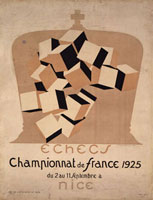
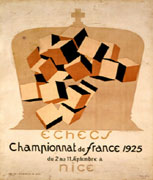
Duchamp claimed that he created his 1925 Poster for the Third French Chess Championship from a photograph (Fig. 1). Schwarz writes in his Catalogue Raisonne of Duchamp's works (708):
Duchamp's explanation, which sounds direct, simple and plausible, was the basis for the final drawing in which he colored the cubes beige, pinkish brown and black. This explanation has also remained unchallenged by scholars. Francis Naumann writes: "The position of the cubes--their three visible sides colored black, white and beige--was determined, as Duchamp later explained, by tossing them into the air and taking a picture" (101, 103).(2) If Duchamp's positioning of the cubes in his 1925 Chess Poster came "readymade" from a photograph that he took of tumbling blocks in a net, then we should be able to take various camera lenses used in 1925, place cubes in the positions depicted, and be able to generate a "photograph" matching Duchamp's poster. We tried this experiment using computer modeling and animation software, and made a surprising discovery. In order to co-exist simultaneously in the spatial position that Duchamp depicts in his poster, the individual cubes that Duchamp photographed would have to have interpenetrating surfaces, edges and vertices--a completely different scenario and physical reality from Duchamp's story of photographing free falling cubes.
Step 1 Look at the Poster itself
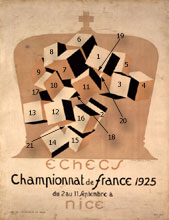
Examine Fig.
2 and more specifically cube 2 or cube 11. The shapes of
these cubes, as well as others, appear to be anomalous. In other words,
these objects are not symmetrical cubes with six square sides, at right
angles to each other and depicted with edges that follow all the rules
of perspective, as would be captured by a photographic lens. Cube #2's
black top-square appears smaller than the vertical length of its cream
colored square, instead of the same size and symmetrical as in our expectation
and prior experience of cubes drawn in perspective. We note the same
situation for cube 16. The pinkish brown cube's vertical square (on
the right side) seems taller than wide, when carefully compared to the
shape of the top black-square. The more you study these individual
cubes by observation alone, even without test or measure, the more maddening
the subtle feeling of contradiction becomes--from "yeah they're cubes"
to the eye, to "what the hell, something is wrong with these cube shapes
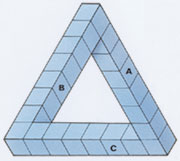
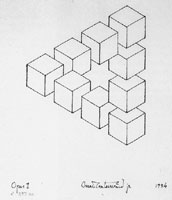
when I compare the squares to each other more carefully" in the mind. We noted the similarity between the shifting sense from distortion to regularity (or non-cubes to cubes) in Duchamp's Chess Poster, and a class of optical illusions called "impossible figures" and named by Penrose and Penrose in the 1950s (R. R. Shearer, "Marcel Duchamp's Impossible Bed and Other "Not" Readymade Objects," Part I and Part II)(3) (Fig. 3). "The Impossible Tri-Bar" discovered by Oscar Reutersvärd in 1934. Impossible Figures, such as this "Tri-Bar," characteristically capture us in a cycle of acceptance based on familiar visual cues, followed by a looping back to rejection resulting from nagging contradictory information. Then, after further mental examination, we again visually accept, but then again reject, what we see, ad infinitum. Nigel Rogers, in his book Incredible Optical Illusions, writes about the tri-bar Fig.: "All those sides appear to be perpendicular to each other and to form a neat, closed triangle. But when you add up the sums of their three right angled corners, you reach a total of 270 degrees -- that is 90 degrees more than is mathematically possible" (62).(4) In other words,
Reutersvärd squeezed into his representation (and to triangles themselves
which, in Euclidean space, are defined as limited to 180 degrees) more
degrees of freedom than would be allowed by real 3D space. The paradoxical
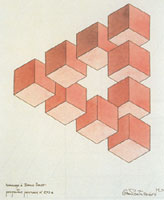
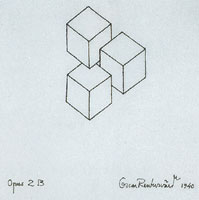
positionings in Reutersvärd's impossible cube drawings (1934, Fig.
4; 1934 Fig. 5; 1940 Fig.
6) remind one of Duchamp's 1925 chess poster cubes. In Fig.5,
as you look at the 3 cubes--you must ask how the 2 lower cubes can be
equal in height at the bottom and of such different heights at the top,
yet still be the same size all at the same time? Since Reutersvärd
has been credited as the first discoverer and developer of Impossible
Objects (before Escher in the 1950s), the chess poster indicates that
Duchamp himself was actually first, having predated Reutersvärd by at
least nine years. (Shearer previously argued that Duchamp's impossible
bed in the Apolinere Enameled work of 1916-17, indicates that
Duchamp already understood the concept of impossible objects, and the
optical illusions based upon them, 18 years before Reutersvärd's discovery
in 1934 (see Shearer
Part I and Part II.)
Step 2 Place blocks in position Using SoftImage
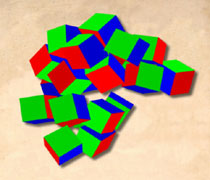
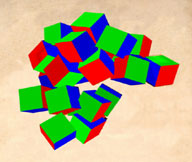
3D modeling and animation software as a tool, we placed 21 red/blue/green
blocks, following the pattern of the falling cubes in Duchamp's poster
(see Fig. 7A, a video computer animation
of our 3D model of red/blue/green shaded cubes, and Fig.
7B a comparison of the chess poster blocks.)
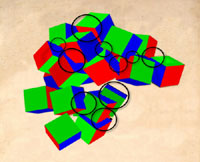
Step 3 Note and then characterize the differences in 10 locationsThe striking difference
in relationships among cubes that we immediately saw when we tried to
arrange our red/blue/green blocks into Duchamp's beige/pinkish brown/black
cubes pattern shows the necessity for imbedding the cubes into each
other. With this new arrangement, the odd distortions in the original
poster disappeared (see Fig. 8A and B,
a video animation that circles 10 embedded locations and then magnifies
the circled area, both in the original poster, and in our 3D model arrangement
for making comparisons, and a still image that can be enlarged for study.)
>>Next
Page 1 2
Notes
|
|||||||||||||||||||||||||||||||||||||||||||||