Response to “Boats & Deckchairs”

Dear Professors,

I am only vaguely familiar with the concept of the fourth dimension, and your fascinating essay in the January Natural History will encourage me to investigate it. I believe that you are away of some points that I would like to make and ignored them for brevity’s sake, but let’s see.

One of the overriding proposals of the essay was that we cannot view both sides of an object at the same time. Actually there are several ways that this would be accomplished, the simplest, by the used of a septum and mirrors. A more easily-understood way would be to use two fiberoptic endoscopes, each focused on opposite sides of the object, and each viewed simultaneously by opposite eyes as follows (I’ll use a sphere since my drawings of cubes, viewed on opposite corners, appear confusing).

Note, however, that even though we have provided the brain with the simultaneous view of each side of the object, we have not enhanced the three-dimensional view into a fourth dimension. In fact, with no common detail visible to each eye, the percept is either diplopia if the two sides are too dissimilar, or fusion to a single, flat, two-dimensional disc.

The hand has many individual tactile sensors, which contribute to the 4-dimensional mental image of the penknife that the brain is programmed to interpret. If A-square were a Cyclops, he could not have appreciated the new stereoscopic view provided by the sphere; there are monocular clues to depth, but the 3-dimensional appreciation requires binocularity. Similarly, we are limited by the bilaterality of the visual system to a maximum view of three dimensions. By my calculation, four eyes, on flexible stalks, and the necessary brain functions to interpret the images would be the minimum requirement. (But you know, I really do not have any trouble visualizing this when I conceive of it this way, with four eyes and four endoscopes, perhaps because of my training. And I do recognize that we are minimizing the spatial elements in these examples).

There are two issues that I need to investigate regarding the 4th dimension. First, why is it necessary to understand it in visual terms, particularly human vision? Is this just a prejudice based on our human emphasis on vision? Why isn’t the hand/penknife example adequate, as it appears to be to me? Secondly, is this all very simplistic? Do we also have to incorporate a view from both insides as well as from the outside of an object to attain appreciation of the fourth dimension?

I better go dig out my old textbooks or hit the library.

Sincerely,

James L. Schmitt, O.D.
Muncy, Pennsylvania


Response to “‘Infusion Ball’ or ‘Holy Ampule’?”


click to enlarge
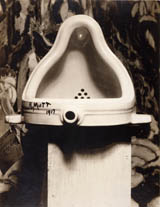
Fountain
Marcel Duchamp,Fountain,
1917 © 2000 Succession Marcel
Duchamp ARS, N.Y./ADAGP, Paris
Trébuche
t (Trap)
Marcel Duchamp,Trébuche
t (Trap), 1917 © 2000 Succession
Marcel Duchamp ARS,
N.Y./ADAGP, Paris.

Hat Rack
Marcel Duchamp,
Hat Rack, 1917
© 2000 Succession
Marcel Duchamp ARS,
N.Y./ADAGP, Paris.

We truly appreciate the effort that you made to research the historical context for Duchamp’s alleged “Paris Air Medical Ampule.”

Despite Duchamp’s contention that his objects were mass-produced readymades, the fact remains that no exact duplicate exists for any of his productions in the historical record. No scholar has ever found — in any museum catalogue or collection, or dealers’ storerooms — any exact object (urinal, coatrack, hatrack, etc.) that, according to Duchamp’s claims, was mass produced, store bought and readymade. Is this not strange? If an object is mass produced, by definition and logic, the attempt to find a duplicate design should not be analogous to searching for a needle in a haystack or scraping the bottom of a barrel, as has been the case.

So little evidence exists for the art historical othodoxy’s assumption — namely, that readymades are mass produced, and were therefore readily found in stores. Therefore, a reversal of the typical question of evidence about the status of Duchamp’s objects must be proposed. We should be persuaded by, and judge only by, direct evidence any claim that Duchamp objects are, in fact, readymade.

Using three illustrations of infusion devises, your letter lists three criteria met by Duchamp’s ampule in your judgement.

1. A closed vessel for sterilization
2.It can be used as an infusion system (with a bottom to break for connection to a tube)
3.”Convenient apparatus to hang over the patient’s bed because of the glass hook”

Yet when I look at your three illustrations, I fail to follow your conclusion that the Paris Air ampule “combines all three functions in one piece made of the same uniform material.”

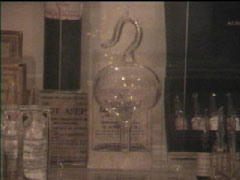
Figure 1 does not have a glass hook and, like Figure 2, is safely and securely held by a metal clasp. Therefore the hook and the ampule are separate, not uniform materials as in Duchamp’s ampules. Indeed, Figure 3 is very suggestive — but unlike Figure 1 and 2, which appear to be accurate technical drawings from medical catalogues, Figure 3 with its inclusion of a hanging curtain and rough, hand-drawn quality is unclear. Considering Figure 3‘s earlier 19th century date, this device was replaced by more practical and safe designs shown inFigure 1 and 2. The cylinder form of Figure 2 shares, with the mass-produced ampules developed in France during the first years of the 20th century, a shape that can be safely packed into boxed rows (see my Illustration A of an early 20th century ampule mass-production factory).


click to enlarge
A
factory mass-producing ampules
Illustration A
Photograph showing a
factory mass-producing ampules,
France, early 20th century

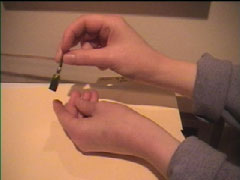
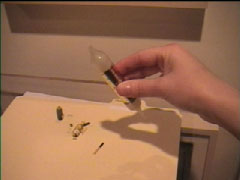
I have handled many European and American ampules and have “opened” them (see video). It would have been very tricky to attach a hose to the jagged end of an ampule. If indeed a glass hook was ever incorporated (as Figure 3 is unclear), the motion of a patient’s arm would have led to stress on a glass hook that would likely cause it to break or become dislodged. Logic and practicality would lead to the further development of a metal, not a glass hook — as shown by the historical chronology held within your illustrations, beginning with Figure 3, then Figure 1, and Figure 2 as the most historically recent in the series.

But let’s say that you are correct and that Figure 3 was among the early experiments in hand-made infusion devises that Duchamp saw hanging in a pharmacy as an “old pharmaceutical/medical instrument for decoration” (as you write). Is this one-of-a kind and obsolete hand-made infusion ampule to be accepted by us as evidence of Duchamp’s use of a mass produced, easily found, store-bought readymade object?

As to size, I believe that the facts about sizes of infusion balls actually used and made would be extremely important to know. For example, what if infusion ampules — even early custom-made ones — were only more than 125 cc in volume? This fact would further indicate that Duchamp had his own ampule made. Or on the contrary, if you discovered that infusion ball ampules were only made in 35 cc and 125 cc in volume, this would suggest that Duchamp exploited the two standard sizes for his original 1919 and 1941 Boite en Valiseversions, etc. Furthermore, we have testimony by experts that a pharmacist would not have needed unusual skills to convert a mass-produced ampule into a custom-made version similar to Duchamp’s larger 1919 and smaller 1941 Paris Air objects. In fact, Duchamp tells us that he had his 1941 ampules version custom made.

  • Click image for video (QT 2.6MB)
  • Click image for video (QT 2.6MB)
  • Click image for video (QT 2.0MB)
  • Demonstration of the
    breaking of two antique
    ampules at the Art Science
    Research Laboratory, NY
  • More contemporary ampule
    (with thicker glass)
  • Display of various antique
    ampules at ASRL, NY

I believe that the question of Duchamp’s readymade ampule is very much aided by your research, but must still continue! I would love to find out more about infusion devices. If, in fact, infusion balls were “available in a great variety of sizes for different medical indications,” evidence and images of mass-produced infusion balls matching Duchamp’s Paris Air (1919) should readily be found, and should now be in the historical record in a duplicate form, not just as resemblances. A duplicate of Paris Air (1919) (alas, for people who want to believe in readymades) has not yet been found. We may be facing another Loch Ness monster or Big Foot. People will believe that Duchamp’s Paris Air (1919) ampule was a mass-produced readymade even in the face of little or no evidence.


The State of Duchamp Studies in the New Millenium


click to enlarge
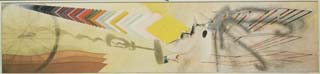
Marcel Duchamp,Tu m'
Marcel Duchamp, Tu m’, 1918 / ©
2000 Succession Marcel Duchamp,
ARS, N.Y./ADAGP, Paris.
(The overall design of
Tout-Fait Volume 1 is based
on the above, Duchamp’s last painting.)

Dear Reader,

When we started Tout-Fait last December we could not have possibly imagined such a positive response! Featured as a selected website by the New York Times, our Marcel Duchamp Studies Online Journal has had more than 11,000 visits from all around the world within its first four months in existence. Each day, we receive inquiries, tips and critical thoughts from an ever-growing network of readers interested in Duchamp and twentieth century art. While we were modest enough to think that our ‘Notes’ section only humbly adds to Duchamp scholarship, it was a pleasant surprise when we learned that Artforum referred to them as “earth-shattering news item[s]”(full text) in a recent review of Tout-Fait.

We are now happy to announce the second issue with contributions from Duchampians Hector Obalk, Dieter Daniels and Hans de Wolf, and a presentation of the by now “historic” computer animation of the Large Glass by Jean Suquet. This time around, Stephen Jay Gould taps into Duchamp’s “Artful Wordplays” and with “Duchamp Bottles Belle Greene: Just Desserts for his Canning” Bonnie Garner adds an interesting twist to the character of Rrose Sélavy. Our interview presents an incredibly vital Charles Henri Ford, who sixty years ago founded View, America’s first avant-garde magazine. Another contribution sheds some light on the naming of the Cassandra Foundation that delivered Duchamp’s posthumously revealed Étant Donnés to the Philadelphia Museum of Art. Further notes, articles and animations revolve around chess, the Large Glass, the relationship between Cage and Duchamp, his “financial documents” and much more.

New features include our ‘Art & Literature’ section, complete with a new* translation of Robert Lebel’s “L’Inventeur du temps gratuit” and other contributions by Madeline Gins and Dove Bradshaw, as well as by J. Bronowski, the first translator of Duchamp’s notes. The ‘Letters’ square makes room for valuable comments, while the contact us link at the bottom of every page enables our readers to forward their thoughts, join the guestlist or post messages on our Bulletin Board. We’re always open to your suggestions and ideas. Through ‘Back Issues,’ previous numbers of Tout-Fait may always be accessed.

Regarding the state of Duchamp studies, the new millenium seems off to a good start. So far, publications by Jean Clair, Didier Ottinger, Richard Hamilton, as well as Léon Altenbaum’s edition of the correspondence between Duchamp and Hélion have appeared this year. Further books on the an-artist by Molly Nesbit, Hector Obalk, André Gervais and Herbert Molderings are scheduled to be published soon. With Duchamp exhibitions from Paris to Ljubliana, and already two major symposiums devoted to him at Yale and the San Francisco Museum of Art, no holds seem to be barred. Joining us on the web is the French Duchamp studies journal Étant Donné, whose second issue appeared in March this year. For more Duchamp related websites, click here for links.

Once again, we would like to express our gratitude to Jacqueline Matisse-Monnier for her continuing support. A big “Thank You!” also goes out to Tout-Fait’s senior advisor André Gervais for his generous help at late hours and last minutes.

Enjoy browsing, stay a while and spread the word.

Thomas Girst
Editor-in-Chief

* We thank David Westling for informing us that a first translation of “L’Inventeur du temps gratuit” was originally published in: J.H. Matthews, The Custom House of Desire: A Half-Century of Surrealist Stories (Berkeley: University of California Press, 1975), pp. 150-160.

Tout-Fait is published by the CyberArtSciencePress,
the publishing branch of the not-for-profit
Art Science Research Laboratory, Inc.,
62 Greene Street, Third Floor, New York, New York 10012
Toutfait welcomes any type
of critical thinking. Multiple authorship is encouraged. All articles
are first publications. All accepted foreign submissions will
be published in both English and their original language.
Tout-Fait (ISSN 1530-0323) is published by CyberArtSciencePress , the publishing house of the not-for-profit
Art Science Research Laboratory
.
We welcome donations!

©2000 Art Science Research Laboratory, Inc.


The 1913 “Armory Show” comes ALIVE!

click each image to see animation

  • Rude Descending
    Animation 1.
    Junghee Choi and
    Rhonda R Shearer
  • The Original Cubist
    Animation 2.
    Junghee Choi and
    Rhonda R Shearer
  • 

Art at the Armory by Powers
    Animation 3.
    Junghee Choi and
    Rhonda R Shearer
  • Animated photograph of the Armory Show
    Animation 4.
    Alvarez Greg and
    Rhonda R Shearer
  • Nude Descending (animated)
    Animation 5.
    Junghee Choi and
    Rhonda R Shearer

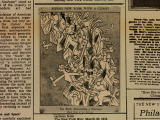
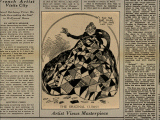
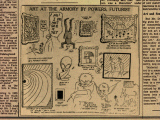
“CUBIST ART IS HERE AS CLEAR AS MUD,” the Chicago Herald-Tribune blasted in 1913. Chicagoans did not understand the new, European modernist art any more than New Yorkers did when the famous Armory Show arrived that same year. It is easy to forget that futurist, cubist and post-impressionist art once provoked a reaction similar to the recent Brooklyn “Sensation Exhibition” sensation. Rudy Giuliani is only a mayor creating a fuss after all. When the Armory Show hit the Big Apple, former President Teddy Roosevelt weighed in by writing that Duchamp’s Nude Descending looked to him like a Navajo Indian rug. See Choi and Shearer’s Animation #4 which attempts to visualize for the Tout-Fait reader this “bully for you” former president’s intrepretation of Duchamp’s work. Choi and Shearer hope that the three newspaper cartoons when transformed into animations will give spectators (Duchamp’s word) a more enlivened sense of the public’s reaction and commentary than what is normally rendered by static, historical images.

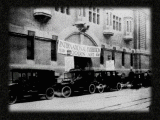
For example, in Animation 1,2 and 3, spectators will find, respectively, the moving confusion of a crowded subway escalator filled with rude New Yorkers; the prototype of bad boy cubists (which is a quilt making Grandma); and a frustrated New York gent literally flipping his “lid” and standing on his head but still not “getting” it. Finally, Alverez and Shearer’s development of Animation 5 — using the classic Armory still photo showing old cars and horse carriages waiting for patrons to return from seeing the scandal — takes advantage of the latest in animation technology and after-effects to emphasize what we most forget when we now look at modernist works: it was a much different “high button shoe/top hat world” in 1913 when Duchamp`s works first came to town…”Hey watch the horse shit.”


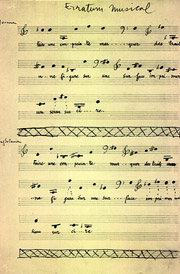
Erratum Musical, 1913

One can look at seeing; one can not hear hearing.
-Marcel Duchamp, Green Box, 1934

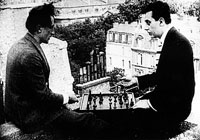
“One way to study music: study Duchamp.” An impressive line John Cage once mentioned. The friendship between these two creative minds reveals their mutual concern with the conventional perception both on the artistic creation and the spectator’s expectation. To Cage, for instance, silence was a compositional tool, a vivid explanation of what can be music. For Duchamp, however, making music meant going beyond the technical exploration of musical composition. Duchamp explored whether one is able to visualize sound and combine it with language by playing music in a random kind of order, in other words, to create something artistic by chance.


click to enlarge
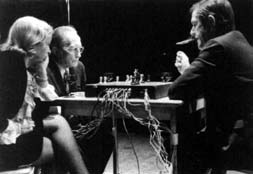
Duchamp, Teeny, and Cage playing chess, 1968
A scene of Duchamp,
Teeny, and Cage playing
chess in a performance,
Sightssoundsystems, a
festival of art and
technology in Toronto,1968

Duchamp’s first musical work, Erratum Musical, is a score for three voices derived from the chance procedure. During a New Year’s visit in Rouen in 1913, he composed this vocal piece with his two sisters, Yvonne and Magdeleine, both musicians. They randomly picked up twenty-five notes from a hat ranging from F below middle C up to high F. The notes then were recorded in the score according to the sequence of the drawing. The three vocal parts of Erratum Musical are marked in sequence as “Yvonne,” “Magdeleine” and “Marcel.” (Duchamp replaced the highest notes with the lower ones in order to make the piece singable for a male voice.) The words that accompanied the music were from a dictionary’s definition of “imprimer” – Faire une empreinte; marquer des traits; une figure sur une surface; imprimer un scau sur cire (To make an imprint; mark with lines; a figure on a surface; impress a seal in wax).

The title “Erratum Musical” can be translated as “musical misprint.” Thus, the book or “text” and the title conjure a dialectic relation between seeing and hearing. Picked from a dictionary, the “text” itself is already a readymade. Through a random order, the meaning of the text/readymade is reproduced and transformed by the repetition of the text.


click to enlarge
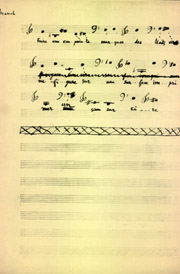
Erratum Musical, 1934Erratum Musical, 1934
Erratum Musical, From
the Green Box, 193

The final representation of this musical “visualizes” the process of hearing a scene of imaginative landscape, as if one is able to see the music through its vocal expression, through its performance or individual interpretation. In other words, the aesthetic experience of listening to a piece of music is transformed into an abstract experience of experiencing an abstract space. One seems to be able to sense the existence of a space in terms of the flow of the layering of the rhythms/voices. Furthermore — and what is very intriguing — this sense of space visualized by the sound/music seems analogous to an abstract experience of a sculptural space. In this case, Duchamp let chance be the creator and make the final decision.

Erratum Musical was first performed publicly by the Dada artist Marguerite Buffet at theManifestation of Dada on March 27, 1920. This earliest performance resulted with restless rustling, shouts and whistles from the audience. The version playing here was from the CD entitled “Marcel Duchamp / The Creative Act,” 1994, No. 6 Erratum Musical (1:38), with Jean-Luc Plouvier as Marcel, Marianne Pousseur as Yvonne and Lucy Grauman as Magdeleine. They perform the three voices simultaneously in different tones. Through the combination of high/low, near/far of the singing, Erratum Musical is visualized/sculpturalized as though one can sense a space contained in its experimental musical landscape. Although Erratum Musical was created in the early 20th century, it is still fully functional to challenge the conventional experience and the musical connoisseurship of today’s general audience.

< Music >

Marcel, Yvonne and Magdeleine Duchamp: Erratum Musical


Le Picadilly by Erik Satie (1866-1925)


click to enlarge

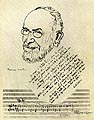
Portrait of Erik Satie

Portrait of Erik Satie
© 1999 Archives Erik Satie, Paris

Satie, a French composer, studied music at the Paris Conservatory Schola Cantorum. He was the pupil of Vincent D’Indy and Albert Roussel.

Against the romantic Wagnerian style which was incapable of expressing a French sensibility, Satie developed a controlled, abstract and seemingly simple style. His music, in general, features a removed, unaffected beauty. Although his early works anticipate the harmonic innovations of some impressionists, such as Debussy and Ravel, his later compositions foretell the neoclassicism of the early 20th century. Satie often disguised his artistic intention with comical humor, adding nonsense programs or whimsical titles such asThree Pieces in the Shape of a Pear (1918). The “avant-garde” in Satie’s aesthetics is found not in his often very bland music but in the ways that his compositional simplicity challenged the ultra-seriousness of the musical establishment.


click to enlarge

Duchamp and Man Ray

Marcel Duchamp and Man
Ray in René Clair’s
1924 film Entr’acte

Clair, Satie, and Picabia

Clair,Satie, and Picabia
during the filming
of Entr’acte, 1924

A widely experimental musician, Satie composed a musical score in 1924 for a twenty-two minute avant-garde film entitled ENTR’ACTE, written and produced by Francis Picabia, directed by René Clair. The cast of the short film included Marcel Duchamp, Man Ray and Satie himself. It was the first time a “shot-by-shot” musical composition had been written for a film. Satie meticulously examined the film and wrote a composition designed to synchronize exactly with it and to have rhythms match the flow of the editing of the film. It is certain that none of the artists involved in the film were interested in providing the audience something that was expected. (They used an element of pleasant rather than unpleasant surprise.) The music of Satie was recorded by Henri Sauguet and added to the silent print in 1967.

The music playing here is cited from SATIE/3Gymnopédies & Other Piano Works, 1984, no. 17 – Le Picadilly. Beginning in 1888, Satie was a pianist in a number of Montmartre cafés (which were the meeting places of musicians as well as of writers and painters.) Around 1900, he produced several first-rate café songs. Le Picadilly is one of the music-hall pieces composed during this period. Satie’s contribution to the world of popular entertainment was substantial.


click to enlarge

Erik Satie by Francis Picabia

Erik Satie by Francis Picabia

It is hard for us now to imagine how astonished the Paris audience must have been with Satie’s music which was so different from the lush compositions of his peers, Franck and Saint-Saens. Satie’s audience must have been especially astonished when the music they heard was accompanied by the composer’s bizarre titles and performance instructions. Yet Satie’s compositions are still unlike anything else in the piano literature and still full of touching and evocative delight and charm.

< Music >

Erik Satie: Le Picadilly


Why Tout-Fait?


click to enlarge
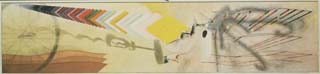
Tu m', 1918
© 1999 Succession Marcel Duchamp, ARS, N.Y./ADAGP,
Paris. Tu m’, 1918

Welcome to the inaugural issue of Tout-Fait: The Marcel Duchamp Studies Online Journal. About six months ago, we sent word to Duchamp scholars, scientists and art historians around the world introducing the idea of the first online journal devoted to Marcel Duchamp and his circle. We are very pleased to announce the arrival of Issue #1, including articles and notes by Craig Adcock, André Gervais and Francis M. Naumann. Tout-Fait’s News section features the collaboration of Rhonda Roland Shearer, Stephen Jay Gould and noted conservators on important findings on Duchamp’s Standard Stoppages (1913/14) and his Green Box of 1934. Artists William Anastasi and Donald Shambroom tackle questions of glass and cracks throughout Duchamp’s oeuvre. And we are honored to present Jean Suquet’s The Large Glass. A Guided Tour (1992) in both French and English. Like André Gervais, Suquet is a poet as well as art historian and greatly adds another dimension to Duchamp scholarship.

You may wonder, why “Tout-Fait”? The term “tout fait” was not only the standard French translation for ready made but also a phrase often used by the French mathematician Henri Poincaré who was a crucial influence on Duchamp. Rhonda Roland Shearer first commented upon the term in The Sciences and it was recently picked up by Thomas Zaunschirm in the Neue Zürcher Zeitung and Barry Cipra in Science. After heavily debating about twenty other suggestions (among them The Oculist Witness, Mirrorical Messenger and The Sunny Apprentice) as well as Duchamp’s idea for Space Art News (expressed in a letter to Marcel Jean, 4 August 1955), we finally agreed on “Tout-Fait,” highlighting the intersection of art and science.

As every Duchamp afficionado might have noticed right away, the colorful squares of Tout-Fait’s design are loosely based on the sequence of rectangular shapes (reminiscent of a book of color filters for light experiments or photography) in Duchamp’s last painting, Tu m’ of 1918. Tout-Fait’s next issue will feature more squares, making room for literature, streaming video, our tri-annual centerfold and a ‘Letters to the Editor’ section. For letters intended for publication, criticism and suggestions or any technical problems, please contact us directly at info@toutfait.com.(Note: e-mails which were sent to info@toutfait.com and editor@toutfait.com were never received. Those are invalid accounts and we are sorry for any confusion this may have caused.) To start or participate in a dialogue regarding Tout-Fait and related matters, we suggest using the
Critical Notes Bulletin Board of the Marcel Duchamp World Community as a forum to generate any kind of discussion. Feel free to post your thoughts!

A strictly not-for-profit journal, Tout-Fait is made possible by a team effort of writers, editors and web designers and relies on the commitment of our readers and the kind support of individuals to keep it up and running. In particular, we wish to thank Jacqueline Matisse-Monnier for her interest and substantial support of this project. Many thanks also to Tim Kummerow on the West Coast for his unfailing collaboration and computer wizardry.

Enjoy browsing, stay a while and spread the word.

Thomas Girst
Editor-in-Chief

For more Duchamp related websites, click here for links.

Tout-Fait is published by the CyberArtSciencePress,
the publishing branch of the not-for-profit
Art Science Research Laboratory, Inc.,
62 Greene Street, Third Floor, New York, New York 10012

Tout-Fait welcomes any type
of critical thinking. Multiple authorship is encouraged. All articles are first publications. All accepted foreign submissions will be published in both English and their original language. Tout-Fait (ISSN 1530-0323) is published by CyberArtSciencePress , the publishing house of the not-for-profit
Art Science Research Laboratory
.
We welcome donations!

©1999 Art Science Research Laboratory, Inc.


Pour un portrait de Marcel Duchamp: “disent les dédicaces”

Il est impossible actuellement de rassembler dans son intégralité, voire de reconstituer dans son intégrité, la bibliothèque de Marcel Duchamp. Et peut-être en sera-t-il à jamais ainsi, l’homme ayant habité longtemps dans de petits appartements ou à l’hôtel, et s’étant aussi beaucoup déplacé sur deux continents. Cette précarité n’a certainement pas favorisé le développement et la conservation de quelque collection que ce soit, sauf peut-être celle, durant les années 1920, en pleine période échiquéenne – après qu’en 1923 il ait laissé inachevé le Grand Verre -, d’une collection d’oeuvres d’art: Picabia et Brancusi. Mais ceci est déjà une autre question.

Cependant, il n’est pas interdit de penser qu’il faudra tenter de rassembler, au moins dans une liste, l’ensemble le plus complet de titres d’imprimés qui ont pu, à une époque ou à une autre, le “rejoindre “: il les a conservés, sa famille, ses amis ou ses compagnes les ont conservés (et peuvent en témoigner d’une façon ou d’une autre), il les mentionne dans ses écrits ou ses parlés, etc. Immense travail qui ne fait que commencer et qui ne peut être mené à bien que lentement.

Dans cet ensemble, il est d’ores et déjà possible de délimiter un sous-ensemble: celui des exemplaires qui lui ont été dédicacés.(1) La “constellation ” que forment ces livres marqués d’un ajout manuscrit (et même, dans certains cas, pictural) est précieuse en ce qu’elle permet de constituer, par le “titre ” dont ils affublent le dédicataire, un portrait de celui-ci.(2)

Sans, donc, la moindre exhaustivité, je n’aborderai rapidement que quelques dédicaces choisies parmi celles que je connais. Une seule, la dernière, n’est pas inédite.(3)

***

Je commencerai, tout simplement, par une dédicace non datée (mais vraisemblablement de 1948, date de la publication du livre) d’un vieux complice, André Breton (1896-1966):

À Marcel Duchamp
ce petit papillon exotique
qu’on invite à ne pas trop
insister à sa fenêtre,
à l’Ami numéro 1

– Martinique charmeuse de serpents. Paris: Ed. du Sagittaire, 1948. [Printing was completed on 25 August 1948].

Lors de son séjour en Amérique du Nord (1941-1946), Breton, qui ne parle pas anglais et vit à New York dans le milieu des intellectuels français exilés (dont Marcel Duchamp, à partir de 1942), n’hésitera pas à faire quelques voyages en territoire francophone: Martinique (avril-mai 1941), Province de Québec (août-novembre 1944) et Haïti (décembre 1945-février 1946).(4) C’est donc lors d’un de ces voyages qu’est amorcé ce recueil, mixte de proses et de poèmes d’André Breton et d’André Masson, qui ne sera publié qu’après son retour à Paris alors que Duchamp, “l’Ami numéro 1”, sera déjà de retour aux États-Unis.

À l’automne 1960, Duchamp dira ceci de cette longue amitié (ils se connaissent depuis l’été 1921): “Une grande sympathie avec Breton. Il y avait une sympathie comme avec Picabia. Une sympathie d’homme à homme, plutôt que de théorie à théorie.” (5) Quant au motif de la fenêtre, il n’est pas inutile de rappeler qu’il permet d’unir les deux hommes: Breton par sa réflexion sur telle phrase automatiquement écrite (“quelque chose comme: ‘Il y a un homme coupé en deux par la fenêtre’ “, Manifeste du surréalisme, 1924), Breton et Duchamp par Au lavoir noir (1936), poème du premier illustré par une fenêtre (La bagarre d’Austerlitz, readymade, 1921) du second.

***

Quand, en 1954, Robert Lebel (1901-1986) demande à André Breton une préface pour son prochain livre, Chantage de la beauté, il a déjà commencé à travailler à la biographie et au catalogue que sera Sur Marcel Duchamp, le livre suivant.(6)

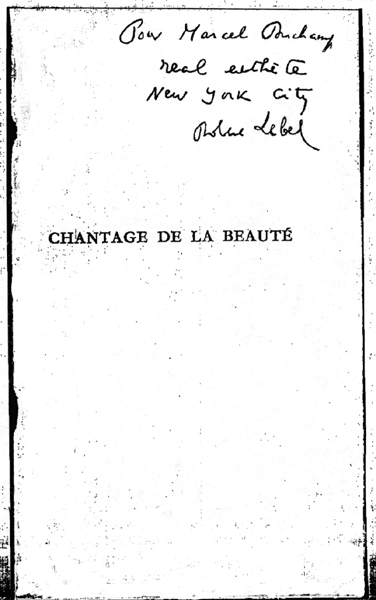
Breton écrira cette préface en novembre 1954 et le livre paraîtra à Paris aux Éd. de Beaune en avril 1955.(7)Lebel l’enverra à Duchamp avec cette dédicace: “Pour Marcel Duchamp / real esthète / New York City / Robert Lebel,” qui répondra par lettre (4 août 1955) ceci:

Cher Lebel

Bien reçu Chantage que j’ai lu comme je lis Platon càd à grande allure – Nevertheless il m’en reste beaucoup collé à matière grise.

Duchamp, qui a fait, début juillet, deux jours de tournage au Philadelphia Museum of Art avec James Johnson Sweeney(8), se repose alors pendant quelques semaines à East Hampton (Long Island), dans la petite maison d’une amie de son épouse.(9)

Le rapport entre l’artiste et le spectateur, analysé avec élégance et verdeur dans ce petit livre, est aussi une question débattue par Duchamp lui-même:

– dans une lettre à son beau-frère Jean Crotti, 17 août 1952, publiée dans le catalogue de l’exposition Jean Crotti (Musée Galleria, Paris, 11 décembre 1959-11 janvier 1960:

Les artistes de tout temps sont comme des joueurs de Monte-Carlo et la loterie aveugle fait sortir les uns et ruine les autres. […]
Je ne crois pas à la peinture en soi. Tout tableau est fait non pas par le peintre mais par ceux qui le regardent et lui accordent leurs faveurs […].

– dans une entrevue avec Jean Schuster, faite en janvier 1955 et publiée dans Le surréalisme, même (Paris, n° 2, printemps 1957):

Ce sont les REGARDEURS qui font les tableaux.

– dans une lettre à Jehan Mayoux, 8 mars 1956, publiée dans son livre La liberté une et divisible. Textes critiques et politiques (Ussel, Éd. Peralta, 1979):

[…] une oeuvre est faite entièrement par ceux qui la regardent ou la lisent et la font survivre par leurs acclamations ou même leur condamnation.

– dans Le processus créatif, brève communication rédigée en anglais en janvier 1957, donnée à Houston en avril 1957 et publiée dans Art News (New York, n° 4, été 1957):

Somme toute, l’artiste n’est pas seul à accomplir l’acte de création car le spectateur établit le contact de l’oeuvre avec le monde extérieur en déchiffrant et en interprétant ses qualifications profondes et par là ajoute sa propre contribution au processus créatif.

All in all, the creative act is not performed by the artist alone; the spectator brings the work into contact with the external world through deciphering and interpreting the painting=s profundity and, in this way, makes a contribution to the creative act.

Comme on le constate, aucun de ces écrits ou parlés n’était connu lors de la publication du livre de Lebel qui, sur cette question, s’oppose et s’opposera à la position radicale de Duchamp:

– ici même (p. 11-12):

Tantôt, on est amené à le [l’artiste] concevoir comme pure végétation: c’est “l’amandier qui fait sa fleur.” Tantôt, dans l’hypothèse la plus favorable à la portée de son intervention, son oeuvre est un essai, une sorte d’intentionnalité timide, une requête, un projet encore amorphe, indéterminé dont il ne connaît pas lui-même la teneur et qu’il soumet, comme humblement, à l’approbation des autres. […]
Le rôle du spectateur est ainsi démesurément enflé. Quant à l’artiste, il est purement et simplement confondu avec l’objet qu’il présente.
– dans “Note pour un post-Duchamp,” article rédigé en 1974 et publié dans Marcel Duchamp (Paris, Belfond, coll. “Les dossiers,” 1985):

Le débat est ouvert entre les “regardeurs,” auxquels il a imprudemment délégué tous pouvoirs et qui sont aujourd’hui maîtres du terrain

Le spectateur (qui regarde) et le maître (qui possède) peuvent, bien sûr, ne faire qu’un. Le “moment crucial où toute valeur se constitue, lorsqu’à l’écart des chemins déjà frayés et des réputations établies, l’oeuvre entre pour la première fois en contact avec le premier spectateur” (p. 14), doit nécessairement être distingué du moment où le maître, qui parle “l’idiome de l’esthète,” “n’hésite pas à [se] séparer [de ses chevaux, ses oeuvres d’art ou ses femmes], sans jamais perdre la notion de leur valeur vénale” (p. 10): lorsque la valeur devient une valeur vénale.

De son côté, l’artiste “est un homme qui réalise plastiquement l’attitude qu’en fait il ne peut pas atteindre. […] La plupart des peintres religieux se sont délivrés par leurs oeuvres de la tentation de la sainteté. Inversement, comme le montre avec éclat Marcel Duchamp, c’est en accédant à un comportement autonome qu’un artiste peut s’affranchir de l’art”(p. 23). Mais Duchamp, “real esthète” dit la dédicace, est aussi l’inverse de Van Gogh dont “la conduite réelle prend le pas sur sa représentation. Ce qu’il peint, c’est Van Gogh aux prises avec le monde, non la conduite de Van Gogh que l’artiste s’avoue incapable d’atteindre et, par suite, de proposer”(p. 24). Si Van Gogh, “suicidé de la société”a dit Artaud (10)], “refuse de combler esthétiquement l’écart qui sépare normalement l’oeuvre-conduite [qu’il propose] de la conduite de fait [qu’il adopte personnellement]”(p. 24), Duchamp, “anartist” dira-t-il bientôt, n’est déjà plus dans cet enjeu.(11)]

Dans sa réponse “Nevertheless”(en anglais) est à “il m’en reste beaucoup collé à ma matière grise”(en français) ce que dans la dédicace “real” est à “esthète,” par cette distinction -dans les deux acceptions de ce mot B qu’il y a dans le passage. C’est aussi par l’angrais duchampien(12)] que “real esthète” ne doit surtout pas s’entendre real estate, “bien fonciers,” ou real estate agent, “agent immobilier”, Duchamp étant assez immobile “à grande allure” pour s’amuser d’un “agent immobilier”(13)] et assez “marchand du sel” pour s’amuser de la couleur “bien foncée” d’un “chantage” (blackmail)(14)].

Si les rapports de Duchamp avec la philosophie (Platon) ou l’esthétique (Lebel) semblent expéditifs, à quelle vitesse a-t-il lu les livres scientifiques ou techniques (mathématiques, photographie, etc.) et la littérature (poésie, roman, etc.)? Peut-être qu’à cette question, qui désigne une longue pratique, il ne pourra jamais être donné une réponse vraiment satisfaisante et vraiment détaillée, trop de livres manquant dans sa bibliothèque en son état actuel, et trop d’indications manquant sur ce qu’il a pu consulter à la Bibliothèque Sainte-Geneviève quand il y travaillait comme stagiaire de 1913 à 1915, par exemple.

Ici, en tout cas, “real esthète” est ramassé en “reste,” et Platon est à l’ombre, cavalièrement, d’East Hampton.

***

Je continuerai avec deux dédicaces venues d=horizons tout à fait différents, mais qui se rejoignent dans la formulation exacte du “titre” dont elles gratifient Duchamp:
– la première est d’Alain Bosquet (1919-):

Pour Marcel Duchamp,
premier anarchiste
de notre temps –

– Premier testament. Paris: Gallimard, 1957 [Printing completed on 12 February 1957].

De Premier testament à “premier anarchiste,” bien sûr. Alain Bosquet, poète et romancier, est aussi l’auteur d’une Anthologie de la poésie américaine des origines à nos jours (Paris, Stock, 1956). Duchamp ne revenant à Paris qu=en 1958, c=est à New York qu=il envoie cet exemplaire.

– la deuxième est de Simon Watson Taylor:

Cette première exemplaire du
livre de la Science sortie de l’imprimerie
huit semaines avant la date de
publication est reservée pour
Marcel Duchamp, premier
pataphysicien de notre temps (et
de tous les autres, selon les
“valeurs equivalents” promulgés
par l’inventeur de la Science).
-Homages pataffectueuses de Simon Watson Taylor (vulg.) janv. 1965 ap. J.C.

Roger Shattuck [1923-] and Simon Watson Taylor [?-] (ed. by), Selected Works of Alfred Jarry, New York, Grove Press, Inc., 1965.

Taylor et Duchamp se connaissent depuis 1959, selon toute vraisemblance. Taylor, qui traduit alors l’Histoire de la peinture surréaliste de Marcel Jean et Arpad Mezei, présentera Shattuck à Duchamp en 1961.
De “première exemplaire” à “premier pataphysicien,” bien sûr. La surdétermination aura donc joué, côté Bosquet, du paratexte (le titre du livre) au paratexte (la dédicace d’exemplaire), côté Taylor, de la circonstance (la rapidité de l’impression) au paratexte.(15)] Mais est-ce délibéré si exemplaire, mot masculin, est devenu féminin, si valeur, mot féminin, est devenu masculin, si homage, mot masculin quand il est en français (hommage), est devenu féminin bien qu=il soit en anglais? Cette inversion du genre a-t-elle ici quelque rapport avec la ‘pataphysique’ – “science du particulier, quoi qu’on dise qu=il n’y a de science que du général?” Et pataffectueuses (pata comme préfixe) n’est-il pas un moyen de “répondre,” avec tout retard, à cette lettre de Duchamp (17 juin 1960) qui se terminait par cordiapata (pata comme suffixe)?

***

Je terminerai, tout simplement, par une dédicace non datée (mais vraisemblablement de 1937, date de la publication de ce tout petit livre) d=un inconnu, Jehan Mayoux (1904-1975):(16)]

À Marcel Duchamp
puisqu’il n’est pas un mythe
comme je l=ai longtemps cru mais
un homme – ce qui est tellement mieux
– Maïs, Paris, not on sale to the general public, 1937 [printing completed on 3 February 1937], reprinted in Oeuvres, tome 1, Ussel (Corrèze), Peralta Ed., 1976.
C’est à Jehan Mayoux (8 mars 1956), mais précédemment à Katherine Dreier (5 novembre 1928), à Magda et Walter Pach (17 octobre 1934), à Jean Crotti (17 août 1952), à Walter Arensberg (23 janvier 1954) et à André Breton (4 octobre 1954), que Duchamp aura écrit telles lettres particulièrement lucides et tranchées à propos de l’art et du langage, du marché de l’art, de la conservation de l’art et de l’interprétation de l’art.

Bien que Duchamp n’utilise pour ainsi dire jamais le mot homme, sauf dans un énoncé comme “There is no solution because there is no problem. Problem is the invention of man – it is nonsensical” (à Harriett et Sidney Janis, 1945) où il s’agit de l’homme et non d’un homme, il reste, pour ne donner qu’un exemple en forme de paradoxe, que cet homme qui pratiquait le silence (17)] aura finalement accepté que, d’entrevues en entretiens et de conversations en communications, se constitue une abondante oeuvre parlée.

Cette dédicace presque naïve, touchante même, faite plus de trente ans avant la mort de Duchamp, ne serait-elle pas toujours d’actualité, plus de trente ans après sa mort? Qu’est-ce qu’un mythe, en effet (18)], sinon, dans l’une de ses acceptions (et je cite, tout simplement, Le nouveau Petit Robert, 1993), une “image simplifiée, souvent illusoire, que des groupes humains élaborent ou acceptent au sujet d’un individu […] et qui joue un rôle déterminant dans leur comportement ou leur appréciation?” Mais ne faut-il pas obtenir, au point où nous en sommes, en cette fin de siècle, avec un être aussi complexe que Marcel Duchamp, artiste et anartiste français et américain, la plus grande précision possible quant à ce qu’il a fait et dit?


Notes

1. La dédicace d’exemplaire, autographe (et privée), à distinguer de la dédicace d’oeuvre, imprimée (et publique): on dit dédicacer un exemplaire, mais dédier une oeuvre. Et « du fait qu’il la représente, l’exemplaire vaut à la fois par et pour l’oeuvre », précise Gérard Genette, Seuils, Paris, Seuil, coll. « Poétique », 1987, p. 133. Ce livre est une étude du paratexte, que celui-ci soit « autour du texte, dans l’espace du même volume » (c’est le péritexte) ou « à distance plus respectueuse (ou plus prudente), […] à l’extérieur du livre » (c’est l’épitexte), péritexte et épitexte se partageant « exhaustivement et sans reste le champ spatial du paratexte » (p. 10 et 11). Autant la dédicace d’oeuvre que la dédicace d’exemplaire font partie du péritexte. Inversement, il faudra donc tenter de rassembler, au moins dans une liste, l’ensemble le plus complet de titres d’imprimés que Duchamp a pu, à une époque ou à une autre, dédicacer: Rrose Sélavy (1939); les petits livres publiés par PAB (1958-1960) et l’impliquant; Sur Marcel Duchamp (1959), le livre de Robert Lebel; The Bride Stripped Bare by Her Bachelors, Even (1960), le « green book » fait à partir de la Boîte Verte; etc.

2.Il ne serait pas inutile de comparer ces énoncés à ceux qu’on peut trouver, par exemple, dans divers témoignages publiés tant dans le catalogue de l’exposition du Museum of Modern Art et du Philadelphia Museum of Art (1973) que dans telle revue à l’occasion de l’exposition de Beaubourg (1977): voir d’une part « A Collective Portrait of Marcel Duchamp », p. 179-229, d’autre part « Faut-il vraiment vénérer Duchamp? » (dossier constitué par Philippe Sers), Connaissance des Arts, Paris, n° 299, janvier 1977, p. 46-55.

3.Elle est dans la collection Mary Reynolds et, à ce titre, a été publiée dans Hugh Edwards, Surrealism and its Affinities: The Mary Reynolds Collection, The Art Institute of Chicago, 1956. Les autres viennent des archives de la succession Marcel Duchamp, Villiers-sous-Grez.

4.C’est lors de ce séjour qu’il écrira sa dernière oeuvre «longue» (tous les autres livres qu’il publiera jusqu’à sa mort étant des recueils d’articles ou de poèmes): Arcane 17 ([décembre] 1944), qui clot le cycle des récits, commencé avec Nadja (1928) et continué avec Les vases communicants (1932) et L’amour fou (1937).

5.Georges Charbonnier, Entretiens avec Marcel Duchamp, Marseille, André Dimanche Éditeur, 1994, p. 72.

6.Commencé en 1953 et pour ainsi dire terminé en 1957, la traduction en anglais en vue d’une publication simultanée en deux langues en sera refaite par George Heard Hamilton en 1958, et cette publication aura effectivement lieu à Paris et à Londres (Trianon Press) ainsi qu’à New York (Grove Press) en 1959.

7.Le « Petit colloque initial » de Breton est aux p. 5-6, le texte de Lebel aux p. 7-27.

8.« A Conversation with Marcel Duchamp », Robert D. Graff réalisateur, NBC, New York, série « Elder Wise Men »; première diffusion: 15 janvier 1956.

9.Pendant six semaines, en fait: Duchamp revenant à New York le lundi 22 août, ce séjour a probablement commencé le lundi 11 juillet.

10.Antonin Artaud, Van Gogh, le suicidé de la société, Paris, K éditeur, 1947; repris dans Oeuvres complètes, tome X, Paris, Gallimard, 1974.

11.« I don’t mind being an anartist [Je veux bien être un anartiste] » (à Richard Hamilton, septembre 1959).

12.Mixte d’anglais et de français, l’angrais (terme proposé par moi en 1977) est à Duchamp ce que l’engrais est à du champ.

13.Cette façon d’être immobile « à grande allure » n’est pas sans convoquer, via tel important poème de Paul Valéry (« Le cimetière marin », strophe XXI, dans Charmes, 1922), tel fameux paradoxe sur le mouvement proposé par Zénon d’Élée (Ve siècle avant J.C., un demi-siècle avant Platon): « Achille immobile à grands pas ».

14.Je n’oublie pas ici, bien sûr, que Robert Lebel, essayiste, est aussi expert près les douanes françaises, et que Duchamp, artiste, comme son ami Roché, diariste, a aussi acheté et vendu bien des oeuvres d’art.

15. La circonstance peut être davantage précisée: cet exemplaire a été remis à Duchamp par Taylor, au nom du Collège de ‘Pataphysique, le 13 janvier exactement, lors du dîner suivant le vernissage (preview dinner) de l’exposition Not Seen and/or Less Seen of/by Marcel Duchamp/Rrose Sélavy 1904-1964, galerie Cordier & Ekstrom, New York, 14 janvier-13 février 1965.

16.Encore peu connu, Mayoux, qui sera successivement « instituteur, professeur et inspecteur de l’enseignement de premier degré » (dans le Nord, à l’époque de cette dédicace, puis en Corrèze), aura été emprisonné durant la Deuxième Guerre pour avoir refusé d’être mobilisé, puis sera suspendu durant la guerre d’Algérie pour avoir été l’un des signataires du « Manifeste des 121 » (septembre 1960) appelant au droit à l’insoumission. Je cite ici la brève notice que lui consacre Jean-Louis Bédouin dans La poésie surréaliste [1964], anthologie, édition revue et augmentée, Paris, Seghers, 1970, p. 227.

17.De Marcel Raval (« […] une oeuvre sévère, amie du silence: celle de Marcel Duchamp », Les Feuilles libres, Paris, n° 36, mars-juin 1924) à Joseph Beuys (« Das Schweigen von Marcel Duchamp wird überbewertet [Le silence de Marcel Duchamp est surestimé] », Düsseldorf, 11 décembre 1964), en passant par Andrew Forge (« The Silence of Marcel Duchamp », The Listener, Londres, 5 novembre 1959) et Georges Charbonnier (« Or, c’est le silence d’un peintre que nous voulons évoquer au cours de cette série d’émissions: le silence de Marcel Duchamp. […] Marcel Duchamp, en cessant de peindre, marquait-il un désaccord absolu? Avec quoi? Ces deux questions sont toujours présentes derrière toutes celles que nous avons posées […] »), cela aura été dit.

18. Sur cette question, voir l’important livre de Luc Brisson, Platon, les mots et les mythes, Paris, Maspero, coll. « Textes à l’appui », 1982. Et revoilà Platon!

For a Portrait of Marcel Duchamp:
“The Dedications Speak”


click to enlarge

It is currently impossible to gather in its entirety, indeed to reconstitute in its integrity, Marcel Duchamp’s book collection. And maybe this will forever be the case, given that the man lived in small apartments or hotels for long periods of time, and that he moved a lot between two continents. Certainly, this precariousness did not favor the preservation of any given collection, apart from maybe one during the 20’s in his chess-playing period (after he left The Large Glass unfinished, in 1923) – but that collection is of the artwork of Picabia and Brancusi and is a different question.

Meanwhile, the thought is not forbidden that one could attempt a complete collection, or at least the most thorough list, of all printed matter that could have been, at one time or another, connected with Duchamp: he preserved things, his family, friends and female companions preserved things (there is evidence of this), and Duchamp mentions these things in his writings, interviews, etc. It is immense work, just beginning, and must be taken slowly.

Within this ensemble, it is already possible to denote a sub-ensemble: those of the exemplars which were autographed to Duchamp.(1) The “constellation” formed by these books which have been marked with a handwritten addition (and even, in certain cases, a pictorial addition) is precious in that it allows us to make up a portrait of the dedicatee through the various “titles” he is given.(2)

Not in the slightest bit exhaustive, I will only rapidly tackle a few dedications chosen from among those I know. Only one, the last, has in fact been published.(3)

***

I will egin very simply with a non-dated dedication (but seemingly from 1948, ate of this book’s publication) from an old accomplice, André reton (1896-1966).

À Marcel DuchampCe petit papillon exotiqueQu’on invite à ne pas tropInsister à sa fenêtre
à l’Ami numéro 1
To Marcel Duchampthis little exotic butterfly that we invite not to insist too much at his window to the number 1 Friend

– Martinique charmeuse de serpents. Paris: Ed. du Sagittaire, 1948 [printing completed on 25 August 1948].

On the occasion of his stay in North America (1941-1946), Breton, who did not speak English and lived within a circle of exiled French intellectuals (including Marcel Duchamp from 1942 on) did not hesitate to visit French-speaking areas this side of the Atlantic: Martinique (April-May 1941), the Province of Quebec (August-November 1944) and Haïti (December 1945-February 1946).(4) It was during one of these trips that Martinique charmeuse de serpents, a collection of prose and poems by André Breton and André Masson, was initiated. It was then published after Breton’s return to Paris whilst Duchamp, “number 1 Friend,” was back in the United States.

In the autumn of 1960, Duchamp said of his longtime friendship with Breton (they had known each other since the summer of 1921): Une grande sympathie avec Breton. Il y avait une sympathie comme avec Picabia. Une sympathie d’homme à homme, plutôt que de théorie à théorie [A great sympathy with Breton. There was a sympathy as with Picabia. A sympathy from man to man, rather than
from theory to theory.](5) As for the window motif, it is worth remembering hat it allows us to bring these two men together. In 1924, Breton wrote he first Surrealist Manifesto in which he reflected on the automatically ritten sentence: quelque chose comme: ‘Il y a un homme coupé en deux par la fenêtre’ [something like: ‘there is a man cut in two by the window’]. Then in 1936, Breton wrote a poem, Au lavoir noir, which was illustrated by Duchamp with the reproduction of a window, La bagarre d’Austerlitz [Brawl at Austerlitz], a readymade (1921).

***

When, in 1954, Robert Lebel (1901-1986) asked André Breton to write a preface for his new book, Chantage de la beauté, Lebel had already started working on the biography and catalog that would be Sur Marcel Duchamp, his next book.(6)

Breton wrote the preface in November 1954 and the Editions de Beaune published the book in Paris in April 1955.(7) Lebel sent it to Duchamp with this dedication: Pour Marcel Duchamp / real esthète / New York City / Robert Lebel. [For Marcel Duchamp / real aesthete / New York City / Robert Lebel.] Duchamp would later respond via letter (4 August 1955):

Cher Lebel

Bien reçu Chantage que j’ai lu comme je lis Platon càd à grande allure – Nevertheless il m’en reste beaucoup collé à matière grise.

Dear Lebel

Received Chantage and have read it as I read Plato which is to say at great speed – Nevertheless there is a lot of it left stuck in my gray matter.

In early July, after two days of shooting at the Philadelphia Museum of Art with James Johnson Sweeney, Duchamp took a few weeks rest in East Hampton, NY, at the house of one of his wife’s friends.(8)

The relationship between the artist and the spectator, analyzed with elegance and earnestness in this little book, is also a question debated by Duchamp himself, as exemplified in the following:

– in a letter to his brother-in-law Jean Crotti, 17 August 1952, published in the Jean Crotti exhibition catalogue (Galleria Museum, Paris, December 1959-January 1960):

Les artistes de tout temps sont comme des joueurs de Monte-Carlo et la loterie aveugle fait sortir les uns et ruine les autres. […]Je ne crois pas à la peinture en soi. Tout tableau est fait non pas par le peintre mais par ceux qui le regardent et lui accordent leurs faveurs […].

Artists of all time are like gamblers in Monte-Carlo and a blind lottery draws certain ones and ruins the others. […]I do not believe in painting in itself. A painting is not made by the painter but by those who look at it and grant it their favor […]

– in an interview with Jean Schuster, January 1955, published in Le Surréalisme, même (Paris, no. 2, Spring 1957):

Ce sont les REGARDEURS qui font les tableaux.

It is the ONLOOKERS who make the paintings.

– in a letter to Jehan Mayoux, 8 March 1956, published in his book La Liberté une et divisible: Textes critiques et politiques (Ussel, Éd. Peralta, 1979).

[…] une oeuvre est faite entièrement par ceux qui la regardent ou la lisent et la font survivre par leurs acclamations ou même leur condamnation.

[…] a work is made entirely by those who look at it or read it and who make it survive by their accolades or even their condemnation.

– in The Creative Act, a brief paper written in English in January 1957, given in Houston in April 1957, and published in Art News (New York, no. 4, Summer 1957):

All in all, the creative act is not performed by the artist alone; the spectator brings the work in contact with the external world by deciphering and interpreting its inner qualifications and thus adds his contribution to the creative act.

As we can see, none of these writings or sayings were known of at the time that Lebel published his book and Lebel, on this question, was opposed and would continue to be opposed to Duchamp=s radical position. For example, on p. 11-12:

Tantôt, on est amené à le [l’artiste] concevoir comme pure végétation: c’est “l’amandier qui fait sa fleur.” Tantôt, dans l’hypothèse la plus favorable à la portée de son intervention, son oeuvre est un essai, une sorte d’intentionnalité timide, une requête, un projet encore amorphe, indéterminé dont il ne connaît pas lui-même la teneur et qu’il soumet, comme humblement, à l’approbation des autres. […]
Le rôle du spectateur est ainsi démesurément enflé. Quant à l’artiste, il est purement et simplement confondu avec l’objet qu’il présente.

Sometimes, we are brought to conceive of him [the artist] as of pure vegetation: he is the “almond tree which blossoms.” Sometimes, the hypothesis most favorable to his intervention is that his work is a trial, a kind of timid intentionality, a request, a still amorphous project, indeterminate and of which he does not himself know the content and which he submits, as if humbly, to others for approbation. […]
The role of the spectator is thus inordinately inflated. As for the artist, he is purely and simply mistaken for the object he presents.

And, for another example, in Note pour un post-Duchamp, an article written in 1974 and published in Marcel Duchamp (Paris, Belfond, coll. “Les Dossiers,” 1985):

Le débat est ouvert entre les * regardeurs +, auxquels il a imprudemment délégué tous pouvoirs et qui sont aujourd’hui maîtres du terrain.

The debate is open among the “onlookers,” to which he unwisely delegated full power and who are today in control of the ground.

The spectator (who looks) and the master (who possesses) can, of course, be one and the same. The “crucial moment when all worth constitutes itself [is the moment when], well away from already cleared paths and established reputations, the work enters into contact with a spectator for the first time” and must necessarily be distinguished from the moment when the master, who speaks the “aesthete’s idiom,” “does ot hesitate to separate himself from his horses, his works of art or his women, without ever losing the notion of their market value”: when the value becomes a market value.(9)

As for the artist himself, he “is a man who plastically realizes the attitude that he cannot in fact achieve. […] Most religious painters delivered themselves from the temptation of sanctity through their painting. Conversely, as brilliantly demonstrated by Marcel Duchamp, it is in acceding to an autonomous behavior that an artist can emancipate himself from art.”(10)]

But Duchamp, who is a “real aesthete” per Lebel’s dedication, is also the opposite of Van Gogh for whom “conduct itself supplants its representation. What he paints is Van Gogh grappling with the world not the conduct of Van Gogh which this artist admits he is incapable of achieving and, by extension, offering.”(11)] If Van Gogh, the “suicide of society” as Artaud puts it, “refuses to aesthetically fill the gap that normally separates work behavior [what he puts forth] from real behavior [what he takes on],” Duchamp, soon to declare himself “anartist,” is already removed from the process and all that there is at stake.(12)]

Duchamp juxtaposes English and French so that “Nevertheless” is to “il m’en reste beaucoup collé à ma matière grise” in his response what “real” is to “esthète” in the dedication, with this exception (which could also be a distinction): there lies within a transformation. And yet, it=s because of duchampian angrais (13)] that Areal esthète@ must above all not sound like real estate [biens fonciers] or real estate agent [agent immobilier], Duchamp being “immobile” (motionless) enough “at great speed” to be amused by an “agent immobilier,” (14)] and enough of a “marchand du sel” (salt seller) to be amused by the “bien foncée” (really dark) color of a “chantage” (blackmail).(15)]

If Duchamp=s relationship with philosophy (Plato) or aesthetics (Lebel) seems hasty, at what speed did he read scientific or technical books (mathematics, photography, etc.) or literature (poetry, novels, etc.)? Maybe this question, which implies a long practice, can never be satisfyingly answered in detail, given that too many books from his collection in its actualized state are now missing, and that references to the books he might have consulted at the Saint-Genevieve library when he worked there as an intern from 1913 to 1915 have disappeared as well.

In any case, “real esthète” can be literally crushed or squeezed into the single word “reste” (which in French means both “left,” as in the verb, and “remains,” as in the noun) and “Platon” can be interpreted as the shadow or offhanded rhyme of “East Hampton.”

***

I will continue with two dedications from completely different horizons but which meet in the exact formulation of the Atitle@ granted Duchamp.

The first is by Alain Bosquet (1919- ):

Pour Marcel Duchamp,premier anarchiste de notre temps- For Marcel Duchamp first anarchiste of our time-

-Premier testament. Paris: Gallimard, 1957 [printing completed on 12 February 1957].

The “Premier testament” [First Testament] for the “first anarchist,” of course. Alain Bosquet, poet and novelist, is also the author of an anthology: Anthologie de la poésie américaine des origines à nos jours (Paris, Stock, 1956). Since Duchamp went back to Paris in 1958, it was in New York that Alain Bosquet sent this exemplary.

The second is by Simon Watson Taylor:

Cette première exemplaire du livre de la Science sortie de l’imprimeriehuit semaines avant la date de
publication est reservée pour Marcel Duchamp, premier pataphysicien de notre temps (etde tous les autres, selon les “valeurs equivalents” promulgés par l’inventeur de la Science).

-Homages pataffectueuses de Simon Watson Taylor (vulg.) janv. 1965 ap. J.C.

This first exemplary of this book of Science, taken from the press eight weeks before the date of
publication is reserved for Marcel Duchamp, first pataphysicist of our time (and of all others, according to the “equivalent worth” promulgated by the inventor of Science).

-Pataffectionate homage from Simon Waston Taylor (vulg.) Jan. 1965 AC.

– Roger Shattuck [1923-] and Simon Watson Taylor [?-], eds., Selected Works of Alfred Jarry. New York: Grove Press, Inc., 1965.

According to all accounts, Taylor and Duchamp had known each other since 1959. Then, translating Histoire de la peinture surréaliste by Marcel Jean (and Arpad Mezei) in 1961, Taylor introduced Shattuck to Duchamp in 1961.

The “first exemplary” for the “first pataphysicist,” of course. Thus, over-determination came into play on Bosquet’s part from paratext (title of the book) to paratext (dedicating of the exemplary), and on Taylor’s part from circumstance (speed of printing) to paratext.(16)] But is it deliberate, we ask ourselves, that the word “exemplaire,” a masculine word in the French, becomes feminine, that “valeur,” a feminine word becomes masculine, and that “homage,” which is not a French word but an English word, is masculine when spelled in the french (hommage) but here modified with a feminine adjective?(17)]Is the inversion of gender related to ‘pataphysics,’ – “science of the particular, in spite of the fact that it is claimed there exists only the science of the general?”(18)]
And isn=t pataffectionate (pata as a prefix) a way of Aresponding,@ in all lateness, to this letter from Duchamp (17 June 1960) that ended by cordiapata (pata as a suffix)?

***

I will end, very simply, with a non-dated dedication (but seemingly from 1937,
date of this small book’s publication) from an unknown person, Jehan Mayoux (1904-1975):(19)

À Marcel Duchamp puisqu=il n’est pas un mythe comme je l’ai longtemps cru mais un homme – ce qui est tellement mieux

To Marcel Duchamp since he is not a myth as I believed for a long time buta man – which is so much better.

-Maïs, Paris, not on sale to the general public, 1937 [printing completed on 3 February 1937], reprinted in Oeuvres, tome 1, Ussel (Corrèze), Peralta Ed., 1976.

Duchamp wrote to Jehan Mayoux (8 March 1956) and previously to Katherine Dreier (5 November 1928), to Magda and Walter Pach (17 October 1934), to Jean Crotti (17 August 1952), to Walter Arensberg (23 January 1954) and to André Breton (4 October 1954) particularly lucid and clear-cut letters about art and language, the market and the preservation and interpretation of art.

Even though Duchamp practically never used the word man, except in a statement like AThere is no solution because there is no problem. Problem is the invention of man – it is nonsensical@ (to Harriet and Sidney Janis, 1945) where it is a question of man, not of a man, it remains, to give only one example in the guise of a paradox, that this man who practiced silence finally accepted that, from interviews to dialogues, from conversations to papers, an abundant spoken oeuvre would form itself.(20)]

Wouldn’t this near naïve – touching, even – dedication written more than thirty years before Duchamp died still resonate today, more than thirty years after his death? What is a myth,(21)] indeed, if not, in one sense and I quote, very simply, from the Nouveau Petit Robert dictionary of 1993), a “simplified image, often illusory, which people elaborate upon or accept about an individual […] and which plays a determining part in their behavior and appreciation?”(22)] But mustn’t we obtain, at the point we have reached, at this end of a century, with a being as complex as Marcel Duchamp, French and American artist and anartist, the utmost precision possible as far as what he has said and done?


Notes

1. The dedication of an exemplary, in the form of an autograph (thus private), is to be distinguished from the dedication of a work in print (thus public): one says autograph an exemplary, but dedicate a work. And, as specified by Gerard Genette, “given that the exemplary represents the work, it is validated both through and as the work.” This book is a study of the paratexts, which will be “around the text, within the very space of the volume” (that’s the peritext) or “at a more respectful (or more cautious) distance […] outside of the book” (that’s the epitext), with peritext and epitext sharing “exhaustively and without residue the spatial field of the paratexts.” The dedication of a work as much as the dedication (autograph) of an exemplary are part of the peritext. Inversely, one will have to collect, at least in a list, the most complete ensemble of printed matter that Duchamp had, at one time or another, dedicated, such as: Rrose Sélavy (1939); the miniature books published by PAB (1958-1960); Robert Lebel’s book Marcel Duchamp (1959); and The Bride Stripped Bare by Her Bachelors, Even (1960), the “green book” produced from the contents of the Green Box, etc.

2. It would be helpful to compare these terms to the ones which can be found, for example, in different statements published on the occasion of the 1973 exhibition by the Museum of Modern Art and the Philadelphia Museum of Art and in a review published on the occasion of the Beaubourg exhibition (1977); see both “A Collective Portrait of Marcel Duchamp,” pp. 179-229, and “Faut-il vraiment vénérer Duchamp?” (a file by Philippe Sers), Connaissance des Arts, Paris, no. 299 (January 1977), pp 46-55.

3. It is in the Mary Reynolds collection and, as such, was published in Hugh Edward’s Surrealism and it’s Affinities: The Mary Reynolds Collection, The Art Institute of Chicago, 1956. The others come from the archives of Marcel Duchamp’s succession, Villiers-sous-Grez, (Seine-et-Marne,France).

4. During his stay in Quebec, Breton wrote his last long, original work: Arcane 17 (December 1944) which brings closure to the cycle of narrative begun with Nadja (1928) and then continued with Les vases communicants (1932) and L’amour fou (1937). Other books published after 1944 and before Breton’s death were collections of either his articles or poems.

5. Georges Charbonnier, Entretiens avec Marcel Duchamp, Marseille: André Dimanche Editeur, 1994, p. 72.

6. The writing of Sur Marcel Duchamp was begun in 1953 and finished, in a manner of speaking, in 1957. However, in light of the fact that French and English editions were going to be published simultaneously, George Heard Hamilton redid in 1958 the English translation (which had been previously done by another and was not good). The simultaneous publication took place in Paris and in London by the Trianon Press, as well as in New York by the Grove Press, in 1959.

7. Breton’s “Petit colloque initial” is on pp. 5-6; Lebel’s text is on pp. 7-27.

8. Duchamp stayed in East Hampton for approximately six weeks. He returned to New York on Monday, 22 August and most likely went out to Long Island on Monday, 11 July. “A Conversation with Marcel Duchamp,” Robert D. Graff, producer, NBC, New York, in the “Elder Wise Men” series, first aired on 15 January 1956.

9. “crucial moment…the first time” = “Le moment crucial où toute valeur se constitue, lorsqu’à l’écart des chemins déjà frayés et des réputations établies, l’oeuvre entre pour la première fois en contact avec le premier spectateur” (p. 14) and “does not hesitate…market value” = “n’hésite pas à [se] séparer [de ses chevaux, ses oeuvres d’art ou ses femmes], sans jamais perdre la notion de leur valeur vénale” (p. 10).

10. “is a man…himself from art” = “est un homme qui réalise plastiquement l’attitude qu’en fait il ne peut pas atteindre. […] La plupart des peintres religieux se sont délivrés par leurs oeuvres de la tentation de la sainteté. Inversement, comme le montre avec éclat Marcel Duchamp, c’est en accédant à un comportement autonome qu’un artiste peut s’affranchir de l’art” (p. 23).

11. “real conduct…of offering” = “la conduite réelle prend le pas sur sa représentation. Ce qu’il peint, c’est Van Gogh aux prises avec le monde, non la conduite de Van Gogh que l’artiste s’avoue incapable d’atteindre et, par suite, de proposer” (p. 24)

12. “refuses to…[personally adopts]” = “refuse de combler esthétiquement l’écart qui sépare normalement l’oeuvre-conduite [qu’il propose] de la conduite de fait [qu’il adopte personnellement]” (p. 24) Also, it is to be noted that Antonin Artaud wrote Van Gogh, le suicidé de la société, Paris, K. éditeur, 1947, which was reprinted in Oeuvres complètes, tome X, Paris, Gallimard, 1974. And to Richard Hamilton , September 1959, Duchamp said, “I don’t mind being an anartist.”

13. A mixture of English and French, “l’angrais” (a term proposed by me in 1977) is to Duchamp what “engrais” is to “du champ.” [Translator’s note: “engrais” in French means “manure” and “du champ” means “of the field.”] What I call “angrais” is Duchamp’s peculiar cross-fertilization of languages.

14. Two references must be mentioned in connection with this way of being motionless “à grande allure” [“at great speed”]: Paul Valéry’s important poem, Le cimetière marin [The graveyard by the sea], stanza XXI, in Charmes, 1922, and the famous paradox proposed by Zeno of Elea (5th century BC, 500 years before Plato), “Achille immobile à grands pas” [“Achilles motionless in great strides”].

15. I do not forget here, of course, that Robert Lebel, essayist, was also an expert to the French Customs and that Duchamp, artist, and his friend Roché, diarist, bought and sold many works of art.

16. The circumstance can be further pinned down: this exemplary was handed to Duchamp by Taylor in the name of the College of Pataphysics on 13 January 1965 during the dinner following the opening of the exhibition Not Seen and/or Less Seen of/by Marcel Duchamp/Rrose Sélavy 1904-1964, Cordier & Ekstrom Gallery, New York. (Exhibition dates: 14 January-13 February 1965.)

17. Translator’s ote: French words are denoted as either masculine or feminine and are modified accordingly. When “l’exemplaire,” a masculine word, “becomes feminine,” that is to say that for some reason it has been modified with an adjective with a feminine, not masculine, ending. The correct expression would be “premier exemplaire” but the dedication gives us “première exemplaire.” Similarly, “equivalent” is an adjective in the masculine but it is modifying a feminine word “valeur.” And “hommages” should be modified with an adjective in the masculine but it is given “pataffectueuses.” The proper word here would be “pataffectueux.”

18. “science du particulier, quoi qu’on dise qu’il n’y a de science que du général?”

19. Stilllittle known, Jehan Mayoux, who was successively a “primary school teacher,secondary school teacher and inspector of primary education” (in theNorth at the time of this dedication, then in Corrèze), would be imprisonedduring WWII for refusing to mobilize, then suspended during the Algerian ar for being one of those who signedthe “Manifeste des 121” (September1960) which called for the right not to fight. I quote here the briefnote that Jean-Louis Bédouin credits him with in the anthology Lapoésie surréaliste (1964), revised and enlarged edition, Paris,Seghers, 1970, p. 227.

20. From Marcel Raval (“[…] a severe oeuvre, befriended with silence: that of Marcel Duchamp,” Les Feuilles libres, Paris, 36, March-June 1924) to Joseph Beuys (“Das Schweigen von Marcel Duchamp wird überbewertet” [“The silence of Marcel Duchamp is overrated.”], Dusseldorf, 11 December 1964, passing by Andrew Forge (“The Silence of Marcel Duchamp ,” The Listener, London, 5 November 1959) and Georges Charbonnier (“Yet , it is the silence of a painter that we wish to evoke during this series of broadcasts: Marcel Duchamp’s silence […] Was Marcel Duchamp indicating an absolute disagreement when he stopped painting? With what? These questions will always be present in our minds behind the others we ask…”) – from all this, it is very clear.

21. See Luc Brisson’s important book, Plato, the Myth Maker, translated by Gerard Naddaf, Chicago, University of Chicago Press, 1998. And here Plato pops up again!

22. “simplified image…appreciation” = “image simplifiée, souvent illusoire, que des groupes humains élaborent ou acceptent au sujet d’un individu…et qui joue un rôle déterminant dans leur comportement ou leur appréciation?”


LE GRAND VERRE: Visite Guidée

Un Chapeau

Jean Suquet, né à Cahors (Lot, dans le midi de la France) le 22 juin 1928, fréquente à Paris le groupe surréaliste depuis 1948.

Un jour du printemps 1949, il est invité par André Breton à lui faire lire quelques pages de ses écrits. Soupçonnant une parenté entre ceux-ci et Le Grand Verre de Duchamp, Breton, à qui on a demandé un livre sure Duchamp, lui suggère d’écrire ce livre à sa place. Il lui fait rencontrer Mary Reynolds et Jacques Villon.

Dans sa première lettre à Duchamp (Paris, 15 juillet 1949), Suquet écrit: “Si je dois écrire sur vous et votre oeuvre ce ne sera pas en critique mais en poète.” Duchamp lui répond (New York, 9 août): “Suis tout à fait d’accord pour votre projet. / Et comme vous le dites, ‘en poète’ est la seule façon de dire quelque chose.”

Parallèlement à une lettre du 12 décembre, Suquet lui envoie quelque quarante pages. Duchamp répond tout de suite (25 décembre). Cela se termine sur rien de moins que: “Après tout, je vous dois la fière chandelle d’avoir mis à nu ma mise à nu.”

Les premiers travaux duchampiens de Suquet (1949-1956) ne seront cependant pas publiés à l’époque, sauf “Le Signe du Cancer,” dans La Nef, Paris, no. spécial (Almanach Surréaliste du demi-siècle), mars 1950.

Les deux hommes – 63 ans et 22 ans – se rencontrent à Paris, chez Mary Reynolds qui vient de mourir, le 26 octobre 1950.

Dès les premières lettres échangées, on le voit, le ton est donné. Et la connivance est là – est toujours là, cinquante ans plus tard. Bien au delà de la mort de Breton (en 1966) et de Duchamp (en 1968), Jean Suquet “retarde en poète.” Il a 71 ans.

Il a publié sept livres, longs et brefs, sur l’oeuvre duchampienne:

*Miroir de la Mariée. Paris: Flammarion, coll. “Textes,” 1974. (267 p.)

*Le guéridon et la virgule. Paris: Christian Bourgois, 1976. (128 p.)

*Le Grand Verre rêvé. Paris: Aubier, 1991. (169 p.)

*Le Grand Verre: Visite guidée. Caen and Paris: l’Échoppe, 1992. (25 p.)

*Regarder L’heure. Sur le ciel de Marcel Duchamp. Caen and Paris: l’Échoppe, 1992. (24 p.)

*In vivo, in vitro. Paris: l’Échoppe, 1994. (119 p.)

*Marcel Duchamp ou L’éblouissement de l’éclaboussure. Paris: Éd. L’Harmattan, coll. “L’art en bref,” 1998. (124 p.)

Bien que Duchamp lui ait écrit (25 décembre 1949): “Vous savez sans doute que vous êtes le suel au monde à avoir reconstitué la gestation du verre dans ses détails, avec même les nombreuses intentions jamais exécutées,” il faudra attendre quelques dizaines d’années et plusieurs essais pour qu’il soit clair, dans le trajet de cette “visite guidée” succincte, que tous les éléments du verre – Le Grand Verre – sont bien en place.

André Gervais

16 novembre 1999


LE GRAND VERRE: Visite Guidée

Par Jean Suquet

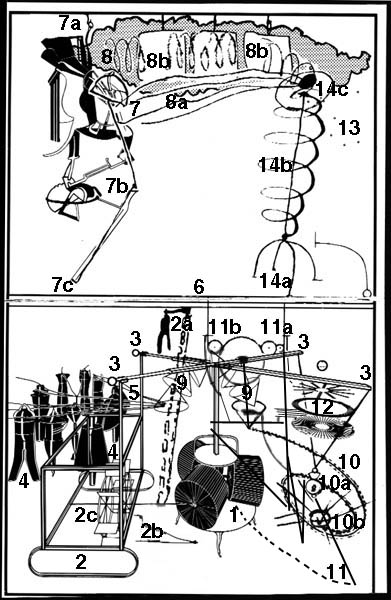
Schéma du Grand Verre de Marcel Duchamp

1 – Broyeuse de chocolat.
2 – Glissière.
2A -Agrafe motrice et chaîne de révolution.
2B -Pédale en sous-sol.
2C -Moulin à eau.
3 – Grands ciseaux.
4 – Célibataires.
5 – Tubes capillaires.
6 – Horizon — vêtements de la Mariée.
7 – Mariée, tête ou yeux.
7A -Anneau de suspension du Pendu femelle.
7B -Guêpe.
7C -Girouelle.
8 – Voie lactée chair.
8A -Allongement météorologique.
8B -Aller-retour des lettres de l’Inscription.
9 – Tamis.
10 -Pentes d’écoulement.
10A-Mobile de l’éclaboussure.
10B-Fracas — éclaboussures.
11 -Canon (?)
11A et
11B-Béliers du combat de boxe.
12 -Tableaux d’oculiste.
13 -Tirés.
14A-“Trépied” du jongleur-manieur-soigneur de gravité.
14B-Ressort du jongleur-manieur-soigneur de gravité.
14C-Plateau et boule noire du soigneur de gravité.

Celui qui a virgulé des moustaches à la Joconde, qui a exposé une pissotière dans un salon, Marcel Duchamp, s’est acquitté à la va-vite de ces salubres moqueries, de loin en loin, pour amuser la galerie, et comme pour donner le change. Car dans le même temps, chaque jour, presqu’en secret, il travaillait à un “grand oeuvre,” aujourd’hui au musée de Philadelphie. Le Grand Verre, telle une fenêtre ouvrant une perspective à perte de vue, est constitué par deux plaques de verre verticales dressées l’une au dessus de l’autre dans un cadre de 1,76 m de large sur 2,72 m de haut. Sur ces vitres, sans offusquer l’essentiel de leur transparence, Marcel Duchamp a dessiné, au moyen de fil de plomb, de sèches figures mécaniques méchamment arrêtées, on dirait prises dans les glaces. Il les a esquissées, précisées, mises en place sur des plans, il en a suggéré les possibles mouvements par des notes, à la plume, au crayon, sur des bouts de papier griffonnés à Paris de 1912 à 1915. Il les a cristallisées patiemment, obsessionnellement, à New York entre 1915 et 1923, date à laquelle il a abandonné son chantier définitivement inachevé. (Le caractère italique souligne les citations de Marcel Duchamp.) En 1933 on lui apprit que l’oeuvre à laquelle il avait consacré des milliers d’heures de travail était brisée en mille morceaux. Aussitôt, avant même de songer à cicatriser le désastre, ce qu’il fit en 1936, comme si les mots s’échappaient d’entre les lèvres des cassures, il entreprit de publier ses brouillons fondateurs. Avec la ferveur d’un sourcier de soi-même et la minutie d’un moine recopiant un texte sacré il reproduisit chaque manuscrit en fac-similé, il le fit imprimer sur un pareil papier, il en déchira le contour à l’identique et il recueillit en vrac dans un luxueux coffret de velours vert édité à trois cents exemplaires à l’automne 1934 un jeu de quatre vingt treize feuilles volantes. Envolées de leur jaillissement au tout premier moment. Le couvercle de cette merveilleuse Boîte Verte est constellé par un pointillé de lettres majuscules qui donnent à déchiffrer une phrase articulée sur sa propre dérobade: LA MARIÉE MISE À NU PAR SES CÉLIBATAIRES MÊME. Nul besoin du nom de l’auteur. Sa sonorité scintille dans le titre: MARiée, CÉLibataires. Ainsi qu’une invite à chercher l’or dans l’oreille. Marcel Duchamp a livré ses notes dans un somptueux désordre de puzzle comme s’il avait voulu que chacun reprenne le jeu à son compte et brode à travers le tissu nerveux des brisures son propre chemin. Il a souhaité libre cours à la légende, pourvu qu’on la lise grâce à la grille du Grand Verre; et sans passer sous silence aucune des données. Pour commencer le lecteur fera bien d’ajouter une lampée d’huile de rigolade au schéma mécanique que ces pages détaillent. Il devra avec le même enjouement faire chanter les mille échos du vocabulaire; retrouver les sources de l’oeuvre dans le plus vif, le plus haletant, le plus irrassasiable désir qui hante le commun des mortels; et à chaque articulation de ce trop maigre tracé prendre le fil de telle ou telle échappée imaginaire, celle par exemple de l’insaisissable quatrième dimension, le temps, que le peintre ne peut mettre à la raison qu’en relevant les empreintes de son passage. C’est pourquoi aucun des rouages, aucune des roueries ne doivent être laissés dans l’ombre. Les engrenages parlent pour peu qu’on les apparie avec exactitude selon le nombre de leurs dents. Et leur machinerie rébarbative, leurs machinations jubilatoires, marchent dès l’instant que les mots leur prêtent moteur.

En bas, au beau milieu, la broyeuse de chocolat (1) tourne; tourne comme elle a tourné et tournera en rond pour revenir au même sous le seul fouet de la répétition de l’adage de spontanéité: le célibataire broie son chocolat lui-même. Ne nous attardons pas à sa couleur douteuse, à son parfum d’enfance. Cette triple meule mue par un proverbe, en dépit de son volume, de sa place centrale, ne sert à rien. Sinon à mettre en garde contre le tape-à-l’oeil des apparences. A son côté une glissière (2) va et vient en ressassant des litanies. Ses saccades et ses hoquets ouvrent et ferment, oh à peine à moitié, de grands ciseaux (3) qui ne coupent pas mais dont le grand X affûte au dessus du monde célibataire la poignante question d’une inconnue. Un peu en retrait du train d’enfer de ces ferrailles grinçantes de railleries, neuf bonhommes rouges se tiennent figés au garde-à-vous. Ce sont les célibataires (4). Ils ne bougent pas mais le nom qu’ils portent ripe et dérape. Cette mascarade d’uniformes aussi creux que strictement ficelés, Duchamp pour commencer l’a baptisée matrice d’éros et pour finir cimetière. Matrice et cimetière confondus en un même lieu! Il faut en faire un grand écart pour joindre ainsi d’un trait l’entrée à la sortie. Une mobilité subtile, une fluidité quasi spirituelle habiter ces moules de mâles réduits à leurs habits. En effet, les célibataires sont pleins d’esprit. Gonflés au gaz d’éclairage. Gaz dérive du “geist” germanique qui signifie esprit. Et de fait en 1912 le gaz n’est pas rabougri aux utilités culinaires. Il insuffle aux lampes leur sang. Mais tant qu’il ne rencontre pas une allumette “l’hydrogène clarteux” demeure invisible. Le peintre ne peut montrer de lui que les bonbonnes qui le contiennent, les tuyaux et les tubes (5) qui le canalisent, ou ne perçoit de sa coulée que la plomberie clouée aux murs. Or dedans l’esprit court, le temps passe, le gaz fuit…

Fuyons de concert. Ce frère en errance, accompagnons le dans son voyage. Bien qu’il soit avare de traces indicatrices. Il ne dit rien du sens de la route, tout juste amorce-t-il le mouvement de la roue. Alors, en laissant la part belle au hasard, vêtus de nos loques personnelles, lourds de notre propre passé, motivés par la très improbable perspective de jouir de la fin d’un repos instantané, entrons dans la durée impersonnelle du Grand Verre. Mais avant d’en franchir le seuil, marquons un suspens debout face à lui. À hauteur d’oeil (du moins dans le cadre d’origine) la fracture entre le bas et le haut suit naturellement le trait de la ligne d’horizon (6). En bas, à terre, les célibataires. En haut, la Mariée (7). Quoi! Ce pantin squelettique se balançant au zénith du cimetière, c’est donc ça la femelle promise? Serait-ce le spectre de Jocaste, la mère pendue d’Œdipe aux yeux crevés? La mort et l’amour croiseraient-ils leurs lames au service des grands ciseaux de l’inconnue? Que signifie cette forme sans forme? Est-ce un fossile? L’empreinte d’un envol, telle la griffe d’un oiseau sur la neige ou le sable? Pouvons nous d’ici-bas l’imaginer? Car Duchamp vers elle n’a entrouvert que le trou de serrure du point de fuite: il a désigné l’horizon comme vêtement de la Mariée. Admirable justesse de l’allégorie! On connaît la duplicité de cette ligne imaginaire qui n’est après tout qu’une infirmité du regard. Où la vue touche à sa perte, là la voit-on tracée. Quand vers elle on avance, elle recule d’une égale dérobade. Et les célibataires qui s’élancent pleins gaz pour mettre à nu la Mariée portent dans leur propre regard, fomentent et agitent au devant d’eux le voile qu’ils brûlent de dégrafer. Tant qu’ils ne se seront pas eux-mêmes déshabillés du pli perspectif qui les aveugle…

La Mariée a donc dénoué son vêtement qui est tombé sur l’horizon et s’arrondit autour du monde. Elle est nue, nuages, nébuleuse. Voie lactée chair (8) écrit Duchamp d’un même trait de plume, d’un seul coup d’aile.

C’est la vie! La Mariée est dotée d’un centre-vie. Son coeur bat. Son pouls à la saccade lancinante, palpitant comme l’abdomen convulsif d’une guêpe (hymen ailé), engendre un courant d’air, un souffle, un vent qui envoie s’effilocher aux quatre points cardinaux une oriflamme de viscères et de méninges. Enfièvrée d’infini, la Mariée s’évade de ses intimités, elle s’évapore d’apparence en transparence, elle rompt les limites de sa peau, échappe à tout contour, récuse toute représentation. Nubile, la jeune fille s’est épanchée en nébuleuse. Nue, elle ne veut faire qu’une avec l’univers. Elle se laisse emporter dans un allongement météorologique (8A), déchiré de tempêtes, embelli de beaux-temps, (le temps qui passe prend les couleurs du temps qu’il fait), qui l’entre-lisse à l’étoffe du ciel telle une flamme consistante. Langue de feu qui se sublime en ce qu’elle a de fatal: le langage. Le courant d’air qui monte à travers la chair poreuse de la Mariée se charge de lettres. Le souffle qui la soulève c’est sa vive voix. La chair se fait verbe. Alors que dans son premier élan l’épanouissement de la Mariée devait transformer le haut du Grand Verre en un vitrail d’entrailles étincelant de cuivre fin, de platine et de poussière d’or, la montée du plaisir a transmuté l’or en paroles, la rosée des lèvres en encre volatile. Épanouissement: en faire une Inscription (8B). Crépite une écriture qui chasse sur son encre. Elle flamboie, elle s’efface, elle ressourd, elle reflue, elle laboure aller-retour de bout en bout la Voie lactée chair. Ses lettres haletantes, toujours sur le qui-vive, portent aux célibataires les commandements, ordres, autorisations de la Mariée. Les temps ont bien changé. Au lieu d’un malabar qui crache la foudre, au ciel règne une femme. Elle dicte la loi.

En bas, le gaz est encore loin du bout de ses peines. De tuyaux en entonnoirs, de tamis (9) en baratte, d’obscurité en étroitesses, compressé, étiré, coupé, recoupé, congelé, et pour finir liquéfié comme une serpillière, l’esprit passe par tous les états de la matière. La pesanteur l’humilie, la pesante heure l’accable des pires contre-temps. En vain. Il ne renonce jamais à son idée fixe ascensionnelle. Le plus tordu de ses avatars, le moins probant de ses ahannants progrès, n’altèrent en rien le rêve qu’il va s’emanciper de la pésanteur. Et quand au bas des pentes d’écoulement (10) le gaz suant sang et eau jute sur la terre sa flaque misérable, il est toujours capable d’exploser de désir. Trois ou quatre de ses gouttes viennent régaler la culasse d’un canon (11) pointé en direction du point de fuite. L’artiste-artilleur crache aussi sec une bille de combat. Les célibataires en fiers gaulois soutiennent le ciel au dessus de leurs têtes grâce à deux béliers (11A, 11B) dressés tout droits qui affleurent l’horizon et flirtent avec ses affriolants dessous. La bille déquille les béliers. Le ciel tombe. Du moins fait-il semblant de tomber. Car à chaque coup tiré le gaz en même temps qu’il effondre les souteneurs aux membres de fer mais aux genoux fragiles les charge du plus cher de ses souvenirs de jeunesse: une résurgence d’aimantation ascensionnelle. Les béliers chus relèvent la tête. Et tout recommence. Ce n’était pas tout à fait ce que je voulais, conclut Duchamp. Alors, après cinq années d’un travail obstiné, mystérieux, distillations, incantations, décantations, retours en arrière, nouvelles avancées des cavaliers, des fous, des reines et des rois, il fait argenter le revers du Grand Verre. Dans ce mirroir, il grace au scalpel, sans retouche possible, trait après trait, au point de s’y arracher les yeux, trois tableaux d’oculiste (12) empruntés ready-mades à la vitrine d’un opticien et mis en perspective. Au terme de ses apprentissages le gaz a compris à quoi son nom le destine. Dit d’éclairage, il doit éclairer. À commencer par sa propre lanterne. Sous le choc d’une dernière chute, celle d’un poids fracassant (10A) précipité dans la flaque par l’entremise des ciseaux, il rejaillit en éclaboussures (10B). Dont la sublimation ne garde que l’éclat. Le gaz fait feu de son propre corps. Il déclare sa flamme. Sur le tremplin des miroirs oculistes qui l’écorchent de ses dernières scories, qui corrigent la flèche de son ultime élan, il gicle vers le ciel en une gerbe de rayons. Essor que Duchamp qualifie dans une envolée d’allitérations: l’éblouissement de l’éclaboussure. Feu le gaz d’éclairage sombre au coeur de sa propre lumière. Il y découvre l’origine de son éclairage intérieur. Et il se métamorphose une dernière fois. Toutes embrasées soient-elles ce ne sont pas les gouttes mêmes qui passent l’horizon et trouvent leur trou vers l’infini dans la constellation des neuf tirés (13) mais leur image. Ce qui est l’exacte définition physiologique du regard. Quand un faisceau de grains de lumière crible la rétine, ce qui passe au delà et se fraie un chemin à travers les épaisseurs de la matière grise, ce n’est plus la lumière, c’est son image à fleur de nerf, un bouquet d’influx électriques, de chimies et de chimères.

Ainsi courent à confluence les énergies à l’oeuvre dans le Grand Verre. En haut, un flot de paroles. En bas, un flux de lumière. À la fin du voyage, le gaz se transmue en un regard ébloui. La Mariée en écriture effervescente. Et la mise à nu, selon le vœu de Duchamp, peut alors être lue comme un poëme. Qui fait rimer l’épanouissement de la Mariée avec l’éblouissement des célibataires. On fera d’or cette rime déjà riche en tirant d’elle le dernier mot: OUI.

Tu parles! vont s’esclaffer les partisans du NON. Entre l’horizon et la Voie lactée s’étend une immensité transparente où Duchamp n’a tracé aucun signe, pas un nuage, pas l’ombre portée d’un trait d’union. Il n’y a que solitudes. C’est n’avoir jamais regardé le ciel par une belle nuit.


click to enlarge

La Voie lactée épouse la rondeur de la voûte nocturne et s’incline jusqu’à toucher l’horizon. Nul besoin d’un géant pour donner corps à ce pur effet de perspective. Y suffit un être dont les formes n’ont plus par rapport à leur destination une mensuration, par exemple les lettres de l’alphabet qui majuscules et minuscules acheminent et délivrent le même message. Justement entre en scène un troubadour qui va se révéler le pèse-lettre de la Mariée, le porte-parole de la Dame; le jongleur de centre de gravité (14). Sur le fil de l’horizon, il DANSE. Il fléchit, il se redresse, d’un pied sur l’autre, au gré des coups de canon, selon le bon plaisir des éclaboussures. Son corps taillé dans un ressort se vrille comme une vis sans fin entre le bas et le haut. A sa tête, il arbore un plateau rond où roule une boule noire. C’est avec ce caillot de ténèbres qu’il jongle. Il danse, il traduit les secousses de la machine en virevoltes de la boule qui concentre les ondes de déséquilibre du branle-bas célibataire. La boule vacille, zigzague, frôle dangeureusement les bords, mais elle ne tombe pas. Car la Mariée lui envoie des ordres de nouvel équilibre en la léchant d’une langue de flamme, en la chiquenaudant de lettres touchantes qui contrecarrent ses écarts. A cinq reprises, en dessins comme un maquette, Duchamp a représenté ce deus ex machina sous la forme d’un guéridon, d’une table tournante. Serpentin sur ses trois pieds (parfois quatre, sinon deux) il est l’oracle de la divinité-mariée. Un coup, deux coups, trois coups, comme tous les dieux il n’existe pas. Le Grand Verre l’a dissipé en transparence. Esquive fondamentale qui endiable la case vide, la lacune miraculeuse autour de laquelle le puzzle s’est reconstitué. Si bien que pour tous les regardeurs qui n’ont pas lu, ou mal lu, le mode d’emploi, ça ne marche pas, ça ne peut pas marcher. Ces mécréants n’entendent pas crisser le grain de sel que croquent les engrenages, ils oublient de déduire le dieu de ses indices, de ses brisées. Dans le titre, par exemple, il arque la queue de la virgule qui s’est glissée entre les célibataires pluriels et le singulier même, virgule, il n’y pas de langue morte qui n’avoue son vrai nom qu’en latin: virga. Eh oui! c’est lui que dans les salons tout le monde aujourd’hui appelle Monsieur le Phallus. Celui qui brille par son absence, qui agit d’autant mieux qu’il n’est pas là. Aux soins de la mise à nu, ce danseur change de nom comme de masque. D’un dernier trait de plume Duchamp l’a institué: Soigneur de gravité. Le docteur de la loi de la chute des graves qui conjoint l’Une au ciel et nous à terre. Le médecin volatil qui cicatrise la grave coupure de l’horizon. Le guérisseur qui met en chanson le cri que Duchamp a laissé deviner dans le premier jet de sa préface: Étant donné, si je suppose que je sois souffrant beaucoup. Et quel remède, quelle drogue, quel alcool porte le guéridon qui sert de table de chevet à la Mariée? Il suffit de l’apostropher à haute voix et de savourer un de ces calembours que Duchamp aimait tant: guéris donc! Et si tu es gai, ris donc! Guérir la gravité, c’est rire. Avec le point sur le i en guise de boule noire. En épelant les lettres de la Mariée, le trismégiste jongleur-manieur-soigneur de gravité déshabille cette vertu bien balancée que Duchamp a qualifiée: ironisme d’affirmation. Il personnalise de pied en cap le OUI. Un OUI dont chacun peut à loisir faire danser les lettres: