 |
|
|
 |
||
 |
|
A critical review by Leif Eriksson
|
|
|
||||||||||||||||||||||||||||||||||||||||||||||||||||||
|
|
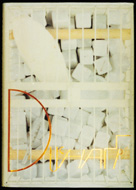
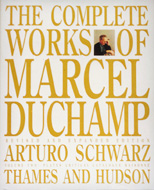
I have used Arturo Schwarz´s critical catalogue raisonné of 1997, The Complete Works of Marcel Duchamp, the revised and expanded edition, Thames and Hudson, 1997, as a main reference for Duchamp's works. As far as I know, it is the latest published to date. In the following text an 'S,' for Schwarz, followed by the catalogue raisonné number, identifies a work by Marcel Duchamp. (2) |
|
|
Notes on How Schwarz Deals with Duchamp's Appearance in Sweden in His Index and Bibliography of 1969 and 1997. |
|
It is obvious that Schwarz
has not understood the importance of the Swedish art context in
connection with Duchamp's kinetic works and readymades.
In Schwarz´s index, pages 619-630, from 1969, the following entries
refer to Swedish art figures: Ilmar Laaban, Ingemar Gustafson (Leckius)
and Erik Lindgren on page 592, (see Salamander below), while
Pontus Hultén has three entries on pages 482, 496, and 600. The Moderna
Museet, (Stockholm), has sixteen entries, but they all refer to the
replicas of Duchamp's readymades made by Linde and Hultén during
1960-1963. Though Ulf Linde has as many as twenty-six entries, there
are no remarks about how important his involvement must have been to
the general acceptance of Duchamp and his readymades.
Hultén's three entries in Schwarz's index, 1969, mention the replica
of the "Rotary Glass Plates (Precision Optics)," 1920, S 379
a, and the replica of "Door: 11 rue Larrey, 1927," S 426,
both made in 1961. The last entry refers to the "Bicycle Wheel."
Of Ulf Linde's twenty-six entries, ten refer to his participation in
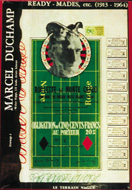
Schwarz´s book Marcel Duchamp ReadyMades, 1913-1964, Milan, 1964
(3). Twelve entries refer to Linde's readymade replicas, one to
Linde's Swedish translation of "The Green Box" in Konstrevy,1961-1963,
(see entry), one to his book Marcel Duchamp, 1963,
and three to his interviews.
|
|
|
||||||||||||||||||||||||||||||||||||||||||||||||||||||
|
The three Swedish poets Ilmar
Laaban, Erik Lindegren, and Ingemar Gustafson (Leckius) are in the
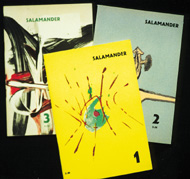
index for their Swedish translation of SUR cen SUR and Breton's
Lighthouse of the Bride in Salamander, no. 1, 1955, (see
entry).
Under Section XX, "Bibliography of Works Quoted," 1969, only Ulf
Linde's MARiée CELibataire is noted from Schwarz´s Marcel
Duchamp: Readymades, Etc., 1964.
In Schwarz's 1997 edition, Pontus Hultén's index is not mentioned at
all, which is strange. His name does, however, appear in Section XXII,
on page 910 [Under the "Bicycle Wheel"] for the catalogue
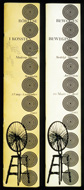
"Bewogen Beweging" ("Art in Motion," 1961,
Amsterdam), which is the same note cited as no. 144, page 600, in the
1969 edition. (4)
|
|
Yet, these entries are incorrect.
What Schwarz refers to might be K. G. (Pontus) Hulten's text A Short
Survey about the History of Kinetic Art During the 20th Century,
published in the catalogue of "Art in Motion." Schwarz also forgets to
mention that this exhibition was curated for the Moderna Museet and that
Hultén, along with Carlo Derkert, Daniel Spoerri and Billy Klüver, was
a member of the exhibition committee. Pontus Hultén was actually the editor
of the catalogue. It is clear that he was in fact the one who initiated
"Art in Motion." (See above quote from Linde's book,1986). In
addition, Schwarz only mentions the Amsterdam venue. The reasons
for Schwarz's oversight in this area, specifically in Hultén's involvement,
are unclear. Even Linde has no more than seven entries in the 1997
edition. These include no. 169, no. 175, and no. 195, which are all interviews
with Duchamp. The other four entries refer to Linde's translation of the
"Green Box" and his participation in Arturo Schwarz´s book Marcel Duchamp:
Readymades Etc., 1964.
Under Schwarz´s "Bibliography of Works Quoted," Section XXIII, 1997,
is Hultén, Karl Gunnar Pontus, The Machine, 1968, and Marcel
Duchamp, Work and Life, 1993. Only Ulf Linde's book Marcel Duchamp,
1963, and his contribution, MARiée CELibatairein in Schwarz´s
Marcel Duchamp: Readymades Etc., 1964, are mentioned here.
In Schwarz´s 1997 edition, Section XXIV, Timothy Shipe's "Bibliography
1969-95," acts as a supplement to the descriptive bibliography
for the 1969 and 1970 editions. Here, Linde's two books of 1963
and 1986 are mentioned. Additionally, he has three entries under Section
4, within the bibliography, "Secondary Literature: Articles and Essays".
Two of them appear in the catalogue that was published for Duchamp's
retrospective exhibition at the Centre Georges Pompidou in 1977. Under
Section 5 of Shipe's bibliography, "Exhibition Catalogues," Linde appears
again, now as the editor for the catalogue published by the Moderna
Museet, 1986-1987, for the exhibition "Marcel Duchamp." Pontus
Hultén is now mentioned as the editor of the catalogue published by
Palazzo Grassi, Venice, 1993.
Section XXV, "Exhibition History," of the 1997 edition, is organized
in two parts. The first part documents solo exhibitions from 1937. The
second part records group shows in which Duchamp participated during
his lifetime. This last section is highly selective according to Timothy
Shipe. The following solo exhibitions in Sweden are recorded: "Marcel
Duchamp," Bokkonsum, 1960, "Marcel Duchamp," Galerie
Burén af Eva, 1963, and "Marcel Duchamp," Moderna Museet,
1986-1987. The group exhibitions are "Art in Motion,"
1961, and "Dada," Moderna Museet, 1966. These are all
listed, but Pontus Hultén's exhibitions "Art in Motion" and
"Bewogen Beweging" are the only major references. The fact
this was ignored remains somewhat perplexing.
Though Schwarz has mentioned those who were interested in Duchamp's
works in Sweden, he has excluded essential information and conclusions
concerning Duchamp's early appearance in the context of Swedish art.
Thus ignoring its effect on his career since the mid-fifties in regard
to his kinetic works and readymades.
|
|
Comments on Lebel's Index
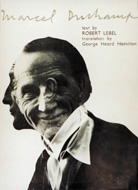
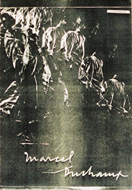
Robert Lebel's first monograph
from 1959, (5) was published five years after the exhibition at Samlaren
in collaboration with Duchamp. Curiously enough, that show and the magazine,
KASARK [no. 1], are not listed. In Lebel's bibliography, under
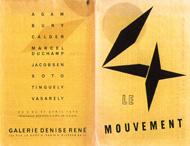
"General References," no. 98, is the Hultén (K) & Vasarely (V) catalogue
Le Mouvement, Galerie Denis René, Paris, 1955. Under "Special Studies
and Documents," no. 68, is Bo Lindwall's article Saboteur et anti-artiste,
from Konstrevy,1955 (see entry).
In Lebel's revised edition of 1967, (6) Ulf Linde's book, Marcel
Duchamp, 1963, appears under the "Bibliography: Addenda, Part 3"
no. 93. In part 5 of the "Addenda," under no.103, is "Bokkonsum,
Invitation Card," with a foreword by K. G. Hultén, Stockholm, 1960.
No.108 lists "Art in Motion," Amsterdam, Stockholm, and Copenhagen.
Lebel writes in "Catalogue Raisonné: Addenda, Part 2," 1967, "Until
1960, Duchamp had usually made or chosen himself the replicas and editions
of his own works. In 1960, a group of his Scandinavian admirers, including
K. G. Hultén, Director of the Stockholm Moderna Museet, Ulf Linde, P.
O. Ultvedt and Magnus Wibom, started working together on replicas which
were later approved and signed by Duchamp." Though Lebel's comments
are correct, he, like Schwarz, does not see the crucial importance of
Duchamp's early appearance in Sweden in regard to his kinetic works
and readymades.
|
|
|
|||||||||||||||||||||||||||||||||||||||||||||||||
|
|
The Swedish Art World and Marcel Duchamp |
|
|
||||||||||||||||||||||

|
|
Readymades at Galerie Eva af Burén, Stockholm, 1963 The exhibition, including Linde's replicas of Duchamp's readymades at Galerie Eva af Burén, Stockholm,1963, was the first show to ever concentrate on his readymades. Duchamp was quite enthusiastic about the proposal. He wrote back, "For the show at Mrs. Buren's I agree thoroughly with your idea to have every Readymade shown in exact replicas, Marcel," and thought that Schwarz should use Linde's replicas as models for the 1964 editions of the readymades. (Ulf Linde's Marcel Duchamp, 1986, pages 52, 57). Concerning the release of the replicas in 1964 in Milan, Schwarz borrowed Linde's copies for the show. It was there that Duchamp signed Linde's versions, which are now at the Moderna Museet, Stockholm. |
|
Crucial Exhibitions in Sweden
My study attempts to shows
how important the Swedish art world must have been to the overall appreciation
of Duchamp's kinetic works and readymades. When looking at the record
of exhibitions related to Marcel Duchamp since the 1950s, one consistently
finds the involvement of Pontus Hultén. It began in 1954 with the exhibition
"Objects or Artefacts Reality Fulfilled" at Agnes Widlund's
Galerie Samlaren, February - March, Stockholm, 1954, and continued with
"Le Mouvement," at the Galerie Denise René, Paris, 1955, (8). The exhibitions
"Marcel Duchamp," Bokkonsum, Stockholm, 1960, (9) "Art in Motion,"
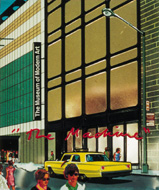
Amsterdam, Stockholm, Louisiana, Denmark, 1961, and "The Machine,"
the Museum of Modern Art, New York, 1968-1969 (10), followed. Some of
these exhibitions are listed in Lebel's and Schwarz's texts, but both
failed to acknowledge their importance.
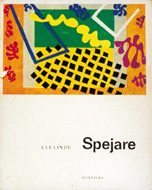
In 1960 Ulf Linde published Spejare (11) that had an enormous
impact on Sweden's art world, primarily due to his presentation of Marcel
Duchamp's works. Yet even Linde forgot to mention Galerie Samlaren and
KASARK in his text and made a significant mistake about the "Bottlerack"
by saying "1914 [Duchamp] took a bottlerack from a cafe and exhibited
it at a salon as a sculpture," page 43. This, as I explain
later, is an incorrect statement. (see entry).
|
|
|
||||||||||||||||||||||||||||||||||||||||||||||||||||||||||||||||||||||||||||||||||||||||||||||||||||||||||||||||||||||||||||||||||||||||||||||||||||||||||||||||||||||||||
|
Duchamp's Intriguing Titles
It is well known that Duchamp
was very specific about his titles. Therefore, I have chosen to quote
the titles from Arturo Schwarz's latest catalogue raisonné for three reasons.
First, it is the most complete list of Duchamp's works, like Köchel's
register of Mozart's works. Second, it is based on Schwarz's direct collaboration
with Duchamp, as was the previous catalogue raisonné of 1969, revised
and updated in 1970 and 1997. Third, Schwarz has a cross-reference to
Robert Lebel's catalogue raisonné, the first Duchamp monograph published
in 1959 and later revised in 1967.
Duchamp's titles have probably been altered or misunderstood through
the years. I have therefore quoted the titles as they stand in the captions
of the Swedish material, and place parentheses around the titles as
they appear in Schwarz´s latest catalogue raisonné.
Common Errors Made Concerning Duchamp's Readymades In my study, I examine some of the misunderstandings of Duchamp's works that are commonly made by art critics and readers. For example, it is often said that his readymades have been exhibited in their original versions. This is untrue, as they have obviously been copies or replicas. He specifically confirmed new replicas of lost readymades made by Ulf Linde, Richard Hamilton and others. Additionally, there are the Schwarz editions from 1964 that celebrate the fiftieth Anniversary of the readymades' introduction in the art world. I do not think Duchamp had any objections about that, because it coincides with his attitudes towards art and the art world. His opinion about art and artists can be examplified in his response to the question "Who is a famous artist?" to which he answered: "He's a lucky guy." (Interview with Ulf Linde, Stockholm, 1961.) (For a closer look at Duchamp's readymades refer to Hector Obalk's essay The Unfindable Readymades in ToutFaitJournal, Vol. 1, Issue 2, 1999.) Due to all the errors concerning the provenance of Duchamp's works, particularly his readymades, I have listed them in an appendix. If a work exists, it is listed along with its current location. The appendix also includes Schwarz's inclusive categories of each item. In the appendix, I have also listed my primary sources chronologically and indicated further readings regarding people of interest. |
|
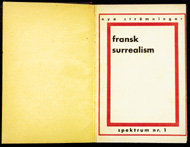
Marcel Duchamp in Sweden 1933-1970 1933 Nya Strömningar, Fransk Surrealism, Spektrums Förlag, 1933
Marcel Duchamp first appears in a Swedish publication in Nya Strömningar,
Fransk Surrealism, published by Spektrum Press in 1933. Gunnar Ekelöf,
the Swedish poet, wrote the introduction and was responsible for translating
this anthology of French surrealist poems. (12) (13)
|
|
|
|||||||||||||||||||||||||||||||||||||||||||||||||||||||||||||||||
|
Marcel Duchamp appears twice
in this book. He is first mentioned in a note on page 47. That note
refers to a critique about the film history written by Salvador Dali where
he comments on René Clair's film Entr´Acte. "Despite René Clair,
it really resumes the concepts of Marcel Duchamp, Man Ray and Francis
Picabia..."
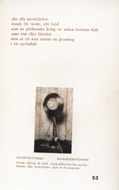
Duchamp's second appearance is in conjunction with Benjamin Péret's
poem För Att Fördriva Tiden, (While Away the Time), page
53. The poem is illustrated with one of Duchamp's kinetic works, a very
advanced choice of illustration at the time. The Swedish caption
reads "Marcel Duchamp, surrealistiskt föremål" followed by the
pun in French "rose selavy et moi, nous estimons les ecchymoses des
esquimaux aux mots exquis." The correct title is actually
"Rotary Demisphere (Precision Optics)," 1925, Paris, S 409. The piece
was exhibited in Stockholm in 1961 at "Rörelse i konsten" ("Art in Motion").
According to Schwarz, "Precision Optics" has been in the collection
of the Museum of Modern Art (MoMA), New York, since 1970.
|
|
1934 BLM, Bonniers Litterära Magasin, Volume 3, no. 3, 1934
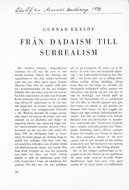
In Bonniers Litterära Magasin, 1934, (14) Gunnar Ekelöf published
his article Från Dadaism till Surrealism. He introduced Marcel
Duchamp, Francis Picabia, and Andre Breton on page 36, where he wrote:
"A major contribution to the continuing development of the movement
[Dada] became the figures who transported it to Paris. They consisted
of Francis Picabia and Marcel Duchamp, both astounding word jugglers
experimenting with artistic values, and a group of young writers centered
around the magazine 'Literature' published by Andre Breton."
Ekelöf also mentions that Duchamp and Picabia had access to the following magazines: Duchamp's Wrong-Wrong, (
Rongwrong, 1917), S 348, The Blind Man, (The Blind Man No. 1: Independents´ Number, 1917), S 346, The Blind Man No. 2: P.B.T., 1917, S 347 and Picabia's 291, 1915, and 391, 1920.
Ekelöf even points out that "['Fountain,' (1917, S 345)] ... which
under the pseudonym R. Mutt was sent into the Independents Show in New
York, originated from someone in the circle. Since the Fountain simply
was a urinal, it was therefore rejected."
|
|
|
|||||||||||||||||||||||||||||||||||||||||||||
|
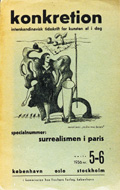
1936 Konkretion, no. 5-6, 1936
Two years later, Duchamp appears in Vilh. Bjerke-Petersen's magazine
Konkretion, no. 5-6, 1936, published in Copenhagen, Oslo and
Stockholm. This magazine is written mainly in Danish. (15)
This is the final and special double-issue about "Surrealism in Paris".
Duchamp's contributed an illustration for the Belgian poet, Gisèle Prassino's
text Den forfuulgte unge pige, (The Pursued Young Girl) 1935.
The caption reads, "Marcel Duchamp: 'Moustiques domestiques demistock'.
Photo Man Ray." In Schwarz, the title of the work is "Monte
Carlo Bond," Paris, 1924, S 406, and called an "Imitated Rectified
Readymade." Duchamp made less then eight of the planned 30 copies
of version a. of the "Monte Carlo Bond." Version b. of the work
was done in 1938, and a version c. in 1941.
1948
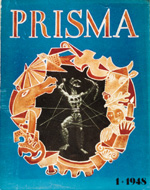
Prisma, no. 1, 1948
Duchamp appears in a Swedish text twelve years later in the inaugural
issue of the exclusive magazine Prisma, no. 1, 1948.(16) He is
mentioned in the section called "Experimentalfältet (The Field of Experiments),"
page 99, where Ebbe Neergaard writes about "French-American-German experimental
film" in New York, specifically the film "Dreams That Money Can Buy." The
film consists of six parts compiled by Hans Richter and includes works
by contributing artists Fernand Léger, Max Ernst, Man Ray, Alexander
Calder, and Marcel Duchamp. The article is illustrated with five photographs,
one of which is illustration no. 5, a detail from Duchamp's scandalous
painting, "Nude Descending a Staircase," S 342.
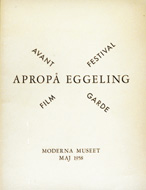
This film was also shown on May 21, 1958 at the Moderna Museet's film
studio during "Apropå Eggeling, Avant-Garde-Film." (17)
|
|
|
|||||||||||||||||||||||||||||||||||||||||||||
|
1948 Konstrevy, no 3, 1948
In Konstrevy, no. 3, 1948, Haavard Rostrup writes about Marcel
Duchamp's brother Jacques Villon (18). Rostrup refers to Marcel
in the following passage: "Jacques Villon's name is really Gaston
Duchamp and brother to the cubist sculptor Raymond Duchamp-Villon, who
died in 1918, and to the painter Marcel Duchamp. First a cubist painter
and later one of the founders of Dadaism, but since 1920, turned his
back on art and devoted himself to chess."
|
|
|
|||||||||||||||||||||||||||||||||||||||||||||
|
1950 Konstrevy, no 4-5, 1950 Konstrevy's double issue, no. 4-5, 1950, features Gabrielle
Buffet-Picabia's article "Några minnen från den abstrakta konstens första år" (Some Memories From the First Years of Abstract Art). (19)
She writes: "In 1910 I became acquainted with the brothers Duchamps
the oldest Raymond Duchamps, and the nowadays the widely appreciated,
completely personal painter, Jacques Villon. [Both were] careful spectators
to the fast development of painting. But the youngest, Marcel Duchamp,
already showed distinctive qualifications to be as controversial as
he was: one of the strangest spirits of his time and the deepest influence
on abstract art. Marcel Duchamp was among the young circle that was
eager to fight. With his work, consisting of a few paintings, his
opinions and way of living, [he] had his own intuition and intelligence. Yet
without effort and affection, [Marcel Duchamp] reached beyond the systematic
destruction of the traditional standards of art, which up until now
were reverentially accepted theories. Thus he appears as one of the
predecessors of surrealism; but the peak of the anarchism was first
achieved in 1915. When we first met Duchamp, he was sincerely engaged
with an issue that was developed by Italian Futurism i.e. the possibility
to express movement within the frame of static painting. One of his
earliest and most well known canvases 'Nu Descendant au Escalier' shows
an almost cinematographic decomposition of movement within the context
of a skeleton. Duchamp's acquaintance with Picabia was of great importance
to both of them."
Further on she writes:
"In 1910, at rue Trouchet was an exhibition with Picasso, Duchamp and Picabia, already showing paintings with a striking boldness, but still far from the character they later achieved."
Her article continues on about the Salon d'Independent, 1912, where
she writes: "That same year there was the great exposition 'La Section
d'Or' with works by, Duchamp, Gris, Delaunay and Picabia. Finally in
January 1913 in New York there was a large audience of genuine American
characters invited to a giant exhibition in order to educate them in
the abstract art. I attended the opening, en elaborate, elegant affair. I
remember that a man in a white tie opened the ceremonies. On a rostrum
he explained: 'Ladies and gentlemen, this exhibition that covers such
an expanse of wall space, consists of so many canvases and has cost
us such a considerable expense to arrange is presented before you. It
is now your task to learn and to understand modern art, and that's that.'
Without finding any understanding the new art had conquered its place
in the intellectual life, but also in another field: The Speculation. Since
that time it has tried and often succeeded to even involve art into
its unceasing and humiliating race, similar to that of the value of
stocks."
Three works of Duchamp and Picabia illustrate the article. Included
is Marcel Duchamp's"Why Not Sneeze Rose Sélavy?" 1921, (Photo:
R. Sélavy, a Semi-Readymade, New York 1921, S 391). According to Schwarz,
the original is at the Philadelphia Museum of Art. A replica by Ulf
Linde made in 1963, for Duchamp's exhibition at the Galerie Eva af Burén,
is now at the Moderna Museet (MMS), which was signed and dated by Duchamp
in Milan in 1964.
In reference to Duchamp's "Elevage de poussière," Photo: Man Ray 1920,
("Bred Readymade [DustBreeding]," S 382),Schwarz writes that both Man
Ray and Marcel Duchamp took this photograph. It currently belongs to
the Jedermann Collection, N.A.
Marcel Duchamp's "Nu Descendant un Escalier," 1912, ("Nude Descending a Staircase No. 2," S 242), now resides at the Philadelphia Museum of Art along with Duchamp's first version, S 239.
The chief editor of Konstrevy in 1950 was Mrs. Ingrid Rydbeck-Zuhr. Choosing
Duchamp's pieces as illustrations was an advanced and visionary decision
for 1950, as those works were somewhat controversial at the time.
1951 Konstperspektiv, 4, 1951
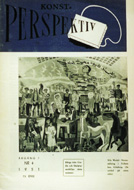
In issue no. 4, 1951, Gunnar Hellman writes an article Variationer
på ett gammalt tema (Variations on an Old Theme), where he
quotes Oscar Reutersvärd's catalogue text from the exhibition "Neo-Plastic
Art" at the Galerie Samlaren, Stockholm, 1951. Hellman's article
is illustrated with Duchamp's "Nu Descendant un Escalier," 1912, ("Nude
Descending a Staircase No. 2," S 242), with the following caption,
"In 1912 the Frenchman Marcel Duchamp did this nude model, descending
a staircase." Hellman's reason for using Duchamp's painting
as an illustration remains unclear, for according to the catalogue;
it was never actually shown at the exhibition. (20)
|
|
|
|||||||||||||||||||||||||||||||||||||||||||||
|
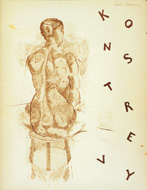
1952 Konstrevy no 2 In Konstrevy no. 2, 1952, Gabrielle Buffet-Picabia submitted the article I
dadaismens tid (In the time of Dadaism) where she discusses Duchamp's stay in New York. (21) "Dadaism existed before it got a name," she writes. Gabrielle describes her ten-year experience of the
Dada-epoch and divides it into three parts. She names the first Dada-epoch in New York, Pré-Dada. The second, the real Dada-epoch, she writes, took place in Zurich while the third Dada-period was in Paris.
She continues to describe Dadaism in Germany with Max Ernst and Hans
Richter in Düsseldorf, Huelsenbeck in Berlin, and with Schwitters in
Cologne. The latter, the author characterizes as the complete Dadaist,
from the very language he used to his specifically arranged home and
lifestyle. Laconically, she states that Dada was born in 1917.
Buffet-Picabia tells the story about the conception of Dada, which
many Dadaists have claimed to coin. She explains that it can be traced
to a minor accident. The Larousse dictionary happened to open onto the
page where the word "Dada" was listed, as Hugo Ball and Hulsenbeck were
looking for a sensational name for a dance sketch. A sketch in
which Emmy Hennings, Hugo Ball's wife, would perform at Cabaret Voltaire.
She writes, "Picabia and Duchamp, the first newsmakers of the period
that tore [the year] 1910 from all bonds with classicism and the four
Gospels. Though they were each other's opponents, both in reactions
and methods, there was a strange competition to reach destructive and
paradoxical, blasphemously and inhuman suggestions. Guillaume Apollinaire
often took part in these attempts of demoralization, which were also
attacks of witticism, puns, and jokes, and even replaced the formal
values of beauty with personal dynamism and suggestive, inventive and
individual forces. This playful search into the unknown dimensions
and into the unexplored regions of being, this spirit of invention,
which has never come back, it seems to me, contained all the seeds,
which later became Dadaism, and even that, has since then grown on to
new ramifications."
She continues, "For his personal use Duchamp came to create a mechanical world of fantasy, consequence and logic, applied to a sentimental gearwheel deed, specifying one necessary text in order to understand the painting
as 'la Marié Mise à nu par ses Célibataires Mêmes´." (S 404) And further,
"In this art environment Duchamp received a popularity, which he got
due to the lasting success of his first exhibited work in the United States:
'Nu Descendant un Escalier'. Between two whiskies and two puns he demonstrates
an attitude of distance from everything, even from himself; his lacking
interest in human standards is not the least of reasons that he is subject
to a pleasant curiosity in the admiring milieu. Soon he declares that
he is going to end all artistic production and keeps his word. If he still
takes part in any artistic manifestations, he does it in order to create
a scandal. For example, he shows, at the New York Independents Show,
one Ready-made called 'Fountain,' which is nothing else but a urinal.
Later, not the least, sensational scandal, he puts a moustache on the
Mona Lisa, symbolizing his contempt for the fetishism of art…"
"…It is during this period when Cravan, boxer, poet and, since 1912, publisher of a small avant-garde magazine 'Maintenant,' made his notorious lecture. Cravan was asked to give an enlightening lecture for a select party. He was
drunk and insulted, in obscene terms, his audience of elegant ladies and started calmly to undress until two policemen took him away with handcuffs. He was immediately released by Arensberg's intervention and was enthusiastically
congratulated by his friends Picabia and Duchamp, who were actually responsible for the scandal." This article is illustrated with works by Picabia, Duchamp, Jean Arp, Sophie Tæuber Arp, and Kurt Schwitters.
Marcel Duchamp's contribution to the article is the infamous "La Joconde." The
correct title is L.H.O.O.Q. according to S 369, and is a "Rectified
Readymade" made in Paris in 1919. The original currently belongs to
a private collector in Paris. In regard to this major work, Schwarz
describes five replicas, one of which was made in an edition of 38 numbered
copies. The first 35 are signed and three remain unnumbered.
An ambiguity remains with this work, as with so many of Duchamp's pieces. It
is unclear as to which works, particularly which readymades, were exhibited
as originals.
|
|
|
||||||||||||||||||||||||||||||||
|
|
Inconsistencies arise when
discussing Duchamp's most famous ready-made, "Bottle Dryer [Bottlerack]."
Even one of the best exegetes of Duchamp's works, Ulf Linde, erred in
his book Spejare, where he wrote: "In 1914 he fetched a Bottle
Dryer [Bottlerack] from a cafe and exhibited it at a salon as a sculpture."
Considering that Linde's book was the first penetrating analyses of Duchamp's
works in Sweden, it had an unfortunate impact, for that inaccurate description
still remains. The original version has actually never been exhibited,
like so many of Duchamp's readymades.(23)
I think that Duchamp did not care if it was an "original" or a "replica"
that he exhibited. His comment on various interpretations or replicas
of his works was "It amuses me." This remains congruent
with his attitude towards art and the art world, against which he protested
through the act of choosing the readymades.
|
|
|
||||||||||||||||||||||||||||||||||||||||||||||||||||||||||||
|
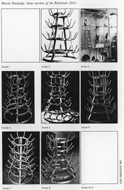
The original version of "Bottle Dryer [Bottlerack]" is lost. Duchamp
bought his first one at Bazaar de l' Hotel de Ville in Paris, 1914.
The disappearance of the original version is due to his sister, Suzanne,
whom Duchamp had asked to clean his apartment in Paris while he was
away in New York. She simply cleaned it away.
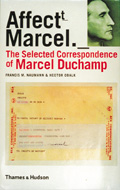
In a new book (24) Affectt Marcel, The Selected Correspondence of
Marcel Duchamp by Francis M. Naumann & Hector Obalk, (Thames
& Hudson, 2000), there are two letters written in January and October
of 1916 to Suzanne Duchamp where Marcel introduces his concept of the
ready-made. "Now, if you have been up to my place, you will have
seen, in the studio, a bicycle wheel and a bottle rack. I bought this
as a readymade sculpture. And I have a plan concerning this so-called
bottle-rack. Listen to this: here in N. Y., I have bought various objects
in the same taste and I treat them as 'readymades'. You know enough
English to understand the meaning of 'ready-made' that I give these
objects. I sign them and I think of an inscription for them in English.
I´ll give you a few examples. I have, for example, a large snow shovel
on which I have inscribed at the bottom: In advance of the broken arm,
French translation: En avance du bras cassé. Don't tear your hair out
of trying to understand this in the Romantic or Impressionist or Cubist
sense–it has nothing to do with all that. Another 'readymade' is called:
Emergency in favour of twice, possible French translation: Danger /Crise/
en faveur de 2 fois. This long preamble just to say: take this bottle
rack for yourself. I'm making it a 'readymade,' remotely. You are to
inscribe it at the bottom and on the inside of the bottom circle, in
small letters painted with a brush in oil, silver white colour, with
an inscription which I will give you herewith, and then sign it, in
the same handwriting, as follows: [after, Marcel Duchamp (end of letter
could very well be missing)]"
In the letter dated October 16, 1916, he returns to the same subject
and asks, "Did you write the inscription on the ready-made?
Do it. And send it, [the inscription], to me and let me know exactly
what you did."
Later Duchamp, in his text Apropos of Readymades, 1961, describes
how the term Readymade arose. "In 1913 I got the good idea to attach
a bicycle wheel to kitchen chair and saw it turn." In New York in
1915 he bought a snow shovel and wrote on it: In advance of the Broken
Arm. "It was about this time the word readymade come to my mind to
describe this form of appearance."
Duchamp bought the second version of "Bottle Dryer [Bottlerack]" for
his sister in 1921. The work was signed by Duchamp: "Marcel Duchamp/Antique
certifie," S 306 a., and was reproduced in Lucy R. Lippard's
essay in the MoMA's Duchamp catalogue in 1973. This version belonged
to the collection of Robert Lebel, and is currently in the collection
of his son, Jean-Jacques Lebel, in Paris.
Duchamp produced his third version of "Bottle Dryer [Bottlerack]" in
1936. It was exhibited the same year at Charles Ratton's gallery in
Paris, May, 1936. This third copy belonged to Man Ray, but there is
no record of its current location. Yet it appears in the photograph
showing the interior of Ratton's gallery, reproduced in the catalogue
"Dada and Surrealism Reviewed," London, 1978. Robert Rauschenberg
bought a "Bottle Dryer [Bottlerack]" in which Duchamp signed the following,
"Impossible de me rappler la phase original/Marcel Duchamp/1960."
This third version was exhibited at the Pasadena Art Museum,
1963, in Duchamp's first retrospective exhibition.
In 1961, Duchamp selected a "Bottle Dryer [Bottlerack]" for his wife
Alexina Duchamp, (She was deceased in 1995), with the inscription, "Marcel
Duchamp 1914," (Replique, 1961).
In 1963, Ulf Linde made a "Bottle Dryer [Bottlerack]," now at the Moderna
Museet. This version was exhibited at the Schwarz Gallery, coinciding
with the release of the edition of replicas made by the gallery in Milan,
1964, in order to celebrate the 50th Anniversary of Duchamp's
first Readymade. Schwarz released an edition of eight signed copies. Two
copies outside the edition were reserved for the artist and Schwarz
and are inscribed, "ex Rrose and ex Arturo." Another two
copies were produced for exhibition purposes and contain the following
inscription, "Ex. h.c. pour exposition, 1964" and "Ex I/II
donated to Israel Museum, Jerusalem, on the occasion of a Duchamp retrospective,
1972," S 306.
There are also other versions, specifically one, which Daniel Spoerri
lent to Bokkonsum's exhibition in 1960. This version is not mentioned
in Schwarz, perhaps because Duchamp never signed it. One of the most
recent "Bottlerack" I have seen was shown in the exhibition "A House
is Not a Home" at Rooseum in Malmö, October 18 - December 14, 1997.
When I asked the museum director, Bo Nilsson, where he had found the
"Bottle Dryer [Bottlerack]," he told me that he and the former director,
Lars Nittve, had some serious problems finding a copy. "You could
have called me," I answered, sensing a distinct note of irritation.
My own copy of the "Bottle Dryer [Bottlerack]" was purchased by my
friend Torsten Ridell in the late 1970's at Bazaar de l' Hotel de Ville.
My version is a meta piece, a re-made, which brings it back to its original
purpose, i.e. to dry wine bottles.
In 1997, I ordered a new bottlerack made of plastic by my friend Jean
Luc Guinnement in Paris, but he misunderstood my request and sent me
a green painted metal copy also purchased at Bazaar de l' Hotel de Ville
in Paris. Following this mistaken delivery, Angelica Juhlner in Fox
Amphoux, succeeded in finding the plastic variant in Bajoule, Provence.
This copy has a bright yellow bottom plate and a blue rack, which can
be dislocated into smaller parts. This version is included in my own
project "Pole Room," 1977, where all the items allude to the
fact that blue and yellow become green when mixed. This plastic version
has an amusing connection to the description of what Elvis Presley was
wearing when he was found dead in his bathroom: "He died in his pajamas,
blue top and yellow bottom."
Duchamp's "Bottle Dryer [Bottlerack]" shows indeed that "Ars longa
vita brevis..." to use a common incomplete quotation.
Duchamp's "Bottle Dryer [Bottlerack]" was exhibited at MoMA's "Fantastic
Art, Dada, Surrealism," 1936-37. This is not entirely the case, for
that "Bottle Dryer [Bottlerack]" was actually Man Ray's photograph of
a "Bottle Dryer [Bottlerack]," probably the copy, which was exhibited
by Charles Ratton in May, 1936. The MoMA's catalogue pictures a reproduction,
in which the "Bottle Dryer [Bottlerack]" stands on a corner of a table.
That catalogue does contain the proper origin, but that information
is lost in later catalogues and books. (25)
|
|
|
|
|
|
|
|
Click to enlarge |
||||||
 |
||||||
|
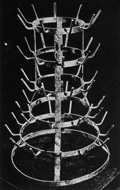
25. Duchamp: "Ready-made," 1914. Photo Man Ray. |
||||||
|
1954
KASARK [no. 1]
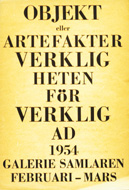
Objekt eller artefakter verkligheten förverkligad, 1954
KASARK is a seven-page magazine, (26), published by Galerie
Samlaren in February, 1954. Galerie Samlaren was one of the most important
galleries in Stockholm from 1943 to 1977. During the 1950s, Pontus Hulten
and Oscar Reutersvard and Hans Nordenstrom were the curators and editors
of Kasark. On page 6, K. G. H. (Pontus Hultén) wrote an article
with the headline "READY-MADE." This is the first time someone
in Sweden attempts to explain what Duchamp's readymades represent. The
following two works by Marcel Duchamp are reproduced in this issue of
KASARK. (sic)
Marcel Duchamp: "Ögat i Biljardbollen," 1935, Rotorelief för grammofon.
Bilden roterar med lägsta hastighet och betraktas med ett öga, (The
eye in the billiard ball, 1935. Rotorelief for gramophone. The image
will rotate at the slowest speed and looked at with one eye), "Rotoreliefs
(Optical Disks)," 1935, S 441. First edition, 500 sets, each set with
6 cardboard disks printed on both sides. About 300 sets were lost during
World War II.
Marcel Duchamp: "Flasktorkare, Ready made," 1914. (Bottle Dryer [Bottlerack]),
Ready-made, 1914, S 306.
|
|
|
|||||||||||||||||||||||||||||||||||||||||||||||||||||||

|
1954 Konstrevy, no. 3
On page 131, Ulf Linde reviews the exhibition "Object or Artefacts
Reality Fulfilled" at the Galerie Samlaren in Stockholm, 1954 (27).
He mentions Dada and makes a specific comment on a piece bought at EPA,
a one price store company in Sweden, similar to Bazaar de l' Hotel de
Ville in Paris, that sold a variety of inexpensive goods. His comment
refers to a piece no. 33 in the exhibition catalogue by V. Enhult, (an
anagram and pseudonym for Pontus Hultén, an organizer of the exhibition),
with the title "Object with unknown application, ready-made found
at One Price Store EPA in Stockholm, 1952." Linde writes,
"The title must be understood as an attempt to release the object from
all trivial relations to flour bags in order to make it an aesthetic
object of 'exclusive uselessness.'" He does not write anything
about Duchamp.
1954 Odyssé, no. 2 -3 In this issue there is a note about Picabia, mentioning that Duchamp published Dadaist publications 291 and 391. 1954 Odyssé, no. 4
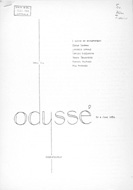
Dag Wedholm published Odyssé. The other editors included Ilmar Laaban, Öyvind Fahlström, Gösta Kriland, Pär Wistrand, and V. Lundström. (28) (29) |
|
|
|||||||||||||||||||||||||||||||||||
|
Gösta Kriland, artist, and
Ilmar Laaban, poet, have translated fourteen of Marcel Duchamp's notes.
There is also a biographical note about Duchamp, which points out that
he is one of the leading Dadaists, who published a number of magazines
together with Picabia and others. "[He has used the pseudonym]
L.H.O.O.Q. - Elle a chaud au cul. Book: Rrose Sélavy. Film: Anemic
Cinema. After 1920 [Duchamp] only temporarily devoted himself to art -
but more to chess." (L.H.O.O.Q., S 369.)
1954 Gåsblandaren, hösten, 1954
Students at the Royal Institute of Technology in Stockholm have published
Gåsblandaren and Vårblandaren (Goose Blender and Spring Blender)
since 1863. Among the editors during 1951-1955 was Hans Nordenström,
one of Pontus Hultén's closest friends, who participated in many of
Hulten's early projects in the 1950s and 1960s. On the front cover is
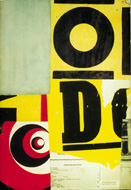
a collage of Gåsblandaren, autumn, 1954, where you can find one of Duchamp's
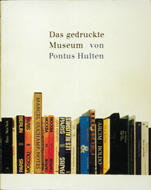
Rotoreliefs, S 441. (See item no. 2 in "Das gedruckte Museum von
Hulten," 1996.) (30)(31)
|
|
|
|||||||||||||||||||||||||||||||||||||||||||||
|
1955 Vårblandaren, våren, 1955
Vårblandaren was a box containing lose material referring to
art in a Dadaist fashion. It is said that George Machunias, the Fluxus
leader, later used this box-issue as a model for his own different kits.
(32)
Konstrevy, no. 1
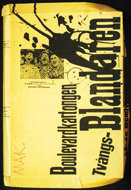
In this issue, the inside of the front cover contains an advertisement
published by the Galerie Samlaren, Stockholm, with the following caption,
"marcel du champ, new york/hultén/." The reason for Duchamp's
rare appearance in such an advertisement is somewhat mysterious. It
can be some kind of tribute to the artist due to Hultén's interest and
appreciation of Duchamp's work. At the time, Hultén was working for
the Galerie Samlaren while editing KASARK, in which he repeatedly
wrote about Duchamp. (33)
|
|
|
|
|||||||||||||||||||||||||||||||||||||||||||||||||||||||||||||||||
|
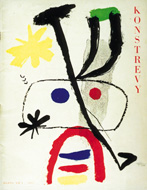
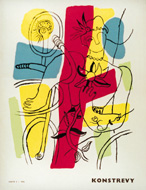
1955 Konstrevy 3 In this issue, the art critic Bo Lindwall has published his article Marcel Duchamp-saboteur
och anti-konstnär (Marcel Duchamp-saboteur and anti-artist). (35) |
|
|
|
|
|
Click to enlarge |
||||
 |
||||
|
35. Konstrevy no. 3 1955. |
||||
|
He writes the following:
"His intellect is as sharp as a razor analyzing every given possibility
to pieces. He started to detest all styles which he completely controlled,
he found that even the most radical cubists yield to disgusting aestheticism,
already towards a petrified academism. His creativity was paralyzed. The
paralysis could not be stopped as long as he dreamt about renewing the
art when he succeeded to convince himself that serious artistic activity
was meaningless, then the paralysis disappeared. A coffee mill became
his rescue in the first difficult crisis. 32 years ago he put down
his brush for good. He is still alive."
The coffee mill Lindwall refers to is "Coffee Mill" which Duchamp painted for his brother Raymond Duchamp-Villon's kitchen, S 237. Since 1981, it has been at the Tate Gallery, London. This piece is an important reference
for Ulf Linde's actual geometrical analysis of Duchamp's last major work "Etant Donnés: 1 la chute d'eau/2 le gaz d'èclairage," 1946-66, S 634. The piece is currently at the PMA. (But the latest news about this project is that
Linde has left it unfinished.) Illustrations:
Marcel Duchamp: "Porträtt av konstnärens fader," 1910. ("Portrait of
the Artist's Father," 1910), S 191, currently at the PMA.
"Sonaten (Konstnärens mor och tre systrar)," 1911, ("Sonata," 1911),
S 229, at the PMA, as well.
"Fresh Widow," 1920, S 376, resides in the MoMA. There are two other
versions of this piece; Ulf Linde's of 1961, which is at the MMS, and
Schwarz´s anniversary edition from 1964.
"Modeller till schackpjäser," 1922. ("Chess Pieces," 1918-19), S 377
is now at the MoMA.
"Ungkarlarna," 1914, ("Cemetery of Uniforms and Liveries No. 2," 1914),
S 305, is currently at the Yale University Art Gallery.
"Monte Carlo," 1924, ("Monte Carlo Bond," 1924), S 406 (See above entry).
"Ready-made," 1914 ("Bottle Dryer [Bottlerack]," 1914), S 306 (See
above entry).
"3 Stoppages Étalon," 1913, ("3 Standard Stoppages," 1913-14), S 282.
The original is at the MoMA while the replica made by Ulf Linde in 1963
is at the MMS. A replica from 1963 is at the Norton Simon Museum in
Pasadena.
"Förvandlingen från jungfru till brud," ("The Passage from Virgin to
Bride," 1912), S 252, is currently at the MoMA.
(The titles in Schwarz latest catalogue raisonné and the Swedish captions do not always correspond.)
In the same issue, page 127, Konstrevy presents Denis René's
exhibition "Le Mouvement." Pontus Hultén curated that exhibition
together with Robert Breer and Jean Tinguely. A few of Duchamp's
mechanical works were represented, "… in some cases they have, as
Duchamp used, clockworks or electricity to operate machinery." The
curators point out that Samlaren's exhibition in 1954,(see previous
entry), was a forerunner to Denis René's exhibition.
1955 Salamander, no. 2
In Salamander, no. 2 there is an article about Robert Matta
written by James Thrall Soby where he suggests Duchamp's influence on
Matta. Soby refers to the Surrealist exhibition "First Papers of Surrealism"
in New York, 1942. The author implies that Matta has been influenced
by Duchamp's Sixteen Miles of Strings, S 488, which ran back and forth
in the exhibition. He continues, "The effect on his [Matta's] paintings
is more likely that Duchamp's influence had a great impact."
Sydsvenska Dagbladet (SDS), Tuesday, June 14, 1955 |
|
|
|
|
|
Click to enlarge |
||||
 |
||||
|
36. Sydsvenska Dagbladet, Tuesday, June 14 1955. |
||||
|
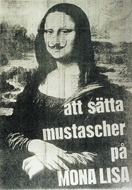
In this daily newspaper, Duchamp
made an indirect appearance in Sweden in a print advertisement (36). Sellers
& Co., an advertising agency, used this work to reach a new clientelle.
They used the "Mona Lisa" with the headline "att satta mustascher
pa MONA LISA" (to put a moustache on MONA LISA) and in a footnote,
refer to Marcel Duchamp. '"Why not be original?' the Dadaist Marcel
Duchamp thought in the 20's and put a moustache on the Mona Lisa! Both
Duchamp's fantastic trick and Dadaism had a short lifetime like a dragonfly.
How many, for example, today know anything about monsieur Marcel Duchamp's
herostratic creation of art?"
1955
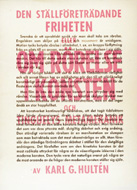
KASARK no. 2. okt, 1955. In this issue, K. G. Hultén (Pontus Hultén) presents "Art in Motion-Kinetic Art." I think Hultén is the first one to write and point out this field of art. On the cover, printed in bold and light red
capital letters is the following headline: "Om den ställföreträdande friheten eller om rörelse i konsten och Tinguelys metamekanik av Karl G. Hultén" ("The Substituted Freedom or About Art in Motion and Tinguely's
Metamechanic" by Karl G. Hultén). (37) |
|
|
|
|
Click to enlarge |
|||
 |
|||
|
37. KASARK no. 2, autumn 1955. |
|||
|
Hultén was one of the curators
of "Le Mouvement" at Galerie Denise René in Paris, 1955 (See previous
entry). Since then, Hultén has dealt with art in motion extensively.
(The best, concise information about his writings on this matter is
in Das Gedruckte Museum von Pontus Hulten, 1996. There you
can read about the exhibitions "Le Mouvement" Paris, 1955, "Marcel Duchamp,
Bokkonsum," Stockholm 1960, Rörelse i konsten (Art in Motion),"
1961, "The Machine," MoMA, 1968, "Marcel Duchamp," Centre George Pompidou,
1977, and "Marcel Duchamp," Palazzo Grassi, 1992-3.)
In this issue he makes an early attempt to introduce the importance of kinetic art, where Duchamp has played a major roll. On pages 7-13, Hultén presents Duchamp's moving and mechanical works and as well as his defining role in
the field. Hultén's article is illustrated with the following images: A photo of Duchamp's studio in New York, where his "first readymade" is seen, a replica of "The Bicycle Wheel," S 278, and, on the floor,
"Trébuchet," S 350.
"The Large Glass," S 404, the cracked version in Katherine S. Dreier's
home.
Photos of the "Rotary Glass Plates (Precision Optics)," one in motion and one still, S 379, currently at the Yale University Art
Gallery. In the article, the work is called "Rotary Glass Piaques," which must be a printing error. It should be "Rotary Glass Plaques," Duchamp's first motor-driven object from 1920.
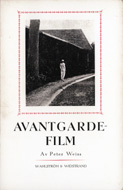
A photo of "Rotary Demisphere," 1925, S 409. The work is currently at the MoMA. Photos of three of Duchamp's "Rotoreliefs," 1935, S 441. 1956 In his book, pages 21-40, Peter Weiss has a chapter about the avant-garde
films in the 1920s. Included are Marcel Duchamp´s "Anemic Cinéma,"
1927, and his roll in René Clair´s "Entr' acte," 1924, in the famous
chess party scene with Man Ray on a Paris rooftop. The text is illustrated
with that scene and stills from Duchamp's own film. (37 b)
|
|
|
|
|
|
Click to enlarge |
||||
 |
||||
|
37b. Avangardefilm, 1956 |
||||
|
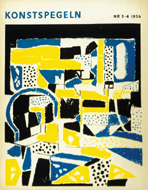
1956 Konstspegeln no. 3-4
This is a small and local art magazine published in the south of Sweden.
In no. 3-4 Max Walter Svanberg writes about The Magic Art. He
mentions the Dadaist, Duchamp. The article is illustrated with "The
King and Queen Traversed by Nudes at High Speed" S 246 a, which is now
at the PMA. In a special caption Svanberg makes the following remark,
"Duchamp, is one of the most important and innovative artists according
to the new direction of art, which in this article is called "the non
geometrical abstractions." (38)
|
|
|
|||||||||||||||||||||||||||||||||||||||||||||
|
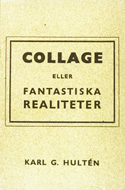
1958 KASARK no. 3. Maj 58. In this issue, K.G.H. (Pontus Hultén) writes about collage or fantastic realities. On
page 8, he points out that Duchamp used chance to create "3 Stoppages Étalon," S 282. It is now at the MoMA. (39) 1959 Konstrevy no. 3 In his review "Utställningar i Stockholm, Mars - April" (Exhibitions in
Stockholm March-April) Eugen Wretholm, mentions that Öyvind Fahlström uses chance similarly to Duchamp. This is probably the first time Duchamp's influence on other artists is mentioned in Sweden. (40) |
|
|
|||||||||||||||||||||||||||||||||||||||||||||
|
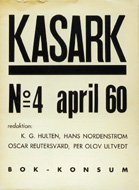
1960 KASARK no. 4. April, 1960. This issue was published about the exhibition "Edition MAT" (Daniel Spoerri) at
Bokkonsum in Stockholm, April 1960. (41)
Even in this issue, K.G.H. (Pontus Hultén) writes about Duchamp. The
headline reads: "A Work of Art has No Price," and continues to quote
Duchamp, "Modern art looks for its Gutenberg." Duchamp is presented
as a, "Painter, poet, chess player, and a forerunner within Dadaism,
Surrealism and kinetic art. In 1936, Duchamp exhibited his Rotoreliefs
at the inventor's exposition in Paris. Born in Blainville, France."
(See entry).
1960 Konstrevy no. 3 Eugen Wretholm writes about the exhibition at Bokkonsum, which he calls "Dadaistica." He mentions Marcel Duchamp and
reproduces his Rotoreliefs placed on the pavement in front of the gallery together with other items from Edition MAT. 1960 Bokkonsum
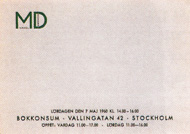
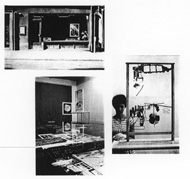
Saturday May 7, 1960, Bokkonsum opened an exhibition with some replicas
of Marcel Duchamp's readymades made by Per Olof Ultvedt and Ulf Linde
(38). In Das gedruckte Museum von Hulten, 1996, page 83,
the circumstances of this exhibition are described. Linde describes
the event quite differently in his book Marcel Duchamp, 1986.
Page 10 of Marcel Duchamp contains a reproduction of the announcement
card from Bokkonsum's exhibit and other photographs taken on the occasion
(42). In one, of the shop-window, there is a large copy of Eliot
Elisofon's photo from Life Magazine, April, 1952, of "Duchamp descending
a staircase," a paraphrase of his painting "Nude Descending a Staircase."
The same photograph was later used as the cover of the revised edition
of Robert Lebel's monograph Marcel Duchamp, published by Paragraphic
Books, Grossman Publishers, New York, 1967. In that edition, Lebel extended
his catalogue raisonné with little information about Duchamp's appearances
in Sweden.
The book also depicts Ulf
Linde's version of the "Bicycle Wheel," 1960, S 278 c, now at the MMS. "Fresh Widow," S 376, was made by a carpenter on Linde's request and was later acknowledged and signed by Duchamp "pour copie conforme Marcel."
This version is now in the collection of the MMS. In his book from 1986, Linde calls it a readymade, but according to Schwarz, it is not. You can also see the "Chocolate Grinder, No. 2," 1914, S 291. Additionally, there is a small version of "The Large Glass," which Linde says, "happily disappeared."
In the Bokkonsum's show was also "Bottle Rack" which Daniel Spoerri had purchased at Bazaar l' Hotel de Ville in Paris, and lent to the show. This copy is not mentioned in Schwarz. |
|
|
|||||||||||||||||||||||||||||||||||||||||||||
|
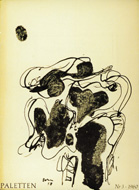
1960 Paletten, no. 3
On page 91, they publish Marcel Duchamp's The Creative Act, translated
by Folke Edwards, the chief editor. This lecture was given by Duchamp
at the Convention of the American Federation of Arts in Houston, April,
1957. On page 99 of the same issue, there is additional information
about Duchamp as a contributor to this issue. (43)
1960
Spejare by Ulf Linde
Linde's book Spejare (Searcher) (See 11) was one of the catalysts
of the great artistic debate in Sweden later named "Är allting konst?"
(Is everything art?). Perhaps it was one of Linde's statements that
awoke the most anger among artists and members of The Royal Academy
of Arts, for Linde stressed Duchamp's opinion that it is the viewer
who creates the work. Duchamp's opinion was already released in 1957
in his lecture The Creative Act.
Rabbe Enckell, chairman of the Royal Academy of Arts, actually started
Sweden's notorious art debate. He delivered a speech entitled, "Ikaros
och lindansare, ett försvar för klassisismen, (Ikaros and Ropewalkers,
a Defence for the Classicism)" to the academy on May 30, 1962. Thereby
dissociating himself and the academy from the tendencies that he felt
threatening to the order of art. This huge debate was later published
in book called Är allting konst? (Is everything art?),Stockholm,
1963, with Duchamp's "Bottle Dryer [Bottlerack]," on the cover.
It was not only Linde's book that caused this violent turbulence in
the Swedish art world. There were other art events, which in the beginning
of the 1960s contributed to the debate. A specific catalyst was
the purchase of Brancusi's "Le Nouveaux-né," 1961 from Rolf de Marée
by the Moderna Museet in Stockholm, for the total of a 161,000 Swedish
crowns. In 1961, this was considered an exorbitant amount for a modern
artwork, and many thought that it was an excessive waste of museum funds.
Art in Motion and Four Americans
In 1961 K.G. Hultén, Carlo Derkert, Daniel Spoerri, and Billy Klüver
opened one of the most important exhibition at the Moderna Museet called
"Art in Motion," from May 17th to September 3rd. Realizing
that the exhibition would be a shock to the Swedish art public, it was
first shown at the Stedelijk Museum in Amsterdam from March 10th
to April 17th. It was also shown at Louisiana, Humblebaeck, Denmark
from September 22nd until October 22nd, 1961. (See
Moderna Museet Stockholm 1958-1983, page 36, (See 4))
I can personally remember what a debacle it was when the Moderna Museet
presented "4 Americans" in March of 1962. Robert Rauschenberg's works
created a scandal especially his "Monogram," a longhaired goat with
a painted face and a tire around his stomach. "The Bed," a painted bed
with cushion, sheets and a quilt hanging on the wall, raised the question
if it could even be considered art.
It was during these two exhibitions that Linde's concept of the viewer's
role gained its breakthrough, aided by the controversial publicity the
shows had received. The issues were related. It was not odd that the
conservative public and art critiques and artists were terrified, for,
in a way, they had become obsolete.
1961
Öyvind Fahlström writes a review about Ulf Linde's Spejare,
1961.
"The central point in 'Spejare' is the analyses of Marcel Duchamp's
large painting, [The Large Glass], which for the first time here is
given the proper importance [compared with the confusion in connection
with Duchamp's exhibition at Konstsalongen, (Bokkonsum), Vallingatan.]
'Spejare' is the most stimulating and beautifully written book in Swedish
which I have read."
1961
Rörelse i konsten, Moderna Museet, Stockholm 17 May -3 September, 1961,
catalogue
This exhibition is one of the most important shows organized in the
twentieth century (see 4). The committee consisted of
K.G. Hultén, (Pontus Hultén), Carlo Derkert, and Daniel Spoerri and
from the U.S.A., Billy Klüver. Pontus Hultén was editor of the catalogue
in which he writes in the introduction,
"Contemporary art is often pessimistic, defeatist and passive; completely
natural, one can say. But there is also an another kind of art. That is
what this exhibition wants to show [dynamic, constructive, full of joy,
confusing, ironical, humorous, aggressive]. It is probably even typical
for our time.
"The 19th century exhibitions were visited by the same curious
and interested masses of spectators that are currently visiting the
motor shows. But will they, in the end, find what they are looking for?
Apollinaire wrote in 1913, according to Marcel Duchamp, that only an
art which is liberated from aesthetic concerns and which deals with
energy as a pictorial material, can hope to 're-unite the Art and the
People.'
"The camera is the machine to take a picture with, and is available
to everyone. But there are other art machines, perhaps more independent,
which also talk to us and tell us who we are. They appear in many forms
and materials, sometimes they look like scientific research or camouflage
themselves as toys.
"Kinetic art has, during the twentieth century, been
developing in many different ways, at least equal in varying forms to
static art. To use the physical movement as an instrument of expression
gives it a freedom, which art has been trying to attain for a long time...
K.G. Hultén"
In the catalogue, there is a short dictionary about the artists working
with kinetic art. The biographical note about Marcel Duchamp, mentions
his first two readymades, "Pharmacy," S 283 and "Flaskstället" ("Bottle
Dryer ([Bottlerack]," 1914, S 306). (Refer to the below entry about
Duchamp's works in the exhibition.)
The catalogue quotes Duchamp, "I did not stop painting in order
to play chess. That is a myth. It is always like that. Because someone
begins to paint it does not mean that he must continue with that. He
is not even forced to stop. He just does not do it any more, in the
same way that you do not make omelets any longer, if you prefer meat.
I do not think that it is necessary to classify people and, above all,
treat painting as a profession. I do not understand why people try to
do painters of civil servants and civil servants of the ministry of
the fine arts. There are those who get medals, and those, who paint."
There is also a short review about the history of kinetic art in the
20th century by K.G. Hultén. He begins with futurists artists,
continues with Marcel Duchamp's "Coffee Mill," 1911, and ends the Duchamp
presentation with his "Rotoreliefs" made in 1936.
Nine of Duchamp's important kinetic works were shown at "Art in Motion"
in addition to "Boite-en-valise" which was represented at the show.
Therefore one can say that all of Duchamp's major works were present.
For in fact, "Boite-en-Valise" represents a retrospective exhibition
in a small suitcase. That was the first time Duchamp's works were presented
to a larger public in Sweden, perhaps for the first time in the world,
without being related to Cubism, Futurism, Dadaism, and Surrealism.
If this was actually his major breakthrough in the context of Swedish
art, is yet to be decided. Though he did become absolutely accepted
by the institutional art world at that time, his standing today is another
question.
Works by Duchamp in the exhibition:
"Cykelhjulet," 1913, reconstruction, ("Bicycle Wheel"), S 278c.
"Chokladkvarn, No. 2," 1914 ("Chocolate Grinder No. 2"), S 291.
"Naken går nedför en trappa, No. 3," 1916 ("Nude Descending a Staircase,
No. 3"), S 343.
"Bruden avklädd t.o.m. av sina ungkarlar," 1915-23, reconstruction,
1961 ("The Bride Stripped Bare by Her Bachelors, Even [The Large Glass]"),
S 404.
"Rotary Glass Plaques (Optique de Precision)," 1920, reconstruction,
1960 ("Rotary Glass Plates [Precision Optics]"), S 379.
"Demisphère Rotative (Optique de Precision)," 1925 ("Rotary Demisphere
[Precision Optics]"), S 409.
"Skivor med ordspråk," 1926 ("Anemic Cinema: Disks Inscribed with Puns"),
S 415-23.
"Dörren i 11, rue Larrey," Paris, 1927, reconstruction, 1960 ("Door:
11, rue Larrey"), S 426.
"12 Rotoreliefer," 1935 ("Rotoreliefs [Optical Disks]"), S 441.
"Boite-en-Valise," (From or by Marcel Duchamp or Rrose Sélavy ["The
Box in Valise"], 1935-41), S 484.
For the exhibition "Rörelse i konsten" ("Art in Motion") in Amsterdam
and Stockholm, Pontus Hultén, Per Olof Ultvedt and Magnus Wibom made
a replica of "Rotary Glass Plates (Precision Optics)," S 379. Hultén
and Daniel Spoerri made a replica of "Door: 11 rue Larrey," S 426. It
was destroyed after the exhibitions. (See 4)
1961
Konstrevy, no. 3
On page 99, is an article about "Art in Movement" at the Moderna Museet,
illustrated with a photo of Duchamp visiting Iris Clert's gallery in
Paris.
In Eugen Wretholm's review "Utställningar i Stockholm" (Exhibitions
in Stockholm), page 112, Duchamp's "Fountain" and "Bottle Dryer [Bottlerack]"
are mentioned. You can also find Umbro Apolloninos' article "The Inner
Movement" where he refers to Duchamp and uses "Nude Descending a Staircase"
as an illustration.
1961
Konstrevy no. 4
Eugen Wretholm writes about "Art in Motion" once again, where he mentions
Duchamp's "Nu Descendant un Escalier." He remarks that the
exhibition originated in Paris as "Le Mouvement" at Denis René by K.G.
Hultén and refers to his text about "Art in Motion" in KASARK
3, October, 1955.
1961
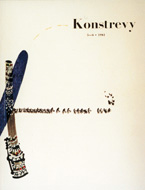
Konstrevy, no. 5-6
Ulf Linde writes the essay Framför och bakom glaset (In front
of and behind the glass) pages 162-165 (44). This is an important
article about Duchamp's "The Large Glass". It is illustrated with six
photographs taken of the assembling of Linde's first reconstruction
of "The Large Glass" together with Duchamp. The essay is a partial interview
with Duchamp.
The other illustrations are:
Marcel Duchamp photographed as a woman by Man Ray. The correct title
as listed in Schwarz's text is "Marcel Duchamp as Belle Halleine," photo
Man Ray, 1921, S 385.
"Chocolate Grinder no. 2." S 291.
"The Bride Stripped Bare by Her Bachelors, Even," S 404, 1915-1923.
Currently, it is at the PMA.
Page out of "Boite Verte, The Green Box." A box containing 93 notes,
drawings, photographs, and/or facsimiles by Duchamp housed in a green-flocked
cardboard box, 1934, S 435.
On pages 224-227, Öyvind Fahlström writes about "The Art of Assemblage"
at the Museum of Modern Art, New York, and he mentions Duchamp's last
painting "Tu m´," S 354. The work is currently at the Yale University
Art Gallery. His article is illustrated with the version of "Bottle
Dryer [Bottlerack]" on a table, photographed by Man Ray and sent in
by Duchamp to the Museum of Modern Art exhibition, 1936-37.
|
|
|
|||||||||||||||||||||||||||||||||||||||||||||
|
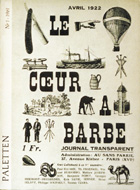
1961 Paletten, no. 1 Paletten no. 1, 1961, published an article Marcel Duchamp: Anti-Artist by
Harriet and Sidney Janis and translated by Folke Edwards, chief editor. (45) This article is richly illustrated with major works from Duchamp's production. "Bride," 1912, S 253. "Coffee Mill," 1911, S 237.
"Rotoreliefs," 1935, S 441. "Bicycle Wheel," 1916, (1913), S 278. "Marcel Duchamp," portrait by Man Ray, 1920, or "Marcel Duchamp as Belle Haleine," S 385.
"L.H.Q.O.Q." 1919. The correct title is "L.H.O.O.Q., 1919, Paris,"
S 369.
"Bachelors," 1914. Properly titled "Nine Malic Moulds," S 328. It is hard to see which version it is because the editor has only reproduced a part
of the original. It seems to be the original version that Duchamp had made in 1914. "The King and Queen Traversed by Nudes at High Speed," 1912, S 246. "Nude Descending a Staircase, No. 2," 1912, S 242. "Bottle Dryer
[Bottlerack]," 1914, S 306. This photograph is another version taken by Man Ray in 1936. It has both a shadow and a white reflection below its base. The photograph appears to have been retouched.
"Trois Stoppages Étalon (3 Standard Stoppages)," 1913-14, S 282.
"La Mariée mise a nu ses clélibataires, meme," 1914-1923, S 404. The
cracked version in Katherine S. Dreier's home.
"Fresh Widow," 1920, S 376.
"Tu m´," 1918, S 354. "Roterande glasplattor (Precisionsoptik)," 1920. The correct title is "Rotating Glass Plates (Precision Optics)," S 379. "Chocolate Grinder No.1," 1913, S 264. 1961 Paletten, no. 2
In this issue Elisabet Hermodsson, artist and poet, refers to Linde's book Spejare. Her contribution is titled "Critics as a Benefit Moralist" and she quotes Linde: "By itself nothing is art. First you have to call it
art, see it as a work of art."
Linde replies in the same issue in his discussion of Duchamp's readymade
"Why not sneeze". He writes, "You have to do something with
the art work, that it could 'be' art." Hermodsson's reaction
was typical among the conservative artists in Sweden who were afraid
of losing their territory within the art world.
The editor, Folke Edwards comments on the exhibition "Art in Motion."
He notes that many of the pioneers of kinetic art participated in the
exhibition and considers Duchamp a representative for Futurism, Constructivism,
and Dadaism.
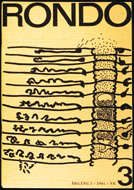
1961 Rondo no. 3
Öyvind Fahlström comments on Duchamp's "SurcenSur" and notes that "Duchamp has, as usual, done it before," page 27. (46) |
|
|
|
|
|
|
|
|
|
|
|
|
|
Click to enlarge |
|||||||||||
 |
|||||||||||
|
46. Rondo no. 3 1961. |
|||||||||||
|
1961 Paletten no. 3
Torsten Andersson, the painter, contributes the article One Price
Store Culture or Artistic Dictatorship. He writes "In the shadow
of Duchamps... I don't stop any man in the world by presenting a 'Bottle
Dryer [Bottlerack]' or let the public fire a pistol."
1962
Konstrevy no. 1
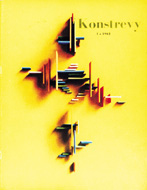
In this issue, Linde begins to present his translation of Duchamp's
notes on "The Large Glass", S 404. The notes 1-11 are published and
are illustrated with sketches from the "Green Box." S 435. (47)
|
|||||||||||
|
Click to enlarge |
|||||||||||
 |
|||||||||||
|
47. Konstrevy no. 1, 1962. In this issue, Ulf Linde begins his translation of notes from "The Green Box". |
|||||||||||